Skip to content

archived edition · 2026-09-12

PaperraftFind the AI research
worth testing.

Understand what a paper changes, what it costs, and whether it fits your next build. Explore research on faster LLM inference, agent memory, and evaluation, with the original sources in reach.

Start with a brief. Follow the evidence. Choose a test.

edition
2026-09-12
briefs
61
research areas
14
independent implementations
43

49 of 61 papers in the index (80%) have no independent implementations.

Research index

Search by topic, browse a research area, or sort by date. Read a brief, open the original paper, and inspect the available evidence before deciding what to test.

showing30 of 61
sort by
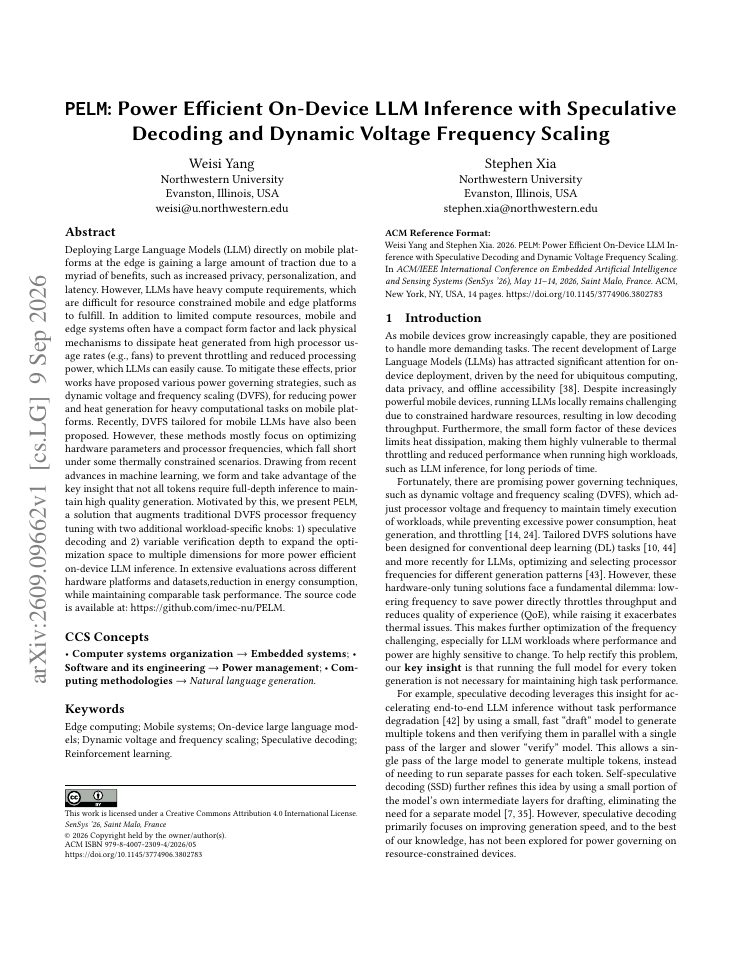
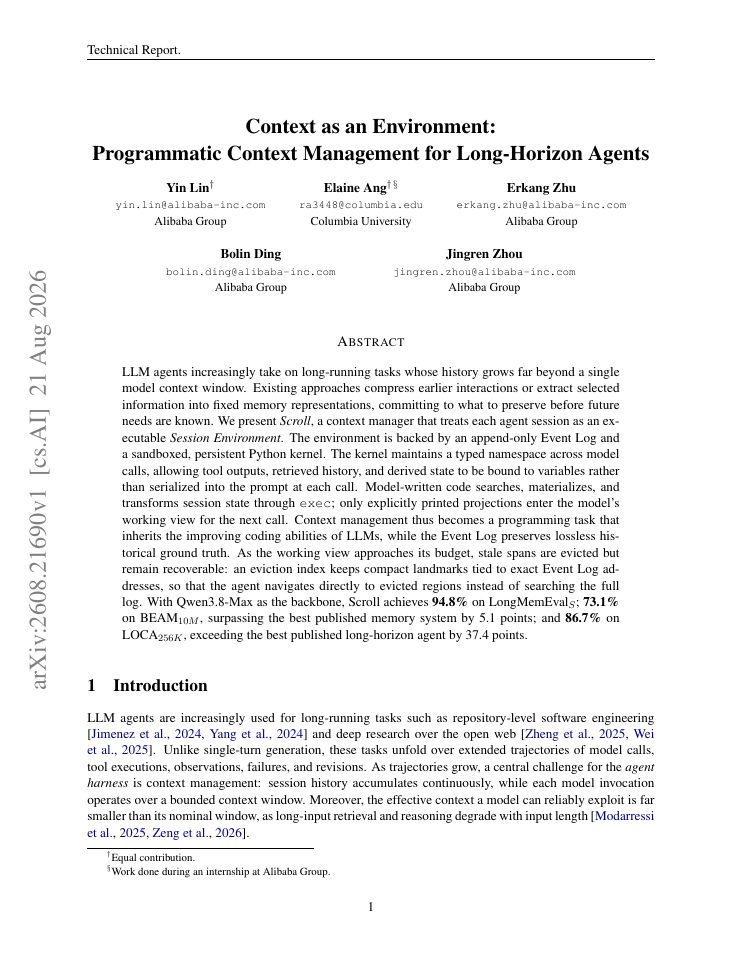
First page of Context as an Environment: Programmatic Context Management for Long-Horizon Agents
memory and contexttest

Context as an Environment: Programmatic Context Management for Long-Horizon Agents

Scroll replaces prompt-side history compression and fixed memory representations with an append-only event log plus a persistent sandboxed Python kernel, where the model writes code to search and materialize state and only printed projections enter the working context. It costs engineering effort to build and sandbox the kernel and eviction index, adds code-execution latency per turn, and its reported results depend on a strong proprietary backbone. It can fail if the model writes faulty state-management code, if eviction landmarks mislead retrieval of evicted regions, or if sandboxing is insufficient against unsafe exec output.

observed signal
5impl.
2stars
0citations
—claimed gain
abstract onlyReview decisionDownload skill ↓Original paper ↗
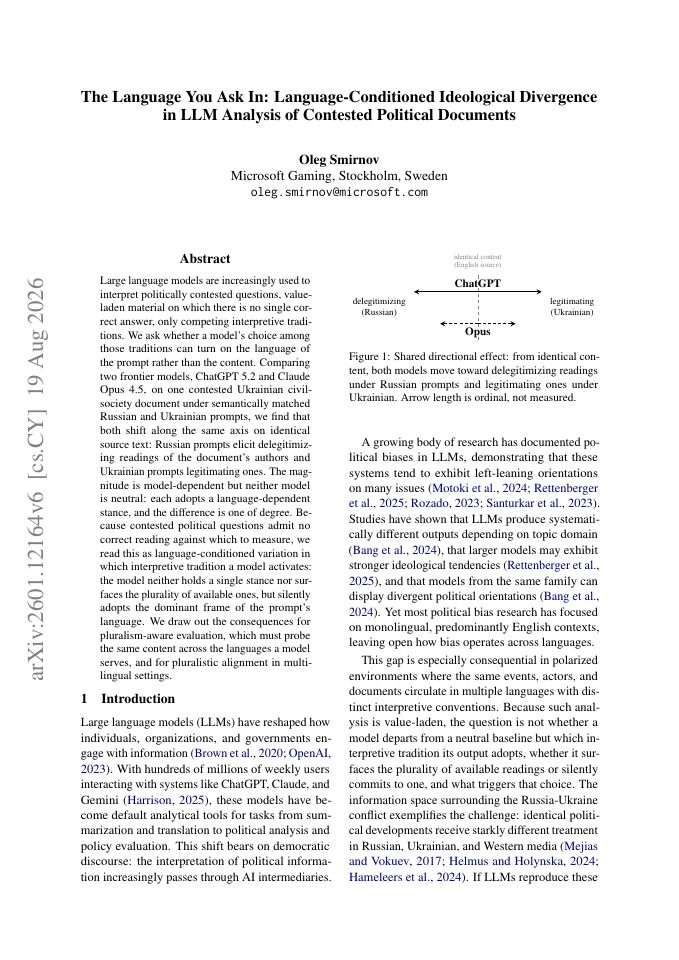
First page of The Language You Ask In: Language-Conditioned Ideological Divergence in LLM Analysis of Contested Political Documents
agent evaluationtest

The Language You Ask In: Language-Conditioned Ideological Divergence in LLM Analysis of Contested Political Documents

Replaces single-language neutrality evaluation with semantically paired prompts in different languages. It needs paired prompts and extra API calls, with human interpretation because contested questions lack a definitive answer key. The study reports that ChatGPT 5.2 and Claude Opus 4.5 adopt the prompt language's dominant framing, but examines a single Ukrainian document and does not establish generalization to other language pairs or topics.

observed signal
2impl.
0stars
0citations
—claimed gain
abstract onlyReview decisionDownload skill ↓Original paper ↗
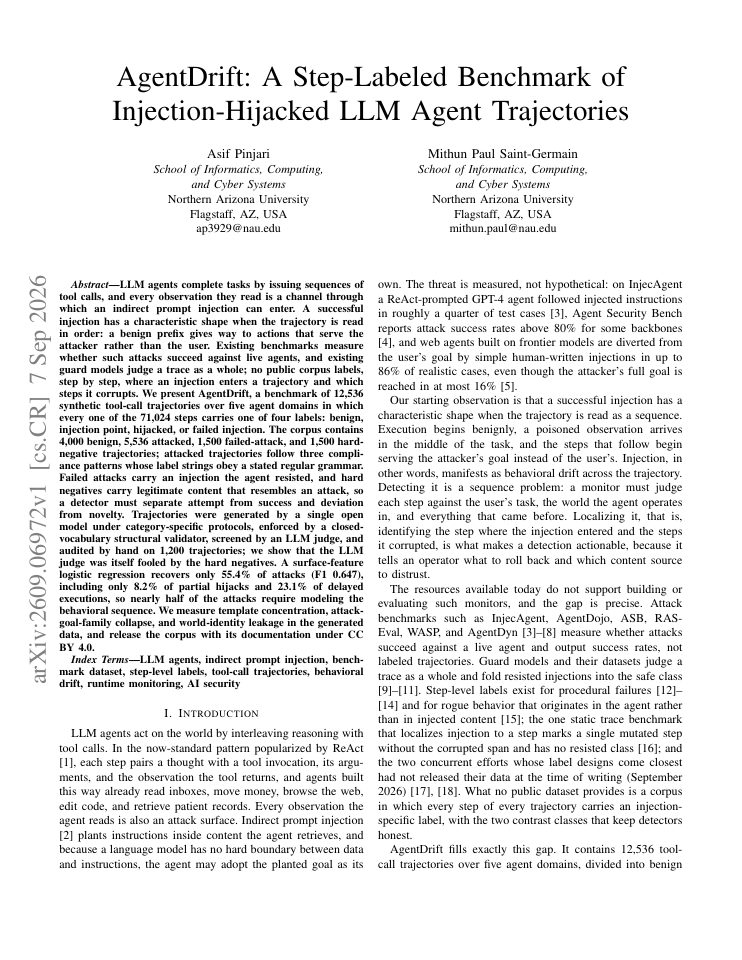
First page of AgentDrift: A Step-Labeled Benchmark of Injection-Hijacked LLM Agent Trajectories
safety and guardrailstest

AgentDrift: A Step-Labeled Benchmark of Injection-Hijacked LLM Agent Trajectories

AgentDrift replaces whole-trace guard judgments and attack-success-only benchmarks with a step-labeled corpus (12,536 trajectories, 71,024 steps labeled benign, injection point, hijacked, or failed injection) for training and evaluating detectors of indirect prompt injection in tool-call trajectories. Adoption costs the integration of an offline evaluation harness against one's own agent traces plus detector development, since the paper provides data and a weak baseline rather than a deployable guard model. Key failure risks include domain mismatch with the five covered domains, synthetic-data artifacts the authors themselves document (template concentration, attack-goal-family collapse, world-identity leakage, an LLM judge fooled by hard negatives), and reduced validity against adaptive attackers once the corpus is public.

observed signal
4impl.
2stars
0citations
—claimed gain
source mappedReview evidenceDownload skill ↓Original paper ↗
First page of Procedural Graphs: Self-Evolving Execution Structures for LLM Agents
memory and contexttest

Procedural Graphs: Self-Evolving Execution Structures for LLM Agents

Replaces unconstrained next-action generation over an accumulating trajectory with an evolving (procedure, relation, procedure) graph that a guidance model turns into step-level hints biasing, but not dictating, the agent's next action. Costs an extra guidance-model call per decision step plus LLM-refiner passes that contrast failed and successful trajectories to edit the graph against a held-out validation set, adding orchestration complexity and API spend. Can fail if validation sets are small or unrepresentative, letting the refiner overfit graph edits, or if localization of the active node is wrong on long trajectories, injecting misleading guidance; the abstract reports only qualitative 'consistent gains' with no quantified improvement, so the benefit is unverified for any specific workload.

observed signal
5impl.
6stars
0citations
—claimed gain
abstract onlyReview decisionDownload skill ↓Original paper ↗
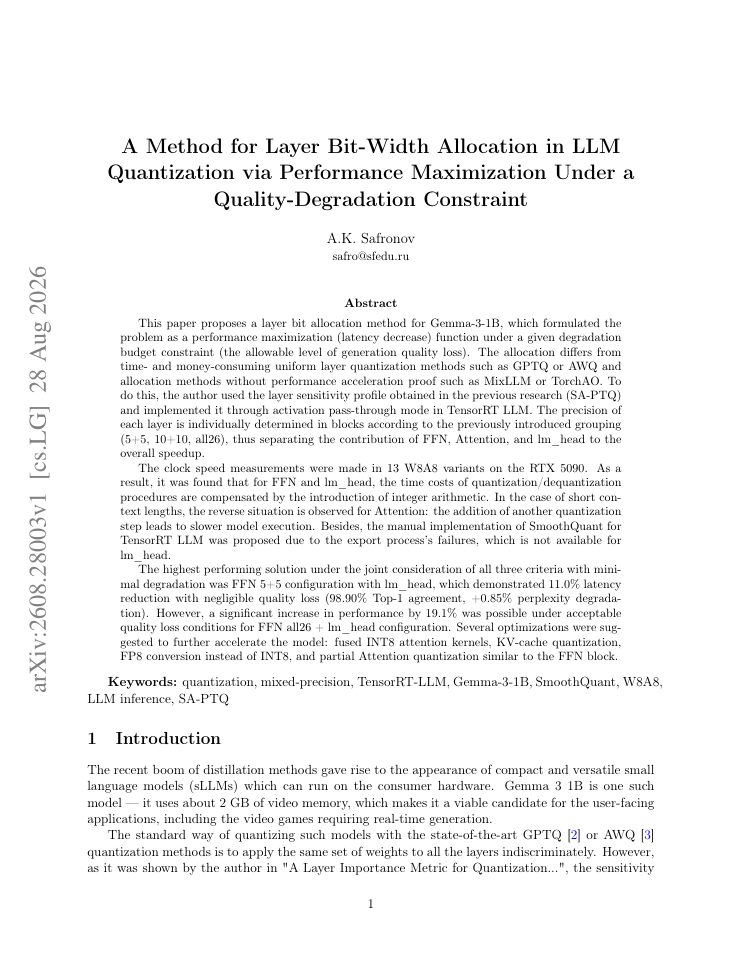
First page of AsymSpec: Context-Asymmetric Speculative Decoding for Agentic LLMs
speculative decodingtest

AsymSpec: Context-Asymmetric Speculative Decoding for Agentic LLMs

AsymSpec replaces the standard lossy choice between input compression and full-context inference by letting a lightweight drafter read the full input while the large verifier generates against a compressed view, fusing their logits with a contrastive delta-fusion and a divergence-aware acceptance gate. The cost is running two models (drafter plus verifier) with dual context representations and a non-standard decoding loop, which increases memory footprint and implementation complexity relative to plain compression or off-the-shelf speculative decoding served through third-party APIs. It can fail when the divergence gate misjudges draft reliability, collapsing acceptance rates and erasing the speedup, and the reported gains are on isolated capabilities and two benchmarks, so end-to-end agentic workloads with heavy tool-call branching may see smaller benefits.

observed signal
2impl.
1stars
0citations
1.7xclaimed gain
abstract onlyReview decisionDownload skill ↓Original paper ↗
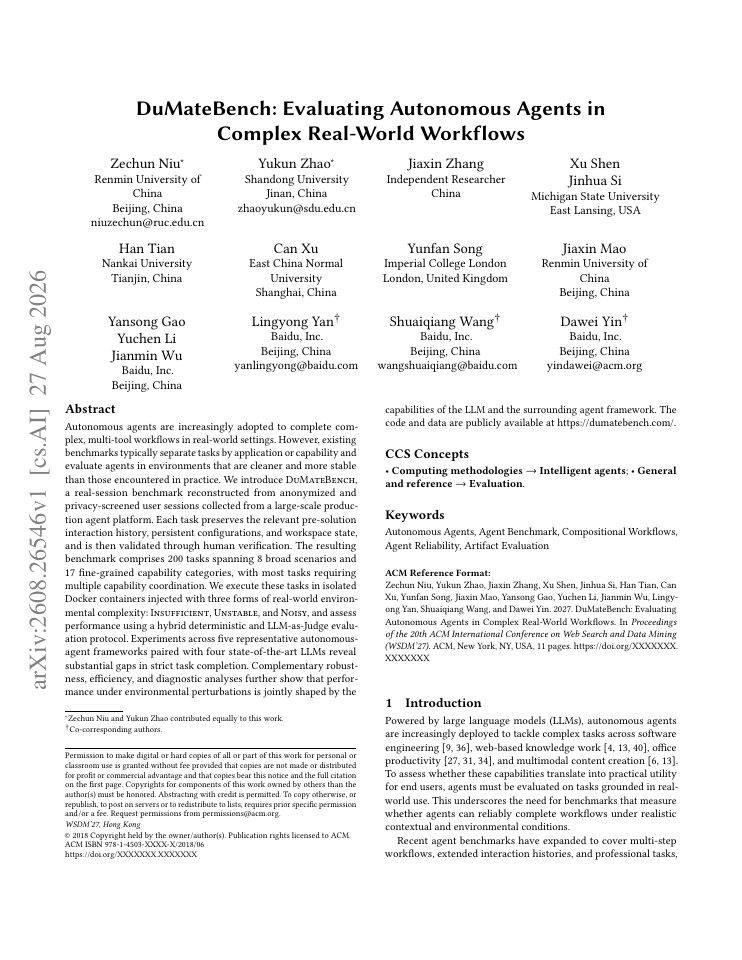
First page of DuMateBench: Evaluating Autonomous Agents in Complex Real-World Workflows
agent evaluationtest

DuMateBench: Evaluating Autonomous Agents in Complex Real-World Workflows

DuMateBench replaces clean, capability-isolated agent benchmarks with 200 tasks reconstructed from production user sessions, run in Docker containers with insufficient, unstable, and noisy environment conditions. Adopting it costs engineering time to set up the containerized harness, LLM-as-Judge API calls for scoring, and compute for multi-framework, multi-model evaluation runs. It can fail if the benchmark's tasks do not match the reader's actual production workload, if LLM-judge scoring is inconsistent for their domain, or if teams over-optimize framework choices to the benchmark rather than to their own telemetry.

observed signal
2impl.
6stars
0citations
—claimed gain
abstract onlyReview decisionDownload skill ↓Original paper ↗
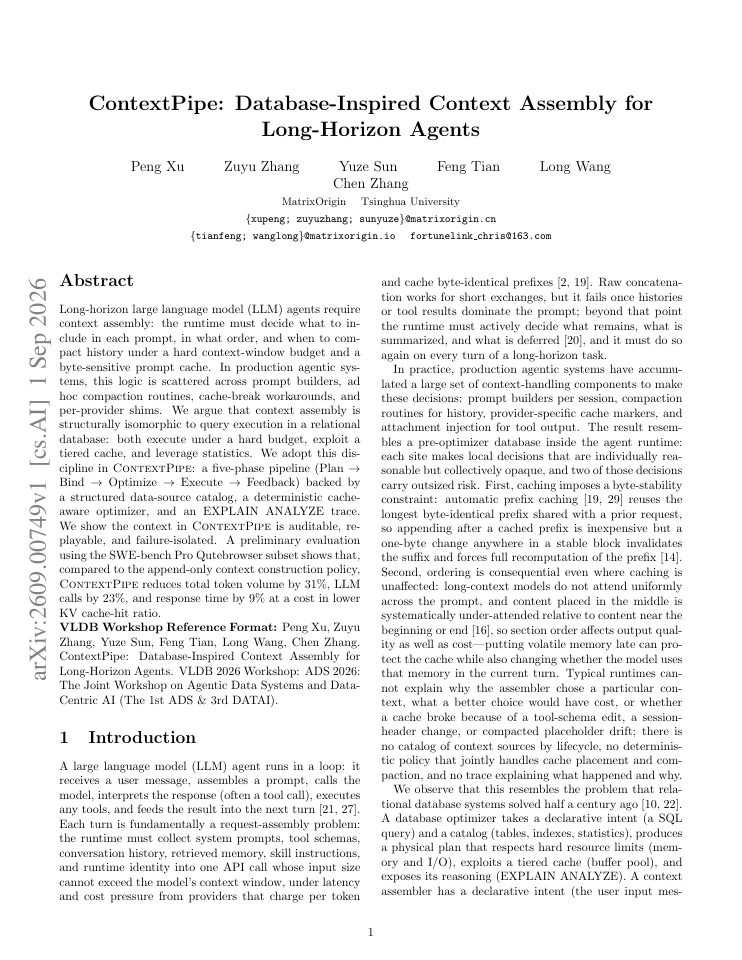
First page of ContextPipe: Database-Inspired Context Assembly for Long-Horizon Agents
memory and contexttest

ContextPipe: Database-Inspired Context Assembly for Long-Horizon Agents

It replaces ad hoc prompt builders, scattered compaction routines, and per-provider cache workarounds with a unified five-phase pipeline (Plan, Bind, Optimize, Execute, Feedback) featuring a structured data-source catalog, a deterministic cache-aware optimizer, and an EXPLAIN ANALYZE trace for auditability and replay. The cost is substantial engineering complexity: the team must implement and maintain the catalog, optimizer, and tracing infrastructure, and the method measurably degrades the KV cache-hit ratio, which can erode token savings on byte-sensitive prompt-caching providers. It can fail if the optimizer's statistics or compaction decisions drop task-relevant history on long-horizon tasks, and the evidence base is a single preliminary evaluation on one benchmark subset, so gains may not transfer to the reader's workload.

observed signal
1impl.
26stars
0citations
1.45xclaimed gain
abstract onlyReview decisionDownload skill ↓Original paper ↗
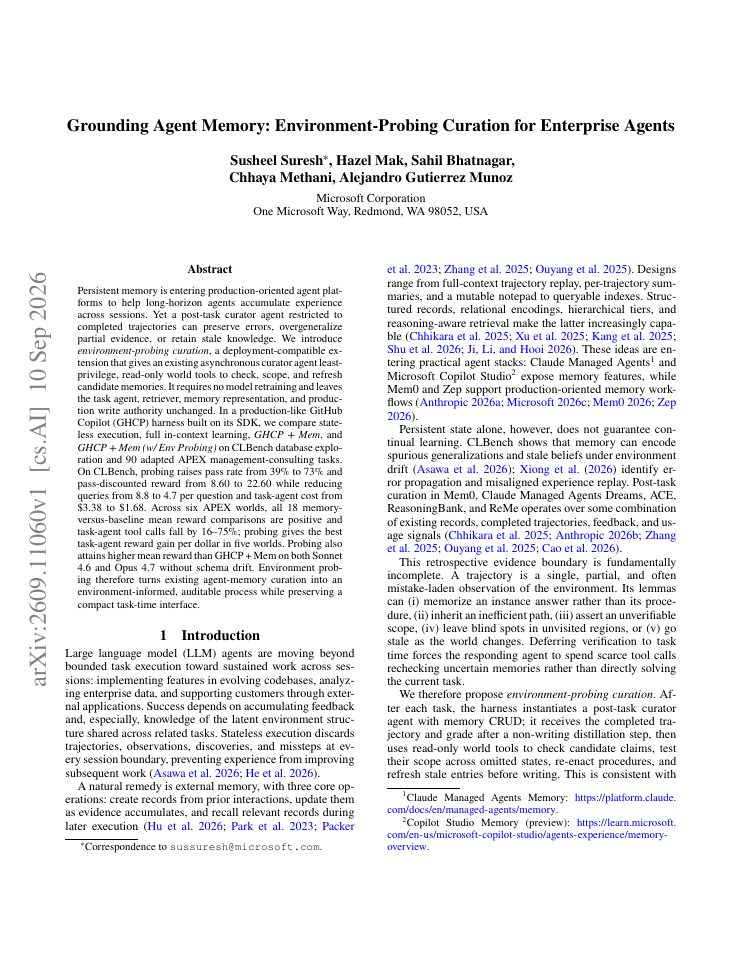
First page of Grounding Agent Memory: Environment-Probing Curation for Enterprise Agents
memory and contexttest

Grounding Agent Memory: Environment-Probing Curation for Enterprise Agents

The method replaces a post-task memory curator that works only from completed trajectories with one that has least-privilege, read-only environment tools to verify, scope, and refresh candidate memories, requiring no retraining and no changes to the task agent, retriever, or memory schema. Costs are an additional asynchronous curator stage with its own inference spend and tool-call latency, plus engineering effort to expose auditable read-only world tools; task-agent cost reportedly falls, but total pipeline cost rises. It can fail if probing tools return misleading or partial environment state, if read-only permissions are misconfigured into a security risk, and because results come from a single GHCP-based harness on database and consulting tasks, gains may not transfer to other agent stacks or domains.

observed signal
1impl.
13stars
—citations
1.87xclaimed gain
source mappedReview evidenceDownload skill ↓Original paper ↗
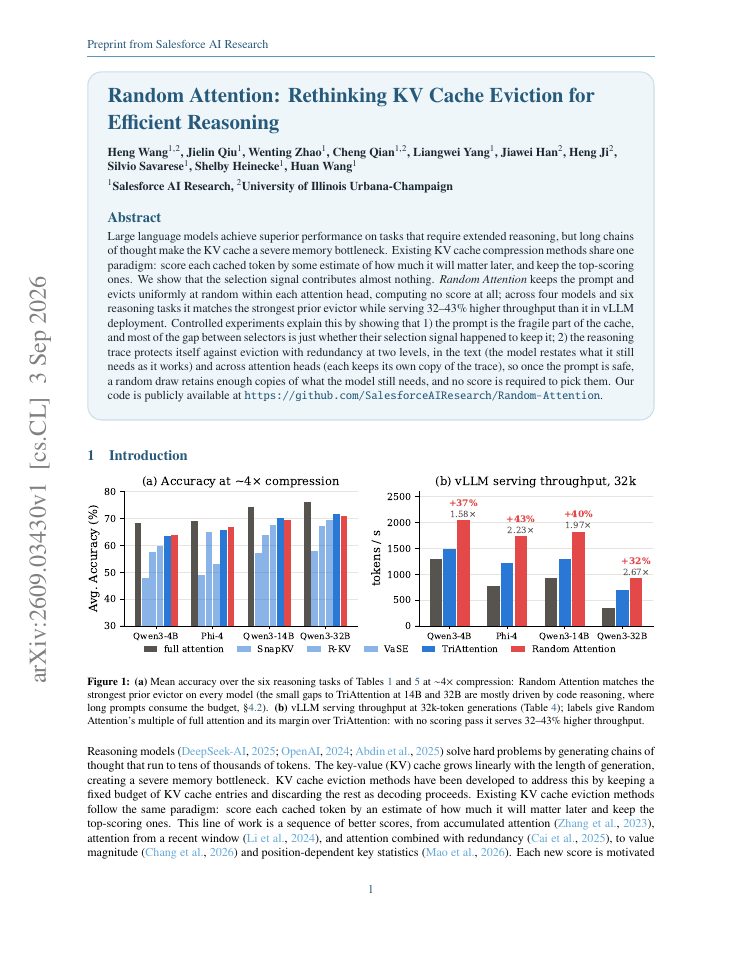
First page of Random Attention: Rethinking KV Cache Eviction for Efficient Reasoning
KV cacheadopt

Random Attention: Rethinking KV Cache Eviction for Efficient Reasoning

Random Attention replaces score-based KV cache eviction policies (such as H2O-style importance scoring) with uniform random eviction within each attention head, while always retaining the prompt, eliminating all per-token scoring computation. It costs nothing in memory or latency beyond the eviction itself and adds almost no implementation complexity, since the selection signal is removed entirely; quality is reported to match the best prior evictor on reasoning workloads. It can fail on workloads where the reasoning trace does not restate needed information or where redundancy across heads is insufficient, and on non-reasoning tasks or cache configurations where the prompt is not the dominant fragile component, since the findings are validated on reasoning traces with long chains of thought.

observed signal
1impl.
59stars
0citations
1.43xclaimed gain
abstract onlyReview decisionDownload skill ↓Original paper ↗
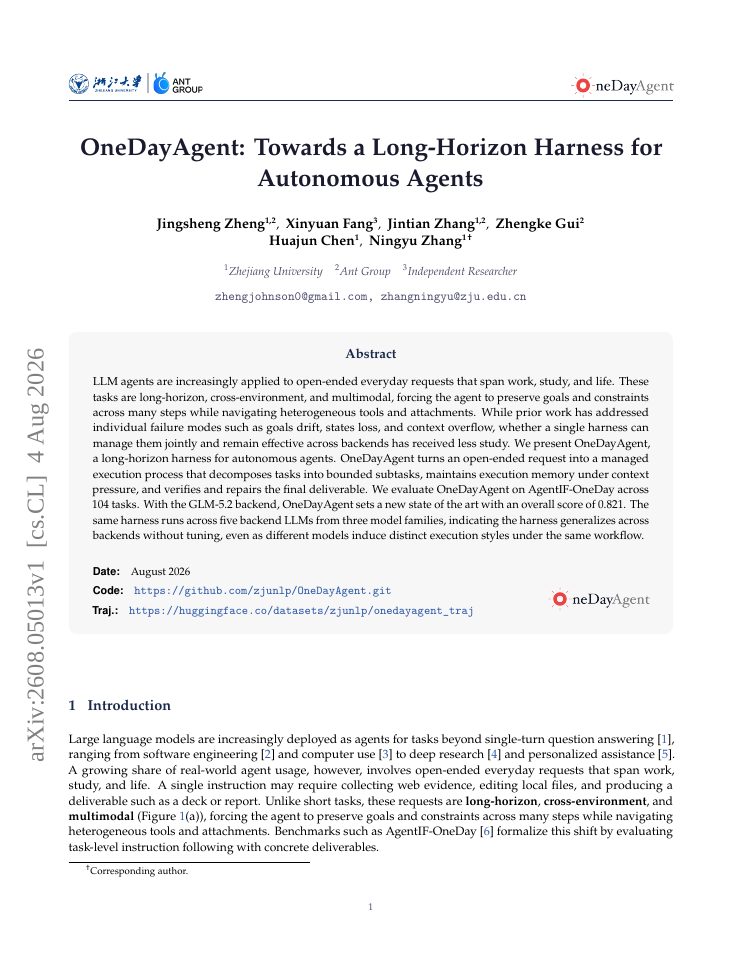
First page of OneDayAgent: Towards a Long-Horizon Harness for Autonomous Agents
planning and decompositiontest

OneDayAgent: Towards a Long-Horizon Harness for Autonomous Agents

OneDayAgent replaces ad hoc single-prompt or manually scripted agent loops with a managed execution process that decomposes open-ended requests into bounded subtasks, maintains execution memory under context pressure, and verifies and repairs the final deliverable. It costs additional orchestration complexity and extra backend calls for decomposition, memory management, and verification, which increases latency and API spend per task relative to a single-pass agent. It can fail if the backend model executes the prescribed workflow poorly, if decomposition produces incorrect subtask boundaries, or if the verifier accepts a flawed deliverable, and the reported score is specific to one benchmark whose tasks may not match the reader's production workload.

observed signal
1impl.
33stars
0citations
—claimed gain
abstract onlyReview decisionDownload skill ↓Original paper ↗
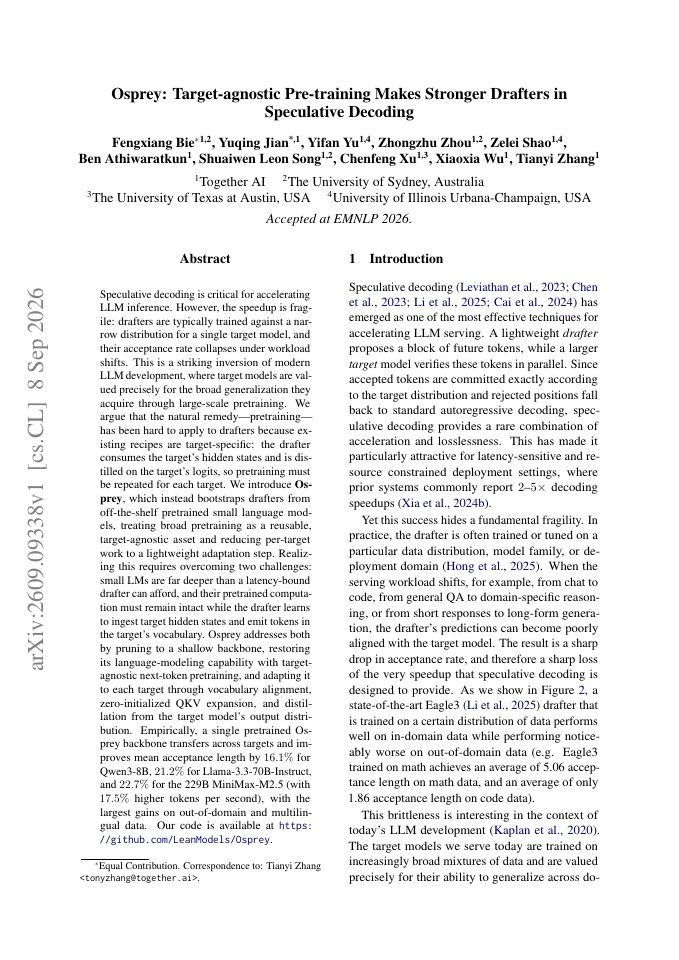
First page of OUTLETS: Output-Length Prediction from Speculative Decoding Backbones
serving and batchingwatch

OUTLETS: Output-Length Prediction from Speculative Decoding Backbones

OUTLETS replaces external proxy models and shallow state probes for output-length prediction with a lightweight regression head on representations already computed by an EAGLE-3-style speculative decoding draft model. Its cost is minimal at inference only if speculative decoding is already deployed; otherwise it requires training and serving a draft backbone plus the regression head, which negates the claimed efficiency. It can fail if the serving stack lacks speculative decoding, if request volume never saturates the scheduler (where length-aware scheduling yields nothing), or if length distributions drift from the training distribution, degrading prediction fidelity.

observed signal
1impl.
116stars
0citations
—claimed gain
abstract onlyReview decisionDownload skill ↓Original paper ↗
First page of HiKV: Hierarchical Importance-Aware KV Cache with Hardware Acceleration for LLM Decoding
KV cachewatch

HiKV: Hierarchical Importance-Aware KV Cache with Hardware Acceleration for LLM Decoding

HiKV replaces the full dense KV cache with a two-stage compressed cache that first evicts unimportant tokens and then retains only significant elements of kept tokens. The headline gains depend on a dedicated reconfigurable-sorter accelerator, so on commodity GPUs only the token-eviction stage is reproducible in software, with the added runtime cost of importance scoring and sorting per decode step. Importance estimation can evict tokens needed later in generation, degrading long-context recall, and the reported accuracy and speed figures are tied to the co-designed hardware rather than to off-the-shelf inference stacks.

observed signal
0impl.
0stars
0citations
7.95xclaimed gain
abstract onlyReview decisionDownload skill ↓Original paper ↗
First page of PIVOT: Efficient Query-Group Indexing for Token-Level Sparse Attention
attention and kernelswatch

PIVOT: Efficient Query-Group Indexing for Token-Level Sparse Attention

PIVOT replaces the per-query full-prefix scoring pass of the DeepSeek Sparse Attention indexer with a single shared scan per group of nearby queries, using a proxy query to build a candidate set from which each query selects its top-k; it is training-free and drop-in. The cost is an approximation risk controlled by group size and by the variant chosen: PIVOT-Reuse maximizes speed by sharing one top-k across the group, while PIVOT-Refine re-scores candidates per query at additional compute to match the dense indexer. It can fail when nearby queries actually need disjoint token sets (the overlap assumption breaks), when group formation interacts poorly with the MTP decode step, or on model stacks that do not expose a DSA-style indexer to modify.

observed signal
0impl.
2stars
0citations
4xclaimed gain
abstract onlyReview decisionDownload skill ↓Original paper ↗
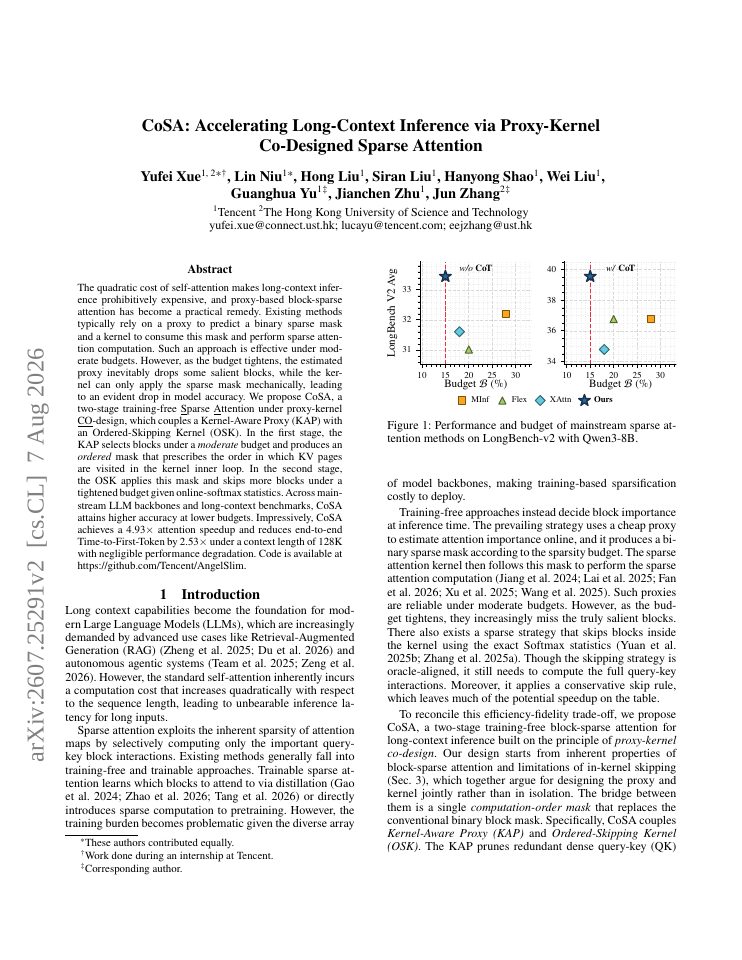
First page of CoSA: Accelerating Long-Context Inference via Proxy-Kernel Co-Designed Sparse Attention
attention and kernelstest

CoSA: Accelerating Long-Context Inference via Proxy-Kernel Co-Designed Sparse Attention

CoSA replaces dense self-attention (and prior two-stage proxy-mask sparse attention) with a kernel-aware proxy that orders KV page visits and an ordered-skipping kernel that drops additional blocks online using softmax statistics, all training-free. It costs integration of a custom attention kernel (distributed via Tencent AngelSlim), adds proxy-selection overhead per query, and requires no retraining or extra memory beyond standard paged KV cache. Under tight compute budgets the proxy can still drop salient blocks, and online skipping driven by softmax statistics risks compounding recall errors on workloads whose attention patterns differ from the evaluated benchmarks, so accuracy must be validated per model and task.

observed signal
0impl.
0stars
0citations
4.93xclaimed gain
abstract onlyReview decisionDownload skill ↓Original paper ↗
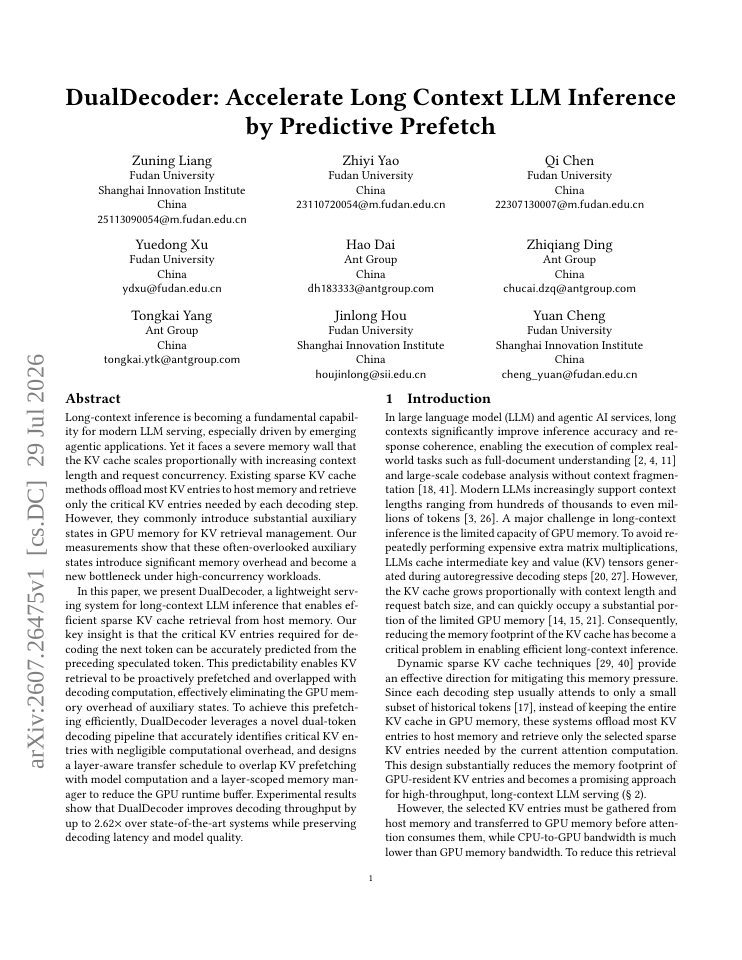
First page of DualDecoder: Accelerate Long Context LLM Inference by Predictive Prefetch
KV cachetest

DualDecoder: Accelerate Long Context LLM Inference by Predictive Prefetch

DualDecoder replaces existing sparse KV cache offloading systems (which keep large auxiliary retrieval-management states in GPU memory) by predicting the critical KV entries from the preceding speculated token and prefetching them from host memory via a dual-token decoding pipeline, layer-aware transfer schedule, and layer-scoped memory manager. The cost is added serving-stack complexity: a speculative decoding pipeline tightly coupled with PCIe transfer scheduling and custom memory management, with implementation effort that is non-trivial and not yet a standard library feature. It can fail if prefetch prediction accuracy degrades on workloads unlike the evaluated ones, if host-to-GPU bandwidth is insufficient to overlap transfers with compute, or if the auxiliary-state savings do not materialize at the reader's lower concurrency levels.

observed signal
0impl.
0stars
0citations
2.62xclaimed gain
abstract onlyReview decisionDownload skill ↓Original paper ↗
First page of Beyond KV Reconstruction: Functional Reconstruction for MLA Draft Models in Speculative Decoding
speculative decodingtest

Beyond KV Reconstruction: Functional Reconstruction for MLA Draft Models in Speculative Decoding

The method replaces direct low-rank MHA/GQA-to-MLA conversion for draft models with a post-conversion calibration procedure that fine-tunes each converted MLA attention module to reproduce the original module's post-output-projection output on calibration hidden states, without verifier logits or supervision. Its cost is an additional per-module optimization stage after conversion, while the converted MLA cache layout and inference graph are preserved, so no extra serving-time memory or latency is introduced. It can fail when acceptance gains do not materialize (26 of 64 cells unchanged, one degraded), when calibration hidden states are unrepresentative of the production workload, or when the reader's stack uses MHA/GQA drafts directly and the MLA conversion step itself is not warranted.

observed signal
0impl.
0stars
0citations
—claimed gain
abstract onlyReview decisionDownload skill ↓Original paper ↗
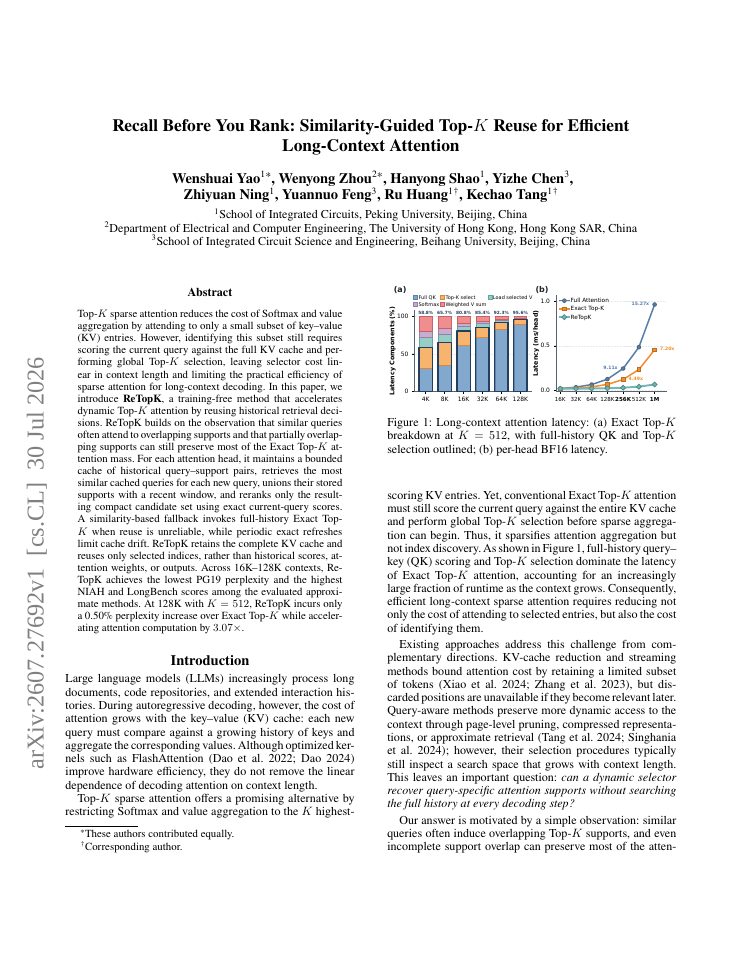
First page of Recall Before You Rank: Similarity-Guided Top-$K$ Reuse for Efficient Long-Context Attention
attention and kernelstest

Recall Before You Rank: Similarity-Guided Top-$K$ Reuse for Efficient Long-Context Attention

ReTopK replaces the per-token full-KV scoring and global Top-K selection step of dynamic sparse attention with a bounded per-head cache of historical query-support pairs: for each new query it retrieves similar cached queries, unions their supports with a recent window, and reranks only that compact candidate set with exact current-query scores, keeping the complete KV cache intact. The cost is extra memory for the query-support cache, the added complexity of similarity retrieval, similarity-based fallback to Exact Top-K, and periodic exact refreshes, plus the residual quality gap of approximate selection (0.50% perplexity increase at 128K, K=512). It can fail when query similarity does not predict support overlap, when the fallback triggers so often that the speedup vanishes, and because the reported gains cover only 16K-128K contexts on PG19/NIAH/LongBench and assume a Top-K attention stack already in production.

observed signal
0impl.
0stars
0citations
3.07xclaimed gain
abstract onlyReview decisionDownload skill ↓Original paper ↗
First page of A Sparse Glimpse of the Whole: Train-Free Self-Speculative Decoding
speculative decodingtest

A Sparse Glimpse of the Whole: Train-Free Self-Speculative Decoding

SparseSpec-L replaces standard autoregressive decoding (and separate-draft-model speculative decoding) by drafting tokens from the target model itself using a dynamically sparsified, recallable KV cache, with an entropy-based controller choosing speculation length. It costs additional implementation complexity in the inference stack: per-head attention statistics must be captured during verification, the KV cache manager must support recall rather than permanent eviction, and an online controller adds per-step overhead; it requires no training and no extra model weights, fitting a single-GPU budget. It can fail when the workload is short-context (where sparse drafting offers little benefit), when marginal token acceptance drops below the relative drafting cost so that longer speculation reduces speedup, or when the serving framework in use (e.g., vLLM) cannot be modified to expose the required attention statistics and cache control.

observed signal
0impl.
0stars
0citations
—claimed gain
abstract onlyReview decisionDownload skill ↓Original paper ↗
First page of Turning Interaction History into Execution State: A Runtime Layer for Long-Horizon Coding Agents
coding agentsadopt

Turning Interaction History into Execution State: A Runtime Layer for Long-Horizon Coding Agents

Ledger replaces the model's implicit inference of execution status from raw interaction history with a deterministic runtime layer that injects a compact state view into each prompt (inform) and intercepts commands to replay still-valid results or flag redundant work (govern), wrapping an unmodified agent. It costs no additional language-model calls and only the engineering effort of maintaining the ledger and its command-interception logic, with reported net cost reductions. It can fail when the ledger's staleness tracking misclassifies state, causing the govern path to return cached results that no longer reflect the repository or to suppress legitimately needed re-execution, and gains may not transfer to agent frameworks or task distributions unlike those evaluated.

observed signal
0impl.
0stars
0citations
1.46xclaimed gain
abstract onlyReview decisionDownload skill ↓Original paper ↗
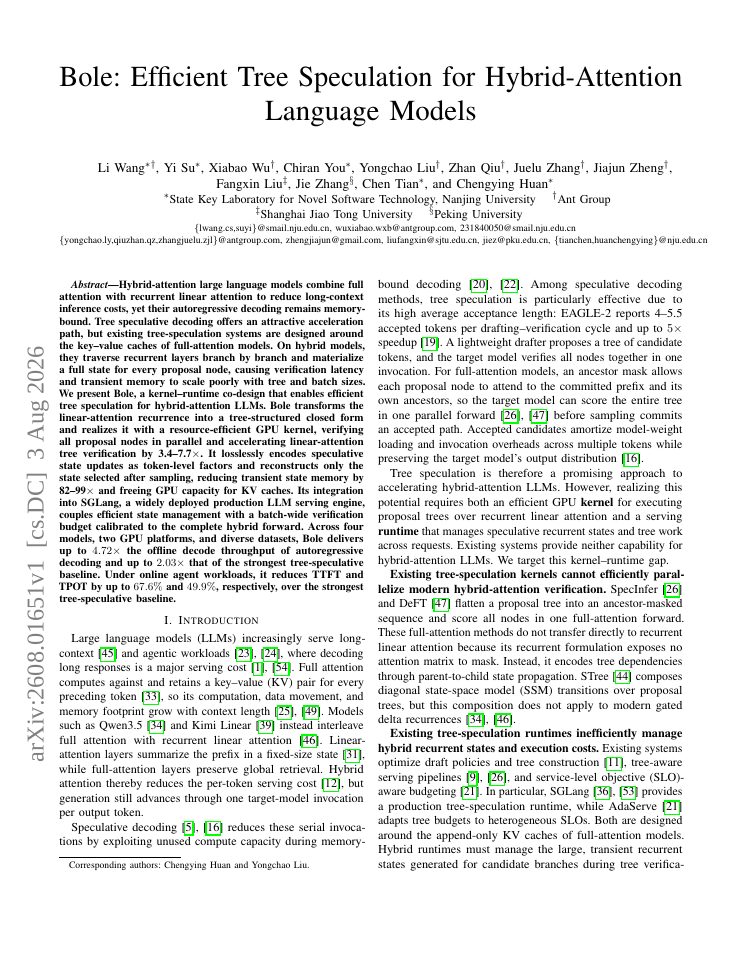
First page of Bole: Efficient Tree Speculation for Hybrid-Attention Language Models
speculative decodingtest

Bole: Efficient Tree Speculation for Hybrid-Attention Language Models

It replaces branch-by-branch recurrent-state traversal in existing tree-speculation systems with a tree-structured closed-form linear-attention kernel that verifies all proposal nodes in parallel and materializes only the post-sampling selected state. The cost is a custom GPU kernel plus integration effort: the work is built into SGLang, so adoption is practical mainly for teams already serving hybrid-attention models through that stack, and the kernel-runtime co-design adds maintenance complexity. It can fail if the deployed models are full-attention only (the technique does not apply), if draft-model acceptance rates are low enough that tree speculation yields no gain, or if the claimed speedups do not transfer to GPU platforms or batch regimes outside those evaluated.

observed signal
0impl.
0stars
0citations
4.72xclaimed gain
abstract onlyReview decisionDownload skill ↓Original paper ↗
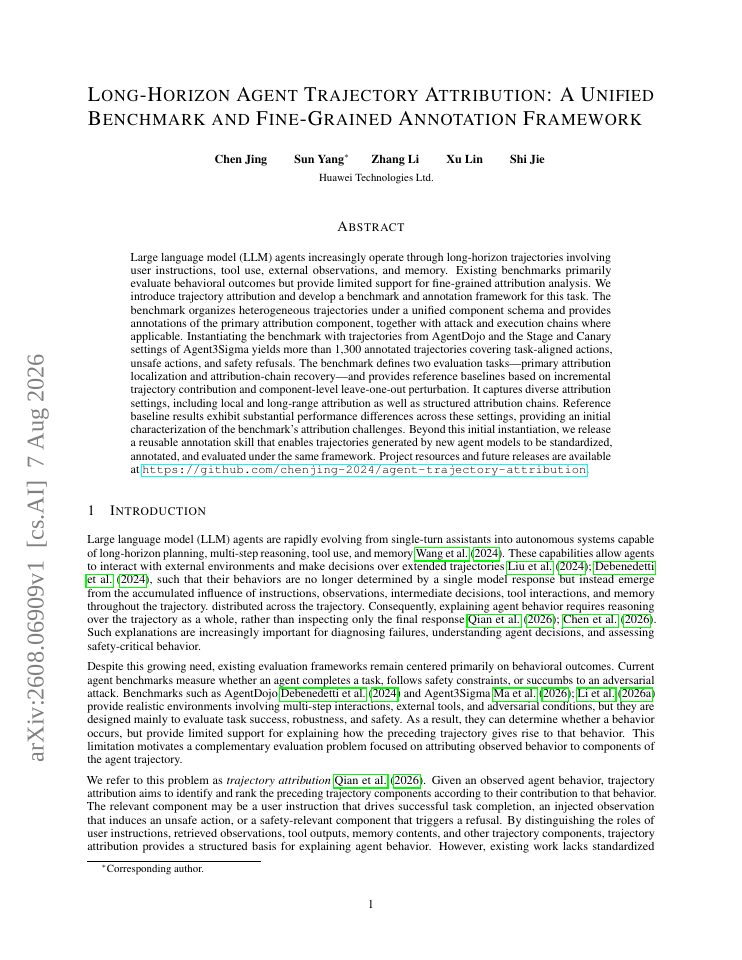
First page of Long-Horizon Agent Trajectory Attribution: A Unified Benchmark and Fine-Grained Annotation Framework
agent evaluationtest

Long-Horizon Agent Trajectory Attribution: A Unified Benchmark and Fine-Grained Annotation Framework

It replaces outcome-only agent evaluation (e.g., raw AgentDojo or Agent3Sigma success rates) with a unified component schema plus fine-grained annotations that localize which instruction, tool call, observation, or memory item caused an unsafe action, task-aligned action, or refusal. It costs annotation and analysis effort rather than compute: the reusable annotation skill must be run over your own trajectories, and attribution baselines such as incremental contribution and leave-one-out perturbation add repeated inference passes over long contexts, which raises API spend. It can fail because baseline attribution methods show substantial performance gaps across local, long-range, and chain-structured settings, so attributions produced in production may be unreliable precisely in the long-range cases that matter most.

observed signal
0impl.
1stars
0citations
—claimed gain
abstract onlyReview decisionDownload skill ↓Original paper ↗
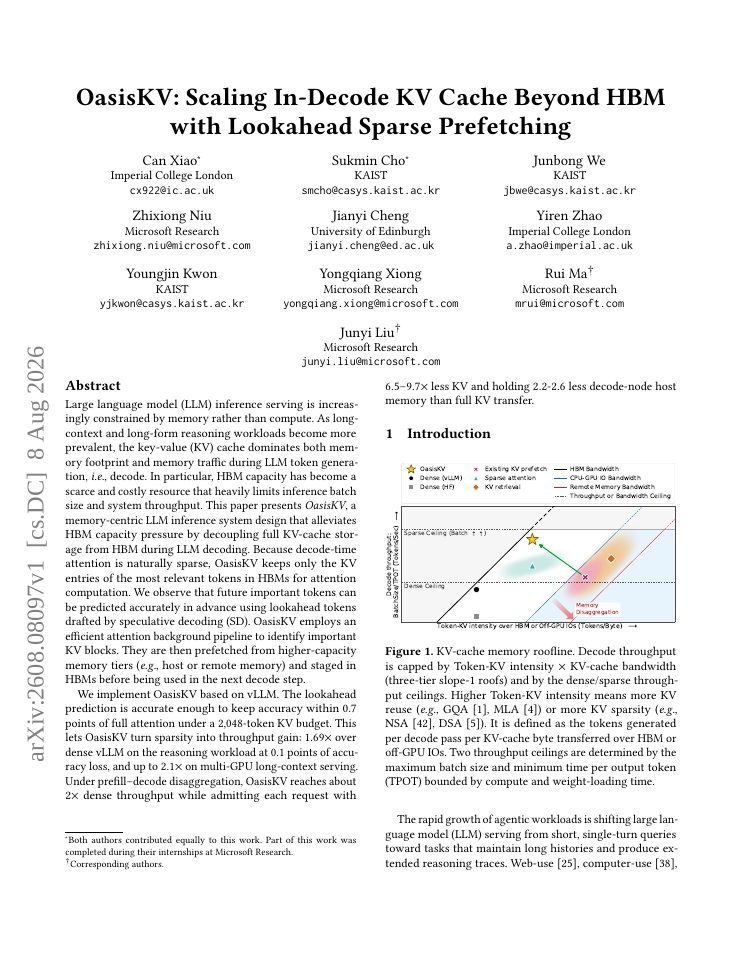
First page of OasisKV: Scaling In-Decode KV Cache Beyond HBM with Lookahead Sparse Prefetching
KV cachetest

OasisKV: Scaling In-Decode KV Cache Beyond HBM with Lookahead Sparse Prefetching

OasisKV replaces storing the full KV cache in HBM with a sparse KV budget (e.g., 2,048 tokens) whose blocks are prefetched from host or remote memory, using speculative-decoding lookahead tokens to predict which blocks matter next. The cost is integration with a modified vLLM serving stack, dependence on speculative decoding as a predictor, added prefetch pipeline complexity, and a small accuracy loss (under 0.7 points at the reported budget). It can fail when lookahead prediction degrades on workloads unlike the evaluated reasoning tasks, when PCIe or network bandwidth cannot hide prefetch latency, or when the team lacks capacity to maintain a custom vLLM fork.

observed signal
0impl.
0stars
0citations
1.69xclaimed gain
abstract onlyReview decisionDownload skill ↓Original paper ↗
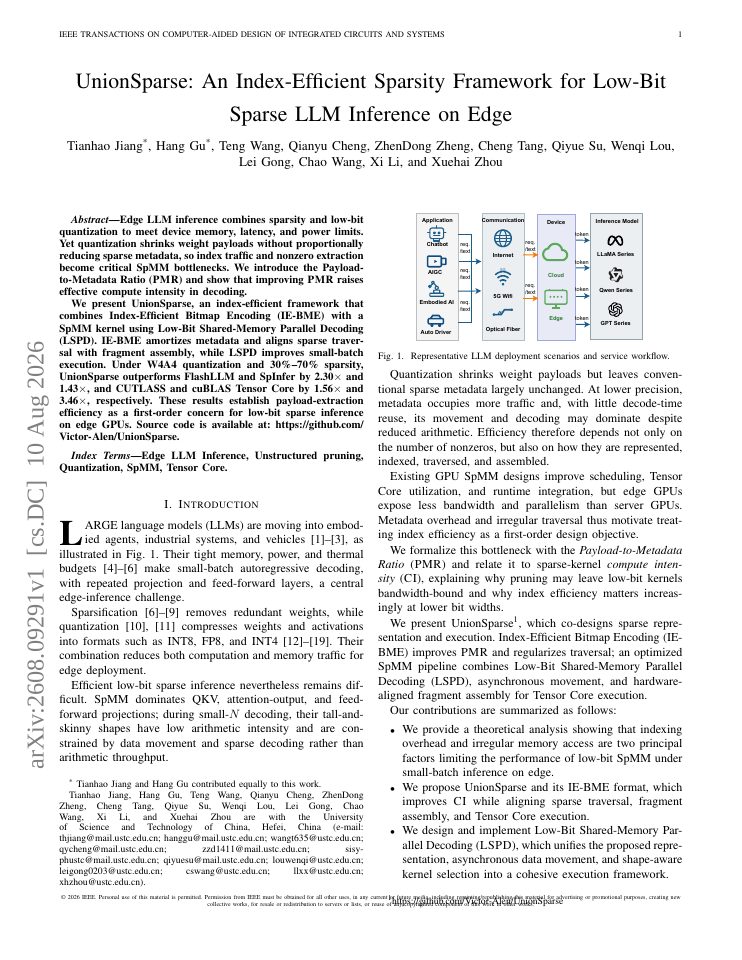
First page of UnionSparse: An Index-Efficient Sparsity Framework for Low-Bit Sparse LLM Inference on Edge
sparsity and pruningtest

UnionSparse: An Index-Efficient Sparsity Framework for Low-Bit Sparse LLM Inference on Edge

UnionSparse replaces the sparse metadata formats and SpMM kernels in existing sparse-inference stacks (FlashLLM, SpInfer, CUTLASS/cuBLAS sparse paths) with an index-efficient bitmap encoding (IE-BME) plus a shared-memory parallel decoding kernel, targeting the payload-to-metadata bottleneck in W4A4 sparse decoding. The cost is adopting a custom kernel and encoding pipeline: weights must be re-encoded into IE-BME, integration work is required outside supported frameworks, and benefits presuppose a model that is already both 4-bit quantized and 30%-70% sparse. It can fail if the workload is dense or weight-only quantized without structured sparsity, if sparsity falls outside the evaluated range, if batch sizes grow beyond the small-batch regime the kernel optimizes, or if the hardware differs from the evaluated edge GPUs.

observed signal
0impl.
0stars
0citations
2.3xclaimed gain
abstract onlyReview decisionDownload skill ↓Original paper ↗
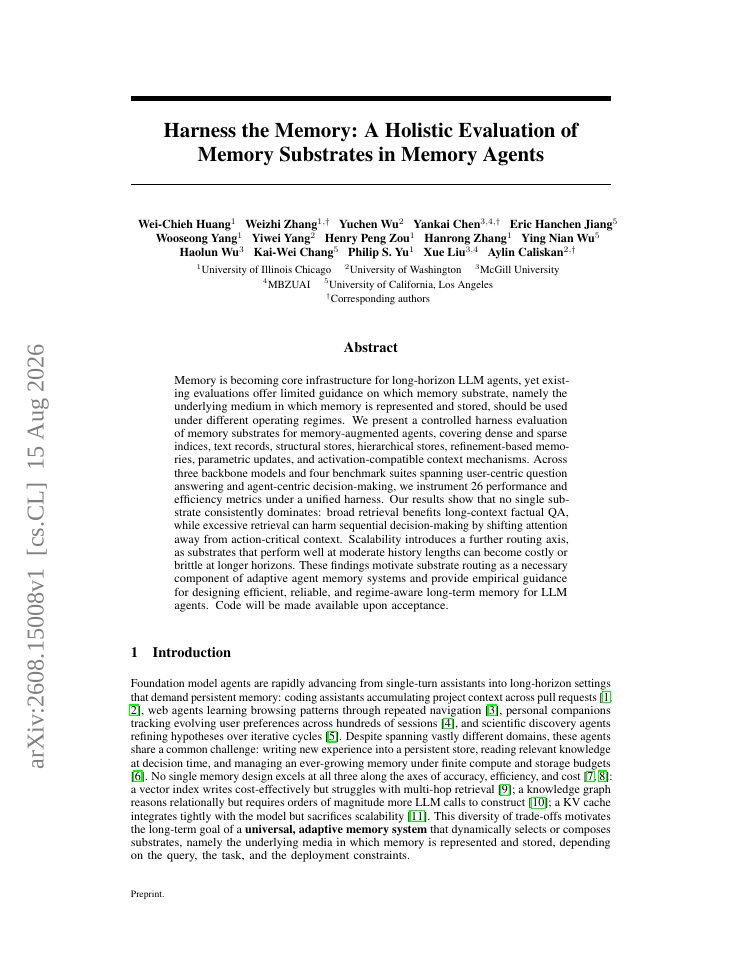
First page of Harness the Memory: A Holistic Evaluation of Memory Substrates in Memory Agents
memory and contexttest

Harness the Memory: A Holistic Evaluation of Memory Substrates in Memory Agents

This is a benchmark study, not a method: it replaces the implicit practice of committing to a single memory substrate (dense retrieval, sparse index, text record, structural or hierarchical store) with the finding that no substrate dominates and that retrieval breadth should be routed by task regime and history length. Adopting its guidance costs engineering effort to instrument memory metrics and to build routing logic over existing memory stores, with no additional model or training cost. It can fail because the substrate rankings may not transfer to a different backbone model, benchmark, or production workload, and code was not yet released, so reproducing the harness requires independent implementation.

observed signal
0impl.
0stars
0citations
—claimed gain
abstract onlyReview decisionDownload skill ↓Original paper ↗
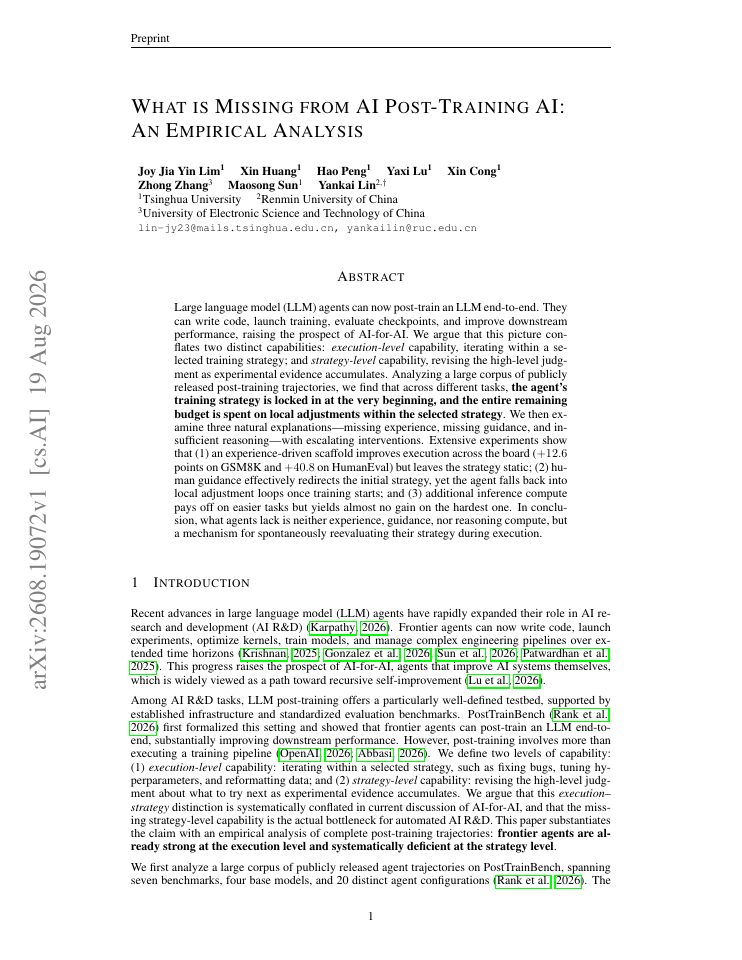
First page of What is Missing from AI Post-Training AI: An Empirical Analysis
agent evaluationwatch

What is Missing from AI Post-Training AI: An Empirical Analysis

The paper is a diagnostic analysis rather than a deployable method: it replaces the assumption that agent-run post-training pipelines improve strategy over time with evidence that agents lock into an initial strategy and only perform local adjustments, even with added experience scaffolds, human guidance, or inference compute. It costs nothing to adopt directly, but any team automating post-training with LLM agents must budget for human strategy oversight, since no tested intervention restored strategy-level revision. It can fail by being over-read as a solved problem: the scaffold gains are execution-level only, and the hardest tasks show almost no benefit from extra reasoning compute.

observed signal
0impl.
2stars
0citations
—claimed gain
abstract onlyReview decisionDownload skill ↓Original paper ↗
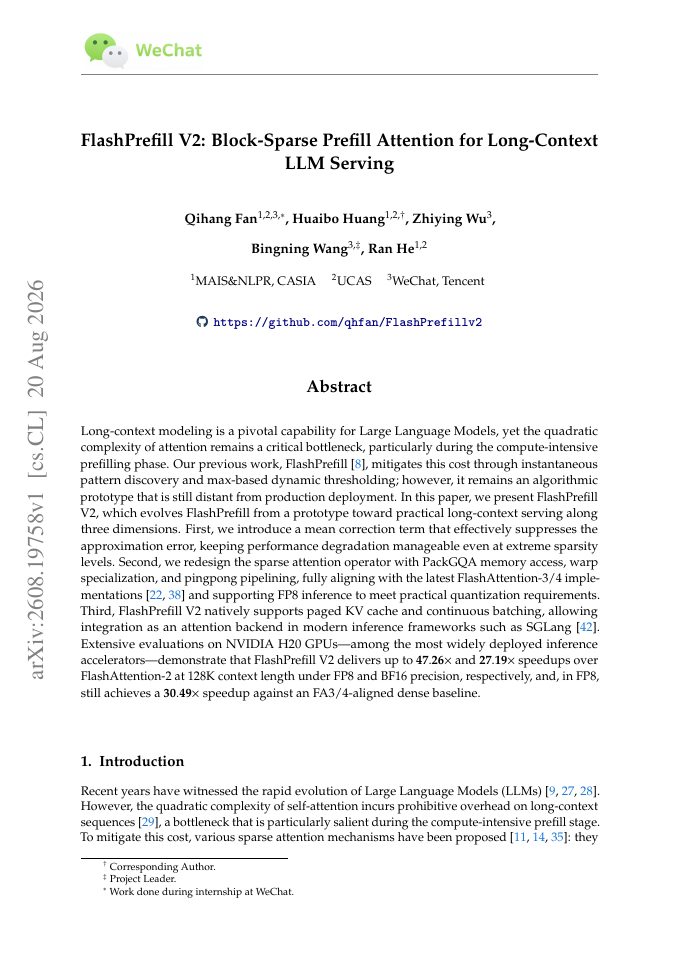
First page of FlashPrefill V2: Block-Sparse Prefill Attention for Long-Context LLM Serving
attention and kernelswatch

FlashPrefill V2: Block-Sparse Prefill Attention for Long-Context LLM Serving

The method replaces dense FlashAttention during the prefill phase with a block-sparse attention operator that uses instantaneous pattern discovery, max-based dynamic thresholding, and a mean correction term, delivered as an SGLang-compatible backend with paged KV cache and continuous batching support. Adoption costs a custom kernel dependency tuned to FlashAttention-3/4-style implementations, integration effort into a serving framework, and approximation error at extreme sparsity that the mean correction only bounds rather than eliminates. It can fail through accuracy degradation on workloads whose attention patterns do not match the discovered sparsity, through hardware-specific kernel behavior validated primarily on H20 GPUs, and through FP8 quantization interacting poorly with the sparse approximation.

observed signal
0impl.
27stars
0citations
47.26xclaimed gain
abstract onlyReview decisionDownload skill ↓Original paper ↗
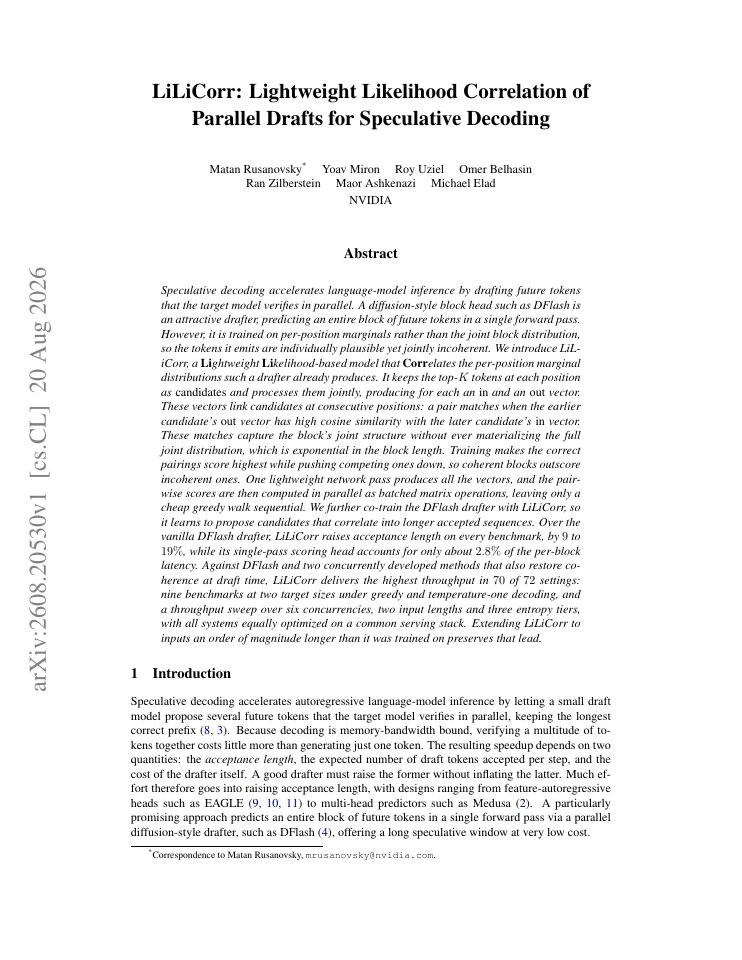
First page of LiLiCorr: Lightweight Likelihood Correlation of Parallel Drafts for Speculative Decoding
speculative decodingtest

LiLiCorr: Lightweight Likelihood Correlation of Parallel Drafts for Speculative Decoding

LiLiCorr replaces raw block-parallel drafting (e.g., DFlash), whose per-position marginals produce jointly incoherent token blocks, with a lightweight head that scores adjacent candidate pairs via in/out vector cosine similarity and a greedy walk to select a coherent draft path. Costs include an extra network pass and batched pairwise scoring (about 2.8% of per-block latency), plus co-training the drafter with LiLiCorr, which adds a training step beyond simply deploying a pretrained drafter. It can fail if the reader does not already use a diffusion-style block drafter (the method presupposes one), if co-training is infeasible under the compute budget, or on workloads whose distributions differ from the training setup, since gains are acceptance-length dependent and workload-specific.

observed signal
0impl.
0stars
0citations
—claimed gain
abstract onlyReview decisionDownload skill ↓Original paper ↗
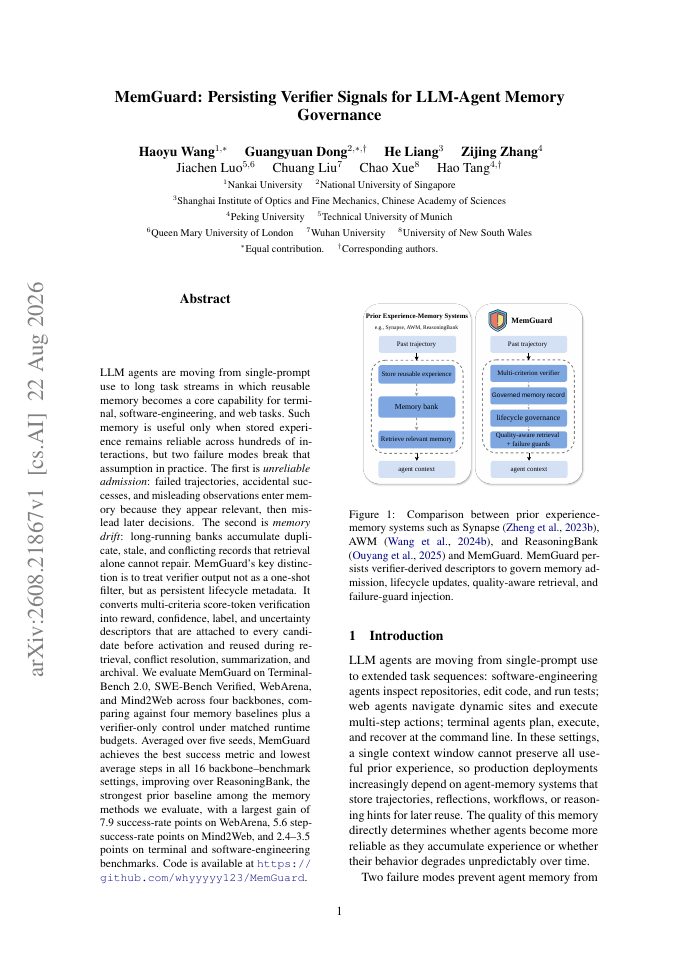
First page of MemGuard: Persisting Verifier Signals for LLM-Agent Memory Governance
memory and contexttest

MemGuard: Persisting Verifier Signals for LLM-Agent Memory Governance

MemGuard replaces one-shot verifier filtering of agent memory with persistent lifecycle metadata (reward, confidence, label, uncertainty) attached to each memory candidate and reused for retrieval, conflict resolution, summarization, and archival. The cost is a score-token verification pass on every candidate memory plus storing and maintaining the metadata through the memory lifecycle, adding inference and engineering overhead to each memory write and retrieval. It can fail if the verifier's scores are miscalibrated for the target domain, if metadata-driven conflict resolution discards useful experience, and its reported gains may not transfer to workloads unlike the evaluated terminal, coding, and web benchmarks.

observed signal
0impl.
3stars
0citations
—claimed gain
abstract onlyReview decisionDownload skill ↓Original paper ↗
First page of TRACE: A Self-Evolving Skill Bank for Consistent, Limit-Aware LLM Agents
memory and contexttest

TRACE: A Self-Evolving Skill Bank for Consistent, Limit-Aware LLM Agents

TRACE replaces static hand-written system prompts and agent policies with a Skill Bank of modular, retrievable tool-use rules that is iteratively refined by contrasting successful and failed trajectories, without modifying model weights. It costs an offline evolution loop of repeated evaluation rounds and trajectory analysis (API tokens and engineering effort), plus per-turn retrieval and state-conditioned skill orchestration that add latency and prompt complexity at deployment. It can fail when the contrastive refinement overfits to evaluation trajectories, when skills conflict or are mis-retrieved for out-of-distribution requests, and its gains are demonstrated only on a single in-car assistant benchmark with specific frontier models, so transfer to other domains is unverified.

observed signal
0impl.
8stars
0citations
—claimed gain
abstract onlyReview decisionDownload skill ↓Original paper ↗
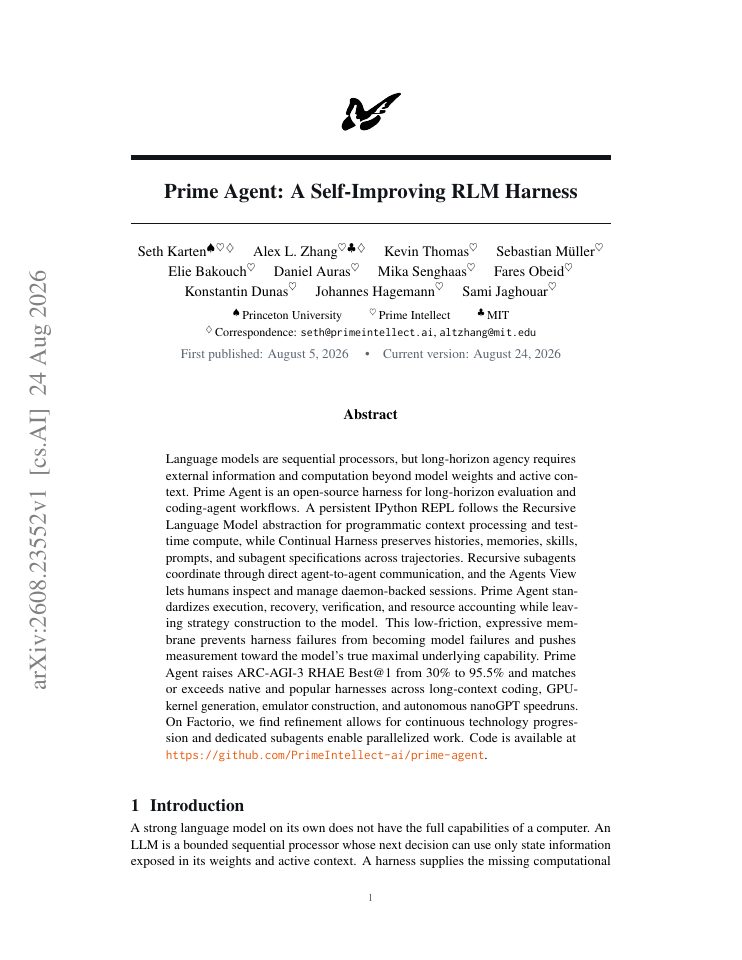
First page of Prime Agent: A Self-Improving RLM Harness
agent evaluationtest

Prime Agent: A Self-Improving RLM Harness

Replaces ad hoc agent scaffolds and default vendor harnesses with a standardized harness combining a persistent IPython REPL (Recursive Language Model abstraction), continual preservation of histories, memories, skills, and subagent specs across trajectories, recursive subagents with agent-to-agent communication, and built-in execution, recovery, verification, and resource accounting. Costs include substantial test-time compute and token consumption from recursive context processing and multi-subagent coordination, plus engineering effort to integrate and maintain the harness and its daemon-backed sessions; API bills can grow sharply on long-horizon tasks. Can fail through compounding errors in self-directed subagent communication, persistence of corrupted memories or skills across trajectories, and benchmark gains (e.g., ARC-AGI-3) that may not transfer to the reader's specific production workloads.

observed signal
18impl.
20636stars
0citations
3.18xclaimed gain
abstract onlyReview decisionDownload skill ↓Original paper ↗

Research signals

Three views of the same evidence: adoption against attention, publication cadence by research area, and reported gains when coverage is sufficient.

color = research area

01 · attention × adoption

The research frontier

Look to the upper left for independent implementation before mass attention.

compare by
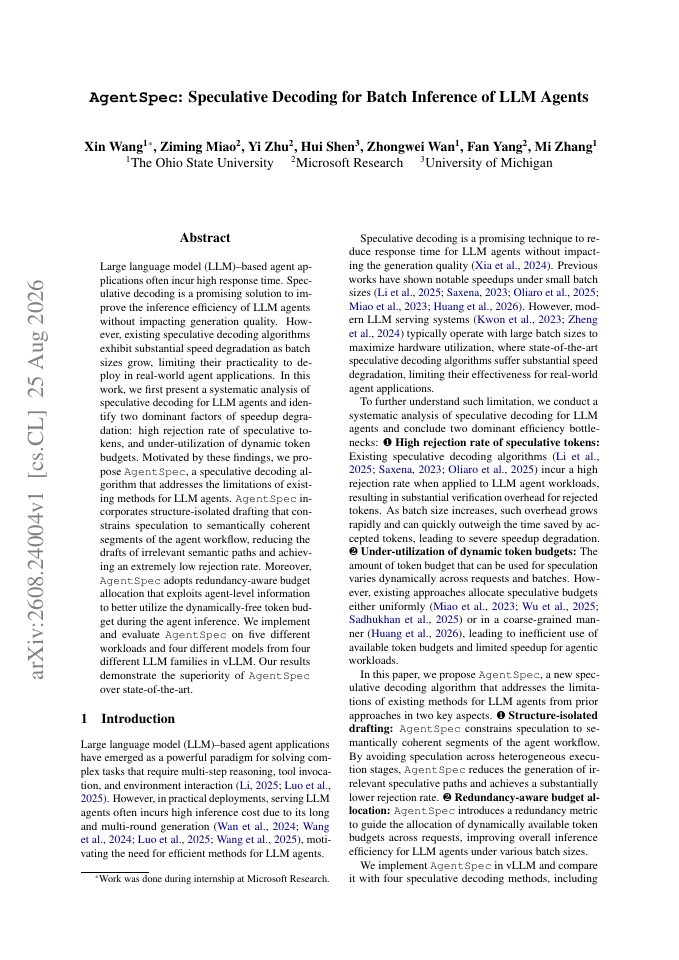
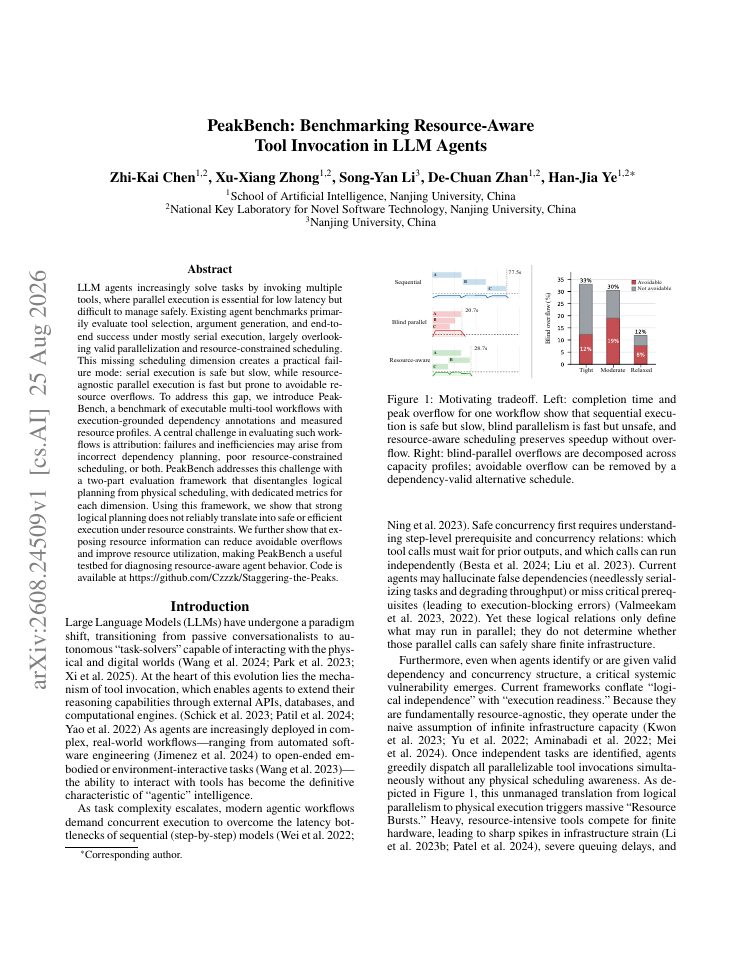
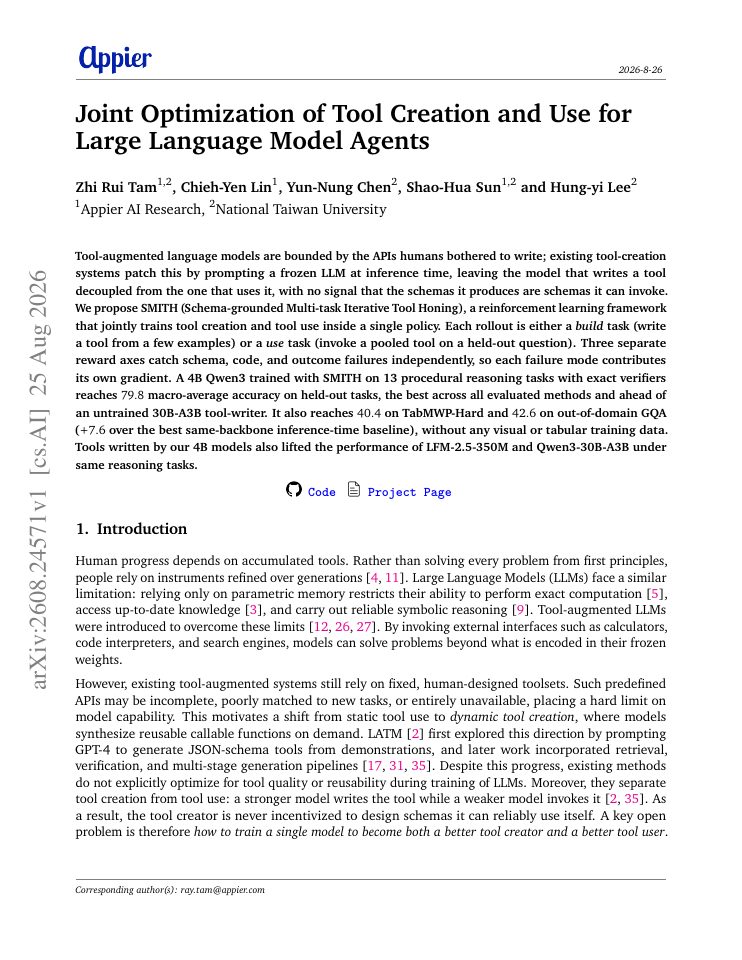
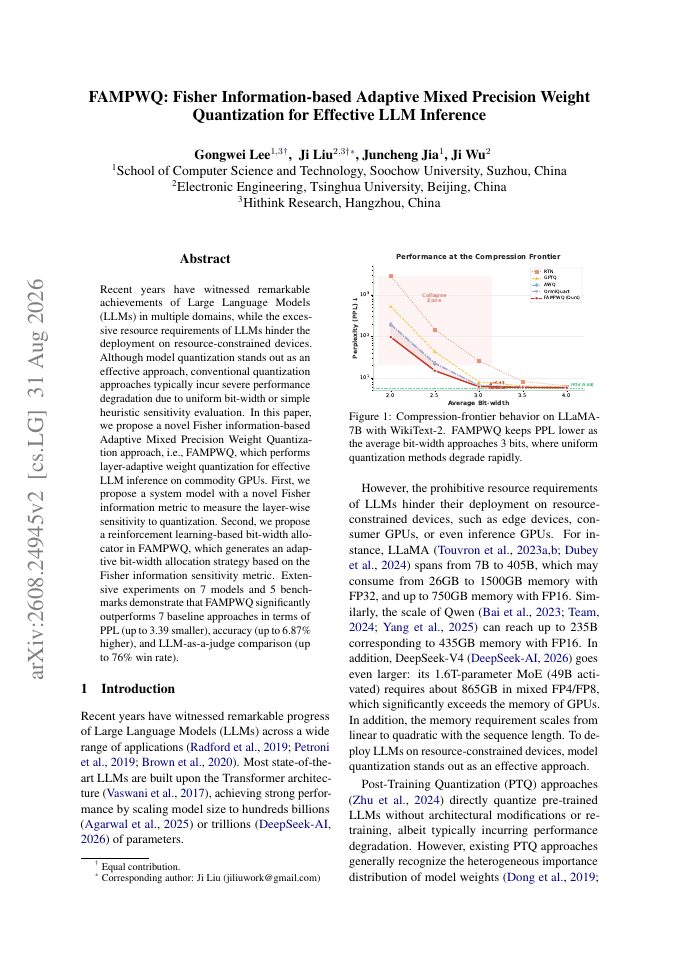
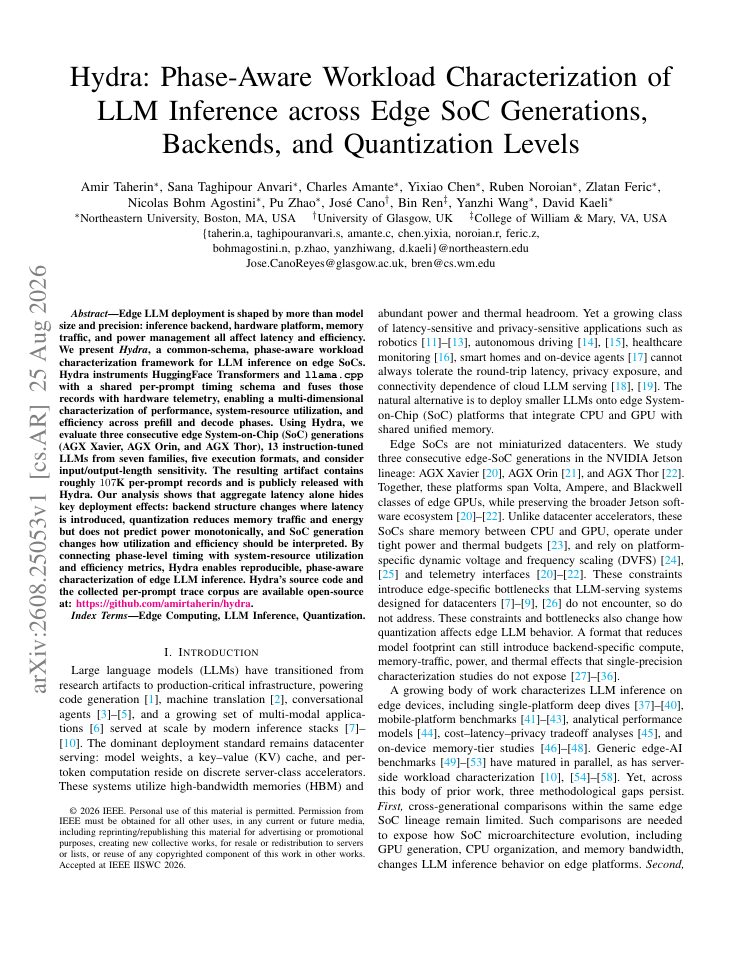
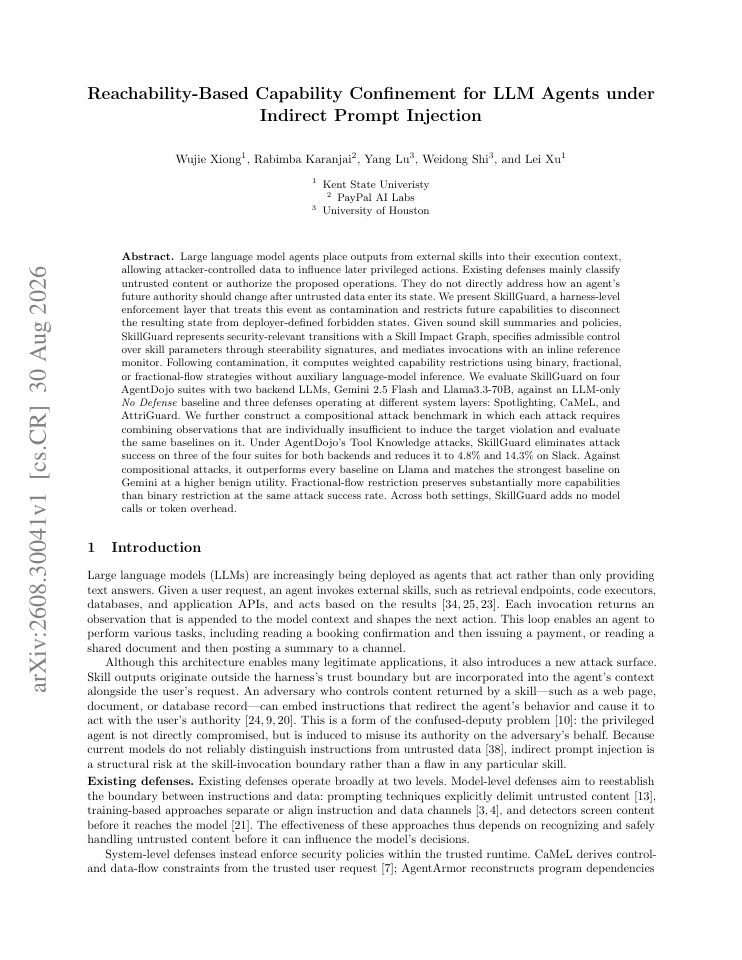
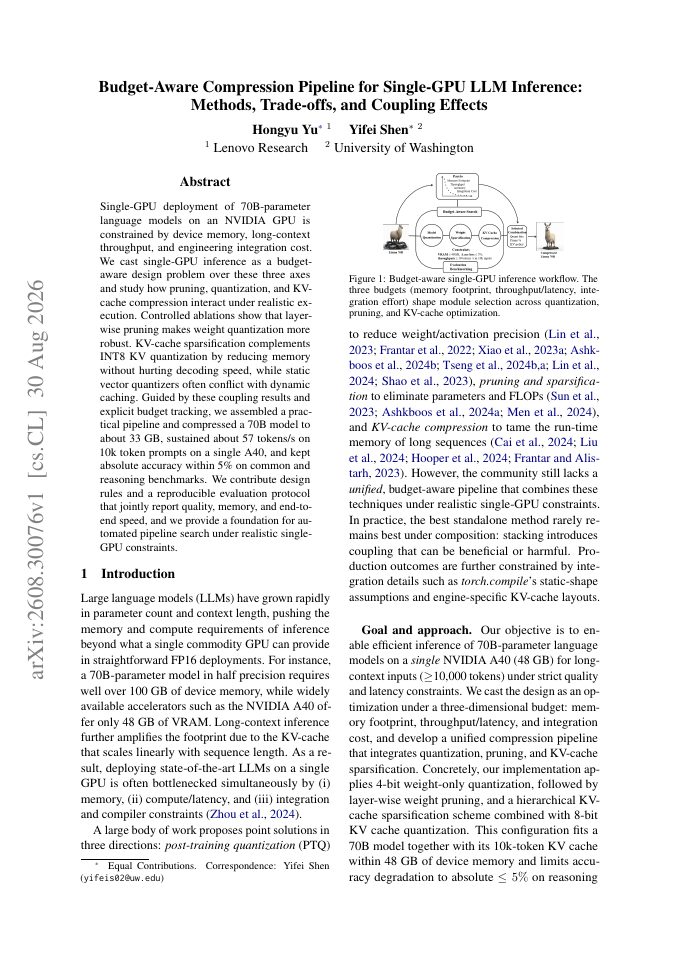
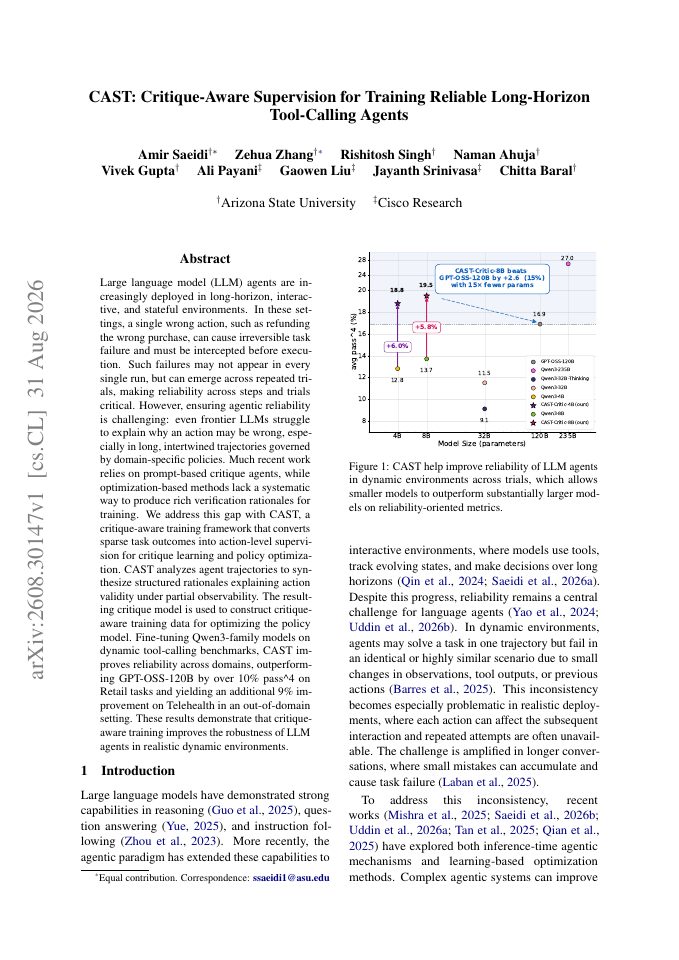
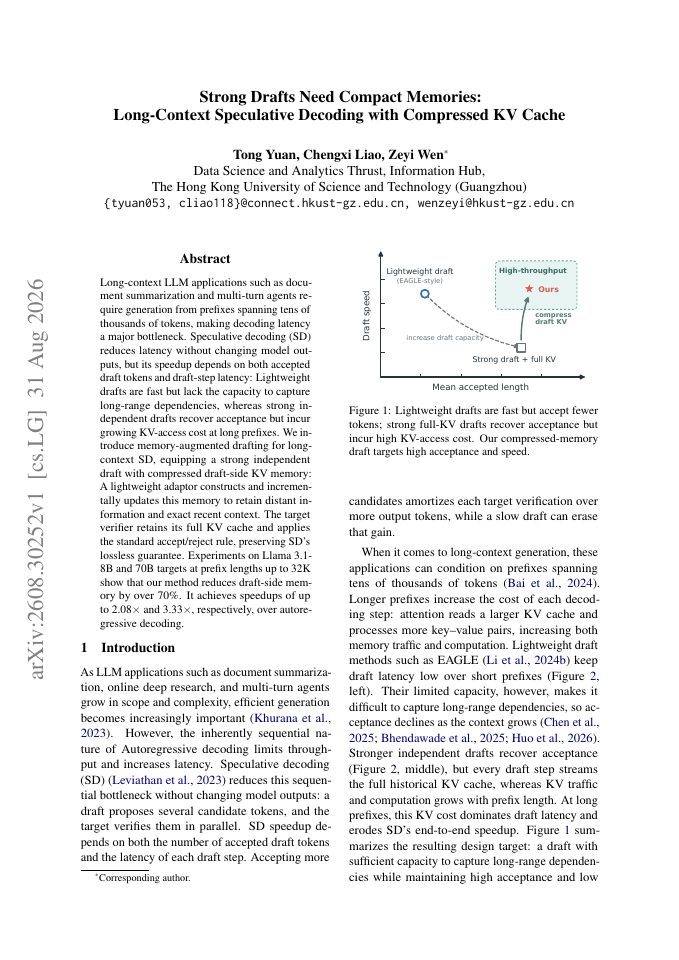
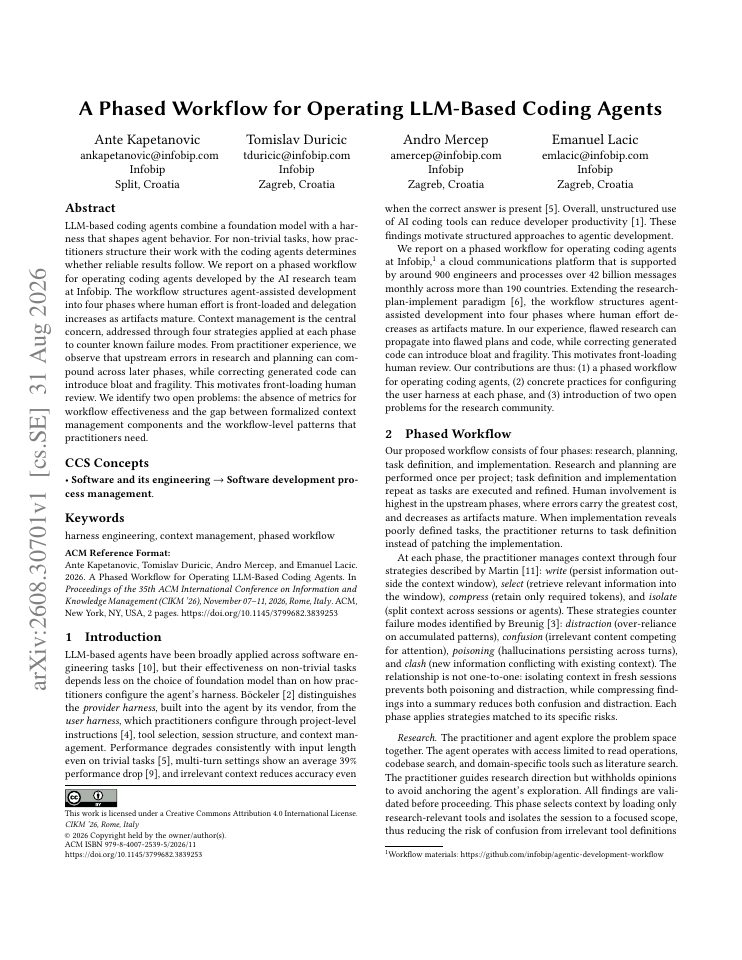
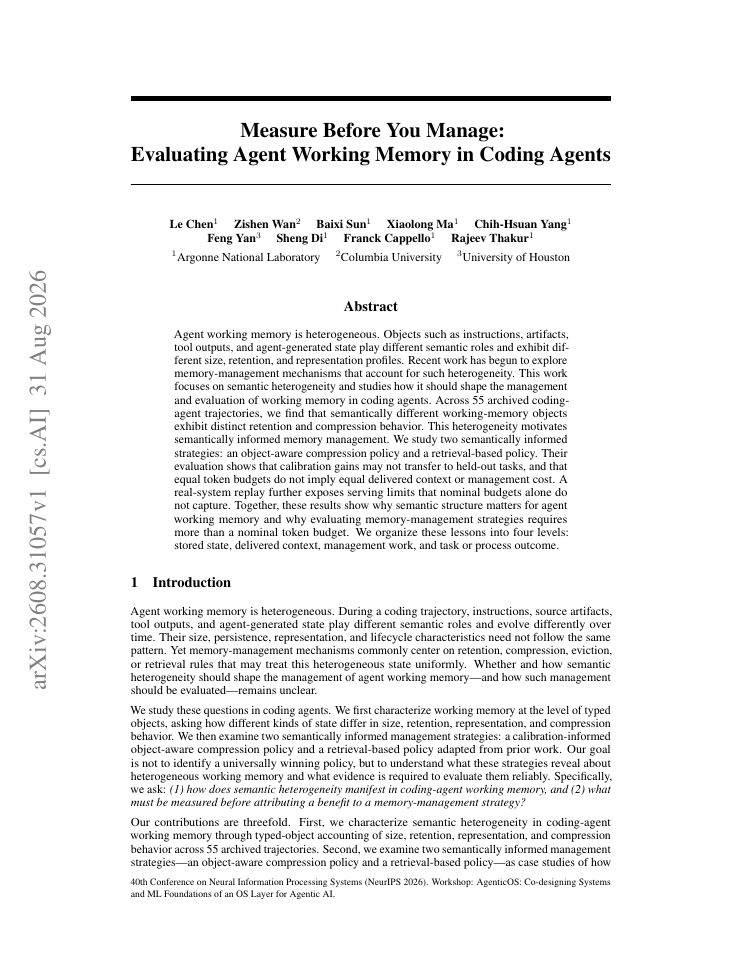
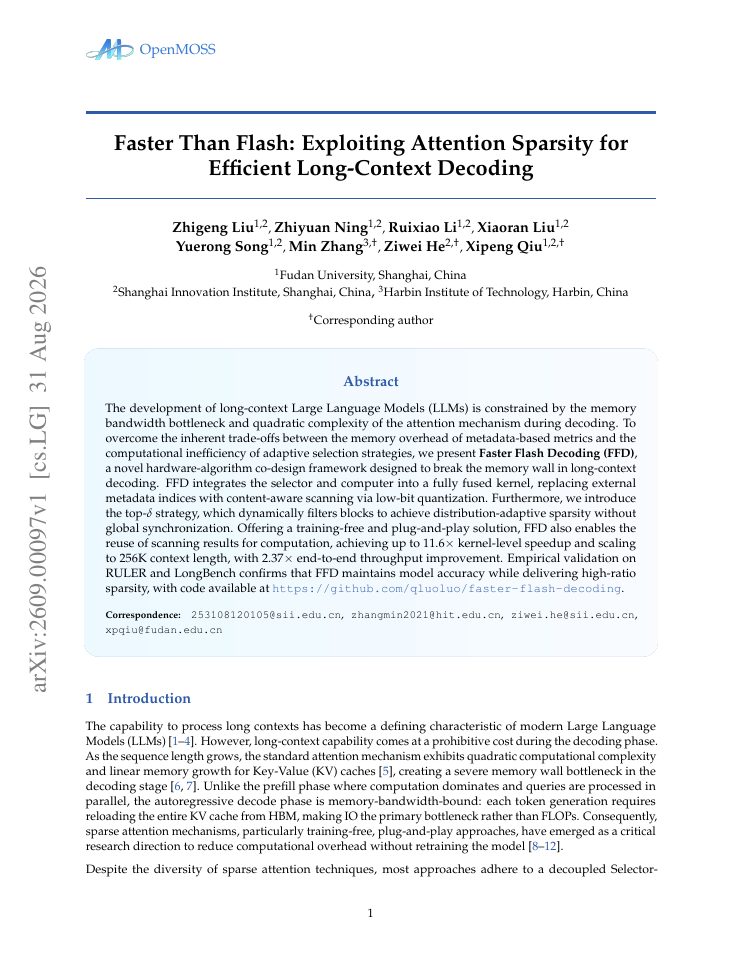
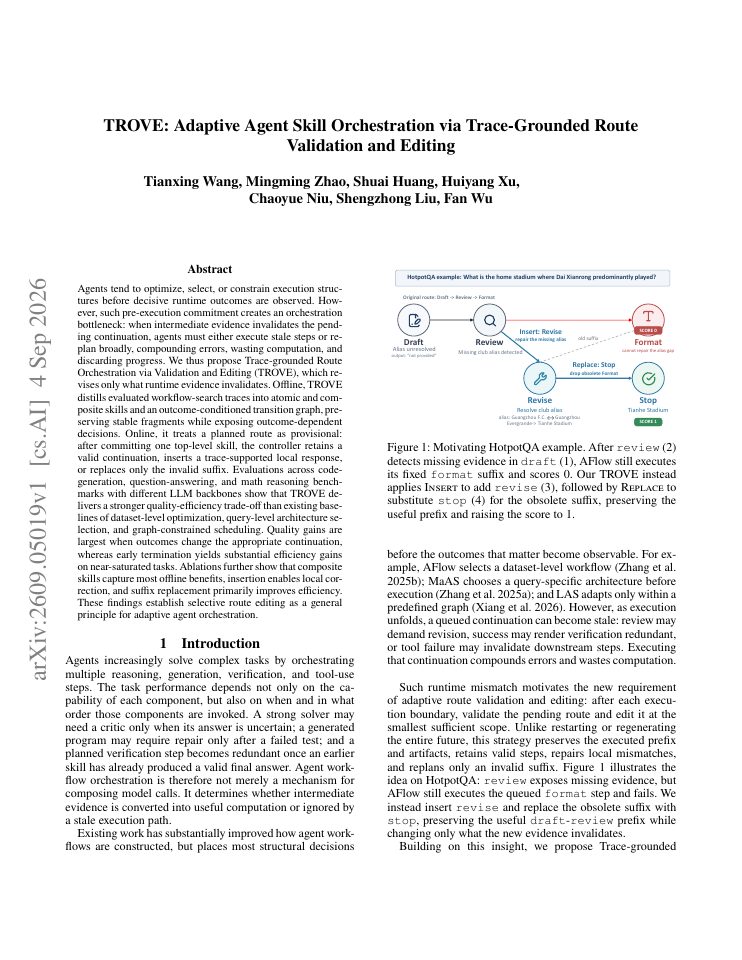
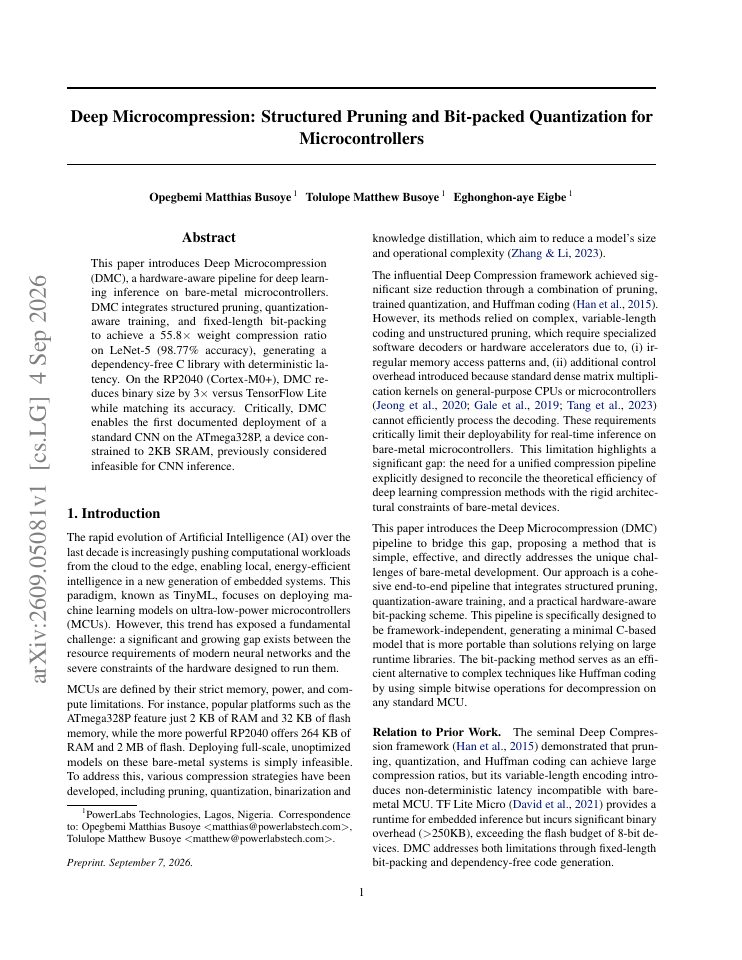
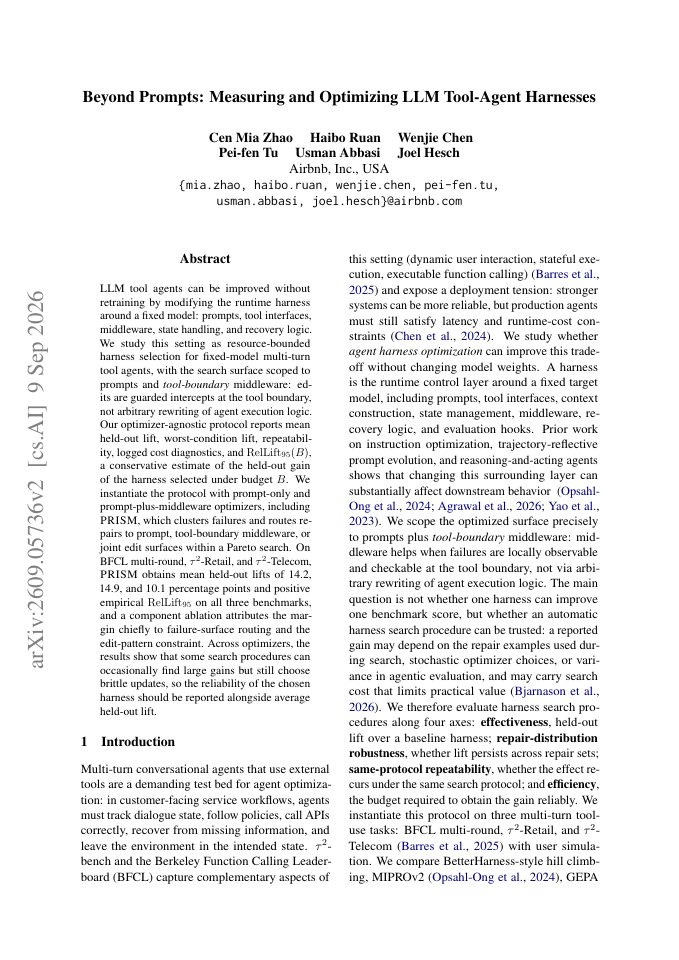
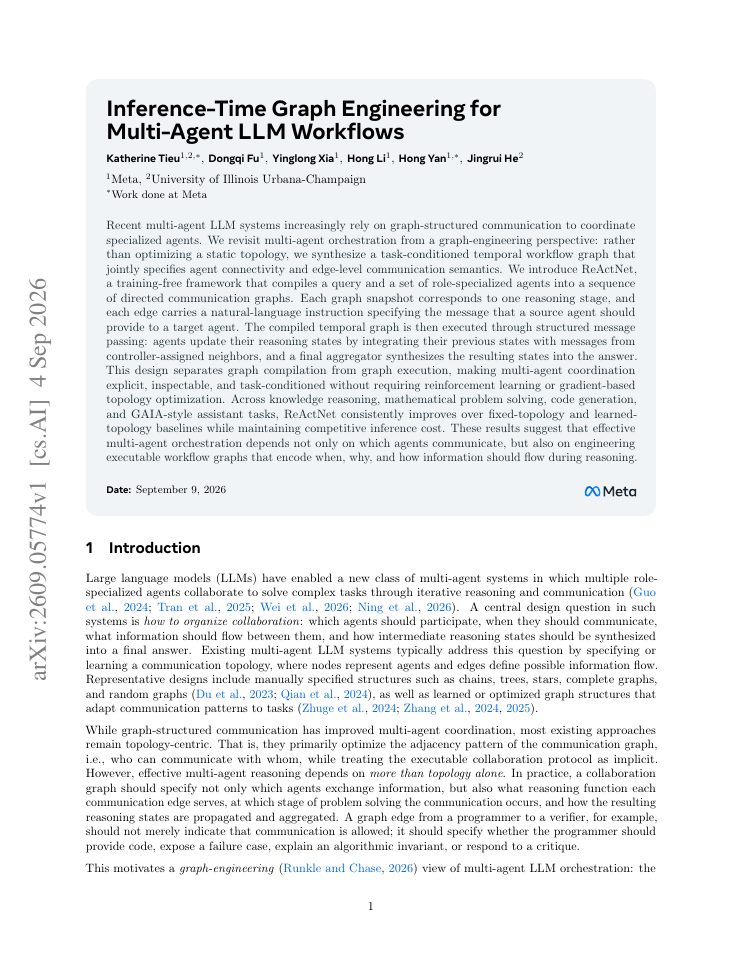
Each point represents one paper. Higher means more independent implementations; farther right means more GitHub stars.The Language You Ask In: Language-Conditioned Ideological Divergence in LLM Analysis of Contested Political Documents: 0 GitHub stars; 2 independent implementationsHiKV: Hierarchical Importance-Aware KV Cache with Hardware Acceleration for LLM Decoding: 0 GitHub stars; 0 independent implementationsPIVOT: Efficient Query-Group Indexing for Token-Level Sparse Attention: 2 GitHub stars; 0 independent implementationsCoSA: Accelerating Long-Context Inference via Proxy-Kernel Co-Designed Sparse Attention: 0 GitHub stars; 0 independent implementationsDualDecoder: Accelerate Long Context LLM Inference by Predictive Prefetch: 0 GitHub stars; 0 independent implementationsBeyond KV Reconstruction: Functional Reconstruction for MLA Draft Models in Speculative Decoding: 0 GitHub stars; 0 independent implementationsRecall Before You Rank: Similarity-Guided Top-$K$ Reuse for Efficient Long-Context Attention: 0 GitHub stars; 0 independent implementationsA Sparse Glimpse of the Whole: Train-Free Self-Speculative Decoding: 0 GitHub stars; 0 independent implementationsTurning Interaction History into Execution State: A Runtime Layer for Long-Horizon Coding Agents: 0 GitHub stars; 0 independent implementationsBole: Efficient Tree Speculation for Hybrid-Attention Language Models: 0 GitHub stars; 0 independent implementationsOneDayAgent: Towards a Long-Horizon Harness for Autonomous Agents: 33 GitHub stars; 1 independent implementationLong-Horizon Agent Trajectory Attribution: A Unified Benchmark and Fine-Grained Annotation Framework: 1 GitHub star; 0 independent implementationsOasisKV: Scaling In-Decode KV Cache Beyond HBM with Lookahead Sparse Prefetching: 0 GitHub stars; 0 independent implementationsUnionSparse: An Index-Efficient Sparsity Framework for Low-Bit Sparse LLM Inference on Edge: 0 GitHub stars; 0 independent implementationsHarness the Memory: A Holistic Evaluation of Memory Substrates in Memory Agents: 0 GitHub stars; 0 independent implementationsWhat is Missing from AI Post-Training AI: An Empirical Analysis: 2 GitHub stars; 0 independent implementationsFlashPrefill V2: Block-Sparse Prefill Attention for Long-Context LLM Serving: 27 GitHub stars; 0 independent implementationsLiLiCorr: Lightweight Likelihood Correlation of Parallel Drafts for Speculative Decoding: 0 GitHub stars; 0 independent implementationsContext as an Environment: Programmatic Context Management for Long-Horizon Agents: 2 GitHub stars; 5 independent implementationsMemGuard: Persisting Verifier Signals for LLM-Agent Memory Governance: 3 GitHub stars; 0 independent implementationsTRACE: A Self-Evolving Skill Bank for Consistent, Limit-Aware LLM Agents: 8 GitHub stars; 0 independent implementationsPrime Agent: A Self-Improving RLM Harness: 20636 GitHub stars; 18 independent implementationsToolRobustBench: Stage-Wise Perturbation Evaluation and Failure Diagnosis for Tool-Calling Agents: 0 GitHub stars; 0 independent implementationsThe Empire, Long Divided, Must Unite: Architectural Convergence in Three LLM Agent Harnesses: 0 GitHub stars; 0 independent implementationsAgentSpec: Speculative Decoding for Batch Inference of LLM Agents: 0 GitHub stars; 0 independent implementationsPeakBench: Benchmarking Resource-Aware Tool Invocation in LLM Agents: 1 GitHub star; 0 independent implementationsJoint Optimization of Tool Creation and Use for Large Language Model Agents: 28 GitHub stars; 0 independent implementationsFAMPWQ: Fisher Information-based Adaptive Mixed Precision Weight Quantization for Effective LLM Inference: 0 GitHub stars; 0 independent implementationsHydra: Phase-Aware Workload Characterization of LLM Inference across Edge SoC Generations, Backends, and Quantization Levels: 0 GitHub stars; 0 independent implementationsAsymSpec: Context-Asymmetric Speculative Decoding for Agentic LLMs: 1 GitHub star; 2 independent implementationsZero-Shot Self-Orchestration with Ledger-Based Control for Improved LLM Coding Performance: 0 GitHub stars; 0 independent implementationsDuMateBench: Evaluating Autonomous Agents in Complex Real-World Workflows: 6 GitHub stars; 2 independent implementationsopenJiuwen: Beyond Static Harnesses for Long-Horizon Coding Agents: 0 GitHub stars; 0 independent implementationsA Method for Layer Bit-Width Allocation in LLM Quantization via Performance Maximization Under a Quality-Degradation Constraint: 0 GitHub stars; 0 independent implementationsReachability-Based Capability Confinement for LLM Agents under Indirect Prompt Injection: 1 GitHub star; 0 independent implementationsBudget-Aware Compression Pipeline for Single-GPU LLM Inference: Methods, Trade-offs, and Coupling Effects: 0 GitHub stars; 0 independent implementationsCAST: Critique-Aware Supervision for Training Reliable Long-Horizon Tool-Calling Agents: 28 GitHub stars; 0 independent implementationsStrong Drafts Need Compact Memories: Long-Context Speculative Decoding with Compressed KV Cache: 0 GitHub stars; 0 independent implementationsA Phased Workflow for Operating LLM-Based Coding Agents: 0 GitHub stars; 0 independent implementationsMeasure Before You Manage: Evaluating Agent Working Memory in Coding Agents: 0 GitHub stars; 0 independent implementationsFaster Than Flash: Exploiting Attention Sparsity for Efficient Long-Context Decoding: 0 GitHub stars; 0 independent implementationsHBQ: Hierarchical Scaling Block Quantization with Hardware-Efficiency-Aware Design for Accurate LLM Inference: 0 GitHub stars; 0 independent implementationsContextPipe: Database-Inspired Context Assembly for Long-Horizon Agents: 26 GitHub stars; 1 independent implementationOUTLETS: Output-Length Prediction from Speculative Decoding Backbones: 116 GitHub stars; 1 independent implementationHarness Engineering in LLM Tool Use via Agent-Native Reusable Tool Primitives: 5 GitHub stars; 0 independent implementationsUnfolding the Leech Lattice: Fused Multi-Shell Decoding and VRAM Layouts for 2-Bit LLM Weights: 0 GitHub stars; 0 independent implementationsRandom Attention: Rethinking KV Cache Eviction for Efficient Reasoning: 59 GitHub stars; 1 independent implementationMonoMoE: An Efficient Fused Mega-kernel for Quantized MoE Decoding: 0 GitHub stars; 0 independent implementationsTROVE: Adaptive Agent Skill Orchestration via Trace-Grounded Route Validation and Editing: 0 GitHub stars; 0 independent implementationsDeep Microcompression: Structured Pruning and Bit-packed Quantization for Microcontrollers: 0 GitHub stars; 0 independent implementationsBeyond Prompts: Measuring and Optimizing LLM Tool-Agent Harnesses: 0 GitHub stars; 0 independent implementationsInference-Time Graph Engineering for Multi-Agent LLM Workflows: 1 GitHub star; 0 independent implementationsExplaining AI Agents Through Execution Traces: 0 GitHub stars; 0 independent implementationsAgentDrift: A Step-Labeled Benchmark of Injection-Hijacked LLM Agent Trajectories: 2 GitHub stars; 4 independent implementationsTrain Overcomplete, Deploy Compact: Scaling Recovery Capacity for Structured LLM Pruning: 0 GitHub stars; 0 independent implementationsMetaKV: Adaptive KV Cache Compression for Constrained LLM Inference: 0 GitHub stars; 0 independent implementationsClosing the Consistency Gap: Self-Evolving Agents That Learn to Stay on Course: 0 GitHub stars; 0 independent implementationsProcedural Graphs: Self-Evolving Execution Structures for LLM Agents: 6 GitHub stars; 5 independent implementationsOsprey: Target-agnostic Pre-training Makes Stronger Drafters in Speculative Decoding: 0 GitHub stars; 0 independent implementationsPELM: Power Efficient On-Device LLM Inference with Speculative Decoding and Dynamic Voltage Frequency Scaling: 0 GitHub stars; 0 independent implementationsGrounding Agent Memory: Environment-Probing Curation for Enterprise Agents: 13 GitHub stars; 1 independent implementation
Papers above 1000 stars or 200 citations are not scored. They have already broken through the attention threshold, while Paperraft is designed to identify earlier signals.

02 · cadence

Research areas over time

Compare monthly publication volume on a shared scale and calendar.

coding agentsmax 6Jan 26: 0 papersJul 26: 0 papersAug 26: 4 papersSep 26: 0 papersJan 26Sep 26agent evaluationmax 6Jan 26: 1 paperJul 26: 0 papersAug 26: 6 papersSep 26: 1 paperJan 26Sep 26KV cachemax 6Jan 26: 0 papersJul 26: 2 papersAug 26: 1 paperSep 26: 2 papersJan 26Sep 26speculative decodingmax 6Jan 26: 0 papersJul 26: 2 papersAug 26: 5 papersSep 26: 2 papersJan 26Sep 26sparsity and pruningmax 6Jan 26: 0 papersJul 26: 0 papersAug 26: 1 paperSep 26: 2 papersJan 26Sep 26attention and kernelsmax 6Jan 26: 0 papersJul 26: 3 papersAug 26: 3 papersSep 26: 0 papersJan 26Sep 26memory and contextmax 6Jan 26: 0 papersJul 26: 0 papersAug 26: 5 papersSep 26: 4 papersJan 26Sep 26multi-agent orchestrationmax 6Jan 26: 0 papersJul 26: 0 papersAug 26: 1 paperSep 26: 1 paperJan 26Sep 26othermax 6Jan 26: 0 papersJul 26: 0 papersAug 26: 1 paperSep 26: 0 papersJan 26Sep 26planning and decompositionmax 6Jan 26: 0 papersJul 26: 0 papersAug 26: 1 paperSep 26: 1 paperJan 26Sep 26quantizationmax 6Jan 26: 0 papersJul 26: 0 papersAug 26: 4 papersSep 26: 1 paperJan 26Sep 26safety and guardrailsmax 6Jan 26: 0 papersJul 26: 0 papersAug 26: 1 paperSep 26: 1 paperJan 26Sep 26serving and batchingmax 6Jan 26: 0 papersJul 26: 0 papersAug 26: 0 papersSep 26: 1 paperJan 26Sep 26tool usemax 6Jan 26: 0 papersJul 26: 0 papersAug 26: 2 papersSep 26: 2 papersJan 26Sep 26

Every panel uses the same calendar and vertical scale. An empty column means no papers were recorded.

03 · reported results

Claimed performance gains

Gains stated in the abstract: reported by the authors; not independently verified.

Factors reported by the authors and not independently verified. The vertical axis uses a logarithmic scale; the baseline is 1x.reported factor · log scaleHiKV: Hierarchical Importance-Aware KV Cache with Hardware Acceleration for LLM Decoding: 7.95x in speed (author-reported)PIVOT: Efficient Query-Group Indexing for Token-Level Sparse Attention: 4x in speed (author-reported)CoSA: Accelerating Long-Context Inference via Proxy-Kernel Co-Designed Sparse Attention: 4.93x in speed (author-reported)DualDecoder: Accelerate Long Context LLM Inference by Predictive Prefetch: 2.62x in speed (author-reported)Recall Before You Rank: Similarity-Guided Top-$K$ Reuse for Efficient Long-Context Attention: 3.07x in speed (author-reported)Turning Interaction History into Execution State: A Runtime Layer for Long-Horizon Coding Agents: 1.46x in cost (author-reported)Bole: Efficient Tree Speculation for Hybrid-Attention Language Models: 4.72x in speed (author-reported)OasisKV: Scaling In-Decode KV Cache Beyond HBM with Lookahead Sparse Prefetching: 1.69x in speed (author-reported)UnionSparse: An Index-Efficient Sparsity Framework for Low-Bit Sparse LLM Inference on Edge: 2.3x in speed (author-reported)FlashPrefill V2: Block-Sparse Prefill Attention for Long-Context LLM Serving: 47.26x in speed (author-reported)Prime Agent: A Self-Improving RLM Harness: 3.18x in quality (author-reported)AsymSpec: Context-Asymmetric Speculative Decoding for Agentic LLMs: 1.7x in speed (author-reported)Zero-Shot Self-Orchestration with Ledger-Based Control for Improved LLM Coding Performance: 5.2x in cost (author-reported)A Method for Layer Bit-Width Allocation in LLM Quantization via Performance Maximization Under a Quality-Degradation Constraint: 1.12x in speed (author-reported)Budget-Aware Compression Pipeline for Single-GPU LLM Inference: Methods, Trade-offs, and Coupling Effects: 4.2x in memory (author-reported)Strong Drafts Need Compact Memories: Long-Context Speculative Decoding with Compressed KV Cache: 3.33x in speed (author-reported)Faster Than Flash: Exploiting Attention Sparsity for Efficient Long-Context Decoding: 2.37x in speed (author-reported)HBQ: Hierarchical Scaling Block Quantization with Hardware-Efficiency-Aware Design for Accurate LLM Inference: 3x in speed (author-reported)ContextPipe: Database-Inspired Context Assembly for Long-Horizon Agents: 1.45x in cost (author-reported)Harness Engineering in LLM Tool Use via Agent-Native Reusable Tool Primitives: 3.8x in quality (author-reported)Unfolding the Leech Lattice: Fused Multi-Shell Decoding and VRAM Layouts for 2-Bit LLM Weights: 2.15x in memory (author-reported)Random Attention: Rethinking KV Cache Eviction for Efficient Reasoning: 1.43x in speed (author-reported)MonoMoE: An Efficient Fused Mega-kernel for Quantized MoE Decoding: 1.54x in speed (author-reported)Deep Microcompression: Structured Pruning and Bit-packed Quantization for Microcontrollers: 55.8x in memory (author-reported)Osprey: Target-agnostic Pre-training Makes Stronger Drafters in Speculative Decoding: 1.175x in speed (author-reported)PELM: Power Efficient On-Device LLM Inference with Speculative Decoding and Dynamic Voltage Frequency Scaling: 1.231x in speed (author-reported)Grounding Agent Memory: Environment-Probing Curation for Enterprise Agents: 1.87x in quality (author-reported)

27 of 61 papers report a quantified gain. The scale is logarithmic; a research-area trend line appears only with at least five papers in the quarter.

Method under scrutiny

Inspect the highest-ranked paper, every repository behind its signal, and the rule used to classify each one.

Context as an Environment: Programmatic Context Management for Long-Horizon Agents

memory and context · test · 5 of 5 implementations are independent

Scroll replaces prompt-side history compression and fixed memory representations with an append-only event log plus a persistent sandboxed Python kernel, where the model writes code to search and materialize state and only printed projections enter the working context. It costs engineering effort to build and sandbox the kernel and eviction index, adds code-execution latency per turn, and its reported results depend on a strong proprietary backbone. It can fail if the model writes faulty state-management code, if eviction landmarks mislead retrieval of evicted regions, or if sandboxing is insufficient against unsafe exec output.

Exclusions and controls

Every exclusion is counted and published.

Exclusion counts were not recorded for this edition.

0 previously indexed papers were rechecked in this run.

Paperraft tracks one signal: how many independent implementations a paper attracts on GitHub after author-owned repositories are removed. This is a discovery signal to investigate, not a measure of implementation quality.

It does not claim that a method works. Paperraft runs no reproduction benchmarks. Reported gains remain author claims until independently tested. Papers above the attention threshold are excluded because this publication is designed to identify research before consensus forms.