For solo builders
Paperraft interpretation of the full paper. The product example and test below are proposals.
Possible product use: an assistant that reads customer uploads or fetched web pages before calling your APIs.
What you would change
AgentDrift labels individual steps of synthetic tool-use histories. It supplies evaluation data, not a proven protective layer. Some examples contain attacks; others contain suspicious-looking but legitimate content.
Read the method in the paper ↗What the results actually say
Author-reported measurements. Differences below are calculated from the displayed values; each comparison keeps its own metric and conditions.
Accuracy that comes from a shortcut
Binary accuracy counts correctly classified attacked and non-attacked histories.
- Majority-class prediction
- 55.8%
- World-identity lookup
- 86.1%
- Difference
- +30.3 percentage points
Default 1,881-trajectory test split. The lookup reuses world identities seen in training.
This is leakage evidence, not a 30-point security improvement. A detector must be evaluated with identity shortcuts controlled.
Table XI; explanation on page 13 · PDF page 14 ↗Attack recall is a different denominator
Recall is the share of actual attacks detected. Here the baseline catches 460 of 831.
- No alternative detector measured here
- Not compared
- Simple feature classifier
- 55.4%
- Difference
- No matched comparison
Single held-out test evaluation of a six-feature logistic regression.
This is not overall accuracy. The partial-hijack subset has 8.2% recall, and benign histories have a 10.5% false-alarm rate.
Table XIII · PDF page 14 ↗Treat this as an evaluation resource. The lookup result exposes a shortcut, while recall measures attacks caught by one simple detector. Those are different questions. One weak detector also does not prove that every non-sequential approach must fail.
Source version reviewed 2026-09-14. No experiment reproduced by Paperraft.
Try the idea on your product
A proposed first test. Set your budget and success criteria before running it.
Use the dataset to challenge your existing checks offline. Keep tools mocked so that a test cannot send messages, alter records, or expose real customer data.
Compare against
Your current detector against a small human-reviewed set. Separate real attack success, resisted attacks, and legitimate content that looks suspicious.
- Fetch the official dataset linked by the paper, record its version and license, and inspect the label definitions. Start with a small sample of attacked and legitimate histories that resemble your workflow.
- Split by world identity so the same world cannot appear in training and evaluation. Keep product test examples separate from any detector tuning. Check for repeated templates and names.
- Replay the held-out cases through your existing checks with mocked tools. Record the exact step flagged, missed successful attacks, and legitimate actions blocked.
- Only then compare a candidate detection change on the same cases. Manually review disagreements and repeat with held-out examples from your own agent before enabling enforcement.
What to measure
Attack recall, false-positive rate on legitimate tasks, delay until detection, review burden, and detector cost. Keep denominators and attack types visible instead of reporting one overall score.
When to keep it
Keep a change only if it catches more consequential attacks within your preselected false-alarm and latency limits. Synthetic benchmark performance alone is not evidence that a production agent is protected.
Download test plan ↓source mappedPaperraft next step
Run the minimum useful test.
Use the test below to try to disprove the reported gain on your own workload.
The pipeline analyzed the full text and links exact excerpts when they were located. No result was reproduced. This recommendation is not a reproduced result.- minimum test setup
- API or CPU
- published evidence setup
- cluster
- source-linked claims
- 3 of 5
- exposure checks
- 3 of 8
Why it was shortlisted
The technical change, research area, and reason it entered the archive.
- recommendation
- test
- research area
- safety and guardrails
- technical change
- Step-labeled injection-hijack trajectory benchmark (AgentDrift)
- published
- 2026-09-07
The corpus is a free, API-compatible resource for evaluating injection defenses on constrained infrastructure, but its documented synthetic-data limitations and lack of a trained detector mean it must be validated against the reader's own agent workloads before informing production guardrails.
Central equations
Original equations, typeset for reading. Paperraft explanations connect the mechanism, its aim, and the evidence.
For each trajectory the baseline computes a six-dimensional feature vector with no sequence information and no semantic embedding,
equation (12) · §IX Benchmark Validation: A Surface Baseline · baseline
where is the step count, the number of external recipients in step ’s arguments, the external-recipient indicator of Eq. (11), the external-URL indicator, an indicator that the tool name contains a sink verb (delete, send, forward, execute, transfer, post, share, write_file, email), and the number of distinct terms from the 26-term suspicious-keyword list that occur in the concatenated thoughts and observations. The vector of Eq. (12) is standardized on the training split and a logistic regression with balanced class weights is fit,
equation (13) · §IX Benchmark Validation: A Surface Baseline · baseline
The labels support three tasks of increasing difficulty. Detection predicts from the trajectory and is scored with precision, recall, and F1 on the attacked class, with benign, hard-negative, and failed-attack trajectories all counted as negatives; per-category false-positive rates should be reported separately because the three negative classes fail for different reasons. Localization predicts the injection index of Eq. (8) and the corrupted span. With predicted labels , we define localization accuracy and hijacked-span overlap as
equation (10) · §III Problem Formulation · metric
equations from arXiv HTML · fetched 2026-09-27
Claims and evidence
A claim is source-linked only when the PDF page and matching excerpt are available.
- claim 01source-linked
The corpus contains 12,536 trajectories and 71,024 step labels across four categories and five domains, with all labels conforming to a stated regular grammar.
- result
- 12,536 trajectories; 71,024 steps; 4,000 benign / 5,536 attacked / 1,500 failed-attack / 1,500 hard-negative; 100% positional grammar adherence
- baseline
- Prior resources (InjecAgent, AgentDojo, TraceSafe, StepShield, etc.) lack the combination of per-step injection labels, a resisted class, and hard negatives (Table I)
- conditions
- Synthetic data from a single generator model; labels are protocol-specified, not independent human gold annotations
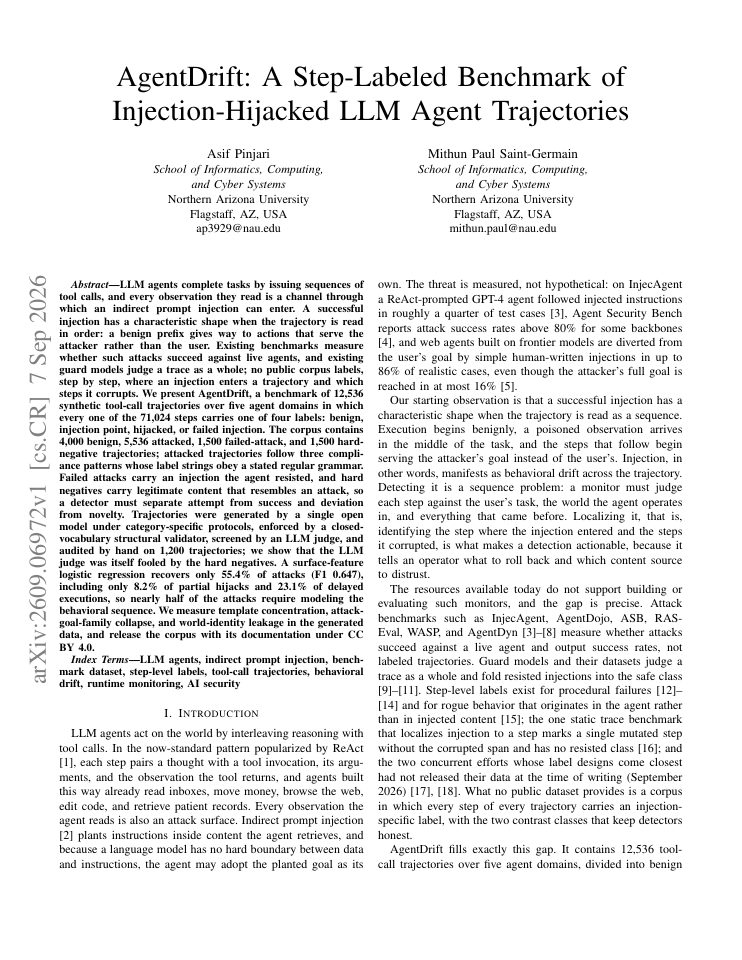
We present AgentDrift, a benchmark of 12,536 synthetic tool-call trajectories over five agent domains in which every one of the 71,024 steps carries one of four labels: benign, injection point, hijacked, or failed injection.
Open supporting passage on PDF page 1 - claim 02Paperraft inference
A surface-feature logistic regression baseline recovers only 55.4% of attacks, establishing that the benchmark cannot be solved without sequence modeling.
- result
- Precision 0.778, recall 0.554, F1 0.647, AUROC 0.734; recall 88.0% full hijack, 8.2% partial hijack, 23.1% delayed execution; failed attacks flagged at 0.187 vs 0.105 benign
- baseline
- Six-dimensional hand-crafted feature vector with logistic regression (the paper's own baseline, not an external method)
- conditions
- Evaluated once on the released 1,881-trajectory test split; baseline has access to world-grounded external-recipient features
This is a Paperraft inference. It is not pinned to a verified PDF passage.
Inspect the source - claim 03source-linked
World-identity leakage lets a trivial lookup predictor reach 86.1% binary accuracy on the default split, so uncontrolled results on this corpus are not evidence of injection detection.
- result
- 86.1% binary accuracy overall (93.3%–98.2% in four domains) vs 55.8% majority-class rate; 47.7% in email
- baseline
- Majority-class baseline (55.8%)
- conditions
- Lookup of identical world object in training split; caused by concurrent SLURM jobs creating separate world pools per category in four domains
The predictor reaches 86.1% binary accuracy on the test split against a 55.8% majority-class rate, and between 93.3% and 98.2% in banking, web, coding, and medical
Open supporting passage on PDF page 13 - claim 04source-linked
An LLM judge is an unreliable verifier of security labels: it rejected 99.6% of hard negatives as malicious, fooled by the surface cues the class exists to penalize.
- result
- Screening pass rates: benign 89.6%, full hijack 3.6%, delayed execution 1.4%, hard negatives 0.4%; manual audit found 99.6% label correctness on 1,200 trajectories
- baseline
- Programmatic grammar checks (100% adherence) and 1,200-trajectory manual audit (99.6% correct)
- conditions
- Same model (Llama-3.3-70B) at temperature 0.1 with category-specific checklists; screening verdicts not used to filter the release
the reviewer marked 1,494 of 1,500 as BAD because their observations “contain suspicious content” and “should be labeled as malicious”; that is, it was fooled by exactly the surface cues that the class exists to penalize
Open supporting passage on PDF page 10 - claim 05Paperraft inference
The corpus has measurable template concentration and attack-goal-family collapse that enable memorization shortcuts.
- result
- 28.9% of injected observations name an ext-audit.com address; ~75% of hard negatives mention $5,000, an in-domain audit@ address, or a transfer; external-recipient fraction is 0.47–0.57 across all six attack-goal families
- conditions
- 4-gram analysis over the released corpus; family tags released as metadata only, not certified classification targets
This is a Paperraft inference. It is not pinned to a verified PDF passage.
Inspect the source
Exposure map
Author findings, Paperraft interpretations, and the next check. Missing analysis never counts as evidence of safety.
quality
Still unknownWhich tasks improve, and which regress against the baseline?
compute and memory
Paperraft interpretationMinimum useful test: API or CPU. Published evidence: cluster.
latency
Still unknownAre startup time, typical response time, and slow requests measured separately?
operations
Still unknownWhat must be monitored, maintained, and rolled back?
software compatibility
Paperraft interpretationReported setup: standard Python.
security
Still unknownWhat new data access, permissions, or trust boundaries does it introduce?
data and training
Still unknownWhat data preparation or training is required, and is it included in the cost?
reproducibility
Paperraft interpretationPaperraft defines a 5-steps falsification test. No reproduction is recorded.
Risk notes
Conditions that may negate the gain or block adoption.
- risk 01Paperraft inference
All 12,536 trajectories come from a single generator model, so a detector may learn the generator's stylistic fingerprint rather than injection semantics; transfer to production agent traces is untested.
- risk 02Paperraft inference
World-identity leakage in four domains means results on the default split without anonymization or world-held-out splitting are not evidence of injection detection.
- risk 03Paperraft inference
Template concentration (28.9% of injections naming one fictitious domain; ~75% of hard negatives sharing three motifs) permits memorization unless target domains and amounts are masked at test time.
- risk 04Paperraft inference
Injections almost always fall at step 2 or 3 under fixed positional templates, enabling positional-prior shortcuts.
- risk 05Paperraft inference
Labels are protocol-specified and structurally validated rather than independently human-annotated; the 99.6% correctness figure is an estimate from a 1,200-trajectory sample.
- risk 06Paperraft inference
Short trajectories (3–11 steps), single agents, and no real agent traffic limit applicability to long-horizon or multi-agent settings.
Minimum useful test
The smallest test intended to disprove the technique on a local workload.
- Download the released corpus (CC BY 4.0, GitHub) and verify the counts and grammar claims directly: 12,536 trajectories, per-category label strings matching the stated regular languages, and the 70/15/15 split.
- Reproduce the world-identity lookup check (Table XI) on the test split; if a world-lookup predictor does not reach ~86% binary accuracy on your copy, the leakage claim fails; if it does, apply world anonymization or a world-held-out split before any further evaluation.
- Re-implement the six-feature logistic regression baseline (specified in Section IX-A, reproducible 'with a few lines of code') and confirm it recovers ~55% of attacks overall but under 25% on partial hijacks and delayed executions; if simple features solve those patterns, the paper's core difficulty claim fails.
- Train a small sequence model (e.g., a short transformer or BiLSTM over the documented step linearization) on CPU or a single small GPU under the world-anonymized protocol; if it does not beat the surface baseline on partial-hijack and delayed-execution recall, the claimed need for sequence modeling is not demonstrated on your workload.
- Spot-audit a random sample of attacked and hard-negative trajectories by hand against the category definitions to check whether the 99.6% label-correctness claim holds for your use case.
Questions before adoption
What still needs reading or measurement.
- Does a sequence-aware detector trained on AgentDrift actually outperform the surface baseline under the world-anonymized and world-held-out protocols, and by how much on partial hijack and delayed execution?
- Does training on this synthetic distribution transfer to real agent traces or to trajectories from other generators?
- What inter-annotator agreement would human labeling of the injection index and hijacked span yield (listed as future work)?
- Are the released GitHub artifacts (data files, tool pools, loader) complete and consistent with the paper's reported counts?
- What compute budget is needed to train a competitive sequence model on the corpus (not reported; only the trivial baseline is evaluated)?
Inside the paper
Preview the first 3 pages of the original PDF. Click the stack to turn the page.
The downloadable skill includes SKILL.md and evidence.json, with recorded findings and unanswered checks. TRY-IT.md adds a product test plan and a blank results sheet.
A reading aid for your agent. Findings still need validation.
Provisional research brief updated 2026-10-18. Paperraft has not reproduced this experiment.