For solo builders
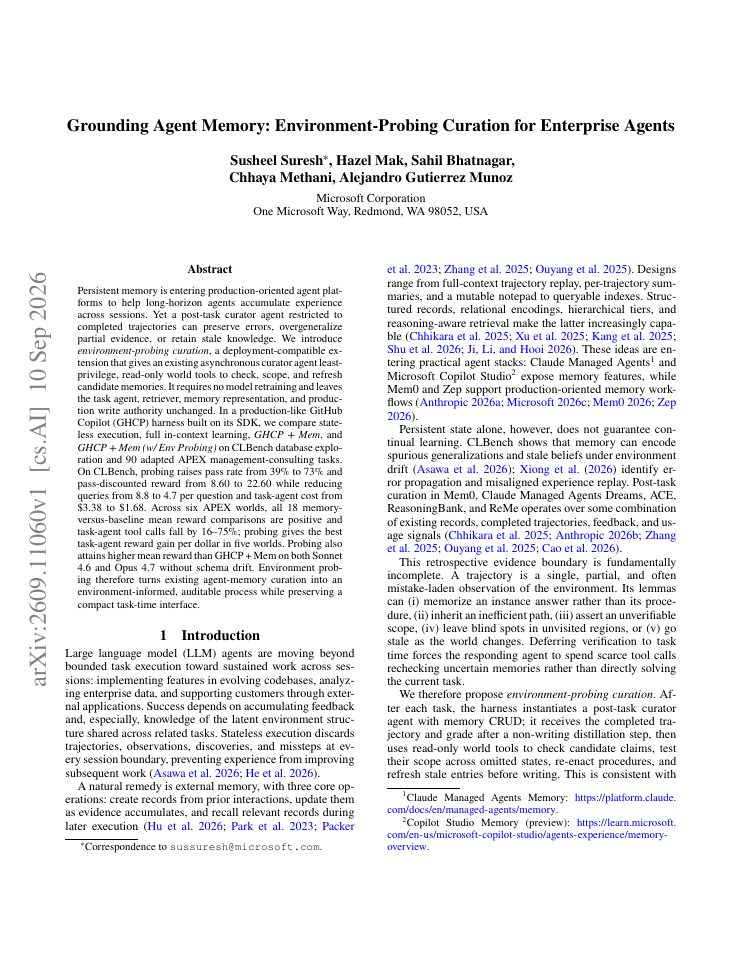
Paperraft interpretation of the full paper. The product example and test below are proposals.
Possible product use: a SaaS data assistant that repeatedly looks up the same customer tables, then makes mistakes after a schema change.
What you would change
After a task ends, a separate curator checks proposed memories with read-only tools before saving or revising them. The responding agent and its memory reader stay the same. The added work happens during memory maintenance.
Read the method in the paper ↗What the results actually say
Author-reported measurements. Differences below are calculated from the displayed values; each comparison keeps its own metric and conditions.
CLBench: the headline versus no memory
Pass rate is the share of database questions answered correctly.
- No memory
- 39%
- Memory with probing
- 73%
- Difference
- +34 percentage points
40 questions with a schema change halfway through; GPT-5.4; five paired runs.
This compares the whole memory system against no memory. It does not isolate the value of probing.
Table 1a · PDF page 5 ↗CLBench: the extra value of checking memory
Same pass metric, now against ordinary memory.
- Ordinary memory
- 70%
- Memory with probing
- 73%
- Difference
- +3 percentage points
Same 40-question experiment. Reported 95% intervals are ±16 and ±5 percentage points.
The intervals overlap. These means alone do not establish a reliable improvement from adding the checking step.
Table 1a · PDF page 5 ↗CLBench: whose cost went down?
Task-agent spending for the 40-question run, averaged across runs.
- Ordinary memory
- $1.99
- Memory with probing
- $1.68
- Difference
- -0.31 USD (-15.6%)
Task-response phase only. Distillation and memory curation are excluded.
This is not total operating cost or cost per request. Any extra maintenance cost must be counted before claiming savings.
Table 1a and caption · PDF page 5 ↗For an existing memory product, start with the comparison against ordinary memory. The no-memory headline includes the benefit of adding memory at all. The extra three percentage points do not establish a reliable product gain, and the reported task-agent bill leaves maintenance out.
Source version reviewed 2026-09-14. No experiment reproduced by Paperraft.
Try the idea on your product
A proposed first test. Set your budget and success criteria before running it.
Add a background memory checker to a sandbox copy of that assistant. Keep customer data and memory isolated. Give the checker only the read access needed to validate a record, and keep the current memory pipeline available as a fallback.
Compare against
Run three conditions: no memory, your current memory, and the same memory with checking. Keep the answering model, tools, retrieval, and task order fixed.
- Prepare 30 representative database questions with verified answers. Change a table name or data convention halfway through the sandbox sequence. Define a spending limit and an acceptable failure rate before testing.
- Run each condition from a fresh environment and empty memory. Let memory persist within a run, never between conditions. Hide future questions from the checker.
- Repeat at least three paired runs with matching question orders. Record answering, distillation, checking, and retrieval usage separately. This pilot size is a Paperraft suggestion, not the paper's evaluation protocol.
- Inspect wrong answers and the memory records that caused them. Save per-task results and check whether new records remain correct after the environment changes.
What to measure
Correct answers, unnecessary database calls, stale records, response latency, and total cost per successful task including failed attempts and all memory maintenance.
When to keep it
Keep checking only if it improves your chosen quality target at an acceptable total cost. If your goal is savings, the reduction in answering cost must exceed the added checking and maintenance cost. Use paired results to inspect variation; three pilot runs are not proof of a stable production gain.
Download test plan ↓source mappedPaperraft next step
Run the minimum useful test.
Use the test below to try to disprove the reported gain on your own workload.
The pipeline analyzed the full text and links exact excerpts when they were located. No result was reproduced. This recommendation is not a reproduced result.- minimum test setup
- API or CPU
- published evidence setup
- API or CPU
- source-linked claims
- 5 of 5
- exposure checks
- 4 of 8
Why it was shortlisted
The technical change, research area, and reason it entered the archive.
- recommendation
- test
- research area
- memory and context
- technical change
- Environment-probing curation for agent memory
- published
- 2026-09-10
The gains are large and deployment-compatible with API-based agents on constrained infrastructure, but the evidence is confined to one vendor harness and two task families, so the reader should validate on their own workload before production adoption.
About the technical core
Equations have not been fetched yet.
When reading the methods, identify the rule, algorithm, or evaluation protocol that produces the claimed change. An equation is useful here only if it explains that mechanism.
Inspect the original paperClaims and evidence
A claim is source-linked only when the PDF page and matching excerpt are available.
- claim 01source-linked
On CLBench (40-question drift schedule, GPT-5.4), environment-probed memory raises pass rate and reward over the no-memory baseline while reducing queries and cost.
- result
- Pass 39% to 73%, reward 8.60 to 22.60, queries 8.8 to 4.7/question, task-agent cost $3.38 to $1.68
- baseline
- GHCP (No Memory)
- conditions
- GPT-5.4 task/distiller/curator, CLBench 40-question drift schedule, five paired seeded runs
Pass rate rises from 39% to 61–73%, while total rewardrisesfrom8.60to20.00–22.60,or2.3–2.6×thebase- line.Thisisnotabrute-forceaccuracygain:queriesfallfrom 8.8 to 3.0–5.6 per question and task-agent cost falls from $3.38 to $1.68–$2.01.
Open supporting passage on PDF page 4 - claim 02source-linked
Environment probing improves over trajectory-only indexed memory on the same CLBench drift schedule, indicating write-time evidence quality rather than task-time capability drives the difference.
- result
- Reward 20.00 to 22.60, queries 5.6 to 4.7, cost $1.99 to $1.68
- baseline
- GHCP + Mem (trajectory-only curation)
- conditions
- GPT-5.4, identical task-time model/tools/memory interface; only curator gains read-only environment tools
Relative to trajectory-only memory, probing raises drift CLBench re- ward from 20.00 to 22.60, lowers queries from 5.6 to 4.7, and reduces task-agent cost from $1.99 to $1.68.
Open supporting passage on PDF page 5 - claim 03source-linked
On the no-drift 30-question CLBench schedule, probing achieves the highest mean reward on both Sonnet 4.6 and Opus 4.7, exceeding both paired baselines and trajectory-only memory.
- result
- Sonnet 4.6: 0.748 vs 0.673 (Mem) and 0.327 baseline; Opus 4.7: 0.721 vs 0.696 and 0.458 baseline
- baseline
- Paired GHCP (No Memory) and GHCP + Mem per model
- conditions
- Fixed canonical 30-question no-drift order, five paired runs per model-memory comparison
Sonnet 4.6 GHCP + Mem (w/ Env Probing)0.327±0.0550.748±0.030+0.421
Open supporting passage on PDF page 5 - claim 04source-linked
Across six adapted APEX worlds, all 18 memory-versus-baseline reward comparisons are positive and probing gives the best reward gain per task-agent dollar in five of six worlds.
- result
- All 18 gains positive; probing best reward/$ in 5 of 6 worlds; tool calls fall e.g. world 941eba66 from 71.6 to 19.3
- baseline
- Three-run GHCP (No Memory) per world
- conditions
- GPT-5.4, 90 adapted APEX management-consulting tasks, five runs per stateful configuration
GHCP + Mem (w/ Env Probing) achieves the best task-agent reward gain per dollar in five of six worlds (Table 2); GHCP + Mem is marginally betterintheremainingworld.
Open supporting passage on PDF page 5 - claim 05source-linked
The probing advantage is heterogeneous: probing adds little or nothing where the trajectory already supports an actionable record, and the authors treat subgroup differences as mechanism interpretation rather than established effects.
- result
- World 941eba66 changes by -0.04 for probing vs trajectory-only memory; intervals overlap
- baseline
- GHCP + Mem
- conditions
- APEX per-world comparison and no-drift cross-model comparison
while941eba66 changes by−0.04(Table 2). Its additional no-drift gain is alsolargeronSonnet(+0.075)thanonOpus(+0.025).
Open supporting passage on PDF page 6
Exposure map
Author findings, Paperraft interpretations, and the next check. Missing analysis never counts as evidence of safety.
quality
Still unknownWhich tasks improve, and which regress against the baseline?
compute and memory
Paperraft interpretationMinimum useful test: API or CPU. Published evidence: API or CPU.
latency
Still unknownAre startup time, typical response time, and slow requests measured separately?
operations
Still unknownWhat must be monitored, maintained, and rolled back?
software compatibility
Paperraft interpretationReported setup: standard Python, custom runtime.
security
Still unknownWhat new data access, permissions, or trust boundaries does it introduce?
data and training
Paperraft interpretationTraining requirement: inference only.
reproducibility
Paperraft interpretationPaperraft defines a 6-steps falsification test. No reproduction is recorded.
Risk notes
Conditions that may negate the gain or block adoption.
- risk 01Paperraft inference
All evaluation is on two benchmarks via a GitHub Copilot SDK harness; gains may not transfer to other agent stacks or task distributions.
- risk 02Paperraft inference
The improvement over plain memory is modest and confidence intervals overlap in places; in one of six APEX worlds probing was slightly worse, and the authors explicitly treat heterogeneity as unresolved.
- risk 03Paperraft inference
Requires a safe, least-privilege read-only environment surface for the curator; without one it degenerates to trajectory-only curation, and granting such access has security/auditing implications.
- risk 04Paperraft inference
Curator, distiller, and probe costs are excluded from reported task-agent cost; total system cost including curation is not the headline metric and could offset savings.
- risk 05Paperraft inference
Probing adds asynchronous compute after every task; latency and cost of the curation phase at production scale are not quantified in the main results.
- risk 06Paperraft inference
Results depend on specific frontier models (GPT-5.4, Sonnet 4.6, Opus 4.7) and benchmark graders; weaker models may not probe effectively.
Minimum useful test
The smallest test intended to disprove the technique on a local workload.
- Pick one of your own workloads with a stream of 20-40 related tasks sharing latent environment structure (e.g., recurring database or document corpus), including at least one unannounced drift event, and define a strict pass/fail grader.
- Stand up two memory pipelines that are identical in task agent, retriever, memory schema, distiller, and CRUD policy; give only one curator a least-privilege read-only subset of the environment tools plus the two probe prompt blocks from Appendix D.3.
- Run both conditions plus a no-memory baseline on the same seeded task order with a small number of runs (at least 3 paired runs), keeping task agent, model, and prompts fixed.
- Measure pass rate, task-agent tool calls, and task-agent cost, with curator/probe usage tracked separately; check whether probe curation calls stay read-only and off the task budget.
- Inspect the committed memory records in both arms: if probed records are not more executable (explicit joins, paths, current schema) than trajectory-only records, the mechanism is not operating as claimed.
- The reported gain is disproven for your workload if probing does not improve reward or tool-call count over trajectory-only memory, or if probing cost/latency erases the task-agent savings.
Questions before adoption
What still needs reading or measurement.
- What is the total end-to-end cost including distiller and curator/probe sessions, which the paper says are tracked separately but does not headline?
- How many probe calls does the curator typically make per task, and what governance prevents read-only probes from leaking information or being abused?
- Does the gain persist on non-benchmark, messier enterprise environments where read-only surfaces are incomplete?
- How sensitive are results to the curator prompt and to the embedding retriever (intfloat/e5-base-v2)?
- Would probing help when memory errors come from retrieval failure rather than record quality, which this design does not address?
Inside the paper
Preview the first 3 pages of the original PDF. Click the stack to turn the page.
The downloadable skill includes SKILL.md and evidence.json, with recorded findings and unanswered checks. TRY-IT.md adds a product test plan and a blank results sheet.
A reading aid for your agent. Findings still need validation.
Provisional research brief updated 2026-10-18. Paperraft has not reproduced this experiment.