For solo builders
Paperraft interpretation of the full paper. The product example and test below are proposals.
Possible product use: a self-hosted writing or coding assistant where output generation is a measured bottleneck.
What you would change
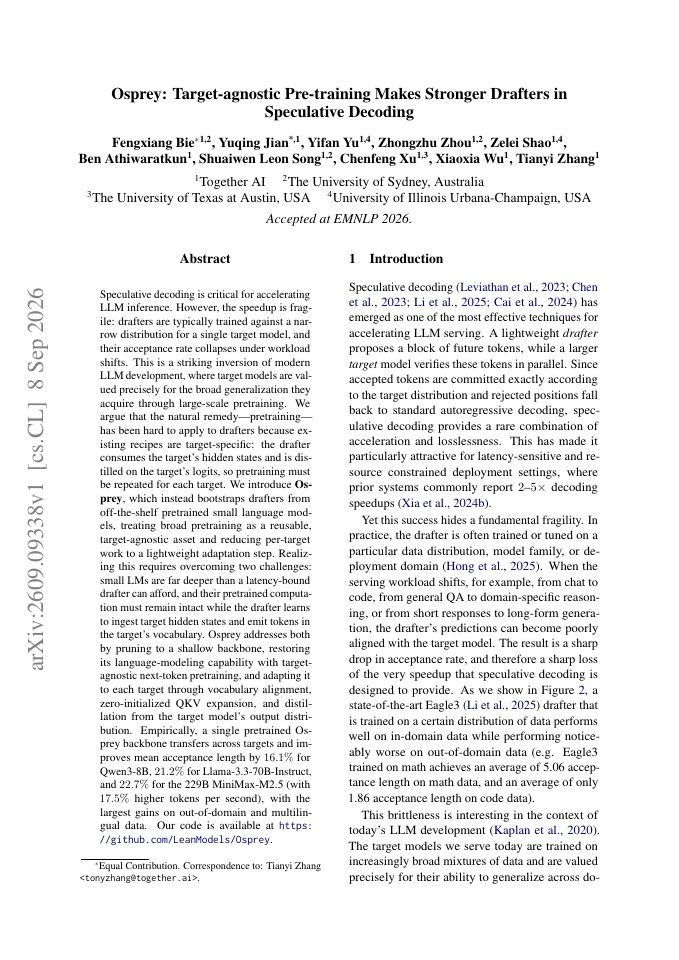
Osprey pretrains a shallow draft model, then adapts it to a target model. The target still verifies proposed tokens. Reusing a compatible checkpoint matters because the preparation stage requires substantial compute.
Read the method in the paper ↗What the results actually say
Author-reported measurements. Differences below are calculated from the displayed values; each comparison keeps its own metric and conditions.
Accepted length: a diagnostic, not app speed
Mean draft tokens accepted per verification step.
- Reproduced EAGLE-3
- 2.45 tokens/step
- Osprey
- 2.97 tokens/step
- Difference
- +0.52 tokens/step (+21.2%)
Llama-3.3-70B-Instruct, five domains; SGLang, batch 1.
Longer acceptance can help, but the draft model also takes time to run. Measure throughput separately.
Table 1 · PDF page 7 ↗Throughput: tokens generated each second
Decoding throughput measures output rate in the tested serving configuration.
- Reproduced EAGLE-3
- 155.8 tokens/s
- Osprey
- 183.7 tokens/s
- Difference
- +27.9 tokens/s (+17.9%)
Same Llama comparison and serving setup.
A throughput increase is not the same percentage reduction in response time or cost. Queueing, prompt processing, and utilization also matter.
Table 1 · PDF page 7 ↗A regression hidden by the average
MT-Bench is the conversational slice of the MiniMax comparison.
- Public EAGLE-3
- 214.4 tokens/s
- Osprey
- 201.6 tokens/s
- Difference
- -12.8 tokens/s (-6.0%)
MiniMax-M2.5, FP8, batch 1; 64 prompts in this benchmark.
Osprey is slower on this slice despite a higher overall mean. Use your own traffic mix.
Table 2 · PDF page 7 ↗Try this only after checking target and runtime compatibility. The paper evaluates Qwen, Llama, and MiniMax targets; these results do not establish support or speedups for GLM-4.7-Flash. Table 10 on page 19 reports 576–3,040 H100-hours for pretraining, before target adaptation. Hardware-hours are not a rental quote.
Source version reviewed 2026-09-14. No experiment reproduced by Paperraft.
Try the idea on your product
A proposed first test. Set your budget and success criteria before running it.
Begin with an artifact check. Verify a usable drafter for your exact target and serving version. If none exists, record the adaptation work and budget before booking GPUs; a new target is an experiment of its own.
Compare against
The same target with speculation disabled, your current drafter if present, and the candidate drafter. Keep the GPU, precision, sampling, context, and request trace fixed.
- Inspect the official repository linked by the paper for weights, license, target support, and pinned runtime instructions. Confirm whether you can reuse pretraining and what adaptation remains. Do not infer compatibility from model size.
- Save 50 held-out product prompts with realistic input and output lengths. Include an unusual-domain slice and define quality, response-time, and cost limits before running. This is a proposed pilot size.
- Once the artifact and budget checks pass, replay the same trace for each condition at low load and your expected concurrency. Repeat paired runs after warm-up, then inspect outputs for regressions.
- Record both accepted draft length and end-to-end performance. Keep preparation, adaptation, idle GPU time, and serving costs in the result sheet. Preserve a configuration that disables the drafter.
What to measure
First-token and completion latency, tokens per second, completed requests, output correctness, peak memory, and total cost per successful request. Report low-load and concurrent results separately.
When to keep it
Keep the drafter only if it improves the workload that matters while preserving quality and meeting latency limits. Divide setup cost by measured savings per request to estimate break-even traffic; if savings are zero or negative, there is no cost break-even. A pilot on another model does not validate GLM support.
Download test plan ↓source mappedPaperraft next step
Run the minimum useful test.
Use the test below to try to disprove the reported gain on your own workload.
The pipeline analyzed the full text and links exact excerpts when they were located. No result was reproduced. This recommendation is not a reproduced result.- minimum test setup
- 1 GPU, 48 to 80 GB
- published evidence setup
- cluster
- source-linked claims
- 1 of 5
- exposure checks
- 4 of 8
Why it was shortlisted
The technical change, research area, and reason it entered the archive.
- recommendation
- test
- research area
- speculative decoding
- technical change
- Target-agnostic pretrained drafters for speculative decoding
- published
- 2026-09-08
The method is directly relevant to lowering LLM serving latency on a single-GPU self-hosted stack, but its benefit depends on hidden-state access, target model choice, and workload-specific acceptance rates, so it warrants a controlled pilot rather than immediate production adoption.
Central equations
Original equations, typeset for reading. Paperraft explanations connect the mechanism, its aim, and the evidence.
Let and denote the target’s and drafter’s next-token distributions at TTT step . We train with the following discounted distillation loss, which emphasizes earlier drafting steps:
equation (5) · §3 Method · loss function
Formally, let denote either pretrained source matrix and let denote its resized counterpart. For each target token , let be the sequence obtained by tokenizing its string representation with the source tokenizer. We initialize each row as
equation (4) · §3 Method · proposed method
equations from arXiv HTML · fetched 2026-09-28
Claims and evidence
A claim is source-linked only when the PDF page and matching excerpt are available.
- claim 01Paperraft inference
Osprey improves mean accepted length over EAGLE-3 on Qwen3-8B across a 5x5 train/eval domain matrix
- result
- Osprey mean AL 3.686 vs EAGLE-3 3.176, +16.1%; higher AL for every domain pair
- baseline
- EAGLE-3 one-layer drafter trained from scratch, matched adaptation budget
- conditions
- Qwen3-8B target, five domains (chat, code, commonsense, finance, math), 65k prompts/domain, 512 held-out eval prompts/domain, SGLang batch=1, steps=5, topk=1, draft_tokens=6
This is a Paperraft inference. It is not pinned to a verified PDF passage.
Inspect the source - claim 02Paperraft inference
Gains are larger out-of-domain than in-domain on Qwen3-8B
- result
- OOD mean AL 3.493 vs 2.977 (+17.3%); ID 4.465 vs 3.971 (+12.4%); OOD/ID ratio 0.782 vs 0.750
- baseline
- EAGLE-3 one-layer drafter
- conditions
- Qwen3-8B cross-domain 5x5 evaluation, single runs per domain pair
This is a Paperraft inference. It is not pinned to a verified PDF passage.
Inspect the source - claim 03source-linked
Same backbone transfers to Llama-3.3-70B-Instruct with higher AL and throughput
- result
- Mean AL 2.97 vs 2.45 (+21.2%); throughput 183.7 vs 155.8 tok/s (+17.9%); +27.5% AL vs official EAGLE-3 checkpoint
- baseline
- Reproduced EAGLE-3 trained on same target-regenerated Open-PerfectBlend data; also official EAGLE-3 checkpoint
- conditions
- Llama-3.3-70B-Instruct target, 37.5k adaptation steps, five evaluation domains
Its mean AL and throughput are respectively 21.2% and 17.9% higher than those of our reproduced EAGLE-3 baseline, and 27.5% and 22.2% higher than those of the official EAGLE-3 checkpoint.
Open supporting passage on PDF page 7 - claim 04Paperraft inference
On MiniMax-M2.5 (229B MoE, FP8), Osprey beats the public EAGLE-3 draft on mean AL and throughput, but roughly ties on chat/commonsense
- result
- Mean AL 3.232 vs 2.634 (+22.7%); throughput 219.8 vs 187.1 TPS (+17.5%); MT-BENCH AL 2.805 vs 2.868 (Osprey lower)
- baseline
- Publicly available one-layer EAGLE-3 checkpoint (Lu et al., 2025); cost-parity not claimed
- conditions
- Code-only adaptation (70k prompts), five benchmarks with 64 prompts each, 4xB200 FP8 serving
This is a Paperraft inference. It is not pinned to a verified PDF passage.
Inspect the source - claim 05Paperraft inference
The advantage comes primarily from the pretrained prior, not from the extra layer, and most of Stage-2 benefit is captured by 10k pretraining steps
- result
- Osprey AL 3.790 vs parameter-matched 2-layer EAGLE-3 3.385 (+0.405); 10k vs 55k pretraining steps differ by only 0.026 overall AL
- baseline
- Two-layer EAGLE-3 trained from scratch, same adaptation data/optimizer/LR; 10k-step pretrained checkpoint
- conditions
- Qwen3-8B, ablation over chat/code/finance/math (16 pairs, commonsense excluded); lr=10^-5 for the budget comparison
This is a Paperraft inference. It is not pinned to a verified PDF passage.
Inspect the source
Exposure map
Author findings, Paperraft interpretations, and the next check. Missing analysis never counts as evidence of safety.
quality
Still unknownWhich tasks improve, and which regress against the baseline?
compute and memory
Paperraft interpretationMinimum useful test: 1 GPU, 48 to 80 GB. Published evidence: cluster.
latency
Still unknownAre startup time, typical response time, and slow requests measured separately?
operations
Still unknownWhat must be monitored, maintained, and rolled back?
software compatibility
Paperraft interpretationReported setup: custom runtime, distributed stack.
security
Still unknownWhat new data access, permissions, or trust boundaries does it introduce?
data and training
Paperraft interpretationTraining requirement: fine-tuning.
reproducibility
Paperraft interpretationPaperraft defines a 5-steps falsification test. No reproduction is recorded.
Risk notes
Conditions that may negate the gain or block adoption.
- risk 01Paperraft inference
Most results are single runs, not multiple seeds (stated in Limitations); small differences such as MT-BENCH ties are not statistically established.
- risk 02Paperraft inference
Osprey is not uniformly better: on MiniMax-M2.5 it is slightly worse than EAGLE-3 on MT-BENCH (2.805 vs 2.868 AL, 201.6 vs 214.4 T/s) and nearly tied on COMMONSENSE-EVAL.
- risk 03Paperraft inference
Throughput advantage narrows at larger batch sizes (24% at batch 1 down to 13% at batch 16) and degrades with sampling temperature (35% at T=1.0 vs 41% at T=0).
- risk 04Paperraft inference
Upfront pretraining cost (576-3,040 H100-hours) is only amortized under high-volume serving or multi-target reuse; the paper itself states it may not be recovered in low-traffic deployments.
- risk 05Paperraft inference
Gains depend on adapting with target-regenerated data; MiniMax-M2.5 results use code-only adaptation data, so non-code targets/domains are untested at that scale.
- risk 06Paperraft inference
Only three targets and one serving stack (SGLang) were evaluated; behavior on other targets, hardware, or verification configurations is unknown.
Minimum useful test
The smallest test intended to disprove the technique on a local workload.
- Skip the 462B-token pretraining: obtain or build a shallow pruned backbone (e.g., 2-layer Qwen3-4B) and use the authors' Stage-2 ablation insight (10k steps ≈ 576 H100-hours claimed, or reuse their released checkpoint from github.com/LeanModels/Osprey).
- Pick your actual serving target model and one workload that is out-of-domain relative to the authors' five domains (e.g., your production traffic), generate ~65k target-regenerated prompts for adaptation.
- Adapt the Osprey drafter and a from-scratch EAGLE-3 baseline on identical data and steps (authors used 2xH100 for Qwen3-8B-scale targets; an 8B target fits on 1-2 80GB GPUs).
- Serve both drafters in SGLang under your real configuration (batch size, draft tokens, temperature) on one 80GB GPU for an 8B-class target; the paper itself shows Osprey's throughput edge shrinks from 24% at batch 1 to 13% at batch 16, so test at your operating batch size.
- Measure mean accepted length and tokens/s on held-out prompts from your workload, including an OOD slice; the claim is disproven for your setting if Osprey does not beat the matched from-scratch EAGLE-3 on your OOD traffic or if the gain is smaller than the cost of adaptation.
Questions before adoption
What still needs reading or measurement.
- Whether the released code/checkpoints are sufficient to skip Stage-2 pretraining entirely and only run per-target adaptation (per-target cost ~48 H100-hours for 8B targets).
- Statistical significance of the gains, given single-run reporting; multi-seed replication needed before adoption.
- Performance at the reader's actual batch size, temperature, and draft-token count, since gains are sensitive to all three.
- Whether a much shorter pretraining (or an existing shallow model) suffices, since 10k steps already captures nearly all of the benefit.
- Adaptation cost and drafter size for the reader's target family, especially cross-tokenizer alignment quality for targets far from Qwen/Llama tokenizers.
- For the MiniMax-M2.5 comparison, the public EAGLE-3 baseline's training cost is unknown, so cost parity is unverified there.
Inside the paper
Preview the first 3 pages of the original PDF. Click the stack to turn the page.
The downloadable skill includes SKILL.md and evidence.json, with recorded findings and unanswered checks. TRY-IT.md adds a product test plan and a blank results sheet.
A reading aid for your agent. Findings still need validation.
Provisional research brief updated 2026-10-18. Paperraft has not reproduced this experiment.