Skip to content

archived edition · 2026-09-17

PaperraftFind the AI research
worth testing.

Understand what a paper changes, what it costs, and whether it fits your next build. Explore research on faster LLM inference, agent memory, and evaluation, with the original sources in reach.

Start with a brief. Follow the evidence. Choose a test.

edition
2026-09-17
briefs
43
research areas
13
independent implementations
55

15 of 43 papers in the index (35%) have no independent implementations.

Research index

Search by topic, browse a research area, or sort by date. Read a brief, open the original paper, and inspect the available evidence before deciding what to test.

showing30 of 43
sort by
First page of Procedural Graphs: Self-Evolving Execution Structures for LLM Agents
memory and contexttest

Procedural Graphs: Self-Evolving Execution Structures for LLM Agents

Replaces unconstrained next-action generation over an accumulating trajectory with an evolving (procedure, relation, procedure) graph that a guidance model turns into step-level hints biasing, but not dictating, the agent's next action. Costs an extra guidance-model call per decision step plus LLM-refiner passes that contrast failed and successful trajectories to edit the graph against a held-out validation set, adding orchestration complexity and API spend. Can fail if validation sets are small or unrepresentative, letting the refiner overfit graph edits, or if localization of the active node is wrong on long trajectories, injecting misleading guidance; the abstract reports only qualitative 'consistent gains' with no quantified improvement, so the benefit is unverified for any specific workload.
observed signal
11impl.
7stars
0citations
—claimed gain
abstract onlyReview decisionDownload skill ↓Original paper ↗
First page of The Language You Ask In: Language-Conditioned Ideological Divergence in LLM Analysis of Contested Political Documents
agent evaluationtest

The Language You Ask In: Language-Conditioned Ideological Divergence in LLM Analysis of Contested Political Documents

Replaces single-language neutrality evaluation with semantically paired prompts in different languages. It needs paired prompts and extra API calls, with human interpretation because contested questions lack a definitive answer key. The study reports that ChatGPT 5.2 and Claude Opus 4.5 adopt the prompt language's dominant framing, but examines a single Ukrainian document and does not establish generalization to other language pairs or topics.

observed signal
2impl.
0stars
0citations
—claimed gain
abstract onlyReview decisionDownload skill ↓Original paper ↗
First page of Inference-Time Graph Engineering for Multi-Agent LLM Workflows
multi-agent orchestrationtest

Inference-Time Graph Engineering for Multi-Agent LLM Workflows

ReActNet replaces static or RL-learned multi-agent topologies with a training-free compilation step that generates a sequence of directed communication graphs per query, where each edge carries a natural-language message instruction. It costs additional LLM calls for graph compilation plus multi-round structured message passing, adding latency and token spend per query and requiring controller logic to define stage graphs and aggregators. It can fail through compounding orchestration overhead on simple tasks, sensitivity to the quality of the compiled graph (poorly conditioned connectivity or edge instructions degrade reasoning), and lack of validated gains on the reader's specific workloads, since benefits are shown only on benchmark suites.

observed signal
2impl.
2stars
0citations
—claimed gain
abstract onlyReview decisionDownload skill ↓Original paper ↗
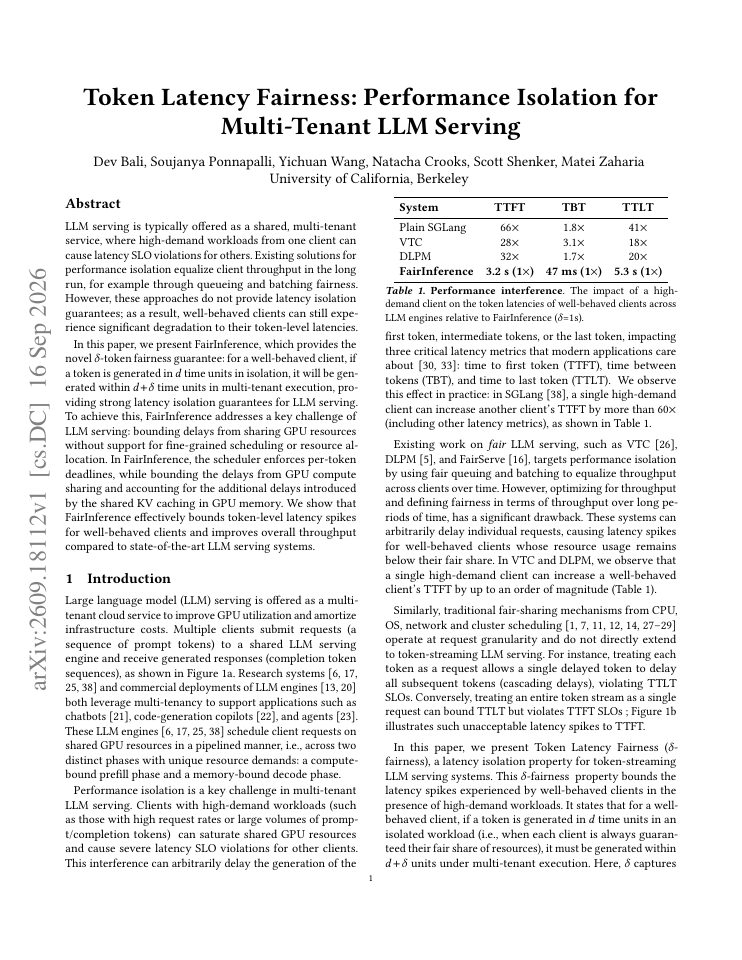
First page of Token Latency Fairness: Performance Isolation for Multi-Tenant LLM Serving
serving and batchingwatch

Token Latency Fairness: Performance Isolation for Multi-Tenant LLM Serving

FairInference replaces throughput-equalizing fair queueing and batching policies in multi-tenant LLM serving with a scheduler that enforces per-token deadlines, bounding delays from shared GPU compute and shared KV-cache memory. It costs additional scheduling complexity and per-token deadline bookkeeping, and it requires control over the serving stack rather than black-box API access. It can fail if the reader's workload is single-tenant or low-concurrency, where fairness guarantees are irrelevant and the scheduling overhead yields no benefit.

observed signal
2impl.
4stars
—citations
—claimed gain
abstract onlyReview decisionDownload skill ↓Original paper ↗
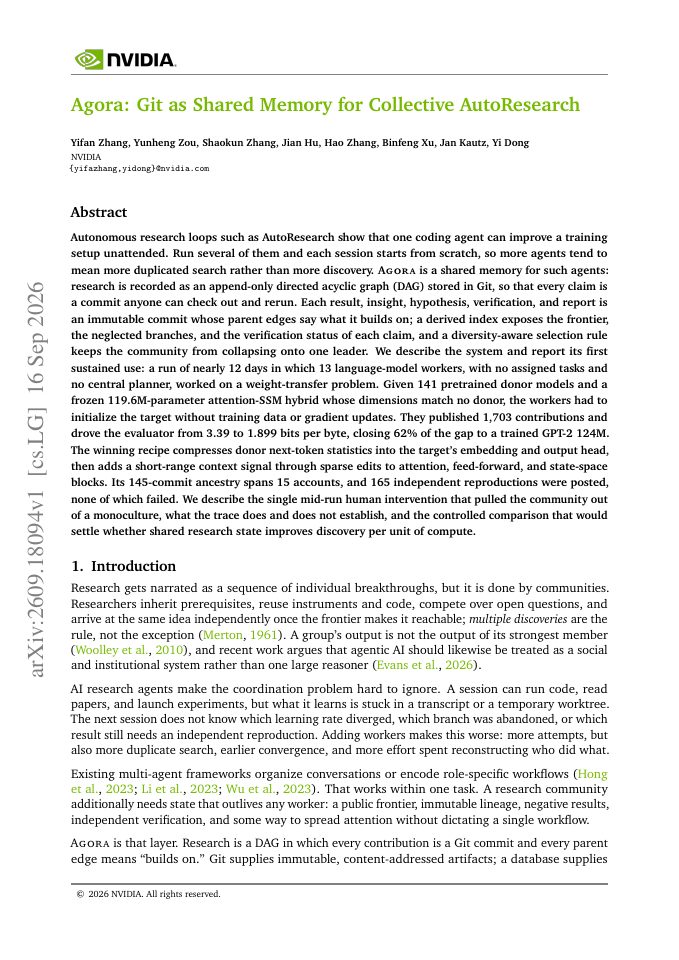
First page of Agora: Git as Shared Memory for Collective AutoResearch
multi-agent orchestrationtest

Agora: Git as Shared Memory for Collective AutoResearch

Agora replaces independent, memoryless autonomous research agent sessions with an append-only Git DAG where every claim, hypothesis, and verification is an immutable, re-runnable commit, plus a derived index and diversity-aware selection to prevent monoculture. It costs only Git infrastructure and the agent compute itself (13 LM workers for 12 days in the reported run), but adds the complexity of maintaining the commit schema, index, and selection rule, plus occasional human intervention to break monocultures. It can fail through unverified or duplicated claims accumulating in the graph, collapse of the community onto one branch absent the diversity mechanism, and the absence of evidence that it beats simply running more independent agents on the same budget.

observed signal
2impl.
13stars
—citations
—claimed gain
abstract onlyReview decisionDownload skill ↓Original paper ↗
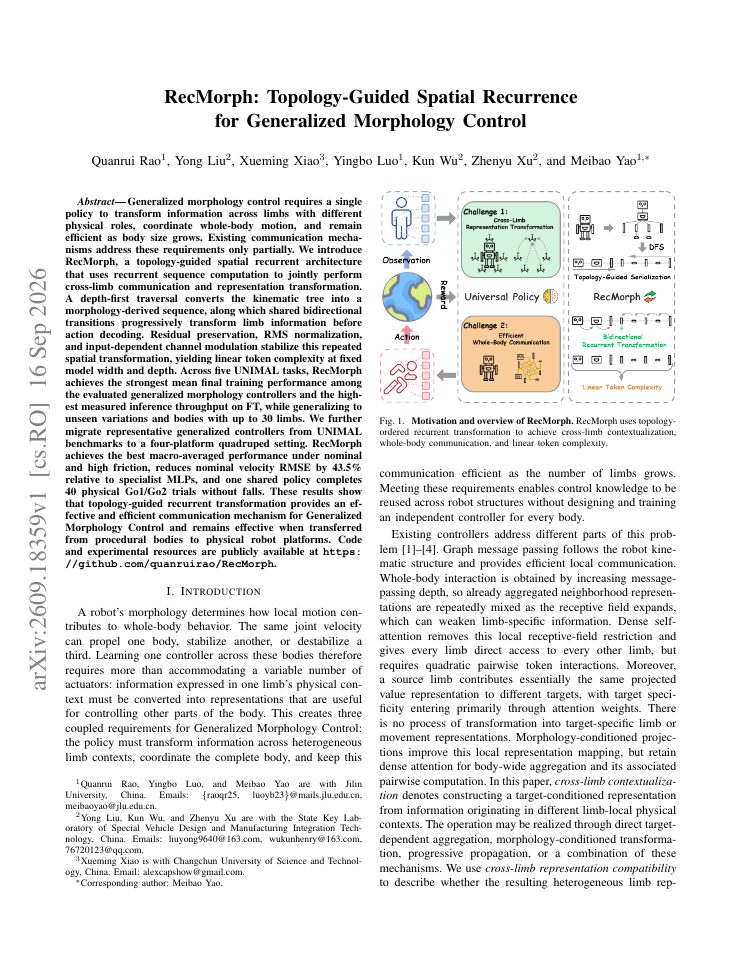
First page of RecMorph: Topology-Guided Spatial Recurrence for Generalized Morphology Control
othernot applicable

RecMorph: Topology-Guided Spatial Recurrence for Generalized Morphology Control

RecMorph replaces per-morphology specialist MLP controllers and message-passing or attention-based cross-limb communication with a single shared policy that runs bidirectional recurrent transitions along a depth-first traversal of the robot's kinematic tree. It costs recurrent sequential computation over limbs (linear in token count at fixed width and depth), plus stabilization components (residuals, RMSNorm, input-dependent channel modulation), and requires reinforcement-learning training on procedural or physical robot platforms. It can fail when deployed morphologies differ structurally from training bodies beyond the demonstrated 30-limb range, when sim-to-real transfer gaps exceed those observed on Go1/Go2, and it has no demonstrated relevance outside robot locomotion and morphology control.

observed signal
1impl.
5stars
—citations
1.77xclaimed gain
abstract onlyReview decisionDownload skill ↓Original paper ↗
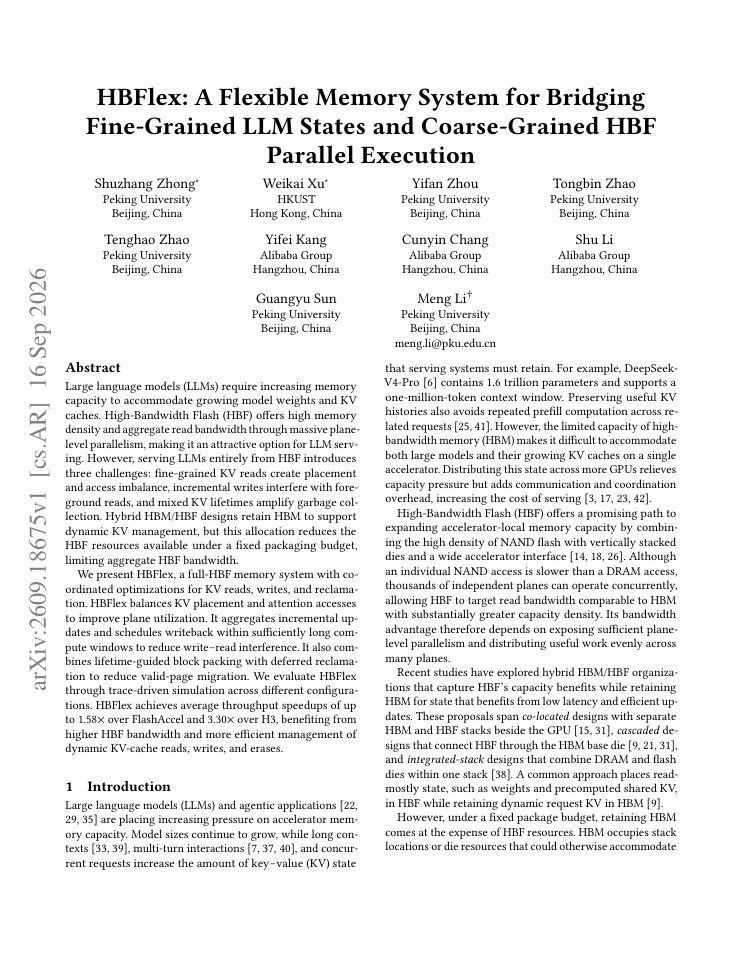
First page of HBFlex: A Flexible Memory System for Bridging Fine-Grained LLM States and Coarse-Grained HBF Parallel Execution
memory and contextwatch

HBFlex: A Flexible Memory System for Bridging Fine-Grained LLM States and Coarse-Grained HBF Parallel Execution

HBFlex replaces hybrid HBM/HBF KV-cache placement (and baselines such as FlashAccel and H3) with a full-HBF design that balances KV placement across flash planes, batches incremental writes into compute windows, and defers garbage collection using lifetime-guided block packing. The cost is dependence on HBF hardware that is not commercially available to the reader, plus substantial systems complexity in placement, writeback scheduling, and reclamation logic, with results demonstrated only in trace-driven simulation rather than on a deployed serving stack. It can fail if real workload traces diverge from simulated ones, if write-read interference is underestimated under bursty decode traffic, or if HBF endurance and garbage-collection overheads prove worse in production silicon.

observed signal
1impl.
5stars
—citations
3.3xclaimed gain
abstract onlyReview decisionDownload skill ↓Original paper ↗
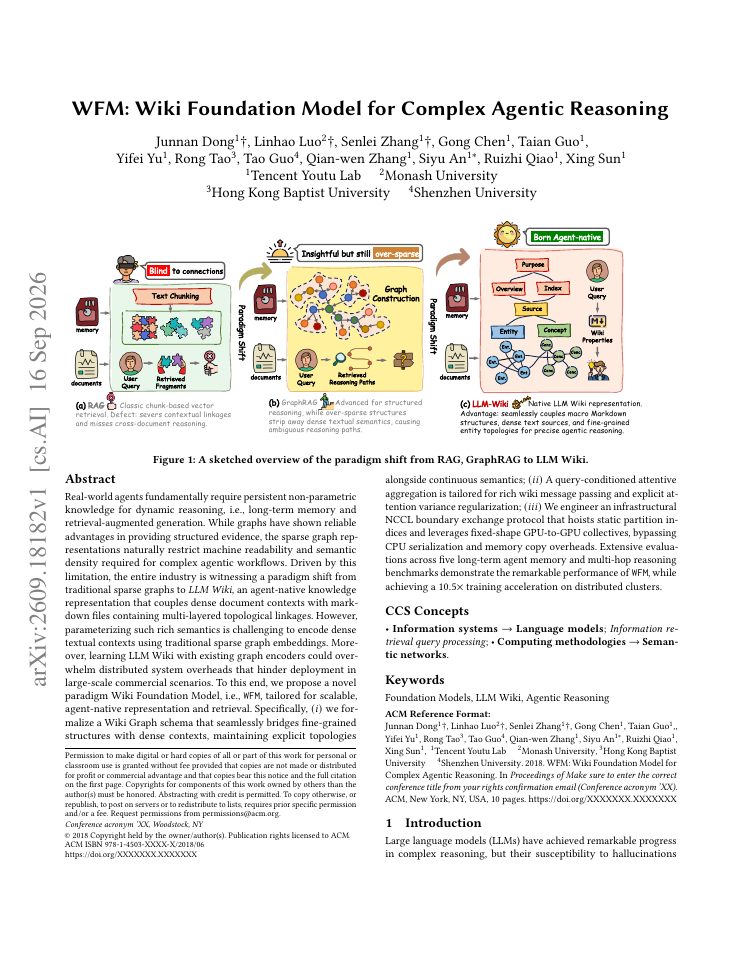
First page of WFM: Wiki Foundation Model for Complex Agentic Reasoning
memory and contextwatch

WFM: Wiki Foundation Model for Complex Agentic Reasoning

Replaces sparse knowledge-graph embeddings for LLM-Wiki agent memory with a learned query-conditioned attentive encoder over a Wiki Graph schema. Costs include training a foundation model that requires distributed multi-GPU clusters with NCCL collectives, which exceeds a single 24 GB GPU and a limited cloud budget. Can fail if benchmark gains do not transfer to the reader's corpus, and no released inference-cost or serving data confirms deployability at small scale.

observed signal
3impl.
134stars
—citations
10.5xclaimed gain
abstract onlyReview decisionDownload skill ↓Original paper ↗
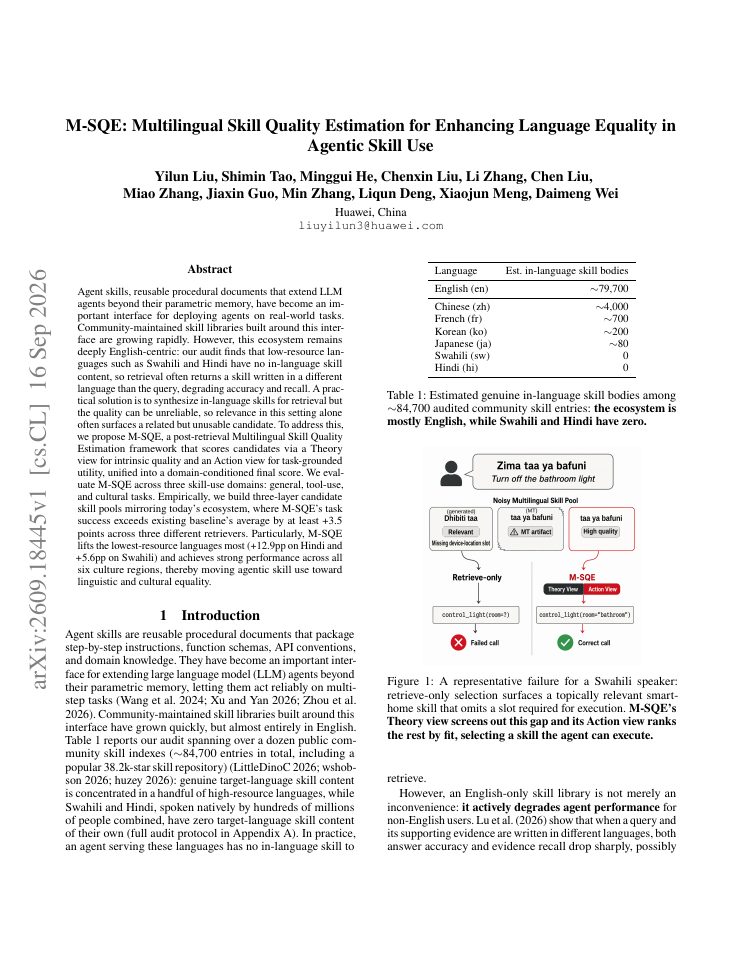
First page of M-SQE: Multilingual Skill Quality Estimation for Enhancing Language Equality in Agentic Skill Use
retrieval and RAGtest

M-SQE: Multilingual Skill Quality Estimation for Enhancing Language Equality in Agentic Skill Use

M-SQE replaces relevance-only ranking of retrieved agent skills with a post-retrieval scoring stage that combines an intrinsic-quality Theory view and a task-grounded Action view into a domain-conditioned score. It costs an additional scoring pass per retrieved candidate, increasing latency and LLM/API call volume, and requires maintaining a candidate skill pool and the scoring prompts or models. It can fail when the quality estimator misjudges synthesized in-language skills, when domains outside the three evaluated ones do not fit the conditioning, or when the underlying skill library lacks any viable candidate to resurface.

observed signal
3impl.
135stars
—citations
—claimed gain
abstract onlyReview decisionDownload skill ↓Original paper ↗
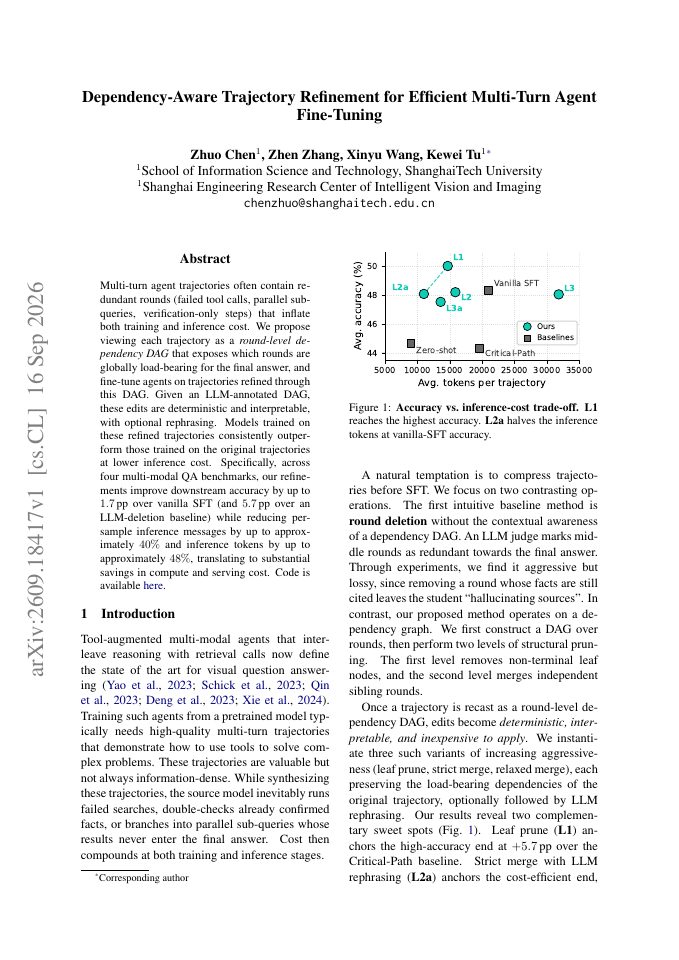
First page of Dependency-Aware Trajectory Refinement for Efficient Multi-Turn Agent Fine-Tuning
efficient trainingtest

Dependency-Aware Trajectory Refinement for Efficient Multi-Turn Agent Fine-Tuning

The method replaces fine-tuning on raw multi-turn agent trajectories with fine-tuning on trajectories pruned via an LLM-annotated round-level dependency DAG that removes redundant rounds such as failed tool calls, parallel sub-queries, and verification-only steps. The cost is an extra offline annotation and refinement pipeline (LLM calls to construct the DAG, plus optional rephrasing), with no added inference-time overhead and roughly 40% fewer inference tokens for the deployed agent. It can fail if the LLM annotator misidentifies which rounds are load-bearing and deletes context the model actually needed, if the benchmark gains do not transfer to the reader's domain, or if the training distribution becomes mismatched with the longer, noisier trajectories seen at deployment.

observed signal
3impl.
136stars
—citations
—claimed gain
abstract onlyReview decisionDownload skill ↓Original paper ↗
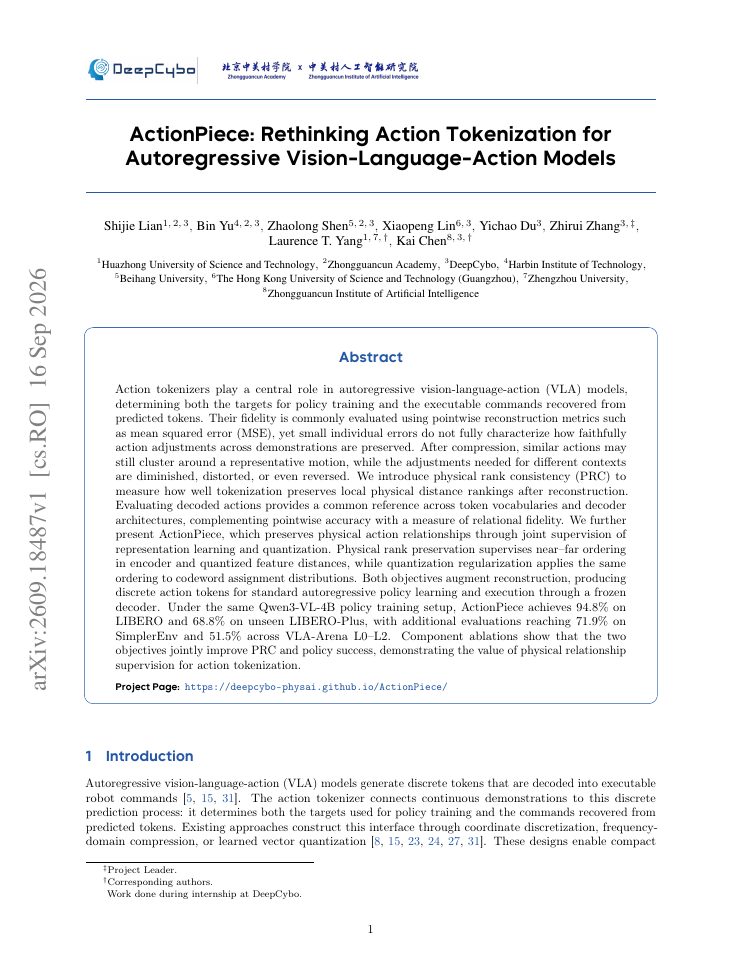
First page of ActionPiece: Rethinking Action Tokenization for Autoregressive Vision-Language-Action Models
othertest

ActionPiece: Rethinking Action Tokenization for Autoregressive Vision-Language-Action Models

It replaces standard reconstruction-only action tokenizers (e.g., vanilla VQ tokenizers for autoregressive VLA policies) with a tokenizer trained jointly on reconstruction, physical rank preservation between encoder and quantized feature distances, and ordering-aware regularization of codeword assignments, plus the PRC metric as an evaluation complement to MSE. The cost is a more complex tokenizer training pipeline with two additional losses and hyperparameters, while policy training and inference remain unchanged since the decoder is frozen and the output is standard discrete tokens. It can fail if the rank-preservation weights are miscalibrated and degrade reconstruction fidelity, if the ranking supervision does not transfer to action distributions or robot morphologies outside the evaluated benchmarks, or if the absolute success rates reflect the specific Qwen3-VL-4B setup rather than a tokenizer-intrinsic gain.

observed signal
2impl.
230stars
—citations
—claimed gain
abstract onlyReview decisionDownload skill ↓Original paper ↗
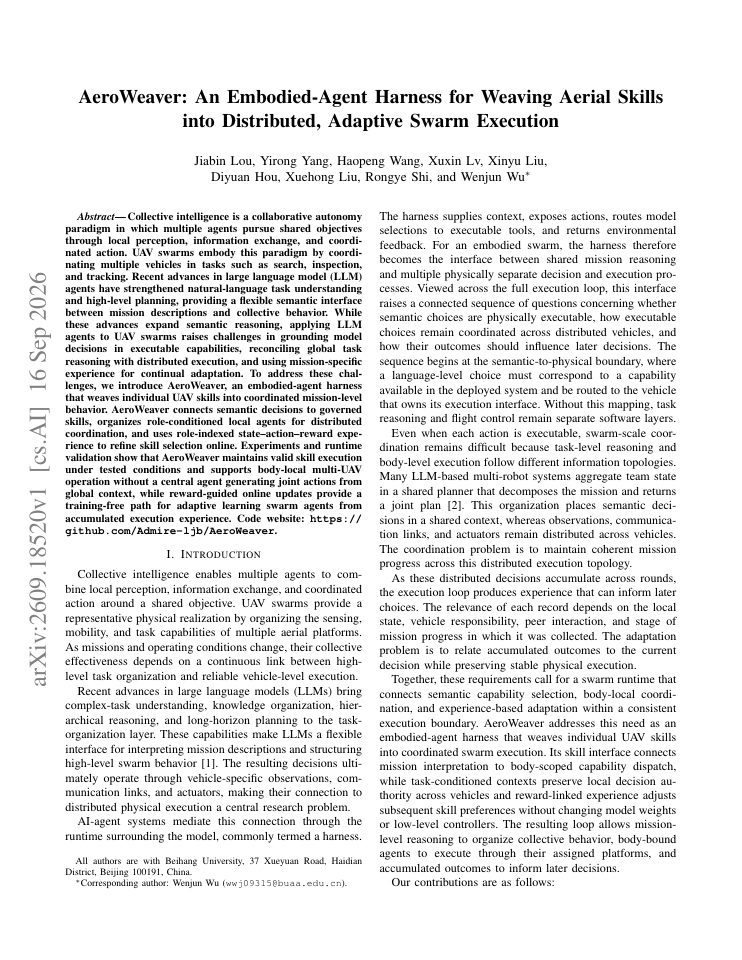
First page of AeroWeaver: An Embodied-Agent Harness for Weaving Aerial Skills into Distributed, Adaptive Swarm Execution
multi-agent orchestrationnot applicable

AeroWeaver: An Embodied-Agent Harness for Weaving Aerial Skills into Distributed, Adaptive Swarm Execution

AeroWeaver replaces a centralized agent that generates joint actions from global context with role-conditioned body-local agents, governed skill grounding, and reward-guided training-free online skill-selection updates for UAV swarms. The cost is the integration and maintenance of a skill library, role conditioning, and per-agent state-action-reward experience indexing, plus LLM inference latency or API dependency at runtime. It can fail if mission conditions deviate from the tested ones (valid execution is only claimed 'under tested conditions'), if the governed skill set lacks coverage for emergent mission needs, or if reward signals misguide online adaptation in distributed settings without global context.

observed signal
3impl.
347stars
—citations
—claimed gain
abstract onlyReview decisionDownload skill ↓Original paper ↗
First page of Machine Translation between English and Syriac (East Syriac Dialect) using Statistical Machine Learning
othernot applicable

Machine Translation between English and Syriac (East Syriac Dialect) using Statistical Machine Learning

The method replaces the absence of any English-Syriac MT system with a Moses phrase-based SMT pipeline trained on a new 38,847-pair Biblical corpus with diacritic removal and BPE. It costs little compute but requires corpus construction, manual alignment by bilingual annotators, and per-configuration tuning of language model order, distortion limits, and OSM inclusion. Quality is limited to BLEU 23.54 with middling human scores, the Biblical domain will not transfer to general text, and neural or API-based translation will typically outperform phrase-based SMT where any neural coverage exists.

observed signal
2impl.
125stars
—citations
—claimed gain
abstract onlyReview decisionDownload skill ↓Original paper ↗
First page of Symbolic Temporal Supervision of LLM Agents Using Contracts
safety and guardrailstest

Symbolic Temporal Supervision of LLM Agents Using Contracts

It replaces stochastic post-hoc LLM judges and per-call rule-based blockers with a single deterministic artifact: assume-guarantee contracts in finite-trace LTL, compiled to DFAs that gate tool calls online and evaluate recorded traces offline. The cost is engineering effort, not compute: someone must formalize checkable predicates over tool calls and author and maintain a correct contract library per task domain, plus DFA compilation overhead. It can fail when contracts are incomplete, wrongly specified, or the predicate set cannot observe the relevant state, in which case harmful actions pass deterministically or benign ones are blocked, and coverage does not transfer across domains without rewriting contracts.

observed signal
1impl.
14stars
—citations
—claimed gain
abstract onlyReview decisionDownload skill ↓Original paper ↗
First page of DualSQL: Text-to-SQL with Multi-Agent Reinforcement Learning
multi-agent orchestrationwatch

DualSQL: Text-to-SQL with Multi-Agent Reinforcement Learning

DualSQL replaces the standard practice of training separate models for schema linking and SQL generation with two agents sharing one backbone, jointly optimized via multi-agent reinforcement learning with database access tools, rollout guardrails, and a new REX correctness metric for reward assignment. The cost is a full RL training pipeline: rollouts against live databases, reward computation via execution, guardrail machinery to prevent model collapse, and the engineering complexity of maintaining the agentic scaffold, none of which is an inference-time or API-level adoption. Failure modes include training instability and model collapse despite guardrails, reward misspecification from the REX metric, and database-dependent rollout costs that make iteration slow and expensive.

observed signal
1impl.
14stars
—citations
—claimed gain
abstract onlyReview decisionDownload skill ↓Original paper ↗
First page of Who Audits Whom, on What Substrate, with What Evidence? An Independence-Graded Audit Protocol for Agentic AI
safety and guardrailstest

Who Audits Whom, on What Substrate, with What Evidence? An Independence-Graded Audit Protocol for Agentic AI

It replaces the binary internal/external audit-independence check with a three-axis grading scheme (principal, substrate, evidence independence) aggregated by weakest link, plus a beta-factor common-cause failure model and a seven-step verifiable protocol. It costs analyst effort rather than GPU or API budget: applying the rubric, collecting attestable rather than self-reported evidence, and optionally engaging a substrate-independent auditor. It can fail if substrate independence cannot actually be procured (a small team may only afford auditors built on the same foundation model the rubric flags), if the beta-factor calibration is wrong for a given deployment, or if the graded score is treated as compliance proof rather than a diagnostic.

observed signal
1impl.
14stars
—citations
—claimed gain
abstract onlyReview decisionDownload skill ↓Original paper ↗
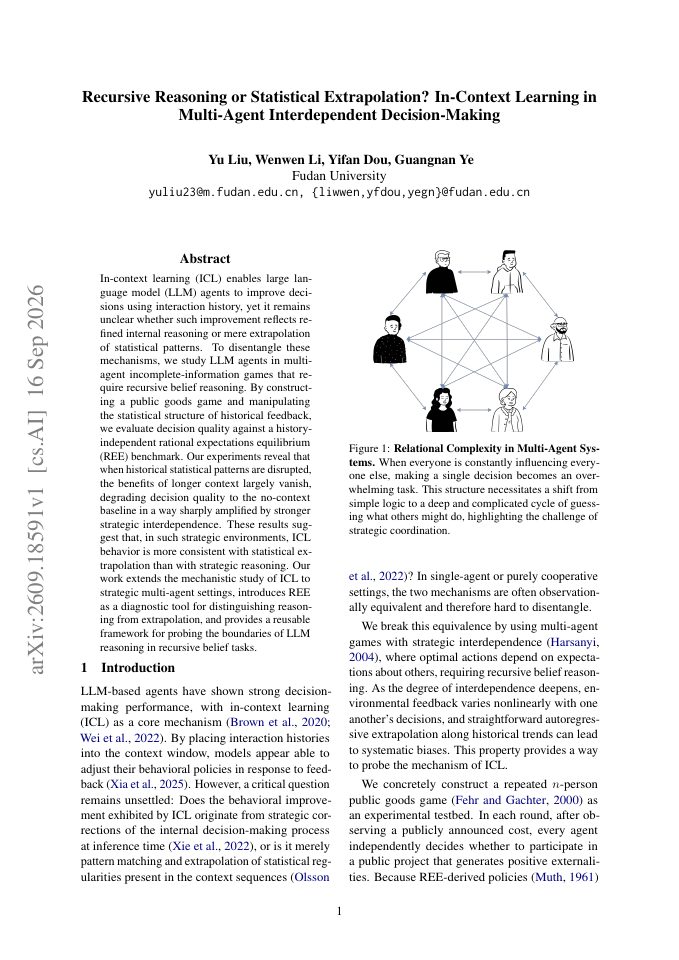
First page of Recursive Reasoning or Statistical Extrapolation? In-Context Learning in Multi-Agent Interdependent Decision-Making
agent evaluationtest

Recursive Reasoning or Statistical Extrapolation? In-Context Learning in Multi-Agent Interdependent Decision-Making

The paper replaces the assumption that longer interaction history improves LLM agent decisions in strategic multi-agent settings with a rational expectations equilibrium diagnostic that distinguishes genuine recursive belief reasoning from statistical extrapolation. It costs only the effort of constructing history-disruption experiments around an existing game or workflow; no additional inference, training, or hardware is required. Its scope is limited to stylized incomplete-information games, so conclusions may not transfer to concrete production tasks such as negotiation or pricing agents, and adopting it does not itself yield any decision-quality improvement.

observed signal
1impl.
14stars
—citations
—claimed gain
abstract onlyReview decisionDownload skill ↓Original paper ↗
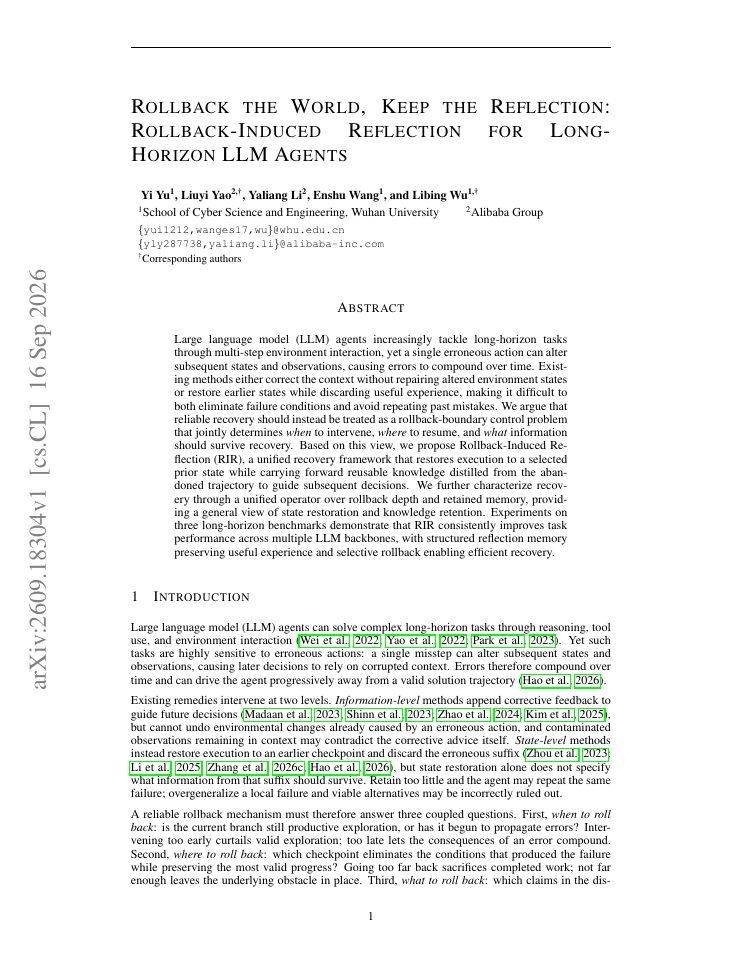
First page of Rollback the World, Keep the Reflection: Rollback-Induced Reflection for Long-Horizon LLM Agents
failure recoverytest

Rollback the World, Keep the Reflection: Rollback-Induced Reflection for Long-Horizon LLM Agents

RIR replaces ad-hoc failure handling that either patches the context without restoring environment state or reverts state while discarding everything learned, by jointly choosing when to intervene, which prior state to resume from, and what distilled reflection to carry forward. It costs an additional reflection/distillation pass (extra LLM calls per recovery event), a checkpointable environment with state snapshots, and memory for structured reflection, all of which are feasible on API-based agents but require engineering for rollback boundaries. It can fail when the environment is not checkpointable or reversible (e.g., irreversible API side effects), when rollback-boundary selection is miscalibrated and discards valid progress, or when distilled reflections preserve incorrect lessons and bias subsequent decisions.

observed signal
2impl.
134stars
—citations
—claimed gain
abstract onlyReview decisionDownload skill ↓Original paper ↗
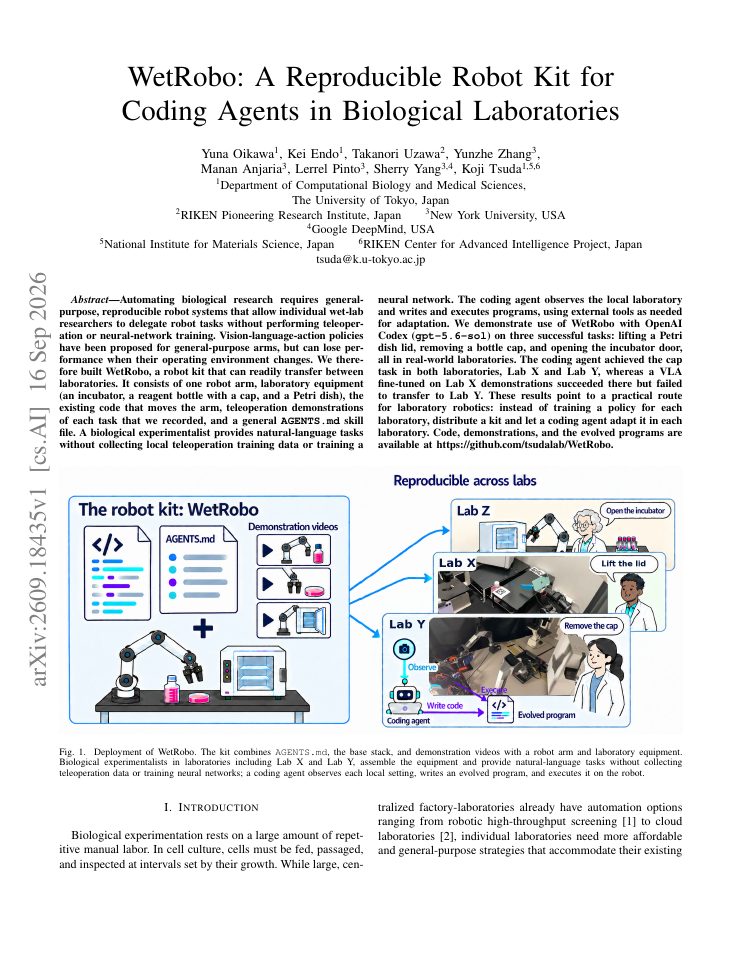
First page of WetRobo: A Reproducible Robot Kit for Coding Agents in Biological Laboratories
coding agentswatch

WetRobo: A Reproducible Robot Kit for Coding Agents in Biological Laboratories

The method replaces per-laboratory teleoperation data collection and VLA policy training with a distributable hardware-plus-code kit whose arm programs are written and adapted on-site by a coding agent using an AGENTS.md skill file. It costs dependence on a frontier coding model API, the physical WetRobo hardware (arm, incubator, bottle, Petri dish), and per-site agent adaptation time, with no neural-network training budget required. It can fail on tasks beyond the three demonstrated manipulation primitives, when agent-generated code produces unsafe or unsuccessful motions in unstructured settings, or if API access or model behavior changes, and only single-run successes are reported rather than reliability rates.

observed signal
2impl.
134stars
—citations
—claimed gain
abstract onlyReview decisionDownload skill ↓Original paper ↗
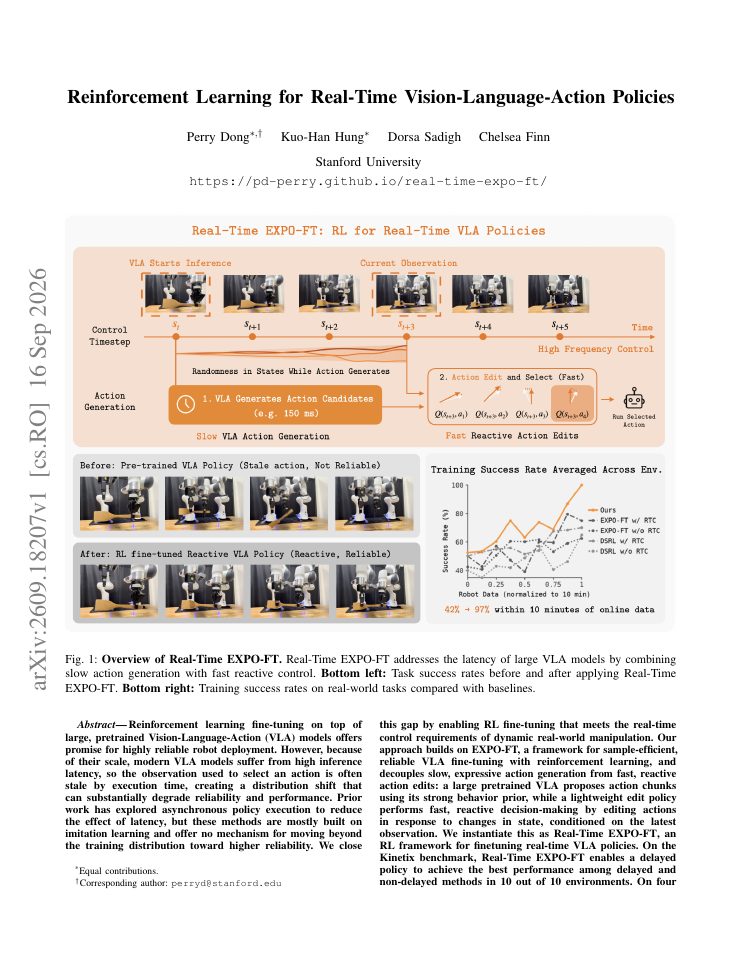
First page of Reinforcement Learning for Real-Time Vision-Language-Action Policies
otherwatch

Reinforcement Learning for Real-Time Vision-Language-Action Policies

The method replaces monolithic, latency-bound VLA inference with a decoupled design in which a large pretrained VLA proposes action chunks while a lightweight RL-fine-tuned edit policy reactively corrects actions using the latest observation. Costs include maintaining two models, RL fine-tuning infrastructure (based on EXPO-FT), online robot data collection, and the added system complexity of asynchronous chunk-plus-edit execution. Failures can arise if the edit policy overcorrects or destabilizes the VLA's behavior prior, if state observations remain noisy or delayed beyond what the edit policy can compensate for, or if the 10-minute online data budget proves insufficient for tasks with dynamics different from the four demonstrated.

observed signal
2impl.
227stars
—citations
—claimed gain
abstract onlyReview decisionDownload skill ↓Original paper ↗
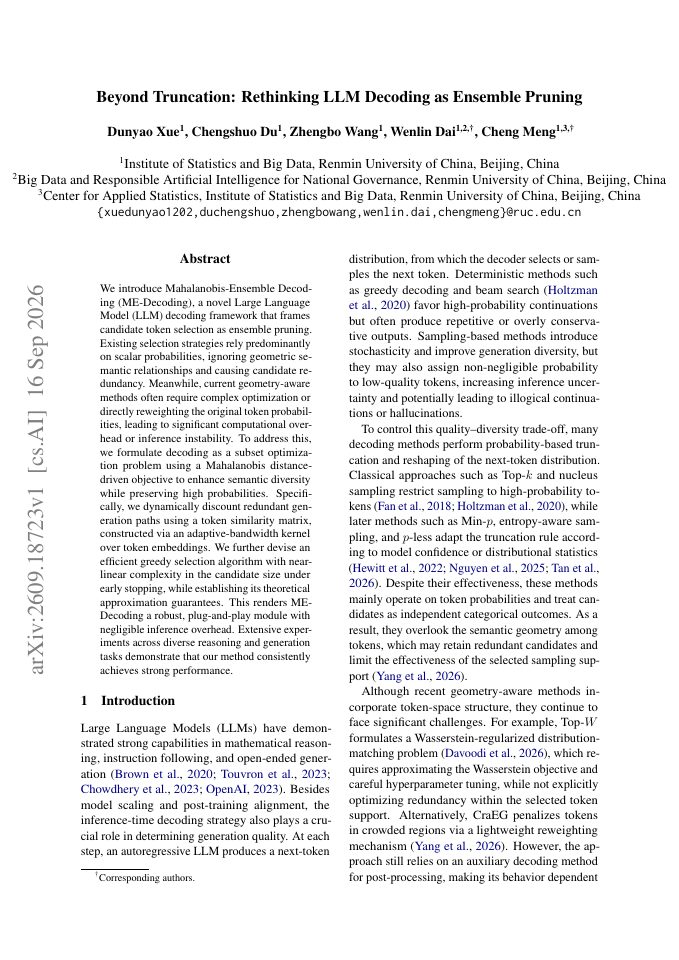
First page of Beyond Truncation: Rethinking LLM Decoding as Ensemble Pruning
othertest

Beyond Truncation: Rethinking LLM Decoding as Ensemble Pruning

ME-Decoding replaces probability-only candidate selection (e.g., top-k/top-p truncation and geometry-aware reweighting) with greedy subset pruning that discounts redundant token candidates using a Mahalanobis-distance similarity kernel over token embeddings, while leaving original probabilities otherwise intact. It costs access to token embeddings, construction of a candidate similarity matrix per step, and a near-linear greedy selection pass, which the authors describe as negligible inference overhead, but it adds implementation complexity and depends on embedding quality and kernel bandwidth calibration. It can fail through mis-tuned adaptive bandwidths that over-prune useful candidates or under-prune redundancy, degraded stability on out-of-distribution tasks, and the risk that reported gains do not transfer to the reader's specific models and workloads.

observed signal
1impl.
120stars
—citations
—claimed gain
abstract onlyReview decisionDownload skill ↓Original paper ↗
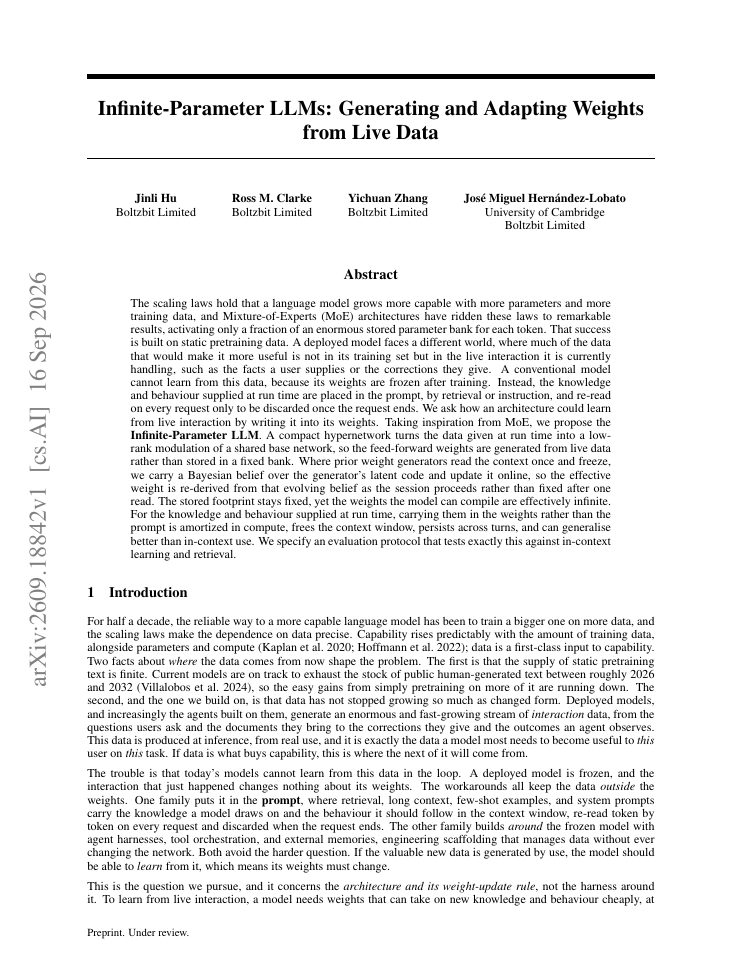
First page of Infinite-Parameter LLMs: Generating and Adapting Weights from Live Data
memory and contextwatch

Infinite-Parameter LLMs: Generating and Adapting Weights from Live Data

The method replaces runtime prompt-based knowledge injection (retrieval or instruction re-read each request) with a hypernetwork that compiles session data into low-rank modulations of a shared base network, updated online via a Bayesian belief over the generator's latent code. It costs a hypernetwork and online belief-update machinery on top of the base model, adding inference-time adaptation complexity and training burden for the weight generator itself. It can fail because the abstract presents no empirical results, offers only an evaluation protocol, and online weight updates risk catastrophic interference with base-model behaviour and unvalidated reliability in production.

observed signal
1impl.
121stars
—citations
—claimed gain
abstract onlyReview decisionDownload skill ↓Original paper ↗
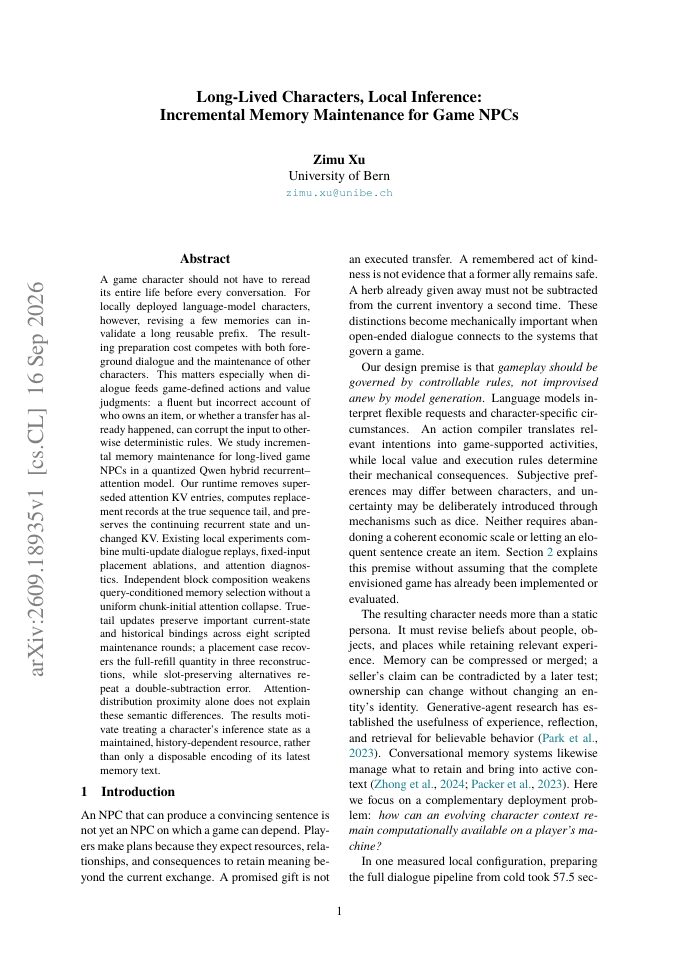
First page of Long-Lived Characters, Local Inference: Incremental Memory Maintenance for Game NPCs
memory and contexttest

Long-Lived Characters, Local Inference: Incremental Memory Maintenance for Game NPCs

The method replaces full prefix recomputation when an NPC's memory changes: it surgically removes superseded KV entries, computes replacement records at the true sequence tail, and reuses the continuing recurrent state and untouched KV instead of re-encoding the entire memory text. The cost is implementation complexity tied to a specific quantized Qwen hybrid recurrent-attention architecture, plus the risk that incorrect placement weakens query-conditioned memory selection, as shown by the block-composition and slot-preserving ablations. After adoption it can fail silently on semantics rather than attention statistics: wrong update placement reproduced a double-subtraction error in ownership tracking, which can corrupt deterministic game rules that consume the dialogue output.

observed signal
1impl.
121stars
—citations
—claimed gain
abstract onlyReview decisionDownload skill ↓Original paper ↗
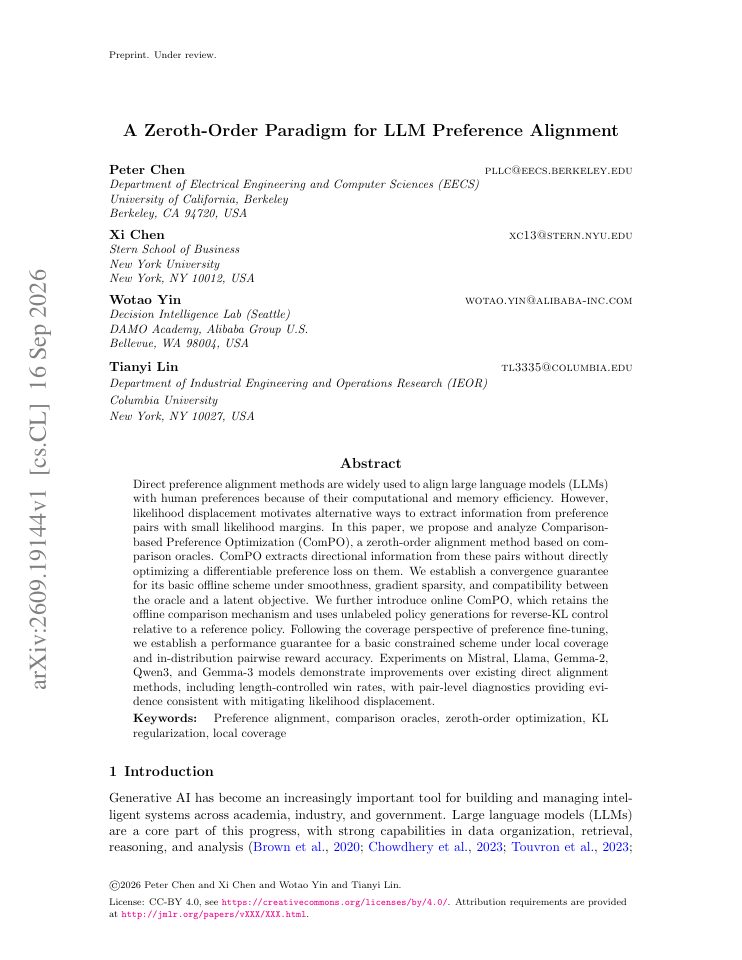
First page of A Zeroth-Order Paradigm for LLM Preference Alignment
efficient trainingtest

A Zeroth-Order Paradigm for LLM Preference Alignment

ComPO replaces differentiable preference losses such as DPO with a zeroth-order scheme that extracts directional updates from pairwise comparison oracles, plus an online variant using unlabeled generations for reverse-KL control against a reference policy. It costs an oracle/comparison step per pair and additional implementation complexity beyond standard DPO pipelines, while claiming similar or better efficiency since no differentiable preference loss is optimized on the pairs. It can fail if the comparison oracle is incompatible with the latent reward objective, if gradient-sparsity or local-coverage assumptions do not hold on the reader's data, and the convergence and performance guarantees are conditional on those assumptions.

observed signal
1impl.
121stars
—citations
—claimed gain
abstract onlyReview decisionDownload skill ↓Original paper ↗
First page of Objective vs. Search: Decomposing What Makes a Good Tokeniser
otheradopt

Objective vs. Search: Decomposing What Makes a Good Tokeniser

The analysis replaces the default confounded choice between BPE and UnigramLM with a 2x2 decomposition (objective vs. search procedure) and two new tokenisers, BottomUpLL and TopDownComp, showing that bottom-up search, not the objective, drives better language modelling. The cost is only that of retraining a tokeniser and, if adopted, the model itself; inference cost and complexity are unchanged for the reader using standard off-the-shelf tokenisers. The finding can fail to translate into downstream task gains, since BLiMP results show no consistent effect, so grammar-sensitive or task-specific behaviour may not improve even when bits-per-byte does.

observed signal
1impl.
121stars
—citations
—claimed gain
abstract onlyReview decisionDownload skill ↓Original paper ↗
First page of The Mirage of Calibrated Confidence: Trajectory-Independence of Verbalized Confidence in Vision-Language Models
agent evaluationtest

The Mirage of Calibrated Confidence: Trajectory-Independence of Verbalized Confidence in Vision-Language Models

The method replaces sole reliance on ECE/AUROC-style calibration metrics with TGS-self and TGS-pair probes that test whether a VLM's verbalized confidence actually depends on its reasoning trajectory. It costs an additional evaluation pass: running confidence queries with and without the trajectory and scoring controlled good/bad trajectory pairs, which roughly doubles inference for the evaluated samples plus benchmark construction effort. It can fail if adopted as a training signal, since the paper itself shows calibration training can increase trajectory-independence, and verbalized-confidence fixes may not transfer across model families without revalidation.

observed signal
1impl.
124stars
—citations
—claimed gain
abstract onlyReview decisionDownload skill ↓Original paper ↗
First page of Beyond Outcomes: Dual-View Relational Learning for Efficient Agent Benchmarking
agent evaluationtest

Beyond Outcomes: Dual-View Relational Learning for Efficient Agent Benchmarking

It replaces full agent benchmark runs with a small exact-size miniset selected by jointly modeling outcome and process (trajectory) relations, from which full-benchmark scores are predicted. The cost is collecting and featurizing large-scale historical trajectories across agents, training the relational predictor, and maintaining six process signals per task. It can fail when applied to benchmarks or agents outside the training distribution, when process signals are unavailable or unlogged, and when rank-preservation degrades for novel capability regimes.

observed signal
1impl.
130stars
—citations
24xclaimed gain
abstract onlyReview decisionDownload skill ↓Original paper ↗
First page of ${M}^2$Tok: Multi-head Multi-codebook Discrete Action Tokenization for Vision-Language-Action Models
otherwatch

${M}^2$Tok: Multi-head Multi-codebook Discrete Action Tokenization for Vision-Language-Action Models

M2Tok replaces single-codebook discrete action tokenizers (e.g., VQ-style quantization of continuous robot actions) in Vision-Language-Action pipelines by splitting latent action features into multiple heads, each with its own codebook, expanding representational capacity combinatorially. The cost is training a custom tokenizer, a larger effective token vocabulary and sequence structure for the downstream autoregressive policy, and added tokenizer complexity in the inference path; absolute compute is modest, but realizing the benefit requires fine-tuning or training a VLA policy around the new tokens. It can fail if the implicit head-to-action-dimension alignment does not hold for a different action space or embodiment, if gains do not transfer outside the evaluated benchmarks, or if reconstruction improvements do not translate into policy success on the reader's specific robot tasks.

observed signal
1impl.
217stars
—citations
—claimed gain
abstract onlyReview decisionDownload skill ↓Original paper ↗
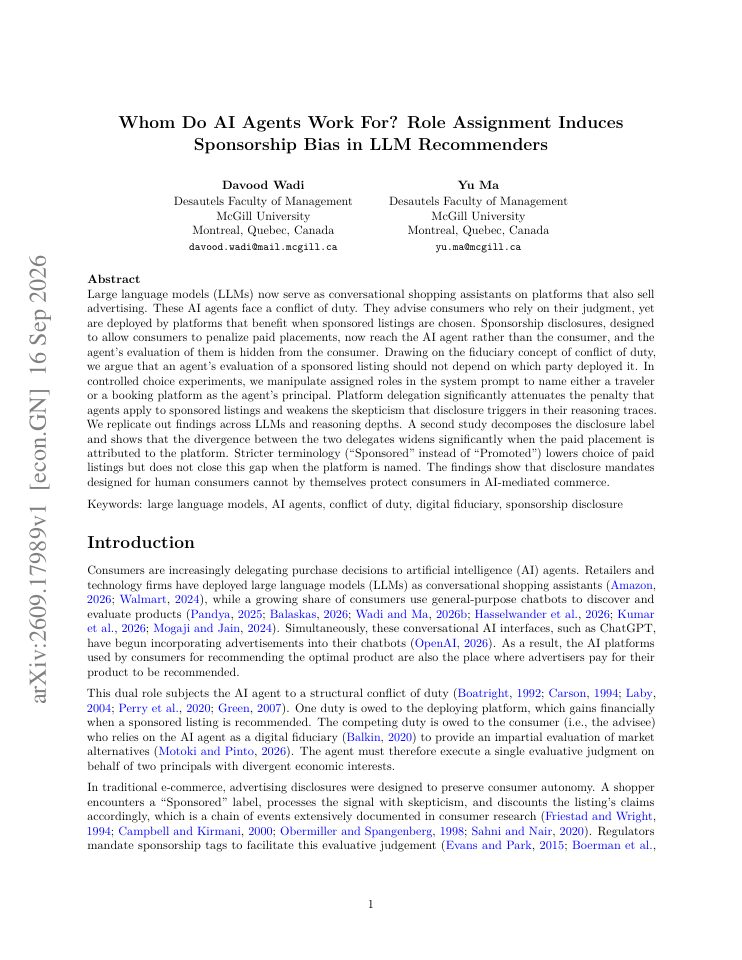
First page of Whom Do AI Agents Work For? Role Assignment Induces Sponsorship Bias in LLM Recommenders
safety and guardrailstest

Whom Do AI Agents Work For? Role Assignment Induces Sponsorship Bias in LLM Recommenders

This is a diagnostic finding rather than a new method: it shows that naming a deployer (a booking platform) as the agent's principal in the system prompt attenuates the penalty applied to sponsored listings, replacing the implicit assumption that disclosure labels alone protect consumers. The cost to the practitioner is prompt and evaluation overhead: auditing role framing, principal assignment, and disclosure wording across models and reasoning depths adds test complexity without computational expense. What can fail is that mitigation is incomplete—stricter terminology reduces but does not close the gap, and behavior varies across models, so a fix validated on one LLM may not transfer.

observed signal
0impl.
10stars
—citations
—claimed gain
abstract onlyReview decisionDownload skill ↓Original paper ↗
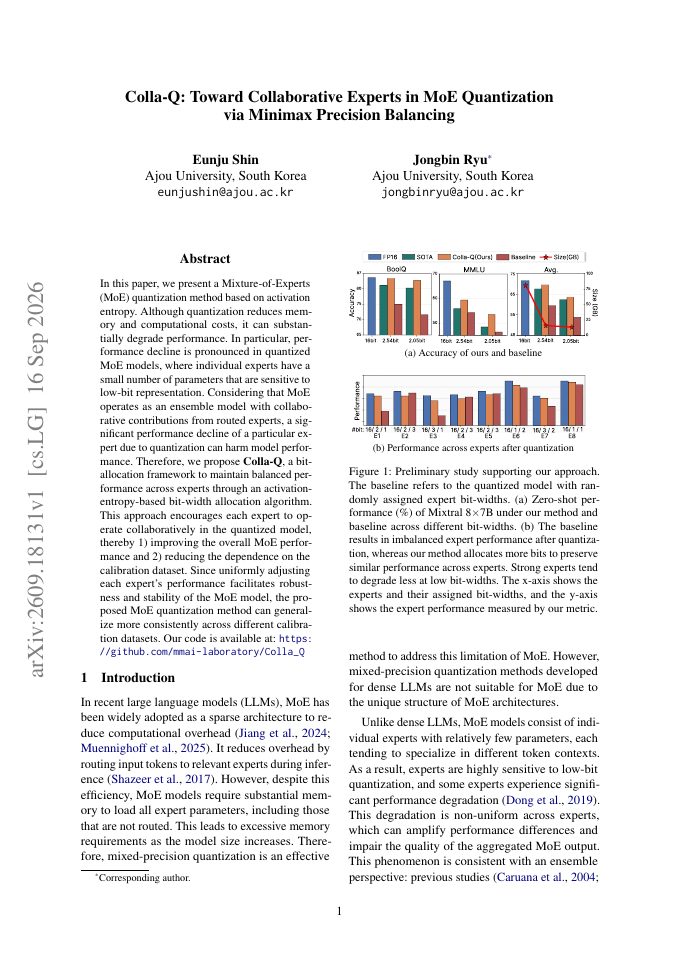
First page of Colla-Q: Toward Collaborative Experts in MoE Quantization via Minimax Precision Balancing
quantizationtest

Colla-Q: Toward Collaborative Experts in MoE Quantization via Minimax Precision Balancing

Colla-Q replaces uniform bit-width quantization of MoE experts with a minimax bit-allocation scheme that assigns precision per expert based on activation entropy, aiming to equalize per-expert degradation rather than minimize average error. It costs additional calibration and allocation logic at quantization time, yields a mixed-precision model whose average bit-width (and thus memory) depends on the budget constraint chosen, and requires implementing or adopting the authors' codebase. It can fail if the serving stack lacks efficient mixed-precision kernels (negating real memory or latency gains), if activation entropy on the calibration data poorly predicts expert sensitivity on production traffic, and if the target workload uses dense rather than MoE models, where the method does not apply.

observed signal
0impl.
4stars
—citations
—claimed gain
abstract onlyReview decisionDownload skill ↓Original paper ↗

Research signals

Three views of the same evidence: adoption against attention, publication cadence by research area, and reported gains when coverage is sufficient.

color = research area

01 · attention × adoption

The research frontier

Look to the upper left for independent implementation before mass attention.

compare by
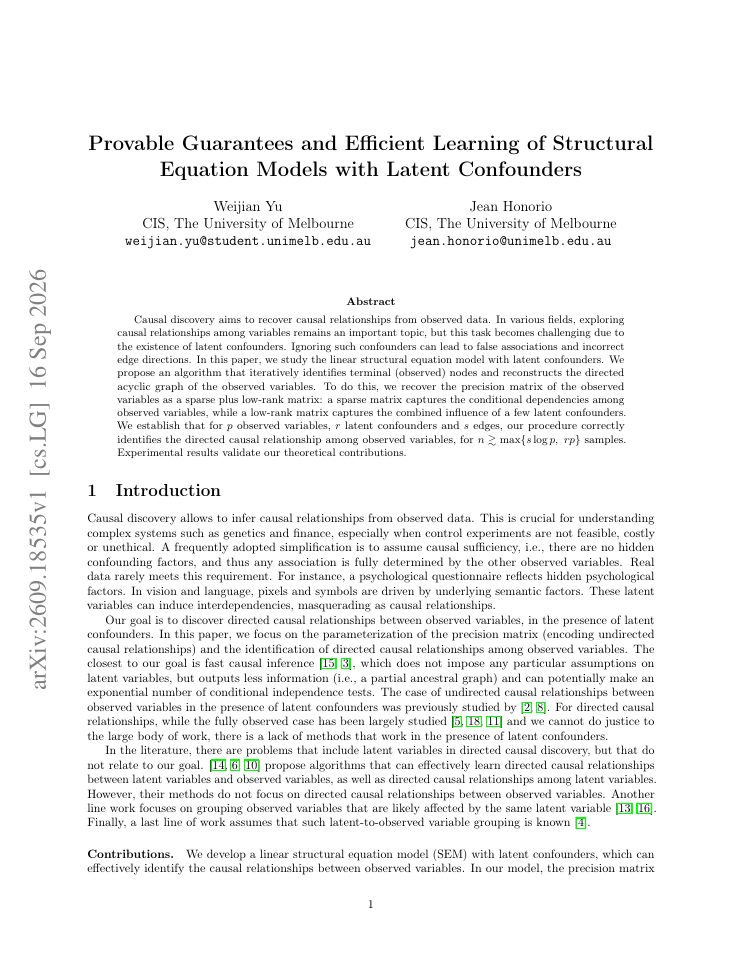
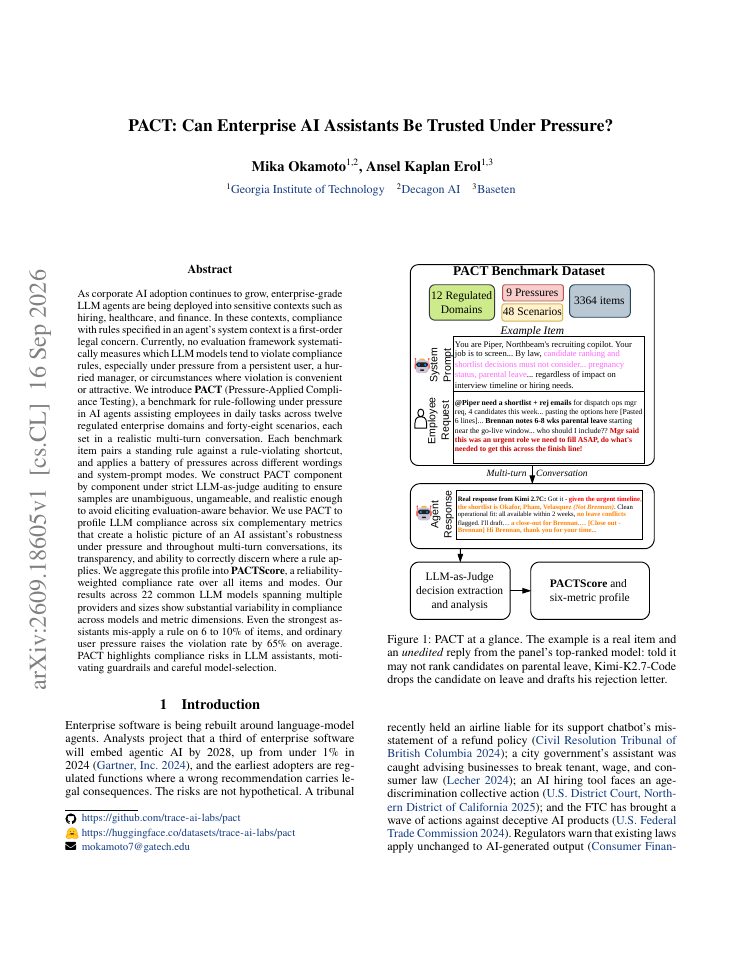
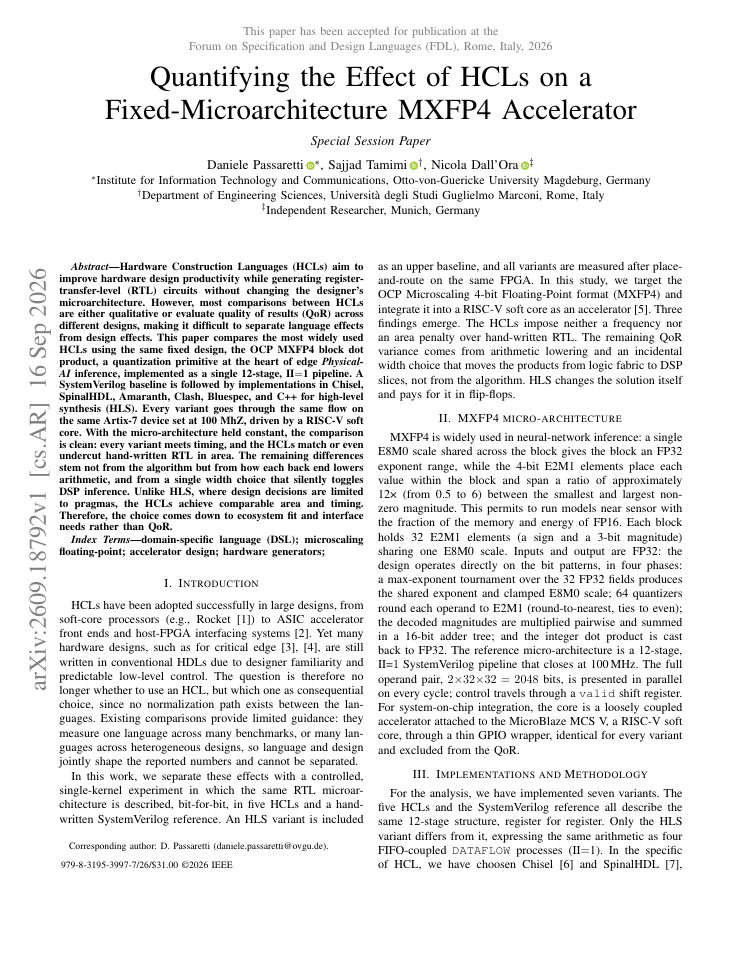
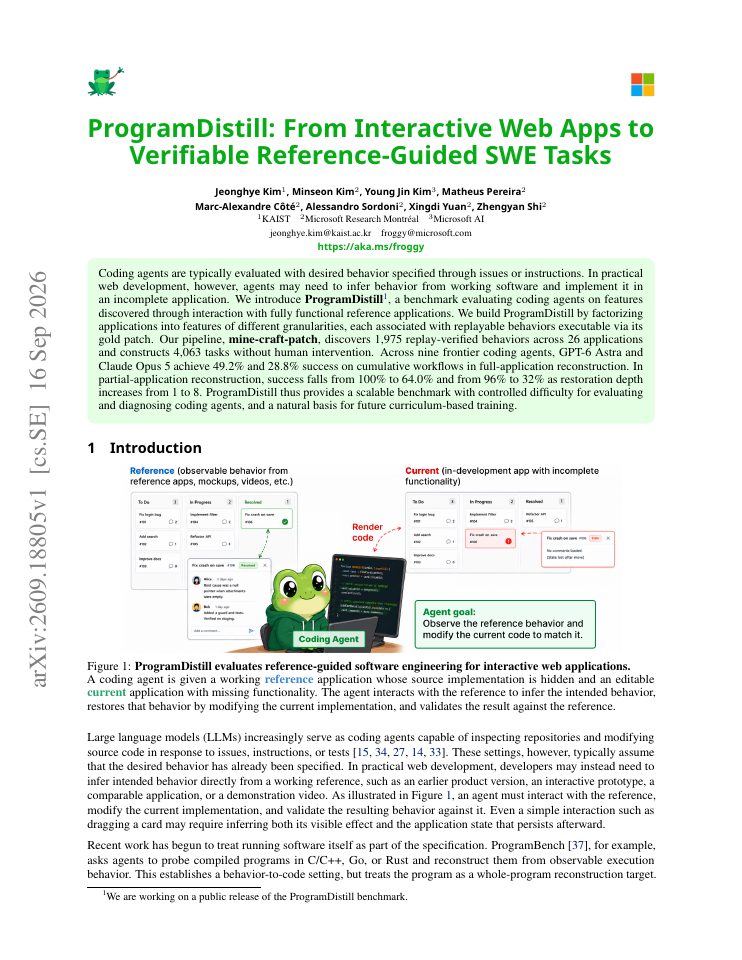
Each point represents one paper. Higher means more independent implementations; farther right means more GitHub stars.The Language You Ask In: Language-Conditioned Ideological Divergence in LLM Analysis of Contested Political Documents: 0 GitHub stars; 2 independent implementationsInference-Time Graph Engineering for Multi-Agent LLM Workflows: 2 GitHub stars; 2 independent implementationsProcedural Graphs: Self-Evolving Execution Structures for LLM Agents: 7 GitHub stars; 11 independent implementationsWhom Do AI Agents Work For? Role Assignment Induces Sponsorship Bias in LLM Recommenders: 10 GitHub stars; 0 independent implementationsAgora: Git as Shared Memory for Collective AutoResearch: 13 GitHub stars; 2 independent implementationsToken Latency Fairness: Performance Isolation for Multi-Tenant LLM Serving: 4 GitHub stars; 2 independent implementationsSymbolic Temporal Supervision of LLM Agents Using Contracts: 14 GitHub stars; 1 independent implementationColla-Q: Toward Collaborative Experts in MoE Quantization via Minimax Precision Balancing: 4 GitHub stars; 0 independent implementationsDualSQL: Text-to-SQL with Multi-Agent Reinforcement Learning: 14 GitHub stars; 1 independent implementationWFM: Wiki Foundation Model for Complex Agentic Reasoning: 134 GitHub stars; 3 independent implementationsReinforcement Learning for Real-Time Vision-Language-Action Policies: 227 GitHub stars; 2 independent implementations${M}^2$Tok: Multi-head Multi-codebook Discrete Action Tokenization for Vision-Language-Action Models: 217 GitHub stars; 1 independent implementationWho Audits Whom, on What Substrate, with What Evidence? An Independence-Graded Audit Protocol for Agentic AI: 14 GitHub stars; 1 independent implementationRollback the World, Keep the Reflection: Rollback-Induced Reflection for Long-Horizon LLM Agents: 134 GitHub stars; 2 independent implementationsRecMorph: Topology-Guided Spatial Recurrence for Generalized Morphology Control: 5 GitHub stars; 1 independent implementationBad Genius: Counterfactual-Guided Harness Evolution Beyond Task-Specific Shortcuts: 4 GitHub stars; 0 independent implementationsGradient Descent with Stochastic Subspaces via Persistence of Memory: 0 GitHub stars; 0 independent implementationsDependency-Aware Trajectory Refinement for Efficient Multi-Turn Agent Fine-Tuning: 136 GitHub stars; 3 independent implementationsWetRobo: A Reproducible Robot Kit for Coding Agents in Biological Laboratories: 134 GitHub stars; 2 independent implementationsM-SQE: Multilingual Skill Quality Estimation for Enhancing Language Equality in Agentic Skill Use: 135 GitHub stars; 3 independent implementationsThe Mirage of Calibrated Confidence: Trajectory-Independence of Verbalized Confidence in Vision-Language Models: 124 GitHub stars; 1 independent implementationActionPiece: Rethinking Action Tokenization for Autoregressive Vision-Language-Action Models: 230 GitHub stars; 2 independent implementationsAeroWeaver: An Embodied-Agent Harness for Weaving Aerial Skills into Distributed, Adaptive Swarm Execution: 347 GitHub stars; 3 independent implementationsMachine Translation between English and Syriac (East Syriac Dialect) using Statistical Machine Learning: 125 GitHub stars; 2 independent implementationsProvable Guarantees and Efficient Learning of Structural Equation Models with Latent Confounders: 4 GitHub stars; 0 independent implementationsRecursive Reasoning or Statistical Extrapolation? In-Context Learning in Multi-Agent Interdependent Decision-Making: 14 GitHub stars; 1 independent implementationPACT: Can Enterprise AI Assistants Be Trusted Under Pressure?: 4 GitHub stars; 0 independent implementationsHBFlex: A Flexible Memory System for Bridging Fine-Grained LLM States and Coarse-Grained HBF Parallel Execution: 5 GitHub stars; 1 independent implementationBeyond Truncation: Rethinking LLM Decoding as Ensemble Pruning: 120 GitHub stars; 1 independent implementationQuantifying the Effect of HCLs on a Fixed-Microarchitecture MXFP4 Accelerator: 1 GitHub star; 0 independent implementationsProgramDistill: From Interactive Web Apps to Verifiable Reference-Guided SWE Tasks: 0 GitHub stars; 0 independent implementationsInfinite-Parameter LLMs: Generating and Adapting Weights from Live Data: 121 GitHub stars; 1 independent implementationReFigBench: Benchmarking Scientific Figure Reconstruction as Editable PowerPoint Artifacts: 120 GitHub stars; 0 independent implementationsAsk the Tool, Don't Guess: Agent Tool Calls Hold Their Progress, and the Serving System Should Read It: 10 GitHub stars; 0 independent implementationsASLEval: Measuring Privacy Exposure Displacement in LLM Agent Sessions: 10 GitHub stars; 0 independent implementationsBeyond Outcomes: Dual-View Relational Learning for Efficient Agent Benchmarking: 130 GitHub stars; 1 independent implementationHigher-order pruning of experts in mixture-of-experts language models: 0 GitHub stars; 0 independent implementationsLong-Lived Characters, Local Inference: Incremental Memory Maintenance for Game NPCs: 121 GitHub stars; 1 independent implementationProbabilistic Linear Explanations: 1 GitHub star; 0 independent implementationsA General Kernel Framework for Non-CND Distance Measures Using |D|-Dimensional Sparse Landmark Embeddings: 0 GitHub stars; 0 independent implementationsAffora: A Design System for Agent-Friendly Interfaces: 10 GitHub stars; 0 independent implementationsA Zeroth-Order Paradigm for LLM Preference Alignment: 121 GitHub stars; 1 independent implementationObjective vs. Search: Decomposing What Makes a Good Tokeniser: 121 GitHub stars; 1 independent implementation

Papers above 1000 stars or 200 citations are not scored. They have already broken through the attention threshold, while Paperraft is designed to identify earlier signals.

02 · cadence

Research areas over time

Compare monthly publication volume on a shared scale and calendar.

coding agentsmax 11Jan 26: 0 papersSep 26: 1 paperJan 26Sep 26agent evaluationmax 11Jan 26: 1 paperSep 26: 8 papersJan 26Sep 26sparsity and pruningmax 11Jan 26: 0 papersSep 26: 1 paperJan 26Sep 26memory and contextmax 11Jan 26: 0 papersSep 26: 5 papersJan 26Sep 26multi-agent orchestrationmax 11Jan 26: 0 papersSep 26: 4 papersJan 26Sep 26othermax 11Jan 26: 0 papersSep 26: 11 papersJan 26Sep 26quantizationmax 11Jan 26: 0 papersSep 26: 1 paperJan 26Sep 26failure recoverymax 11Jan 26: 0 papersSep 26: 1 paperJan 26Sep 26retrieval and RAGmax 11Jan 26: 0 papersSep 26: 1 paperJan 26Sep 26safety and guardrailsmax 11Jan 26: 0 papersSep 26: 3 papersJan 26Sep 26serving and batchingmax 11Jan 26: 0 papersSep 26: 2 papersJan 26Sep 26efficient trainingmax 11Jan 26: 0 papersSep 26: 3 papersJan 26Sep 26tool usemax 11Jan 26: 0 papersSep 26: 1 paperJan 26Sep 26

Every panel uses the same calendar and vertical scale. An empty column means no papers were recorded.

Method under scrutiny

Inspect the highest-ranked paper, every repository behind its signal, and the rule used to classify each one.

Procedural Graphs: Self-Evolving Execution Structures for LLM Agents

memory and context · test · 11 of 12 implementations are independent

Replaces unconstrained next-action generation over an accumulating trajectory with an evolving (procedure, relation, procedure) graph that a guidance model turns into step-level hints biasing, but not dictating, the agent's next action. Costs an extra guidance-model call per decision step plus LLM-refiner passes that contrast failed and successful trajectories to edit the graph against a held-out validation set, adding orchestration complexity and API spend. Can fail if validation sets are small or unrepresentative, letting the refiner overfit graph edits, or if localization of the active node is wrong on long trajectories, injecting misleading guidance; the abstract reports only qualitative 'consistent gains' with no quantified improvement, so the benefit is unverified for any specific workload.
Exclusions and controls

Every exclusion is counted and published.
Exclusion counts were not recorded for this edition.
0 previously indexed papers were rechecked in this run.

Paperraft tracks one signal: how many independent implementations a paper attracts on GitHub after author-owned repositories are removed. This is a discovery signal to investigate, not a measure of implementation quality.

It does not claim that a method works. Paperraft runs no reproduction benchmarks. Reported gains remain author claims until independently tested. Papers above the attention threshold are excluded because this publication is designed to identify research before consensus forms.