Skip to content

archived edition · 2026-09-24

PaperraftFind the AI research
worth testing.

Understand what a paper changes, what it costs, and whether it fits your next build. Explore research on faster LLM inference, agent memory, and evaluation, with the original sources in reach.

Start with a brief. Follow the evidence. Choose a test.

edition
2026-09-24
briefs
43
research areas
14
independent implementations
25

27 of 43 papers in the index (63%) have no independent implementations.

Research index

Search by topic, browse a research area, or sort by date. Read a brief, open the original paper, and inspect the available evidence before deciding what to test.

showing30 of 43
sort by
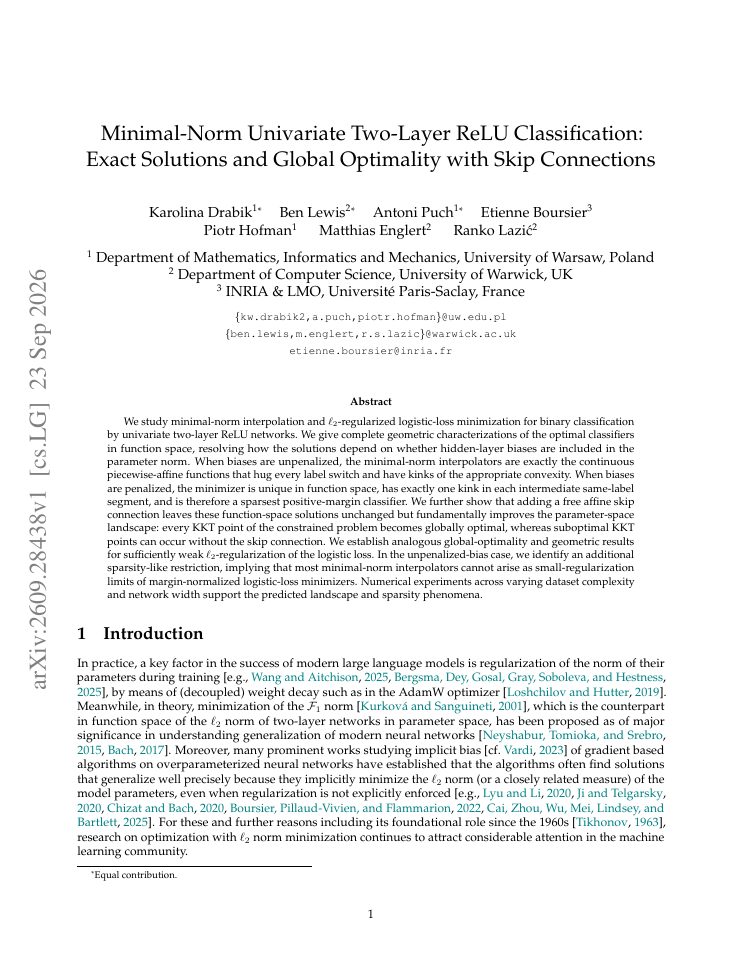
First page of Context as an Environment: Programmatic Context Management for Long-Horizon Agents
memory and contexttest

Context as an Environment: Programmatic Context Management for Long-Horizon Agents

Scroll replaces prompt-side history compression and fixed memory representations with an append-only event log plus a persistent sandboxed Python kernel, where the model writes code to search and materialize state and only printed projections enter the working context. It costs engineering effort to build and sandbox the kernel and eviction index, adds code-execution latency per turn, and its reported results depend on a strong proprietary backbone. It can fail if the model writes faulty state-management code, if eviction landmarks mislead retrieval of evicted regions, or if sandboxing is insufficient against unsafe exec output.

observed signal
4impl.
6stars
0citations
—claimed gain
abstract onlyReview decisionDownload skill ↓Original paper ↗
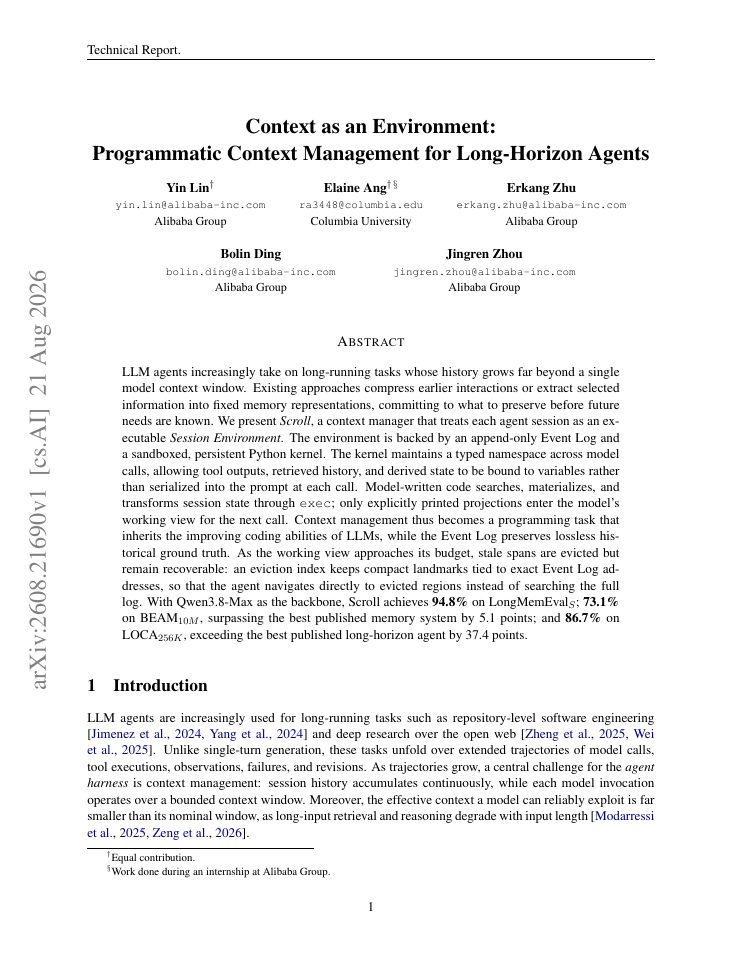
First page of Zero-Shot Self-Orchestration with Ledger-Based Control for Improved LLM Coding Performance
multi-agent orchestrationtest

Zero-Shot Self-Orchestration with Ledger-Based Control for Improved LLM Coding Performance

The method replaces single-pass LLM code generation with a manager-worker scaffold in which short worker calls share state through a filesystem ledger, requiring no training or per-benchmark tuning. It roughly triples the token bill per problem, though it can buy accuracy more cheaply than upgrading to a larger model and is self-hostable on a 24 GB GPU only via small open-weight workers such as Qwen-27B-class models. It can fail because gains are strongly model-conditional: some models show null or negative deltas (e.g., Qwen3.6-35B, -1 to -9 points with reasoning off), and large reasoning-enabled models gain little, so the extra token cost may buy nothing on a given workload.

observed signal
2impl.
1stars
0citations
5.2xclaimed gain
abstract onlyReview decisionDownload skill ↓Original paper ↗
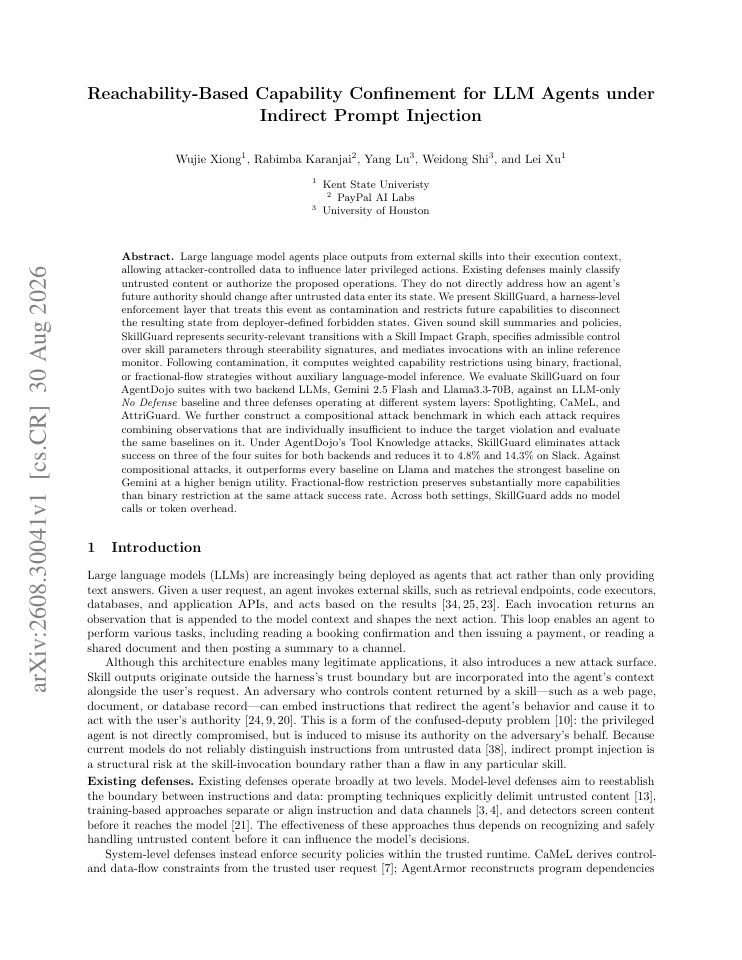
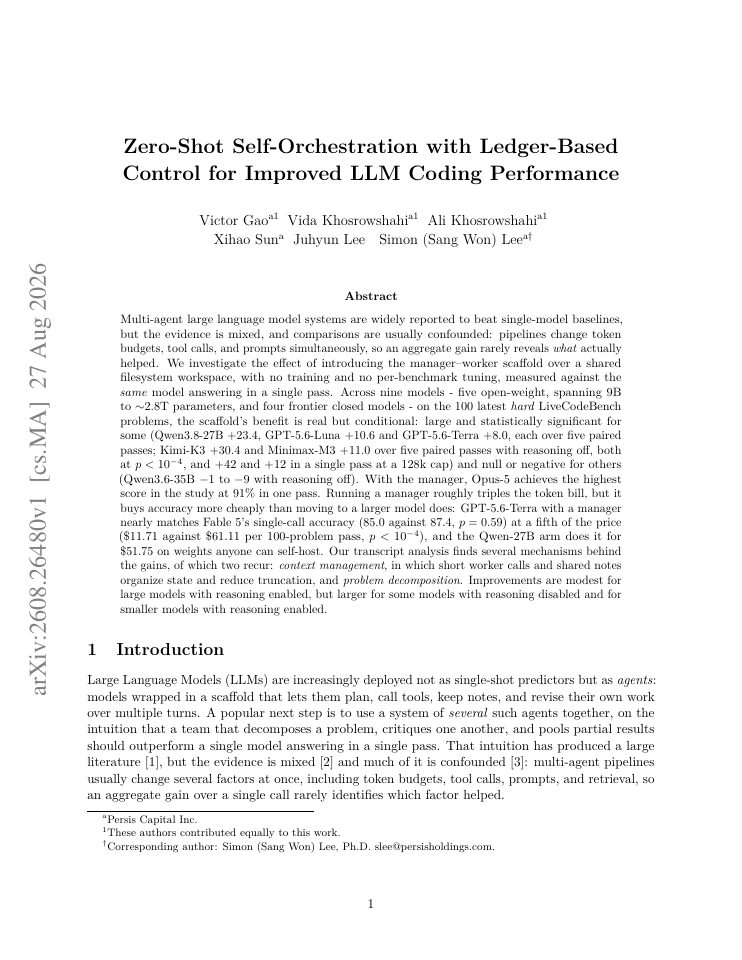
First page of Reachability-Based Capability Confinement for LLM Agents under Indirect Prompt Injection
safety and guardrailstest

Reachability-Based Capability Confinement for LLM Agents under Indirect Prompt Injection

SkillGuard replaces LLM-inference-based prompt-injection filters and content classifiers with a harness-level reference monitor that treats untrusted skill output as contamination and restricts the agent's future capabilities via a Skill Impact Graph and steerability signatures. It costs no additional model calls or token overhead, but requires authoring sound skill summaries, steerability signatures, and deployer-defined forbidden-state policies, plus integration into the agent harness. It can fail if skill summaries are incomplete or unsound, if policies misclassify which states are forbidden, or if fractional restriction parameters are tuned to preserve utility at the expense of residual attack paths, as the non-zero Slack attack success rates show.

observed signal
1impl.
1stars
0citations
—claimed gain
abstract onlyReview decisionDownload skill ↓Original paper ↗
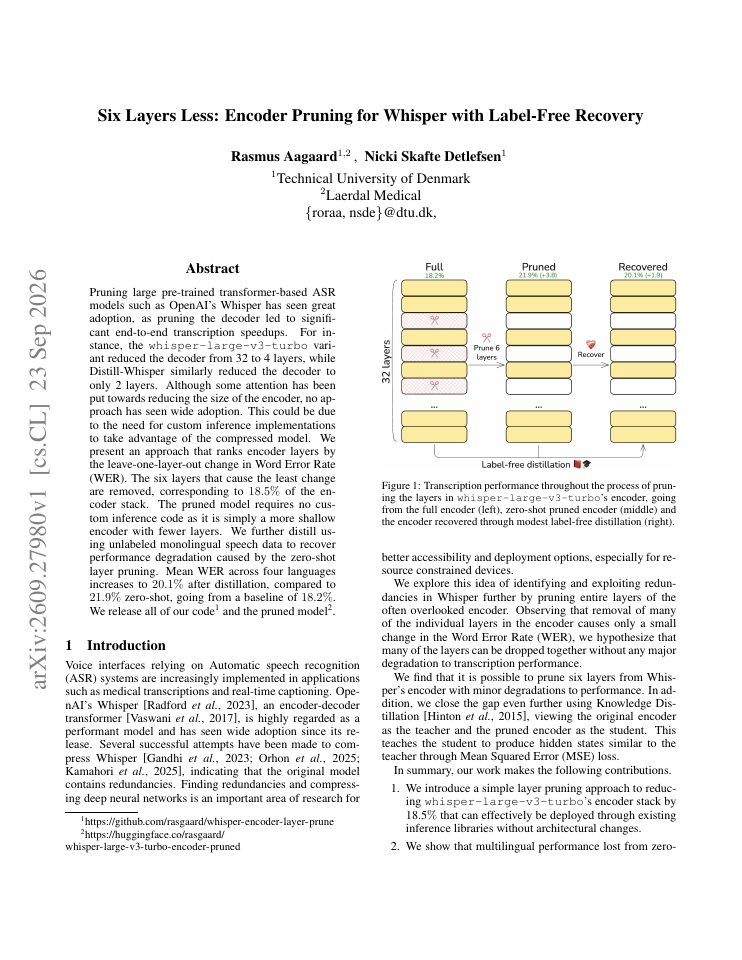
First page of Six Layers Less: Encoder Pruning for Whisper with Label-Free Recovery
sparsity and pruningtest

Six Layers Less: Encoder Pruning for Whisper with Label-Free Recovery

Replaces the full 32-layer Whisper large-v3-turbo encoder with a 26-layer encoder selected by leave-one-layer-out WER ranking, recovered via distillation on unlabeled monolingual speech. The cost is a mean WER increase of roughly 1.9 points (18.2% to 20.1%) plus a distillation run requiring unlabeled speech data and modest GPU time; inference itself needs no custom code. What can fail: the ~10% relative WER regression may be unacceptable for high-accuracy domains, the layer ranking and recovery may not transfer to languages or acoustic conditions outside the four evaluated, and realized latency gains depend on whether the encoder is the bottleneck in the deployment stack.

observed signal
4impl.
125stars
—citations
—claimed gain
abstract onlyReview decisionDownload skill ↓Original paper ↗
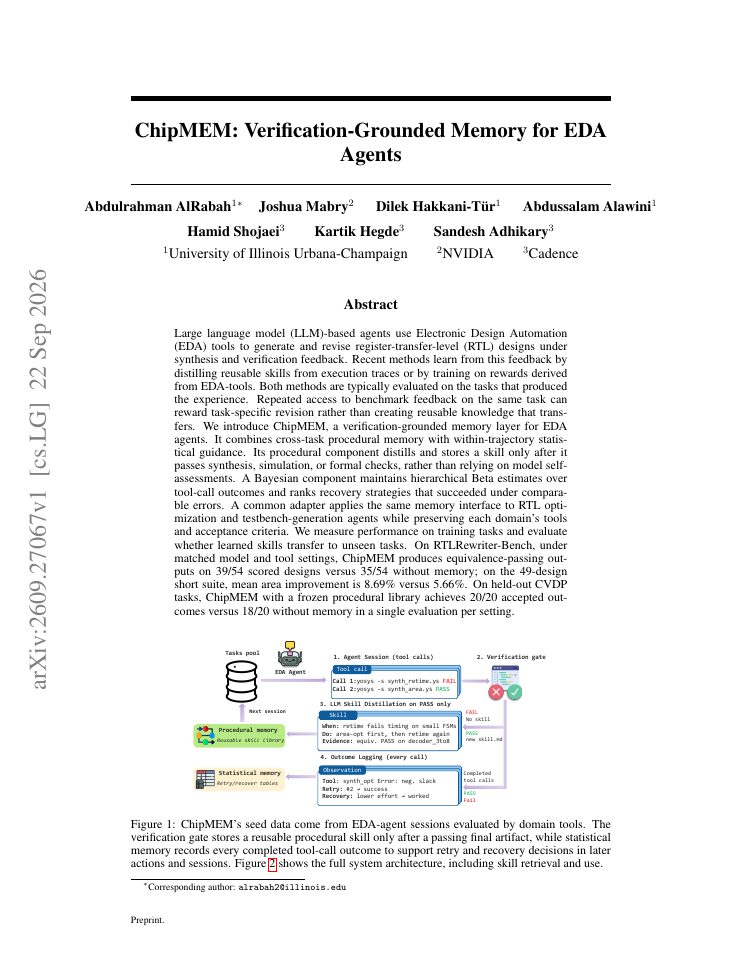
First page of ChipMEM: Verification-Grounded Memory for EDA Agents
memory and contexttest

ChipMEM: Verification-Grounded Memory for EDA Agents

ChipMEM replaces experience distillation based on model self-assessment with a memory layer that stores skills only after synthesis, simulation, or formal verification passes, plus a Bayesian ranker of recovery strategies conditioned on error types. The cost is additional infrastructure: persistent skill storage, verified-trace bookkeeping, hierarchical Beta statistics per tool call, and an adapter per agent domain, with inference latency increasing from memory retrieval and ranking. It can fail when verification signals are too sparse to populate the library, when held-out tasks diverge from the errors the Beta estimates were built on, or when frozen procedural skills overfit the training distribution and misguide revision on novel designs.

observed signal
1impl.
10stars
—citations
—claimed gain
abstract onlyReview decisionDownload skill ↓Original paper ↗
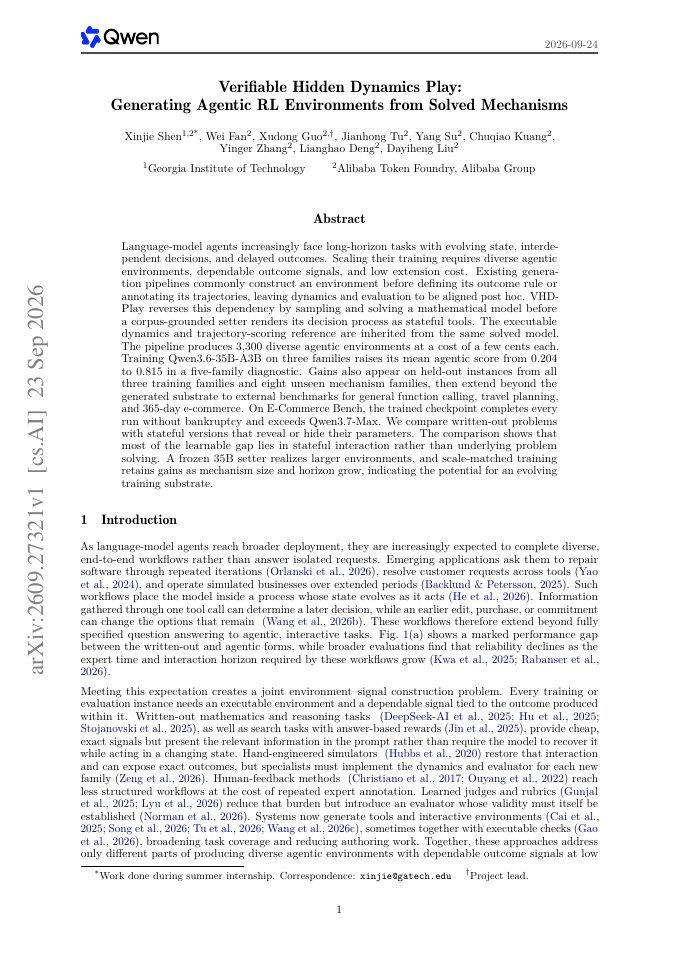
First page of Verifiable Hidden Dynamics Play: Generating Agentic RL Environments from Solved Mechanisms
agent evaluationwatch

Verifiable Hidden Dynamics Play: Generating Agentic RL Environments from Solved Mechanisms

VHD-Play replaces pipelines that build an agentic environment first and align its dynamics and scoring afterward, instead sampling and solving a mathematical model whose executable dynamics and trajectory-scoring reference are inherited directly by the rendered stateful tools. Generation costs a few cents per environment (3,300 environments produced), but exploiting the substrate requires multi-family RL training of a 35B-class model, which exceeds a single 24 GB GPU. Failure modes include overfitting to the generated mechanism distribution, corpus-grounding errors by the setter model, and gains that may not transfer to production tasks unlike the diagnostic families.

observed signal
2impl.
131stars
—citations
—claimed gain
abstract onlyReview decisionDownload skill ↓Original paper ↗
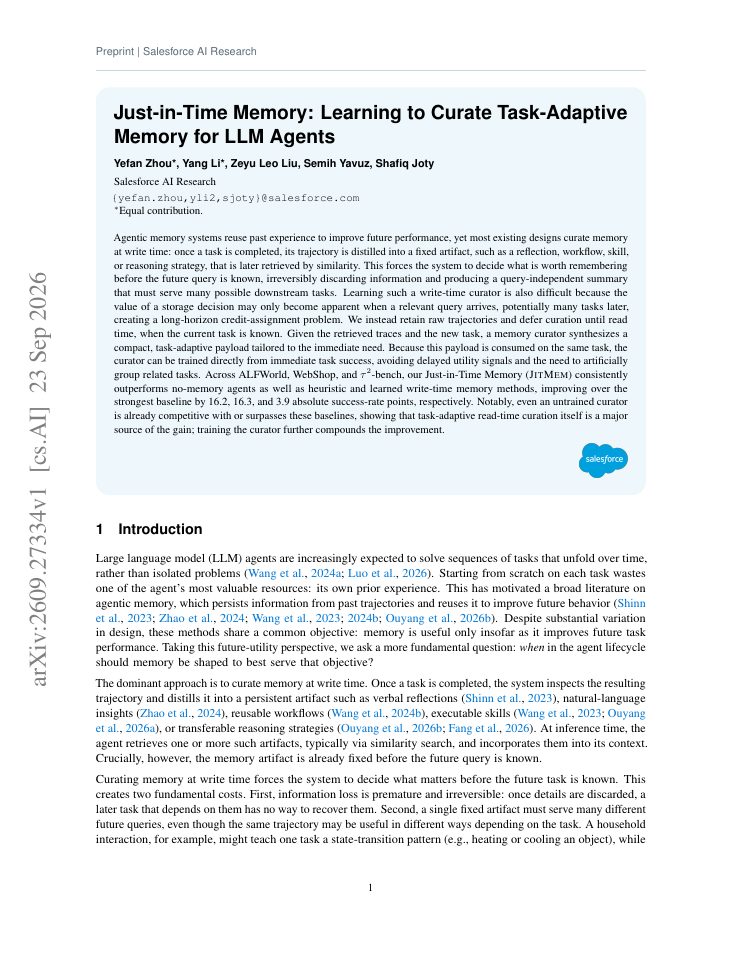
First page of Just-in-Time Memory: Learning to Curate Task-Adaptive Memory for LLM Agents
memory and contexttest

Just-in-Time Memory: Learning to Curate Task-Adaptive Memory for LLM Agents

Replaces write-time memory distillation, where each completed trajectory is compressed into a fixed reflection or skill artifact retrieved by similarity, with retention of raw trajectories and read-time synthesis of a compact task-adaptive payload conditioned on the current query. Costs include storing full raw trajectories (higher memory and retrieval footprint), an extra curator LLM call at read time adding latency and API spend, and optionally training the curator on task-success signals. Failure modes include curator errors when retrieved traces are noisy or irrelevant, degraded performance if the new task differs from anything in the trace store, and unbounded storage growth without a retention or pruning policy.

observed signal
2impl.
131stars
—citations
—claimed gain
abstract onlyReview decisionDownload skill ↓Original paper ↗
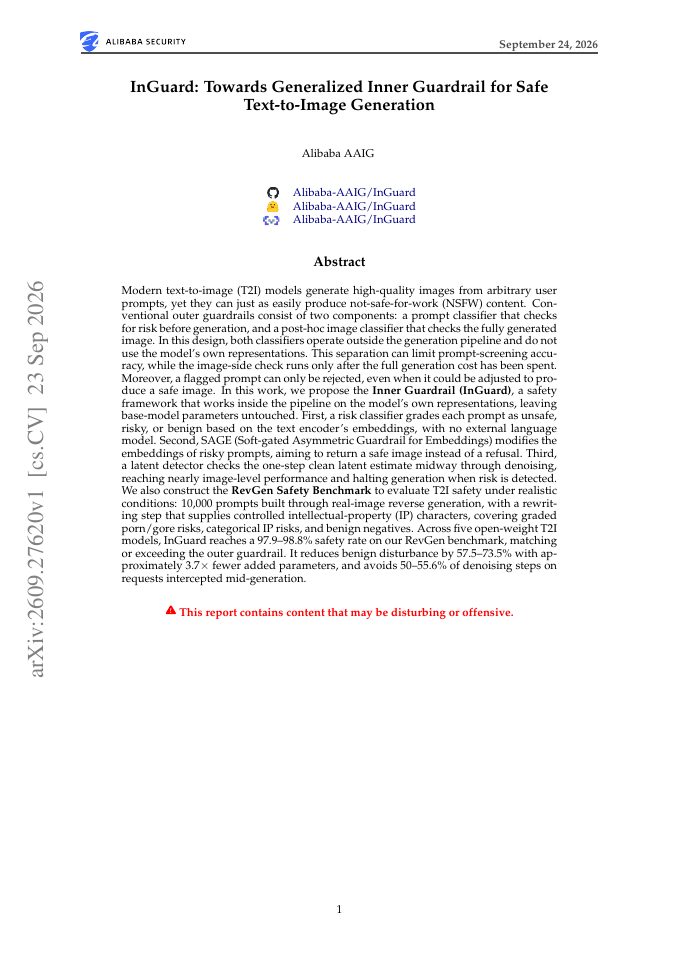
First page of InGuard: Towards Generalized Inner Guardrail for Safe Text-to-Image Generation
safety and guardrailstest

InGuard: Towards Generalized Inner Guardrail for Safe Text-to-Image Generation

InGuard replaces the conventional two-stage outer guardrail (prompt classifier plus post-hoc image classifier) with components operating on the T2I model's own representations: an embedding-based risk classifier, soft embedding modification (SAGE) to redirect risky prompts toward safe outputs, and a mid-denoising latent detector that halts generation early. The cost is training and validating three add-on components per deployed model, added pipeline complexity, and residual inference overhead, though base-model parameters remain untouched and flagged generations can exit after roughly half the denoising steps. It can fail on the mid-denoising latent estimate missing content that only becomes explicit in later steps, on graded 'risky' prompt handling degrading benign-prompt fidelity, and on the benchmark's reverse-generated prompts not covering the reader's actual threat distribution.

observed signal
1impl.
122stars
—citations
—claimed gain
abstract onlyReview decisionDownload skill ↓Original paper ↗
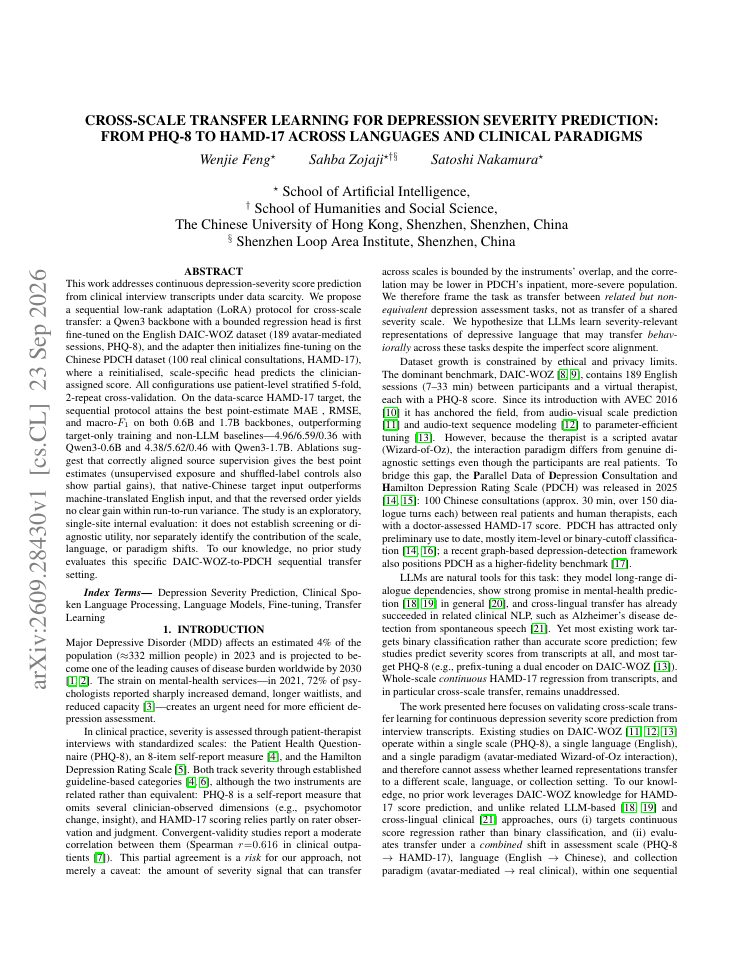
First page of Cross-Scale Transfer Learning for Depression Severity Prediction: From PHQ-8 to HAMD-17 Across Languages and Clinical Paradigms
efficient trainingtest

Cross-Scale Transfer Learning for Depression Severity Prediction: From PHQ-8 to HAMD-17 Across Languages and Clinical Paradigms

The method replaces training a clinical severity regressor from scratch (or target-only fine-tuning) by sequentially adapting LoRA adapters: first on a larger English PHQ-8 corpus, then on a small target-language HAMD-17 corpus with a reinitialised scale-specific regression head. Cost is low and fits the reader's constraints: two short LoRA fine-tuning runs on sub-2B models, feasible on a single 24 GB GPU, with added pipeline complexity of a two-stage protocol and cross-dataset alignment. It can fail because the evidence is a single-site exploratory study of 100 target sessions: gains are within run-to-run variance in some ablations, the contributions of scale, language, and paradigm shifts are not disentangled, and shuffled-label controls showing partial gains suggest the improvement may partly reflect generic adaptation rather than aligned supervision.

observed signal
1impl.
122stars
—citations
—claimed gain
abstract onlyReview decisionDownload skill ↓Original paper ↗
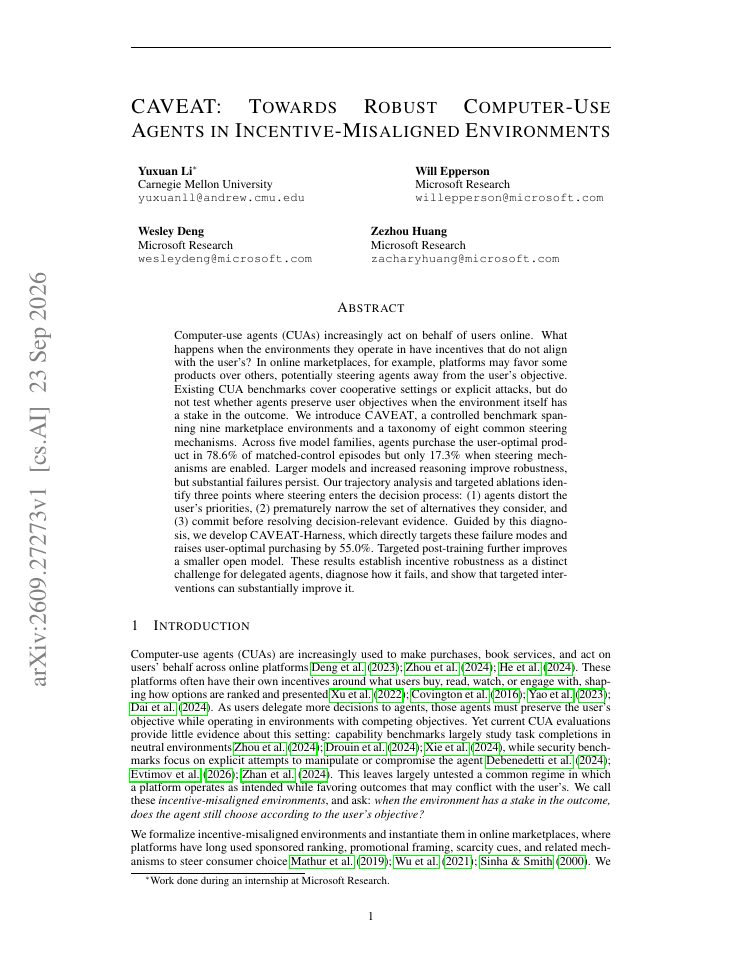
First page of CAVEAT: Towards Robust Computer-Use Agents in Incentive-Misaligned Environments
agent evaluationtest

CAVEAT: Towards Robust Computer-Use Agents in Incentive-Misaligned Environments

CAVEAT-Harness replaces naive prompting of computer-use agents in incentive-misaligned environments with a scaffold that counters three diagnosed failure points: distorted user priorities, prematurely narrowed candidate sets, and early commitment before evidence resolution. The cost is additional orchestration and inference overhead per episode, plus benchmark-specific tuning, with optional targeted post-training if a smaller open model is used. It can fail when steering mechanisms differ from the eight in the taxonomy, when the harness itself is steered, or when residual failures persist even after the 55% relative improvement, since absolute robustness remains well below control performance.

observed signal
1impl.
131stars
—citations
1.55xclaimed gain
abstract onlyReview decisionDownload skill ↓Original paper ↗
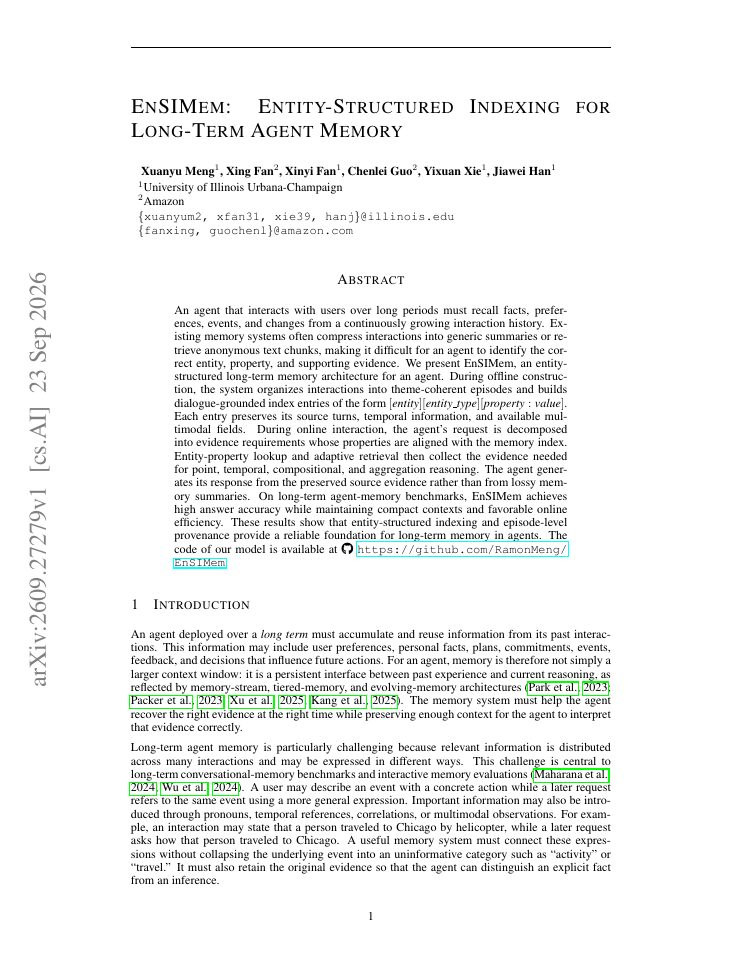
First page of EnSIMem: Entity-Structured Indexing for Long-Term Agent Memory
memory and contexttest

EnSIMem: Entity-Structured Indexing for Long-Term Agent Memory

EnSIMem replaces generic summary-based or chunk-based agent memory with an offline-built index of [entity][entity type][property:value] entries grounded in dialogue turns, retrieved online via entity-property lookup rather than lossy summaries. It costs an offline episode-construction and indexing pipeline (LLM calls for decomposition, alignment, and indexing), additional storage for the structured index, and integration complexity in the agent's request decomposition step. It can fail when entity extraction or property alignment is incorrect, when queries reference entities not captured during indexing, or when the episode segmentation breaks temporal or compositional reasoning that depends on cross-episode evidence.

observed signal
1impl.
131stars
—citations
—claimed gain
abstract onlyReview decisionDownload skill ↓Original paper ↗
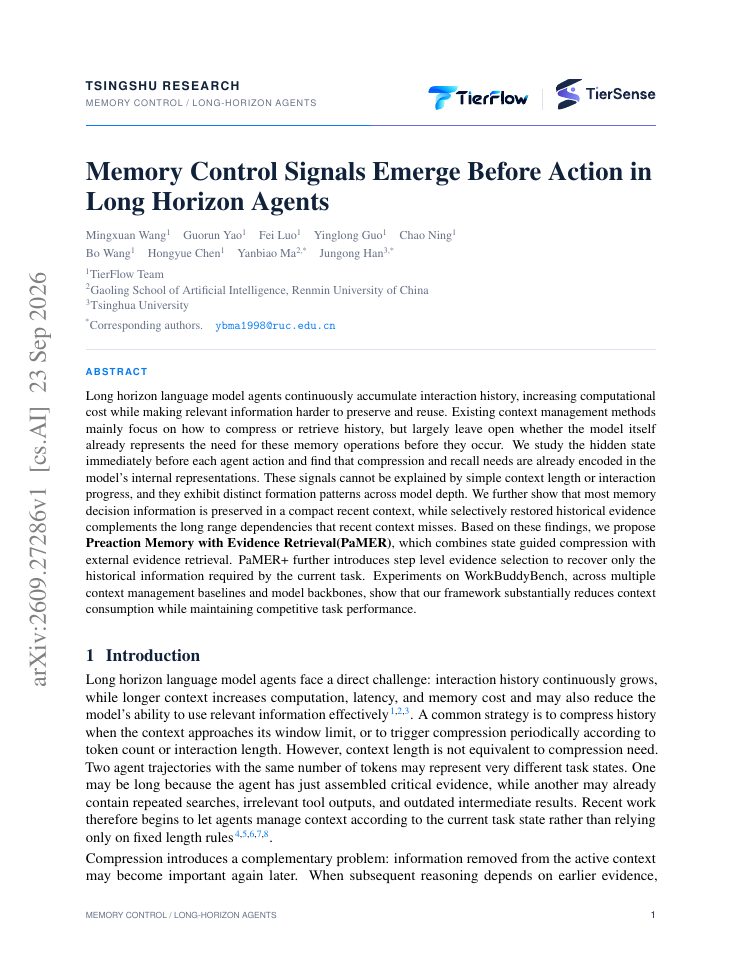
First page of Memory Control Signals Emerge Before Action in Long Horizon Agents
memory and contexttest

Memory Control Signals Emerge Before Action in Long Horizon Agents

Replaces fixed or heuristic context compression/retrieval policies with decisions guided by the model's own pre-action hidden states, combining state-guided compression with selective retrieval of historical evidence (PaMER+ adds step-level evidence selection). Costs include training or fitting probes on hidden states (which requires access to model internals, excluding closed third-party APIs), plus an external evidence store and added orchestration complexity, with modest per-step overhead. It can fail if probing signals do not transfer across models, tasks, or prompt distributions, if compression discards evidence that step-level selection later needs, or if gains shrink on tasks whose histories are short.

observed signal
1impl.
131stars
—citations
—claimed gain
abstract onlyReview decisionDownload skill ↓Original paper ↗
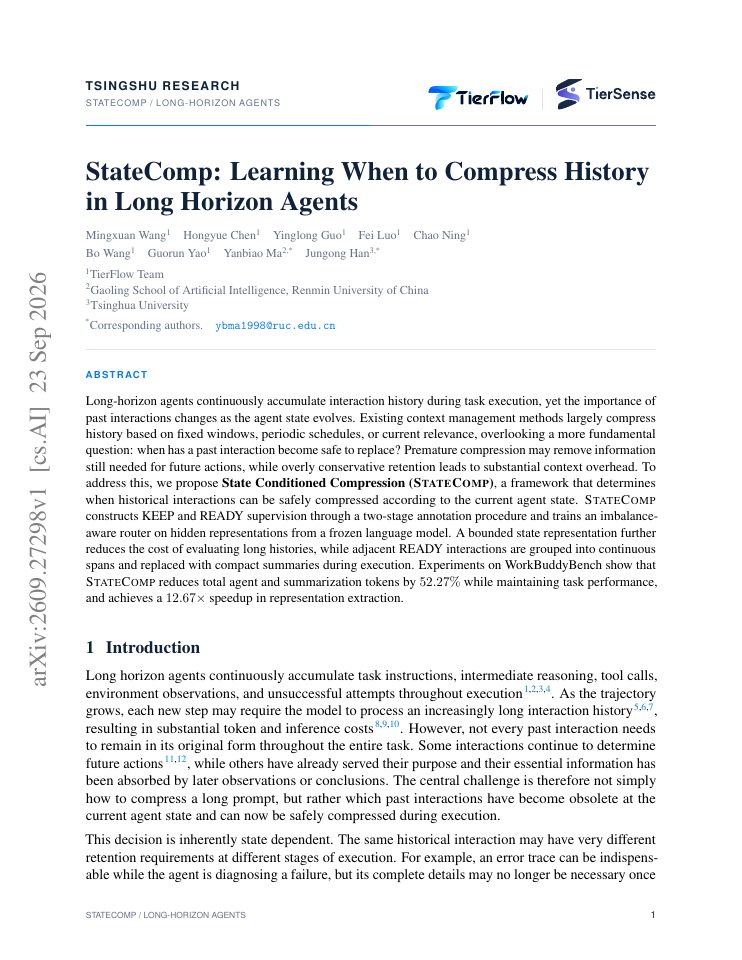
First page of StateComp: Learning When to Compress History in Long Horizon Agents
memory and contexttest

StateComp: Learning When to Compress History in Long Horizon Agents

StateComp replaces fixed-window or periodic history compression with a learned router that decides, from frozen LM hidden states, when past interactions are safe to compress, grouping READY interactions into spans replaced by summaries. The cost is a two-stage annotation procedure to build KEEP/READY supervision, training an imbalance-aware router, and maintaining a bounded state representation, all adding pipeline complexity beyond a drop-in prompt change. It can fail if the router mislabels still-needed interactions as READY, causing irreversible information loss, and the reported gains come from a single benchmark (WorkBuddyBench), so transfer to other agent workloads is unverified.

observed signal
1impl.
131stars
—citations
2.1xclaimed gain
abstract onlyReview decisionDownload skill ↓Original paper ↗
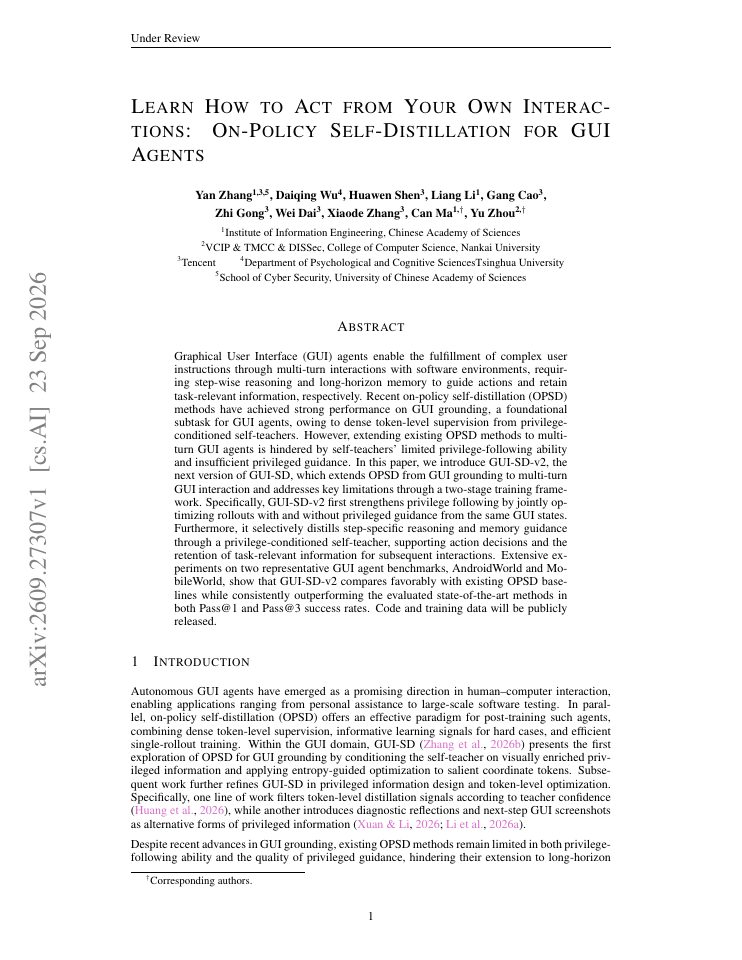
First page of Learn How to Act from Your Own Interactions: On-Policy Self-Distillation for GUI Agents
distillationwatch

Learn How to Act from Your Own Interactions: On-Policy Self-Distillation for GUI Agents

GUI-SD-v2 replaces external teacher or human-annotated supervision for multi-turn GUI agents with a two-stage on-policy self-distillation pipeline: joint rollout optimization with and without privileged guidance, followed by selective distillation of step-specific reasoning and memory from a privilege-conditioned self-teacher. The cost is a full RL-style training loop with environment rollouts on AndroidWorld/MobileWorld-class simulators, two training stages, and trajectory data generation, which exceeds a single 24 GB GPU budget for any non-trivial base model and adds substantial engineering complexity. Failure modes include the self-teacher's imperfect privilege following propagating errors into the student, overfitting to the two evaluated mobile benchmarks, and memory-guidance distillation degrading on long-horizon tasks outside the training distribution.

observed signal
1impl.
131stars
—citations
—claimed gain
abstract onlyReview decisionDownload skill ↓Original paper ↗
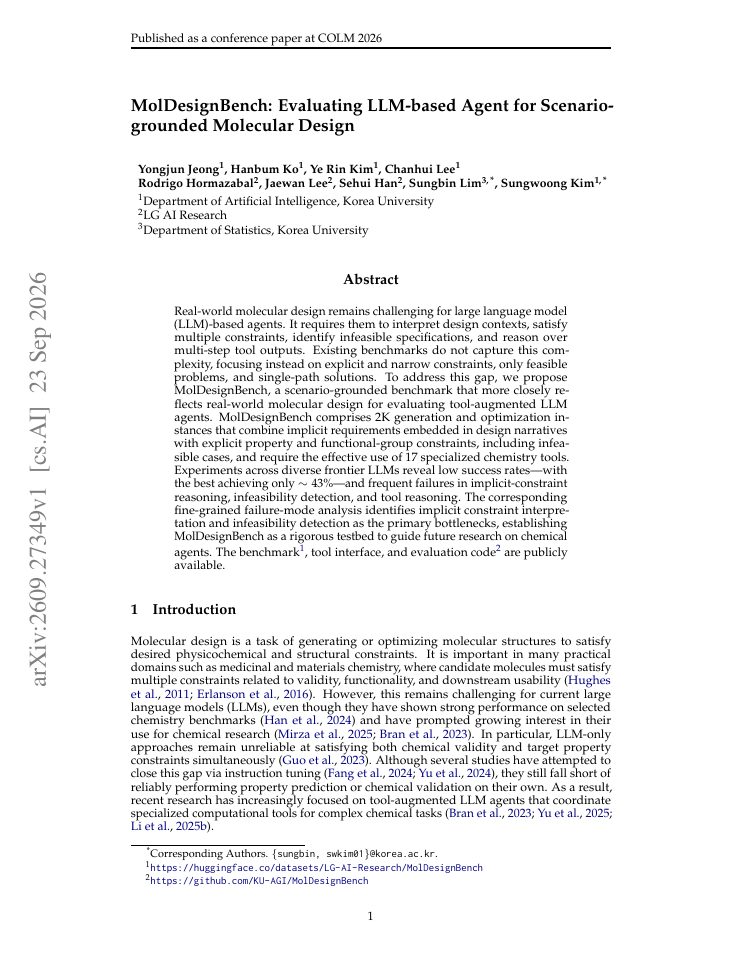
First page of MolDesignBench: Evaluating LLM-based Agent for Scenario-grounded Molecular Design
agent evaluationnot applicable

MolDesignBench: Evaluating LLM-based Agent for Scenario-grounded Molecular Design

MolDesignBench replaces narrow, single-constraint molecular design benchmarks with a 2K-instance scenario-grounded evaluation of tool-augmented LLM agents over 17 chemistry tools, including infeasible cases. It costs nothing in model infrastructure but requires a chemistry domain workload and the benchmark's tool stack to be useful, and it provides an evaluation harness rather than a deployable capability. It offers no production method to adopt; its ~43% ceiling measures current agent limits rather than a performance gain.

observed signal
1impl.
131stars
—citations
—claimed gain
abstract onlyReview decisionDownload skill ↓Original paper ↗
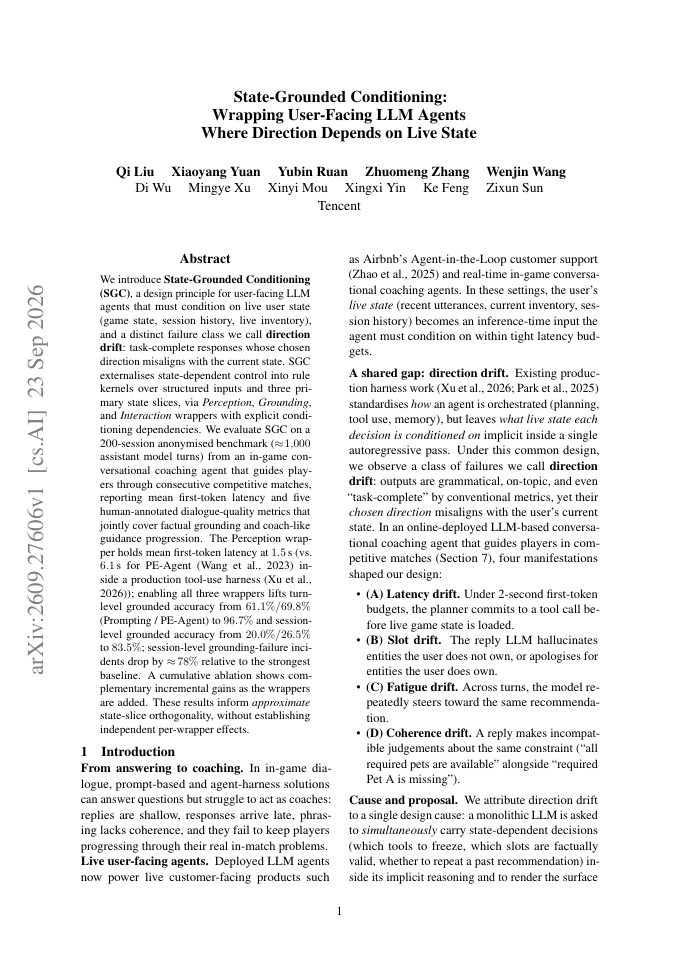
First page of State-Grounded Conditioning: Wrapping User-Facing LLM Agents Where Direction Depends on Live State
memory and contexttest

State-Grounded Conditioning: Wrapping User-Facing LLM Agents Where Direction Depends on Live State

The method replaces monolithic prompt-based state injection and generic tool-use agent loops with explicit Perception, Grounding, and Interaction wrappers that externalise state-dependent control into rule kernels over structured state slices. It costs engineering effort to define state slices, write and maintain rule kernels, and wire conditioning dependencies, with latency and accuracy gains reported on a single narrow benchmark. It can fail when rule kernels drift out of sync with evolving application state schemas, when the three state slices are not actually orthogonal for a new domain, or when the 200-session in-game coaching results do not transfer to other agent workloads.

observed signal
1impl.
131stars
—citations
4.07xclaimed gain
abstract onlyReview decisionDownload skill ↓Original paper ↗
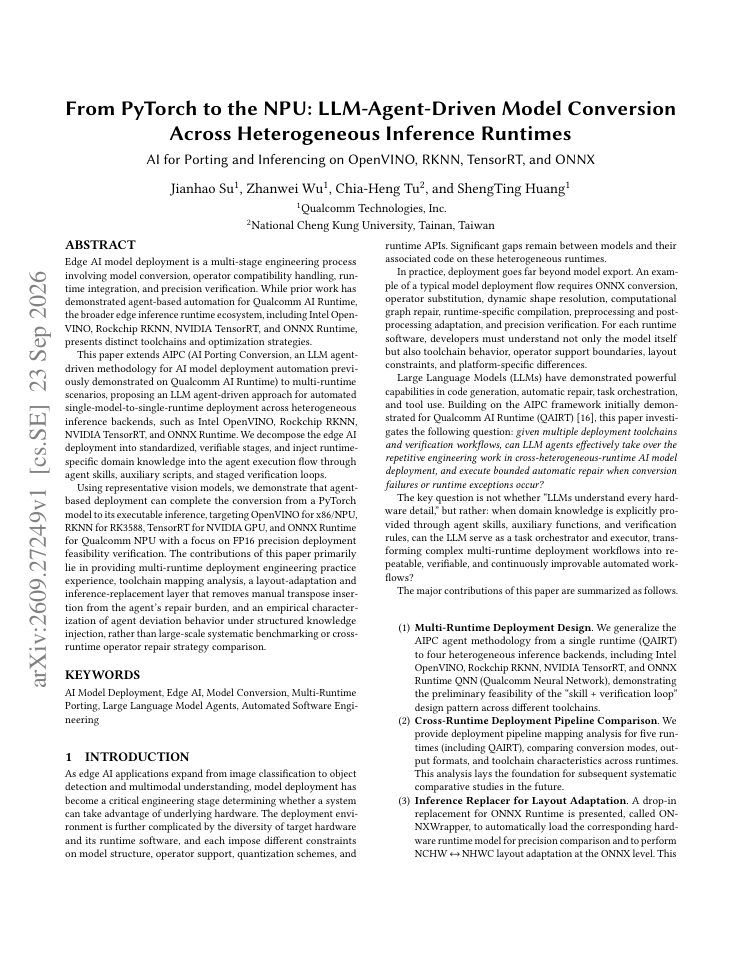
First page of From PyTorch to the NPU: LLM-Agent-Driven Model Conversion Across Heterogeneous Inference Runtimes
tool usewatch

From PyTorch to the NPU: LLM-Agent-Driven Model Conversion Across Heterogeneous Inference Runtimes

The method replaces manual, engineer-driven model porting (PyTorch to OpenVINO, RKNN, TensorRT, or ONNX Runtime) with an LLM agent that executes staged conversion, operator repair, and precision verification using injected runtime-specific knowledge and a layout-adaptation layer. The cost is agent orchestration overhead, dependence on runtime-specific skills and auxiliary scripts that must be authored and maintained per backend, and the paper's own characterization of agent deviation behavior even under structured knowledge injection. Failures include agent divergence during operator-compatibility repair, FP16 precision mismatches caught only by staged verification, and toolchain brittleness when target runtime versions change.

observed signal
0impl.
0stars
—citations
—claimed gain
abstract onlyReview decisionDownload skill ↓Original paper ↗
First page of Can One Adapted Model Do It All? Fine-Tuning Strategy Selection for Customer Support LLMs
efficient trainingadopt

Can One Adapted Model Do It All? Fine-Tuning Strategy Selection for Customer Support LLMs

This replaces the common practice of maintaining separate specialist fine-tunes (or ad-hoc sequential updates) per support skill with a single multi-task fully fine-tuned checkpoint per model size. The cost is one full fine-tuning run over the combined task data and full-precision optimizer memory during training, which on a 24 GB GPU limits feasible sizes to small models or requires API-based fine-tuning for larger ones; sequential LoRA is the fallback when full fine-tuning is infeasible and better preserves earlier skills than sequential full fine-tuning. Failure modes include sharp off-task degradation if specialists are deployed without a reliable router, and catastrophic forgetting of earlier skills under sequential full fine-tuning when tasks are added over time.

observed signal
0impl.
121stars
—citations
—claimed gain
abstract onlyReview decisionDownload skill ↓Original paper ↗
First page of CART: Closed-Loop Adaptive Red Teaming for Large Language Models
safety and guardrailstest

CART: Closed-Loop Adaptive Red Teaming for Large Language Models

CART replaces one-shot replay of a fixed red-team prompt set with a closed-loop Challenger-Target-Judge loop that adapts probes to emerging weaknesses while logging evidence and provenance. It costs Challenger and Judge inference per iteration (third-party APIs are viable), plus the engineering to separate roles, maintain probe diversity, and store auditable findings. It can fail because Challenger-Judge model choices bias which evidence surfaces, results describe discoverable failures rather than real-world failure rates, and unconstrained loops may drift into redundant or unrepresentative attacks without independent review.

observed signal
0impl.
121stars
—citations
—claimed gain
abstract onlyReview decisionDownload skill ↓Original paper ↗
First page of Constraint-Driven Context Engineering: Designing Domain Interfaces for AI Systems
memory and contexttest

Constraint-Driven Context Engineering: Designing Domain Interfaces for AI Systems

CDCE replaces ad-hoc prompt and RAG assembly with a structured design process that inventories domain constraints (technical, regulatory, institutional) and derives the context assets and representations an AI system needs. It costs upfront analysis and ongoing maintenance of constraint specifications and interface artifacts rather than GPU or API budget, adding design complexity without model changes. It can fail if constraints are incompletely identified or become stale, if the case-study findings do not transfer to the reader's domain, or if the resulting context representations exceed prompt budgets without measurable quality gain.

observed signal
0impl.
0stars
—citations
—claimed gain
abstract onlyReview decisionDownload skill ↓Original paper ↗
First page of Psychoacoustically Aligned Latent Smoothing for Adversarial Robustness of Full-Duplex Speech-to-Speech Dialogue Models
safety and guardrailswatch

Psychoacoustically Aligned Latent Smoothing for Adversarial Robustness of Full-Duplex Speech-to-Speech Dialogue Models

PALS replaces an undefended residual-vector-quantized latent interface in full-duplex speech-to-speech models with anisotropic Gaussian noise injection shaped by local codebook covariance, trained via a KL consistency objective, as a defense against psychoacoustically masked adversarial perturbations. It adds no inference-time cost but requires training-time access to the model's latent codebook interface and its covariance statistics, plus retraining with the consistency loss. It can fail against adaptive attackers who optimize through the smoothing noise, offers only a limited certified radius well below observed empirical robustness, and its validation is confined to a Moshi-style architecture, leaving transferability to other speech stacks unproven.

observed signal
0impl.
0stars
—citations
11xclaimed gain
abstract onlyReview decisionDownload skill ↓Original paper ↗
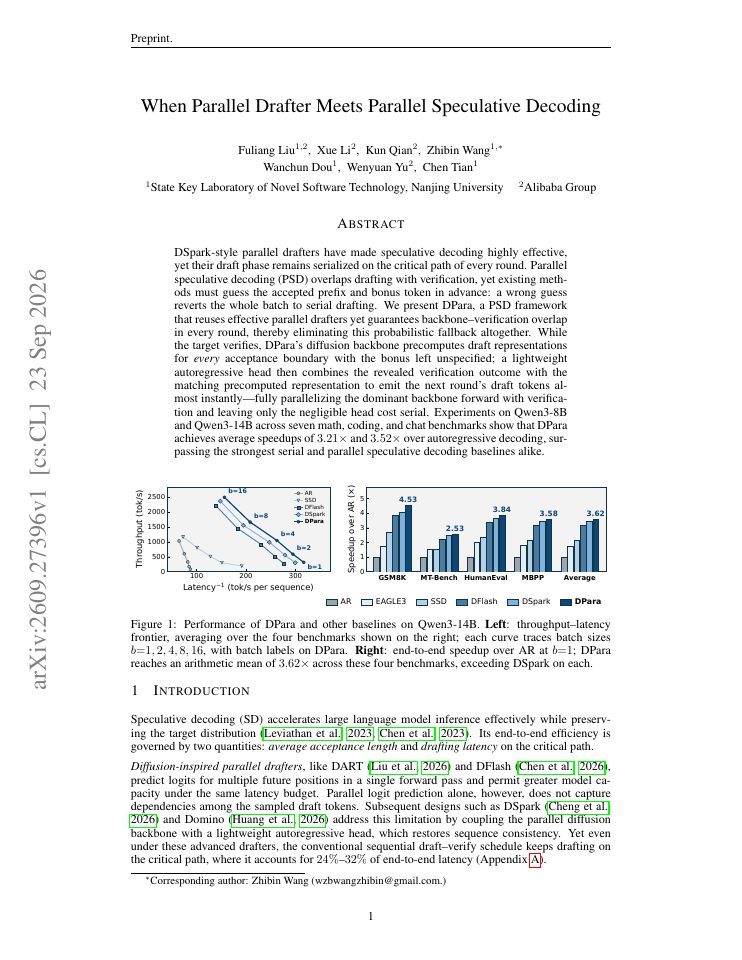
First page of When Parallel Drafter Meets Parallel Speculative Decoding
speculative decodingwatch

When Parallel Drafter Meets Parallel Speculative Decoding

DPara replaces the serialized draft phase of DSpark-style speculative decoding and the guess-and-fallback mechanism of prior parallel speculative decoding by precomputing draft representations for every acceptance boundary on a diffusion backbone while the target verifies, leaving only a lightweight autoregressive head on the critical path. It requires a diffusion backbone drafter plus an extra AR head, adding implementation complexity and draft-model memory on top of the target model, and has been demonstrated only on Qwen3-8B/14B. It can fail if no compatible pretrained parallel drafter exists for the reader's production model, since adopting it likely requires training or sourcing a diffusion drafter rather than plugging into an off-the-shelf checkpoint.

observed signal
0impl.
121stars
—citations
3.52xclaimed gain
abstract onlyReview decisionDownload skill ↓Original paper ↗
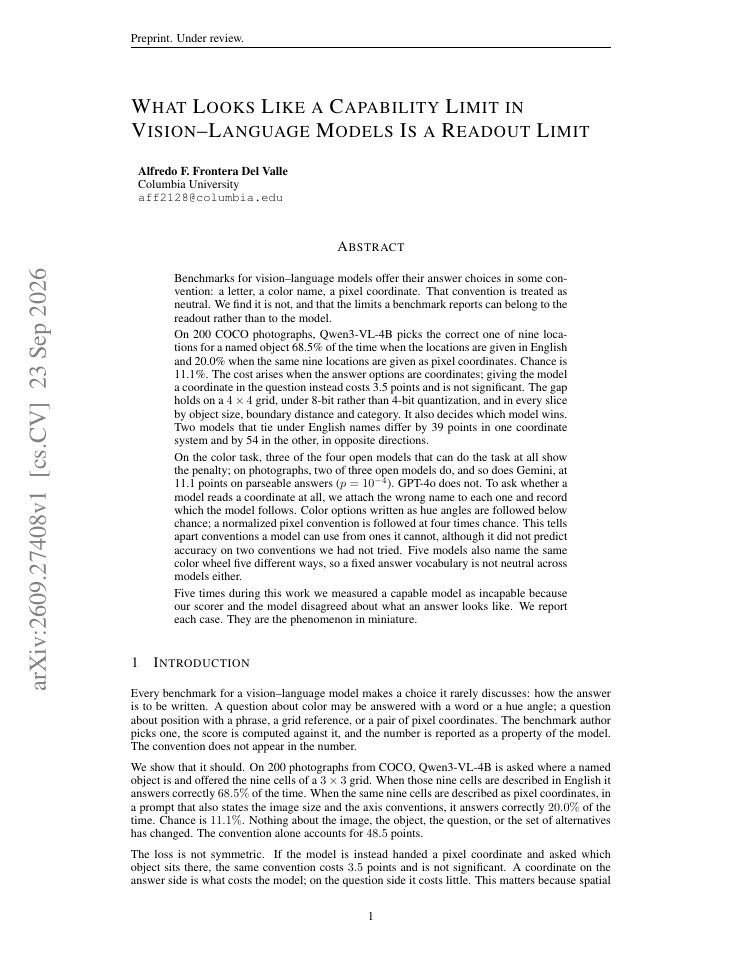
First page of What Looks Like a Capability Limit in Vision-Language Models Is a Readout Limit
agent evaluationadopt

What Looks Like a Capability Limit in Vision-Language Models Is a Readout Limit

This replaces the assumption that benchmark answer conventions (letters, names, pixel coordinates, hue angles) are neutral, requiring practitioners to audit answer formats and scorer parsing when evaluating VLMs rather than adopting new models or infrastructure. The cost is additional evaluation engineering: testing each model under multiple answer conventions, verifying that scoring matches the model's output format (the authors measured capable models as incapable five times due to scorer disagreement), and avoiding coordinate-format options when the underlying task does not require them. What can fail is that convention sensitivity is model-specific (GPT-4o shows no penalty), conventions a model demonstrably parses did not predict accuracy on untried formats, and a fixed answer vocabulary can itself disadvantage particular models, so findings must be revalidated per model and per benchmark.

observed signal
0impl.
121stars
—citations
—claimed gain
abstract onlyReview decisionDownload skill ↓Original paper ↗
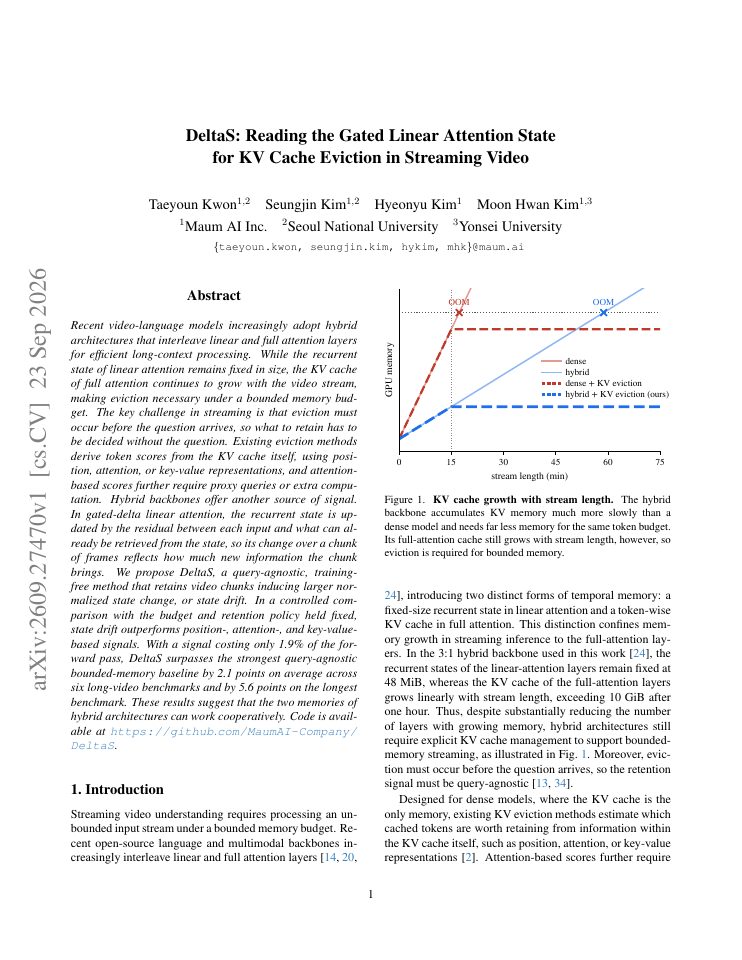
First page of DeltaS: Reading the Gated Linear Attention State for KV Cache Eviction in Streaming Video
KV cachetest

DeltaS: Reading the Gated Linear Attention State for KV Cache Eviction in Streaming Video

DeltaS replaces position-, attention-, and key-value-based scoring for query-agnostic KV cache eviction in streaming video with the normalized drift of the gated-delta linear attention recurrent state. It is training-free and adds roughly 1.9% of forward-pass compute, but it presupposes a hybrid backbone that interleaves gated-delta linear attention with full attention layers. It can fail when the deployed model is a pure full-attention transformer (no recurrent state exists to read), when state drift does not correlate with question-relevant content, or when benchmarks shift away from the streaming setting it was validated on.

observed signal
0impl.
121stars
—citations
—claimed gain
abstract onlyReview decisionDownload skill ↓Original paper ↗
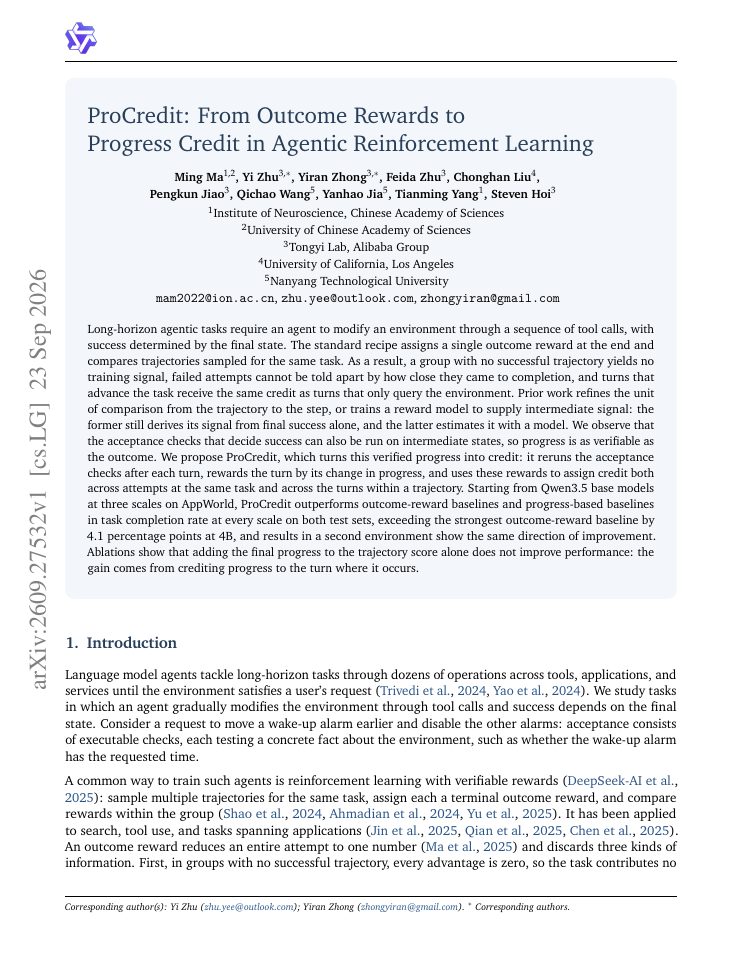
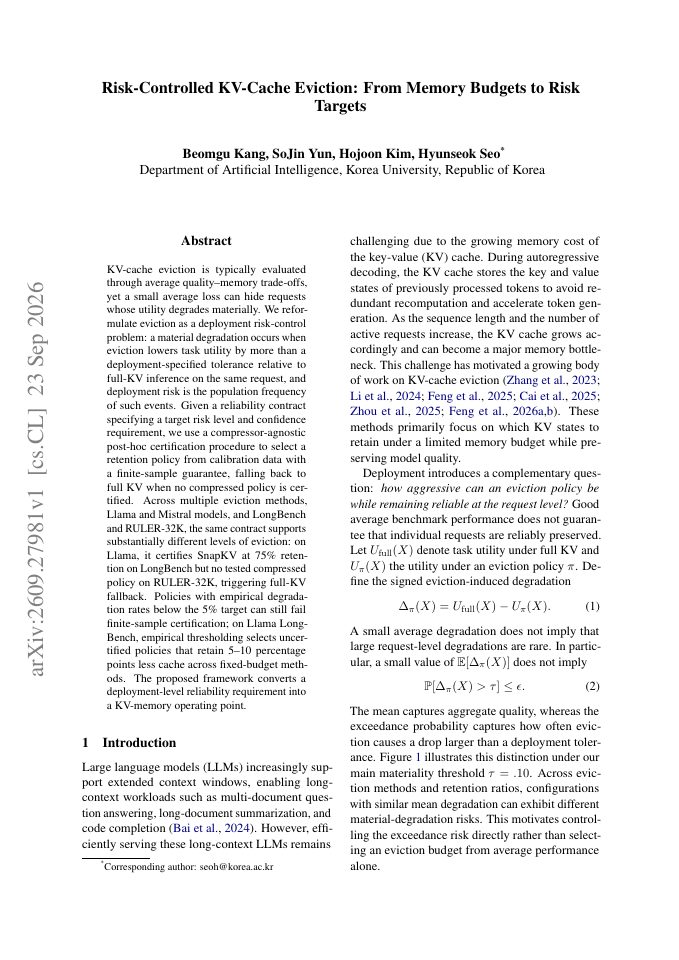
First page of ProCredit: From Outcome Rewards to Progress Credit in Agentic Reinforcement Learning
efficient trainingwatch

ProCredit: From Outcome Rewards to Progress Credit in Agentic Reinforcement Learning

ProCredit replaces terminal outcome-only rewards in agentic reinforcement learning with per-turn rewards computed by re-running the task's acceptance checks on intermediate environment states and crediting each turn by its change in verified progress. It costs repeated execution of the acceptance-check suite after every turn, increasing training compute and environment interaction, and requires modifying the RL pipeline to propagate turn-level credit; the ablation shows naive use of final progress as a trajectory score yields nothing. It fails where tasks lack programmatically verifiable intermediate acceptance checks, where checks are expensive or non-idempotent to run on partial states, or where progress measures are non-monotonic and can be gamed by the policy.

observed signal
0impl.
10stars
—citations
—claimed gain
abstract onlyReview decisionDownload skill ↓Original paper ↗
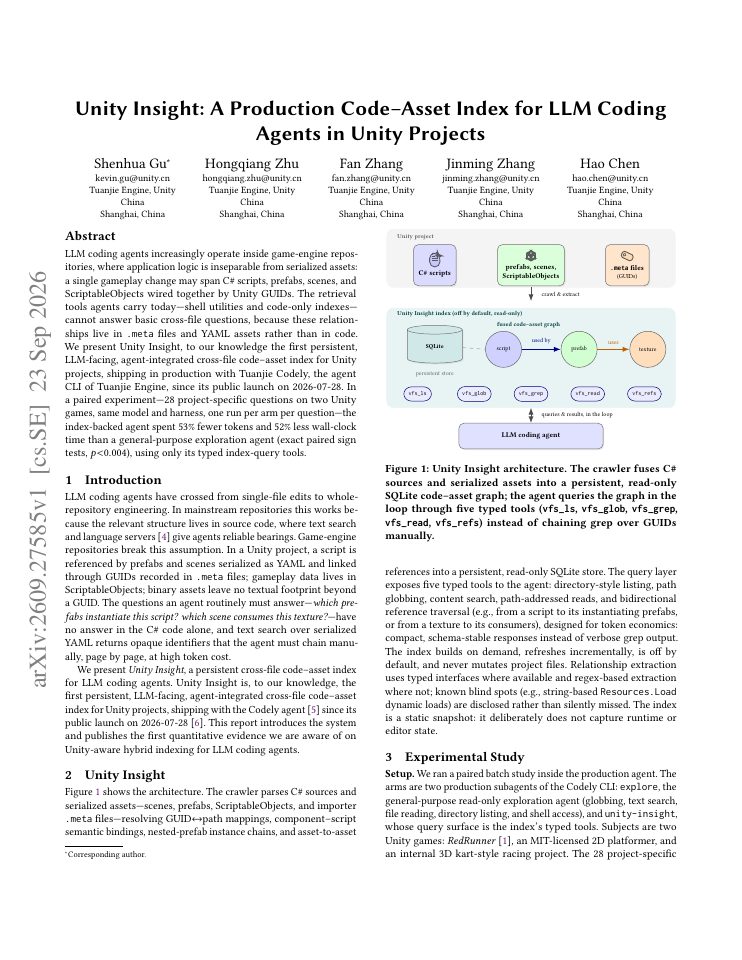
First page of Unity Insight: A Production Code--Asset Index for LLM Coding Agents in Unity Projects
coding agentstest

Unity Insight: A Production Code--Asset Index for LLM Coding Agents in Unity Projects

The technique replaces ad-hoc shell exploration and code-only retrieval by LLM coding agents with a persistent, typed cross-file index linking C# scripts to Unity assets (prefabs, scenes, ScriptableObjects) via GUIDs and .meta files. It costs the build and maintenance of a project-specific index plus integration of index-query tools into the agent harness; the paper reports no accuracy degradation, but provides no detail on indexing overhead or storage. It can fail when assets change without index refresh (stale GUID mappings), on non-Unity engines where the approach does not transfer, and the evidence base is narrow: 28 questions, two projects, one run per arm, from a single vendor's production system.

observed signal
0impl.
0stars
—citations
2.13xclaimed gain
abstract onlyReview decisionDownload skill ↓Original paper ↗
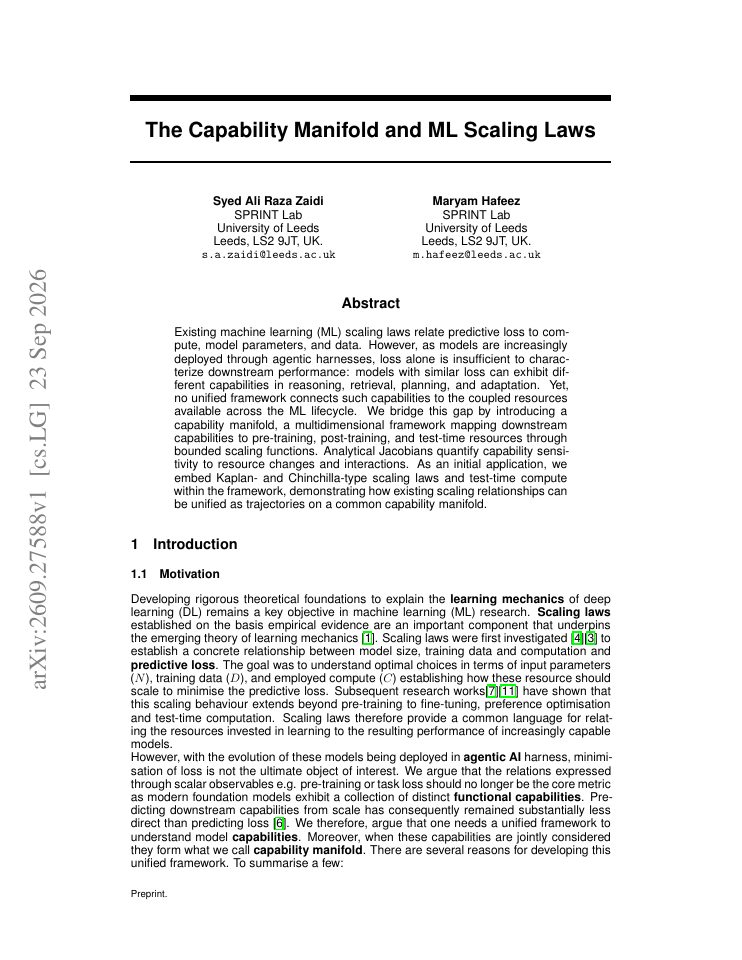
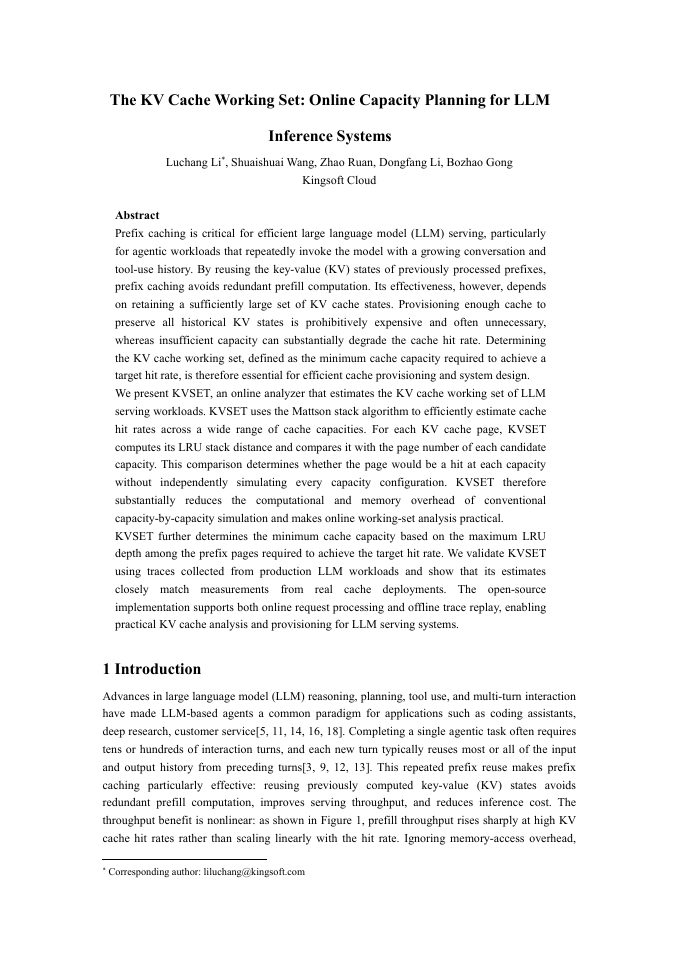
First page of The Capability Manifold and ML Scaling Laws
otherwatch

The Capability Manifold and ML Scaling Laws

The paper proposes an analytical framework, the capability manifold, that replaces ad hoc interpretation of separate loss-based scaling laws with a multidimensional mapping from pre-training, post-training, and test-time resources to downstream capabilities, with Jacobians quantifying sensitivity and interactions. It costs nothing to deploy but offers no new model, method, or empirical efficiency gain; it is a mathematical formalization that re-embeds known Kaplan-, Chinchilla-, and test-time-compute laws. It can fail as a decision tool if its bounded scaling functions are miscalibrated to a specific workload, since the abstract reports no empirical validation against measured capability data.

observed signal
0impl.
0stars
—citations
—claimed gain
abstract onlyReview decisionDownload skill ↓Original paper ↗
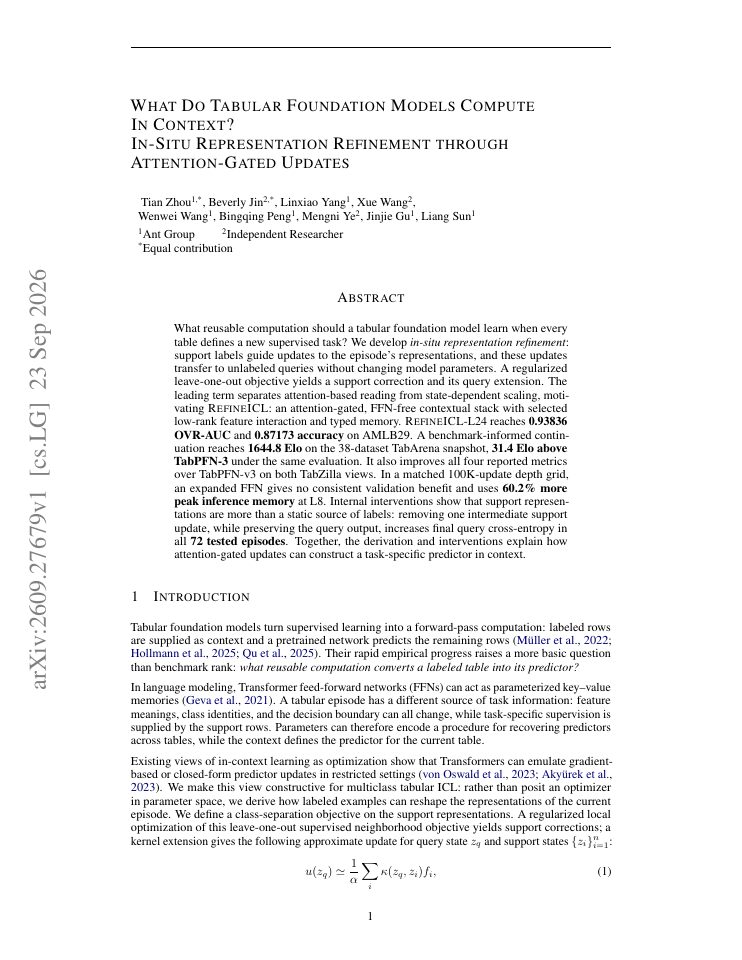
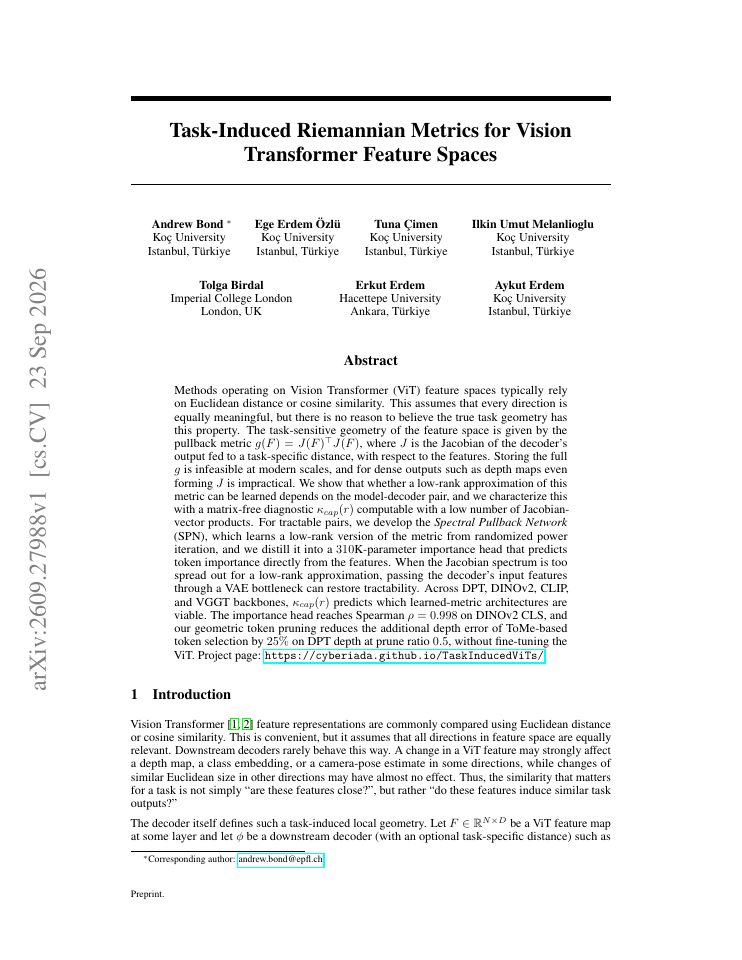
First page of What Do Tabular Foundation Models Compute In Context? In-Situ Representation Refinement through Attention-Gated Updates
othertest

What Do Tabular Foundation Models Compute In Context? In-Situ Representation Refinement through Attention-Gated Updates

The method replaces FFN-heavy tabular in-context learning stacks (as in TabPFN-style models) with an attention-gated, FFN-free contextual stack using low-rank feature interaction and typed memory, so task-specific prediction is built in context without parameter updates. It costs adoption of a new architecture and inference stack, benchmark-specific tuning effort, and—per the paper's own grid—an expanded FFN variant adds 60.2% more peak inference memory at L8 without consistent validation benefit. It can fail if results do not transfer beyond the reported AMLB29/TabArena/TabZilla benchmarks, if the single-GPU inference cost of the contextual stack exceeds API-based alternatives on the reader's workloads, or if pretrained weights and code are unavailable or unmaintained.
observed signal
0impl.
0stars
—citations
—claimed gain
abstract onlyReview decisionDownload skill ↓Original paper ↗
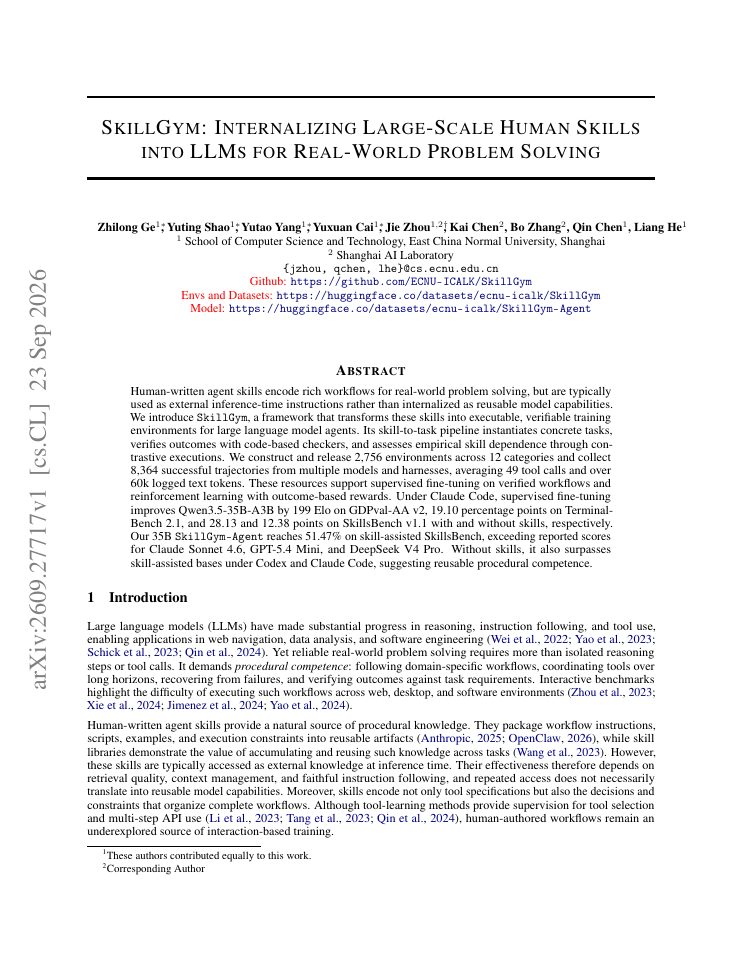
First page of SkillGym: Internalizing Human Skills into LLMs for Real-World Problem Solving
distillationwatch

SkillGym: Internalizing Human Skills into LLMs for Real-World Problem Solving

The method replaces inference-time prompting of human-written skill instructions with supervised fine-tuning (and optionally RL) on verified skill-execution trajectories, internalizing workflows into model weights. It costs an environment-construction and verification pipeline, trajectory collection averaging 49 tool calls and over 60k tokens each, and fine-tuning of a 35B-class model, which exceeds a single 24 GB GPU without aggressive quantization or rented compute. It can fail if the released trajectories do not transfer to the reader's domain, if code-based checkers verify spurious success signals, or if benchmark gains (GDPval, Terminal-Bench, SkillsBench) do not materialize on the reader's actual workloads.

observed signal
0impl.
121stars
—citations
—claimed gain
abstract onlyReview decisionDownload skill ↓Original paper ↗
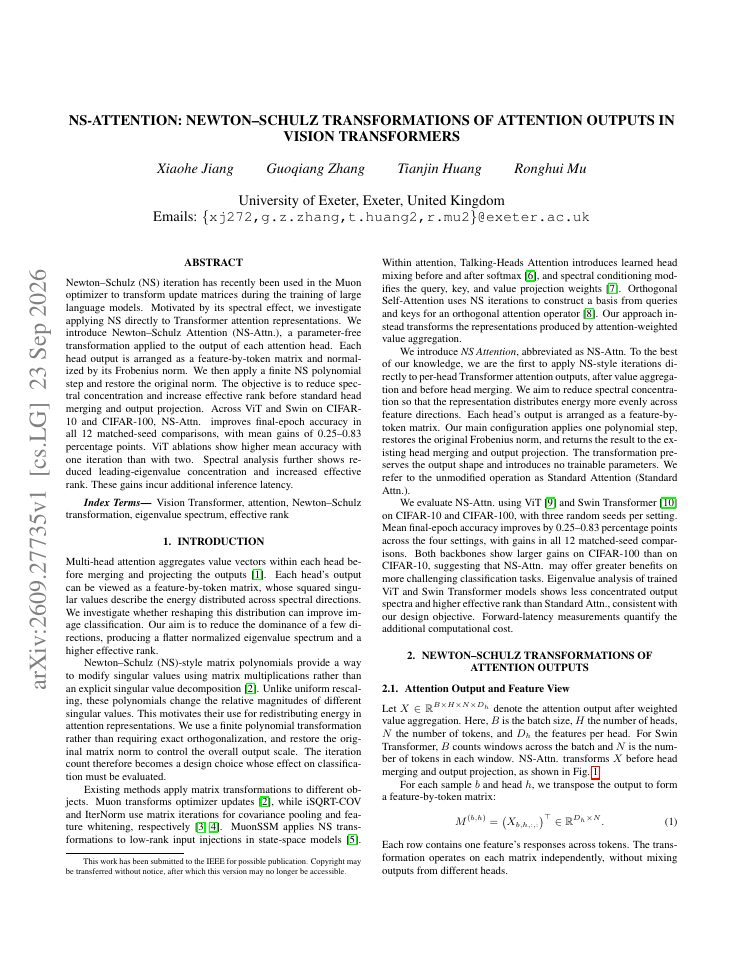
First page of NS-ATTENTION: Newton-Schulz Transformations of Attention Outputs in Vision Transformers
efficient architecturestest

NS-ATTENTION: Newton-Schulz Transformations of Attention Outputs in Vision Transformers

The method inserts a parameter-free Newton-Schulz polynomial step on each attention head's output matrix (after Frobenius normalization, with the norm restored afterward) between attention computation and the standard head merge and output projection, replacing nothing but augmenting that path. It adds inference latency and extra per-head matrix polynomial computation at both training and inference, with no parameters or memory overhead beyond transient buffers. Gains are demonstrated only on small-scale image classification (ViT/Swin on CIFAR), so the effect may not transfer to other modalities, larger models, or pre-trained checkpoints, and the one-versus-two-iteration ablation suggests sensitivity to the iteration count.

observed signal
0impl.
0stars
—citations
—claimed gain
abstract onlyReview decisionDownload skill ↓Original paper ↗

Research signals

Three views of the same evidence: adoption against attention, publication cadence by research area, and reported gains when coverage is sufficient.

color = research area

01 · attention × adoption

The research frontier

Look to the upper left for independent implementation before mass attention.

compare by
Each point represents one paper. Higher means more independent implementations; farther right means more GitHub stars.Context as an Environment: Programmatic Context Management for Long-Horizon Agents: 6 GitHub stars; 4 independent implementationsZero-Shot Self-Orchestration with Ledger-Based Control for Improved LLM Coding Performance: 1 GitHub star; 2 independent implementationsReachability-Based Capability Confinement for LLM Agents under Indirect Prompt Injection: 1 GitHub star; 1 independent implementationChipMEM: Verification-Grounded Memory for EDA Agents: 10 GitHub stars; 1 independent implementationFrom PyTorch to the NPU: LLM-Agent-Driven Model Conversion Across Heterogeneous Inference Runtimes: 0 GitHub stars; 0 independent implementationsCan One Adapted Model Do It All? Fine-Tuning Strategy Selection for Customer Support LLMs: 121 GitHub stars; 0 independent implementationsCAVEAT: Towards Robust Computer-Use Agents in Incentive-Misaligned Environments: 131 GitHub stars; 1 independent implementationEnSIMem: Entity-Structured Indexing for Long-Term Agent Memory: 131 GitHub stars; 1 independent implementationMemory Control Signals Emerge Before Action in Long Horizon Agents: 131 GitHub stars; 1 independent implementationStateComp: Learning When to Compress History in Long Horizon Agents: 131 GitHub stars; 1 independent implementationLearn How to Act from Your Own Interactions: On-Policy Self-Distillation for GUI Agents: 131 GitHub stars; 1 independent implementationVerifiable Hidden Dynamics Play: Generating Agentic RL Environments from Solved Mechanisms: 131 GitHub stars; 2 independent implementationsJust-in-Time Memory: Learning to Curate Task-Adaptive Memory for LLM Agents: 131 GitHub stars; 2 independent implementationsCART: Closed-Loop Adaptive Red Teaming for Large Language Models: 121 GitHub stars; 0 independent implementationsMolDesignBench: Evaluating LLM-based Agent for Scenario-grounded Molecular Design: 131 GitHub stars; 1 independent implementationConstraint-Driven Context Engineering: Designing Domain Interfaces for AI Systems: 0 GitHub stars; 0 independent implementationsPsychoacoustically Aligned Latent Smoothing for Adversarial Robustness of Full-Duplex Speech-to-Speech Dialogue Models: 0 GitHub stars; 0 independent implementationsWhen Parallel Drafter Meets Parallel Speculative Decoding: 121 GitHub stars; 0 independent implementationsWhat Looks Like a Capability Limit in Vision-Language Models Is a Readout Limit: 121 GitHub stars; 0 independent implementationsDeltaS: Reading the Gated Linear Attention State for KV Cache Eviction in Streaming Video: 121 GitHub stars; 0 independent implementationsProCredit: From Outcome Rewards to Progress Credit in Agentic Reinforcement Learning: 10 GitHub stars; 0 independent implementationsUnity Insight: A Production Code--Asset Index for LLM Coding Agents in Unity Projects: 0 GitHub stars; 0 independent implementationsThe Capability Manifold and ML Scaling Laws: 0 GitHub stars; 0 independent implementationsState-Grounded Conditioning: Wrapping User-Facing LLM Agents Where Direction Depends on Live State: 131 GitHub stars; 1 independent implementationInGuard: Towards Generalized Inner Guardrail for Safe Text-to-Image Generation: 122 GitHub stars; 1 independent implementationWhat Do Tabular Foundation Models Compute In Context? In-Situ Representation Refinement through Attention-Gated Updates: 0 GitHub stars; 0 independent implementationsSkillGym: Internalizing Human Skills into LLMs for Real-World Problem Solving: 121 GitHub stars; 0 independent implementationsNS-ATTENTION: Newton-Schulz Transformations of Attention Outputs in Vision Transformers: 0 GitHub stars; 0 independent implementationsThe KV Cache Working Set: Online Capacity Planning for LLM Inference Systems: 0 GitHub stars; 0 independent implementationsSix Layers Less: Encoder Pruning for Whisper with Label-Free Recovery: 125 GitHub stars; 4 independent implementationsRisk-Controlled KV-Cache Eviction: From Memory Budgets to Risk Targets: 121 GitHub stars; 0 independent implementationsTask-Induced Riemannian Metrics for Vision Transformer Feature Spaces: 121 GitHub stars; 0 independent implementationsTensor Decomposition of Transformer Key-Value Caches: Spectral Structure and Format Comparison: 0 GitHub stars; 0 independent implementationsConfidence Falls Short: Asymmetric Certainty Gains from Optimization Hinder Multimodal Classification: 121 GitHub stars; 0 independent implementationshyperbolix: Hyperbolic Deep Learning in JAX: 1 GitHub star; 0 independent implementationsComplementary Roles of Activation and Parametric Memory in Few-Shot Learning: 121 GitHub stars; 0 independent implementationsRAMP: Robust Adaptive Mixed-Precision Quantization for Edge CPU Vision Models: 1 GitHub star; 0 independent implementationsPredicting Quantization Price for Selecting PTQ Configurations Before Deployment: 121 GitHub stars; 0 independent implementationsNon-Commutative State Tracking with Input-Dependent Low-Rank Updates in Mamba-3: 1 GitHub star; 0 independent implementationsMicroQonv: Reshaping Convolution Tensors for Efficient Microscaling in Training and Inference: 1 GitHub star; 0 independent implementationsShopping by algorithm: How agentic AI deploys human heuristics as a surrogate consumer: 10 GitHub stars; 0 independent implementationsCross-Scale Transfer Learning for Depression Severity Prediction: From PHQ-8 to HAMD-17 Across Languages and Clinical Paradigms: 122 GitHub stars; 1 independent implementationMinimal-Norm Univariate Two-Layer ReLU Classification: Exact Solutions and Global Optimality with Skip Connections: 121 GitHub stars; 0 independent implementations

Papers above 1000 stars or 200 citations are not scored. They have already broken through the attention threshold, while Paperraft is designed to identify earlier signals.

02 · cadence

Research areas over time

Compare monthly publication volume on a shared scale and calendar.

coding agentsmax 8Aug 26: 0 papersSep 26: 1 paperAug 26Sep 26efficient architecturesmax 8Aug 26: 0 papersSep 26: 2 papersAug 26Sep 26agent evaluationmax 8Aug 26: 0 papersSep 26: 5 papersAug 26Sep 26KV cachemax 8Aug 26: 0 papersSep 26: 4 papersAug 26Sep 26speculative decodingmax 8Aug 26: 0 papersSep 26: 1 paperAug 26Sep 26distillationmax 8Aug 26: 0 papersSep 26: 2 papersAug 26Sep 26sparsity and pruningmax 8Aug 26: 0 papersSep 26: 2 papersAug 26Sep 26memory and contextmax 8Aug 26: 1 paperSep 26: 8 papersAug 26Sep 26multi-agent orchestrationmax 8Aug 26: 1 paperSep 26: 0 papersAug 26Sep 26othermax 8Aug 26: 0 papersSep 26: 5 papersAug 26Sep 26quantizationmax 8Aug 26: 0 papersSep 26: 3 papersAug 26Sep 26safety and guardrailsmax 8Aug 26: 1 paperSep 26: 3 papersAug 26Sep 26efficient trainingmax 8Aug 26: 0 papersSep 26: 3 papersAug 26Sep 26tool usemax 8Aug 26: 0 papersSep 26: 1 paperAug 26Sep 26

Every panel uses the same calendar and vertical scale. An empty column means no papers were recorded.

Method under scrutiny

Inspect the highest-ranked paper, every repository behind its signal, and the rule used to classify each one.

Context as an Environment: Programmatic Context Management for Long-Horizon Agents

memory and context · test · 4 of 4 implementations are independent

Scroll replaces prompt-side history compression and fixed memory representations with an append-only event log plus a persistent sandboxed Python kernel, where the model writes code to search and materialize state and only printed projections enter the working context. It costs engineering effort to build and sandbox the kernel and eviction index, adds code-execution latency per turn, and its reported results depend on a strong proprietary backbone. It can fail if the model writes faulty state-management code, if eviction landmarks mislead retrieval of evicted regions, or if sandboxing is insufficient against unsafe exec output.

Exclusions and controls

Every exclusion is counted and published.

Exclusion counts were not recorded for this edition.

0 previously indexed papers were rechecked in this run.

Paperraft tracks one signal: how many independent implementations a paper attracts on GitHub after author-owned repositories are removed. This is a discovery signal to investigate, not a measure of implementation quality.

It does not claim that a method works. Paperraft runs no reproduction benchmarks. Reported gains remain author claims until independently tested. Papers above the attention threshold are excluded because this publication is designed to identify research before consensus forms.