Skip to content

archived edition · 2026-09-15

PaperraftFind the AI research
worth testing.

Understand what a paper changes, what it costs, and whether it fits your next build. Explore research on faster LLM inference, agent memory, and evaluation, with the original sources in reach.

Start with a brief. Follow the evidence. Choose a test.

edition
2026-09-15
briefs
24
research areas
11
independent implementations
9

21 of 24 papers in the index (88%) have no independent implementations.

Research index

Search by topic, browse a research area, or sort by date. Read a brief, open the original paper, and inspect the available evidence before deciding what to test.

showing24 of 24
sort by
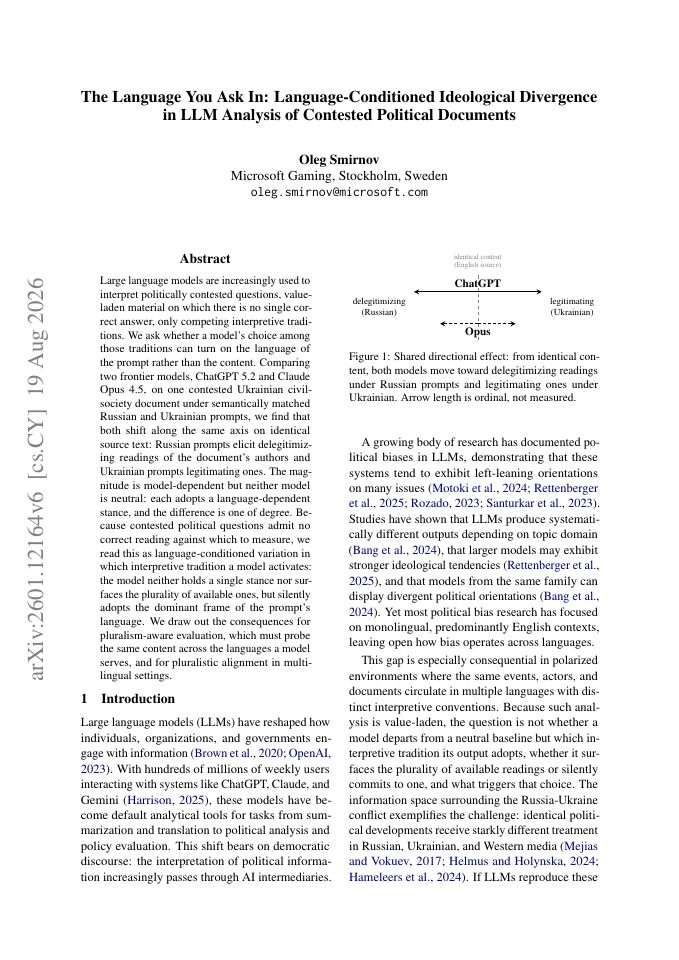
First page of The Language You Ask In: Language-Conditioned Ideological Divergence in LLM Analysis of Contested Political Documents
agent evaluationtest

The Language You Ask In: Language-Conditioned Ideological Divergence in LLM Analysis of Contested Political Documents

Replaces single-language neutrality evaluation with semantically paired prompts in different languages. It needs paired prompts and extra API calls, with human interpretation because contested questions lack a definitive answer key. The study reports that ChatGPT 5.2 and Claude Opus 4.5 adopt the prompt language's dominant framing, but examines a single Ukrainian document and does not establish generalization to other language pairs or topics.

observed signal
2impl.
0stars
0citations
—claimed gain
abstract onlyReview decisionDownload skill ↓Original paper ↗
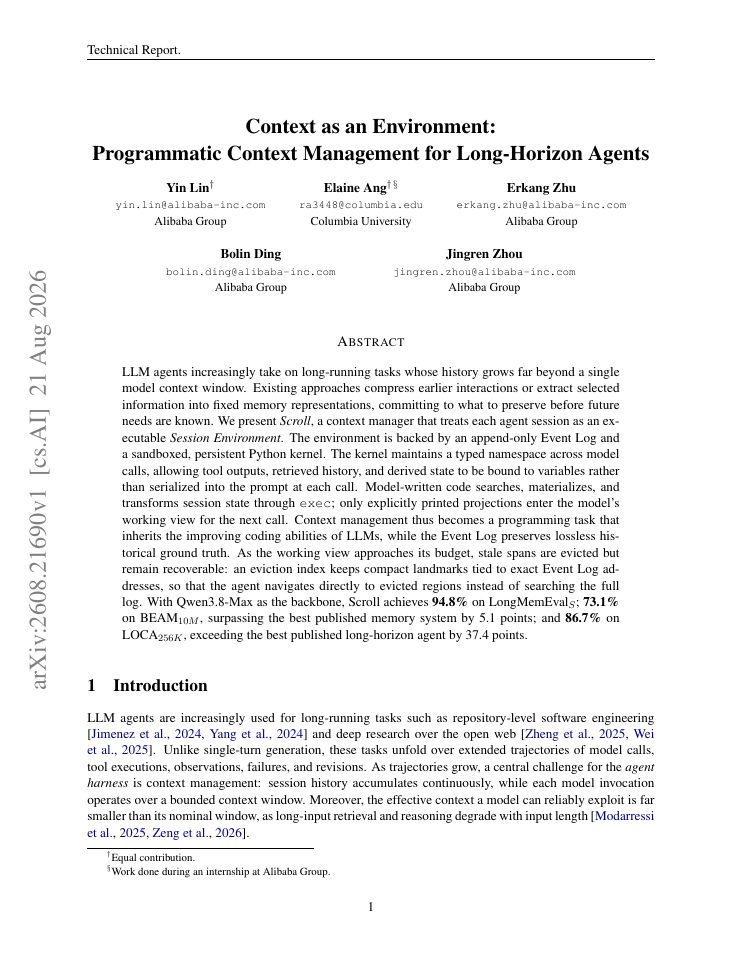
First page of Context as an Environment: Programmatic Context Management for Long-Horizon Agents
memory and contexttest

Context as an Environment: Programmatic Context Management for Long-Horizon Agents

Scroll replaces prompt-side history compression and fixed memory representations with an append-only event log plus a persistent sandboxed Python kernel, where the model writes code to search and materialize state and only printed projections enter the working context. It costs engineering effort to build and sandbox the kernel and eviction index, adds code-execution latency per turn, and its reported results depend on a strong proprietary backbone. It can fail if the model writes faulty state-management code, if eviction landmarks mislead retrieval of evicted regions, or if sandboxing is insufficient against unsafe exec output.

observed signal
5impl.
3stars
0citations
—claimed gain
abstract onlyReview decisionDownload skill ↓Original paper ↗
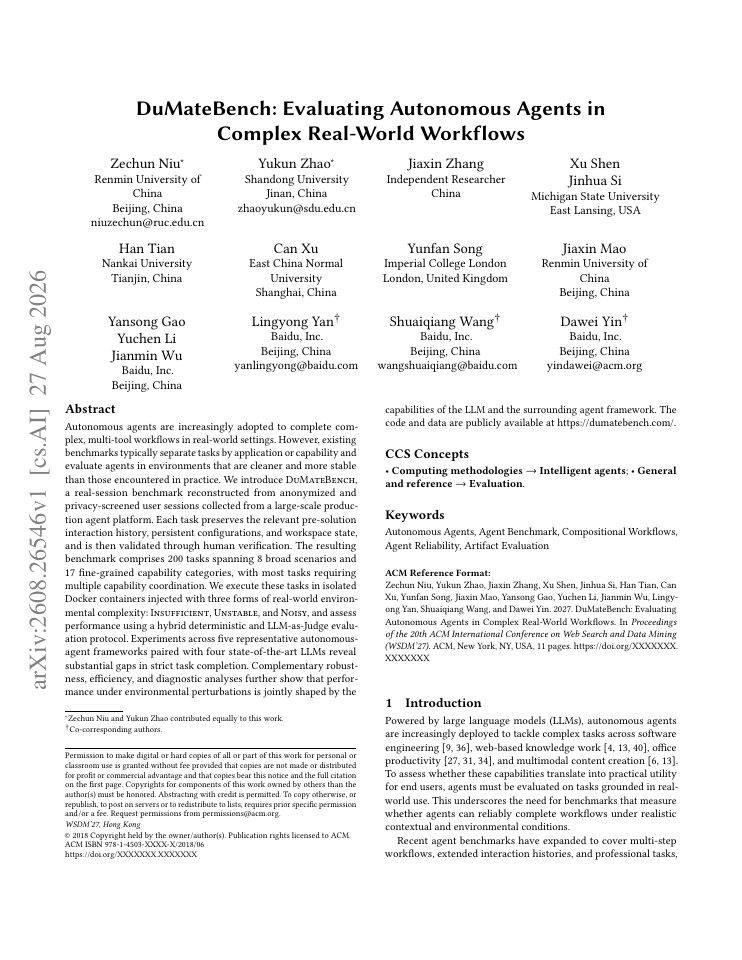
First page of DuMateBench: Evaluating Autonomous Agents in Complex Real-World Workflows
agent evaluationtest

DuMateBench: Evaluating Autonomous Agents in Complex Real-World Workflows

DuMateBench replaces clean, capability-isolated agent benchmarks with 200 tasks reconstructed from production user sessions, run in Docker containers with insufficient, unstable, and noisy environment conditions. Adopting it costs engineering time to set up the containerized harness, LLM-as-Judge API calls for scoring, and compute for multi-framework, multi-model evaluation runs. It can fail if the benchmark's tasks do not match the reader's actual production workload, if LLM-judge scoring is inconsistent for their domain, or if teams over-optimize framework choices to the benchmark rather than to their own telemetry.

observed signal
2impl.
7stars
0citations
—claimed gain
abstract onlyReview decisionDownload skill ↓Original paper ↗
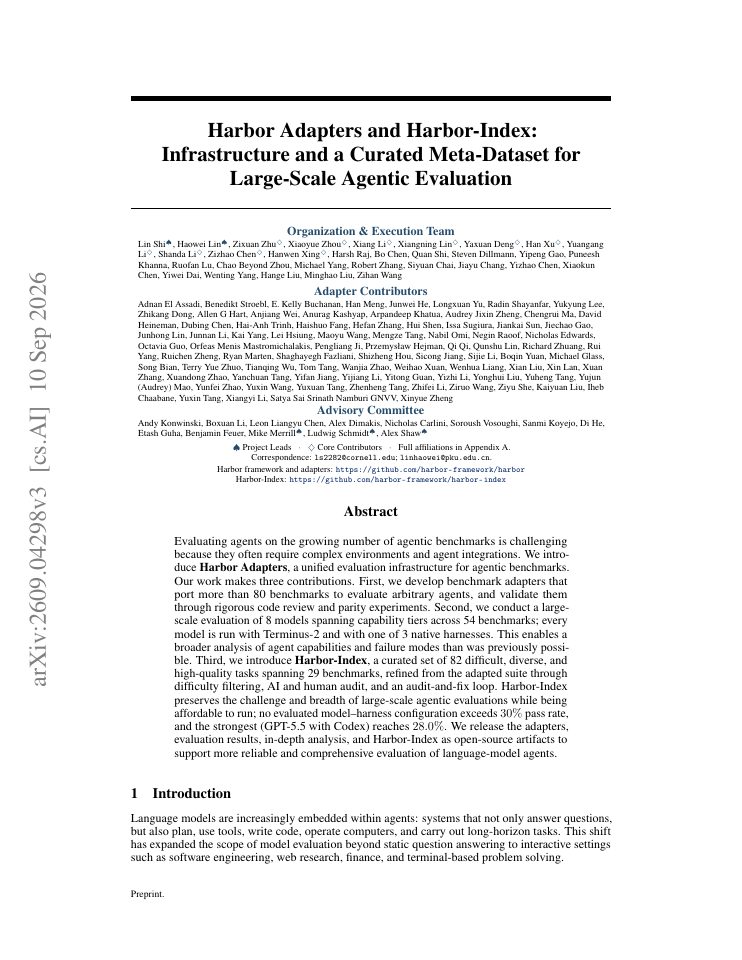
First page of Harbor Adapters and Harbor-Index: Infrastructure and a Curated Meta-Dataset for Large-Scale Agentic Evaluation
agent evaluationadopt

Harbor Adapters and Harbor-Index: Infrastructure and a Curated Meta-Dataset for Large-Scale Agentic Evaluation

The Harbor Adapters replace bespoke, per-benchmark environment setup and agent integration work with a single ported evaluation infrastructure covering more than 80 benchmarks, and Harbor-Index replaces running full benchmark suites with a curated 82-task subset. The cost is the engineering effort of adopting the Harbor harness and the API spend per evaluation run, plus dependence on adapter fidelity validated by the authors' parity experiments rather than one's own. Failures include adapter or environment bugs silently skewing scores, the curated index drifting from the reader's actual production workload distribution, and pass-rate comparisons becoming stale as new models and harnesses appear.

observed signal
0impl.
0stars
0citations
—claimed gain
abstract onlyReview decisionDownload skill ↓Original paper ↗
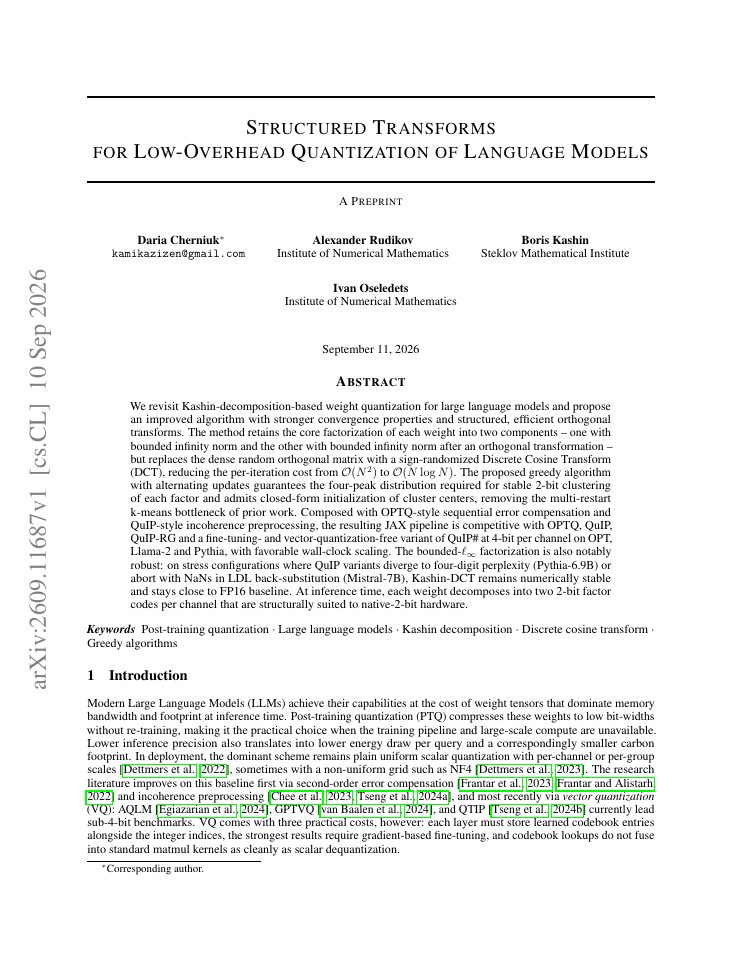
First page of Structured Transforms for Low-Overhead Quantization of Language Models
quantizationtest

Structured Transforms for Low-Overhead Quantization of Language Models

The method replaces dense random orthogonal transforms in Kashin-decomposition quantization with a sign-randomized DCT, cutting per-iteration cost from O(N^2) to O(N log N), and replaces multi-restart k-means with a greedy alternating-update algorithm with closed-form cluster initialization. Cost is a JAX-based one-shot compression pass composed with OPTQ-style error compensation and QuIP-style preprocessing; the paper claims competitiveness only at 4-bit per channel, with no reported accuracy gain over existing PTQ methods. The main failure risk after adoption is practical: the two 2-bit factor codes per channel require native-2-bit hardware or custom kernels to realize memory and speed benefits, so on a single 24 GB GPU with standard kernels the effective benefit may be limited to the 4-bit regime where OPTQ-class methods already suffice.

observed signal
0impl.
0stars
0citations
—claimed gain
abstract onlyReview decisionDownload skill ↓Original paper ↗
First page of Why Does Post-Training Quantization Work?
quantizationadopt

Why Does Post-Training Quantization Work?

The paper introduces no new technique; it explains why standard post-training quantization, which replaces full-precision weight storage with low-bit weights without retraining, degrades pretrained LLMs far less than naive error-accumulation arguments predict, attributing this to self-cancelling layer errors and LM-head geometry that protects top-ranked tokens. Adoption cost is limited to the usual PTQ workflow (calibration data and a one-time quantization pass via existing tools such as GPTQ or AWQ), with no training infrastructure required. What can fail: the findings are mechanistic and empirical rather than guarantees, so robustness at aggressive bit-widths (e.g., 2-bit), on out-of-distribution tasks, or on architectures not covered by the study must still be validated on the reader's own workload.

observed signal
0impl.
0stars
0citations
—claimed gain
abstract onlyReview decisionDownload skill ↓Original paper ↗
First page of Vortex: Bridging Extreme Compression and Efficient LLM Inference
quantizationwatch

Vortex: Bridging Extreme Compression and Efficient LLM Inference

Vortex replaces conventional systolic-array execution of vector-quantized and input-dependent-sparse LLMs with a bi-flow execution strategy plus codebook-wise contextual sparsity designed to align the algorithm with the hardware. It costs custom accelerator hardware with modified systolic-array datapaths and a co-designed sparsity algorithm, neither of which is available as software for commodity GPUs. It can fail to deliver its reported gains outside its own hardware prototype, and the extreme VQ compression it targets can degrade model quality on sensitive tasks.

observed signal
0impl.
4stars
0citations
8.03xclaimed gain
abstract onlyReview decisionDownload skill ↓Original paper ↗
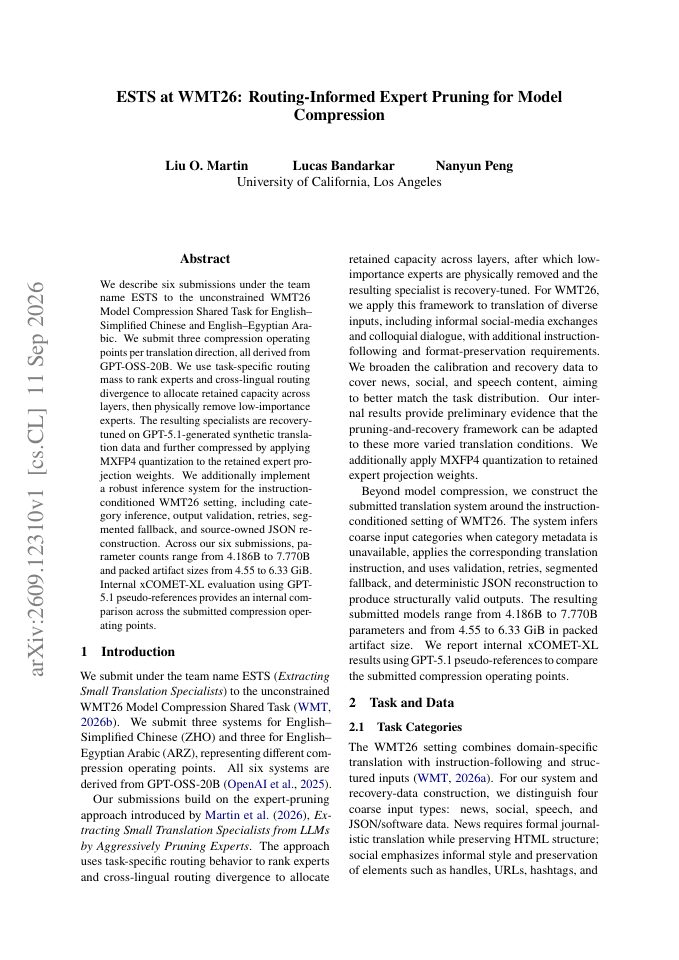
First page of ESTS at WMT26: Routing-Informed Expert Pruning for Model Compression
sparsity and pruningwatch

ESTS at WMT26: Routing-Informed Expert Pruning for Model Compression

The method replaces a full 20B-parameter mixture-of-experts model with a layer-wise pruned specialist, ranking experts by task-specific routing mass and allocating retained capacity via cross-lingual routing divergence, followed by recovery fine-tuning on synthetic data and MXFP4 quantization of the remaining expert weights. It costs a multi-stage pipeline: routing-statistics collection over task data, synthetic recovery-tuning data generated by a proprietary frontier model (GPT-5.1), retraining compute, and a custom inference stack with category inference, validation, retries, and fallback logic. It can fail when routing statistics do not transfer to unseen domains, when pruned experts carry rare-but-critical capability, when MXFP4 quantization compounds pruning error, or when the synthetic teacher data biases the specialist toward teacher artifacts, and the reported quality rests on pseudo-references from the same model family that generated the training data.

observed signal
0impl.
4stars
0citations
4.8xclaimed gain
abstract onlyReview decisionDownload skill ↓Original paper ↗
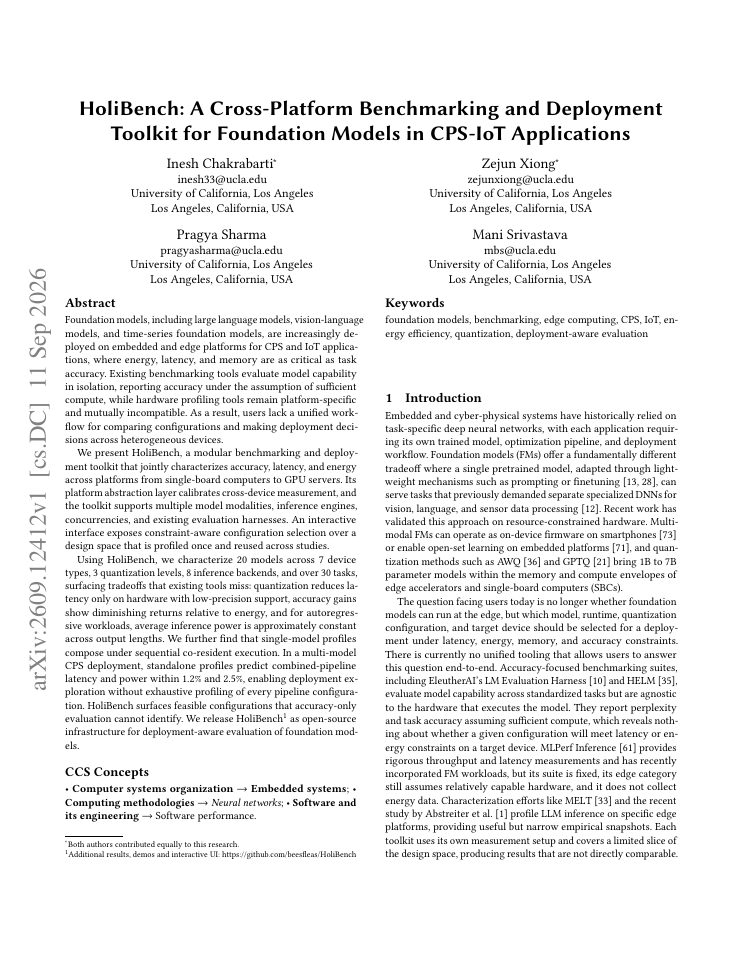
First page of HoliBench: A Cross-Platform Benchmarking and Deployment Toolkit for Foundation Models in CPS-IoT Applications
othertest

HoliBench: A Cross-Platform Benchmarking and Deployment Toolkit for Foundation Models in CPS-IoT Applications

HoliBench replaces ad-hoc, platform-specific profiling scripts and accuracy-only evaluation harnesses with a unified toolkit that measures accuracy, latency, and energy once per device and reuses those profiles for constraint-aware deployment selection. The cost is an upfront profiling campaign per device-model-backend combination, integration effort with its abstraction layer, and the engineering overhead of maintaining an open-source toolkit rather than a model-level optimization. It can fail if the reader's targets are only a single 24 GB GPU or third-party APIs (where cross-device calibration adds little), if profile composition breaks down under concurrent rather than sequential co-resident execution, or if measurement drift and quantization-backend interactions make reused profiles stale.

observed signal
0impl.
4stars
0citations
—claimed gain
abstract onlyReview decisionDownload skill ↓Original paper ↗
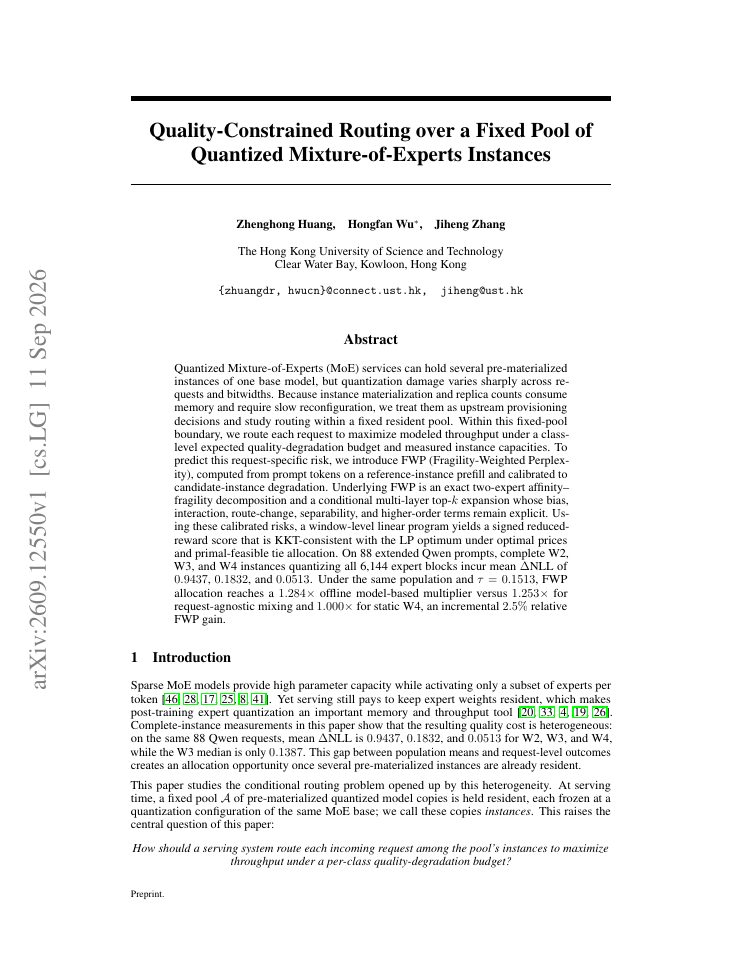
First page of Quality-Constrained Routing over a Fixed Pool of Quantized Mixture-of-Experts Instances
serving and batchingwatch

Quality-Constrained Routing over a Fixed Pool of Quantized Mixture-of-Experts Instances

The method replaces static single-bitwidth serving or request-agnostic mixing across pre-materialized quantized MoE instances with per-request routing driven by a fragility-weighted perplexity risk score and a window-level linear program. It costs an additional reference-instance prefill per request, an online LP solve per window, and the operational burden of maintaining calibration between the reference and candidate quantized instances. It can fail if FWP calibration drifts from actual per-instance degradation, if traffic shifts away from the evaluated prompt population, or if the 2.5% incremental gain over request-agnostic mixing does not justify the added routing complexity, since the result is demonstrated on only 88 prompts of one model family.

observed signal
0impl.
0stars
0citations
1.284xclaimed gain
abstract onlyReview decisionDownload skill ↓Original paper ↗
First page of Dissecting GPU Utilization for LLM Inference on Nvidia Hopper
attention and kernelsadopt

Dissecting GPU Utilization for LLM Inference on Nvidia Hopper

The method replaces the single SM utilization percentage with eight counter-validated views derived from raw Nsight Compute reports, mapping utilization gaps to concrete mechanisms such as fragment fill, occupancy limits, stall signatures, wave quantization, and kernel selection. The cost is profiling overhead and engineering effort: NCU runs add measurement time, require hardware counter access, and demand expertise to interpret per-layer kernel roles across the serving stack. It can fail if insights are overfit to the profiled configuration (vLLM, FlashAttention-3, cuBLASLt on H100), since kernel selection and stall behavior shift with different models, runtimes, or GPU generations.

observed signal
0impl.
0stars
0citations
—claimed gain
abstract onlyReview decisionDownload skill ↓Original paper ↗
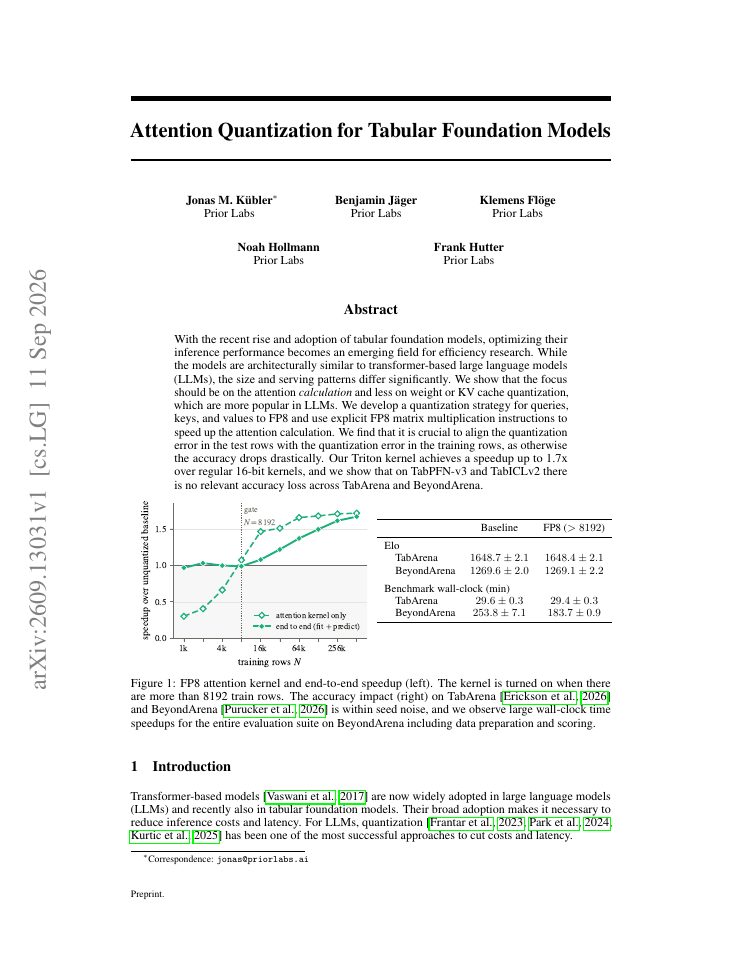
First page of Attention Quantization for Tabular Foundation Models
quantizationtest

Attention Quantization for Tabular Foundation Models

The method replaces 16-bit attention computation in tabular foundation models with FP8-quantized queries, keys, and values executed via a custom Triton kernel with explicit FP8 matmul instructions. It costs adoption of a custom kernel, requires hardware with FP8 instruction support (Hopper-class or newer), and demands careful calibration so that the quantization error on test rows matches that on training rows. If that error alignment is not maintained, accuracy drops drastically, and the 1.7x speedup is an upper bound that depends on workload and GPU.

observed signal
0impl.
0stars
0citations
1.7xclaimed gain
abstract onlyReview decisionDownload skill ↓Original paper ↗
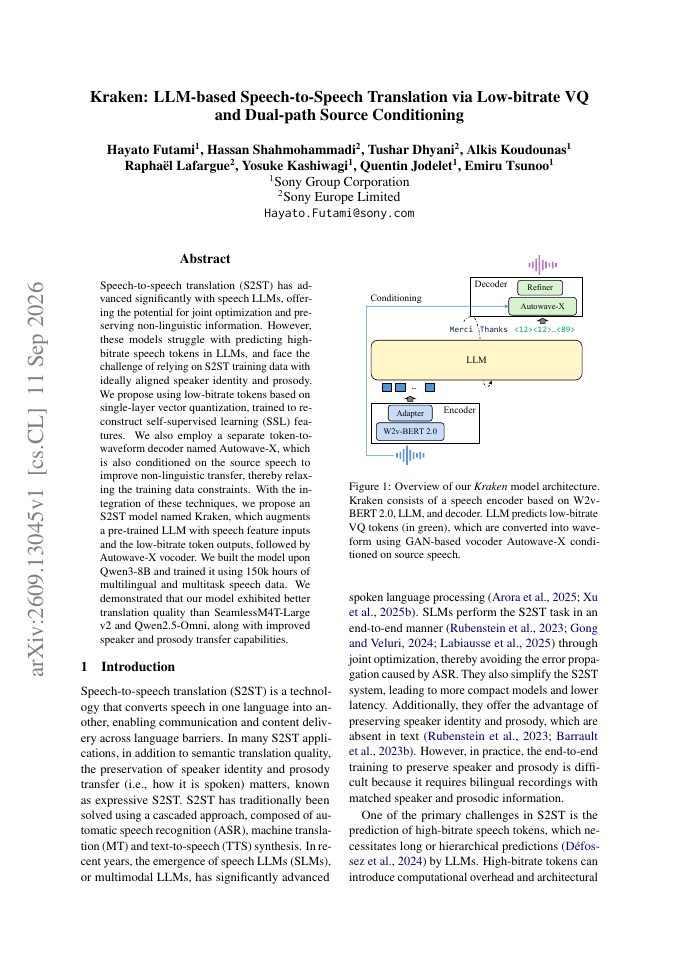
First page of Kraken: LLM-based Speech-to-Speech Translation via Low-bitrate VQ and Dual-path Source Conditioning
efficient architectureswatch

Kraken: LLM-based Speech-to-Speech Translation via Low-bitrate VQ and Dual-path Source Conditioning

Kraken replaces high-bitrate speech token prediction in speech LLMs with single-layer low-bitrate VQ tokens trained to reconstruct SSL features, plus a separate source-conditioned token-to-waveform decoder (Autowave-X) that handles non-linguistic transfer. It costs a full training pipeline: a Qwen3-8B backbone, 150k hours of multilingual multitask speech data, a custom VQ tokenizer, and a bespoke vocoder, which exceeds a 24 GB GPU and limited cloud budget. What can fail is reproduction at smaller data scale, loss of prosody or speaker fidelity from aggressive low-bitrate quantization, and dependence on a non-standard vocoder component that adds deployment complexity.

observed signal
0impl.
1stars
0citations
—claimed gain
abstract onlyReview decisionDownload skill ↓Original paper ↗
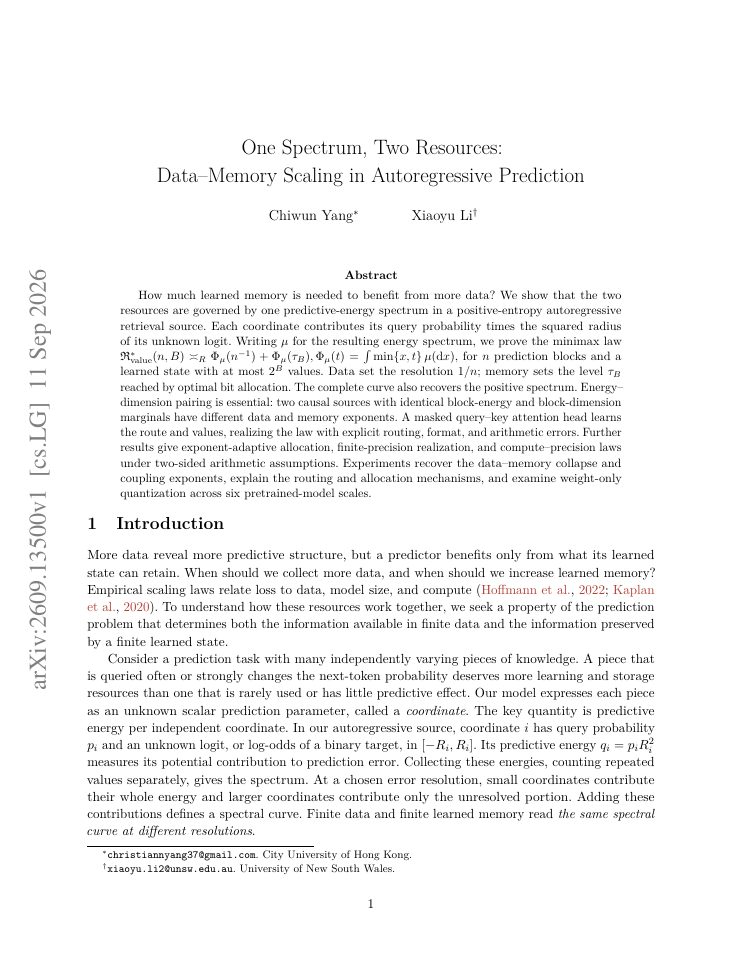
First page of One Spectrum, Two Resources: Data-Memory Scaling in Autoregressive Prediction
otherwatch

One Spectrum, Two Resources: Data-Memory Scaling in Autoregressive Prediction

The paper does not propose a deployable technique; it proves a minimax law linking dataset size and learned-state memory through a single predictive-energy spectrum, replacing heuristic capacity-data sizing rules with a theoretical curve. It costs nothing to adopt directly but offers no implementation, serving path, or quantified efficiency gain; the weight-only quantization section is an examination of existing pretrained models, not a new compression method. The law's assumptions (positive-entropy autoregressive retrieval source, optimal bit allocation, two-sided arithmetic bounds) may not hold for real pretraining workloads, so its exponents may not transfer to production model sizing decisions.

observed signal
0impl.
0stars
—citations
—claimed gain
abstract onlyReview decisionDownload skill ↓Original paper ↗
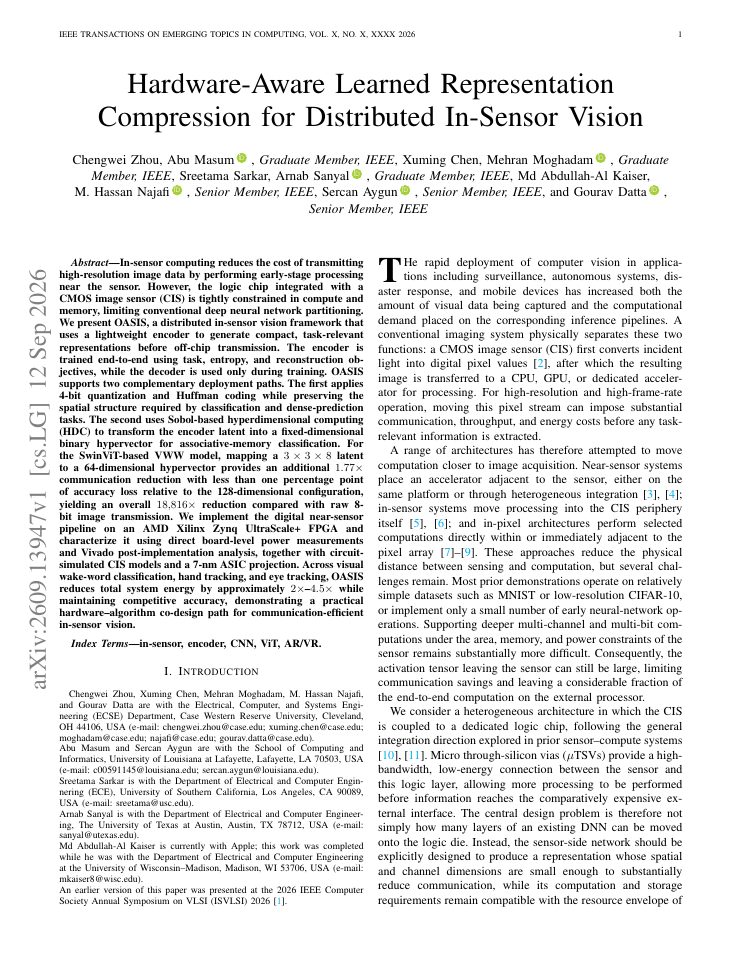
First page of Hardware-Aware Learned Representation Compression for Distributed In-Sensor Vision
othernot applicable

Hardware-Aware Learned Representation Compression for Distributed In-Sensor Vision

OASIS replaces transmission of raw high-resolution sensor images (and conventional DNN partitioning) with compact task-relevant latents produced by a lightweight encoder on a CIS-integrated logic chip, using 4-bit quantization plus Huffman coding or Sobol-based hyperdimensional computing. It costs a custom FPGA/ASIC near-sensor pipeline, end-to-end training with task, entropy, and reconstruction objectives, and up to roughly one percentage point of accuracy at the most aggressive compression. It can fail when the target task drifts from the training distribution (the latent is task-specific), when the required CIS-plus-logic hardware or FPGA toolchain is unavailable, or when associative-memory HDC classification underperforms on complex dense-prediction workloads.

observed signal
0impl.
0stars
—citations
4.5xclaimed gain
abstract onlyReview decisionDownload skill ↓Original paper ↗
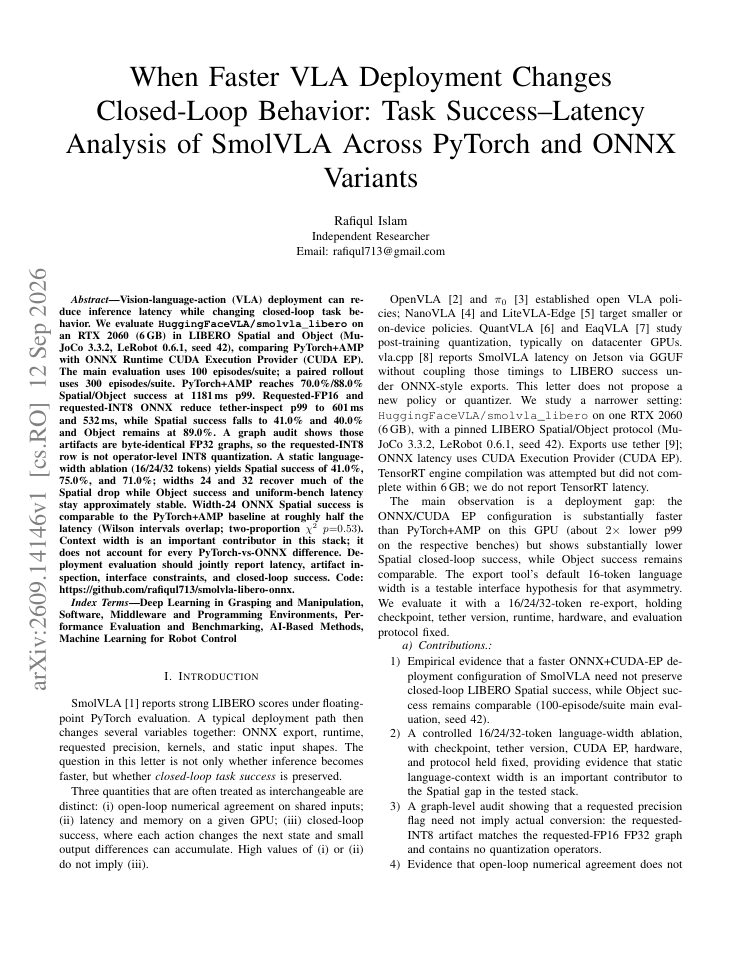
First page of When Faster VLA Deployment Changes Closed-Loop Behavior: Task Success-Latency Analysis of SmolVLA Across PyTorch and ONNX Variants
serving and batchingtest

When Faster VLA Deployment Changes Closed-Loop Behavior: Task Success-Latency Analysis of SmolVLA Across PyTorch and ONNX Variants

Replaces the default PyTorch+AMP inference path of a vision-language-action policy with an ONNX Runtime CUDA EP export, tuned via a language-context-width ablation (16/24/32 tokens). Costs include export and validation effort plus a severe closed-loop quality risk: naive conversion dropped Spatial success from 70.0% to 41.0% even though Object success held near 89%, and latency on uniform benchmarks stayed flat across widths. Can fail silently because requested-FP16 and requested-INT8 artifacts were byte-identical FP32 graphs, so the advertised quantization never occurred and only artifact inspection plus closed-loop rollouts reveal the discrepancy.

observed signal
0impl.
0stars
—citations
2xclaimed gain
abstract onlyReview decisionDownload skill ↓Original paper ↗
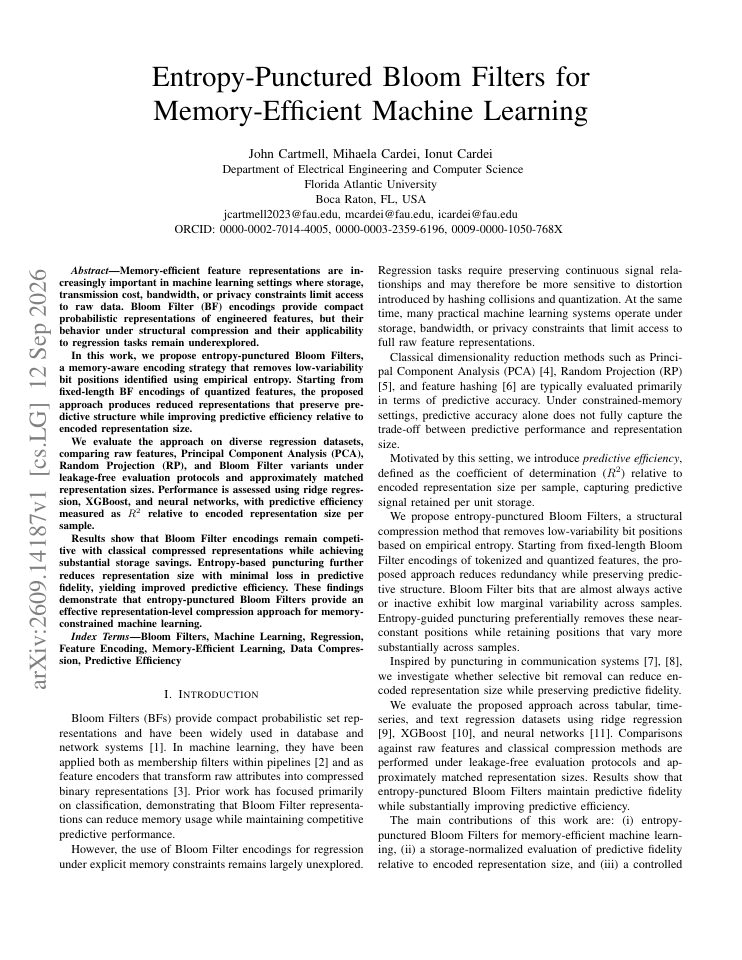
First page of Entropy-Punctured Bloom Filters for Memory-Efficient Machine Learning
othertest

Entropy-Punctured Bloom Filters for Memory-Efficient Machine Learning

The method replaces raw or classically compressed tabular features (PCA, random projections) with Bloom filter encodings of quantized features, punctured at low-entropy bit positions, for regression pipelines. It costs an additional encoding, quantization, and entropy-estimation stage plus some predictive fidelity, and it adds implementation complexity to the feature pipeline. It can fail if the entropy estimates from training data do not transfer to production distributions, if the evaluation datasets are not representative of the reader's workload, or if downstream models already handle raw features at acceptable memory cost.

observed signal
0impl.
0stars
—citations
—claimed gain
abstract onlyReview decisionDownload skill ↓Original paper ↗
First page of WaterKron and FlipFlop Hessian: Information-Theoretically Grounded Quantization with Kronecker-factored Hessians
quantizationtest

WaterKron and FlipFlop Hessian: Information-Theoretically Grounded Quantization with Kronecker-factored Hessians

It replaces the input-only (activation covariance) Hessian approximation used in standard GPTQ with a Kronecker-factored Hessian whose factors are selected by minimizing an explicit mismatch factor via alternating covariance-fitting ('flip-flop') updates, combined with waterfilling scales and entropy coding. The cost is additional calibration-time computation for the iterative factor fitting and entropy coding, plus implementation complexity beyond stock GPTQ; inference memory and latency are unchanged. It can fail if the claimed perplexity and KL gains do not hold on the reader's specific models, bit-widths, or downstream tasks, and integrating it requires modifying an existing PTQ pipeline rather than using an off-the-shelf tool.

observed signal
0impl.
0stars
—citations
—claimed gain
abstract onlyReview decisionDownload skill ↓Original paper ↗
First page of TriCalRAG: A Three-Strategy, Retrieval-Augmented Benchmark for On-Premise LLM-Based Root Cause Analysis in AIOps
retrieval and RAGtest

TriCalRAG: A Three-Strategy, Retrieval-Augmented Benchmark for On-Premise LLM-Based Root Cause Analysis in AIOps

Replaces zero-shot and few-shot prompting of cloud or local LLMs for log-based root cause analysis with retrieval over a labeled incident history served locally via vLLM. Costs a retrieval index and labeled incident data, plus the VRAM and roughly half throughput of the better-calibrated model; 4-bit quantization mitigates latency without accuracy loss. Can fail through calibration breakdown in some model/dataset configurations (Mistral-Small failed in 7 of 12), dependence on the quality and coverage of the incident history, and evaluation limited to four public log datasets that may not match production distributions.

observed signal
0impl.
0stars
—citations
—claimed gain
abstract onlyReview decisionDownload skill ↓Original paper ↗
First page of GGUF-Metadata Prediction of Single-Sequence llama.cpp Throughput Across Three Systems
quantizationtest

GGUF-Metadata Prediction of Single-Sequence llama.cpp Throughput Across Three Systems

Replaces empirical per-host throughput benchmarking or naive total-parameter cost estimates with roofline-shaped predictors using quantization-specific scale factors fitted from GGUF metadata. Costs are low in compute and memory, but the method requires reference measurements to fit host-specific efficiency coefficients and adds a modeling layer to the deployment pipeline. Fitted efficiencies do not transfer universally across systems (RTX 5080 test MAPE near 36%), prefill prediction is far less reliable than decode prediction, and quantization ladders reorder across runtime stacks, so choices made from transferred coefficients can be wrong.

observed signal
0impl.
0stars
—citations
3.8xclaimed gain
abstract onlyReview decisionDownload skill ↓Original paper ↗
First page of Validating Hybrid-State Cache Recovery for GLM-5.3-Flash with vLLM and LMCache
KV cachewatch

Validating Hybrid-State Cache Recovery for GLM-5.3-Flash with vLLM and LMCache

The method replaces full prompt recomputation after cache transfer with externally restored KV/hybrid state repaired by strict-prefix lookup so the scheduler credits the correct token count. It costs the LMCache integration layer, a patched vLLM recovery path, matched checkpoint scheduling, and fixed per-rank kernel configurations, adding operational complexity for a 1.9-7.0% end-to-end latency benefit. It can fail by restoring state for the full prompt while crediting one fewer token, producing silently inconsistent resumed generations, and the evidence covers only one quantized GLM-5.3-Flash revision under four-way tensor parallelism with no concurrent-serving validation.

observed signal
0impl.
0stars
—citations
2.78xclaimed gain
abstract onlyReview decisionDownload skill ↓Original paper ↗
First page of SpliTEE: Improving LLM Inference on Trusted Hardware with Differentially Private GPU Outsourcing
safety and guardrailswatch

SpliTEE: Improving LLM Inference on Trusted Hardware with Differentially Private GPU Outsourcing

Replaces running the full LLM inside a slow CPU-based trusted execution environment (or Slalom-style encrypted outsourcing) with a split architecture where privacy-sensitive computations run in the TEE and linear layers are outsourced to an untrusted GPU protected by differentially private noise calibrated via global sensitivity analysis. The costs are the DP noise (bounded by epsilon, with a derived floating-point error bound), a measured prompt-reconstruction risk of nearly 80% accuracy on unmasked intermediates if masking is omitted, and a hard dependency on Intel TDX-capable hardware plus a split-execution engineering stack. Adoption can fail because the reader lacks TDX hardware, the method only protects prompts against an untrusted inference provider (irrelevant when self-hosting on one's own GPU), and DP masking adds latency and potential accuracy degradation that must be validated per workload.

observed signal
0impl.
0stars
—citations
2xclaimed gain
abstract onlyReview decisionDownload skill ↓Original paper ↗
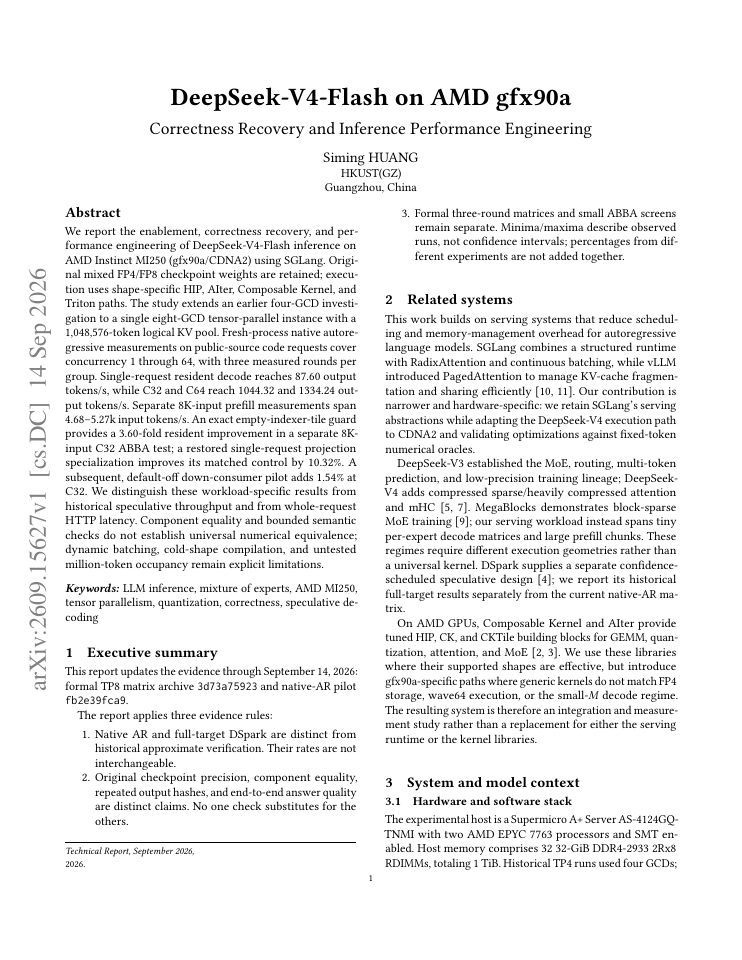
First page of DeepSeek-V4-Flash on AMD gfx90a: Correctness Recovery and Inference Performance Engineering
attention and kernelswatch

DeepSeek-V4-Flash on AMD gfx90a: Correctness Recovery and Inference Performance Engineering

The work replaces a default SGLang execution path with a hardware-specific stack combining FP4 routed-expert computation, FP8 dense projections, CDNA2 MFMA and dot-product kernels, HIP graphs, and a load-time repair of a numerically incorrect routed-expert W2 weight layout, validated by fixed-token and hash-based correctness checks. The cost is substantial porting and validation effort tied to AMD gfx90a hardware, plus the ongoing burden of maintaining packed FP4 formats, topology-aware kernel tuning, and custom correctness harnesses. It can fail silently through weight-layout or execution-format mismatches that produce fast but numerically wrong output, and through low-M utilization and per-layer synchronization overhead that erode the expected gains.

observed signal
0impl.
0stars
—citations
—claimed gain
abstract onlyReview decisionDownload skill ↓Original paper ↗
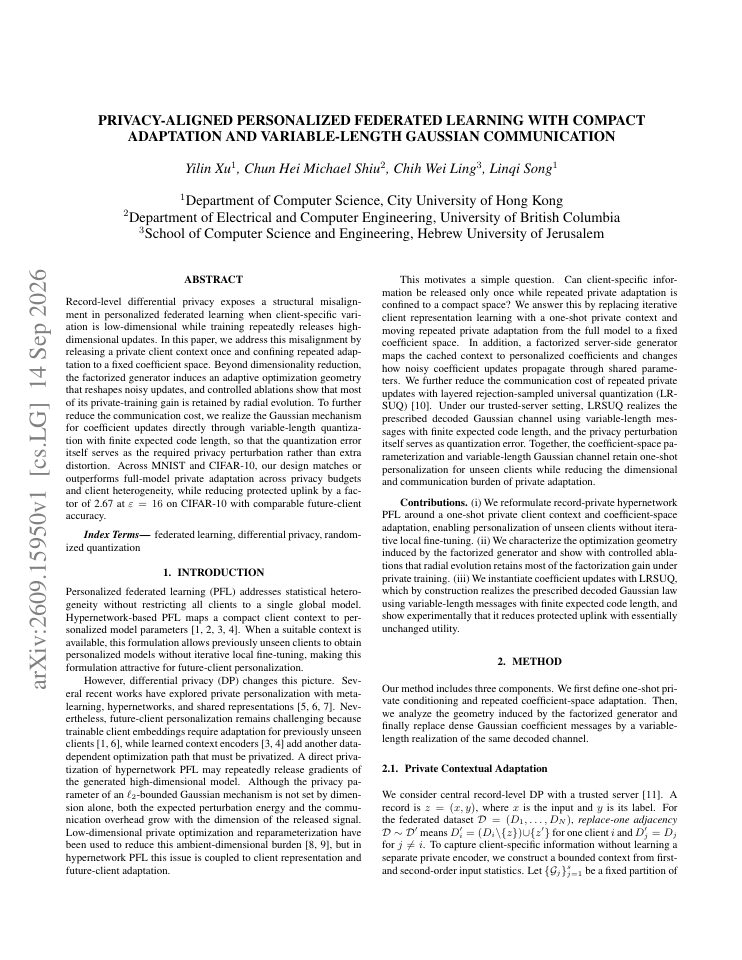
First page of Privacy-Aligned Personalized Federated Learning with Compact Adaptation and Variable-Length Gaussian Communication
safety and guardrailstest

Privacy-Aligned Personalized Federated Learning with Compact Adaptation and Variable-Length Gaussian Communication

The method replaces repeated high-dimensional differentially private model updates in personalized federated learning with a one-time private client context release followed by repeated adaptation confined to a fixed low-dimensional coefficient space, using variable-length quantization whose error doubles as the Gaussian privacy noise. The cost is implementing the factorized generator, the adaptive optimization geometry, and the variable-length coding scheme, plus accepting that gains depend on the assumption that client variation is genuinely low-dimensional. It can fail when client heterogeneity is high-dimensional, when the one-time context release is compromised or poorly calibrated, or in deployments not bound by record-level privacy accounting, where the added machinery buys nothing.

observed signal
0impl.
0stars
—citations
2.67xclaimed gain
abstract onlyReview decisionDownload skill ↓Original paper ↗

Research signals

Three views of the same evidence: adoption against attention, publication cadence by research area, and reported gains when coverage is sufficient.

color = research area

01 · attention × adoption

The research frontier

Look to the upper left for independent implementation before mass attention.

compare by
Each point represents one paper. Higher means more independent implementations; farther right means more GitHub stars.The Language You Ask In: Language-Conditioned Ideological Divergence in LLM Analysis of Contested Political Documents: 0 GitHub stars; 2 independent implementationsContext as an Environment: Programmatic Context Management for Long-Horizon Agents: 3 GitHub stars; 5 independent implementationsDuMateBench: Evaluating Autonomous Agents in Complex Real-World Workflows: 7 GitHub stars; 2 independent implementationsHarbor Adapters and Harbor-Index: Infrastructure and a Curated Meta-Dataset for Large-Scale Agentic Evaluation: 0 GitHub stars; 0 independent implementationsStructured Transforms for Low-Overhead Quantization of Language Models: 0 GitHub stars; 0 independent implementationsWhy Does Post-Training Quantization Work?: 0 GitHub stars; 0 independent implementationsVortex: Bridging Extreme Compression and Efficient LLM Inference: 4 GitHub stars; 0 independent implementationsESTS at WMT26: Routing-Informed Expert Pruning for Model Compression: 4 GitHub stars; 0 independent implementationsHoliBench: A Cross-Platform Benchmarking and Deployment Toolkit for Foundation Models in CPS-IoT Applications: 4 GitHub stars; 0 independent implementationsQuality-Constrained Routing over a Fixed Pool of Quantized Mixture-of-Experts Instances: 0 GitHub stars; 0 independent implementationsDissecting GPU Utilization for LLM Inference on Nvidia Hopper: 0 GitHub stars; 0 independent implementationsAttention Quantization for Tabular Foundation Models: 0 GitHub stars; 0 independent implementationsKraken: LLM-based Speech-to-Speech Translation via Low-bitrate VQ and Dual-path Source Conditioning: 1 GitHub star; 0 independent implementationsOne Spectrum, Two Resources: Data-Memory Scaling in Autoregressive Prediction: 0 GitHub stars; 0 independent implementationsHardware-Aware Learned Representation Compression for Distributed In-Sensor Vision: 0 GitHub stars; 0 independent implementationsWhen Faster VLA Deployment Changes Closed-Loop Behavior: Task Success-Latency Analysis of SmolVLA Across PyTorch and ONNX Variants: 0 GitHub stars; 0 independent implementationsEntropy-Punctured Bloom Filters for Memory-Efficient Machine Learning: 0 GitHub stars; 0 independent implementationsWaterKron and FlipFlop Hessian: Information-Theoretically Grounded Quantization with Kronecker-factored Hessians: 0 GitHub stars; 0 independent implementationsTriCalRAG: A Three-Strategy, Retrieval-Augmented Benchmark for On-Premise LLM-Based Root Cause Analysis in AIOps: 0 GitHub stars; 0 independent implementationsGGUF-Metadata Prediction of Single-Sequence llama.cpp Throughput Across Three Systems: 0 GitHub stars; 0 independent implementationsValidating Hybrid-State Cache Recovery for GLM-5.3-Flash with vLLM and LMCache: 0 GitHub stars; 0 independent implementationsSpliTEE: Improving LLM Inference on Trusted Hardware with Differentially Private GPU Outsourcing: 0 GitHub stars; 0 independent implementationsDeepSeek-V4-Flash on AMD gfx90a: Correctness Recovery and Inference Performance Engineering: 0 GitHub stars; 0 independent implementationsPrivacy-Aligned Personalized Federated Learning with Compact Adaptation and Variable-Length Gaussian Communication: 0 GitHub stars; 0 independent implementations

Papers above 1000 stars or 200 citations are not scored. They have already broken through the attention threshold, while Paperraft is designed to identify earlier signals.

02 · cadence

Research areas over time

Compare monthly publication volume on a shared scale and calendar.

efficient architecturesmax 6Jan 26: 0 papersAug 26: 0 papersSep 26: 1 paperJan 26Sep 26agent evaluationmax 6Jan 26: 1 paperAug 26: 1 paperSep 26: 1 paperJan 26Sep 26KV cachemax 6Jan 26: 0 papersAug 26: 0 papersSep 26: 1 paperJan 26Sep 26sparsity and pruningmax 6Jan 26: 0 papersAug 26: 0 papersSep 26: 1 paperJan 26Sep 26attention and kernelsmax 6Jan 26: 0 papersAug 26: 0 papersSep 26: 2 papersJan 26Sep 26memory and contextmax 6Jan 26: 0 papersAug 26: 1 paperSep 26: 0 papersJan 26Sep 26othermax 6Jan 26: 0 papersAug 26: 0 papersSep 26: 4 papersJan 26Sep 26quantizationmax 6Jan 26: 0 papersAug 26: 0 papersSep 26: 6 papersJan 26Sep 26retrieval and RAGmax 6Jan 26: 0 papersAug 26: 0 papersSep 26: 1 paperJan 26Sep 26safety and guardrailsmax 6Jan 26: 0 papersAug 26: 0 papersSep 26: 2 papersJan 26Sep 26serving and batchingmax 6Jan 26: 0 papersAug 26: 0 papersSep 26: 2 papersJan 26Sep 26

Every panel uses the same calendar and vertical scale. An empty column means no papers were recorded.

03 · reported results

Claimed performance gains

Gains stated in the abstract: reported by the authors; not independently verified.

Factors reported by the authors and not independently verified. The vertical axis uses a logarithmic scale; the baseline is 1x.reported factor · log scaleVortex: Bridging Extreme Compression and Efficient LLM Inference: 8.03x in speed (author-reported)ESTS at WMT26: Routing-Informed Expert Pruning for Model Compression: 4.8x in memory (author-reported)Quality-Constrained Routing over a Fixed Pool of Quantized Mixture-of-Experts Instances: 1.284x in speed (author-reported)Attention Quantization for Tabular Foundation Models: 1.7x in speed (author-reported)Hardware-Aware Learned Representation Compression for Distributed In-Sensor Vision: 4.5x in cost (author-reported)When Faster VLA Deployment Changes Closed-Loop Behavior: Task Success-Latency Analysis of SmolVLA Across PyTorch and ONNX Variants: 2x in speed (author-reported)GGUF-Metadata Prediction of Single-Sequence llama.cpp Throughput Across Three Systems: 3.8x in quality (author-reported)Validating Hybrid-State Cache Recovery for GLM-5.3-Flash with vLLM and LMCache: 2.78x in speed (author-reported)SpliTEE: Improving LLM Inference on Trusted Hardware with Differentially Private GPU Outsourcing: 2x in speed (author-reported)Privacy-Aligned Personalized Federated Learning with Compact Adaptation and Variable-Length Gaussian Communication: 2.67x in cost (author-reported)

10 of 24 papers report a quantified gain. The scale is logarithmic; a research-area trend line appears only with at least five papers in the quarter.

Method under scrutiny

Inspect the highest-ranked paper, every repository behind its signal, and the rule used to classify each one.

The Language You Ask In: Language-Conditioned Ideological Divergence in LLM Analysis of Contested Political Documents

agent evaluation · test · 2 of 2 implementations are independent

Replaces single-language neutrality evaluation with semantically paired prompts in different languages. It needs paired prompts and extra API calls, with human interpretation because contested questions lack a definitive answer key. The study reports that ChatGPT 5.2 and Claude Opus 4.5 adopt the prompt language's dominant framing, but examines a single Ukrainian document and does not establish generalization to other language pairs or topics.

Exclusions and controls

Every exclusion is counted and published.

Exclusion counts were not recorded for this edition.

0 previously indexed papers were rechecked in this run.

Paperraft tracks one signal: how many independent implementations a paper attracts on GitHub after author-owned repositories are removed. This is a discovery signal to investigate, not a measure of implementation quality.

It does not claim that a method works. Paperraft runs no reproduction benchmarks. Reported gains remain author claims until independently tested. Papers above the attention threshold are excluded because this publication is designed to identify research before consensus forms.