Skip to content

archived edition · 2026-10-25

PaperraftFind the AI research
worth testing.

Understand what a paper changes, what it costs, and whether it fits your next build. Explore research on faster LLM inference, agent memory, and evaluation, with the original sources in reach.

Start with a brief. Follow the evidence. Choose a test.

edition
2026-10-25
briefs
41
research areas
16
independent implementations
18

30 of 41 papers in the index (73%) have no independent implementations.

Research index

Search by topic, browse a research area, or sort by date. Read a brief, open the original paper, and inspect the available evidence before deciding what to test.

showing30 of 41
sort by
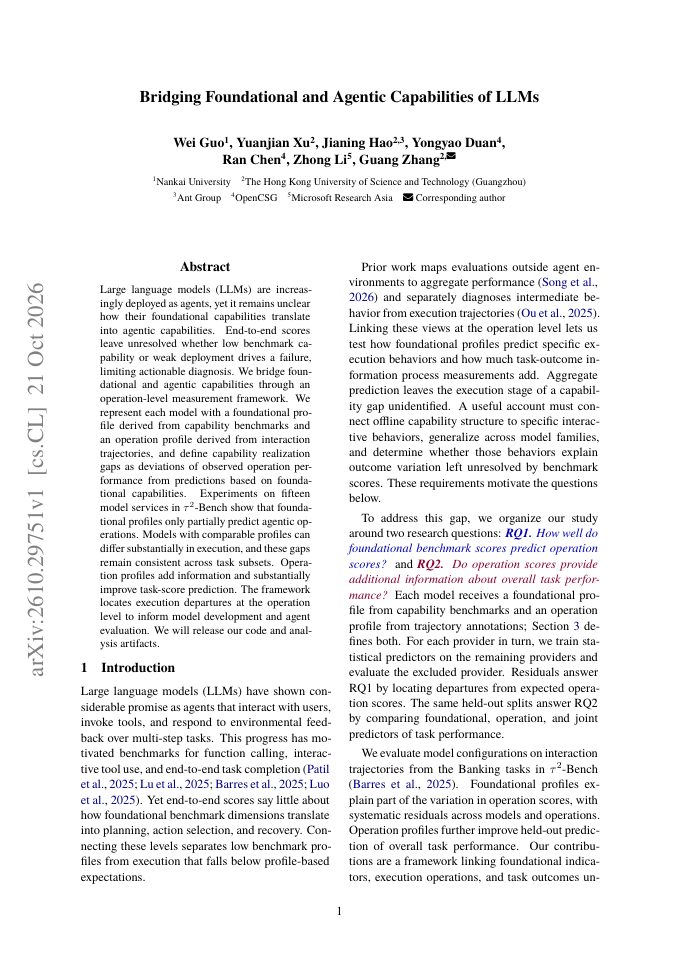
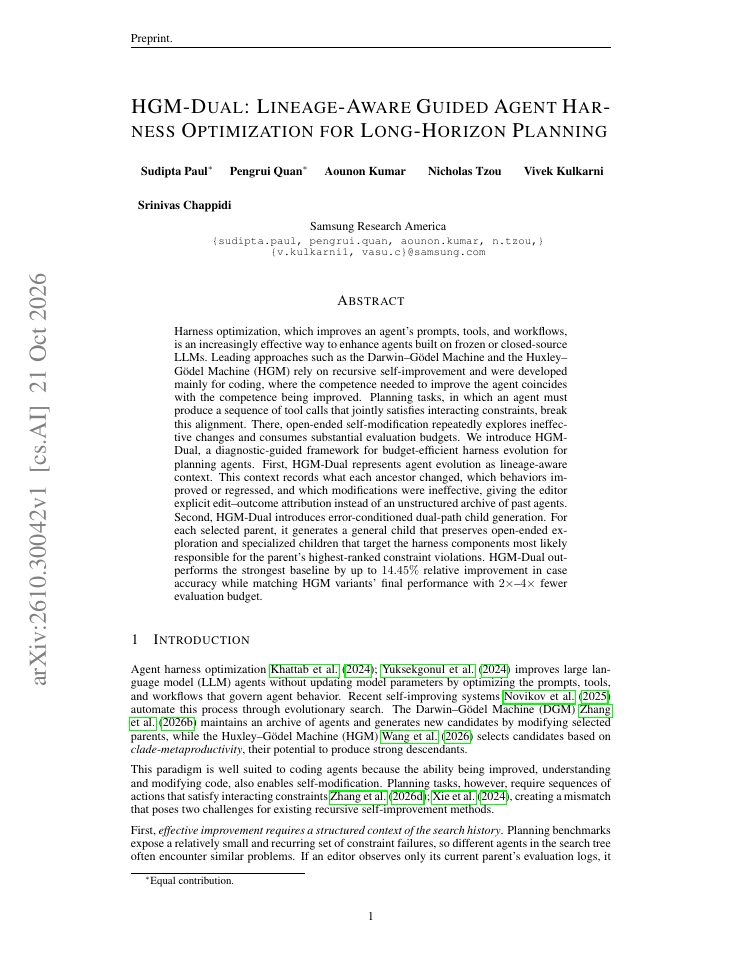
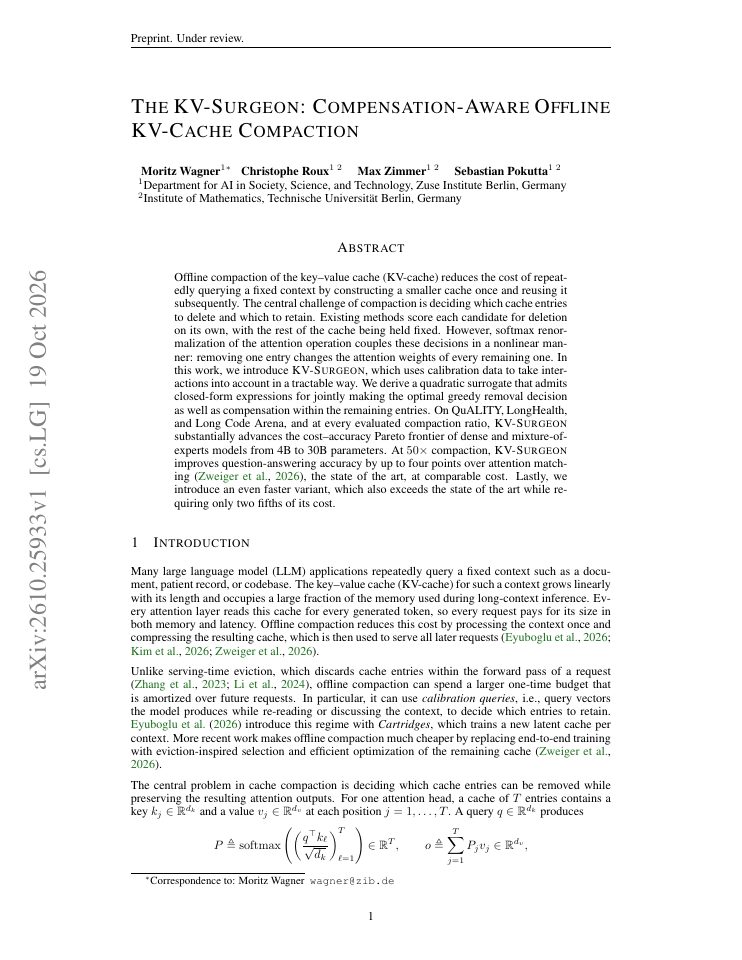
First page of The KV-Surgeon: Compensation-Aware Offline KV-Cache Compaction
KV cachetest

The KV-Surgeon: Compensation-Aware Offline KV-Cache Compaction

Replaces per-entry independent scoring for KV-cache eviction (e.g., attention matching) with a calibration-data-driven quadratic surrogate that jointly selects removals and compensates remaining entries, accounting for softmax renormalization. Cost is a one-time offline compaction pass with calibration data per fixed context, plus the memory of retaining a small calibration set; the compacted cache then reduces per-query memory and compute on repeated queries. It can fail when the queried context is not fixed and reused (no amortization of the offline cost), when calibration data is unrepresentative of production queries, or when compaction ratios are pushed beyond the validated operating points.

observed signal
2impl.
0stars
0citations
—claimed gain
abstract onlyReview decisionDownload skill ↓Original paper ↗
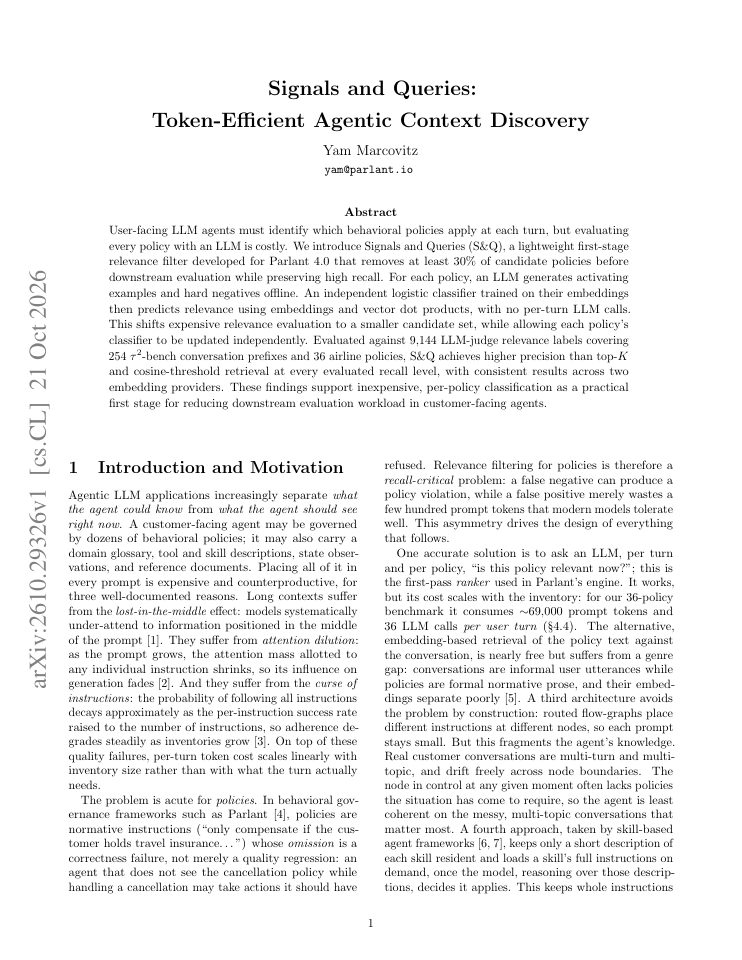
First page of Signals and Queries: Token-Efficient Agentic Context Discovery
memory and contextadopt

Signals and Queries: Token-Efficient Agentic Context Discovery

S&Q replaces per-turn LLM-based relevance evaluation of every behavioral policy with an offline-trained, per-policy logistic classifier over embeddings that filters candidates before any LLM call. The cost is an offline generation step (activating examples and hard negatives per policy), classifier training and maintenance per policy, and a small risk of false negatives that downstream stages never see. It can fail when user behavior drifts from the offline training examples, when new policies lack sufficient generated examples, or when embedding quality is poor for the domain, since a wrongly discarded policy is silently excluded from that turn.

observed signal
2impl.
0stars
0citations
1.43xclaimed gain
abstract onlyReview decisionDownload skill ↓Original paper ↗
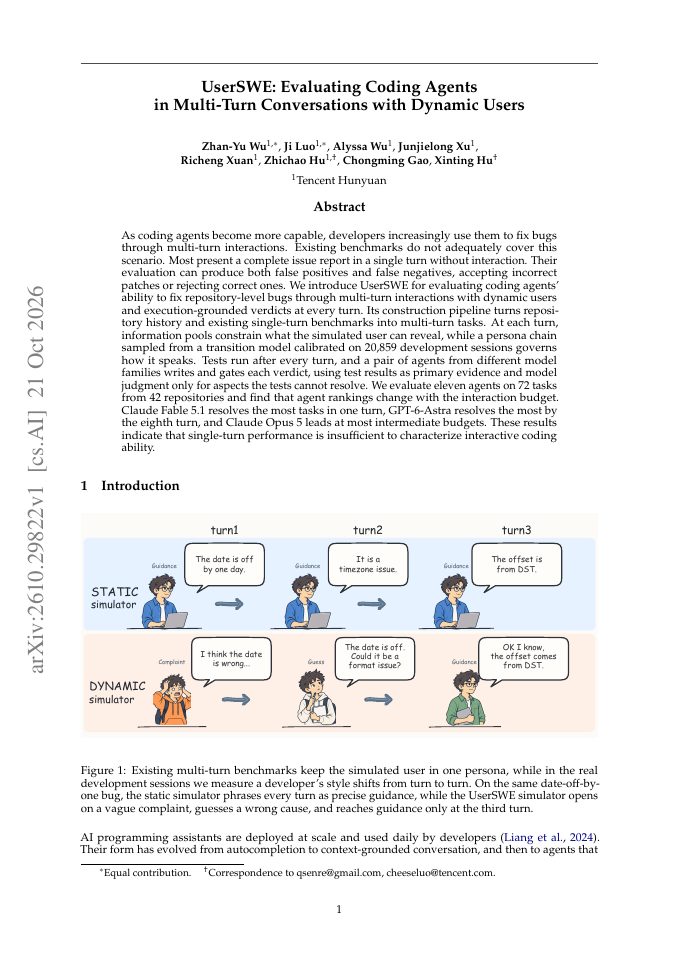
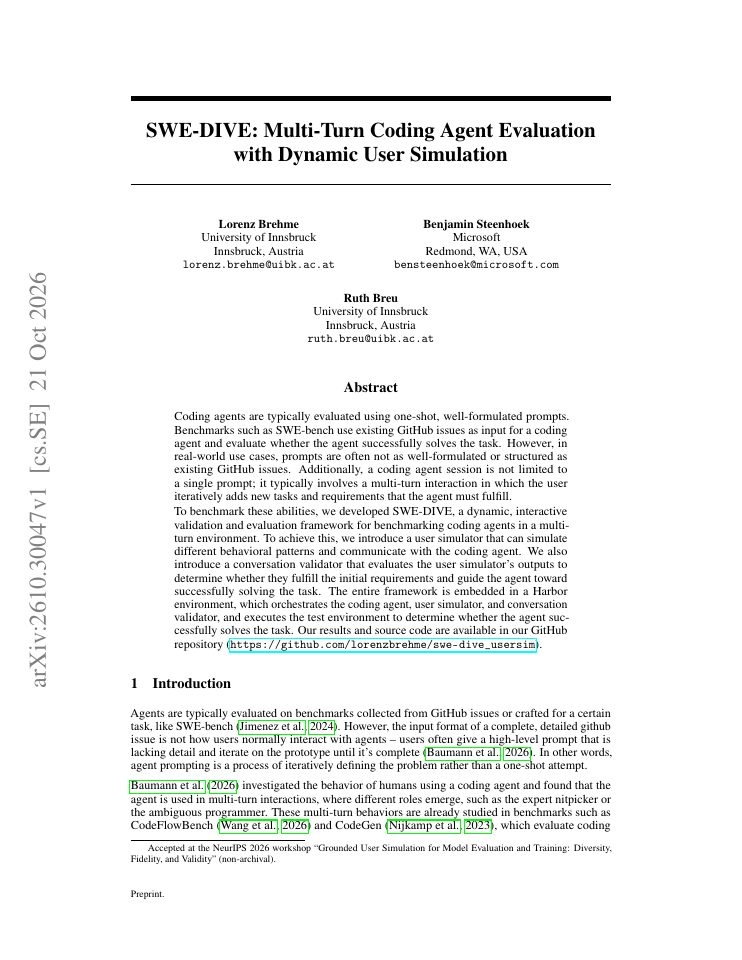
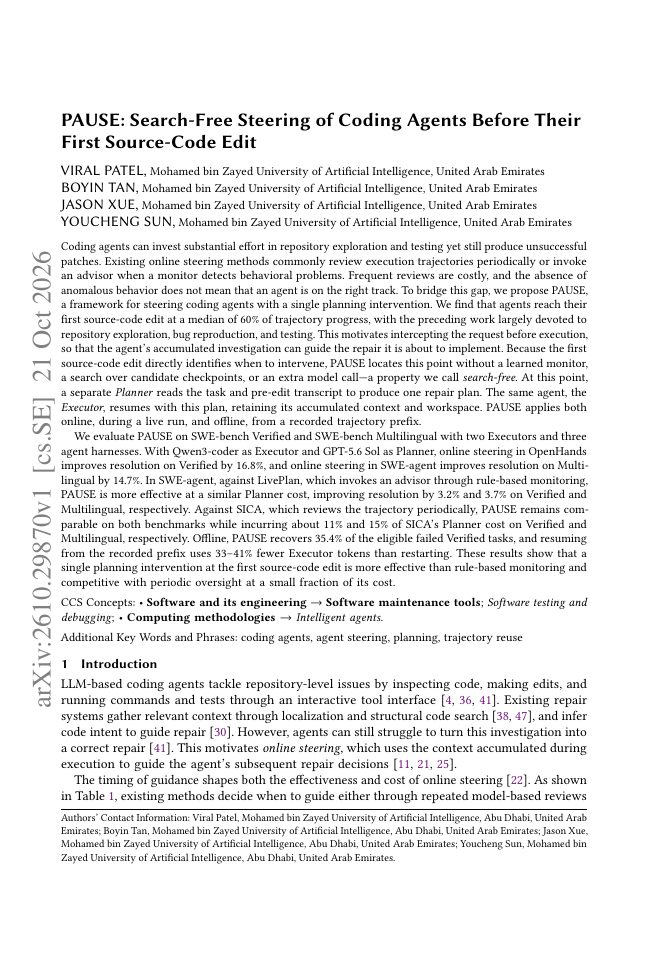
First page of PAUSE: Search-Free Steering of Coding Agents Before Their First Source-Code Edit
coding agentstest

PAUSE: Search-Free Steering of Coding Agents Before Their First Source-Code Edit

PAUSE replaces periodic trajectory reviews, learned monitors, and search-over-checkpoints steering with one intervention: the agent's first source-code edit is intercepted, a separate Planner model writes a repair plan from the pre-edit transcript, and the same agent resumes with its context and workspace intact. The cost is one extra Planner call per run (a strong frontier model such as GPT-5.6 Sol in the reported results), plus engineering to hook the edit tool in the agent harness; Executor compute is unchanged and offline replay saves 33-41% of Executor tokens versus restarting. It can fail when the Planner is weaker than the Executor's own reasoning, when the task's decisive error occurs after the first edit and is never revisited, or when the harness cannot expose a clean pre-edit interception point.

observed signal
2impl.
0stars
0citations
—claimed gain
abstract onlyReview decisionDownload skill ↓Original paper ↗
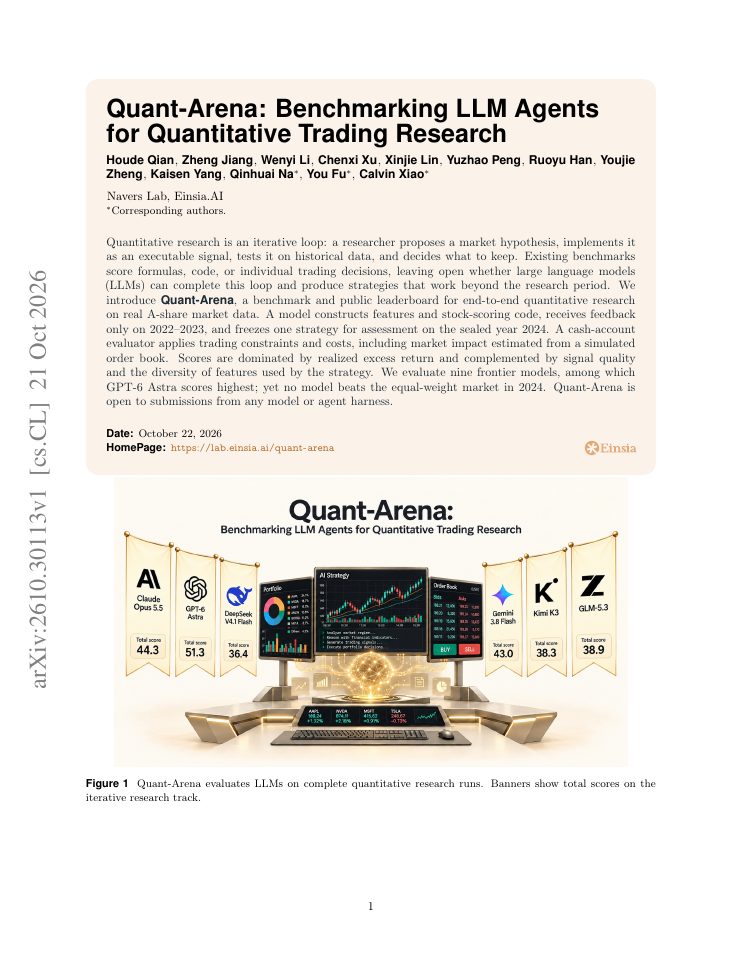
First page of Quant-Arena: Benchmarking LLM Agents for Quantitative Trading Research
agent evaluationnot applicable

Quant-Arena: Benchmarking LLM Agents for Quantitative Trading Research

Quant-Arena replaces ad-hoc evaluation of trading agents with a sealed backtest that forces models to generate features, signals, and code under realistic trading constraints. It costs access to proprietary A-share data, a backtesting engine, and LLM usage, and adds complexity via feature engineering and signal-code generation. The sealed 2024 test shows no frontier model beats the equal-weight market, so there is no production edge to adopt and the approach can fail after deployment.

observed signal
2impl.
0stars
0citations
—claimed gain
abstract onlyReview decisionDownload skill ↓Original paper ↗
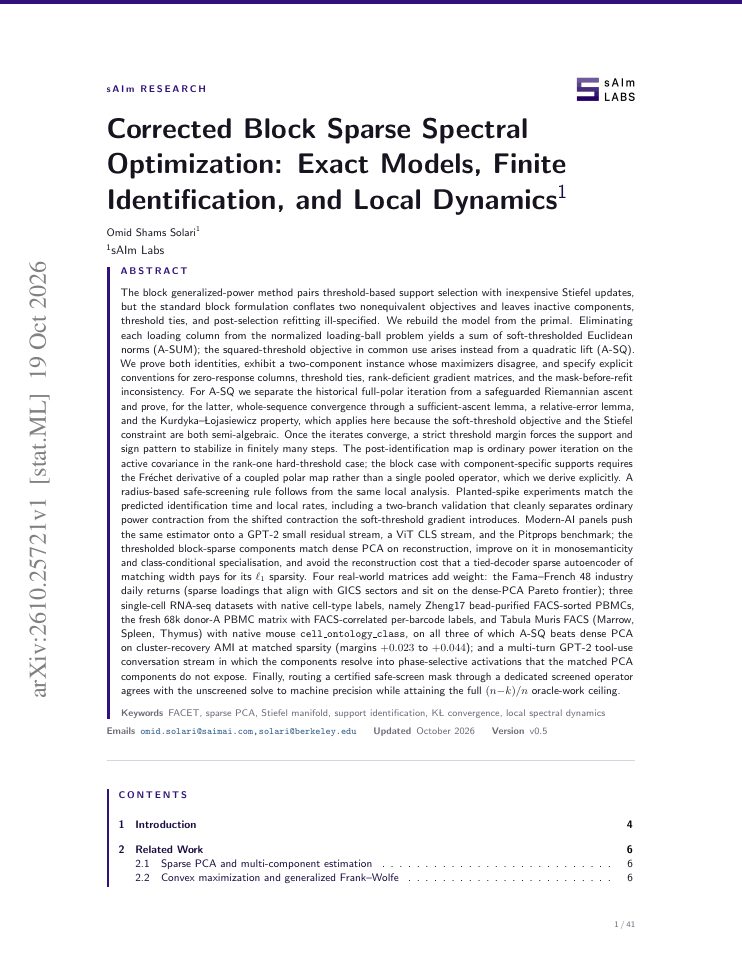
First page of Corrected Block Sparse Spectral Optimization: Exact Models, Finite Identification, and Local Dynamics
sparsity and pruningtest

Corrected Block Sparse Spectral Optimization: Exact Models, Finite Identification, and Local Dynamics

Replaces dense PCA and the ambiguous standard block generalized-power sparse-PCA formulation with a primal-derived soft-threshold objective (A-SQ), a safeguarded Riemannian ascent with proven convergence, finite support identification, and post-identification refitting via power iteration. Cost is modest: Stiefel updates and thresholding on covariance-scale data run on a single GPU or CPU, with added implementation complexity for tie-breaking, zero-response columns, and mask-before-refit conventions. It can fail when the strict threshold-margin assumption does not hold, delaying or preventing support identification, and the quality gains are dataset-specific additive AMI improvements rather than guaranteed uplifts on arbitrary workloads.

observed signal
1impl.
0stars
0citations
—claimed gain
abstract onlyReview decisionDownload skill ↓Original paper ↗
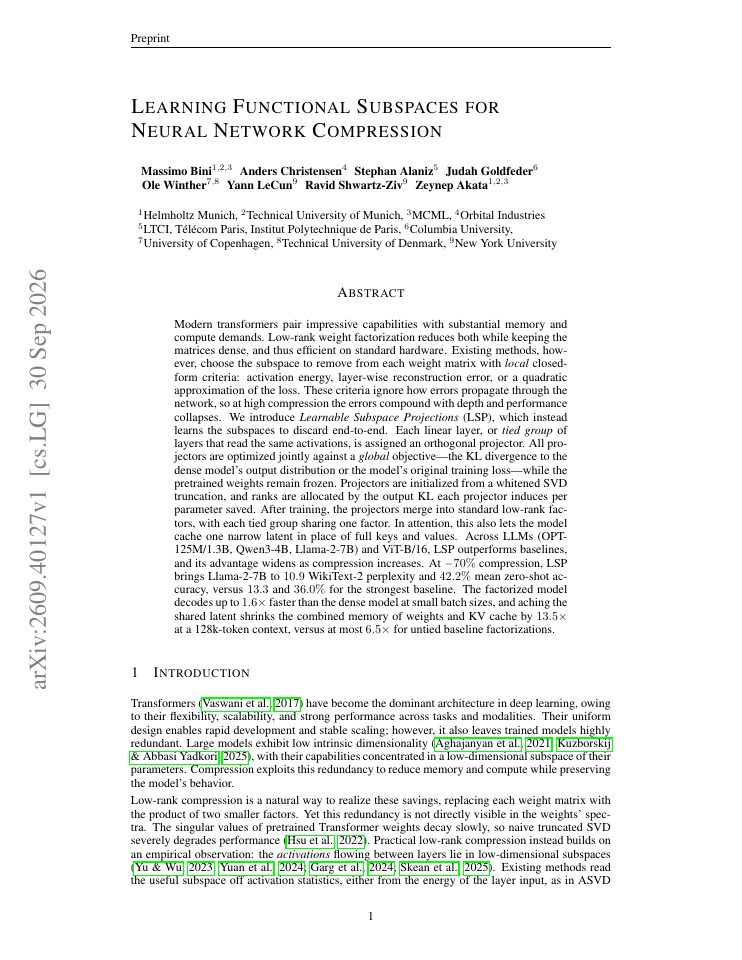
First page of Learning Functional Subspaces for Neural Network Compression
efficient architecturestest

Learning Functional Subspaces for Neural Network Compression

LSP replaces closed-form low-rank truncation criteria (activation energy, layer-wise reconstruction, quadratic loss approximations) with orthogonal projectors learned jointly against a global KL or training-loss objective, then merged into standard low-rank factors that also permit a shared narrow KV latent. The cost is an additional optimization pass over the projectors (weights stay frozen, so it fits one 24 GB GPU for models up to roughly 7B with careful handling), plus rank-allocation overhead and the engineering of tied-layer factor sharing, which is not yet an off-the-shelf library feature. It can fail when the KL-to-dense objective does not preserve task-specific behavior, when downstream kernels do not exploit the low-rank factors or shared latent (eliminating the speedup), and at extreme compression where even learned subspaces degrade.

observed signal
2impl.
1stars
0citations
1.6xclaimed gain
abstract onlyReview decisionDownload skill ↓Original paper ↗
First page of Latent Projection for Latent Planning
planning and decompositiontest

Latent Projection for Latent Planning

The method replaces the raw l2 distance between predicted and goal latents with an l2 distance restricted to the k-dimensional subspace that the learned state dynamics propagate with least uncertainty, derived from a normal-matrix transition model fit under SIGReg regularization. The cost is fitting a single constrained matrix A post hoc; the encoder, predictor, rollout, and planner remain unchanged, adding negligible compute. The approach can fail if the SIGReg and Gauss-Markov assumptions do not hold for the reader's environment, if the latent dynamics are not well-approximated by a normal linear map, and the reported gains are demonstrated only on 2D navigation tasks, so transfer to other domains is unvalidated.

observed signal
1impl.
1stars
0citations
—claimed gain
abstract onlyReview decisionDownload skill ↓Original paper ↗
First page of Mitigating Reward Hacking in Realistic Scenarios Through Representation Engineering
safety and guardrailstest

Mitigating Reward Hacking in Realistic Scenarios Through Representation Engineering

The method replaces prompt-level anti-reward-hacking instructions and output-only monitors with activation-space monitoring plus dynamic steering-vector interventions on the residual stream, including for tool calls and long contexts. Costs include labeled or otherwise sourced rollouts for vector extraction, additional inference-time intervention machinery, and potential small degradation in coherence or capability if steering is miscalibrated. It can fail when extracted vectors do not transfer to the production distribution, when activation monitoring misses novel hacking strategies, or when interventions suppress undesirable behavior only partially while affecting useful behavior.

observed signal
1impl.
3stars
0citations
—claimed gain
abstract onlyReview decisionDownload skill ↓Original paper ↗
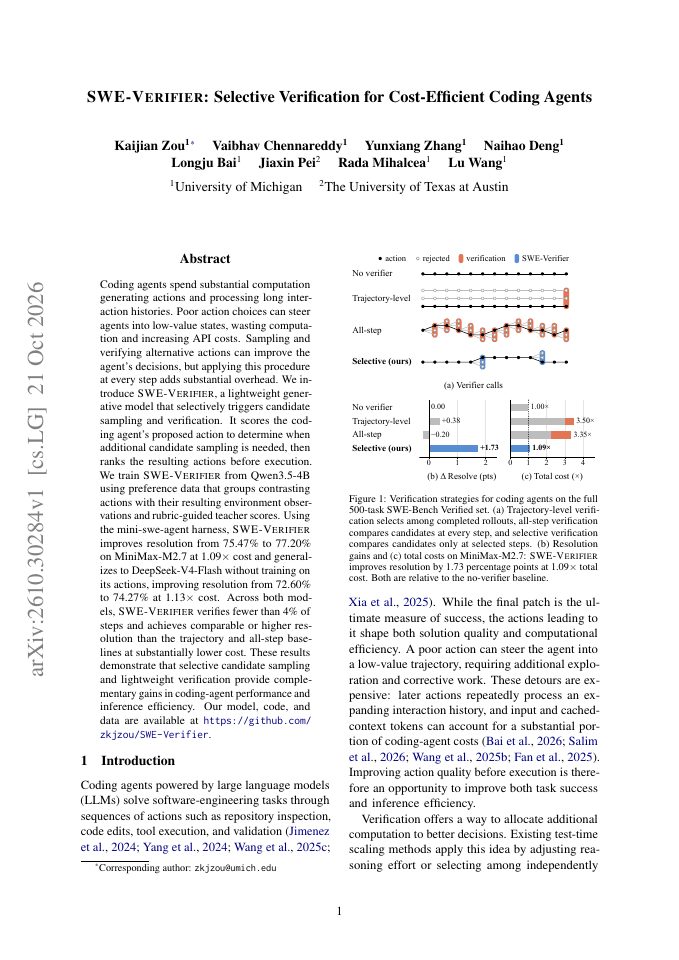
First page of SWE-VERIFIER: Selective Verification for Cost-Efficient Coding Agents
coding agentstest

SWE-VERIFIER: Selective Verification for Cost-Efficient Coding Agents

Replaces always-on candidate sampling and per-step verification (or unverified single-action execution) with a lightweight 4B verifier that triggers sampling only on low-confidence steps and ranks candidate actions before execution. Costs training a small verifier model plus a modest inference overhead of roughly 1.1x API cost, and adds a preference-data training pipeline as integration complexity. Can fail if the verifier miscalibrates on out-of-distribution agent policies or task types, since gains are demonstrated only on the mini-swe-agent harness with two specific models and generalization to other agents is not guaranteed.

observed signal
3impl.
34stars
0citations
—claimed gain
abstract onlyReview decisionDownload skill ↓Original paper ↗
First page of Feedback That Backfires in Games: Do LLM Players Repeat the Move They Just Watched Fail?
failure recoveryadopt

Feedback That Backfires in Games: Do LLM Players Repeat the Move They Just Watched Fail?

Replaces the common harness pattern of appending the failed action and error message verbatim into the transcript before retrying; use a failure description that omits the move string, or at minimum decoder-level bans on exact repeats. Costs nothing in memory, latency, or infrastructure, though it requires careful prompt/harness design and omits information the model might in principle use. What can fail: the effect is model-dependent (present in base models, largely removed at the DPO stage), a 'do not repeat' instruction does nothing, and decoder bans stop exact repeats but not other illegal moves, so illegal play can persist.

observed signal
1impl.
126stars
0citations
—claimed gain
abstract onlyReview decisionDownload skill ↓Original paper ↗
First page of Steering Black-Box Large Language Model Agents with Pitfall Anticipation World Model
planning and decompositionwatch

Steering Black-Box Large Language Model Agents with Pitfall Anticipation World Model

PAWM replaces per-step next-observation world models with a selectively invoked model that predicts impending multi-step failures and steers a black-box LLM agent away from them. It costs a two-stage training pipeline: supervised fine-tuning on synthetic pitfall-labeled data plus GRPO co-training against the target environment, plus added inference latency at intervention points. It can fail when the synthetic pitfall distribution mismatches the deployment environment, when pitfalls are mispredicted (false interventions can derail correct trajectories), and the method requires retraining per environment.

observed signal
1impl.
218stars
0citations
—claimed gain
abstract onlyReview decisionDownload skill ↓Original paper ↗
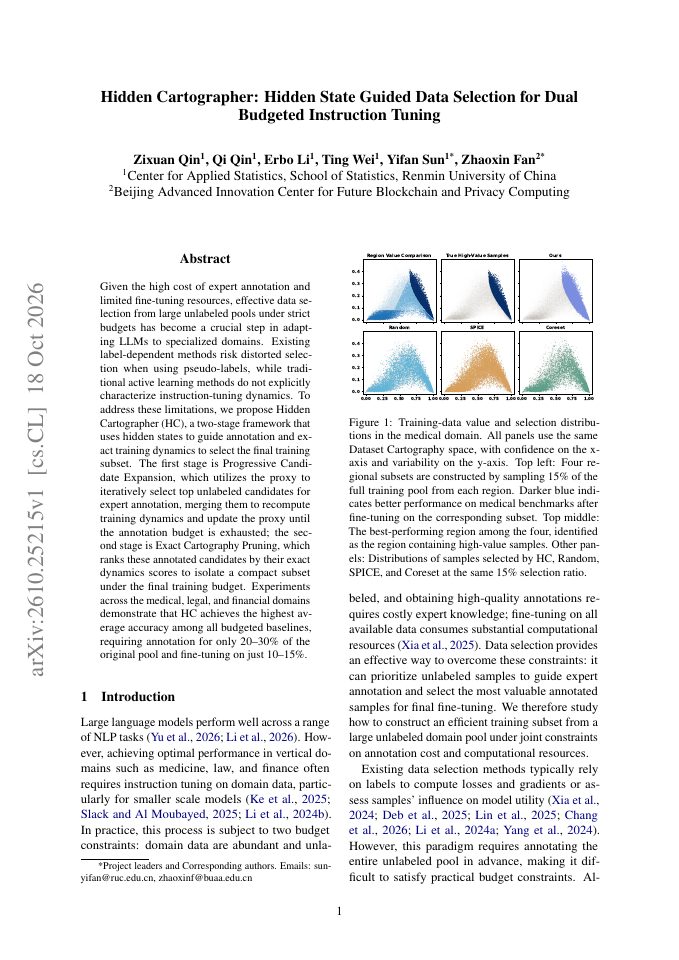
First page of Hidden Cartographer: Hidden State Guided Data Selection for Dual Budgeted Instruction Tuning
efficient trainingtest

Hidden Cartographer: Hidden State Guided Data Selection for Dual Budgeted Instruction Tuning

It replaces pseudo-label-based selection and conventional active learning with a two-stage process: progressive candidate expansion using a hidden-state proxy, then exact training-dynamics pruning to a compact fine-tuning subset. It costs repeated proxy updates and training-dynamics recomputation during the expansion loop, adding pipeline complexity and compute beyond a single-pass selection, though it reduces annotation and fine-tuning volume substantially. It can fail if the proxy's hidden-state signals mischaracterize which examples are valuable, or if domain-specific dynamics do not transfer, making validation on the reader's own data distribution necessary before relying on the reported accuracy advantage.

observed signal
0impl.
0stars
0citations
5xclaimed gain
abstract onlyReview decisionDownload skill ↓Original paper ↗
First page of Improving the Expressive Power of Hybrid Sequence Models via Multi-Hop Retrieval
efficient architectureswatch

Improving the Expressive Power of Hybrid Sequence Models via Multi-Hop Retrieval

MuRA replaces conventional hybrid blocks (full-attention layers plus fixed-state efficient layers) by letting efficient layers perform m sequential retrieval hops from a shared KV cache, which provably enables m-function composition where existing blocks require capacity scaling as Omega(sqrt(n)) even for two hops. The cost is architectural: it is a new block design that requires training from scratch or fine-tuning a custom implementation, with added implementation complexity in the retrieval mechanism, though it preserves asymptotic compute and memory efficiency. It can fail in practice because the evidence is a theoretical expressivity hierarchy plus synthetic composition tasks; there is no demonstration on pretrained models, real downstream benchmarks, or pretrained-checkpoint compatibility, so gains may not transfer to production workloads.

observed signal
0impl.
0stars
0citations
—claimed gain
abstract onlyReview decisionDownload skill ↓Original paper ↗
First page of MOSAIC: Multi-Objective Search for Allocating Inference Cache Across LLM Decoder Layers
KV cachetest

MOSAIC: Multi-Objective Search for Allocating Inference Cache Across LLM Decoder Layers

MOSAIC replaces uniform per-layer KV-cache budgets (as used by SnapKV, H2O, AdaKV, L2Norm-style eviction) with a per-layer budget allocation found by one multi-objective search whose best allocation transfers across target budgets, optionally refined by a budget-constrained search. The cost is a one-time offline search per model and eviction method (reported as cheaper than EvolKV, but still multi-evaluation GPU work on a single 24 GB card for 7-8B models), plus serving-side plumbing to track and enforce per-layer budgets, with no runtime quality loss claimed at matched budgets. It can fail if the searched allocation does not transfer to models, tasks, context lengths, or eviction methods outside the validated Llama-3-8B / Mistral-7B and RULER/LongBench settings, or if the serving stack cannot apply heterogeneous per-layer budgets without kernel or scheduler changes.

observed signal
0impl.
0stars
0citations
4xclaimed gain
abstract onlyReview decisionDownload skill ↓Original paper ↗
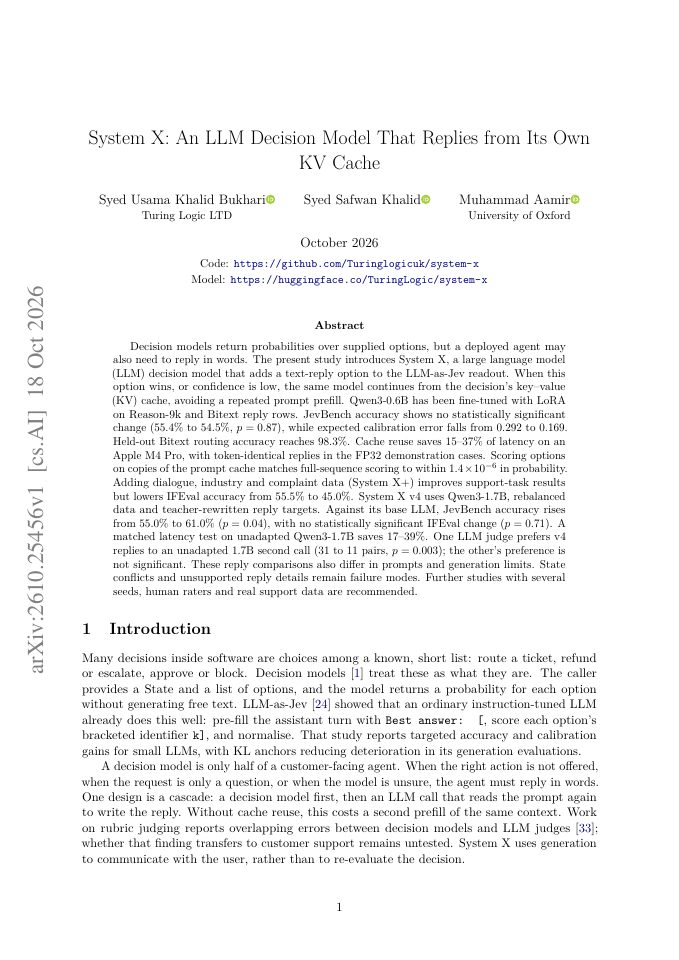
First page of System X: An LLM Decision Model That Replies from Its Own KV Cache
KV cachetest

System X: An LLM Decision Model That Replies from Its Own KV Cache

The method replaces a separate full-prompt second LLM call for text replies with continuation from the decision model's existing KV cache after a Jev-style option readout. It costs a LoRA fine-tuning pipeline, routing-data curation, and added serving complexity, and gains remain workload-dependent rather than a fixed multiplicative factor. Failures include state conflicts, unsupported reply details, possible instruction-following degradation from added support data, and reply-judge results confounded by prompt and generation-limit differences.

observed signal
0impl.
0stars
0citations
—claimed gain
abstract onlyReview decisionDownload skill ↓Original paper ↗
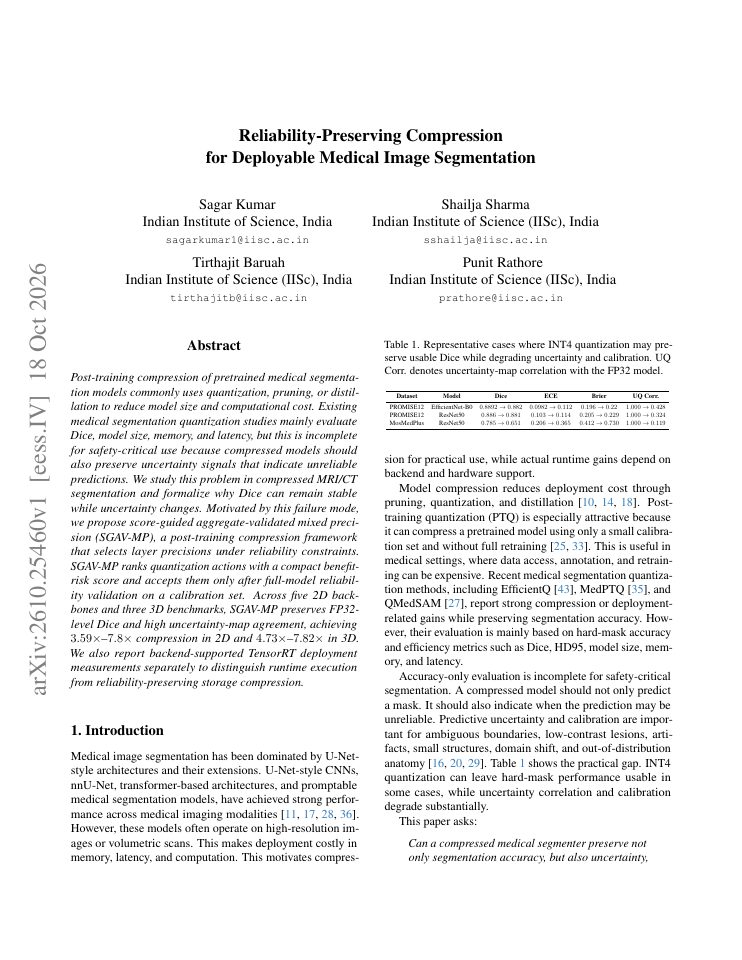
First page of Reliability-Preserving Compression for Deployable Medical Image Segmentation
quantizationtest

Reliability-Preserving Compression for Deployable Medical Image Segmentation

SGAV-MP replaces uniform post-training quantization, pruning, or distillation pipelines that select layer precisions by Dice and size alone, by scoring quantization actions on a benefit-risk basis and accepting them only after full-model reliability validation on a calibration set. The cost is an added calibration and validation stage per quantization candidate, plus reliance on a backend such as TensorRT to convert stored compression into actual runtime speedup, which the paper reports separately. It can fail if the calibration set is unrepresentative of deployment data, in which case the accepted precision assignments may preserve uncertainty agreement in validation but not in production, and the method is validated only on MRI/CT segmentation, so transfer to other tasks is unverified.

observed signal
0impl.
0stars
0citations
3.59xclaimed gain
abstract onlyReview decisionDownload skill ↓Original paper ↗
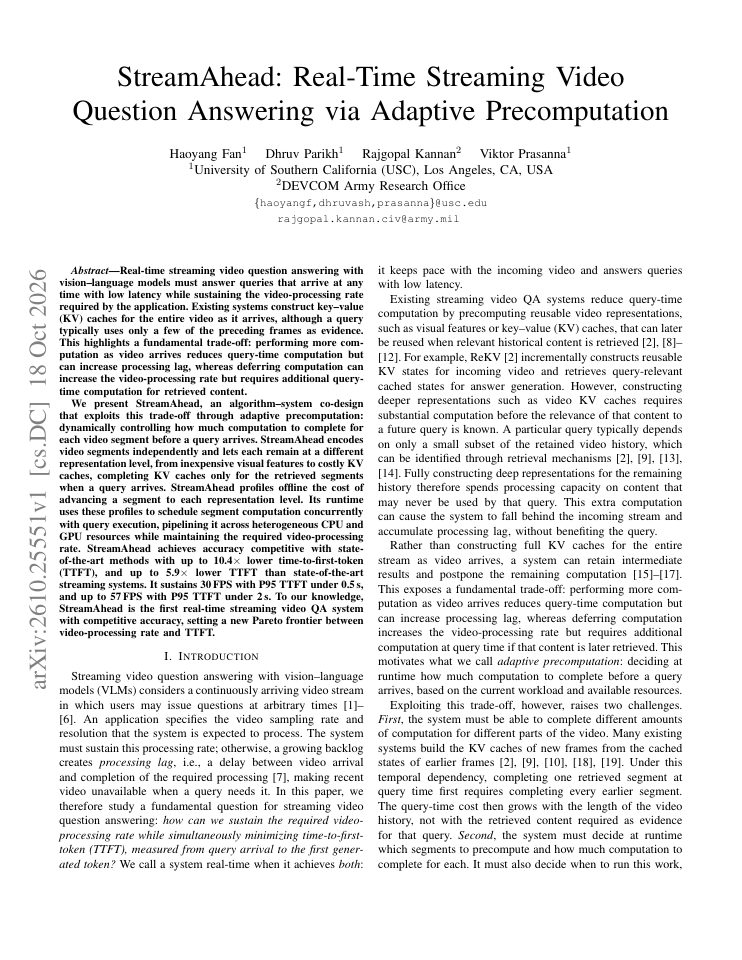
First page of StreamAhead: Real-Time Streaming Video Question Answering via Adaptive Precomputation
serving and batchingtest

StreamAhead: Real-Time Streaming Video Question Answering via Adaptive Precomputation

StreamAhead replaces the standard practice of building full KV caches for every incoming video segment with a tiered scheme that keeps segments at cheap representation levels (visual features) and materializes KV caches only for query-retrieved segments. The cost is an offline profiling step per segment and model, a runtime scheduler that pipelines segment computation across CPU and GPU concurrently with queries, and the query-time compute of completing KV caches for retrieved segments. It can fail when the retrieval stage selects the wrong segments, when query arrival bursts exceed the scheduler's ability to complete KV caches within latency targets, or when the offline cost profiles do not transfer to the deployment hardware or model.

observed signal
0impl.
0stars
0citations
10.4xclaimed gain
abstract onlyReview decisionDownload skill ↓Original paper ↗
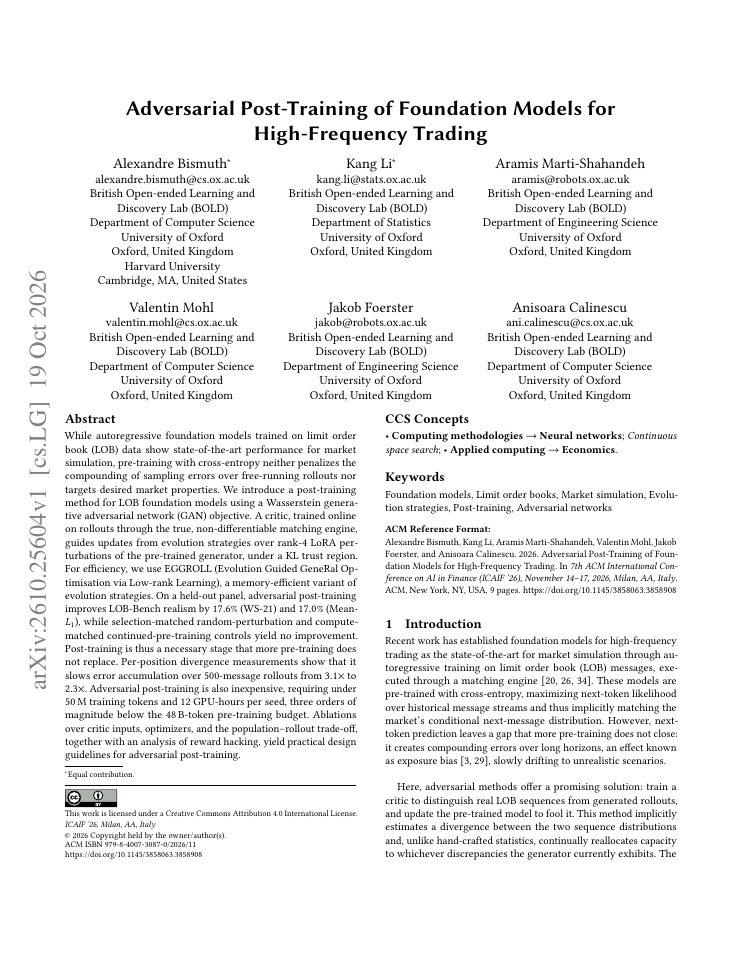
First page of Adversarial Post-Training of Foundation Models for High-Frequency Trading
efficient trainingnot applicable

Adversarial Post-Training of Foundation Models for High-Frequency Trading

The method replaces additional cross-entropy pre-training of a limit-order-book generator with a short adversarial post-training stage: a WGAN critic evaluates free-running rollouts through the real matching engine and evolution strategies update rank-4 LoRA perturbations under a KL trust region. It costs under 50M training tokens and roughly 12 GPU-hours per seed, but presupposes an existing pre-trained LOB foundation model (a 48B-token pre-training budget), access to a non-differentiable matching engine, and online critic infrastructure. It can fail through reward hacking of the critic, as the paper's own analysis notes, and its gains are specific to market-simulation fidelity rather than general language-model quality.

observed signal
0impl.
0stars
0citations
1.176xclaimed gain
abstract onlyReview decisionDownload skill ↓Original paper ↗
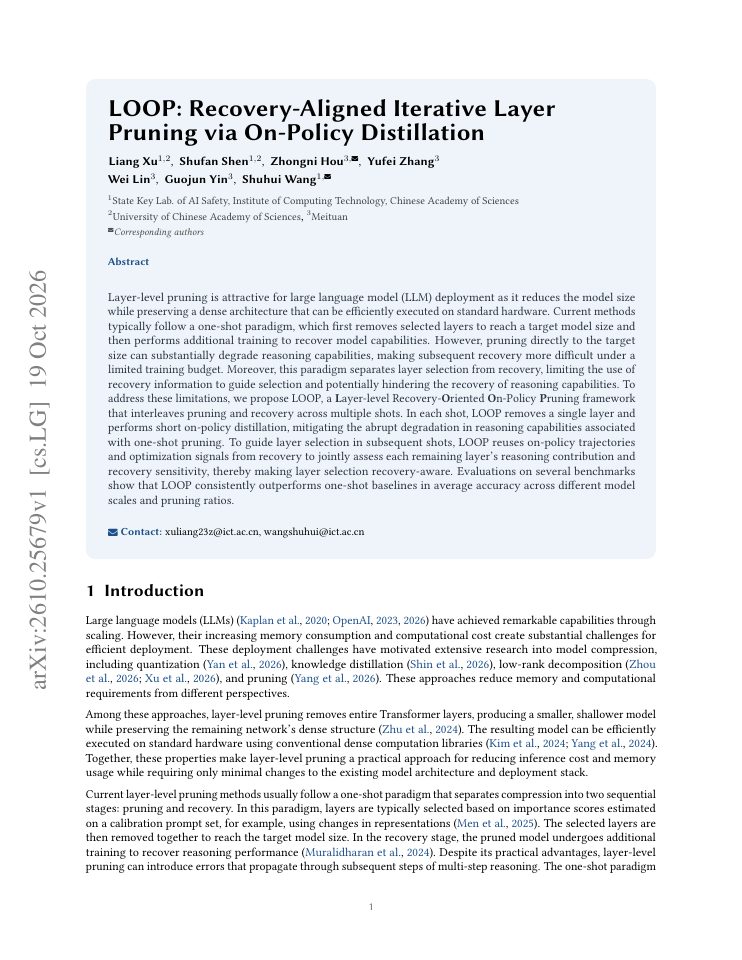
First page of LOOP: Recovery-Aligned Iterative Layer Pruning via On-Policy Distillation
sparsity and pruningwatch

LOOP: Recovery-Aligned Iterative Layer Pruning via On-Policy Distillation

Replaces one-shot layer pruning followed by a single recovery phase with an iterative loop that removes one layer at a time, runs short on-policy distillation after each removal, and reuses recovery signals to select subsequent layers. Costs repeated distillation cycles with on-policy trajectory generation (teacher rollouts at every shot), which raises compute and wall-clock budget well beyond a one-shot prune, though it preserves a dense architecture that runs on standard hardware after pruning. Can fail if the per-shot recovery budget is insufficient to make the pruning signal informative, if on-policy distillation is unstable for the target model, or if the accuracy gains over cheaper one-shot baselines do not justify the added training cost on a limited budget.

observed signal
0impl.
0stars
0citations
—claimed gain
abstract onlyReview decisionDownload skill ↓Original paper ↗
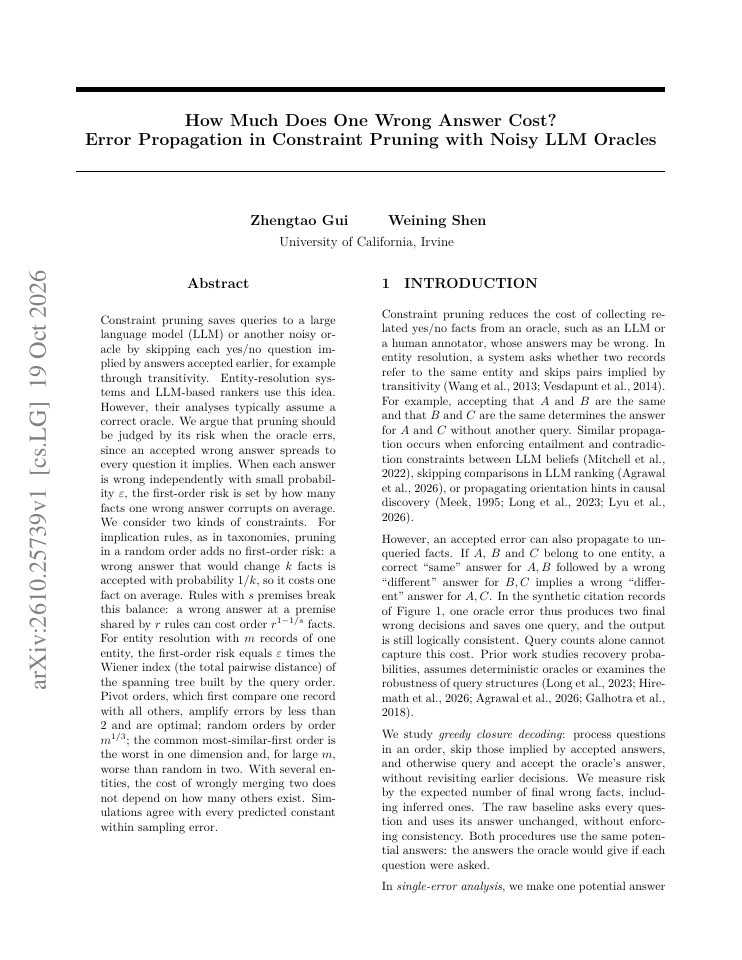
First page of How Much Does One Wrong Answer Cost? Error Propagation in Constraint Pruning with Noisy LLM Oracles
failure recoverytest

How Much Does One Wrong Answer Cost? Error Propagation in Constraint Pruning with Noisy LLM Oracles

The method does not replace constraint pruning itself; it replaces the assumption that a correct oracle makes query order irrelevant, prescribing query orders (notably pivot orders for entity resolution) that bound how far one wrong LLM answer propagates. It costs nothing in extra queries or infrastructure, only deliberate ordering of the same yes/no questions, with pivot ordering being simple to implement. It can fail when error independence or small-epsilon assumptions break down (correlated oracle errors, systematic biases toward certain record pairs), since the guarantees are first-order in epsilon and the common most-similar-first ordering is provably the worst in one dimension.

observed signal
0impl.
0stars
0citations
—claimed gain
abstract onlyReview decisionDownload skill ↓Original paper ↗
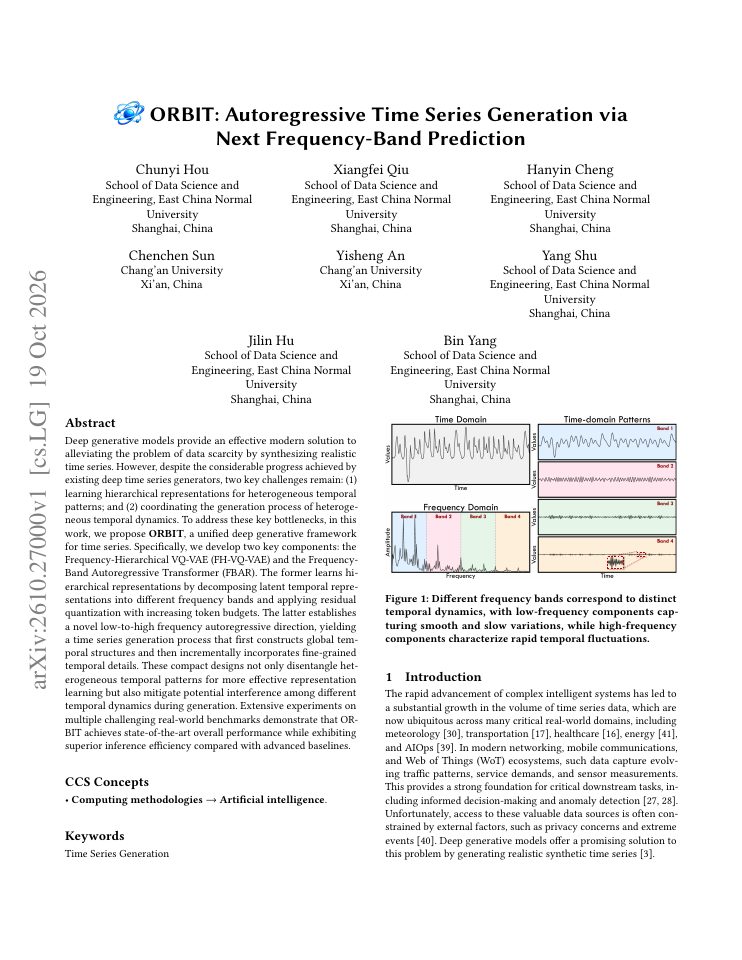
First page of ORBIT: Autoregressive Time Series Generation via Next Frequency-Band Prediction
efficient architectureswatch

ORBIT: Autoregressive Time Series Generation via Next Frequency-Band Prediction

ORBIT replaces conventional time-series generative models (GANs, diffusion models, and standard autoregressive transformers) with a two-stage framework: a Frequency-Hierarchical VQ-VAE that decomposes latent representations into frequency bands with residual quantization, and a Frequency-Band Autoregressive Transformer that generates from low to high frequencies. The abstract claims state-of-the-art overall performance and superior inference efficiency compared with advanced baselines, but provides no quantitative factor in the abstract itself; assessing actual compute and memory costs requires consulting the full paper. The approach demands training both a custom VQ-VAE and a custom transformer on the reader's own time-series data, which adds implementation complexity and training time; it can fail if the reader lacks sufficient domain-specific training data, if the frequency decomposition does not match the characteristics of the target signals, or if the claimed efficiency gains do not materialize at the reader's data scale and sequence lengths.

observed signal
0impl.
0stars
0citations
—claimed gain
abstract onlyReview decisionDownload skill ↓Original paper ↗
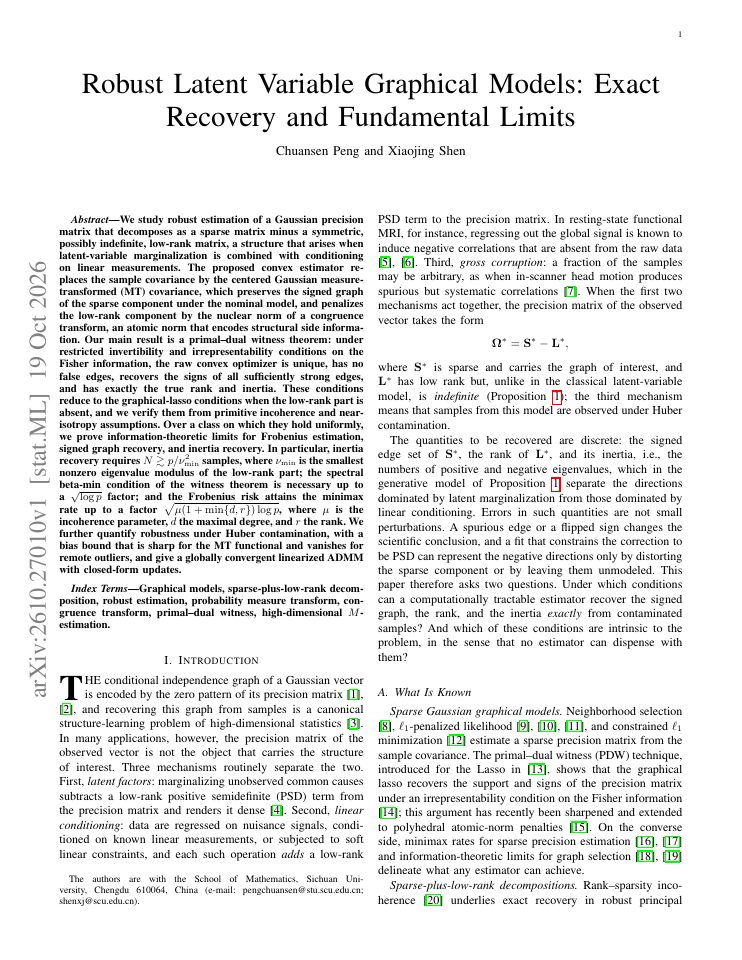
First page of Robust Latent Variable Graphical Models: Exact Recovery and Fundamental Limits
othernot applicable

Robust Latent Variable Graphical Models: Exact Recovery and Fundamental Limits

The method replaces the sample covariance in sparse-plus-low-rank precision matrix estimation with a centered Gaussian measure-transformed covariance, penalizing the low-rank component via a nuclear norm of a congruence transform. It costs a convex optimization solved by a linearized ADMM with closed-form updates, with statistical guarantees requiring N greater than roughly p/nu_min^2 samples for inertia recovery and restricted invertibility plus irrepresentability conditions on the Fisher information. Signed-graph and inertia recovery can fail when these structural conditions are violated, when the low-rank eigenvalues are too small relative to sample size, or under Huber contamination beyond the quantified bias bound, though the bound vanishes for remote outliers.

observed signal
0impl.
0stars
0citations
—claimed gain
abstract onlyReview decisionDownload skill ↓Original paper ↗
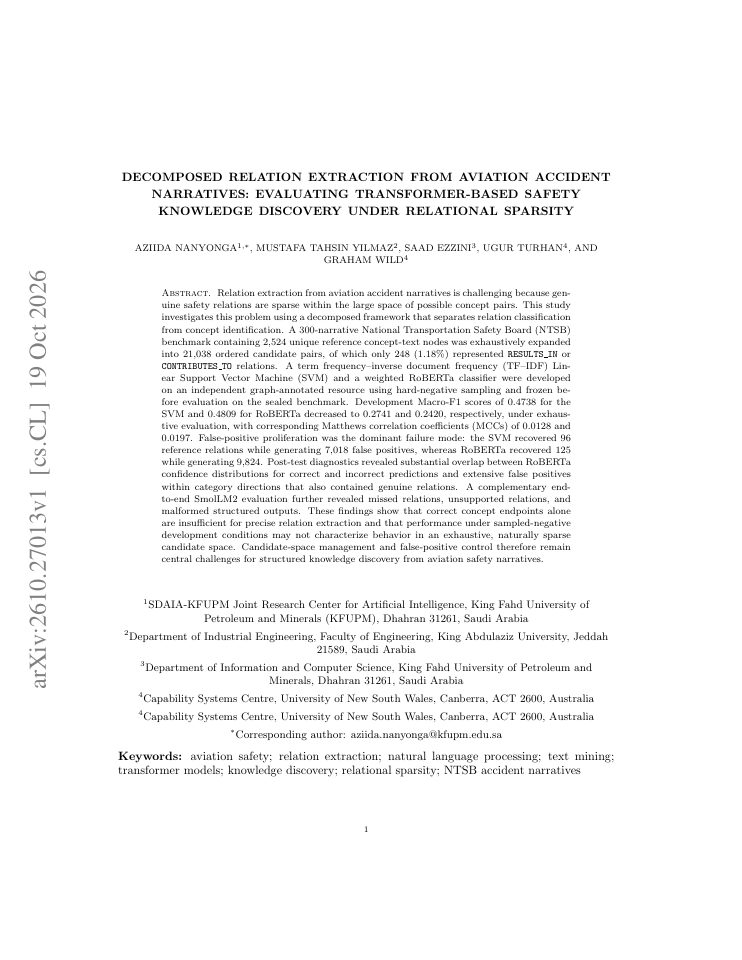
First page of Decomposed Relation Extraction from Aviation Accident Narratives: Evaluating Transformer-Based Safety Knowledge Discovery under Relational Sparsity
retrieval and RAGwatch

Decomposed Relation Extraction from Aviation Accident Narratives: Evaluating Transformer-Based Safety Knowledge Discovery under Relational Sparsity

The method replaces end-to-end relation extraction with a decomposed pipeline: candidate concept pairs are enumerated first, then a TF-IDF Linear SVM or weighted RoBERTa classifier labels them as RESULTS_IN or CONTRIBUTES_TO. Cost is dominated by the candidate space (21,038 pairs from 300 narratives) and by quality: exhaustive evaluation collapsed Macro-F1 from ~0.47-0.48 in development to 0.24-0.27, with MCC near zero (0.013-0.020) and 7,018-9,824 false positives against 96-125 recovered true relations. What fails after adoption is precision at deployment scale: hard-negative sampled development scores did not transfer to exhaustive candidate evaluation, RoBERTa confidence distributions overlapped between classes, and false positives persisted even within valid relation directions, so known concept endpoints do not yield reliable extraction.

observed signal
0impl.
0stars
0citations
—claimed gain
abstract onlyReview decisionDownload skill ↓Original paper ↗
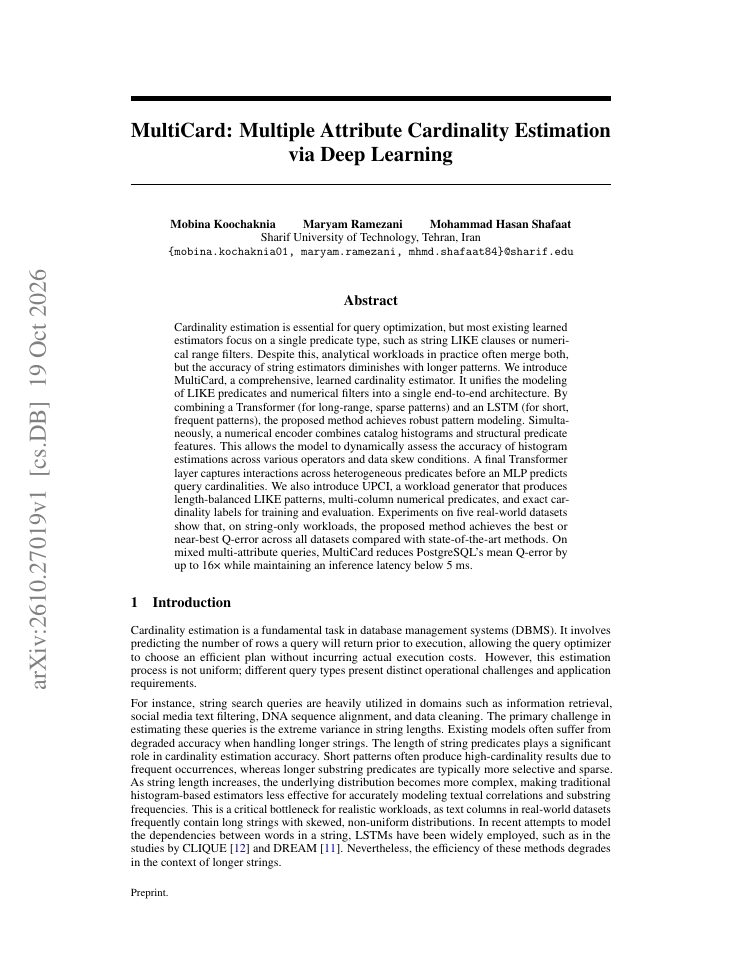
First page of MultiCard: Multiple Attribute Cardinality Estimation via Deep Learning
othertest

MultiCard: Multiple Attribute Cardinality Estimation via Deep Learning

MultiCard replaces PostgreSQL's default cardinality estimator and prior single-predicate learned estimators (histograms, LIKE-only or range-only models) with a single end-to-end neural model combining a Transformer, an LSTM, a numerical histogram encoder, and a predicate-interaction Transformer, trained on labeled queries. The cost is a supervised training pipeline requiring exact cardinality labels (produced by the UPCI workload generator), model maintenance as data and schema drift, and integration work with the query optimizer, plus small GPU or CPU inference overhead per query. It can fail on schema or data distributions not covered by the training workload, since learned estimators degrade under drift and the reported gains hold only on the five evaluated datasets and generated workloads.

observed signal
0impl.
0stars
0citations
16xclaimed gain
abstract onlyReview decisionDownload skill ↓Original paper ↗
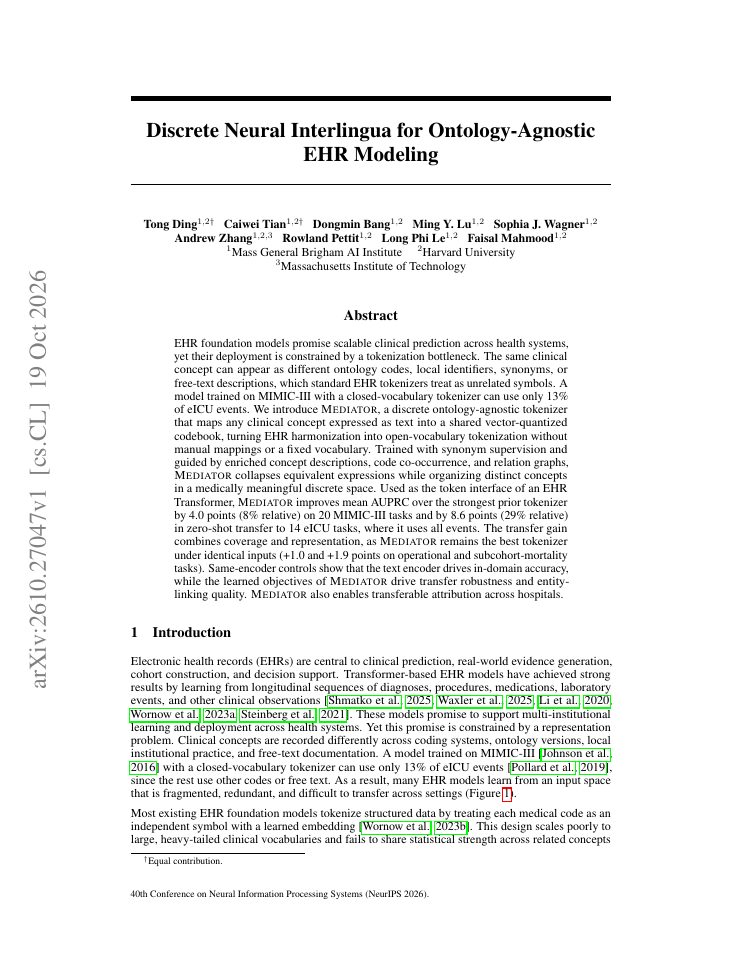
First page of Discrete Neural Interlingua for Ontology-Agnostic EHR Modeling
otherwatch

Discrete Neural Interlingua for Ontology-Agnostic EHR Modeling

MEDIATOR replaces fixed-vocabulary EHR tokenizers and manual ontology crosswalks with a vector-quantized tokenizer that maps any clinical concept text into a shared discrete codebook, enabling cross-hospital transfer without hand-built mappings. Adoption costs training the tokenizer with synonym supervision plus co-occurrence and relation-graph objectives, and integrating it as the input layer of a downstream EHR Transformer rather than a drop-in inference component. It can fail where source systems lack usable concept text (codes without descriptions), where the learned codebook collapses genuinely distinct concepts, or where evaluation is confined to a single hospital because the reported gains concentrate on cross-institution transfer.

observed signal
0impl.
0stars
0citations
1.29xclaimed gain
abstract onlyReview decisionDownload skill ↓Original paper ↗
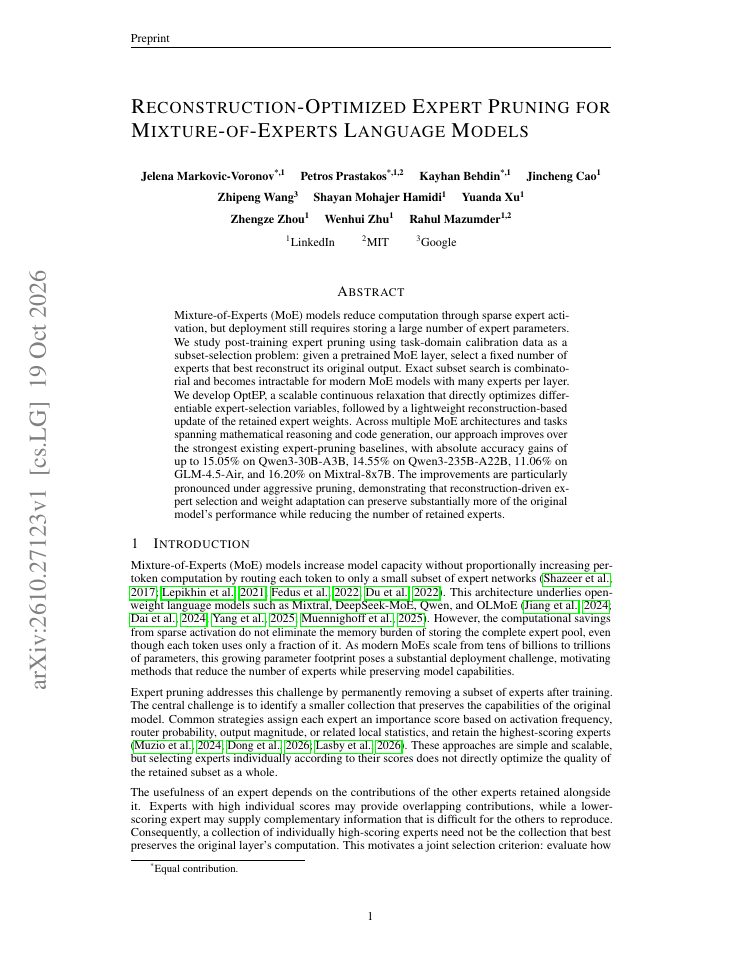
First page of Reconstruction-Optimized Expert Pruning for Mixture-of-Experts Language Models
sparsity and pruningtest

Reconstruction-Optimized Expert Pruning for Mixture-of-Experts Language Models

OptEP replaces heuristic or search-based expert-pruning criteria with a continuous relaxation that optimizes differentiable expert-selection variables against a reconstruction objective, followed by a lightweight update of retained expert weights; the pruned experts are removed, reducing storage and deployment memory for MoE models. Cost is a post-training calibration procedure requiring task-domain data, per-layer reconstruction optimization, and the weight-adaptation pass, plus some residual accuracy loss relative to the unpruned model. It can fail when calibration data is not representative of production traffic, when pruning is pushed to ratios the reconstruction objective cannot compensate for, and on hardware or serving stacks where sparse expert routing gives no realized speed or memory benefit despite fewer stored experts.

observed signal
0impl.
0stars
0citations
—claimed gain
abstract onlyReview decisionDownload skill ↓Original paper ↗
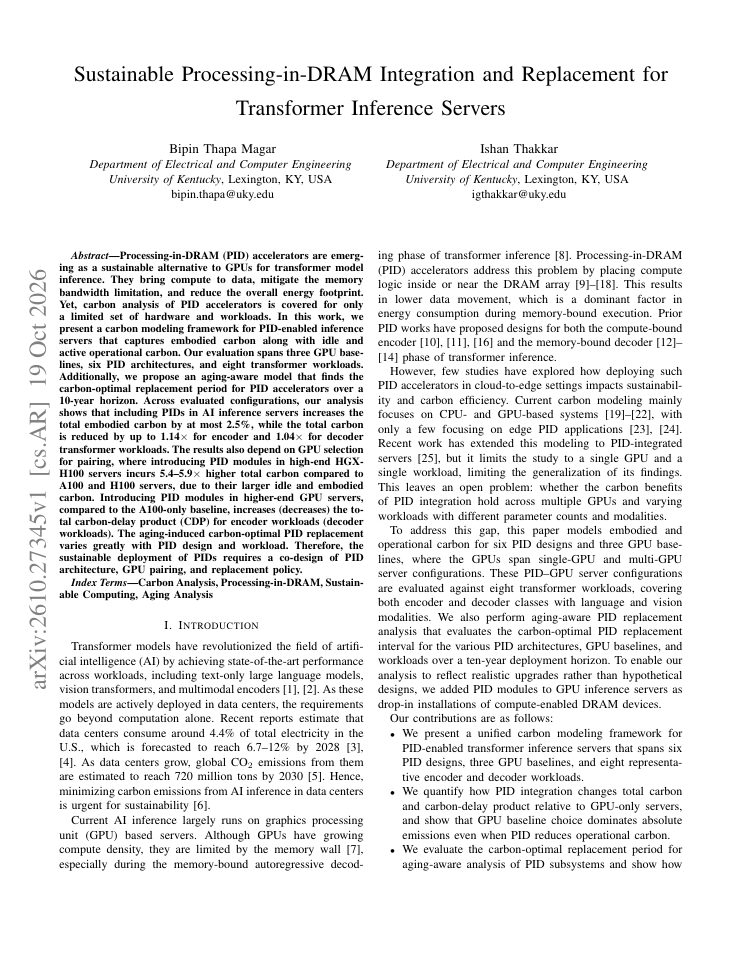
First page of Sustainable Processing-in-DRAM Integration and Replacement for Transformer Inference Servers
otherwatch

Sustainable Processing-in-DRAM Integration and Replacement for Transformer Inference Servers

The paper evaluates replacing or augmenting GPU inference servers with Processing-in-DRAM (PID) accelerators, providing a carbon modeling framework covering embodied, idle, and active carbon plus an aging-aware replacement schedule over 10 years. Adoption costs are substantial: PID hardware is not commercially procurable for a small team, requires server-level integration paired with specific GPUs, and results depend strongly on GPU pairing, with HGX-H100 servers showing 5.4-5.9x higher total carbon than A100/H100 configurations. The findings can fail in practice because they are model-based projections rather than measurements from deployed PID systems, and the optimal replacement period depends on carbon-intensity assumptions and workload mix.

observed signal
0impl.
0stars
0citations
1.14xclaimed gain
abstract onlyReview decisionDownload skill ↓Original paper ↗
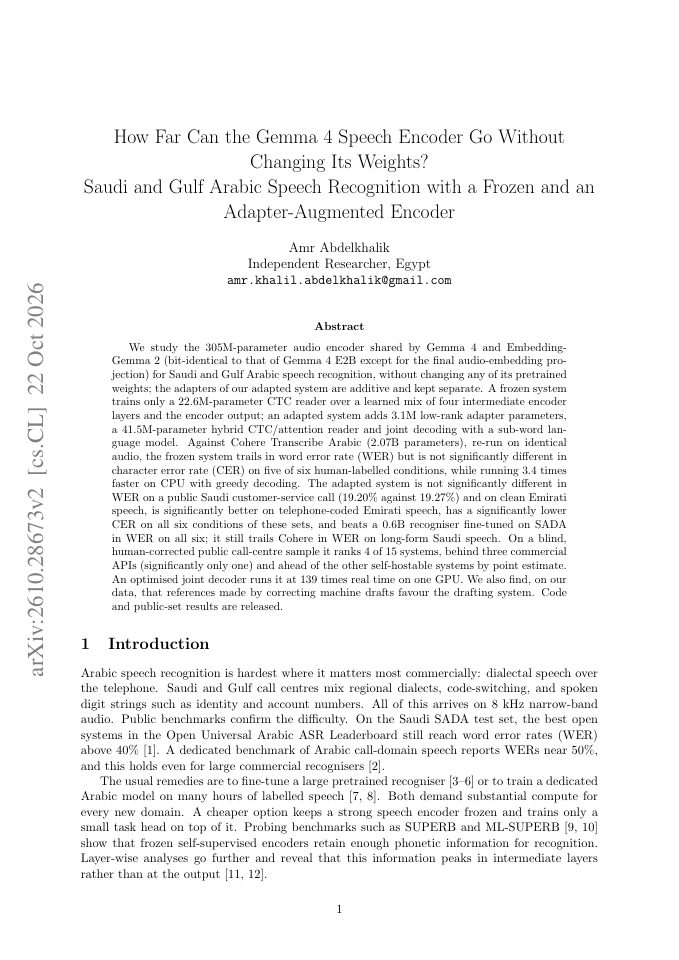
First page of How Far Can the Gemma 4 Speech Encoder Go Without Changing Its Weights? Saudi and Gulf Arabic Speech Recognition with a Frozen and an Adapter-Augmented Encoder
efficient trainingtest

How Far Can the Gemma 4 Speech Encoder Go Without Changing Its Weights? Saudi and Gulf Arabic Speech Recognition with a Frozen and an Adapter-Augmented Encoder

The method replaces full fine-tuning of a speech foundation model (or reliance on a commercial ASR API) with a frozen pretrained encoder plus a small trainable CTC or hybrid CTC/attention reader and optional low-rank adapters, targeting Arabic dialect ASR. It costs training and validation effort on domain data (around 25.7M to 44.6M trainable parameters), still trails the commercial baseline in WER on long-form speech, and adds pipeline complexity in layer mixing and joint decoding. It can fail on domains far from the Saudi/Gulf data used, and the paper itself warns that human-corrected machine drafts bias evaluation toward the drafting system.

observed signal
0impl.
0stars
0citations
3.4xclaimed gain
abstract onlyReview decisionDownload skill ↓Original paper ↗
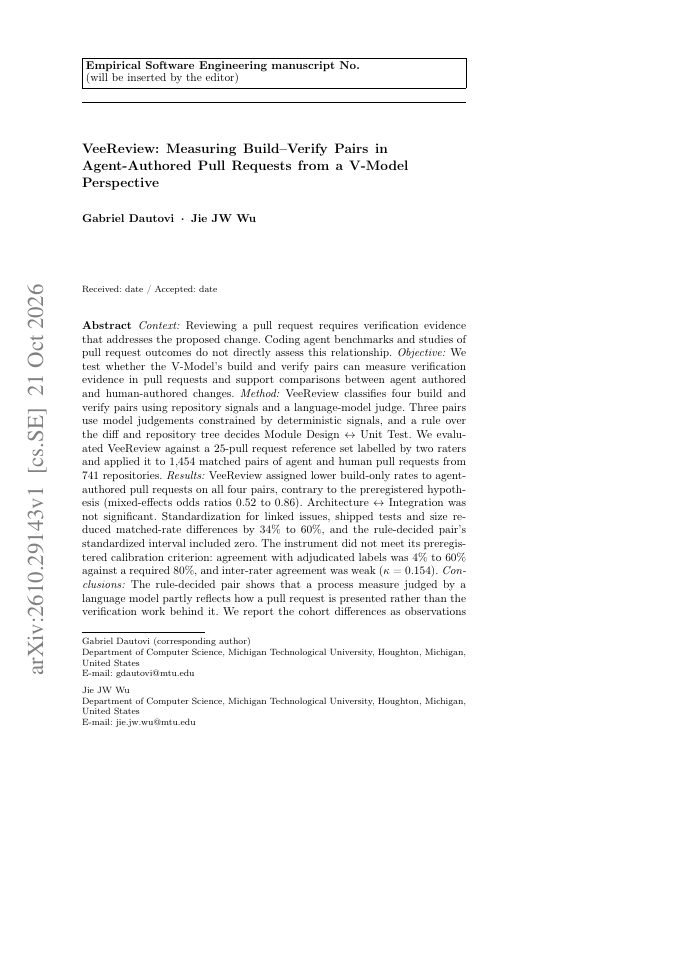
First page of VeeReview: Measuring Build-Verify Pairs in Agent-Authored Pull Requests from a V-Model Perspective
agent evaluationwatch

VeeReview: Measuring Build-Verify Pairs in Agent-Authored Pull Requests from a V-Model Perspective

VeeReview replaces informal human judgement of whether a pull request's verification evidence matches its proposed change with a hybrid of deterministic repository signals, one rule over the diff and tree, and a language-model judge for the remaining pairs. The cost is building repository-signal extraction plus LLM judging per pull request, and the authors themselves show the instrument did not meet its calibration target: agreement with adjudicated labels was only 4% to 60% against a required 80%, and inter-rater agreement was weak (kappa = 0.154). What can fail is exactly what the paper demonstrates: the model-judged pairs partly measure how a pull request is presented rather than the verification work performed, so adopting it for gating or comparing agent versus human output would encode an unvalidated measurement.

observed signal
0impl.
0stars
0citations
—claimed gain
abstract onlyReview decisionDownload skill ↓Original paper ↗
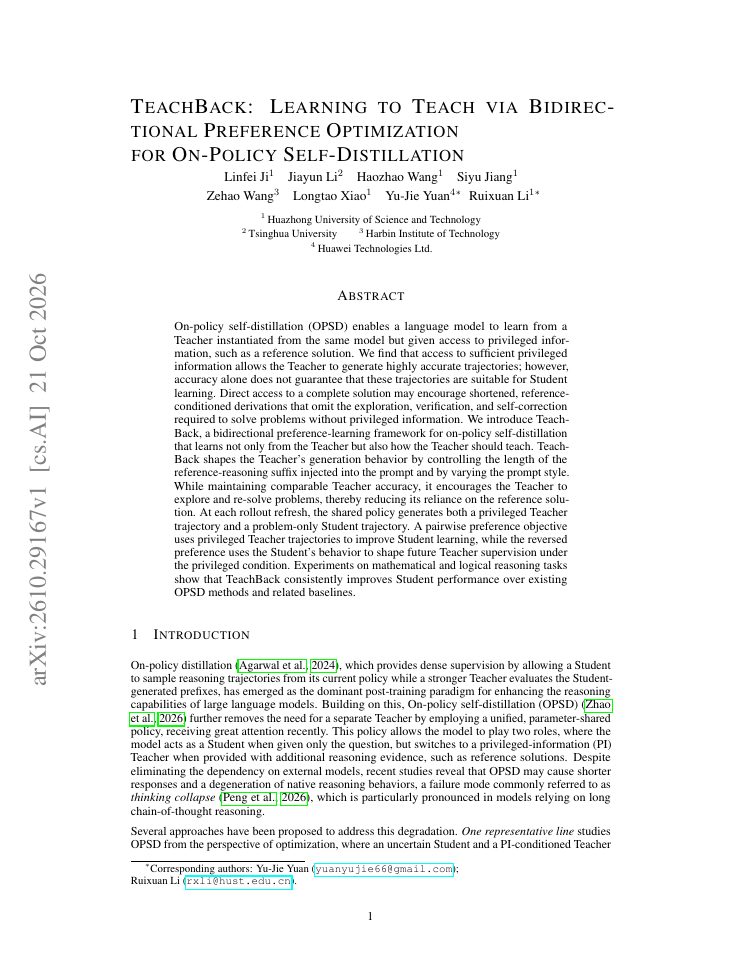
First page of TeachBack: Learning to Teach via Bidirectional Preference Optimization for On-Policy Self-Distillation
distillationwatch

TeachBack: Learning to Teach via Bidirectional Preference Optimization for On-Policy Self-Distillation

TeachBack replaces standard on-policy self-distillation where the Teacher has static privileged access to the solution with a bidirectional preference-learning framework that shapes the Teacher's generation via reference-length control and prompt variation. It requires generating paired privileged and non-privileged trajectories at each rollout refresh and optimizing a pairwise preference objective, which increases training compute and implementation complexity compared to standard OPSD. The method can fail if the privileged Teacher trajectories, despite accuracy, omit the exploration and self-correction behaviors necessary for the Student to learn robust problem-solving without privileged information.

observed signal
0impl.
0stars
0citations
—claimed gain
abstract onlyReview decisionDownload skill ↓Original paper ↗

Research signals

Three views of the same evidence: adoption against attention, publication cadence by research area, and reported gains when coverage is sufficient.

color = research area

01 · attention × adoption

The research frontier

Look to the upper left for independent implementation before mass attention.

compare by
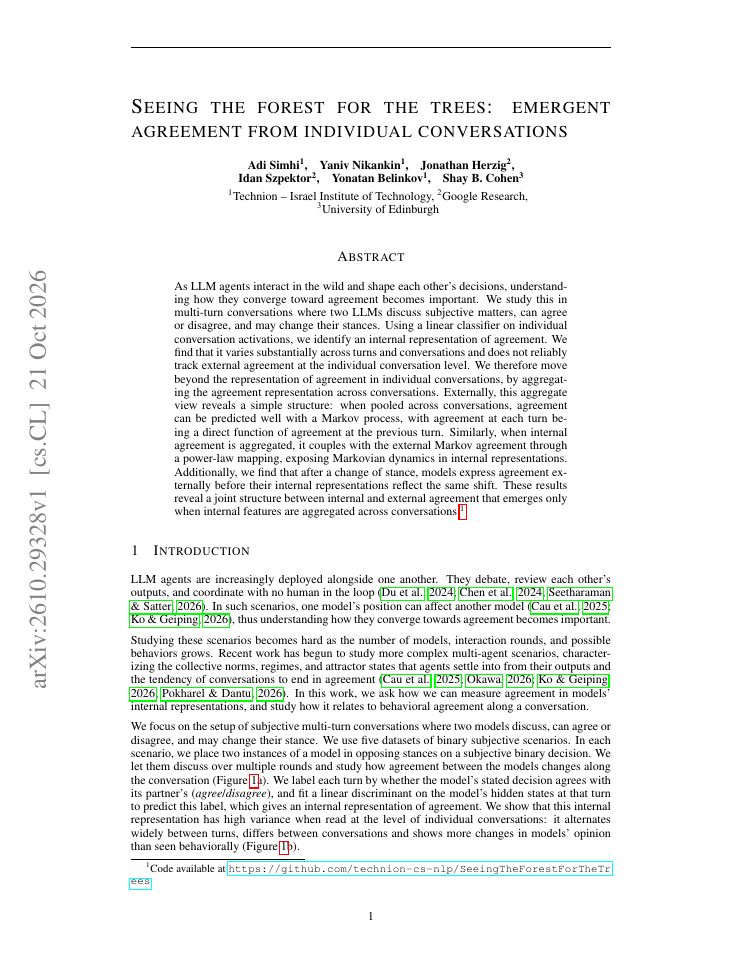
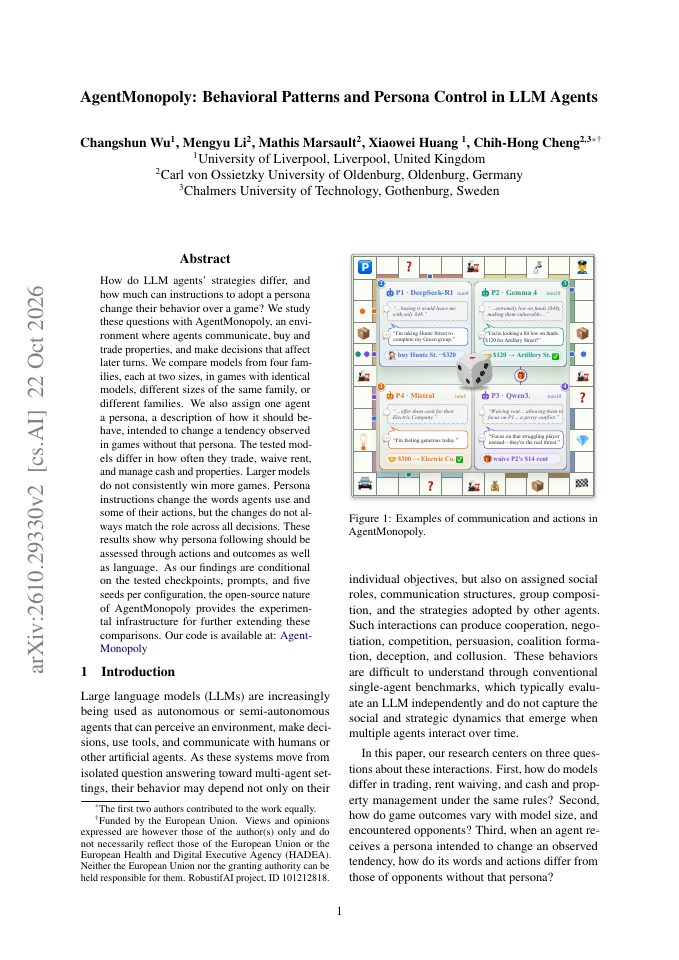
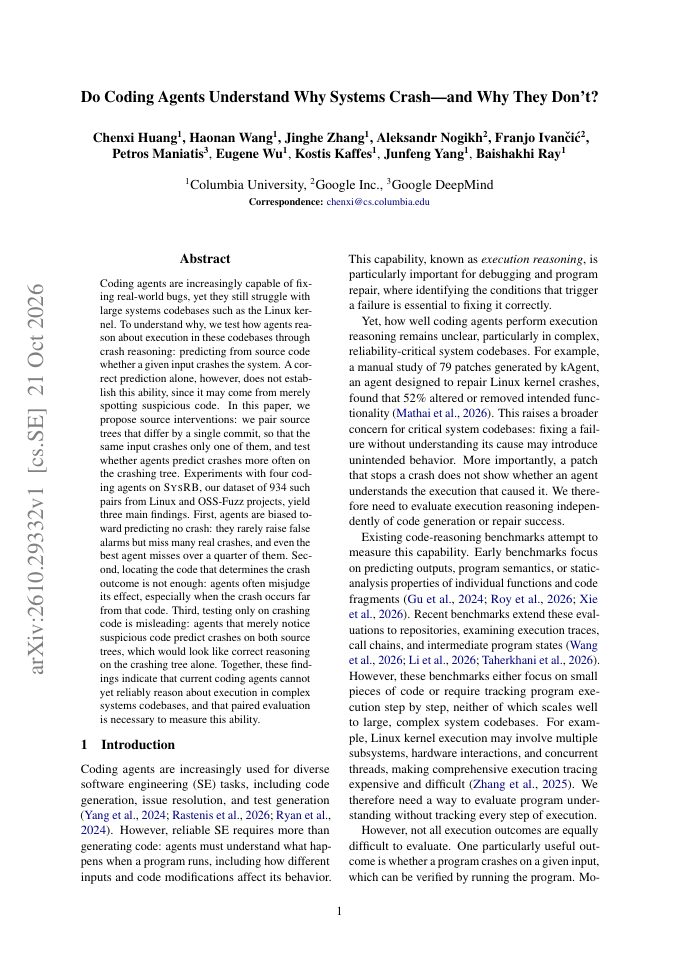
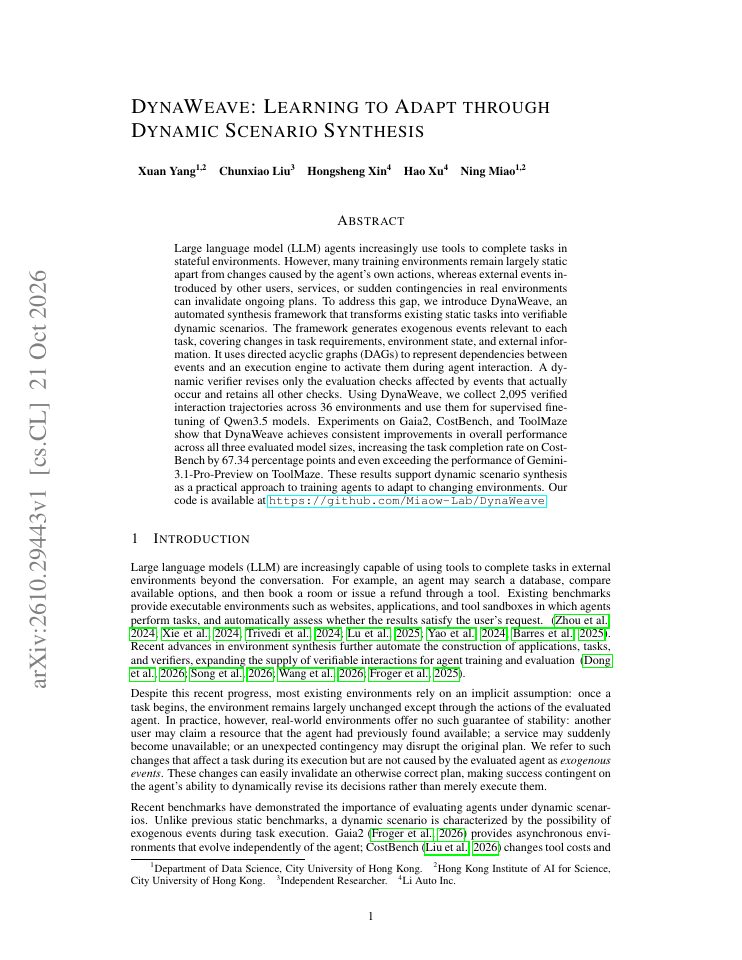
Each point represents one paper. Higher means more independent implementations; farther right means more GitHub stars.Learning Functional Subspaces for Neural Network Compression: 1 GitHub star; 2 independent implementationsHidden Cartographer: Hidden State Guided Data Selection for Dual Budgeted Instruction Tuning: 0 GitHub stars; 0 independent implementationsImproving the Expressive Power of Hybrid Sequence Models via Multi-Hop Retrieval: 0 GitHub stars; 0 independent implementationsMOSAIC: Multi-Objective Search for Allocating Inference Cache Across LLM Decoder Layers: 0 GitHub stars; 0 independent implementationsSystem X: An LLM Decision Model That Replies from Its Own KV Cache: 0 GitHub stars; 0 independent implementationsReliability-Preserving Compression for Deployable Medical Image Segmentation: 0 GitHub stars; 0 independent implementationsStreamAhead: Real-Time Streaming Video Question Answering via Adaptive Precomputation: 0 GitHub stars; 0 independent implementationsAdversarial Post-Training of Foundation Models for High-Frequency Trading: 0 GitHub stars; 0 independent implementationsLOOP: Recovery-Aligned Iterative Layer Pruning via On-Policy Distillation: 0 GitHub stars; 0 independent implementationsCorrected Block Sparse Spectral Optimization: Exact Models, Finite Identification, and Local Dynamics: 0 GitHub stars; 1 independent implementationHow Much Does One Wrong Answer Cost? Error Propagation in Constraint Pruning with Noisy LLM Oracles: 0 GitHub stars; 0 independent implementationsThe KV-Surgeon: Compensation-Aware Offline KV-Cache Compaction: 0 GitHub stars; 2 independent implementationsLatent Projection for Latent Planning: 1 GitHub star; 1 independent implementationORBIT: Autoregressive Time Series Generation via Next Frequency-Band Prediction: 0 GitHub stars; 0 independent implementationsRobust Latent Variable Graphical Models: Exact Recovery and Fundamental Limits: 0 GitHub stars; 0 independent implementationsDecomposed Relation Extraction from Aviation Accident Narratives: Evaluating Transformer-Based Safety Knowledge Discovery under Relational Sparsity: 0 GitHub stars; 0 independent implementationsMultiCard: Multiple Attribute Cardinality Estimation via Deep Learning: 0 GitHub stars; 0 independent implementationsDiscrete Neural Interlingua for Ontology-Agnostic EHR Modeling: 0 GitHub stars; 0 independent implementationsReconstruction-Optimized Expert Pruning for Mixture-of-Experts Language Models: 0 GitHub stars; 0 independent implementationsSustainable Processing-in-DRAM Integration and Replacement for Transformer Inference Servers: 0 GitHub stars; 0 independent implementationsHow Far Can the Gemma 4 Speech Encoder Go Without Changing Its Weights? Saudi and Gulf Arabic Speech Recognition with a Frozen and an Adapter-Augmented Encoder: 0 GitHub stars; 0 independent implementationsMitigating Reward Hacking in Realistic Scenarios Through Representation Engineering: 3 GitHub stars; 1 independent implementationSteering Black-Box Large Language Model Agents with Pitfall Anticipation World Model: 218 GitHub stars; 1 independent implementationVeeReview: Measuring Build-Verify Pairs in Agent-Authored Pull Requests from a V-Model Perspective: 0 GitHub stars; 0 independent implementationsTeachBack: Learning to Teach via Bidirectional Preference Optimization for On-Policy Self-Distillation: 0 GitHub stars; 0 independent implementationsExpEvolve: Structuring and Reusing Experience for Open-Ended Discovery: 0 GitHub stars; 0 independent implementationsSignals and Queries: Token-Efficient Agentic Context Discovery: 0 GitHub stars; 2 independent implementationsSeeing the Forest for the Trees: Emergent Agreement from Individual Conversations: 0 GitHub stars; 0 independent implementationsAgentMonopoly: Behavioral Patterns and Persona Control in LLM Agents: 122 GitHub stars; 0 independent implementationsDo Coding Agents Understand Why Systems Crash---and Why They Don't?: 0 GitHub stars; 0 independent implementationsDynaWeave: Learning to Adapt through Dynamic Scenario Synthesis: 0 GitHub stars; 0 independent implementationsBridging Foundational and Agentic Capabilities of LLMs: 0 GitHub stars; 0 independent implementationsUserSWE: Evaluating Coding Agents in Multi-Turn Conversations with Dynamic Users: 0 GitHub stars; 0 independent implementationsPAUSE: Search-Free Steering of Coding Agents Before Their First Source-Code Edit: 0 GitHub stars; 2 independent implementationsToM2Vec: Continuous Theory-of-Mind Tokens for Multi-Agent Coordination: 0 GitHub stars; 0 independent implementationsAgent Behavior Maps: Locating Agents by What They Would Do, Without Running Them: 0 GitHub stars; 0 independent implementationsHGM-Dual: Lineage-Aware Guided Agent Harness Optimization for Long-Horizon Planning: 0 GitHub stars; 0 independent implementationsSWE-DIVE: Multi-Turn Coding Agent Evaluation with Dynamic User Simulation: 0 GitHub stars; 0 independent implementationsQuant-Arena: Benchmarking LLM Agents for Quantitative Trading Research: 0 GitHub stars; 2 independent implementationsFeedback That Backfires in Games: Do LLM Players Repeat the Move They Just Watched Fail?: 126 GitHub stars; 1 independent implementationSWE-VERIFIER: Selective Verification for Cost-Efficient Coding Agents: 34 GitHub stars; 3 independent implementations

Papers above 1000 stars or 200 citations are not scored. They have already broken through the attention threshold, while Paperraft is designed to identify earlier signals.

02 · cadence

Research areas over time

Compare monthly publication volume on a shared scale and calendar.

coding agentsmax 8Sep 26: 0 papersOct 26: 3 papersSep 26Oct 26efficient architecturesmax 8Sep 26: 1 paperOct 26: 2 papersSep 26Oct 26agent evaluationmax 8Sep 26: 0 papersOct 26: 8 papersSep 26Oct 26KV cachemax 8Sep 26: 0 papersOct 26: 3 papersSep 26Oct 26distillationmax 8Sep 26: 0 papersOct 26: 1 paperSep 26Oct 26sparsity and pruningmax 8Sep 26: 0 papersOct 26: 3 papersSep 26Oct 26memory and contextmax 8Sep 26: 0 papersOct 26: 1 paperSep 26Oct 26multi-agent orchestrationmax 8Sep 26: 0 papersOct 26: 2 papersSep 26Oct 26othermax 8Sep 26: 0 papersOct 26: 4 papersSep 26Oct 26planning and decompositionmax 8Sep 26: 0 papersOct 26: 3 papersSep 26Oct 26quantizationmax 8Sep 26: 0 papersOct 26: 1 paperSep 26Oct 26failure recoverymax 8Sep 26: 0 papersOct 26: 2 papersSep 26Oct 26retrieval and RAGmax 8Sep 26: 0 papersOct 26: 1 paperSep 26Oct 26safety and guardrailsmax 8Sep 26: 0 papersOct 26: 1 paperSep 26Oct 26serving and batchingmax 8Sep 26: 0 papersOct 26: 1 paperSep 26Oct 26efficient trainingmax 8Sep 26: 0 papersOct 26: 4 papersSep 26Oct 26

Every panel uses the same calendar and vertical scale. An empty column means no papers were recorded.

Method under scrutiny

Inspect the highest-ranked paper, every repository behind its signal, and the rule used to classify each one.

The KV-Surgeon: Compensation-Aware Offline KV-Cache Compaction

KV cache · test · 2 of 2 implementations are independent

Replaces per-entry independent scoring for KV-cache eviction (e.g., attention matching) with a calibration-data-driven quadratic surrogate that jointly selects removals and compensates remaining entries, accounting for softmax renormalization. Cost is a one-time offline compaction pass with calibration data per fixed context, plus the memory of retaining a small calibration set; the compacted cache then reduces per-query memory and compute on repeated queries. It can fail when the queried context is not fixed and reused (no amortization of the offline cost), when calibration data is unrepresentative of production queries, or when compaction ratios are pushed beyond the validated operating points.

Exclusions and controls

Every exclusion is counted and published.

Exclusion counts were not recorded for this edition.

0 previously indexed papers were rechecked in this run.

Paperraft tracks one signal: how many independent implementations a paper attracts on GitHub after author-owned repositories are removed. This is a discovery signal to investigate, not a measure of implementation quality.

It does not claim that a method works. Paperraft runs no reproduction benchmarks. Reported gains remain author claims until independently tested. Papers above the attention threshold are excluded because this publication is designed to identify research before consensus forms.