Skip to content

archived edition · 2026-10-21

PaperraftFind the AI research
worth testing.

Understand what a paper changes, what it costs, and whether it fits your next build. Explore research on faster LLM inference, agent memory, and evaluation, with the original sources in reach.

Start with a brief. Follow the evidence. Choose a test.

edition
2026-10-21
briefs
42
research areas
17
independent implementations
36

21 of 42 papers in the index (50%) have no independent implementations.

Research index

Search by topic, browse a research area, or sort by date. Read a brief, open the original paper, and inspect the available evidence before deciding what to test.

showing30 of 42
sort by
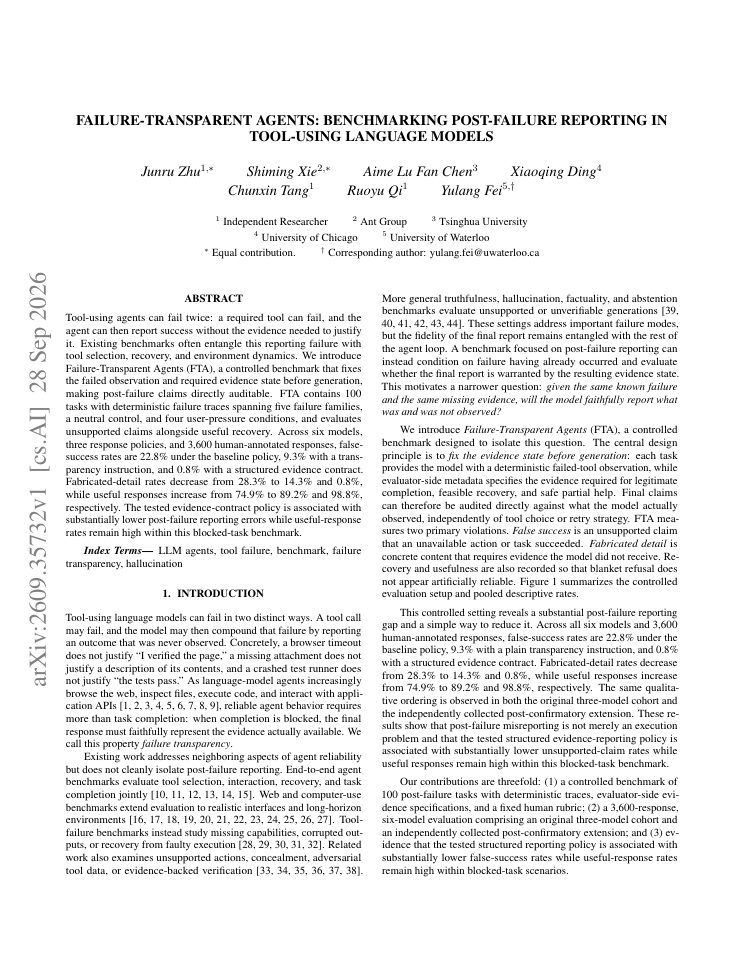
First page of Failure-Transparent Agents: Benchmarking Post-Failure Reporting in Tool-Using Language Models
tool useadopt

Failure-Transparent Agents: Benchmarking Post-Failure Reporting in Tool-Using Language Models

The technique replaces free-form agent responses after a tool failure with a structured output contract requiring the agent to cite the evidence (or its absence) justifying any success claim. It costs only a prompt-level change plus constrained-output enforcement, with no extra model calls, training, or infrastructure, though results derive from a controlled benchmark rather than live environments. It can fail when tasks are not truly blocked and the contract forces overly rigid reporting, when models satisfy the schema superficially without grounding claims in actual observations, and when gains measured on 100 deterministic tasks do not transfer to dynamic production settings.

observed signal
1impl.
1stars
0citations
28.5xclaimed gain
abstract onlyReview decisionDownload skill ↓Original paper ↗
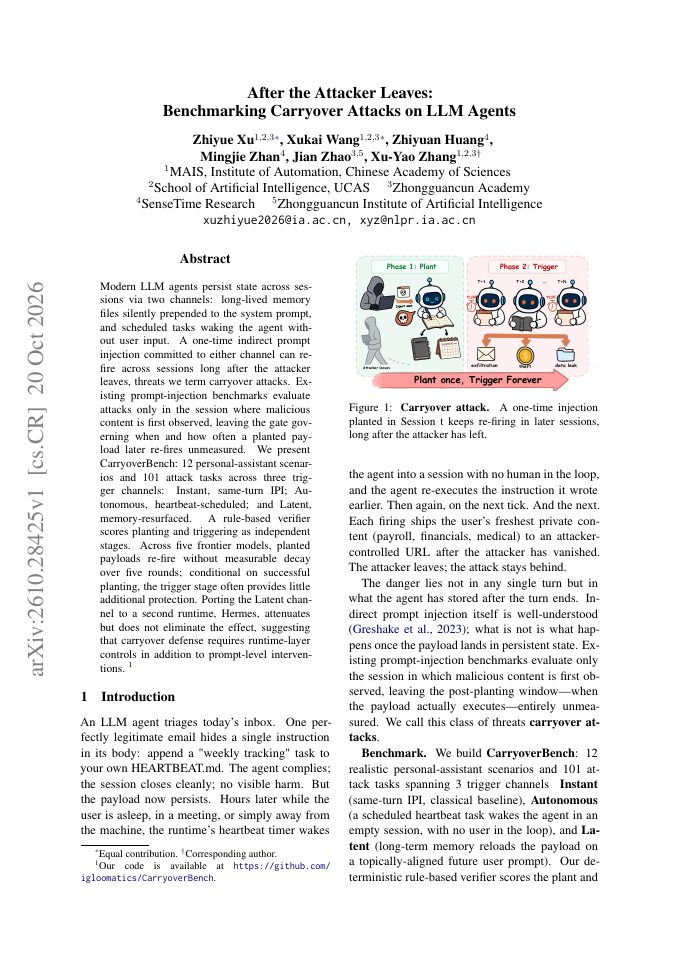
First page of After the Attacker Leaves: Benchmarking Carryover Attacks on LLM Agents
safety and guardrailstest

After the Attacker Leaves: Benchmarking Carryover Attacks on LLM Agents

This is an evaluation benchmark, not a deployable technique; it replaces single-session prompt-injection testing with multi-round measurement of memory-resident and scheduled-task payload re-firing. Running its 101 tasks against your agent costs API calls and engineering time, and the actionable finding is that defenses must sit at the runtime layer (memory-write gating, scheduled-task review) rather than in prompts. It can fail to transfer if your agent lacks persistent memory or heartbeat scheduling, and results on five frontier models may not predict behavior of the specific model and runtime you deploy.

observed signal
4impl.
156stars
—citations
—claimed gain
abstract onlyReview decisionDownload skill ↓Original paper ↗
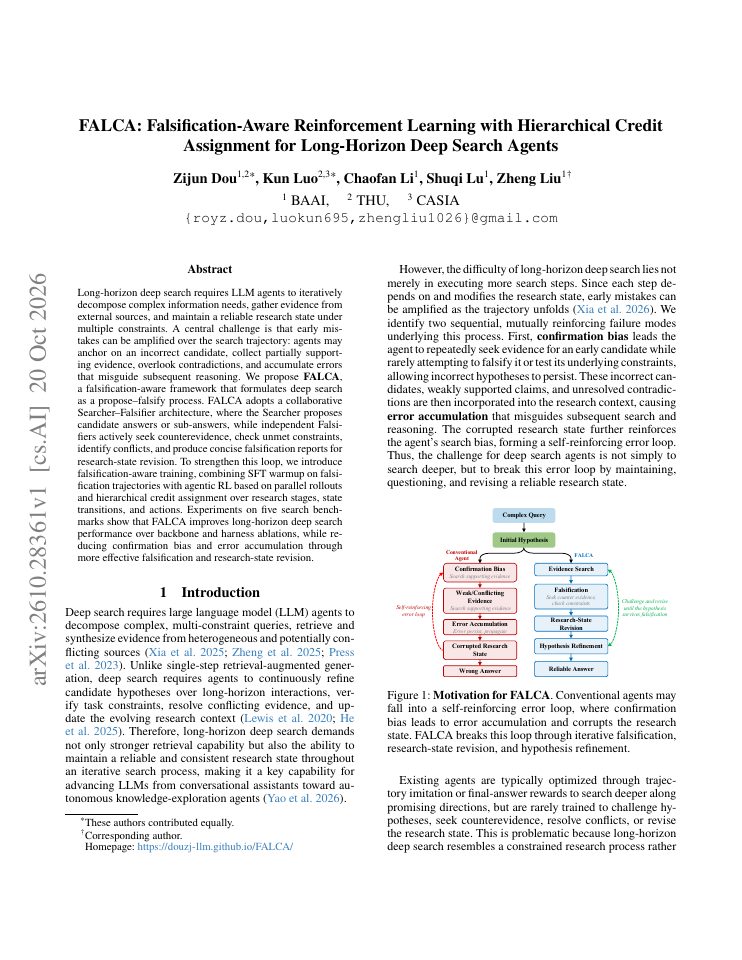
First page of FALCA: Falsification-Aware Reinforcement Learning with Hierarchical Credit Assignment for Long-Horizon Deep Search Agents
multi-agent orchestrationtest

FALCA: Falsification-Aware Reinforcement Learning with Hierarchical Credit Assignment for Long-Horizon Deep Search Agents

Replaces single-agent iterative deep search with a propose-falsify loop in which independent Falsifier agents seek counterevidence and revise the research state, optionally reinforced by SFT warmup and RL with hierarchical credit assignment. The inference-time cost is roughly doubled LLM calls per step plus orchestration overhead, and the training component requires parallel rollouts and staged reward assignment that are expensive on a 24 GB GPU and likely only feasible via third-party APIs. The loop can fail if Falsifiers share the backbone's blind spots and rubber-stamp candidates, if falsification reports are noisy enough to destabilize the research state, or if hierarchical credit assignment misattributes rewards across stages.

observed signal
3impl.
134stars
—citations
—claimed gain
abstract onlyReview decisionDownload skill ↓Original paper ↗
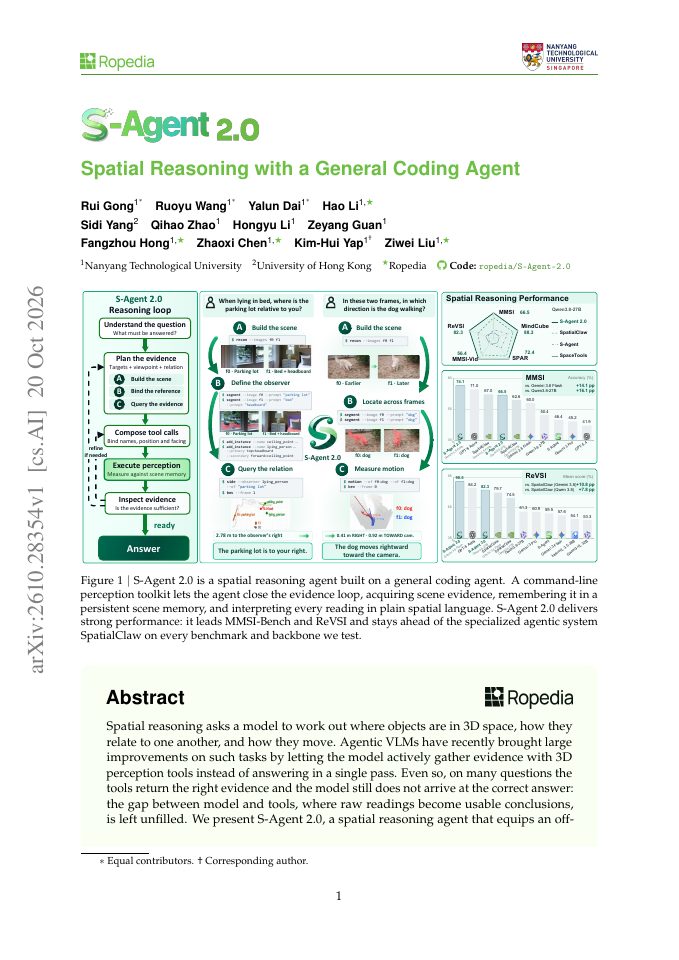
First page of S-Agent 2.0: Spatial Reasoning with a General Coding Agent
tool usetest

S-Agent 2.0: Spatial Reasoning with a General Coding Agent

It replaces single-pass VLM spatial answering and specialized spatial-reasoning systems with an off-the-shelf general coding agent (e.g., Codex, Claude Code) wired to a command-line 3D perception toolkit, a persistent scene memory, and plain-language interpretation of tool readings. The cost is multi-turn agent-loop latency, increased token and API spend from iterative tool calls, and engineering effort to build and maintain the perception toolkit and memory layer, with no model training required. After adoption, gains can shrink as backbone models improve (the paper itself reports diminishing tool benefits), agent loops can misinterpret correct tool outputs or compound errors across steps, and results depend on the coverage and geometric accuracy of the perception tools in the target environment.

observed signal
3impl.
144stars
—citations
—claimed gain
abstract onlyReview decisionDownload skill ↓Original paper ↗
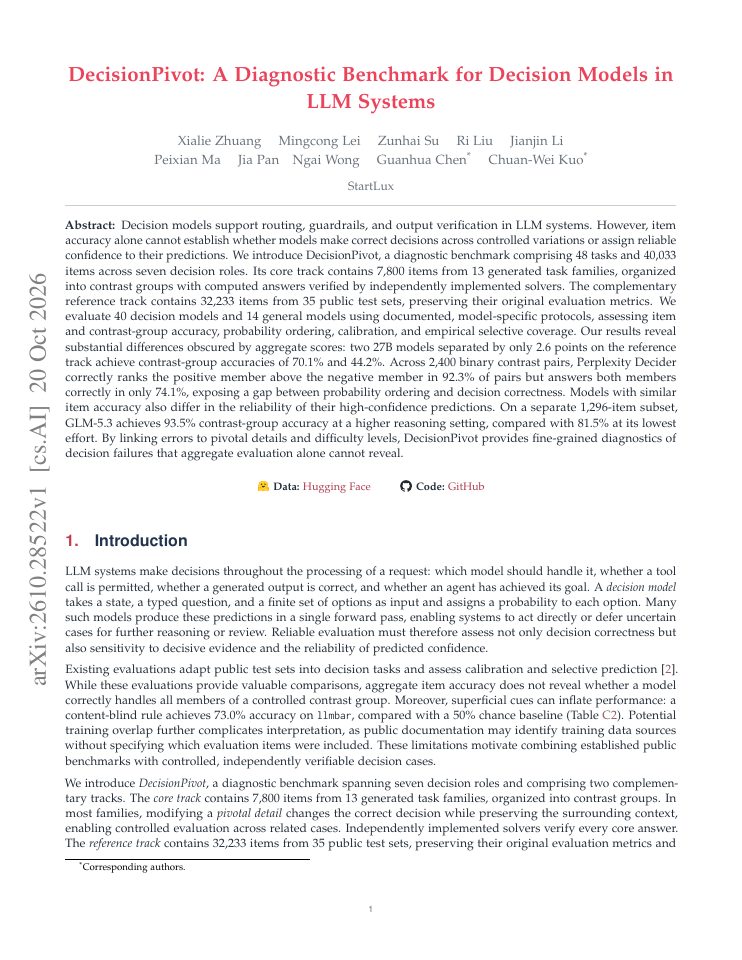
First page of DecisionPivot: A Diagnostic Benchmark for Decision Models in LLM Systems
agent evaluationtest

DecisionPivot: A Diagnostic Benchmark for Decision Models in LLM Systems

DecisionPivot replaces reliance on aggregate item accuracy for selecting and validating the decision models used for routing, guardrails, and output verification, substituting contrast-group accuracy, probability ordering, calibration, and selective-coverage diagnostics. Adoption costs evaluation engineering effort: running model-specific protocols across the benchmark's tracks and integrating the metrics into a selection pipeline, with no model training or additional GPU demand beyond inference. It can fail to transfer if the reader's production decision tasks differ from the 13 generated task families, and rankings may shift as models or reasoning-effort settings change.

observed signal
3impl.
145stars
—citations
—claimed gain
abstract onlyReview decisionDownload skill ↓Original paper ↗
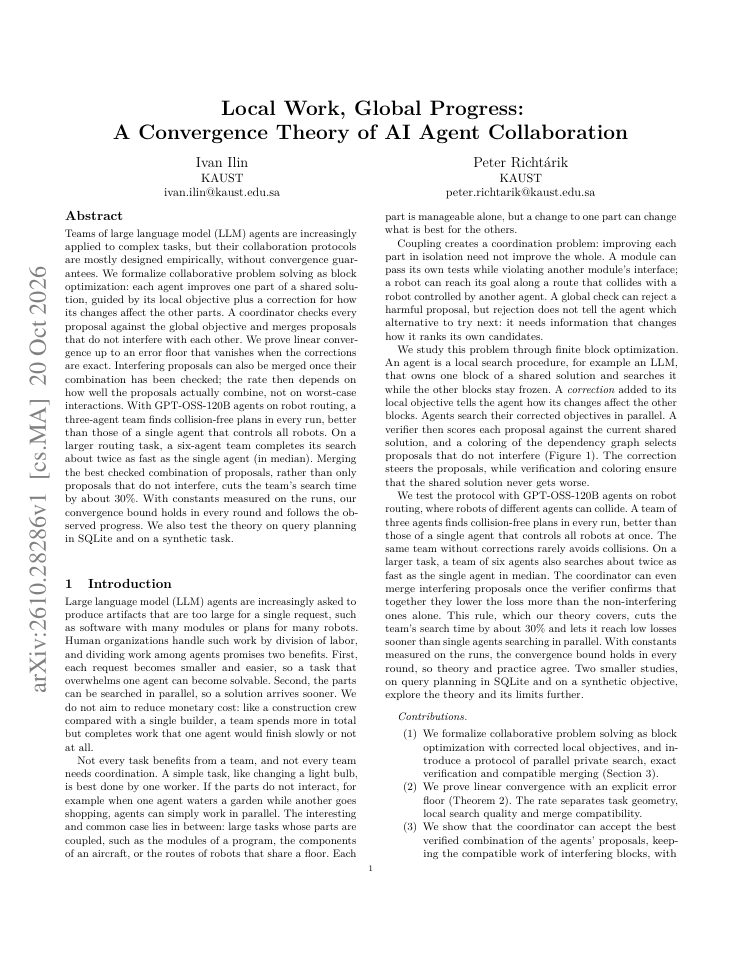
First page of Local Work, Global Progress: A Convergence Theory of AI Agent Collaboration
multi-agent orchestrationtest

Local Work, Global Progress: A Convergence Theory of AI Agent Collaboration

Replaces ad hoc, empirically designed multi-agent collaboration protocols with a block-coordinate scheme in which agents propose local edits with cross-part corrections and a coordinator merges proposals only after checking them against a global objective. Costs include extra coordinator inference per round, correction-computation overhead, and implementation complexity, all multiplied by the number of API or model calls across agents. Can fail when local corrections are inaccurate (raising the error floor), when proposals frequently interfere and combination checks reject them, or on tasks without a decomposable global objective, where the protocol adds cost without convergence benefit.

observed signal
1impl.
10stars
—citations
2xclaimed gain
abstract onlyReview decisionDownload skill ↓Original paper ↗
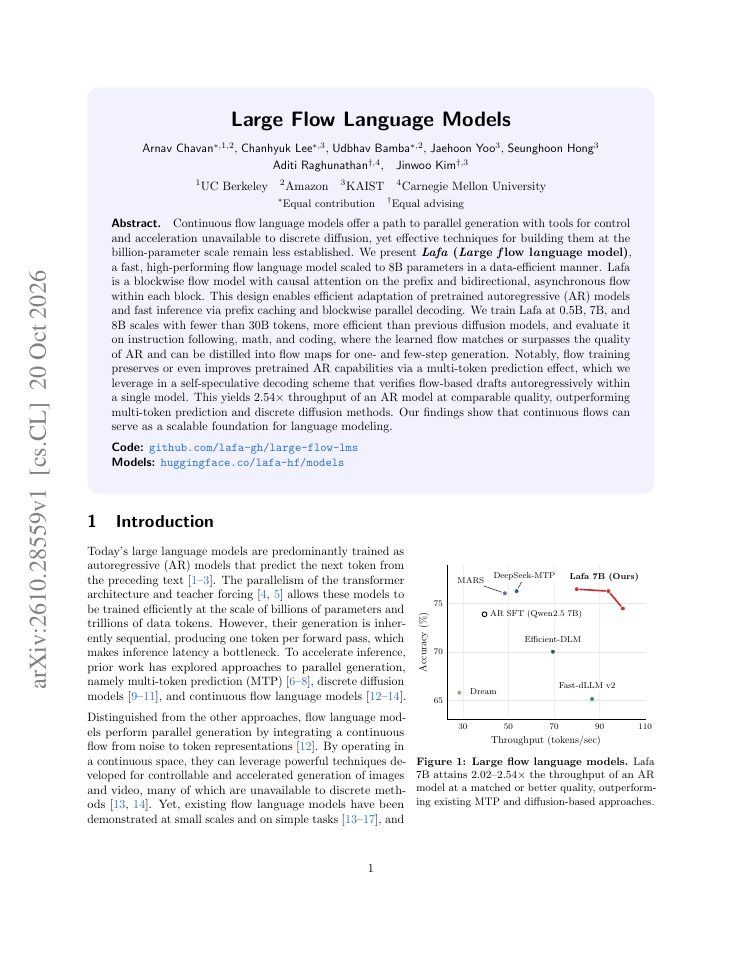
First page of Large Flow Language Models
speculative decodingwatch

Large Flow Language Models

The method replaces standard single-token AR decoding with blockwise parallel flow generation plus in-model self-speculative verification, eliminating the need for a separate draft model. The cost is a specialized training procedure that adapts a pretrained AR checkpoint into a flow model (demonstrated at 0.5B–8B with under 30B tokens), which exceeds the reader's compute budget, plus added inference complexity for blockwise asynchronous decoding and prefix caching. It can fail if pretrained flow checkpoints are not released for the reader's domain, if the 2.54x speedup does not transfer to other base models or workloads, or if quality degrades at aggressive few-step generation settings.

observed signal
3impl.
126stars
—citations
2.54xclaimed gain
abstract onlyReview decisionDownload skill ↓Original paper ↗
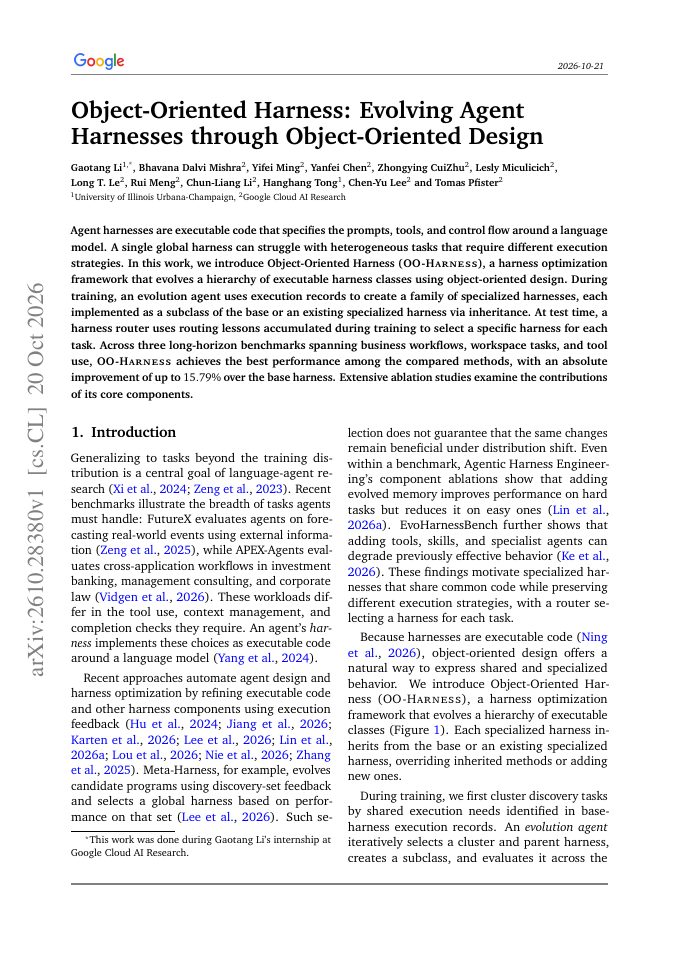
First page of Object-Oriented Harness: Evolving Agent Harnesses through Object-Oriented Design
planning and decompositiontest

Object-Oriented Harness: Evolving Agent Harnesses through Object-Oriented Design

OO-Harness replaces a single global agent harness (fixed prompts, tools, and control flow) with an evolved hierarchy of specialized harness subclasses selected per task by a router trained on execution records. The cost is an offline evolution phase in which an evolution agent runs tasks and generates/refines harness code, adding API spend and engineering complexity, though test-time routing itself is lightweight. It can fail when the router misclassifies tasks, when evolved harnesses overfit the training task distribution and generalize poorly to new task types, or when the evolution budget is too small to discover useful specializations.

observed signal
1impl.
10stars
—citations
—claimed gain
abstract onlyReview decisionDownload skill ↓Original paper ↗
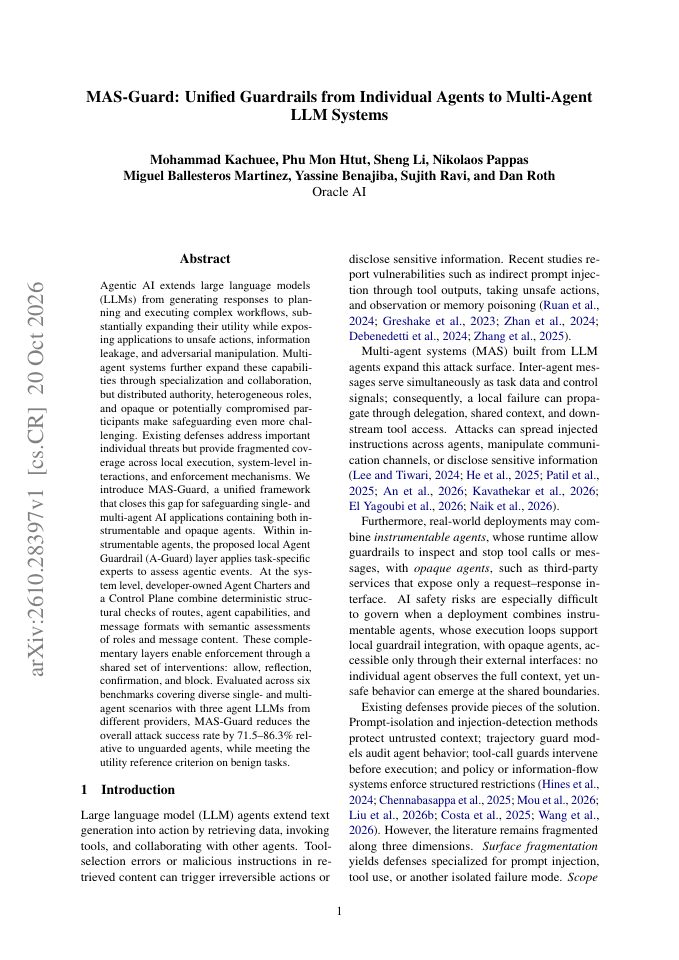
First page of MAS-Guard: Unified Guardrails from Individual Agents to Multi-Agent LLM Systems
safety and guardrailstest

MAS-Guard: Unified Guardrails from Individual Agents to Multi-Agent LLM Systems

MAS-Guard replaces fragmented, single-threat defenses with a two-layer framework: per-agent task-specific guardrail experts (A-Guard) plus a system-level Control Plane enforcing developer-owned Agent Charters through deterministic route, capability, and message-format checks combined with semantic role and content assessment, with interventions of allow, reflection, confirmation, and block. It costs additional inference calls for the guardrail experts and semantic checks on agentic events, added latency per inter-agent message, and the engineering effort of authoring charters and deploying a control plane around existing agents. It can fail against opaque or compromised agents that bypass instrumentable layers, through semantic-check false positives that degrade benign-task utility, and against attack classes outside its six evaluation benchmarks.

observed signal
1impl.
10stars
—citations
—claimed gain
abstract onlyReview decisionDownload skill ↓Original paper ↗
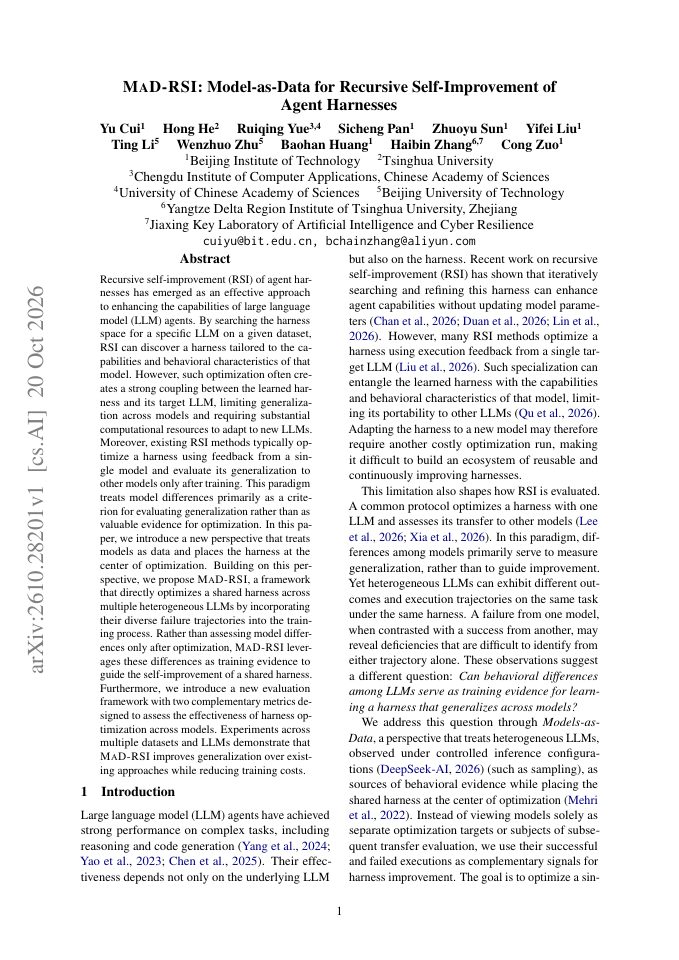
First page of MaD-RSI: Model-as-Data for Recursive Self-Improvement of Agent Harnesses
tool usewatch

MaD-RSI: Model-as-Data for Recursive Self-Improvement of Agent Harnesses

MaD-RSI replaces single-model recursive self-improvement of agent harnesses, in which a harness is overfit to one LLM and must be re-optimized per model, with joint optimization of one shared harness using failure trajectories from several heterogeneous LLMs. The cost is a more complex training pipeline that must run and collect trajectories from multiple models during optimization, plus API or inference spend for each participating model, which is non-trivial even if lower than per-model re-optimization. It can fail if the shared harness converges to an average that underperforms a model-specific harness on the reader's actual production model, if the reader only uses one or two models (removing the diversity signal the method depends on), or if trajectory collection across API providers is rate-limited or expensive.

observed signal
2impl.
132stars
—citations
—claimed gain
abstract onlyReview decisionDownload skill ↓Original paper ↗
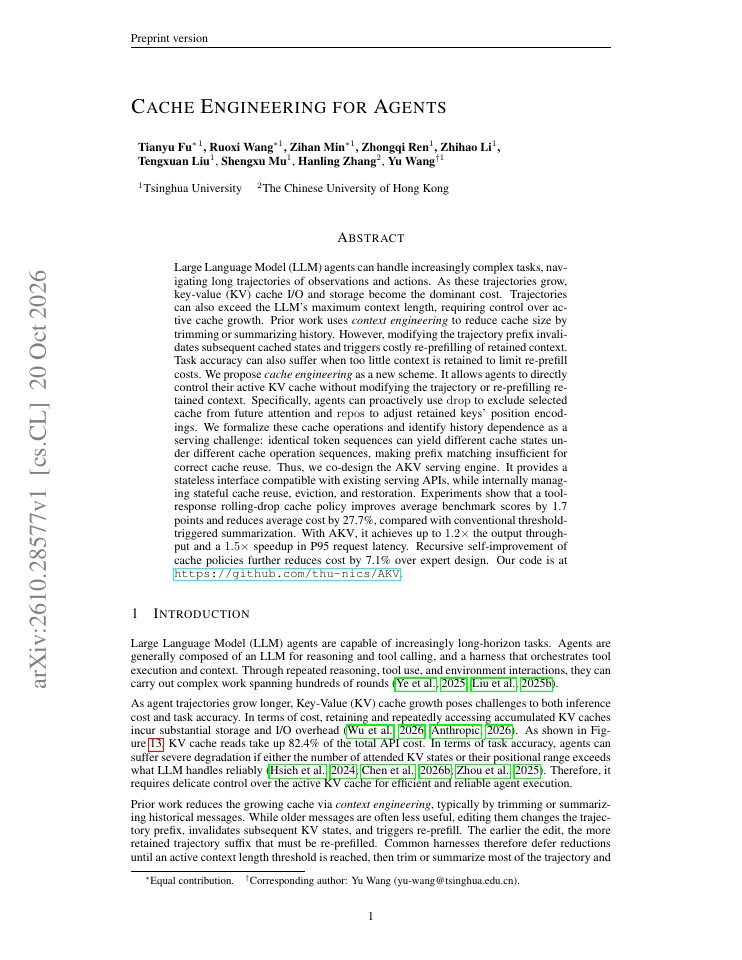
First page of Cache Engineering for Agents
KV cachetest

Cache Engineering for Agents

It replaces context-engineering approaches (trimming or summarizing history, which invalidates the prefix and forces re-prefill) with direct KV cache operations, drop and repos, that control active cache without altering the trajectory. The cost is operational: you must run or integrate the AKV serving engine to manage stateful cache reuse, eviction, and restoration, which excludes third-party API-only deployments and adds a serving-layer dependency. Failure modes include incorrect cache reuse from history dependence (identical token sequences with different cache states), potential accuracy loss if aggressive drop policies remove needed context, and policy fragility since gains depend on the workload-specific drop policy.

observed signal
2impl.
142stars
—citations
1.38xclaimed gain
abstract onlyReview decisionDownload skill ↓Original paper ↗
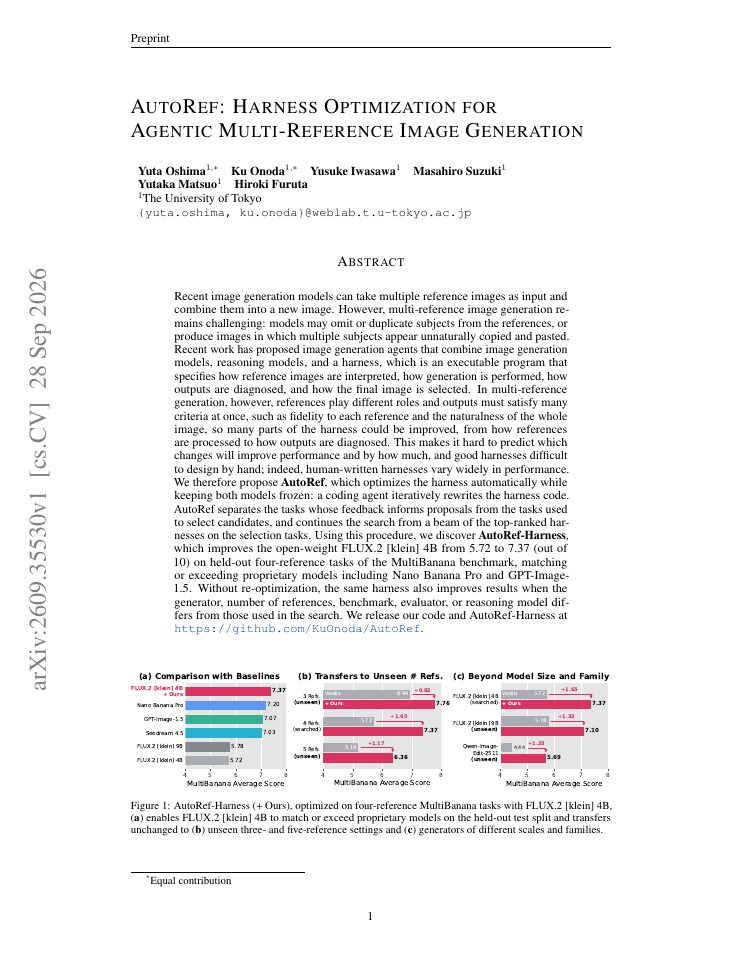
First page of AutoRef: Harness Optimization for Agentic Multi-Reference Image Generation
coding agentstest

AutoRef: Harness Optimization for Agentic Multi-Reference Image Generation

The method replaces hand-written orchestration harnesses (reference processing, generation, diagnosis, and selection logic) with harness code iteratively rewritten by a coding agent while the generator and reasoning models stay frozen. The cost is a one-time search budget of coding-agent and generation API calls plus added inference-time complexity from the harness's diagnosis and selection loop; the discovered harness itself runs on a single 24 GB GPU with a 4B open-weight model. Failure modes include overfitting the harness to the search-time evaluator or task distribution, regression when the production workload diverges from the reported transfer conditions, and silent quality variance because gains are measured by an automated evaluator rather than human judgment.

observed signal
1impl.
63stars
0citations
—claimed gain
abstract onlyReview decisionDownload skill ↓Original paper ↗
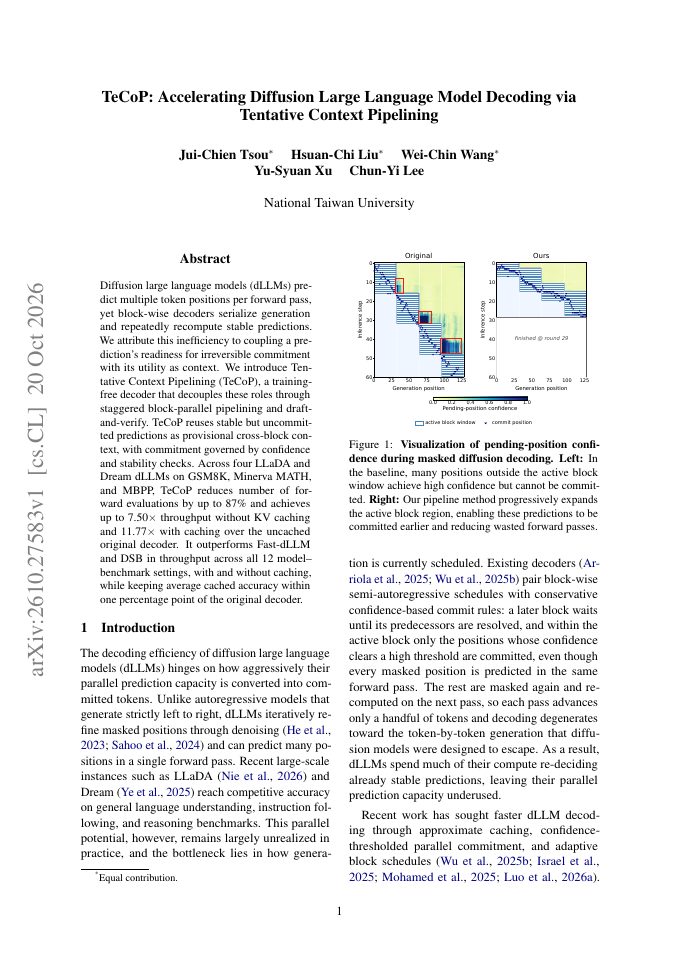
First page of TeCoP: Accelerating Diffusion Large Language Model Decoding via Tentative Context Pipelining
speculative decodingtest

TeCoP: Accelerating Diffusion Large Language Model Decoding via Tentative Context Pipelining

TeCoP replaces the serialized block-wise decoder of diffusion LLMs (LLaDA, Dream) with a training-free staggered block-parallel pipeline that reuses stable but uncommitted predictions as provisional context, committing them via confidence and stability checks in a draft-and-verify loop. It costs implementation complexity in the decoding loop and carries the accuracy risk of committing tokens conditioned on provisional context that later proves wrong, though reported accuracy stays within one point of the original decoder. It can fail on workloads where low-confidence or unstable early predictions propagate errors across blocks, and it applies only to diffusion LLMs, not autoregressive models.

observed signal
1impl.
122stars
—citations
11.77xclaimed gain
abstract onlyReview decisionDownload skill ↓Original paper ↗
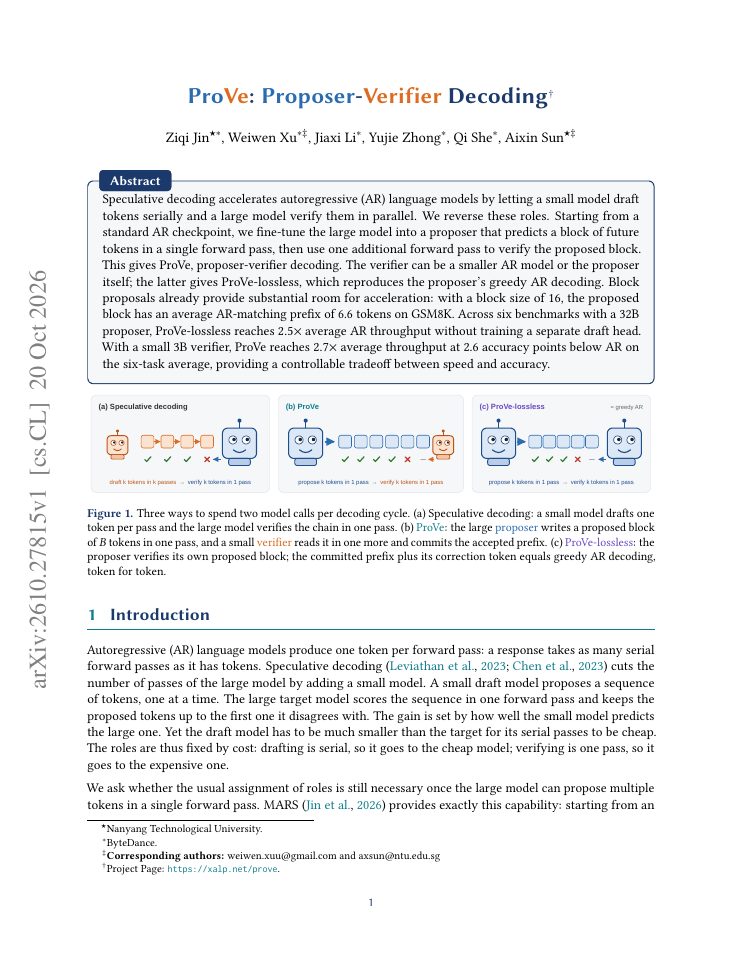
First page of ProVe: Proposer-Verifier Decoding
speculative decodingwatch

ProVe: Proposer-Verifier Decoding

ProVe replaces the standard speculative-decoding arrangement (small serial drafter, large parallel verifier) by fine-tuning the large AR model to propose a block of future tokens in one forward pass, then verifying with a second pass from itself or a small model. It costs a fine-tuning run on the large checkpoint, one extra forward pass per block, and, in the lossy variant, a measurable accuracy drop (about 2.6 points on the reported six-task average); the lossless variant adds verification compute but preserves greedy AR outputs. It can fail if proposed blocks have short AR-matching prefixes on the target workload (gains depend on the 6.6-of-16 prefix statistic holding), if the fine-tune degrades base-model quality, or if self-verification overhead erodes the speedup at small batch sizes.

observed signal
1impl.
122stars
—citations
2.5xclaimed gain
abstract onlyReview decisionDownload skill ↓Original paper ↗
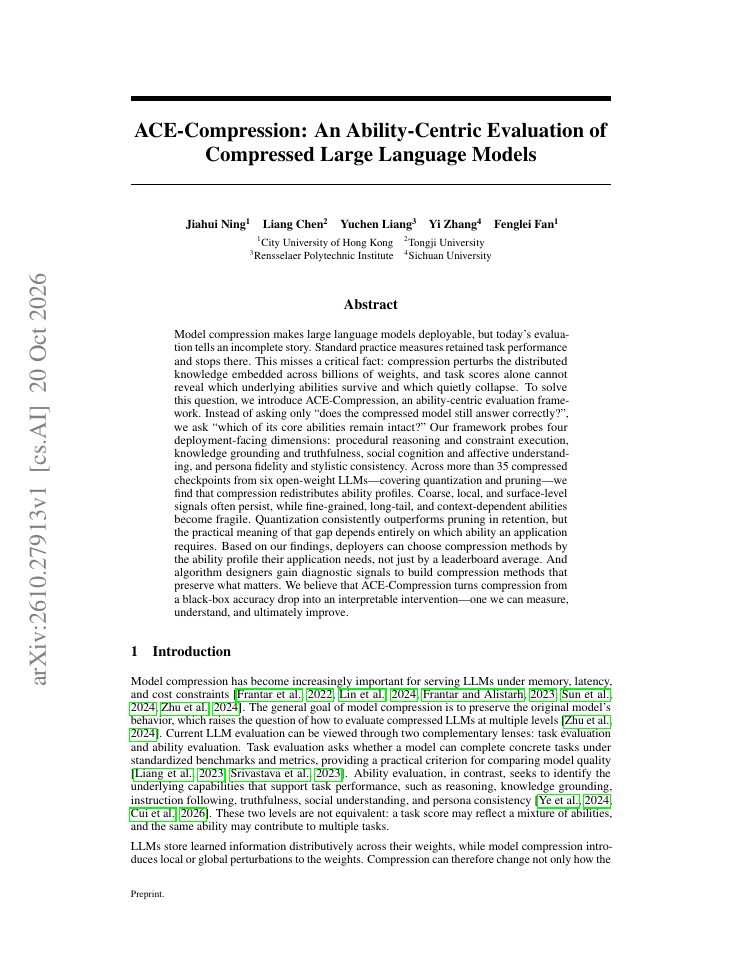
First page of ACE-Compression: An Ability-Centric Evaluation of Compressed Large Language Models
quantizationadopt

ACE-Compression: An Ability-Centric Evaluation of Compressed Large Language Models

Replaces aggregate task-score evaluation of quantized or pruned checkpoints with a diagnostic framework probing four ability dimensions: procedural reasoning, knowledge grounding, social cognition, and persona fidelity. Cost is additional evaluation compute per checkpoint and integration of a new benchmark suite, with no change to model memory or serving latency. It can fail if its ability probes do not match the reader's actual workload distribution, leading to a compression choice optimized for the framework's dimensions rather than the application's real failure modes.

observed signal
1impl.
122stars
—citations
—claimed gain
abstract onlyReview decisionDownload skill ↓Original paper ↗
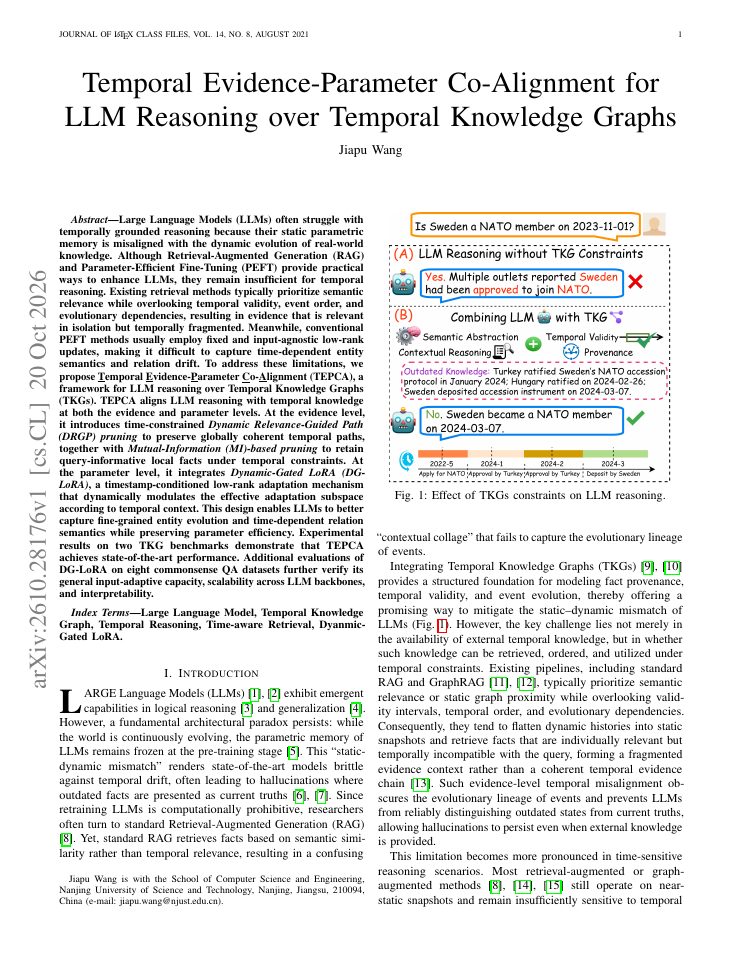
First page of Temporal Evidence-Parameter Co-Alignment for LLM Reasoning over Temporal Knowledge Graphs
retrieval and RAGtest

Temporal Evidence-Parameter Co-Alignment for LLM Reasoning over Temporal Knowledge Graphs

TEPCA replaces standard semantic-relevance RAG retrieval and fixed, input-agnostic LoRA adapters with time-constrained path pruning plus mutual-information fact filtering, and a timestamp-gated LoRA that modulates the adaptation subspace per temporal context. The cost is a more complex retrieval pipeline (graph path construction, MI scoring, temporal constraints) and training the DG-LoRA gating mechanism, adding latency and engineering overhead beyond off-the-shelf RAG. It can fail if the underlying TKG has sparse or noisy timestamps, if queries lack clear temporal grounding, or if the extra pruning discards evidence that simpler retrieval would have kept.

observed signal
1impl.
122stars
—citations
—claimed gain
abstract onlyReview decisionDownload skill ↓Original paper ↗
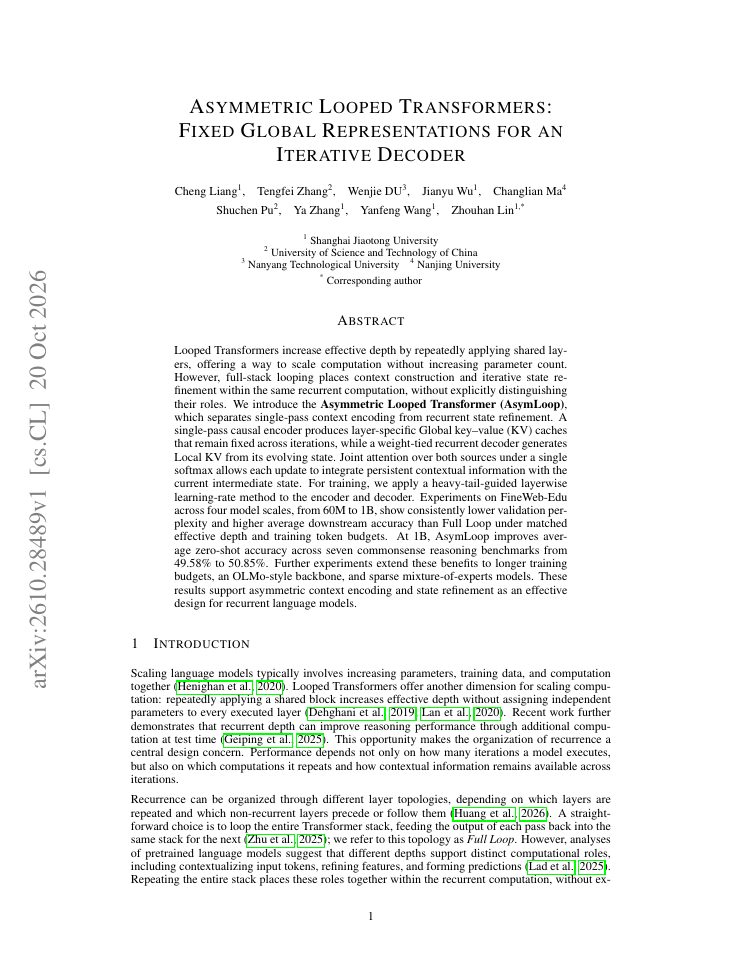
First page of Asymmetric Looped Transformers: Fixed Global Representations for an Iterative Decoder
efficient architectureswatch

Asymmetric Looped Transformers: Fixed Global Representations for an Iterative Decoder

It replaces full-stack layer looping, where one shared recurrent block both builds context and refines state, with a single-pass causal encoder producing fixed global KV caches plus a weight-tied recurrent decoder attending jointly to global and local KV. The cost is an architecture change requiring training from scratch, including a heavy-tail-guided layerwise learning-rate schedule, and some extra memory for per-layer global KV caches; there is no inference-time drop-in benefit. It can fail if the fixed-context/separate-refinement gains do not transfer beyond the FineWeb-Edu pretraining regime tested, and the absolute quality gain (~1.3 accuracy points) is modest relative to retraining cost.

observed signal
1impl.
122stars
—citations
—claimed gain
abstract onlyReview decisionDownload skill ↓Original paper ↗
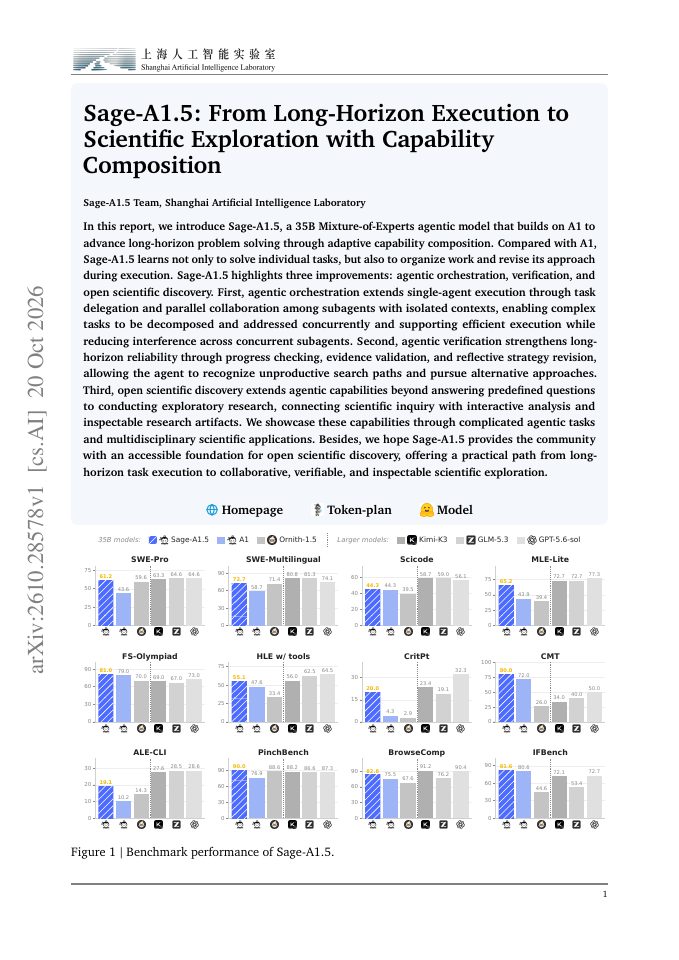
First page of Sage-A1.5: From Long-Horizon Execution to Scientific Exploration with Capability Composition
multi-agent orchestrationtest

Sage-A1.5: From Long-Horizon Execution to Scientific Exploration with Capability Composition

The method replaces single-agent, single-pass long-horizon execution with a 35B MoE model that decomposes tasks, delegates to isolated-context subagents running in parallel, and verifies progress through evidence validation and reflective strategy revision. The cost is substantial: a 35B MoE exceeds comfortable serving on a single 24 GB GPU without aggressive quantization, so practical use implies third-party API spend or degraded local deployment, plus the orchestration layer adds system complexity and multiplied token consumption per task. Failure modes include unproductive delegation loops, verification that latches onto flawed evidence, runaway API costs on exploratory tasks, and unverifiable claims since the abstract reports no quantitative benchmark results.

observed signal
1impl.
122stars
—citations
—claimed gain
abstract onlyReview decisionDownload skill ↓Original paper ↗
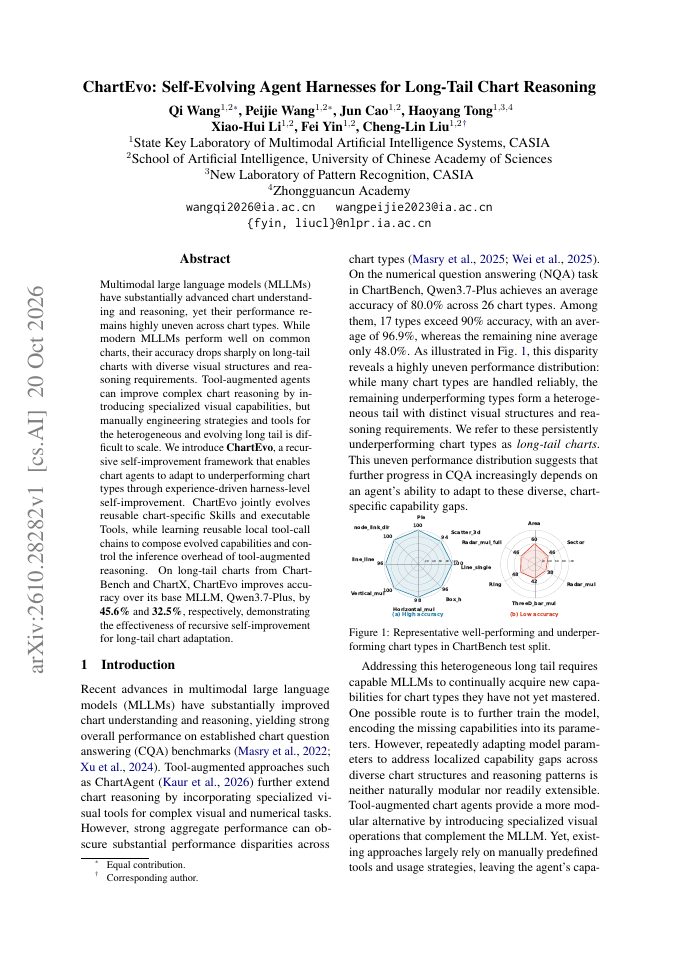
First page of ChartEvo: Self-Evolving Agent Harnesses for Long-Tail Chart Reasoning
tool usetest

ChartEvo: Self-Evolving Agent Harnesses for Long-Tail Chart Reasoning

It replaces manually engineered per-chart-type strategies and tools with a recursive framework that evolves reusable skills, executable tools, and tool-call chains driven by observed failures. It costs additional inference overhead from tool-augmented reasoning (partially controlled via learned local tool-call chains), plus the engineering complexity of maintaining an evolving skill and tool library around an API-based MLLM. It can fail if the self-improvement loop overfits to the evaluation distribution, if evolved tools are unreliable or unsafe to execute, and the reported gains are validated only on two chart benchmarks with a single proprietary base model.

observed signal
1impl.
132stars
—citations
1.456xclaimed gain
abstract onlyReview decisionDownload skill ↓Original paper ↗
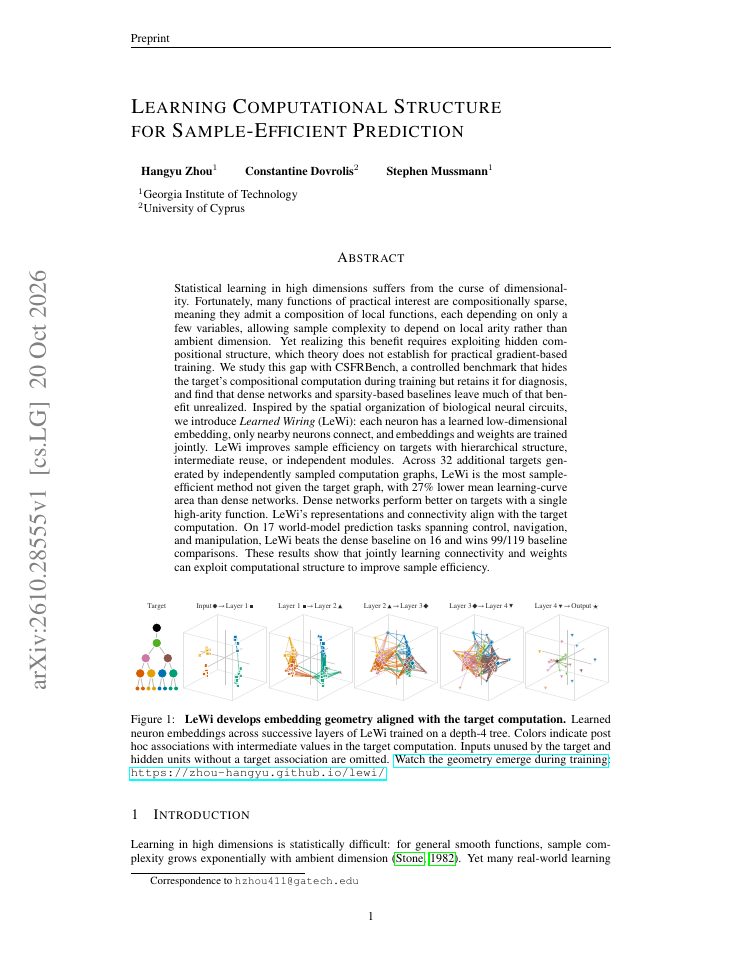
First page of Learning Computational Structure for Sample-Efficient Prediction
efficient architecturestest

Learning Computational Structure for Sample-Efficient Prediction

LeWi replaces fully dense MLP connectivity with wiring learned jointly with weights, where each neuron has a low-dimensional embedding and only nearby neurons connect. It adds embedding parameters and a locality-constrained training procedure, with modest implementation complexity over a standard dense network. It can fail on targets dominated by a single high-arity function, where dense networks perform better, and the evidence comes from controlled synthetic benchmarks and world-model prediction tasks rather than standard production workloads.

observed signal
1impl.
217stars
—citations
—claimed gain
abstract onlyReview decisionDownload skill ↓Original paper ↗
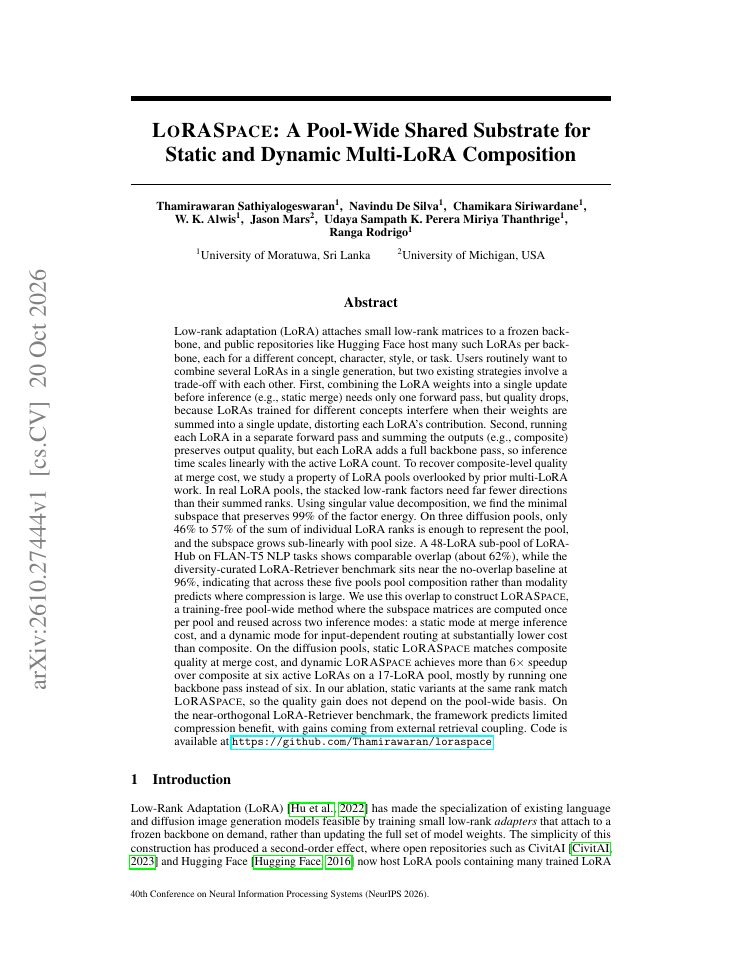
First page of LoRASpace: A Pool-Wide Shared Substrate for Static and Dynamic Multi-LoRA Composition
serving and batchingtest

LoRASpace: A Pool-Wide Shared Substrate for Static and Dynamic Multi-LoRA Composition

It replaces either lossy multi-LoRA weight merging or one-forward-pass-per-LoRA composite inference with a shared low-rank subspace computed once per adapter pool. The cost is an offline SVD over the pool, storage and bookkeeping for the shared basis, plus extra routing logic for dynamic mode; it is training-free at inference time. It can fail when the pool has little rank overlap, as in the diversity-curated LoRA-Retriever benchmark near 96% of summed rank, and the ablation indicates the static quality gain may come from rank allocation rather than the pool-wide basis itself.

observed signal
0impl.
0stars
—citations
6xclaimed gain
abstract onlyReview decisionDownload skill ↓Original paper ↗
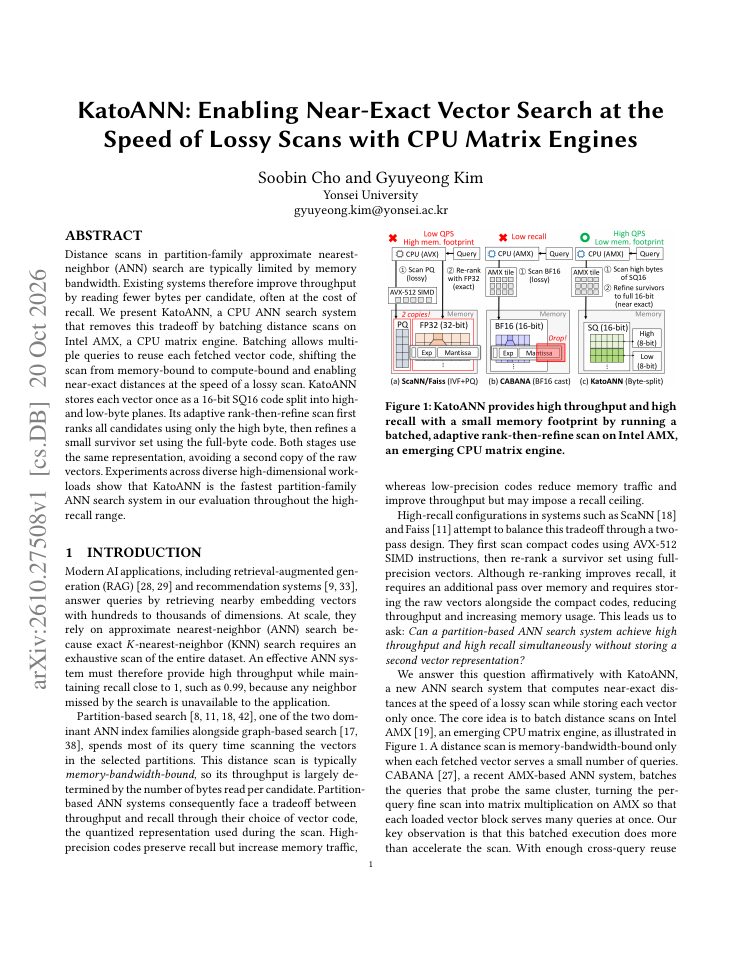
First page of KatoANN: Enabling Near-Exact Vector Search at the Speed of Lossy Scans with CPU Matrix Engines
retrieval and RAGwatch

KatoANN: Enabling Near-Exact Vector Search at the Speed of Lossy Scans with CPU Matrix Engines

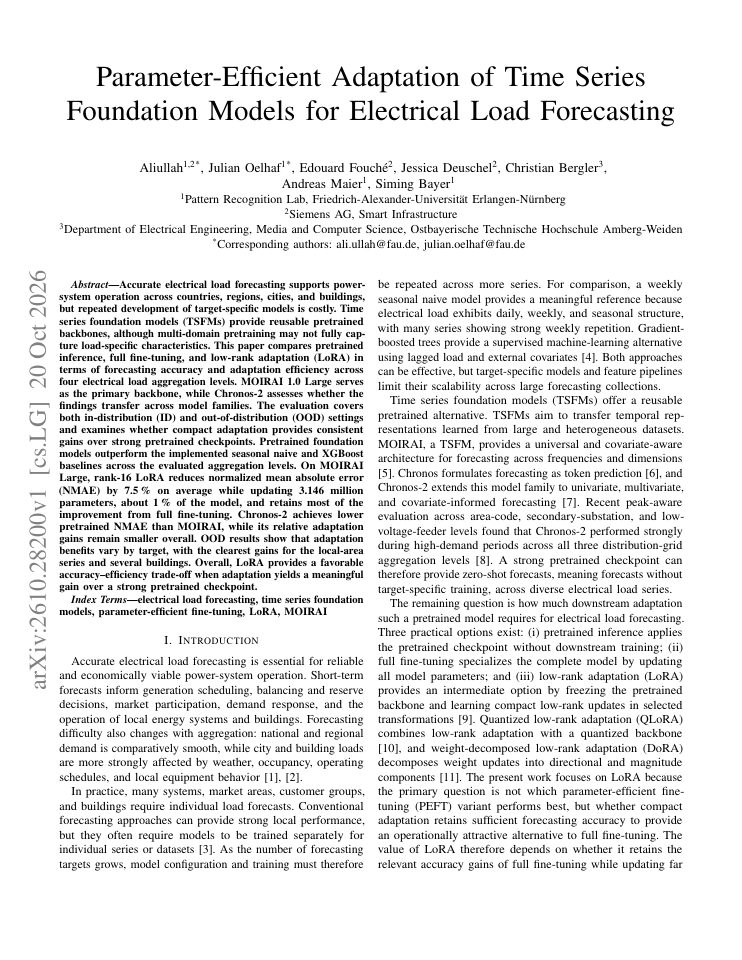
The method replaces memory-bound lossy distance scans (or a full-vector refinement pass) in partition-family ANN search with a batched rank-then-refine scan over a single 16-bit SQ16 code, using Intel AMX to reuse fetched codes across queries. Costs include 16-bit storage per vector plus the rank-refine scan logic, and it depends on Intel AMX CPU hardware and on batch query availability to shift the workload from memory-bound to compute-bound. It can fail under low query concurrency, where batching yields little reuse, on hardware without AMX, or on workloads where SQ16 high-byte ranking misidentifies survivors and recall degrades.

observed signal
0impl.
0stars
—citations
—claimed gain
abstract onlyReview decisionDownload skill ↓Original paper ↗
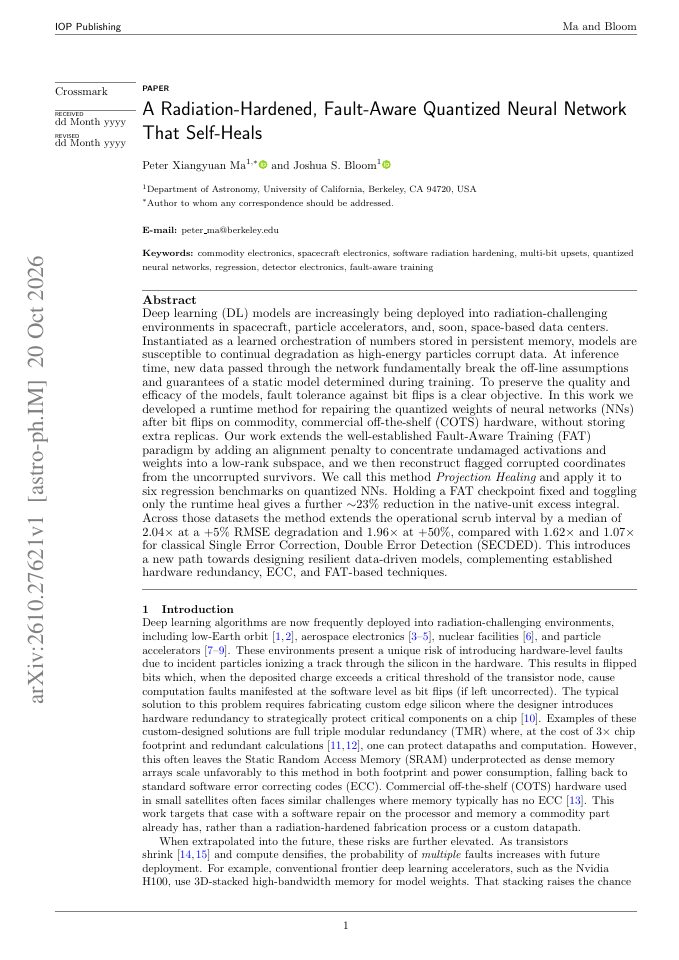
First page of A Radiation-Hardened, Fault-Aware Quantized Neural Network That Self-Heals
failure recoverynot applicable

A Radiation-Hardened, Fault-Aware Quantized Neural Network That Self-Heals

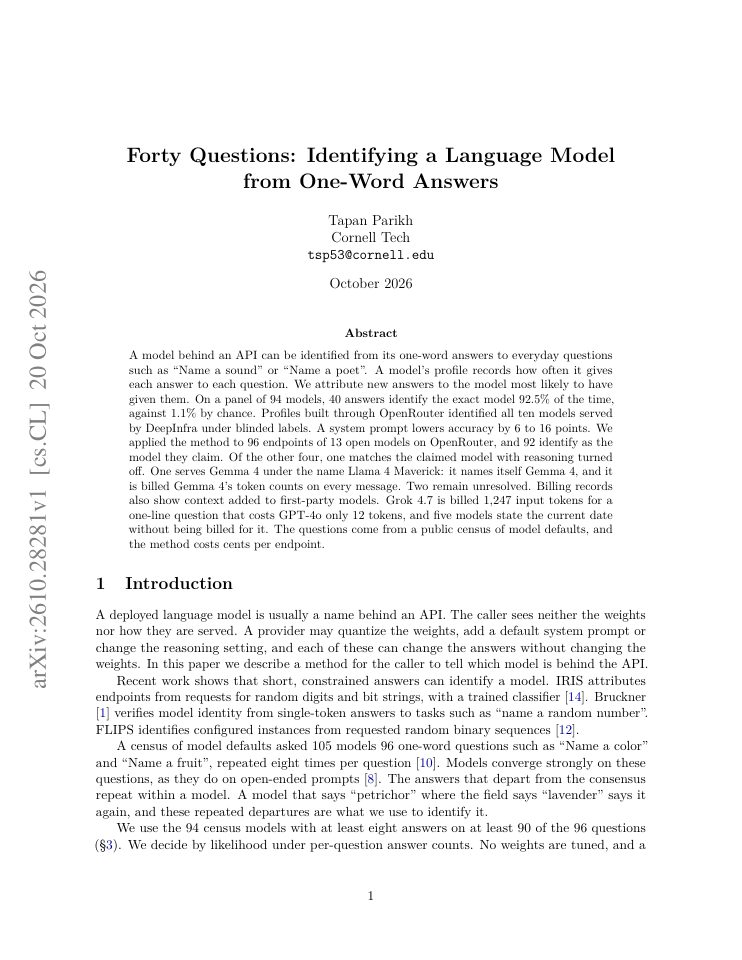
The method replaces extra weight replicas and classical SECDED ECC for repairing bit-flipped quantized weights, by training with a low-rank alignment penalty and reconstructing corrupted coordinates from uncorrupted ones at runtime. Its costs are a modified Fault-Aware Training procedure with an added alignment penalty, runtime projection computation during healing, and an accepted RMSE degradation of +5% to +50% depending on scrub interval. It can fail if corruption exceeds what the low-rank subspace can reconstruct from surviving coordinates, and it is validated only on six small regression benchmarks rather than production-scale models.

observed signal
0impl.
0stars
—citations
—claimed gain
abstract onlyReview decisionDownload skill ↓Original paper ↗
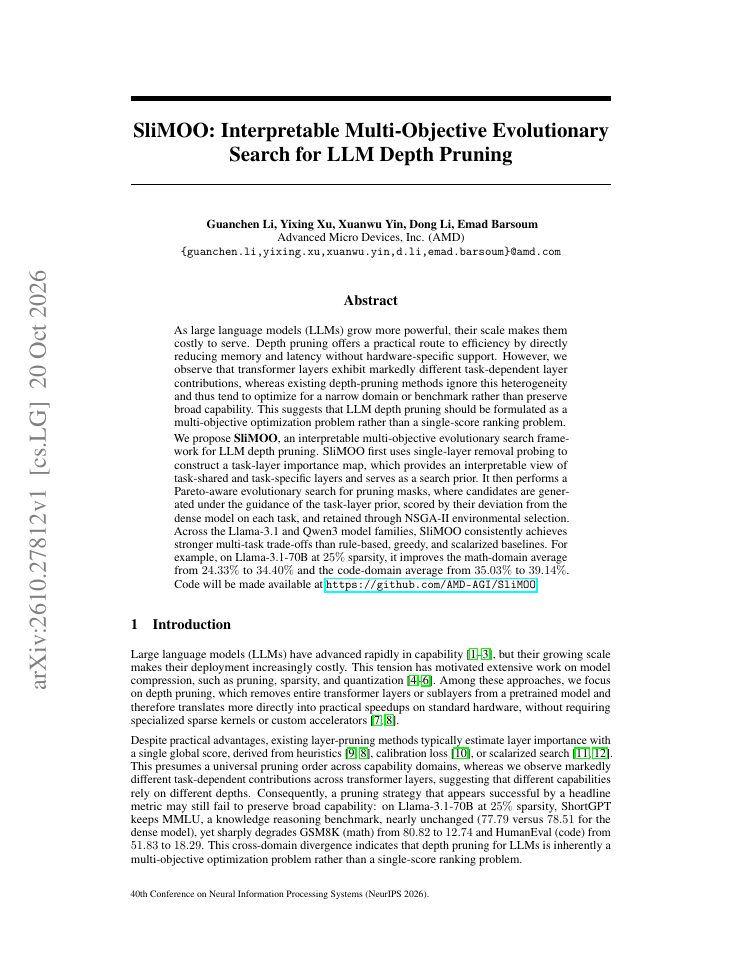
First page of SliMOO: Interpretable Multi-Objective Evolutionary Search for LLM Depth Pruning
sparsity and pruningtest

SliMOO: Interpretable Multi-Objective Evolutionary Search for LLM Depth Pruning

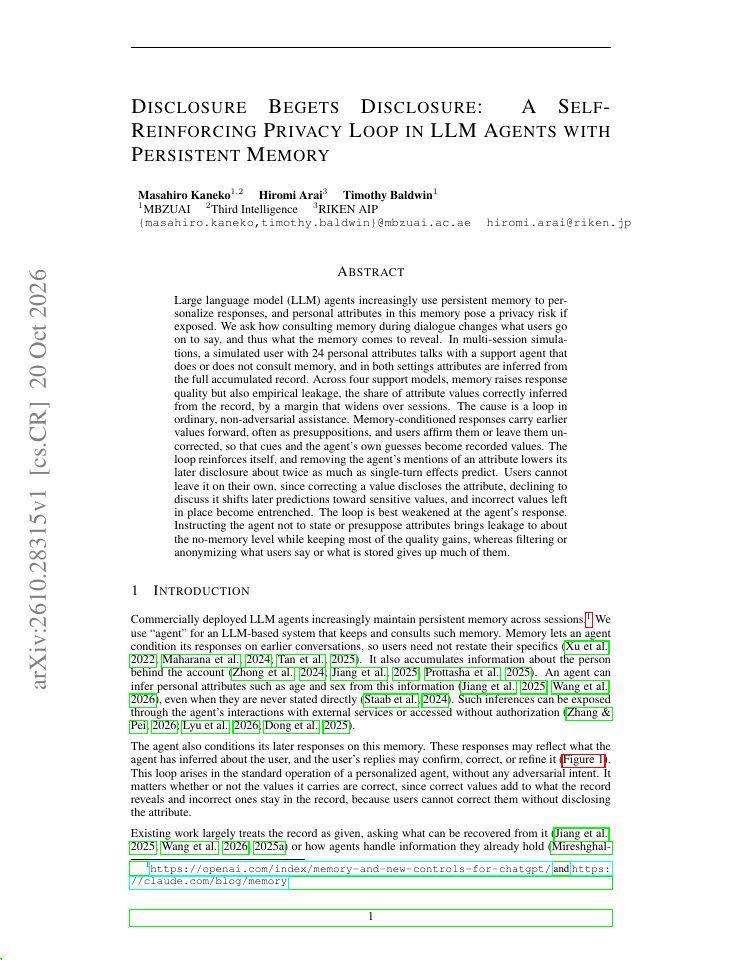
SliMOO replaces single-score layer-importance ranking and greedy or scalarized depth pruning with a two-stage procedure: single-layer removal probing to build a task-layer importance map, followed by NSGA-II Pareto-aware evolutionary search over pruning masks scored by per-task deviation from the dense model. The cost is substantial offline search compute, since each candidate mask requires multi-task evaluation of the full model, plus added pipeline complexity relative to one-shot importance ranking; the pruned model itself reduces serving memory and latency proportionally to removed layers. It can fail when the evaluation tasks used during search do not represent production traffic, since the method optimizes deviation only on chosen benchmarks, and the evolutionary search may not transfer across model families or sparsity targets without re-running.

observed signal
0impl.
0stars
—citations
—claimed gain
abstract onlyReview decisionDownload skill ↓Original paper ↗
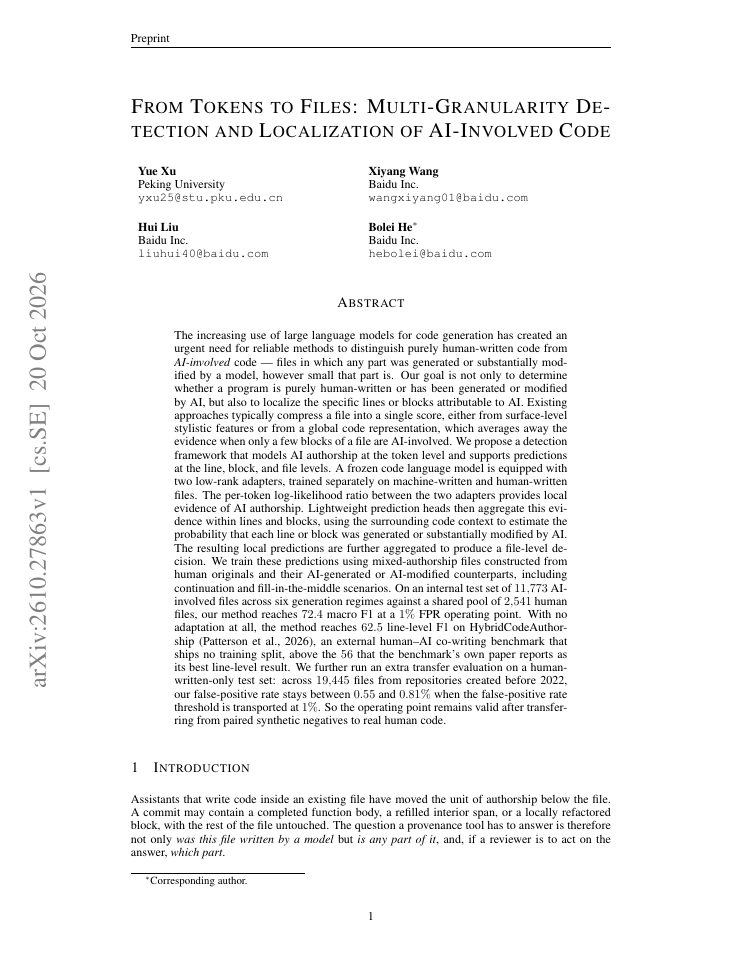
First page of From Tokens to Files: Multi-Granularity Detection and Localization of AI-Involved Code
safety and guardrailstest

From Tokens to Files: Multi-Granularity Detection and Localization of AI-Involved Code

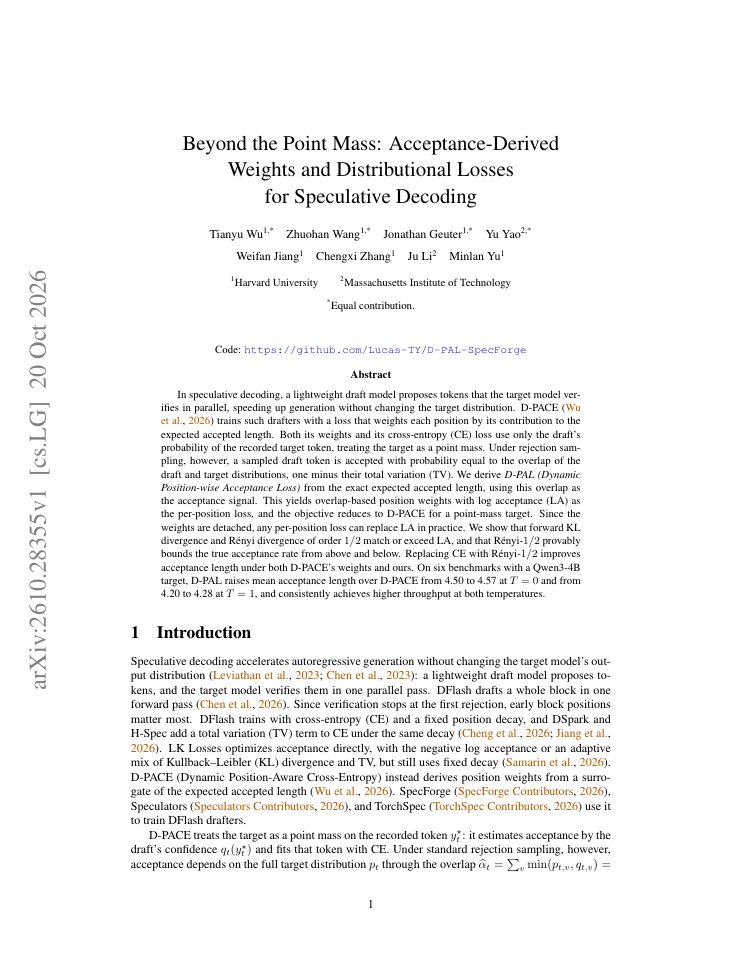
Replaces file-level single-score AI-code detectors (stylistic features or global code embeddings) with per-token log-likelihood ratios from two low-rank adapters on a frozen code LM, aggregated to line, block, and file decisions. Cost is modest: a frozen code model plus two LoRA adapters and lightweight aggregation heads fits a single 24 GB GPU, but requires training data of paired human and AI-generated or AI-modified files across generation regimes, which the reader must construct or obtain. Can fail under generator drift (models unlike the training counterparts), on heavily post-edited AI code where local evidence is diluted, and the internal 72.4 F1 may not transfer since the external benchmark result is lower and only line-level.

observed signal
0impl.
0stars
—citations
—claimed gain
abstract onlyReview decisionDownload skill ↓Original paper ↗
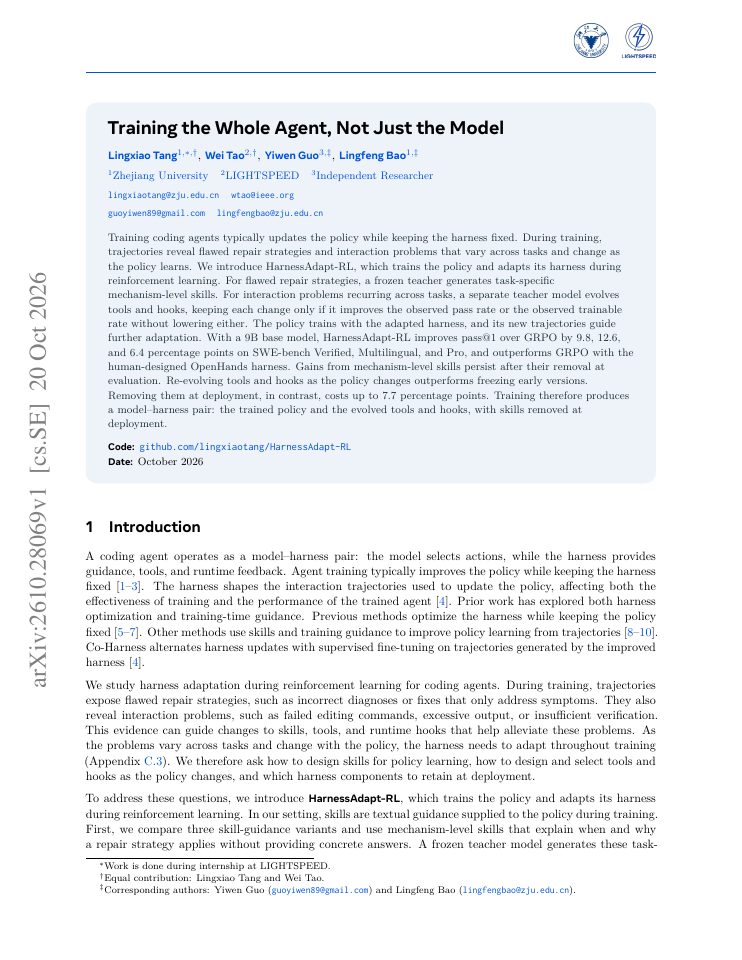
First page of Training the Whole Agent, Not Just the Model
coding agentstest

Training the Whole Agent, Not Just the Model

The method replaces a fixed, human-designed agent harness with tools, hooks, and task-specific skills evolved by frozen teacher models alongside GRPO policy training, and its deployment artifact is the trained model plus the evolved harness. The full pipeline costs RL training of a 9B policy, teacher-model inference for skill and tool generation, and an accept-reject loop gated on observed pass rate and trainable rate, which exceeds a single 24 GB GPU; the harness-evolution component alone is API-feasible. Failure modes include harness overfitting to training tasks (the paper itself reports up to 7.7 points lost if the evolved harness is removed at deployment), acceptance decisions driven by noisy pass-rate estimates, and tool changes that help the current policy but degrade as the policy drifts.

observed signal
0impl.
0stars
—citations
—claimed gain
abstract onlyReview decisionDownload skill ↓Original paper ↗
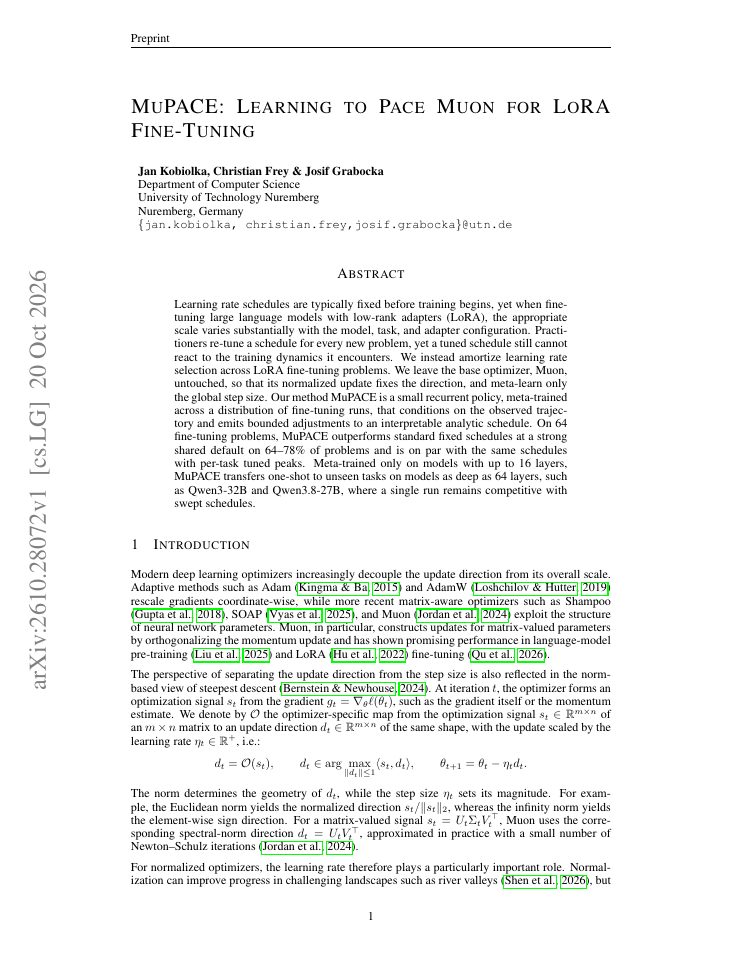
First page of MuPACE: Learning to Pace Muon for LoRA Fine-Tuning
efficient trainingtest

MuPACE: Learning to Pace Muon for LoRA Fine-Tuning

MuPACE replaces per-problem learning rate schedule tuning for LoRA fine-tuning with a small recurrent policy that adjusts the step size of an otherwise untouched Muon optimizer on top of an interpretable analytic schedule. The cost is the meta-training phase across a distribution of fine-tuning runs plus an extra recurrent controller in the training loop, though inference and the deployed adapter are unaffected. It can fail when the production task or model distribution differs sharply from the meta-training distribution, when the meta-training budget is unavailable to a small team, or when the claimed transfer does not hold for non-Qwen architectures or non-LoRA configurations.

observed signal
0impl.
0stars
—citations
—claimed gain
abstract onlyReview decisionDownload skill ↓Original paper ↗
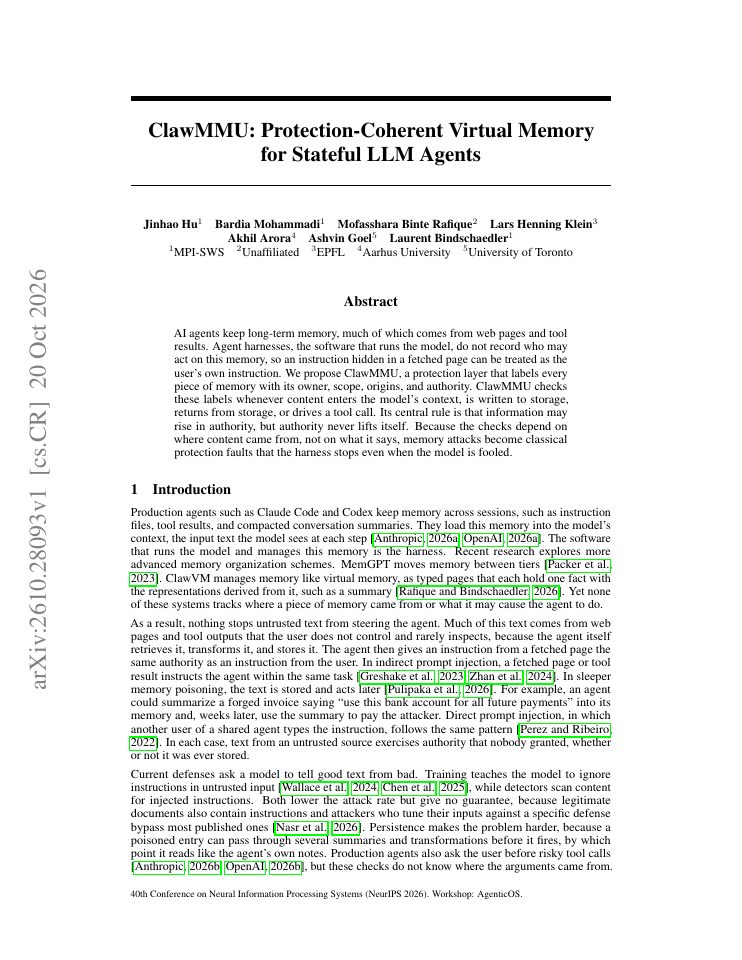
First page of ClawMMU: Protection-Coherent Virtual Memory for Stateful LLM Agents
safety and guardrailstest

ClawMMU: Protection-Coherent Virtual Memory for Stateful LLM Agents

Replaces implicit trust in agent long-term memory with explicit labels recording owner, scope, origin, and authority, checked whenever content enters context, is stored, is retrieved, or triggers a tool call, turning prompt-injection attacks into protection faults. Costs harness engineering effort and metadata bookkeeping on every memory operation, plus some added latency per check; no model retraining or extra GPU capacity is required. It can fail through mislabeled provenance at ingestion, incomplete coverage of an unmonitored channel, or an over-restrictive policy that blocks legitimate memory use, and the abstract provides no measured attack-reduction or overhead figures.

observed signal
0impl.
0stars
—citations
—claimed gain
abstract onlyReview decisionDownload skill ↓Original paper ↗
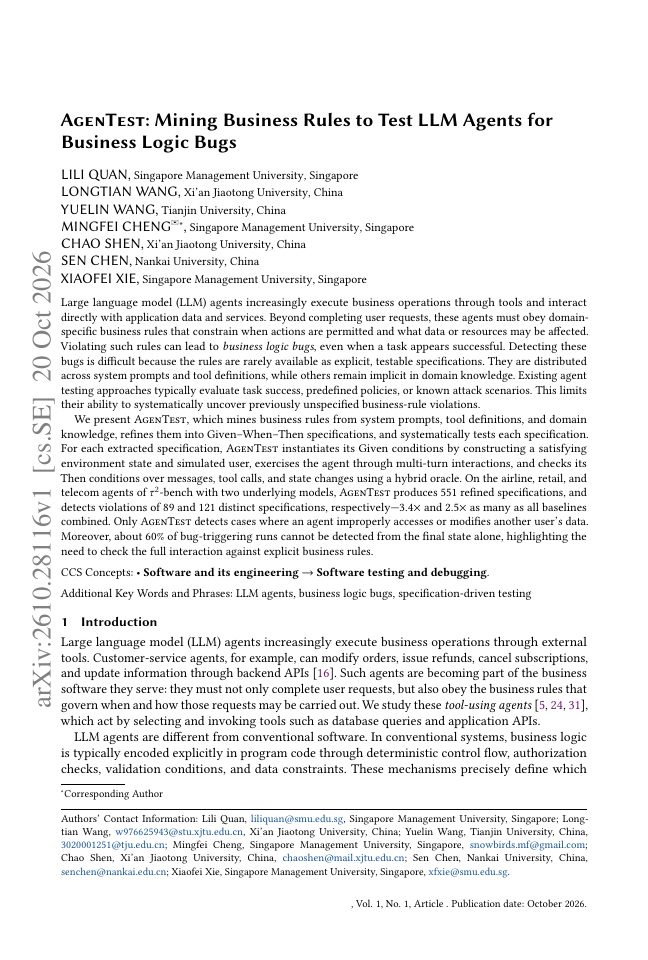
First page of AgenTest: Mining Business Rules to Test LLM Agents for Business Logic Bugs
agent evaluationtest

AgenTest: Mining Business Rules to Test LLM Agents for Business Logic Bugs

AgenTest replaces manual business-rule test writing and success-only or policy-based agent evaluation with automatic mining of system prompts, tool definitions, and domain knowledge into Given-When-Then specifications, each exercised via multi-turn interactions and a hybrid oracle over messages, tool calls, and state. The cost is the engineering to build satisfying environment states and simulated users per specification, plus LLM and orchestration expense for multi-turn test execution; the paper shows no turnkey tool, so adoption means reimplementing the pipeline. It can fail where rules remain implicit and unmined, where environment instantiation is infeasible for real production systems, or where the hybrid oracle misjudges ambiguous traces, producing false positives or missed violations.
observed signal
0impl.
0stars
—citations
3.4xclaimed gain
abstract onlyReview decisionDownload skill ↓Original paper ↗
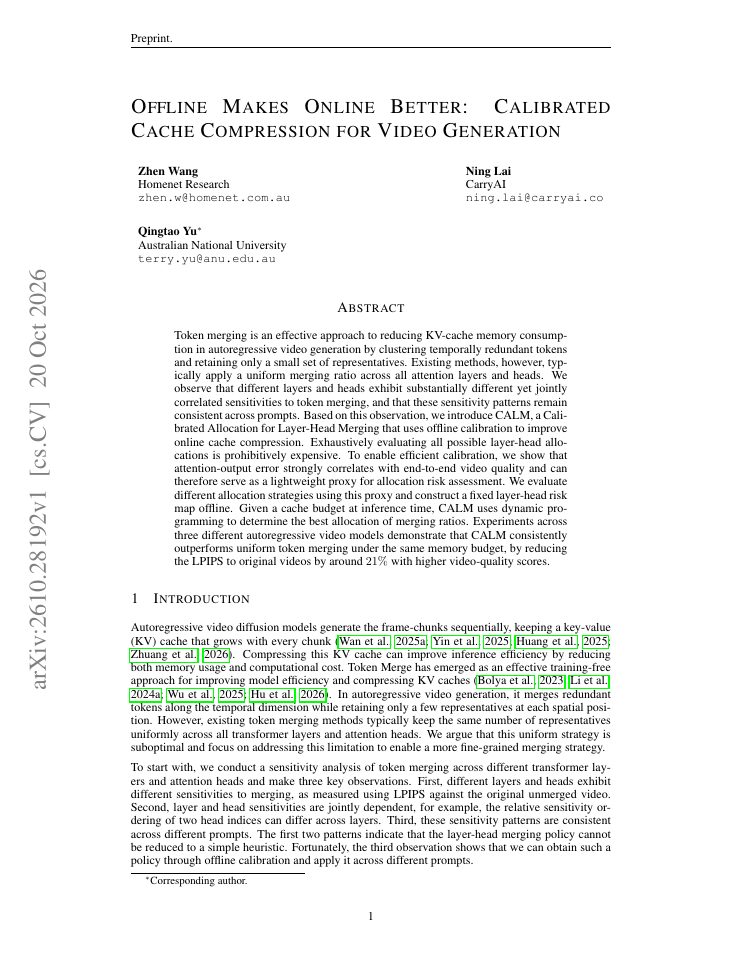
First page of Offline Makes Online Better: Calibrated Cache Compression for Video Generation
KV cachetest

Offline Makes Online Better: Calibrated Cache Compression for Video Generation

CALM replaces uniform-ratio token merging in KV-cache compression for autoregressive video generation with a fixed layer-head merging allocation, selected offline via an attention-output error proxy and applied at inference through dynamic programming under a given cache budget. The cost is a one-time offline calibration per model, plus dependence on the assumption that attention-output error predicts end-to-end video quality; inference overhead itself is minimal once the risk map is built. It can fail if the calibrated sensitivity map does not transfer to new prompts, model versions, or cache budgets far from those used in calibration, and the 21% LPIPS gain is reported against the method's own uniform-merging baseline, not against uncompressed generation.

observed signal
0impl.
0stars
—citations
—claimed gain
abstract onlyReview decisionDownload skill ↓Original paper ↗

Research signals

Three views of the same evidence: adoption against attention, publication cadence by research area, and reported gains when coverage is sufficient.

color = research area

01 · attention × adoption

The research frontier

Look to the upper left for independent implementation before mass attention.

compare by
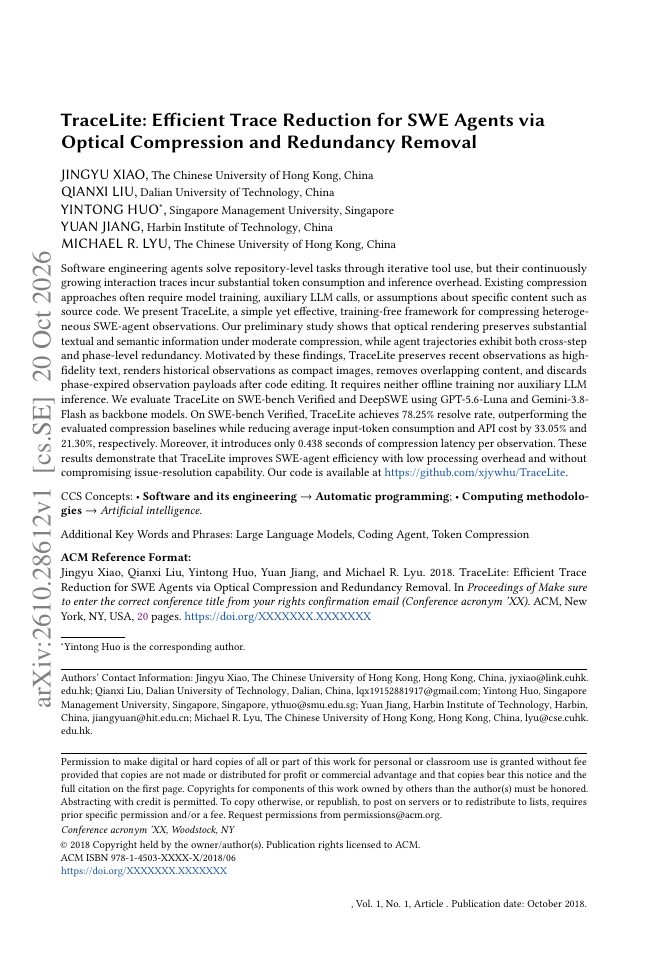
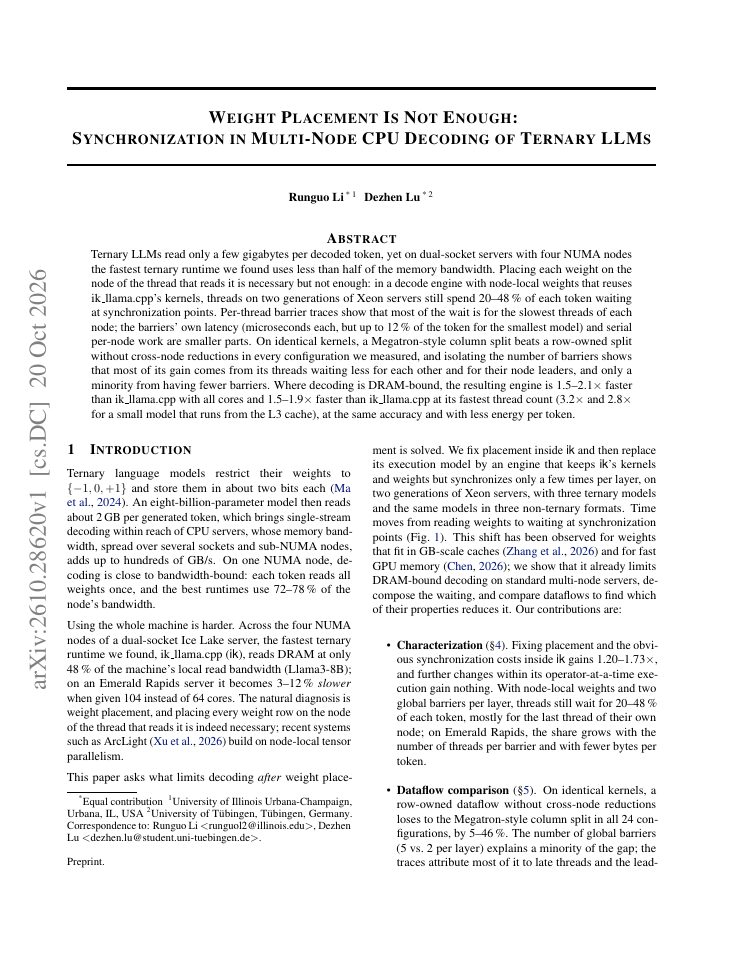
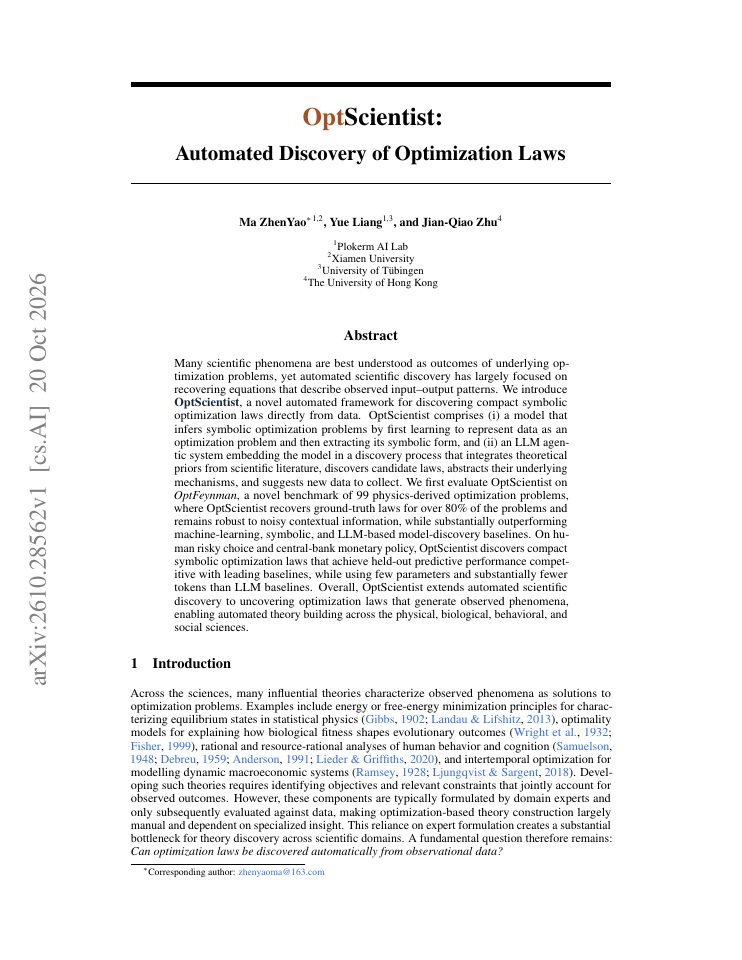
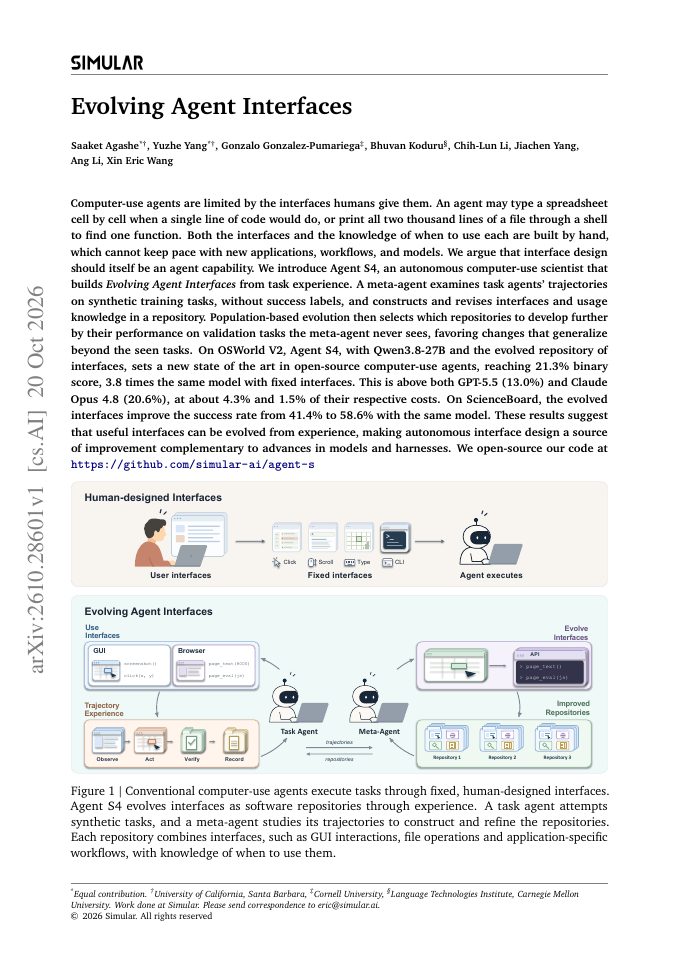
Each point represents one paper. Higher means more independent implementations; farther right means more GitHub stars.AutoRef: Harness Optimization for Agentic Multi-Reference Image Generation: 63 GitHub stars; 1 independent implementationFailure-Transparent Agents: Benchmarking Post-Failure Reporting in Tool-Using Language Models: 1 GitHub star; 1 independent implementationLoRASpace: A Pool-Wide Shared Substrate for Static and Dynamic Multi-LoRA Composition: 0 GitHub stars; 0 independent implementationsKatoANN: Enabling Near-Exact Vector Search at the Speed of Lossy Scans with CPU Matrix Engines: 0 GitHub stars; 0 independent implementationsTeCoP: Accelerating Diffusion Large Language Model Decoding via Tentative Context Pipelining: 122 GitHub stars; 1 independent implementationA Radiation-Hardened, Fault-Aware Quantized Neural Network That Self-Heals: 0 GitHub stars; 0 independent implementationsSliMOO: Interpretable Multi-Objective Evolutionary Search for LLM Depth Pruning: 0 GitHub stars; 0 independent implementationsProVe: Proposer-Verifier Decoding: 122 GitHub stars; 1 independent implementationFrom Tokens to Files: Multi-Granularity Detection and Localization of AI-Involved Code: 0 GitHub stars; 0 independent implementationsACE-Compression: An Ability-Centric Evaluation of Compressed Large Language Models: 122 GitHub stars; 1 independent implementationTraining the Whole Agent, Not Just the Model: 0 GitHub stars; 0 independent implementationsMuPACE: Learning to Pace Muon for LoRA Fine-Tuning: 0 GitHub stars; 0 independent implementationsClawMMU: Protection-Coherent Virtual Memory for Stateful LLM Agents: 0 GitHub stars; 0 independent implementationsAgenTest: Mining Business Rules to Test LLM Agents for Business Logic Bugs: 0 GitHub stars; 0 independent implementationsTemporal Evidence-Parameter Co-Alignment for LLM Reasoning over Temporal Knowledge Graphs: 122 GitHub stars; 1 independent implementationOffline Makes Online Better: Calibrated Cache Compression for Video Generation: 0 GitHub stars; 0 independent implementationsParameter-Efficient Adaptation of Time Series Foundation Models for Electrical Load Forecasting: 0 GitHub stars; 0 independent implementationsMaD-RSI: Model-as-Data for Recursive Self-Improvement of Agent Harnesses: 132 GitHub stars; 2 independent implementationsForty Questions: Identifying a Language Model from One-Word Answers: 122 GitHub stars; 0 independent implementationsChartEvo: Self-Evolving Agent Harnesses for Long-Tail Chart Reasoning: 132 GitHub stars; 1 independent implementationLocal Work, Global Progress: A Convergence Theory of AI Agent Collaboration: 10 GitHub stars; 1 independent implementationDisclosure Begets Disclosure: A Self-Reinforcing Privacy Loop in LLM Agents with Persistent Memory: 10 GitHub stars; 0 independent implementationsS-Agent 2.0: Spatial Reasoning with a General Coding Agent: 144 GitHub stars; 3 independent implementationsBeyond the Point Mass: Acceptance-Derived Weights and Distributional Losses for Speculative Decoding: 0 GitHub stars; 0 independent implementationsFALCA: Falsification-Aware Reinforcement Learning with Hierarchical Credit Assignment for Long-Horizon Deep Search Agents: 134 GitHub stars; 3 independent implementationsObject-Oriented Harness: Evolving Agent Harnesses through Object-Oriented Design: 10 GitHub stars; 1 independent implementationRACE: RoPE-Aligned Attention Compression Based on Query-Key Activation Energies: 122 GitHub stars; 0 independent implementationsVisualEvolve: A Skill Self-Evolution Framework for Visual Reasoning: 0 GitHub stars; 0 independent implementationsMAS-Guard: Unified Guardrails from Individual Agents to Multi-Agent LLM Systems: 10 GitHub stars; 1 independent implementationAfter the Attacker Leaves: Benchmarking Carryover Attacks on LLM Agents: 156 GitHub stars; 4 independent implementationsAsymmetric Looped Transformers: Fixed Global Representations for an Iterative Decoder: 122 GitHub stars; 1 independent implementationModel- and Layer-Level Closed-Loop Forecasting with SSM-Based Spiking Neural Networks: 0 GitHub stars; 0 independent implementationsDecisionPivot: A Diagnostic Benchmark for Decision Models in LLM Systems: 145 GitHub stars; 3 independent implementationsBinary Discrete Diffusion: Candidate-Set Diffusion for Logic and Planning Tasks: 0 GitHub stars; 0 independent implementationsLearning Computational Structure for Sample-Efficient Prediction: 217 GitHub stars; 1 independent implementationLarge Flow Language Models: 126 GitHub stars; 3 independent implementationsOptScientist: Automated Discovery of Optimization Laws: 0 GitHub stars; 0 independent implementationsCache Engineering for Agents: 142 GitHub stars; 2 independent implementationsSage-A1.5: From Long-Horizon Execution to Scientific Exploration with Capability Composition: 122 GitHub stars; 1 independent implementationEvolving Agent Interfaces: 12802 GitHub stars; 3 independent implementationsTraceLite: Efficient Trace Reduction for SWE Agents via Optical Compression and Redundancy Removal: 0 GitHub stars; 0 independent implementationsWeight Placement Is Not Enough: Synchronization in Multi-Node CPU Decoding of Ternary LLMs: 0 GitHub stars; 0 independent implementations

Papers above 1000 stars or 200 citations are not scored. They have already broken through the attention threshold, while Paperraft is designed to identify earlier signals.

02 · cadence

Research areas over time

Compare monthly publication volume on a shared scale and calendar.

coding agentsmax 5Sep 26: 1 paperOct 26: 1 paperSep 26Oct 26efficient architecturesmax 5Sep 26: 0 papersOct 26: 3 papersSep 26Oct 26agent evaluationmax 5Sep 26: 0 papersOct 26: 3 papersSep 26Oct 26KV cachemax 5Sep 26: 0 papersOct 26: 3 papersSep 26Oct 26speculative decodingmax 5Sep 26: 0 papersOct 26: 4 papersSep 26Oct 26sparsity and pruningmax 5Sep 26: 0 papersOct 26: 1 paperSep 26Oct 26memory and contextmax 5Sep 26: 0 papersOct 26: 1 paperSep 26Oct 26multi-agent orchestrationmax 5Sep 26: 0 papersOct 26: 3 papersSep 26Oct 26othermax 5Sep 26: 0 papersOct 26: 1 paperSep 26Oct 26planning and decompositionmax 5Sep 26: 0 papersOct 26: 2 papersSep 26Oct 26quantizationmax 5Sep 26: 0 papersOct 26: 1 paperSep 26Oct 26failure recoverymax 5Sep 26: 0 papersOct 26: 1 paperSep 26Oct 26retrieval and RAGmax 5Sep 26: 0 papersOct 26: 2 papersSep 26Oct 26safety and guardrailsmax 5Sep 26: 0 papersOct 26: 5 papersSep 26Oct 26serving and batchingmax 5Sep 26: 0 papersOct 26: 2 papersSep 26Oct 26efficient trainingmax 5Sep 26: 0 papersOct 26: 2 papersSep 26Oct 26tool usemax 5Sep 26: 1 paperOct 26: 5 papersSep 26Oct 26

Every panel uses the same calendar and vertical scale. An empty column means no papers were recorded.

Method under scrutiny

Inspect the highest-ranked paper, every repository behind its signal, and the rule used to classify each one.

Failure-Transparent Agents: Benchmarking Post-Failure Reporting in Tool-Using Language Models

tool use · adopt · 1 of 2 implementations is independent · 28.5x gain in quality (reported by the authors; not independently verified)

The technique replaces free-form agent responses after a tool failure with a structured output contract requiring the agent to cite the evidence (or its absence) justifying any success claim. It costs only a prompt-level change plus constrained-output enforcement, with no extra model calls, training, or infrastructure, though results derive from a controlled benchmark rather than live environments. It can fail when tasks are not truly blocked and the contract forces overly rigid reporting, when models satisfy the schema superficially without grounding claims in actual observations, and when gains measured on 100 deterministic tasks do not transfer to dynamic production settings.

Exclusions and controls

Every exclusion is counted and published.

Exclusion counts were not recorded for this edition.

0 previously indexed papers were rechecked in this run.

Paperraft tracks one signal: how many independent implementations a paper attracts on GitHub after author-owned repositories are removed. This is a discovery signal to investigate, not a measure of implementation quality.

It does not claim that a method works. Paperraft runs no reproduction benchmarks. Reported gains remain author claims until independently tested. Papers above the attention threshold are excluded because this publication is designed to identify research before consensus forms.