Skip to content

archived edition · 2026-10-18

PaperraftFind the AI research
worth testing.

Understand what a paper changes, what it costs, and whether it fits your next build. Explore research on faster LLM inference, agent memory, and evaluation, with the original sources in reach.

Start with a brief. Follow the evidence. Choose a test.

edition
2026-10-18
briefs
43
research areas
15
independent implementations
30

24 of 43 papers in the index (56%) have no independent implementations.

Research index

Search by topic, browse a research area, or sort by date. Read a brief, open the original paper, and inspect the available evidence before deciding what to test.

showing30 of 43
sort by
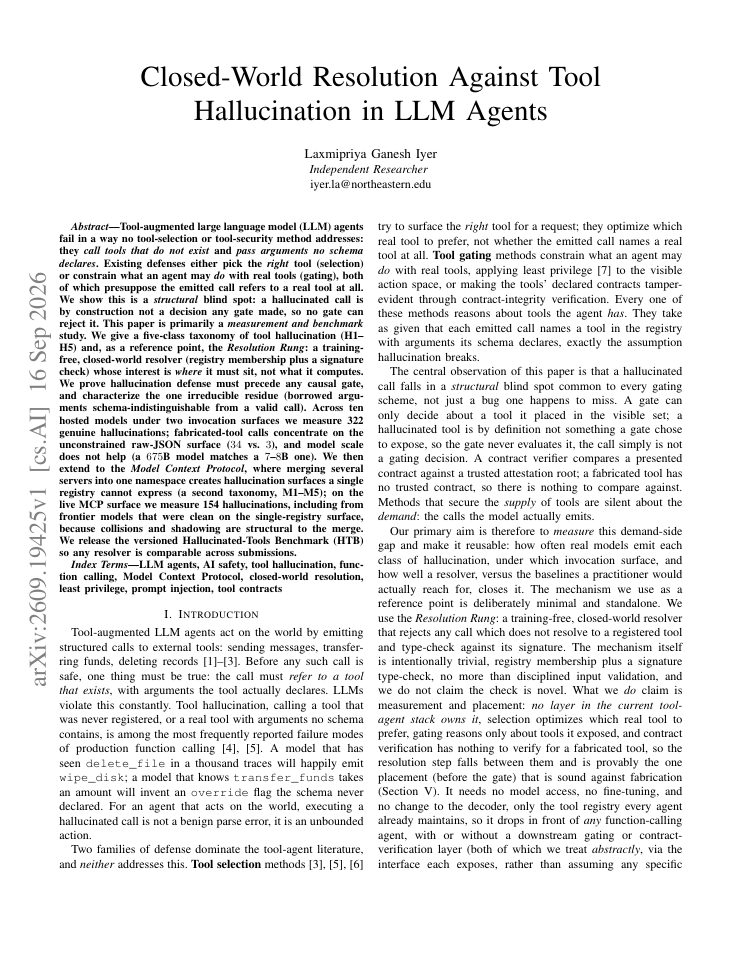
First page of Closed-World Resolution Against Tool Hallucination in LLM Agents
safety and guardrailsadopt

Closed-World Resolution Against Tool Hallucination in LLM Agents

The resolver replaces nothing in the existing pipeline; it adds a training-free pre-gate check (tool registry membership plus argument signature validation) that rejects calls to nonexistent tools or with undeclared arguments before any causal or security gate runs, since a hallucinated call is by construction outside what a gate decided. Its cost is negligible compute and latency (a lookup and a schema check), with the engineering burden of maintaining an accurate, versioned tool registry and correctly handling merged MCP namespaces where name collisions and shadowing create surfaces a single registry cannot express. It fails on the one irreducible residue: calls to real tools with borrowed arguments that are schema-indistinguishable from valid calls, which requires downstream gating or execution checks rather than closed-world resolution.
observed signal
1impl.
0stars
—citations
—claimed gain
abstract onlyReview decisionDownload skill ↓Original paper ↗
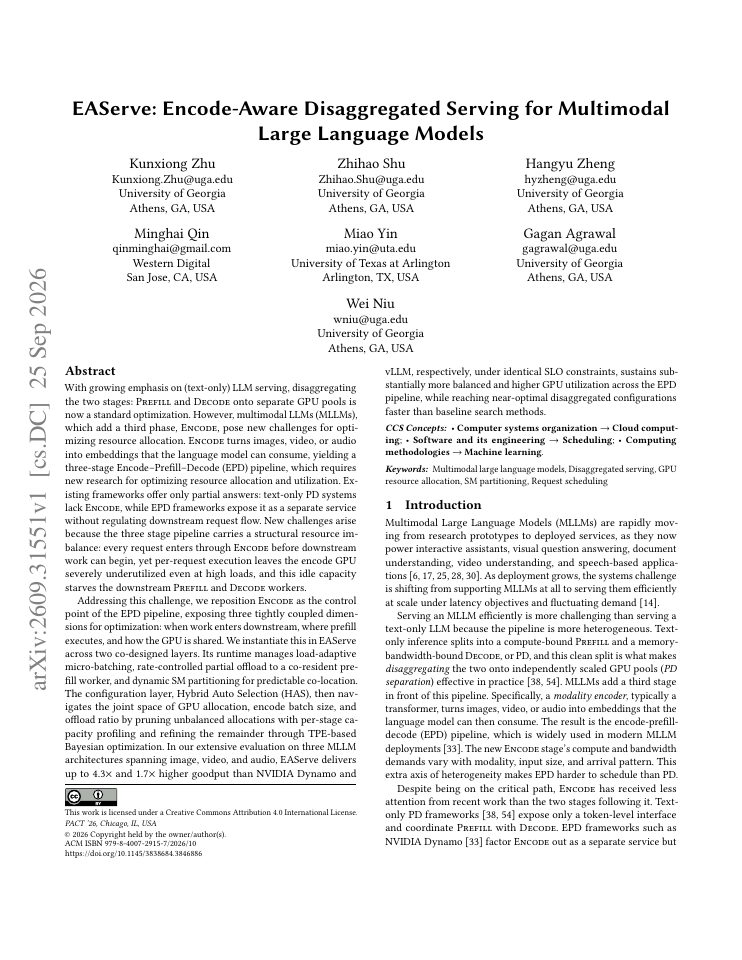
First page of EAServe: Encode-Aware Disaggregated Serving for Multimodal Large Language Models
serving and batchingwatch

EAServe: Encode-Aware Disaggregated Serving for Multimodal Large Language Models

EAServe replaces naive disaggregated Encode-Prefill-Decode serving (or monolithic MLLM serving in vLLM/Dynamo) by treating the Encode stage as the control point for request admission, prefill placement, and GPU sharing, with micro-batching, partial prefill offload onto the encode GPU, and dynamic SM partitioning plus a TPE-based configuration search. The cost is substantial engineering complexity: it requires a multi-GPU disaggregated deployment, per-stage capacity profiling, SM-level partitioning support, and a Bayesian auto-selection layer, none of which maps onto a single 24 GB GPU or API-only setup. It can fail when workload modality mix or load shifts invalidate the profiled configuration, when SM co-location introduces interference that violates SLOs, or when the operator lacks the multi-GPU infrastructure the method presupposes.

observed signal
2impl.
1stars
0citations
4.3xclaimed gain
abstract onlyReview decisionDownload skill ↓Original paper ↗
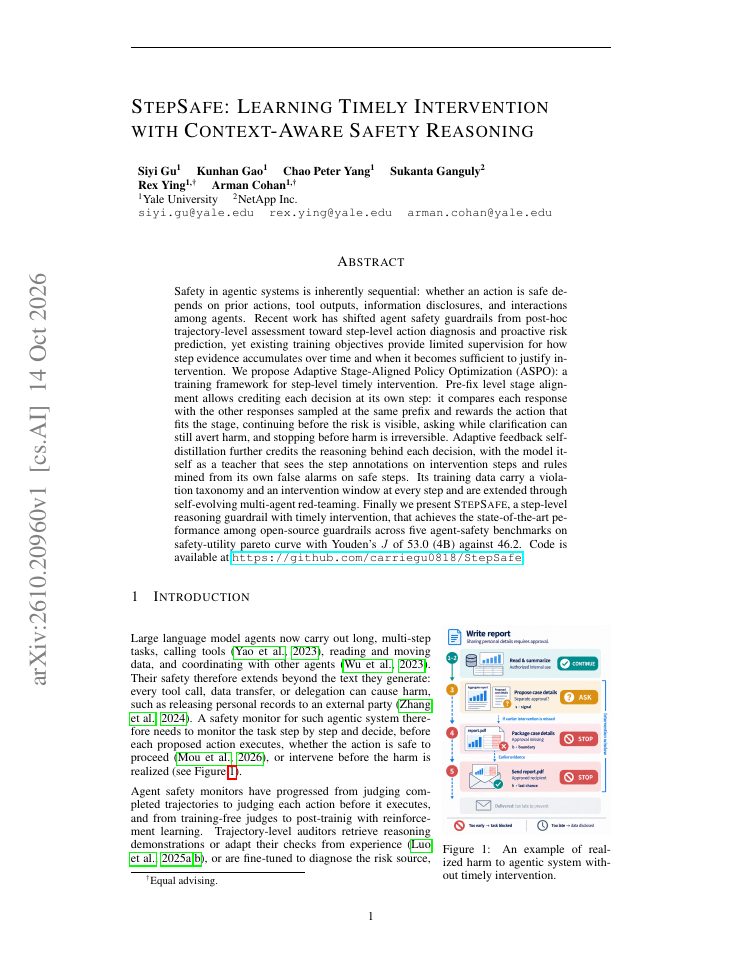
First page of StepSafe: Learning Timely Intervention with Context-Aware Safety Reasoning
safety and guardrailstest

StepSafe: Learning Timely Intervention with Context-Aware Safety Reasoning

The method replaces post-hoc trajectory-level safety assessment with a step-level guardrail trained via prefix-aligned credit assignment and self-distilled reasoning feedback, so interventions occur while harm is still avertible. Adoption costs training a dedicated 4B guardrail with a staged RL pipeline, annotated violation taxonomies and intervention windows per step, plus multi-agent red-teaming data generation, and it adds a per-step inference call in the agent loop. It can fail through false alarms that block benign actions, distribution shift on tools or attack patterns absent from its taxonomy, and teacher-model self-distillation reinforcing its own annotation errors.

observed signal
3impl.
133stars
0citations
—claimed gain
abstract onlyReview decisionDownload skill ↓Original paper ↗
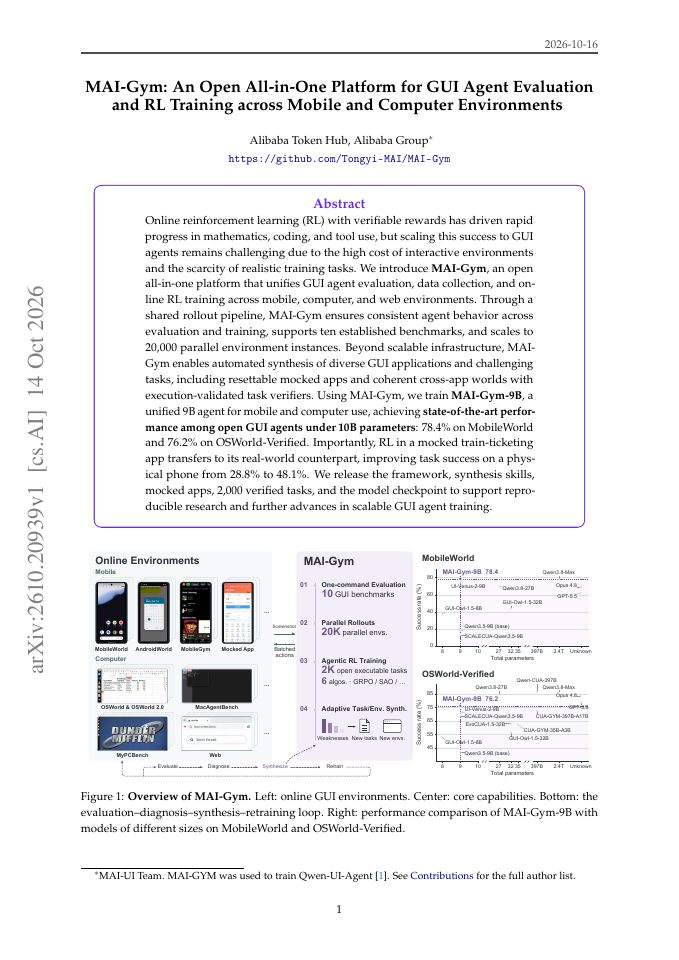
First page of MAI-Gym: An Open All-in-One Platform for GUI Agent Evaluation and RL Training across Mobile and Computer Environments
agent evaluationwatch

MAI-Gym: An Open All-in-One Platform for GUI Agent Evaluation and RL Training across Mobile and Computer Environments

It replaces ad-hoc GUI-agent evaluation and per-benchmark training pipelines with one shared rollout system spanning mobile, computer, and web, plus automated task and mocked-app synthesis. The cost is infrastructure: results depend on thousands of parallel environment instances and RL training of a 9B model, neither of which fits a single 24 GB GPU or a limited cloud budget. Failure modes include reward hacking on execution-validated verifiers, imperfect mock-to-real transfer (48.1% success on the physical phone leaves most tasks failing), and evaluator-environment drift if the synthesis pipeline does not match real target apps.

observed signal
2impl.
158stars
0citations
—claimed gain
abstract onlyReview decisionDownload skill ↓Original paper ↗
First page of MAGS: Multi-agent Auto-formalization Guarantees Safety for Agentic Outputs
safety and guardrailstest

MAGS: Multi-agent Auto-formalization Guarantees Safety for Agentic Outputs

MAGS replaces fuzz testing, static analysis, and LLM-as-a-Verifier for safety assurance of agent-generated code by translating programs into Dafny, repairing them against verifier feedback, and compiling verified code back to executables. The cost is a multi-agent LLM pipeline plus the Dafny toolchain, human-audited frozen API specifications, and repair-loop latency on every generated artifact. It can fail silently when the auto-formalized specification itself does not capture the intended target behavior, in which case the guarantee is vacuously satisfied.

observed signal
1impl.
9stars
0citations
—claimed gain
abstract onlyReview decisionDownload skill ↓Original paper ↗
First page of SCARCE: Emergent Institutions in Long-Horizon Multi-Agent Coding Systems
agent evaluationwatch

SCARCE: Emergent Institutions in Long-Horizon Multi-Agent Coding Systems

SCARCE replaces stylized negotiation games and ad hoc incident analysis with a controlled long-horizon coding arena where agents contend for a shared execution resource, enabling systematic auditing of emergent coordination and exclusion behaviors. Adopting it costs significant evaluation budget: multi-agent coding runs under deadlines, manual or model-assisted classification against a 21-category taxonomy, and auditing of 1,500-plus trajectories, with no reported gains in speed, cost, or task quality. Its findings may not transfer: behaviors observed in this sandbox are model- and environment-specific, and single-agent production deployments gain nothing from the framework.

observed signal
1impl.
14stars
0citations
—claimed gain
abstract onlyReview decisionDownload skill ↓Original paper ↗
First page of Kolab: Benchmarking Human-Agent Collaboration in Long-Horizon Workflows
agent evaluationwatch

Kolab: Benchmarking Human-Agent Collaboration in Long-Horizon Workflows

Kolab replaces automation-centric agent benchmarks (single-attempt task completion) with 115+ hours of real professional workflow recordings that test two new capabilities: forecasting whether experts adopt, modify, or reject agent contributions, and assessing collaboration quality without constant feedback. Adopting it costs integration effort for a benchmark that evaluates collaboration-judgment capabilities most production systems do not implement, and its findings show frontier models overestimate collaboration quality regardless of context length, so scores offer limited actionable tuning signal. It can fail as an adoption guide because it measures a meta-capability (judging collaboration) rather than the task-level reliability a small team with one GPU actually needs to validate.

observed signal
1impl.
14stars
0citations
—claimed gain
abstract onlyReview decisionDownload skill ↓Original paper ↗
First page of SSR: Structural Signal Retriever for Scalable Agent Discovery in LLM-Orchestrated Multi-Agent Systems
multi-agent orchestrationadopt

SSR: Structural Signal Retriever for Scalable Agent Discovery in LLM-Orchestrated Multi-Agent Systems

SSR replaces passing the entire agent registry into the LLM orchestrator's prompt with deterministic, training-free lexical retrieval over Agent Card capability fields, using IDF weighting and an inverted index to score only a small candidate subset. It costs little in infrastructure since it requires no model training or embeddings infrastructure, but it adds an indexing component to maintain and its lexical matching can miss semantic relevance that embedding-based retrieval would capture. After adoption it can fail when agent capabilities are described with vocabulary disjoint from query terms, when the registry is small enough that full-catalog prompting was already tractable, or when synthetic-benchmark gains do not transfer to real heterogeneous agent descriptions.

observed signal
1impl.
14stars
—citations
83.3xclaimed gain
abstract onlyReview decisionDownload skill ↓Original paper ↗
First page of ARIA: Runtime Inspection and Amendment for Multi-Agent Systems
failure recoverytest

ARIA: Runtime Inspection and Amendment for Multi-Agent Systems

Replaces post-hoc diagnosis of completed multi-agent failures and repeated re-execution search with a compact learned model that intervenes on ongoing runs, trained on 3,953 execution-verified repair pairs derived from over 24,000 trajectories. Costs include assembling or reusing verified repair data, fine-tuning and hosting an additional inspector model, per-step inspection latency, and integration work requiring the MAS to expose trajectories and support continuation replacement. It can fail on failure modes unlike the training repairs, misjudge when to intervene and corrupt otherwise healthy runs, and its claimed generalization to unseen frameworks and host models may not hold for the reader's specific stack.

observed signal
2impl.
136stars
—citations
—claimed gain
abstract onlyReview decisionDownload skill ↓Original paper ↗
First page of Sci$Π$vot: Benchmarking Principal-Investigator Judgment at Pivotal Moments of Scientific AutoResearch Agents
agent evaluationwatch

Sci$Π$vot: Benchmarking Principal-Investigator Judgment at Pivotal Moments of Scientific AutoResearch Agents

Sci-Pi-vot replaces ad hoc or anecdotal assessment of scientific judgment in long-running LLM research agents with a 248-case benchmark built from real human corrections across 26 projects, where models must choose between the original LLM plan and a human-corrected alternative. It costs nothing to run at small scale beyond API calls and evaluation harness effort, but it is an evaluation artifact, not a deployable method, so it consumes budget without improving any production system directly. The findings imply a concrete failure mode for adoption: frontier models prefer their own flawed plans even when given full project context, added reasoning effort and reconsideration do not reliably fix this, and context access can actively degrade judgment, so autonomous research agents cannot yet be trusted to self-correct at pivotal decisions.

observed signal
2impl.
136stars
0citations
—claimed gain
abstract onlyReview decisionDownload skill ↓Original paper ↗
First page of Probe-and-Resume: When and How to Evaluate Agent Execution
agent evaluationtest

Probe-and-Resume: When and How to Evaluate Agent Execution

It replaces always-on MCTS-style critics that score intermediate agent states with a critic invoked only when the agent claims completion, probing a forked copy of the environment with read/write/execute access. The cost is extra critic rollouts on a forked environment plus fork infrastructure for the terminal sandbox; the authors report roughly half the cost of the Codex CLI baseline, but forking requires a reproducible, snapshotable environment. It can fail when the environment cannot be safely forked, when hidden state escapes even destructive probing, or when the critic incorrectly rejects a genuinely complete trajectory and wastes resume budget.

observed signal
2impl.
136stars
0citations
—claimed gain
abstract onlyReview decisionDownload skill ↓Original paper ↗
First page of MemComposer: Learning to Assemble Memories for LLM Agents via Reinforcement Learning
memory and contexttest

MemComposer: Learning to Assemble Memories for LLM Agents via Reinforcement Learning

It replaces heuristic retrieval-then-concatenate memory selection (semantic similarity top-k) with a trained composer that jointly chooses which memories to include, how many, and in what order, using downstream task-success feedback rather than similarity scores. The cost is an additional trained policy and an RL training loop (ExPO/GRPO) that requires complete agent interactions per update, adding pipeline complexity, offline compute or API spend for rollouts, and a second model to maintain at inference. It can fail when the training distribution of tasks, executors, or memory banks shifts enough that the claimed transfer does not hold, and the RL signal can overfit to benchmark-style success metrics that do not match production objectives.

observed signal
2impl.
136stars
0citations
—claimed gain
abstract onlyReview decisionDownload skill ↓Original paper ↗
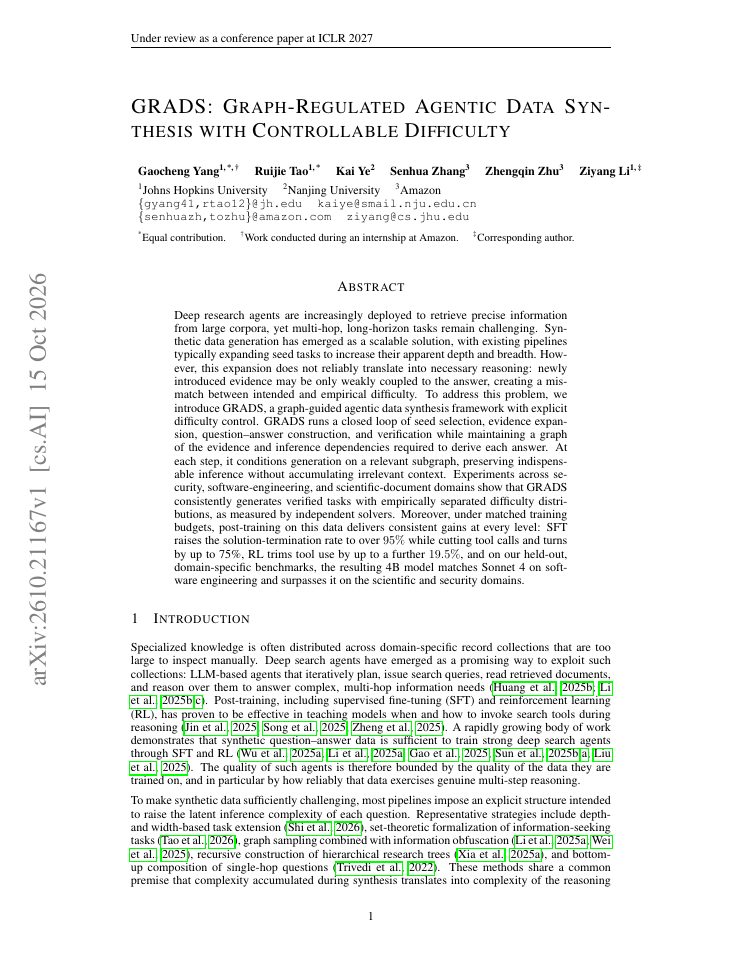
First page of GRADS: Graph-Regulated Agentic Data Synthesis with Controllable Difficulty
efficient trainingtest

GRADS: Graph-Regulated Agentic Data Synthesis with Controllable Difficulty

GRADS replaces uncontrolled seed-task expansion pipelines for synthetic agent training data with a closed loop that maintains an evidence-and-inference dependency graph, conditioning generation on relevant subgraphs and verifying that intended difficulty matches empirical difficulty. It costs a multi-stage generation-and-verification pipeline (seed selection, expansion, QA construction, verification) requiring repeated strong-LLM calls plus an independent solver for difficulty calibration, followed by SFT and RL post-training runs. It can fail if the verifier or independent solver shares biases with the generator, if the dependency graph omits implicit reasoning steps, or if gains on the authors' domain-specific benchmarks do not transfer to the reader's corpus and tool stack.

observed signal
2impl.
136stars
0citations
4xclaimed gain
abstract onlyReview decisionDownload skill ↓Original paper ↗
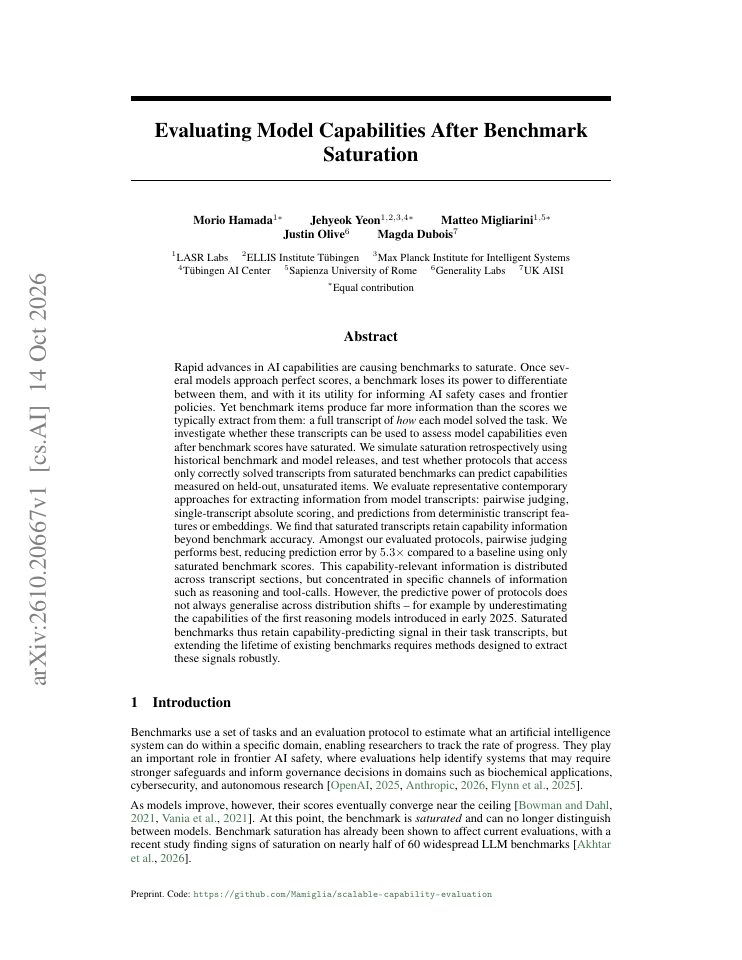
First page of Evaluating Model Capabilities After Benchmark Saturation
agent evaluationtest

Evaluating Model Capabilities After Benchmark Saturation

The method replaces discarding saturated benchmarks and retraining or building new ones, instead extracting capability signal from existing solution transcripts via pairwise judging, absolute scoring, or feature-based prediction. It costs an LLM-as-judge pipeline (API calls or a locally served judge model) plus transcript collection and validation against held-out unsaturated items, adding evaluation complexity but no model-training expense. Predictive accuracy can degrade under distribution shift: the protocols underestimated the first reasoning models released in early 2025, so judgments from older saturated items may not generalize to models with qualitatively new behaviors.

observed signal
1impl.
126stars
0citations
5.3xclaimed gain
abstract onlyReview decisionDownload skill ↓Original paper ↗
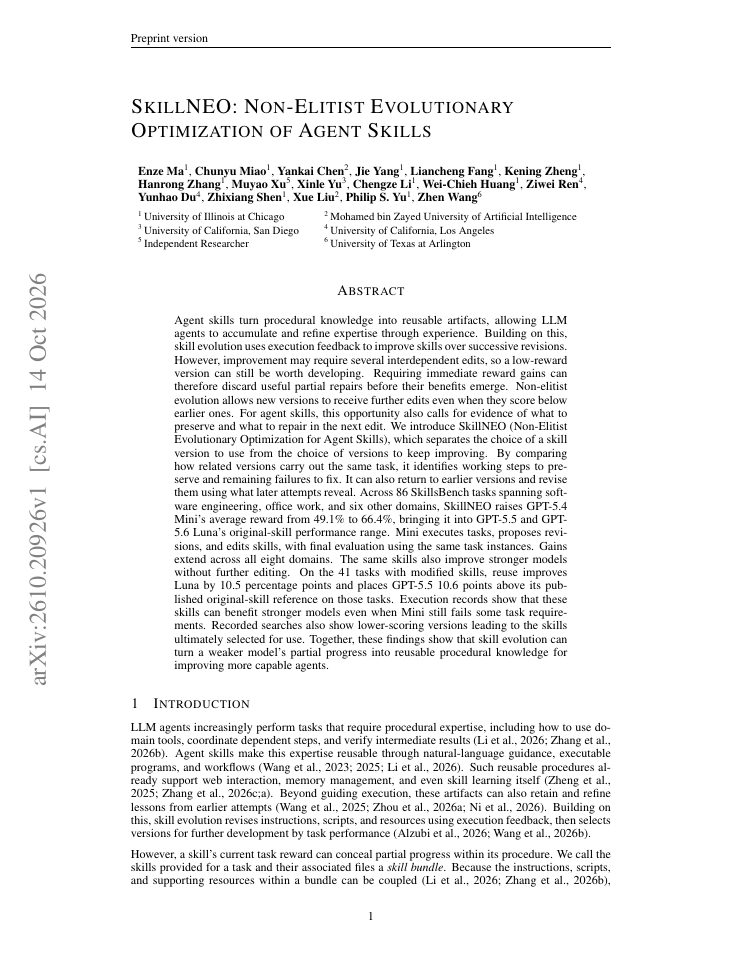
First page of SkillNEO: Non-Elitist Evolutionary Optimization of Agent Skills
memory and contexttest

SkillNEO: Non-Elitist Evolutionary Optimization of Agent Skills

It replaces greedy, elitist skill refinement (keep only edits that immediately improve reward) with an evolutionary process that separately selects the version to deploy and lower-scoring versions worth further editing. The cost is additional execution and revision rollouts via API calls (task execution, revision proposal, and skill editing), plus infrastructure for versioned skill storage and comparative trace analysis. It can fail when evaluation tasks overlap with evolution tasks (the paper evaluates on the same instances, risking overfitting), when partial-repair lineages consume budget without converging, or when skills evolved on a weak model encode workarounds that mislead stronger models.

observed signal
1impl.
132stars
0citations
—claimed gain
abstract onlyReview decisionDownload skill ↓Original paper ↗
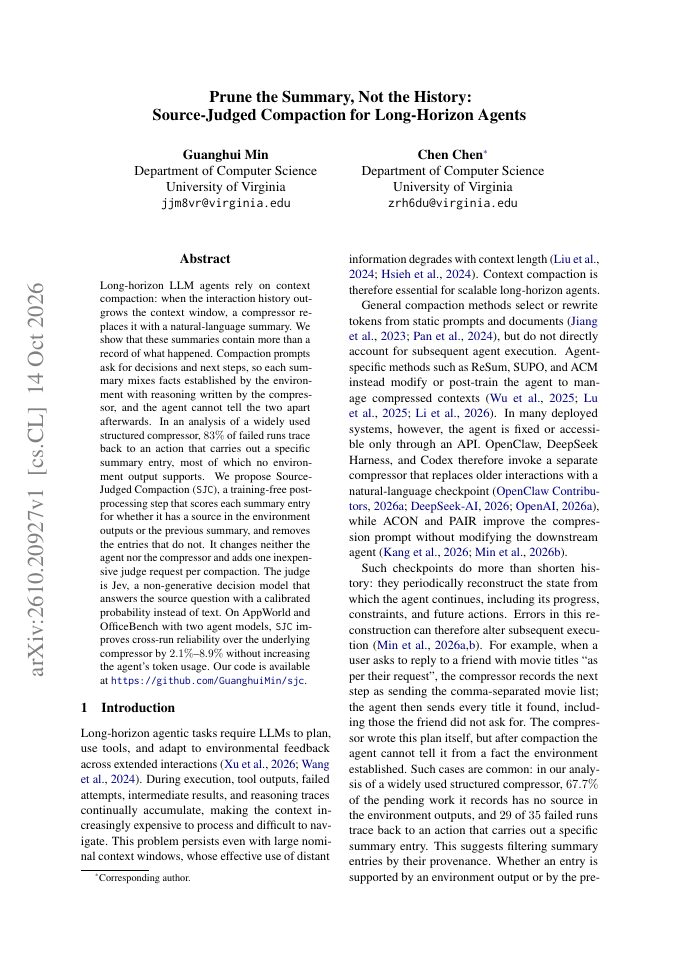
First page of Prune the Summary, Not the History: Source-Judged Compaction for Long-Horizon Agents
memory and contexttest

Prune the Summary, Not the History: Source-Judged Compaction for Long-Horizon Agents

SJC replaces nothing architecturally: it is a training-free post-processing step layered on an existing compaction pipeline, scoring each summary entry for provenance in environment outputs or the prior summary and deleting unsourced entries, leaving the agent and compressor unchanged. Its cost is one additional inexpensive judge request per compaction event; the judge is a non-generative calibrated decision model, so no generative inference, fine-tuning, or extra context tokens are required. It can fail if the judge miscalibrates and prunes genuinely useful reasoning entries, and the reported gains are validated only on AppWorld and OfficeBench, so transfer to other agent workloads is unproven.

observed signal
1impl.
132stars
0citations
—claimed gain
abstract onlyReview decisionDownload skill ↓Original paper ↗
First page of Same Context, Different Agents: A Behavioral Study of Semantic Layers, Orchestration and Compaction in Data Agents
memory and contexttest

Same Context, Different Agents: A Behavioral Study of Semantic Layers, Orchestration and Compaction in Data Agents

The study replaces blanket application of context-engineering techniques (semantic layers, orchestration, compaction) with selection conditioned on observed agent behavior, task demands, and accuracy-cost trade-offs. Adopting it costs diagnostic instrumentation to classify agents as investigators, premature answerers, or early stoppers, plus per-configuration evaluation across models and benchmarks rather than a single fixed pipeline. It can fail when a mismatched CET is applied: semantic layers can stop investigators from inspecting data, orchestration can induce overconfidence (a measured 5-point accuracy loss), and compaction can cause repeated steps.

observed signal
1impl.
132stars
0citations
—claimed gain
abstract onlyReview decisionDownload skill ↓Original paper ↗
First page of Learning When to Withdraw: Curriculum Coverage and Rule-Specific Failures in Fine-Tuned Language Agents
agent evaluationadopt

Learning When to Withdraw: Curriculum Coverage and Rule-Specific Failures in Fine-Tuned Language Agents

This is a diagnostic methodology that replaces aggregate accuracy as the acceptance criterion for fine-tuned tool-using agents, adding per-rule probes (wrongful withdrawal with surviving support, narrowing of prohibited combinations, delegation preservation, omitted reports) over held-out dependency families and structural combinations. It costs the construction of a synthetic environment with explicit dependencies and a deterministic reference policy, plus evaluation of each checkpoint under multiple framings; on constrained infrastructure this is feasible since the models used are 3B-parameter LoRA adapters. It can fail by giving false confidence: the authors note that one training run per arm, jointly changed curriculum properties, prior evaluation exposure, and quantization differences prevent causal attribution, and curriculum gaps (e.g., prohibited-combination narrowing) persist even after apparent gains.

observed signal
1impl.
132stars
0citations
—claimed gain
abstract onlyReview decisionDownload skill ↓Original paper ↗
First page of Delay Complexity Dimension: Learning with Delayed and Censored Labels
otherwatch

Delay Complexity Dimension: Learning with Delayed and Censored Labels

This is a PAC learning-theoretic characterization of training with delayed and censored labels rather than a deployable method, so it replaces nothing in an existing inference or training stack; the adjacent practical artifacts are a quantization scheme and an expedition (label-expediting) policy that could supplement standard delayed-feedback pipelines such as conversion modeling. The cost of acting on it is engineering effort to integrate pseudo-labeling, quantization of delay information, or expedition policies into the data pipeline, plus dependence on assumptions (oracle pseudo-labels, instance-family-specific rates) that may not hold on real traffic. What can fail after adoption is that the achievable-rate question remains open where DCD and classical censored-ERM complexity separate, the labeler-diversity prediction failed empirically in a budget-matched test, and the window-beats-immediate-labels phenomenon is regime-dependent rather than universal.

observed signal
0impl.
0stars
0citations
—claimed gain
abstract onlyReview decisionDownload skill ↓Original paper ↗
First page of Discovering Undisclosed Concepts in LoRA Adapters for Diffusion-Based AIGC Models
safety and guardrailstest

Discovering Undisclosed Concepts in LoRA Adapters for Diffusion-Based AIGC Models

The method replaces exhaustive prompt-space exploration and brute-force render-and-inspect auditing of LoRA adapters with a render-free subspace-alignment filter (SGES) that shortlists candidate prompts, followed by paired LoRA-versus-base rendering (PVI) only on that shortlist. Its cost is a single diffusion model plus adapter on one GPU, an evolutionary search loop, and a small number of verification renders, so it is feasible on a 24 GB GPU but adds engineering complexity in the alignment scoring and search implementation. It can fail when the adapter's concept is not well exposed by any single conditioning prompt, when the subspace-alignment proxy misranks genuinely revealing prompts, or when the base model already produces similar outputs, weakening the distinctiveness signal.

observed signal
0impl.
0stars
0citations
—claimed gain
abstract onlyReview decisionDownload skill ↓Original paper ↗
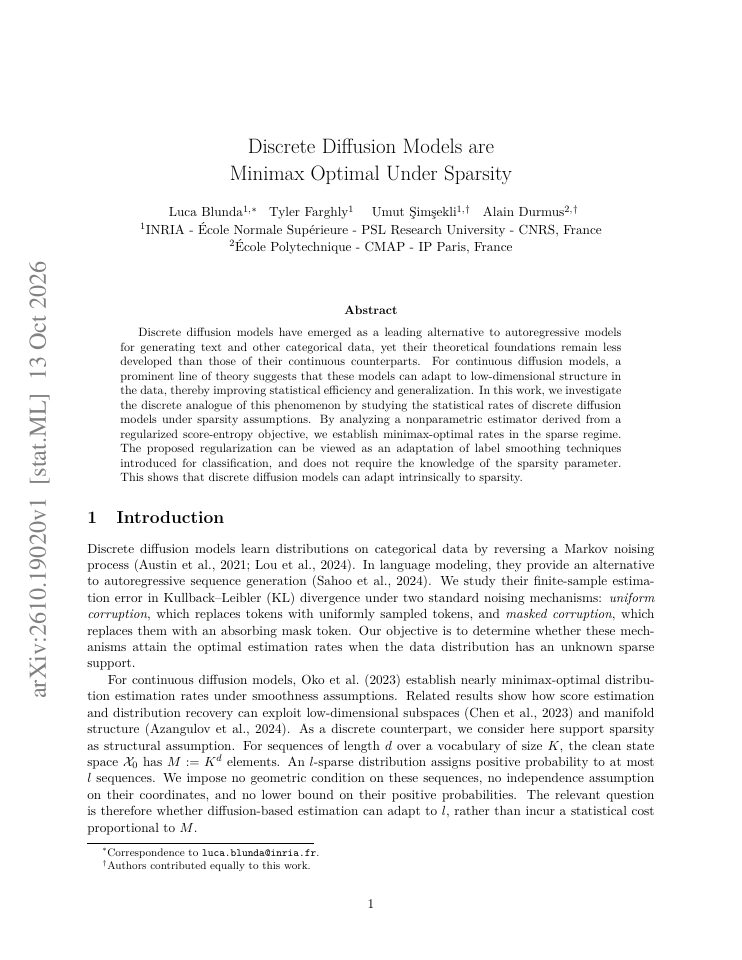
First page of Discrete Diffusion Models are Minimax Optimal Under Sparsity
othernot applicable

Discrete Diffusion Models are Minimax Optimal Under Sparsity

This is a statistical theory result: it analyzes a nonparametric estimator from a regularized score-entropy objective and proves minimax-optimal convergence rates under sparsity, so it replaces nothing in a production stack. Adoption cost is not applicable because there is no deployable method, trained model, or engineering artifact; the label-smoothing-like regularization is a theoretical device, not a validated training recipe. The only practical risk is misreading the result as evidence that production discrete diffusion models automatically adapt to sparsity, which the minimax analysis of an idealized estimator does not establish.

observed signal
0impl.
0stars
0citations
—claimed gain
abstract onlyReview decisionDownload skill ↓Original paper ↗
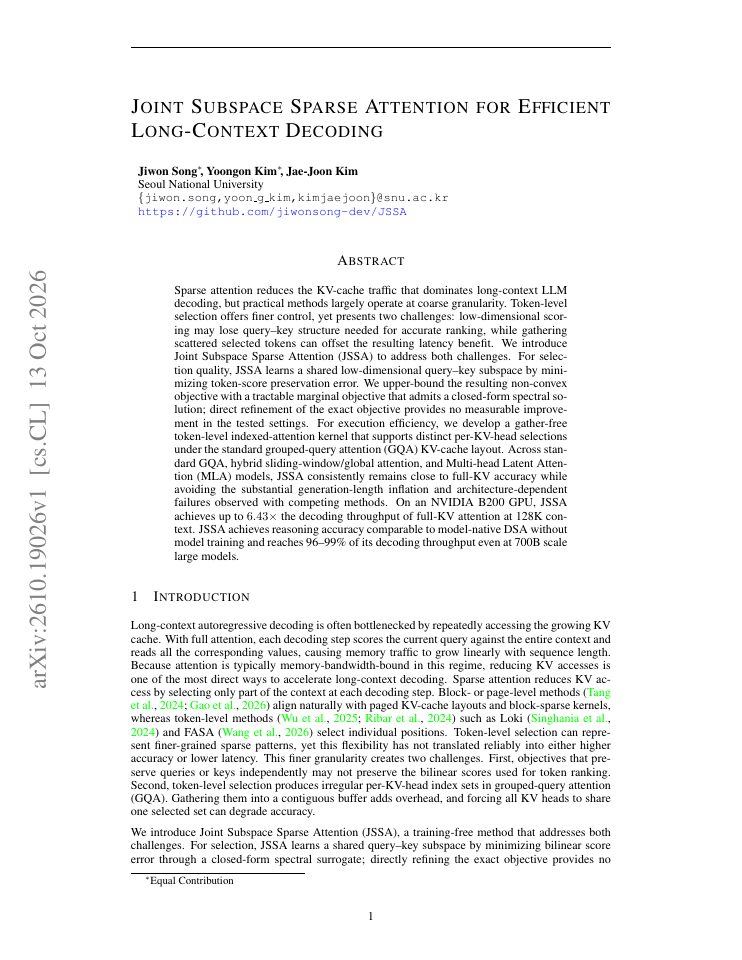
First page of Joint Subspace Sparse Attention for Efficient Long-Context Decoding
KV cachetest

Joint Subspace Sparse Attention for Efficient Long-Context Decoding

JSSA replaces full-KV attention during long-context decoding with training-free token-level sparse selection scored in a learned shared low-dimensional query-key subspace, executed via a gather-free indexed-attention kernel compatible with the standard GQA KV-cache layout. The cost is integrating a custom kernel and computing the subspace projection per model, plus residual selection overhead; the subspace is derived from a closed-form spectral solution, so there is no training pipeline to maintain. It can fail if the low-dimensional scoring loses ranking structure on out-of-distribution workloads, if the kernel is unavailable or unoptimized for the reader's hardware (gains were demonstrated on a B200, not a 24 GB consumer GPU), or if competing sparse methods' generation-length inflation reappears on atypical prompts.

observed signal
0impl.
0stars
0citations
6.43xclaimed gain
abstract onlyReview decisionDownload skill ↓Original paper ↗
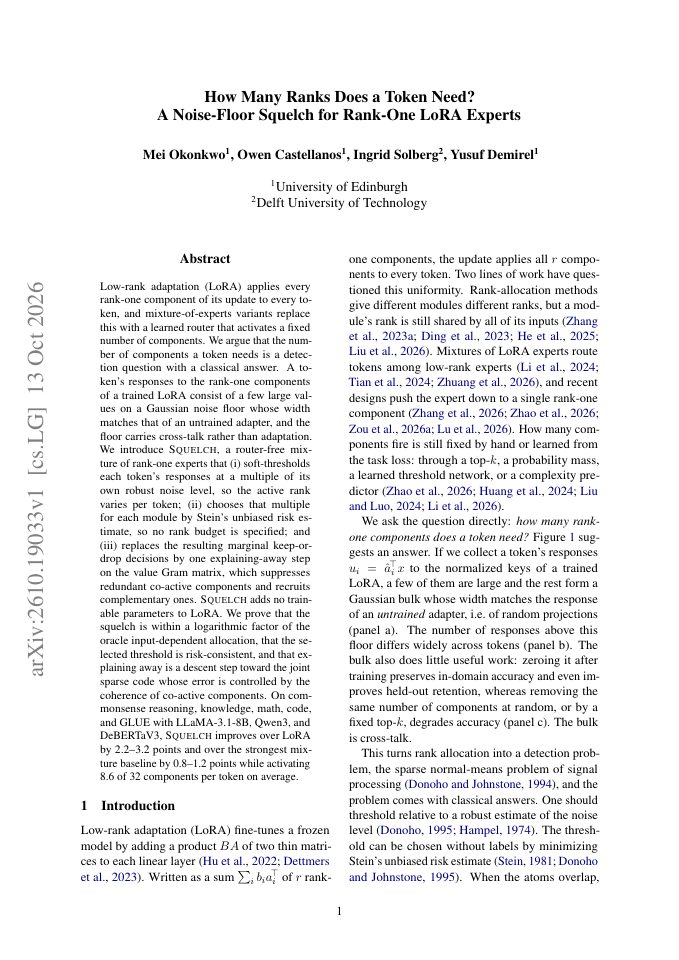
First page of How Many Ranks Does a Token Need? A Noise-Floor Squelch for Rank-One LoRA Experts
efficient trainingtest

How Many Ranks Does a Token Need? A Noise-Floor Squelch for Rank-One LoRA Experts

Replaces the fixed-rank LoRA update and learned top-k routers of mixture-of-LoRA methods with a router-free soft-thresholding of each token's rank-one responses, with the threshold chosen per module by Stein's unbiased risk estimate and a Gram-matrix explaining-away step, adding no trainable parameters. Cost is an extra per-token response computation, robust noise estimation, and a value Gram solve at inference, plus implementation complexity beyond a standard LoRA stack; training cost is comparable to LoRA since thresholds are set post hoc per module. It can fail if the Gaussian noise-floor assumption does not hold for a given adapter or domain, if coherence among co-active components is high enough to degrade the explaining-away step, or if the reported gains do not transfer beyond the evaluated models and benchmarks.

observed signal
0impl.
0stars
0citations
—claimed gain
abstract onlyReview decisionDownload skill ↓Original paper ↗
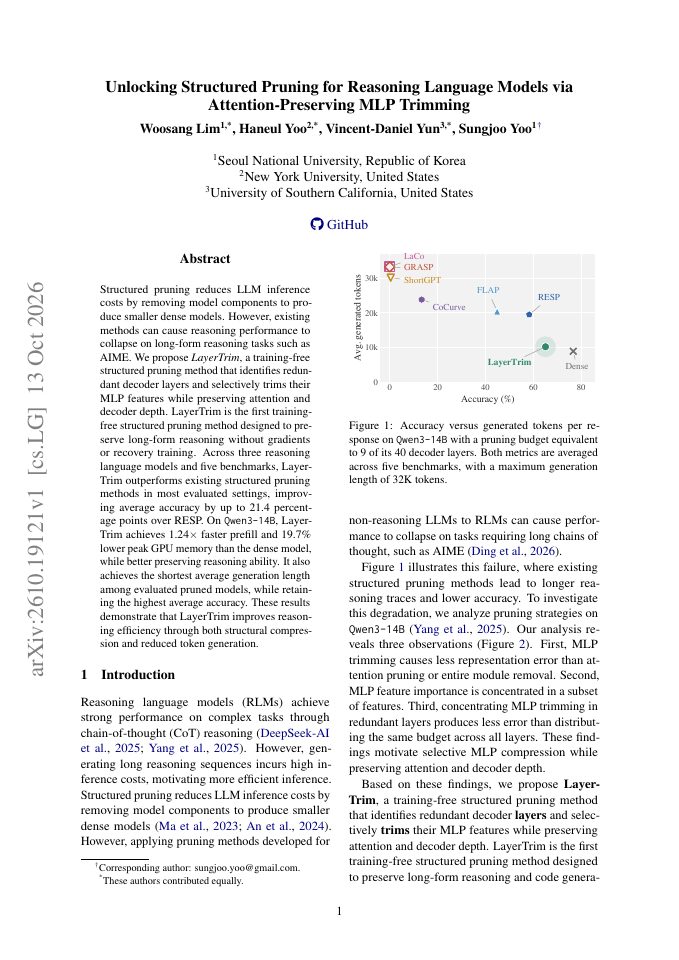
First page of Unlocking Structured Pruning for Reasoning Language Models via Attention-Preserving MLP Trimming
sparsity and pruningtest

Unlocking Structured Pruning for Reasoning Language Models via Attention-Preserving MLP Trimming

LayerTrim replaces training-based structured pruning pipelines (e.g., RESP) with a training-free method that trims MLP features in redundant decoder layers while preserving attention blocks and depth, yielding a smaller dense model. It costs implementation effort for the layer-selection and trimming procedure and incurs some accuracy loss relative to the dense model, though less than competing pruning methods; no recovery training or extra GPU memory is required. It can fail on reasoning workloads or model families not covered in the evaluation, since long-form reasoning accuracy (e.g., AIME) is sensitive to layer removal and the reported gains come from a single study on three models.

observed signal
0impl.
0stars
0citations
1.24xclaimed gain
abstract onlyReview decisionDownload skill ↓Original paper ↗
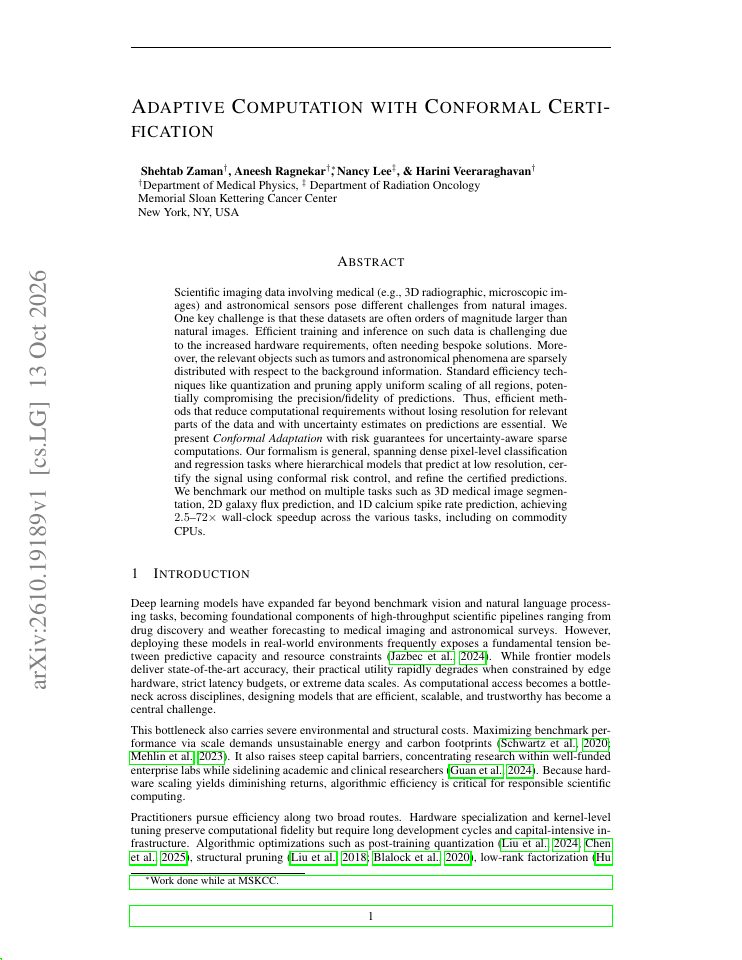
First page of Adaptive Computation with Conformal Certification
sparsity and pruningwatch

Adaptive Computation with Conformal Certification

The method replaces uniform full-resolution dense inference (and uniform efficiency techniques such as quantization and pruning) with hierarchical prediction: a low-resolution model proposes regions, conformal risk control certifies which regions contain signal, and computation is spent refining only certified regions. The cost is a two-stage hierarchical architecture plus a conformal calibration procedure requiring labeled calibration data and a chosen risk target, adding pipeline and validation complexity beyond a single dense model. Failure modes include miscertification if the calibration distribution shifts from deployment data, missed sparse signals that the low-resolution stage fails to propose, and speedups that may not materialize on data where relevant content is not spatially sparse.

observed signal
0impl.
0stars
0citations
72xclaimed gain
abstract onlyReview decisionDownload skill ↓Original paper ↗
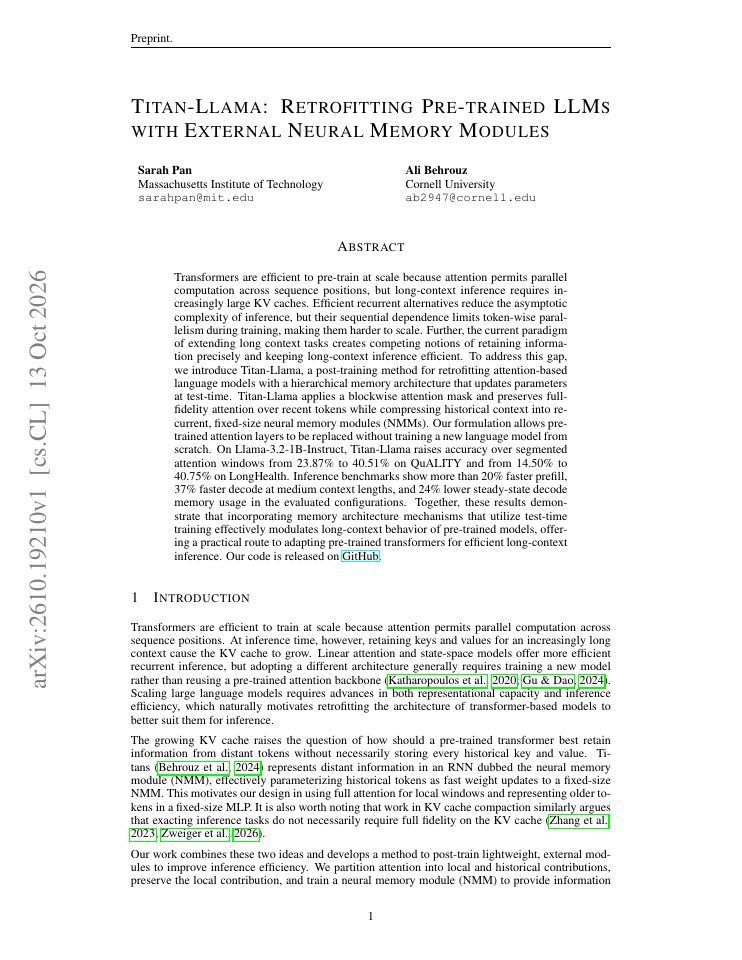
First page of Titan-Llama: Retrofitting Pre-trained LLMs with External Neural Memory Modules
memory and contexttest

Titan-Llama: Retrofitting Pre-trained LLMs with External Neural Memory Modules

The method replaces full attention over distant tokens with recurrent fixed-size neural memory modules updated at test time, while retaining full-fidelity attention over a recent block via a blockwise attention mask. It requires a post-training retrofit phase rather than pretraining from scratch, adds test-time parameter updates that increase implementation and serving complexity, and was validated only on a 1B model with medium context lengths. Failure modes include loss of precise recall of distant details compressed into the memory modules, sensitivity to block size and memory capacity, and uncertain transfer of the gains to larger models or very long contexts.

observed signal
0impl.
0stars
0citations
1.59xclaimed gain
abstract onlyReview decisionDownload skill ↓Original paper ↗
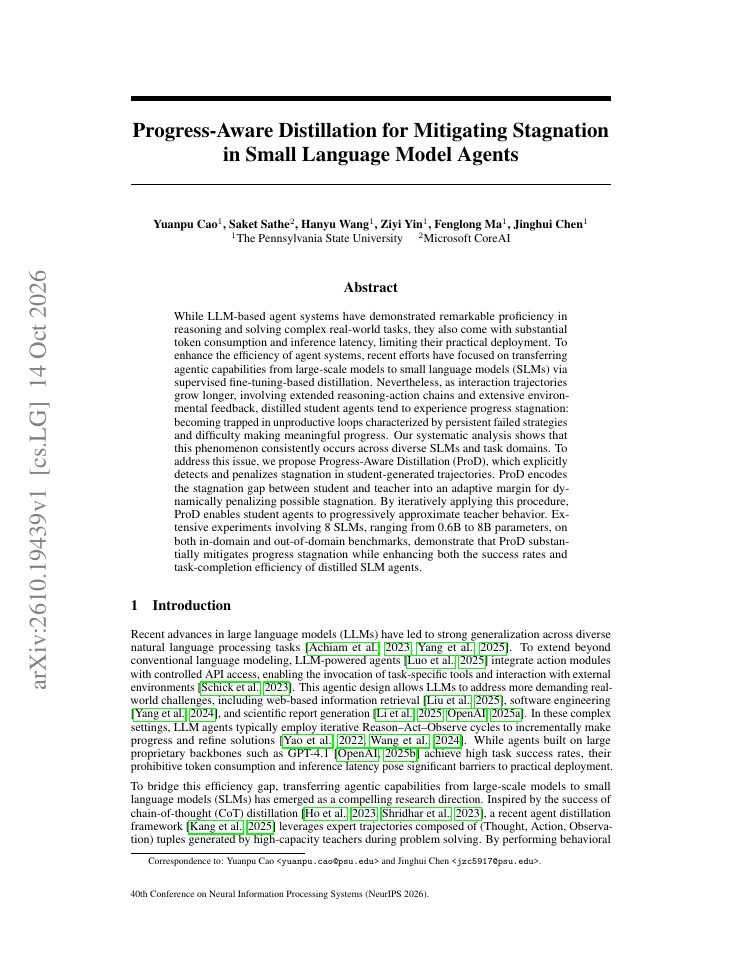
First page of Progress-Aware Distillation for Mitigating Stagnation in Small Language Model Agents
distillationtest

Progress-Aware Distillation for Mitigating Stagnation in Small Language Model Agents

ProD replaces plain supervised fine-tuning on teacher trajectories with an iterative distillation procedure that detects stagnation in student trajectories and adds an adaptive margin penalty to discourage unproductive loops. Costs include access to a teacher model for trajectory comparison, stagnation detection and margin computation during training, and iterative training rounds; on a single 24 GB GPU this is feasible for 0.6B-8B students with parameter-efficient fine-tuning but adds training complexity and time. It can fail if teacher trajectories are unavailable for the target domain, if the stagnation detector misfires and penalizes legitimate exploration, or if the student is too small to absorb the corrected behavior.

observed signal
0impl.
0stars
0citations
—claimed gain
abstract onlyReview decisionDownload skill ↓Original paper ↗
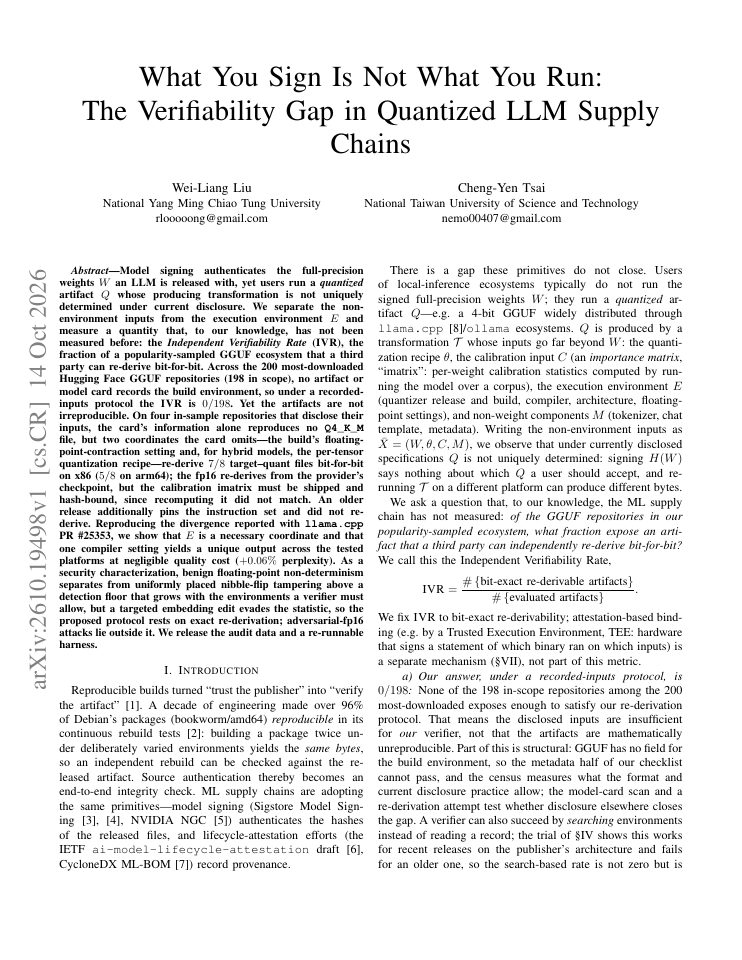
First page of What You Sign Is Not What You Run: The Verifiability Gap in Quantized LLM Supply Chains
safety and guardrailsadopt

What You Sign Is Not What You Run: The Verifiability Gap in Quantized LLM Supply Chains

Replaces trusting a downloaded GGUF solely via its full-precision weight signature with a protocol that re-derives the quantized artifact bit-for-bit from disclosed inputs, requiring the builder to record and ship the floating-point-contraction setting, per-tensor quantization recipes, and a hash-bound calibration imatrix. It costs negligible model quality (+0.06% perplexity from the unique-output compiler setting), adds build-provenance bookkeeping, and requires the verifier to rerun quantization locally on a 24 GB GPU, which is feasible for GGUF-class models. It fails when providers omit build-environment coordinates (currently universal: IVR 0/198), against targeted embedding edits that evade divergence statistics, and against adversarial-fp16 attacks, which lie outside the protocol.

observed signal
0impl.
0stars
0citations
—claimed gain
abstract onlyReview decisionDownload skill ↓Original paper ↗
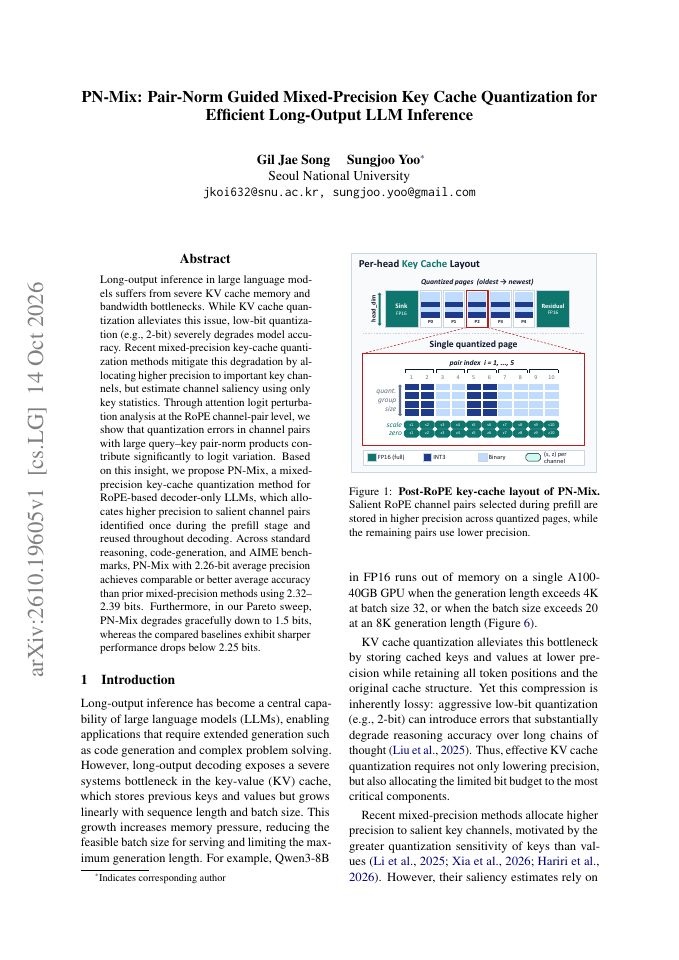
First page of PN-Mix: Pair-Norm Guided Mixed-Precision Key Cache Quantization for Efficient Long-Output LLM Inference
KV cachetest

PN-Mix: Pair-Norm Guided Mixed-Precision Key Cache Quantization for Efficient Long-Output LLM Inference

PN-Mix replaces fixed-precision or purely key-statistics-based mixed-precision KV cache quantization with saliency allocation driven by query-key pair-norm products at the RoPE channel-pair level, identified once during prefill and reused during decoding. The cost is a one-time prefill saliency analysis, implementation of per-channel-pair mixed-precision kernels, and residual accuracy loss at very low bit rates compared to full-precision caching. It can fail on non-RoPE or non-decoder-only architectures, on workloads whose saliency profile shifts between prefill and long decoding, and if custom kernel overhead negates the memory-bandwidth savings on a single-GPU serving stack.

observed signal
0impl.
0stars
0citations
—claimed gain
abstract onlyReview decisionDownload skill ↓Original paper ↗
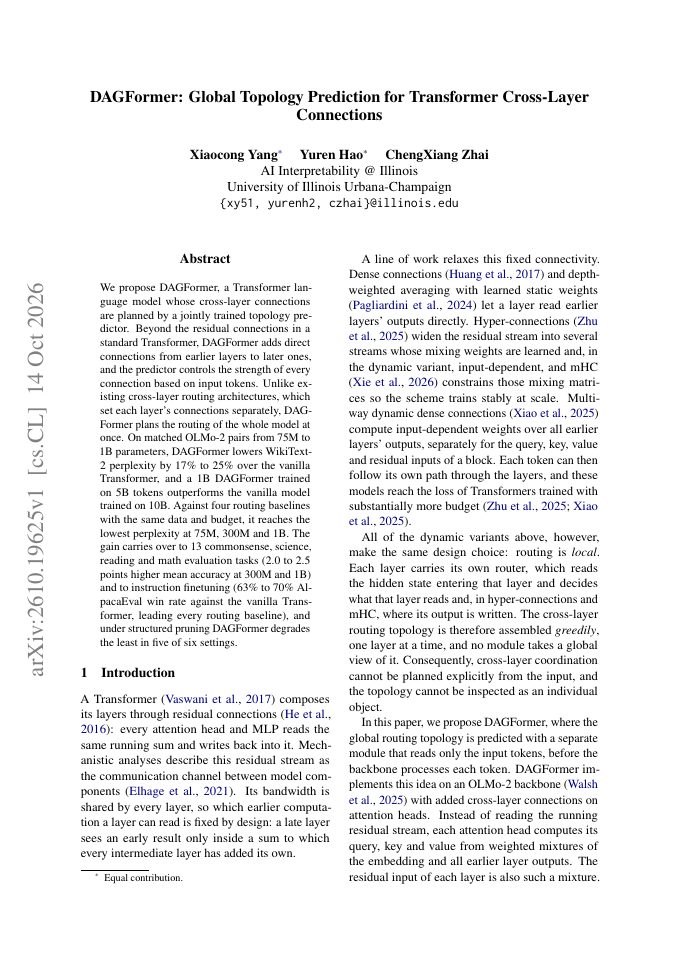
First page of DAGFormer: Global Topology Prediction for Transformer Cross-Layer Connections
efficient architectureswatch

DAGFormer: Global Topology Prediction for Transformer Cross-Layer Connections

DAGFormer replaces the fixed residual-connection topology of a standard Transformer with token-conditioned cross-layer connections whose strengths are planned globally by a jointly trained topology predictor, so it must be incorporated at pretraining time rather than retrofitted to existing checkpoints. The cost is an additional predictor module, extra connection parameters, modified training code, and a full pretraining run from scratch, with all reported evidence limited to models at or below 1B parameters trained on up to 10B tokens. What can fail is unverified scaling behavior beyond 1B, incompatibility with off-the-shelf pretrained checkpoints and optimized inference stacks, and the possibility that input-dependent routing gains do not transfer to domains or data mixtures unlike the paper's setup.

observed signal
0impl.
0stars
0citations
2xclaimed gain
abstract onlyReview decisionDownload skill ↓Original paper ↗

Research signals

Three views of the same evidence: adoption against attention, publication cadence by research area, and reported gains when coverage is sufficient.

color = research area

01 · attention × adoption

The research frontier

Look to the upper left for independent implementation before mass attention.

compare by
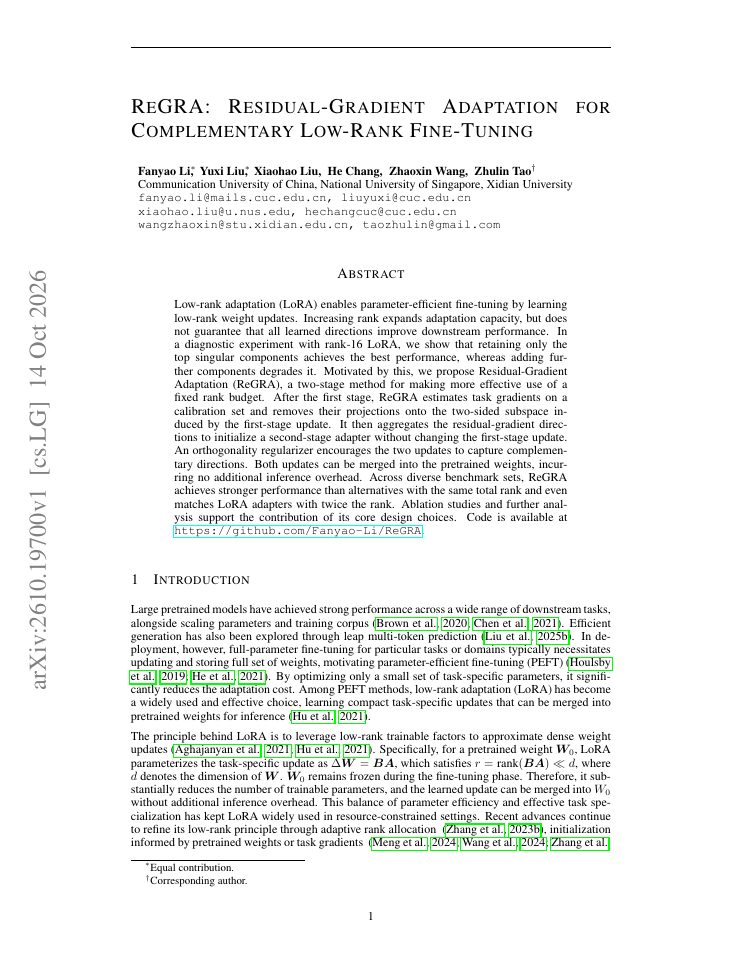
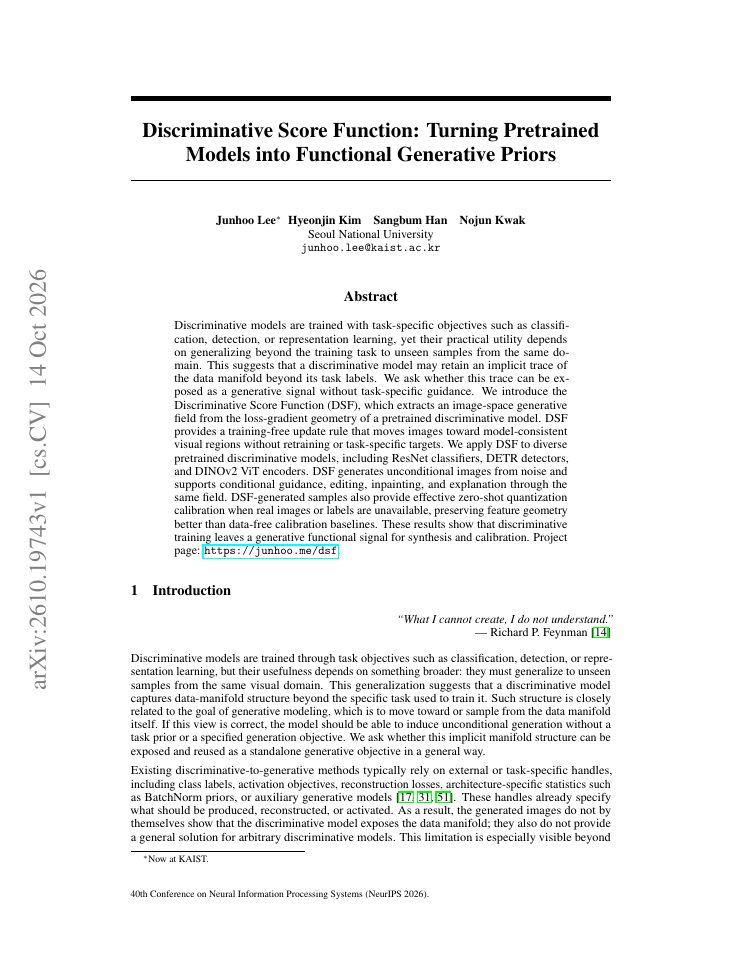
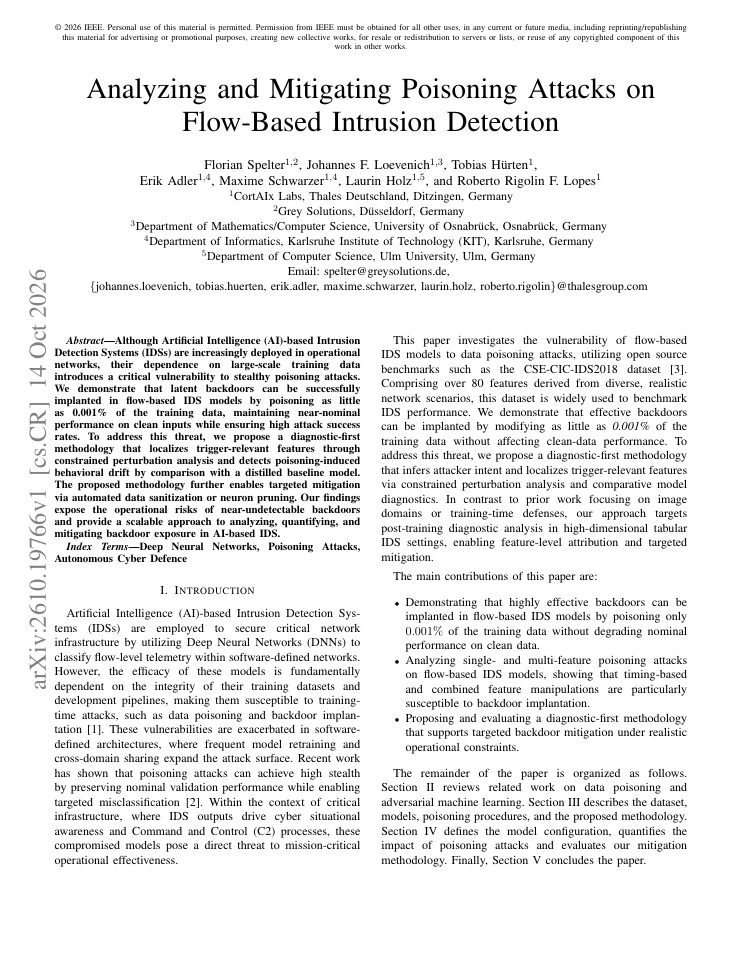
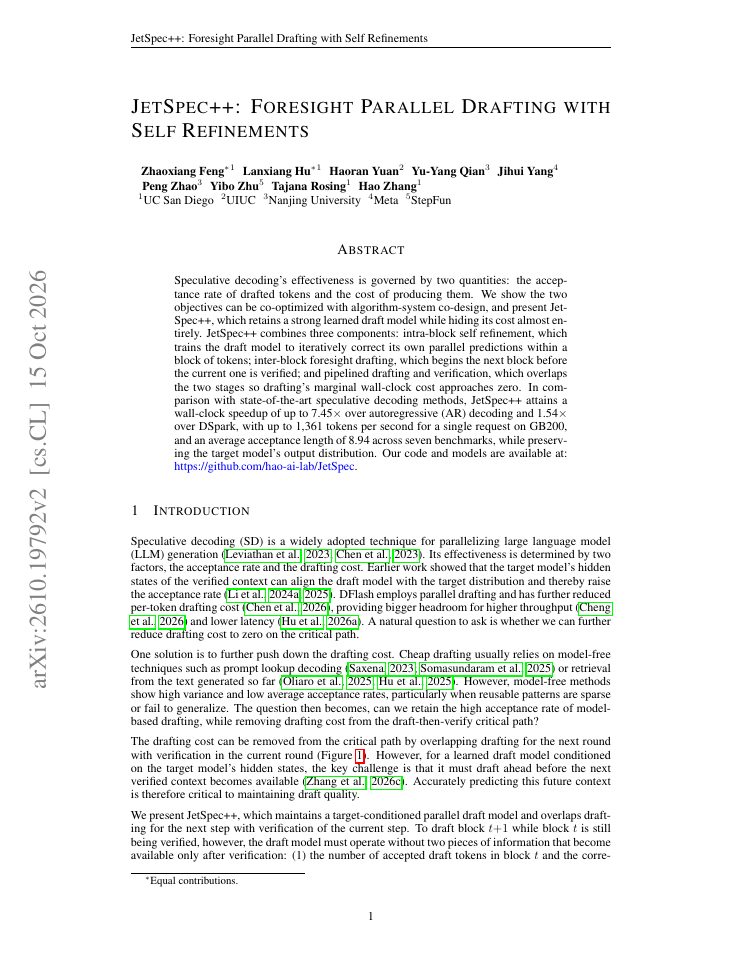
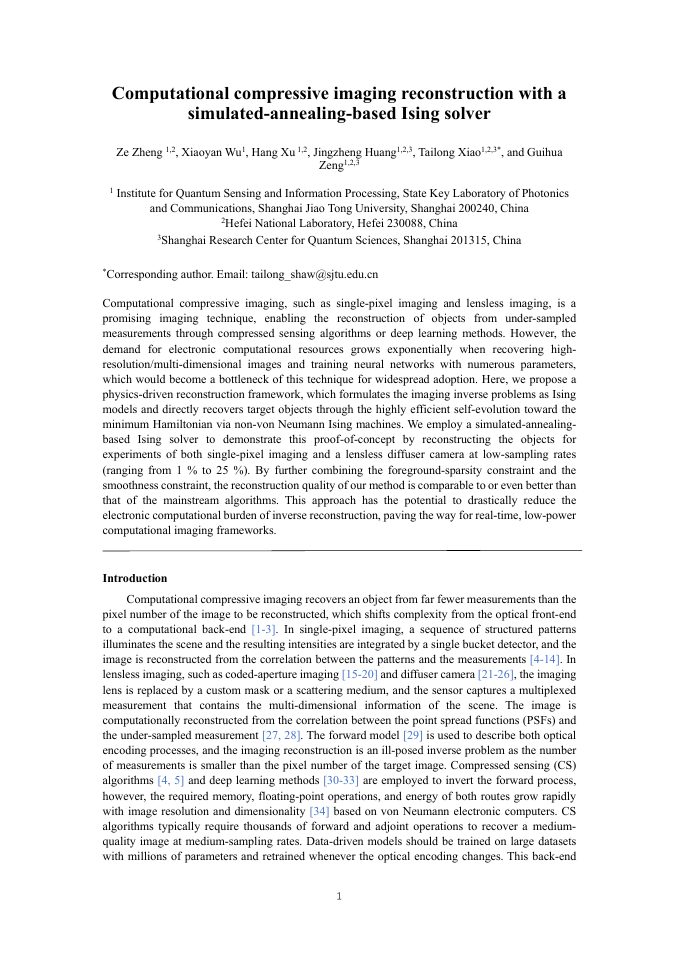
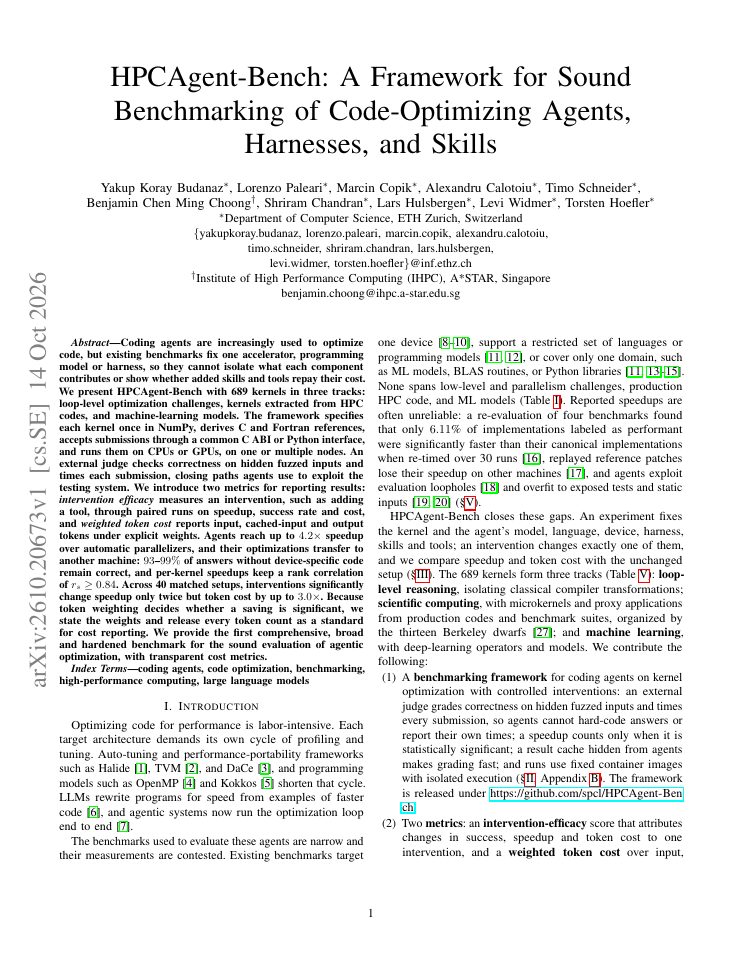
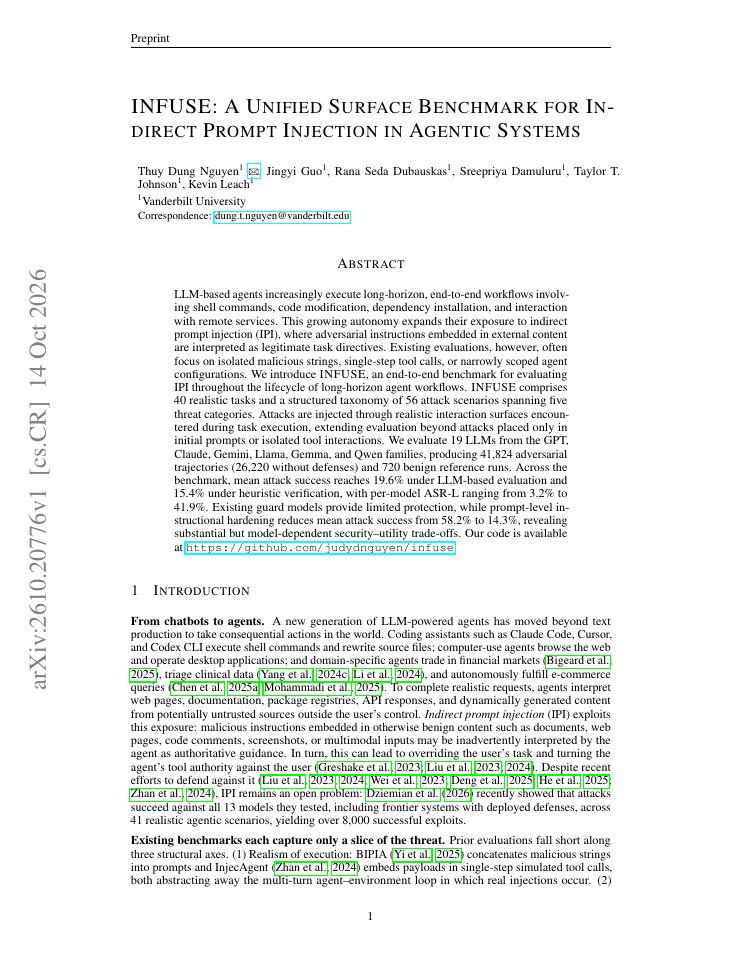
Each point represents one paper. Higher means more independent implementations; farther right means more GitHub stars.MAGS: Multi-agent Auto-formalization Guarantees Safety for Agentic Outputs: 9 GitHub stars; 1 independent implementationClosed-World Resolution Against Tool Hallucination in LLM Agents: 0 GitHub stars; 1 independent implementationEAServe: Encode-Aware Disaggregated Serving for Multimodal Large Language Models: 1 GitHub star; 2 independent implementationsDelay Complexity Dimension: Learning with Delayed and Censored Labels: 0 GitHub stars; 0 independent implementationsDiscovering Undisclosed Concepts in LoRA Adapters for Diffusion-Based AIGC Models: 0 GitHub stars; 0 independent implementationsDiscrete Diffusion Models are Minimax Optimal Under Sparsity: 0 GitHub stars; 0 independent implementationsJoint Subspace Sparse Attention for Efficient Long-Context Decoding: 0 GitHub stars; 0 independent implementationsHow Many Ranks Does a Token Need? A Noise-Floor Squelch for Rank-One LoRA Experts: 0 GitHub stars; 0 independent implementationsUnlocking Structured Pruning for Reasoning Language Models via Attention-Preserving MLP Trimming: 0 GitHub stars; 0 independent implementationsAdaptive Computation with Conformal Certification: 0 GitHub stars; 0 independent implementationsTitan-Llama: Retrofitting Pre-trained LLMs with External Neural Memory Modules: 0 GitHub stars; 0 independent implementationsProgress-Aware Distillation for Mitigating Stagnation in Small Language Model Agents: 0 GitHub stars; 0 independent implementationsWhat You Sign Is Not What You Run: The Verifiability Gap in Quantized LLM Supply Chains: 0 GitHub stars; 0 independent implementationsPN-Mix: Pair-Norm Guided Mixed-Precision Key Cache Quantization for Efficient Long-Output LLM Inference: 0 GitHub stars; 0 independent implementationsDAGFormer: Global Topology Prediction for Transformer Cross-Layer Connections: 0 GitHub stars; 0 independent implementationsESL-former: Event Sparse Linear Transformer for FPGA-Accelerated Malware Detection: 0 GitHub stars; 0 independent implementationsCAFE: Conducting-Cell-Aware Adaptive Differential Encoding for Robust DNN Inference in FeFET-Based Compute-in-Memory: 0 GitHub stars; 0 independent implementationsReGRA: Residual-Gradient Adaptation for Complementary Low-Rank Fine-Tuning: 0 GitHub stars; 0 independent implementationsDiscriminative Score Function: Turning Pretrained Models into Functional Generative Priors: 0 GitHub stars; 0 independent implementationsAnalyzing and Mitigating Poisoning Attacks on Flow-Based Intrusion Detection: 0 GitHub stars; 0 independent implementationsComputational compressive imaging reconstruction with a simulated-annealing-based Ising solver: 0 GitHub stars; 0 independent implementationsJetSpec++: Foresight Parallel Drafting with Self Refinements: 122 GitHub stars; 0 independent implementationsDelta Tokenizer: Reference-Identical Tokenization of Session Deltas and Segment-Parallelism for Long Prompts on Multicore CPUs: 6 GitHub stars; 0 independent implementationsEvaluating Model Capabilities After Benchmark Saturation: 126 GitHub stars; 1 independent implementationHPCAgent-Bench: A Framework for Sound Benchmarking of Code-Optimizing Agents, Harnesses, and Skills: 4 GitHub stars; 0 independent implementationsINFUSE: A Unified Surface Benchmark for Indirect Prompt Injection in Agentic Systems: 1547 GitHub stars; 3 independent implementationsARIA: Runtime Inspection and Amendment for Multi-Agent Systems: 136 GitHub stars; 2 independent implementationsSkillNEO: Non-Elitist Evolutionary Optimization of Agent Skills: 132 GitHub stars; 1 independent implementationPrune the Summary, Not the History: Source-Judged Compaction for Long-Horizon Agents: 132 GitHub stars; 1 independent implementationMAI-Gym: An Open All-in-One Platform for GUI Agent Evaluation and RL Training across Mobile and Computer Environments: 158 GitHub stars; 2 independent implementationsSame Context, Different Agents: A Behavioral Study of Semantic Layers, Orchestration and Compaction in Data Agents: 132 GitHub stars; 1 independent implementationStepSafe: Learning Timely Intervention with Context-Aware Safety Reasoning: 133 GitHub stars; 3 independent implementationsSCARCE: Emergent Institutions in Long-Horizon Multi-Agent Coding Systems: 14 GitHub stars; 1 independent implementationLearning When to Withdraw: Curriculum Coverage and Rule-Specific Failures in Fine-Tuned Language Agents: 132 GitHub stars; 1 independent implementationSkip the Compressor: Coding Agents Fix More Issues When They Pick Whole Files: 0 GitHub stars; 0 independent implementationsSci$Π$vot: Benchmarking Principal-Investigator Judgment at Pivotal Moments of Scientific AutoResearch Agents: 136 GitHub stars; 2 independent implementationsProbe-and-Resume: When and How to Evaluate Agent Execution: 136 GitHub stars; 2 independent implementationsMemComposer: Learning to Assemble Memories for LLM Agents via Reinforcement Learning: 136 GitHub stars; 2 independent implementationsToolBottleneckBench: Measuring Tool-Agent Performance under Controlled Pressures and Fixed Harness Budgets: 11 GitHub stars; 0 independent implementationsKolab: Benchmarking Human-Agent Collaboration in Long-Horizon Workflows: 14 GitHub stars; 1 independent implementationSSR: Structural Signal Retriever for Scalable Agent Discovery in LLM-Orchestrated Multi-Agent Systems: 14 GitHub stars; 1 independent implementationStronger Judges Do Not See More: Deployment-Integrity Blindness in LLM Evaluation: 0 GitHub stars; 0 independent implementationsGRADS: Graph-Regulated Agentic Data Synthesis with Controllable Difficulty: 136 GitHub stars; 2 independent implementations

Papers above 1000 stars or 200 citations are not scored. They have already broken through the attention threshold, while Paperraft is designed to identify earlier signals.

02 · cadence

Research areas over time

Compare monthly publication volume on a shared scale and calendar.

coding agentsmax 10Sep 26: 0 papersOct 26: 1 paperSep 26Oct 26efficient architecturesmax 10Sep 26: 0 papersOct 26: 1 paperSep 26Oct 26agent evaluationmax 10Sep 26: 0 papersOct 26: 10 papersSep 26Oct 26KV cachemax 10Sep 26: 0 papersOct 26: 2 papersSep 26Oct 26speculative decodingmax 10Sep 26: 0 papersOct 26: 1 paperSep 26Oct 26distillationmax 10Sep 26: 0 papersOct 26: 1 paperSep 26Oct 26sparsity and pruningmax 10Sep 26: 0 papersOct 26: 3 papersSep 26Oct 26memory and contextmax 10Sep 26: 0 papersOct 26: 5 papersSep 26Oct 26multi-agent orchestrationmax 10Sep 26: 0 papersOct 26: 1 paperSep 26Oct 26othermax 10Sep 26: 0 papersOct 26: 4 papersSep 26Oct 26quantizationmax 10Sep 26: 0 papersOct 26: 1 paperSep 26Oct 26failure recoverymax 10Sep 26: 0 papersOct 26: 1 paperSep 26Oct 26safety and guardrailsmax 10Sep 26: 2 papersOct 26: 5 papersSep 26Oct 26serving and batchingmax 10Sep 26: 1 paperOct 26: 1 paperSep 26Oct 26efficient trainingmax 10Sep 26: 0 papersOct 26: 3 papersSep 26Oct 26

Every panel uses the same calendar and vertical scale. An empty column means no papers were recorded.

Method under scrutiny

Inspect the highest-ranked paper, every repository behind its signal, and the rule used to classify each one.

Closed-World Resolution Against Tool Hallucination in LLM Agents

safety and guardrails · adopt · 1 of 2 implementations is independent

The resolver replaces nothing in the existing pipeline; it adds a training-free pre-gate check (tool registry membership plus argument signature validation) that rejects calls to nonexistent tools or with undeclared arguments before any causal or security gate runs, since a hallucinated call is by construction outside what a gate decided. Its cost is negligible compute and latency (a lookup and a schema check), with the engineering burden of maintaining an accurate, versioned tool registry and correctly handling merged MCP namespaces where name collisions and shadowing create surfaces a single registry cannot express. It fails on the one irreducible residue: calls to real tools with borrowed arguments that are schema-indistinguishable from valid calls, which requires downstream gating or execution checks rather than closed-world resolution.
Exclusions and controls

Every exclusion is counted and published.

Exclusion counts were not recorded for this edition.
0 previously indexed papers were rechecked in this run.
Paperraft tracks one signal: how many independent implementations a paper attracts on GitHub after author-owned repositories are removed. This is a discovery signal to investigate, not a measure of implementation quality.
It does not claim that a method works. Paperraft runs no reproduction benchmarks. Reported gains remain author claims until independently tested. Papers above the attention threshold are excluded because this publication is designed to identify research before consensus forms.