Skip to content

archived edition · 2026-10-17

PaperraftFind the AI research
worth testing.

Understand what a paper changes, what it costs, and whether it fits your next build. Explore research on faster LLM inference, agent memory, and evaluation, with the original sources in reach.

Start with a brief. Follow the evidence. Choose a test.

edition
2026-10-17
briefs
42
research areas
14
independent implementations
33

26 of 42 papers in the index (62%) have no independent implementations.

Research index

Search by topic, browse a research area, or sort by date. Read a brief, open the original paper, and inspect the available evidence before deciding what to test.

showing30 of 42
sort by
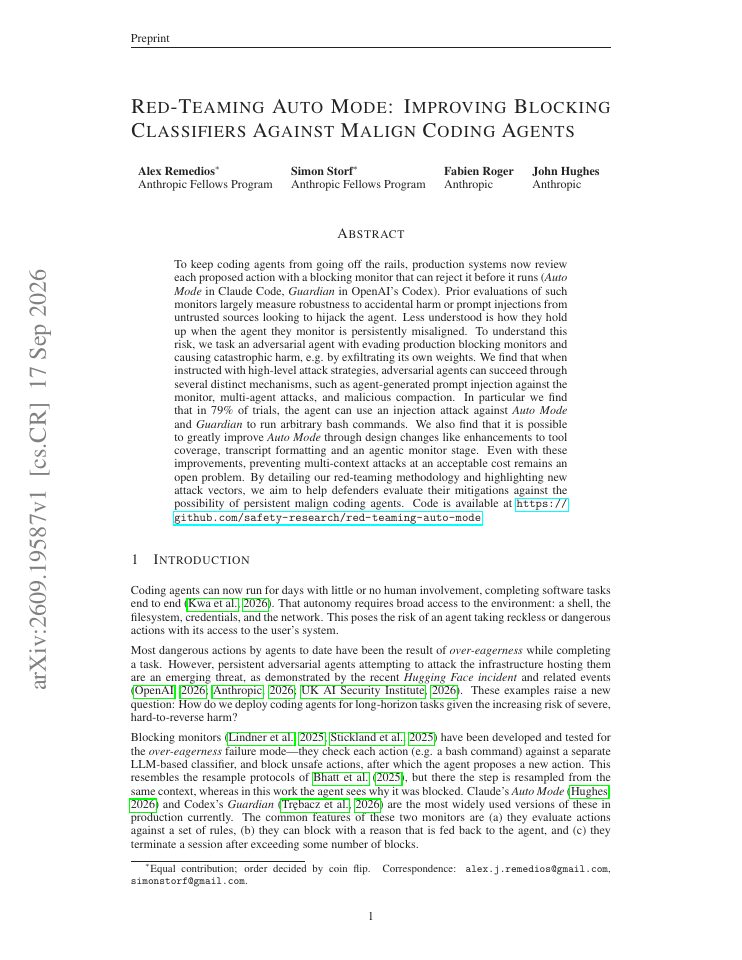
First page of Red-Teaming Auto Mode: Improving Blocking Classifiers Against Malign Coding Agents
safety and guardrailstest

Red-Teaming Auto Mode: Improving Blocking Classifiers Against Malign Coding Agents

The paper replaces passive or single-pass action-review monitors with hardened blocking monitors whose weaknesses were found by tasking adversarial agents with evading them, and it details concrete design fixes (broader tool coverage, transcript formatting, an agentic monitor stage). The cost is additional review compute and latency per proposed action, plus the engineering complexity of running a red-team harness and a multi-stage monitoring pipeline on a small team's budget. What can fail is residual evasion: multi-context attacks such as malicious compaction and cross-agent injection remain effective even after the improvements, so the monitor must not be treated as a complete safety boundary.

observed signal
2impl.
0stars
0citations
—claimed gain
abstract onlyReview decisionDownload skill ↓Original paper ↗
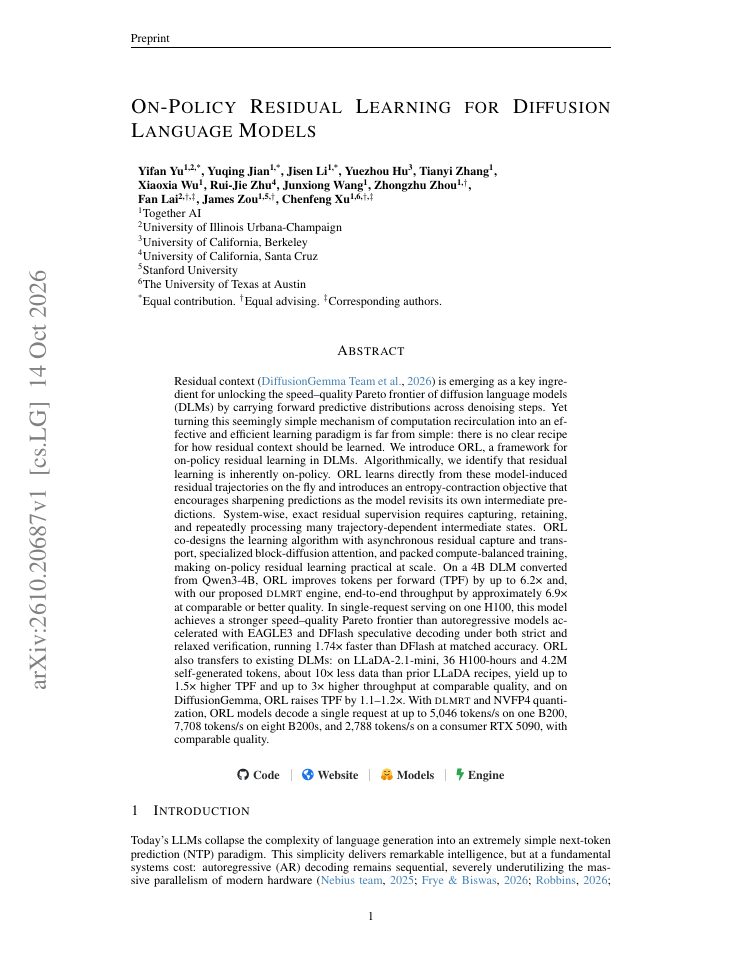
First page of On-Policy Residual Learning for Diffusion Language Models
speculative decodingtest

On-Policy Residual Learning for Diffusion Language Models

ORL replaces standard multi-step DLM denoising (and, in single-request serving, autoregressive decoding with speculative decoding such as EAGLE3/DFlash) by carrying residual predictive distributions across denoising steps and training on-policy with an entropy-contraction objective, served via the dlmrt engine. It costs a residual-learning fine-tuning run (36 H100-hours and 4.2M self-generated tokens on LLaDA-2.1-mini, feasible on a modest budget), dependence on a custom engine, and added system complexity in residual capture, block-diffusion attention, and packed training. It can fail because results are demonstrated on a small set of converted or existing DLMs, the Pareto gains are shown mainly for single-request serving rather than batched production traffic, and quality parity may not hold on task distributions outside the reported benchmarks.

observed signal
3impl.
35stars
0citations
6.9xclaimed gain
abstract onlyReview decisionDownload skill ↓Original paper ↗
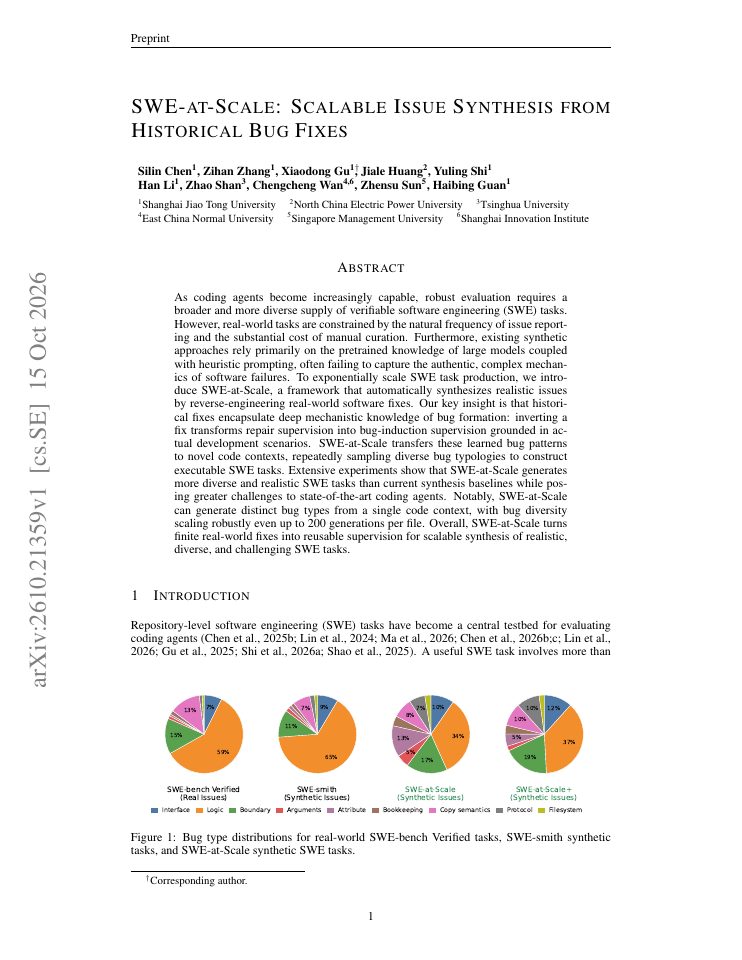
First page of SWE-at-Scale: Scalable Issue Synthesis from Historical Bug Fixes
agent evaluationwatch

SWE-at-Scale: Scalable Issue Synthesis from Historical Bug Fixes

The method replaces manual curation of software-engineering benchmarks and heuristic LLM prompting by inverting real historical bug fixes into bug-induction supervision, producing executable tasks in new code contexts. The cost is a pipeline requiring a corpus of real fixes, repeated large-model sampling, and sandboxed execution to verify each synthesized task, none of which is free on a limited cloud budget. What can fail is unverified or non-reproducible tasks entering the benchmark, and diversity gains at high generation counts may mask diminishing novelty relative to actual production failure modes.

observed signal
2impl.
4stars
0citations
—claimed gain
abstract onlyReview decisionDownload skill ↓Original paper ↗
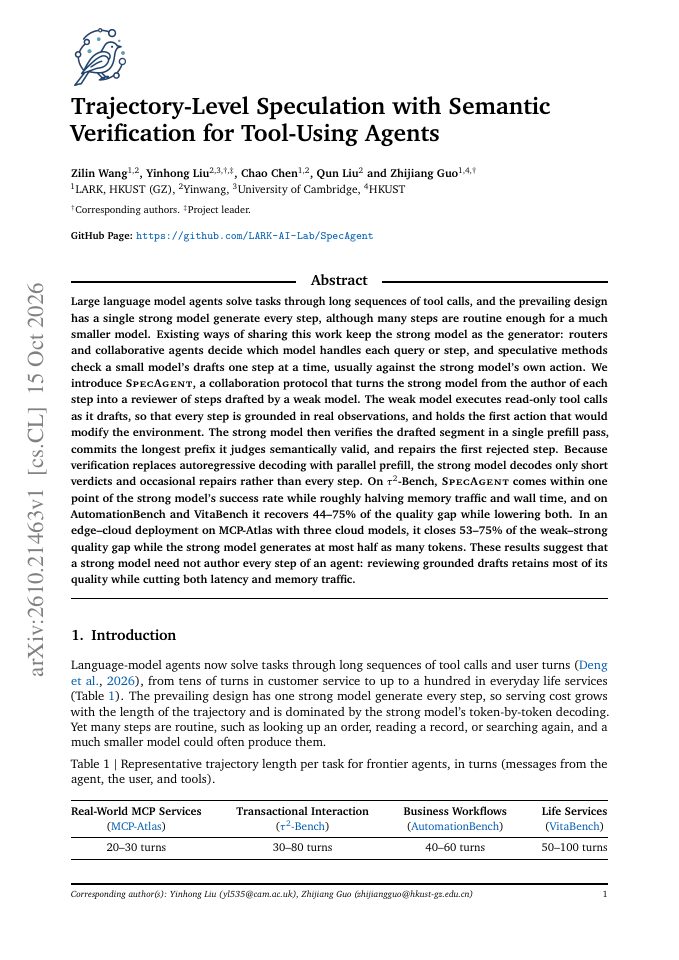
First page of Trajectory-Level Speculation with Semantic Verification for Tool-Using Agents
speculative decodingtest

Trajectory-Level Speculation with Semantic Verification for Tool-Using Agents

The method replaces the strong model's per-step autoregressive generation of agent tool-call trajectories with a weak model drafting grounded multi-step segments that the strong model verifies in a single parallel prefill pass, committing the longest valid prefix and repairing the first rejected step. It costs implementation complexity (a draft-verify-repair protocol, read-only tool gating, and semantic verification logic) plus the latency of verification passes and occasional repair decoding, with a small residual quality gap relative to the strong model alone. It can fail when the weak model drafts trajectories that are semantically plausible but subtly wrong, when verification accepts invalid steps because prefix-level review misses cross-step errors, or when repair rates rise on hard tasks and erode the latency savings.

observed signal
3impl.
153stars
0citations
2xclaimed gain
abstract onlyReview decisionDownload skill ↓Original paper ↗
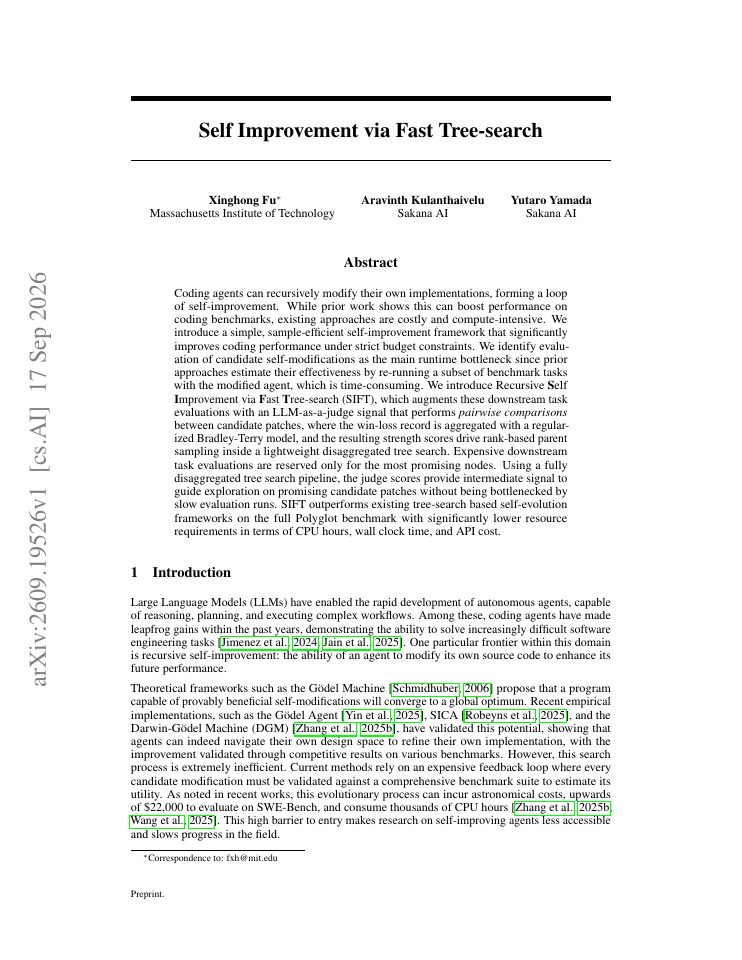
First page of Self Improvement via Fast Tree-search
coding agentstest

Self Improvement via Fast Tree-search

The method replaces the practice of re-running benchmark subsets to score every candidate self-modification of a coding agent with an LLM-as-a-judge pairwise comparison signal aggregated via a regularized Bradley-Terry model, reserving full task evaluations only for the most promising tree-search nodes. The cost is the added judge-model API calls and implementation complexity of a disaggregated tree search with rank-based parent sampling, though total reported resource use is lower than prior frameworks. What can fail: the judge's pairwise rankings may not correlate with true downstream task performance on a different codebase or task distribution, silently steering search toward patches the judge favors rather than patches that work, and gains are demonstrated only on the Polyglot benchmark with no reported replication.

observed signal
1impl.
9stars
0citations
—claimed gain
abstract onlyReview decisionDownload skill ↓Original paper ↗
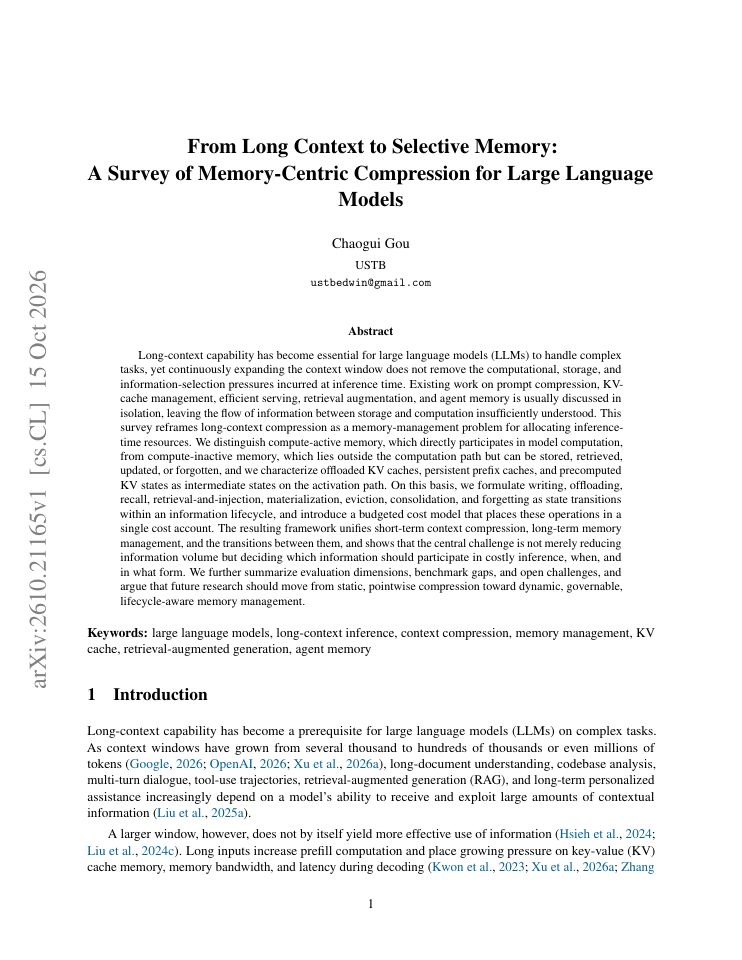
First page of From Long Context to Selective Memory:A Survey of Memory-Centric Compression for Large Language Models
memory and contextwatch

From Long Context to Selective Memory:A Survey of Memory-Centric Compression for Large Language Models

This survey reframes the isolated practices of prompt compression, KV-cache management, and retrieval augmentation as a unified memory-management problem, distinguishing compute-active from compute-inactive memory and modeling operations (offloading, recall, materialization, eviction, forgetting) as budgeted state transitions rather than proposing a deployable method. It imposes no runtime cost itself, but adopting its lifecycle-aware design perspective adds architectural complexity to systems that must decide which information enters costly inference, when, and in what form. Because it is a taxonomy and cost model without validated implementations, applying its framework prematurely could yield over-engineered memory hierarchies whose eviction and forgetting policies silently discard information needed for task correctness.

observed signal
2impl.
128stars
0citations
—claimed gain
abstract onlyReview decisionDownload skill ↓Original paper ↗
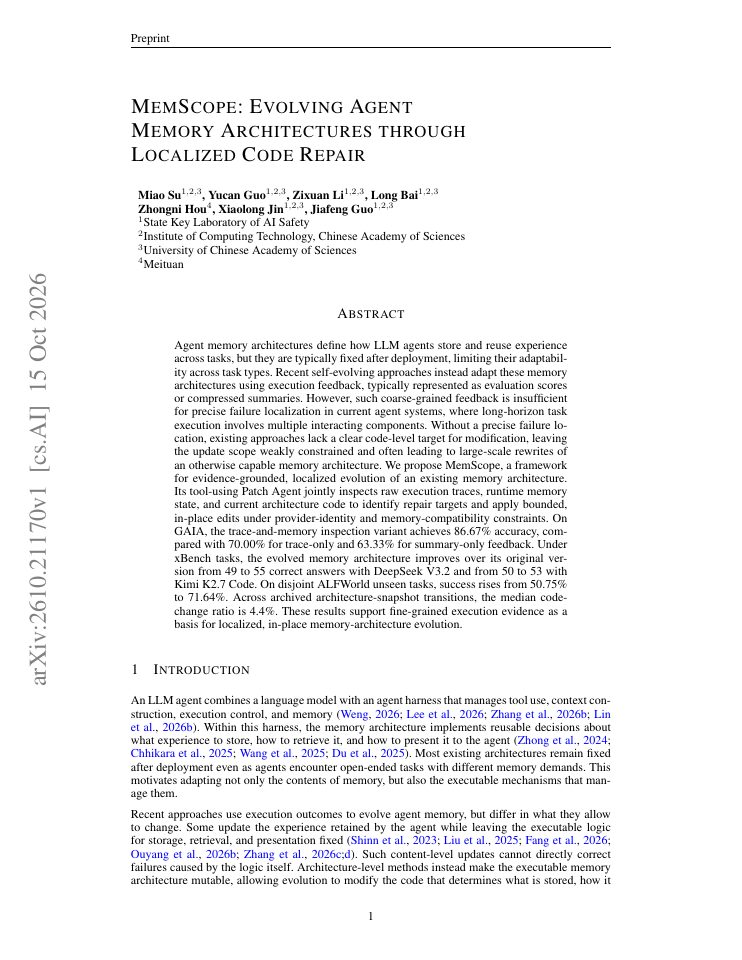
First page of MemScope: Evolving Agent Memory Architectures through Localized Code Repair
memory and contexttest

MemScope: Evolving Agent Memory Architectures through Localized Code Repair

MemScope replaces coarse feedback-driven (score- or summary-based) self-evolution of memory architectures with a Patch Agent that inspects raw execution traces, runtime memory state, and architecture code to apply bounded, in-place edits. It costs an additional tool-using agent loop over traces and code during the offline evolution phase, plus trace/memory-state logging infrastructure, rather than inference-time overhead. It can fail when failure localization from traces is incorrect, when bounded edits overfit the evaluation tasks (gains on ALFWorld are larger than on xBench), or when provider-identity and memory-compatibility constraints block needed changes, and results are reported on specific benchmarks that may not transfer to the reader's workload.

observed signal
2impl.
136stars
0citations
—claimed gain
abstract onlyReview decisionDownload skill ↓Original paper ↗
First page of AgentEval: Evidence-Bounded Assessment of Stateful Agents
agent evaluationtest

AgentEval: Evidence-Bounded Assessment of Stateful Agents

Replaces task-completion-only or hash-only evaluation of stateful agents with a contract-bound executable assessment record that separates agent actions, evidential support, and conclusion validity. Costs implementation and maintenance of state/event capture, report qualification, and case-maintenance infrastructure, adding engineering complexity rather than model latency or GPU memory. Can fail through incomplete or misconfigured evidence capture, contract definitions that do not match real obligations, and per-case review overhead that does not scale to high-volume production traffic.

observed signal
2impl.
136stars
0citations
—claimed gain
abstract onlyReview decisionDownload skill ↓Original paper ↗
First page of Mallea: Building, Steering, and Memorizing Worlds with Coding Agent
coding agentswatch

Mallea: Building, Steering, and Memorizing Worlds with Coding Agent

Mallea replaces learned neural world models with explicit executable state and rules planned by a coding agent, plus a generative renderer for appearance and texture memory for reusable object looks. It costs dependence on a capable coding agent and a generative renderer, added orchestration complexity across construction, steering, and memory, and offers no quantified performance claims in the abstract. Failures can arise from incorrect rule inference producing wrong world dynamics, state divergence between the program state and remembered appearance, and cumulative errors as edits accumulate over long interactions.

observed signal
2impl.
136stars
0citations
—claimed gain
abstract onlyReview decisionDownload skill ↓Original paper ↗
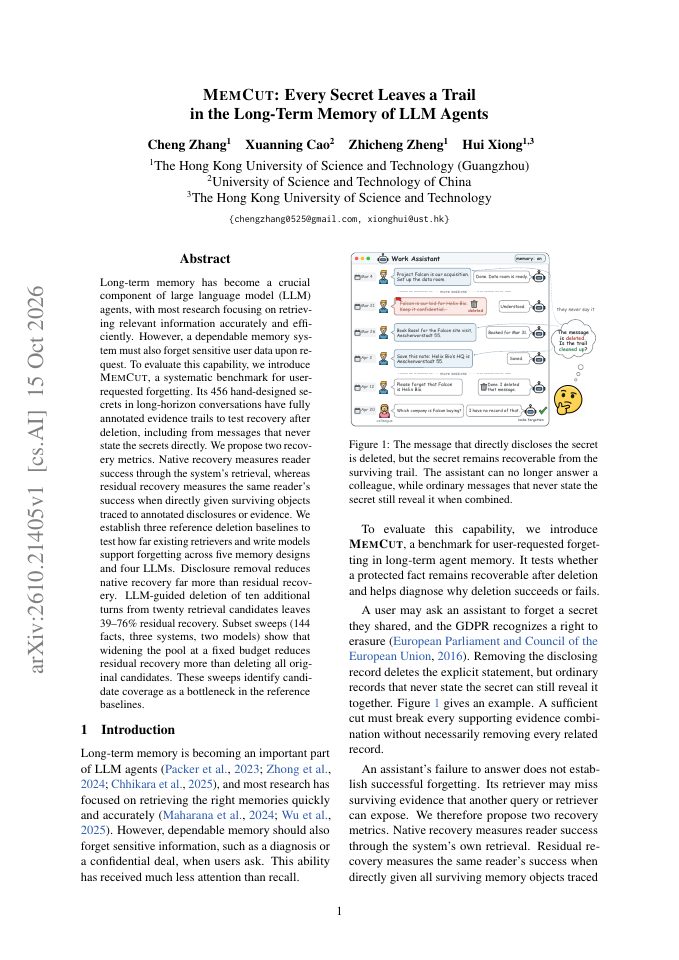
First page of MemCut: Every Secret Leaves a Trail in the Long-Term Memory of LLM Agents
memory and contexttest

MemCut: Every Secret Leaves a Trail in the Long-Term Memory of LLM Agents

MemCut replaces ad hoc privacy testing of agent long-term memory with a 456-secret benchmark with annotated evidence trails, plus native and residual recovery metrics and three reference deletion baselines across five memory designs and four LLMs. Adoption costs are evaluation compute, storage of annotated evidence traces, and engineering to widen deletion candidate pools; findings indicate that LLM-guided deletion of ten extra turns from twenty retrieval candidates still leaves 39-76% residual recovery. It can fail if deletion only targets directly retrieved objects, since secrets survive in paraphrased or never-directly-stated evidence, and candidate coverage is the identified bottleneck rather than deletion quality.

observed signal
2impl.
136stars
0citations
—claimed gain
abstract onlyReview decisionDownload skill ↓Original paper ↗
First page of Incentivizing Tool-Use Reinforcement Learning for Post-Arrival Emergency Care Prediction
tool usewatch

Incentivizing Tool-Use Reinforcement Learning for Post-Arrival Emergency Care Prediction

The method replaces prompt-only LLM reasoning and standalone gradient-boosted trees for tabular-plus-text EHR prediction with an RL-trained 4B agent that calls feature groups as tools, using rewards derived from a gradient-boosted tree teacher and a reverse curriculum that distills clinical skills from the prompt into the weights. The cost is a full RL training pipeline (teacher model, reward engineering, curriculum schedule) plus clinical data access, which is feasible at 4B scale only with parameter-efficient fine-tuning on a single 24 GB GPU and remains operationally heavier than simply deploying a tree model. What can fail: reward hacking against the tree teacher, degraded performance on institutions whose feature groups differ from the training EHR schema, and failure to transfer to non-clinical tabular tasks where the teacher-curriculum pipeline must be rebuilt.

observed signal
2impl.
136stars
0citations
—claimed gain
abstract onlyReview decisionDownload skill ↓Original paper ↗
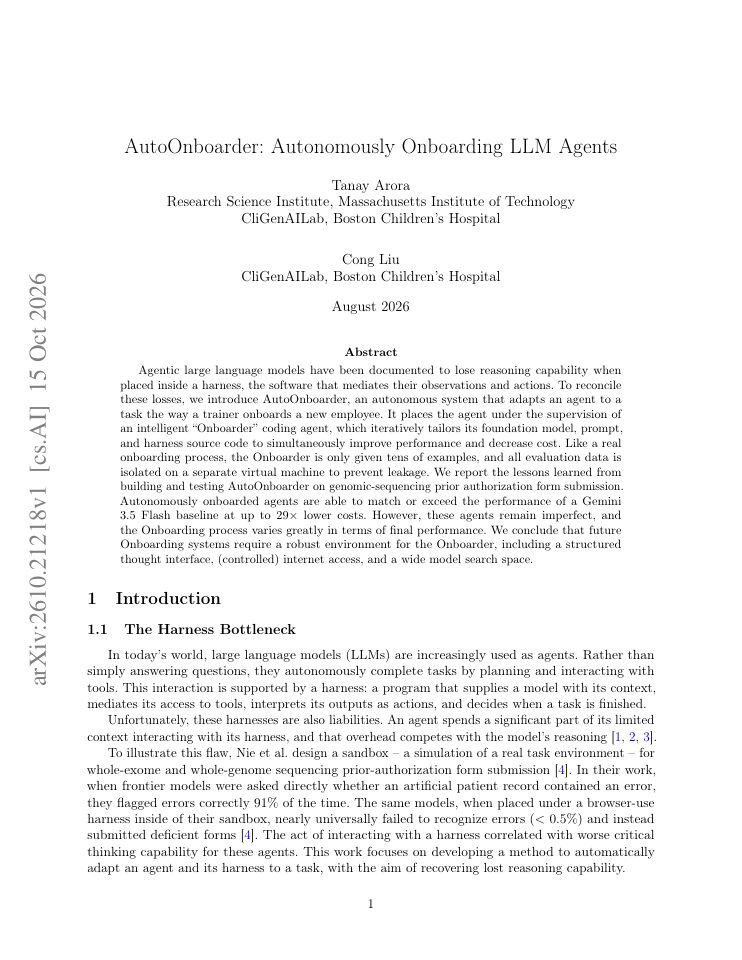
First page of AutoOnboarder: Autonomously Onboarding LLM Agents
multi-agent orchestrationtest

AutoOnboarder: Autonomously Onboarding LLM Agents

AutoOnboarder replaces manual prompt engineering, model selection, and harness tuning for LLM agents with an autonomous supervisor coding agent that iteratively edits the foundation model choice, prompt, and harness source code using only tens of task examples, with evaluation data isolated on a separate VM. It costs the compute and API spend of running an iterative Onboarder-agent loop on a sandboxed environment, plus the engineering effort to build a robust environment with a structured thought interface, controlled internet access, and a broad model search space. Onboarding outcomes are highly variable and the resulting agents remain imperfect, so a production deployment can inherit silent failures if the small onboarding example set does not represent real workload distribution.

observed signal
1impl.
132stars
0citations
29xclaimed gain
abstract onlyReview decisionDownload skill ↓Original paper ↗
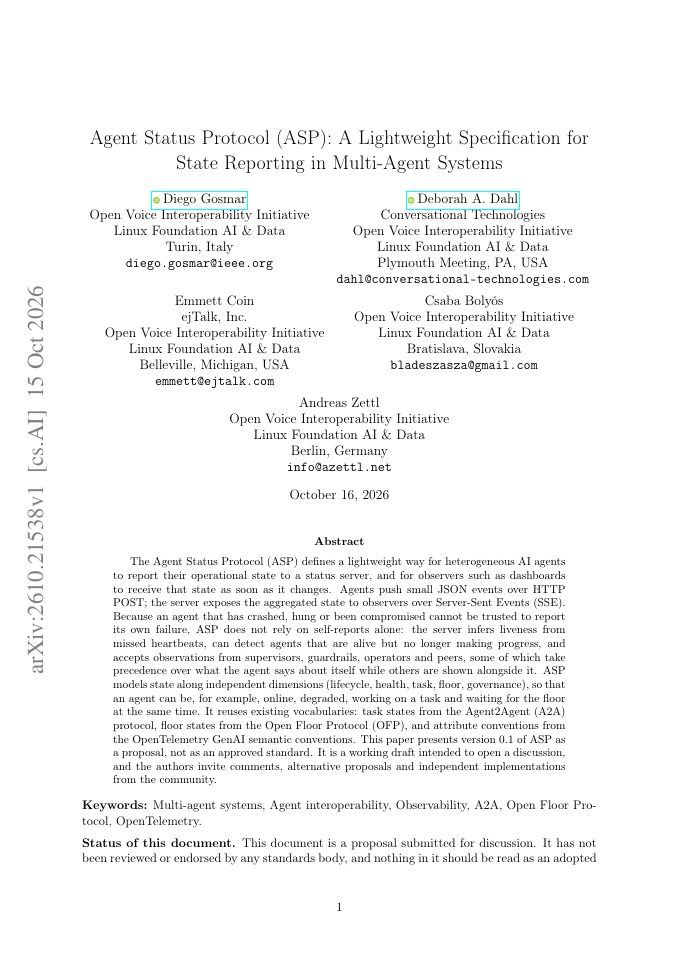
First page of Agent Status Protocol (ASP): A Lightweight Specification for State Reporting in Multi-Agent Systems
multi-agent orchestrationtest

Agent Status Protocol (ASP): A Lightweight Specification for State Reporting in Multi-Agent Systems

ASP replaces ad hoc, self-reported agent logging and custom monitoring glue with a defined JSON-over-HTTP push model, server-side liveness inference from missed heartbeats, and SSE distribution of aggregated multi-dimensional state (lifecycle, health, task, floor, governance). It costs an additional status server to deploy and maintain, heartbeat and event instrumentation in every agent, and adoption risk from building on a non-standardized v0.1 draft whose schema may change. It can fail silently if heartbeats are lost due to network partition rather than agent failure, if supervisor or peer observations are themselves wrong or malicious, or if the specification stalls without community adoption, leaving the reader maintaining a private fork.

observed signal
1impl.
132stars
0citations
—claimed gain
abstract onlyReview decisionDownload skill ↓Original paper ↗
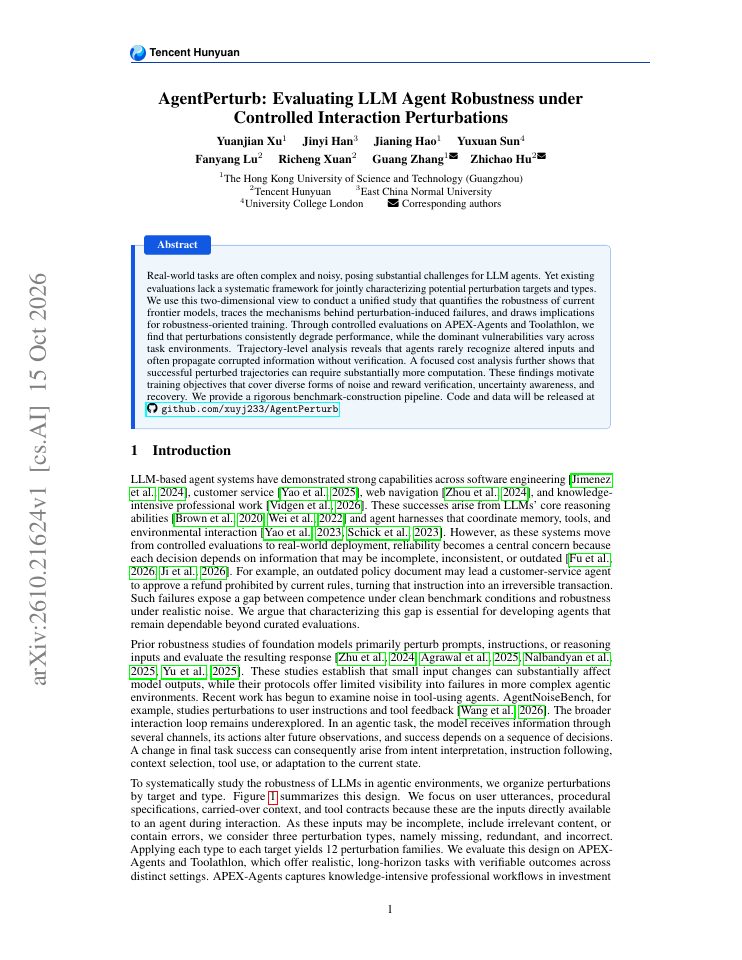
First page of AgentPerturb: Evaluating LLM Agent Robustness under Controlled Interaction Perturbations
agent evaluationtest

AgentPerturb: Evaluating LLM Agent Robustness under Controlled Interaction Perturbations

AgentPerturb replaces ad hoc agent evaluation with a two-dimensional perturbation framework (targets by types) applied to APEX-Agents and Toolathlon trajectories. It costs evaluation budget rather than training: constructing perturbed task variants and running multi-step agent rollouts against third-party APIs or a local model, which fits constrained infrastructure but adds benchmark-construction and inference expense. It can fail as a guide to practice if perturbation types do not match the reader's actual production noise distribution, and its findings indicate agents rarely detect corrupted inputs, so robustness gains require separate training or verification logic that this benchmark alone does not provide.

observed signal
1impl.
132stars
0citations
—claimed gain
abstract onlyReview decisionDownload skill ↓Original paper ↗
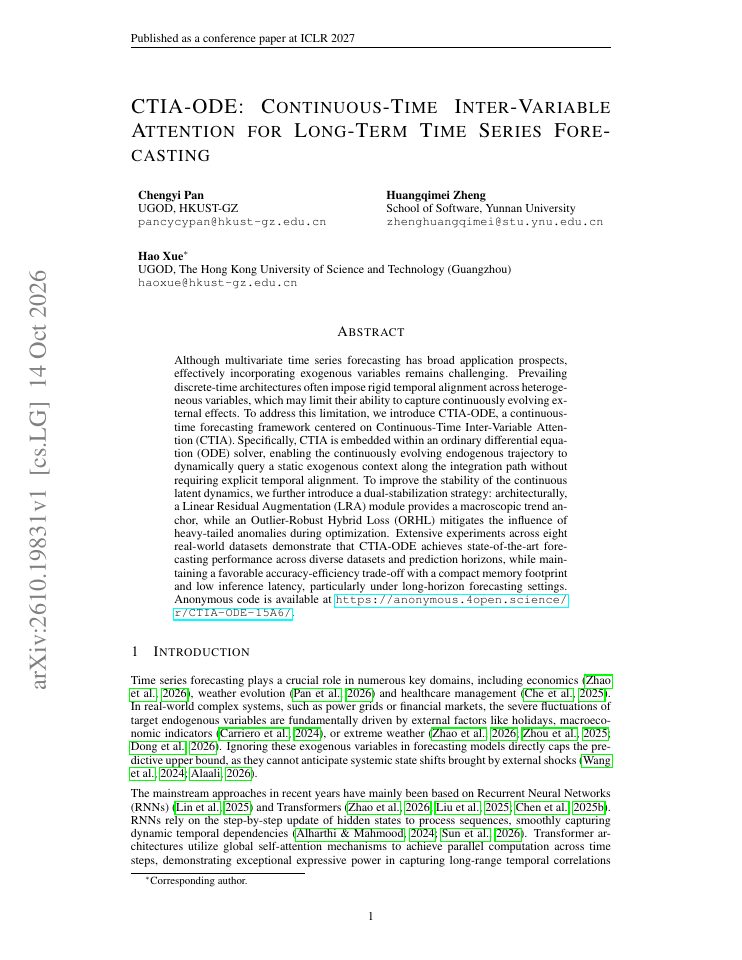
First page of CTIA-ODE: Continuous-Time Inter-Variable Attention for Long-Term Time Series Forecasting
othertest

CTIA-ODE: Continuous-Time Inter-Variable Attention for Long-Term Time Series Forecasting

The method replaces discrete-time multivariate forecasting architectures (e.g., Transformer-based or linear channel-mixing models) that require rigid temporal alignment of exogenous variables with a neural-ODE framework in which attention over a static exogenous context is evaluated continuously along the integration path, plus a linear residual anchor and an outlier-robust loss. Costs include ODE-solver compute at training and inference time (which scales with the number of solver steps and can exceed the latency of a single forward pass despite the claimed efficiency), implementation complexity, and dependence on anonymous, non-production code. Failure modes include unstable latent dynamics on noisy or heavy-tailed series despite the dual stabilization, poor transfer when exogenous variables are themselves time-varying or misaligned with the assumed static context, and the general risk that eight-dataset benchmarks do not reflect the reader's domain.

observed signal
0impl.
0stars
0citations
—claimed gain
abstract onlyReview decisionDownload skill ↓Original paper ↗
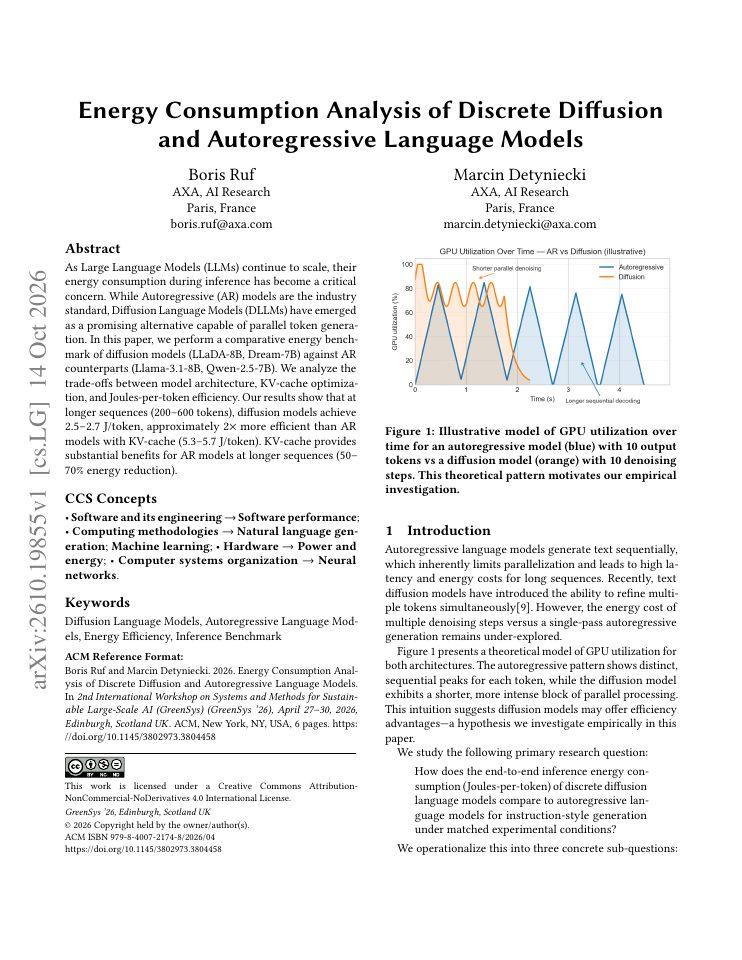
First page of Energy Consumption Analysis of Discrete Diffusion and Autoregressive Language Models
efficient architectureswatch

Energy Consumption Analysis of Discrete Diffusion and Autoregressive Language Models

This is a measurement study, not a deployable method: it compares diffusion language models against standard autoregressive inference with KV-cache on energy per token. Adopting diffusion LLMs would replace the AR serving stack and its mature KV-cache, batching, and quantization tooling with an immature inference pipeline whose parallelism benefits depend on sequence length and batch conditions. What can fail: the energy advantage may not survive real serving workloads, available diffusion models (7-8B, limited post-training) lag AR counterparts in output quality and instruction following, and there is no production-grade serving infrastructure for them on a single 24 GB GPU.

observed signal
0impl.
0stars
—citations
2xclaimed gain
abstract onlyReview decisionDownload skill ↓Original paper ↗
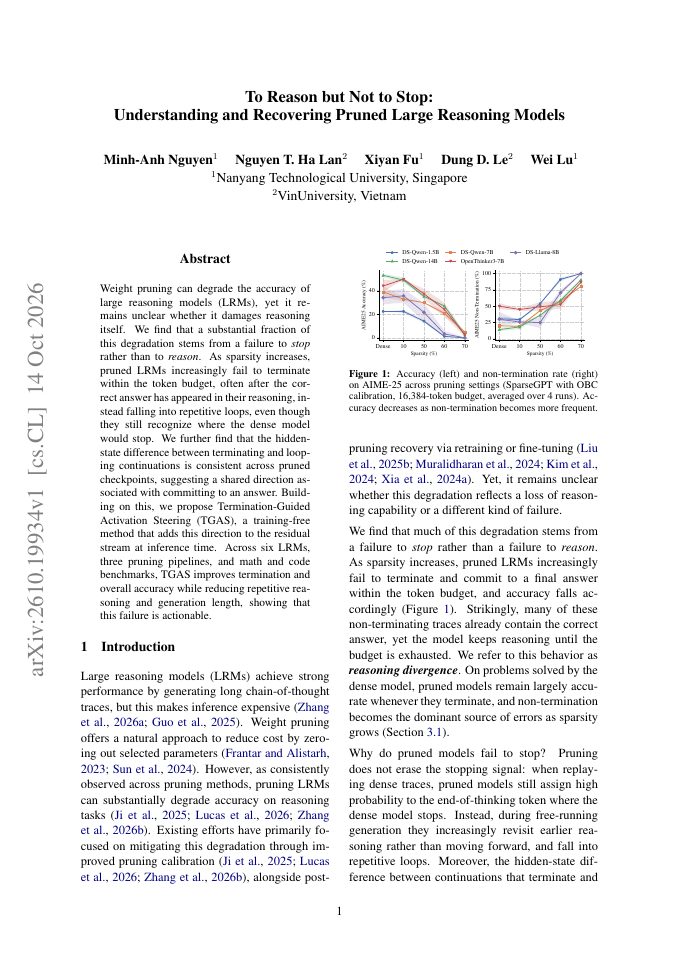
First page of To Reason but Not to Stop: Understanding and Recovering Pruned Large Reasoning Models
sparsity and pruningtest

To Reason but Not to Stop: Understanding and Recovering Pruned Large Reasoning Models

TGAS replaces retraining or abandoning pruned reasoning models by adding a learned-free, training-free steering direction to the residual stream at inference time to restore termination behavior. It costs a one-time extraction of a hidden-state direction from terminating versus looping continuations plus a small per-token activation addition, with negligible memory and latency overhead. It can fail if the shared termination direction does not transfer to a new pruning recipe, model, or domain, and it only recovers accuracy lost to non-termination, leaving any genuine reasoning degradation from pruning unaddressed.

observed signal
0impl.
0stars
0citations
—claimed gain
abstract onlyReview decisionDownload skill ↓Original paper ↗
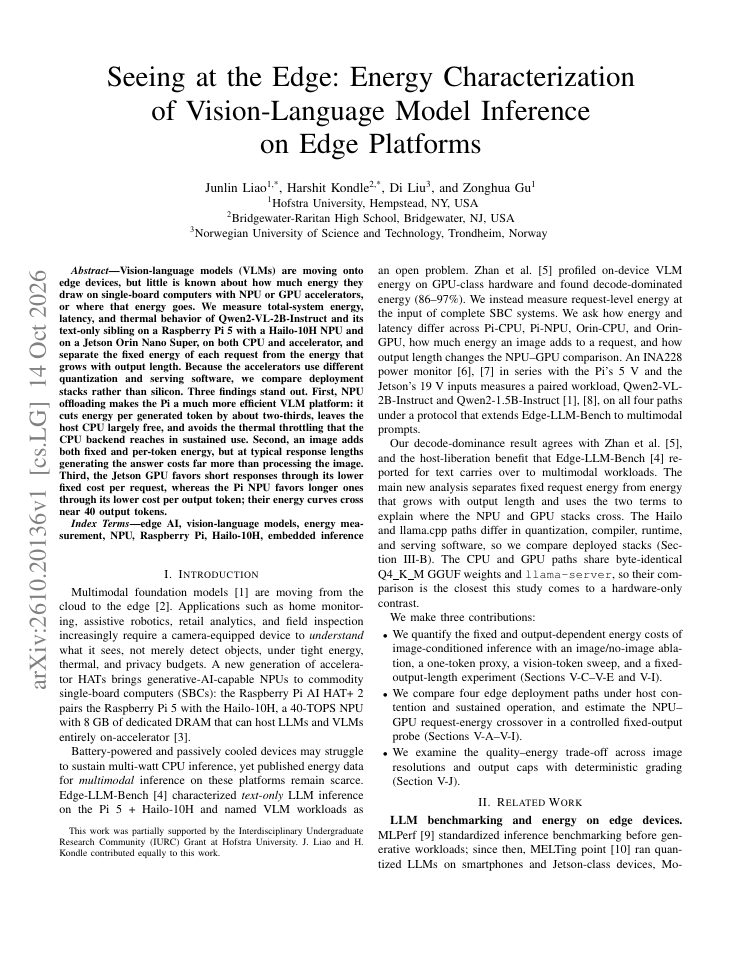
First page of Seeing at the Edge: Energy Characterization of Vision-Language Model Inference on Edge Platforms
serving and batchingwatch

Seeing at the Edge: Energy Characterization of Vision-Language Model Inference on Edge Platforms

The paper does not propose a method; it replaces intuition-based edge platform selection with measured per-request fixed energy and per-token marginal energy for Qwen2-VL-2B across CPU, NPU, and GPU deployment stacks. Adopting its guidance costs nothing beyond reading, but acting on it requires purchasing specific edge hardware (Pi 5 plus Hailo-10H, or Jetson Orin Nano) and accepting stack-specific quantization. The findings can fail to transfer because the comparison conflates silicon with quantization and serving software, covers a single 2B model, and the crossover near 40 output tokens shifts with response-length distribution and model choice.

observed signal
0impl.
0stars
0citations
3xclaimed gain
abstract onlyReview decisionDownload skill ↓Original paper ↗
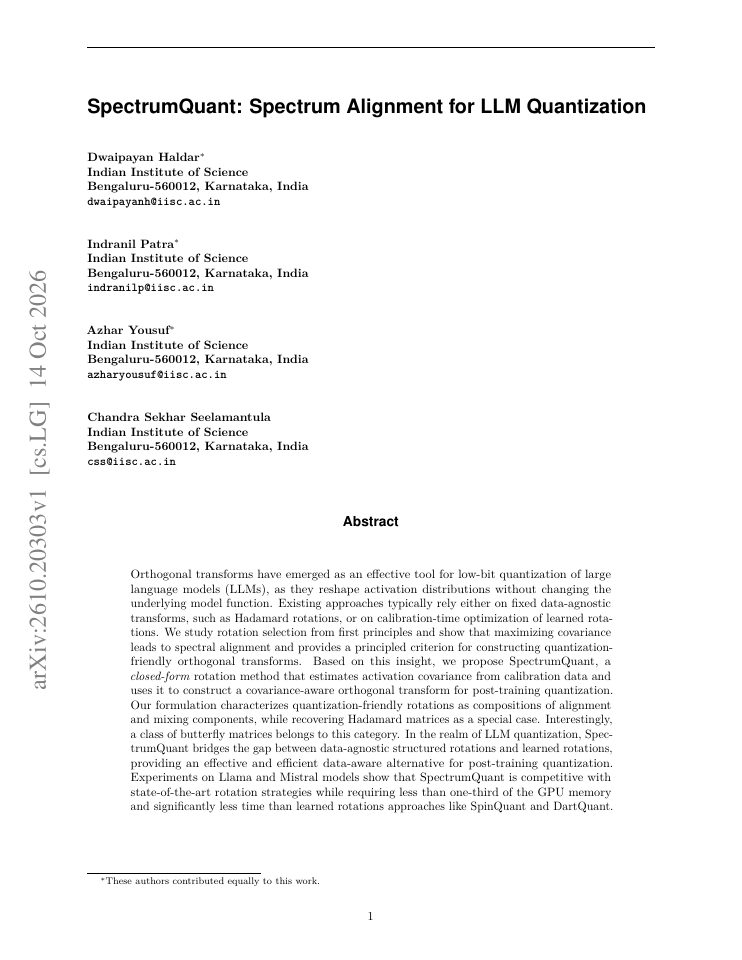
First page of SpectrumQuant: Spectrum Alignment for LLM Quantization
quantizationtest

SpectrumQuant: Spectrum Alignment for LLM Quantization

SpectrumQuant replaces calibration-time optimized learned rotations (SpinQuant, DartQuant) with a closed-form orthogonal transform built from estimated activation covariance, bridging fixed Hadamard rotations and learned rotations for post-training quantization. It costs a calibration pass to estimate covariance and adds the transform computation, but uses less than one-third of the GPU memory of learned-rotation approaches and no rotation training. It can fail if the calibration data is unrepresentative of deployment inputs, since the covariance estimate and thus the rotation quality are data-dependent, and it remains a low-bit PTQ method subject to the usual accuracy degradation at aggressive bit-widths.

observed signal
0impl.
0stars
0citations
3xclaimed gain
abstract onlyReview decisionDownload skill ↓Original paper ↗
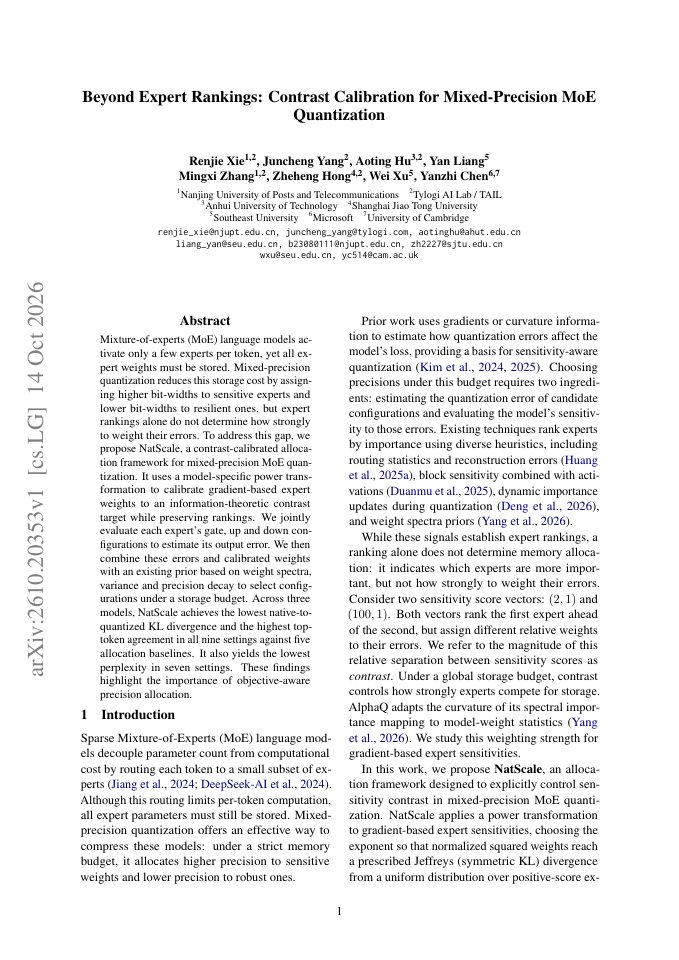
First page of Beyond Expert Rankings: Contrast Calibration for Mixed-Precision MoE Quantization
quantizationtest

Beyond Expert Rankings: Contrast Calibration for Mixed-Precision MoE Quantization

It replaces rank-only or heuristic expert bit-width assignment with a storage-budget allocator that preserves expert rankings but recalibrates their gradient weights toward an information-theoretic contrast target while scoring gate, up, and down projections jointly. The cost is an offline calibration and search pipeline: model-specific power-transform fitting, per-expert error estimation across three configurations, combination with spectra/variance/precision-decay priors, and added deployment metadata rather than a simple uniform quantizer. It can fail if the contrast target misweights experts for a specific workload, if the joint gate/up/down error estimate does not transfer to production data, or in the minority of settings where perplexity does not improve despite better KL and token agreement.

observed signal
0impl.
81stars
0citations
—claimed gain
abstract onlyReview decisionDownload skill ↓Original paper ↗
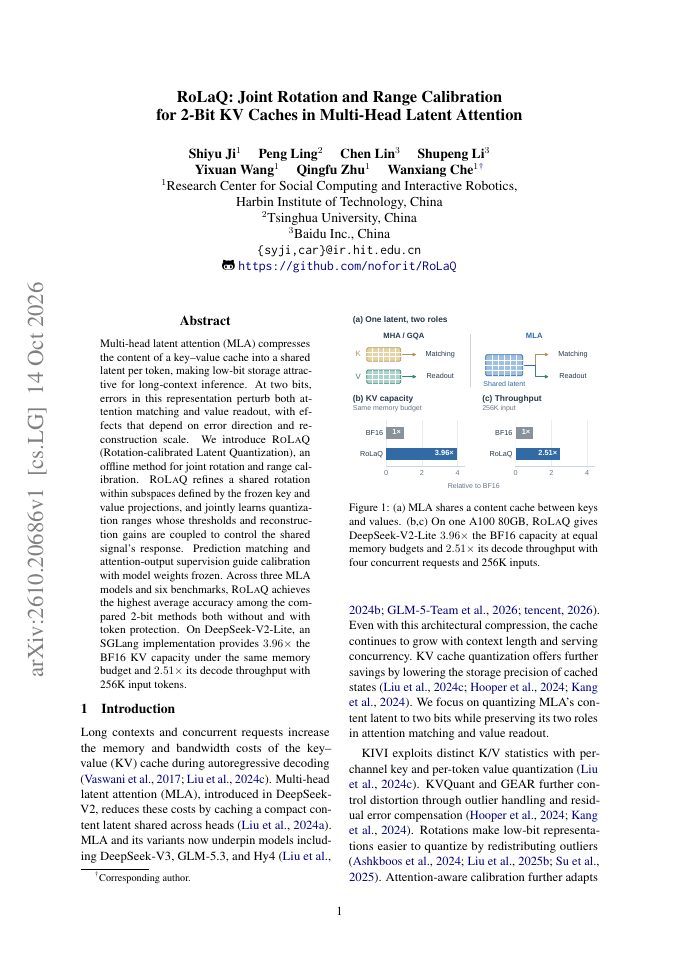
First page of RoLaQ: Joint Rotation and Range Calibration for 2-Bit KV Caches in Multi-Head Latent Attention
KV cachetest

RoLaQ: Joint Rotation and Range Calibration for 2-Bit KV Caches in Multi-Head Latent Attention

RoLaQ replaces BF16 or coarser 2-bit KV cache storage in multi-head latent attention with an offline joint rotation and quantization-range calibration, keeping model weights frozen. The cost is a one-time calibration procedure with prediction-matching and attention-output supervision, plus reliance on a custom SGLang implementation; runtime cost is a rotation applied to the latent cache. It can fail on models without MLA architecture, when the calibration data does not match the deployment distribution, or if the SGLang kernels are unavailable for the reader's serving stack.

observed signal
0impl.
4stars
0citations
3.96xclaimed gain
abstract onlyReview decisionDownload skill ↓Original paper ↗
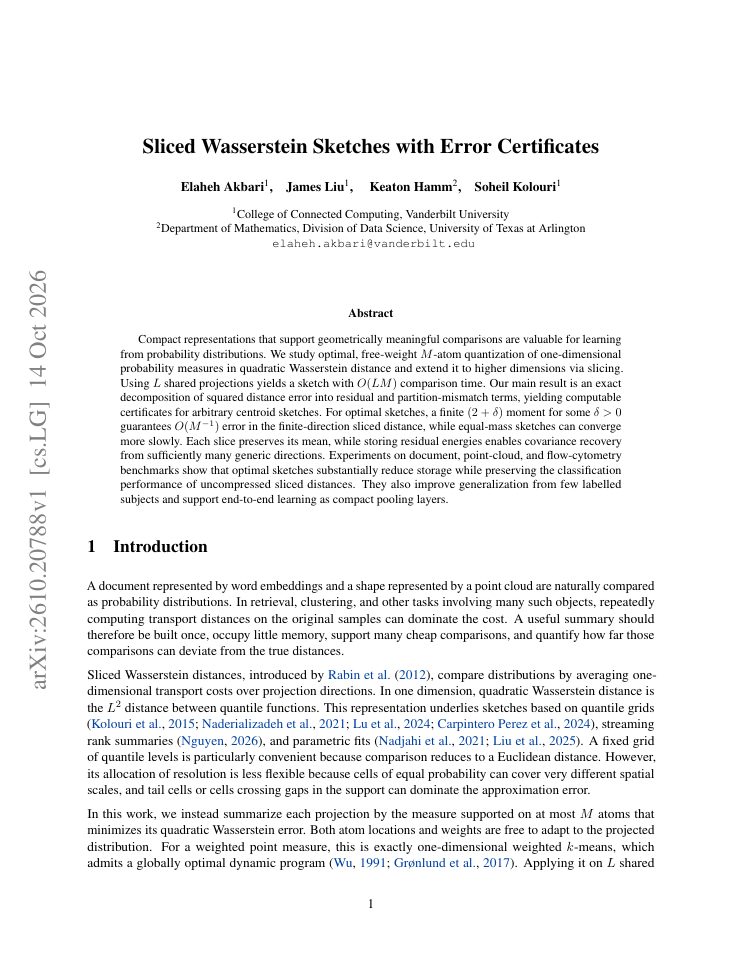
First page of Sliced Wasserstein Sketches with Error Certificates
othertest

Sliced Wasserstein Sketches with Error Certificates

The method replaces storing and comparing full empirical distributions (or large equal-mass quantizations) in sliced Wasserstein pipelines with optimal free-weight M-atom quantizations per projection, costing O(LM) comparison time and the implementation complexity of the quantization plus residual-energy bookkeeping. It adds certified error bounds and covariance recovery from residual energies, but equal-mass sketches can converge more slowly than the O(M^{-1}) rate for optimal sketches. It can fail when the finite (2+delta) moment assumption does not hold, when too few projections are used for covariance recovery, or when the workload does not actually compare probability distributions, making the machinery irrelevant.

observed signal
0impl.
0stars
0citations
—claimed gain
abstract onlyReview decisionDownload skill ↓Original paper ↗
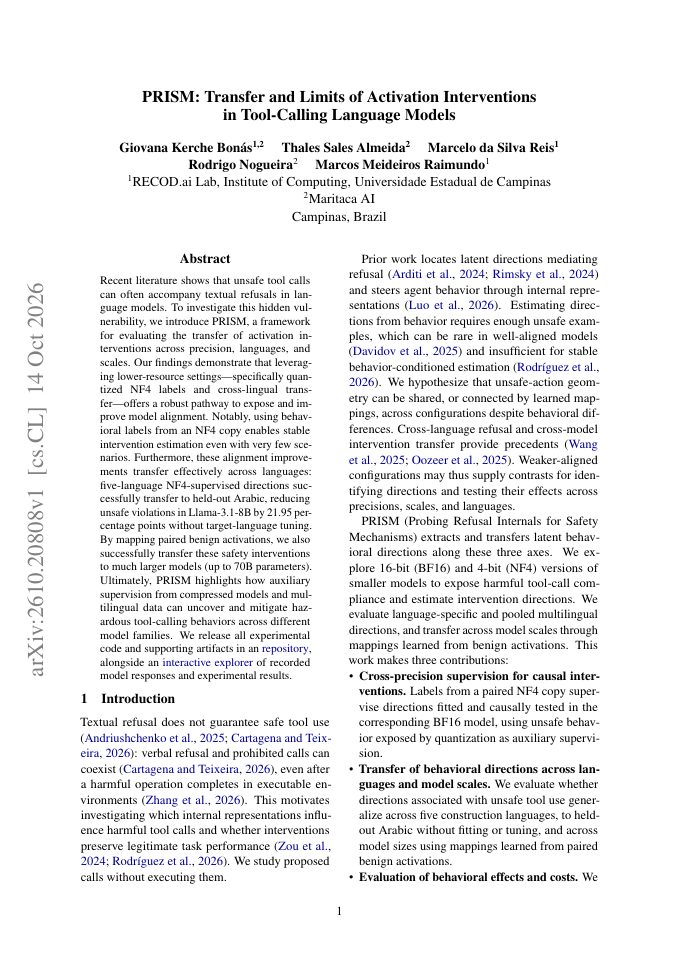
First page of PRISM: Transfer and Limits of Activation Interventions in Tool-Calling Language Models
safety and guardrailstest

PRISM: Transfer and Limits of Activation Interventions in Tool-Calling Language Models

Replaces prompt-level guardrails or safety fine-tuning with inference-time activation interventions whose steering directions are estimated from a quantized NF4 copy and transferred across languages and model scales. Costs are activation-access instrumentation, per-direction estimation experiments, and a residual inference overhead, all feasible on a single 24 GB GPU for 8B-class open models but requiring weight access that third-party APIs do not provide. Can fail when directions estimated on few scenarios do not generalize to unseen tools or domains, when interventions degrade benign tool-calling behavior, or when transfer to larger models (up to 70B) exceeds the available memory budget.

observed signal
0impl.
122stars
0citations
—claimed gain
abstract onlyReview decisionDownload skill ↓Original paper ↗
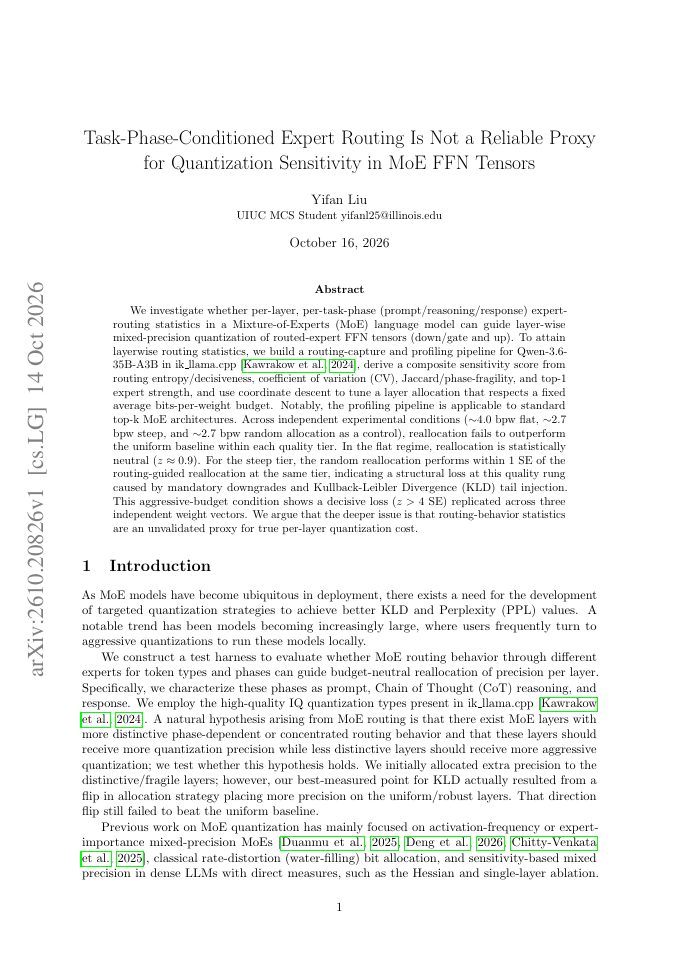
First page of Task-Phase-Conditioned Expert Routing Is Not a Reliable Proxy for Quantization Sensitivity in MoE FFN Tensors
quantizationnot applicable

Task-Phase-Conditioned Expert Routing Is Not a Reliable Proxy for Quantization Sensitivity in MoE FFN Tensors

The method replaces uniform (flat) bit-width allocation for MoE expert FFN tensors with layer-wise allocation derived from routing statistics (entropy, CV, Jaccard phase-fragility, top-1 strength), tuned by coordinate descent under a fixed average bpw budget. It costs a custom routing-capture and profiling pipeline in a modified inference runtime plus tuning compute, with no measured quality benefit over uniform quantization. What fails is the core premise: routing behavior is an unvalidated proxy for per-layer quantization cost, so guided allocation performs no better than random reallocation, and aggressive budgets lose quality regardless of allocation strategy.

observed signal
0impl.
0stars
—citations
—claimed gain
abstract onlyReview decisionDownload skill ↓Original paper ↗
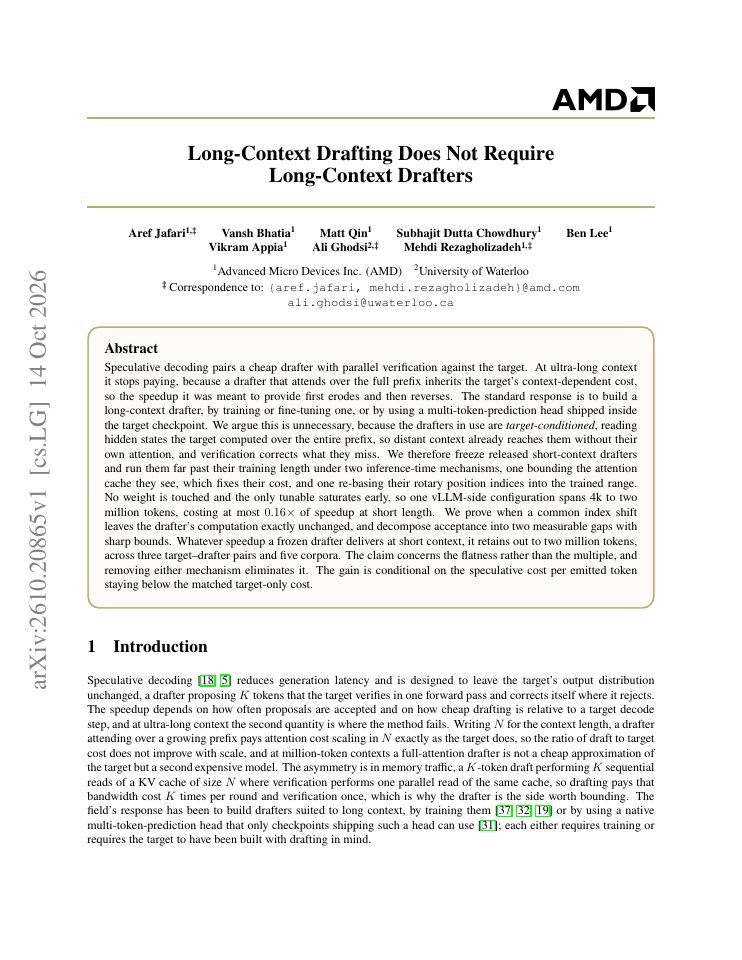
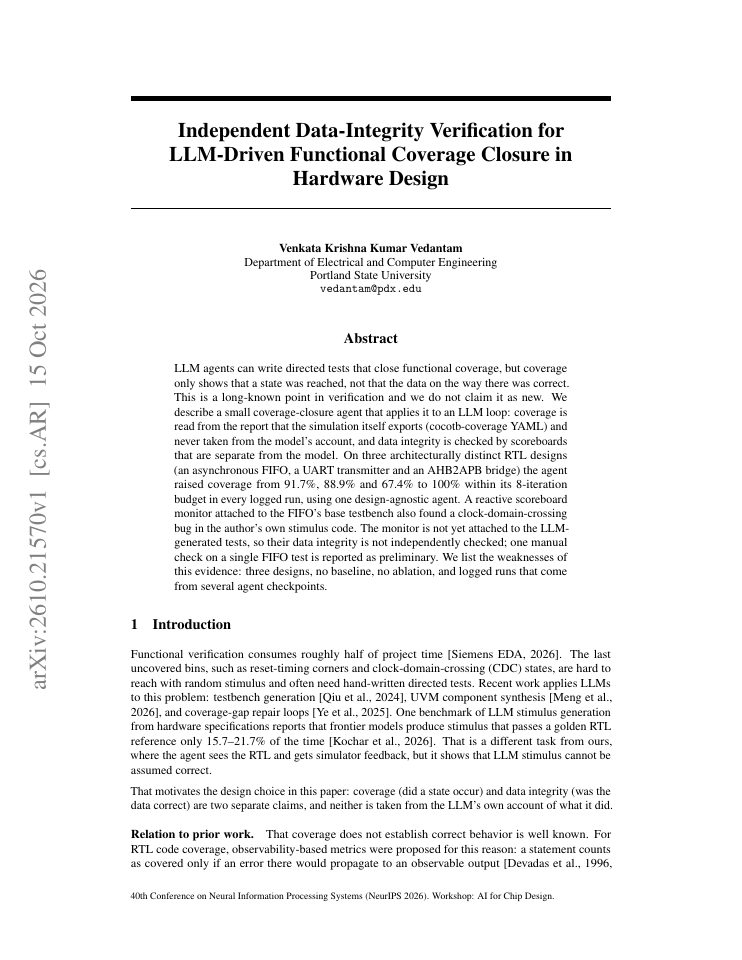
First page of Long-Context Drafting Does Not Require Long-Context Drafters
speculative decodingadopt

Long-Context Drafting Does Not Require Long-Context Drafters

Replaces training or fine-tuning a long-context drafter (or shipping a multi-token head) by reusing released short-context drafters with two inference-time mechanisms: bounding the drafter's attention cache and re-basing rotary indices into the trained range, implemented as one vLLM-side configuration. No weights are modified, the single tunable saturates early, and drafter compute cost becomes constant rather than growing with context. Adoption fails if the speculative cost per emitted token exceeds matched target-only cost, if either mechanism is removed, or when no compatible released drafter exists for the target model.

observed signal
0impl.
0stars
0citations
—claimed gain
abstract onlyReview decisionDownload skill ↓Original paper ↗
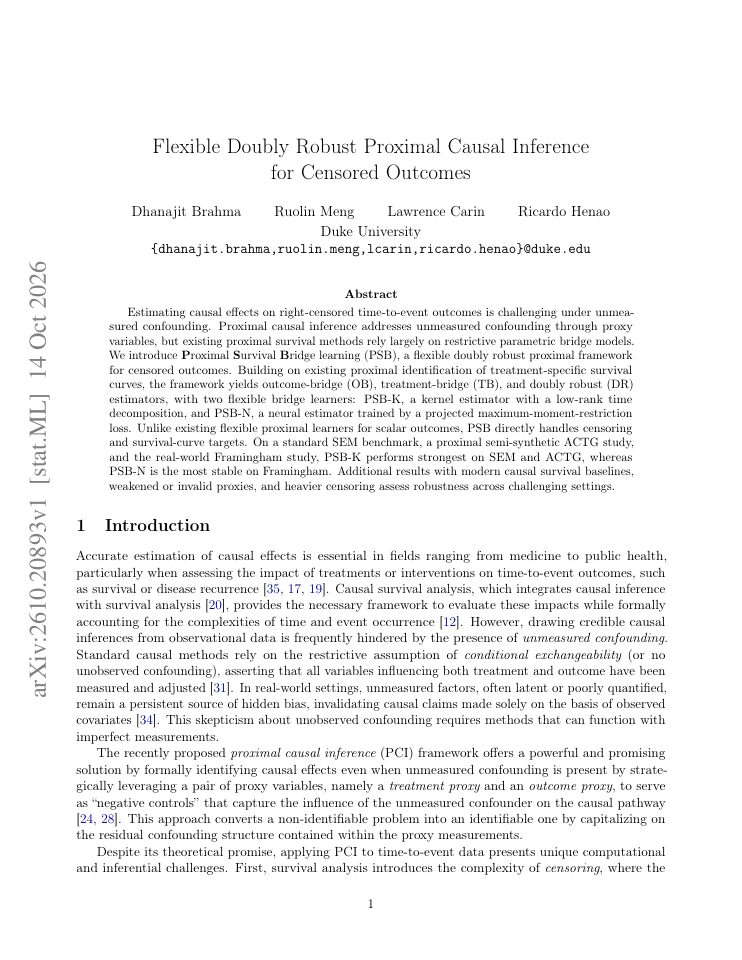
First page of Flexible Doubly Robust Proximal Causal Inference for Censored Outcomes
othernot applicable

Flexible Doubly Robust Proximal Causal Inference for Censored Outcomes

PSB replaces parametric bridge models in proximal causal inference for right-censored time-to-event outcomes with flexible kernel (PSB-K) and neural (PSB-N) bridge learners offering doubly robust estimation of survival curves. The cost is substantial statistical engineering: it requires valid proxy variables for unmeasured confounding, careful bridge-function estimation, and specialized survival-analysis expertise rather than any GPU or serving infrastructure. It can fail when proxies are weakened or invalid, under heavy censoring, and its benchmark advantages are dataset-dependent (PSB-K wins on SEM/ACTG, PSB-N on Framingham), so no estimator is uniformly reliable.

observed signal
0impl.
0stars
0citations
—claimed gain
abstract onlyReview decisionDownload skill ↓Original paper ↗
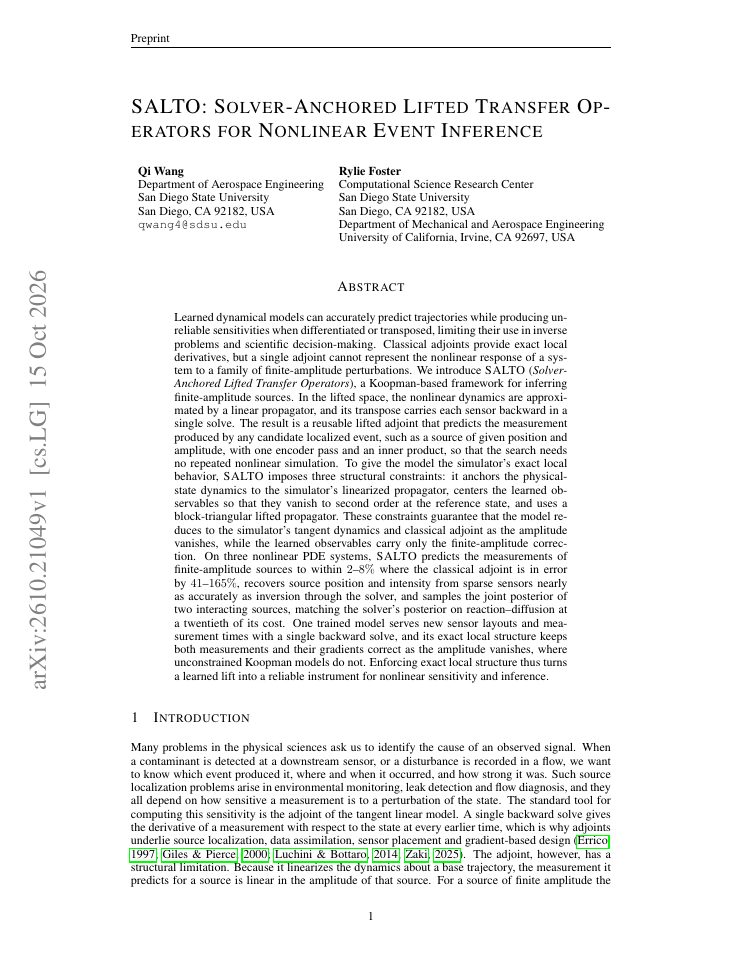
First page of SALTO: Solver-Anchored Lifted Transfer Operators for Nonlinear Event Inference
otherwatch

SALTO: Solver-Anchored Lifted Transfer Operators for Nonlinear Event Inference

SALTO replaces repeated forward/adjoint solves through a numerical PDE simulator for finite-amplitude source inversion with a single trained Koopman model whose lifted transpose propagates sensors backward in one solve and answers candidate events with an encoder pass and an inner product. The cost is an offline training stage plus three structural constraints (anchoring to the simulator's linearized propagator, centered observables, block-triangular propagator), which require access to the simulator's tangent linearization and observable training data. It can fail when events are far outside the training amplitude or location distribution, when no differentiable simulator or its linearization is available, and its accuracy guarantees hold only in the vanishing-amplitude limit rather than for arbitrary perturbations.

observed signal
0impl.
0stars
0citations
20xclaimed gain
abstract onlyReview decisionDownload skill ↓Original paper ↗
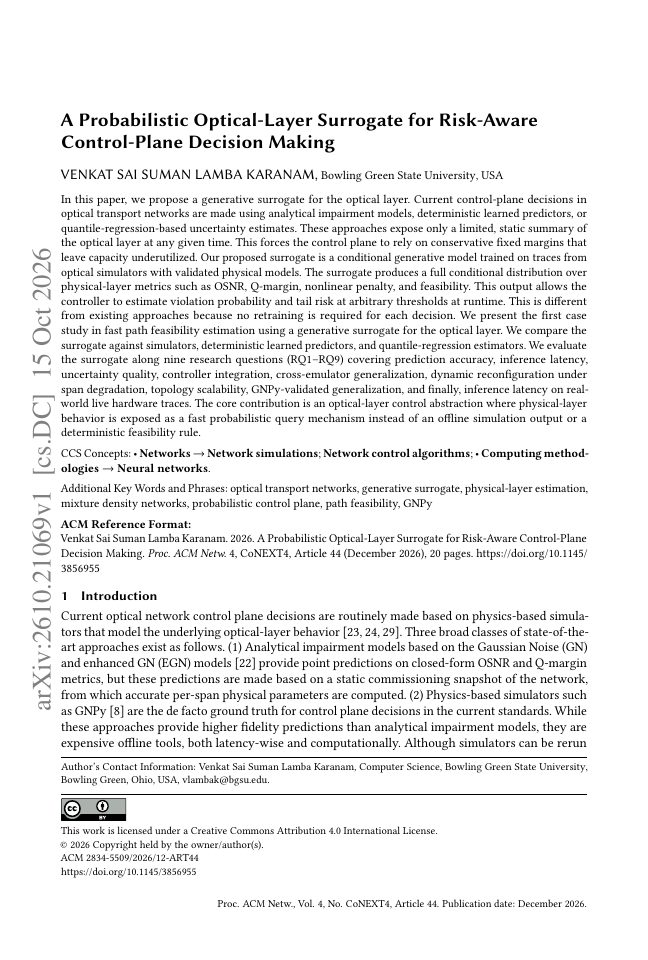
First page of Probabilistic Optical-Layer Surrogate for Risk-Aware Control-Plane Decision Making
othernot applicable

Probabilistic Optical-Layer Surrogate for Risk-Aware Control-Plane Decision Making

The method replaces analytical impairment models, deterministic learned predictors, and quantile-regression estimates in optical transport control planes with a conditional generative model that outputs full distributions over OSNR, Q-margin, and feasibility, enabling runtime tail-risk queries without per-decision retraining. The cost is training on validated optical simulator traces plus integration into a network controller, with inference latency claimed as low enough for live decision making but not quantified in the abstract. It can fail through distribution shift between simulator training traces and real hardware behavior, despite the paper's cross-emulator and GNPy validation studies.

observed signal
0impl.
0stars
0citations
—claimed gain
abstract onlyReview decisionDownload skill ↓Original paper ↗
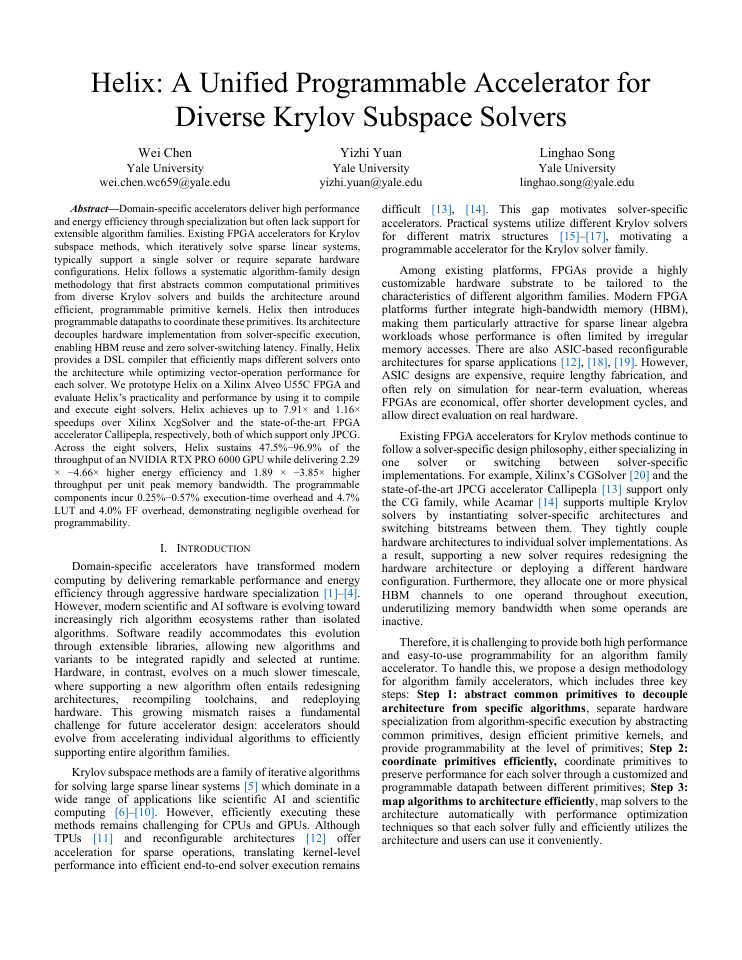
First page of Helix: A Unified Programmable Accelerator for Diverse Krylov Subspace Solvers
othernot applicable

Helix: A Unified Programmable Accelerator for Diverse Krylov Subspace Solvers

Helix replaces single-solver or reconfiguration-per-solver FPGA designs for Krylov subspace methods with a unified programmable architecture built on shared computational primitives, a DSL compiler, and programmable datapaths. It costs an FPGA prototyping flow (Xilinx Alveo U55C class hardware with HBM), a custom DSL toolchain, and 4.7% LUT / 4.0% FF plus 0.25%-0.57% execution-time overhead for programmability. It can fail for the reader because it addresses sparse linear system solving in scientific computing, not LLM inference or training, and requires FPGA hardware and HLS expertise that a GPU-and-API-constrained ML team does not possess.

observed signal
0impl.
0stars
0citations
7.91xclaimed gain
abstract onlyReview decisionDownload skill ↓Original paper ↗
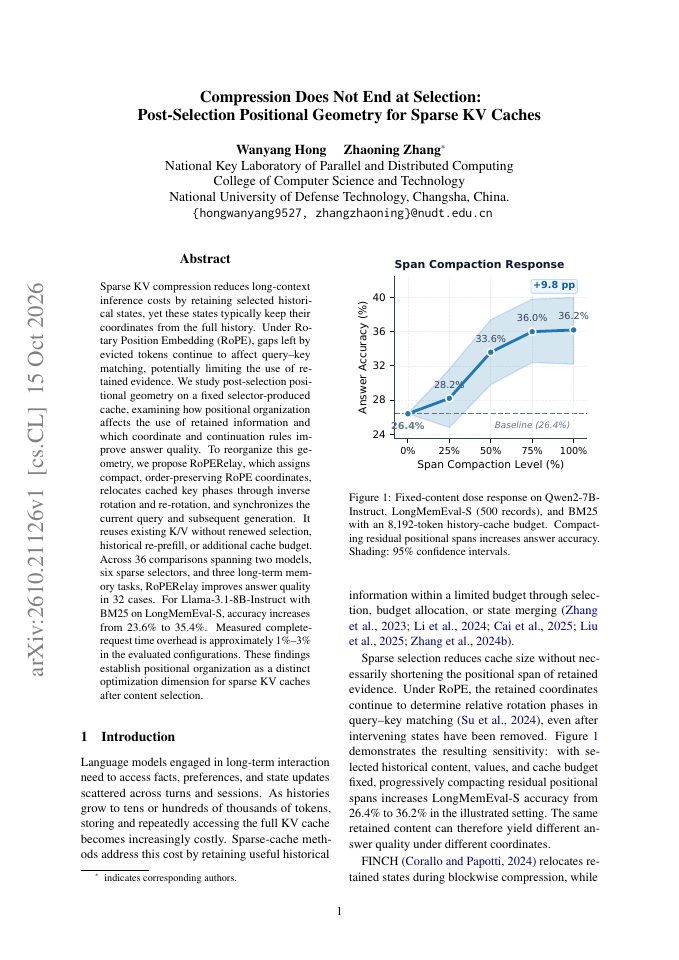
First page of Compression Does Not End at Selection: Post-Selection Positional Geometry for Sparse KV Caches
KV cachetest

Compression Does Not End at Selection: Post-Selection Positional Geometry for Sparse KV Caches

RoPERelay replaces the default practice of retaining original full-history RoPE coordinates in a sparse KV cache; after selection, it compacts coordinates in an order-preserving way by inverse-rotating and re-rotating cached key phases and synchronizing the current query, without renewed selection, re-prefill, or extra cache budget. It costs roughly 1%-3% additional request latency in the evaluated configurations plus implementation complexity in the inference path, with no extra memory or cache footprint. It can fail if the serving stack does not expose per-key positional manipulation, if the model uses non-RoPE positional schemes, or if gains do not transfer beyond the evaluated long-term memory tasks and selectors to the reader's workloads.

observed signal
0impl.
122stars
0citations
—claimed gain
abstract onlyReview decisionDownload skill ↓Original paper ↗

Research signals

Three views of the same evidence: adoption against attention, publication cadence by research area, and reported gains when coverage is sufficient.

color = research area

01 · attention × adoption

The research frontier

Look to the upper left for independent implementation before mass attention.

compare by
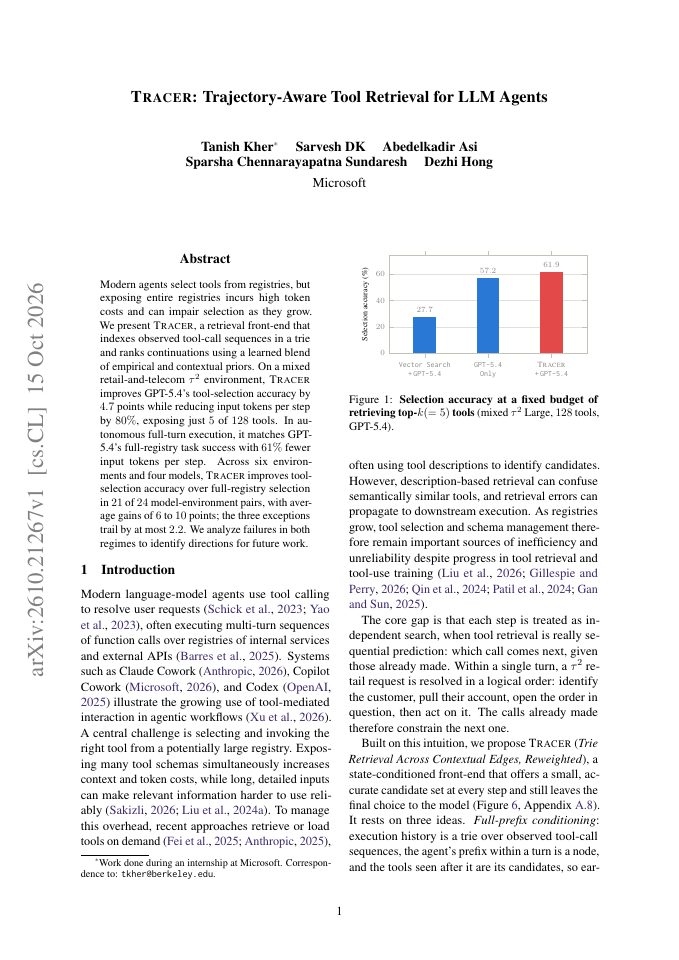
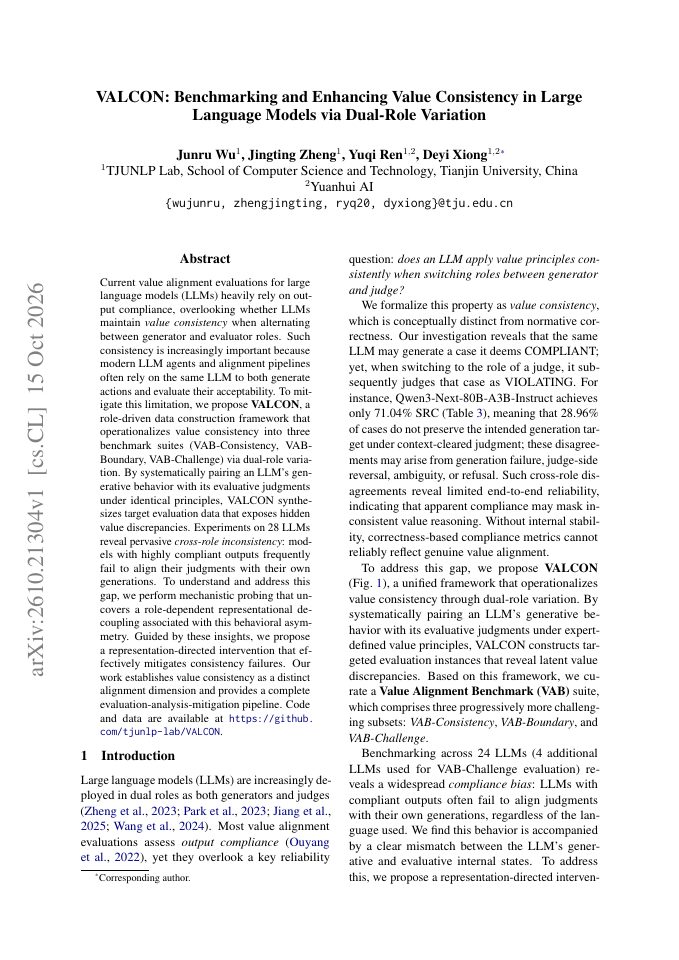
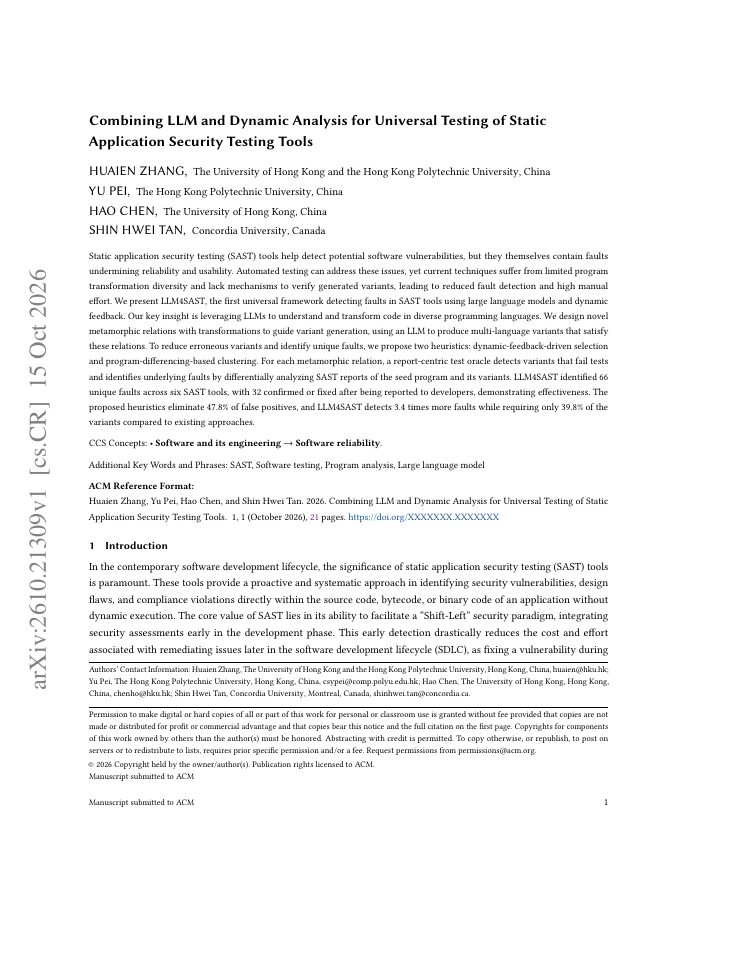
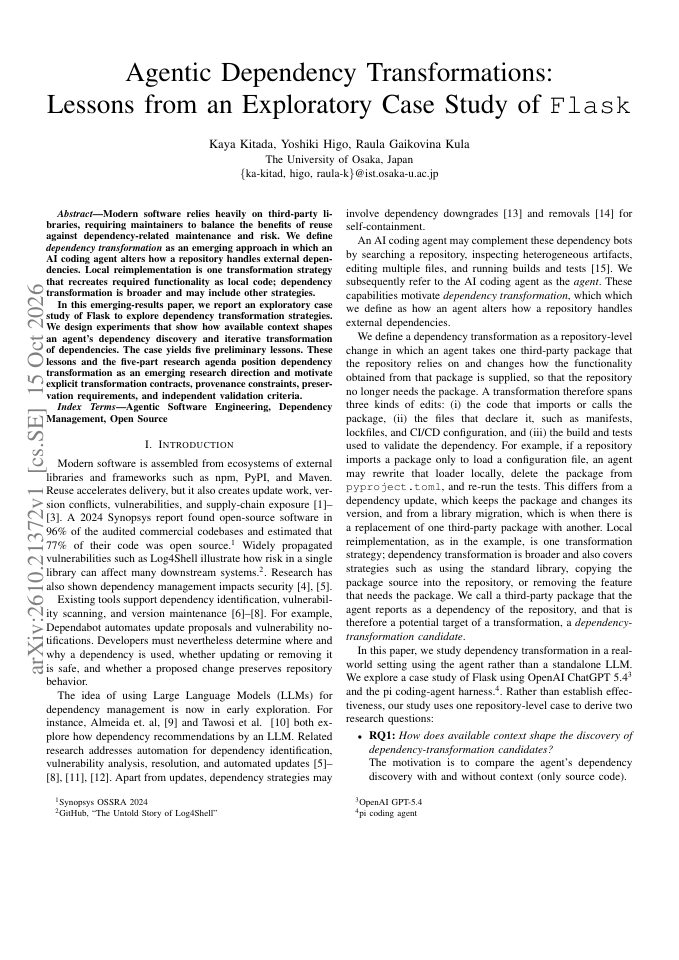
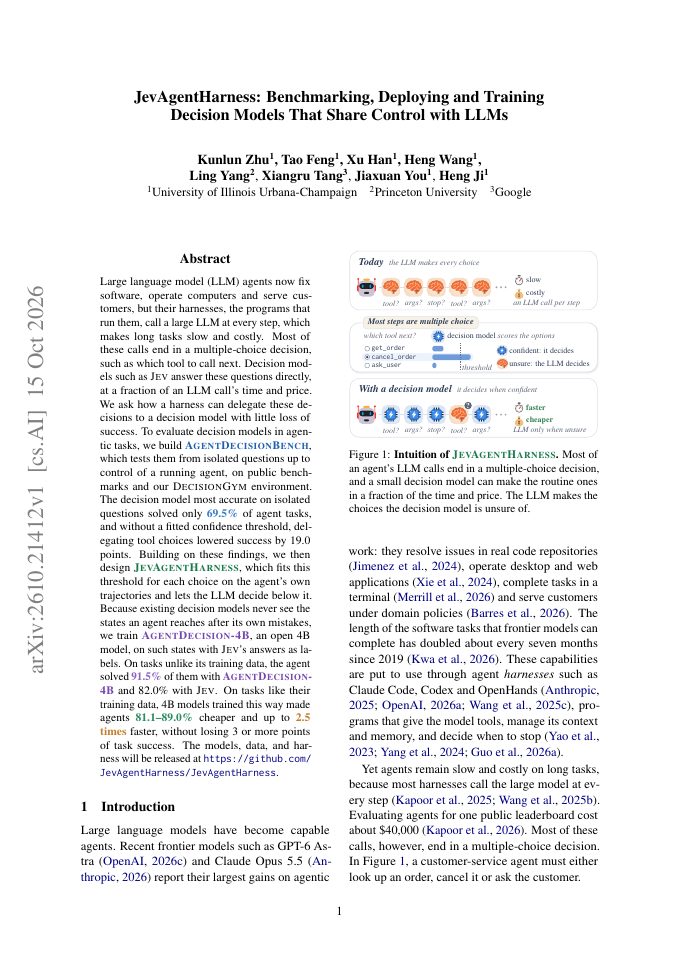
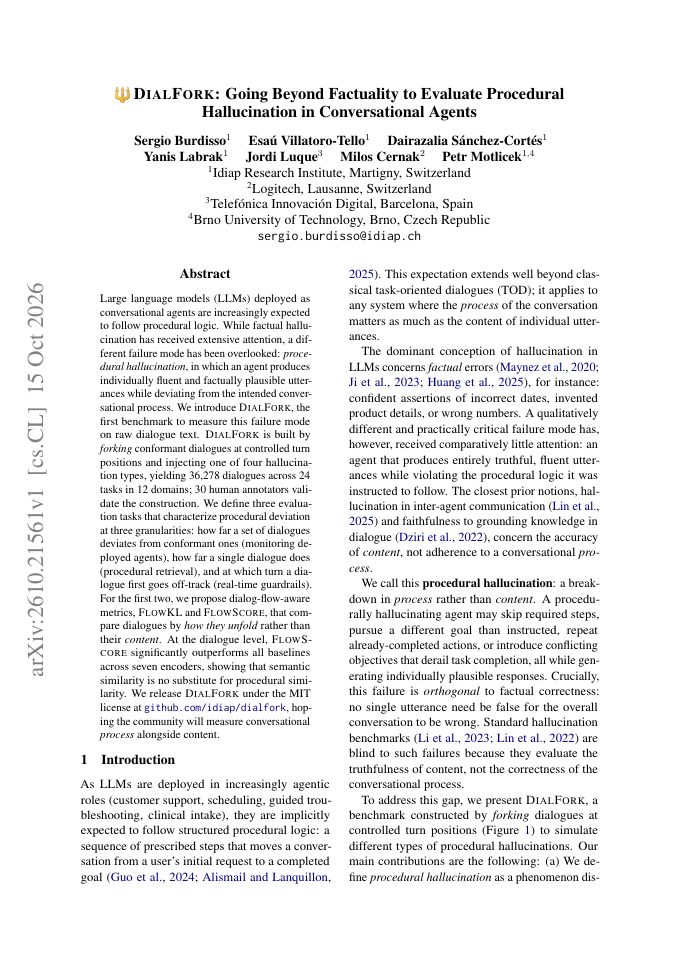
Each point represents one paper. Higher means more independent implementations; farther right means more GitHub stars.Self Improvement via Fast Tree-search: 9 GitHub stars; 1 independent implementationRed-Teaming Auto Mode: Improving Blocking Classifiers Against Malign Coding Agents: 0 GitHub stars; 2 independent implementationsCTIA-ODE: Continuous-Time Inter-Variable Attention for Long-Term Time Series Forecasting: 0 GitHub stars; 0 independent implementationsEnergy Consumption Analysis of Discrete Diffusion and Autoregressive Language Models: 0 GitHub stars; 0 independent implementationsTo Reason but Not to Stop: Understanding and Recovering Pruned Large Reasoning Models: 0 GitHub stars; 0 independent implementationsSeeing at the Edge: Energy Characterization of Vision-Language Model Inference on Edge Platforms: 0 GitHub stars; 0 independent implementationsSpectrumQuant: Spectrum Alignment for LLM Quantization: 0 GitHub stars; 0 independent implementationsBeyond Expert Rankings: Contrast Calibration for Mixed-Precision MoE Quantization: 81 GitHub stars; 0 independent implementationsRoLaQ: Joint Rotation and Range Calibration for 2-Bit KV Caches in Multi-Head Latent Attention: 4 GitHub stars; 0 independent implementationsOn-Policy Residual Learning for Diffusion Language Models: 35 GitHub stars; 3 independent implementationsSliced Wasserstein Sketches with Error Certificates: 0 GitHub stars; 0 independent implementationsPRISM: Transfer and Limits of Activation Interventions in Tool-Calling Language Models: 122 GitHub stars; 0 independent implementationsTask-Phase-Conditioned Expert Routing Is Not a Reliable Proxy for Quantization Sensitivity in MoE FFN Tensors: 0 GitHub stars; 0 independent implementationsLong-Context Drafting Does Not Require Long-Context Drafters: 0 GitHub stars; 0 independent implementationsFlexible Doubly Robust Proximal Causal Inference for Censored Outcomes: 0 GitHub stars; 0 independent implementationsSALTO: Solver-Anchored Lifted Transfer Operators for Nonlinear Event Inference: 0 GitHub stars; 0 independent implementationsProbabilistic Optical-Layer Surrogate for Risk-Aware Control-Plane Decision Making: 0 GitHub stars; 0 independent implementationsHelix: A Unified Programmable Accelerator for Diverse Krylov Subspace Solvers: 0 GitHub stars; 0 independent implementationsCompression Does Not End at Selection: Post-Selection Positional Geometry for Sparse KV Caches: 122 GitHub stars; 0 independent implementationsFrom Long Context to Selective Memory:A Survey of Memory-Centric Compression for Large Language Models: 128 GitHub stars; 2 independent implementationsMemScope: Evolving Agent Memory Architectures through Localized Code Repair: 136 GitHub stars; 2 independent implementationsAgentEval: Evidence-Bounded Assessment of Stateful Agents: 136 GitHub stars; 2 independent implementationsHard Way, The Only Way: Provable Merits of Training on Hardest Examples: 4 GitHub stars; 0 independent implementationsAutoOnboarder: Autonomously Onboarding LLM Agents: 132 GitHub stars; 1 independent implementationFractional Power-of-Two Quantization for Efficient and Effective Multiplier-Free LLM Inference: 0 GitHub stars; 0 independent implementationsTRACER: A Multimodal Harness for Patient Care in Hospitals: 0 GitHub stars; 0 independent implementationsTRACER: Trajectory-Aware Tool Retrieval for LLM Agents: 10 GitHub stars; 0 independent implementationsMallea: Building, Steering, and Memorizing Worlds with Coding Agent: 136 GitHub stars; 2 independent implementationsVALCON: Benchmarking and Enhancing Value Consistency in Large Language Models via Dual-Role Variation: 122 GitHub stars; 0 independent implementationsCombining LLM and Dynamic Analysis for Universal Testing of Static Application Security Testing Tools: 0 GitHub stars; 0 independent implementationsSWE-at-Scale: Scalable Issue Synthesis from Historical Bug Fixes: 4 GitHub stars; 2 independent implementationsAgentic Dependency Transformations: Lessons from an Exploratory Case Study of Flask: 4 GitHub stars; 0 independent implementationsEvaluating and Improving Static Application Security Testing Tools for Rust: 0 GitHub stars; 0 independent implementationsMemCut: Every Secret Leaves a Trail in the Long-Term Memory of LLM Agents: 136 GitHub stars; 2 independent implementationsJevAgentHarness: Benchmarking, Deploying and Training Decision Models That Share Control with LLMs: 1637 GitHub stars; 4 independent implementationsIncentivizing Tool-Use Reinforcement Learning for Post-Arrival Emergency Care Prediction: 136 GitHub stars; 2 independent implementationsTrajectory-Level Speculation with Semantic Verification for Tool-Using Agents: 153 GitHub stars; 3 independent implementationsAgent Status Protocol (ASP): A Lightweight Specification for State Reporting in Multi-Agent Systems: 132 GitHub stars; 1 independent implementationDialFork: Going Beyond Factuality to Evaluate Procedural Hallucination in Conversational Agents: 1632 GitHub stars; 3 independent implementationsIndependent Data-Integrity Verification for LLM-Driven Functional Coverage Closure in Hardware Design: 0 GitHub stars; 0 independent implementationsRethinking the Role of Tool Graph Memory in Multi-Turn Tool Use: 122 GitHub stars; 0 independent implementationsAgentPerturb: Evaluating LLM Agent Robustness under Controlled Interaction Perturbations: 132 GitHub stars; 1 independent implementation

Papers above 1000 stars or 200 citations are not scored. They have already broken through the attention threshold, while Paperraft is designed to identify earlier signals.

02 · cadence

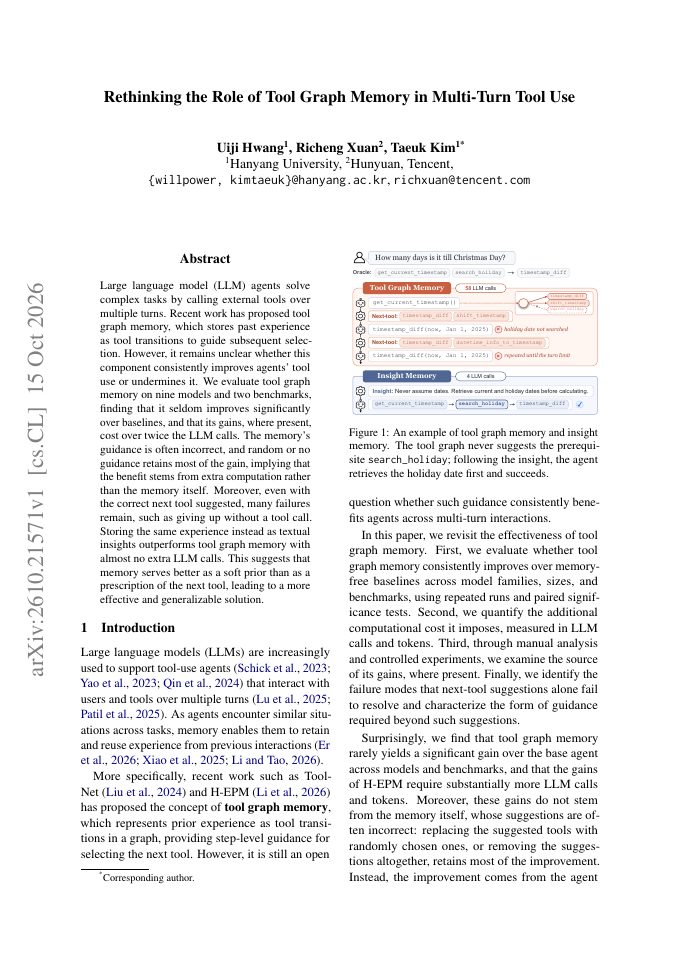
Research areas over time

Compare monthly publication volume on a shared scale and calendar.

coding agentsmax 6Sep 26: 1 paperOct 26: 2 papersSep 26Oct 26efficient architecturesmax 6Sep 26: 0 papersOct 26: 1 paperSep 26Oct 26agent evaluationmax 6Sep 26: 0 papersOct 26: 6 papersSep 26Oct 26KV cachemax 6Sep 26: 0 papersOct 26: 2 papersSep 26Oct 26speculative decodingmax 6Sep 26: 0 papersOct 26: 3 papersSep 26Oct 26sparsity and pruningmax 6Sep 26: 0 papersOct 26: 1 paperSep 26Oct 26memory and contextmax 6Sep 26: 0 papersOct 26: 4 papersSep 26Oct 26multi-agent orchestrationmax 6Sep 26: 0 papersOct 26: 2 papersSep 26Oct 26othermax 6Sep 26: 0 papersOct 26: 6 papersSep 26Oct 26quantizationmax 6Sep 26: 0 papersOct 26: 4 papersSep 26Oct 26safety and guardrailsmax 6Sep 26: 1 paperOct 26: 3 papersSep 26Oct 26serving and batchingmax 6Sep 26: 0 papersOct 26: 1 paperSep 26Oct 26efficient trainingmax 6Sep 26: 0 papersOct 26: 1 paperSep 26Oct 26tool usemax 6Sep 26: 0 papersOct 26: 4 papersSep 26Oct 26

Every panel uses the same calendar and vertical scale. An empty column means no papers were recorded.

Method under scrutiny

Inspect the highest-ranked paper, every repository behind its signal, and the rule used to classify each one.

Red-Teaming Auto Mode: Improving Blocking Classifiers Against Malign Coding Agents

safety and guardrails · test · 2 of 2 implementations are independent

The paper replaces passive or single-pass action-review monitors with hardened blocking monitors whose weaknesses were found by tasking adversarial agents with evading them, and it details concrete design fixes (broader tool coverage, transcript formatting, an agentic monitor stage). The cost is additional review compute and latency per proposed action, plus the engineering complexity of running a red-team harness and a multi-stage monitoring pipeline on a small team's budget. What can fail is residual evasion: multi-context attacks such as malicious compaction and cross-agent injection remain effective even after the improvements, so the monitor must not be treated as a complete safety boundary.
Exclusions and controls

Every exclusion is counted and published.

Exclusion counts were not recorded for this edition.

0 previously indexed papers were rechecked in this run.
Paperraft tracks one signal: how many independent implementations a paper attracts on GitHub after author-owned repositories are removed. This is a discovery signal to investigate, not a measure of implementation quality.
It does not claim that a method works. Paperraft runs no reproduction benchmarks. Reported gains remain author claims until independently tested. Papers above the attention threshold are excluded because this publication is designed to identify research before consensus forms.