Skip to content

archived edition · 2026-10-14

PaperraftFind the AI research
worth testing.

Understand what a paper changes, what it costs, and whether it fits your next build. Explore research on faster LLM inference, agent memory, and evaluation, with the original sources in reach.

Start with a brief. Follow the evidence. Choose a test.

edition
2026-10-14
briefs
43
research areas
15
independent implementations
16

35 of 43 papers in the index (81%) have no independent implementations.

Research index

Search by topic, browse a research area, or sort by date. Read a brief, open the original paper, and inspect the available evidence before deciding what to test.

showing30 of 43
sort by
First page of Where Does Exactly-Once Live? Model, Harness, and Tool-Contract Effects on Duplicate Side Effects in LLM Agents
failure recoveryadopt

Where Does Exactly-Once Live? Model, Harness, and Tool-Contract Effects on Duplicate Side Effects in LLM Agents

The technique replaces blind retry or model-level caution when a tool write times out or errors: a small harness guard that attaches an idempotency key to every write, letting the service deduplicate redeliveries. Cost is modest engineering (a key-generation and propagation guard, plus tool contracts that accept keys) with no model, GPU, or serving overhead; where contracts cannot accept keys, only waiting with a known in-flight bound partially substitutes. It fails when tool APIs do not support idempotency keys, when faults occur outside the service boundary the guard covers, and agents still misreport success (90% of duplicated episodes were reported as successful), so ledger-level auditing remains necessary.

observed signal
4impl.
0stars
0citations
7xclaimed gain
abstract onlyReview decisionDownload skill ↓Original paper ↗
First page of DoubtLess: Training-Free Contrastive Decoding for Efficient Reasoning
speculative decodingtest

DoubtLess: Training-Free Contrastive Decoding for Efficient Reasoning

Replaces per-model training for CoT compression, steering-vector methods, and heuristic early stopping by adding a scaled logit difference from a small model run twice (brief-prompted vs verbose-prompted) to the large model's logits at every decoding step. Costs two extra small-model forward passes per generated token plus per-step logit manipulation, which roughly triples inference compute per token even though total tokens fall, so net latency and cost savings depend on the small model being much cheaper than the large one. Can fail if the steering strength is mis-tuned (accuracy degradation on tasks needing extended verification), if no suitable smaller reasoning model in the same family is available, or on workloads where the claimed accuracy parity does not transfer.

observed signal
1impl.
0stars
—citations
1.45xclaimed gain
abstract onlyReview decisionDownload skill ↓Original paper ↗
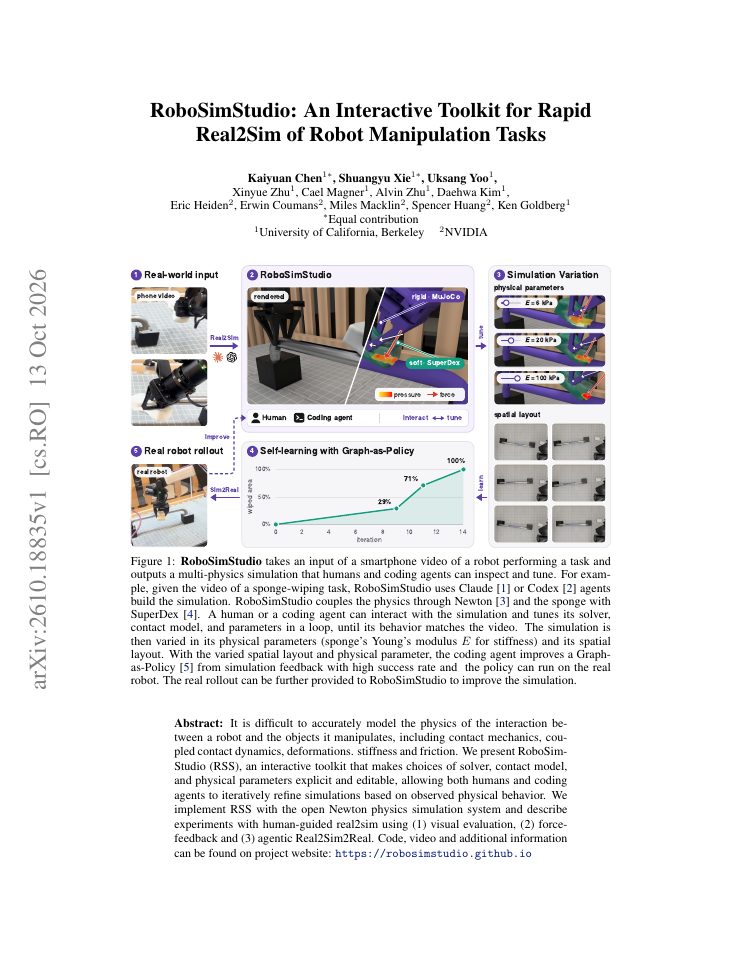
First page of RoboSimStudio: An Interactive Toolkit for Rapid Real2Sim of Robot Manipulation Tasks
othernot applicable

RoboSimStudio: An Interactive Toolkit for Rapid Real2Sim of Robot Manipulation Tasks

RoboSimStudio replaces ad-hoc, hand-tuned physics configuration for robot manipulation simulation with an interactive toolkit built on the Newton simulator that exposes solver, contact model, and physical parameters as explicit, editable choices for humans or coding agents. Its cost is engineering time in iterative visual, force-feedback, or agent-in-the-loop refinement, plus the infrastructure and hardware access required to run physics simulation and compare against real robot behavior; it does not consume inference GPU budget in the LLM-serving sense. It can fail where contact mechanics, friction, and deformation remain mis-modeled despite parameter editing, producing sim2real transfer gaps, and the abstract provides no quantified evidence of improved transfer accuracy or reduced tuning effort.

observed signal
2impl.
17stars
—citations
—claimed gain
abstract onlyReview decisionDownload skill ↓Original paper ↗
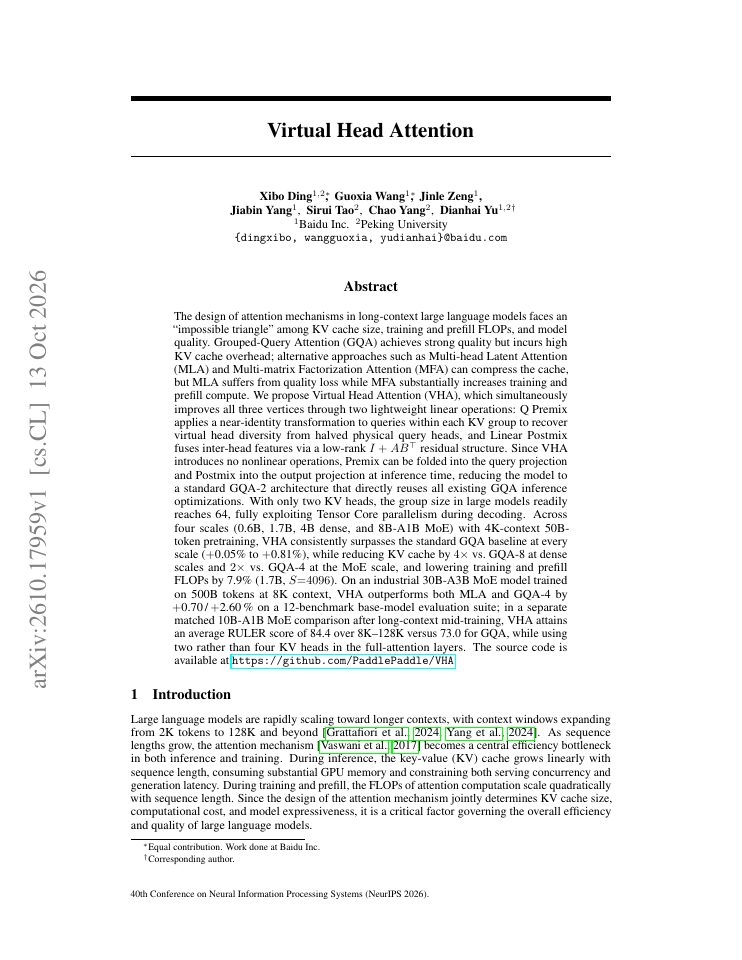
First page of Virtual Head Attention
KV cachewatch

Virtual Head Attention

VHA replaces standard GQA attention in a model trained from scratch, using a query premix and a low-rank I + AB^T postmix that fold into the query and output projections at inference, yielding a GQA-2-equivalent model with two KV heads. The cost is that the gains only exist if the architecture is adopted at pretraining time; it cannot be retrofitted onto existing pretrained checkpoints, and the reader has no pretraining budget. What can fail after adoption is unvalidated quality at scales or context lengths beyond the reported experiments, and the small accuracy deltas may not transfer to downstream fine-tuning or domain-specific workloads.

observed signal
1impl.
5stars
—citations
4xclaimed gain
abstract onlyReview decisionDownload skill ↓Original paper ↗
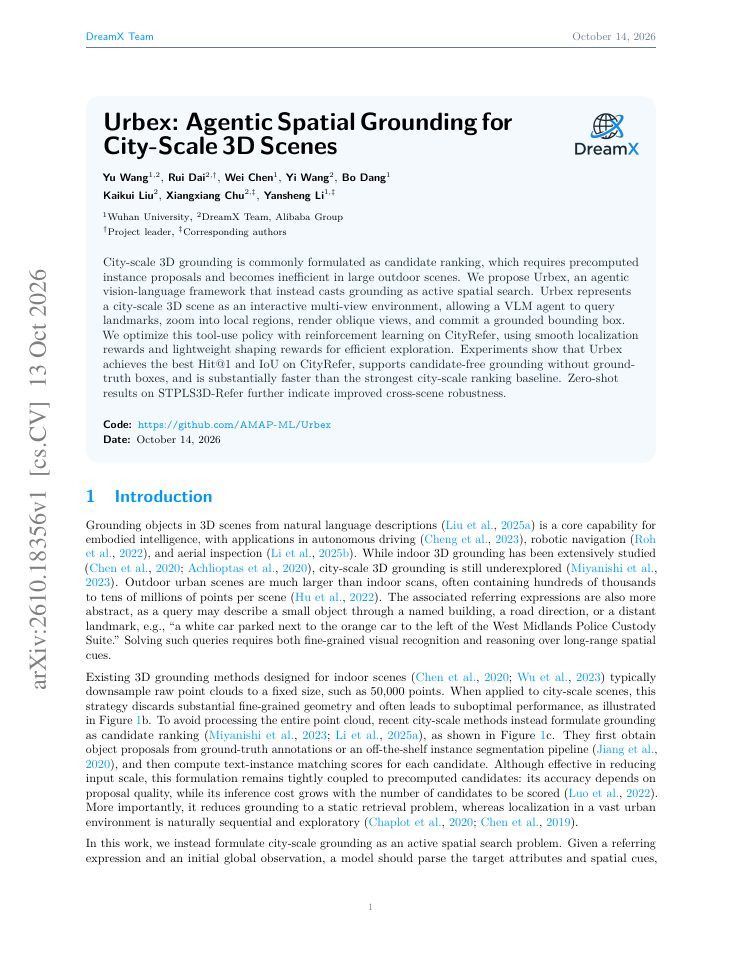
First page of Urbex: Agentic Spatial Grounding for City-Scale 3D Scenes
tool usewatch

Urbex: Agentic Spatial Grounding for City-Scale 3D Scenes

Urbex replaces candidate-ranking pipelines that depend on precomputed 3D instance proposals with a VLM agent that actively navigates a multi-view city scene (querying landmarks, zooming, rendering oblique views) before committing a bounding box, trained with reinforcement learning on CityRefer. The cost is an interactive multi-view rendering environment, RL training of the tool-use policy with localization and shaping rewards, and a VLM agent capable of sequential spatial reasoning, none of which is off-the-shelf for a constrained-infrastructure team. Failure modes include the agent committing to a wrong region during search, degraded performance on scenes whose geometry or landmark distribution differs from CityRefer, and environment/rendering engineering overhead that may exceed the cost of a simpler ranking baseline for smaller scenes.

observed signal
2impl.
76stars
—citations
—claimed gain
abstract onlyReview decisionDownload skill ↓Original paper ↗
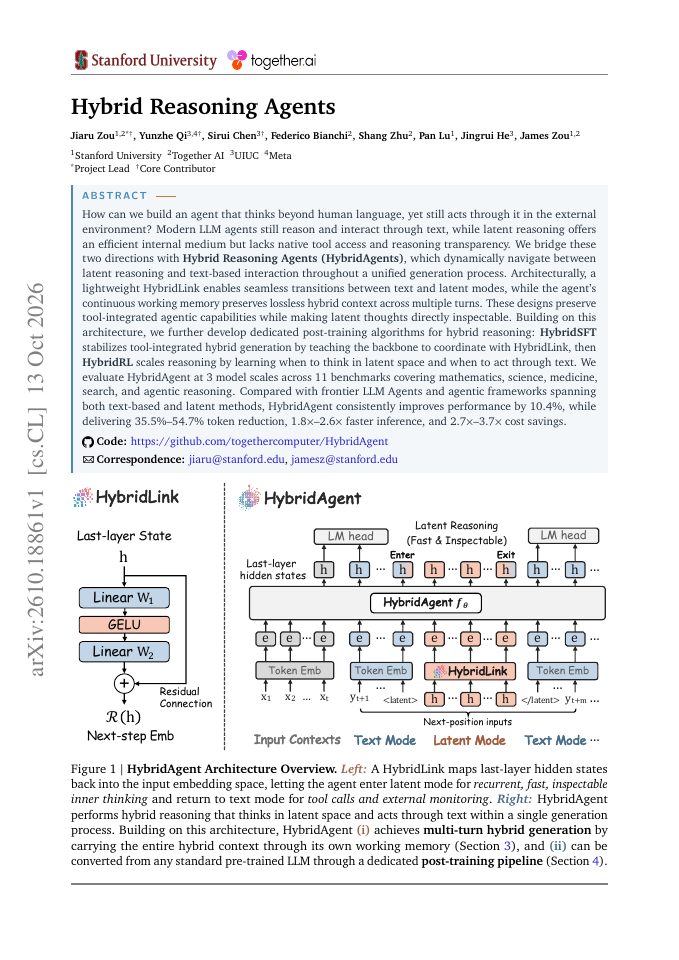
First page of Hybrid Reasoning Agents
tool usetest

Hybrid Reasoning Agents

Replaces purely text-based chain-of-thought and tool interaction in LLM agents with a unified generation process that alternates between latent reasoning (via a HybridLink module and continuous working memory) and text-based tool calls, reducing tokens and latency. Costs include training the HybridLink plus two post-training stages (HybridSFT and HybridRL), added architectural complexity over standard prompting or ReAct-style loops, and dependence on a custom serving path rather than off-the-shelf API inference. Failure modes include coordination errors at latent-text transition points, degraded interpretability if latent thoughts are inspected only superficially, and results that may not transfer when applied to backbones or tool schemas different from those used in the paper's training.

observed signal
1impl.
20stars
—citations
1.8xclaimed gain
abstract onlyReview decisionDownload skill ↓Original paper ↗
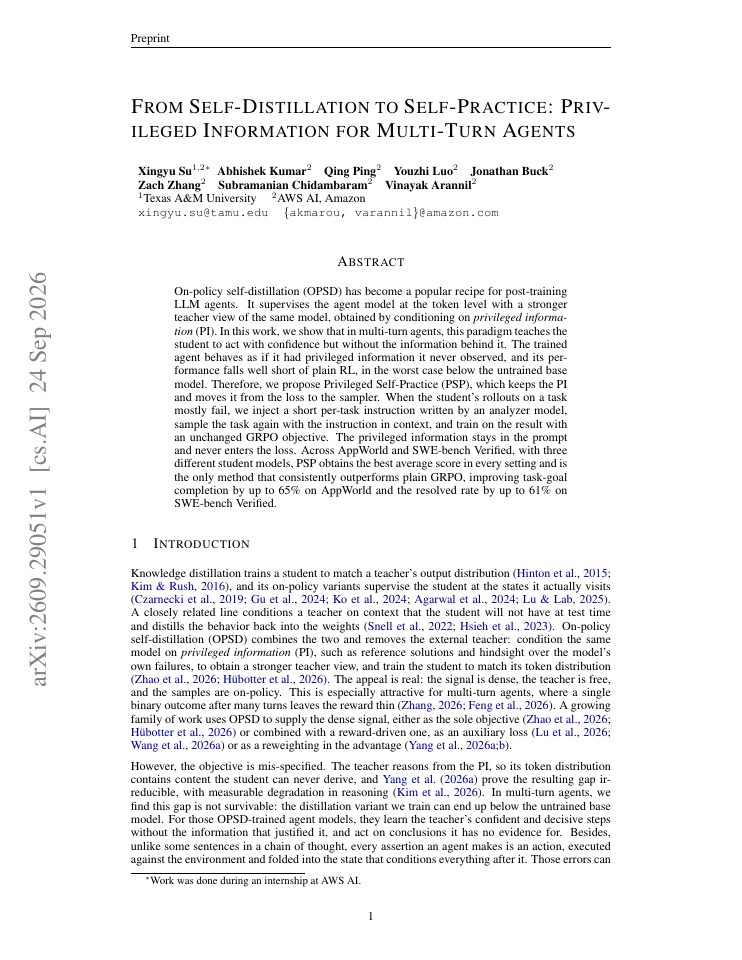
First page of From Self-Distillation to Self-Practice: Privileged Information for Multi-Turn Agents
efficient trainingtest

From Self-Distillation to Self-Practice: Privileged Information for Multi-Turn Agents

PSP replaces on-policy self-distillation, in which token-level supervision from a privileged-information teacher causes the student to act confidently without the underlying information, with a sampler-side intervention: an analyzer model writes a short per-task instruction when rollouts mostly fail, the task is resampled with that instruction in context, and training proceeds with an unchanged GRPO objective. The cost is an additional analyzer model and a second sampling pass per failing task, plus the existing infrastructure for GRPO-based RL post-training on multi-turn agent benchmarks. It can fail if the analyzer's instructions are inaccurate or unhelpful, if the workload lacks a clear failure signal to trigger instruction injection, or if the team's pipeline cannot support on-policy RL rollouts within a 24 GB GPU budget without API-based student models.

observed signal
2impl.
876stars
0citations
1.65xclaimed gain
abstract onlyReview decisionDownload skill ↓Original paper ↗
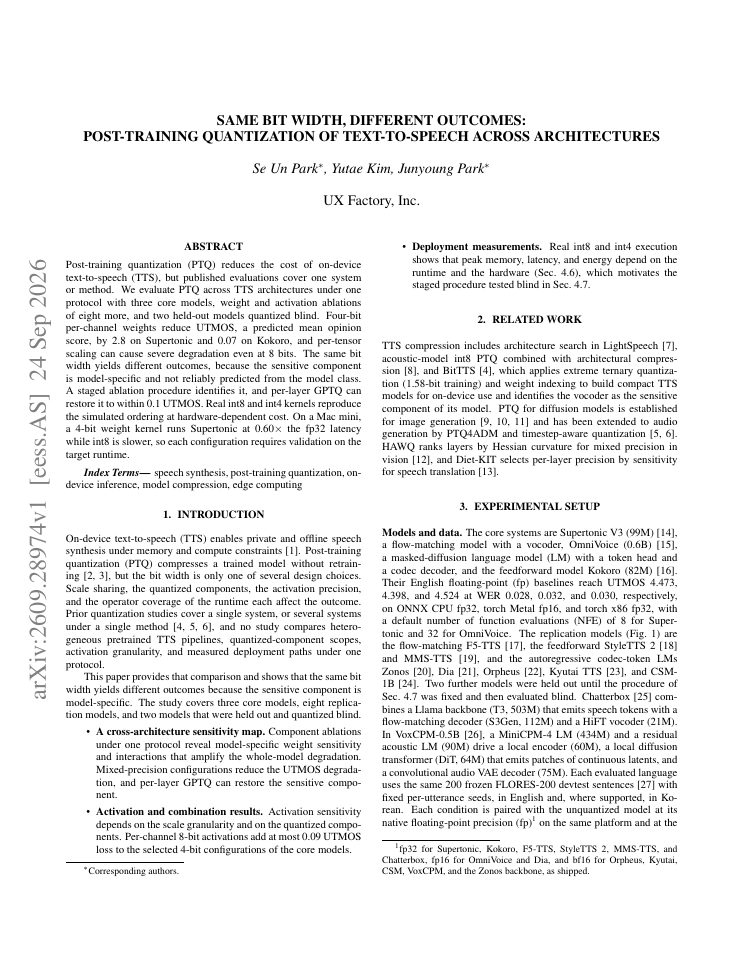
First page of Same Bit Width, Different Outcomes: Post-Training Quantization of Text-to-Speech Across Architectures
quantizationtest

Same Bit Width, Different Outcomes: Post-Training Quantization of Text-to-Speech Across Architectures

The method replaces full-precision TTS weights with 4-bit per-channel quantization, using a staged ablation to locate the model-specific sensitive component and per-layer GPTQ to repair it. The cost is a quantization and validation pipeline per model and target runtime: outcomes at the same bit width vary by architecture (2.8 UTMOS loss on Supertonic versus 0.07 on Kokoro), so no single recipe transfers. What can fail is quality collapse from per-tensor scaling even at 8 bits, misidentified sensitive layers when skipping the ablation, and kernels that are slower than fp32 on a given runtime despite lower bit width.

observed signal
3impl.
674stars
0citations
1.67xclaimed gain
abstract onlyReview decisionDownload skill ↓Original paper ↗
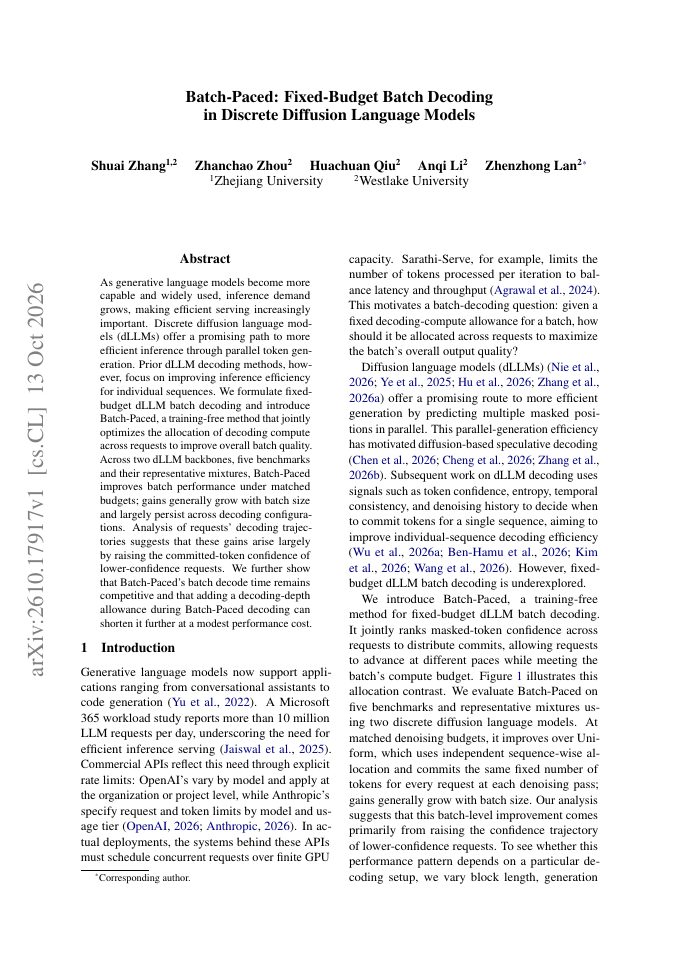
First page of Batch-Paced: Fixed-Budget Batch Decoding in Discrete Diffusion Language Models
serving and batchingtest

Batch-Paced: Fixed-Budget Batch Decoding in Discrete Diffusion Language Models

Batch-Paced replaces per-sequence dLLM decoding schedules, which allocate compute independently per request, with a training-free joint allocation of a fixed decoding budget across a batch. It costs additional scheduling logic at the serving layer and optional quality trade-off when a decoding-depth allowance is used to shorten batch decode time, though reported decode time remains competitive. It fails if the serving stack runs autoregressive models rather than discrete diffusion LLMs, or at small batch sizes where the reported gains shrink.

observed signal
0impl.
0stars
—citations
—claimed gain
abstract onlyReview decisionDownload skill ↓Original paper ↗
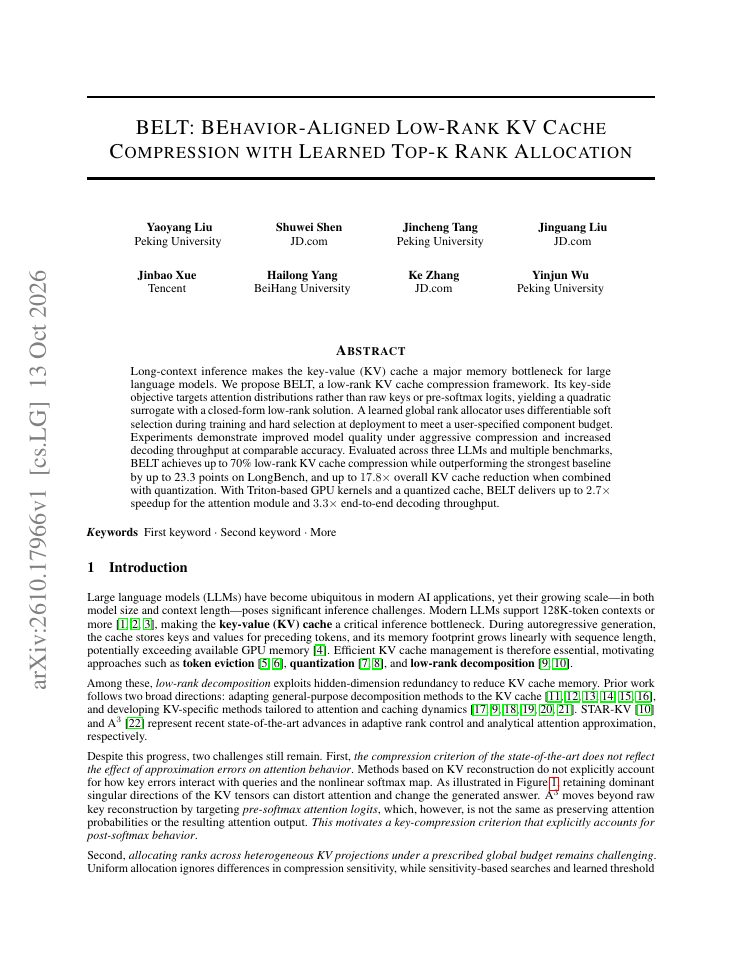
First page of BELT : BEhavior-Aligned Low-Rank KV Cache Compression with Learned Top-k Rank Allocation
KV cachetest

BELT : BEhavior-Aligned Low-Rank KV Cache Compression with Learned Top-k Rank Allocation

BELT replaces the full-rank KV cache in a pretrained LLM with a low-rank factorized cache, where a learned allocator distributes a fixed component budget across layers and heads, and where the compression objective matches post-softmax attention distributions rather than raw keys. Adoption costs an offline training/calibration phase for the low-rank factors and rank allocator, integration of custom Triton kernels (or a custom attention path) into the inference stack, and additional engineering complexity around combining low-rank storage with quantization. It can fail when the learned rank allocation does not transfer to domains or sequence lengths outside its training distribution, when real long-context workloads lose the reported LongBench quality margin at aggressive budgets, or when kernel and serving-stack integration overhead erodes the reported throughput gains on the reader's single-GPU setup.

observed signal
0impl.
0stars
—citations
17.8xclaimed gain
abstract onlyReview decisionDownload skill ↓Original paper ↗
First page of Neural Dimensional Analysis: Foundations of Dimensionless and Scale-Consistent Computation
efficient trainingwatch

Neural Dimensional Analysis: Foundations of Dimensionless and Scale-Consistent Computation

The method replaces standard scale-control machinery (layer normalization, residual scaling, attention temperature, loss weighting) with a dimensional-consistency framework implemented as the Gauge-Canonical Transformer with normalized coordinates and orthogonalized residual additions. The cost is that benefits accrue only when training a model from scratch under this architecture, plus implementation complexity in reworking residual streams, attention inputs, and multi-loss objectives. It can fail to transfer if adopted piecemeal onto existing pretrained checkpoints, and its quantization-robustness and stability claims are demonstrated only up to 1B parameters on the authors' training setup.

observed signal
0impl.
0stars
—citations
—claimed gain
abstract onlyReview decisionDownload skill ↓Original paper ↗
First page of AlignPred: Error-Controlled KV Cache Compression via Alignment and Predictive Coding
KV cachetest

AlignPred: Error-Controlled KV Cache Compression via Alignment and Predictive Coding

AlignPred replaces storing raw or conventionally compressed persistent KV caches in multi-turn agent deployments with a codec that aligns heads/layers via local orthogonal transforms, predicts token-wise and cross-head/layer, then quantizes residuals on an error-bounded lattice with entropy coding, and it integrates with SGLang HiCache. The cost is added encode/decode compute in the serving path (CPU codec overhead, though reported as faster than baseline codecs), integration effort with a specific serving stack, and a configurable reconstruction-error budget that must be tuned per workload. Failure modes include quality degradation if the error budget is set too aggressively for tasks sensitive to KV fidelity, gains that may not transfer beyond the three evaluated attention mechanisms or the LongBench-Pro benchmark, and limited benefit for workloads without long-lived cross-session caches.

observed signal
0impl.
0stars
—citations
1.72xclaimed gain
abstract onlyReview decisionDownload skill ↓Original paper ↗
First page of Exact power indices for plurality-voting ensembles
othertest

Exact power indices for plurality-voting ensembles

ENPOWER replaces Monte Carlo sampling approximations of Shapley/Banzhaf values for plurality-voting ensembles with exact closed-form and generating-function algorithms, applied to ensemble pruning and prompt-based ensembling of vision-language models. Cost is low: it is a post-hoc combinatorial computation requiring no GPU training, only the base classifiers' predictions, with polynomial-time complexity that grows with class count and ensemble size. It can fail when the plurality-voting-with-random-tie-breaking model does not match the production aggregation rule (e.g., weighted or soft voting), and attribution-driven pruning may remove classifiers whose value depends on correlated errors that power indices do not capture.

observed signal
0impl.
0stars
—citations
—claimed gain
abstract onlyReview decisionDownload skill ↓Original paper ↗
First page of LatentRemedy: Efficient Remedy For Non-Prefix KV Cache Reuse in Multi-Agent Systems
KV cachetest

LatentRemedy: Efficient Remedy For Non-Prefix KV Cache Reuse in Multi-Agent Systems

It replaces selective recomputation and offset-based calibration for recovering quality when reusing non-prefix KV cache blocks across agents with conflicting tasks, substituting recomputation of the shared block with a few MLP-generated latent tokens inserted after the reused block. The cost is training a small MLP via full-prefill distillation per model, plus extra inference-time compute and engineering to insert latent tokens into the serving path. It can fail outside multi-agent workloads with genuinely shared context blocks, if the distillation training does not transfer to a different base model or task distribution, or if the serving stack cannot accommodate inserted latent tokens without modification.

observed signal
0impl.
12stars
—citations
—claimed gain
abstract onlyReview decisionDownload skill ↓Original paper ↗
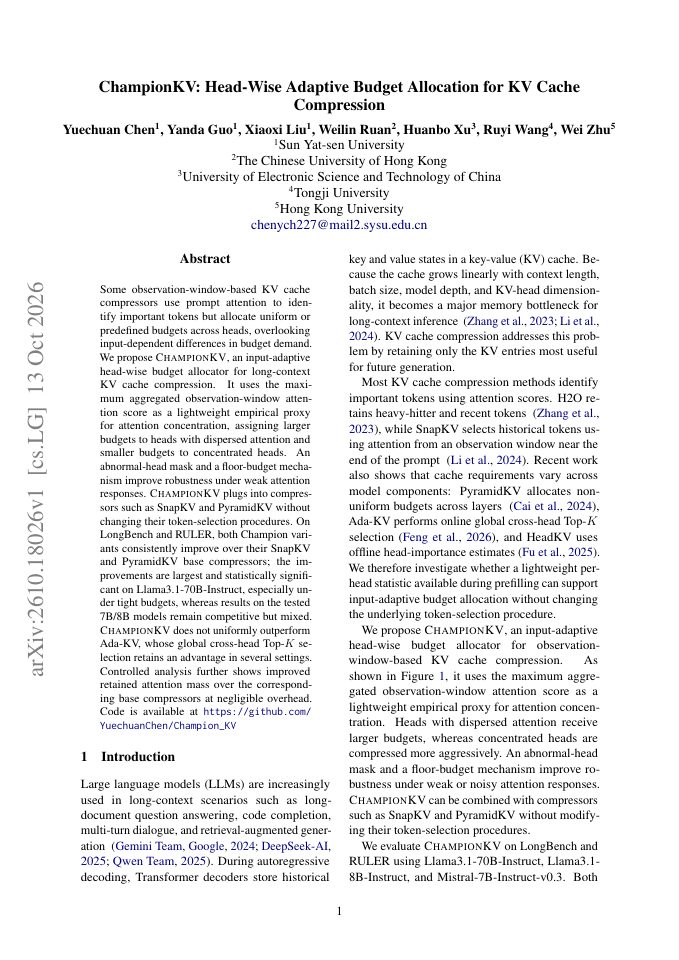
First page of ChampionKV: Head-Wise Adaptive Budget Allocation for KV Cache Compression
KV cachetest

ChampionKV: Head-Wise Adaptive Budget Allocation for KV Cache Compression

ChampionKV replaces the uniform or predefined per-head budget allocation in observation-window KV compressors (SnapKV, PyramidKV) with input-adaptive head-wise budgets derived from attention concentration, leaving the token-selection procedure unchanged. The cost is negligible compute overhead for computing aggregated observation-window attention scores, plus an abnormal-head mask and floor-budget mechanism, with no additional memory beyond the compressed cache itself. It can fail to deliver gains on 7B/8B-class models, where results are mixed, and it does not uniformly outperform Ada-KV's global cross-head Top-K selection, so the base compressor choice may dominate the improvement.

observed signal
0impl.
0stars
—citations
—claimed gain
abstract onlyReview decisionDownload skill ↓Original paper ↗
otherwatch

H-DDCM: Hadamard Codebooks for Fast Generative Image and Video Compression

H-DDCM replaces the dense Gaussian codebooks of codebook-based training-free diffusion compression (e.g., Turbo-DDCM) with implicit randomized Hadamard dictionaries synthesized via the fast Walsh-Hadamard transform, and adds a table-free lexicographic scheme for combinatorial bitstream encoding. The cost is that encode/decode still runs full diffusion or flow-model inference per block, so end-to-end latency and quality remain bounded by the pretrained generator rather than by the codebook, and the method only pays off at ultra-low bitrates where perceptual, not distortion, metrics dominate. Adoption can fail if no suitable pretrained image/video diffusion model exists for the target domain, if rate-distortion (PSNR/SSIM) rather than perceptual quality is the requirement, or if the KV-cache re-encoding streaming scheme drifts on long videos.

observed signal
0impl.
0stars
—citations
—claimed gain
abstract onlyReview decisionDownload skill ↓Original paper ↗
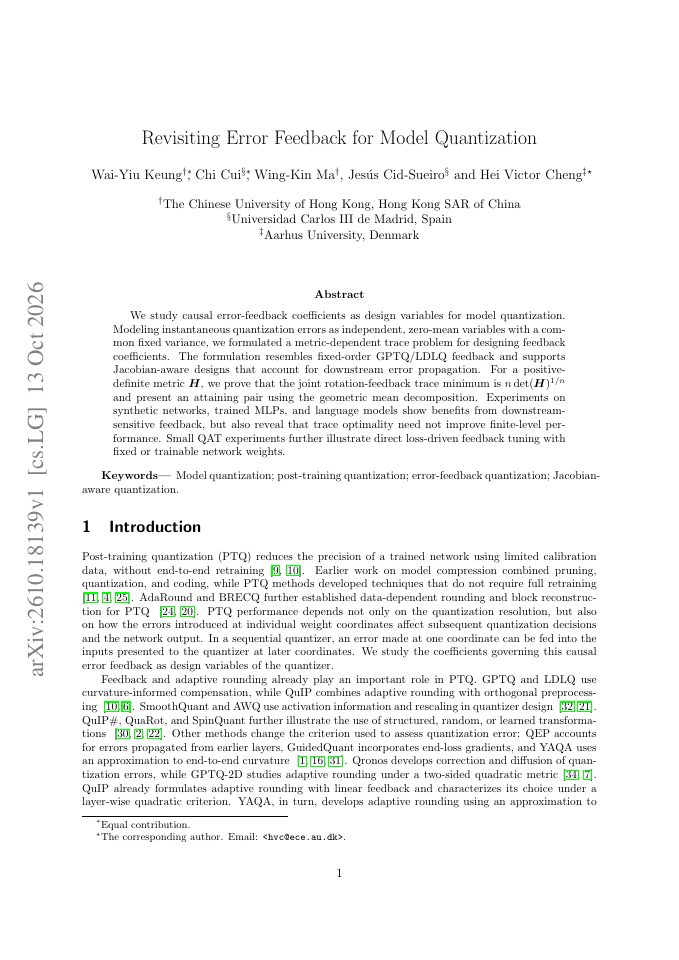
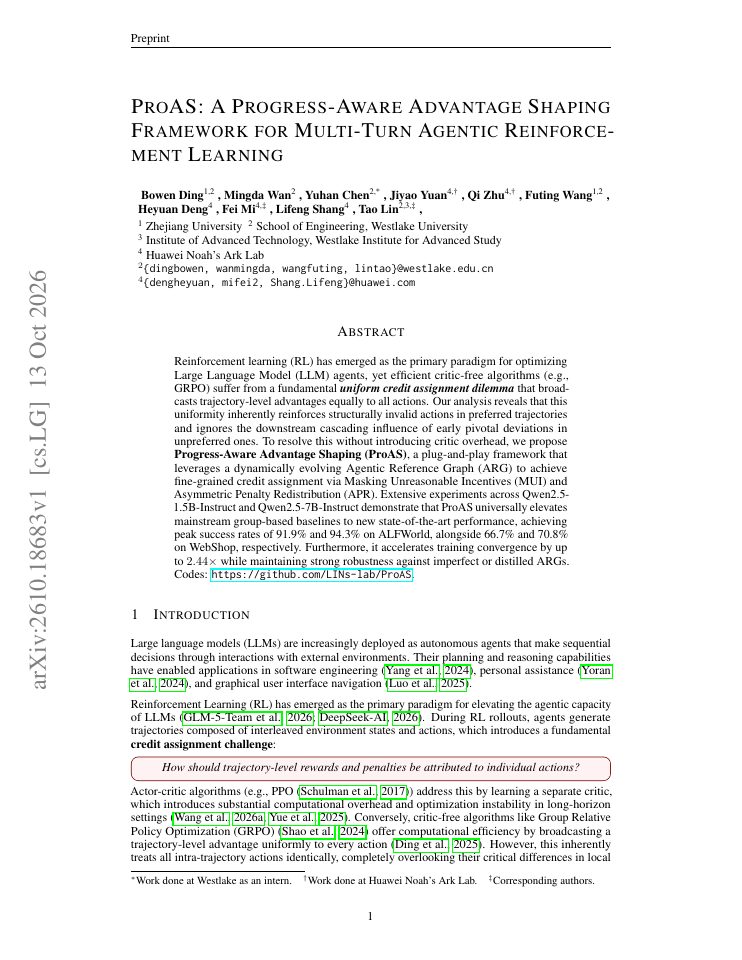
First page of Revisiting Error Feedback for Model Quantization
quantizationtest

Revisiting Error Feedback for Model Quantization

Replaces the fixed-order error-feedback coefficients used in GPTQ/LDLQ-style post-training quantization with coefficients optimized via a metric-dependent trace problem, attained by a geometric mean decomposition of the Hessian. Cost is limited: it runs as a modification to an existing one-shot PTQ procedure on a single GPU, with added complexity from computing downstream-sensitive metrics, and QAT variants require additional training budget. What can fail: the paper itself shows that minimizing the trace bound does not guarantee better finite-level (actual bit-width) quantization accuracy, so gains may not transfer to a specific model and task without validation.

observed signal
0impl.
0stars
—citations
—claimed gain
abstract onlyReview decisionDownload skill ↓Original paper ↗
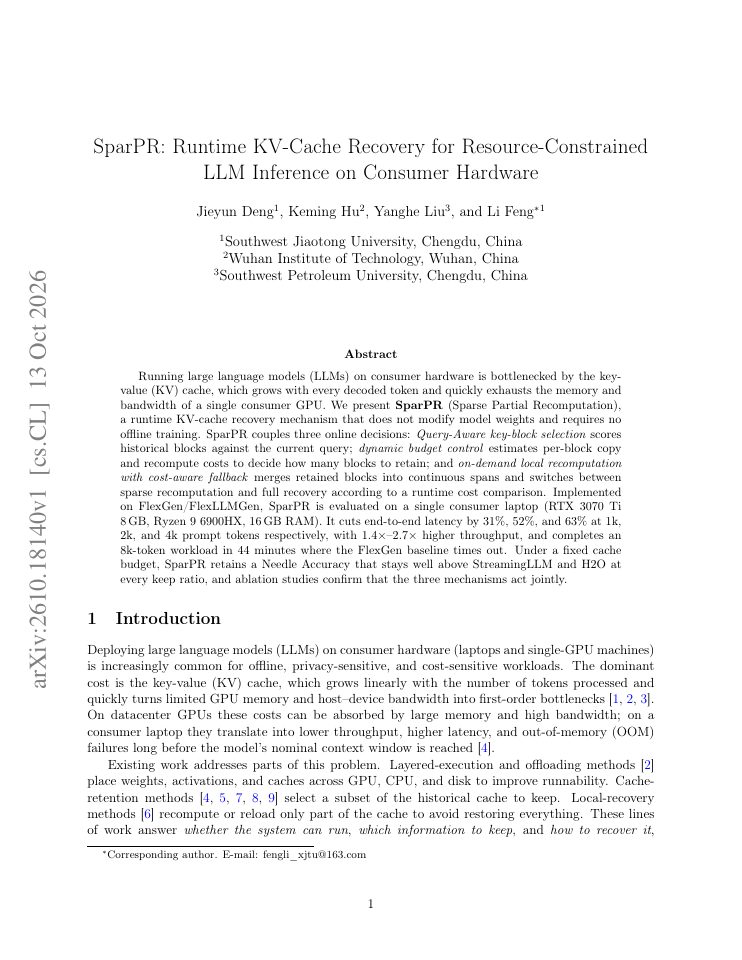
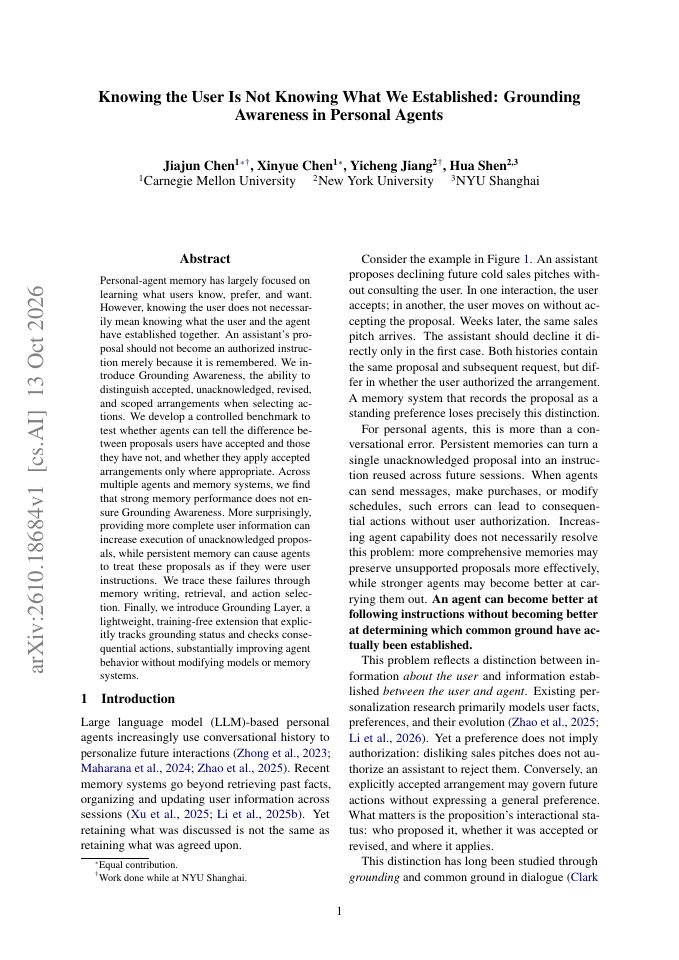
First page of SparPR: Runtime KV-Cache Recovery for Resource-Constrained LLM Inference on Consumer Hardware
KV cachetest

SparPR: Runtime KV-Cache Recovery for Resource-Constrained LLM Inference on Consumer Hardware

SparPR replaces static KV-cache eviction policies (e.g., StreamingLLM, H2O) and full offloading/reload in FlexGen-style constrained inference with runtime query-aware block selection, dynamic cache budgeting, and on-demand local recomputation with a cost-aware fallback to full recovery, requiring no weight changes or offline training. Its cost is runtime overhead for scoring, cost estimation, and selective recomputation, plus implementation complexity tied to the FlexGen/FlexLLMGen stack. It can fail if the runtime cost model mispredicts copy-versus-recompute tradeoffs on different hardware, if query-aware selection drops blocks needed by later tokens in workloads unlike the Needle benchmark, or if gains measured on an 8GB laptop do not transfer to a 24 GB production GPU serving different models and request patterns.

observed signal
0impl.
0stars
—citations
2.7xclaimed gain
abstract onlyReview decisionDownload skill ↓Original paper ↗
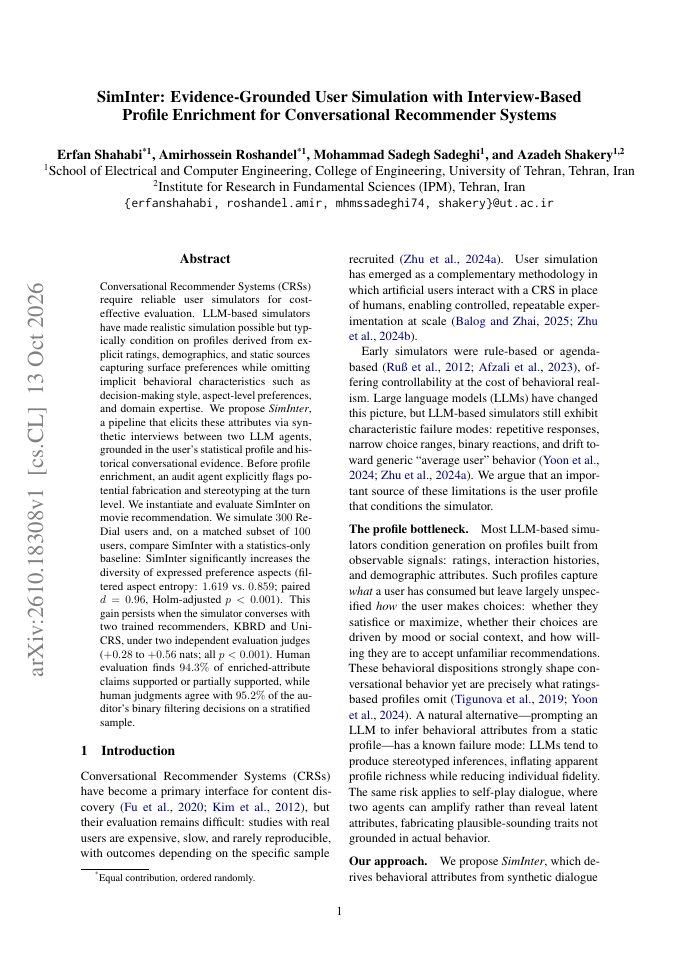
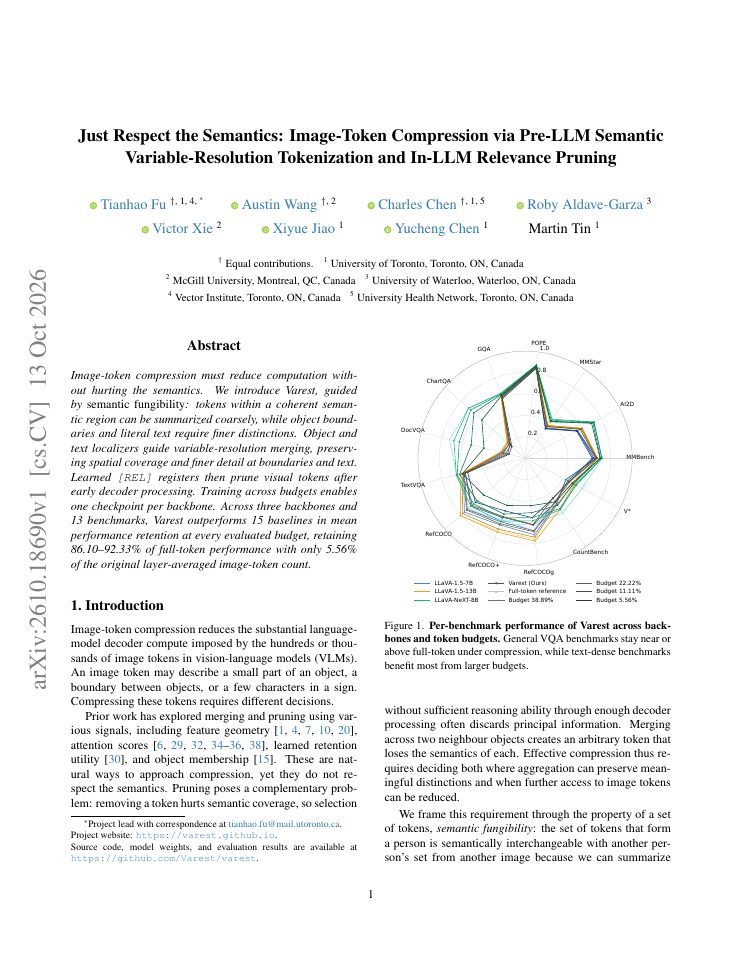
First page of SimInter: Evidence-Grounded User Simulation with Interview-Based Profile Enrichment for Conversational Recommender Systems
agent evaluationtest

SimInter: Evidence-Grounded User Simulation with Interview-Based Profile Enrichment for Conversational Recommender Systems

SimInter replaces user simulators conditioned only on ratings, demographics, and static profiles by enriching profiles through synthetic LLM interviews grounded in historical conversational evidence, with a turn-level audit agent flagging fabrication and stereotyping. The cost is additional LLM inference for interview generation and auditing per simulated user, plus pipeline complexity; it is feasible on API access or a single GPU, but the paper validates only movie recommendation on ReDial, so transfer to other domains is unverified. After adoption, the main failure mode is residual fabricated or stereotyped attributes passing the audit (about 5.7% of claims unsupported and 4.8% auditor disagreement), which can bias downstream recommender evaluation.

observed signal
0impl.
0stars
—citations
—claimed gain
abstract onlyReview decisionDownload skill ↓Original paper ↗
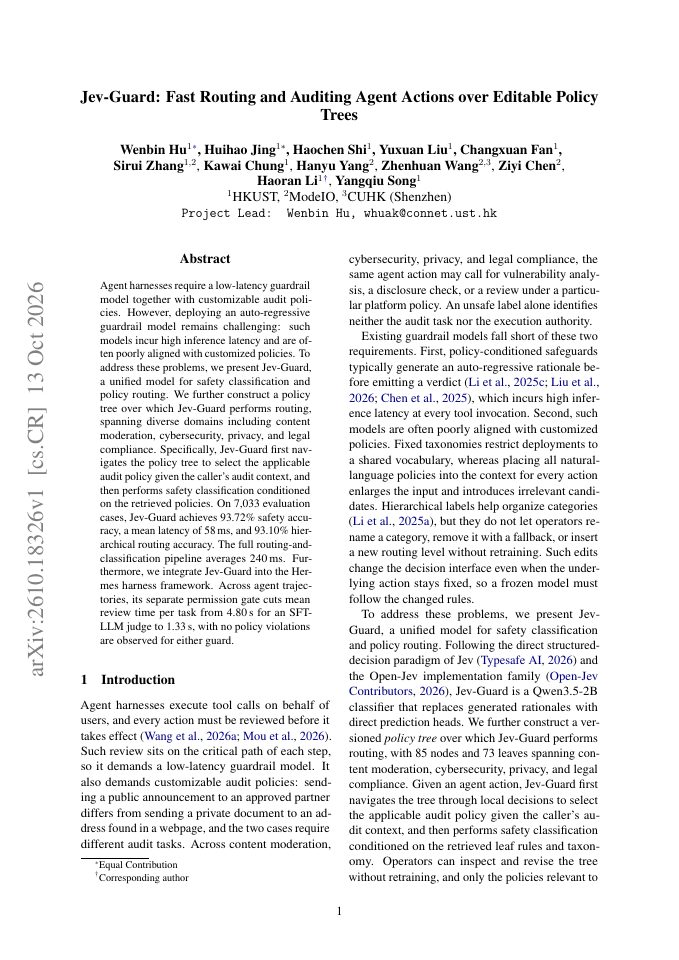
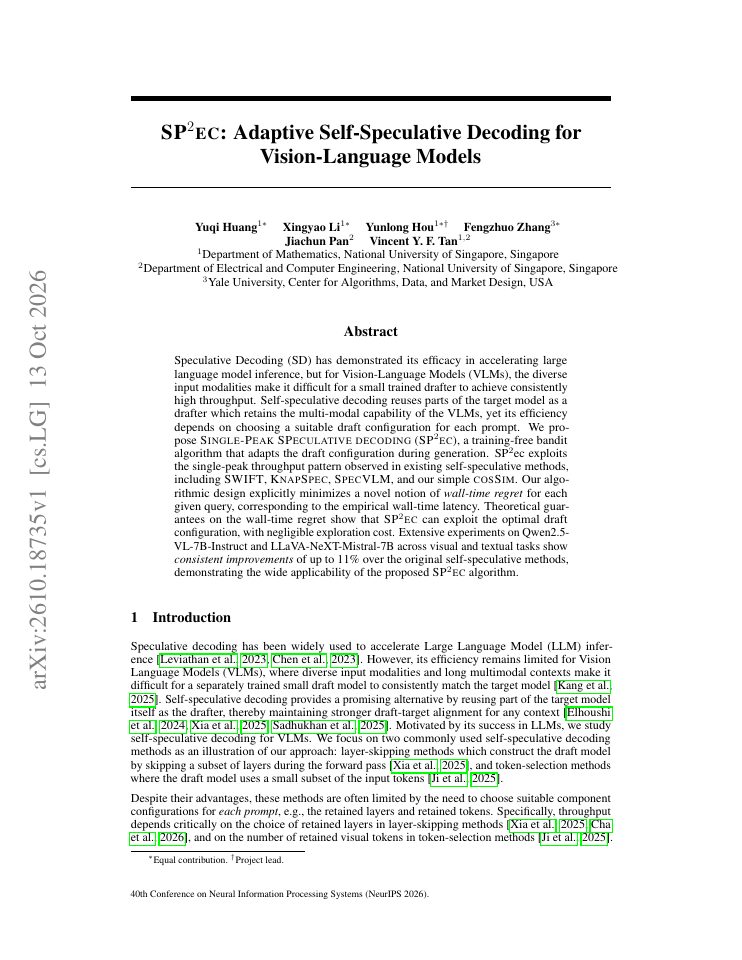
First page of Jev-Guard: Fast Routing and Auditing Agent Actions over Editable Policy Trees
safety and guardrailstest

Jev-Guard: Fast Routing and Auditing Agent Actions over Editable Policy Trees

Replaces an autoregressive guardrail model or LLM-as-judge used for agent action auditing with a single small model that first routes over an editable policy tree and then classifies safety conditioned on the retrieved policy. Costs include training or obtaining the specialized model, maintaining the policy tree spanning moderation, cybersecurity, privacy, and legal domains, and a residual error rate of roughly 6% on both routing and classification; integration is demonstrated only within the Hermes harness. Can fail through misrouting to the wrong policy branch (which invalidates the downstream audit), residual misclassification of unsafe actions, and policy drift if the editable tree is not kept synchronized with actual deployment rules.

observed signal
0impl.
0stars
—citations
3.6xclaimed gain
abstract onlyReview decisionDownload skill ↓Original paper ↗
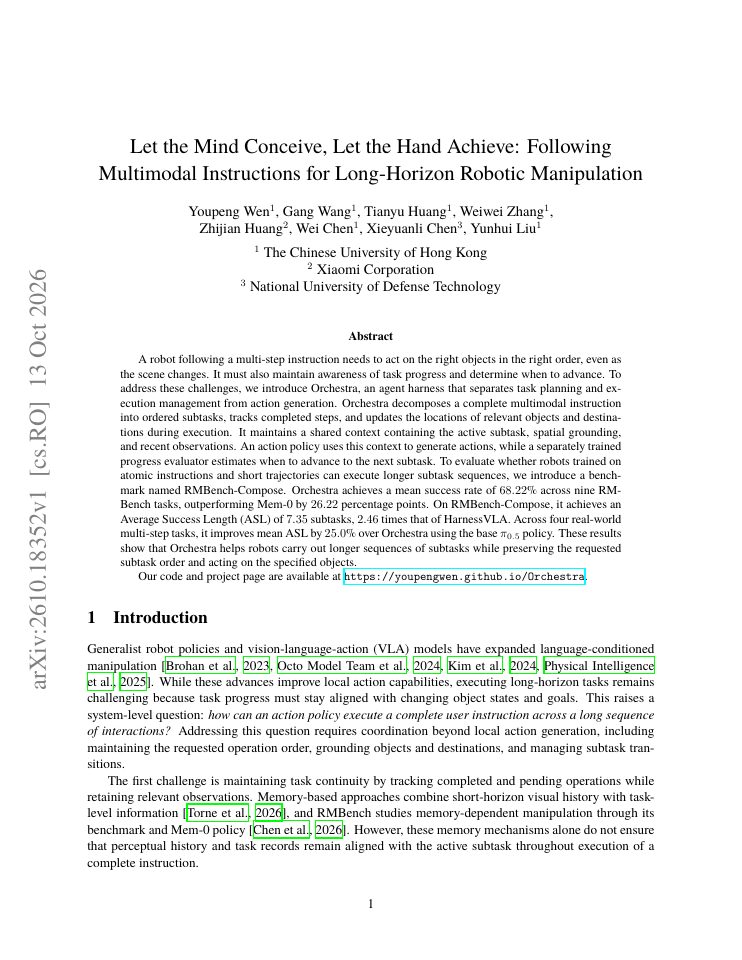
First page of Let the Mind Conceive, Let the Hand Achieve: Following Multimodal Instructions for Long-Horizon Robotic Manipulation
planning and decompositionwatch

Let the Mind Conceive, Let the Hand Achieve: Following Multimodal Instructions for Long-Horizon Robotic Manipulation

Orchestra replaces monolithic end-to-end action policies for multi-step robot instructions with a harness that decomposes instructions into ordered subtasks, maintains shared spatial and progress context, and uses a separately trained progress evaluator to decide when to advance. The cost is added system complexity: a planner, context tracking, and a separately trained progress evaluator on top of the action policy, plus dependence on the underlying pi_0.5-style policy. It can fail when the progress evaluator misjudges subtask completion, when object-location tracking drifts as the scene changes, or when the base action policy cannot execute a decomposed subtask it was not trained on.

observed signal
0impl.
0stars
—citations
2.46xclaimed gain
abstract onlyReview decisionDownload skill ↓Original paper ↗
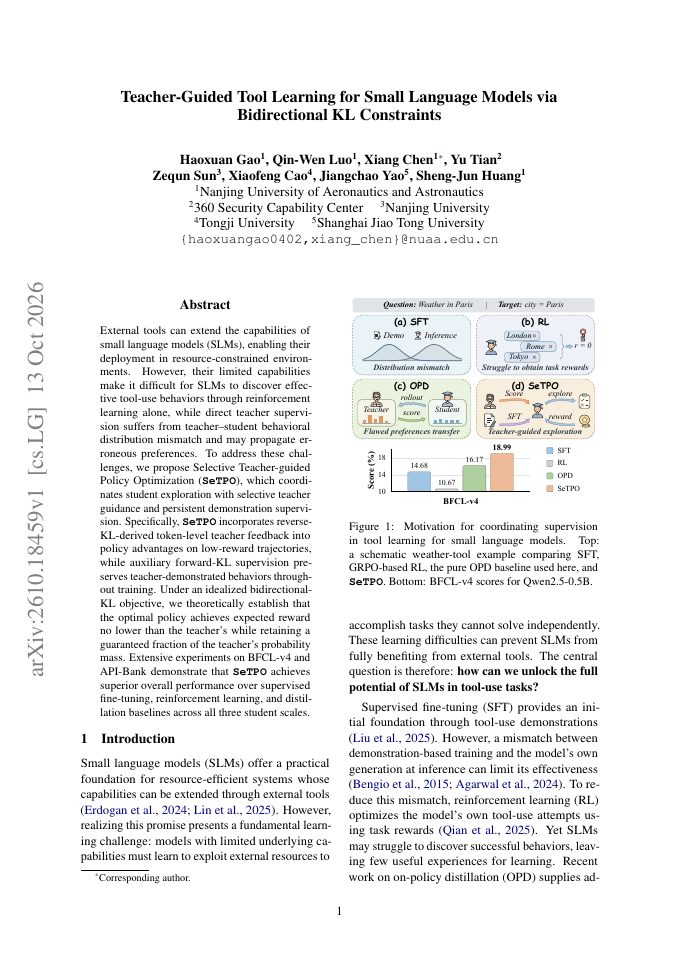
First page of Teacher-Guided Tool Learning for Small Language Models via Bidirectional KL Constraints
tool usewatch

Teacher-Guided Tool Learning for Small Language Models via Bidirectional KL Constraints

The method replaces pure reinforcement learning and direct teacher supervision (SFT/distillation) for training small language models to use external tools, combining reverse-KL token-level teacher feedback on low-reward trajectories with forward-KL demonstration supervision. It costs a capable teacher model accessible during training, RL training infrastructure, and added implementation complexity over plain SFT or distillation. Adoption can fail if the teacher's tool-use preferences contain errors that persist through forward-KL supervision, if the reader lacks RL training capacity on a single 24 GB GPU, or if results on BFCL v4 and API-Bank do not transfer to the reader's specific tool schemas and APIs.

observed signal
0impl.
0stars
—citations
—claimed gain
abstract onlyReview decisionDownload skill ↓Original paper ↗
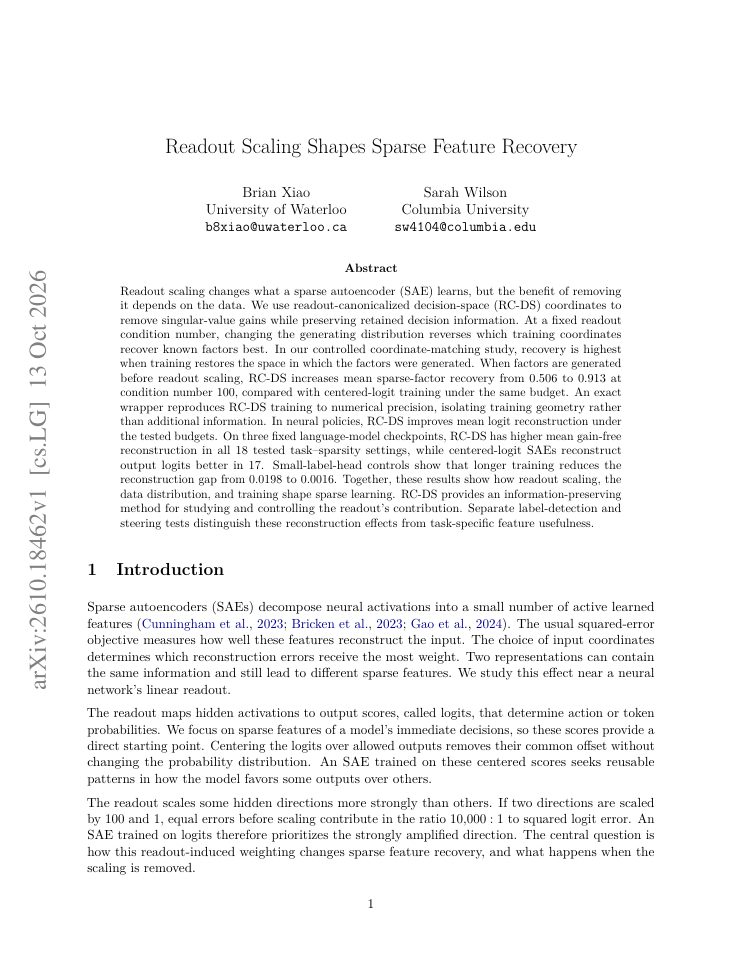
First page of Readout Scaling Shapes Sparse Feature Recovery
sparsity and pruningwatch

Readout Scaling Shapes Sparse Feature Recovery

RC-DS replaces standard centered-logit SAE training coordinates with coordinates canonicalized to remove readout singular-value gains while preserving decision information. It costs an additional coordinate transformation (available as an exact wrapper) and, per the paper's own controls, worse output-logit reconstruction than centered-logit SAEs in most tested settings. It can fail when the generating distribution differs from the assumed pre-readout space, since the benefit reverses with the data distribution, and reconstruction gains do not imply task-useful features, as the label-detection and steering controls indicate.

observed signal
0impl.
0stars
—citations
1.8xclaimed gain
abstract onlyReview decisionDownload skill ↓Original paper ↗
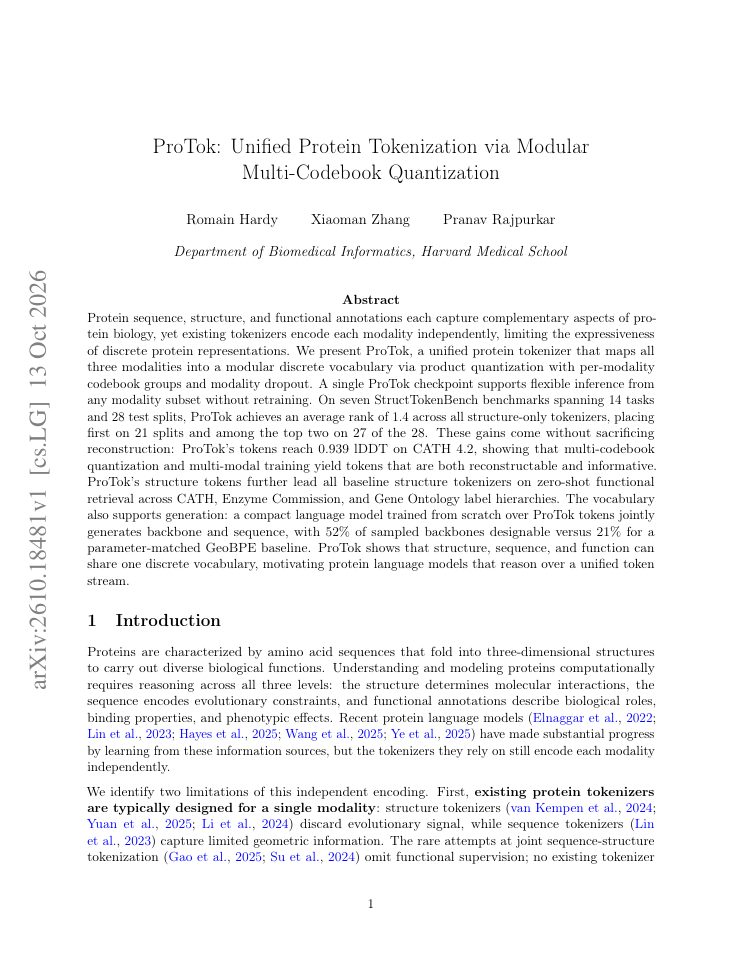
First page of ProTok: Unified Protein Tokenization via Modular Multi-Codebook Quantization
othernot applicable

ProTok: Unified Protein Tokenization via Modular Multi-Codebook Quantization

ProTok replaces separate per-modality protein tokenizers (independent sequence, structure, and function vocabularies) with a single modular multi-codebook product-quantized vocabulary that supports inference from any modality subset without retraining. Adoption costs the training of a new tokenizer and any downstream model over its tokens, plus integration of a non-standard vocabulary; reconstruction quality (0.939 lDDT) and multi-modal fusion add pipeline complexity relative to single-modality tokenizers. Failure modes include degraded performance on out-of-distribution proteins, dependence on the availability and quality of structural and functional annotations, and benchmark gains that may not transfer to a specific downstream design or retrieval workload.

observed signal
0impl.
0stars
—citations
2.48xclaimed gain
abstract onlyReview decisionDownload skill ↓Original paper ↗
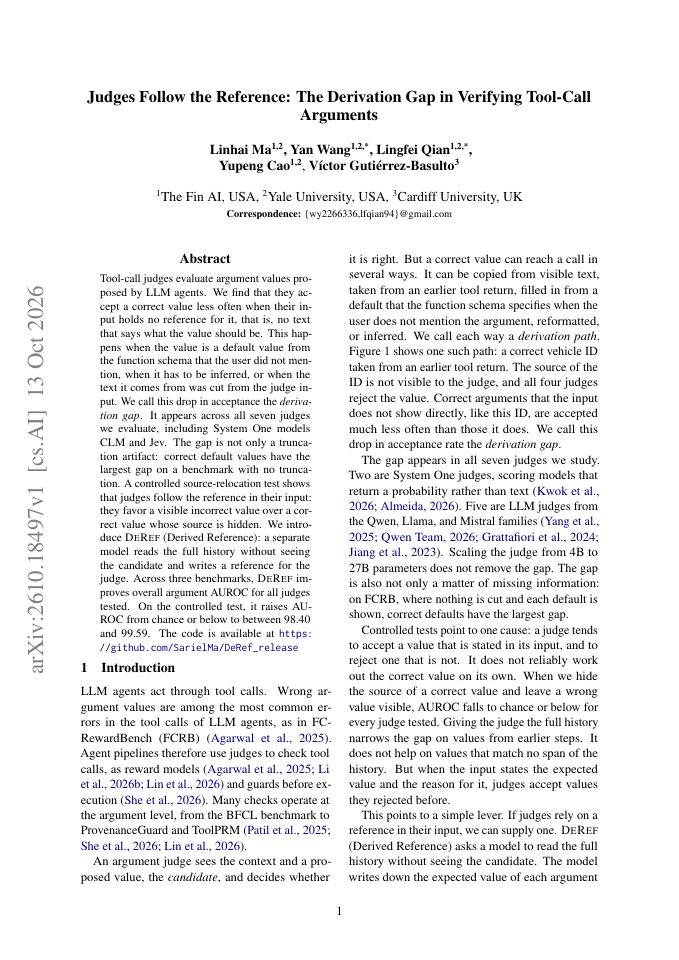
First page of Judges Follow the Reference: The Derivation Gap in Verifying Tool-Call Arguments
agent evaluationtest

Judges Follow the Reference: The Derivation Gap in Verifying Tool-Call Arguments

DeRef replaces giving the judge raw (possibly truncated or reference-free) conversation history by having a separate model read the full history without seeing the candidate argument and write an explicit reference stating what the value should be. It costs one additional model inference per judged argument, adding latency, API or GPU cost, and a new pipeline component. It can fail when the reference-writing model itself misderives the intended value, since judges are shown to follow the visible reference even when it is incorrect, so a wrong reference can systematically flip verdicts.

observed signal
0impl.
122stars
—citations
—claimed gain
abstract onlyReview decisionDownload skill ↓Original paper ↗
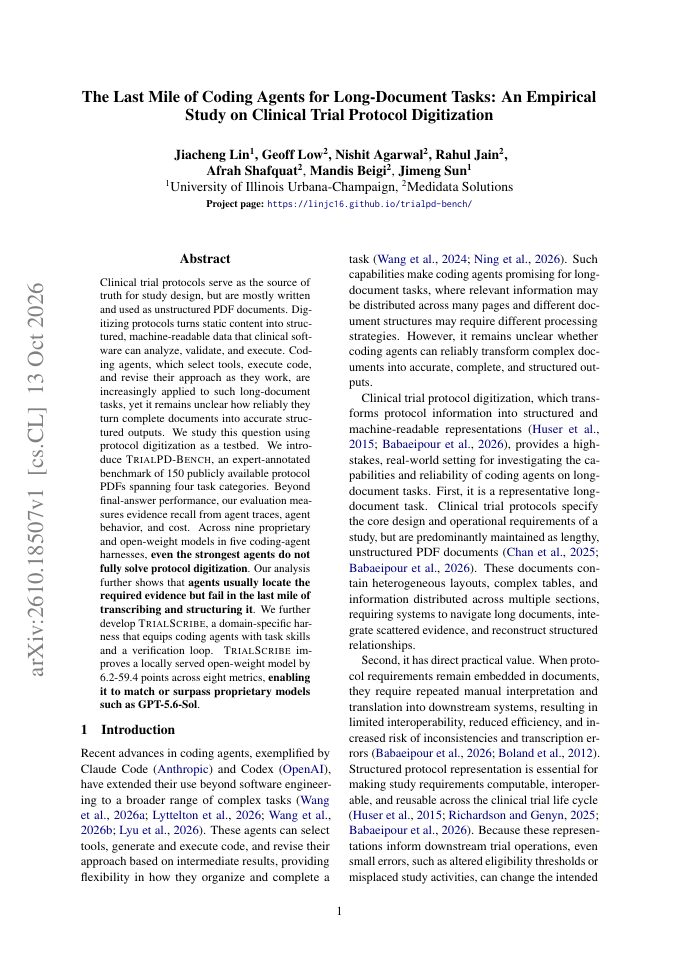
First page of The Last Mile of Coding Agents for Long-Document Tasks: An Empirical Study on Clinical Trial Protocol Digitization
coding agentstest

The Last Mile of Coding Agents for Long-Document Tasks: An Empirical Study on Clinical Trial Protocol Digitization

The technique replaces a generic coding-agent harness (and reliance on frontier proprietary models) with a domain-specific harness that adds task skills and a verification loop for long-document-to-structured-output tasks. The cost is engineering effort to build domain skills and verifiers, plus extra verification passes that increase token consumption and latency, and the reported gains are measured only on clinical trial protocol digitization. After adoption, agents can still fail in the transcription and structuring stage, so structured outputs require downstream validation, and the skill assets may not transfer to other document domains without rework.

observed signal
0impl.
10stars
—citations
—claimed gain
abstract onlyReview decisionDownload skill ↓Original paper ↗
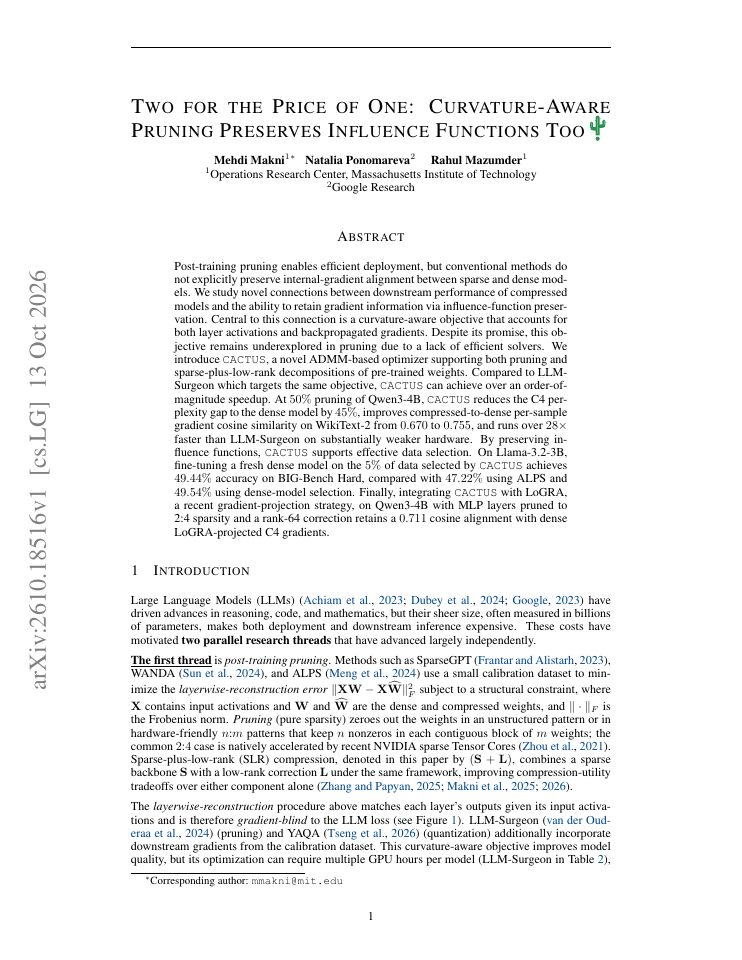
First page of Two For The Price Of One: Curvature-Aware Pruning Preserves Influence Functions Too
sparsity and pruningtest

Two For The Price Of One: Curvature-Aware Pruning Preserves Influence Functions Too

CACTUS replaces standard post-training pruning solvers (and the LLM-Surgeon optimizer) with an ADMM-based method that jointly matches layer activations and backpropagated gradients, supporting both pruning and sparse-plus-low-rank decompositions. It costs a calibration optimization pass per layer, added implementation complexity over magnitude or WANDA-style pruning, and optionally memory for the low-rank correction term. It can fail if the calibration data is unrepresentative of deployment inputs, if the target hardware lacks sparse-kernel support to realize 2:4 speedups, or if influence-function preservation does not transfer to tasks beyond the evaluated data-selection and perplexity settings.

observed signal
0impl.
0stars
—citations
28xclaimed gain
abstract onlyReview decisionDownload skill ↓Original paper ↗
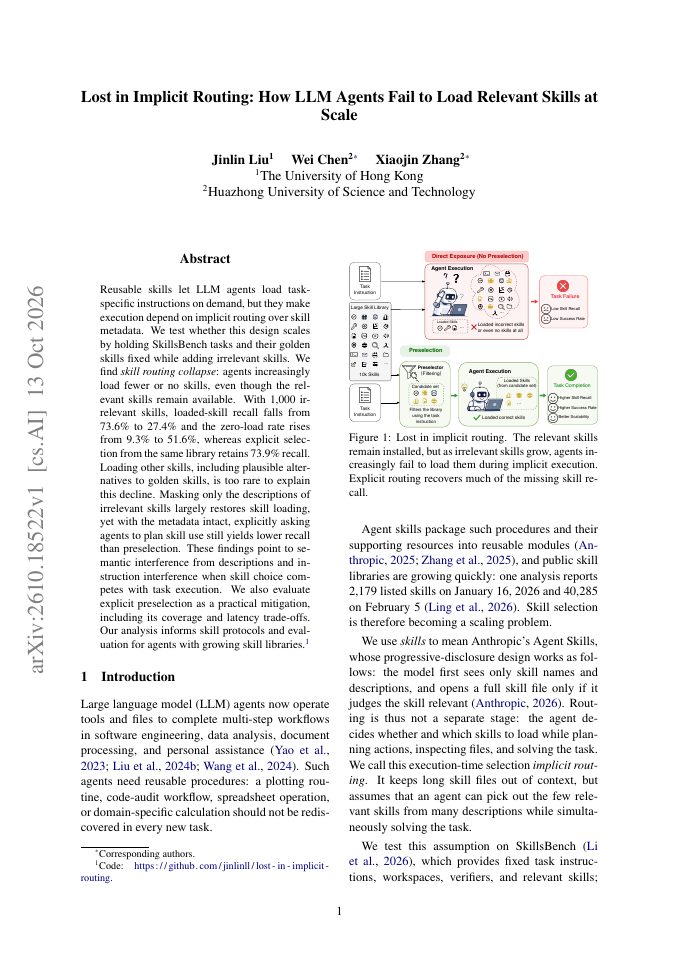
First page of Lost in Implicit Routing: How LLM Agents Fail to Load Relevant Skills at Scale
tool useadopt

Lost in Implicit Routing: How LLM Agents Fail to Load Relevant Skills at Scale

Explicit preselection of relevant skills before agent execution replaces implicit routing, in which the agent scans full skill metadata and decides what to load during the task. It costs an additional selection step with its own latency and coverage trade-offs, and requires a mechanism (retriever or selector model) to pick candidate skills from the library. It can fail when the preselector misses the golden skill, since the agent then has no opportunity to recover it, and gains shrink when libraries are small enough that implicit routing has not yet collapsed.

observed signal
0impl.
122stars
—citations
2.7xclaimed gain
abstract onlyReview decisionDownload skill ↓Original paper ↗
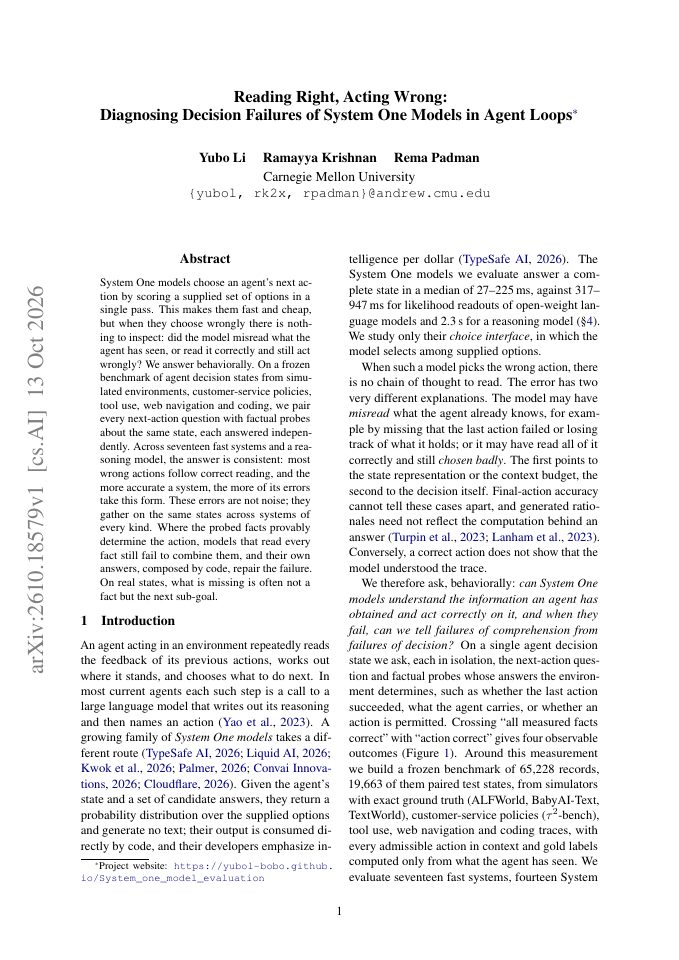
First page of Reading Right, Acting Wrong: Diagnosing Decision Failures of System One Models in Agent Loops
agent evaluationtest

Reading Right, Acting Wrong: Diagnosing Decision Failures of System One Models in Agent Loops

The method replaces uninterpretable single-pass action scoring with behavioral diagnostics: each next-action decision is paired with independent factual probes about the same state, separating perception failures from decision failures and enabling a repair path where the model's own correct factual answers are composed by code to fix the action. It costs additional probe queries per decision state, benchmark construction effort, and code to compose answers, adding latency and engineering complexity to the evaluation loop. It can fail when the diagnosis relies on synthetic probes that do not transfer to production states, and the abstract notes that on real states the missing element is often the next sub-goal, which factual probing and code composition may not supply.

observed signal
0impl.
122stars
—citations
—claimed gain
abstract onlyReview decisionDownload skill ↓Original paper ↗
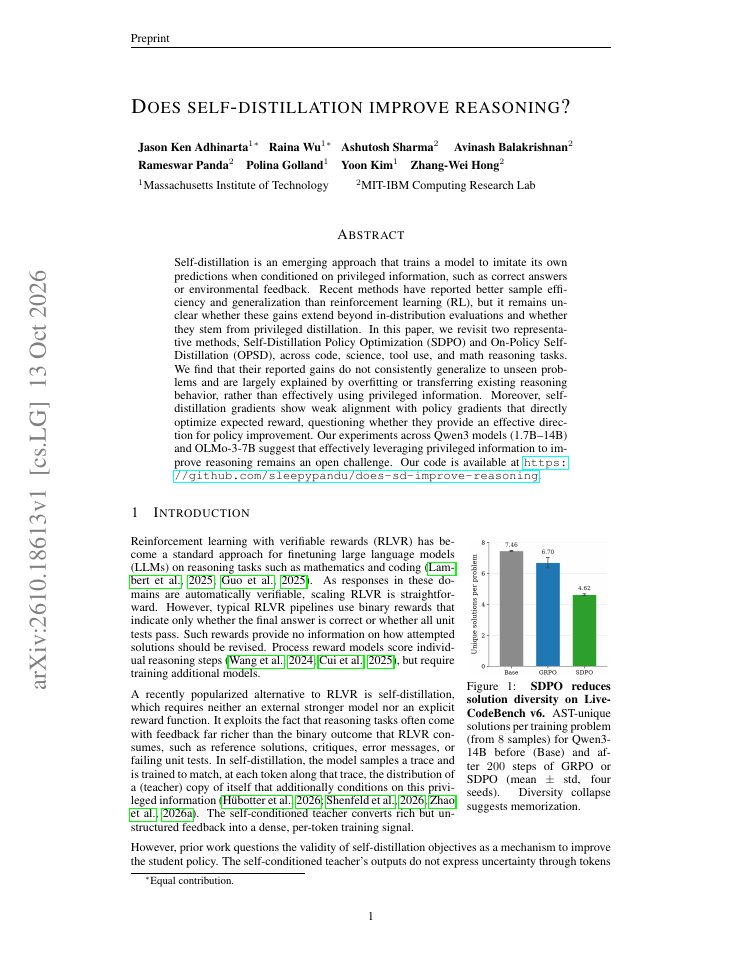
First page of Does self-distillation improve reasoning?
distillationwatch

Does self-distillation improve reasoning?

Self-distillation (SDPO, OPSD) trains a model to imitate its own predictions conditioned on privileged information, positioned as a more sample-efficient replacement for reinforcement learning from rewards; this paper is a critical re-evaluation, not a new method. The method costs a training run with privileged conditioning and adds distillation pipeline complexity over standard supervised fine-tuning, while this paper finds its gradients align weakly with reward-optimizing policy gradients. What can fail: reported gains do not transfer to unseen problems, are explained by overfitting or transferring existing behavior rather than using privileged information, and so the approach may deliver no out-of-distribution improvement in production.

observed signal
0impl.
0stars
—citations
—claimed gain
abstract onlyReview decisionDownload skill ↓Original paper ↗

Research signals

Three views of the same evidence: adoption against attention, publication cadence by research area, and reported gains when coverage is sufficient.

color = research area

01 · attention × adoption

The research frontier

Look to the upper left for independent implementation before mass attention.

compare by
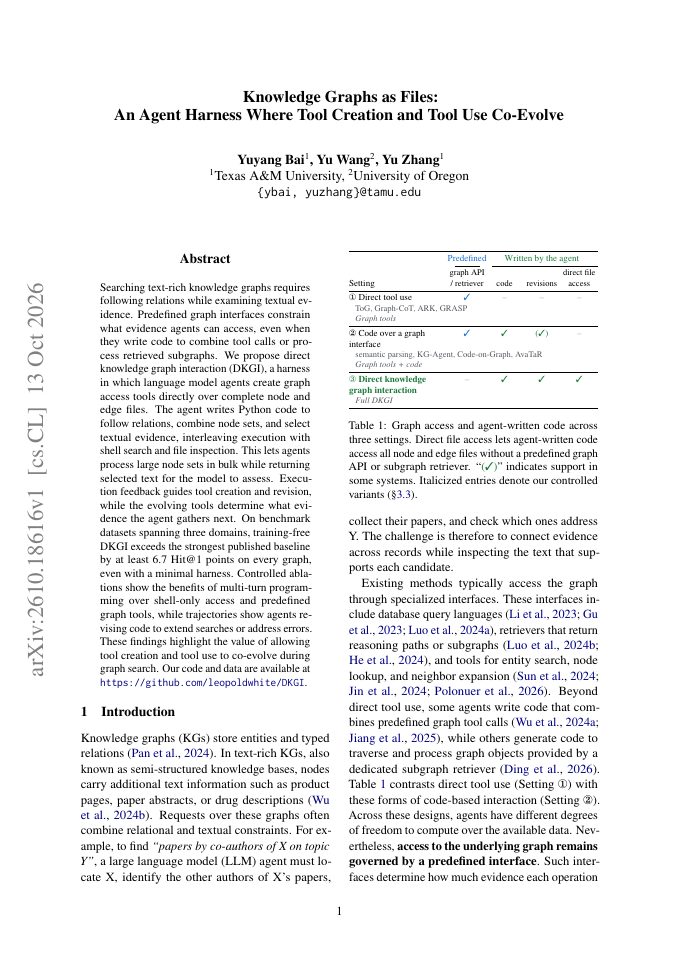
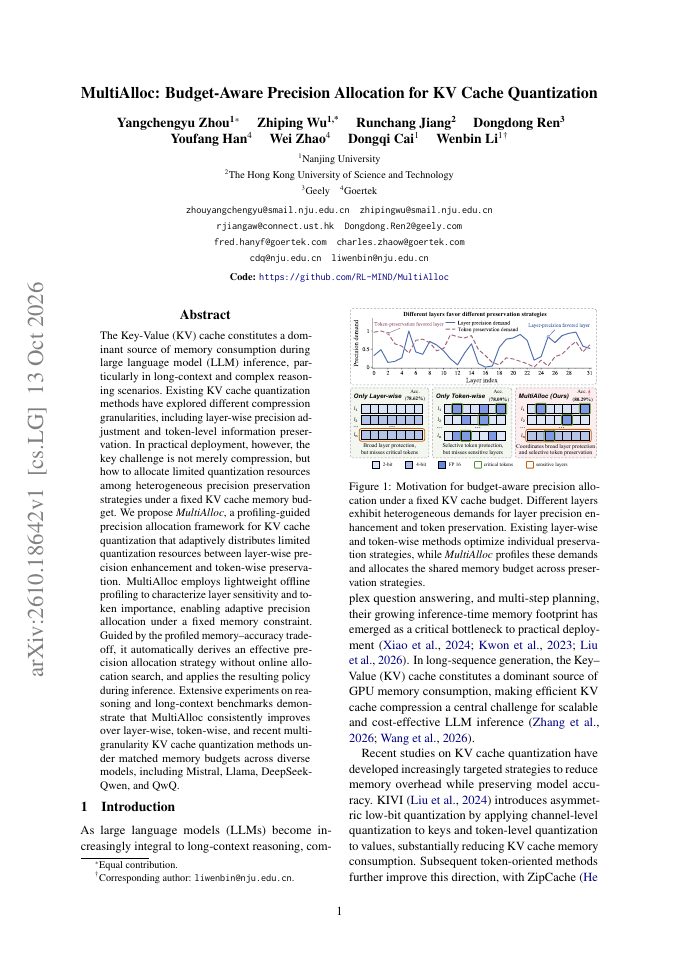
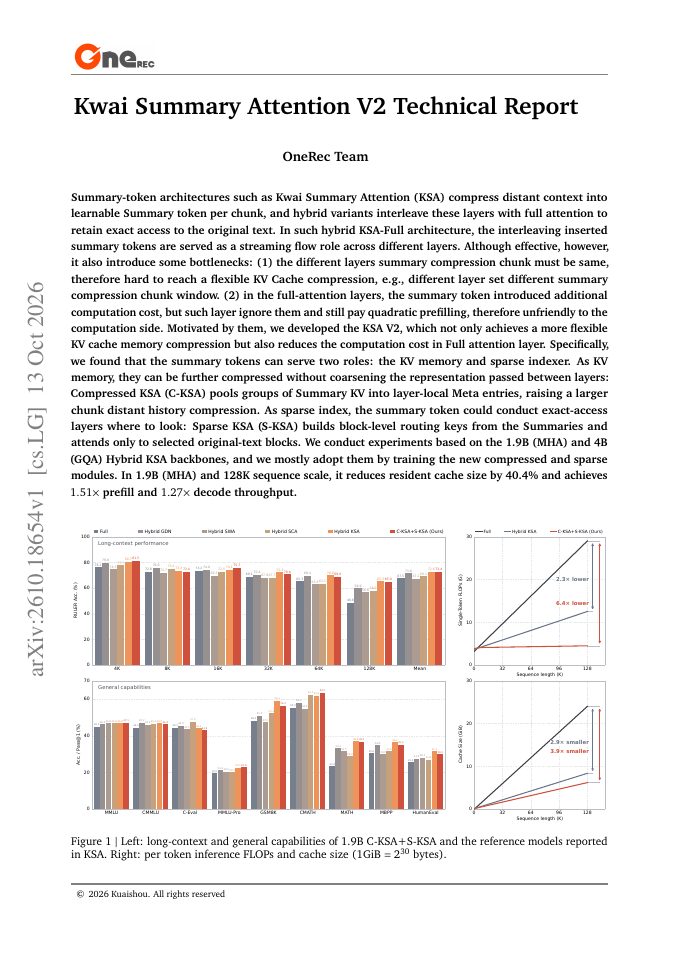
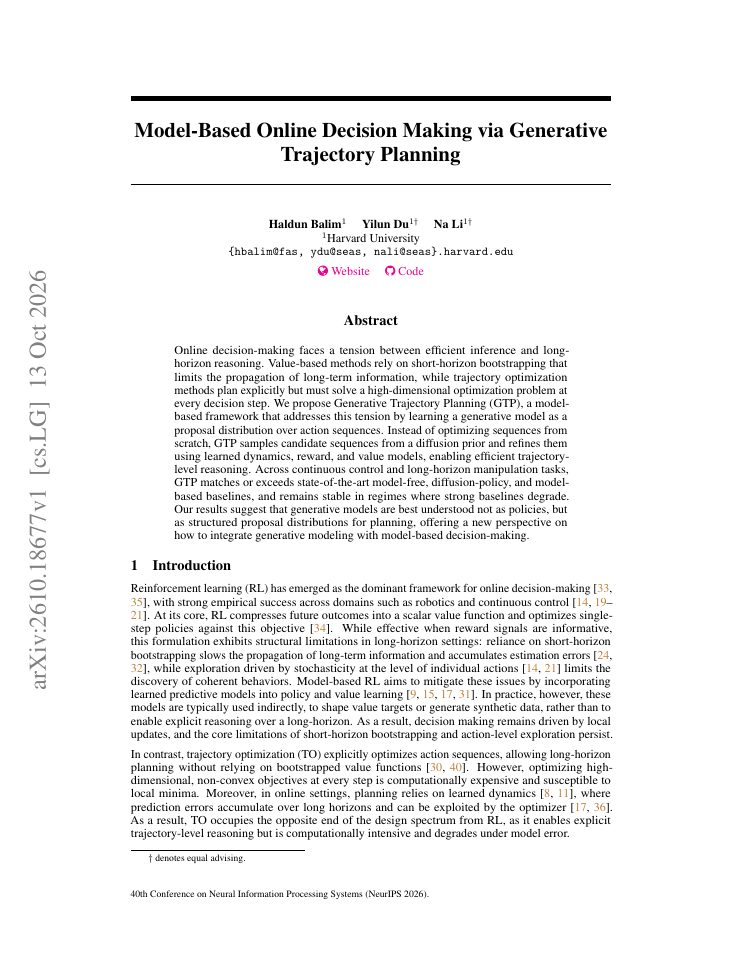
Each point represents one paper. Higher means more independent implementations; farther right means more GitHub stars.Same Bit Width, Different Outcomes: Post-Training Quantization of Text-to-Speech Across Architectures: 674 GitHub stars; 3 independent implementationsFrom Self-Distillation to Self-Practice: Privileged Information for Multi-Turn Agents: 876 GitHub stars; 2 independent implementationsWhere Does Exactly-Once Live? Model, Harness, and Tool-Contract Effects on Duplicate Side Effects in LLM Agents: 0 GitHub stars; 4 independent implementationsBatch-Paced: Fixed-Budget Batch Decoding in Discrete Diffusion Language Models: 0 GitHub stars; 0 independent implementationsVirtual Head Attention: 5 GitHub stars; 1 independent implementationBELT : BEhavior-Aligned Low-Rank KV Cache Compression with Learned Top-k Rank Allocation: 0 GitHub stars; 0 independent implementationsNeural Dimensional Analysis: Foundations of Dimensionless and Scale-Consistent Computation: 0 GitHub stars; 0 independent implementationsAlignPred: Error-Controlled KV Cache Compression via Alignment and Predictive Coding: 0 GitHub stars; 0 independent implementationsExact power indices for plurality-voting ensembles: 0 GitHub stars; 0 independent implementationsLatentRemedy: Efficient Remedy For Non-Prefix KV Cache Reuse in Multi-Agent Systems: 12 GitHub stars; 0 independent implementationsChampionKV: Head-Wise Adaptive Budget Allocation for KV Cache Compression: 0 GitHub stars; 0 independent implementationsH-DDCM: Hadamard Codebooks for Fast Generative Image and Video Compression: 0 GitHub stars; 0 independent implementationsRevisiting Error Feedback for Model Quantization: 0 GitHub stars; 0 independent implementationsSparPR: Runtime KV-Cache Recovery for Resource-Constrained LLM Inference on Consumer Hardware: 0 GitHub stars; 0 independent implementationsSimInter: Evidence-Grounded User Simulation with Interview-Based Profile Enrichment for Conversational Recommender Systems: 0 GitHub stars; 0 independent implementationsJev-Guard: Fast Routing and Auditing Agent Actions over Editable Policy Trees: 0 GitHub stars; 0 independent implementationsLet the Mind Conceive, Let the Hand Achieve: Following Multimodal Instructions for Long-Horizon Robotic Manipulation: 0 GitHub stars; 0 independent implementationsUrbex: Agentic Spatial Grounding for City-Scale 3D Scenes: 76 GitHub stars; 2 independent implementationsTeacher-Guided Tool Learning for Small Language Models via Bidirectional KL Constraints: 0 GitHub stars; 0 independent implementationsReadout Scaling Shapes Sparse Feature Recovery: 0 GitHub stars; 0 independent implementationsProTok: Unified Protein Tokenization via Modular Multi-Codebook Quantization: 0 GitHub stars; 0 independent implementationsJudges Follow the Reference: The Derivation Gap in Verifying Tool-Call Arguments: 122 GitHub stars; 0 independent implementationsThe Last Mile of Coding Agents for Long-Document Tasks: An Empirical Study on Clinical Trial Protocol Digitization: 10 GitHub stars; 0 independent implementationsTwo For The Price Of One: Curvature-Aware Pruning Preserves Influence Functions Too: 0 GitHub stars; 0 independent implementationsLost in Implicit Routing: How LLM Agents Fail to Load Relevant Skills at Scale: 122 GitHub stars; 0 independent implementationsReading Right, Acting Wrong: Diagnosing Decision Failures of System One Models in Agent Loops: 122 GitHub stars; 0 independent implementationsDoes self-distillation improve reasoning?: 0 GitHub stars; 0 independent implementationsCan an Agent Learn to Predict Its Own Failure? Outcome-Grounded Confidence Calibration in LLM Agents: 122 GitHub stars; 0 independent implementationsKnowledge Graphs as Files: An Agent Harness Where Tool Creation and Tool Use Co-Evolve: 10 GitHub stars; 0 independent implementationsMultiAlloc: Budget-Aware Precision Allocation for KV Cache Quantization: 0 GitHub stars; 0 independent implementationsKwai Summary Attention V2 Technical Report: 0 GitHub stars; 0 independent implementationsModel-Based Online Decision Making via Generative Trajectory Planning: 0 GitHub stars; 0 independent implementationsProAS: A Progress-Aware Advantage Shaping Framework for Multi-Turn Agentic Reinforcement Learning: 0 GitHub stars; 0 independent implementationsKnowing the User Is Not Knowing What We Established: Grounding Awareness in Personal Agents: 10 GitHub stars; 0 independent implementationsJust Respect the Semantics: Image-Token Compression via Pre-LLM Semantic Variable-Resolution Tokenization and In-LLM Relevance Pruning: 0 GitHub stars; 0 independent implementationsSP$^2$ec: Adaptive Self-Speculative Decoding for Vision-Language Models: 0 GitHub stars; 0 independent implementationsSolBehave: Evaluating the Behavioural Correctness of LLM-Generated Smart Contracts: 0 GitHub stars; 0 independent implementationsSEAR: Self-Evolving Agentic Robotics: 10 GitHub stars; 0 independent implementationsRoboSimStudio: An Interactive Toolkit for Rapid Real2Sim of Robot Manipulation Tasks: 17 GitHub stars; 2 independent implementationsThe Last Remote Sensing Model Built by Humans? Casting Any Earth Observation Task as Recursive Self-Improvement: 9 GitHub stars; 0 independent implementationsHybrid Reasoning Agents: 20 GitHub stars; 1 independent implementationDoubtLess: Training-Free Contrastive Decoding for Efficient Reasoning: 0 GitHub stars; 1 independent implementationChunkAct: Action Chunking for Agentic Robotics: 0 GitHub stars; 0 independent implementations

Papers above 1000 stars or 200 citations are not scored. They have already broken through the attention threshold, while Paperraft is designed to identify earlier signals.

02 · cadence

Research areas over time

Compare monthly publication volume on a shared scale and calendar.

coding agentsmax 8Sep 26: 0 papersOct 26: 2 papersSep 26Oct 26agent evaluationmax 8Sep 26: 0 papersOct 26: 6 papersSep 26Oct 26KV cachemax 8Sep 26: 0 papersOct 26: 8 papersSep 26Oct 26speculative decodingmax 8Sep 26: 0 papersOct 26: 2 papersSep 26Oct 26distillationmax 8Sep 26: 0 papersOct 26: 1 paperSep 26Oct 26sparsity and pruningmax 8Sep 26: 0 papersOct 26: 2 papersSep 26Oct 26memory and contextmax 8Sep 26: 0 papersOct 26: 1 paperSep 26Oct 26othermax 8Sep 26: 0 papersOct 26: 5 papersSep 26Oct 26planning and decompositionmax 8Sep 26: 0 papersOct 26: 2 papersSep 26Oct 26quantizationmax 8Sep 26: 1 paperOct 26: 1 paperSep 26Oct 26failure recoverymax 8Sep 26: 1 paperOct 26: 0 papersSep 26Oct 26safety and guardrailsmax 8Sep 26: 0 papersOct 26: 2 papersSep 26Oct 26serving and batchingmax 8Sep 26: 0 papersOct 26: 1 paperSep 26Oct 26efficient trainingmax 8Sep 26: 1 paperOct 26: 2 papersSep 26Oct 26tool usemax 8Sep 26: 0 papersOct 26: 5 papersSep 26Oct 26

Every panel uses the same calendar and vertical scale. An empty column means no papers were recorded.

03 · reported results

Claimed performance gains

Gains stated in the abstract: reported by the authors; not independently verified.

Factors reported by the authors and not independently verified. The vertical axis uses a logarithmic scale; the baseline is 1x.reported factor · log scaleSame Bit Width, Different Outcomes: Post-Training Quantization of Text-to-Speech Across Architectures: 1.67x in speed (author-reported)From Self-Distillation to Self-Practice: Privileged Information for Multi-Turn Agents: 1.65x in quality (author-reported)Where Does Exactly-Once Live? Model, Harness, and Tool-Contract Effects on Duplicate Side Effects in LLM Agents: 7x in quality (author-reported)Virtual Head Attention: 4x in memory (author-reported)BELT : BEhavior-Aligned Low-Rank KV Cache Compression with Learned Top-k Rank Allocation: 17.8x in memory (author-reported)AlignPred: Error-Controlled KV Cache Compression via Alignment and Predictive Coding: 1.72x in memory (author-reported)SparPR: Runtime KV-Cache Recovery for Resource-Constrained LLM Inference on Consumer Hardware: 2.7x in speed (author-reported)Jev-Guard: Fast Routing and Auditing Agent Actions over Editable Policy Trees: 3.6x in speed (author-reported)Let the Mind Conceive, Let the Hand Achieve: Following Multimodal Instructions for Long-Horizon Robotic Manipulation: 2.46x in quality (author-reported)Readout Scaling Shapes Sparse Feature Recovery: 1.8x in quality (author-reported)ProTok: Unified Protein Tokenization via Modular Multi-Codebook Quantization: 2.48x in quality (author-reported)Two For The Price Of One: Curvature-Aware Pruning Preserves Influence Functions Too: 28x in speed (author-reported)Lost in Implicit Routing: How LLM Agents Fail to Load Relevant Skills at Scale: 2.7x in quality (author-reported)Can an Agent Learn to Predict Its Own Failure? Outcome-Grounded Confidence Calibration in LLM Agents: 4.3x in quality (author-reported)ProAS: A Progress-Aware Advantage Shaping Framework for Multi-Turn Agentic Reinforcement Learning: 2.44x in speed (author-reported)Just Respect the Semantics: Image-Token Compression via Pre-LLM Semantic Variable-Resolution Tokenization and In-LLM Relevance Pruning: 18x in memory (author-reported)SP$^2$ec: Adaptive Self-Speculative Decoding for Vision-Language Models: 1.11x in speed (author-reported)Hybrid Reasoning Agents: 1.8x in speed (author-reported)DoubtLess: Training-Free Contrastive Decoding for Efficient Reasoning: 1.45x in cost (author-reported)ChunkAct: Action Chunking for Agentic Robotics: 2.9x in cost (author-reported)

20 of 43 papers report a quantified gain. The scale is logarithmic; a research-area trend line appears only with at least five papers in the quarter.

Method under scrutiny

Inspect the highest-ranked paper, every repository behind its signal, and the rule used to classify each one.

Where Does Exactly-Once Live? Model, Harness, and Tool-Contract Effects on Duplicate Side Effects in LLM Agents

failure recovery · adopt · 4 of 4 implementations are independent · 7x gain in quality (reported by the authors; not independently verified)

The technique replaces blind retry or model-level caution when a tool write times out or errors: a small harness guard that attaches an idempotency key to every write, letting the service deduplicate redeliveries. Cost is modest engineering (a key-generation and propagation guard, plus tool contracts that accept keys) with no model, GPU, or serving overhead; where contracts cannot accept keys, only waiting with a known in-flight bound partially substitutes. It fails when tool APIs do not support idempotency keys, when faults occur outside the service boundary the guard covers, and agents still misreport success (90% of duplicated episodes were reported as successful), so ledger-level auditing remains necessary.

Exclusions and controls

Every exclusion is counted and published.

Exclusion counts were not recorded for this edition.

0 previously indexed papers were rechecked in this run.

Paperraft tracks one signal: how many independent implementations a paper attracts on GitHub after author-owned repositories are removed. This is a discovery signal to investigate, not a measure of implementation quality.

It does not claim that a method works. Paperraft runs no reproduction benchmarks. Reported gains remain author claims until independently tested. Papers above the attention threshold are excluded because this publication is designed to identify research before consensus forms.