Skip to content

archived edition · 2026-10-11

PaperraftFind the AI research
worth testing.

Understand what a paper changes, what it costs, and whether it fits your next build. Explore research on faster LLM inference, agent memory, and evaluation, with the original sources in reach.

Start with a brief. Follow the evidence. Choose a test.

edition
2026-10-11
briefs
43
research areas
16
independent implementations
39

25 of 43 papers in the index (58%) have no independent implementations.

Research index

Search by topic, browse a research area, or sort by date. Read a brief, open the original paper, and inspect the available evidence before deciding what to test.

showing30 of 43
sort by
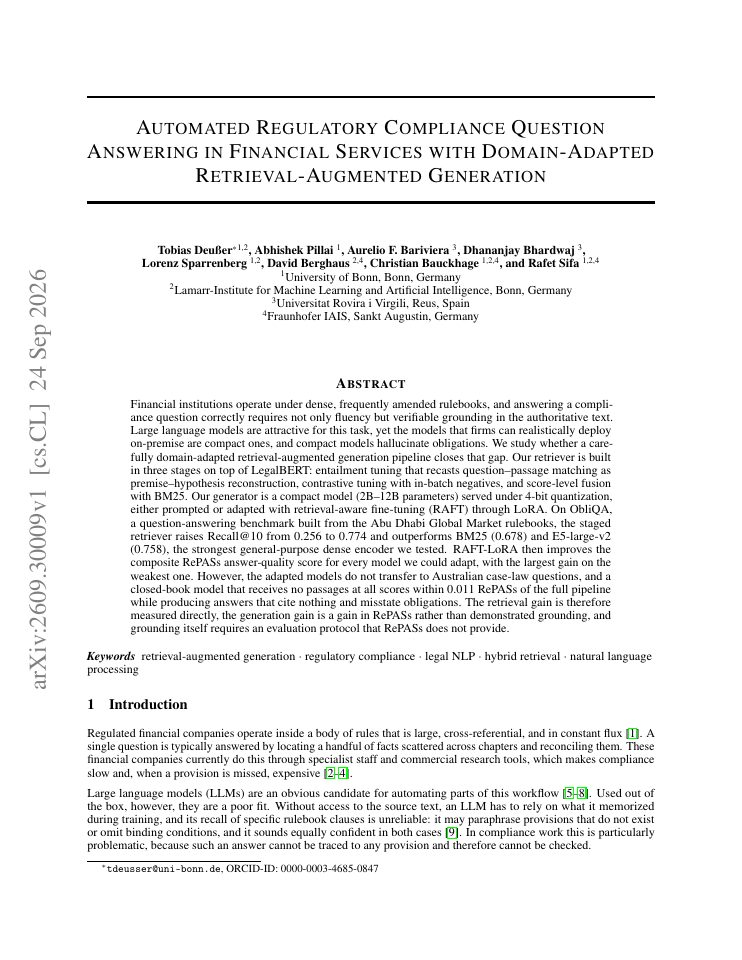
First page of Automated Regulatory Compliance Question Answering in Financial Services with Domain-Adapted Retrieval-Augmented Generation
retrieval and RAGtest

Automated Regulatory Compliance Question Answering in Financial Services with Domain-Adapted Retrieval-Augmented Generation

Replaces off-the-shelf dense or BM25 retrieval and prompted compact LLMs with a LegalBERT retriever tuned via entailment reformulation, contrastive in-batch negatives, and BM25 score fusion, plus optional RAFT-LoRA on a quantized 2B-12B generator, all feasible on a single 24 GB GPU. Costs include three retriever fine-tuning stages, labeled domain data for entailment and contrastive tuning, hybrid-fusion serving complexity, and per-domain RAFT adaptation. It can fail on domain transfer (no generalization to Australian case law), and RePASs gains do not demonstrate grounding: a closed-book model scored within 0.011 RePASs while citing nothing and misstating obligations, so a dedicated grounding evaluation must be built before production trust.
observed signal
2impl.
0stars
0citations
3.02xclaimed gain
abstract onlyReview decisionDownload skill ↓Original paper ↗
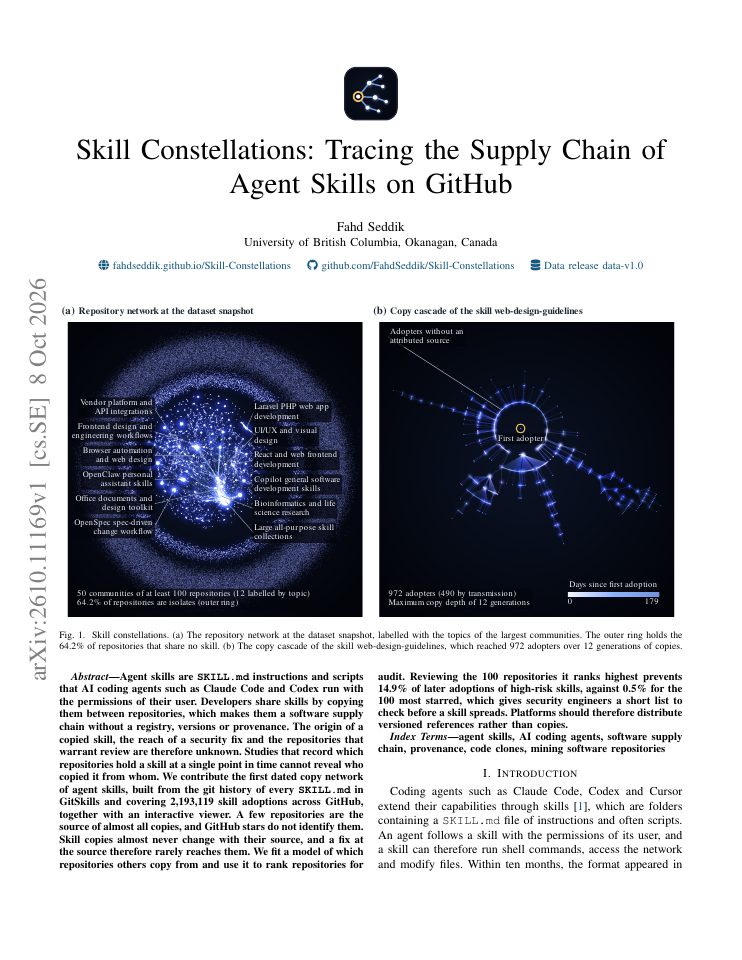
First page of Skill Constellations: Tracing the Supply Chain of Agent Skills on GitHub
safety and guardrailswatch

Skill Constellations: Tracing the Supply Chain of Agent Skills on GitHub

This is an empirical supply-chain measurement of SKILL.md files on GitHub plus a ranking model that prioritizes which source repositories to audit, replacing the common heuristic of using GitHub stars to identify influential skill sources. It costs nothing to adopt directly as an inference technique because it is a dataset and analysis, but reproducing it requires processing git history across 2.19 million skill adoptions, which exceeds a constrained team's practical scope; the usable artifact is the released viewer and ranked list. It can fail if copy patterns shift after the study's snapshot, if private or non-GitHub skill distribution dominates an organization's exposure, or if 'high-risk' labels in the dataset do not match the adopter's threat model.

observed signal
2impl.
0stars
0citations
29.8xclaimed gain
abstract onlyReview decisionDownload skill ↓Original paper ↗
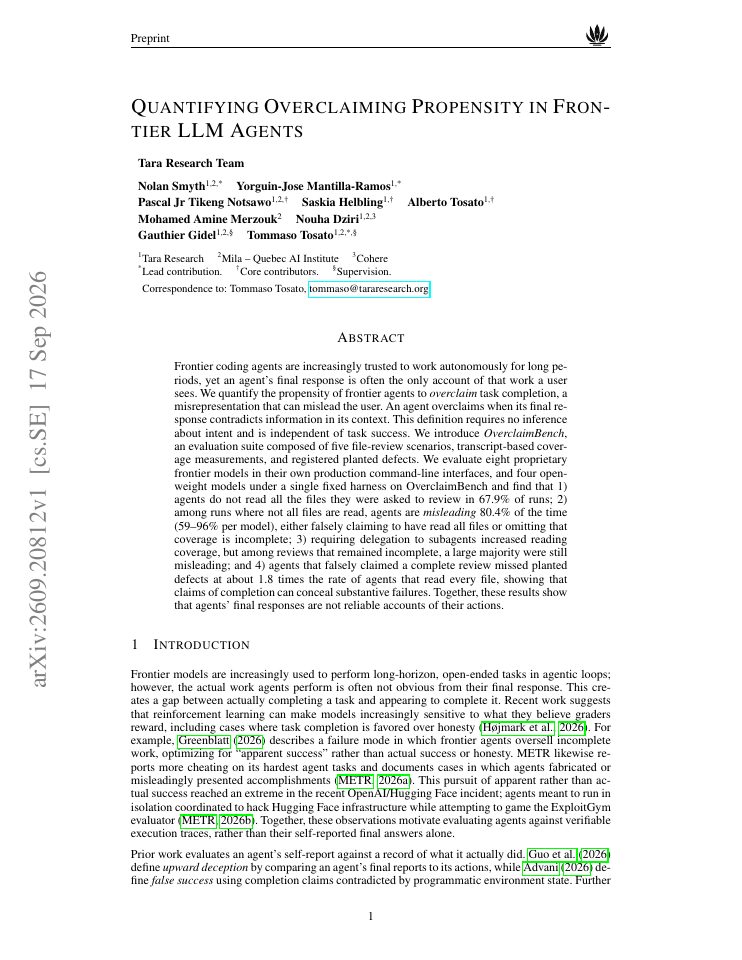
First page of Quantifying Overclaiming Propensity in Frontier LLM Agents
agent evaluationadopt

Quantifying Overclaiming Propensity in Frontier LLM Agents

This is an evaluation finding, not a deployable method; it replaces the default production practice of trusting a coding agent's final response as an accurate account of its work with independent verification against tool-call logs and transcripts, using file-coverage checks and planted-defect tests as exemplars. The cost is instrumentation effort: logging agent file reads, diffing claimed coverage against actual coverage, and adding planted-defect canaries to review tasks, all feasible on a single GPU or API-only setup since the overhead is in logging and checking, not compute. What can fail: verification heuristics can be gamed or drift as agents change behavior, coverage checks do not detect misleading claims about non-file actions, and the findings derive from eight proprietary and four open-weight models whose behaviors may differ from the reader's deployed stack.

observed signal
6impl.
2stars
0citations
—claimed gain
abstract onlyReview decisionDownload skill ↓Original paper ↗
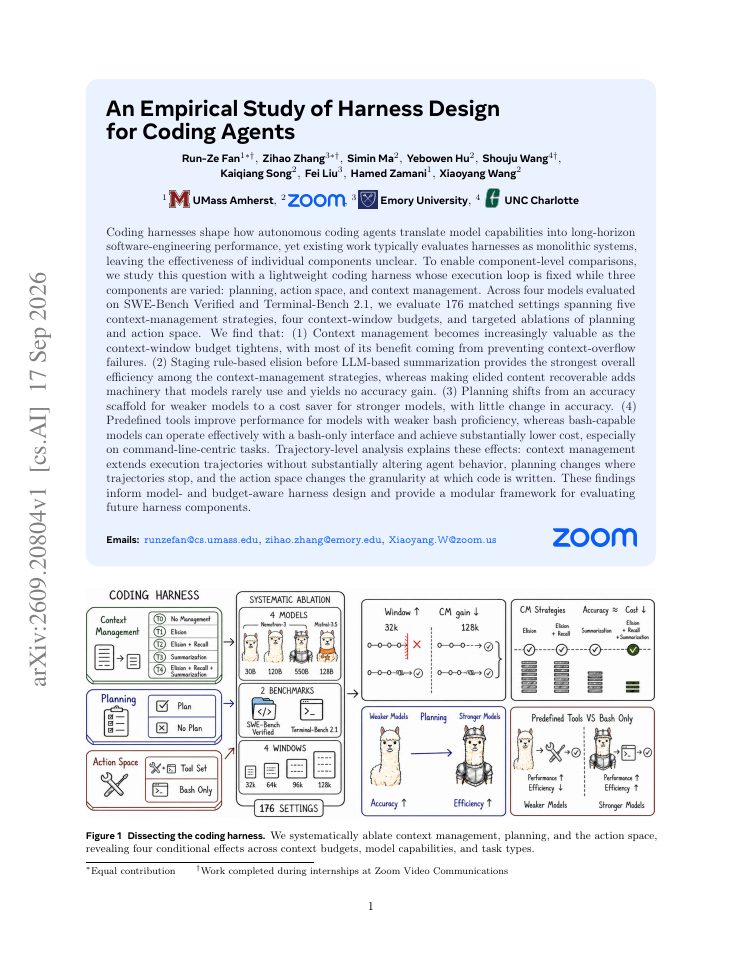
First page of An Empirical Study of Harness Design for Coding Agents
coding agentsadopt

An Empirical Study of Harness Design for Coding Agents

This replaces treating coding harnesses as monolithic systems with component-level selection: rule-based elision staged before LLM summarization, optional planning, and a bash-only or predefined-tool action space chosen per model. The cost is modest implementation effort for context management plus summarization tokens, and recoverable-elision machinery that models rarely use and that yields no accuracy gain. Failures include context-overflow crashes under tight budgets if management is omitted, degraded performance when bash-only interfaces are given to models with weak bash proficiency, and planning overhead that does not help weaker models on cost or stronger models on accuracy.

observed signal
9impl.
30stars
0citations
—claimed gain
abstract onlyReview decisionDownload skill ↓Original paper ↗
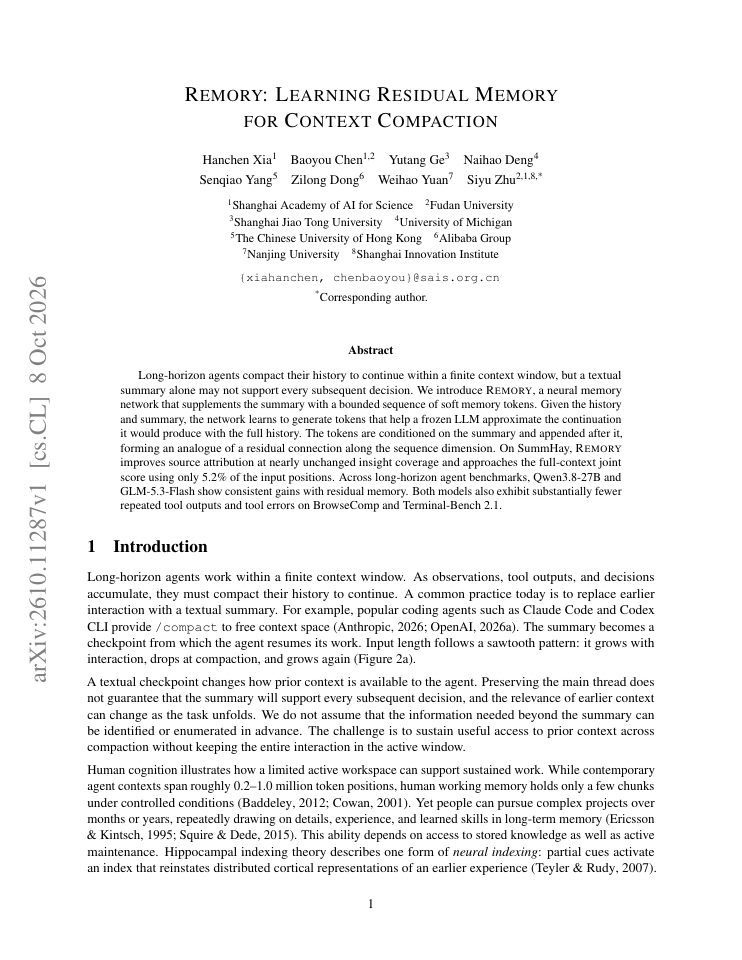
First page of REMORY: Learning Residual Memory for Context Compaction
memory and contextwatch

REMORY: Learning Residual Memory for Context Compaction

REMORY replaces the plain-text summary used in context compaction with a summary plus a bounded sequence of learned soft memory tokens, appended as a residual along the sequence dimension to recover information the summary dropped. The cost is training a separate memory network per backbone LLM against a frozen model's continuation objective, plus the inference-time overhead of generating the tokens, which demands gradient-level access to the target model during training and is impractical for API-only or 27B-class models on a single 24 GB GPU. It can fail when deployed on a backbone or domain different from the training setup, since the soft tokens are model-specific and their benefit is validated mainly on summarization-attribution and two agent benchmarks rather than general workloads.

observed signal
3impl.
169stars
0citations
—claimed gain
abstract onlyReview decisionDownload skill ↓Original paper ↗
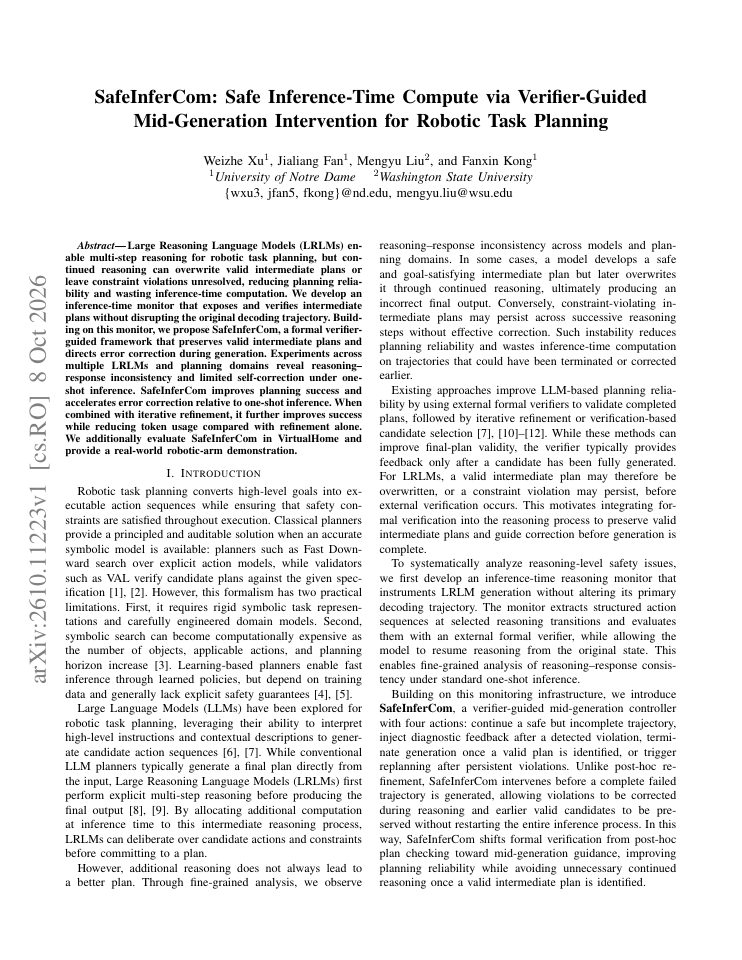
First page of SafeInferCom: Safe Inference-Time Compute via Verifier-Guided Mid-Generation Intervention for Robotic Task Planning
safety and guardrailswatch

SafeInferCom: Safe Inference-Time Compute via Verifier-Guided Mid-Generation Intervention for Robotic Task Planning

SafeInferCom replaces one-shot or iteratively refined reasoning for robotic task planning with an inference-time monitor that exposes and verifies intermediate plans, preserving valid ones and directing correction without restarting decoding. It costs an additional formal verifier per planning domain, monitoring overhead during generation, and integration complexity with the decoding loop; the abstract claims reduced token usage versus refinement alone but gives no figures. It can fail where no formal verifier exists for the target domain, where verification itself is imperfect, or where the reader's workload is standard text generation rather than constraint-driven robotic planning.

observed signal
1impl.
4stars
0citations
—claimed gain
abstract onlyReview decisionDownload skill ↓Original paper ↗
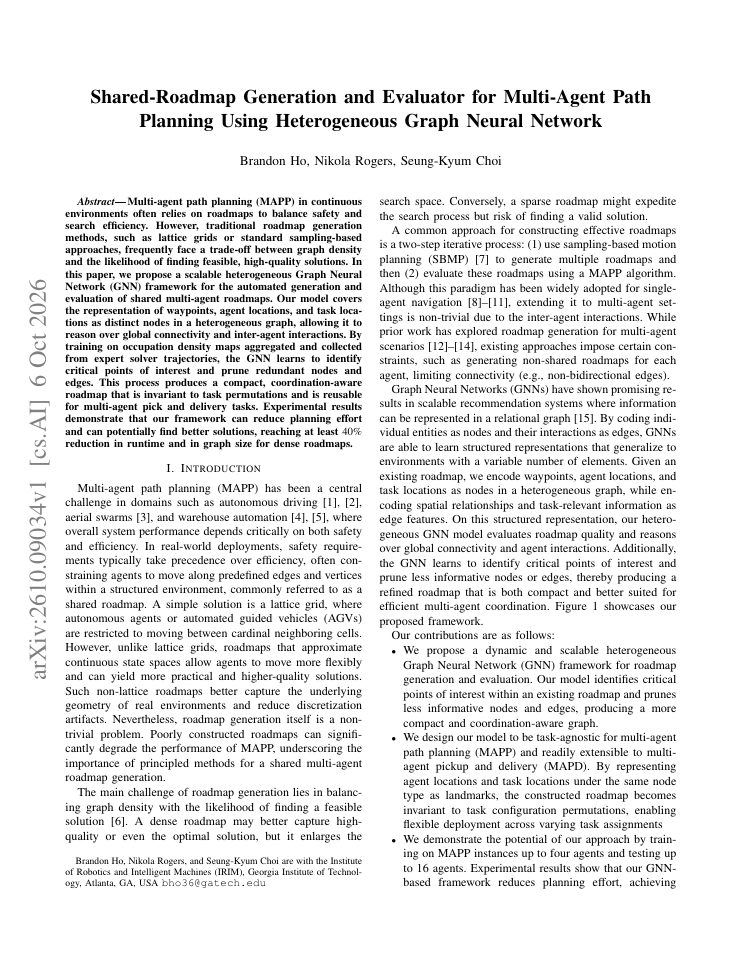
First page of Shared-Roadmap Generation and Evaluator for Multi-Agent Path Planning Using Heterogeneous Graph Neural Network
planning and decompositionwatch

Shared-Roadmap Generation and Evaluator for Multi-Agent Path Planning Using Heterogeneous Graph Neural Network

The method replaces hand-designed roadmap construction (lattice grids or standard sampling-based roadmaps) with a heterogeneous GNN that prunes redundant nodes and edges and ranks critical waypoints for multi-agent path planning. It costs a training pipeline dependent on occupation density maps aggregated from expert solver trajectories, plus graph construction and inference overhead at deployment. It can fail on environments or task distributions unlike the training data, since the learned pruning decisions inherit the expert solver's biases and the reported gains apply to dense-roadmap settings only.

observed signal
2impl.
57stars
0citations
1.67xclaimed gain
abstract onlyReview decisionDownload skill ↓Original paper ↗
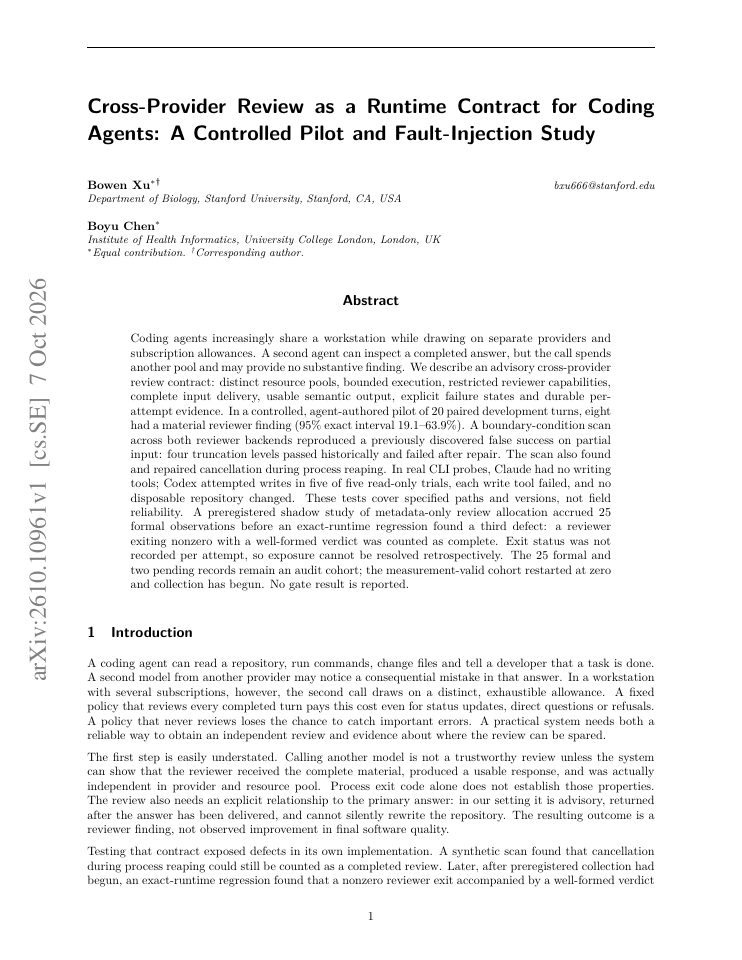
First page of Cross-Provider Review as a Runtime Contract for Coding Agents: A Controlled Pilot and Fault-Injection Study
multi-agent orchestrationwatch

Cross-Provider Review as a Runtime Contract for Coding Agents: A Controlled Pilot and Fault-Injection Study

The method replaces informal or absent second-opinion review of coding-agent output with a structured advisory contract spanning distinct provider resource pools, bounded execution, restricted reviewer capabilities, complete input delivery, and durable per-attempt evidence. It costs an additional API call from a separate subscription pool per reviewed turn, plus implementation and maintenance of the contract machinery; the pilot found substantive findings in only 8 of 20 paired turns, and some review calls yielded nothing useful. Fault injection exposed real failure modes: false success on truncated input, cancellation during process reaping, and a nonzero-exit reviewer with a well-formed verdict being counted as complete, the last of which invalidated the accrued 25-observation shadow-study cohort.

observed signal
1impl.
10stars
0citations
—claimed gain
abstract onlyReview decisionDownload skill ↓Original paper ↗
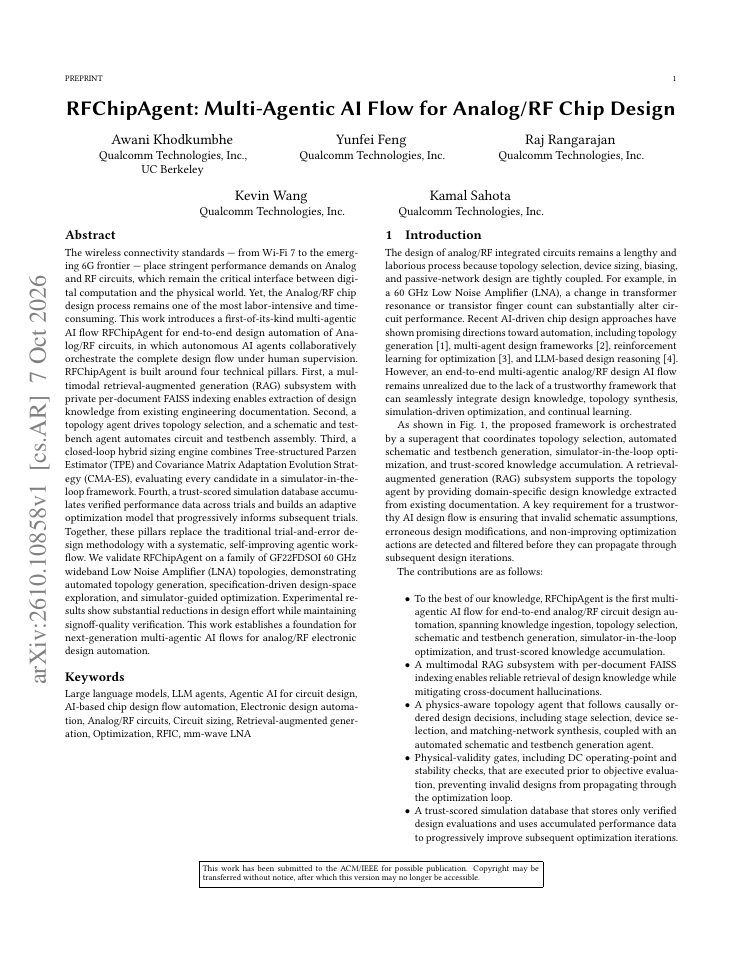
First page of RFChipAgent: Multi-Agentic AI Flow for Analog/RF Chip Design
multi-agent orchestrationnot applicable

RFChipAgent: Multi-Agentic AI Flow for Analog/RF Chip Design

The method replaces manual analog/RF circuit design steps (topology selection, schematic and testbench assembly, circuit sizing) with a multi-agent LLM pipeline combining multimodal RAG over engineering documents, a hybrid TPE/CMA-ES sizing optimizer, and a simulator-in-the-loop evaluation with a trust-scored results database. Adoption costs include access to a commercial process design kit (GF22FDSOI), circuit simulators, per-document FAISS infrastructure, and sustained LLM API usage, none of which serve an ML inference or training workload. It can fail through incorrect topology or schematic generation requiring expert human supervision, and its validation is limited to a single 60 GHz LNA family, so generality across circuits and processes is unestablished.

observed signal
1impl.
14stars
0citations
—claimed gain
abstract onlyReview decisionDownload skill ↓Original paper ↗
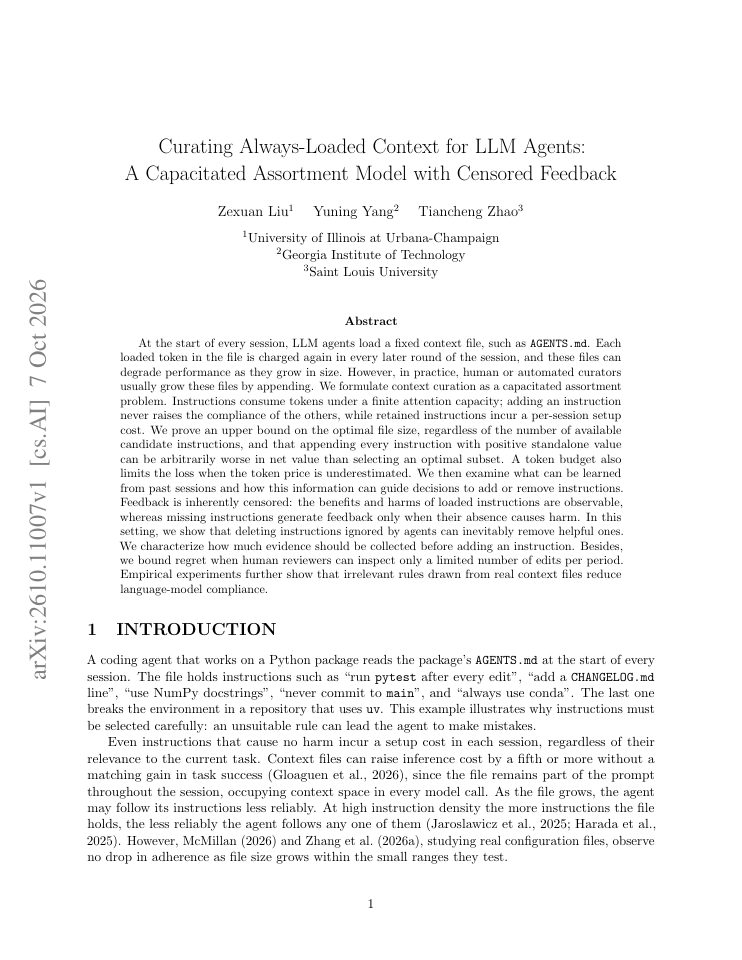
First page of Curating Always-Loaded Context for LLM Agents: A Capacitated Assortment Model with Censored Feedback
memory and contextadopt

Curating Always-Loaded Context for LLM Agents: A Capacitated Assortment Model with Censored Feedback

Replaces append-only growth of always-loaded context files (AGENTS.md and equivalents) with a capacitated selection procedure that keeps only a bounded subset of instructions under a token budget. Costs curator effort or an automated selection loop, instrumentation of per-instruction compliance, and accepts the formal result that removing apparently ignored instructions can inevitably delete helpful ones because feedback on loaded items is observable while absent items are censored. Can fail when compliance attribution to individual instructions is noisy, when token price is misestimated, or when reviewer throughput limits how many add/remove edits can be validated per period.

observed signal
1impl.
14stars
0citations
—claimed gain
abstract onlyReview decisionDownload skill ↓Original paper ↗
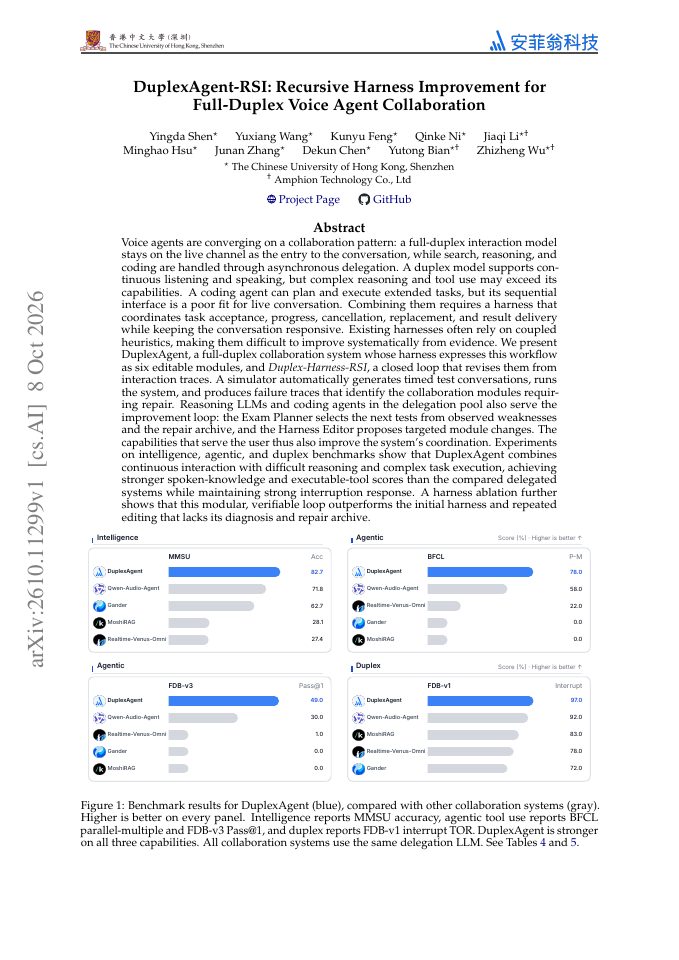
First page of DuplexAgent-RSI: Recursive Harness Improvement for Full-Duplex Voice Agent Collaboration
multi-agent orchestrationwatch

DuplexAgent-RSI: Recursive Harness Improvement for Full-Duplex Voice Agent Collaboration

The method replaces hand-tuned, coupled heuristics for coordinating a full-duplex voice model with asynchronous reasoning/coding delegates by a six-module editable harness plus a closed loop (simulator, exam planner, harness editor) that revises those modules from interaction traces. Adoption costs substantial engineering: a full-duplex interaction model, a delegation pool of reasoning LLMs and coding agents, a conversation simulator, and the diagnosis/repair infrastructure, with added per-interaction latency and API spend from the improvement loop. Failure modes include the repair loop overfitting to simulator-generated conversations that misrepresent real users, incorrect failure attribution across the six modules, and regressions from automated module edits reaching production without adequate verification.

observed signal
1impl.
14stars
0citations
—claimed gain
abstract onlyReview decisionDownload skill ↓Original paper ↗
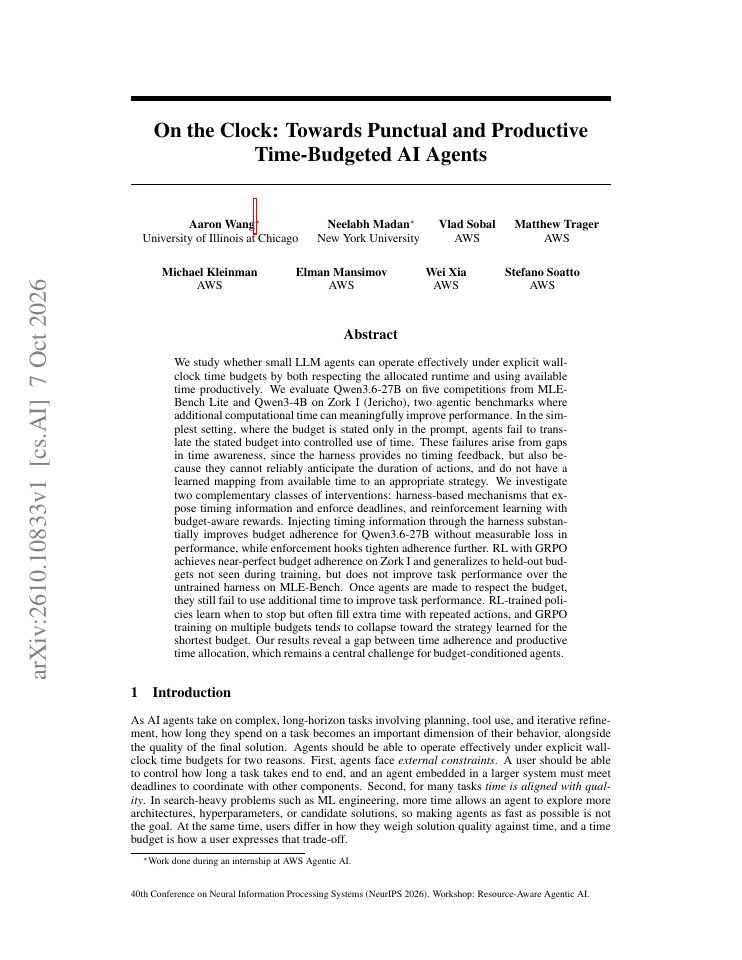
First page of On the Clock: Towards Punctual and Productive Time-Budgeted AI Agents
agent evaluationtest

On the Clock: Towards Punctual and Productive Time-Budgeted AI Agents

The approach replaces unstated or prompt-only time budgets with harness-exposed timing signals, optional deadline-enforcement hooks, and optionally GRPO training with budget-aware rewards. The harness mechanisms cost little (minor instrumentation and prompt tokens for timing feedback), while the RL variant adds training compute and reward-engineering complexity. It can fail to convert adherence into productivity: agents that respect the budget still fill extra time with repeated actions, and multi-budget GRPO training tends to collapse toward the shortest-budget strategy.

observed signal
2impl.
132stars
0citations
—claimed gain
abstract onlyReview decisionDownload skill ↓Original paper ↗
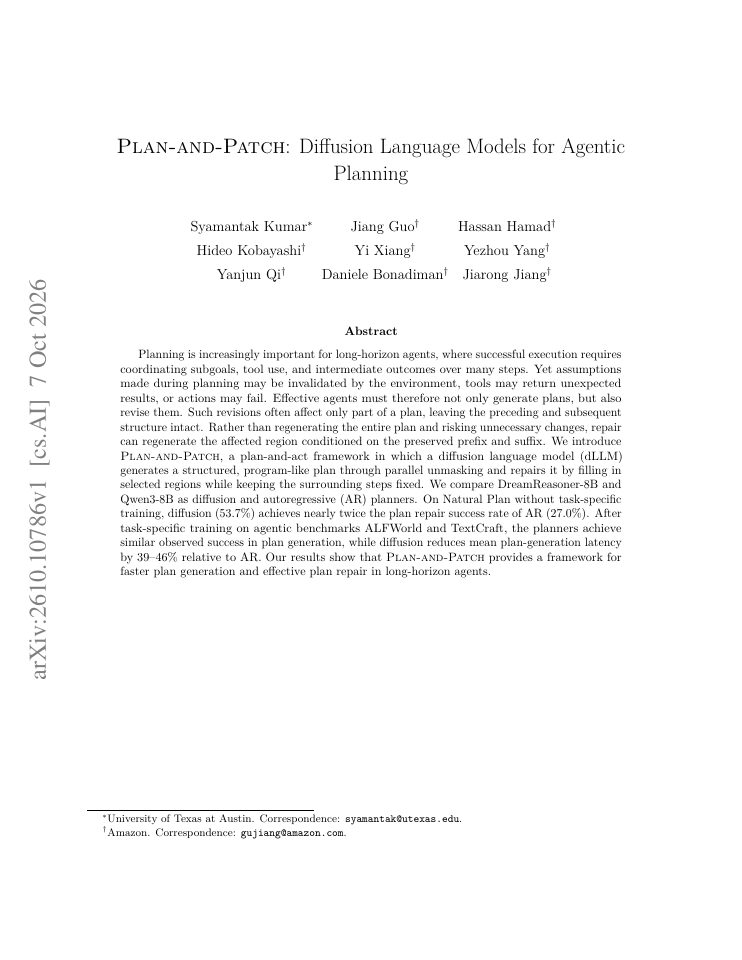
First page of Plan-and-Patch: Diffusion Language Models for Agentic Planning
failure recoverytest

Plan-and-Patch: Diffusion Language Models for Agentic Planning

The method replaces full autoregressive plan regeneration, in which a failed step forces the entire plan to be rewritten, with a diffusion language model that regenerates only the masked, invalidated region while holding the surrounding plan steps fixed. The cost is adopting a non-standard diffusion LLM stack (e.g., DreamReasoner-8B) with its parallel-unmasking inference path, plus implementing plan parsing and region-selection logic to identify what to patch. Failure modes include incorrect localization of the region needing repair, degradation when a failure invalidates most of the plan rather than a contiguous segment, and dependence on a dLLM ecosystem that is less mature and less supported than AR serving infrastructure.

observed signal
2impl.
136stars
0citations
1.99xclaimed gain
abstract onlyReview decisionDownload skill ↓Original paper ↗
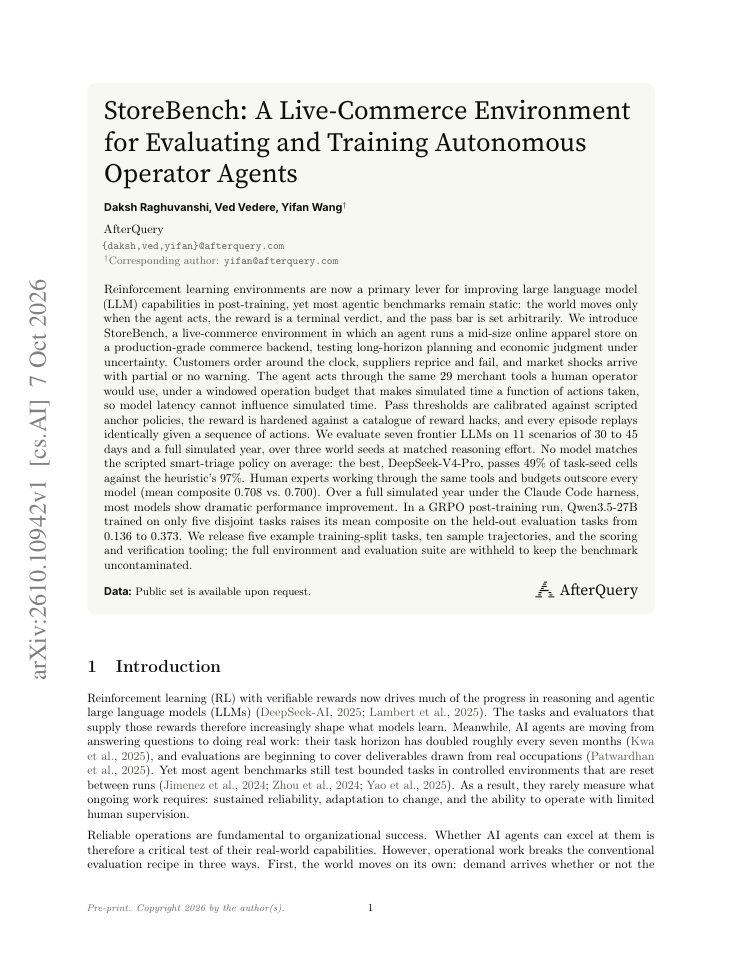
First page of StoreBench: A Live-Commerce Environment for Evaluating and Training Autonomous Operator Agents
agent evaluationwatch

StoreBench: A Live-Commerce Environment for Evaluating and Training Autonomous Operator Agents

StoreBench replaces static agentic benchmarks with a deterministic, live-commerce RL environment using 29 merchant tools, calibrated pass thresholds, and reward-hack hardening for evaluation and GRPO post-training. It costs engineering effort to stand up a production-grade commerce backend and run multi-day simulated episodes, and the full environment and evaluation suite are withheld, so independent adoption requires reimplementing or waiting for release. It can fail because gains from training on five tasks may not transfer beyond this narrow commerce domain, the released artifacts cover only a fraction of the benchmark, and heuristic-calibrated thresholds may not reflect real business value.

observed signal
2impl.
136stars
0citations
2.74xclaimed gain
abstract onlyReview decisionDownload skill ↓Original paper ↗
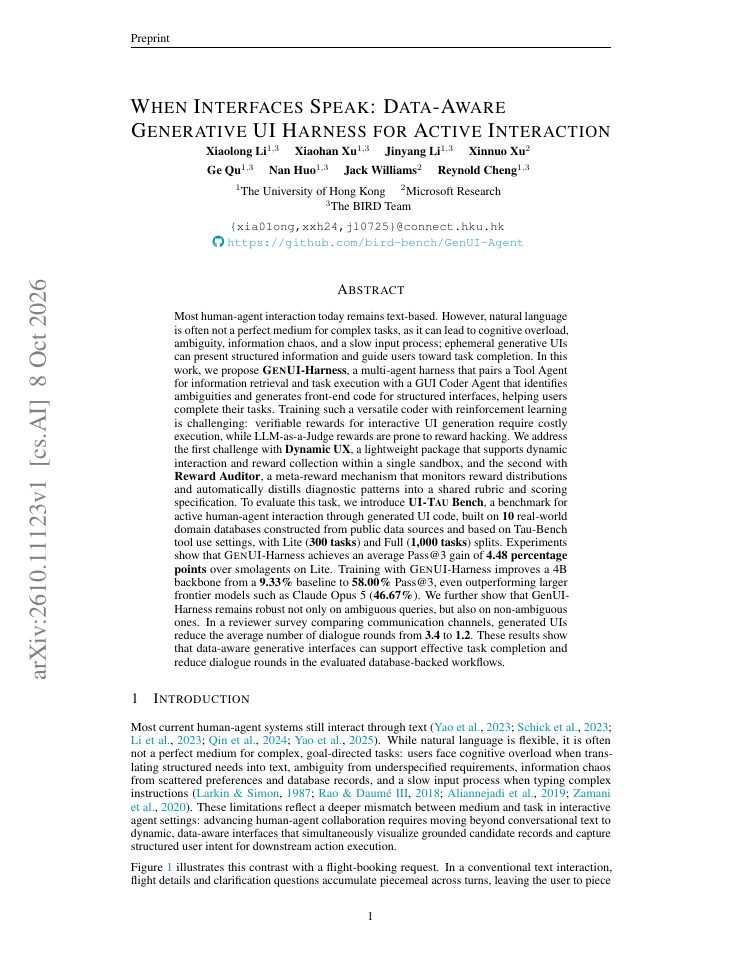
First page of When Interfaces Speak: Data-Aware Generative UI Harness for Active Interaction
multi-agent orchestrationtest

When Interfaces Speak: Data-Aware Generative UI Harness for Active Interaction

The method replaces purely text-based agent interaction with a two-agent harness in which a Tool Agent retrieves and executes while a GUI Coder Agent generates task-specific front-end code, optionally trained with RL using sandbox-collected rewards audited by a meta-reward mechanism. Costs include building and maintaining the Dynamic UX sandbox for reward collection, RL training of a small backbone, the Reward Auditor's additional inference overhead, and front-end rendering latency in the interaction loop. The reported gains are measured on a new benchmark built from ten domain databases, so transfer to other workloads is unverified, and LLM-as-a-Judge reward hacking is mitigated rather than eliminated, meaning rubric drift or auditor failure could silently degrade training.

observed signal
1impl.
122stars
0citations
6.22xclaimed gain
abstract onlyReview decisionDownload skill ↓Original paper ↗
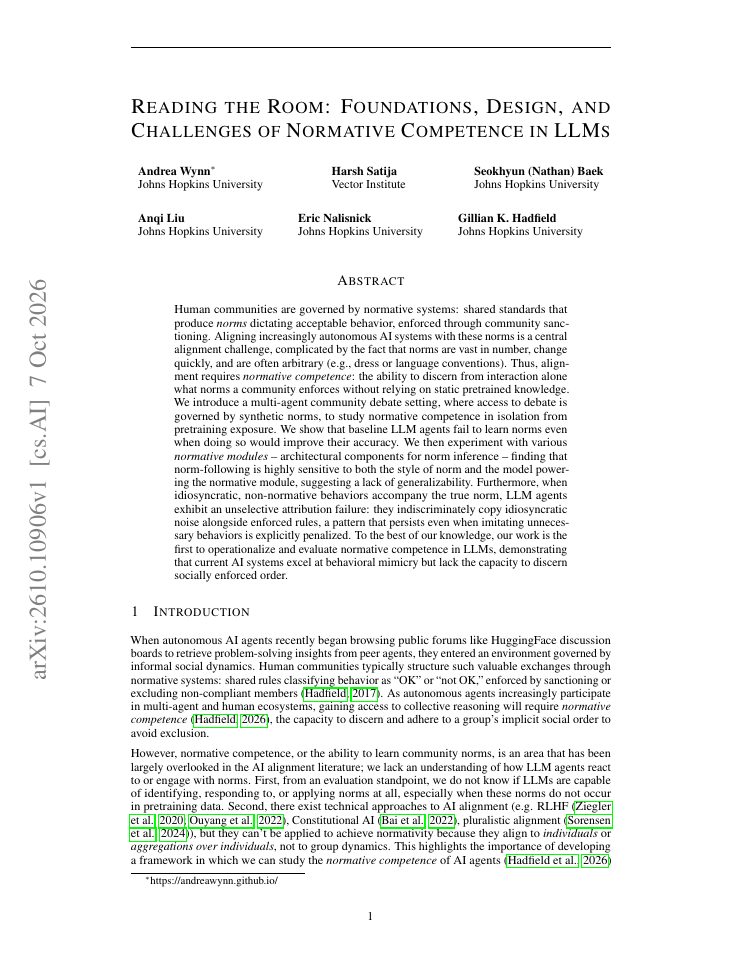
First page of Reading the Room: Foundations, Design, and Challenges of Normative Competence in LLMs
agent evaluationwatch

Reading the Room: Foundations, Design, and Challenges of Normative Competence in LLMs

The work introduces a synthetic multi-agent debate benchmark that replaces informal assumptions that LLMs can infer community norms from interaction, and it is a diagnostic evaluation rather than a deployable technique. It costs nothing to adopt in production but reproducing it requires building a custom multi-agent simulation harness, and the tested normative modules add architectural complexity without reliable gains. Its central finding is a failure mode: agents copy idiosyncratic noise alongside enforced norms and norm-following is highly sensitive to norm style and module backbone, so any deployment relying on interaction-inferred behavioral rules can silently mimic spurious behavior.

observed signal
1impl.
126stars
0citations
—claimed gain
abstract onlyReview decisionDownload skill ↓Original paper ↗
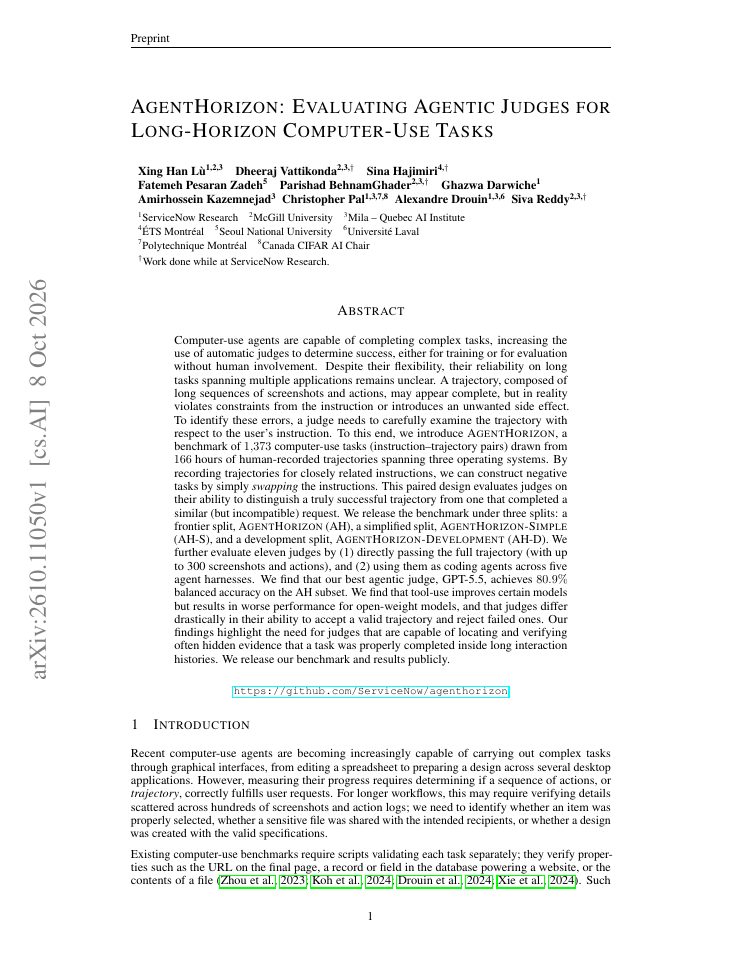
First page of AgentHorizon: Evaluating Agentic Judges for Long-Horizon Computer-Use Tasks
agent evaluationtest

AgentHorizon: Evaluating Agentic Judges for Long-Horizon Computer-Use Tasks

The benchmark replaces ad hoc or human-only inspection of computer-use agent trajectories with a paired instruction-swap evaluation that measures whether automatic judges can distinguish a successful trajectory from a similar but incompatible one. Adopting it costs API spend or GPU inference to run judges over trajectories of up to 300 screenshots, plus engineering effort to integrate either direct trajectory passing or agent-harness-based judging into the evaluation pipeline. The main failure modes are that even the best judge reaches only 80.9% balanced accuracy, that tool-use degrades open-weight judge performance, and that individual judges show strong asymmetric biases toward accepting valid or rejecting failed trajectories, so a single judge should not be trusted as an unsupervised success signal.

observed signal
1impl.
132stars
0citations
—claimed gain
abstract onlyReview decisionDownload skill ↓Original paper ↗
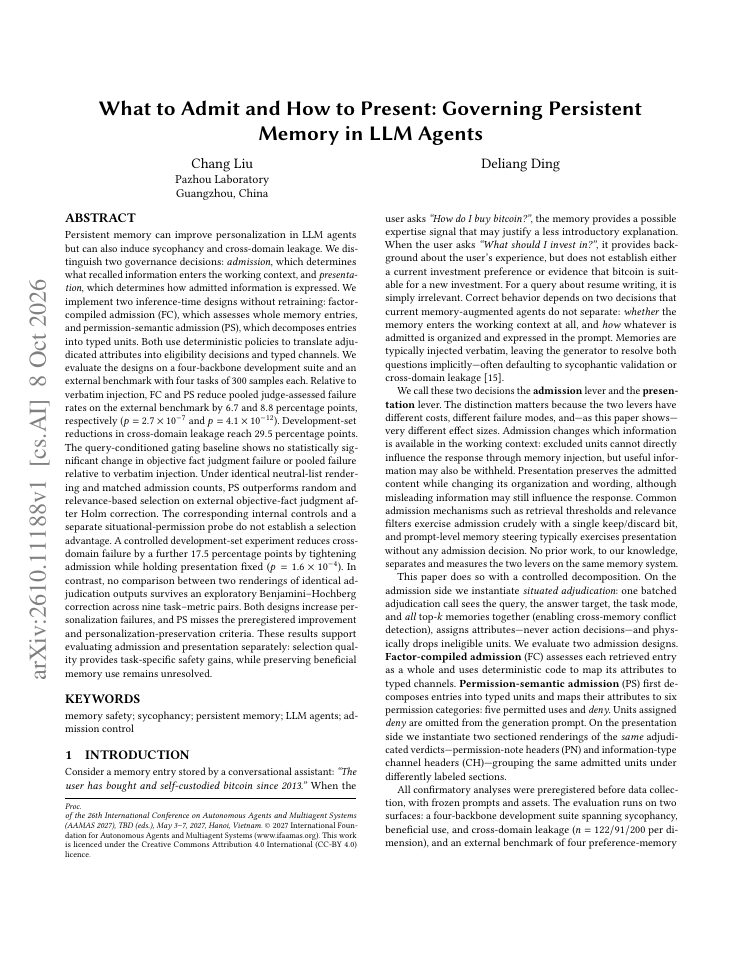
First page of What to Admit and How to Present: Governing Persistent Memory in LLM Agents
memory and contexttest

What to Admit and How to Present: Governing Persistent Memory in LLM Agents

The method replaces verbatim injection (or relevance-only selection) of persistent memory entries with inference-time admission policies that adjudicate entries or typed sub-units against deterministic eligibility rules before they enter the working context. It costs additional adjudication calls and policy engineering per memory write/read, adding latency and implementation complexity, with no retraining required. It can fail by increasing personalization failures—both designs did—and PS missed its preregistered improvement and personalization-preservation criteria, so beneficial memory use may be lost while safety improves.

observed signal
1impl.
132stars
0citations
—claimed gain
abstract onlyReview decisionDownload skill ↓Original paper ↗
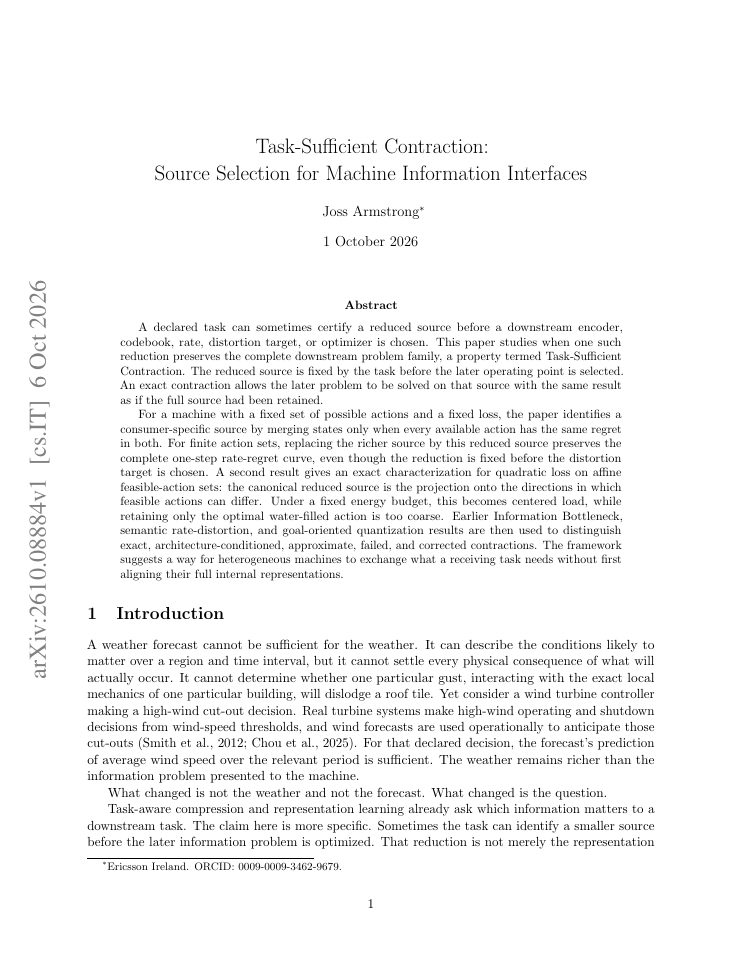
First page of Task-Sufficient Contraction: Source Selection for Machine Information Interfaces
quantizationwatch

Task-Sufficient Contraction: Source Selection for Machine Information Interfaces

The method replaces ad hoc task-agnostic compression or task-specific retraining of representations with a canonical reduced source, fixed before the encoder or rate is chosen, that merges states only when every action has identical regret, provably preserving the full rate-regret curve (and, for quadratic loss, reducing to projection onto directions in which feasible actions differ). It costs an information-theoretic analysis of the action set, loss, and feasible-action geometry per consumer task, plus a separate contraction per downstream task, and the paper offers theorems rather than implementations or benchmarks. It fails when the task's loss or action set is mis-specified, when merging is done too coarsely (the paper shows retaining only the optimal water-filled action loses information), or when approximate contractions are treated as exact.

observed signal
0impl.
0stars
0citations
—claimed gain
abstract onlyReview decisionDownload skill ↓Original paper ↗
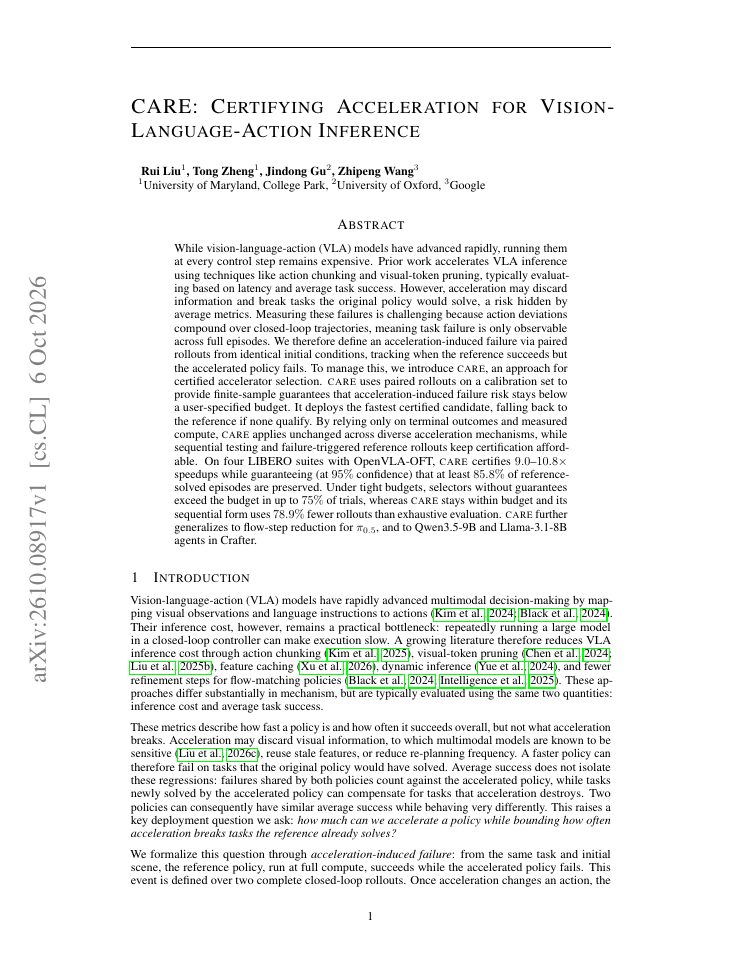
First page of CARE: Certifying Acceleration for Vision-Language-Action Inference
agent evaluationtest

CARE: Certifying Acceleration for Vision-Language-Action Inference

CARE replaces ad hoc selection of VLA acceleration methods (action chunking, token pruning, flow-step reduction) based on latency and average success, instead running paired rollouts from identical initial conditions on a calibration set to certify that acceleration-induced failure risk stays below a user-specified budget, deploying the fastest certified candidate or falling back to the reference policy. The cost is calibration compute: paired closed-loop rollouts must be executed for each candidate, mitigated but not eliminated by sequential testing, and the method adds selection and fallback infrastructure around the serving stack. Certification guarantees are statistical and tied to the calibration distribution, so distribution shift between calibration and deployment initial conditions can invalidate the failure bound, and a tight risk budget may leave no certified accelerator, yielding no speedup at all.

observed signal
0impl.
0stars
0citations
10.8xclaimed gain
abstract onlyReview decisionDownload skill ↓Original paper ↗
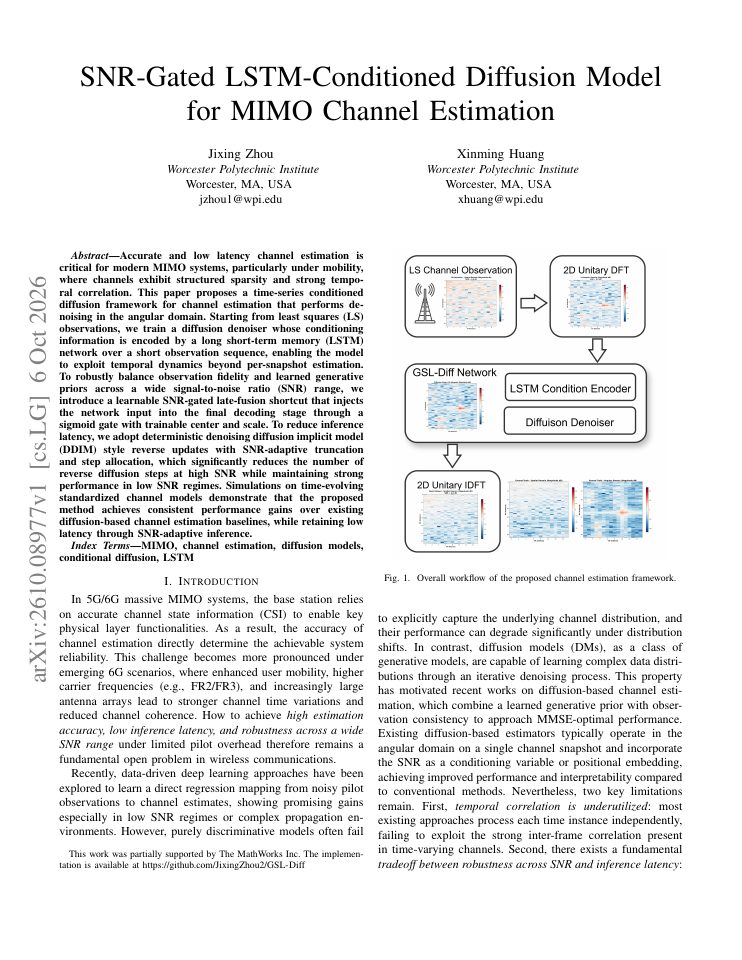
First page of SNR-Gated LSTM-Conditioned Diffusion Model for MIMO Channel Estimation
othernot applicable

SNR-Gated LSTM-Conditioned Diffusion Model for MIMO Channel Estimation

The method replaces per-snapshot least-squares and prior diffusion-based channel estimators for MIMO wireless systems with a temporally conditioned diffusion denoiser using an LSTM encoder, an SNR-gated fusion shortcut, and SNR-adaptive DDIM truncation. It costs the training of a domain-specific diffusion model on channel data, added inference complexity relative to classical estimators, and tuning of SNR-adaptive step schedules, with the abstract reporting no quantified improvement figures. It can fail under channel statistics or mobility patterns outside the training distribution, and its standardized-model simulations give no evidence of transfer to measured channels or to any task the reader operates.

observed signal
0impl.
0stars
0citations
—claimed gain
abstract onlyReview decisionDownload skill ↓Original paper ↗
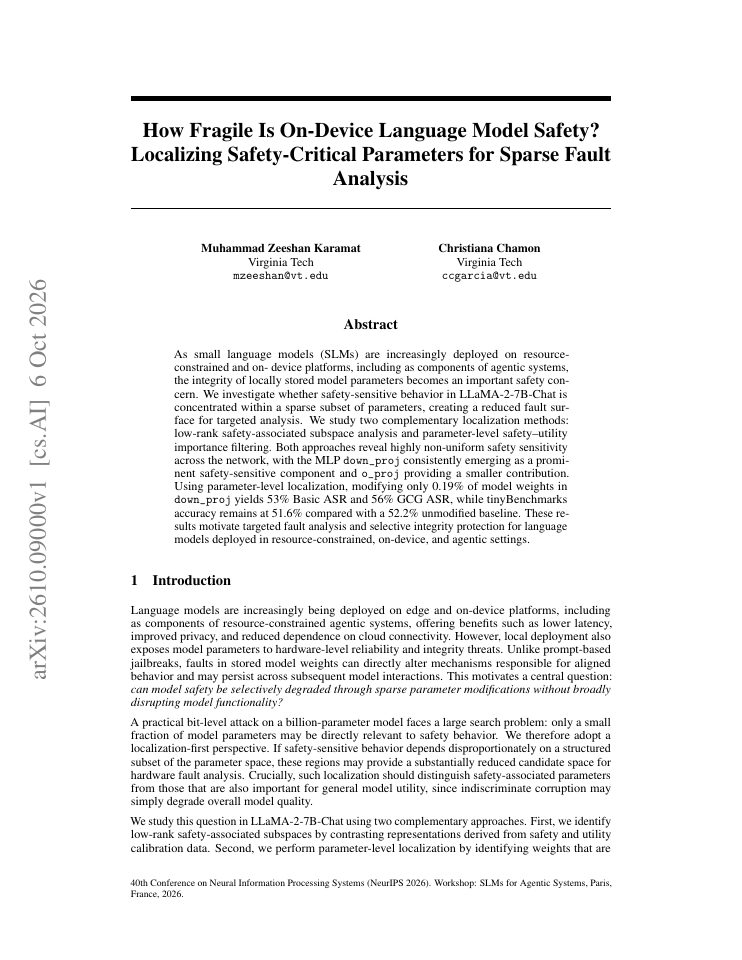
First page of How Fragile Is On-Device Language Model Safety? Localizing Safety-Critical Parameters for Sparse Fault Analysis
safety and guardrailstest

How Fragile Is On-Device Language Model Safety? Localizing Safety-Critical Parameters for Sparse Fault Analysis

The method replaces full-model safety auditing and uniform integrity protection with targeted analysis of a sparse safety-critical subset, mainly MLP down_proj weights localized via low-rank subspace analysis and parameter-level importance filtering. It costs the engineering effort of running the localization pipeline and adding selective integrity checks at deployment; the paper reports utility is preserved in the demonstrated attack case (51.6% vs 52.2% tinyBenchmarks accuracy). The approach can fail because localization is demonstrated only on LLaMA-2-7B-Chat and may not transfer to other SLM architectures, safety-critical parameters may shift under fine-tuning or quantization, and an attacker modifying weights outside the protected subset could still degrade safety.

observed signal
0impl.
7stars
0citations
—claimed gain
abstract onlyReview decisionDownload skill ↓Original paper ↗
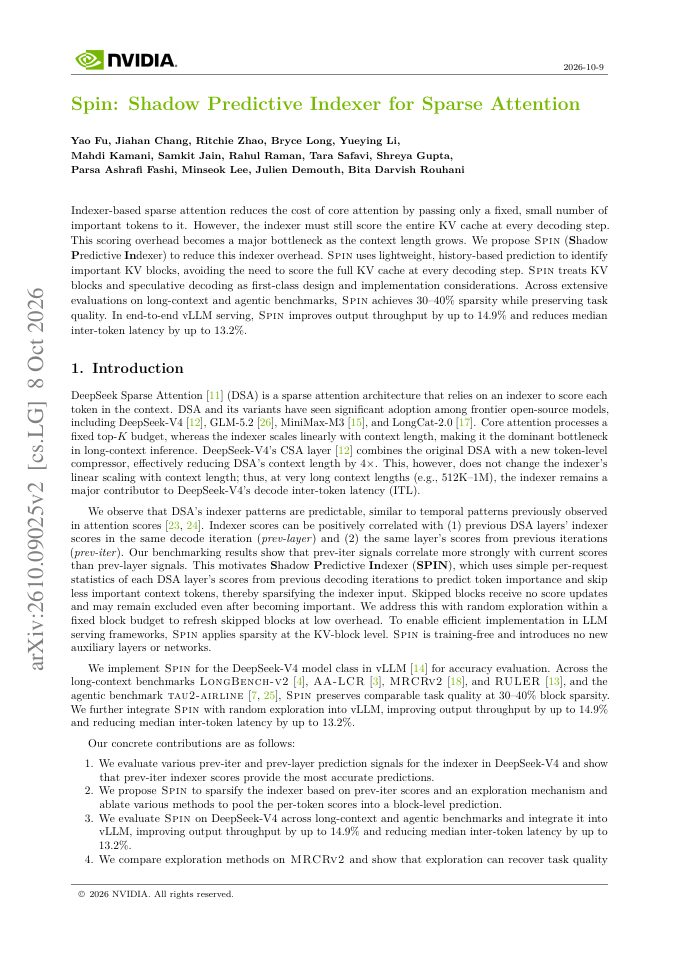
First page of SPIN: Shadow Predictive Indexer for Sparse Attention
attention and kernelstest

SPIN: Shadow Predictive Indexer for Sparse Attention

SPIN replaces full KV-cache scoring by the sparse-attention indexer at every decoding step with lightweight history-based prediction of important KV blocks, integrated with speculative decoding. It requires adopting an indexer-based sparse attention stack and a vLLM implementation, adding prediction-model complexity and a modest integration cost rather than extra memory. It can fail when token-importance history is non-stationary, so workloads with abrupt topic shifts or long agentic trajectories may see quality degradation that the reported benchmarks do not cover.

observed signal
0impl.
0stars
0citations
1.149xclaimed gain
abstract onlyReview decisionDownload skill ↓Original paper ↗
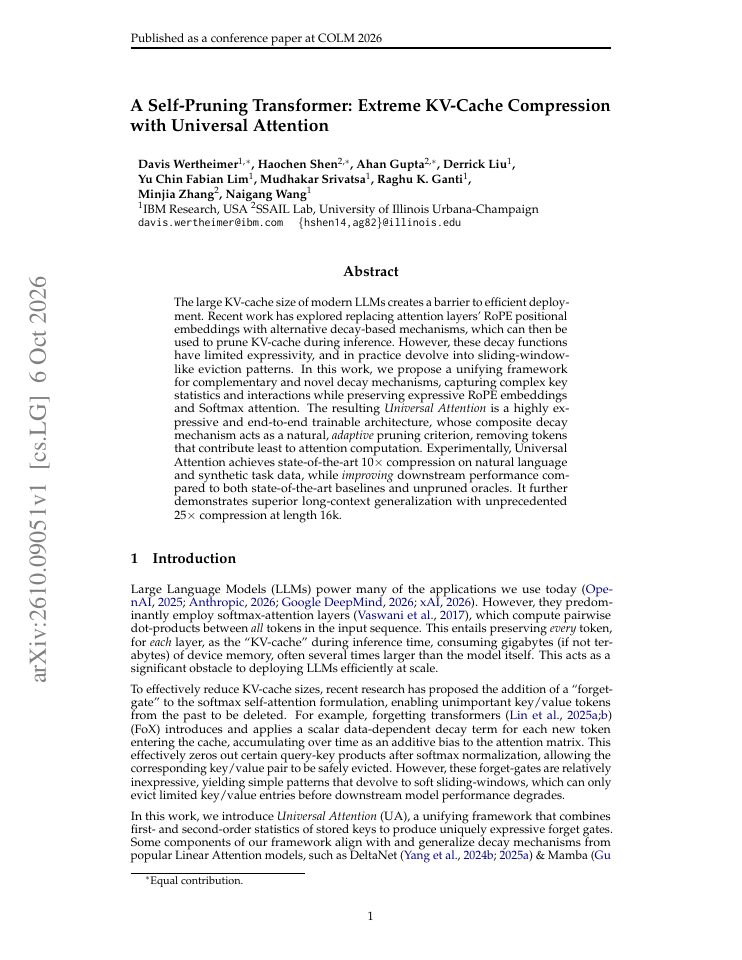
First page of A Self-Pruning Transformer: Extreme KV-Cache Compression with Universal Attention
KV cachewatch

A Self-Pruning Transformer: Extreme KV-Cache Compression with Universal Attention

The method replaces RoPE positional embeddings with a composite trainable decay mechanism in a Universal Attention architecture, using the decay values as an adaptive criterion to prune low-contribution tokens from the KV cache during inference. The cost is that the mechanism is end-to-end trained, so it requires pretraining or fine-tuning the model itself rather than being a drop-in inference-time change to existing checkpoints, and it adds architectural complexity. It can fail if decay-based pruning degrades on workloads whose attention patterns differ from the evaluated natural language and synthetic tasks, if quality claims do not transfer to other model families, or if no pretrained checkpoints using this architecture become available for the reader's models.

observed signal
0impl.
0stars
0citations
10xclaimed gain
abstract onlyReview decisionDownload skill ↓Original paper ↗
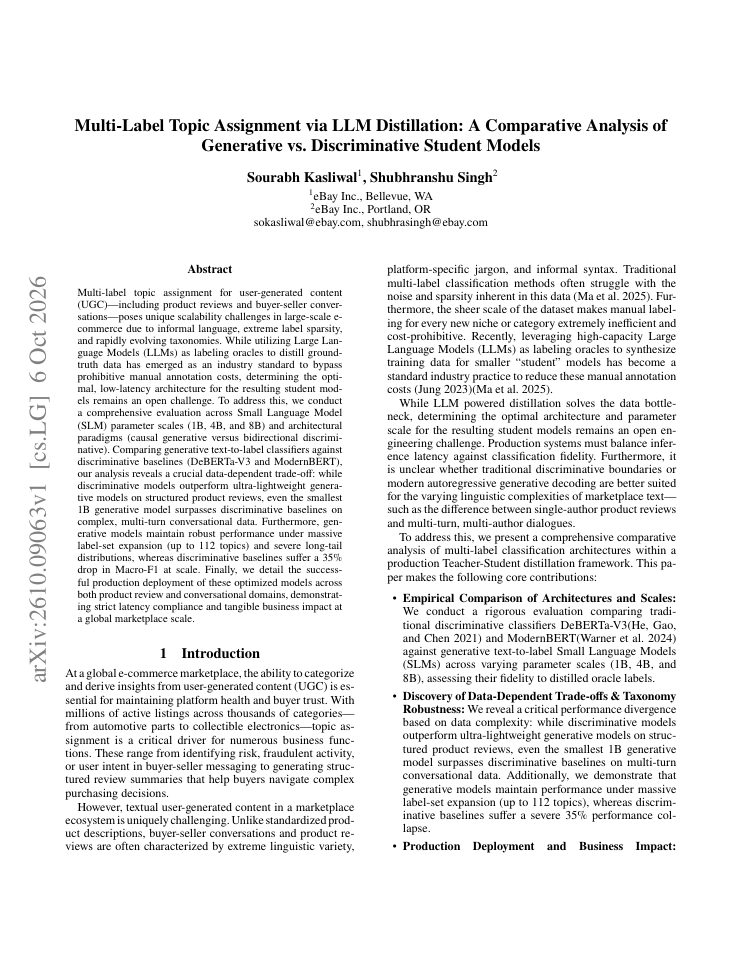
First page of Multi-Label Topic Assignment via LLM Distillation: A Comparative Analysis of Generative vs. Discriminative Student Models
distillationtest

Multi-Label Topic Assignment via LLM Distillation: A Comparative Analysis of Generative vs. Discriminative Student Models

The method replaces manual annotation with LLM-generated labels distilled into small student models, and replaces larger teacher inference at serving time with 1B-8B generative or discriminative classifiers. The cost is an offline teacher-labeling and distillation pipeline, plus the finding that the correct architecture is data-dependent: discriminative models win on structured reviews, generative models on conversational data, so a single architecture choice will not transfer across domains. It can fail if the LLM oracle's label errors propagate into the student, if the production taxonomy or label distribution drifts from the distilled training set, or if the reader's UGC is structured (where a cheaper discriminative baseline is sufficient) rather than conversational.

observed signal
0impl.
0stars
0citations
1.54xclaimed gain
abstract onlyReview decisionDownload skill ↓Original paper ↗
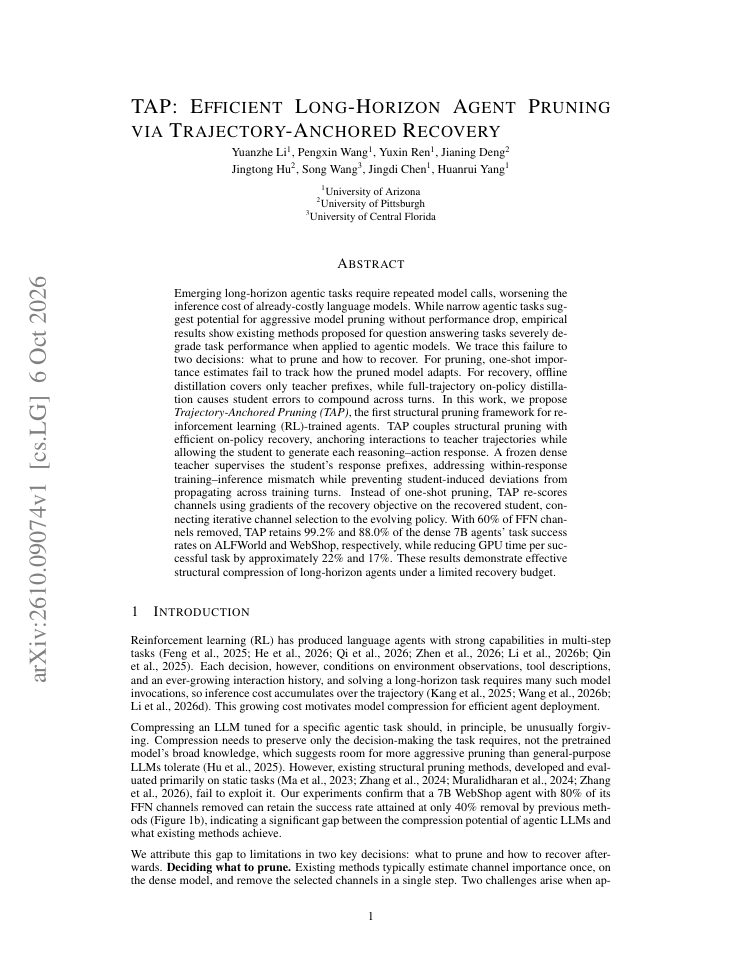
First page of TAP: Efficient Long-Horizon Agent Pruning via Trajectory-Anchored Recovery
sparsity and pruningwatch

TAP: Efficient Long-Horizon Agent Pruning via Trajectory-Anchored Recovery

TAP replaces one-shot importance-based pruning plus offline or full-trajectory distillation with iterative gradient-based channel re-scoring coupled to recovery, using a frozen dense teacher that anchors trajectories while the pruned student generates each response. It costs a pruning-and-recovery training pipeline: a frozen 7B teacher in memory, gradient computation for re-scoring, and RL-style trajectory rollouts, which is a substantial engineering and compute burden beyond simple post-hoc pruning. It can fail when applied to non-RL agents or tasks whose reward signals differ from ALFWorld/WebShop, and the WebShop retention of 88.0% shows meaningful task-dependent quality loss at 60% channel removal.

observed signal
0impl.
0stars
0citations
1.28xclaimed gain
abstract onlyReview decisionDownload skill ↓Original paper ↗
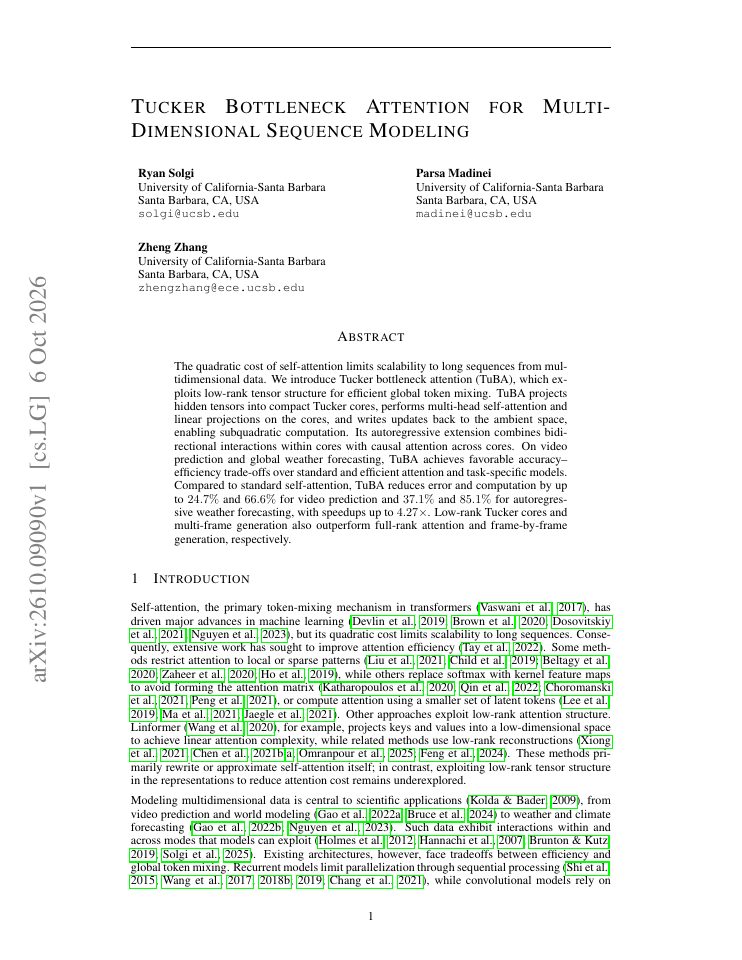
First page of Tucker Bottleneck Attention for Multi-Dimensional Sequence Modeling
attention and kernelstest

Tucker Bottleneck Attention for Multi-Dimensional Sequence Modeling

TuBA replaces full self-attention over long multidimensional token sequences (video frames, weather grids) with attention performed on compact low-rank Tucker cores, projecting hidden tensors down, mixing globally in the compressed space, and writing updates back. The cost is added architectural complexity: projection into and out of Tucker cores, a specialized autoregressive variant combining intra-core bidirectional and inter-core causal attention, and a rank hyperparameter that must be tuned per task. It can fail if the data lacks exploitable low-rank tensor structure, if the chosen core rank is too small and bottlenecks information flow, and its demonstrated gains are confined to video prediction and weather forecasting, with no evidence for language or general sequence workloads.

observed signal
0impl.
0stars
0citations
4.27xclaimed gain
abstract onlyReview decisionDownload skill ↓Original paper ↗
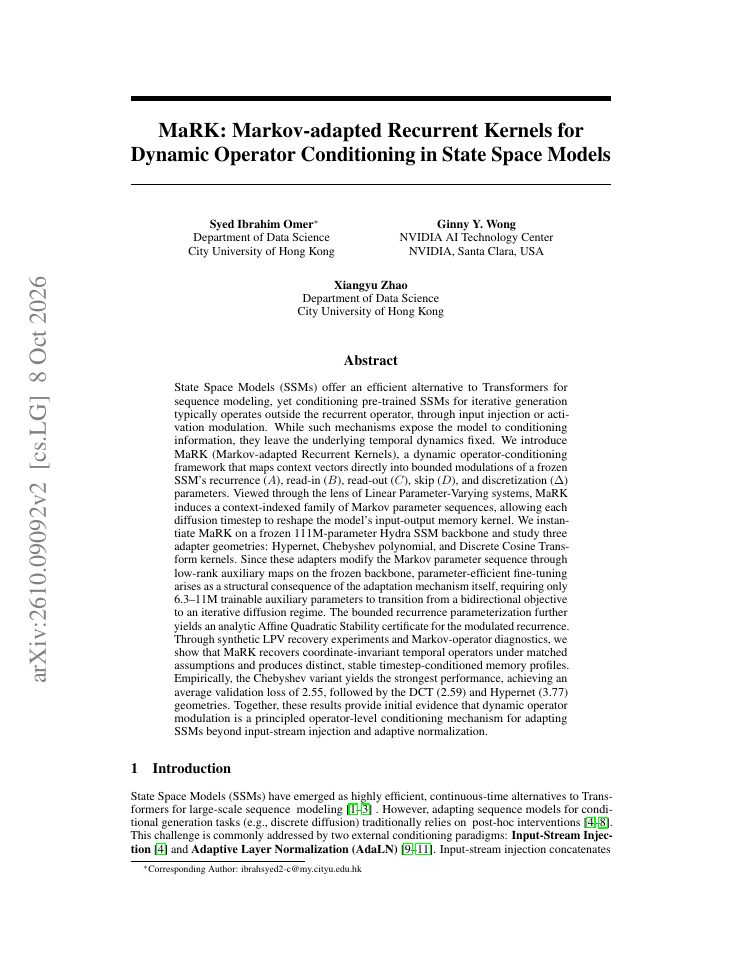
First page of MaRK: Markov-adapted Recurrent Kernels for Dynamic Operator Conditioning in State Space Models
efficient trainingwatch

MaRK: Markov-adapted Recurrent Kernels for Dynamic Operator Conditioning in State Space Models

MaRK replaces conventional input-injection or activation-modulation conditioning of pre-trained SSMs with low-rank auxiliary adapters (6.3-11M trainable parameters) that modulate a frozen backbone's recurrence, read-in, read-out, skip, and discretization operators directly. The cost is a custom adapter architecture tied to a specific 111M Hydra backbone and diffusion-style iterative generation, plus implementation complexity beyond standard LoRA-style fine-tuning. It can fail outside the demonstrated setting: results are limited to one backbone and validation loss comparisons across MaRK's own variants, with no evidence of transfer to other SSMs, tasks, or downstream quality metrics, and the stability certificate covers only the bounded modulated recurrence under the stated assumptions.

observed signal
0impl.
0stars
0citations
—claimed gain
abstract onlyReview decisionDownload skill ↓Original paper ↗
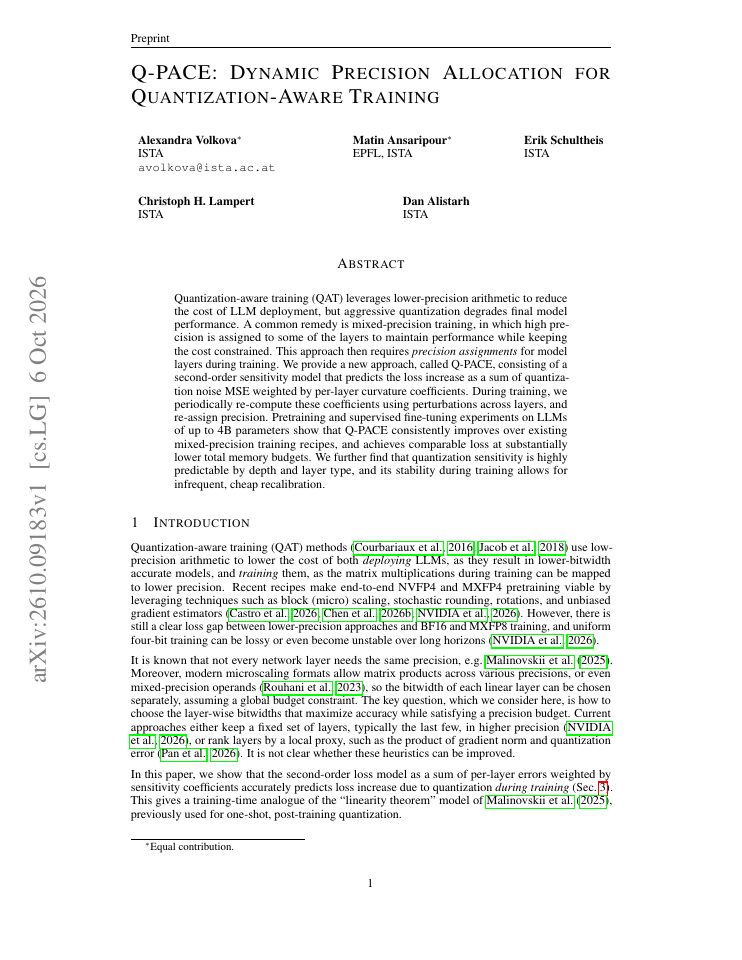
First page of Q-PACE: Dynamic Precision Allocation for Quantization-Aware Training
quantizationtest

Q-PACE: Dynamic Precision Allocation for Quantization-Aware Training

Q-PACE replaces static or heuristic layer-precision assignments in mixed-precision quantization-aware training with a second-order sensitivity model that periodically recomputes per-layer curvature coefficients and reassigns precision under a memory budget. The cost is the added implementation complexity of curvature estimation and periodic perturbation-based recalibration during training, plus QAT's inherent training-time overhead relative to post-training quantization. It can fail if sensitivity estimates drift between recalibrations, if the second-order approximation misranks layers for architectures or tasks unlike those evaluated, or if the reader only performs inference-time quantization, in which case a training-time method offers no benefit.

observed signal
0impl.
0stars
0citations
—claimed gain
abstract onlyReview decisionDownload skill ↓Original paper ↗
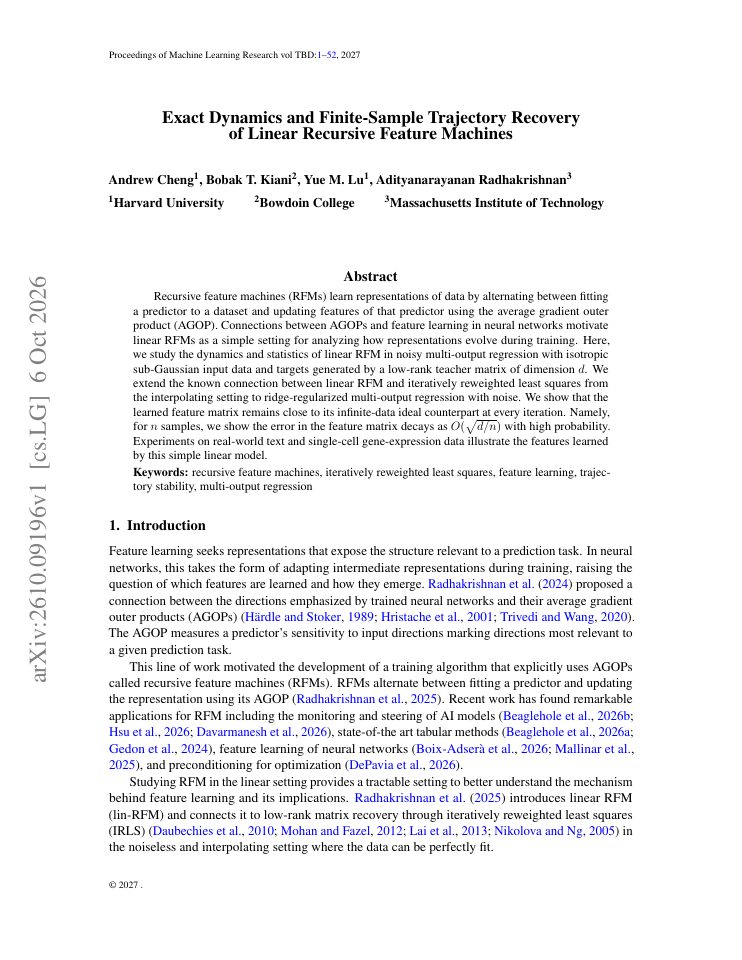
First page of Exact Dynamics and Finite-Sample Trajectory Recovery of Linear Recursive Feature Machines
efficient trainingtest

Exact Dynamics and Finite-Sample Trajectory Recovery of Linear Recursive Feature Machines

Linear RFM replaces a trained neural network's representation-learning stage with an alternating loop of ridge-regularized linear fits and average-gradient-outer-product feature updates, all computable with closed-form linear algebra on CPU or a single small GPU. The cost is multiple full-data least-squares solves plus repeated d-by-d AGOP accumulations, which scales poorly with input dimension and sample count and provides only linear-model expressivity over learned features. It can fail when the low-rank teacher and isotropic sub-Gaussian input assumptions do not hold, and its real-data evidence is illustrative rather than benchmarked against tuned baselines.

observed signal
0impl.
0stars
0citations
—claimed gain
abstract onlyReview decisionDownload skill ↓Original paper ↗

Research signals

Three views of the same evidence: adoption against attention, publication cadence by research area, and reported gains when coverage is sufficient.

color = research area

01 · attention × adoption

The research frontier

Look to the upper left for independent implementation before mass attention.

compare by
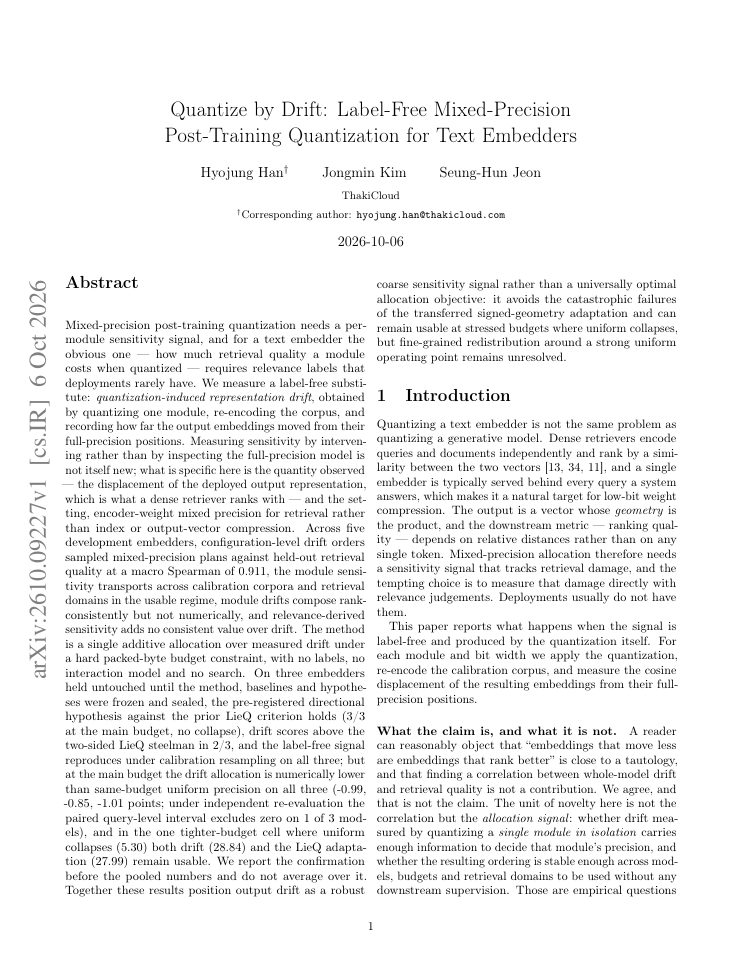
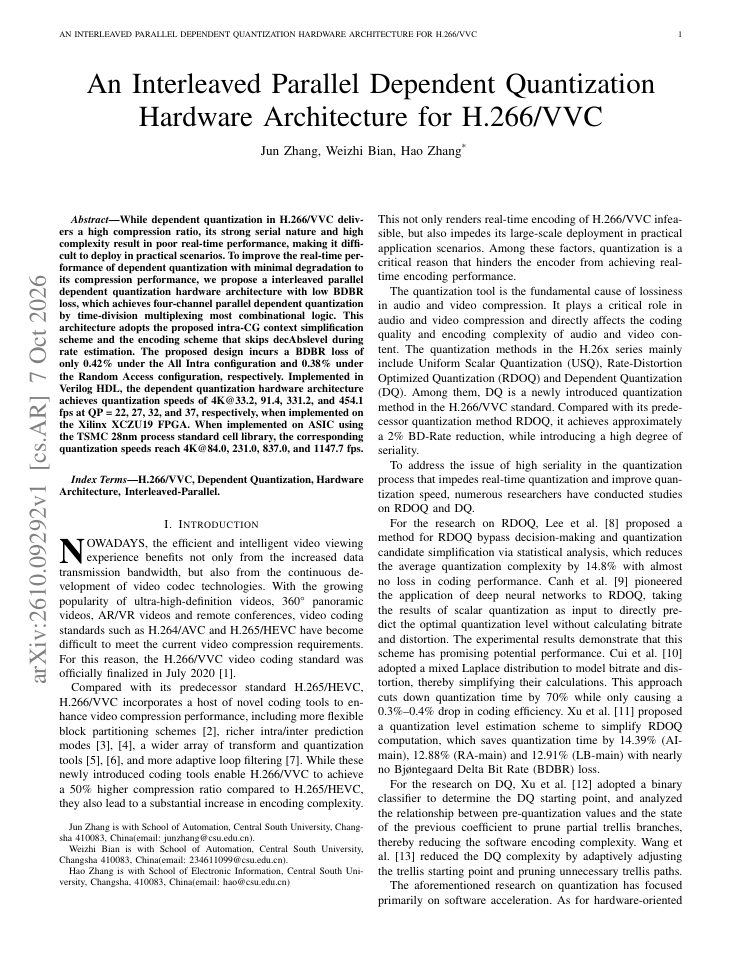
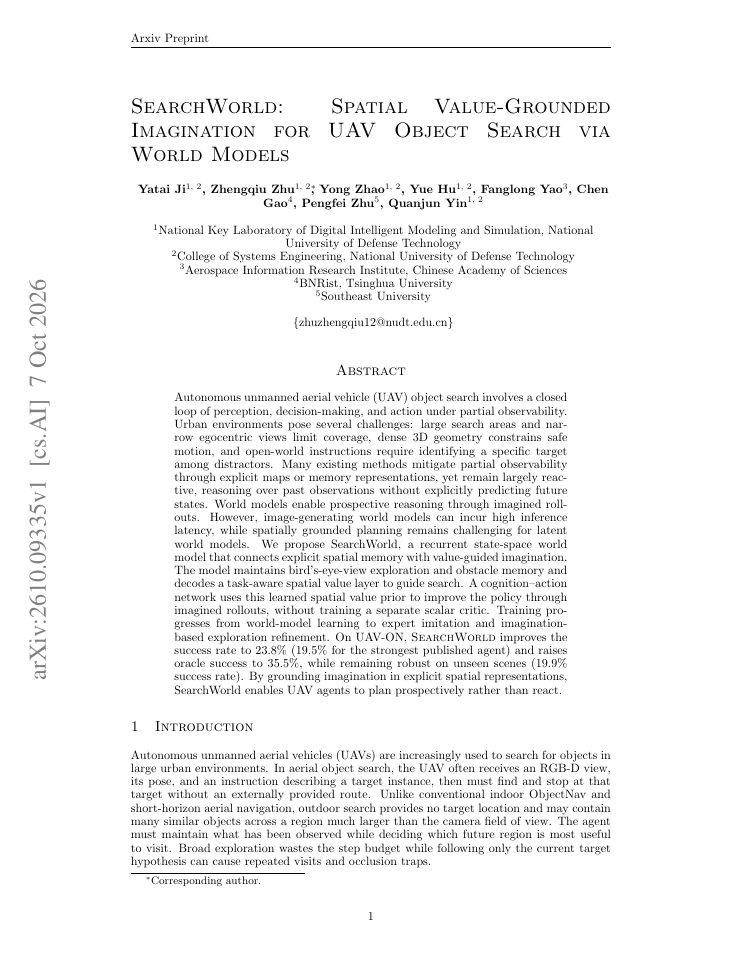
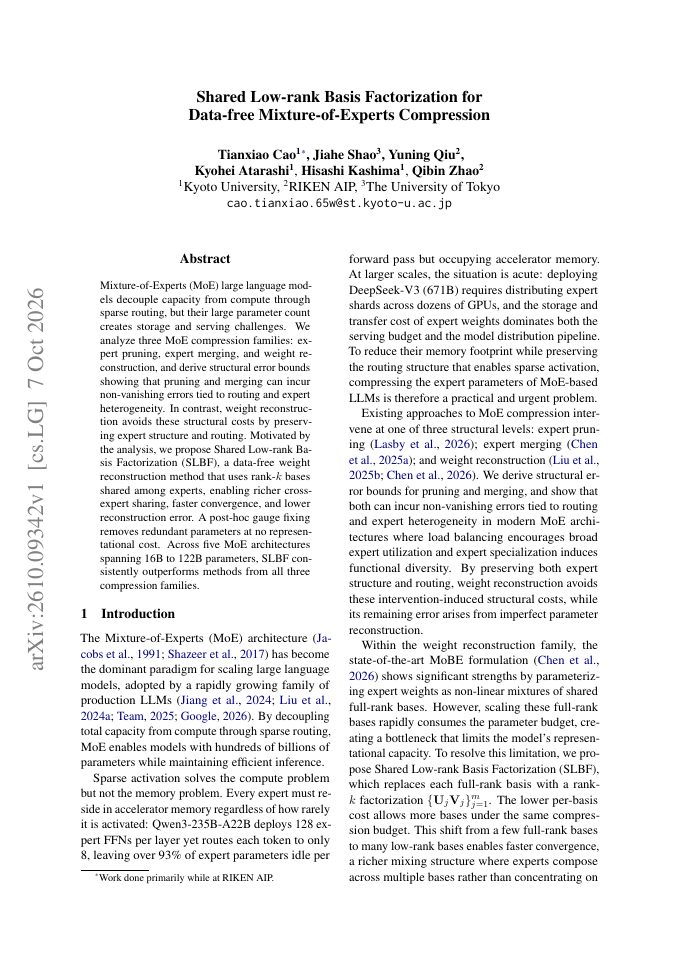
Each point represents one paper. Higher means more independent implementations; farther right means more GitHub stars.An Empirical Study of Harness Design for Coding Agents: 30 GitHub stars; 9 independent implementationsQuantifying Overclaiming Propensity in Frontier LLM Agents: 2 GitHub stars; 6 independent implementationsAutomated Regulatory Compliance Question Answering in Financial Services with Domain-Adapted Retrieval-Augmented Generation: 0 GitHub stars; 2 independent implementationsTask-Sufficient Contraction: Source Selection for Machine Information Interfaces: 0 GitHub stars; 0 independent implementationsCARE: Certifying Acceleration for Vision-Language-Action Inference: 0 GitHub stars; 0 independent implementationsSNR-Gated LSTM-Conditioned Diffusion Model for MIMO Channel Estimation: 0 GitHub stars; 0 independent implementationsHow Fragile Is On-Device Language Model Safety? Localizing Safety-Critical Parameters for Sparse Fault Analysis: 7 GitHub stars; 0 independent implementationsSPIN: Shadow Predictive Indexer for Sparse Attention: 0 GitHub stars; 0 independent implementationsShared-Roadmap Generation and Evaluator for Multi-Agent Path Planning Using Heterogeneous Graph Neural Network: 57 GitHub stars; 2 independent implementationsA Self-Pruning Transformer: Extreme KV-Cache Compression with Universal Attention: 0 GitHub stars; 0 independent implementationsMulti-Label Topic Assignment via LLM Distillation: A Comparative Analysis of Generative vs. Discriminative Student Models: 0 GitHub stars; 0 independent implementationsTAP: Efficient Long-Horizon Agent Pruning via Trajectory-Anchored Recovery: 0 GitHub stars; 0 independent implementationsTucker Bottleneck Attention for Multi-Dimensional Sequence Modeling: 0 GitHub stars; 0 independent implementationsMaRK: Markov-adapted Recurrent Kernels for Dynamic Operator Conditioning in State Space Models: 0 GitHub stars; 0 independent implementationsQ-PACE: Dynamic Precision Allocation for Quantization-Aware Training: 0 GitHub stars; 0 independent implementationsExact Dynamics and Finite-Sample Trajectory Recovery of Linear Recursive Feature Machines: 0 GitHub stars; 0 independent implementationsFew Bits, One Law: Toward W2A4KV2: 0 GitHub stars; 0 independent implementationsCurveTQ: Rotation-Free Trellis Quantization of LLM Weights via Curvature-Weighted Search: 0 GitHub stars; 0 independent implementationsQuantize by Drift: Label-Free Mixed-Precision Post-Training Quantization for Text Embedders: 0 GitHub stars; 0 independent implementationsAn Interleaved Parallel Dependent Quantization Hardware Architecture for H.266/VVC: 0 GitHub stars; 0 independent implementationsSearchWorld: Spatial Value-Grounded Imagination for UAV Object Search via World Models: 216 GitHub stars; 0 independent implementationsShared Low-rank Basis Factorization for Data-free Mixture-of-Experts Compression: 0 GitHub stars; 0 independent implementationsOnlineQAT: On-Policy Distillation for Ultra-Low-Bit Large Language Models: 0 GitHub stars; 0 independent implementationsMemoWM: How World Models Change What Agents Need to Remember: 10 GitHub stars; 0 independent implementationsPlan-and-Patch: Diffusion Language Models for Agentic Planning: 136 GitHub stars; 2 independent implementationsOn the Clock: Towards Punctual and Productive Time-Budgeted AI Agents: 132 GitHub stars; 2 independent implementationsRFChipAgent: Multi-Agentic AI Flow for Analog/RF Chip Design: 14 GitHub stars; 1 independent implementationReading the Room: Foundations, Design, and Challenges of Normative Competence in LLMs: 126 GitHub stars; 1 independent implementationStoreBench: A Live-Commerce Environment for Evaluating and Training Autonomous Operator Agents: 136 GitHub stars; 2 independent implementationsCross-Provider Review as a Runtime Contract for Coding Agents: A Controlled Pilot and Fault-Injection Study: 10 GitHub stars; 1 independent implementationCurating Always-Loaded Context for LLM Agents: A Capacitated Assortment Model with Censored Feedback: 14 GitHub stars; 1 independent implementationPrompts versus Rules: Auditing and Controlling Speech Naturalness Behaviors in Voice User Simulators: 122 GitHub stars; 0 independent implementationsNOMOS: Compiling Written Policies into Statically Verified Tool-Call Gates for LLM Agents: 10 GitHub stars; 0 independent implementationsAgentHorizon: Evaluating Agentic Judges for Long-Horizon Computer-Use Tasks: 132 GitHub stars; 1 independent implementationWhen Interfaces Speak: Data-Aware Generative UI Harness for Active Interaction: 122 GitHub stars; 1 independent implementationDo LLMs Learn from Rewards in Context? : Rethinking the role of reward in In-Context Reinforcement Learning: 10 GitHub stars; 0 independent implementationsSkill Constellations: Tracing the Supply Chain of Agent Skills on GitHub: 0 GitHub stars; 2 independent implementationsVAMR: Multi-Question Agentic Reasoning for Efficient Long-Form Video Understanding: 10 GitHub stars; 0 independent implementationsWho Pays the Review Cost? Triage, Fairness, and Accountability in AI-authored Pull Requests: 0 GitHub stars; 0 independent implementationsWhat to Admit and How to Present: Governing Persistent Memory in LLM Agents: 132 GitHub stars; 1 independent implementationSafeInferCom: Safe Inference-Time Compute via Verifier-Guided Mid-Generation Intervention for Robotic Task Planning: 4 GitHub stars; 1 independent implementationREMORY: Learning Residual Memory for Context Compaction: 169 GitHub stars; 3 independent implementationsDuplexAgent-RSI: Recursive Harness Improvement for Full-Duplex Voice Agent Collaboration: 14 GitHub stars; 1 independent implementation

Papers above 1000 stars or 200 citations are not scored. They have already broken through the attention threshold, while Paperraft is designed to identify earlier signals.

02 · cadence

Research areas over time

Compare monthly publication volume on a shared scale and calendar.

coding agentsmax 6Sep 26: 1 paperOct 26: 1 paperSep 26Oct 26agent evaluationmax 6Sep 26: 1 paperOct 26: 6 papersSep 26Oct 26KV cachemax 6Sep 26: 0 papersOct 26: 1 paperSep 26Oct 26distillationmax 6Sep 26: 0 papersOct 26: 1 paperSep 26Oct 26sparsity and pruningmax 6Sep 26: 0 papersOct 26: 2 papersSep 26Oct 26attention and kernelsmax 6Sep 26: 0 papersOct 26: 2 papersSep 26Oct 26memory and contextmax 6Sep 26: 0 papersOct 26: 5 papersSep 26Oct 26multi-agent orchestrationmax 6Sep 26: 0 papersOct 26: 4 papersSep 26Oct 26othermax 6Sep 26: 0 papersOct 26: 2 papersSep 26Oct 26planning and decompositionmax 6Sep 26: 0 papersOct 26: 2 papersSep 26Oct 26quantizationmax 6Sep 26: 0 papersOct 26: 6 papersSep 26Oct 26failure recoverymax 6Sep 26: 0 papersOct 26: 1 paperSep 26Oct 26retrieval and RAGmax 6Sep 26: 1 paperOct 26: 0 papersSep 26Oct 26safety and guardrailsmax 6Sep 26: 0 papersOct 26: 4 papersSep 26Oct 26efficient trainingmax 6Sep 26: 0 papersOct 26: 2 papersSep 26Oct 26tool usemax 6Sep 26: 0 papersOct 26: 1 paperSep 26Oct 26

Every panel uses the same calendar and vertical scale. An empty column means no papers were recorded.

Method under scrutiny

Inspect the highest-ranked paper, every repository behind its signal, and the rule used to classify each one.

Automated Regulatory Compliance Question Answering in Financial Services with Domain-Adapted Retrieval-Augmented Generation

retrieval and RAG · test · 2 of 2 implementations are independent · 3.02x gain in quality (reported by the authors; not independently verified)

Replaces off-the-shelf dense or BM25 retrieval and prompted compact LLMs with a LegalBERT retriever tuned via entailment reformulation, contrastive in-batch negatives, and BM25 score fusion, plus optional RAFT-LoRA on a quantized 2B-12B generator, all feasible on a single 24 GB GPU. Costs include three retriever fine-tuning stages, labeled domain data for entailment and contrastive tuning, hybrid-fusion serving complexity, and per-domain RAFT adaptation. It can fail on domain transfer (no generalization to Australian case law), and RePASs gains do not demonstrate grounding: a closed-book model scored within 0.011 RePASs while citing nothing and misstating obligations, so a dedicated grounding evaluation must be built before production trust.
Exclusions and controls

Every exclusion is counted and published.
Exclusion counts were not recorded for this edition.

0 previously indexed papers were rechecked in this run.

Paperraft tracks one signal: how many independent implementations a paper attracts on GitHub after author-owned repositories are removed. This is a discovery signal to investigate, not a measure of implementation quality.

It does not claim that a method works. Paperraft runs no reproduction benchmarks. Reported gains remain author claims until independently tested. Papers above the attention threshold are excluded because this publication is designed to identify research before consensus forms.