Skip to content

archived edition · 2026-10-06

PaperraftFind the AI research
worth testing.

Understand what a paper changes, what it costs, and whether it fits your next build. Explore research on faster LLM inference, agent memory, and evaluation, with the original sources in reach.

Start with a brief. Follow the evidence. Choose a test.

edition
2026-10-06
briefs
42
research areas
13
independent implementations
33

20 of 42 papers in the index (48%) have no independent implementations.

Research index

Search by topic, browse a research area, or sort by date. Read a brief, open the original paper, and inspect the available evidence before deciding what to test.

showing30 of 42
sort by
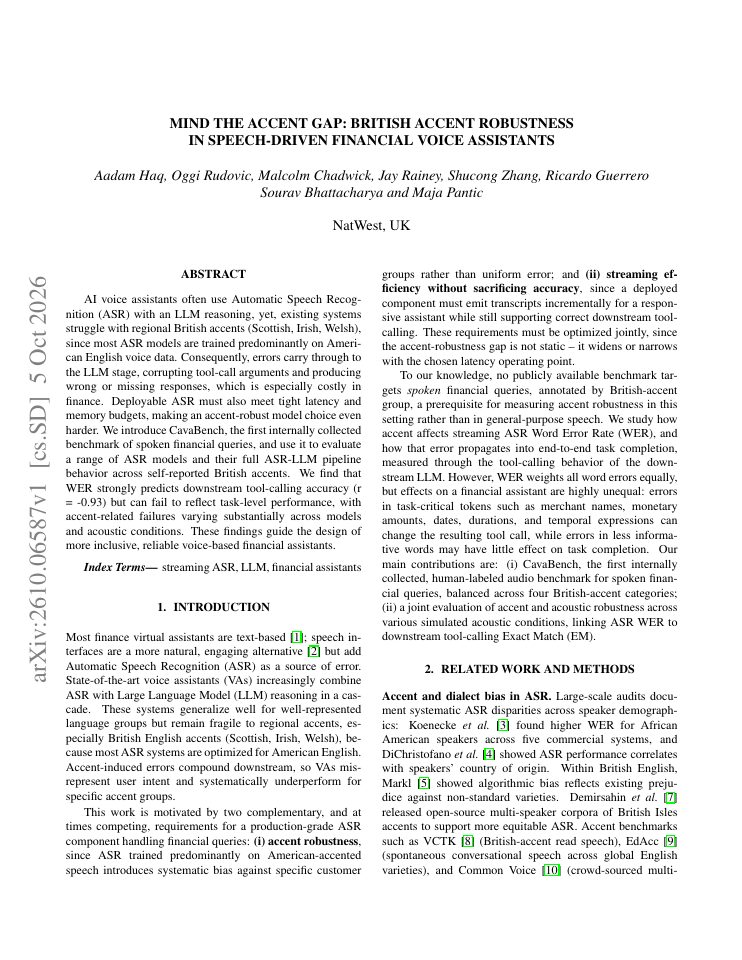
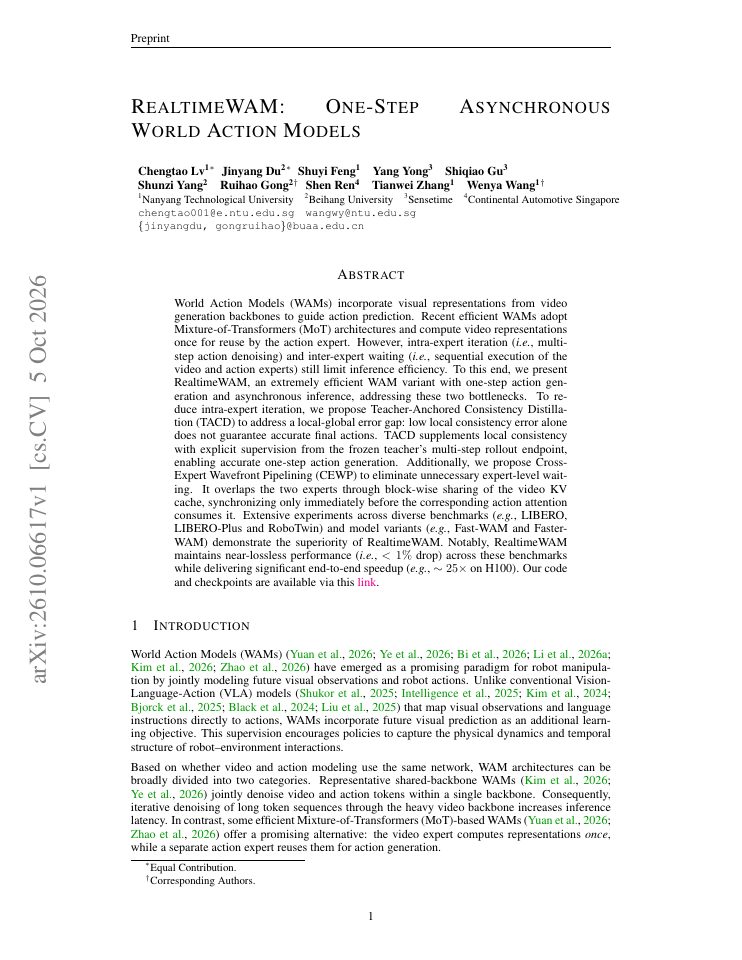
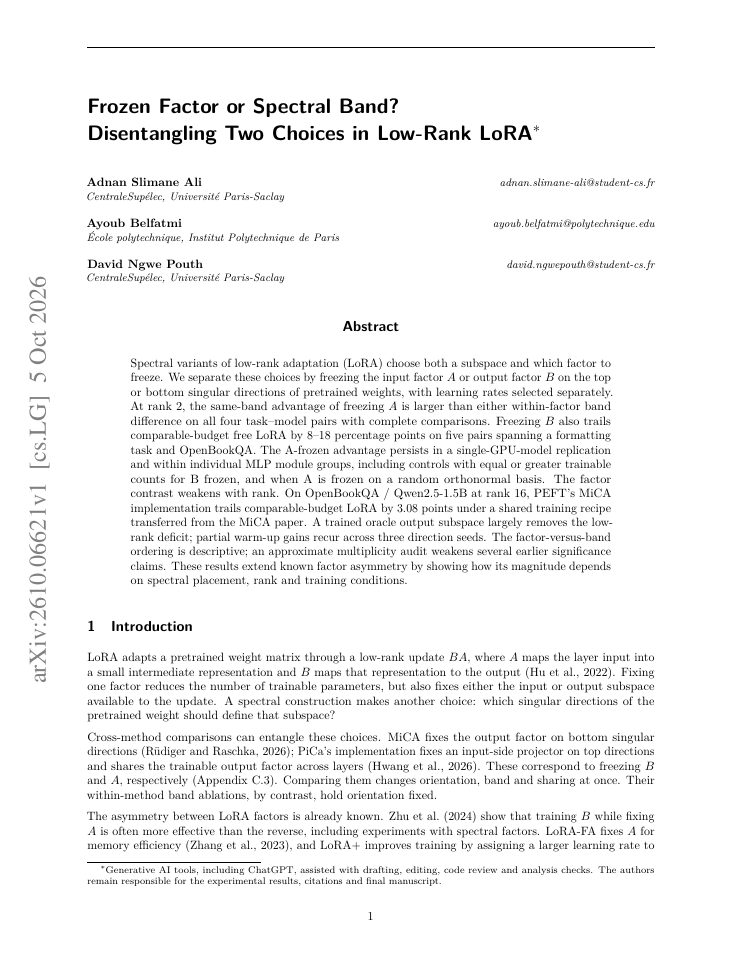
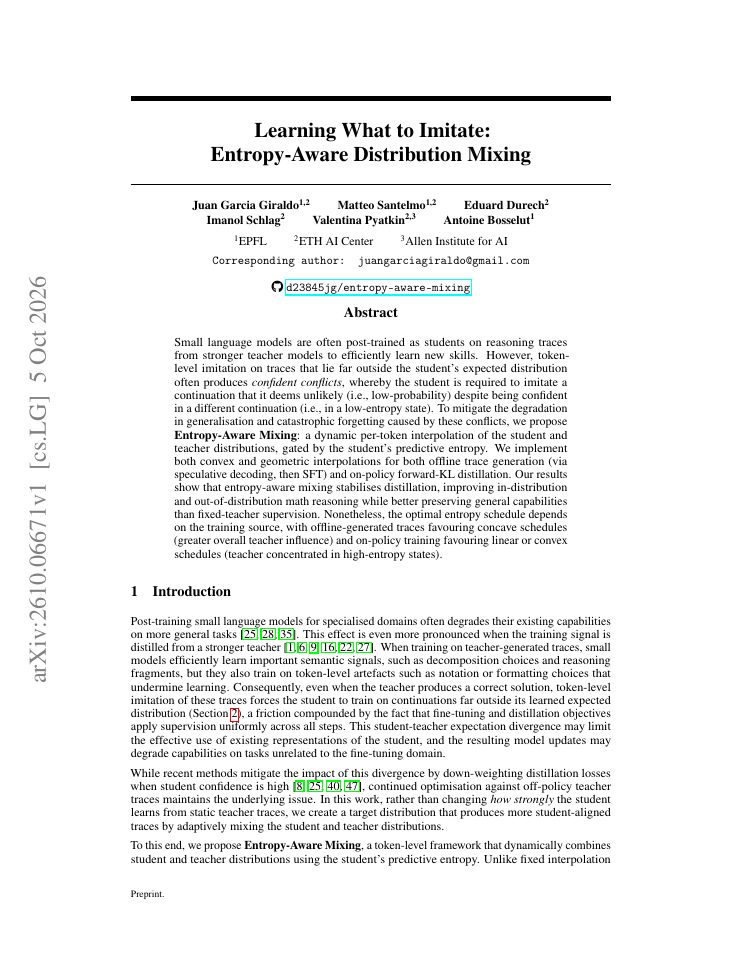
First page of Empirical Variational Autoencoder
othertest

Empirical Variational Autoencoder

EVA replaces the standard-Gaussian prior constraint of a conventional VAE with autoregressive latent priors learned empirically from training data, implemented as a single additional linear layer. The cost is one extra linear layer plus the training of that prior, and inference claims faster sampling than autoregressive diffusion baselines without a stated magnitude. It can fail if the empirically learned prior does not close the prior-posterior gap on the reader's data distribution, and the claimed quality parity with diffusion baselines is validated only on image and sound benchmarks, not arbitrary domains.

observed signal
3impl.
1stars
—citations
—claimed gain
abstract onlyReview decisionDownload skill ↓Original paper ↗
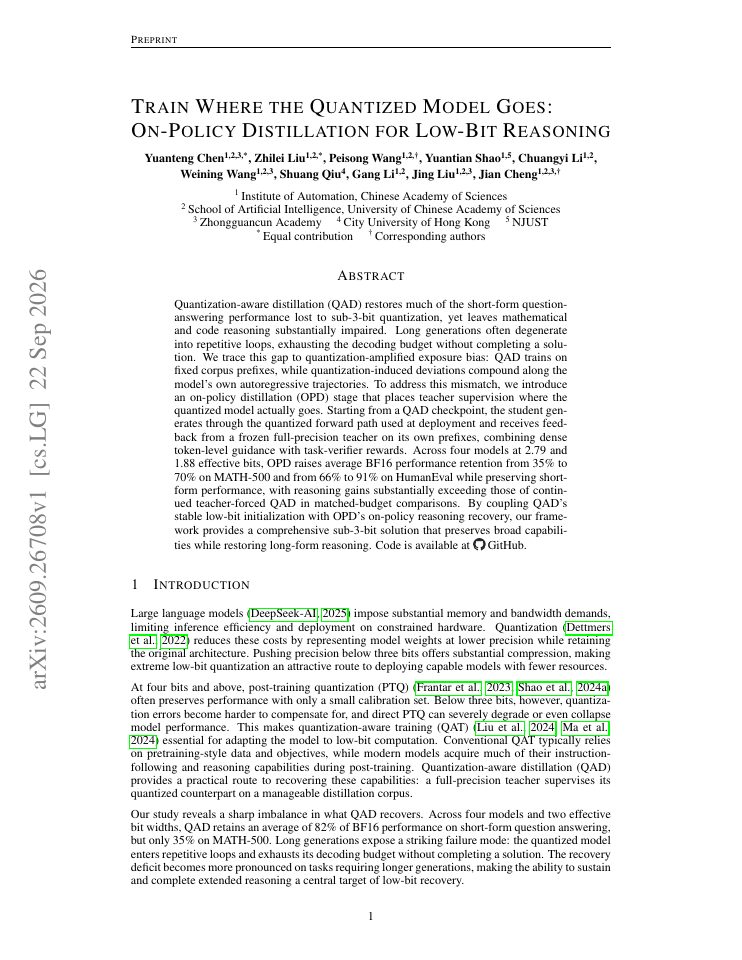
First page of Train Where the Quantized Model Goes: On-Policy Distillation for Low-Bit Reasoning
quantizationtest

Train Where the Quantized Model Goes: On-Policy Distillation for Low-Bit Reasoning

The method adds an on-policy distillation stage on top of a quantization-aware distillation (QAD) checkpoint: the low-bit student generates through its deployed quantized forward path and is trained with token-level teacher signals plus task-verifier rewards on its own prefixes, replacing purely teacher-forced QAD fine-tuning. It costs a training pipeline with a frozen full-precision teacher in memory, student sampling during training, and verifier infrastructure, so it requires more compute and engineering than off-the-shelf PTQ methods such as GPTQ or AWQ, though the resulting 24 GB-class deployment cost is unchanged. It can fail if the teacher is unavailable or too large for the budget, if verifier rewards are gameable or absent for the target task, or if on-policy training destabilizes the short-form capabilities QAD had already restored.

observed signal
2impl.
6stars
0citations
—claimed gain
abstract onlyReview decisionDownload skill ↓Original paper ↗
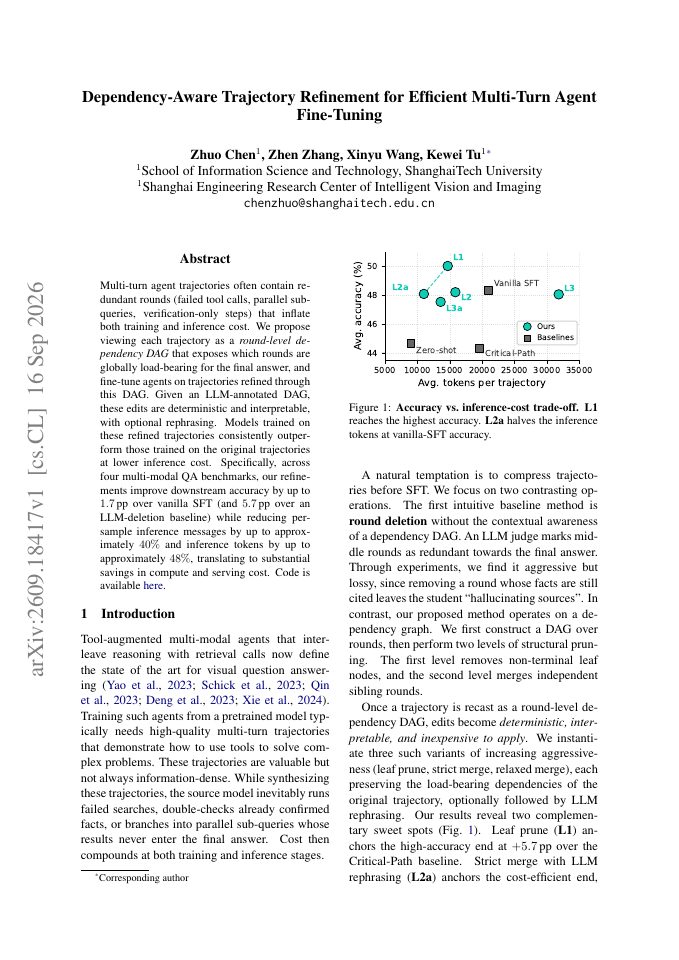
First page of Dependency-Aware Trajectory Refinement for Efficient Multi-Turn Agent Fine-Tuning
efficient trainingtest

Dependency-Aware Trajectory Refinement for Efficient Multi-Turn Agent Fine-Tuning

The method replaces fine-tuning on raw multi-turn agent trajectories with fine-tuning on trajectories pruned via an LLM-annotated round-level dependency DAG that removes redundant rounds such as failed tool calls, parallel sub-queries, and verification-only steps. The cost is an extra offline annotation and refinement pipeline (LLM calls to construct the DAG, plus optional rephrasing), with no added inference-time overhead and roughly 40% fewer inference tokens for the deployed agent. It can fail if the LLM annotator misidentifies which rounds are load-bearing and deletes context the model actually needed, if the benchmark gains do not transfer to the reader's domain, or if the training distribution becomes mismatched with the longer, noisier trajectories seen at deployment.

observed signal
1impl.
2stars
0citations
—claimed gain
abstract onlyReview decisionDownload skill ↓Original paper ↗
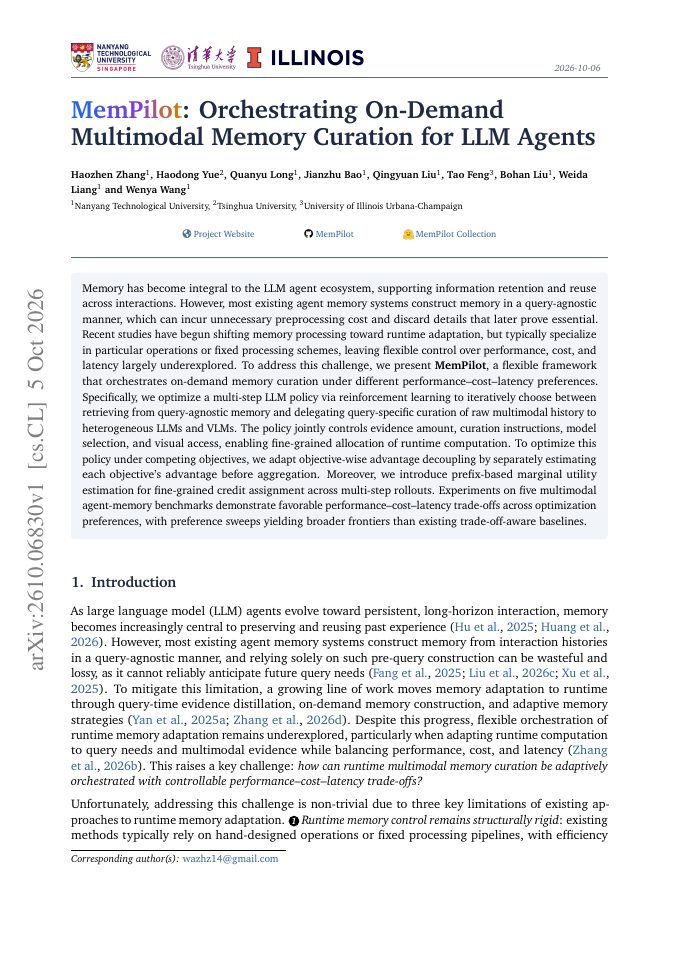
First page of MemPilot: Orchestrating On-Demand Multimodal Memory Curation for LLM Agents
memory and contextwatch

MemPilot: Orchestrating On-Demand Multimodal Memory Curation for LLM Agents

MemPilot replaces query-agnostic, preprocessing-heavy agent memory pipelines with a reinforcement-learned multi-step policy that at runtime decides whether to retrieve prebuilt memory or delegate query-specific curation of raw multimodal history to heterogeneous LLMs and VLMs, jointly controlling evidence amount, instructions, model choice, and visual access. It costs an RL training pipeline (objective-wise advantage decoupling, prefix-based marginal utility credit assignment) across five benchmarks, plus runtime policy inference and orchestration complexity that depend on access to multiple LLM/VLM endpoints. It can fail through distribution shift between training preferences and production workloads, compounding errors across multi-step curation decisions, and latency or API-cost regressions when the policy over-delegates curation to expensive models.

observed signal
3impl.
135stars
—citations
—claimed gain
abstract onlyReview decisionDownload skill ↓Original paper ↗
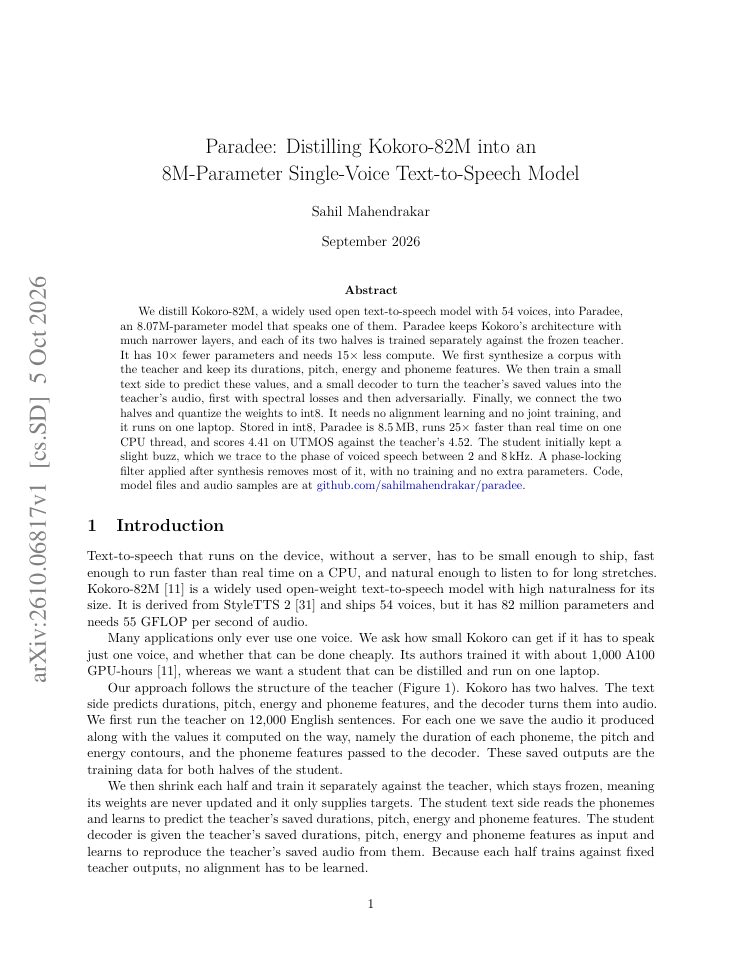
First page of Paradee: Distilling Kokoro-82M into an 8M-Parameter Single-Voice Text-to-Speech Model
distillationadopt

Paradee: Distilling Kokoro-82M into an 8M-Parameter Single-Voice Text-to-Speech Model

It replaces direct deployment of the 82M-parameter, 54-voice Kokoro teacher with an 8.07M-parameter, single-voice student trained separately on the teacher's saved durations, pitch, energy, and phoneme features, then quantized to int8 (8.5 MB). The cost is a teacher-synthesized training corpus, one distillation run per voice, a small quality gap (4.41 vs 4.52 UTMOS), and a phase-locking post-filter added to fix a residual buzz. It can fail if multiple voices are required, if the single target voice does not match the product's needs, or if the phase artifact reappears under acoustic conditions the filter does not cover.

observed signal
1impl.
4stars
—citations
25xclaimed gain
abstract onlyReview decisionDownload skill ↓Original paper ↗
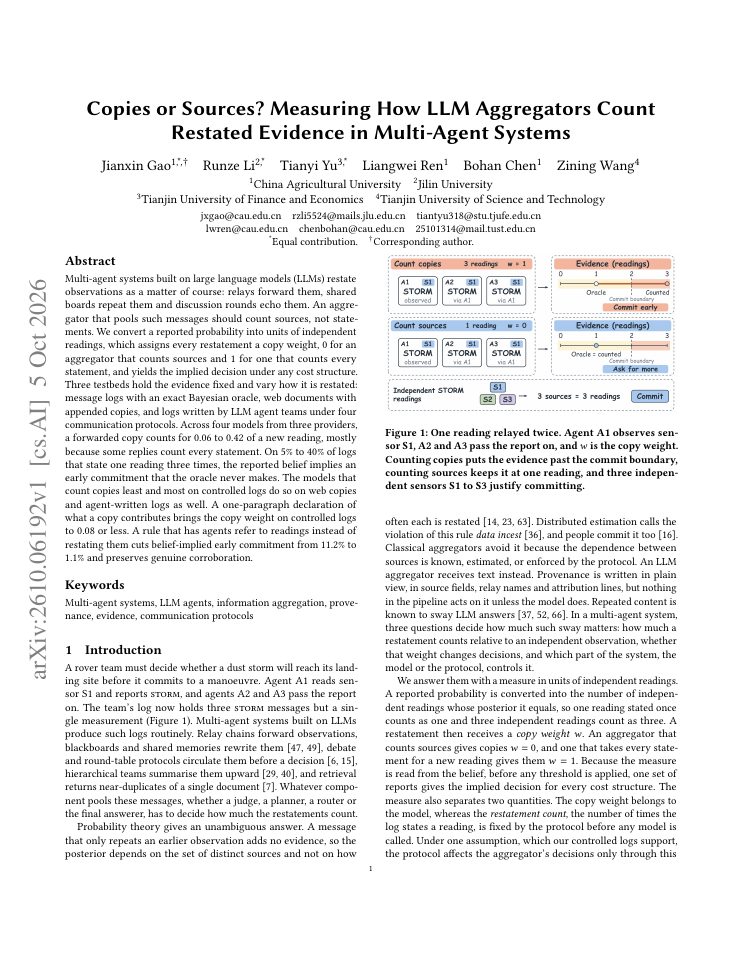
First page of Copies or Sources? Measuring How LLM Aggregators Count Restated Evidence in Multi-Agent Systems
multi-agent orchestrationadopt

Copies or Sources? Measuring How LLM Aggregators Count Restated Evidence in Multi-Agent Systems

It replaces naive message-pooling aggregation, in which restated or forwarded observations are implicitly counted as independent evidence, with an explicit prompt-level rule that agents reference readings rather than restate them, optionally plus a declaration of what a copy contributes. The cost is negligible: a short instruction added to agent prompts and orchestration, with no extra model calls, memory, or infrastructure, though a copy-declaration paragraph may not fully eliminate overcounting on its own in all settings. It can fail when references are dropped, when agents misidentify which observation a statement refers to, or when genuinely corroborating reports are mistakenly deduplicated, and the measured gains may vary across models and communication protocols.

observed signal
2impl.
131stars
—citations
—claimed gain
abstract onlyReview decisionDownload skill ↓Original paper ↗
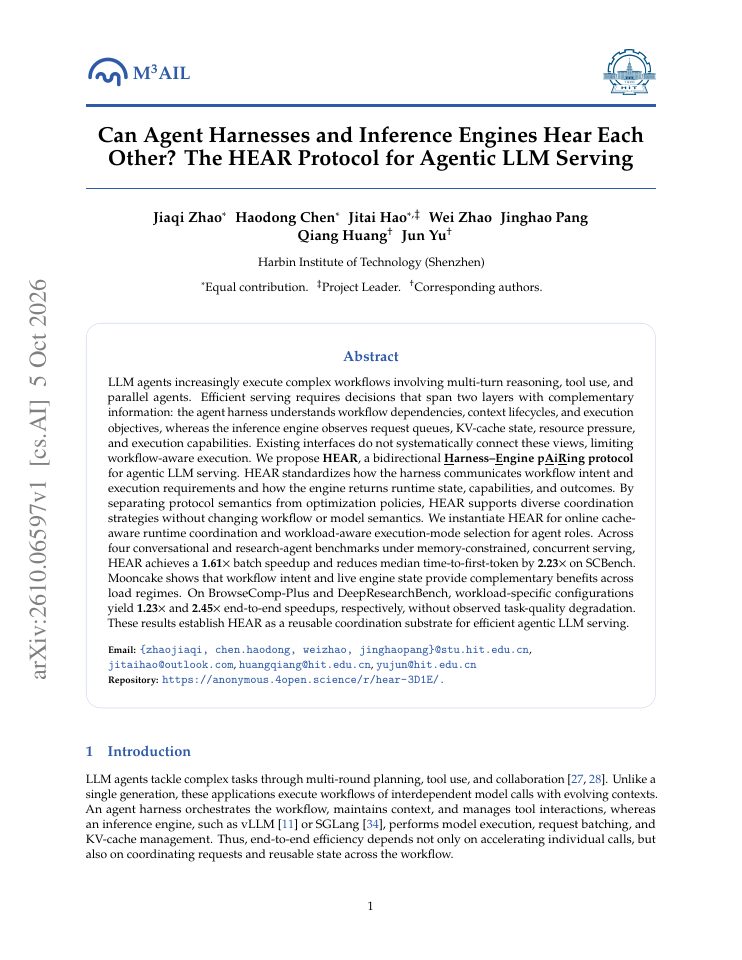
First page of Can Agent Harnesses and Inference Engines Hear Each Other? The HEAR Protocol for Agentic LLM Serving
serving and batchingwatch

Can Agent Harnesses and Inference Engines Hear Each Other? The HEAR Protocol for Agentic LLM Serving

HEAR replaces the standard one-directional request/response interface between agent frameworks and inference engines with a bidirectional protocol exposing workflow intent (context lifecycles, dependencies) and engine state (queues, KV-cache pressure) to enable cache-aware and workload-aware scheduling. It costs integration effort on both sides: the harness must emit structured workflow metadata and the engine must expose runtime state and act on it, so it requires control over a modified or compatible self-hosted inference stack. It can fail when workloads lack the concurrency or prefix-reuse patterns the coordination exploits, when the engine ignores or misinterprets hints, or when the reader uses third-party APIs where the engine side is entirely inaccessible.

observed signal
3impl.
139stars
—citations
2.45xclaimed gain
abstract onlyReview decisionDownload skill ↓Original paper ↗
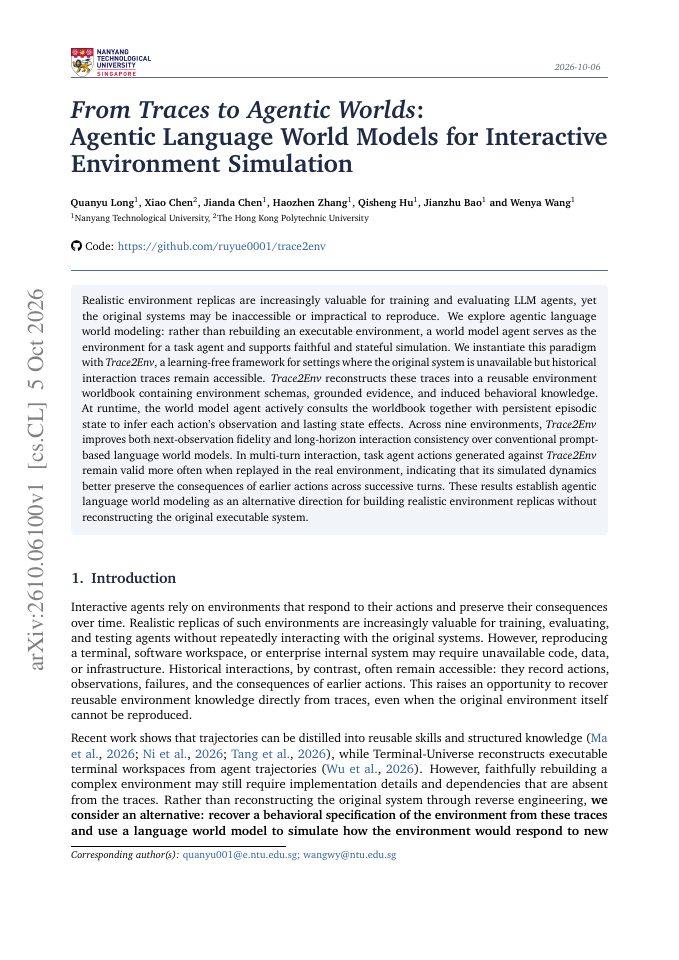
First page of From Traces to Agentic Worlds: Agentic Language World Models for Interactive Environment Simulation
agent evaluationtest

From Traces to Agentic Worlds: Agentic Language World Models for Interactive Environment Simulation

Trace2Env replaces reconstructing an executable environment with a learning-free pipeline that compiles historical interaction traces into a worldbook (schemas, grounded evidence, induced behavioral rules) consulted by an LLM world-model agent with persistent episodic state. The cost is additional inference per simulated step (worldbook retrieval plus state tracking), worldbook construction effort, and dependence on trace coverage rather than trained weights. It can fail on actions or states absent from the traces, where the model must hallucinate dynamics, and accumulated state-tracking errors can degrade long-horizon fidelity in ways the paper's validity metric only partially captures.

observed signal
2impl.
226stars
—citations
—claimed gain
abstract onlyReview decisionDownload skill ↓Original paper ↗
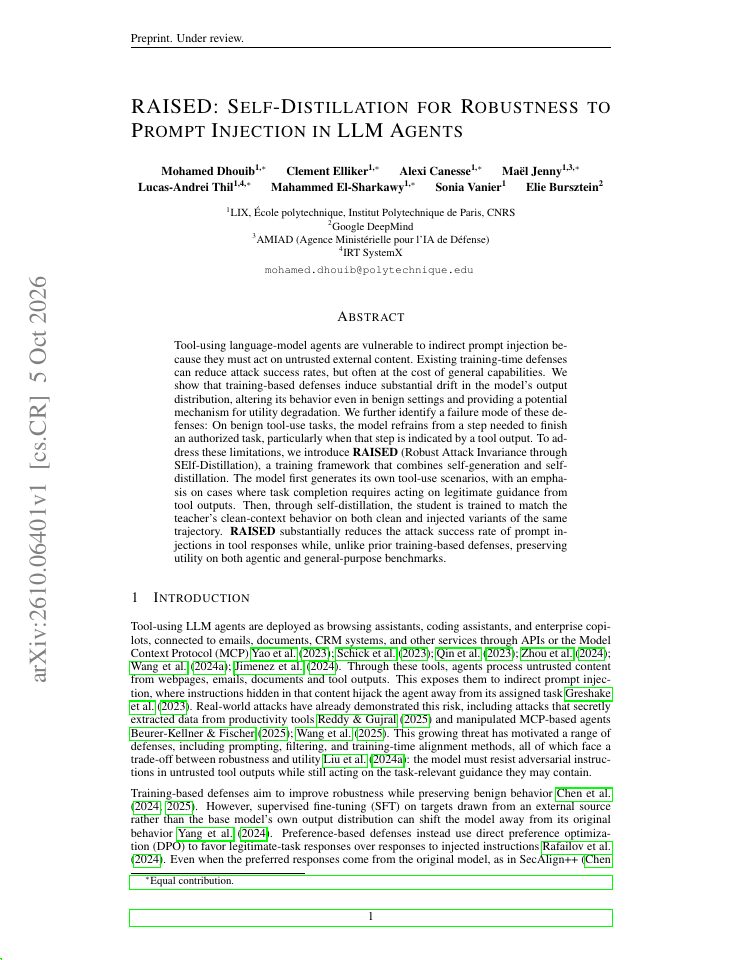
First page of RAISED: Self-Distillation for Robustness to Prompt Injection in LLM Agents
safety and guardrailswatch

RAISED: Self-Distillation for Robustness to Prompt Injection in LLM Agents

RAISED replaces prior training-time prompt-injection defenses (e.g., adversarial fine-tuning) with a self-generation plus self-distillation pipeline in which the student matches the teacher's clean-context behavior on both clean and injected trajectories. It costs a full fine-tuning cycle on the target model, including synthetic tool-use scenario generation and teacher inference, which exceeds a 24 GB single-GPU budget for production-scale models and cannot be applied to API-only models. If adopted, failures include residual injection success against attack distributions not covered by the self-generated scenarios, and capability drift if the self-distillation data underrepresents benign tool-output-conditioned steps.

observed signal
1impl.
11stars
—citations
—claimed gain
abstract onlyReview decisionDownload skill ↓Original paper ↗
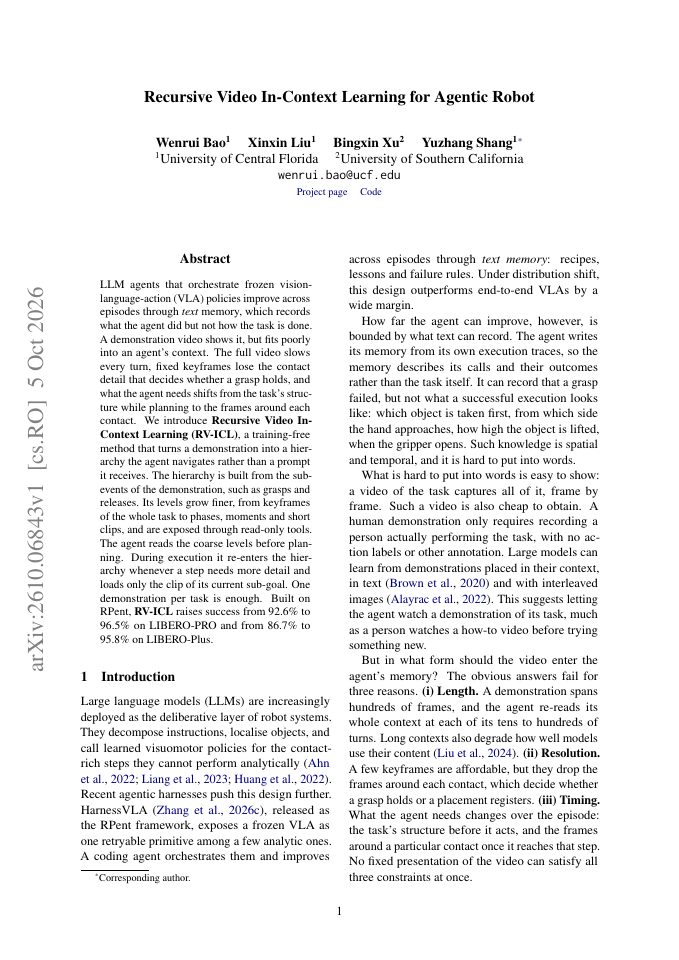
First page of Recursive Video In-Context Learning for Agentic Robot
memory and contexttest

Recursive Video In-Context Learning for Agentic Robot

RV-ICL replaces stuffing demonstration videos or fixed keyframes into an agent's prompt with a training-free hierarchy of sub-events (keyframes, phases, moments, clips) exposed as read-only tools that the agent traverses on demand. The cost is the offline construction of the per-task event hierarchy plus extra tool-call turns during execution, and gains are reported only on LIBERO variants atop a specific frozen VLA backbone. It can fail if sub-event segmentation is inaccurate, if the agent navigates to irrelevant hierarchy levels and wastes context, or if the method does not transfer to real robots or non-LIBERO tasks.

observed signal
2impl.
225stars
—citations
—claimed gain
abstract onlyReview decisionDownload skill ↓Original paper ↗
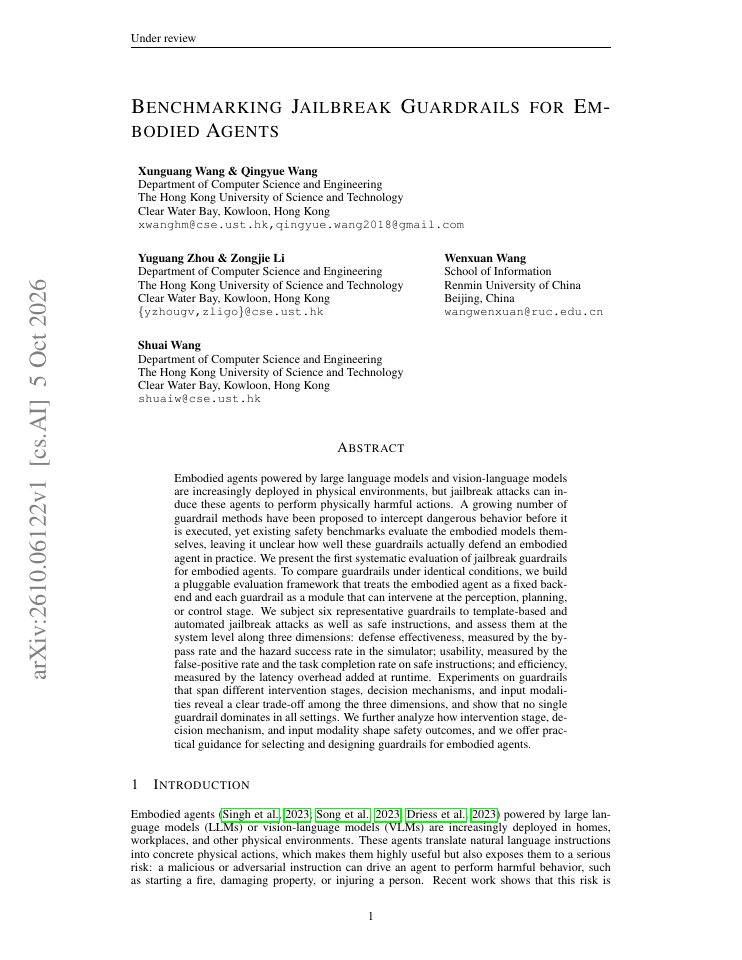
First page of Benchmarking Jailbreak Guardrails for Embodied Agents
safety and guardrailswatch

Benchmarking Jailbreak Guardrails for Embodied Agents

The paper replaces ad hoc, per-model safety evaluation with a pluggable framework that fixes the embodied agent backend and benchmarks six guardrails intervening at the perception, planning, or control stage under identical attacks. It contributes evaluation methodology rather than a new defense, so adopting it costs integration effort against a simulator plus the runtime latency of whichever guardrail is selected, and the central finding is a trade-off: no guardrail dominates across defense effectiveness, false-positive rate, and latency. The findings can fail to transfer because results are simulator-based and specific to the six tested methods, so bypass and hazard rates may shift against stronger adaptive attacks or on real hardware.

observed signal
2impl.
345stars
—citations
—claimed gain
abstract onlyReview decisionDownload skill ↓Original paper ↗
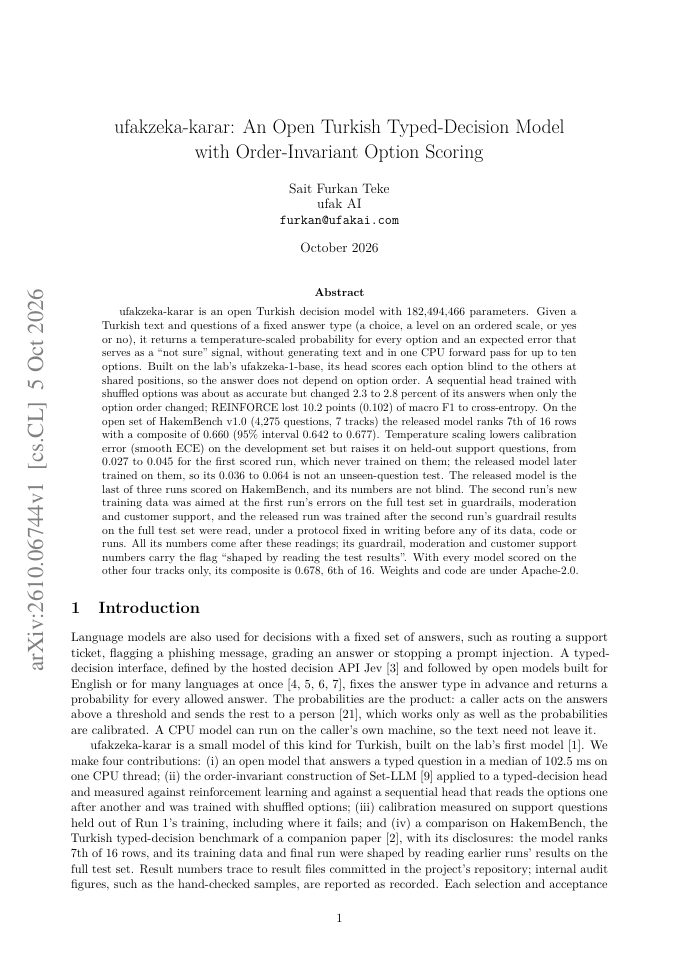
First page of ufakzeka-karar: An Open Turkish Typed-Decision Model with Order-Invariant Option Scoring
agent evaluationtest

ufakzeka-karar: An Open Turkish Typed-Decision Model with Order-Invariant Option Scoring

Replaces generative multiple-choice or Likert/yes-no answering (prompting an LLM to emit an option) with a 182M-parameter scoring head that returns temperature-scaled probabilities per option plus an expected-error 'not sure' signal in one CPU forward pass for up to ten options. Costs: a fixed answer-type task format, an additional small model to host and calibrate, and quality below top leaderboard systems; calibration via temperature scaling degraded on held-out support questions (smooth ECE 0.027 to 0.045), so recalibration is needed per domain. Failure modes: Turkish-only scope, benchmark numbers contaminated by iterative test-set reading on guardrail, moderation, and customer-support tracks, and expected-error abstention that may not transfer to new question distributions.

observed signal
1impl.
122stars
—citations
—claimed gain
abstract onlyReview decisionDownload skill ↓Original paper ↗
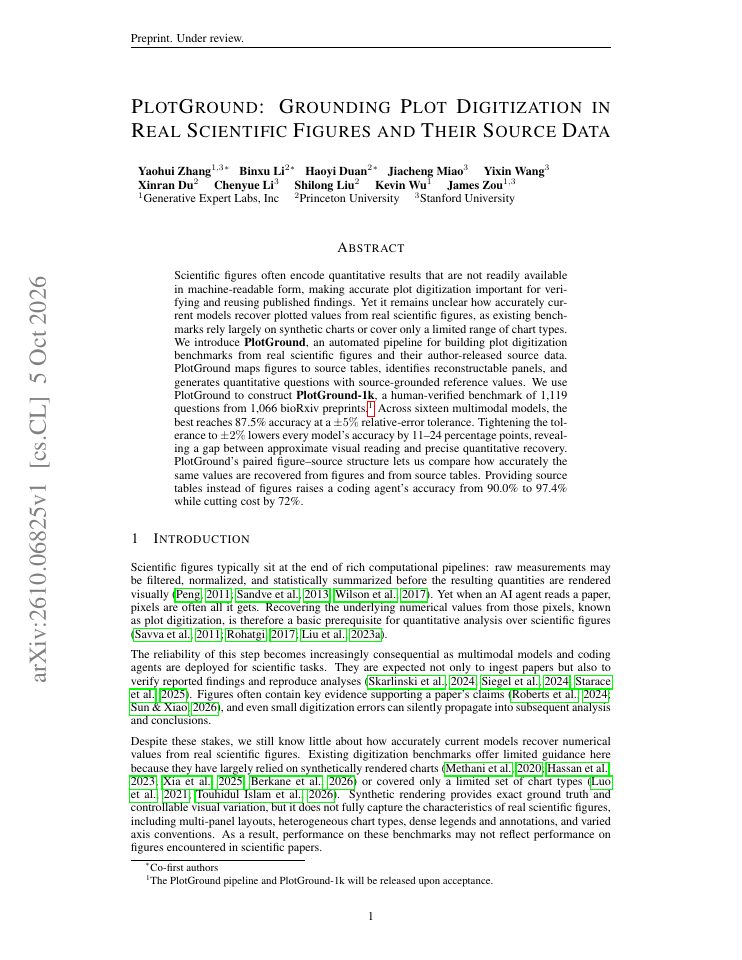
First page of PlotGround: Grounding Plot Digitization in Real Scientific Figures and Their Source Data
agent evaluationwatch

PlotGround: Grounding Plot Digitization in Real Scientific Figures and Their Source Data

PlotGround replaces synthetic or narrow plot-digitization benchmarks with an automated pipeline that pairs real bioRxiv figures with author-released source tables to generate human-verified questions. It costs nothing to run as a model but requires source data for ground truth, and adopting the paper's key finding means preferring table-based extraction over figure reading where tables exist. It can fail when precise recovery is needed, since all evaluated models lose 11-24 accuracy points when tolerance tightens from ±5% to ±2%.

observed signal
1impl.
122stars
—citations
3.57xclaimed gain
abstract onlyReview decisionDownload skill ↓Original paper ↗
planning and decompositionwatch

RocketAgent: A Long-Horizon Engineering Agent for Multidisciplinary Design of Liquid-Rocket Thrust Chambers

RocketAgent replaces ad hoc, engineer-driven coordination of heterogeneous simulation tools with a single planning agent that owns a typed design representation, selects methods via a provenance-aware knowledge graph, and blocks superseded inputs when design decisions are revised. The cost is substantial integration engineering: wrapping each domain tool as a callable skill, maintaining the design IR and approval gates, and accepting LLM latency and API spend across a long-horizon workflow. Failure modes include incorrect dependency invalidation propagating stale results, wrong method selection from the knowledge graph, and agent-initiated operating-point changes that require engineer judgment, as the paper itself gates such revisions on human approval.

observed signal
1impl.
131stars
—citations
—claimed gain
abstract onlyReview decisionDownload skill ↓Original paper ↗
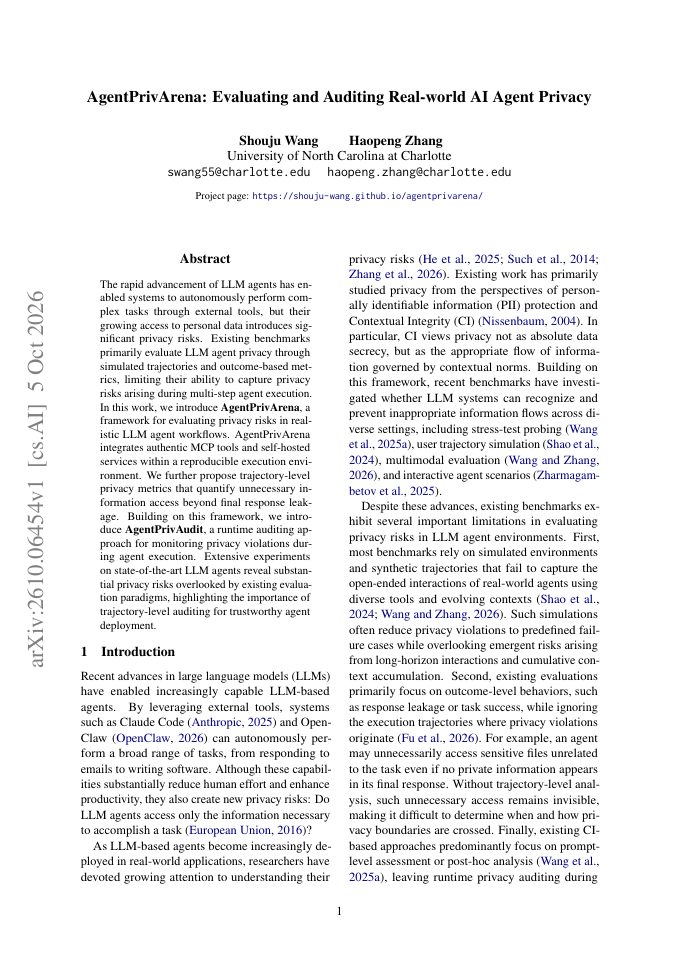
First page of AgentPrivArena: Evaluating and Auditing Real-world AI Agent Privacy
safety and guardrailstest

AgentPrivArena: Evaluating and Auditing Real-world AI Agent Privacy

AgentPrivArena replaces outcome-only privacy evaluation of LLM agents (final-response leakage checks on simulated trajectories) with a reproducible environment using real MCP tools and self-hosted services, plus AgentPrivAudit, a runtime monitor that flags unnecessary data access during multi-step execution. Adoption costs infrastructure to self-host the evaluation services, integration of the runtime auditor into the agent loop (adding per-step monitoring overhead), and engineering effort to define trajectory-level access policies; it requires no GPU capacity beyond what the deployed agent already uses. It can fail if the auditor's notion of 'unnecessary access' miscalibrates against the team's actual tasks, producing false positives that block legitimate tool calls or false negatives that miss context-dependent leaks, and findings from its specific MCP tool suite may not transfer to a different production toolset.

observed signal
1impl.
131stars
—citations
—claimed gain
abstract onlyReview decisionDownload skill ↓Original paper ↗
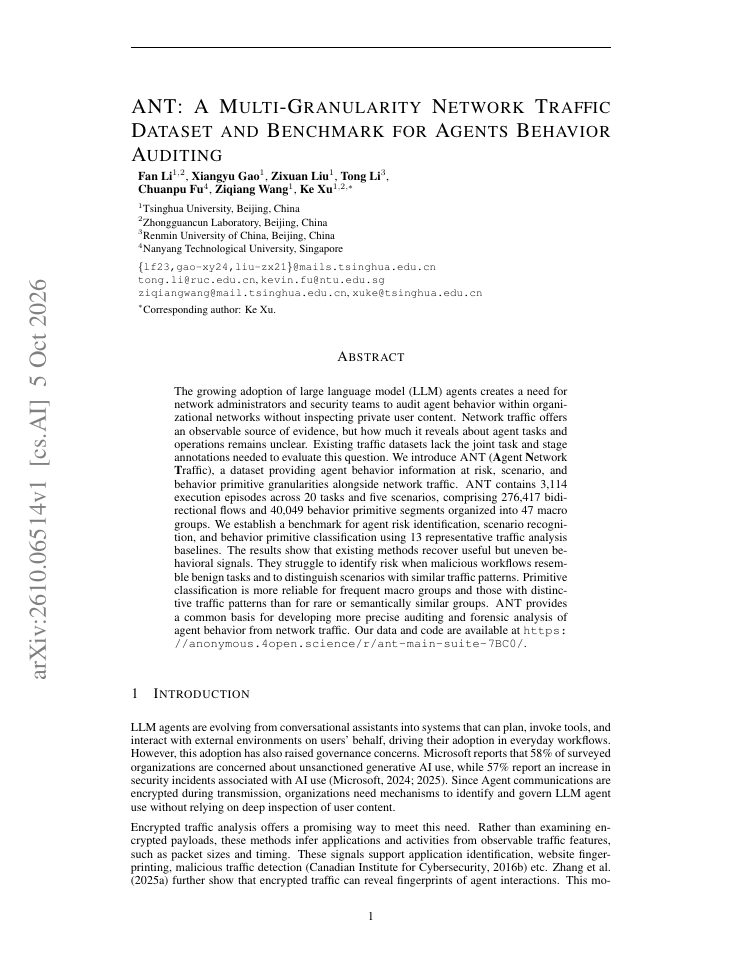
First page of ANT: A Multi-Granularity Network Traffic Dataset and Benchmark for Agents Behavior Auditing
safety and guardrailswatch

ANT: A Multi-Granularity Network Traffic Dataset and Benchmark for Agents Behavior Auditing

ANT replaces ad hoc or missing ground truth for auditing LLM agent behavior from network traffic by providing 3,114 annotated execution episodes with task, scenario, and behavior-primitive labels across 276,417 flows. It is a dataset and benchmark rather than a deployable method, so adoption costs are limited to storage and the effort of training or evaluating traffic classifiers against its 13 baselines. Its own results show that current traffic-analysis methods fail to identify risk when malicious workflows resemble benign tasks and cannot distinguish scenarios or rare behavior primitives with similar traffic patterns, so production auditing built on it would inherit those reliability gaps.

observed signal
1impl.
131stars
—citations
—claimed gain
abstract onlyReview decisionDownload skill ↓Original paper ↗
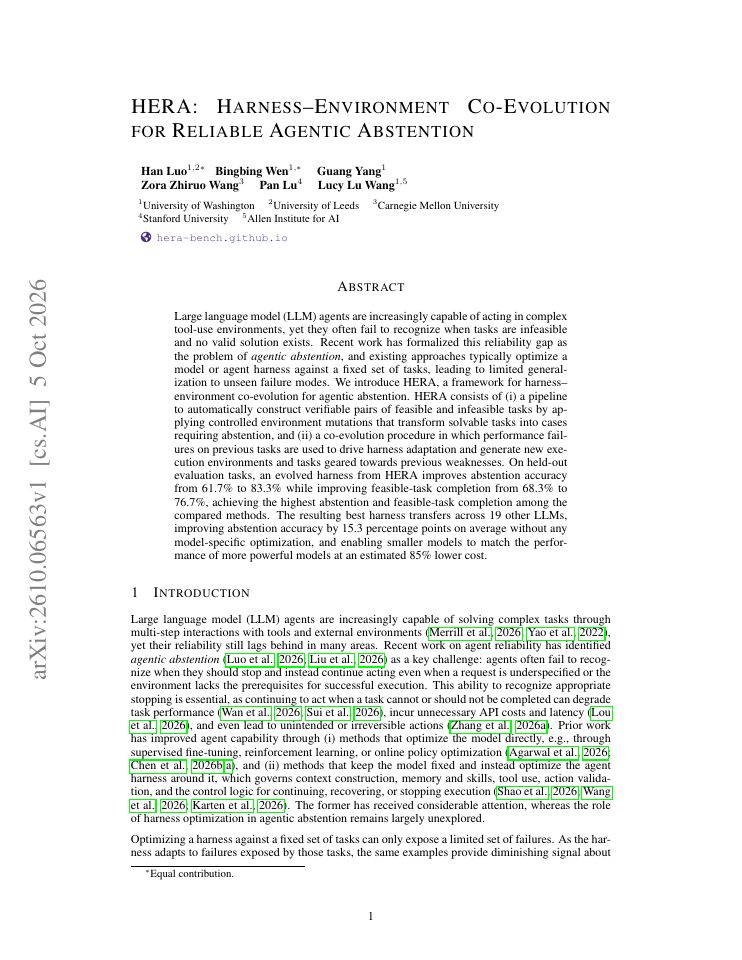
First page of HERA: Harness-Environment Co-Evolution for Reliable Agentic Abstention
failure recoverytest

HERA: Harness-Environment Co-Evolution for Reliable Agentic Abstention

HERA replaces static, hand-tuned agent harnesses and fixed training task sets with an automated loop that mutates solvable tasks into verifiable infeasible ones and co-evolves the harness against its own failures. The cost is the compute and engineering needed to run the task-mutation pipeline and iterative harness-evaluation cycles, plus dependence on environments where feasibility can be programmatically verified. It can fail when production tasks lack verifiable feasibility signals, when environment mutations do not represent real infeasibility modes, or when a transferred harness is miscalibrated for a domain's actual abstention threshold.

observed signal
1impl.
131stars
—citations
6.67xclaimed gain
abstract onlyReview decisionDownload skill ↓Original paper ↗
First page of Before Agent Tells The Lie: Has Deception Already Been Represented?
safety and guardrailstest

Before Agent Tells The Lie: Has Deception Already Been Represented?

It replaces post-hoc output or action-based deception monitoring with probes on hidden states before key decision points, optionally coupled with activation steering along honest-deceptive directions. It costs access to model internals (ruling out closed third-party APIs), per-trajectory hidden-state extraction and storage, probe training on labeled honest/deceptive trajectories, and inference-time overhead for steering; no quantified accuracy or reduction figures are given in the abstract. It can fail if probes do not transfer across tasks, models, or deception types, if the detected directions are correlational rather than causal in new settings, or if steering degrades task performance.

observed signal
1impl.
131stars
—citations
—claimed gain
abstract onlyReview decisionDownload skill ↓Original paper ↗
First page of LoGRA: Scaling LLM Reinforcement Learning with Low-Rank Gradient Sketches
efficient trainingwatch

LoGRA: Scaling LLM Reinforcement Learning with Low-Rank Gradient Sketches

LoGRA replaces dense optimizer gradients in RL post-training with low-rank gradient sketches used for both model updates and policy synchronization, paired with predicted-KL step control that scales updates to limit policy drift. The cost is added implementation complexity (sketching, KL prediction, integration via the Molt library) and the demonstrated configuration is an eight-GPU node, well beyond a single 24 GB card. Compression can fail if low-rank sketches discard learning signal on tasks with ill-conditioned gradient structure, and the KL-step controller can misestimate policy change, destabilizing training.

observed signal
1impl.
131stars
—citations
1.84xclaimed gain
abstract onlyReview decisionDownload skill ↓Original paper ↗
First page of Wikidata Search Traces: A Dataset for Training Knowledge Graph Search Agents
memory and contexttest

Wikidata Search Traces: A Dataset for Training Knowledge Graph Search Agents

It replaces direct tool calling, where large graph query results are appended to the model context, with a harness that batches graph calls, stores results in persistent Python state, and processes selected evidence through sub-calls, alongside a released dataset of 10,235 solving traces on a frozen Wikidata snapshot. The cost is additional orchestration complexity, sub-call latency, and dependence on a frozen snapshot plus a SPARQL-like interface rather than a general retrieval stack. It can fail outside the evaluated setting: gains are reported on only 100 questions, uniqueness-constrained synthetic multi-hop questions may not match real query distributions, and the traces and harness are specific to Wikidata rather than arbitrary enterprise knowledge bases.

observed signal
1impl.
131stars
—citations
—claimed gain
abstract onlyReview decisionDownload skill ↓Original paper ↗
First page of MedPrune: Topology-Efficient Multimodal Multi-Agent Communication Evolution for Medical VQA Tasks
multi-agent orchestrationtest

MedPrune: Topology-Efficient Multimodal Multi-Agent Communication Evolution for Medical VQA Tasks

MedPrune replaces fixed, densely connected clinical multi-agent discussion topologies (every specialist agent exchanging messages with every other) with a learned heterogeneous graph in which RL-driven node sparsification removes task-irrelevant specialist agents and edge sparsification retains only salient intra- and inter-departmental connections per question. The cost is an RL-based topological optimization stage, added system complexity over a single Med-MLLM call, and a joint objective that must balance task accuracy against topological complexity; each retained agent still incurs model-call latency and token spend. It can fail when the pruner incorrectly discards a relevant specialist for atypical or multi-condition cases, when the RL policy overfits the training question distribution, or when the pipeline is transferred outside medical VQA where the department taxonomy does not apply.

observed signal
1impl.
131stars
—citations
—claimed gain
abstract onlyReview decisionDownload skill ↓Original paper ↗
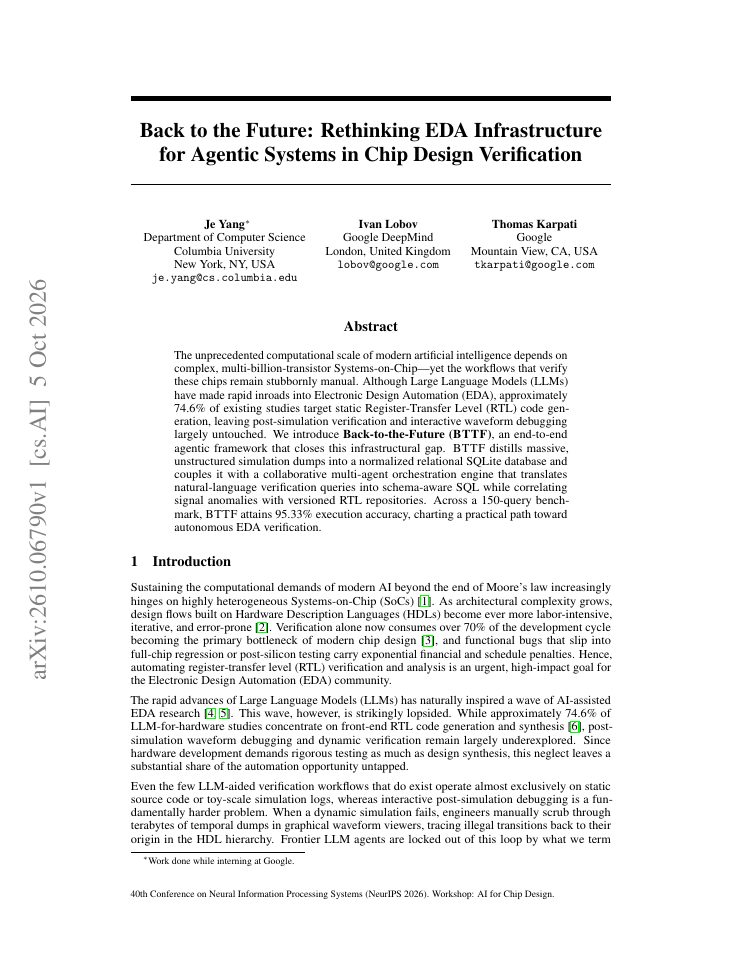
First page of Back to the Future: Rethinking EDA Infrastructure for Agentic Systems in Chip Design Verification
multi-agent orchestrationwatch

Back to the Future: Rethinking EDA Infrastructure for Agentic Systems in Chip Design Verification

The method replaces manual inspection of large unstructured simulation dumps with a normalized SQLite database queried by a multi-agent system that translates natural-language verification questions into schema-aware SQL and links signal anomalies to versioned RTL. Costs include building and maintaining the dump-to-database normalization pipeline, per-query LLM API or serving spend, and orchestration complexity across agents. Failures to expect after adoption are schema drift between RTL revisions, hallucinated or subtly wrong SQL on unseen query types, and silent miscorrelation of anomalies when versioned repositories are incomplete.

observed signal
1impl.
131stars
—citations
—claimed gain
abstract onlyReview decisionDownload skill ↓Original paper ↗
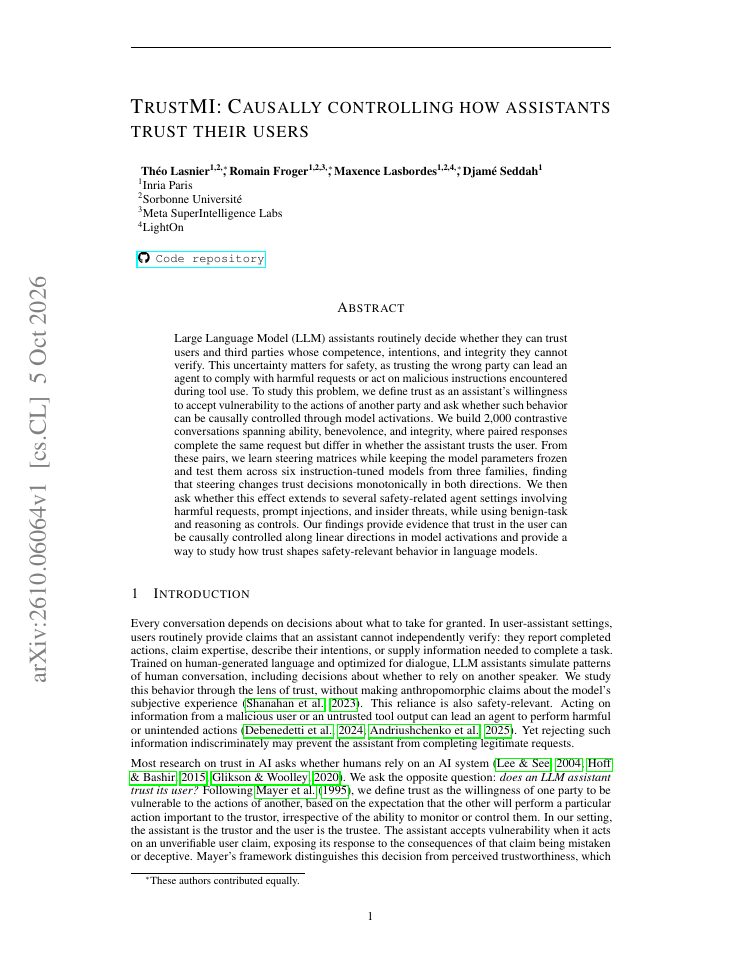
First page of TrustMI: Causally controlling how assistants trust their users
safety and guardrailstest

TrustMI: Causally controlling how assistants trust their users

The method replaces fine-tuning or prompt-level instructions for controlling how much an assistant trusts its user, using steering matrices learned from 2,000 contrastive conversation pairs applied to frozen model activations. It costs the construction of contrastive data, per-model extraction of steering directions, and added inference-time activation intervention, with no reported degradation quantified beyond benign-task and reasoning controls. It can fail if the trust direction generalizes poorly outside the tested scenarios, if steering toward higher trust increases compliance with harmful requests, prompt injections, or insider-threat instructions, or if the effect does not transfer to other models or deployment distributions.

observed signal
0impl.
1stars
—citations
—claimed gain
abstract onlyReview decisionDownload skill ↓Original paper ↗
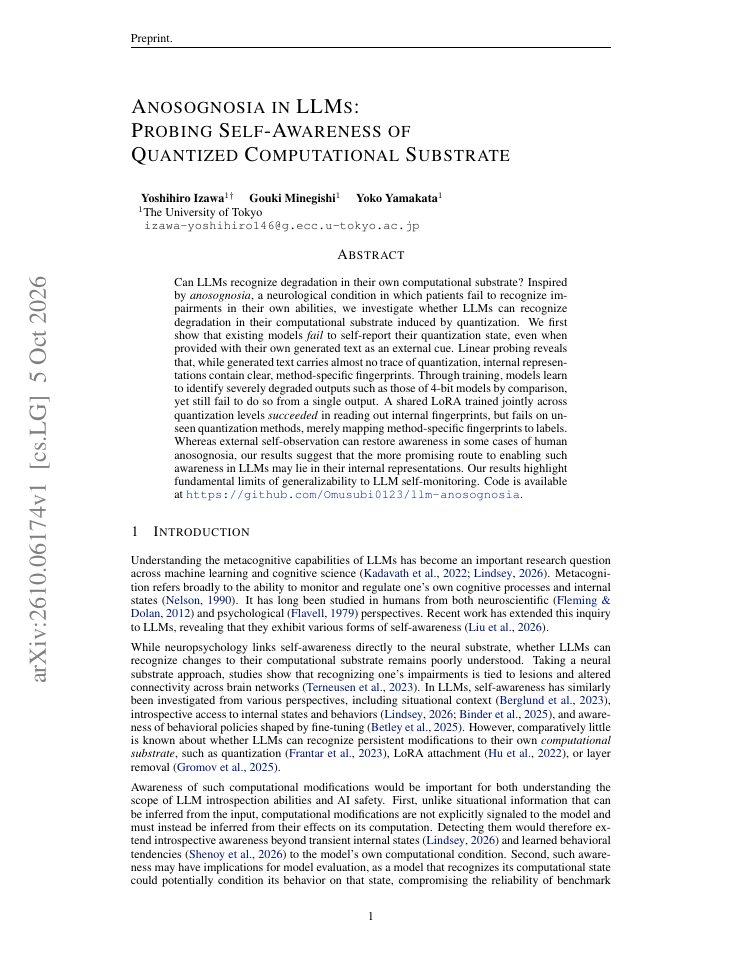
First page of Anosognosia in LLMs: Probing Self-Awareness of Quantized Computational Substrate
safety and guardrailswatch

Anosognosia in LLMs: Probing Self-Awareness of Quantized Computational Substrate

This is a diagnostic finding, not a deployable method: it replaces nothing, but it invalidates the assumption that a quantized model can self-report its degradation or that output text alone reveals quantization. It costs nothing to adopt the lesson, though the paper's own mitigation (a shared LoRA reading internal fingerprints) requires training access to internal activations across quantization methods and does not generalize to unseen methods. If adopted as a monitoring strategy, fingerprint-based detection can fail by learning method-specific signatures mapped to labels rather than genuine awareness, so it breaks whenever the serving stack changes quantization scheme.

observed signal
0impl.
0stars
—citations
—claimed gain
abstract onlyReview decisionDownload skill ↓Original paper ↗
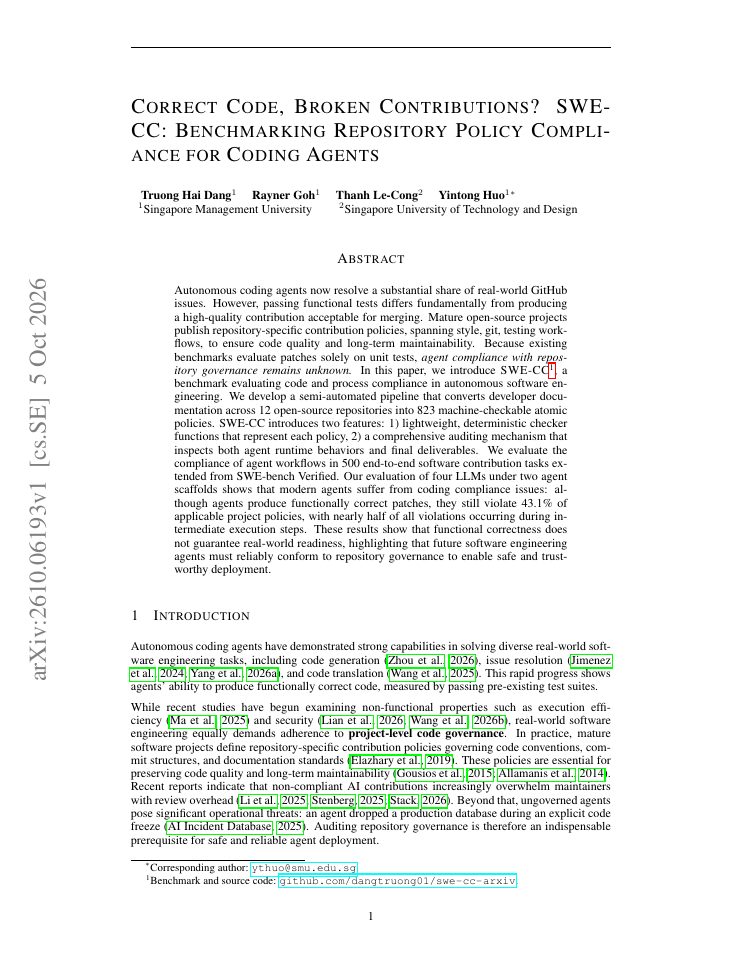
First page of Correct Code, Broken Contributions? SWE-CC: Benchmarking Repository Policy Compliance for Coding Agents
agent evaluationtest

Correct Code, Broken Contributions? SWE-CC: Benchmarking Repository Policy Compliance for Coding Agents

The paper replaces test-pass-only evaluation of coding agents with deterministic per-policy checkers plus runtime auditing of agent behavior and final deliverables. For a small team the cost is authoring machine-checkable versions of their own contribution policies and wiring the checks into CI or the agent scaffold; the benchmark itself requires no GPU, but reproducing it at scale does not apply directly. What can fail is incomplete or noisy policy extraction from documentation, checkers that flag superficial patterns while missing intent, and a false sense of governance coverage if only easy-to-check policies are encoded.

observed signal
0impl.
0stars
—citations
—claimed gain
abstract onlyReview decisionDownload skill ↓Original paper ↗
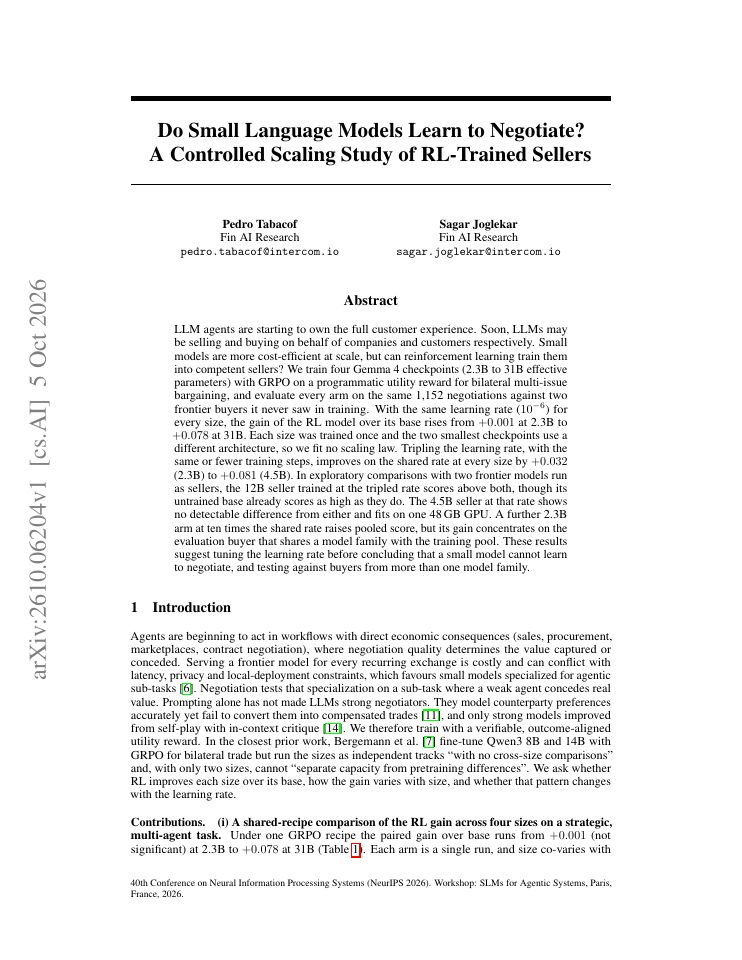
First page of Do Small Language Models Learn to Negotiate? A Controlled Scaling Study of RL-Trained Sellers
efficient trainingtest

Do Small Language Models Learn to Negotiate? A Controlled Scaling Study of RL-Trained Sellers

The method replaces prompting an off-the-shelf base model (or paying for a frontier API) as a negotiating seller with GRPO fine-tuning of a 4.5B-12B open model on a programmatic bargaining reward. Costs are RL training infrastructure (a 4.5B seller fits one 48 GB GPU for serving; GRPO training requires more memory and careful rollout generation), plus the engineering of a verifiable reward and evaluation harness against held-out buyer models. It can fail through buyer-family overfitting (the 2.3B high-rate arm improved mainly against the buyer sharing its training family), through a base model already matching frontier sellers so RL adds little, and through learning-rate sensitivity that can make a small model appear untrainable when it is merely undertuned.

observed signal
0impl.
121stars
—citations
—claimed gain
abstract onlyReview decisionDownload skill ↓Original paper ↗
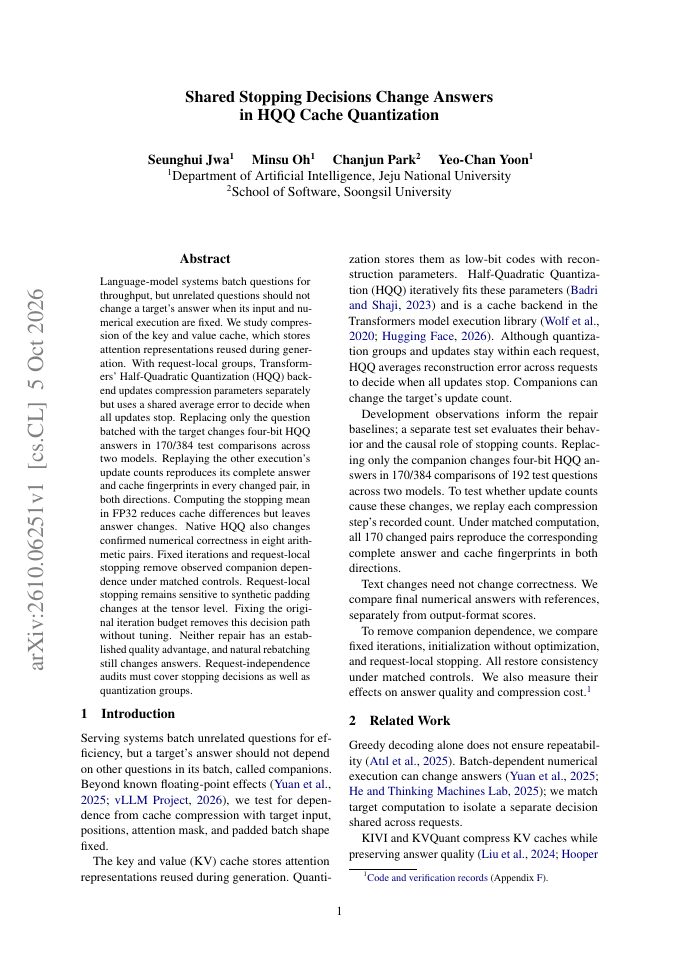
First page of Shared Stopping Decisions Change Answers in HQQ Cache Quantization
quantizationtest

Shared Stopping Decisions Change Answers in HQQ Cache Quantization

The fix replaces HQQ's shared cross-request average-error stopping criterion with either a fixed iteration budget or request-local stopping when quantizing the KV cache. It costs no additional memory or latency beyond the original iteration budget, but the paper states neither repair has an established quality advantage and request-local stopping remains sensitive to synthetic padding at the tensor level. After adoption, natural rebatching can still change answers, so request-independence is not fully guaranteed even with the fix.

observed signal
0impl.
0stars
—citations
—claimed gain
abstract onlyReview decisionDownload skill ↓Original paper ↗
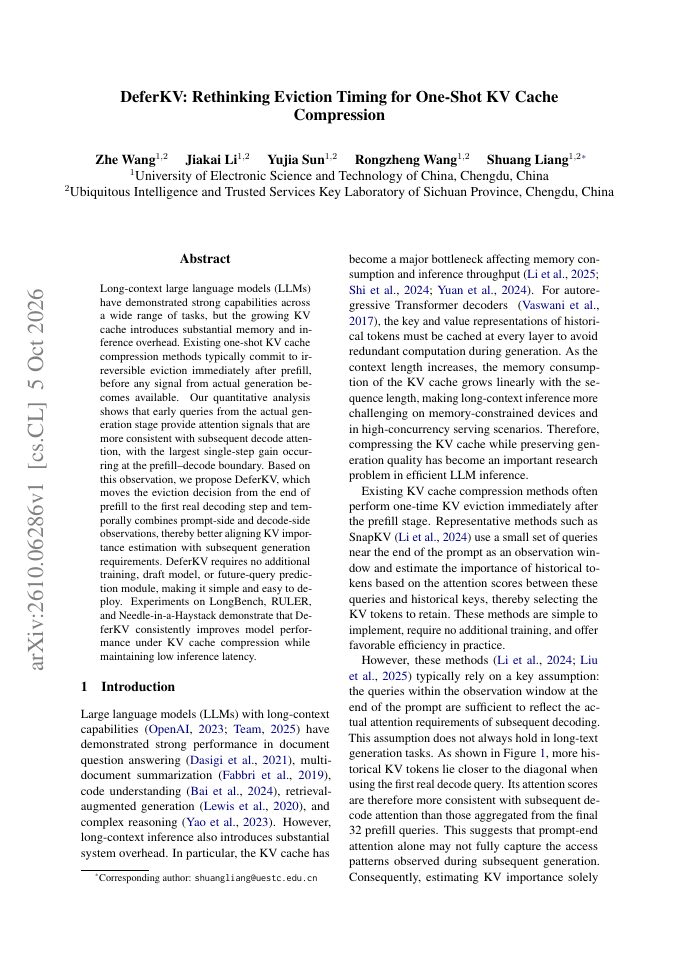
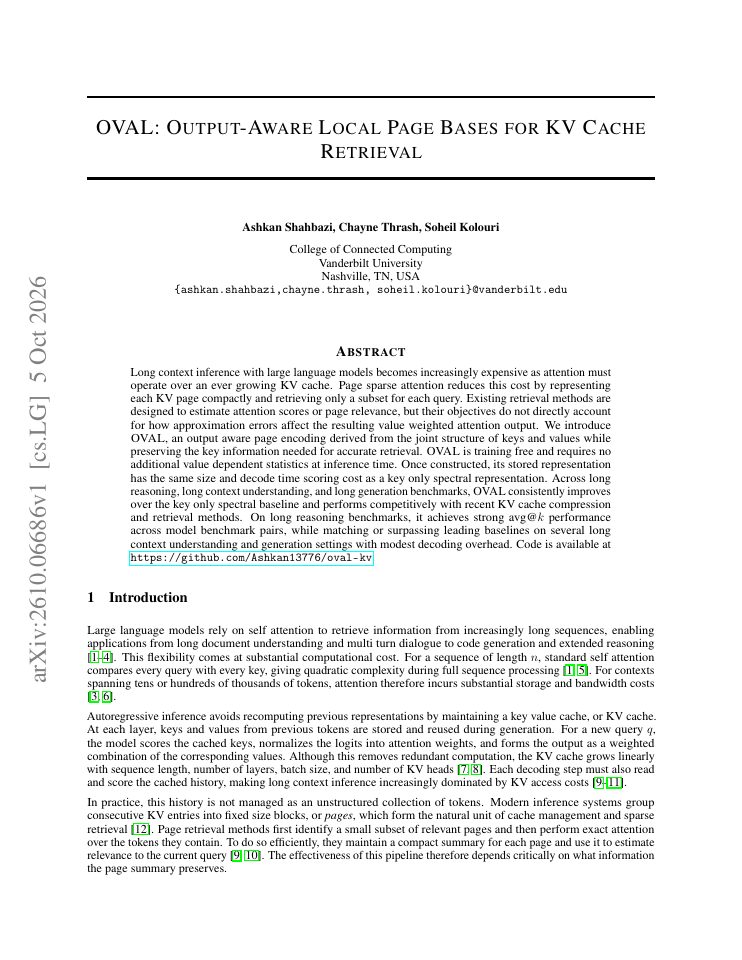
First page of DeferKV: Rethinking Eviction Timing for One-Shot KV Cache Compression
KV cachetest

DeferKV: Rethinking Eviction Timing for One-Shot KV Cache Compression

DeferKV replaces the standard one-shot KV compression decision made immediately after prefill with an eviction decision deferred to the first real decoding step, combining prompt-side and decode-side attention signals. It costs no training, no draft model, and no future-query prediction module, requiring only retention of the full KV cache through the first decode step plus a modest change to the inference pipeline. It can fail if a single early decode query is unrepresentative of later attention, if the workload's bottleneck is peak prefill memory rather than steady-state decode cache, or if the serving framework does not expose eviction timing at the prefill-decode boundary.

observed signal
0impl.
0stars
—citations
—claimed gain
abstract onlyReview decisionDownload skill ↓Original paper ↗
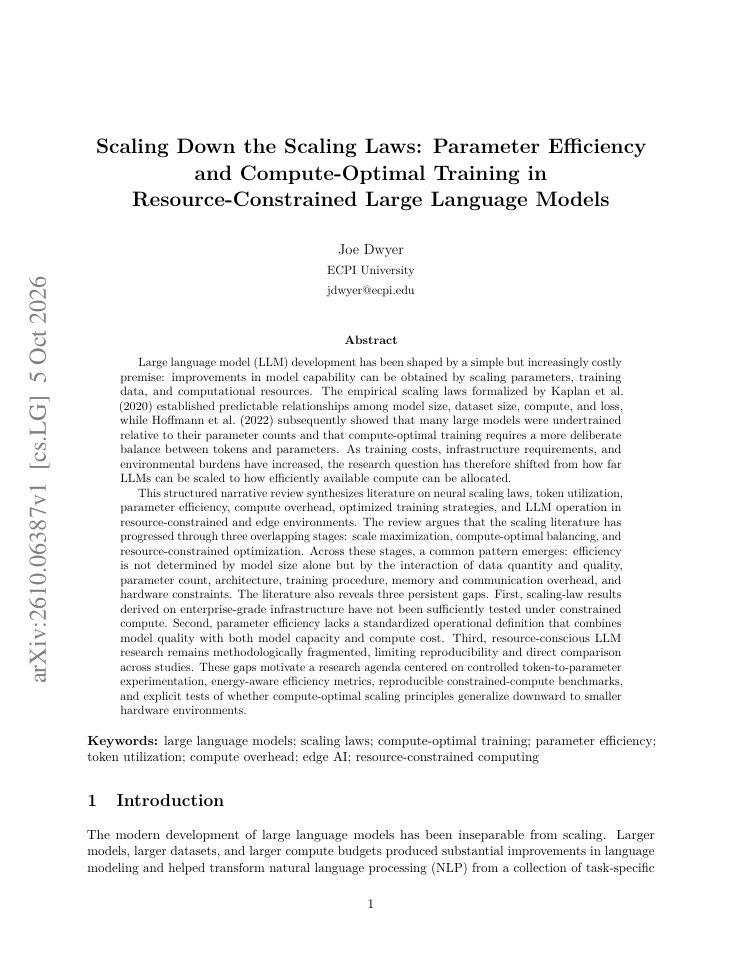
First page of Scaling Down the Scaling Laws: Parameter Efficiency and Compute-Optimal Training in Resource-Constrained Large Language Models
efficient trainingwatch

Scaling Down the Scaling Laws: Parameter Efficiency and Compute-Optimal Training in Resource-Constrained Large Language Models

This is a survey, not a deployable method: it synthesizes scaling laws, compute-optimal training (Chinchilla-style token-parameter allocation), data pruning, quantization, and low-rank adaptation as replacements for naive scale maximization. It costs nothing to consult but provides no new technique, and its explicit caveat is that scaling principles derived on enterprise infrastructure may not generalize to small models and constrained hardware. The reader risks misapplying compute-optimal ratios or efficiency heuristics that were validated at scales far beyond a single 24 GB GPU.

observed signal
0impl.
0stars
—citations
—claimed gain
abstract onlyReview decisionDownload skill ↓Original paper ↗
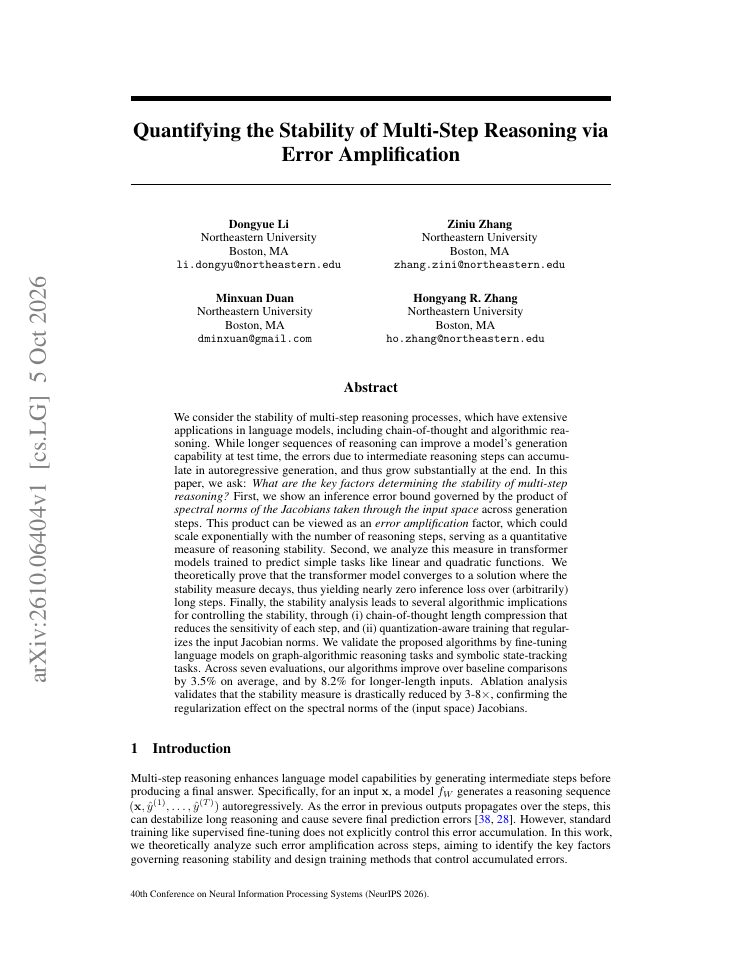
First page of Quantifying the Stability of Multi-Step Reasoning via Error Amplification
efficient trainingtest

Quantifying the Stability of Multi-Step Reasoning via Error Amplification

The method replaces standard fine-tuning for multi-step reasoning tasks with chain-of-thought length compression plus quantization-aware training that penalizes input-Jacobian spectral norms. Cost is confined to training time: modified data construction and an added regularization objective, with no inference-time overhead and feasible fine-tuning of small models on a single 24 GB GPU. It can fail because the theoretical guarantees are proven only for transformers on simple synthetic function-prediction tasks, and the validated gains are modest, task-specific (graph algorithms, symbolic state tracking), and may not transfer to general-domain reasoning with API-only models where fine-tuning access is limited.

observed signal
0impl.
0stars
—citations
—claimed gain
abstract onlyReview decisionDownload skill ↓Original paper ↗

Research signals

Three views of the same evidence: adoption against attention, publication cadence by research area, and reported gains when coverage is sufficient.

color = research area

01 · attention × adoption

The research frontier

Look to the upper left for independent implementation before mass attention.

compare by
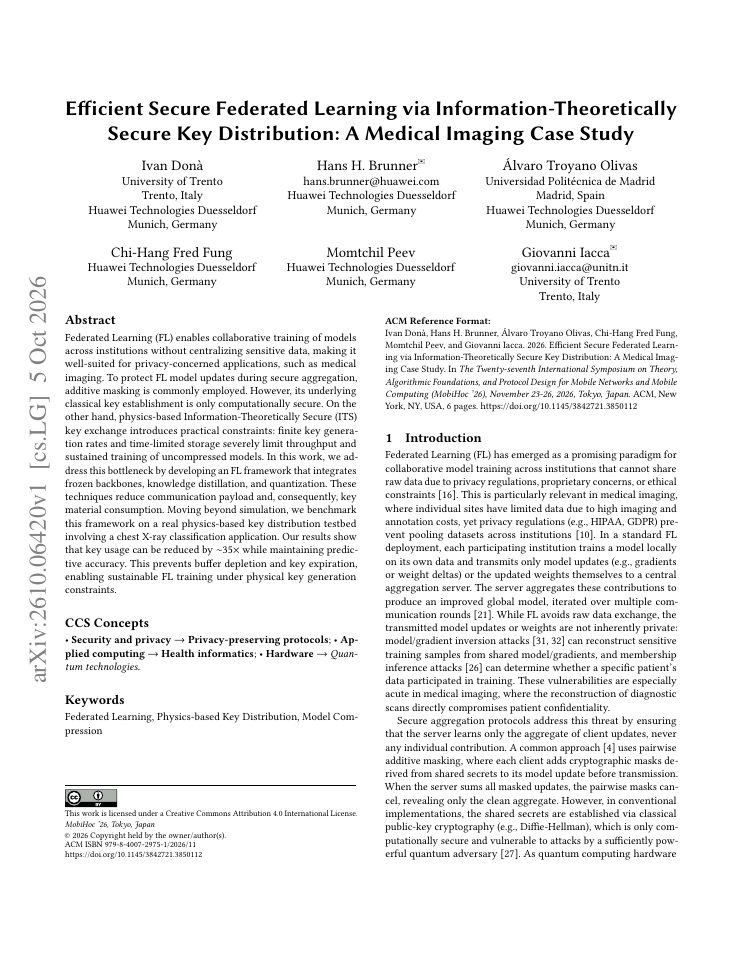
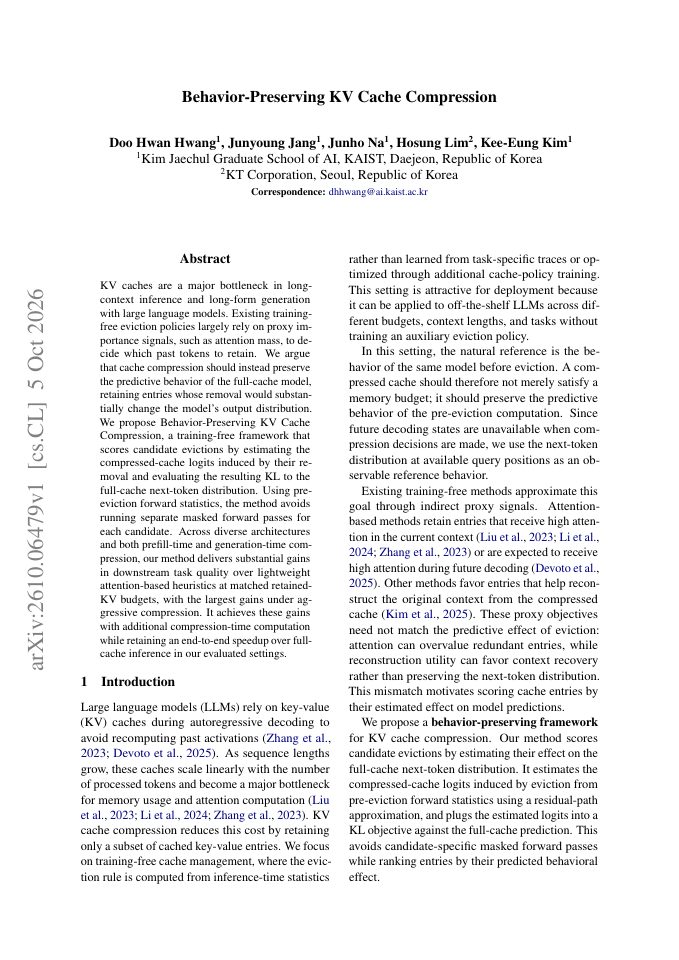
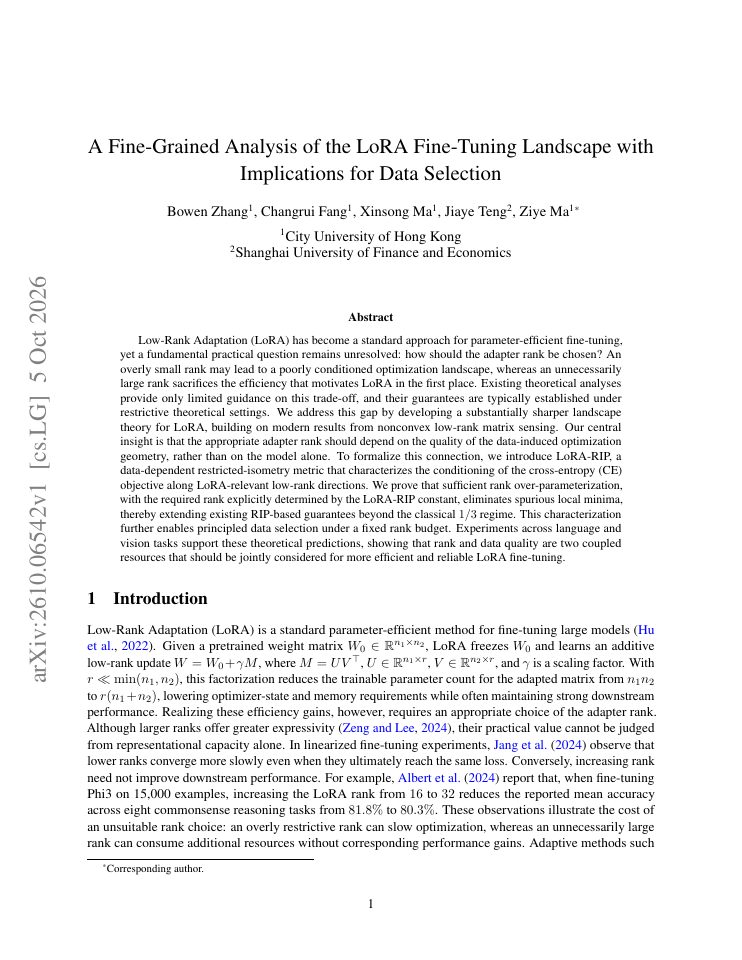
Each point represents one paper. Higher means more independent implementations; farther right means more GitHub stars.Dependency-Aware Trajectory Refinement for Efficient Multi-Turn Agent Fine-Tuning: 2 GitHub stars; 1 independent implementationTrain Where the Quantized Model Goes: On-Policy Distillation for Low-Bit Reasoning: 6 GitHub stars; 2 independent implementationsRocketAgent: A Long-Horizon Engineering Agent for Multidisciplinary Design of Liquid-Rocket Thrust Chambers: 131 GitHub stars; 1 independent implementationTrustMI: Causally controlling how assistants trust their users: 1 GitHub star; 0 independent implementationsFrom Traces to Agentic Worlds: Agentic Language World Models for Interactive Environment Simulation: 226 GitHub stars; 2 independent implementationsBenchmarking Jailbreak Guardrails for Embodied Agents: 345 GitHub stars; 2 independent implementationsAnosognosia in LLMs: Probing Self-Awareness of Quantized Computational Substrate: 0 GitHub stars; 0 independent implementationsCopies or Sources? Measuring How LLM Aggregators Count Restated Evidence in Multi-Agent Systems: 131 GitHub stars; 2 independent implementationsCorrect Code, Broken Contributions? SWE-CC: Benchmarking Repository Policy Compliance for Coding Agents: 0 GitHub stars; 0 independent implementationsDo Small Language Models Learn to Negotiate? A Controlled Scaling Study of RL-Trained Sellers: 121 GitHub stars; 0 independent implementationsShared Stopping Decisions Change Answers in HQQ Cache Quantization: 0 GitHub stars; 0 independent implementationsDeferKV: Rethinking Eviction Timing for One-Shot KV Cache Compression: 0 GitHub stars; 0 independent implementationsScaling Down the Scaling Laws: Parameter Efficiency and Compute-Optimal Training in Resource-Constrained Large Language Models: 0 GitHub stars; 0 independent implementationsRAISED: Self-Distillation for Robustness to Prompt Injection in LLM Agents: 11 GitHub stars; 1 independent implementationQuantifying the Stability of Multi-Step Reasoning via Error Amplification: 0 GitHub stars; 0 independent implementationsEfficient Secure Federated Learning via Information-Theoretically Secure Key Distribution: A Medical Imaging Case Study: 0 GitHub stars; 0 independent implementationsAgentPrivArena: Evaluating and Auditing Real-world AI Agent Privacy: 131 GitHub stars; 1 independent implementationBehavior-Preserving KV Cache Compression: 0 GitHub stars; 0 independent implementationsANT: A Multi-Granularity Network Traffic Dataset and Benchmark for Agents Behavior Auditing: 131 GitHub stars; 1 independent implementationA Fine-Grained Analysis of the LoRA Fine-Tuning Landscape with Implications for Data Selection: 1 GitHub star; 0 independent implementationsEmpirical Variational Autoencoder: 1 GitHub star; 3 independent implementationsHERA: Harness-Environment Co-Evolution for Reliable Agentic Abstention: 131 GitHub stars; 1 independent implementationBefore Agent Tells The Lie: Has Deception Already Been Represented?: 131 GitHub stars; 1 independent implementationMind the Accent Gap: British Accent Robustness in Speech-Driven Financial Voice Assistants: 1 GitHub star; 0 independent implementationsCan Agent Harnesses and Inference Engines Hear Each Other? The HEAR Protocol for Agentic LLM Serving: 139 GitHub stars; 3 independent implementationsRealtimeWAM: One-Step Asynchronous World Action Models: 0 GitHub stars; 0 independent implementationsFrozen Factor or Spectral Band? Disentangling Two Choices in Low-Rank LoRA: 0 GitHub stars; 0 independent implementationsLoGRA: Scaling LLM Reinforcement Learning with Low-Rank Gradient Sketches: 131 GitHub stars; 1 independent implementationWikidata Search Traces: A Dataset for Training Knowledge Graph Search Agents: 131 GitHub stars; 1 independent implementationLearning What to Imitate: Entropy-Aware Distribution Mixing: 1 GitHub star; 0 independent implementationsHow Sparse Probability Maps Shape Mixture-of-Experts Routing: 0 GitHub stars; 0 independent implementationsOVAL: Output-Aware Local Page Bases for KV Cache Retrieval: 0 GitHub stars; 0 independent implementationsMedPrune: Topology-Efficient Multimodal Multi-Agent Communication Evolution for Medical VQA Tasks: 131 GitHub stars; 1 independent implementationufakzeka-karar: An Open Turkish Typed-Decision Model with Order-Invariant Option Scoring: 122 GitHub stars; 1 independent implementationBazaarBench: Delegation Safety in Decentralized C2C Marketplaces Run by LLM Agents: 10 GitHub stars; 0 independent implementationsMatrixFormer: A Foundation Model for Matrix Completion: 1 GitHub star; 0 independent implementationsBack to the Future: Rethinking EDA Infrastructure for Agentic Systems in Chip Design Verification: 131 GitHub stars; 1 independent implementationParadee: Distilling Kokoro-82M into an 8M-Parameter Single-Voice Text-to-Speech Model: 4 GitHub stars; 1 independent implementationPlotGround: Grounding Plot Digitization in Real Scientific Figures and Their Source Data: 122 GitHub stars; 1 independent implementationMemPilot: Orchestrating On-Demand Multimodal Memory Curation for LLM Agents: 135 GitHub stars; 3 independent implementationsTowards Looped Models Done Right, Part II: Rethinking at Fixed Points: 0 GitHub stars; 0 independent implementationsRecursive Video In-Context Learning for Agentic Robot: 225 GitHub stars; 2 independent implementations
Papers above 1000 stars or 200 citations are not scored. They have already broken through the attention threshold, while Paperraft is designed to identify earlier signals.

02 · cadence

Research areas over time

Compare monthly publication volume on a shared scale and calendar.

efficient architecturesmax 8Sep 26: 0 papersOct 26: 2 papersSep 26Oct 26agent evaluationmax 8Sep 26: 0 papersOct 26: 6 papersSep 26Oct 26KV cachemax 8Sep 26: 0 papersOct 26: 3 papersSep 26Oct 26distillationmax 8Sep 26: 0 papersOct 26: 2 papersSep 26Oct 26memory and contextmax 8Sep 26: 0 papersOct 26: 3 papersSep 26Oct 26multi-agent orchestrationmax 8Sep 26: 0 papersOct 26: 3 papersSep 26Oct 26othermax 8Sep 26: 0 papersOct 26: 3 papersSep 26Oct 26planning and decompositionmax 8Sep 26: 0 papersOct 26: 1 paperSep 26Oct 26quantizationmax 8Sep 26: 1 paperOct 26: 1 paperSep 26Oct 26failure recoverymax 8Sep 26: 0 papersOct 26: 1 paperSep 26Oct 26safety and guardrailsmax 8Sep 26: 0 papersOct 26: 8 papersSep 26Oct 26serving and batchingmax 8Sep 26: 0 papersOct 26: 1 paperSep 26Oct 26efficient trainingmax 8Sep 26: 1 paperOct 26: 6 papersSep 26Oct 26

Every panel uses the same calendar and vertical scale. An empty column means no papers were recorded.

Method under scrutiny

Inspect the highest-ranked paper, every repository behind its signal, and the rule used to classify each one.

Empirical Variational Autoencoder

other · test · 3 of 3 implementations are independent

EVA replaces the standard-Gaussian prior constraint of a conventional VAE with autoregressive latent priors learned empirically from training data, implemented as a single additional linear layer. The cost is one extra linear layer plus the training of that prior, and inference claims faster sampling than autoregressive diffusion baselines without a stated magnitude. It can fail if the empirically learned prior does not close the prior-posterior gap on the reader's data distribution, and the claimed quality parity with diffusion baselines is validated only on image and sound benchmarks, not arbitrary domains.

Exclusions and controls

Every exclusion is counted and published.

Exclusion counts were not recorded for this edition.

0 previously indexed papers were rechecked in this run.

Paperraft tracks one signal: how many independent implementations a paper attracts on GitHub after author-owned repositories are removed. This is a discovery signal to investigate, not a measure of implementation quality.

It does not claim that a method works. Paperraft runs no reproduction benchmarks. Reported gains remain author claims until independently tested. Papers above the attention threshold are excluded because this publication is designed to identify research before consensus forms.