For solo builders
A possible application for this research area. Paper-specific feasibility still needs a full-paper review.
You already need task-specific training and want to reduce its memory or compute cost.
What you would change
Change only the training technique on a small controlled run after checking prerequisites.
Try the idea on your product
A proposed first test. Set your budget and success criteria before running it.
Change only the training technique on a small controlled run after checking prerequisites.
Compare against
Your current training recipe with the same model, data split, and evaluation.
- Locate the paper's implementation and check its license, model support, data needs, and hardware requirements. Stop here if you cannot obtain the required artifacts.
- Save a small set of representative product tasks and expected outcomes. Keep evaluation tasks out of any training or tuning, and choose quality and cost limits before running.
- Run the baseline and the proposed change on identical inputs. Keep other settings fixed and repeat paired runs to expose variation.
- Save per-task outputs, failures, timings, and all usage costs. Review regressions before expanding the test.
What to measure
Held-out quality, peak memory, training time, and full compute cost to the target quality.
When to keep it
Keep the change only if it meets your preselected quality and latency limits and improves the metric you care about after setup and operating costs. Otherwise retain the baseline. This is an exploration plan, not a validated recommendation.
Download test plan ↓abstract indexedPaperraft next step
Do not allocate compute yet.
This page uses the abstract and public adoption signal only. Request the deep report before relying on its recommendation.
Abstract-level screening only. Risks and infrastructure may not have been evaluated. This recommendation is not a reproduced result.- minimum test setup
- not reported
- published evidence setup
- not reported
- source-linked claims
- 0 of 2
- exposure checks
- 0 of 8
Why it was shortlisted
The technical change, research area, and reason it entered the archive.
- recommendation
- test
- research area
- efficient training
- technical change
- Freezing LoRA input factor A on top singular directions
- published
- 2026-10-05
The finding is a cheap, infrastructure-compatible hyperparameter choice with reported double-digit gains at low rank, but the limited task coverage, rank-dependent attenuation, and weakened significance claims require validation on the reader's own workload before production adoption.
About the technical core
Equations have not been fetched yet.
When reading the methods, identify the rule, algorithm, or evaluation protocol that produces the claimed change. An equation is useful here only if it explains that mechanism.
Inspect the original paperClaims and evidence
A claim is source-linked only when the PDF page and matching excerpt are available.
- claim 01Paperraft inference
Read the brief interpretation
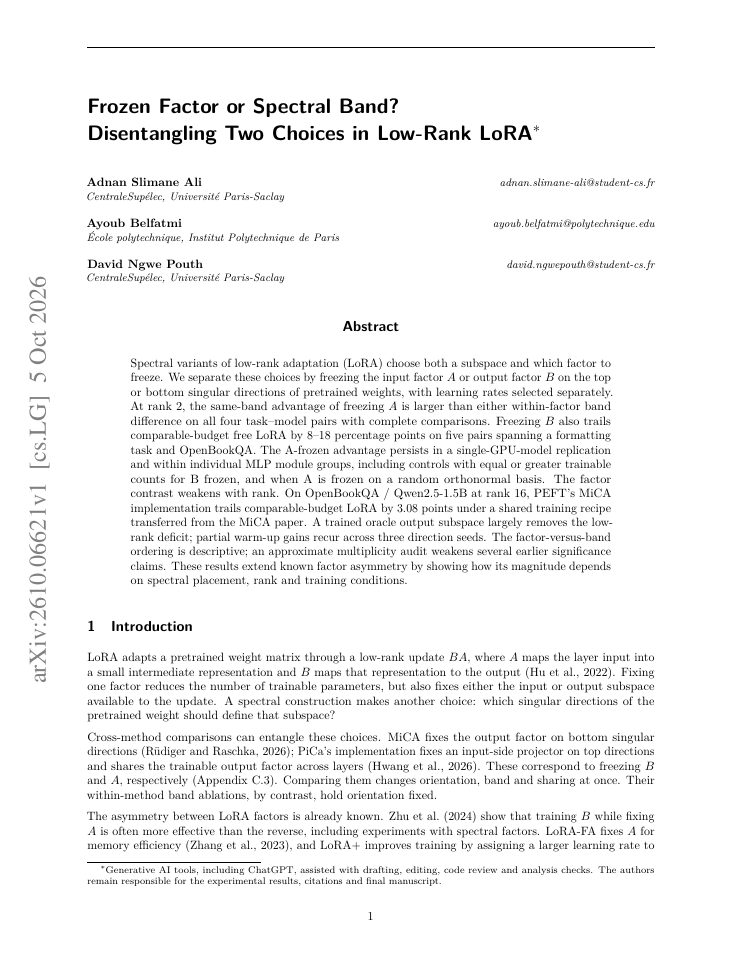
The paper studies which LoRA factor to freeze and on which singular band, replacing the default practice of fully training both A and B or adopting spectral-frozen variants such as MiCA without examining the factor choice; at low rank, freezing the input factor A on top singular directions is the better default. It costs nothing beyond standard LoRA: fewer trainable parameters, no extra memory or latency, only a subspace selection step at initialization. The advantage weakens as rank increases, the factor-versus-band ordering is descriptive rather than causal, an approximate multiplicity audit weakened several significance claims, and results cover only a handful of task-model pairs, so the benefit may not transfer to other models or tasks.
This is a Paperraft inference. It is not pinned to a verified PDF passage.
Inspect the source - claim 02Paperraft inference
Freezing A outperforms freezing B by 8-18 percentage points at comparable trainable budgets on five task-model pairs, and PEFT's MiCA trails comparable-budget LoRA by 3.08 points on OpenBookQA/Qwen2.5-1.5B at rank 16 under a shared recipe.
This is a Paperraft inference. It is not pinned to a verified PDF passage.
Inspect the source
Exposure map
Author findings, Paperraft interpretations, and the next check. Missing analysis never counts as evidence of safety.
quality
Still unknownWhich tasks improve, and which regress against the baseline?
compute and memory
Still unknownWhat memory, hardware, and total compute does the complete method require?
latency
Still unknownAre startup time, typical response time, and slow requests measured separately?
operations
Still unknownWhat must be monitored, maintained, and rolled back?
software compatibility
Still unknownDoes the implementation support your model, runtime, and hardware?
security
Still unknownWhat new data access, permissions, or trust boundaries does it introduce?
data and training
Still unknownWhat data preparation or training is required, and is it included in the cost?
reproducibility
Still unknownAre code, versions, inputs, and evaluation scripts available?
Continue the investigation
A reading guide for efficient training.
Editorial prompts, not findings from this paper or a validated test plan. Detailed analysis is still pending for the topics below.
What to inspect
Which assumptions does the proposed method need, and where might your workload violate them?
Plan a fair comparison
Identify the baseline, metric, dataset, and experimental settings in the paper. Which can you match?
Questions for adoption
What implementation and evaluation artifacts are available, and what would you need to supply?
Inside the paper
Preview the first 3 pages of the original PDF. Click the stack to turn the page.
The downloadable skill includes SKILL.md and evidence.json, with recorded findings and unanswered checks. TRY-IT.md adds a product test plan and a blank results sheet.
A reading aid for your agent. Findings still need validation.
Provisional research brief updated 2026-10-18. Paperraft has not reproduced this experiment.