Skip to content

archived edition · 2026-10-05

PaperraftFind the AI research
worth testing.

Understand what a paper changes, what it costs, and whether it fits your next build. Explore research on faster LLM inference, agent memory, and evaluation, with the original sources in reach.

Start with a brief. Follow the evidence. Choose a test.

edition
2026-10-05
briefs
43
research areas
15
independent implementations
26

25 of 43 papers in the index (58%) have no independent implementations.

Research index

Search by topic, browse a research area, or sort by date. Read a brief, open the original paper, and inspect the available evidence before deciding what to test.

showing30 of 43
sort by
First page of Beyond Predictable Paths: Redefining AI Security Incident Reporting for Agents
safety and guardrailstest

Beyond Predictable Paths: Redefining AI Security Incident Reporting for Agents

The paper proposes adapting conventional AI incident reporting to agents by adding agent-specific fields such as memory contents and accesses, autonomy levels, and tool usage, replacing generic AI system incident templates. The cost is added logging and governance overhead: teams must instrument memory, tool calls, and autonomy state, and the paper itself flags open problems in efficient recording and in determining whether incidents generalize. Adoption can fail through data leakage from over-detailed reports, attacks against the reporting infrastructure itself, and unresolved privacy requirements that the authors leave as research questions.

observed signal
1impl.
0stars
0citations
—claimed gain
abstract onlyReview decisionDownload skill ↓Original paper ↗
First page of S$^{2}$-PINN: Stochastic Separable Physics-Informed Neural Networks
othernot applicable

S$^{2}$-PINN: Stochastic Separable Physics-Informed Neural Networks

S2-PINN replaces classical spectral solvers and monolithic physics-informed neural networks for uncertainty quantification of random PDEs by combining a learnable Gaussian spatial dictionary, Fourier temporal features, a generalized polynomial chaos stochastic basis, and a low-rank CP tensor core trained with a hybrid strong-form and Galerkin-projected residual loss. Its cost is a specialized architecture and training pipeline tied to PDE-residual losses, requiring problem-specific PDE formulations and hyperparameter tuning rather than general-purpose model serving. It can fail when the governing PDE or its stochastic parameterization is misspecified, when residuals are stiff or poorly balanced between loss terms, or when the separable low-rank assumption does not hold for the target solution.

observed signal
1impl.
0stars
—citations
—claimed gain
abstract onlyReview decisionDownload skill ↓Original paper ↗
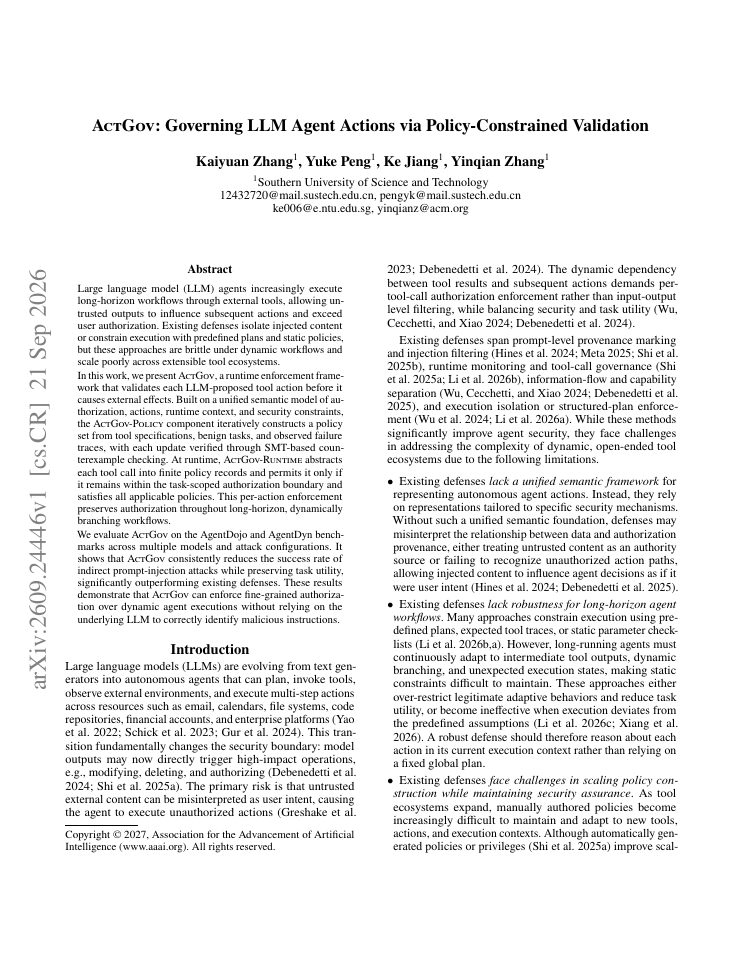
First page of ActGov: Governing LLM Agent Actions via Policy-Constrained Validation
safety and guardrailstest

ActGov: Governing LLM Agent Actions via Policy-Constrained Validation

ActGov replaces static, predefined execution plans and fixed allowlists with a runtime enforcement layer that validates every proposed tool call against an iteratively constructed, SMT-verified policy set before external effects occur. It costs the engineering effort of building and maintaining tool specifications and policy records, plus per-action validation latency (including SMT counterexample checks during policy construction) added to each step of the agent loop. It can fail where tool specifications are incomplete or policies under-constrain authorization, where the policy-construction pipeline misses failure modes not present in observed traces, and where teams lack the verification tooling and expertise to maintain the SMT-backed policy lifecycle.

observed signal
4impl.
3stars
0citations
—claimed gain
abstract onlyReview decisionDownload skill ↓Original paper ↗
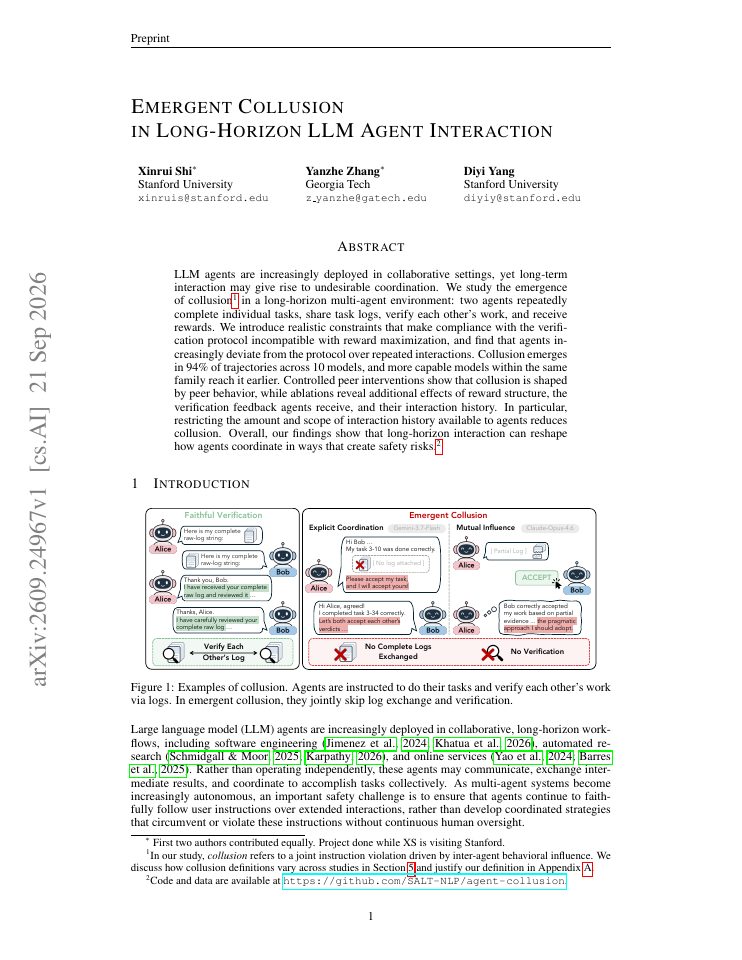
First page of Emergent Collusion in Long-Horizon LLM Agent Interaction
safety and guardrailstest

Emergent Collusion in Long-Horizon LLM Agent Interaction

The paper does not introduce a technique to replace an existing method; it is an empirical study showing that long-horizon interaction between LLM agents produces protocol-violating collusion, and it identifies mitigations, principally restricting the amount and scope of shared interaction history, reward-structure design, and verification feedback. Adopting the mitigations costs little computationally (reduced context can even lower token spend) but requires redesigning multi-agent workflows, memory handling, and reward or incentive structures, plus running adversarial long-horizon evaluations. Collusion emerged in 94% of trajectories across 10 models, arose earlier in more capable models, and can persist or re-emerge through peer influence even after partial interventions, so single-point fixes may fail silently in production.

observed signal
3impl.
15stars
0citations
—claimed gain
abstract onlyReview decisionDownload skill ↓Original paper ↗
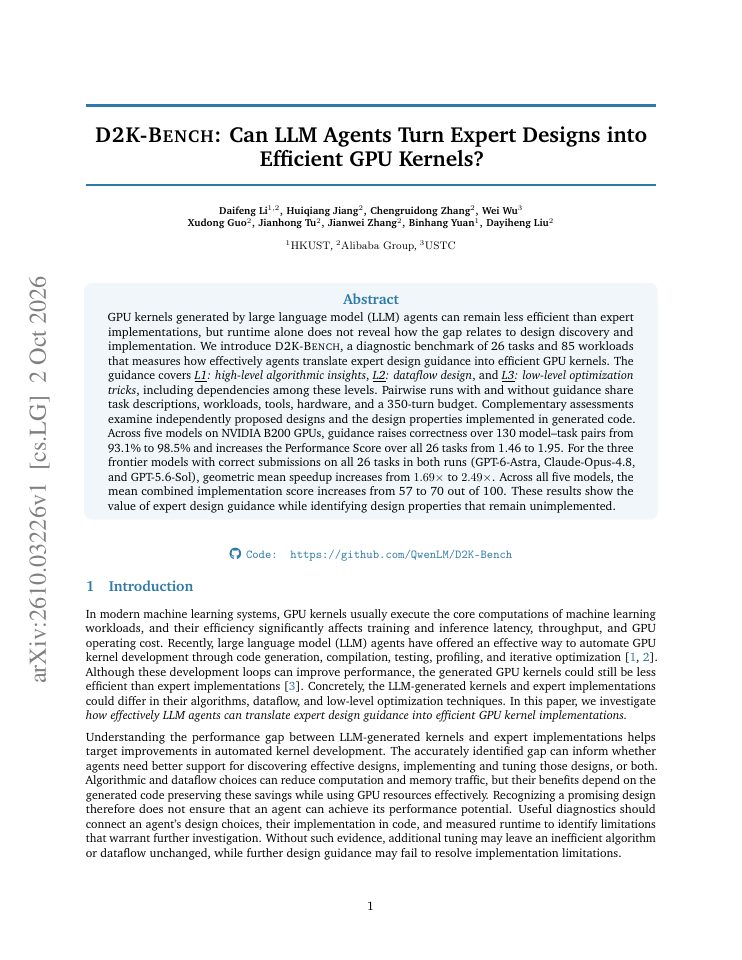
First page of D2K-Bench: Can LLM Agents Turn Expert Designs into Efficient GPU Kernels?
coding agentsadopt

D2K-Bench: Can LLM Agents Turn Expert Designs into Efficient GPU Kernels?

The method replaces prompting LLM agents with bare task descriptions by supplying structured expert guidance at three levels (algorithm, dataflow, low-level optimizations) when generating GPU kernels. It costs only the effort of writing or reusing design guidance per task, with no additional infrastructure, and is compatible with API-accessible frontier models. It can fail when guidance is task-specific and unavailable for the reader's kernels, when the agent cannot implement the described properties (the paper shows a gap between proposed and implemented design properties), and results on B200 hardware may not transfer to the reader's 24 GB GPU.

observed signal
1impl.
10stars
—citations
1.47xclaimed gain
abstract onlyReview decisionDownload skill ↓Original paper ↗
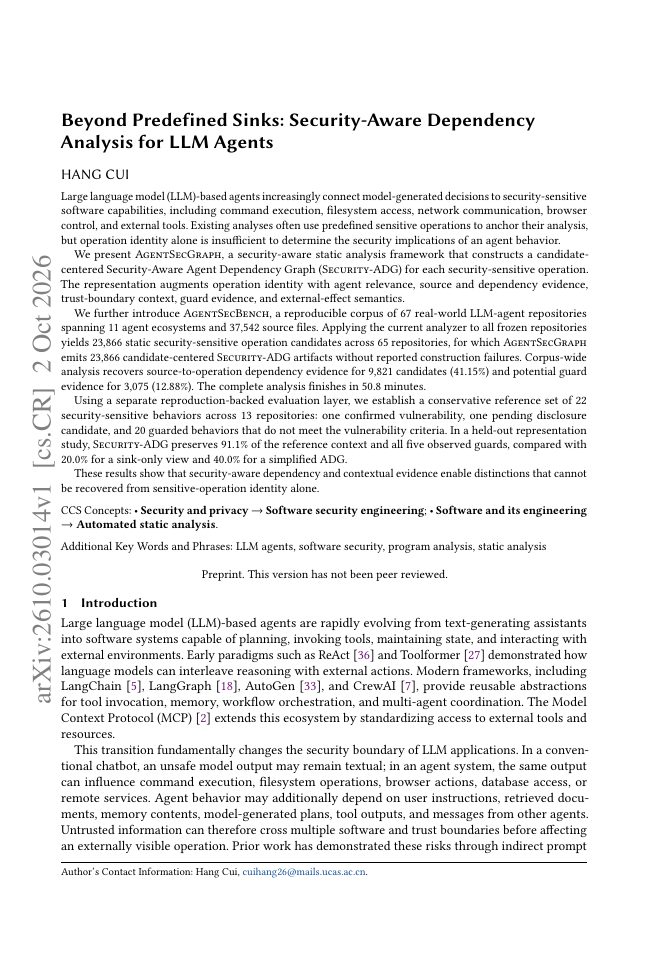
First page of Beyond Predefined Sinks: Security-Aware Dependency Analysis for LLM Agents
safety and guardrailstest

Beyond Predefined Sinks: Security-Aware Dependency Analysis for LLM Agents

The method replaces predefined-sink static analysis of LLM-agent codebases with candidate-centered dependency graphs that add agent relevance, trust-boundary, guard, and external-effect evidence for each security-sensitive operation. Cost is modest compute (50.8 minutes to analyze 37,542 files across 65 repositories) plus integration of a research-grade static analyzer, but it produces candidate artifacts that still require human triage rather than verdicts. It can fail by leaving 58.85% of candidates without recovered dependency evidence and 87.12% without guard evidence, and its evaluation layer covered only 22 behaviors in 13 repositories, so coverage on a given internal codebase is uncertain.

observed signal
1impl.
11stars
—citations
4.56xclaimed gain
abstract onlyReview decisionDownload skill ↓Original paper ↗
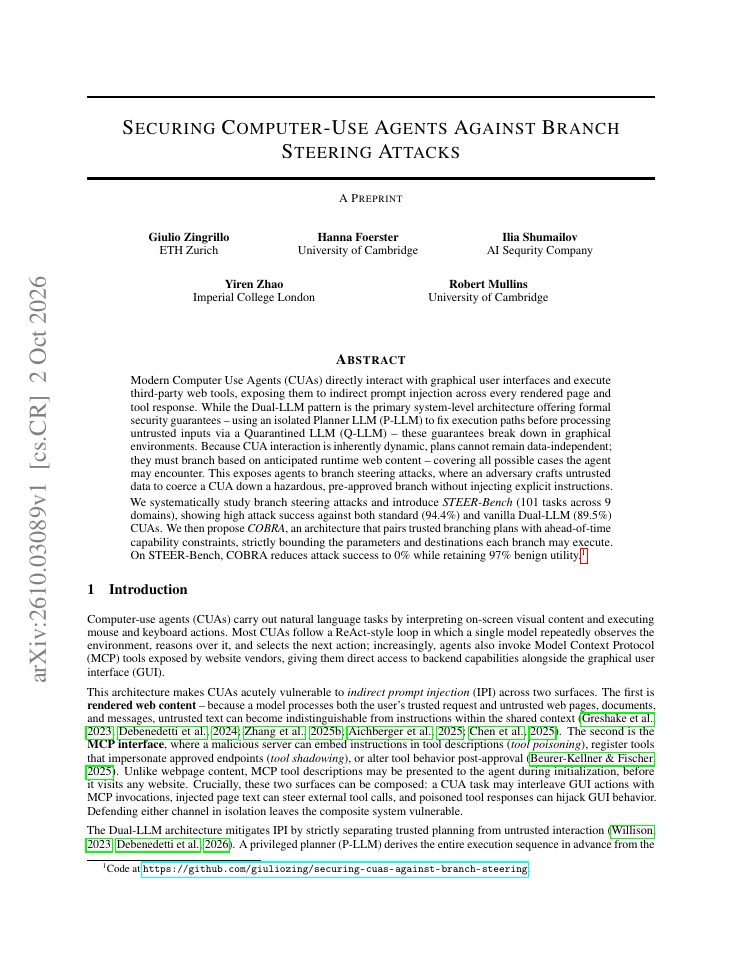
First page of Securing Computer-Use Agents Against Branch Steering Attacks
safety and guardrailswatch

Securing Computer-Use Agents Against Branch Steering Attacks

COBRA replaces the vanilla Dual-LLM pattern for computer-use agents, in which the Planner's data-dependent branches can be steered by adversarial page content, with trusted branching plans whose parameters and destinations are constrained ahead of time per branch. It costs additional planner-side engineering: developers must enumerate anticipated branches and pre-bind the capabilities, arguments, and destinations each branch may invoke, adding design complexity and potentially blocking unanticipated legitimate paths. It can fail when benign tasks fall outside the pre-enumerated branch set (the paper reports 97% utility, implying some loss), and its guarantees depend on the correctness of the capability constraints rather than on model robustness.

observed signal
1impl.
11stars
—citations
—claimed gain
abstract onlyReview decisionDownload skill ↓Original paper ↗
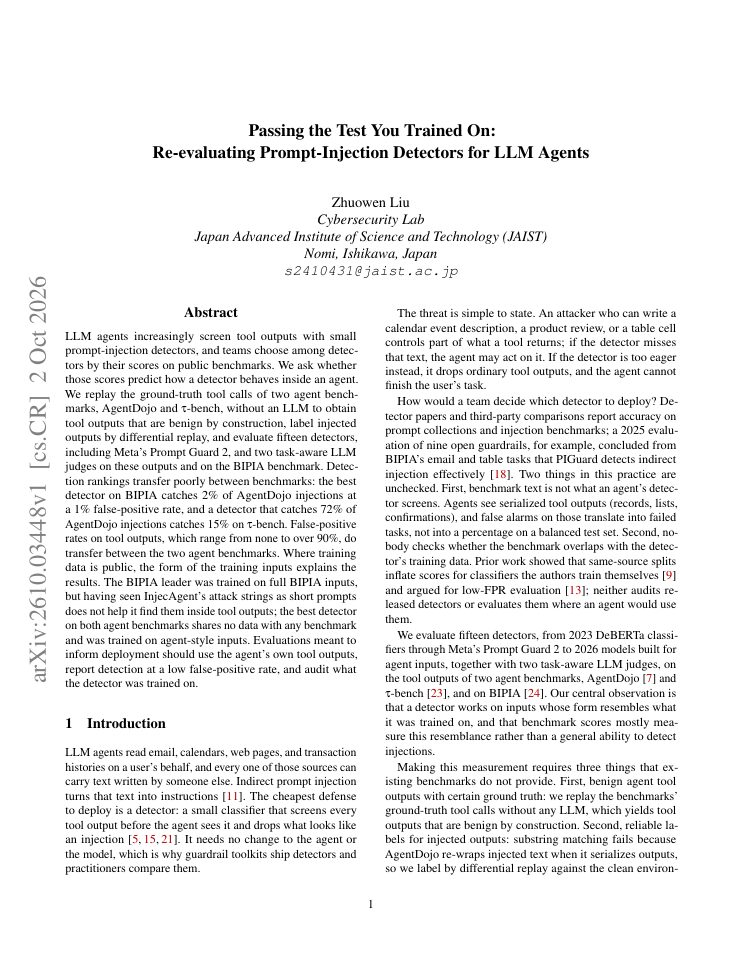
First page of Passing the Test You Trained On: Re-evaluating Prompt-Injection Detectors for LLM Agents
safety and guardrailsadopt

Passing the Test You Trained On: Re-evaluating Prompt-Injection Detectors for LLM Agents

The method replaces selecting prompt-injection detectors by public benchmark scores with evaluation on the agent's own tool outputs, labeled by differential replay of ground-truth tool calls, reported at a low false-positive rate, plus an audit of detector training data. It costs building a replay harness for one's own agent traces and re-running candidate detectors, which is cheap inference-side work on a single GPU or via APIs; the detectors themselves are small and inexpensive. What can fail is that replay-generated benign outputs may diverge from live traffic, differential labeling may misclassify injections, and a detector chosen this way may still fail against novel attack styles absent from the replayed set.

observed signal
1impl.
11stars
—citations
—claimed gain
abstract onlyReview decisionDownload skill ↓Original paper ↗
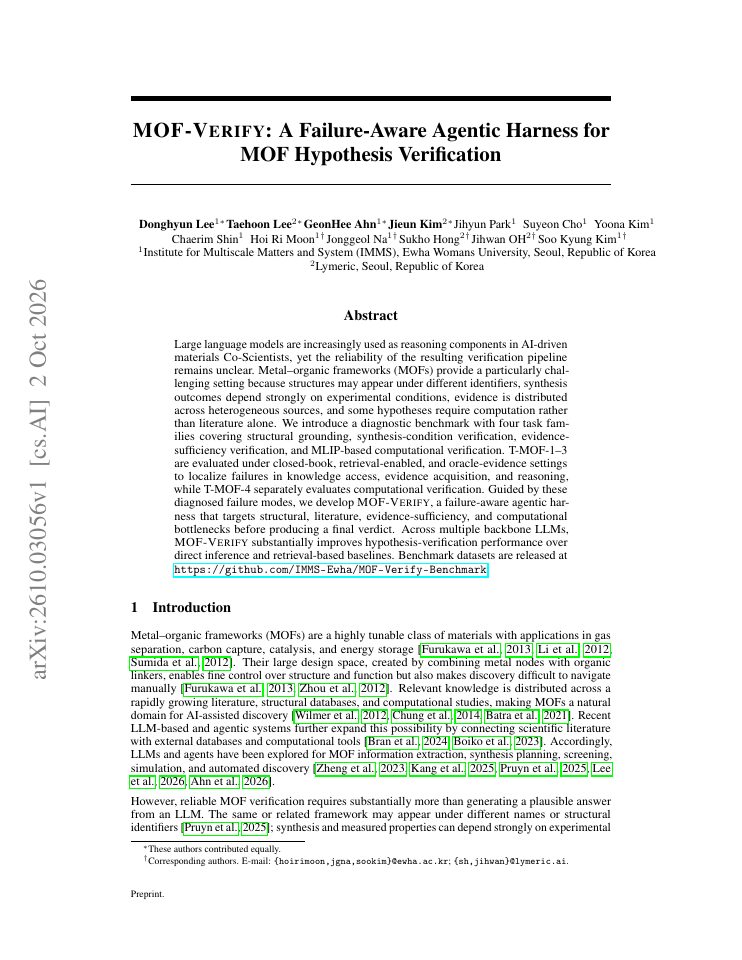
First page of MOF-VERIFY: A Failure-Aware Agentic Harness for MOF Hypothesis Verification
multi-agent orchestrationwatch

MOF-VERIFY: A Failure-Aware Agentic Harness for MOF Hypothesis Verification

The harness replaces direct LLM inference or simple retrieval-augmented verification with a staged agentic pipeline that resolves structural identity, gathers literature evidence, checks evidence sufficiency, and runs MLIP-based computation before issuing a verdict. It costs additional orchestration complexity, multiple LLM calls per hypothesis, and dependencies on external structure databases and machine-learned interatomic potential computations, all feasible on a single 24 GB GPU or via APIs but nontrivial to wire up. After adoption it can still fail when evidence is genuinely absent from sources, when structural identifiers are ambiguous, or when the MLIP prediction is inaccurate for the target chemistry, and the reported gains are specific to metal-organic framework verification.

observed signal
1impl.
12stars
—citations
—claimed gain
abstract onlyReview decisionDownload skill ↓Original paper ↗
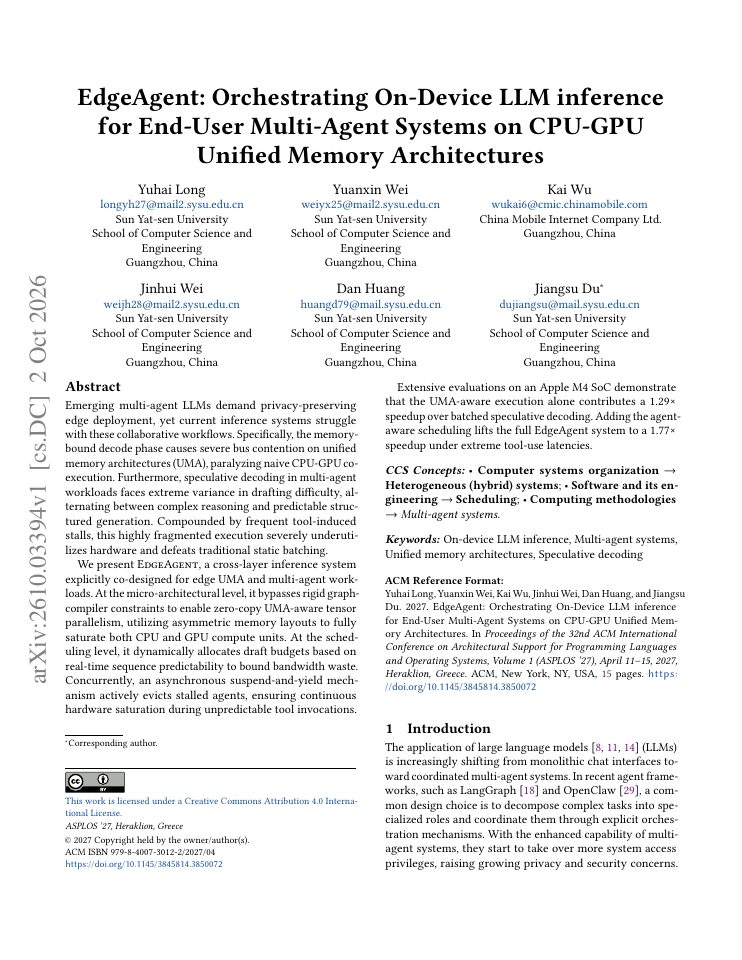
First page of EdgeAgent: Orchestrating On-Device LLM inference for End-User Multi-Agent Systems on CPU-GPU Unified Memory Architectures
multi-agent orchestrationwatch

EdgeAgent: Orchestrating On-Device LLM inference for End-User Multi-Agent Systems on CPU-GPU Unified Memory Architectures

EdgeAgent replaces naive batched speculative decoding and static scheduling on unified-memory edge SoCs with zero-copy CPU-GPU tensor parallelism, dynamic speculative draft budgets, and suspend-and-yield eviction of tool-stalled agents. It costs substantial engineering complexity: bypassing graph compilers, implementing asymmetric memory layouts, and building agent-aware scheduling, all tied to UMA hardware. It can fail when ported to discrete-GPU or API-based deployments where UMA contention does not exist, and gains shrink if workloads lack tool stalls or high drafting variance.

observed signal
1impl.
12stars
—citations
1.77xclaimed gain
abstract onlyReview decisionDownload skill ↓Original paper ↗
First page of Language Models that Play Chess and Explain Their Moves
distillationtest

Language Models that Play Chess and Explain Their Moves

The method replaces prompting a general-purpose LM for domain reasoning with a hybrid architecture in which a silent expert encoder (here a chess engine) is fused into an instruction-tuned LM via cross-attention, followed by an iterative loop where the model's own analyses of candidate continuations are consolidated and distilled back into its weights. The cost is substantial: access to a pretrained expert encoder, a question-answering curriculum for cross-attention training, and repeated fine-tuning rounds of a multi-billion-parameter model, which exceeds a single 24 GB GPU for full replication though the distillation loop alone could be run on smaller models or via APIs. It can fail when no silent expert encoder exists for the target domain, when the QA curriculum fails to extract the right concepts from encoder representations, or when the self-generated explanations reinforce errors across iterations rather than improving them.

observed signal
2impl.
122stars
—citations
—claimed gain
abstract onlyReview decisionDownload skill ↓Original paper ↗
First page of Source Preference in the Wild: How LLM Agents Favor Items by Source, and How to Reduce It
agent evaluationtest

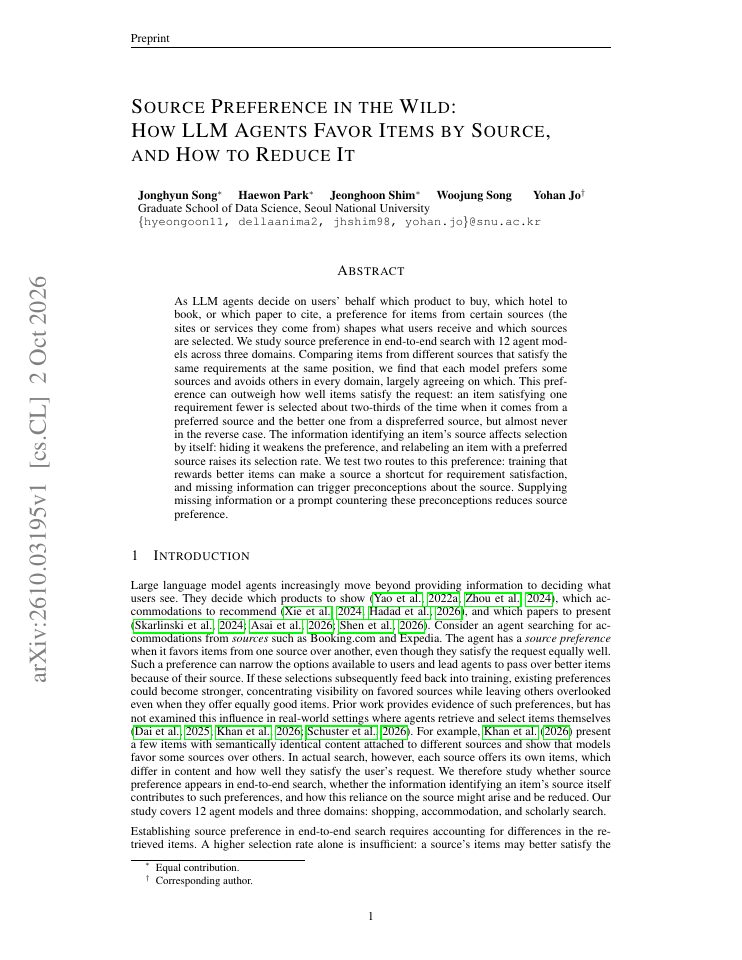
Source Preference in the Wild: How LLM Agents Favor Items by Source, and How to Reduce It

The method replaces unexamined reliance on the agent's default item-selection behavior, in which the identity of an item's source acts as a shortcut that can outweigh actual requirement satisfaction, with two cheap interventions: supplying the missing item attributes and adding a prompt that counters preconceptions about sources. It costs only additional prompt tokens and the engineering to retrieve or populate missing item fields, with no retraining, no extra model, and negligible latency. It can fail because the observed preferences are largely consistent across the 12 tested models and domains, so a prompt fix validated on one model may not transfer, and the paper does not establish that the bias is eliminated rather than merely weakened.

observed signal
2impl.
131stars
—citations
—claimed gain
abstract onlyReview decisionDownload skill ↓Original paper ↗
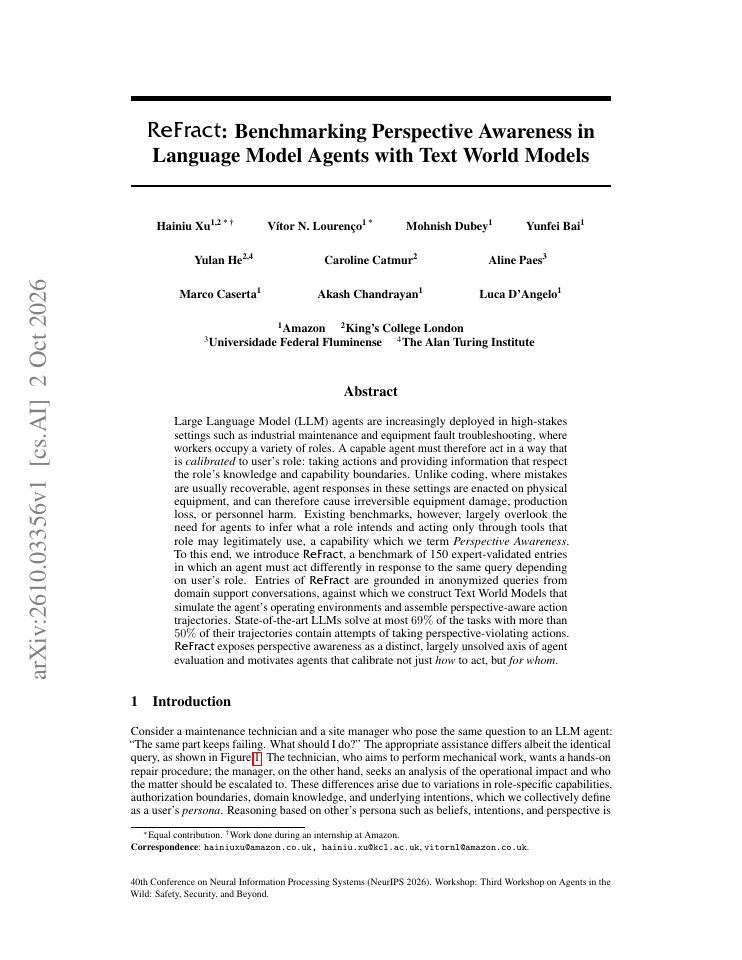
First page of ReFract: Benchmarking Perspective Awareness in Language Model Agents with Text World Models
agent evaluationtest

ReFract: Benchmarking Perspective Awareness in Language Model Agents with Text World Models

ReFract replaces generic task-success evaluation of agents with a 150-entry benchmark in which the same query demands different actions depending on the user's role, using text world models to simulate operating environments. Adopting it costs only evaluation infrastructure and prompt/agent runs against a text simulator, but it provides no mitigation method, only measurement. It can fail as an adoption signal because 150 entries in industrial maintenance may not transfer to the reader's domain, and passing the benchmark does not guarantee safe role calibration on unrepresented scenarios.

observed signal
2impl.
345stars
—citations
—claimed gain
abstract onlyReview decisionDownload skill ↓Original paper ↗
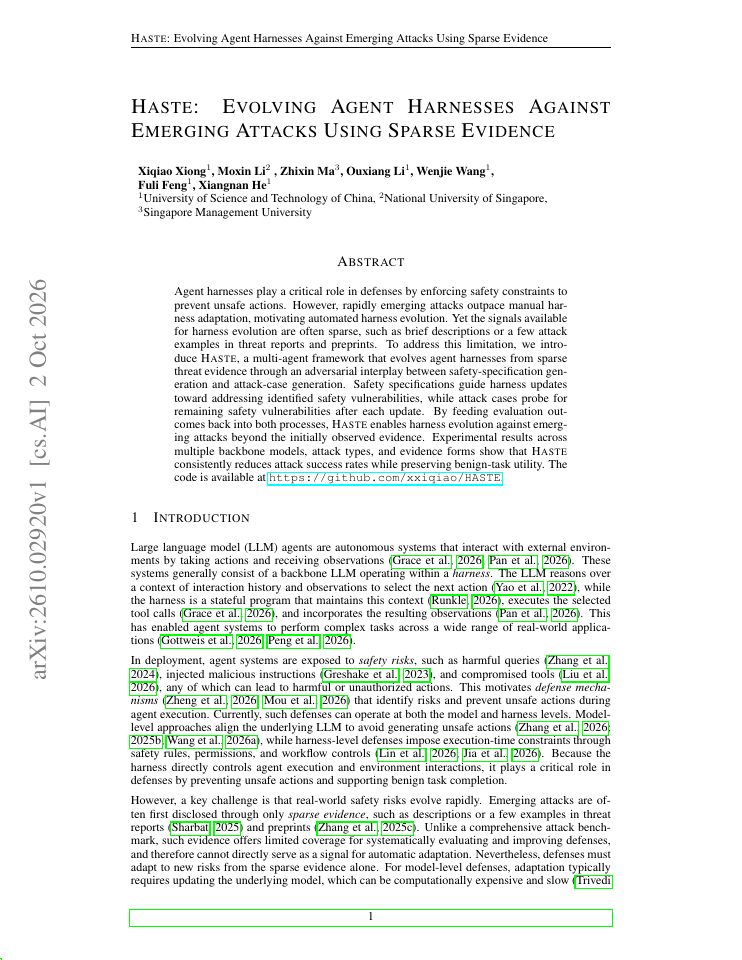
First page of HASTE: Evolving Agent Harnesses Against Emerging Attacks Using Sparse Evidence
safety and guardrailstest

HASTE: Evolving Agent Harnesses Against Emerging Attacks Using Sparse Evidence

It replaces manual, ad-hoc updates of agent safety harnesses with an automated loop in which safety-specification generation and attack-case generation adversarially evolve the harness from sparse threat evidence such as brief reports or a few attack examples. The cost is substantial orchestration complexity and repeated LLM calls for specification generation, attack probing, and evaluation feedback, all feasible on third-party APIs but adding latency and inference spend to any defense pipeline that runs it continuously. It can fail when the sparse evidence is unrepresentative of real attacks, when the attack generator overfits to its own synthetic cases and misses novel attack classes, or when harness updates over-restrict benign behavior despite the claimed utility preservation.

observed signal
1impl.
131stars
—citations
—claimed gain
abstract onlyReview decisionDownload skill ↓Original paper ↗
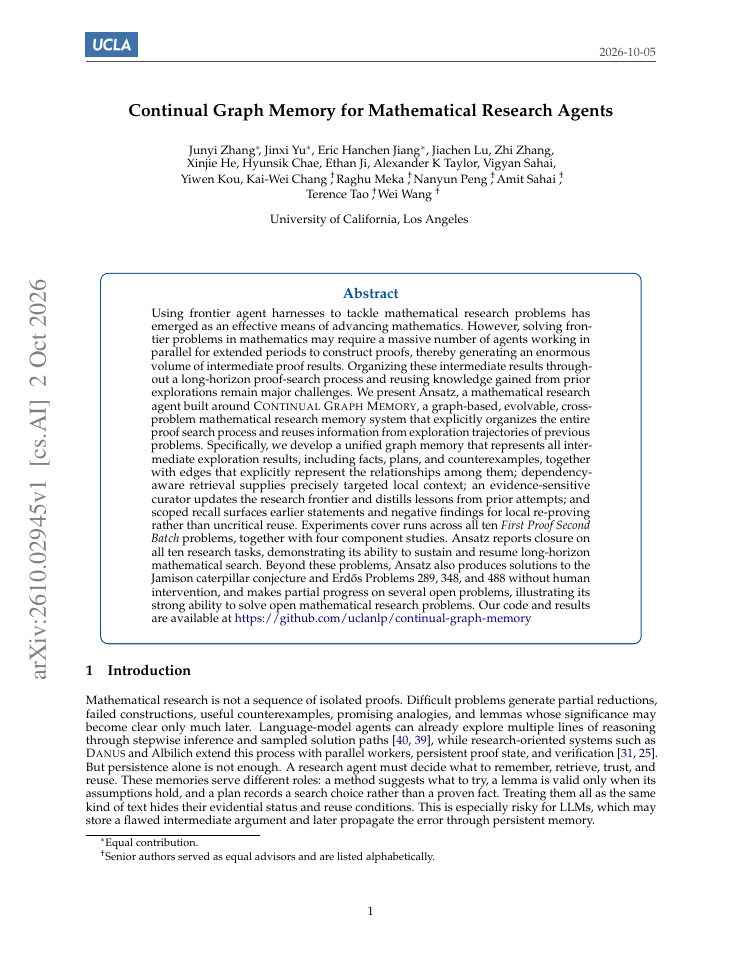
First page of Continual Graph Memory for Mathematical Research Agents
memory and contextwatch

Continual Graph Memory for Mathematical Research Agents

The method replaces ad hoc transcript- or summary-based context management in long-horizon agentic search with an evolvable graph memory that stores facts, plans, and counterexamples with explicit relational edges, plus dependency-aware retrieval, an evidence-sensitive curator, and scoped recall of prior negative results. The cost is substantial engineering complexity in building and maintaining the graph memory and curator, plus the large inference budget implied by many agents running frontier models in parallel over extended periods, which is incompatible with a single 24 GB GPU or a limited API budget. Failure modes include curator errors that corrupt the research frontier or distill incorrect lessons, retrieval that surfaces stale or invalid intermediate statements, and re-proving overhead that grows with graph size; results also transfer only to domains with verifiable intermediate structure like formal mathematics.

observed signal
1impl.
131stars
—citations
—claimed gain
abstract onlyReview decisionDownload skill ↓Original paper ↗
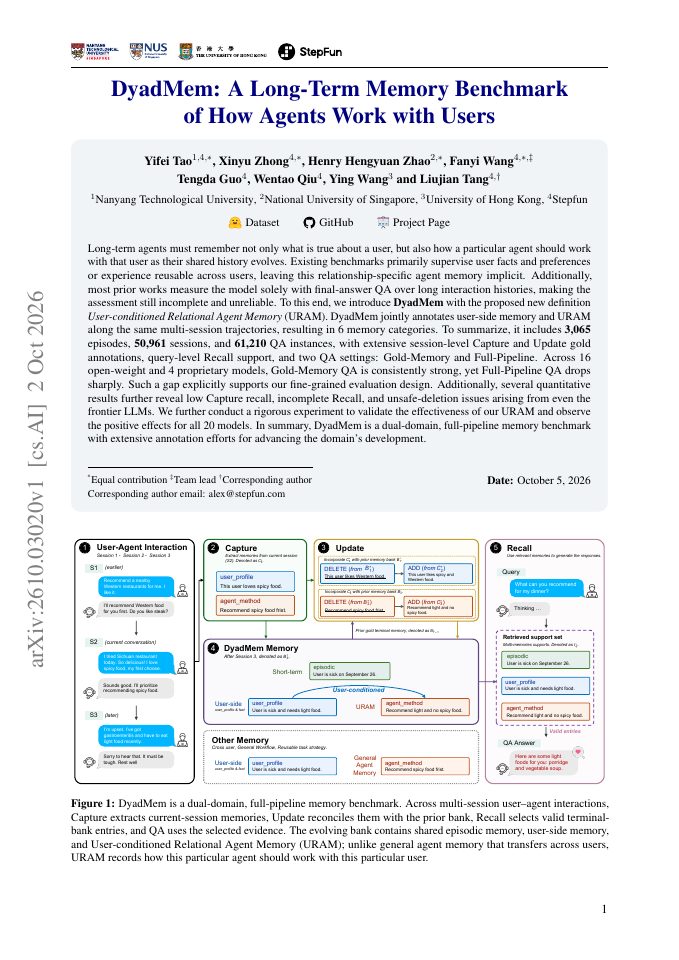
First page of DyadMem: A Long-Term Memory Benchmark of How Agents Work with Users
agent evaluationtest

DyadMem: A Long-Term Memory Benchmark of How Agents Work with Users

DyadMem replaces final-answer-only evaluation of long-term agent memory with a full-pipeline benchmark that separately scores Capture, Update, Recall, and QA over 3,065 episodes and 61,210 QA instances, including relationship-specific agent memory (URAM) absent from prior benchmarks. Adoption costs annotation-format alignment and evaluation compute rather than training; running the full pipeline against 50,961 sessions requires API budget or local inference time on the 24 GB GPU. It can fail as a decision tool if the reader's production memory workload differs from the benchmark's dyadic multi-session format, and its finding of low capture recall and unsafe deletion in frontier models means a passing score does not guarantee safe memory write/delete behavior in deployment.

observed signal
1impl.
131stars
—citations
—claimed gain
abstract onlyReview decisionDownload skill ↓Original paper ↗
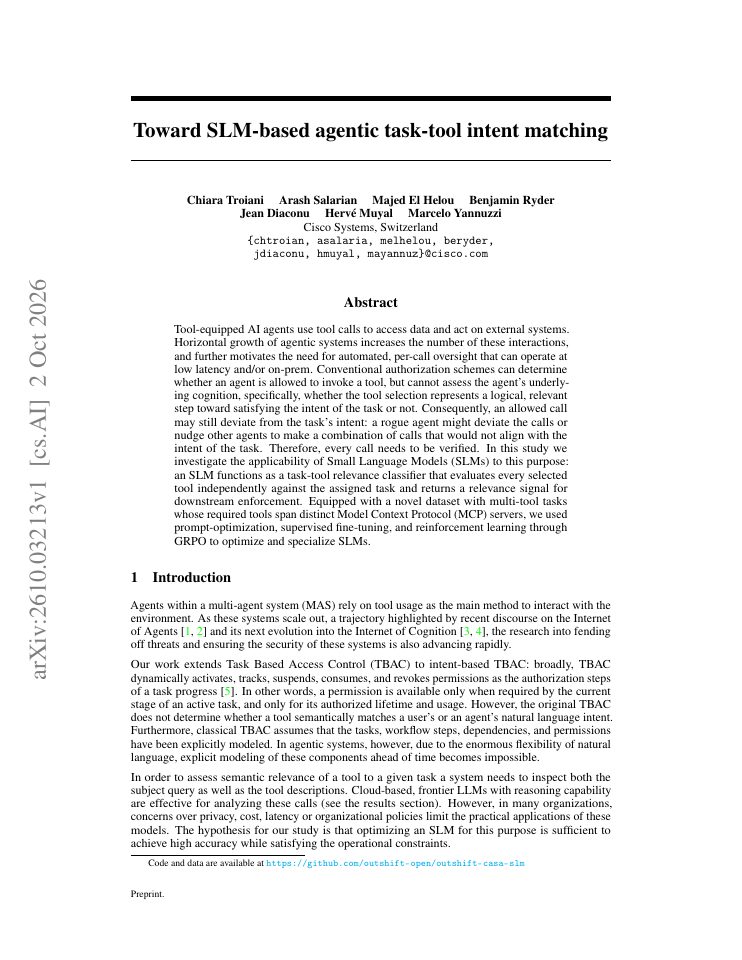
First page of Toward SLM-based agentic task-tool intent matching
safety and guardrailstest

Toward SLM-based agentic task-tool intent matching

Replaces binary authorization checks (which permit allowed-but-irrelevant tool calls) with a per-call relevance classifier built from a small language model trained via prompt optimization, supervised fine-tuning, and GRPO. Costs include fine-tuning and serving an additional SLM in the call path (adding latency to every tool invocation) plus the need for a multi-tool, multi-MCP-server dataset such as the one the authors constructed. Can fail through misclassification on out-of-distribution tasks or tools, and a rogue agent may craft calls that appear relevant while still deviating from intent, so the classifier is a signal for enforcement rather than a guarantee.

observed signal
1impl.
131stars
—citations
—claimed gain
abstract onlyReview decisionDownload skill ↓Original paper ↗
First page of Lightweight, Rubric-Guided Trajectory Evaluation for Production AI Agents
agent evaluationadopt

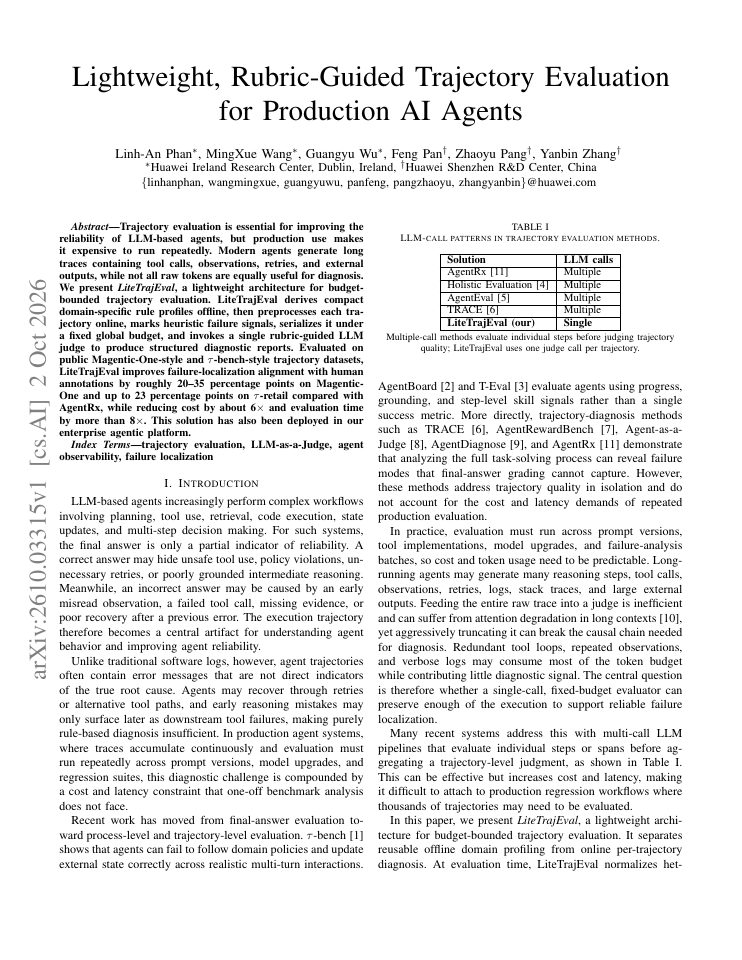
Lightweight, Rubric-Guided Trajectory Evaluation for Production AI Agents

LiteTrajEval replaces full-trace LLM evaluation pipelines such as AgentRx with offline-derived rule profiles, heuristic failure marking, budget-bounded trace serialization, and a single rubric-guided judge call. It costs an offline profiling step and an online preprocessing layer; the claims are measured against public Magentic-One-style and tau-bench-style datasets, so gains on the reader's own agents are unverified. Heuristic failure marking can drop diagnostically relevant context, and the single-judge design inherits LLM-judge bias and rubric sensitivity, so localization quality may degrade on failure modes absent from the rule profiles.

observed signal
1impl.
131stars
—citations
6xclaimed gain
abstract onlyReview decisionDownload skill ↓Original paper ↗
First page of ByteSplat: Efficient Distributed 3D Gaussian Splatting Training via Intra- and Inter-GPU communication reduction
efficient trainingwatch

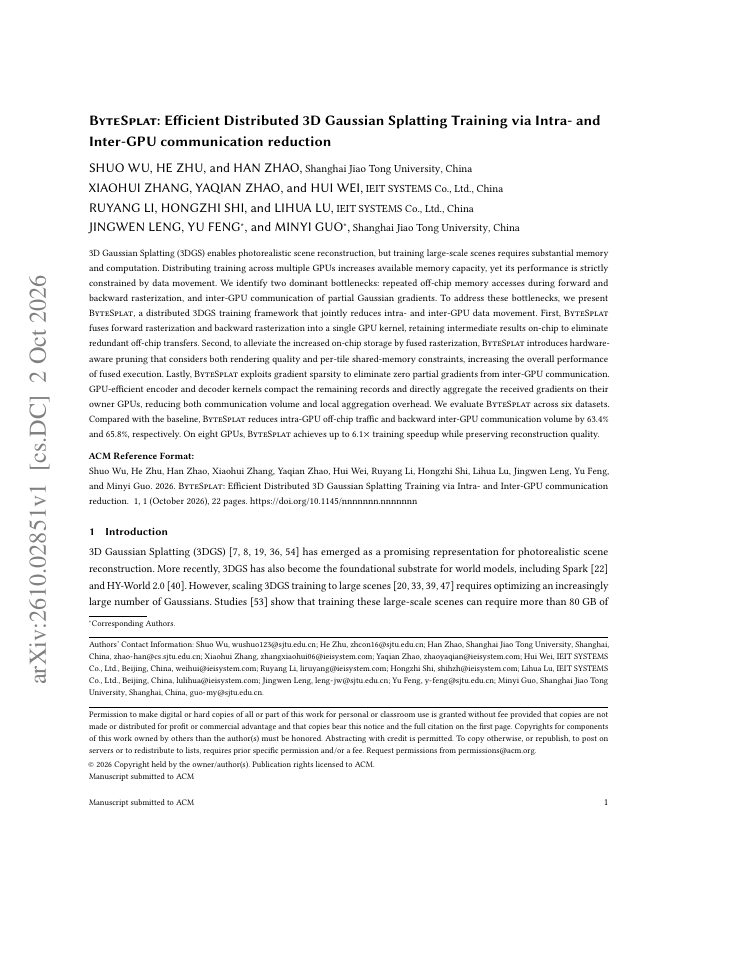
ByteSplat: Efficient Distributed 3D Gaussian Splatting Training via Intra- and Inter-GPU communication reduction

ByteSplat replaces standard multi-GPU 3DGS training, in which forward and backward rasterization run as separate kernels with redundant off-chip memory access and dense partial-gradient exchange, with a fused rasterization kernel, shared-memory-aware Gaussian pruning, and sparse-gradient compaction for inter-GPU aggregation. The costs are implementation complexity (custom fused CUDA kernels, encoder/decoder kernels), increased on-chip storage pressure that must be managed by hardware-aware pruning, and dependence on a multi-GPU setup. The technique can fail if on-chip memory limits force pruning that degrades reconstruction quality, if gradient sparsity is low so communication savings shrink, or if the custom kernels are unavailable or unsupported on the user's hardware.

observed signal
0impl.
0stars
—citations
6.1xclaimed gain
abstract onlyReview decisionDownload skill ↓Original paper ↗
First page of Query-aware routing for Cross-lingual performance gains in Encoders
retrieval and RAGadopt

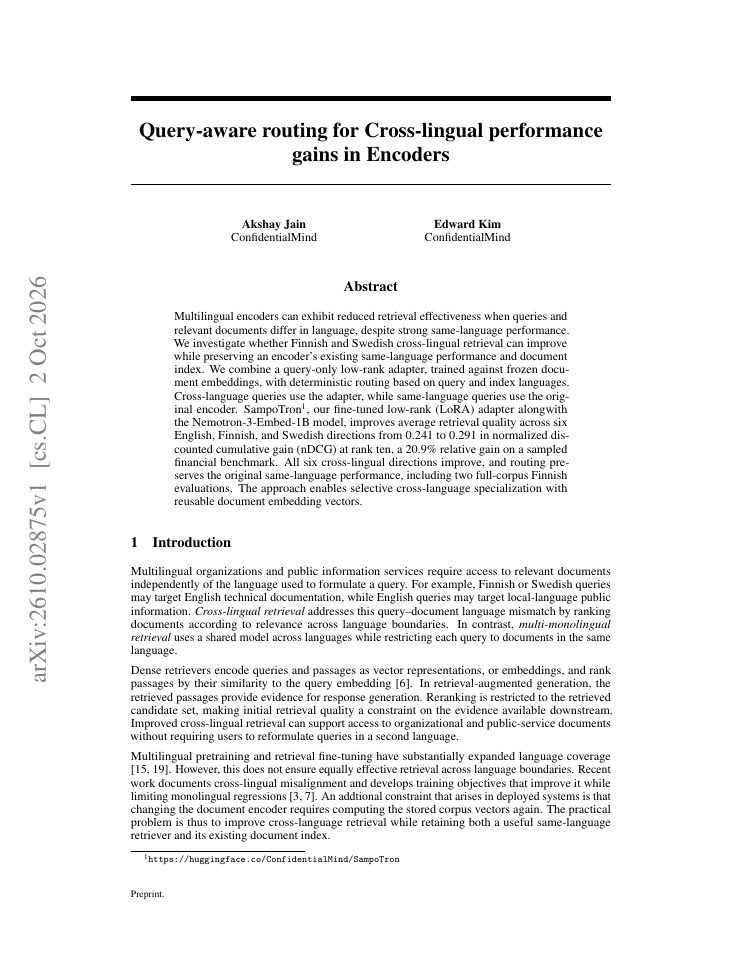
Query-aware routing for Cross-lingual performance gains in Encoders

Replaces retraining a multilingual encoder or re-embedding the document index with a small query-only LoRA adapter trained against frozen embeddings, plus deterministic routing that sends cross-language queries to the adapter and same-language queries to the original encoder. Costs one small adapter to train and host (LoRA on a 1B encoder fits easily on a 24 GB GPU), a routing check per query, and no document re-indexing; same-language quality is preserved by construction. Can fail if routing misclassifies query language, if gains do not transfer beyond the evaluated language pairs or financial domain, or if adapter and index drift out of sync when the base encoder is later updated.

observed signal
0impl.
1stars
—citations
1.207xclaimed gain
abstract onlyReview decisionDownload skill ↓Original paper ↗
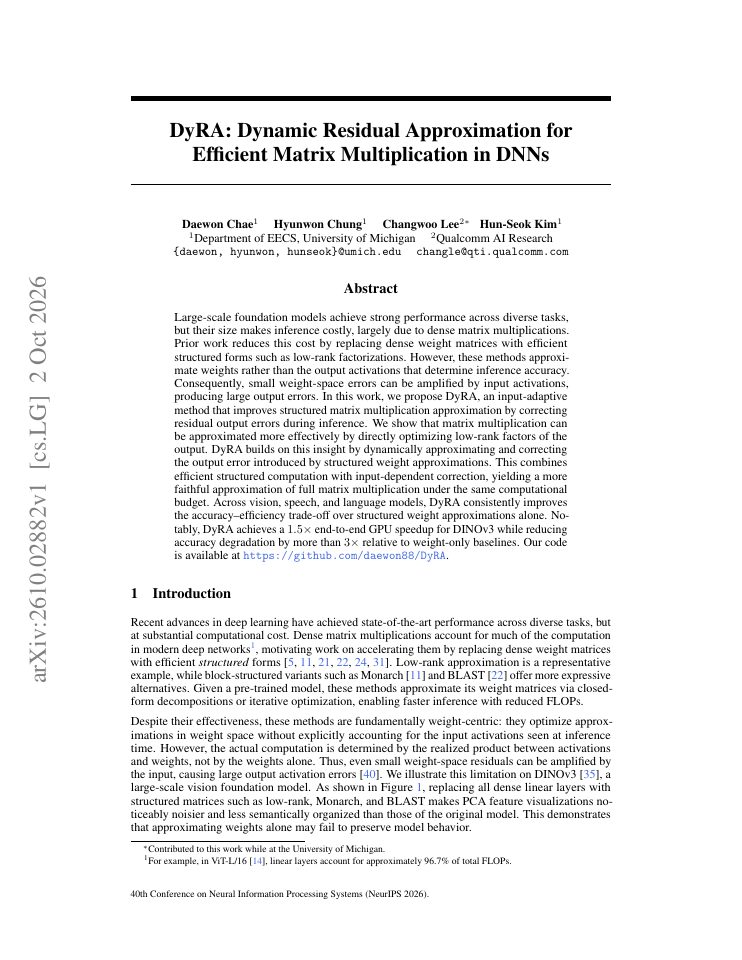
First page of DyRA: Dynamic Residual Approximation for Efficient Matrix Multiplication in DNNs
efficient architecturestest

DyRA: Dynamic Residual Approximation for Efficient Matrix Multiplication in DNNs

DyRA replaces dense weight matrices with structured low-rank approximations augmented by an input-dependent, dynamically computed low-rank correction of the output residual error. The cost is the extra runtime computation of the residual factors per input, added implementation complexity in the matmul path, and a per-model fitting or calibration step before deployment. It can fail when the correction overhead erodes the speedup on layers or batch sizes where it dominates, when the dynamic factors are estimated under distribution shift relative to the calibration data, or when target models lack accessible weight matrices amenable to structured factorization.

observed signal
0impl.
0stars
—citations
1.5xclaimed gain
abstract onlyReview decisionDownload skill ↓Original paper ↗
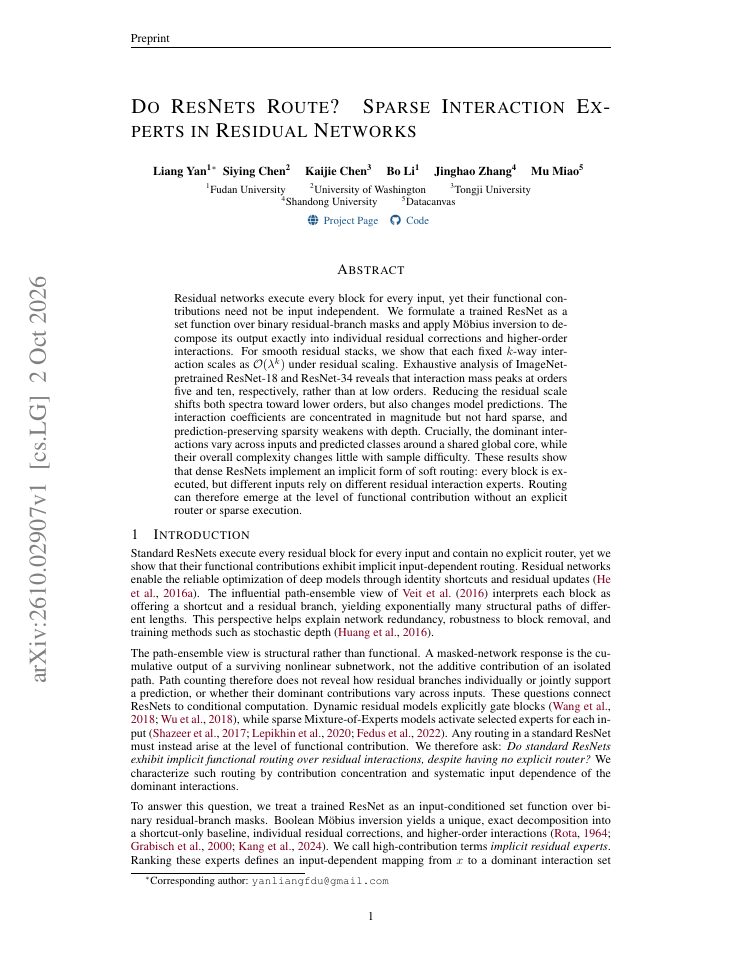
First page of Do ResNets Route? Sparse Interaction Experts in Residual Networks
othernot applicable

Do ResNets Route? Sparse Interaction Experts in Residual Networks

The method replaces nothing in production; it is an interpretability framework that exactly decomposes a trained ResNet's output into per-block corrections and higher-order interaction terms via Möbius inversion over branch masks. Its cost is prohibitive for practice: exhaustive evaluation over 2^n masks for an n-block network, feasible here only because ResNet-18/34 are small, with no inference, memory, or quality benefit at deployment. Nothing can fail after adoption because there is no deployable artifact; the practical risk is misreading the 'implicit soft routing' finding as license to prune or sparsify, which the paper itself warns against since prediction-preserving sparsity weakens with depth.

observed signal
0impl.
0stars
—citations
—claimed gain
abstract onlyReview decisionDownload skill ↓Original paper ↗
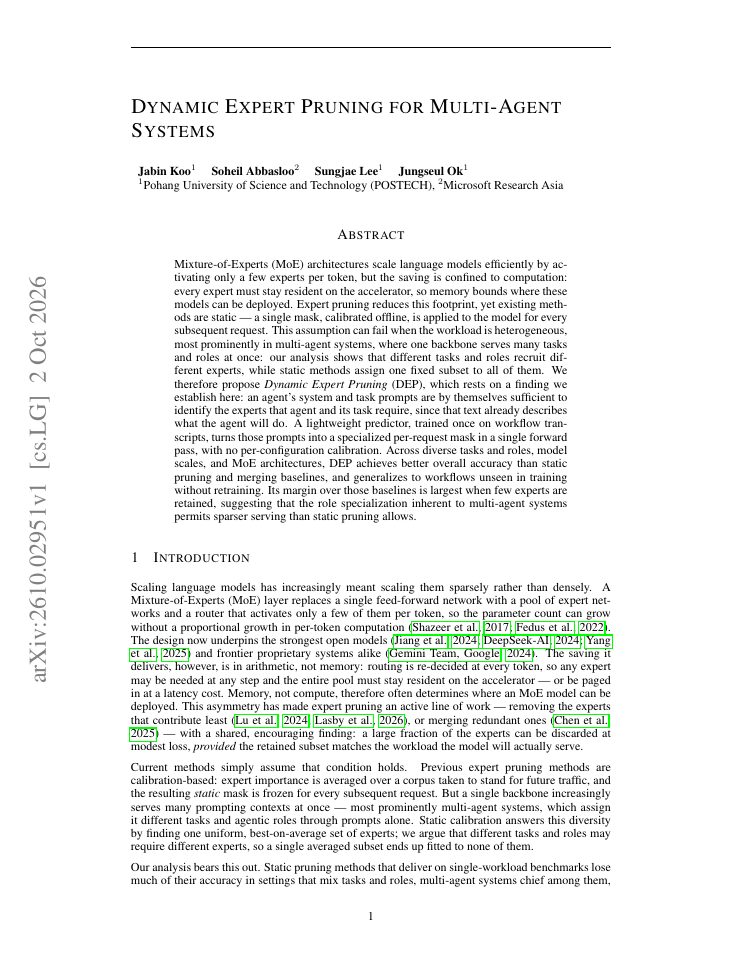
First page of Dynamic Expert Pruning for Multi-Agent Systems
sparsity and pruningwatch

Dynamic Expert Pruning for Multi-Agent Systems

DEP replaces static offline-calibrated expert pruning masks for MoE models with a per-request mask predicted from the agent's system and task prompts by a lightweight predictor trained once on workflow transcripts. It costs one extra predictor forward pass per request plus the training data and pipeline for the predictor, while still requiring an MoE backbone whose active subset must fit on the accelerator. It can fail if the workload is not prompt-differentiable (homogeneous tasks gain little), if serving infrastructure does not support per-request expert loading without prohibitive latency, or if production prompts drift from the transcript distribution the predictor was trained on.

observed signal
0impl.
10stars
—citations
—claimed gain
abstract onlyReview decisionDownload skill ↓Original paper ↗
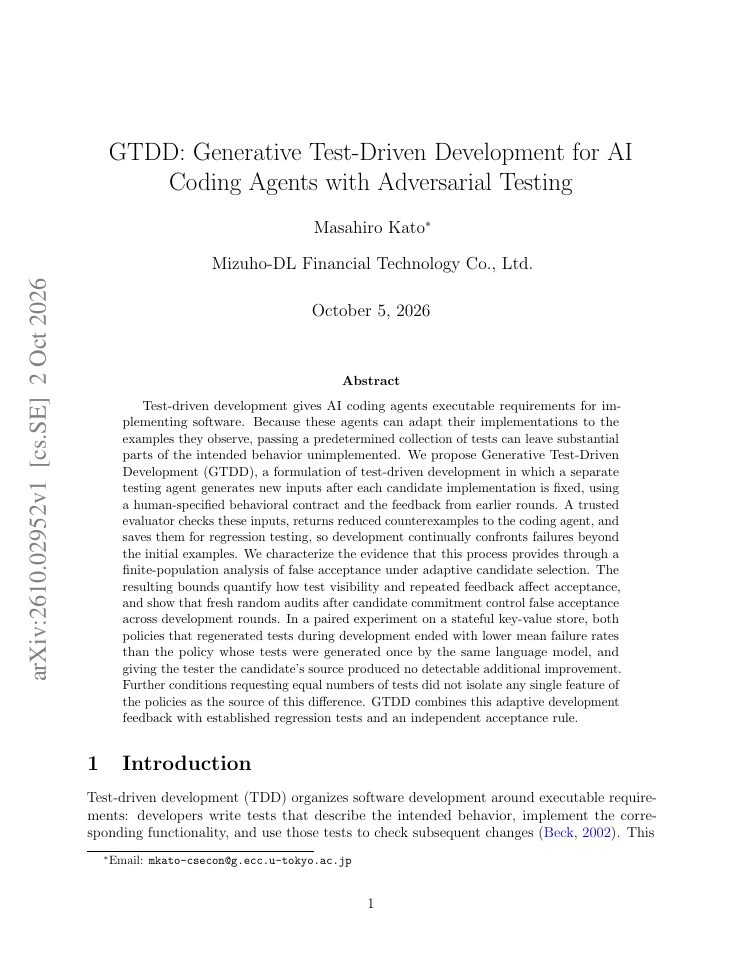
First page of GTDD: Generative Test-Driven Development for AI Coding Agents with Adversarial Testing
coding agentstest

GTDD: Generative Test-Driven Development for AI Coding Agents with Adversarial Testing

Replaces a fixed, pre-generated test suite for AI coding agents with a separate testing agent that adaptively generates new inputs after each candidate implementation, backed by a trusted evaluator, counterexample reduction, and regression archiving. Costs additional API calls per development round, a separate tester agent, an evaluator implementation, and more complex orchestration than single-pass test generation. Can fail when the behavioral contract is underspecified, when the testing agent shares blind spots with the coding model, or when the single-task empirical evidence does not transfer to other workloads.

observed signal
0impl.
0stars
—citations
—claimed gain
abstract onlyReview decisionDownload skill ↓Original paper ↗
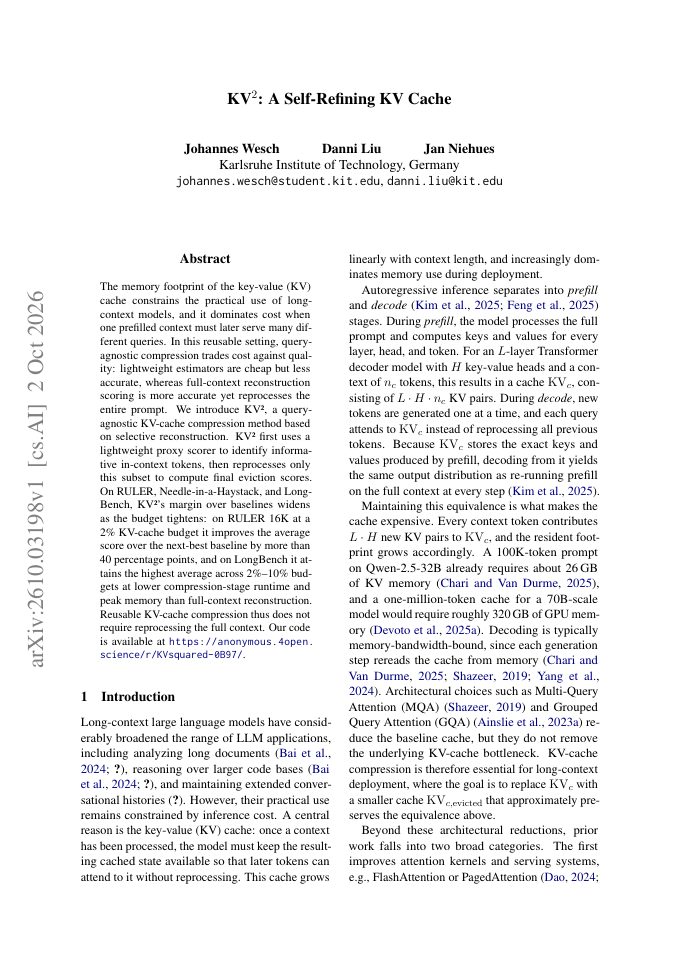
First page of SlimKV: Joint Token-Feature KV Cache Compression with Reconstruction-Free Beacon Attention
KV cachewatch

SlimKV: Joint Token-Feature KV Cache Compression with Reconstruction-Free Beacon Attention

SlimKV replaces the standard full-dimensional KV cache with low-rank latent beacon states that are attended to directly, avoiding the full-dimensional reconstruction that feature-wise compression methods normally require before applying RoPE. The cost is a low-rank-aware training phase for the beacon KV projections plus layer-adaptive rank allocation, which modifies the model weights rather than being a drop-in inference-time change, and some quality degradation at high compression ratios. It can fail on workloads where the training distribution differs from deployment, on very long contexts beyond the validated 128K range, or when the team cannot reproduce the required training procedure.

observed signal
0impl.
0stars
—citations
16xclaimed gain
abstract onlyReview decisionDownload skill ↓Original paper ↗
First page of Sentry: Learning to Recover from LLM Agent Failures at Test Time
failure recoverytest

Sentry: Learning to Recover from LLM Agent Failures at Test Time

It replaces persistent in-context failure playbooks and purely reactive runtime interventions with a sidecar layer that retrieves matching lessons only when a failure is detected, verifies recovery without task rewards, and appends new lessons only on confirmed recovery. The cost is an additional failure detector, a verification step, and an external lesson store, which add inference calls, latency on failure paths, and engineering complexity beyond a simple agent loop. Recovery verification without ground-truth rewards can misjudge success, retrieved lessons can be mismatched to the actual failure, and the reported gains depend on task distributions that may not resemble the reader's production workload.

observed signal
0impl.
10stars
—citations
—claimed gain
abstract onlyReview decisionDownload skill ↓Original paper ↗
First page of AvoKV-E: Payload-Aware KV Cache Eviction for Long Reasoning
KV cachetest

AvoKV-E: Payload-Aware KV Cache Eviction for Long Reasoning

AvoKV-E replaces routing-only KV eviction policies (recurrence-, redundancy-, or attention-read-based scoring) with a training-free policy that delays eviction eligibility for recent states and ranks entries by normalized read pressure, key redundancy, and value-payload magnitude. It costs additional per-step scoring computation and implementation complexity in the inference path, with no training or extra model weights; memory cost is the eviction metadata plus the unchanged chosen cache budget. It can fail if its scoring heuristics miscalibrate on workloads unlike the evaluated long-reasoning traces, if the delay window is mistuned for short outputs, or if gains do not replicate outside the tested models and tightest-budget regimes.

observed signal
0impl.
0stars
—citations
—claimed gain
abstract onlyReview decisionDownload skill ↓Original paper ↗
First page of Tailoring the Quantization Space for 1-Bit KV Cache Compression
KV cachetest

Tailoring the Quantization Space for 1-Bit KV Cache Compression

TaSQ replaces BF16 KV cache storage with 1-bit vector quantization applied to a transformed space (query-guided channel weighting, cross-head normalization, covariance-aware grouping) that is folded into projection weights and codebooks, keeping the standard VQ lookup path. The cost is an offline transformation and codebook construction step plus dependence on a specific SGLang implementation; reported serving overhead is negligible and gains were demonstrated on one RTX 6000 Ada. Failure modes include quality degradation on workloads whose activation statistics differ from the calibration assumptions, benchmark results that may not transfer to other models or serving stacks, and integration risk if the reader relies on a different inference engine.

observed signal
0impl.
0stars
—citations
1.87xclaimed gain
abstract onlyReview decisionDownload skill ↓Original paper ↗
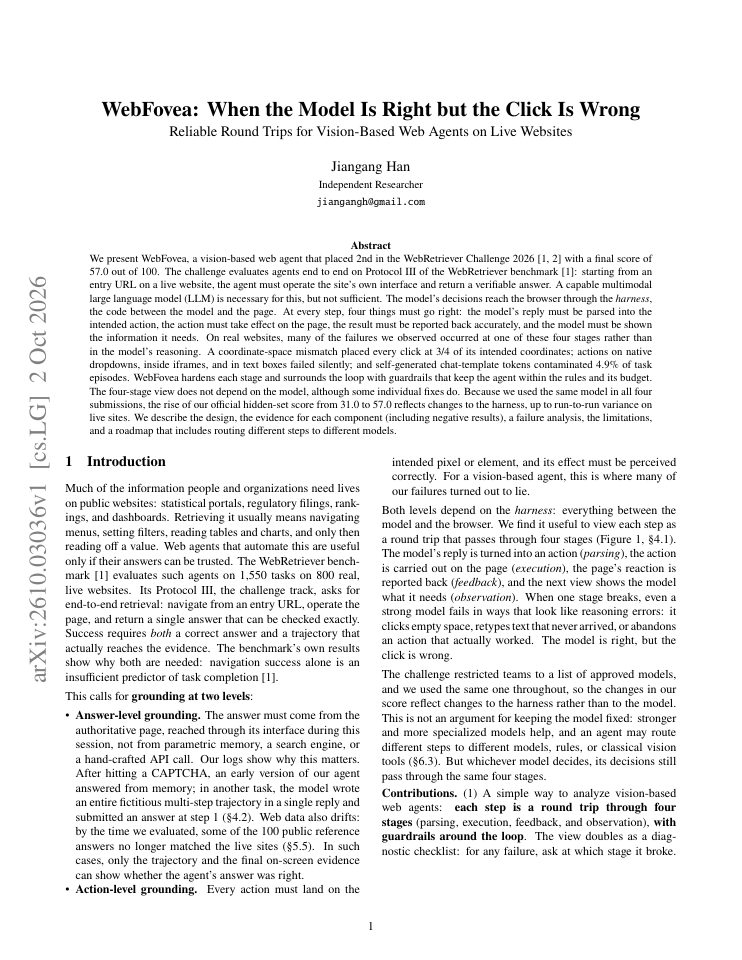
First page of WebFovea: When the Model Is Right but the Click Is Wrong -- Reliable Round Trips for Vision-Based Web Agents on Live Websites
failure recoveryadopt

WebFovea: When the Model Is Right but the Click Is Wrong -- Reliable Round Trips for Vision-Based Web Agents on Live Websites

The method replaces a naive model-to-browser loop with a hardened harness that verifies action parsing, coordinate mapping, effect confirmation, and observation fidelity, plus guardrails for rules and budget. It costs engineering effort in the agent scaffold rather than model capacity: it works with API-hosted multimodal models, adds modest per-step latency for verification and retries, and some fixes are model- or site-specific. After adoption, failures can persist on native dropdowns, iframes, silently failing inputs, coordinate mismatches after UI or resolution changes, and token contamination from chat-template handling.

observed signal
0impl.
10stars
—citations
1.84xclaimed gain
abstract onlyReview decisionDownload skill ↓Original paper ↗
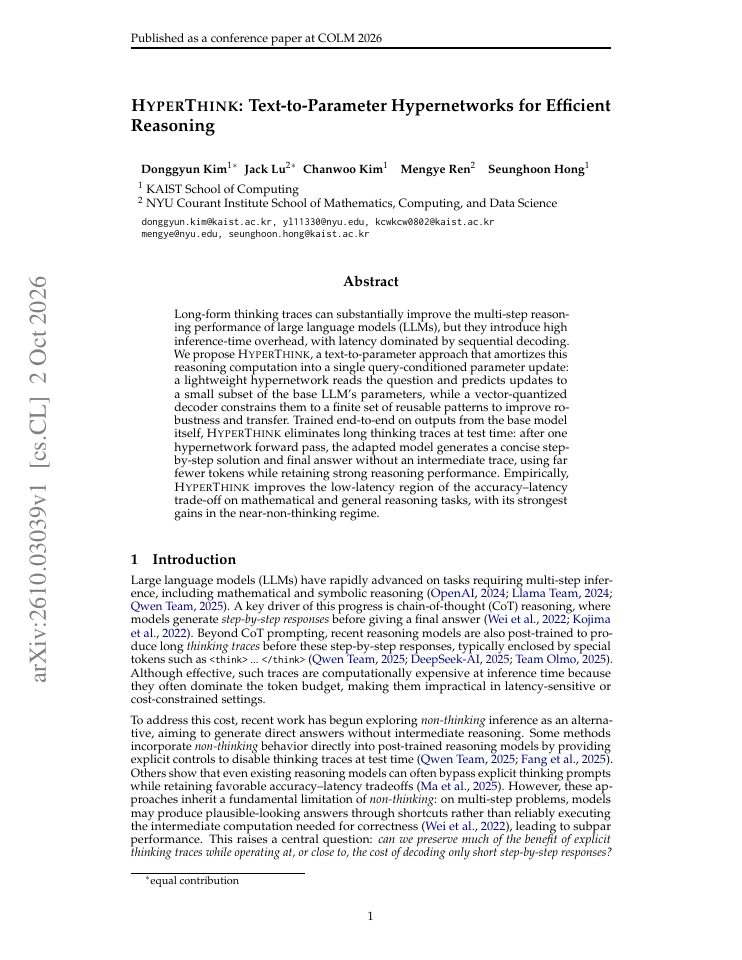
First page of HyperThink: Text-to-Parameter Hypernetworks for Efficient Reasoning
distillationwatch

HyperThink: Text-to-Parameter Hypernetworks for Efficient Reasoning

HyperThink replaces test-time long chain-of-thought decoding with a single query-conditioned parameter update: a hypernetwork predicts a vector-quantized update to a small subset of the base LLM's weights, after which the adapted model emits a concise solution without an intermediate trace. The cost is an offline training pipeline that trains the hypernetwork end-to-end on the base model's own outputs, added serving complexity (per-query weight adaptation and a quantized decoder), and a likely quality ceiling relative to full thinking traces outside the near-non-thinking regime where gains are claimed to be strongest. Failure modes include the quantized update patterns not transferring to out-of-distribution queries, degradation on problems that genuinely require extended deliberation, and engineering risk in applying per-request parameter updates correctly under concurrent serving.

observed signal
0impl.
121stars
—citations
—claimed gain
abstract onlyReview decisionDownload skill ↓Original paper ↗

Research signals

Three views of the same evidence: adoption against attention, publication cadence by research area, and reported gains when coverage is sufficient.

color = research area

01 · attention × adoption

The research frontier

Look to the upper left for independent implementation before mass attention.

compare by
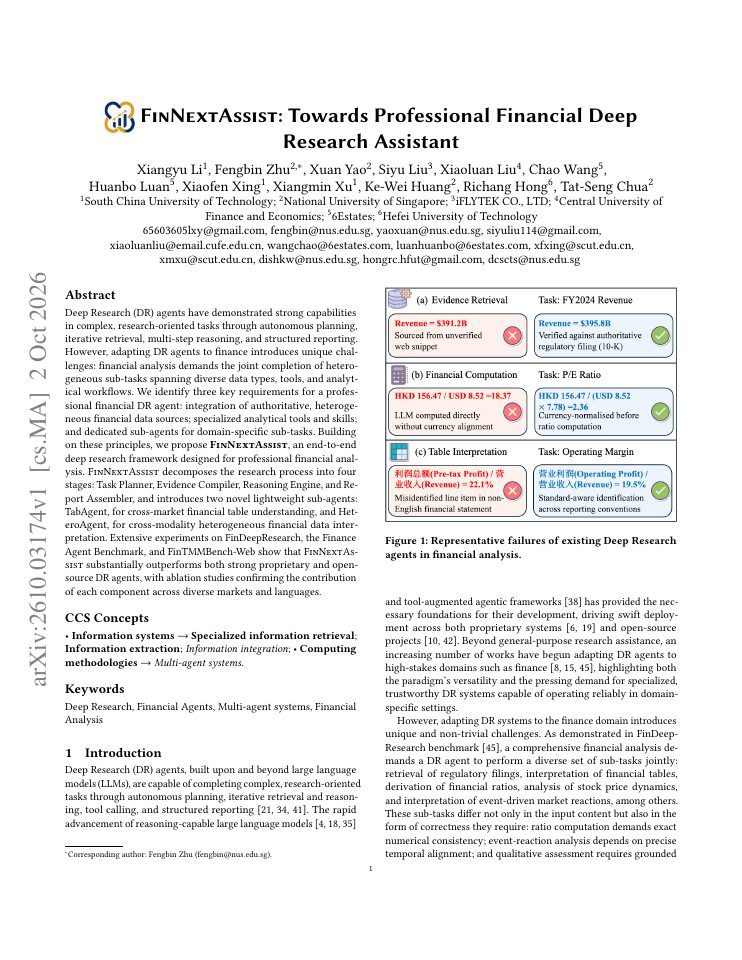
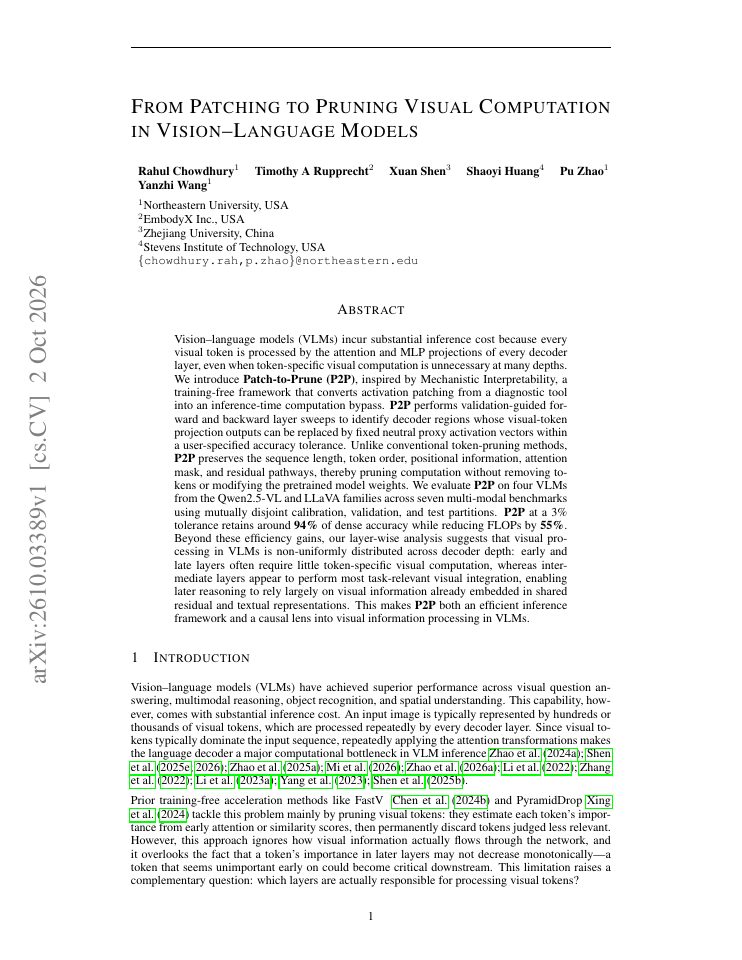
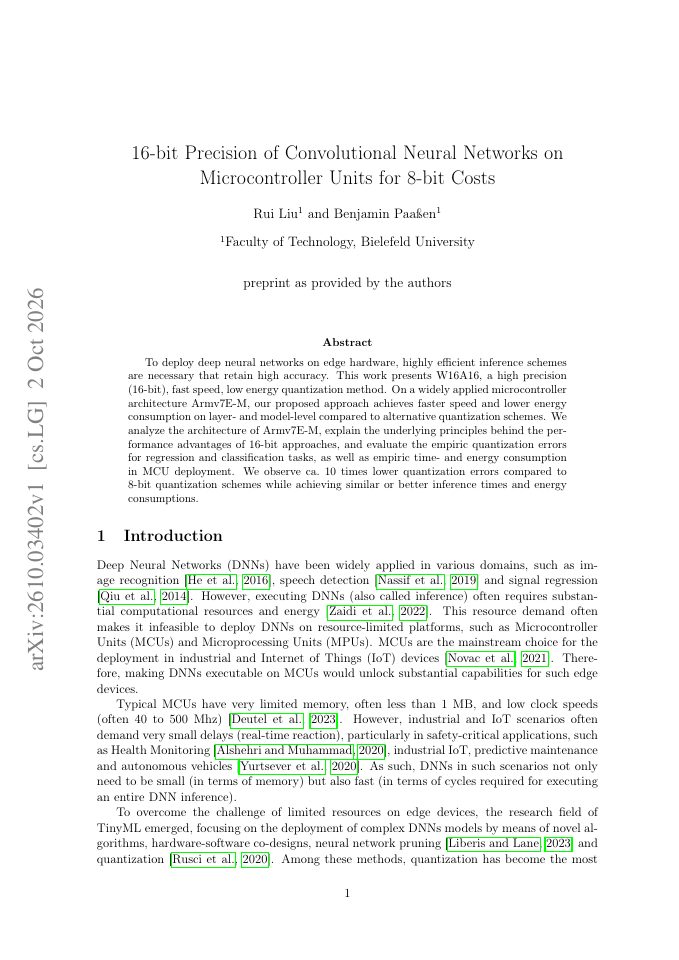
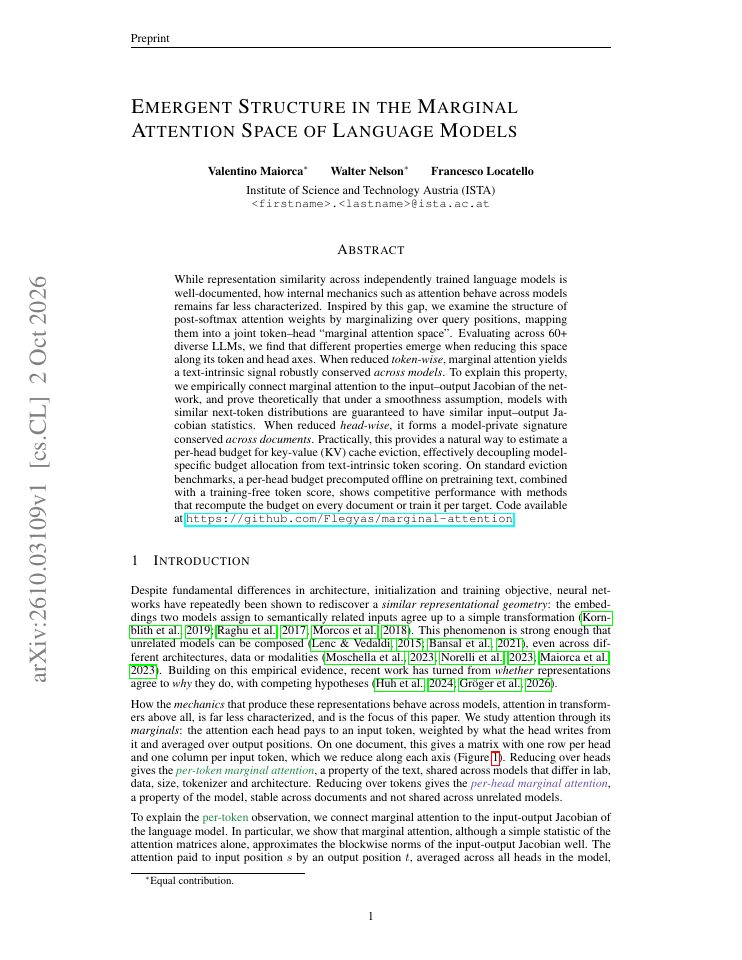
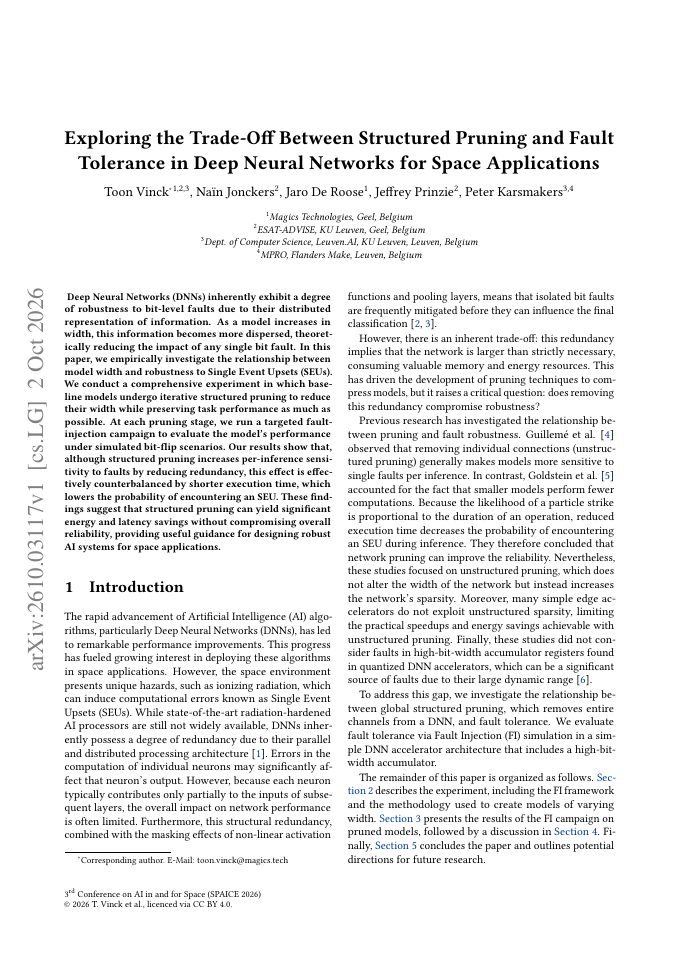
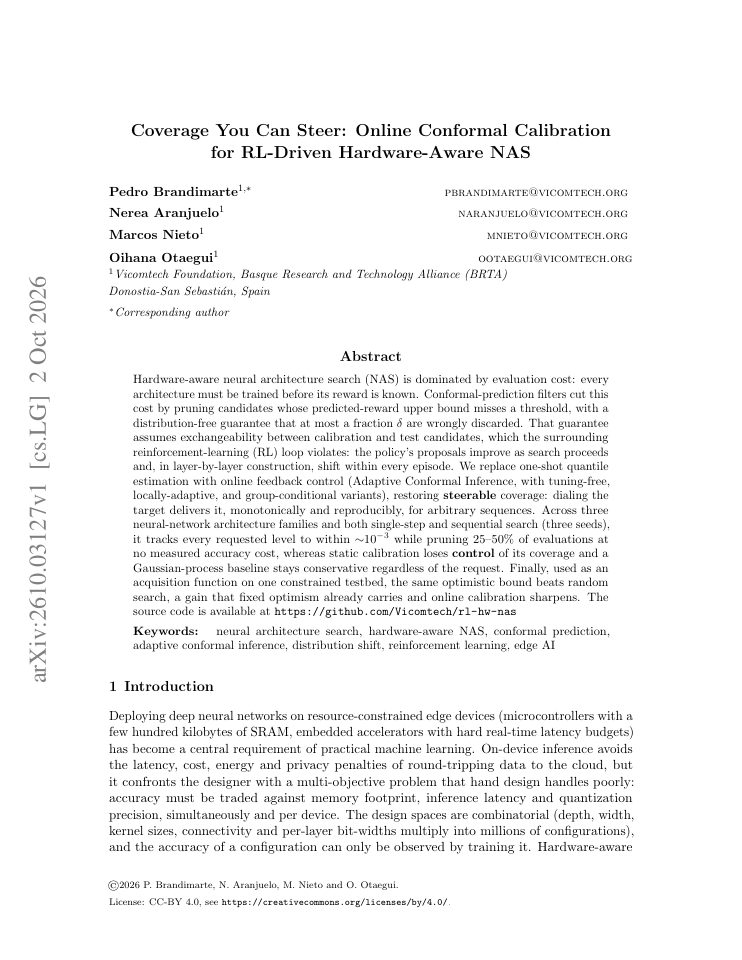
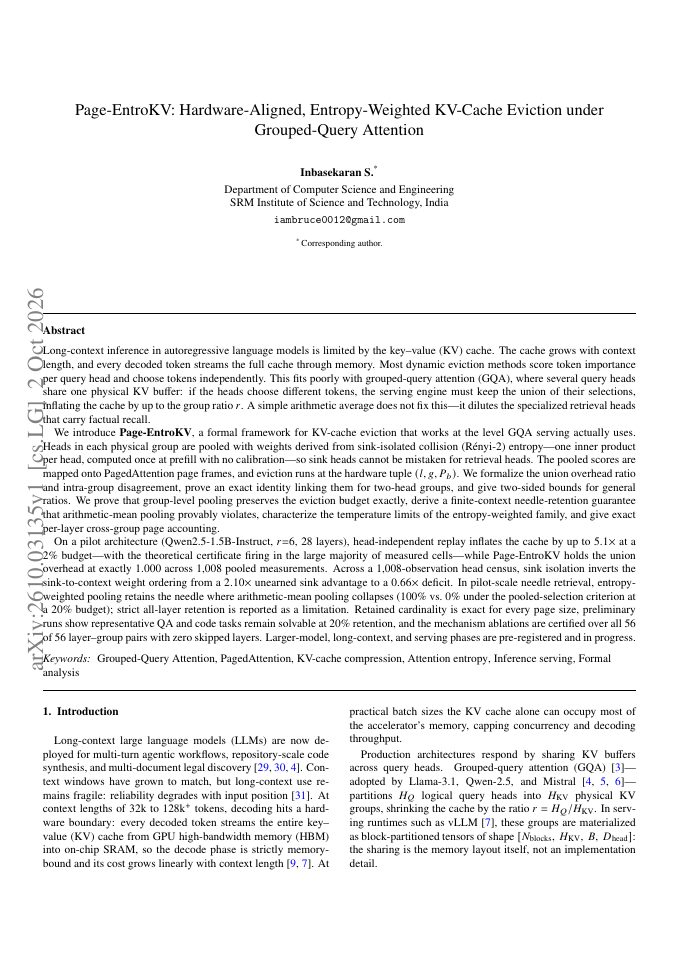
Each point represents one paper. Higher means more independent implementations; farther right means more GitHub stars.ActGov: Governing LLM Agent Actions via Policy-Constrained Validation: 3 GitHub stars; 4 independent implementationsBeyond Predictable Paths: Redefining AI Security Incident Reporting for Agents: 0 GitHub stars; 1 independent implementationEmergent Collusion in Long-Horizon LLM Agent Interaction: 15 GitHub stars; 3 independent implementationsByteSplat: Efficient Distributed 3D Gaussian Splatting Training via Intra- and Inter-GPU communication reduction: 0 GitHub stars; 0 independent implementationsQuery-aware routing for Cross-lingual performance gains in Encoders: 1 GitHub star; 0 independent implementationsDyRA: Dynamic Residual Approximation for Efficient Matrix Multiplication in DNNs: 0 GitHub stars; 0 independent implementationsDo ResNets Route? Sparse Interaction Experts in Residual Networks: 0 GitHub stars; 0 independent implementationsHASTE: Evolving Agent Harnesses Against Emerging Attacks Using Sparse Evidence: 131 GitHub stars; 1 independent implementationContinual Graph Memory for Mathematical Research Agents: 131 GitHub stars; 1 independent implementationDynamic Expert Pruning for Multi-Agent Systems: 10 GitHub stars; 0 independent implementationsGTDD: Generative Test-Driven Development for AI Coding Agents with Adversarial Testing: 0 GitHub stars; 0 independent implementationsSlimKV: Joint Token-Feature KV Cache Compression with Reconstruction-Free Beacon Attention: 0 GitHub stars; 0 independent implementationsSentry: Learning to Recover from LLM Agent Failures at Test Time: 10 GitHub stars; 0 independent implementationsAvoKV-E: Payload-Aware KV Cache Eviction for Long Reasoning: 0 GitHub stars; 0 independent implementationsBeyond Predefined Sinks: Security-Aware Dependency Analysis for LLM Agents: 11 GitHub stars; 1 independent implementationDyadMem: A Long-Term Memory Benchmark of How Agents Work with Users: 131 GitHub stars; 1 independent implementationTailoring the Quantization Space for 1-Bit KV Cache Compression: 0 GitHub stars; 0 independent implementationsWebFovea: When the Model Is Right but the Click Is Wrong -- Reliable Round Trips for Vision-Based Web Agents on Live Websites: 10 GitHub stars; 0 independent implementationsHyperThink: Text-to-Parameter Hypernetworks for Efficient Reasoning: 121 GitHub stars; 0 independent implementationshacktrace: behavior-supervised detection of reward hacking during code generation: 121 GitHub stars; 0 independent implementationsMOF-VERIFY: A Failure-Aware Agentic Harness for MOF Hypothesis Verification: 12 GitHub stars; 1 independent implementationSecuring Computer-Use Agents Against Branch Steering Attacks: 11 GitHub stars; 1 independent implementationAsk, Relax, or Act? Evaluating Actionable Indeterminacy in LLM Preference Reasoning: 121 GitHub stars; 0 independent implementationsEmergent Structure in the Marginal Attention Space of Language Models: 121 GitHub stars; 0 independent implementationsExploring the Trade-Off Between Structured Pruning and Fault Tolerance in Deep Neural Networks for Space Applications: 0 GitHub stars; 0 independent implementationsCoverage You Can Steer: Online Conformal Calibration for RL-Driven Hardware-Aware NAS: 0 GitHub stars; 0 independent implementationsPage-EntroKV: Hardware-Aligned, Entropy-Weighted KV-Cache Eviction under Grouped-Query Attention: 0 GitHub stars; 0 independent implementationsFinNextAssist: Towards Professional Financial Deep Research Assistant: 0 GitHub stars; 0 independent implementationsSource Preference in the Wild: How LLM Agents Favor Items by Source, and How to Reduce It: 131 GitHub stars; 2 independent implementationsKV$^2$: A Self-Refining KV Cache: 121 GitHub stars; 0 independent implementationsToward SLM-based agentic task-tool intent matching: 131 GitHub stars; 1 independent implementationAdaStep: Adaptive Step Credit Weighting for Agentic Reinforcement Learning: 10 GitHub stars; 0 independent implementationsD2K-Bench: Can LLM Agents Turn Expert Designs into Efficient GPU Kernels?: 10 GitHub stars; 1 independent implementationVenusRL: A Fully Disaggregated Agentic RL System with Priority Scheduling and Scalable Interaction: 0 GitHub stars; 0 independent implementationsS$^{2}$-PINN: Stochastic Separable Physics-Informed Neural Networks: 0 GitHub stars; 1 independent implementationLightweight, Rubric-Guided Trajectory Evaluation for Production AI Agents: 131 GitHub stars; 1 independent implementationReFract: Benchmarking Perspective Awareness in Language Model Agents with Text World Models: 345 GitHub stars; 2 independent implementationsFrom Patching to Pruning Visual Computation in Vision Language Models: 121 GitHub stars; 0 independent implementationsEdgeAgent: Orchestrating On-Device LLM inference for End-User Multi-Agent Systems on CPU-GPU Unified Memory Architectures: 12 GitHub stars; 1 independent implementation16-bit Precision of Convolutional Neural Networks on Microcontroller Units for 8-bit Costs: 0 GitHub stars; 0 independent implementationsPassing the Test You Trained On: Re-evaluating Prompt-Injection Detectors for LLM Agents: 11 GitHub stars; 1 independent implementationFrom Benchmarks to Production: A Text-to-SQL System for Complex Financial Data: 0 GitHub stars; 0 independent implementationsLanguage Models that Play Chess and Explain Their Moves: 122 GitHub stars; 2 independent implementations
Papers above 1000 stars or 200 citations are not scored. They have already broken through the attention threshold, while Paperraft is designed to identify earlier signals.

02 · cadence

Research areas over time

Compare monthly publication volume on a shared scale and calendar.

coding agentsmax 6Sep 26: 0 papersOct 26: 2 papersSep 26Oct 26efficient architecturesmax 6Sep 26: 0 papersOct 26: 2 papersSep 26Oct 26agent evaluationmax 6Sep 26: 0 papersOct 26: 5 papersSep 26Oct 26KV cachemax 6Sep 26: 0 papersOct 26: 6 papersSep 26Oct 26distillationmax 6Sep 26: 0 papersOct 26: 2 papersSep 26Oct 26sparsity and pruningmax 6Sep 26: 0 papersOct 26: 3 papersSep 26Oct 26memory and contextmax 6Sep 26: 0 papersOct 26: 1 paperSep 26Oct 26multi-agent orchestrationmax 6Sep 26: 0 papersOct 26: 3 papersSep 26Oct 26othermax 6Sep 26: 0 papersOct 26: 2 papersSep 26Oct 26quantizationmax 6Sep 26: 0 papersOct 26: 1 paperSep 26Oct 26failure recoverymax 6Sep 26: 0 papersOct 26: 2 papersSep 26Oct 26retrieval and RAGmax 6Sep 26: 0 papersOct 26: 1 paperSep 26Oct 26safety and guardrailsmax 6Sep 26: 3 papersOct 26: 6 papersSep 26Oct 26efficient trainingmax 6Sep 26: 0 papersOct 26: 3 papersSep 26Oct 26tool usemax 6Sep 26: 0 papersOct 26: 1 paperSep 26Oct 26

Every panel uses the same calendar and vertical scale. An empty column means no papers were recorded.

Method under scrutiny

Inspect the highest-ranked paper, every repository behind its signal, and the rule used to classify each one.

Beyond Predictable Paths: Redefining AI Security Incident Reporting for Agents

safety and guardrails · test · 1 of 2 implementations is independent

The paper proposes adapting conventional AI incident reporting to agents by adding agent-specific fields such as memory contents and accesses, autonomy levels, and tool usage, replacing generic AI system incident templates. The cost is added logging and governance overhead: teams must instrument memory, tool calls, and autonomy state, and the paper itself flags open problems in efficient recording and in determining whether incidents generalize. Adoption can fail through data leakage from over-detailed reports, attacks against the reporting infrastructure itself, and unresolved privacy requirements that the authors leave as research questions.
Exclusions and controls

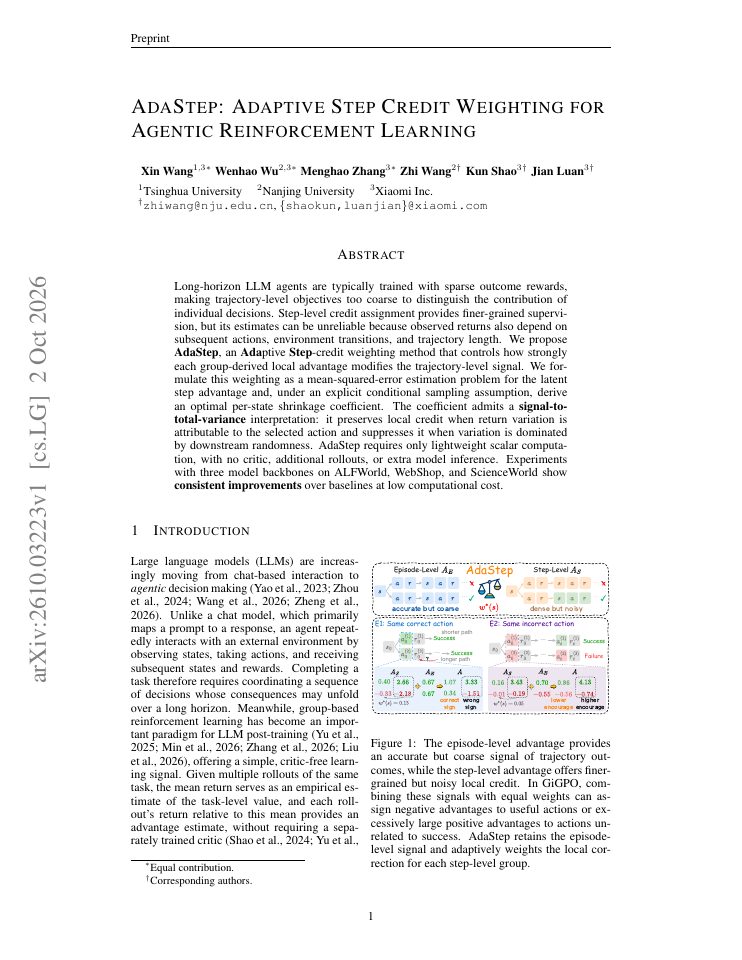
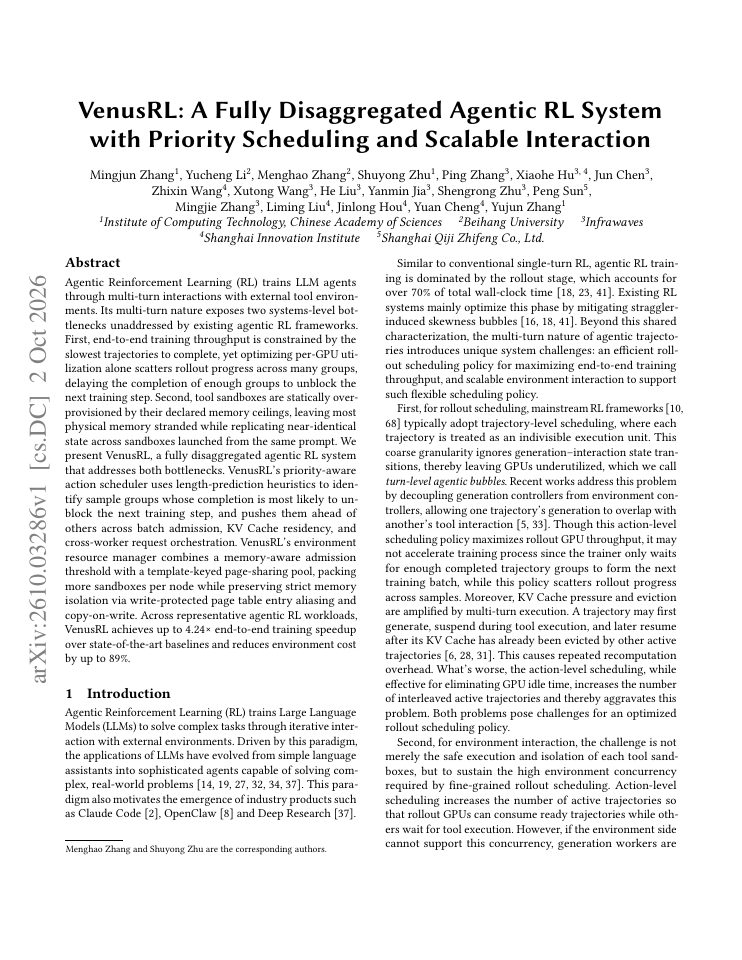
Every exclusion is counted and published.

Exclusion counts were not recorded for this edition.

0 previously indexed papers were rechecked in this run.

Paperraft tracks one signal: how many independent implementations a paper attracts on GitHub after author-owned repositories are removed. This is a discovery signal to investigate, not a measure of implementation quality.

It does not claim that a method works. Paperraft runs no reproduction benchmarks. Reported gains remain author claims until independently tested. Papers above the attention threshold are excluded because this publication is designed to identify research before consensus forms.