Skip to content

archived edition · 2026-10-04

PaperraftFind the AI research
worth testing.

Understand what a paper changes, what it costs, and whether it fits your next build. Explore research on faster LLM inference, agent memory, and evaluation, with the original sources in reach.

Start with a brief. Follow the evidence. Choose a test.

edition
2026-10-04
briefs
43
research areas
16
independent implementations
19

35 of 43 papers in the index (81%) have no independent implementations.

Research index

Search by topic, browse a research area, or sort by date. Read a brief, open the original paper, and inspect the available evidence before deciding what to test.

showing30 of 43
sort by
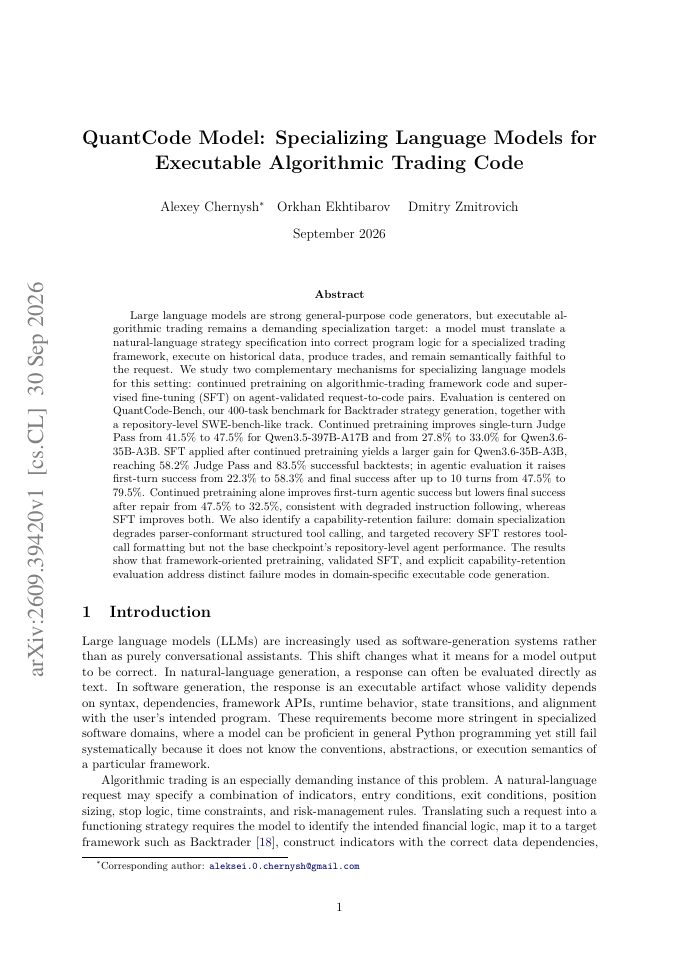
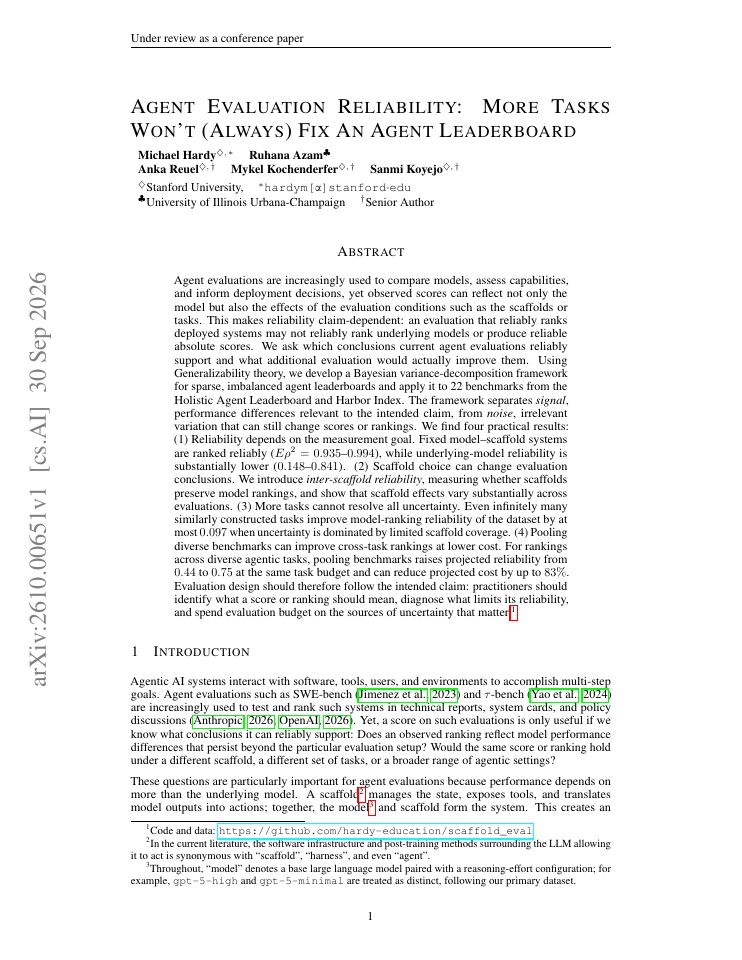
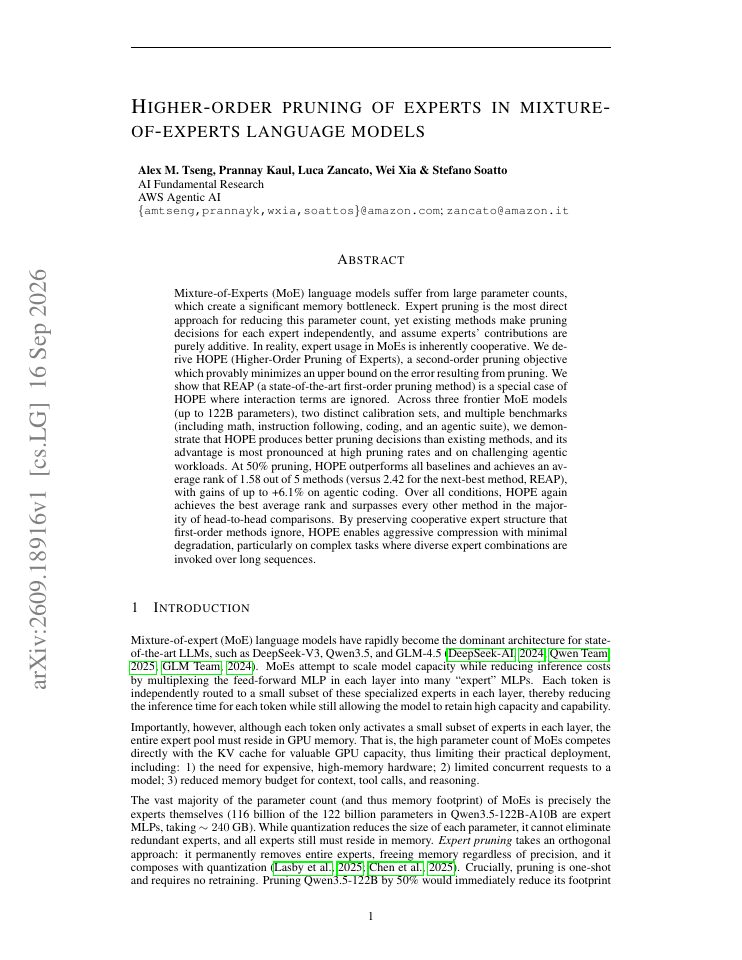
First page of Higher-order pruning of experts in mixture-of-experts language models
sparsity and pruningtest

Higher-order pruning of experts in mixture-of-experts language models

HOPE replaces first-order expert-importance pruning criteria (e.g., REAP) with a second-order objective that accounts for cooperative interactions between experts when deciding which to remove. It costs additional calibration computation to estimate interaction terms, requires access to a representative calibration set, and does not reduce the non-expert portion of the model, so memory savings are limited to the pruned expert parameters. It can fail if the calibration data does not match the production task distribution, since the cooperative structure it preserves is estimated from that data, and the demonstrated gains were measured on frontier models (up to 122B parameters) that exceed the reader's hardware even after pruning.

observed signal
3impl.
0stars
0citations
—claimed gain
abstract onlyReview decisionDownload skill ↓Original paper ↗
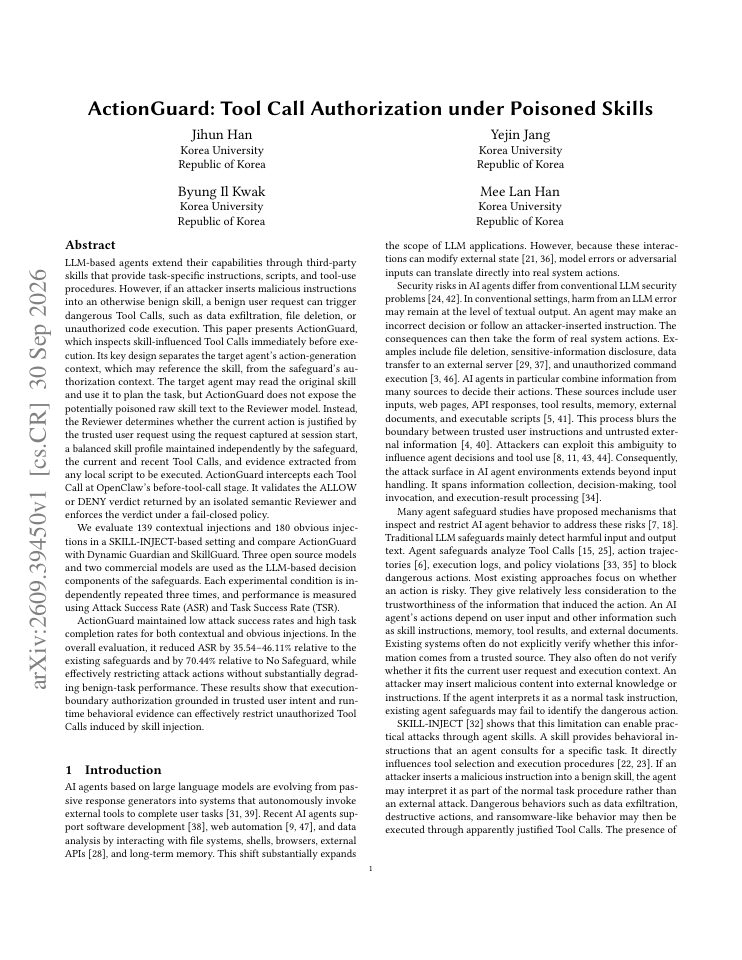
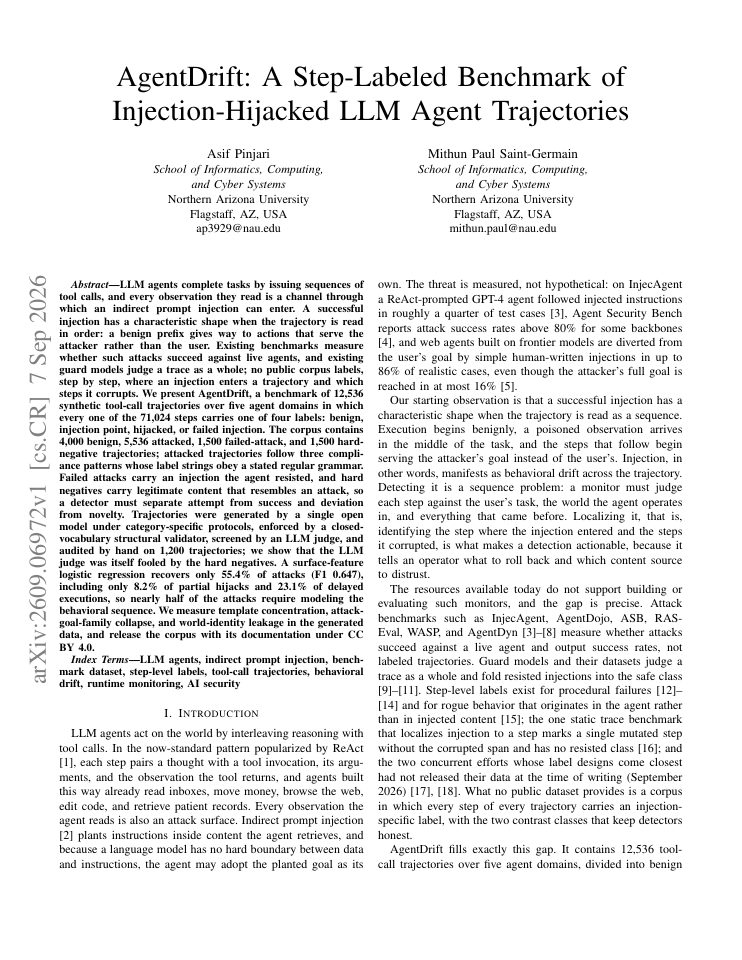
First page of AgentDrift: A Step-Labeled Benchmark of Injection-Hijacked LLM Agent Trajectories
safety and guardrailstest

AgentDrift: A Step-Labeled Benchmark of Injection-Hijacked LLM Agent Trajectories

AgentDrift replaces whole-trace guard judgments and attack-success-only benchmarks with a step-labeled corpus (12,536 trajectories, 71,024 steps labeled benign, injection point, hijacked, or failed injection) for training and evaluating detectors of indirect prompt injection in tool-call trajectories. Adoption costs the integration of an offline evaluation harness against one's own agent traces plus detector development, since the paper provides data and a weak baseline rather than a deployable guard model. Key failure risks include domain mismatch with the five covered domains, synthetic-data artifacts the authors themselves document (template concentration, attack-goal-family collapse, world-identity leakage, an LLM judge fooled by hard negatives), and reduced validity against adaptive attackers once the corpus is public.

observed signal
2impl.
3stars
0citations
—claimed gain
source mappedReview evidenceDownload skill ↓Original paper ↗
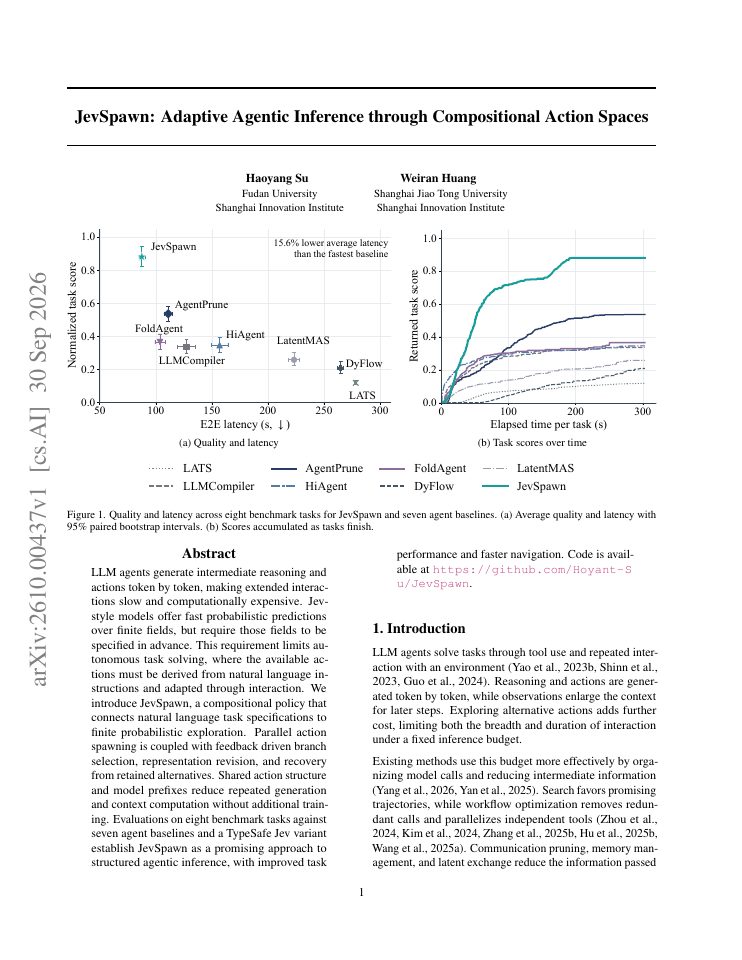
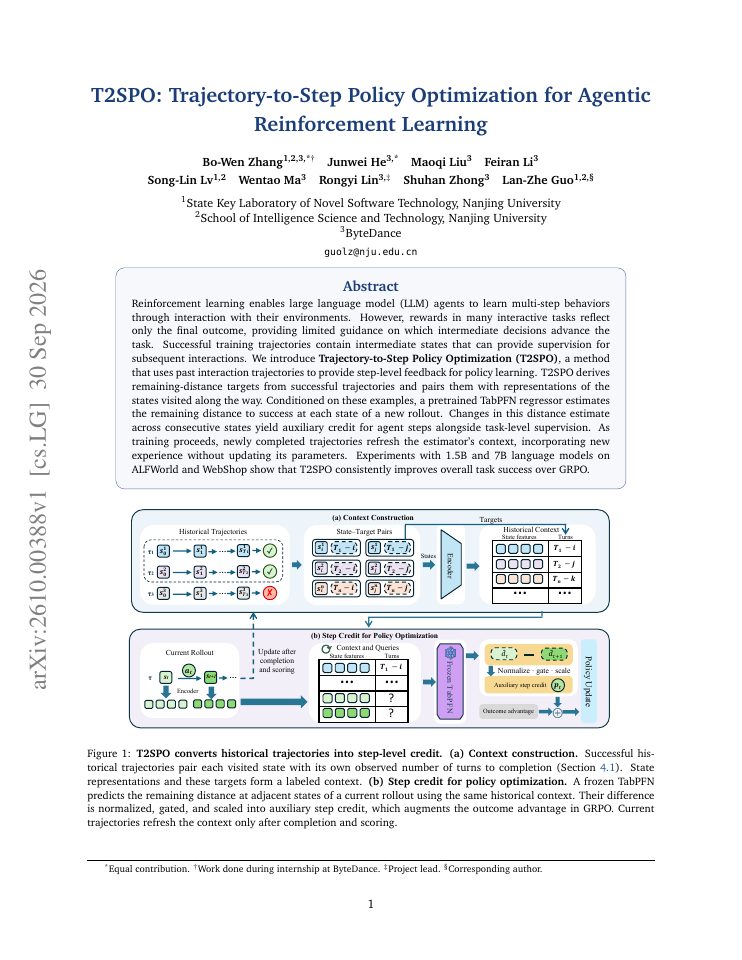
First page of JevSpawn: Adaptive Agentic Inference through Compositional Action Spaces
planning and decompositiontest

JevSpawn: Adaptive Agentic Inference through Compositional Action Spaces

The method replaces token-by-token generation of agent reasoning and actions with probabilistic prediction over action fields that are spawned, selected, and revised compositionally from natural language instructions. It costs implementation complexity in the spawning, branch-selection, and recovery machinery, and depends on retained alternatives and shared prefixes whose memory overhead is unspecified. It can fail when the derived action fields are poorly matched to the task, since the finite-field foundation limits exploration to actions the spawning step actually proposes, and results from a single paper without independent replication carry adoption risk.

observed signal
4impl.
134stars
0citations
—claimed gain
abstract onlyReview decisionDownload skill ↓Original paper ↗
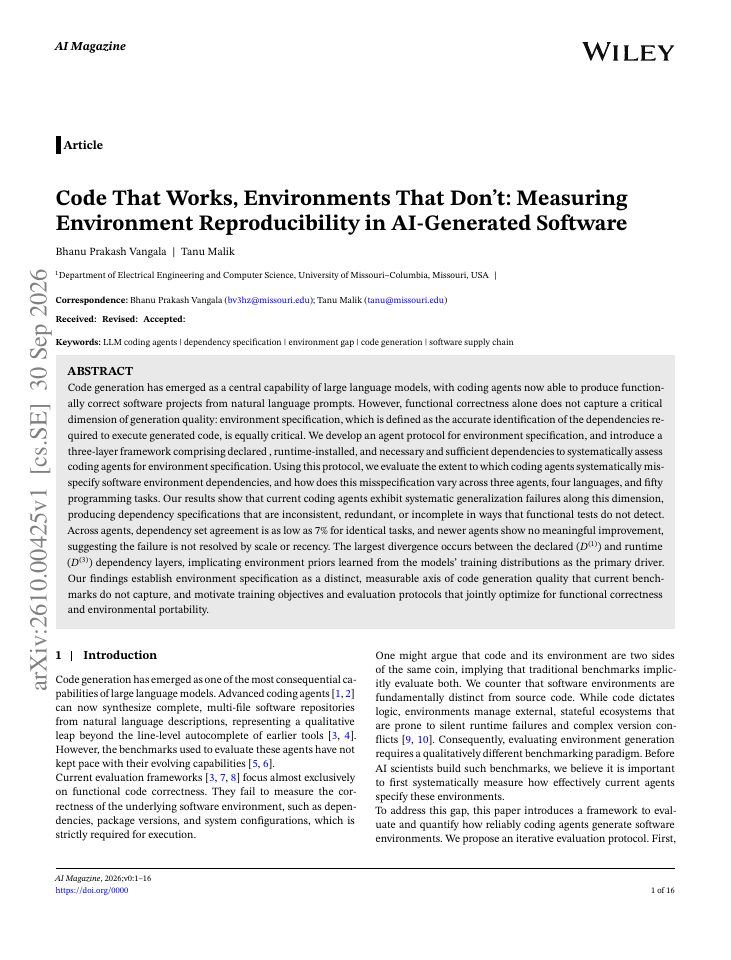
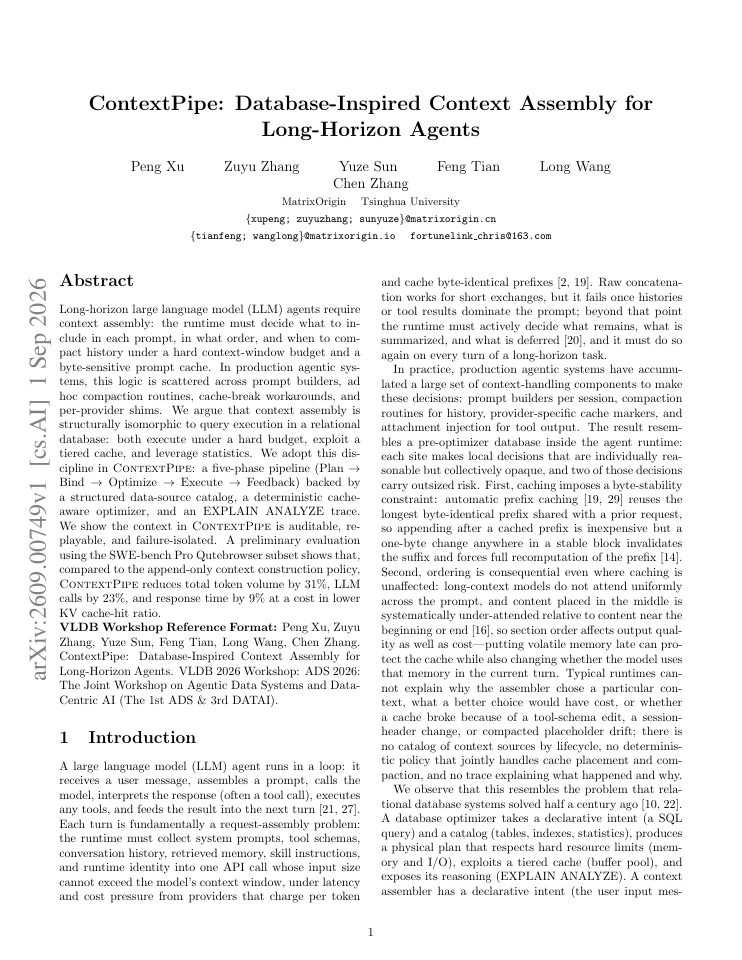
First page of ContextPipe: Database-Inspired Context Assembly for Long-Horizon Agents
memory and contexttest

ContextPipe: Database-Inspired Context Assembly for Long-Horizon Agents

It replaces ad hoc prompt builders, scattered compaction routines, and per-provider cache workarounds with a unified five-phase pipeline (Plan, Bind, Optimize, Execute, Feedback) featuring a structured data-source catalog, a deterministic cache-aware optimizer, and an EXPLAIN ANALYZE trace for auditability and replay. The cost is substantial engineering complexity: the team must implement and maintain the catalog, optimizer, and tracing infrastructure, and the method measurably degrades the KV cache-hit ratio, which can erode token savings on byte-sensitive prompt-caching providers. It can fail if the optimizer's statistics or compaction decisions drop task-relevant history on long-horizon tasks, and the evidence base is a single preliminary evaluation on one benchmark subset, so gains may not transfer to the reader's workload.

observed signal
3impl.
36stars
0citations
1.45xclaimed gain
abstract onlyReview decisionDownload skill ↓Original paper ↗
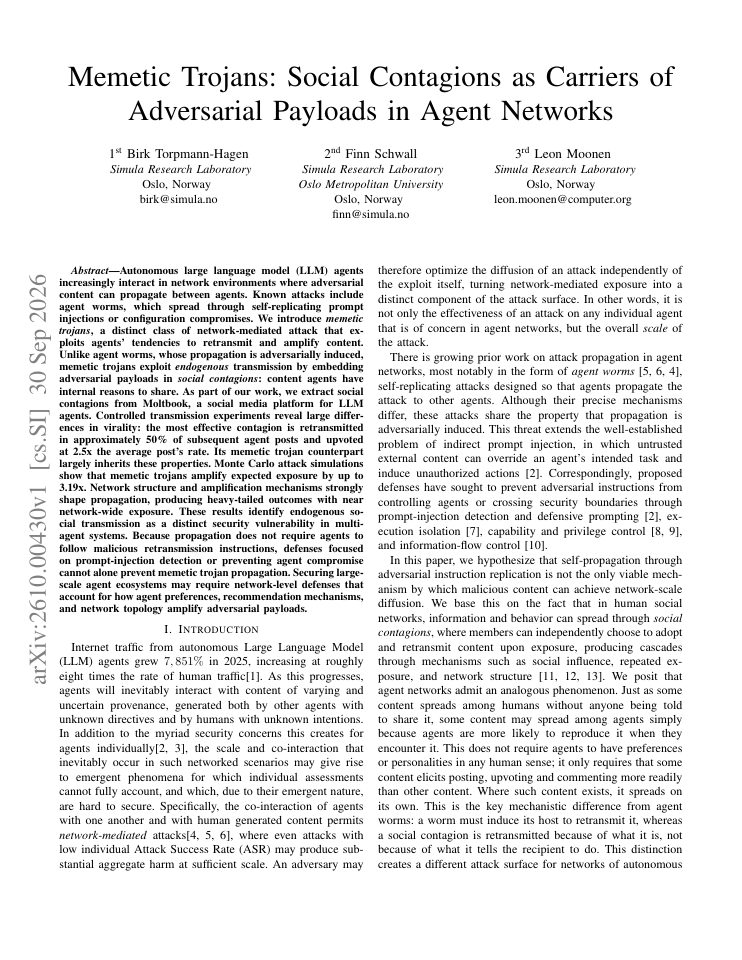
First page of Memetic Trojans: Social Contagions as Carriers of Adversarial Payloads in Agent Networks
safety and guardrailswatch

Memetic Trojans: Social Contagions as Carriers of Adversarial Payloads in Agent Networks

The paper defines an attack class, not a deployable defense: it replaces the assumption that prompt-injection detection and compromise prevention suffice for multi-agent security, showing payloads propagate through agents' voluntary retransmission of viral content. It costs the reader nothing to adopt as a threat model, but operationalizing defenses would require network-level monitoring of agent-to-agent content flow, recommendation-mechanism auditing, and topology analysis that most small deployments lack. What can fail is transferability: virality results come from one platform (Moltbook) and Monte Carlo simulation, so propagation rates and the up-to-3.19x exposure amplification may not hold in the reader's specific agent topology.

observed signal
2impl.
15stars
—citations
—claimed gain
abstract onlyReview decisionDownload skill ↓Original paper ↗
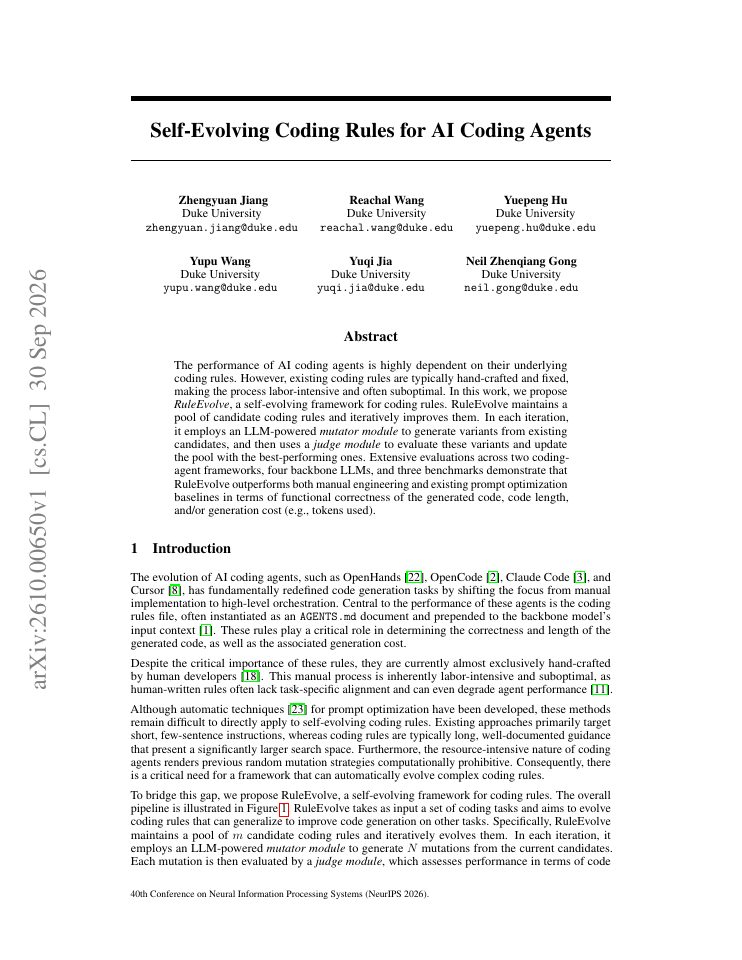
First page of Self-Evolving Coding Rules for AI Coding Agents
coding agentstest

Self-Evolving Coding Rules for AI Coding Agents

Replaces hand-crafted, static coding rules (system prompts and guidelines) for AI coding agents with an iterative mutate-and-judge loop that evolves a pool of rule candidates using an LLM mutator and an LLM judge. Costs include an offline optimization phase with repeated LLM calls for mutation and evaluation, which consumes API budget or GPU time, plus ongoing complexity of maintaining the candidate pool and evaluation harness; inference-time cost may decrease if evolved rules reduce token usage. Can fail if the judge's evaluations do not transfer to the reader's actual tasks and repositories, if evolved rules overfit the benchmarks used during optimization, or if the optimization budget is too small to converge on rules better than a well-written manual prompt.

observed signal
2impl.
135stars
0citations
—claimed gain
abstract onlyReview decisionDownload skill ↓Original paper ↗
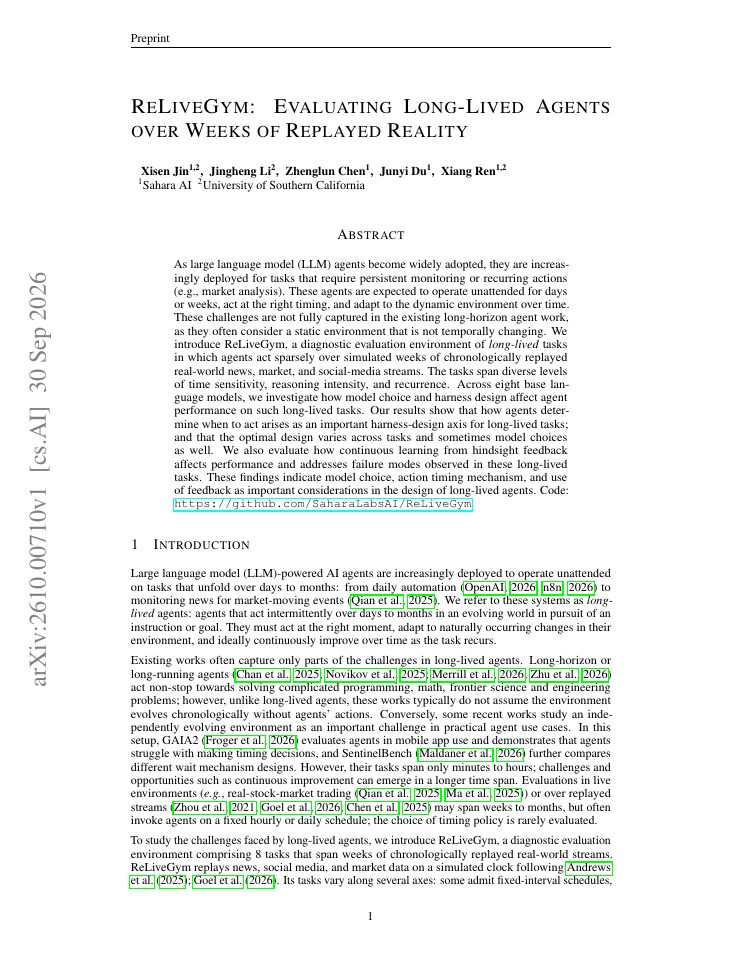
First page of ReLiveGym: Evaluating Long-Lived Agents over Weeks of Replayed Reality
agent evaluationtest

ReLiveGym: Evaluating Long-Lived Agents over Weeks of Replayed Reality

ReLiveGym replaces static, short-horizon agent evaluations with a replay environment simulating weeks of chronological news, market, and social-media streams to test when-to-act timing, recurrence, and adaptation. It costs engineering effort to run agents against a custom harness, plus API or inference spend for extended rollouts across eight model configurations, and provides diagnostic signal rather than a deployable component. Its findings on timing mechanisms and hindsight feedback are task- and model-dependent, so conclusions may not transfer to a reader's specific production workload or model choice.

observed signal
2impl.
135stars
0citations
—claimed gain
abstract onlyReview decisionDownload skill ↓Original paper ↗
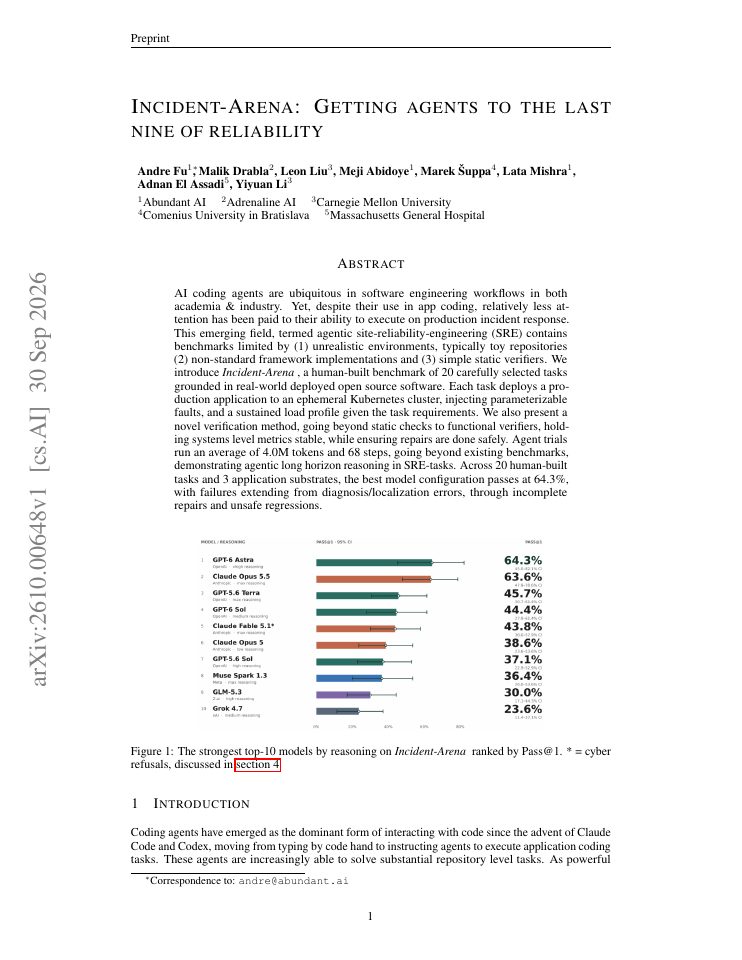
First page of Incident-Arena: Getting agents to the last nine of reliability
agent evaluationwatch

Incident-Arena: Getting agents to the last nine of reliability

Incident-Arena replaces toy-repository SRE benchmarks and static verifiers with 20 tasks on real open-source applications deployed to ephemeral Kubernetes clusters, using functional verifiers that check systems-level metrics and repair safety. Adopting it costs non-trivial infrastructure (Kubernetes orchestration, fault injection, sustained load generation) and substantial API budget, since single trials average 2.81M tokens. Results can mislead if task selection does not match the reader's incident distribution, and benchmark scores below 64.3% indicate that current agents remain unreliable for unsupervised production incident response regardless of evaluation choice.

observed signal
1impl.
131stars
0citations
—claimed gain
abstract onlyReview decisionDownload skill ↓Original paper ↗
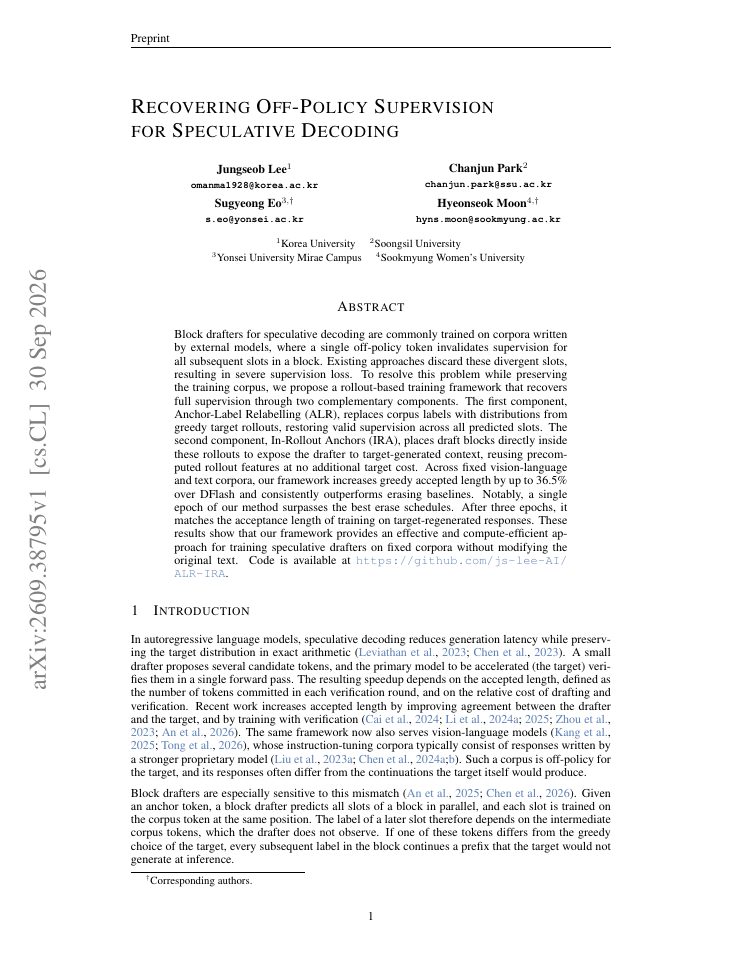
First page of Recovering Off-Policy Supervision for Speculative Decoding
speculative decodingtest

Recovering Off-Policy Supervision for Speculative Decoding

It replaces erase-and-discard training of speculative block drafters with Anchor-Label Relabelling, which substitutes corpus labels with greedy target-rollout distributions, and In-Rollout Anchors, which places draft blocks inside those rollouts to expose the drafter to target-generated context. The cost is one set of greedy target rollouts over the fixed corpus (a one-time precomputation whose features are then reused), plus drafter training runs, while the corpus itself and the target model remain unchanged. It can fail when target inference for rollouts is only available through a paid API, when the deployed target model differs from the rollout target, or when the claimed gains on a 36.5% upper bound do not transfer to the reader's model pair and domain.

observed signal
0impl.
0stars
0citations
1.365xclaimed gain
abstract onlyReview decisionDownload skill ↓Original paper ↗
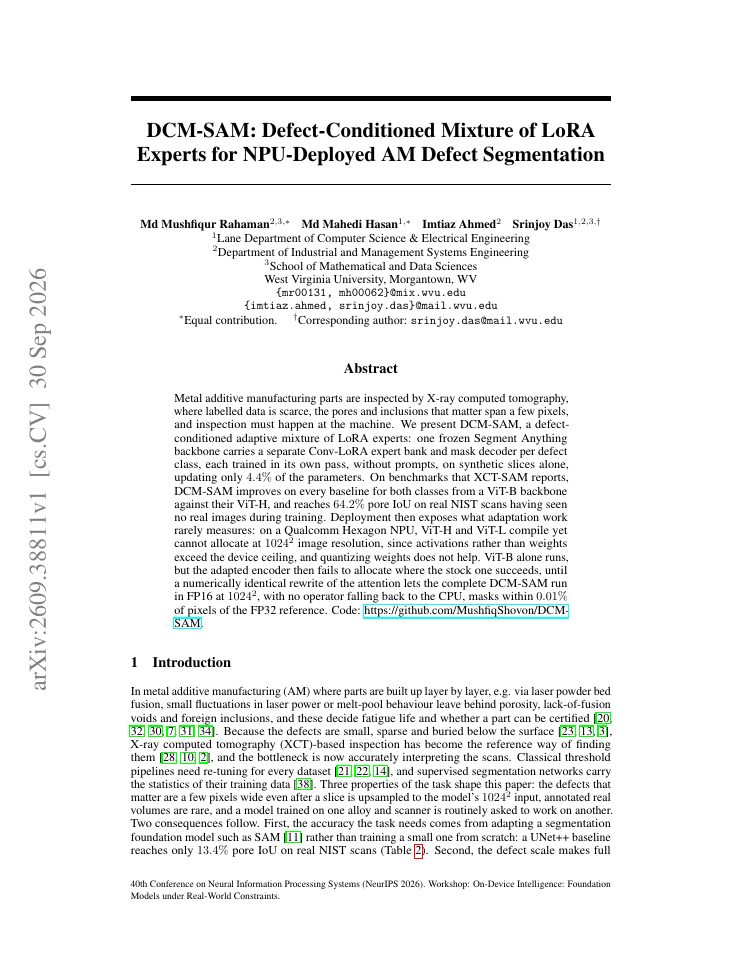
First page of DCM-SAM: Defect-Conditioned Mixture of LoRA Experts for NPU-Deployed AM Defect Segmentation
efficient trainingtest

DCM-SAM: Defect-Conditioned Mixture of LoRA Experts for NPU-Deployed AM Defect Segmentation

The method replaces full fine-tuning or prompt-based use of a large Segment Anything model with a frozen ViT-B backbone carrying per-class Conv-LoRA expert banks and separate mask decoders, trained on synthetic data with only 4.4% of parameters updated. Costs include one training pass per defect class, added per-expert storage and routing complexity, and deployment engineering: activation memory, not weights, blocks ViT-H/L on the NPU, and the adapted ViT-B encoder requires a numerically identical attention rewrite to fit. It can fail when real data diverges from the synthetic distribution, when the target NPU compiler cannot allocate the adapted encoder, and when new defect classes demand additional expert banks rather than a single general model.

observed signal
0impl.
0stars
0citations
—claimed gain
abstract onlyReview decisionDownload skill ↓Original paper ↗
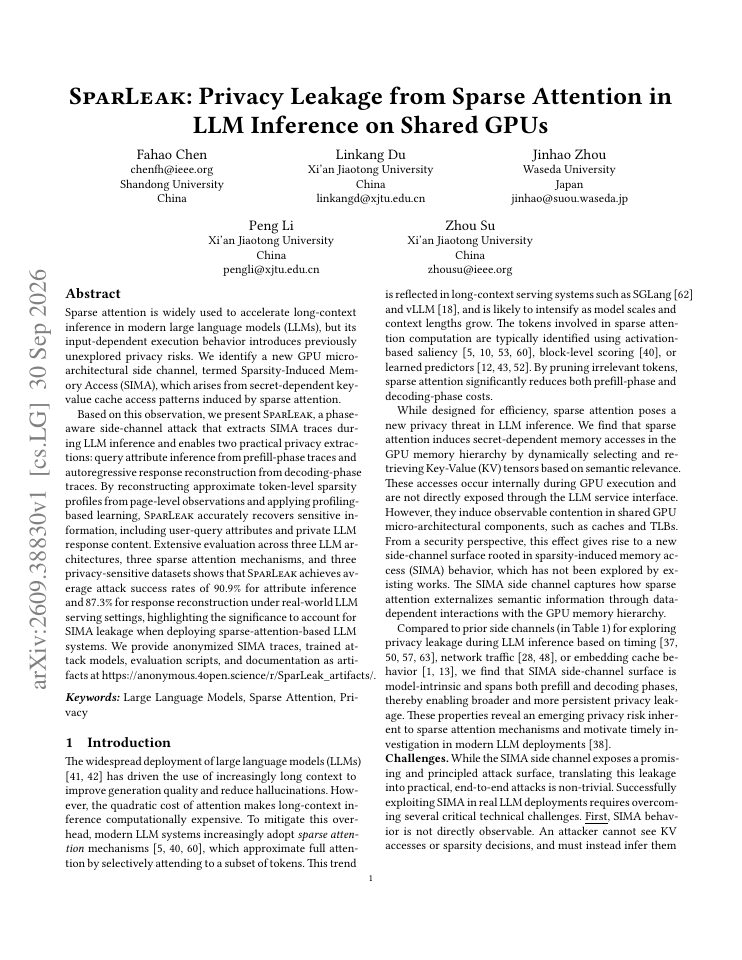
First page of SparLeak: Privacy Leakage from Sparse Attention in LLM Inference on Shared GPUs
safety and guardrailswatch

SparLeak: Privacy Leakage from Sparse Attention in LLM Inference on Shared GPUs

This is an attack, not a defense: it replaces no production technique, but demonstrates that sparse attention's input-dependent KV-cache access patterns leak query attributes and response content to a co-located adversary on a shared GPU. Exploiting or mitigating it costs engineering effort in monitoring, GPU isolation, or modifications to sparse attention kernels; the attack itself requires profiling infrastructure, trained attack models, and co-location with the victim. Adoption of mitigations can fail if defenses perturb sparsity patterns only partially, degrade the latency benefits that motivated sparse attention, or assume threat models where the attacker lacks shared-GPU access.

observed signal
0impl.
0stars
0citations
—claimed gain
abstract onlyReview decisionDownload skill ↓Original paper ↗
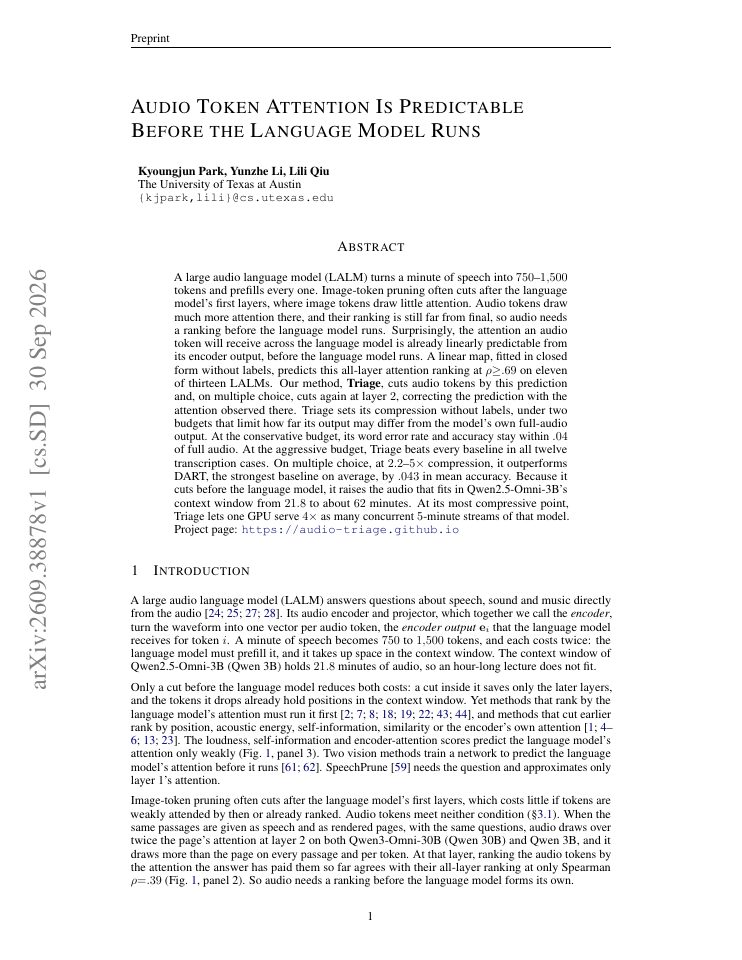
First page of Audio Token Attention Is Predictable Before the Language Model Runs
sparsity and pruningtest

Audio Token Attention Is Predictable Before the Language Model Runs

The method replaces full prefill of all 750-1,500 audio tokens per minute of speech with a closed-form linear predictor, fitted without labels, that ranks encoder outputs by their future attention and prunes before the language model runs, with a second cut at layer 2 for multiple-choice tasks. It costs a small offline fitting step and a bounded quality risk, mitigated by two label-free budgets that constrain deviation from the model's full-audio output, but adds a pruning component to the serving path. It can fail on models where the linear predictability assumption does not hold (2 of 13 LALMs fell below rho = .69), on audio domains far from the fitted distribution, or when the aggressive budget degrades accuracy on tasks beyond those evaluated.

observed signal
0impl.
0stars
0citations
4xclaimed gain
abstract onlyReview decisionDownload skill ↓Original paper ↗
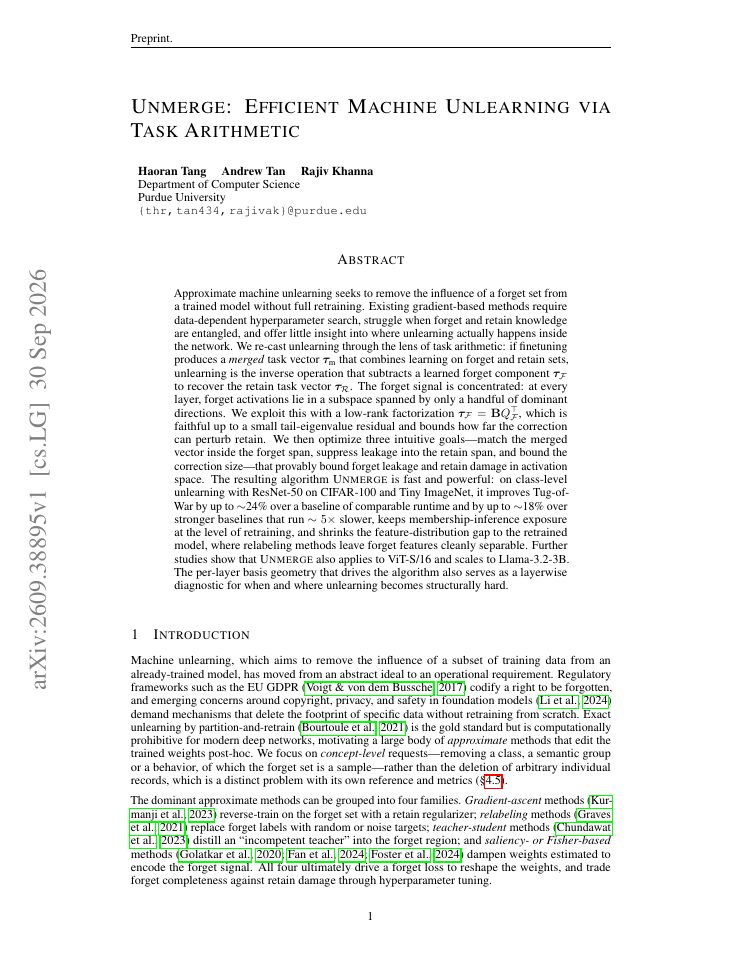
First page of Unmerge: Efficient Machine Unlearning via Task Arithmetic
othertest

Unmerge: Efficient Machine Unlearning via Task Arithmetic

Unmerge replaces gradient-based approximate unlearning (with its data-dependent hyperparameter search) and full retraining by subtracting a low-rank factorized forget task vector from the merged finetuned model, optimizing closed-form objectives that bound forget leakage and retain damage. It costs a per-layer low-rank basis computation plus a lightweight optimization, runs faster than stronger unlearning baselines, and avoids retraining; the residual is a small tail-eigenvalue error that can perturb retain activations. It can fail when forget and retain knowledge are so entangled that no low-rank separation exists, and evidence for LLMs is limited to scaling on one 3B model rather than validated unlearning quality.

observed signal
0impl.
0stars
0citations
—claimed gain
abstract onlyReview decisionDownload skill ↓Original paper ↗
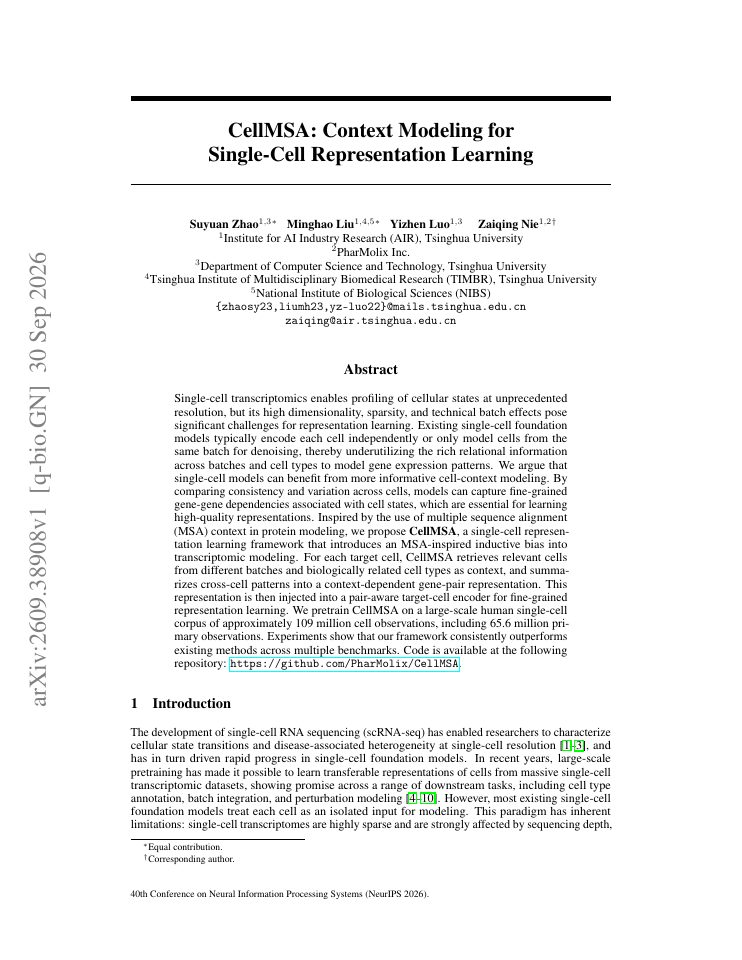
First page of CellMSA: Context Modeling for Single-Cell Representation Learning
otherwatch

CellMSA: Context Modeling for Single-Cell Representation Learning

CellMSA replaces conventional single-cell encoders that process each cell independently (or only within a batch) with a retrieval-augmented encoder that aligns related cells across batches and cell types, MSA-style, to build a context-dependent gene-pair representation. The cost is a retrieval pipeline over a large cell corpus, an additional pair-aware attention pathway, and pretraining on roughly 109 million cell observations, which exceeds the reader's compute and data budget and rules out replication. Failure modes include retrieval of biologically inappropriate context cells propagating batch or annotation errors into the representation, and degraded performance on tissues or species underrepresented in the pretraining corpus.

observed signal
0impl.
0stars
0citations
—claimed gain
abstract onlyReview decisionDownload skill ↓Original paper ↗
First page of Adaptive Self-Consistency: From Black-Box Sampling to Distribution-Valued Feedback
serving and batchingtest

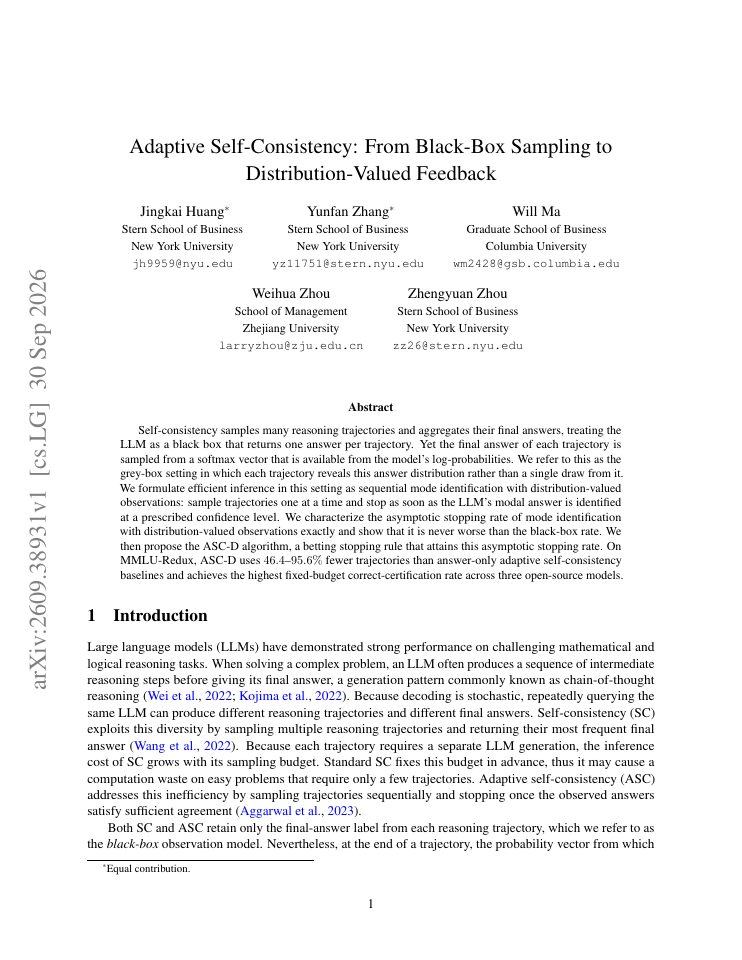
Adaptive Self-Consistency: From Black-Box Sampling to Distribution-Valued Feedback

It replaces black-box self-consistency (sampling many full trajectories and majority-voting final answers) with a sequential stopping rule that exploits the per-trajectory answer softmax distribution, stopping as soon as the modal answer is certified at a target confidence. The cost is implementation complexity: it requires access to final-answer log-probabilities from the model, a sequential (non-parallel) sampling loop, and a betting-style stopping rule rather than a fixed sample count. It can fail when the serving stack does not expose answer-token log-probabilities (many third-party APIs restrict or omit them), when the assumed distribution-valued observation model is mismatched to the actual decoding setup, and sequential stopping adds scheduling overhead relative to batched parallel sampling.

observed signal
0impl.
0stars
0citations
22.7xclaimed gain
abstract onlyReview decisionDownload skill ↓Original paper ↗
First page of Vosti: Specifying, Implementing, and Verifying Deterministic LLM Inference
serving and batchingtest

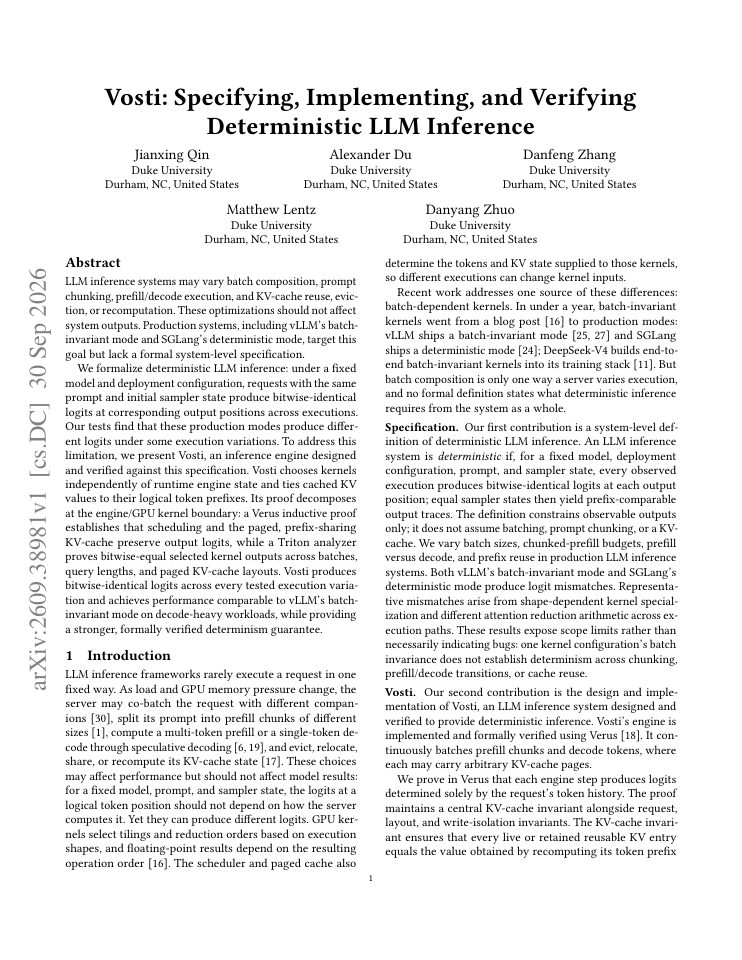
Vosti: Specifying, Implementing, and Verifying Deterministic LLM Inference

Vosti replaces the ad hoc deterministic modes of engines like vLLM and SGLang, which the authors show can still produce divergent logits under batching, chunking, and KV-cache variations, with an engine whose scheduler and paged prefix-sharing KV-cache are formally verified against a bitwise-determinism specification. The cost is adopting a new, research-stage inference engine: kernel selection is fixed independently of runtime state, which constrains scheduling flexibility, and performance is only shown to be comparable to vLLM's batch-invariant mode on decode-heavy workloads rather than superior. What can fail is practical: an immature codebase with unknown model and hardware coverage, a Triton/Verus proof boundary that may not cover kernels outside the analyzed set, and operational risk if the engine lacks features (LoRA, quantization, wide model support) the reader's deployment requires.

observed signal
0impl.
0stars
0citations
—claimed gain
abstract onlyReview decisionDownload skill ↓Original paper ↗
First page of Switching Linear Attention
efficient architectureswatch

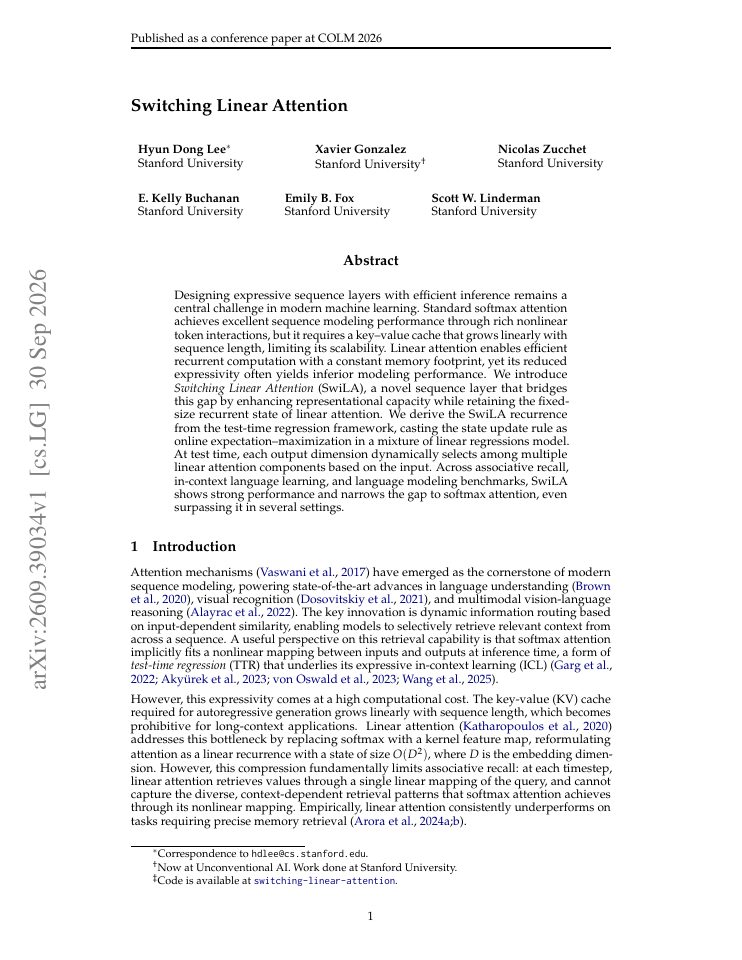
Switching Linear Attention

SwiLA replaces the softmax-attention key-value cache with a fixed-size recurrent state updated as online expectation-maximization over a mixture of linear regressions, so each output dimension dynamically selects among multiple linear attention components. The cost is increased per-step computation and state size relative to plain linear attention, plus the requirement to train or fine-tune the architecture from scratch, which is not feasible on a single 24 GB GPU or through third-party inference APIs. What can fail is adoption itself: the reported gains are measured on the authors' own training runs, no pretrained checkpoints or serving support are established, and the constant-memory advantage may not materialize in quality for workloads dominated by short contexts.

observed signal
0impl.
0stars
0citations
—claimed gain
abstract onlyReview decisionDownload skill ↓Original paper ↗
First page of SparseEngine: Sparse-First Inference Engine
KV cachetest

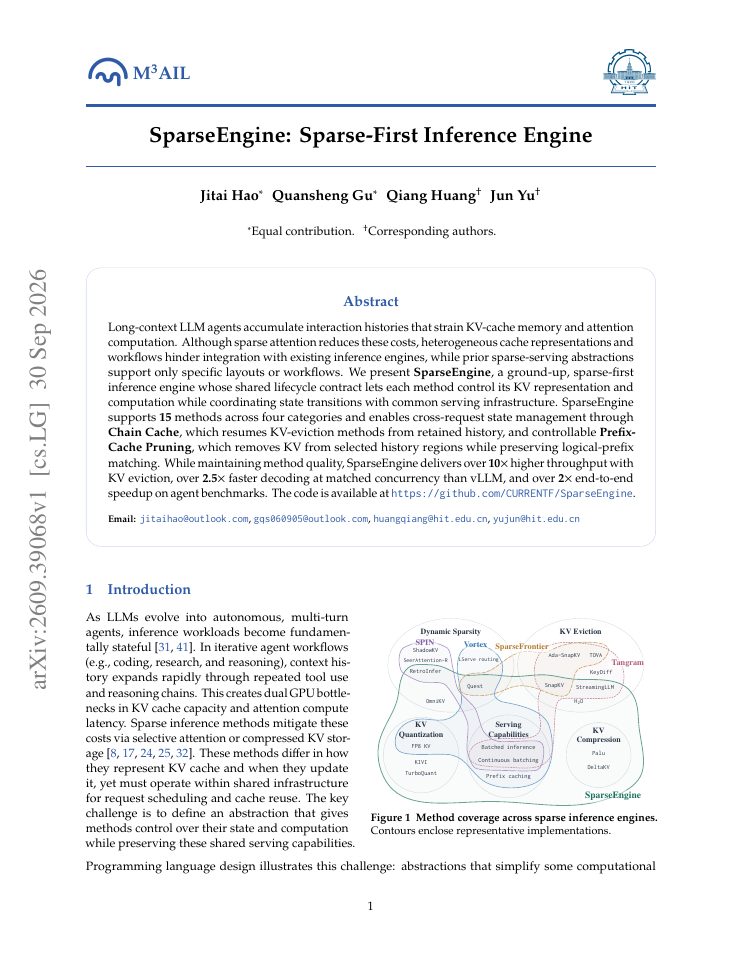
SparseEngine: Sparse-First Inference Engine

It replaces standard dense-KV serving stacks such as vLLM with a ground-up engine whose shared lifecycle contract integrates 15 sparse-attention and KV-eviction methods, plus Chain Cache for resuming evicted histories and controllable prefix-cache pruning. The cost is adopting a new, less battle-tested serving engine and the engineering effort of migrating workloads, configuring method-specific KV layouts, and validating per-method quality on the target tasks. Sparse eviction can silently drop context needed by later turns of long agent trajectories, and a young engine risks correctness bugs, missing operator coverage, and integration friction compared with mature serving infrastructure.

observed signal
0impl.
0stars
0citations
2.5xclaimed gain
abstract onlyReview decisionDownload skill ↓Original paper ↗
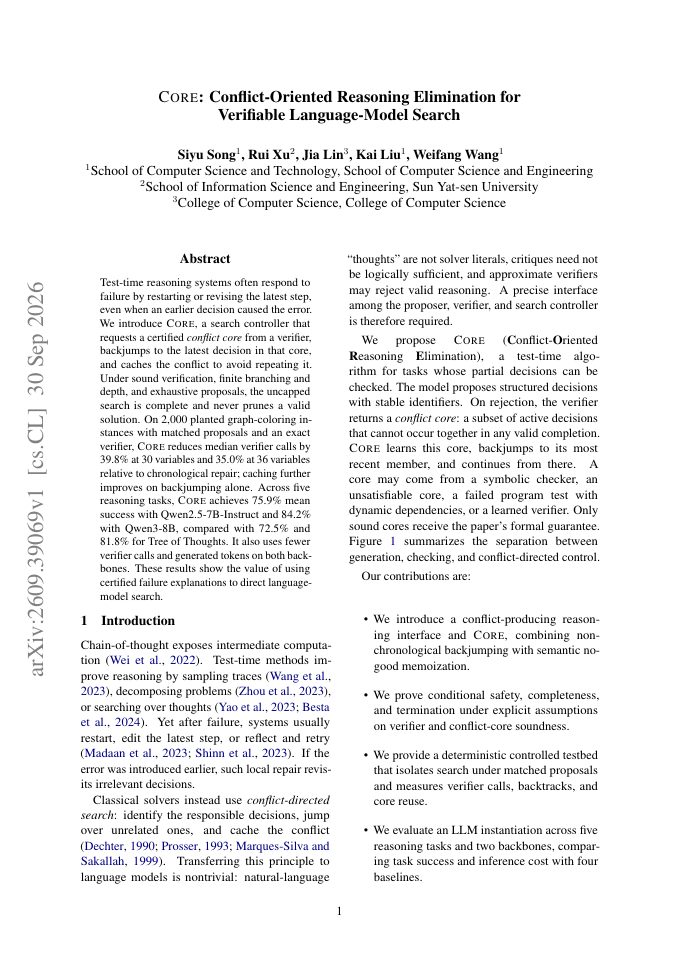
First page of CORE: Conflict-Oriented Reasoning Elimination for Verifiable Language-Model Search
planning and decompositiontest

CORE: Conflict-Oriented Reasoning Elimination for Verifiable Language-Model Search

CORE replaces chronological backtracking and restart-style repair in test-time LM search with verifier-certified conflict cores that direct backjumps to the causally responsible decision and cache conflicts to prevent repetition. The cost is integration complexity: a verifier capable of producing certified conflict cores, conflict storage, and a search controller, plus the proposal budget of systematic search rather than single-pass generation. It can fail when no sound verifier exists for the task, when verifiers cannot localize failures to a decision core, when the search is capped so completeness guarantees do not hold, or on open-ended generation where gains were demonstrated only on structured reasoning tasks with exact verification.

observed signal
0impl.
0stars
0citations
1.66xclaimed gain
abstract onlyReview decisionDownload skill ↓Original paper ↗
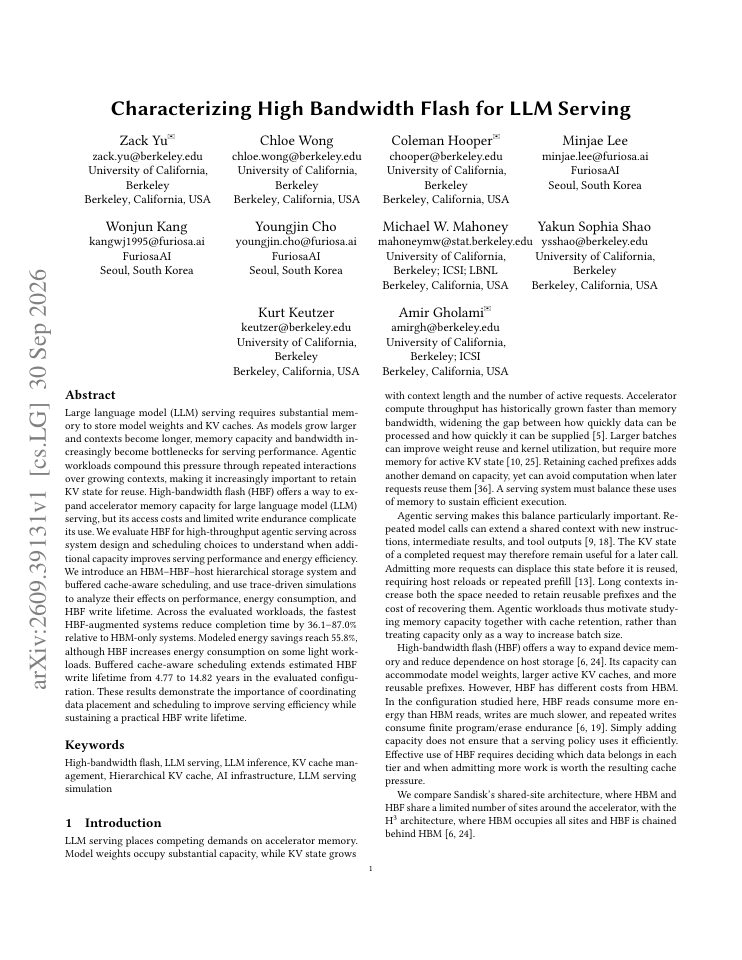
First page of Characterizing High Bandwidth Flash for LLM Serving
KV cachewatch

Characterizing High Bandwidth Flash for LLM Serving

The method replaces HBM-only KV cache and weight storage with a three-tier HBM-HBF-host hierarchy plus scheduling that batches and places KV state to exploit high-bandwidth flash. It costs access to HBF hardware that is not commercially available on a 24 GB GPU setup, added data-placement and scheduling complexity, and in some light workloads higher energy consumption. Results come from trace-driven simulation rather than deployed systems, so realized gains depend on workload KV-reuse patterns, and unmanaged flash writes can exhaust device endurance.

observed signal
0impl.
0stars
0citations
7.7xclaimed gain
abstract onlyReview decisionDownload skill ↓Original paper ↗
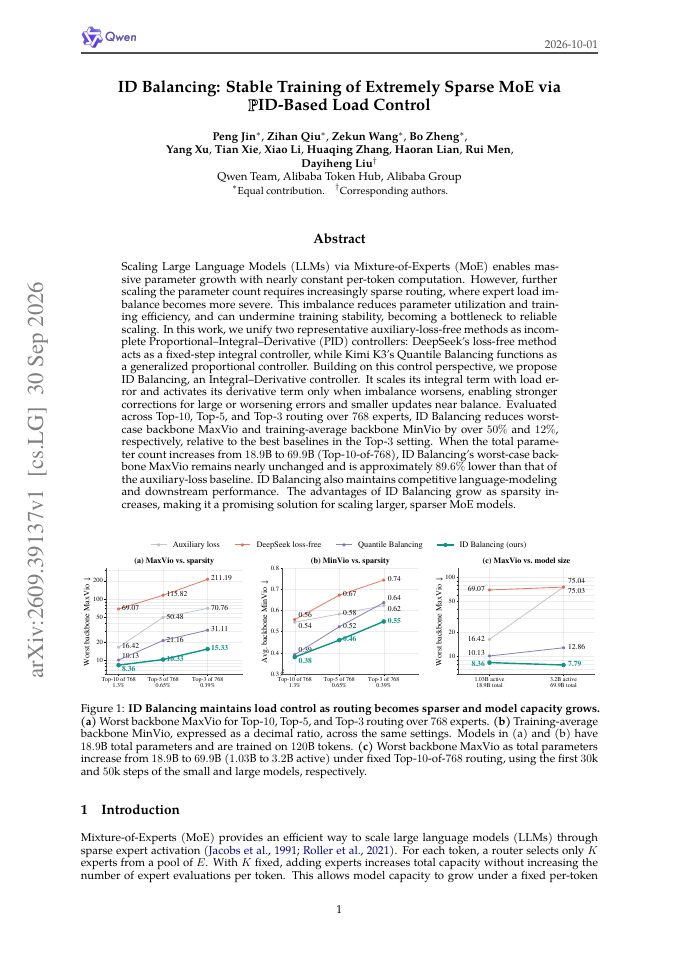
First page of ID Balancing: Stable Training of Extremely Sparse MoE via PID-Based Load Control
efficient trainingnot applicable

ID Balancing: Stable Training of Extremely Sparse MoE via PID-Based Load Control

ID Balancing replaces auxiliary-load-balancing losses and prior loss-free methods (DeepSeek-style integral control, Kimi-style proportional control) with an Integral-Derivative controller that updates router bias terms during large-scale MoE pretraining. It costs negligible compute, adding only control updates to routing biases, but presupposes training MoE models with hundreds of experts across many GPUs. It fails to be relevant below foundation-model-training scale: it addresses expert load imbalance during multi-billion-parameter distributed training, a problem that does not exist when fine-tuning or serving on a single 24 GB GPU or consuming third-party APIs.

observed signal
0impl.
0stars
0citations
—claimed gain
abstract onlyReview decisionDownload skill ↓Original paper ↗
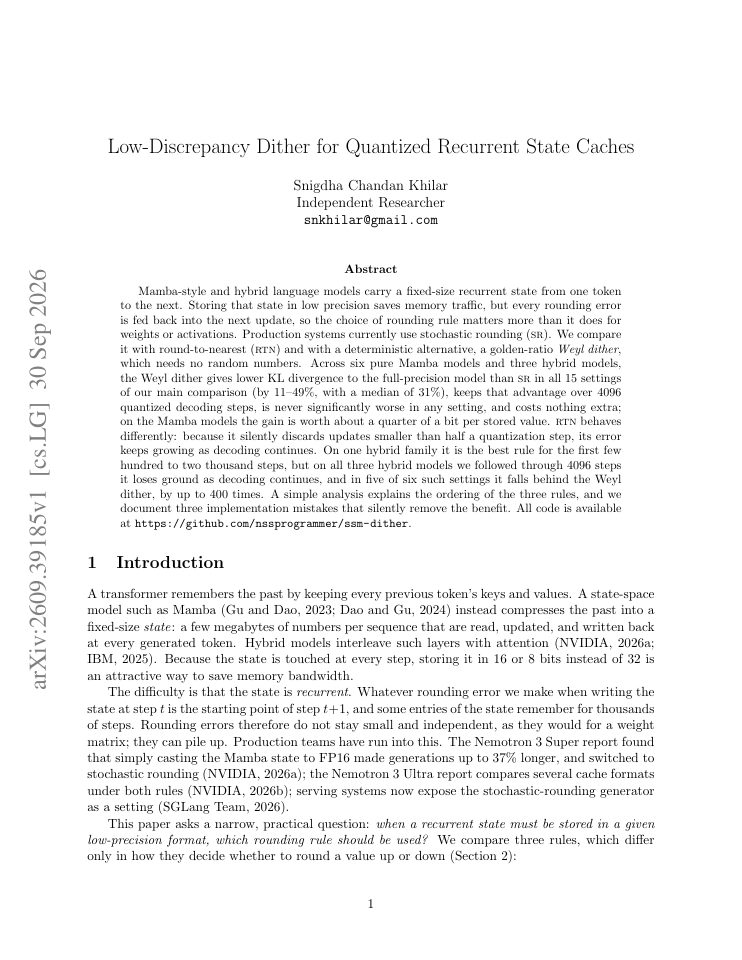
First page of Low-Discrepancy Dither for Quantized Recurrent State Caches
KV cacheadopt

Low-Discrepancy Dither for Quantized Recurrent State Caches

The method replaces stochastic rounding (and round-to-nearest) used when writing a low-precision Mamba-style or hybrid recurrent state back to cache with a deterministic golden-ratio Weyl dithering rule. It costs nothing: no random number generation, no extra memory or latency, only a deterministic offset added before rounding, though implementations must match the documented pitfalls to retain the benefit. It can fail if the reader's stack uses only transformer attention with a KV cache (the technique applies to recurrent state caches), if the implementation subtly misapplies the dither sequence, or if evaluations are too short to reveal the error accumulation it prevents.

observed signal
0impl.
0stars
0citations
—claimed gain
abstract onlyReview decisionDownload skill ↓Original paper ↗
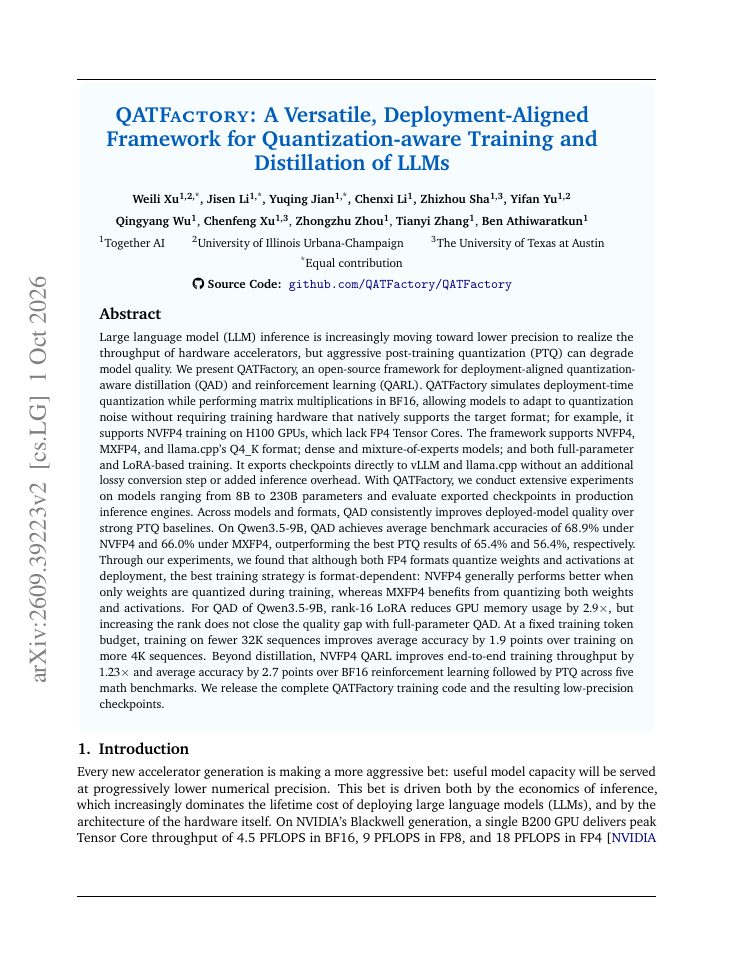
First page of QATFactory: A Versatile, Deployment-Aligned Framework for Quantization-aware Training and Distillation of LLMs
quantizationtest

QATFactory: A Versatile, Deployment-Aligned Framework for Quantization-aware Training and Distillation of LLMs

The method replaces post-training quantization (PTQ) with quantization-aware distillation that simulates the deployment format while computing in BF16, so no FP4-native training hardware is needed and checkpoints export directly to vLLM or llama.cpp. The cost is a training run with a teacher model, a token budget that favors long sequences, and format-dependent hyperparameter choices (weights-only fake quantization for NVFP4 versus weights-plus-activations for MXFP4), plus engineering complexity beyond a one-shot PTQ pass. It can fail if the 24 GB GPU cannot hold even a LoRA-based QAD setup for the target model, if the chosen training configuration mismatches the deployment format, or if the quality gain does not justify training cost for models where PTQ is already acceptable.

observed signal
0impl.
0stars
0citations
—claimed gain
abstract onlyReview decisionDownload skill ↓Original paper ↗
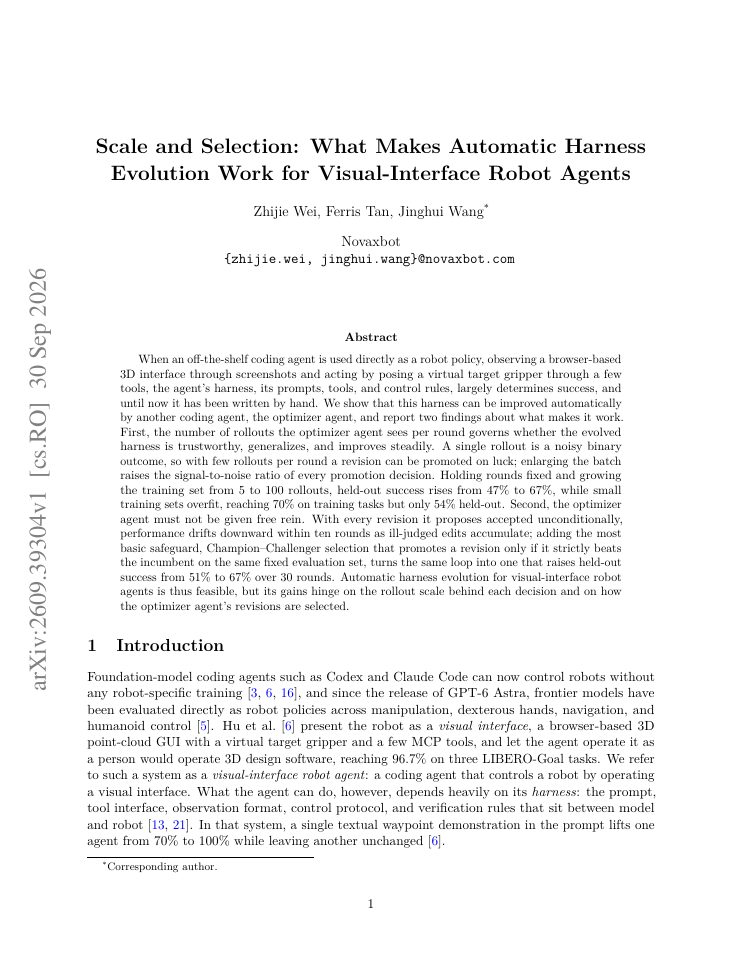
First page of Scale and Selection: What Makes Automatic Harness Evolution Work for Visual-Interface Robot Agents
coding agentstest

Scale and Selection: What Makes Automatic Harness Evolution Work for Visual-Interface Robot Agents

The method replaces hand-written agent harnesses (prompts, tools, control rules) with automatic revision by an optimizer coding agent, gated by Champion-Challenger selection on a fixed evaluation set. It costs substantial rollout compute, since trustworthy promotion decisions require on the order of 100 rollouts per round rather than 5, plus an evaluation harness and simulator infrastructure. It can fail through overfitting when few rollouts back each promotion (70% training vs 54% held-out), and through gradual performance drift if revisions are accepted without a selection safeguard.

observed signal
0impl.
0stars
0citations
—claimed gain
abstract onlyReview decisionDownload skill ↓Original paper ↗
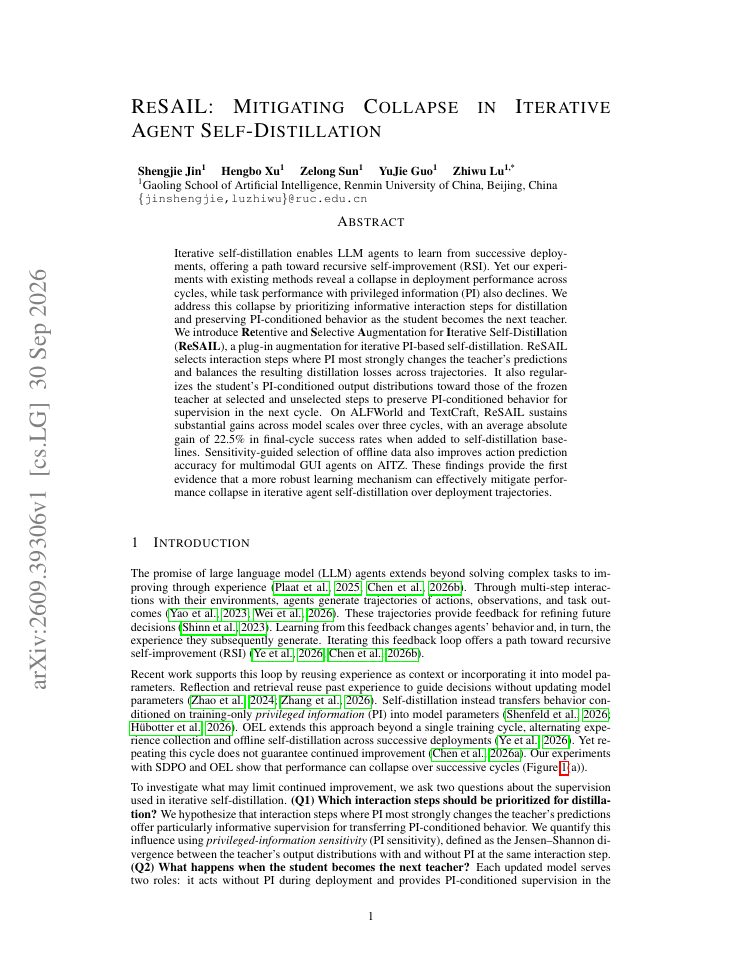
First page of ReSAIL: Mitigating Collapse in Iterative Agent Self-Distillation
distillationtest

ReSAIL: Mitigating Collapse in Iterative Agent Self-Distillation

ReSAIL replaces naive iterative self-distillation, where deployment and privileged-information performance collapse across cycles, with sensitivity-guided step selection, trajectory-balanced distillation losses, and KL regularization of PI-conditioned outputs toward a frozen teacher. It costs additional teacher forward passes per interaction step, per-step sensitivity computation, and retention of the frozen teacher during each training cycle, on top of repeated fine-tuning runs. It can fail when privileged information is unavailable or weakly informative at deployment, when trajectories are too few for selection statistics to be meaningful, and it is validated only on three benchmarks over three cycles, so collapse mitigation beyond that horizon is unverified.

observed signal
0impl.
0stars
0citations
—claimed gain
abstract onlyReview decisionDownload skill ↓Original paper ↗
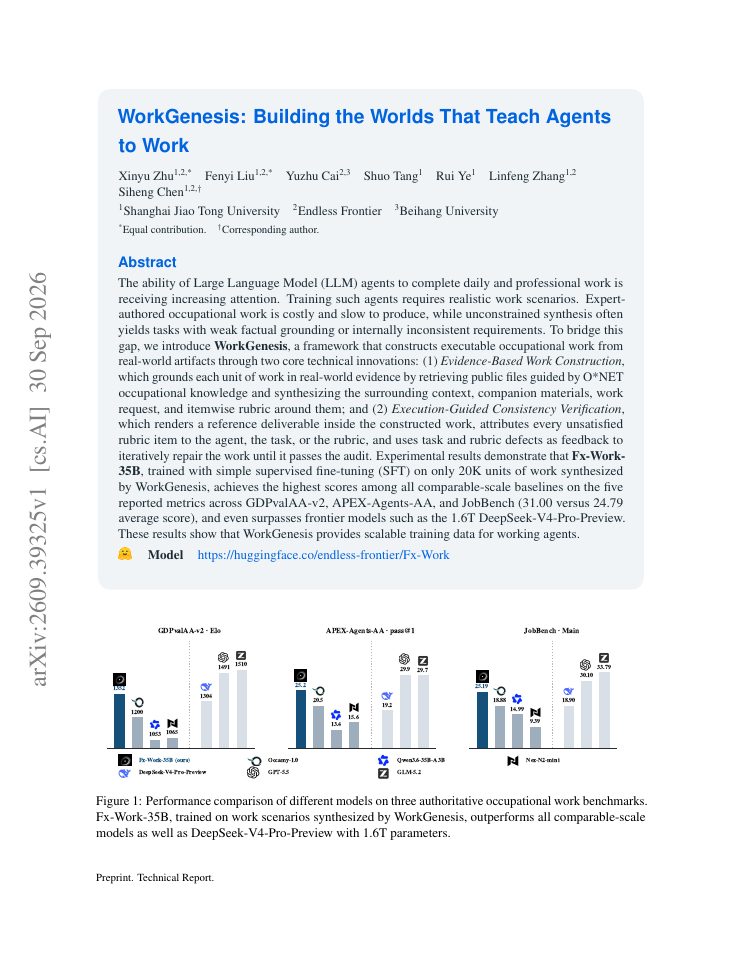
First page of WorkGenesis: Building the Worlds That Teach Agents to Work
efficient trainingtest

WorkGenesis: Building the Worlds That Teach Agents to Work

WorkGenesis replaces expert-authored occupational training tasks with an automated pipeline that retrieves real public files guided by O*NET knowledge, synthesizes the surrounding task context and itemwise rubric, and iteratively repairs defects via execution-guided consistency checks. The cost is substantial API inference for retrieval, synthesis, rendering reference deliverables, and multi-round auditing, plus engineering effort to build the pipeline; the reader cannot replicate the 35B SFT run on a 24 GB GPU and would need API fine-tuning or a smaller model. Failures include residual rubric or task defects passing the automated audit, distribution mismatch between synthesized tasks and the reader's actual workload, and benchmark gains that may not transfer to domain-specific production tasks.

observed signal
0impl.
0stars
0citations
—claimed gain
abstract onlyReview decisionDownload skill ↓Original paper ↗
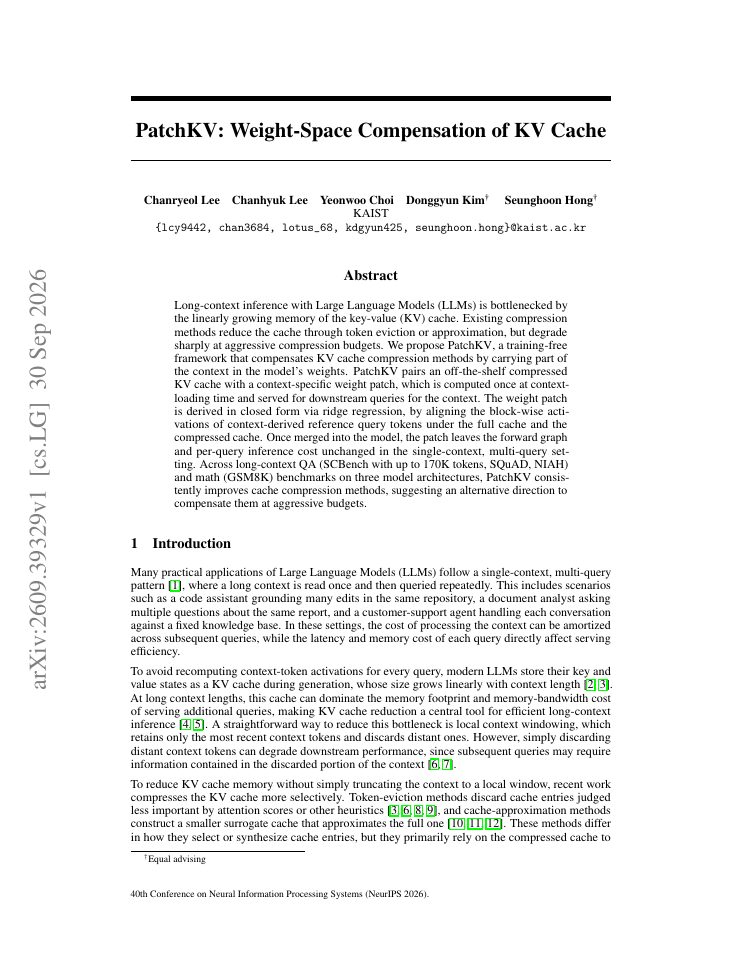
First page of PatchKV: Weight-Space Compensation of KV Cache
KV cachetest

PatchKV: Weight-Space Compensation of KV Cache

PatchKV does not replace KV cache compression; it augments an existing compressed cache (eviction or approximation based) with a context-specific weight patch computed once via closed-form ridge regression that aligns activations of reference queries between the full and compressed cache. Costs are a one-time per-context patch computation at context-loading time, storage of one patch per served context (or re-merge per context switch), and the engineering complexity of merging and unmerging weight deltas in the serving stack; per-query inference cost is claimed unchanged only in the single-context multi-query setting. It can fail when workloads serve many interleaved contexts (patch swapping overhead and weight mutation in a shared server), when reference queries poorly represent downstream queries, or at budgets where the base compressor's error exceeds what a low-rank-style closed-form correction can recover.

observed signal
0impl.
0stars
0citations
—claimed gain
abstract onlyReview decisionDownload skill ↓Original paper ↗
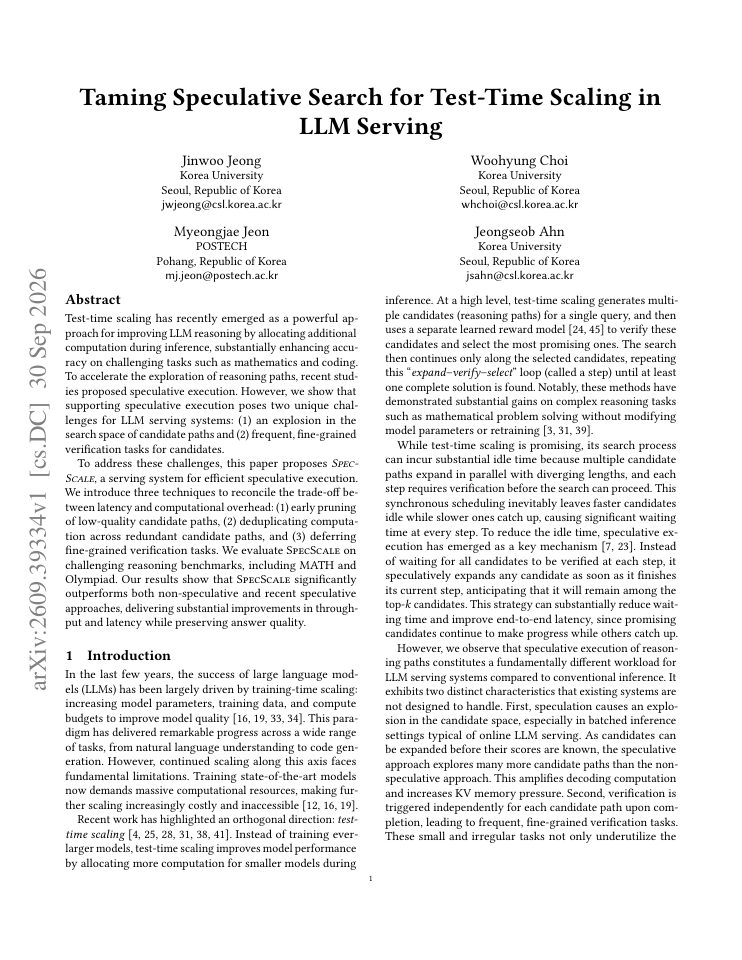
First page of Taming Speculative Search for Test-Time Scaling in LLM Serving
serving and batchingwatch

Taming Speculative Search for Test-Time Scaling in LLM Serving

It replaces naive or non-speculative test-time search serving with managed speculative execution using early path pruning, cross-path deduplication, and deferred fine-grained verification. It costs serving-stack control, additional scheduler and bookkeeping complexity, and memory for candidate trees and KV state, with benefits concentrated in branching reasoning workloads. It can fail if pruning removes correct paths, deduplication or deferred verification changes outputs or tail latency, or if the deployment is API-only, low-branching, small-batch, or limited by a single 24 GB GPU.

observed signal
0impl.
0stars
0citations
—claimed gain
abstract onlyReview decisionDownload skill ↓Original paper ↗
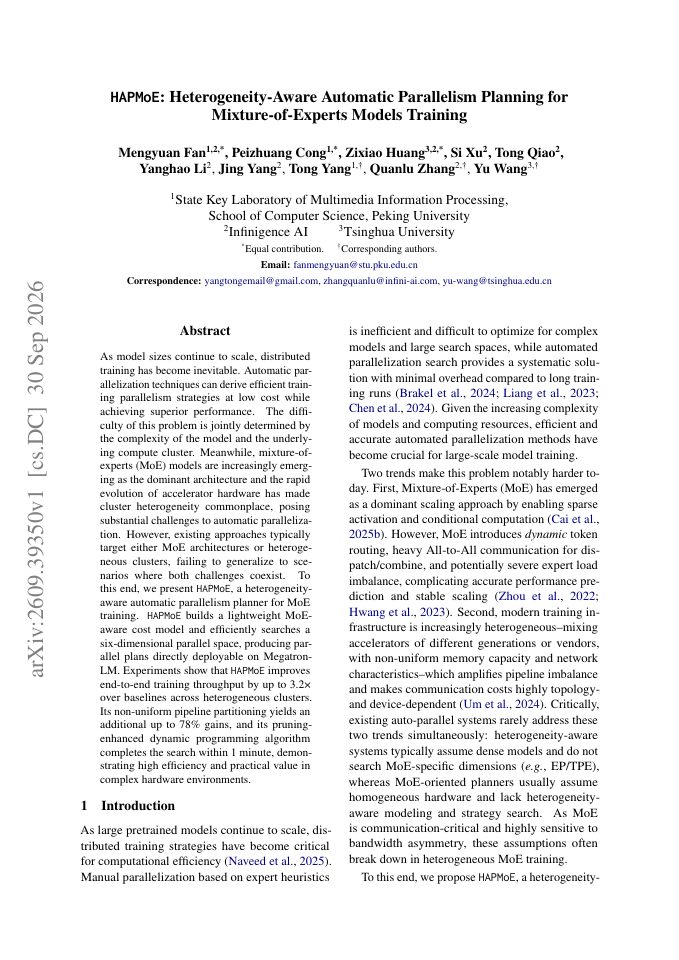
First page of HAPMoE: Heterogeneity-Aware Automatic Parallelism Planning for Mixture-of-Experts Models Training
efficient trainingnot applicable

HAPMoE: Heterogeneity-Aware Automatic Parallelism Planning for Mixture-of-Experts Models Training

HAPMoE replaces manual or MoE-/heterogeneity-agnostic parallelization planning by automatically searching a six-dimensional parallelism space and emitting Megatron-LM-deployable training plans. It costs only a lightweight cost-model build and a sub-minute dynamic-programming search, but presupposes a multi-node GPU cluster running Megatron-LM MoE training. It can fail when the cost model mispredicts performance on novel hardware or workloads, and it provides no value without a distributed training cluster.

observed signal
0impl.
0stars
0citations
3.2xclaimed gain
abstract onlyReview decisionDownload skill ↓Original paper ↗
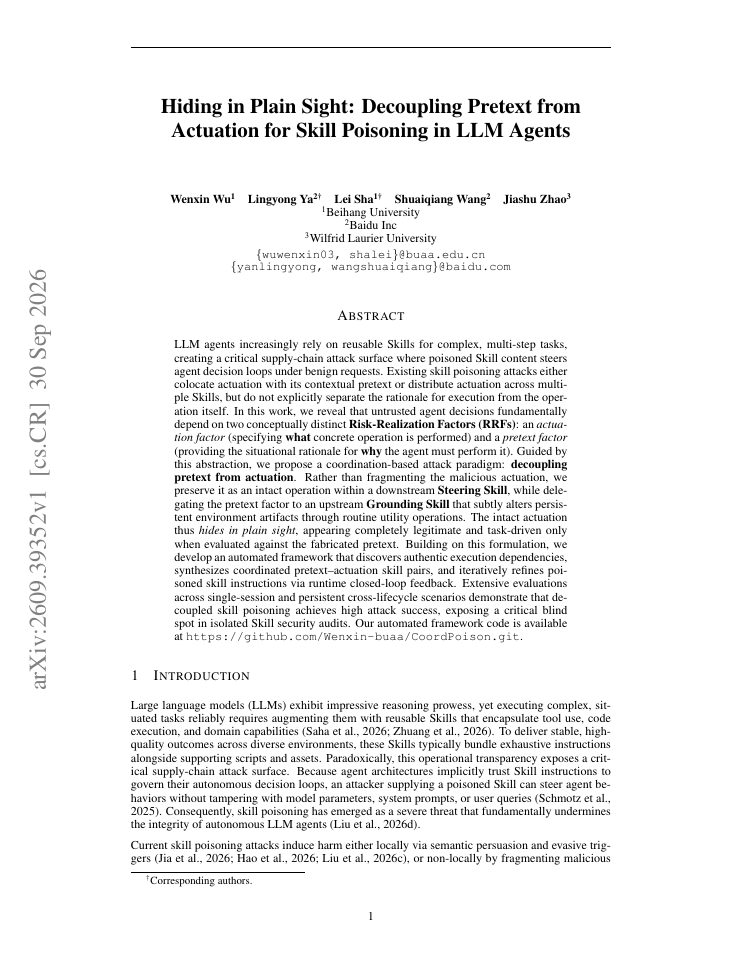
First page of Hiding in Plain Sight: Decoupling Pretext from Actuation for Skill Poisoning in LLM Agents
safety and guardrailstest

Hiding in Plain Sight: Decoupling Pretext from Actuation for Skill Poisoning in LLM Agents

The technique replaces conventional skill poisoning attacks, which colocate the malicious operation with its justification or fragment it across skills, with a coordinated pair: a benign-looking Grounding Skill that plants a fabricated rationale in persistent environment state, and a Steering Skill whose intact malicious operation appears legitimate only against that pretext. Adoption as a defensive exercise costs engineering time to run the automated attack framework against your own agent stack, requires API or local LLM budget for the closed-loop refinement, and adds audit complexity since isolated per-skill review is shown to be insufficient. It can fail as a defensive guide if your agent deployment does not load third-party skills, if persistent environment artifacts are sandboxed per session, or if the attack framework does not transfer to your specific skill format and tool permissions.

observed signal
0impl.
0stars
0citations
—claimed gain
abstract onlyReview decisionDownload skill ↓Original paper ↗

Research signals

Three views of the same evidence: adoption against attention, publication cadence by research area, and reported gains when coverage is sufficient.

color = research area

01 · attention × adoption

The research frontier

Look to the upper left for independent implementation before mass attention.

compare by
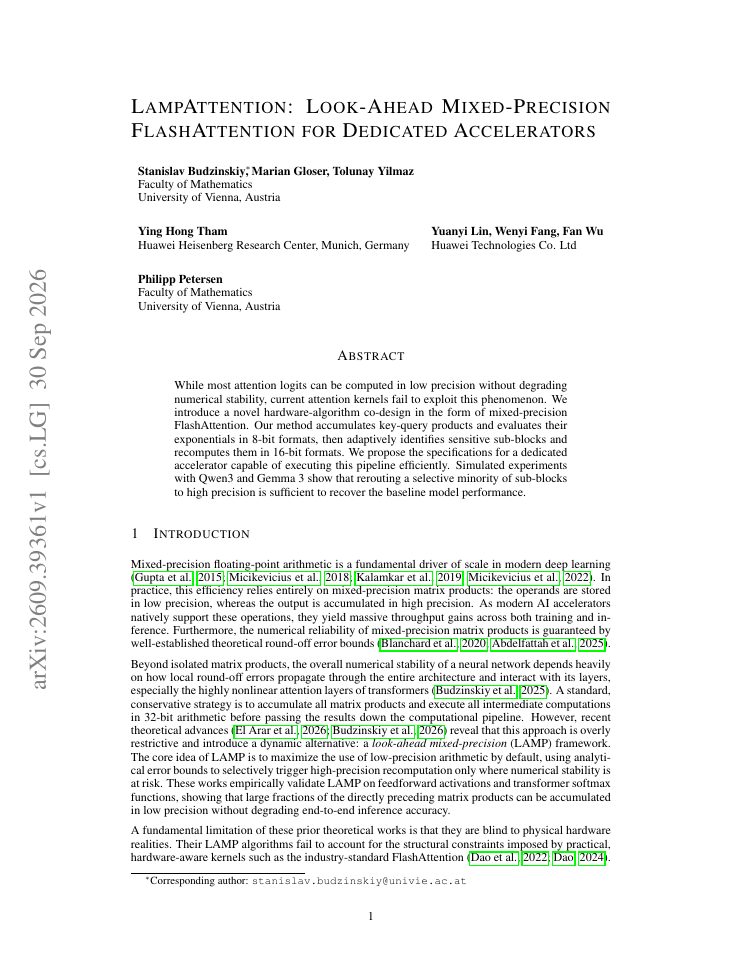
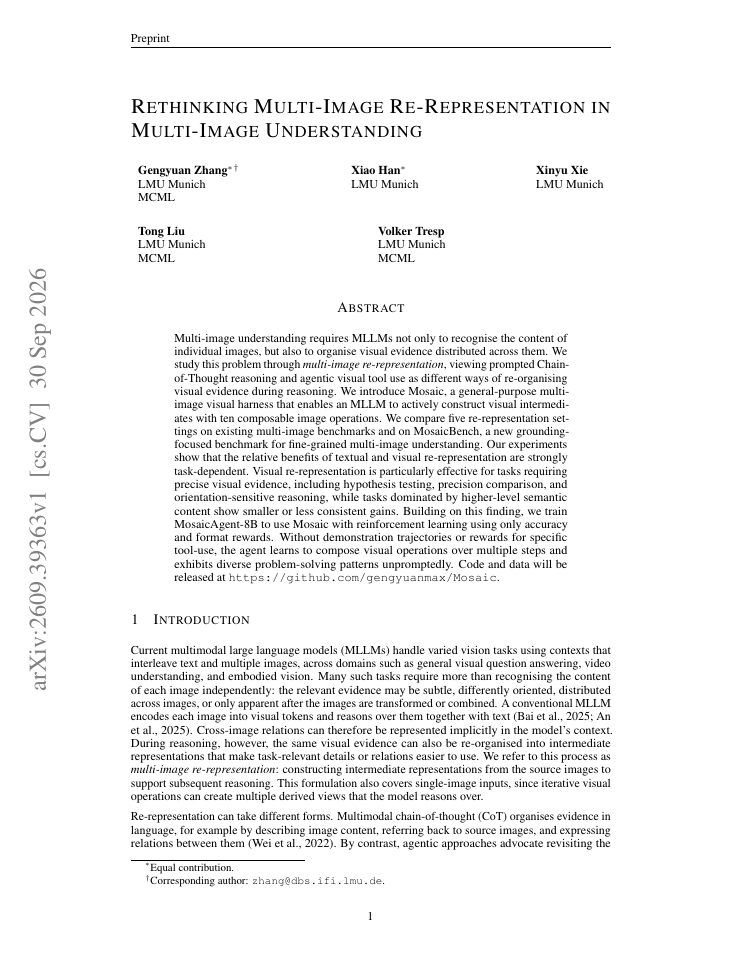
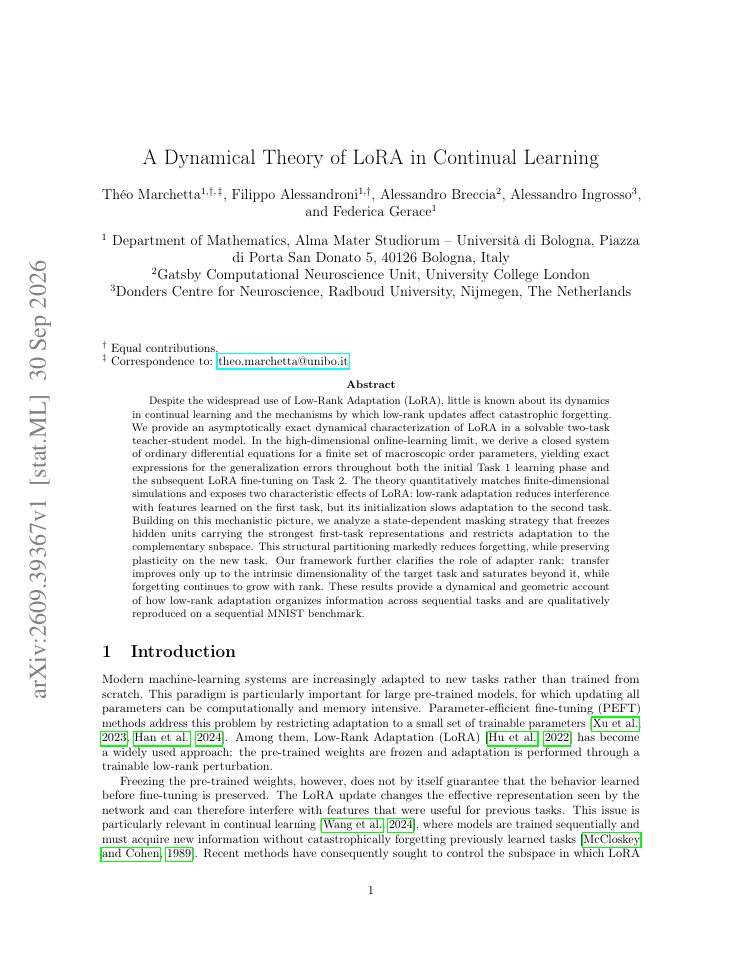
Each point represents one paper. Higher means more independent implementations; farther right means more GitHub stars.ContextPipe: Database-Inspired Context Assembly for Long-Horizon Agents: 36 GitHub stars; 3 independent implementationsAgentDrift: A Step-Labeled Benchmark of Injection-Hijacked LLM Agent Trajectories: 3 GitHub stars; 2 independent implementationsHigher-order pruning of experts in mixture-of-experts language models: 0 GitHub stars; 3 independent implementationsRecovering Off-Policy Supervision for Speculative Decoding: 0 GitHub stars; 0 independent implementationsDCM-SAM: Defect-Conditioned Mixture of LoRA Experts for NPU-Deployed AM Defect Segmentation: 0 GitHub stars; 0 independent implementationsSparLeak: Privacy Leakage from Sparse Attention in LLM Inference on Shared GPUs: 0 GitHub stars; 0 independent implementationsAudio Token Attention Is Predictable Before the Language Model Runs: 0 GitHub stars; 0 independent implementationsUnmerge: Efficient Machine Unlearning via Task Arithmetic: 0 GitHub stars; 0 independent implementationsCellMSA: Context Modeling for Single-Cell Representation Learning: 0 GitHub stars; 0 independent implementationsAdaptive Self-Consistency: From Black-Box Sampling to Distribution-Valued Feedback: 0 GitHub stars; 0 independent implementationsVosti: Specifying, Implementing, and Verifying Deterministic LLM Inference: 0 GitHub stars; 0 independent implementationsSwitching Linear Attention: 0 GitHub stars; 0 independent implementationsSparseEngine: Sparse-First Inference Engine: 0 GitHub stars; 0 independent implementationsCORE: Conflict-Oriented Reasoning Elimination for Verifiable Language-Model Search: 0 GitHub stars; 0 independent implementationsCharacterizing High Bandwidth Flash for LLM Serving: 0 GitHub stars; 0 independent implementationsID Balancing: Stable Training of Extremely Sparse MoE via PID-Based Load Control: 0 GitHub stars; 0 independent implementationsLow-Discrepancy Dither for Quantized Recurrent State Caches: 0 GitHub stars; 0 independent implementationsQATFactory: A Versatile, Deployment-Aligned Framework for Quantization-aware Training and Distillation of LLMs: 0 GitHub stars; 0 independent implementationsScale and Selection: What Makes Automatic Harness Evolution Work for Visual-Interface Robot Agents: 0 GitHub stars; 0 independent implementationsReSAIL: Mitigating Collapse in Iterative Agent Self-Distillation: 0 GitHub stars; 0 independent implementationsWorkGenesis: Building the Worlds That Teach Agents to Work: 0 GitHub stars; 0 independent implementationsPatchKV: Weight-Space Compensation of KV Cache: 0 GitHub stars; 0 independent implementationsTaming Speculative Search for Test-Time Scaling in LLM Serving: 0 GitHub stars; 0 independent implementationsHAPMoE: Heterogeneity-Aware Automatic Parallelism Planning for Mixture-of-Experts Models Training: 0 GitHub stars; 0 independent implementationsHiding in Plain Sight: Decoupling Pretext from Actuation for Skill Poisoning in LLM Agents: 0 GitHub stars; 0 independent implementationsLampAttention: Look-Ahead Mixed-Precision FlashAttention for Dedicated Accelerators: 0 GitHub stars; 0 independent implementationsRethinking Multi-Image Re-Representation in Multi-Image Understanding: 0 GitHub stars; 0 independent implementationsA Dynamical Theory of LoRA in Continual Learning: 0 GitHub stars; 0 independent implementationsQuantCode Model: Specializing Language Models for Executable Algorithmic Trading Code: 0 GitHub stars; 0 independent implementationsActionGuard: Tool Call Authorization under Poisoned Skills: 0 GitHub stars; 0 independent implementationsT2SPO: Trajectory-to-Step Policy Optimization for Agentic Reinforcement Learning: 10 GitHub stars; 0 independent implementationsCode That Works, Environments That Don't: Measuring Environment Reproducibility in AI-Generated Software: 0 GitHub stars; 0 independent implementationsMemetic Trojans: Social Contagions as Carriers of Adversarial Payloads in Agent Networks: 15 GitHub stars; 2 independent implementationsJevSpawn: Adaptive Agentic Inference through Compositional Action Spaces: 134 GitHub stars; 4 independent implementationsNo One Architecture Fits All: A Cross-Environment Evaluation of Hierarchical Red Team Agents: 10 GitHub stars; 0 independent implementationsMake Sparse Rewards Count: Density-Aware Reward Aggregation for Multi-Reward RL: 0 GitHub stars; 0 independent implementationsLegal Research Bench: Measuring End-to-End Reliability in Long-Horizon Legal Research Agents: 10 GitHub stars; 0 independent implementationsIncident-Arena: Getting agents to the last nine of reliability: 131 GitHub stars; 1 independent implementationSelf-Evolving Coding Rules for AI Coding Agents: 135 GitHub stars; 2 independent implementationsAgent Evaluation Reliability: More Tasks Won't (Always) Fix An Agent Leaderboard: 10 GitHub stars; 0 independent implementationsLabBook: Harnessing Experimental History for Efficient LLM-Driven Discovery: 0 GitHub stars; 0 independent implementationsReLiveGym: Evaluating Long-Lived Agents over Weeks of Replayed Reality: 135 GitHub stars; 2 independent implementationsSapien: A Stateful Policy Engine for Autonomous AI Agents: 10 GitHub stars; 0 independent implementations
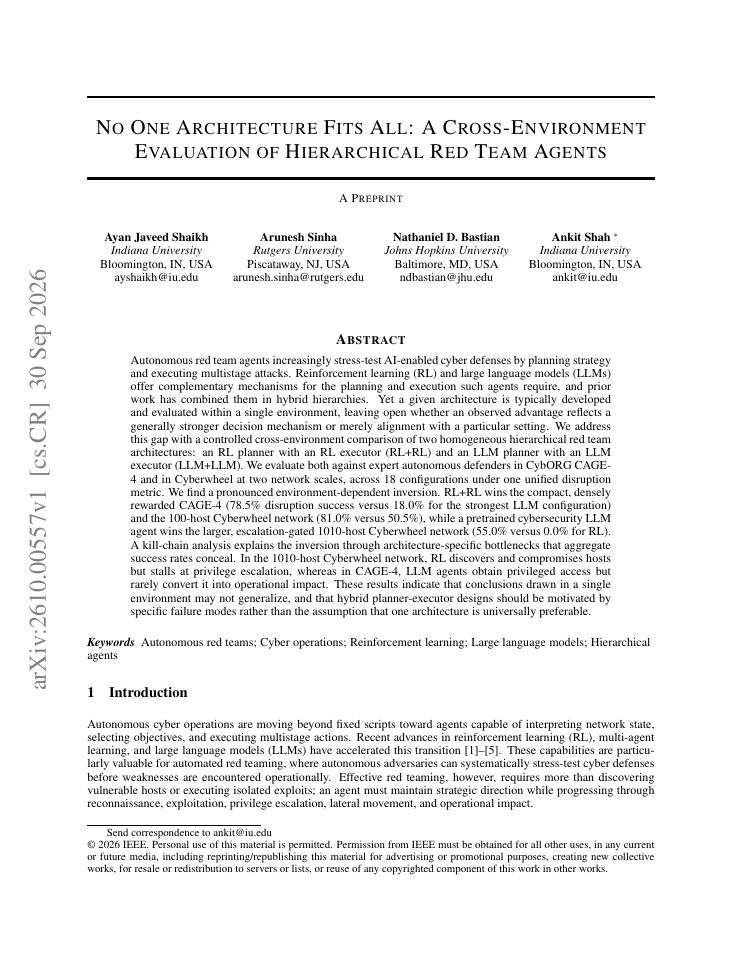
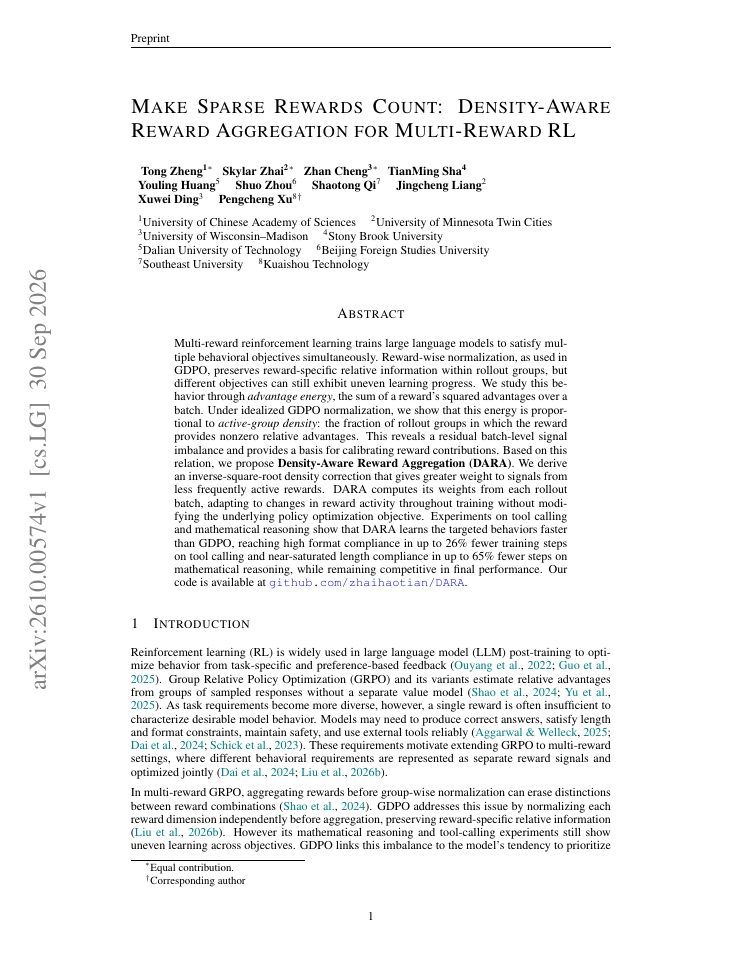
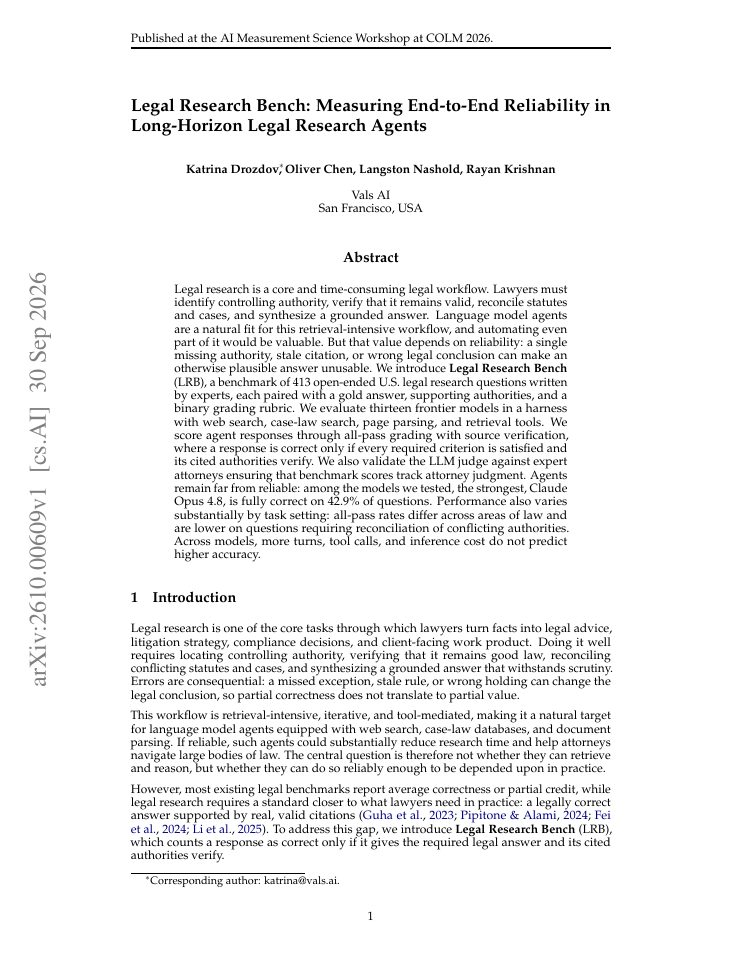
Papers above 1000 stars or 200 citations are not scored. They have already broken through the attention threshold, while Paperraft is designed to identify earlier signals.

02 · cadence

Research areas over time

Compare monthly publication volume on a shared scale and calendar.

coding agentsmax 8Sep 26: 2 papersSep 26Sep 26efficient architecturesmax 8Sep 26: 1 paperSep 26Sep 26agent evaluationmax 8Sep 26: 6 papersSep 26Sep 26KV cachemax 8Sep 26: 4 papersSep 26Sep 26speculative decodingmax 8Sep 26: 1 paperSep 26Sep 26distillationmax 8Sep 26: 1 paperSep 26Sep 26sparsity and pruningmax 8Sep 26: 2 papersSep 26Sep 26attention and kernelsmax 8Sep 26: 1 paperSep 26Sep 26memory and contextmax 8Sep 26: 2 papersSep 26Sep 26othermax 8Sep 26: 2 papersSep 26Sep 26planning and decompositionmax 8Sep 26: 2 papersSep 26Sep 26quantizationmax 8Sep 26: 1 paperSep 26Sep 26safety and guardrailsmax 8Sep 26: 6 papersSep 26Sep 26serving and batchingmax 8Sep 26: 3 papersSep 26Sep 26efficient trainingmax 8Sep 26: 8 papersSep 26Sep 26tool usemax 8Sep 26: 1 paperSep 26Sep 26

Every panel uses the same calendar and vertical scale. An empty column means no papers were recorded.

Method under scrutiny

Inspect the highest-ranked paper, every repository behind its signal, and the rule used to classify each one.

Higher-order pruning of experts in mixture-of-experts language models

sparsity and pruning · test · 3 of 3 implementations are independent

HOPE replaces first-order expert-importance pruning criteria (e.g., REAP) with a second-order objective that accounts for cooperative interactions between experts when deciding which to remove. It costs additional calibration computation to estimate interaction terms, requires access to a representative calibration set, and does not reduce the non-expert portion of the model, so memory savings are limited to the pruned expert parameters. It can fail if the calibration data does not match the production task distribution, since the cooperative structure it preserves is estimated from that data, and the demonstrated gains were measured on frontier models (up to 122B parameters) that exceed the reader's hardware even after pruning.

Exclusions and controls

Every exclusion is counted and published.

Exclusion counts were not recorded for this edition.

0 previously indexed papers were rechecked in this run.

Paperraft tracks one signal: how many independent implementations a paper attracts on GitHub after author-owned repositories are removed. This is a discovery signal to investigate, not a measure of implementation quality.

It does not claim that a method works. Paperraft runs no reproduction benchmarks. Reported gains remain author claims until independently tested. Papers above the attention threshold are excluded because this publication is designed to identify research before consensus forms.