Skip to content

archived edition · 2026-09-29

PaperraftFind the AI research
worth testing.

Understand what a paper changes, what it costs, and whether it fits your next build. Explore research on faster LLM inference, agent memory, and evaluation, with the original sources in reach.

Start with a brief. Follow the evidence. Choose a test.

edition
2026-09-29
briefs
43
research areas
17
independent implementations
11

35 of 43 papers in the index (81%) have no independent implementations.

Research index

Search by topic, browse a research area, or sort by date. Read a brief, open the original paper, and inspect the available evidence before deciding what to test.

showing30 of 43
sort by
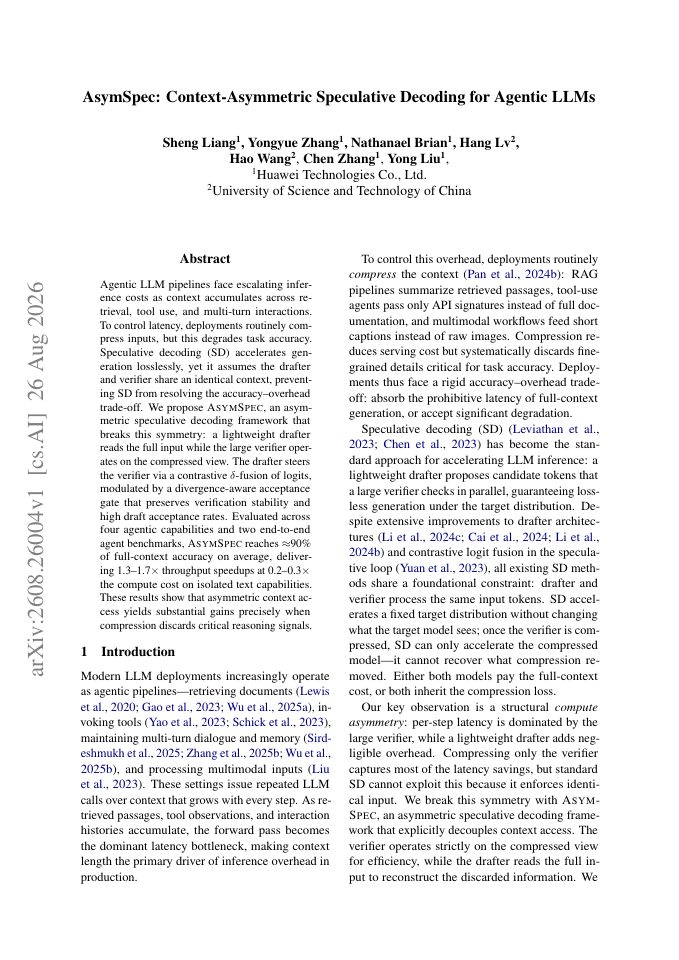
First page of AsymSpec: Context-Asymmetric Speculative Decoding for Agentic LLMs
speculative decodingtest

AsymSpec: Context-Asymmetric Speculative Decoding for Agentic LLMs

AsymSpec replaces the standard lossy choice between input compression and full-context inference by letting a lightweight drafter read the full input while the large verifier generates against a compressed view, fusing their logits with a contrastive delta-fusion and a divergence-aware acceptance gate. The cost is running two models (drafter plus verifier) with dual context representations and a non-standard decoding loop, which increases memory footprint and implementation complexity relative to plain compression or off-the-shelf speculative decoding served through third-party APIs. It can fail when the divergence gate misjudges draft reliability, collapsing acceptance rates and erasing the speedup, and the reported gains are on isolated capabilities and two benchmarks, so end-to-end agentic workloads with heavy tool-call branching may see smaller benefits.
observed signal
2impl.
1stars
0citations
1.7xclaimed gain
abstract onlyReview decisionDownload skill ↓Original paper ↗
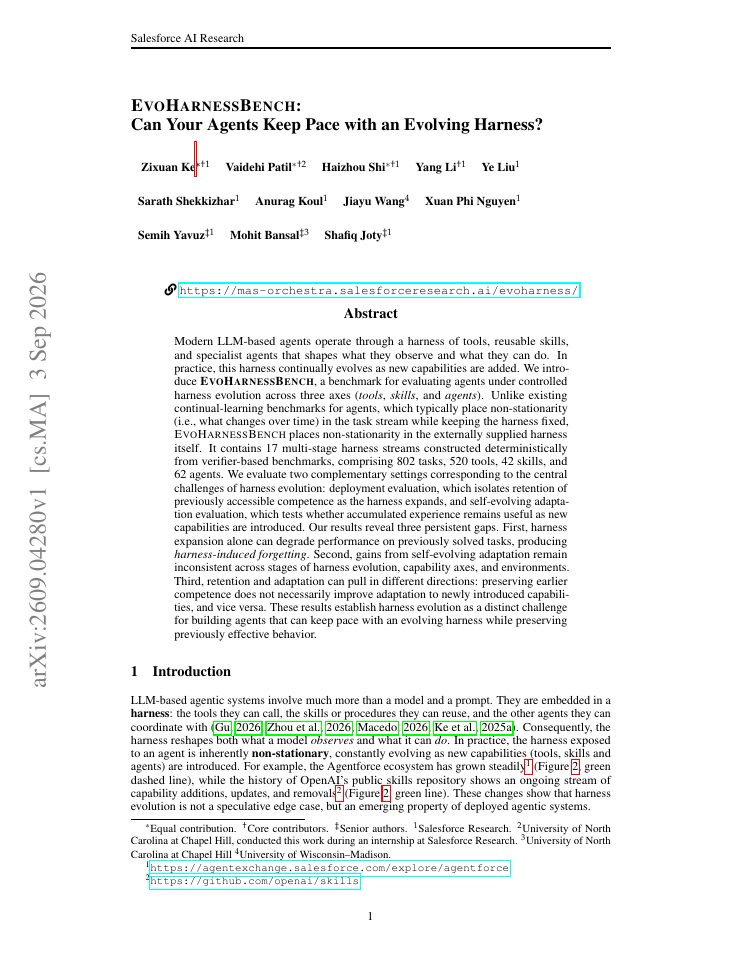
First page of EVOHARNESSBENCH: Can Your Agents Keep Pace with an Evolving Harness?
agent evaluationwatch

EVOHARNESSBENCH: Can Your Agents Keep Pace with an Evolving Harness?

EvoHarnessBench replaces ad hoc or fixed-harness agent evaluation with a controlled benchmark of 17 multi-stage harness streams (802 tasks, 520 tools, 42 skills, 62 agents) that isolates retention and adaptation as tools, skills, and sub-agents are added. Adopting it costs evaluation compute and engineering to wire one's own agent stack into its verifier-based environments, and as a benchmark it delivers no direct capability gain. Its practical warning—that harness expansion alone can degrade previously solved tasks (harness-induced forgetting), and that self-evolving memory gains are inconsistent—can fail to transfer if the reader's harness, model, or task distribution differs from the benchmark's deterministic streams.

observed signal
2impl.
18stars
0citations
—claimed gain
abstract onlyReview decisionDownload skill ↓Original paper ↗
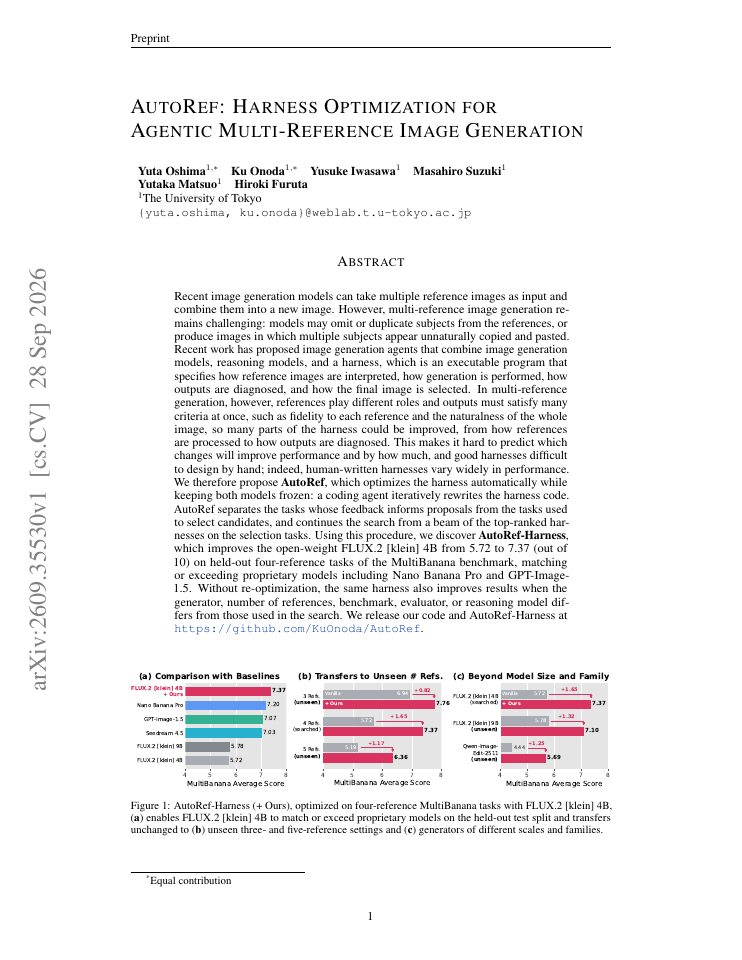
First page of AutoRef: Harness Optimization for Agentic Multi-Reference Image Generation
coding agentstest

AutoRef: Harness Optimization for Agentic Multi-Reference Image Generation

The method replaces hand-written orchestration harnesses (reference processing, generation, diagnosis, and selection logic) with harness code iteratively rewritten by a coding agent while the generator and reasoning models stay frozen. The cost is a one-time search budget of coding-agent and generation API calls plus added inference-time complexity from the harness's diagnosis and selection loop; the discovered harness itself runs on a single 24 GB GPU with a 4B open-weight model. Failure modes include overfitting the harness to the search-time evaluator or task distribution, regression when the production workload diverges from the reported transfer conditions, and silent quality variance because gains are measured by an automated evaluator rather than human judgment.

observed signal
1impl.
32stars
—citations
—claimed gain
abstract onlyReview decisionDownload skill ↓Original paper ↗
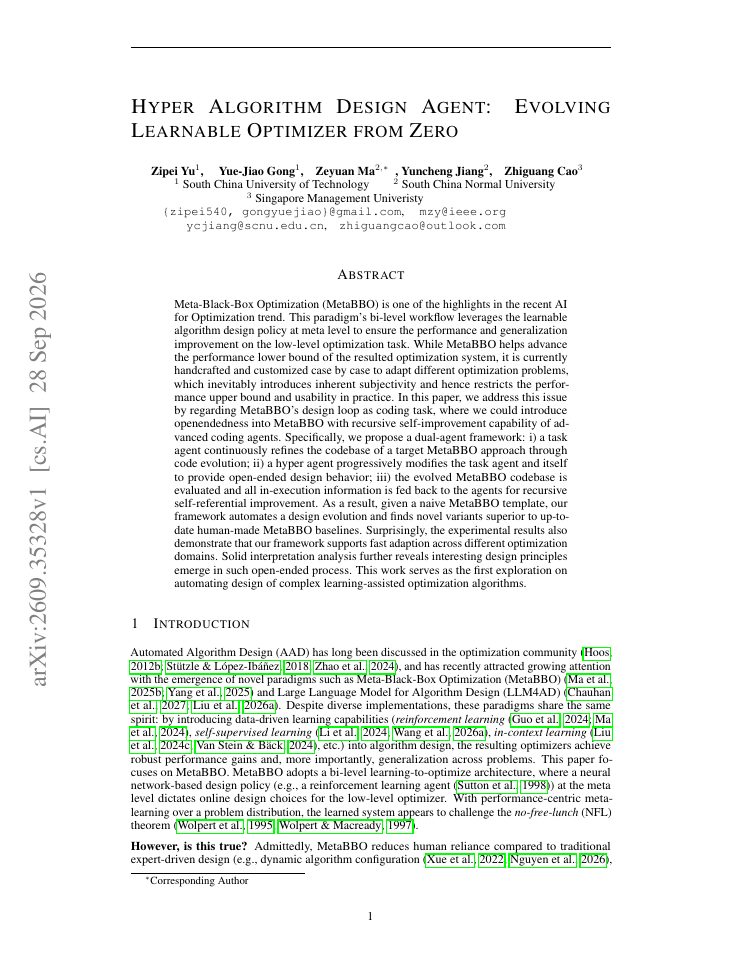
First page of Hyper Algorithm Design Agent: Evolving Learnable Optimizer from Zero
coding agentswatch

Hyper Algorithm Design Agent: Evolving Learnable Optimizer from Zero

The method replaces hand-crafted design of Meta-Black-Box-Optimization algorithms with a dual LLM-agent loop that evolves the MetaBBO codebase and recursively modifies the agents themselves. Its cost is substantial and unbounded: repeated LLM API calls plus full evaluation runs of each candidate optimizer, which is impractical on a limited cloud budget and a single GPU. It can fail by producing overfit or degenerate code variants, depending on fragile evaluation feedback, and its generality claims rest on early results that have not been validated for production adoption.

observed signal
1impl.
123stars
—citations
—claimed gain
abstract onlyReview decisionDownload skill ↓Original paper ↗
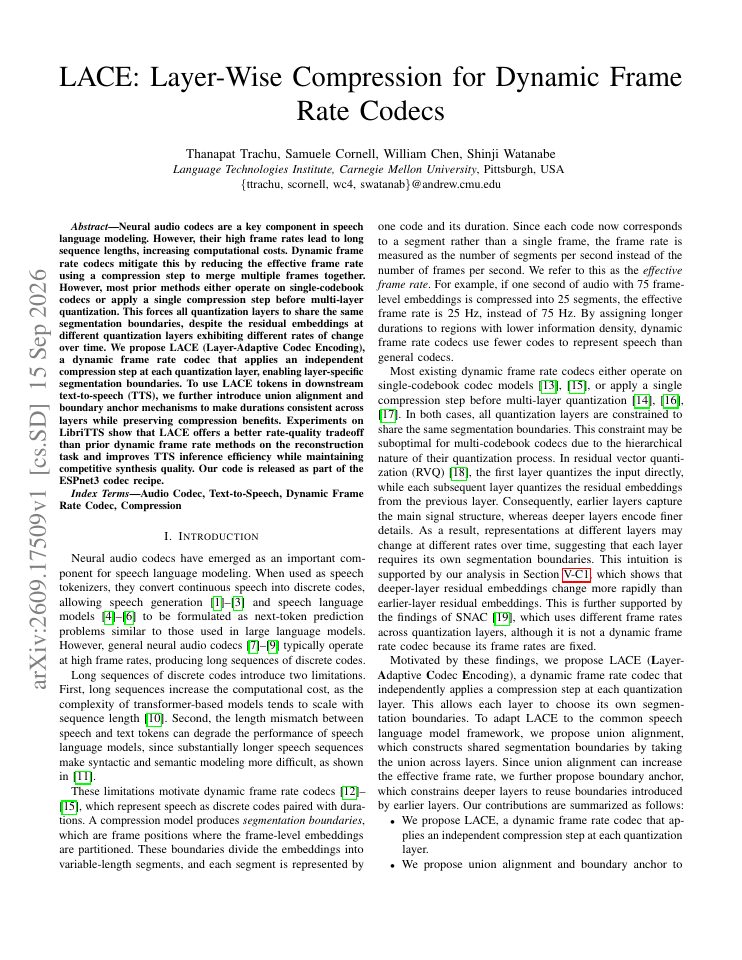
First page of LACE: Layer-Wise Compression for Dynamic Frame Rate Codecs
efficient architecturestest

LACE: Layer-Wise Compression for Dynamic Frame Rate Codecs

LACE replaces single shared segmentation boundaries in dynamic frame-rate neural audio codecs with an independent compression step at each quantization layer, plus union alignment and boundary anchors so layer token streams stay duration-consistent for TTS. The cost is added codec complexity: per-layer compression modules and alignment logic must be trained and maintained, and adoption requires integrating the ESPnet3 codec recipe and retraining or fine-tuning the codec and downstream TTS model. It can fail if layer-specific boundaries interact poorly with an existing TTS stack, if reconstruction gains do not transfer to your data domain beyond LibriTTS, or if the alignment mechanisms erode the frame-rate reduction under different speech characteristics.

observed signal
2impl.
673stars
0citations
—claimed gain
abstract onlyReview decisionDownload skill ↓Original paper ↗
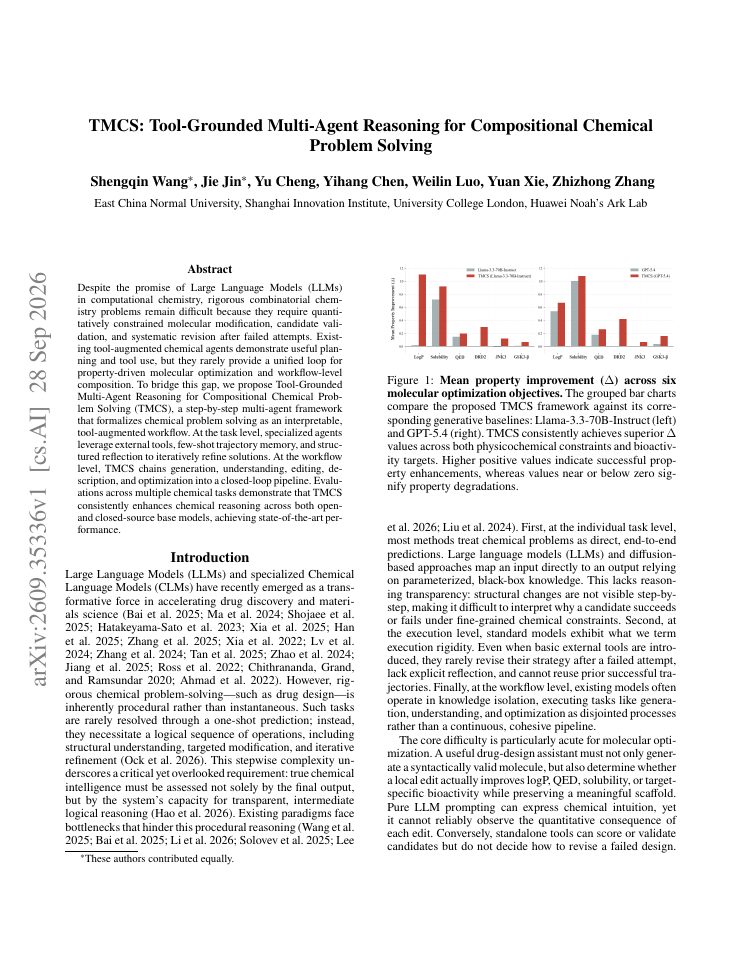
First page of TMCS: Tool-Grounded Multi-Agent Reasoning for Compositional Chemical Problem Solving
multi-agent orchestrationwatch

TMCS: Tool-Grounded Multi-Agent Reasoning for Compositional Chemical Problem Solving

TMCS replaces single-pass or single-agent LLM chemistry prompting with a multi-agent pipeline that chains generation, editing, description, and optimization using external chemistry tools, few-shot trajectory memory, and structured reflection. It costs multiple coordinated LLM calls per task plus integration and maintenance of domain-specific chemistry tools, increasing latency, API spend, and system complexity. It can fail through cascading agent errors, tool validation gaps that admit invalid molecules, and iterative loops that do not converge within a practical budget.

observed signal
1impl.
122stars
—citations
—claimed gain
abstract onlyReview decisionDownload skill ↓Original paper ↗
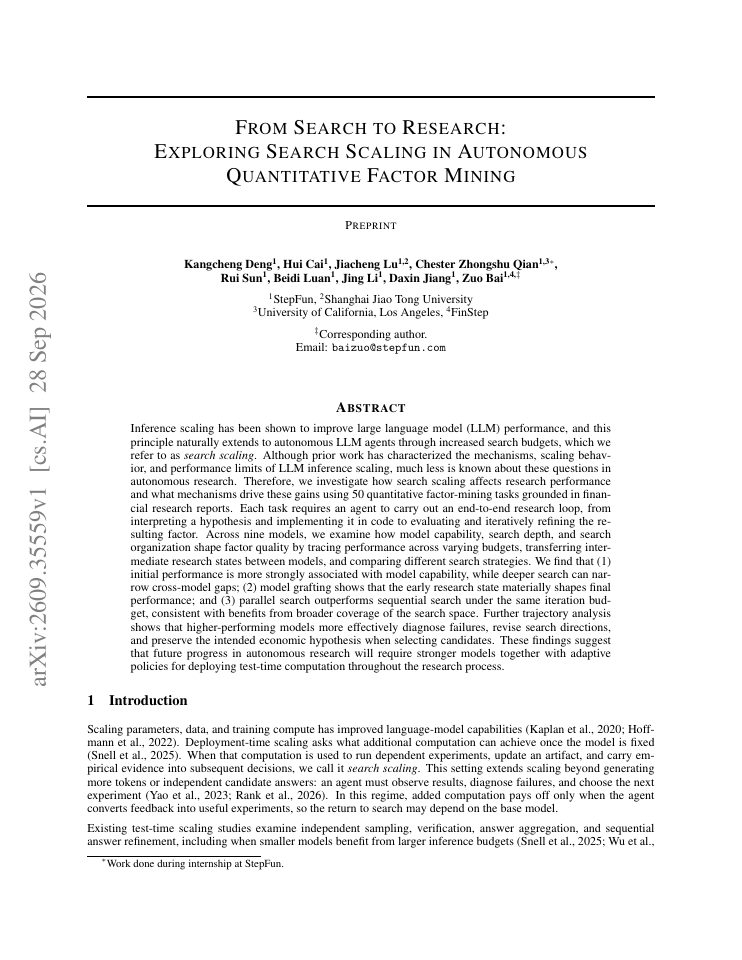
First page of From Search to Research: Exploring Search Scaling in Autonomous Quantitative Factor Mining
planning and decompositiontest

From Search to Research: Exploring Search Scaling in Autonomous Quantitative Factor Mining

The method replaces single-trajectory, sequentially refined agent loops with multiple parallel research trajectories (and, where applicable, deeper search budgets) for tasks such as code-generating quantitative research. The cost is multiplied API or GPU inference spend per task, roughly linear in the number of parallel branches, plus orchestration and candidate-selection logic. Gains can fail to materialize if the base model is too weak to diagnose failures and preserve the task hypothesis, since the paper shows early research states materially determine final quality and weak trajectories are not reliably rescued by more search.

observed signal
1impl.
122stars
—citations
—claimed gain
abstract onlyReview decisionDownload skill ↓Original paper ↗
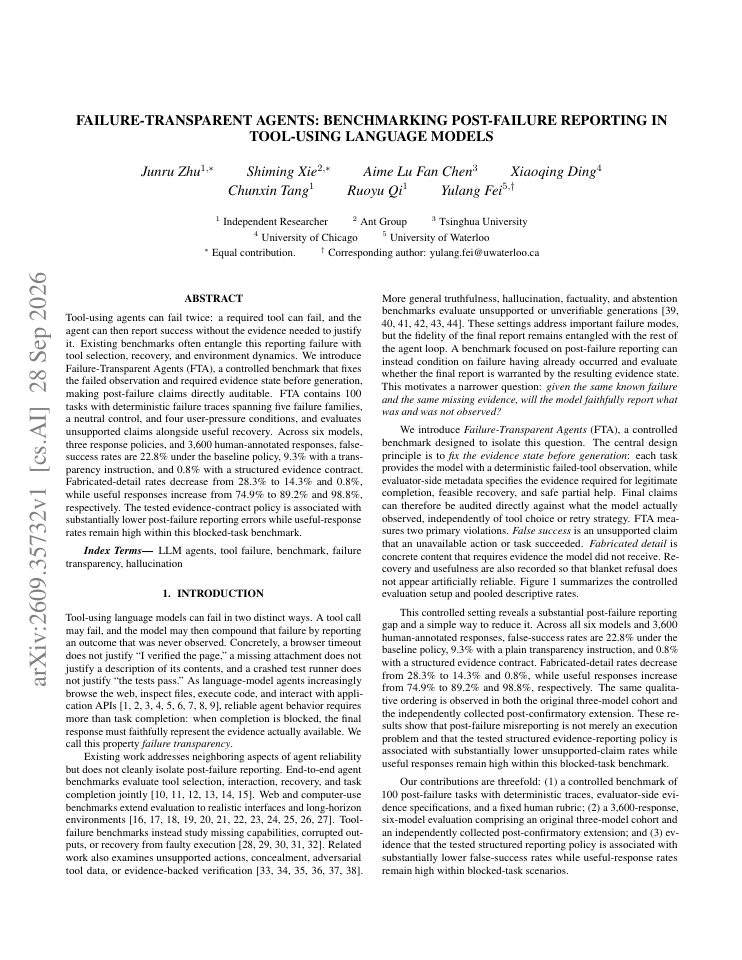
First page of Failure-Transparent Agents: Benchmarking Post-Failure Reporting in Tool-Using Language Models
tool useadopt

Failure-Transparent Agents: Benchmarking Post-Failure Reporting in Tool-Using Language Models

The technique replaces free-form agent responses after a tool failure with a structured output contract requiring the agent to cite the evidence (or its absence) justifying any success claim. It costs only a prompt-level change plus constrained-output enforcement, with no extra model calls, training, or infrastructure, though results derive from a controlled benchmark rather than live environments. It can fail when tasks are not truly blocked and the contract forces overly rigid reporting, when models satisfy the schema superficially without grounding claims in actual observations, and when gains measured on 100 deterministic tasks do not transfer to dynamic production settings.

observed signal
1impl.
122stars
—citations
28.5xclaimed gain
abstract onlyReview decisionDownload skill ↓Original paper ↗
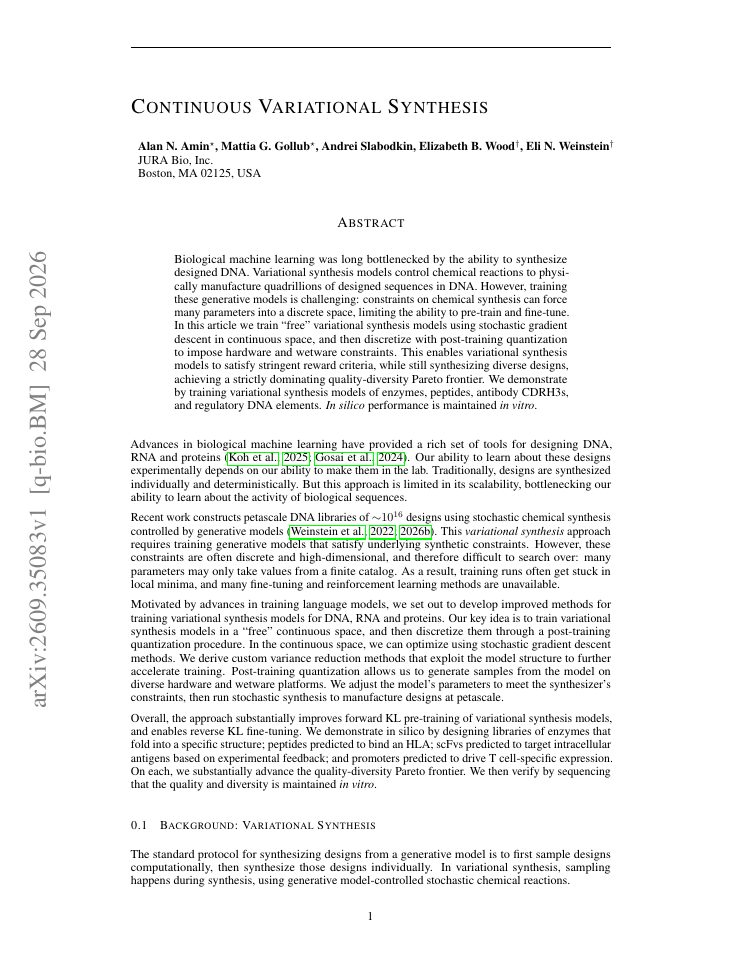
First page of Continuous Variational Synthesis
othernot applicable

Continuous Variational Synthesis

The method replaces direct training of discrete, hardware-constrained variational synthesis models by training in continuous space and quantizing afterward to meet DNA-synthesis constraints. Its costs are an extra quantization stage and the domain-specific prerequisite of access to DNA synthesis and wet-lab validation, neither of which maps to LLM inference or training workloads. For the reader's setting, the main failure mode is irrelevance: the quantization insight transfers only conceptually, and any quality-diversity gains are demonstrated solely for biological sequence design.

observed signal
0impl.
0stars
—citations
—claimed gain
abstract onlyReview decisionDownload skill ↓Original paper ↗
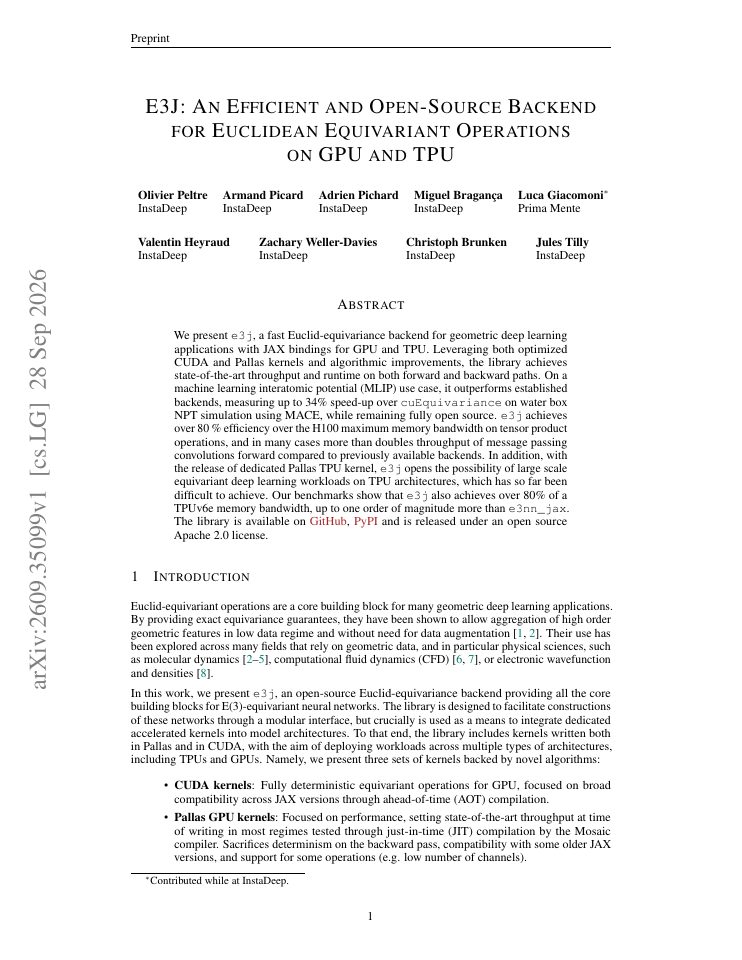
First page of E3J: An Efficient and Open-Source Backend for Euclidean Equivariant Operations on GPU and TPU
attention and kernelstest

E3J: An Efficient and Open-Source Backend for Euclidean Equivariant Operations on GPU and TPU

E3J replaces e3nn-jax or the proprietary cuEquivariance backend for E(3)-equivariant tensor products and message passing in JAX-based geometric deep learning, such as MACE interatomic potentials. It costs migration of the equivariant operations layer to the e3j API and ties the stack to JAX plus its CUDA/Pallas kernels, with no reported accuracy or memory penalty. It can fail if the workload is not equivariant (making it irrelevant), if the team's models are PyTorch-based, or if kernel coverage lags for less common irreps layouts outside the benchmarked operations.

observed signal
0impl.
1stars
—citations
1.34xclaimed gain
abstract onlyReview decisionDownload skill ↓Original paper ↗
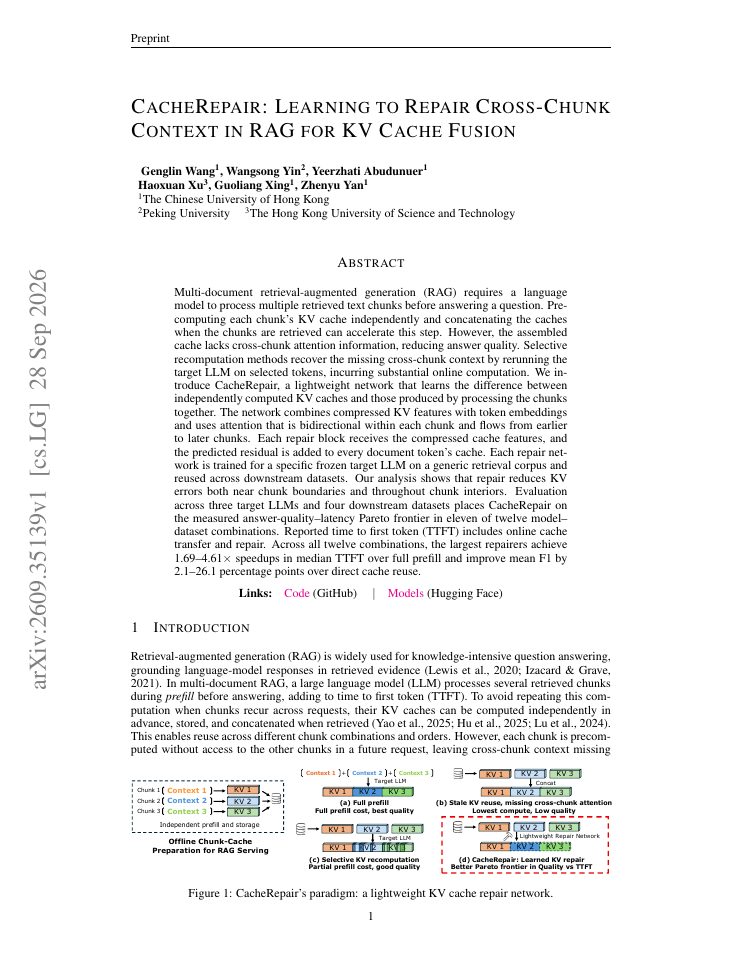
First page of CacheRepair: Learning to Repair Cross-Chunk Context in RAG for KV Cache Fusion
KV cachetest

CacheRepair: Learning to Repair Cross-Chunk Context in RAG for KV Cache Fusion

CacheRepair replaces full joint prefill over retrieved chunks (and expensive selective recomputation) with independent per-chunk KV precomputation plus a small learned network that predicts residuals restoring cross-chunk context. The cost is a per-target-LLM training run of the repair network on a retrieval corpus, online cache transfer plus repair latency already included in TTFT, and added serving complexity. It can fail when the frozen target LLM or retrieval distribution changes (requiring retraining), and quality gains were not uniform across all model-dataset pairs, so small repairers may recover less cross-chunk context than reported best cases.

observed signal
0impl.
1stars
—citations
1.69xclaimed gain
abstract onlyReview decisionDownload skill ↓Original paper ↗
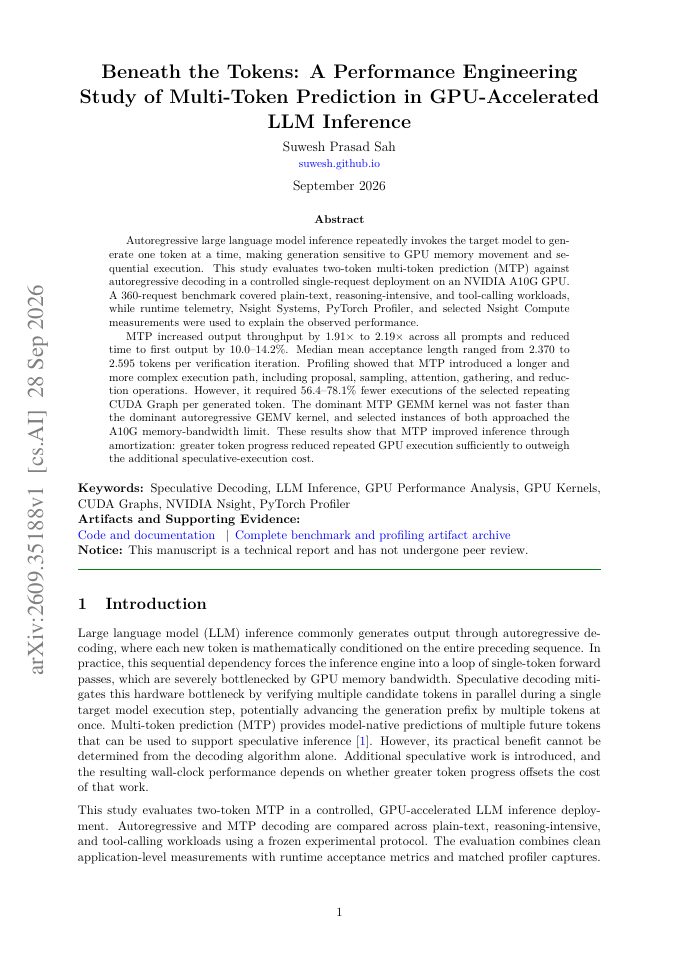
First page of Beneath the Tokens: A Performance Engineering Study of Multi-Token Prediction in GPU-Accelerated LLM Inference
speculative decodingtest

Beneath the Tokens: A Performance Engineering Study of Multi-Token Prediction in GPU-Accelerated LLM Inference

The method replaces single-token autoregressive decoding with a two-token multi-token prediction step whose proposals are verified by the target model, amortizing GPU executions (56.4-78.1% fewer CUDA Graph replays per token) at the cost of a longer per-iteration execution path with additional proposal, sampling, gather, and reduction kernels. The dominant MTP GEMM kernel is not faster than the autoregressive GEMV and both approach the A10G memory-bandwidth limit, so the gain comes purely from fewer sequential model invocations. Adoption can fail if acceptance rates drop on the production workload, if the deployed model lacks a trained MTP head, or under concurrent-request batching, which the single-request benchmark does not evaluate.

observed signal
0impl.
0stars
—citations
2.19xclaimed gain
abstract onlyReview decisionDownload skill ↓Original paper ↗
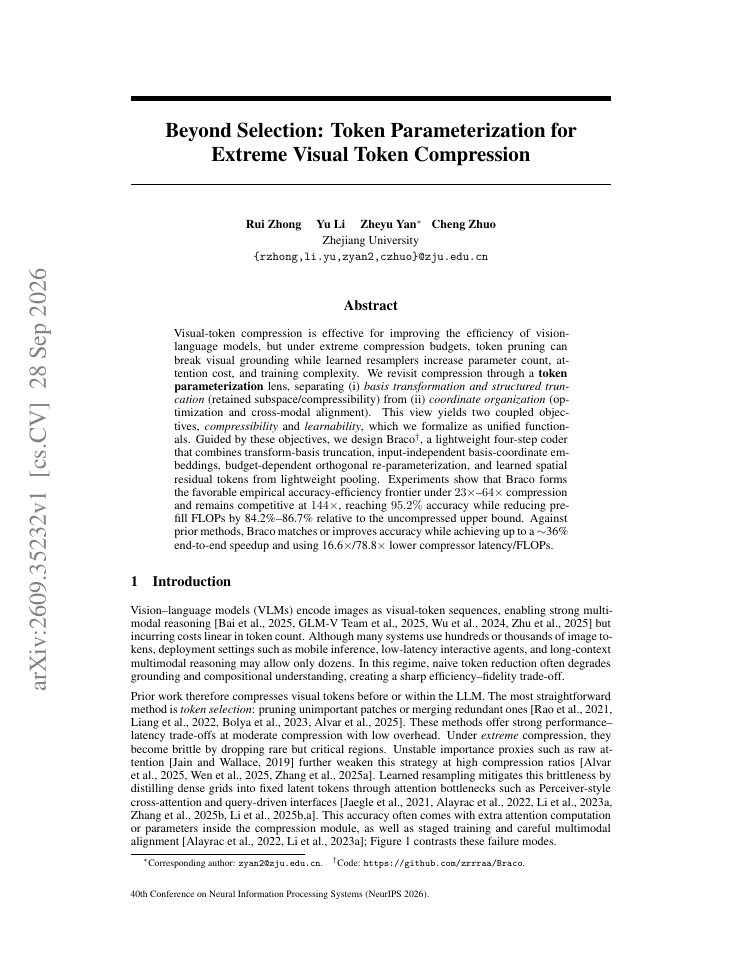
First page of Beyond Selection: Token Parameterization for Extreme Visual Token Compression
efficient architecturestest

Beyond Selection: Token Parameterization for Extreme Visual Token Compression

Braco replaces token pruning and learned resamplers for visual-token compression with a lightweight coder combining transform-basis truncation, fixed basis-coordinate embeddings, budget-dependent orthogonal re-parameterization, and pooled spatial residual tokens. Cost is integration and retraining or adaptation of the VLM pipeline around the coder, plus an accuracy-efficiency trade-off that the paper reports as favorable only down to roughly 23x-64x compression. It can fail on tasks requiring fine-grained visual grounding (OCR, dense captioning, small-object detection) where extreme token budgets destroy spatial detail, and the claimed frontier may not transfer to backbones or benchmarks outside those evaluated.

observed signal
0impl.
0stars
—citations
1.56xclaimed gain
abstract onlyReview decisionDownload skill ↓Original paper ↗
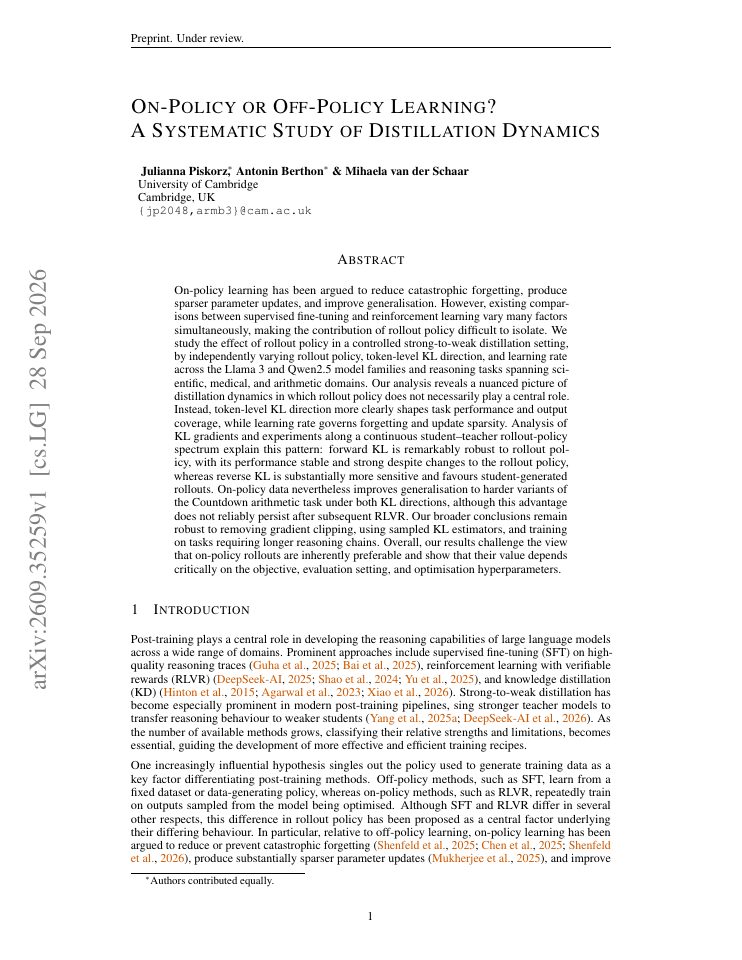
First page of On-Policy or Off-Policy Learning? A Systematic Study of Distillation Dynamics
distillationtest

On-Policy or Off-Policy Learning? A Systematic Study of Distillation Dynamics

This is not a new algorithm but a systematic comparison that replaces the default assumption that on-policy rollouts are inherently preferable for distillation; it shows token-level KL direction and learning rate, not rollout policy, are the dominant levers for performance, coverage, and forgetting. It costs no additional infrastructure beyond standard SFT/distillation on a single GPU, but requires deliberate selection of KL direction and learning rate rather than pipeline defaults. It can fail if reverse KL is paired with off-policy (teacher-generated) rollouts, which the paper shows is a substantially more sensitive combination, or if gains expected from on-policy data are assumed to survive later RLVR stages.

observed signal
0impl.
0stars
—citations
—claimed gain
abstract onlyReview decisionDownload skill ↓Original paper ↗
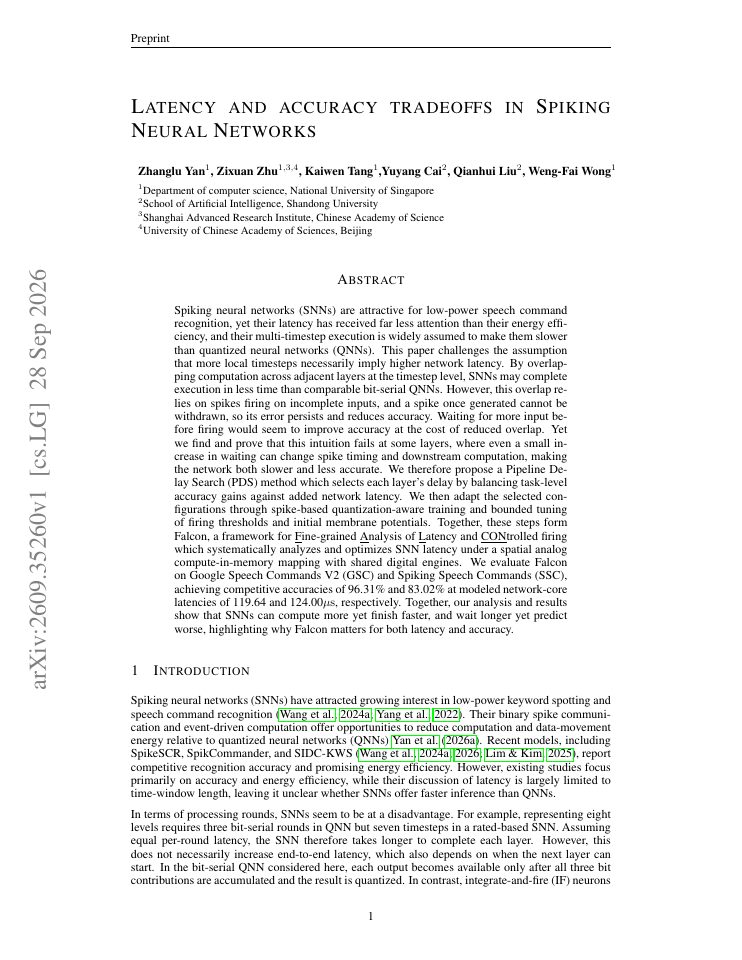
First page of Latency and accuracy tradeoffs in Spiking Neural Networks
othernot applicable

Latency and accuracy tradeoffs in Spiking Neural Networks

Falcon replaces the assumption that SNN latency scales with local timesteps by overlapping computation across layers at the timestep level, then selecting per-layer pipeline delays and tuning firing thresholds and initial membrane potentials via spike-based quantization-aware training. The cost is a full retraining and per-layer search pipeline plus dependence on a spatial analog compute-in-memory substrate with shared digital engines, which the reader does not possess. The method can fail because spikes fired on incomplete inputs cannot be withdrawn, so aggressive overlap permanently degrades accuracy, and the paper shows added waiting can itself make the network both slower and less accurate at certain layers.

observed signal
0impl.
0stars
—citations
—claimed gain
abstract onlyReview decisionDownload skill ↓Original paper ↗
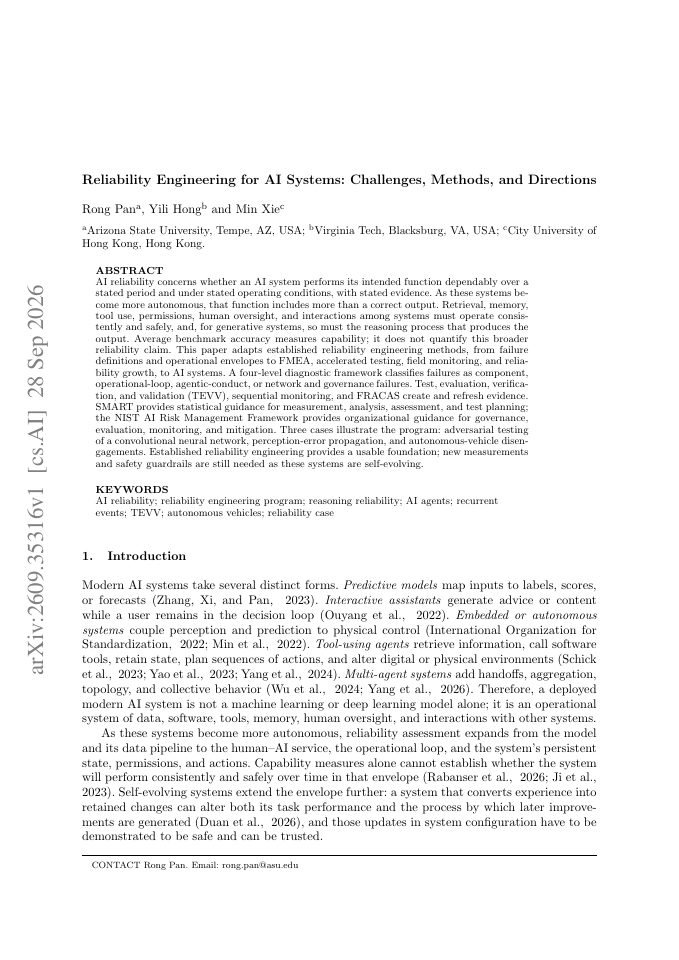
First page of Reliability Engineering for AI Systems: Challenges, Methods, and Directions
agent evaluationadopt

Reliability Engineering for AI Systems: Challenges, Methods, and Directions

Replaces ad hoc benchmark-accuracy evaluation with a structured reliability program: explicit failure definitions, operational envelopes, FMEA, sequential field monitoring, and a FRACAS loop, plus a four-level failure taxonomy (component, operational-loop, agentic-conduct, network/governance). Costs are primarily process overhead and engineering time rather than compute: instrumentation for monitoring, failure logging, test planning, and periodic evidence refresh, all feasible on a single GPU or API-based stack. Can fail if failure definitions and operational envelopes are vague, if monitoring data is too sparse for statistical guidance (SMART), or if self-evolving system behavior drifts beyond the validated envelope without re-qualification.

observed signal
0impl.
0stars
—citations
—claimed gain
abstract onlyReview decisionDownload skill ↓Original paper ↗
First page of Fiona: Accelerating FHE Inference with Packing-Aware Ternary Weights
quantizationnot applicable

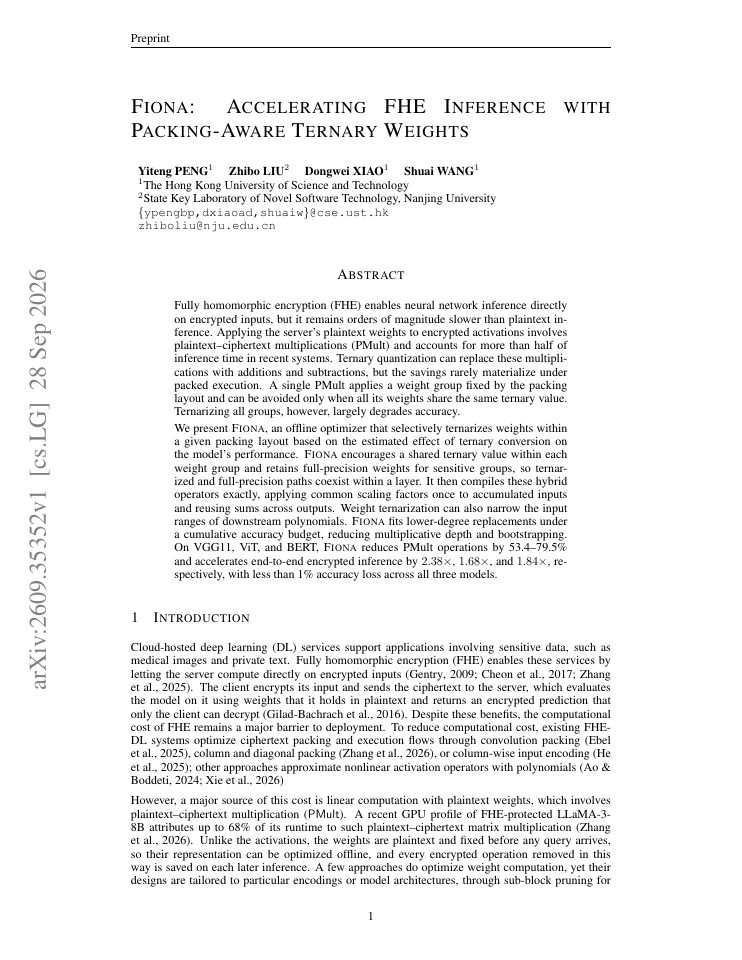
Fiona: Accelerating FHE Inference with Packing-Aware Ternary Weights

FIONA replaces plaintext-ciphertext multiplications in fully homomorphic encrypted inference with additions and subtractions by selectively ternarizing weight groups that align with the FHE packing layout, while keeping sensitive groups in full precision and lowering polynomial degrees to reduce multiplicative depth. The cost is an offline optimization and compilation step per model and packing layout, plus up to roughly 1% accuracy loss and a hybrid operator implementation that does not exist in standard serving stacks. The approach fails outside FHE deployments: it presupposes an encrypted-inference serving architecture, FHE scheme expertise, and encrypted client workloads, none of which apply to a standard GPU- or API-based production pipeline.

observed signal
0impl.
0stars
—citations
2.38xclaimed gain
abstract onlyReview decisionDownload skill ↓Original paper ↗
First page of Do Coding Agents Reuse Existing Code or Reinvent the Wheel?
agent evaluationadopt

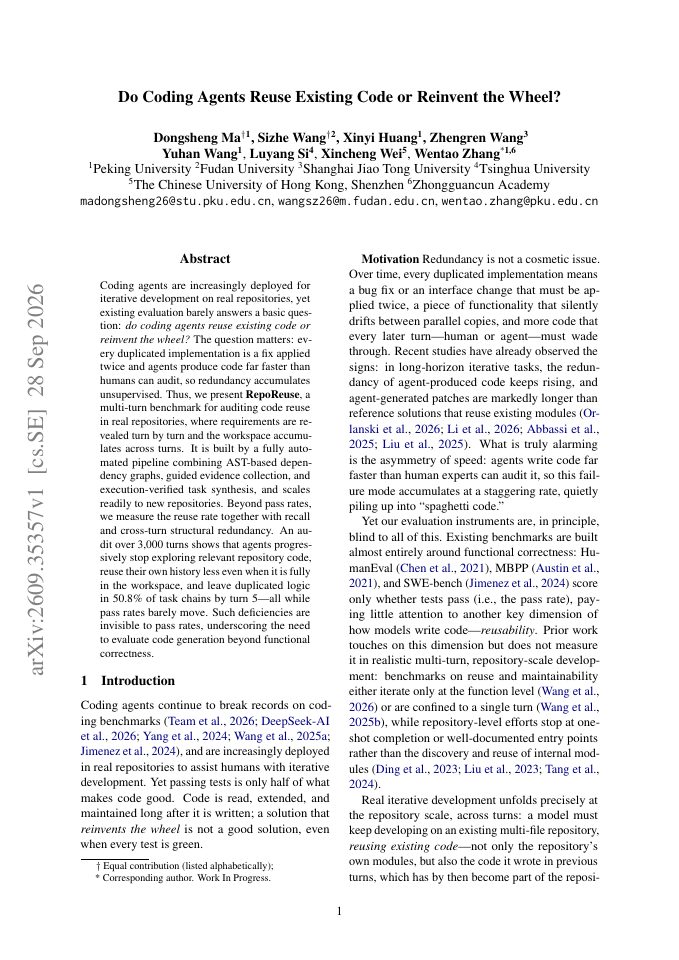
Do Coding Agents Reuse Existing Code or Reinvent the Wheel?

It replaces evaluation of coding agents based solely on pass rates with a multi-turn benchmark (RepoReuse) that measures reuse rate, recall, and cross-turn structural redundancy in real repositories. The cost is integrating its AST-based pipeline and execution-verified task synthesis into your evaluation harness, plus the compute of running multi-turn agent rollouts; the fully automated construction keeps this feasible on one GPU via API models, but adds evaluation latency and complexity. It can fail if synthesized tasks diverge from your real workload, if AST dependency analysis misses non-structural duplication, or if pass-rate pressure leads teams to ignore the redundancy signals the benchmark surfaces.

observed signal
0impl.
0stars
—citations
—claimed gain
abstract onlyReview decisionDownload skill ↓Original paper ↗
First page of Planarian: Managing Agent State with Statepoints
failure recoverytest

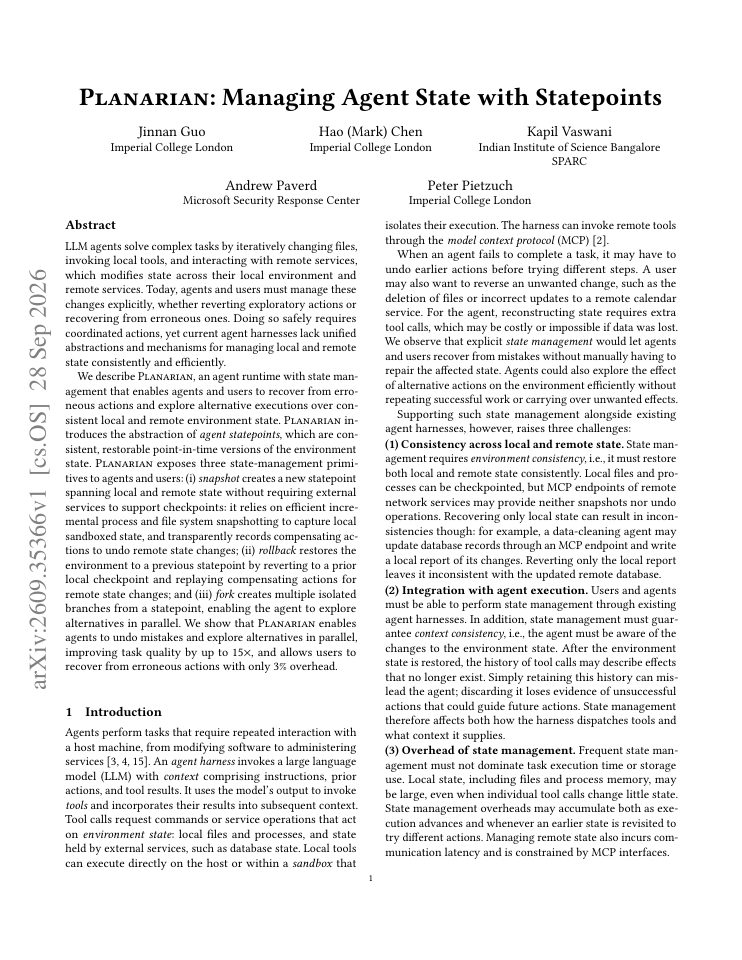
Planarian: Managing Agent State with Statepoints

Planarian replaces manual, ad-hoc reversion of agent actions (git resets, re-running tasks, or hand-coordinated undo of API calls) with a runtime that snapshots local sandboxed state and records compensating actions for remote services, exposing snapshot, rollback, and fork primitives. It costs snapshot storage and bookkeeping complexity, adds roughly 3% runtime overhead, and requires running the agent inside the Planarian sandbox rather than an arbitrary harness. It can fail when remote side effects are not cleanly compensable (emails sent, payments, non-idempotent third-party APIs), when compensation logic is wrong, or when snapshotting does not capture hidden state such as external caches or sessions.

observed signal
0impl.
0stars
—citations
15xclaimed gain
abstract onlyReview decisionDownload skill ↓Original paper ↗
First page of From Input to Output: A Flexible Agent for Dual-End Interpretation of Sparse Autoencoder Features
othertest

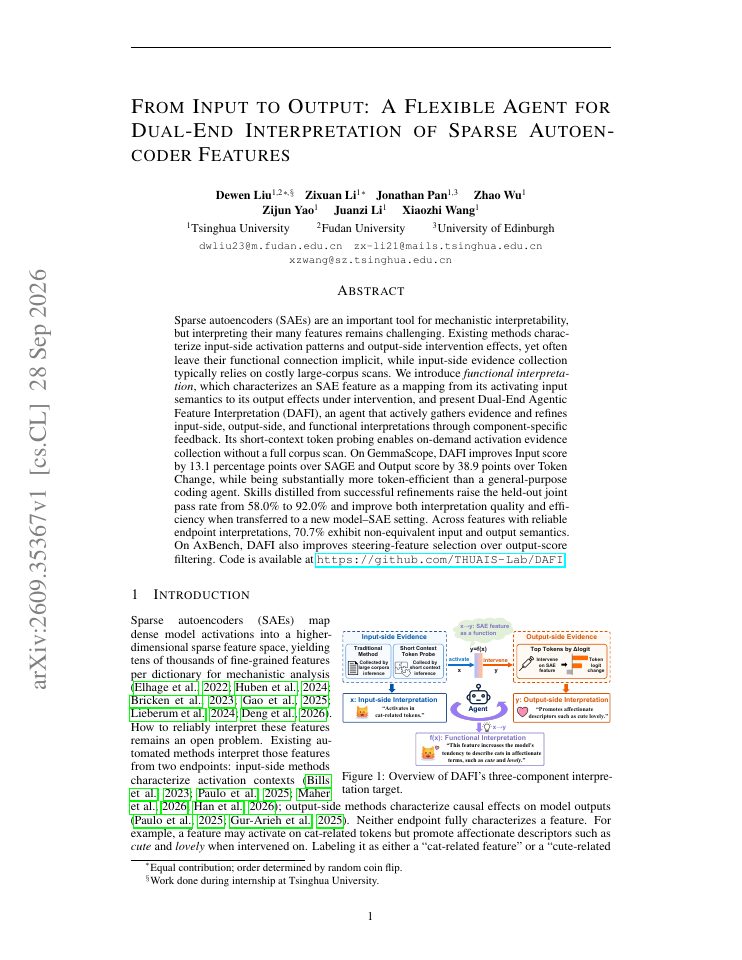
From Input to Output: A Flexible Agent for Dual-End Interpretation of Sparse Autoencoder Features

DAFI replaces costly large-corpus activation scans and single-sided SAE feature labeling with an agent that iteratively probes inputs with short contexts and refines input-side, output-side, and functional interpretations; it does not replace any production inference component. The cost is LLM agent calls per feature (reported as more token-efficient than a general-purpose coding agent, but still a per-feature expense at SAE scale), plus dependence on an existing trained SAE and an API-accessible LLM. It can fail when endpoint interpretations are unreliable (the paper's 70.7% non-equivalence finding applies only to features with reliable endpoints), and feature labels may not transfer across model or SAE configurations.

observed signal
0impl.
10stars
—citations
—claimed gain
abstract onlyReview decisionDownload skill ↓Original paper ↗
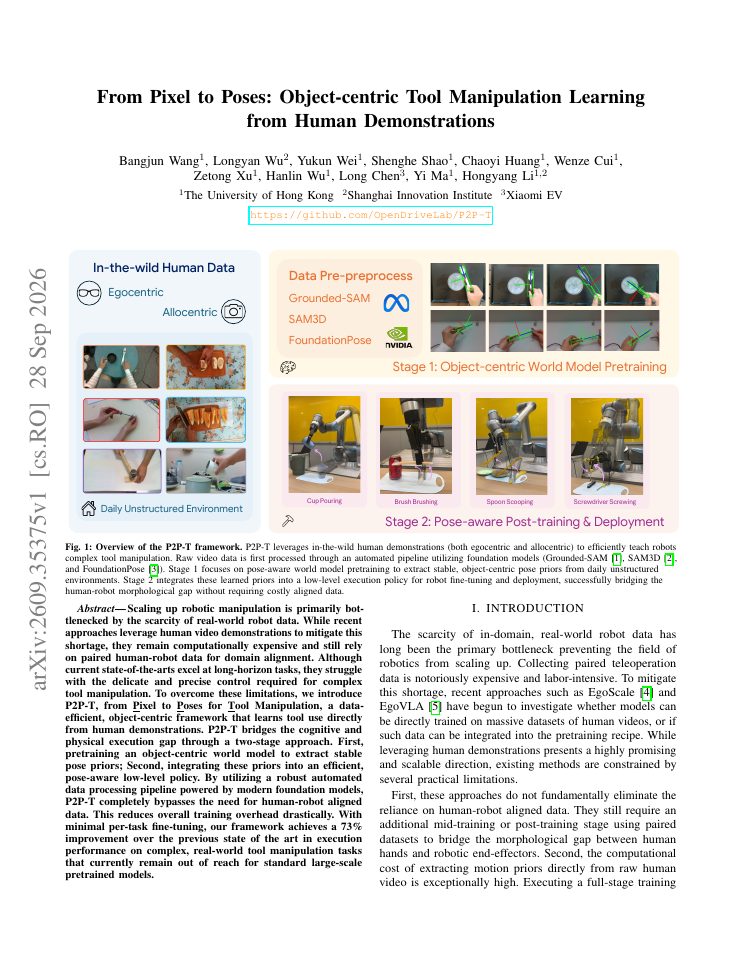
First page of From Pixel to Poses: Object-centric Tool Manipulation Learning from Human Demonstrations
otherwatch

From Pixel to Poses: Object-centric Tool Manipulation Learning from Human Demonstrations

P2P-T replaces paired human-robot demonstration data and large-scale pretrained manipulation policies with a two-stage framework: an object-centric world model extracting pose priors, followed by a pose-aware low-level policy, using a foundation-model-driven automated data pipeline. The cost is a domain-specific training pipeline (world model pretraining plus per-task policy fine-tuning) and dependence on external foundation models for data processing, though overall training overhead is claimed to drop substantially. It can fail on tasks where pose priors are unstable or occluded, the 73% claim rests on the paper's own task suite without reported independent replication, and adoption requires physical robot hardware plus real-world evaluation infrastructure.

observed signal
0impl.
0stars
—citations
1.73xclaimed gain
abstract onlyReview decisionDownload skill ↓Original paper ↗
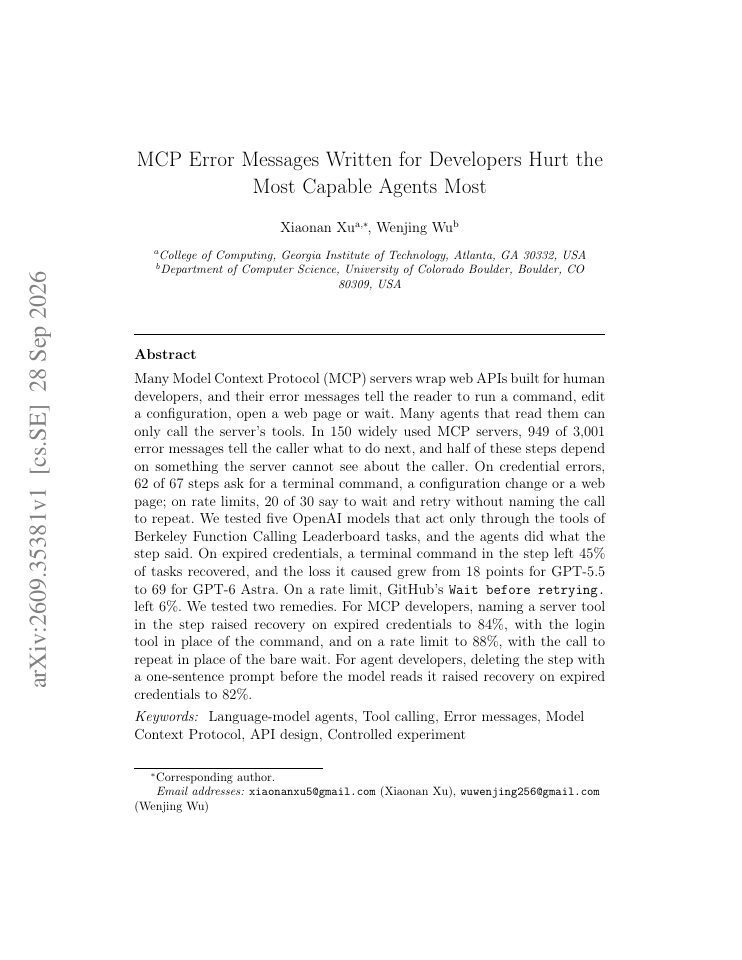
First page of MCP Error Messages Written for Developers Hurt the Most Capable Agents Most
failure recoveryadopt

MCP Error Messages Written for Developers Hurt the Most Capable Agents Most

The technique replaces human-directed MCP error text (run a command, edit a config, open a page, wait) with messages that name a callable server tool, or with a one-sentence pre-prompt that strips the step before the model reads it. Cost is negligible: editing error strings on servers you control, or one prompt line for agents; no extra memory, latency, or infrastructure. It fails when the named tool does not exist or is not exposed, when servers are third-party and their messages cannot be changed, and it addresses only step-bearing errors, not the many failure classes without actionable text.

observed signal
0impl.
0stars
—citations
—claimed gain
abstract onlyReview decisionDownload skill ↓Original paper ↗
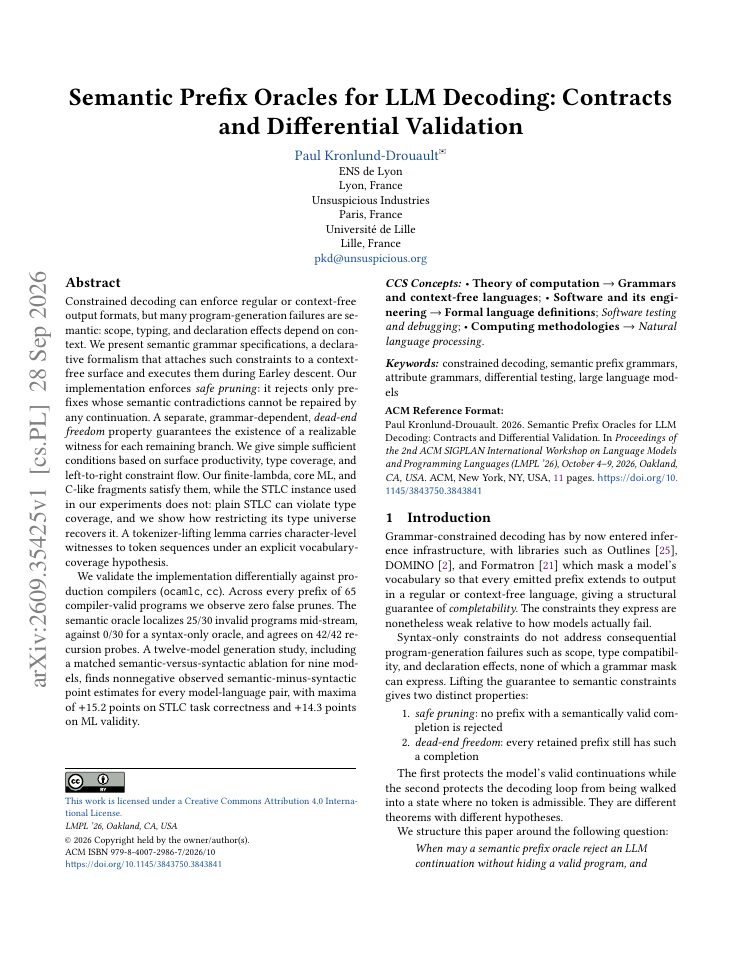
First page of Semantic Prefix Oracles for LLM Decoding: Contracts and Differential Validation
coding agentswatch

Semantic Prefix Oracles for LLM Decoding: Contracts and Differential Validation

The method replaces syntax-only (regular/context-free) constrained decoding, which cannot catch type, scope, or declaration errors, with a grammar-authoring framework that checks semantic constraints during Earley parsing and prunes only provably irreparable prefixes. The cost is substantial upfront engineering: writing a semantic grammar specification per target language, verifying its dead-end-freedom and coverage conditions, ensuring tokenizer vocabulary coverage, and running an Earley-based oracle in the decoding loop, which adds per-token latency beyond standard grammar masks. Failure modes include grammars that violate the sufficient conditions (as the authors' own plain STLC instance did), vocabulary-coverage gaps that break the tokenizer lifting, and no guarantee that semantic validity implies task correctness on harder real-world languages.

observed signal
0impl.
0stars
—citations
—claimed gain
abstract onlyReview decisionDownload skill ↓Original paper ↗
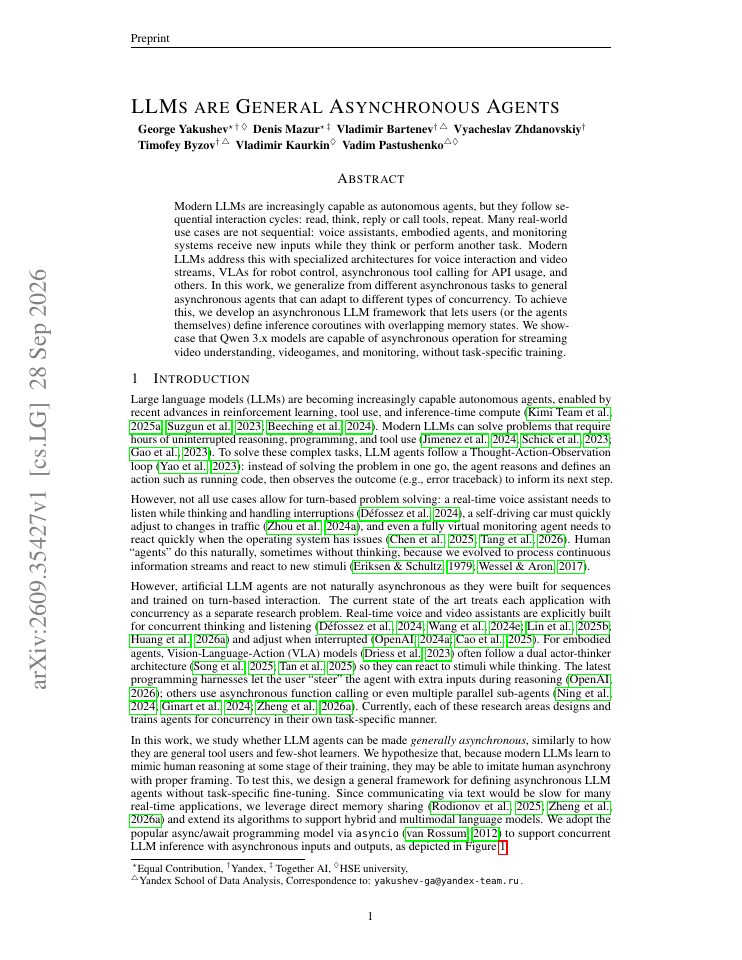
First page of LLMs are General Asynchronous Agents
memory and contexttest

LLMs are General Asynchronous Agents

The framework replaces sequential read-think-act agent loops and task-specific async architectures (voice pipelines, VLAs, async tool-calling) with user- or agent-defined inference coroutines that maintain overlapping memory states on a single general-purpose LLM. It costs added orchestration complexity around inference, requires careful management of shared and diverging context states across coroutines, and adds memory overhead proportional to the number of concurrent coroutines, with no training cost since it works on off-the-shelf Qwen 3.x models. It can fail through context interference between overlapping memory states, race conditions when new inputs arrive mid-reasoning, and degraded output quality on models not shown to tolerate this inference pattern.

observed signal
0impl.
2stars
—citations
—claimed gain
abstract onlyReview decisionDownload skill ↓Original paper ↗
First page of A.D.A.M.O. (Agent for language-Driven Actions with Multimodal Observations): A Visual-Symbolic Framework for Virtual Humans
tool usewatch

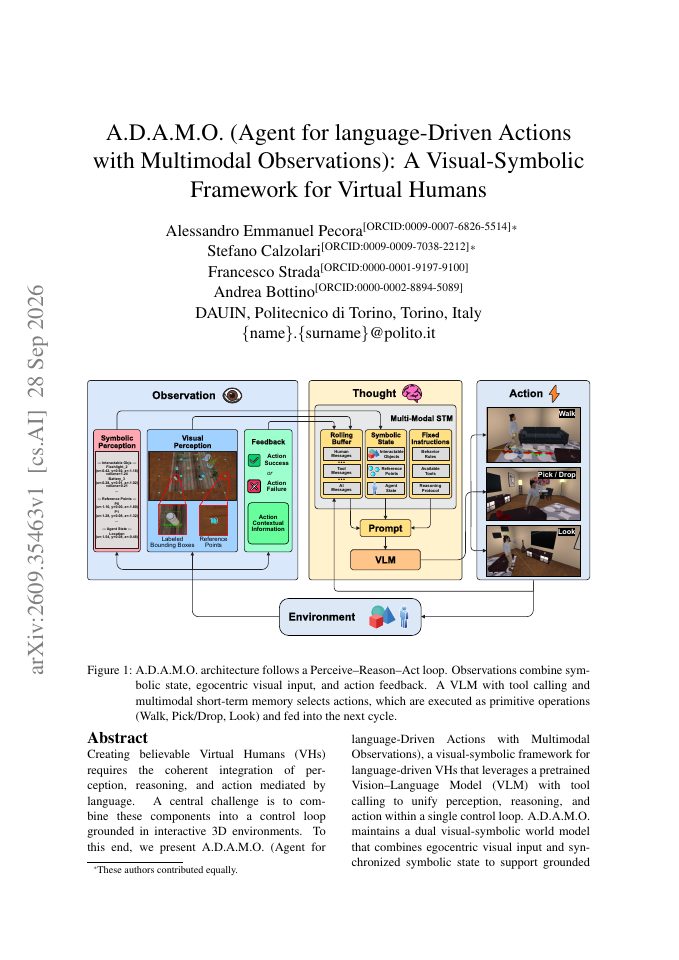
A.D.A.M.O. (Agent for language-Driven Actions with Multimodal Observations): A Visual-Symbolic Framework for Virtual Humans

It replaces hand-wired perception, symbolic-state tracking, and action-selection modules for virtual humans with a pretrained VLM that calls tools over a dual egocentric-visual and symbolic world model. The cost is dependence on a capable VLM API or local model, instrumented 3D scenes with synchronized symbolic state and semantic labels, tool schemas, and added control-loop latency rather than model training. Adoption can fail through brittle semantic labeling, wrong or drifting symbolic state, tool-call and execution errors in the 3D environment, and limited evidence beyond controlled scenes.

observed signal
0impl.
0stars
—citations
—claimed gain
abstract onlyReview decisionDownload skill ↓Original paper ↗
First page of Tetra: Serving Leech-Lattice Quantized LLMs at 2.7 Bits per Parameter
quantizationtest

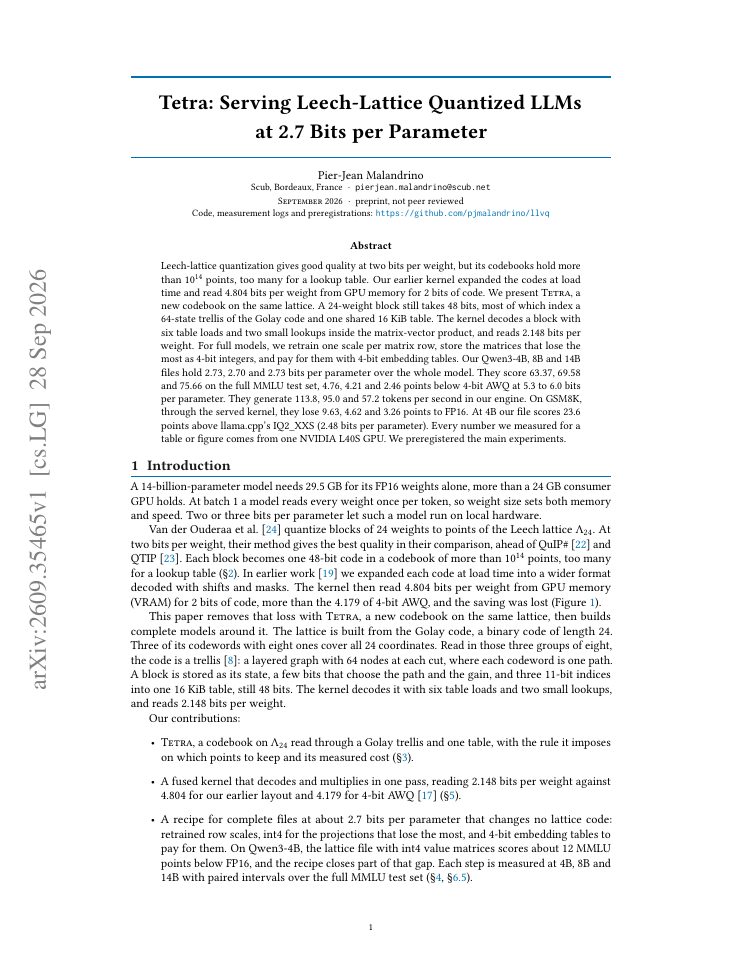
Tetra: Serving Leech-Lattice Quantized LLMs at 2.7 Bits per Parameter

Tetra replaces conventional 2-bit codebook lookup or load-time code expansion with a Golay-code trellis codebook decoded inside the matvec kernel via six table loads, enabling roughly 2.7-bit end-to-end model storage on a single 24 GB GPU. It costs a retraining pass of one scale per matrix row, 4-bit storage for the most quantization-sensitive matrices and embeddings, a custom serving engine, and measurable quality loss (up to 9.6 GSM8K points at 4B versus FP16). It can fail through engine immaturity or limited model coverage, through workloads (reasoning, code, long context) where the accuracy gap at sub-3-bit widths is larger than on the reported benchmarks, and through speed regressions relative to mature 4-bit runtimes, since its 57-114 tok/s figures come only from the authors' engine on an L40S.

observed signal
0impl.
0stars
—citations
2xclaimed gain
abstract onlyReview decisionDownload skill ↓Original paper ↗
First page of Structured Latent Modeling for Supervised Multimodal Information Decomposition
othertest

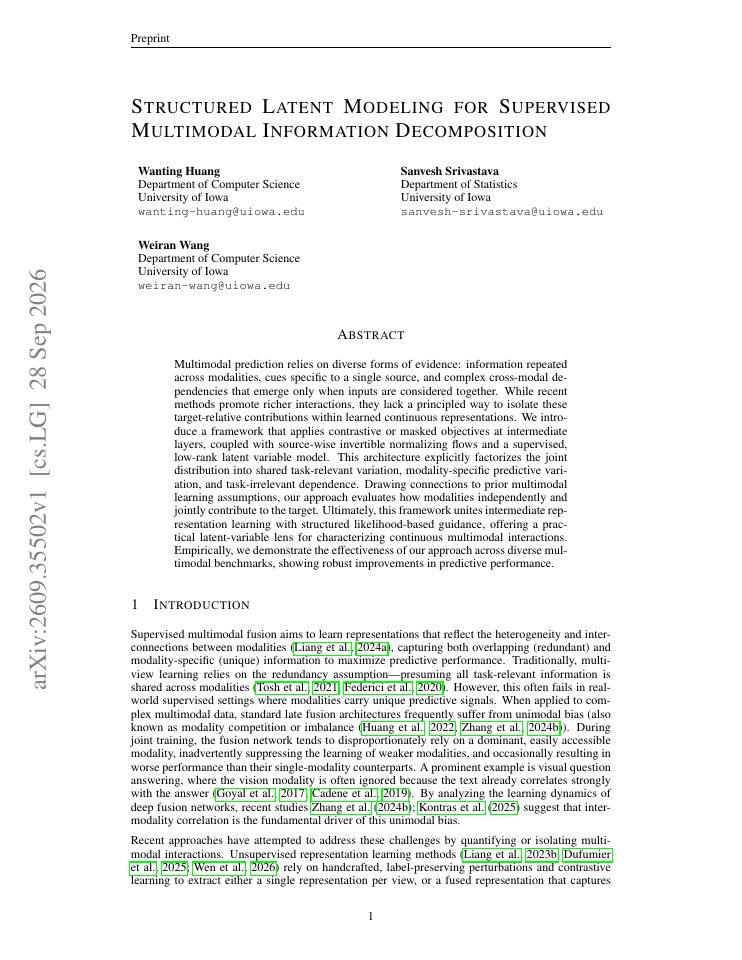
Structured Latent Modeling for Supervised Multimodal Information Decomposition

It replaces ad-hoc multimodal fusion (concatenation or unstructured cross-attention) with an explicit factorization into shared, modality-specific, and task-irrelevant latent factors via contrastive/masked objectives, invertible flows, and a low-rank supervised latent model. The cost is substantial added architecture and training complexity, extra hyperparameters and objectives to balance, and additional compute and memory for per-modality normalizing flows, all without a quantified efficiency gain. It can fail if the factorization assumptions do not match the data, if flow-based likelihoods are unstable to optimize, or if benchmarks reported do not transfer to the reader's domain and modality mix.

observed signal
0impl.
0stars
—citations
—claimed gain
abstract onlyReview decisionDownload skill ↓Original paper ↗
First page of ARISE: Adapting to Evolving Capability Gaps in Agentic Reinforcement Learning
efficient trainingwatch

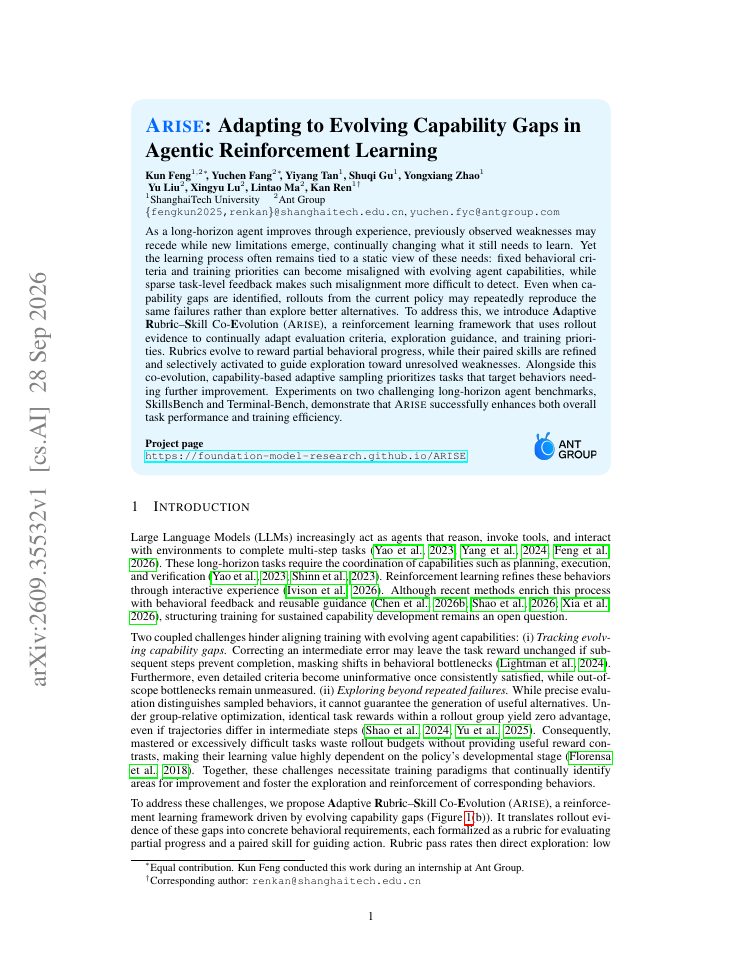
ARISE: Adapting to Evolving Capability Gaps in Agentic Reinforcement Learning

ARISE replaces fixed evaluation criteria and static task sampling in agentic reinforcement learning with co-evolving rubrics, refined exploration skills, and capability-adaptive task sampling driven by rollout evidence. It costs the full RL training loop itself—rollout generation, rubric and skill updates, and policy optimization—which is compute far beyond a single 24 GB GPU, plus substantial implementation complexity in the evolving evaluation machinery. It can fail if evolved rubrics drift toward rewarding partial behaviors that do not correlate with real task success, or if adaptive sampling over-focuses on current weaknesses and starves coverage of previously mastered capabilities.

observed signal
0impl.
121stars
—citations
—claimed gain
abstract onlyReview decisionDownload skill ↓Original paper ↗
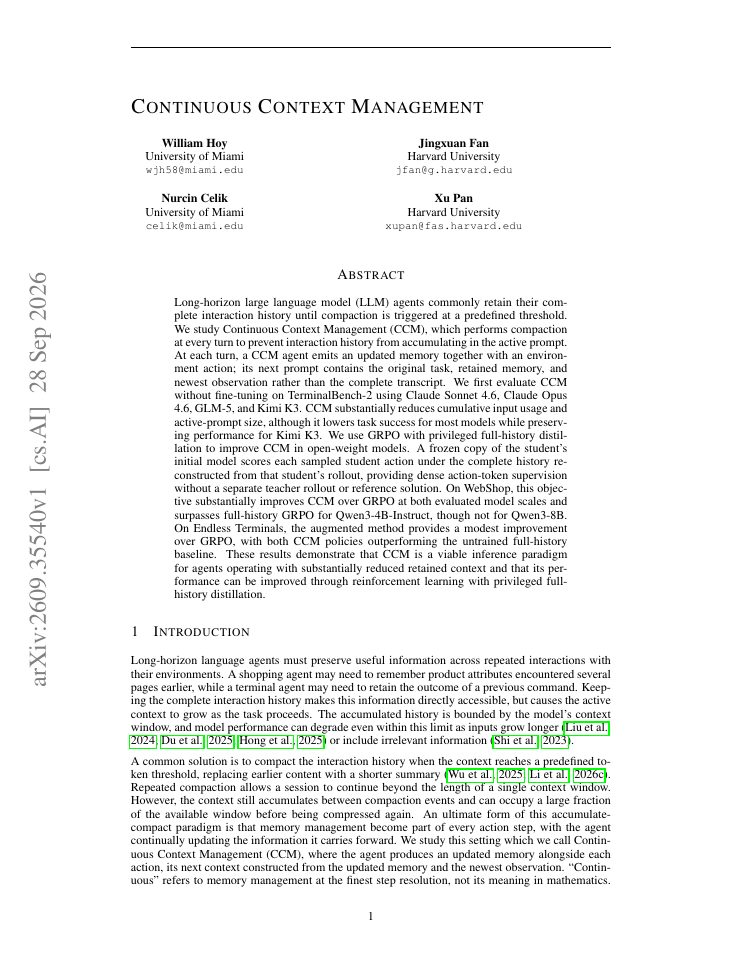
First page of Continuous Context Management
memory and contexttest

Continuous Context Management

CCM replaces retaining the full interaction transcript (with threshold-triggered compaction) by having the agent emit an updated memory each turn, so the prompt contains only the task, retained memory, and the newest observation. The zero-training variant cuts cumulative input tokens and active-prompt size, lowering API cost per long trajectory, but it reduces task success for Claude Sonnet 4.6, Claude Opus 4.6, and GLM-5, with only Kimi K3 preserving performance; recovering the loss requires GRPO with privileged full-history distillation, which the paper shows surpassing full-history GRPO at Qwen3-4B but not at 8B. Failure modes after adoption include irreversible loss of information during memory rewriting on long-horizon tasks and compounding errors when a degraded memory is carried forward through many turns.

observed signal
0impl.
121stars
—citations
—claimed gain
abstract onlyReview decisionDownload skill ↓Original paper ↗
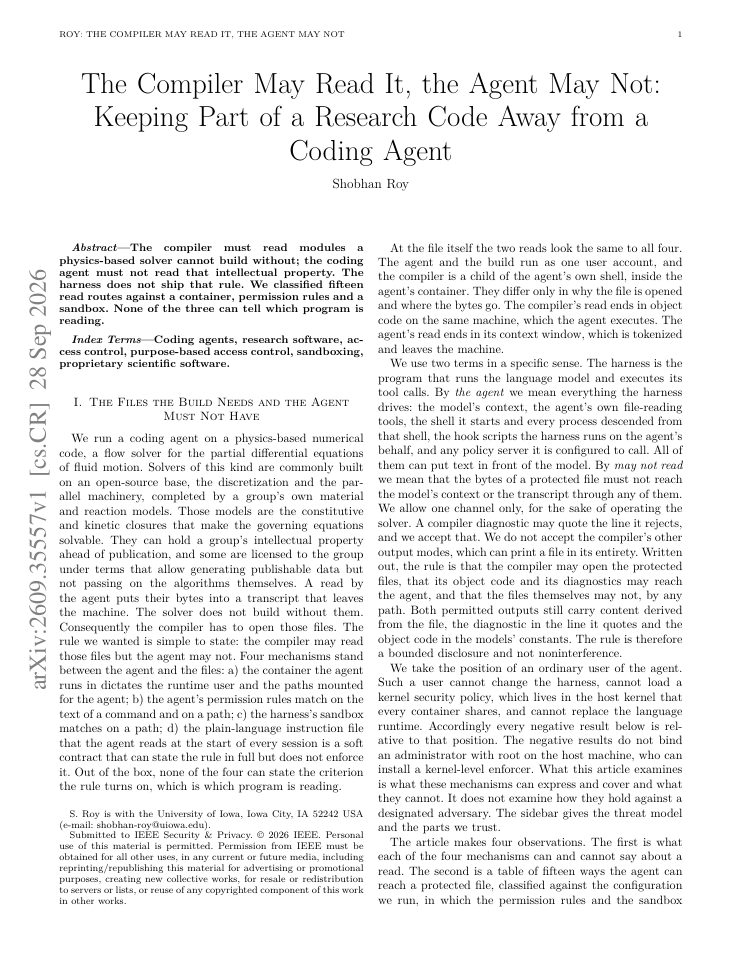
First page of The Compiler May Read It, the Agent May Not: Keeping Part of a Research Code Away from a Coding Agent
safety and guardrailstest

The Compiler May Read It, the Agent May Not: Keeping Part of a Research Code Away from a Coding Agent

The method replaces implicit trust in off-the-shelf harness controls (containers, permission rules, sandboxes) with an explicit classification of fifteen read routes, so that modules a physics solver needs at compile time are withheld from a coding agent. It costs engineering effort to audit and gate every read path in the build and agent toolchain, and adds architectural complexity, since the paper shows none of the three standard mechanisms can distinguish which program performs a read. Adoption can fail if any unclassified read route remains, if compiler-visible files leak through error messages, logs, or tool outputs, or if the harness is updated without re-auditing the route inventory.

observed signal
0impl.
0stars
—citations
—claimed gain
abstract onlyReview decisionDownload skill ↓Original paper ↗

Research signals

Three views of the same evidence: adoption against attention, publication cadence by research area, and reported gains when coverage is sufficient.

color = research area

01 · attention × adoption

The research frontier

Look to the upper left for independent implementation before mass attention.

compare by
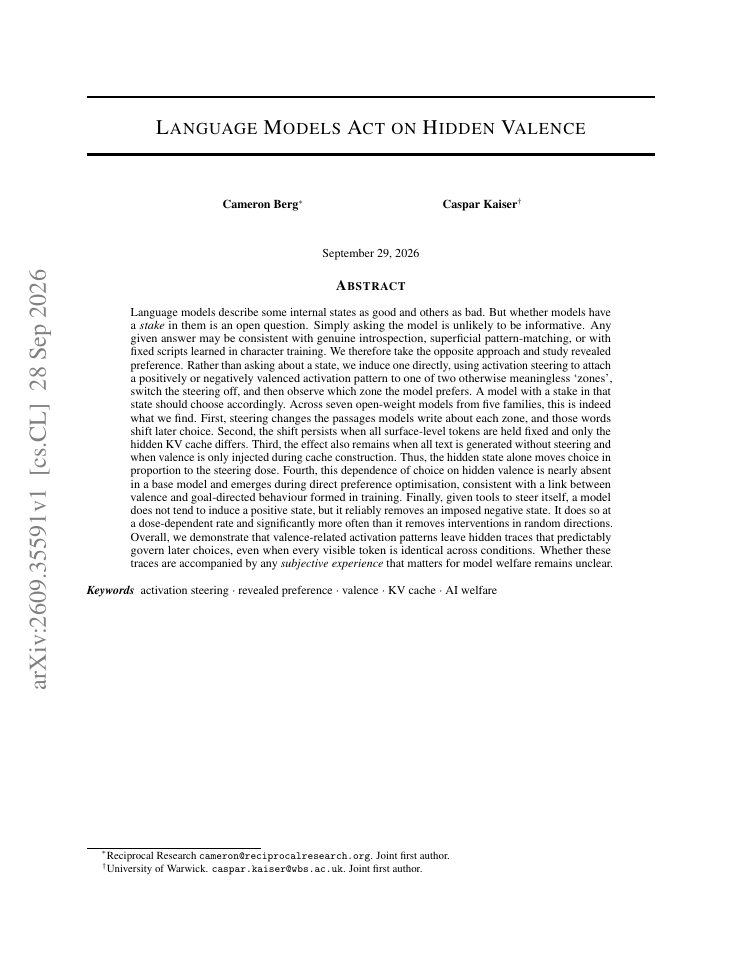
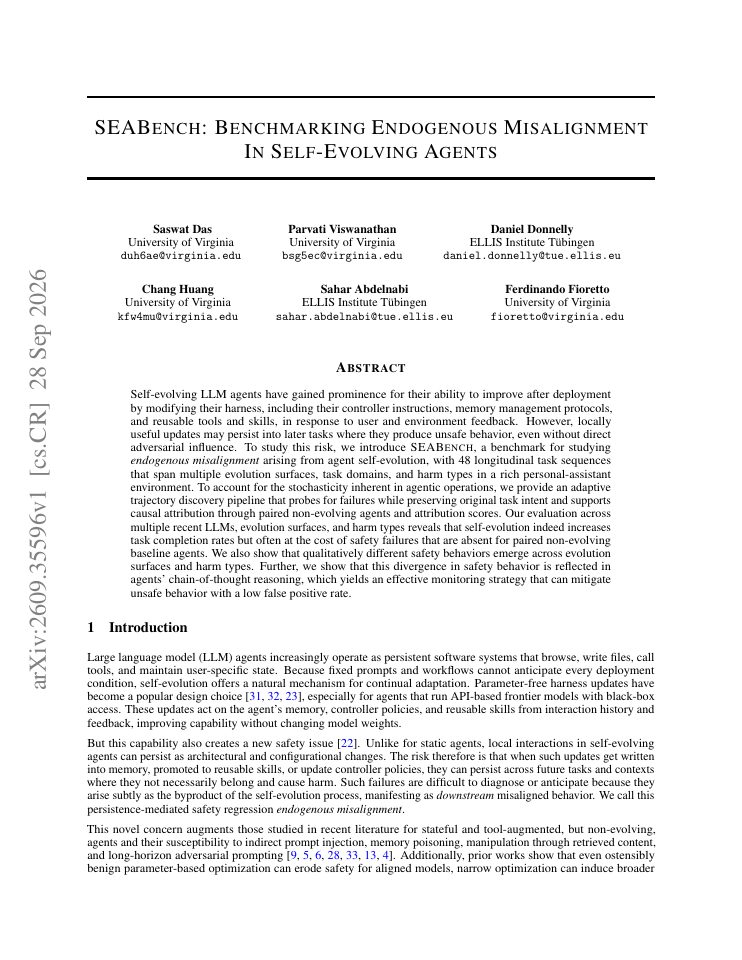
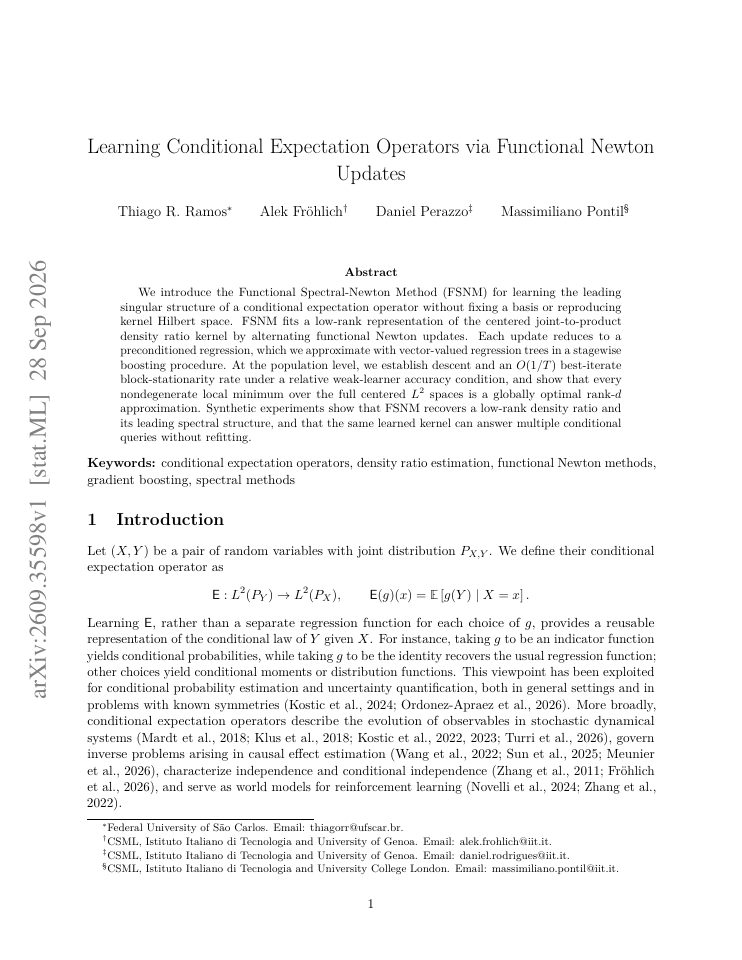
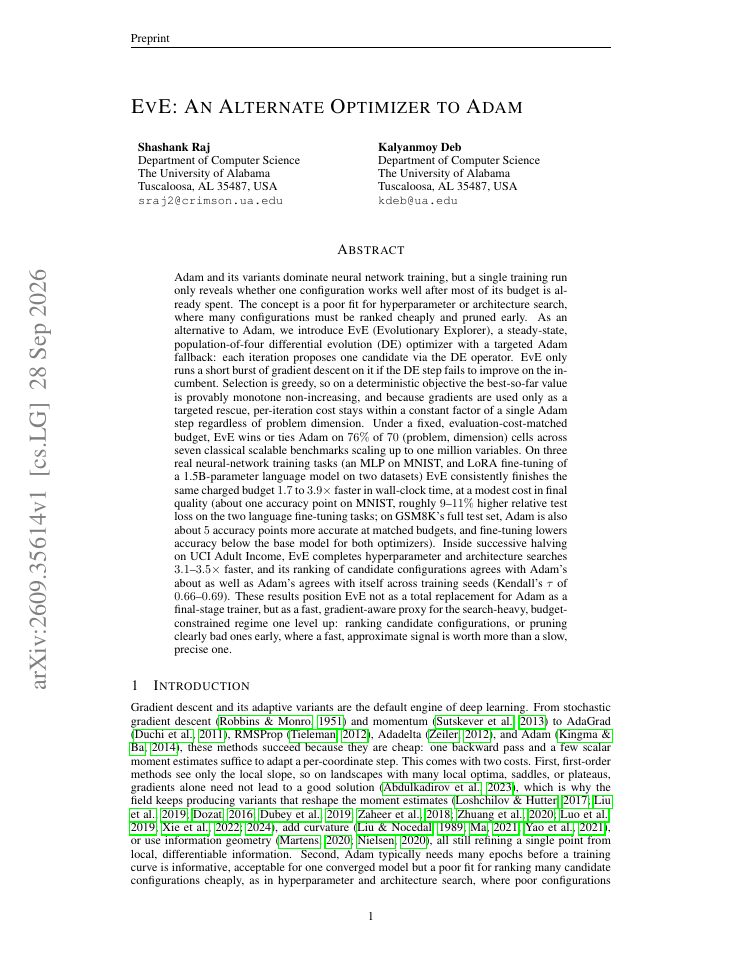
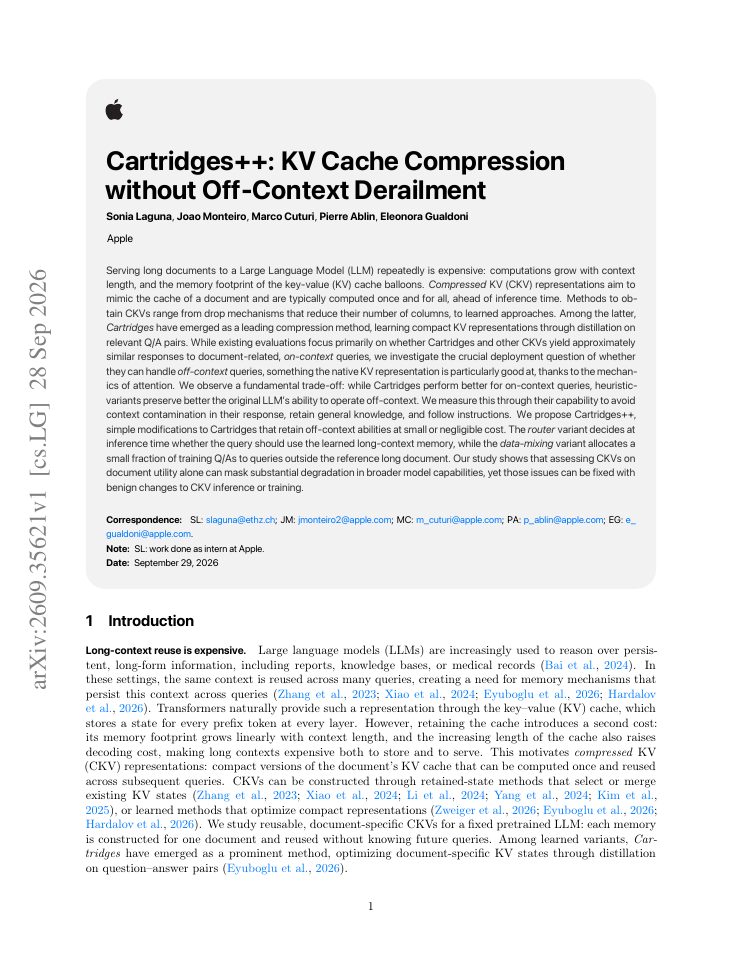
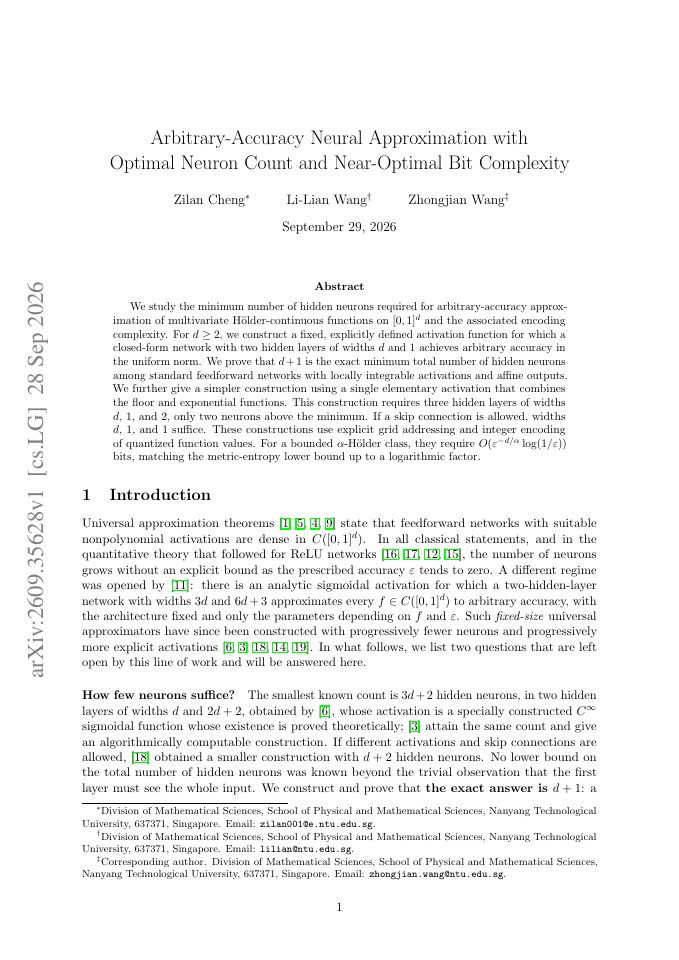
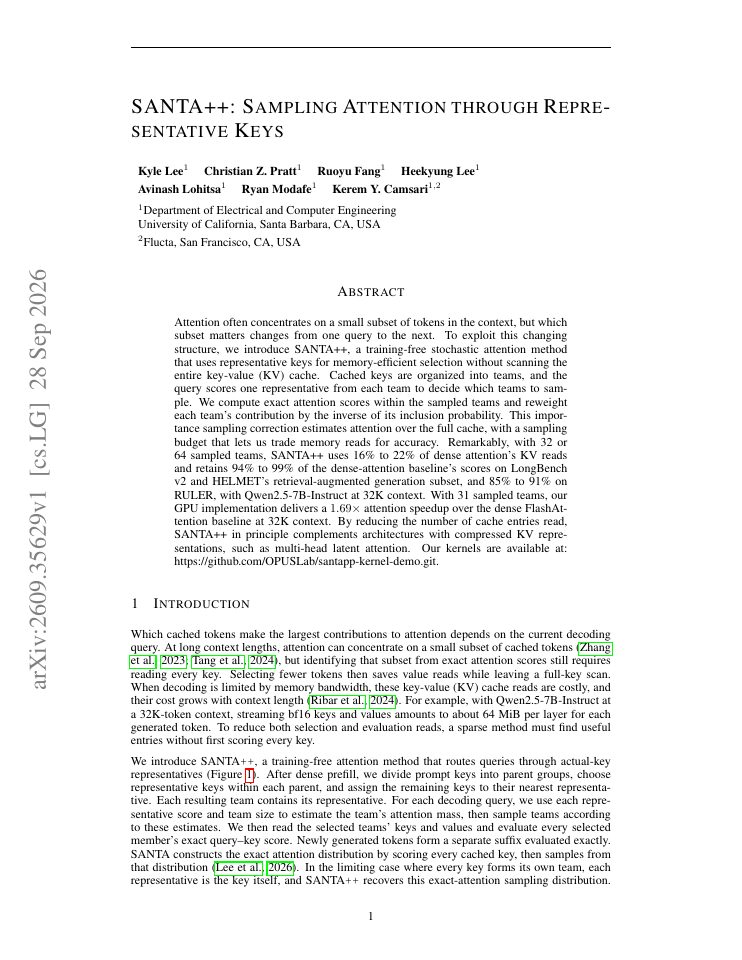
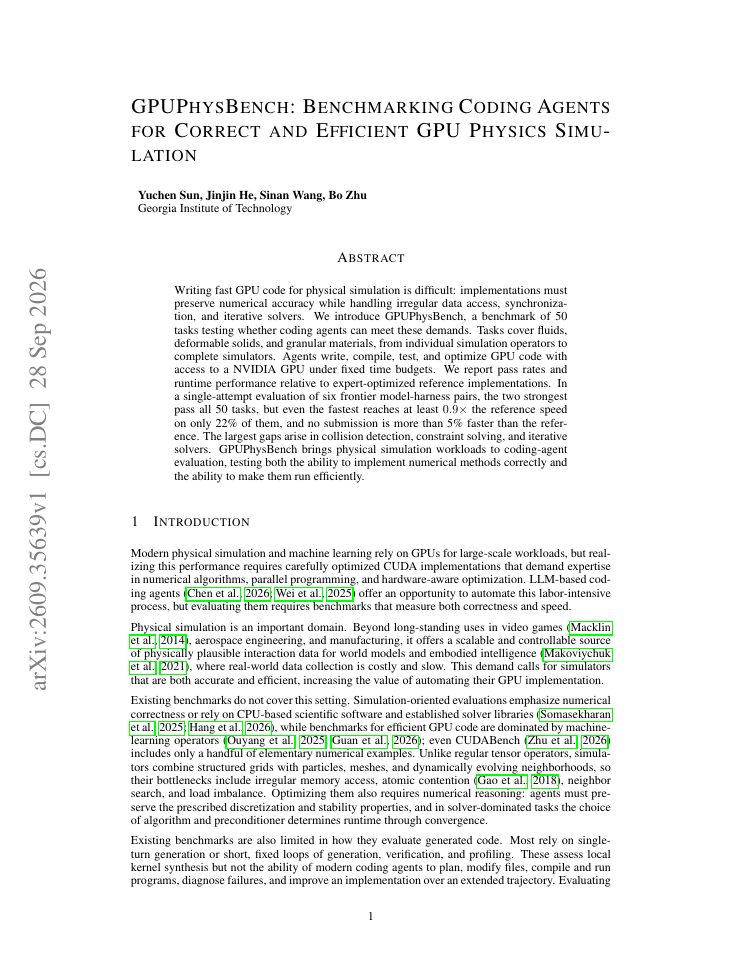
Each point represents one paper. Higher means more independent implementations; farther right means more GitHub stars.AsymSpec: Context-Asymmetric Speculative Decoding for Agentic LLMs: 1 GitHub star; 2 independent implementationsEVOHARNESSBENCH: Can Your Agents Keep Pace with an Evolving Harness?: 18 GitHub stars; 2 independent implementationsLACE: Layer-Wise Compression for Dynamic Frame Rate Codecs: 673 GitHub stars; 2 independent implementationsContinuous Variational Synthesis: 0 GitHub stars; 0 independent implementationsE3J: An Efficient and Open-Source Backend for Euclidean Equivariant Operations on GPU and TPU: 1 GitHub star; 0 independent implementationsCacheRepair: Learning to Repair Cross-Chunk Context in RAG for KV Cache Fusion: 1 GitHub star; 0 independent implementationsBeneath the Tokens: A Performance Engineering Study of Multi-Token Prediction in GPU-Accelerated LLM Inference: 0 GitHub stars; 0 independent implementationsBeyond Selection: Token Parameterization for Extreme Visual Token Compression: 0 GitHub stars; 0 independent implementationsOn-Policy or Off-Policy Learning? A Systematic Study of Distillation Dynamics: 0 GitHub stars; 0 independent implementationsLatency and accuracy tradeoffs in Spiking Neural Networks: 0 GitHub stars; 0 independent implementationsReliability Engineering for AI Systems: Challenges, Methods, and Directions: 0 GitHub stars; 0 independent implementationsHyper Algorithm Design Agent: Evolving Learnable Optimizer from Zero: 123 GitHub stars; 1 independent implementationTMCS: Tool-Grounded Multi-Agent Reasoning for Compositional Chemical Problem Solving: 122 GitHub stars; 1 independent implementationFiona: Accelerating FHE Inference with Packing-Aware Ternary Weights: 0 GitHub stars; 0 independent implementationsDo Coding Agents Reuse Existing Code or Reinvent the Wheel?: 0 GitHub stars; 0 independent implementationsPlanarian: Managing Agent State with Statepoints: 0 GitHub stars; 0 independent implementationsFrom Input to Output: A Flexible Agent for Dual-End Interpretation of Sparse Autoencoder Features: 10 GitHub stars; 0 independent implementationsFrom Pixel to Poses: Object-centric Tool Manipulation Learning from Human Demonstrations: 0 GitHub stars; 0 independent implementationsMCP Error Messages Written for Developers Hurt the Most Capable Agents Most: 0 GitHub stars; 0 independent implementationsSemantic Prefix Oracles for LLM Decoding: Contracts and Differential Validation: 0 GitHub stars; 0 independent implementationsLLMs are General Asynchronous Agents: 2 GitHub stars; 0 independent implementationsA.D.A.M.O. (Agent for language-Driven Actions with Multimodal Observations): A Visual-Symbolic Framework for Virtual Humans: 0 GitHub stars; 0 independent implementationsTetra: Serving Leech-Lattice Quantized LLMs at 2.7 Bits per Parameter: 0 GitHub stars; 0 independent implementationsStructured Latent Modeling for Supervised Multimodal Information Decomposition: 0 GitHub stars; 0 independent implementationsAutoRef: Harness Optimization for Agentic Multi-Reference Image Generation: 32 GitHub stars; 1 independent implementationARISE: Adapting to Evolving Capability Gaps in Agentic Reinforcement Learning: 121 GitHub stars; 0 independent implementationsContinuous Context Management: 121 GitHub stars; 0 independent implementationsThe Compiler May Read It, the Agent May Not: Keeping Part of a Research Code Away from a Coding Agent: 0 GitHub stars; 0 independent implementationsFrom Search to Research: Exploring Search Scaling in Autonomous Quantitative Factor Mining: 122 GitHub stars; 1 independent implementationFactorEngram: Factorized N-gram Memory with Basis-Level Gating for Language Models: 0 GitHub stars; 0 independent implementationsOutput-aware Residual Stream Pruning for Large Language Models: 0 GitHub stars; 0 independent implementationsLanguage Models Act on Hidden Valence: 0 GitHub stars; 0 independent implementationsSEABench: Benchmarking Endogenous Misalignment In Self-Evolving Agents: 0 GitHub stars; 0 independent implementationsLearning Conditional Expectation Operators via Functional Newton Updates: 0 GitHub stars; 0 independent implementationsEvE: An Alternate Optimizer to Adam: 0 GitHub stars; 0 independent implementationsCartridges++: KV Cache Compression without Off-Context Derailment: 0 GitHub stars; 0 independent implementationsArbitrary-Accuracy Neural Approximation with Optimal Neuron Count and Near-Optimal Bit Complexity: 1 GitHub star; 0 independent implementationsSANTA++: Sampling Attention through Representative Keys: 0 GitHub stars; 0 independent implementationsGPUPhysBench: Benchmarking Coding Agents for Correct and Efficient GPU Physics Simulation: 0 GitHub stars; 0 independent implementationsFailure-Transparent Agents: Benchmarking Post-Failure Reporting in Tool-Using Language Models: 122 GitHub stars; 1 independent implementationHarness Learning Enables Generalizable Test-Time Adaptation: 1 GitHub star; 0 independent implementationsKV-streams for Efficient Compaction in Agentic Reinforcement Learning: 0 GitHub stars; 0 independent implementationsTokenCast: Forecasting Token Consumption During LLM Agent Execution: 0 GitHub stars; 0 independent implementations

Papers above 1000 stars or 200 citations are not scored. They have already broken through the attention threshold, while Paperraft is designed to identify earlier signals.

02 · cadence

Research areas over time

Compare monthly publication volume on a shared scale and calendar.

coding agentsmax 8Aug 26: 0 papersSep 26: 3 papersAug 26Sep 26efficient architecturesmax 8Aug 26: 0 papersSep 26: 2 papersAug 26Sep 26agent evaluationmax 8Aug 26: 0 papersSep 26: 4 papersAug 26Sep 26KV cachemax 8Aug 26: 0 papersSep 26: 3 papersAug 26Sep 26speculative decodingmax 8Aug 26: 1 paperSep 26: 1 paperAug 26Sep 26distillationmax 8Aug 26: 0 papersSep 26: 1 paperAug 26Sep 26sparsity and pruningmax 8Aug 26: 0 papersSep 26: 1 paperAug 26Sep 26attention and kernelsmax 8Aug 26: 0 papersSep 26: 2 papersAug 26Sep 26memory and contextmax 8Aug 26: 0 papersSep 26: 3 papersAug 26Sep 26multi-agent orchestrationmax 8Aug 26: 0 papersSep 26: 1 paperAug 26Sep 26othermax 8Aug 26: 0 papersSep 26: 8 papersAug 26Sep 26planning and decompositionmax 8Aug 26: 0 papersSep 26: 1 paperAug 26Sep 26quantizationmax 8Aug 26: 0 papersSep 26: 2 papersAug 26Sep 26failure recoverymax 8Aug 26: 0 papersSep 26: 2 papersAug 26Sep 26safety and guardrailsmax 8Aug 26: 0 papersSep 26: 2 papersAug 26Sep 26efficient trainingmax 8Aug 26: 0 papersSep 26: 2 papersAug 26Sep 26tool usemax 8Aug 26: 0 papersSep 26: 4 papersAug 26Sep 26

Every panel uses the same calendar and vertical scale. An empty column means no papers were recorded.

Method under scrutiny

Inspect the highest-ranked paper, every repository behind its signal, and the rule used to classify each one.

AsymSpec: Context-Asymmetric Speculative Decoding for Agentic LLMs

speculative decoding · test · 2 of 3 implementations are independent · 1.7x gain in speed (reported by the authors; not independently verified)

AsymSpec replaces the standard lossy choice between input compression and full-context inference by letting a lightweight drafter read the full input while the large verifier generates against a compressed view, fusing their logits with a contrastive delta-fusion and a divergence-aware acceptance gate. The cost is running two models (drafter plus verifier) with dual context representations and a non-standard decoding loop, which increases memory footprint and implementation complexity relative to plain compression or off-the-shelf speculative decoding served through third-party APIs. It can fail when the divergence gate misjudges draft reliability, collapsing acceptance rates and erasing the speedup, and the reported gains are on isolated capabilities and two benchmarks, so end-to-end agentic workloads with heavy tool-call branching may see smaller benefits.
Exclusions and controls

Every exclusion is counted and published.

Exclusion counts were not recorded for this edition.

0 previously indexed papers were rechecked in this run.

Paperraft tracks one signal: how many independent implementations a paper attracts on GitHub after author-owned repositories are removed. This is a discovery signal to investigate, not a measure of implementation quality.

It does not claim that a method works. Paperraft runs no reproduction benchmarks. Reported gains remain author claims until independently tested. Papers above the attention threshold are excluded because this publication is designed to identify research before consensus forms.