Skip to content

archived edition · 2026-09-28

PaperraftFind the AI research
worth testing.

Understand what a paper changes, what it costs, and whether it fits your next build. Explore research on faster LLM inference, agent memory, and evaluation, with the original sources in reach.

Start with a brief. Follow the evidence. Choose a test.

edition
2026-09-28
briefs
43
research areas
14
independent implementations
18

30 of 43 papers in the index (70%) have no independent implementations.

Research index

Search by topic, browse a research area, or sort by date. Read a brief, open the original paper, and inspect the available evidence before deciding what to test.

showing30 of 43
sort by
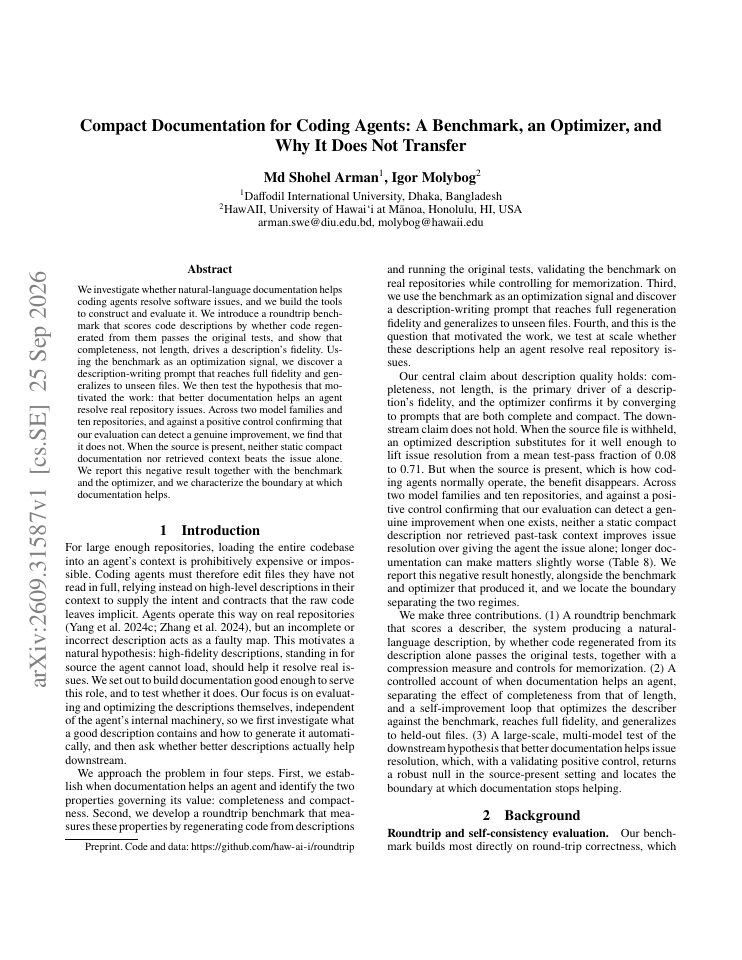
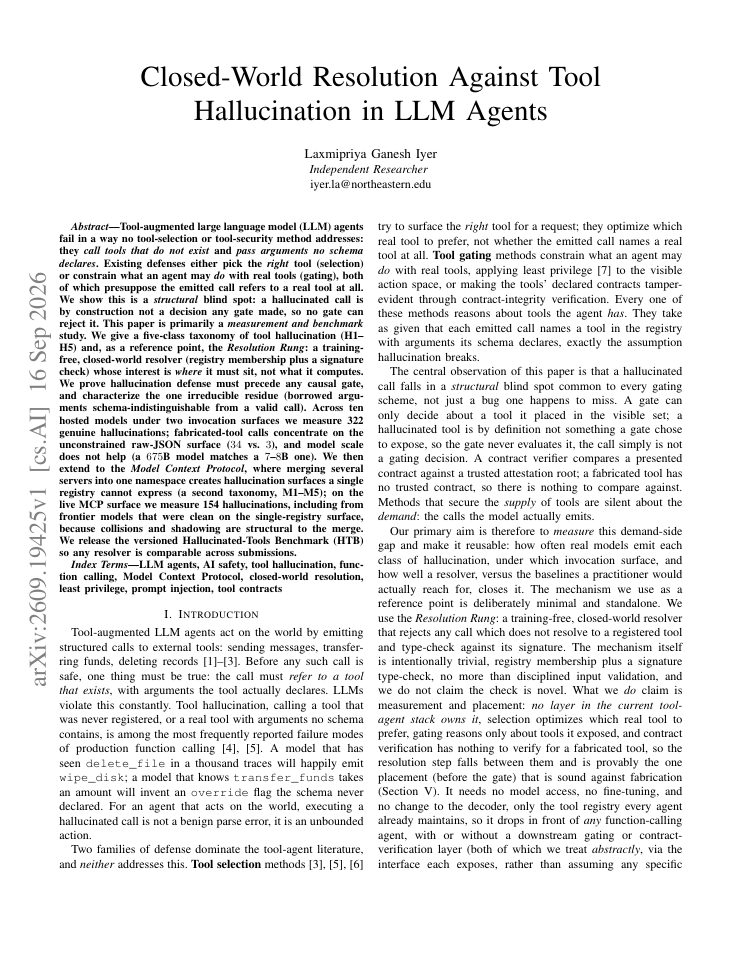
First page of Red-Teaming Auto Mode: Improving Blocking Classifiers Against Malign Coding Agents
safety and guardrailstest

Red-Teaming Auto Mode: Improving Blocking Classifiers Against Malign Coding Agents

The paper replaces passive or single-pass action-review monitors with hardened blocking monitors whose weaknesses were found by tasking adversarial agents with evading them, and it details concrete design fixes (broader tool coverage, transcript formatting, an agentic monitor stage). The cost is additional review compute and latency per proposed action, plus the engineering complexity of running a red-team harness and a multi-stage monitoring pipeline on a small team's budget. What can fail is residual evasion: multi-context attacks such as malicious compaction and cross-agent injection remain effective even after the improvements, so the monitor must not be treated as a complete safety boundary.

observed signal
2impl.
0stars
0citations
—claimed gain
abstract onlyReview decisionDownload skill ↓Original paper ↗
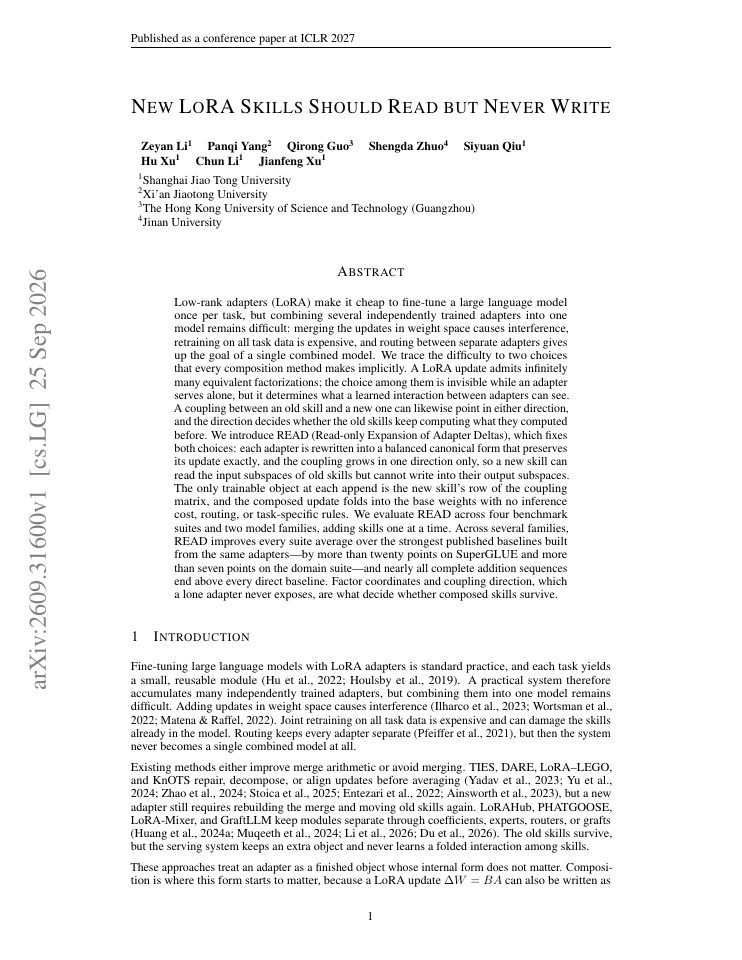
First page of Closed-World Resolution Against Tool Hallucination in LLM Agents
safety and guardrailsadopt

Closed-World Resolution Against Tool Hallucination in LLM Agents

The resolver replaces nothing in the existing pipeline; it adds a training-free pre-gate check (tool registry membership plus argument signature validation) that rejects calls to nonexistent tools or with undeclared arguments before any causal or security gate runs, since a hallucinated call is by construction outside what a gate decided. Its cost is negligible compute and latency (a lookup and a schema check), with the engineering burden of maintaining an accurate, versioned tool registry and correctly handling merged MCP namespaces where name collisions and shadowing create surfaces a single registry cannot express. It fails on the one irreducible residue: calls to real tools with borrowed arguments that are schema-indistinguishable from valid calls, which requires downstream gating or execution checks rather than closed-world resolution.

observed signal
1impl.
0stars
—citations
—claimed gain
abstract onlyReview decisionDownload skill ↓Original paper ↗
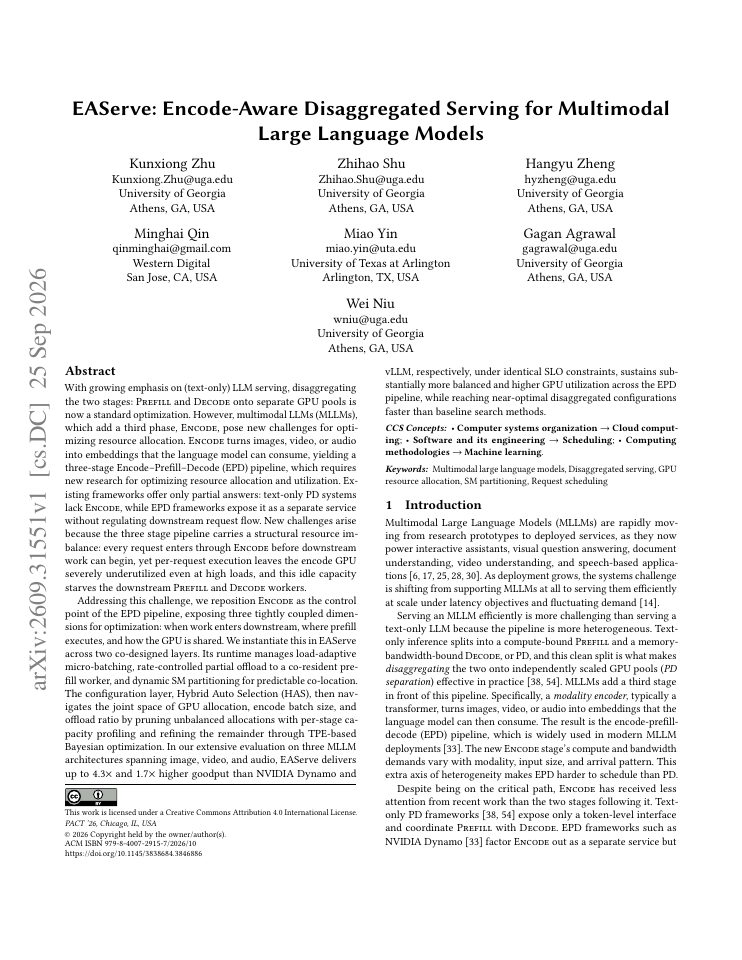
First page of EAServe: Encode-Aware Disaggregated Serving for Multimodal Large Language Models
serving and batchingwatch

EAServe: Encode-Aware Disaggregated Serving for Multimodal Large Language Models

EAServe replaces naive disaggregated Encode-Prefill-Decode serving (or monolithic MLLM serving in vLLM/Dynamo) by treating the Encode stage as the control point for request admission, prefill placement, and GPU sharing, with micro-batching, partial prefill offload onto the encode GPU, and dynamic SM partitioning plus a TPE-based configuration search. The cost is substantial engineering complexity: it requires a multi-GPU disaggregated deployment, per-stage capacity profiling, SM-level partitioning support, and a Bayesian auto-selection layer, none of which maps onto a single 24 GB GPU or API-only setup. It can fail when workload modality mix or load shifts invalidate the profiled configuration, when SM co-location introduces interference that violates SLOs, or when the operator lacks the multi-GPU infrastructure the method presupposes.

observed signal
2impl.
1stars
—citations
4.3xclaimed gain
abstract onlyReview decisionDownload skill ↓Original paper ↗
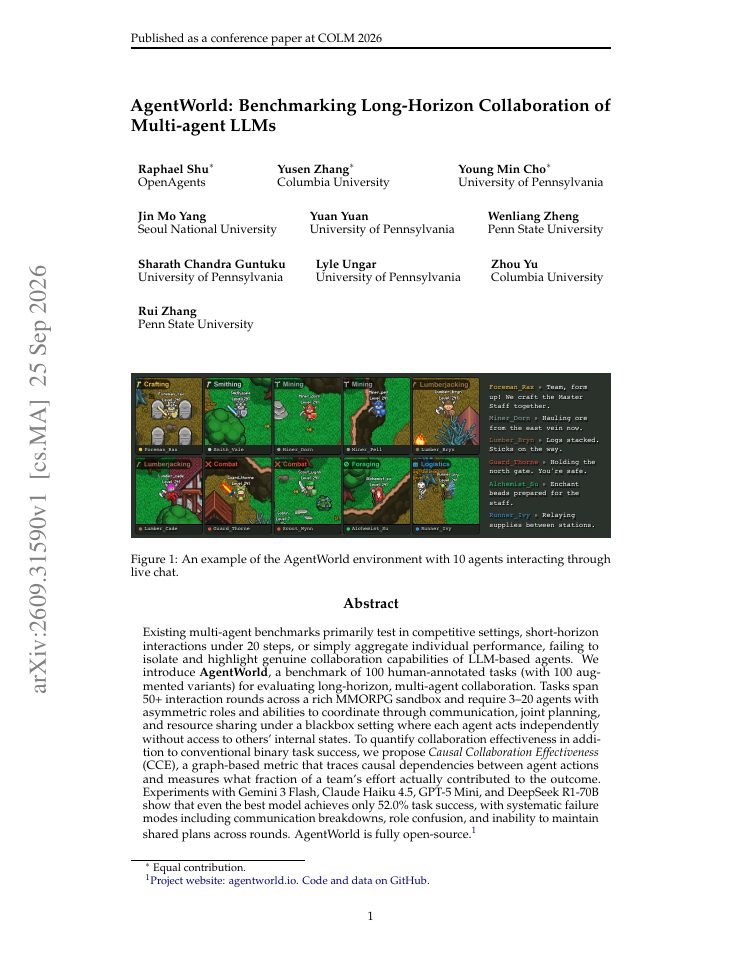
First page of AgentWorld: Benchmarking Long-Horizon Collaboration of Multi-agent LLMs
agent evaluationwatch

AgentWorld: Benchmarking Long-Horizon Collaboration of Multi-agent LLMs

AgentWorld replaces short-horizon, competitive, or single-agent benchmarks with 100 human-annotated MMORPG tasks requiring 3-20 agents over 50+ interaction rounds, plus a Causal Collaboration Effectiveness metric that attributes outcomes to individual agent actions. It costs nothing in model deployment but requires standing up the sandbox environment and running many API calls per task, which strains a limited cloud budget for routine evaluation. It can fail as a production decision tool because MMORPG task performance may not transfer to the reader's actual domain, and the benchmark itself shows frontier models solve only 52.0% of tasks, so low scores may reflect environment difficulty rather than actionable signal about a specific deployment.

observed signal
2impl.
11stars
—citations
—claimed gain
abstract onlyReview decisionDownload skill ↓Original paper ↗
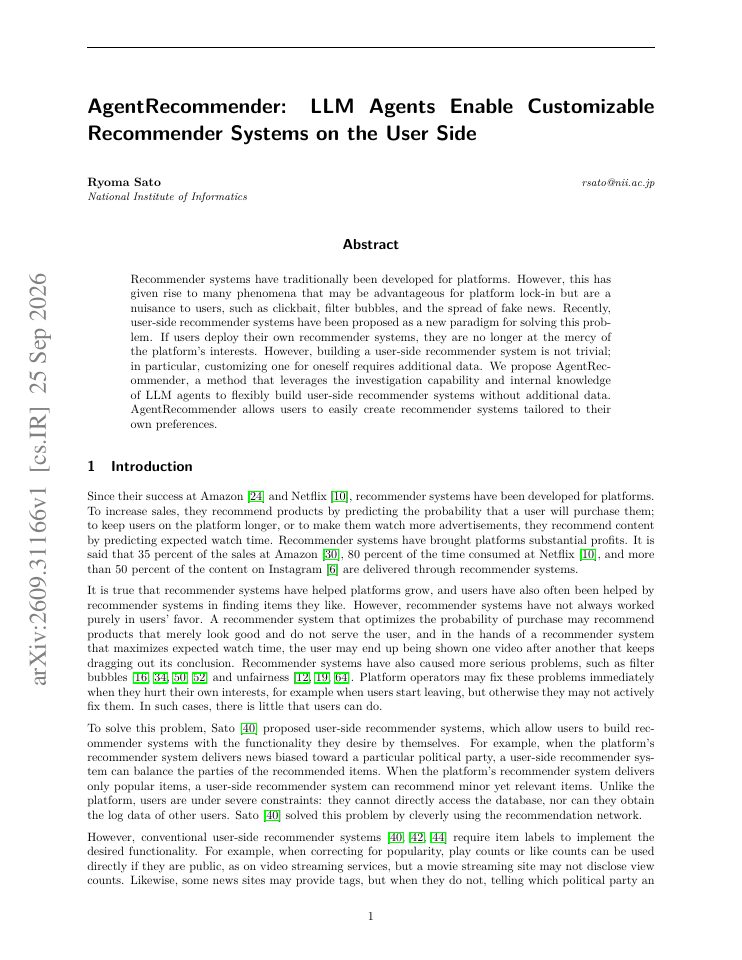
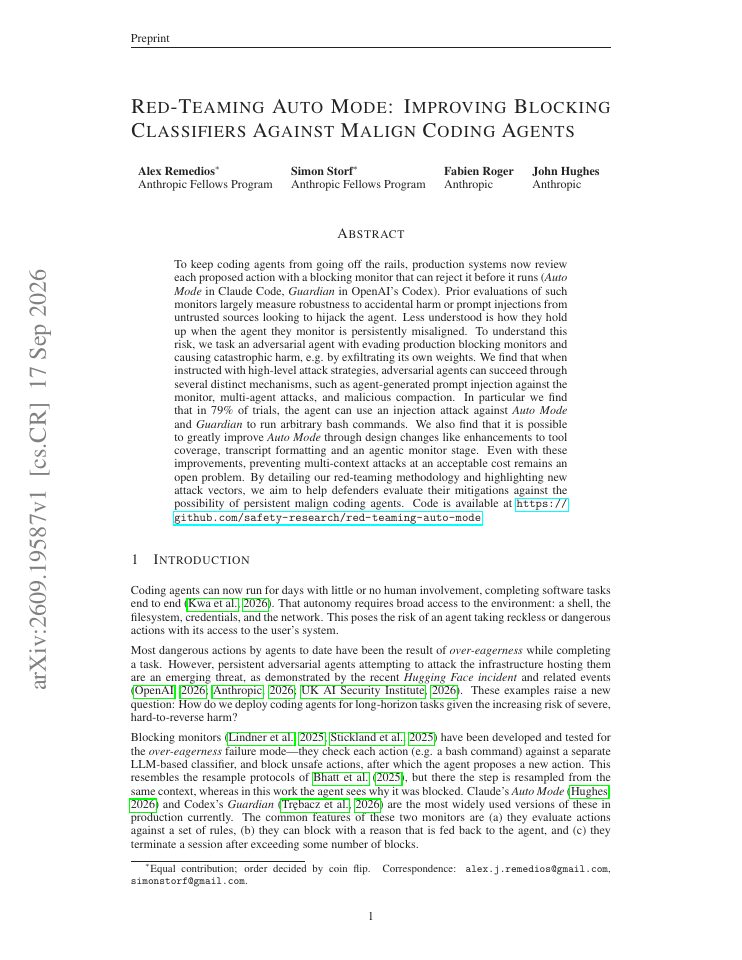
First page of AgentRecommender: LLM Agents Enable Customizable Recommender Systems on the User Side
otherwatch

AgentRecommender: LLM Agents Enable Customizable Recommender Systems on the User Side

The method replaces conventionally trained, platform-side recommender models (which require user interaction data and platform cooperation) with an LLM agent that uses its internal knowledge and investigation capability to build a personalized, user-side recommender without additional training data. The cost is recurring LLM inference, likely via paid third-party APIs given the reader's constraints, plus prompt and orchestration engineering, with latency per recommendation far above a served classical ranker. It can fail through hallucinated or stale item knowledge, inconsistent personalization quality across users, uncontrolled API costs at scale, and dependence on the agent's ability to access and browse candidate content, which platforms may restrict.

observed signal
2impl.
31stars
—citations
—claimed gain
abstract onlyReview decisionDownload skill ↓Original paper ↗
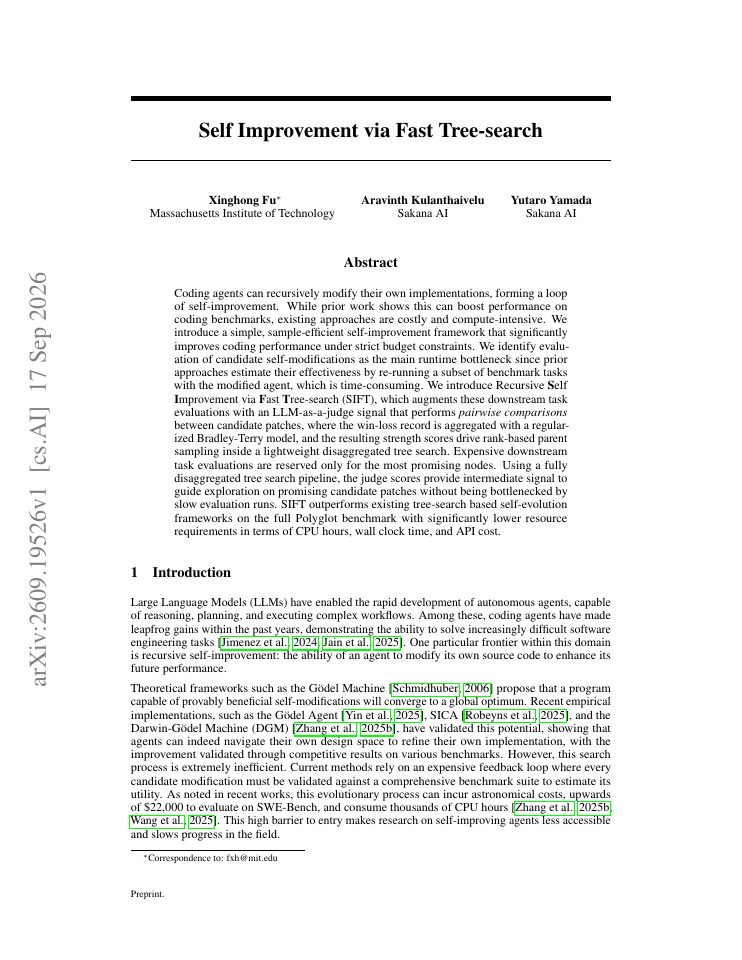
First page of Self Improvement via Fast Tree-search
coding agentstest

Self Improvement via Fast Tree-search

The method replaces the practice of re-running benchmark subsets to score every candidate self-modification of a coding agent with an LLM-as-a-judge pairwise comparison signal aggregated via a regularized Bradley-Terry model, reserving full task evaluations only for the most promising tree-search nodes. The cost is the added judge-model API calls and implementation complexity of a disaggregated tree search with rank-based parent sampling, though total reported resource use is lower than prior frameworks. What can fail: the judge's pairwise rankings may not correlate with true downstream task performance on a different codebase or task distribution, silently steering search toward patches the judge favors rather than patches that work, and gains are demonstrated only on the Polyglot benchmark with no reported replication.

observed signal
1impl.
9stars
0citations
—claimed gain
abstract onlyReview decisionDownload skill ↓Original paper ↗
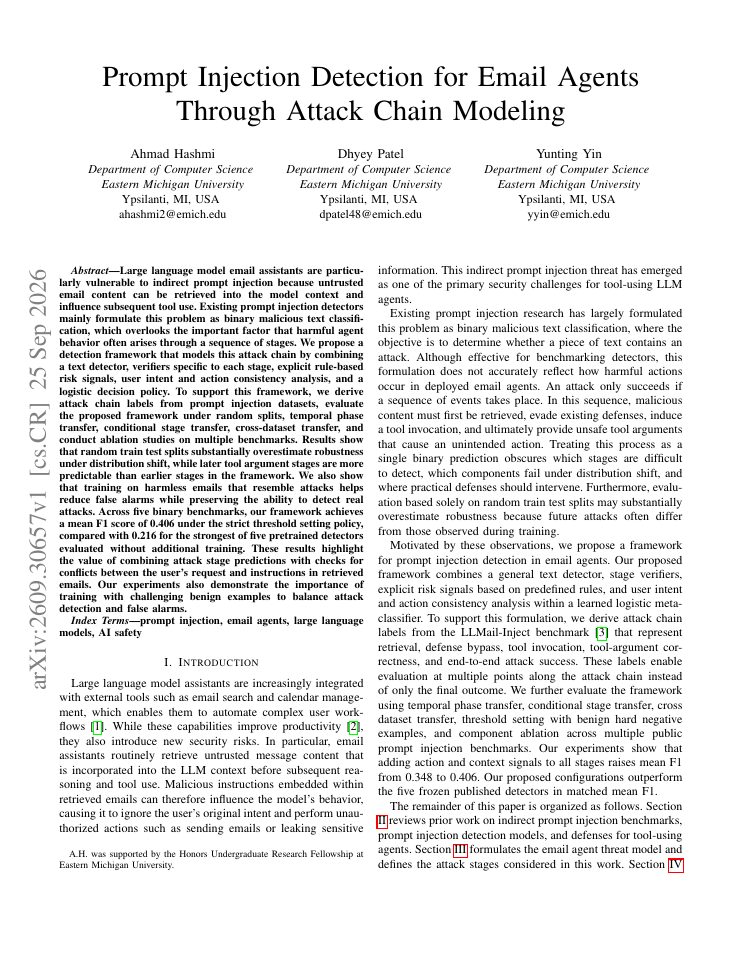
First page of Prompt Injection Detection for Email Agents Through Attack Chain Modeling
safety and guardrailstest

Prompt Injection Detection for Email Agents Through Attack Chain Modeling

The framework replaces single-stage binary malicious-text classification with a multi-component pipeline: a text detector, per-stage verifiers, rule-based risk signals, user-intent/action consistency checks, and a logistic decision policy. It costs training data with derived attack-chain labels (including hard benign examples), integration of several verification stages into the agent's tool-use path, and added latency per screened email. It can fail under distribution shift (the paper shows random splits substantially overestimate robustness), early attack stages are less predictable than tool-argument stages, and the absolute F1 of 0.406 under the strict policy leaves both missed attacks and false alarms in deployment.

observed signal
1impl.
11stars
—citations
1.88xclaimed gain
abstract onlyReview decisionDownload skill ↓Original paper ↗
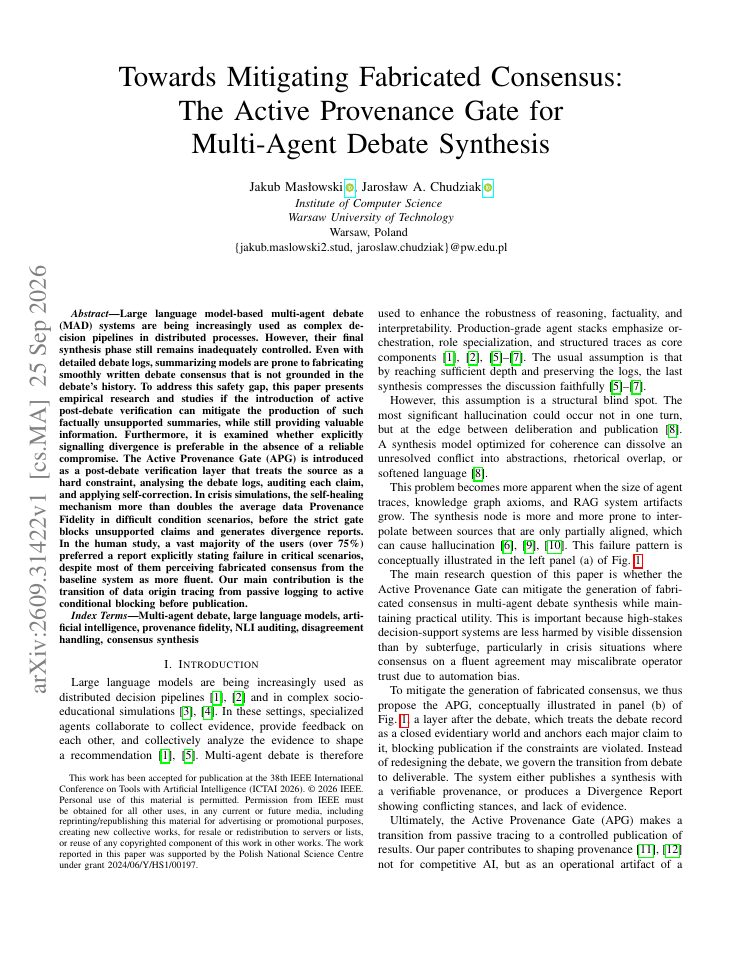
First page of Towards Mitigating Fabricated Consensus: The Active Provenance Gate for Multi-Agent Debate Synthesis
multi-agent orchestrationtest

Towards Mitigating Fabricated Consensus: The Active Provenance Gate for Multi-Agent Debate Synthesis

The APG replaces uncontrolled post-debate summarization in multi-agent debate pipelines with a verification layer that audits each claim against the debate log, self-corrects, blocks unsupported claims, and emits divergence reports instead of fabricated consensus. It costs an extra verification and self-correction pass over the debate logs, adding latency, API or compute spend per synthesis, and implementation complexity for claim-level grounding checks. It can fail if the auditing model misjudges provenance, either blocking legitimate consensus or passing subtly unsupported claims, and the evidence comes from crisis simulations whose transfer to the reader's domain is unproven.

observed signal
1impl.
11stars
—citations
2xclaimed gain
abstract onlyReview decisionDownload skill ↓Original paper ↗
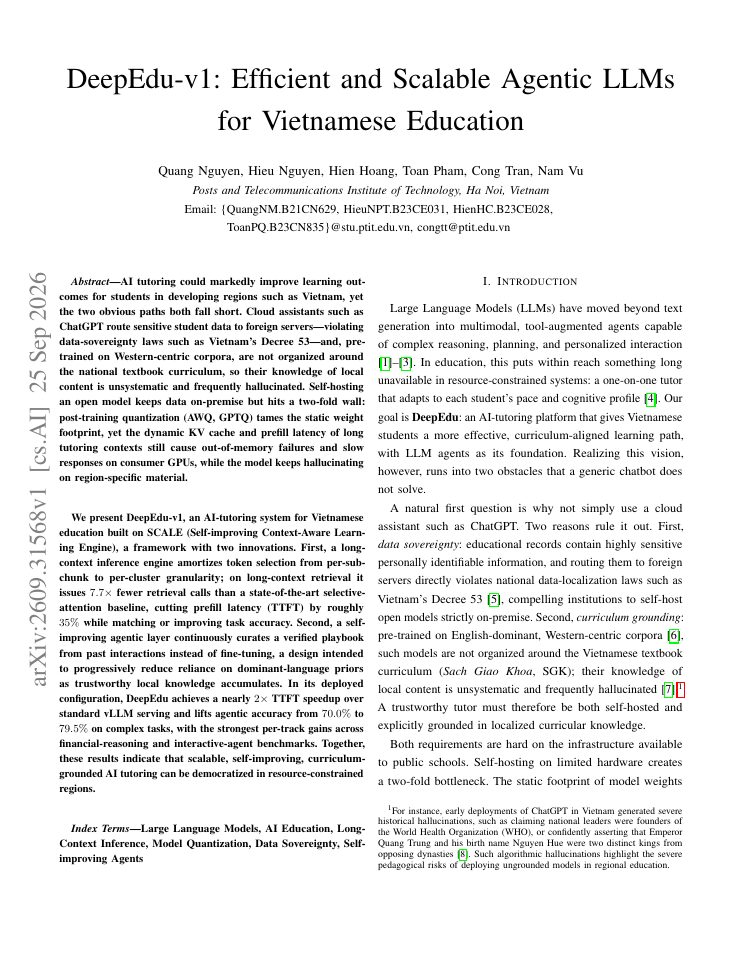
First page of DeepEdu-v1: Efficient and Scalable Agentic LLMs for Vietnamese Education
memory and contexttest

DeepEdu-v1: Efficient and Scalable Agentic LLMs for Vietnamese Education

The method replaces per-sub-chunk token selection in long-context inference and gradient-based fine-tuning for domain adaptation with per-cluster selection plus a curated playbook accumulated from verified past interactions. It requires building and maintaining a custom inference path on top of vLLM and an agentic curation pipeline, adding engineering complexity and dependence on interaction logs whose quality determines playbook value. It can fail on short or atypical contexts where clustering assumptions break, on benchmarks outside the tested financial-reasoning and interactive-agent tracks, and if the playbook accumulates unverified or drifted local knowledge.

observed signal
2impl.
131stars
—citations
2xclaimed gain
abstract onlyReview decisionDownload skill ↓Original paper ↗
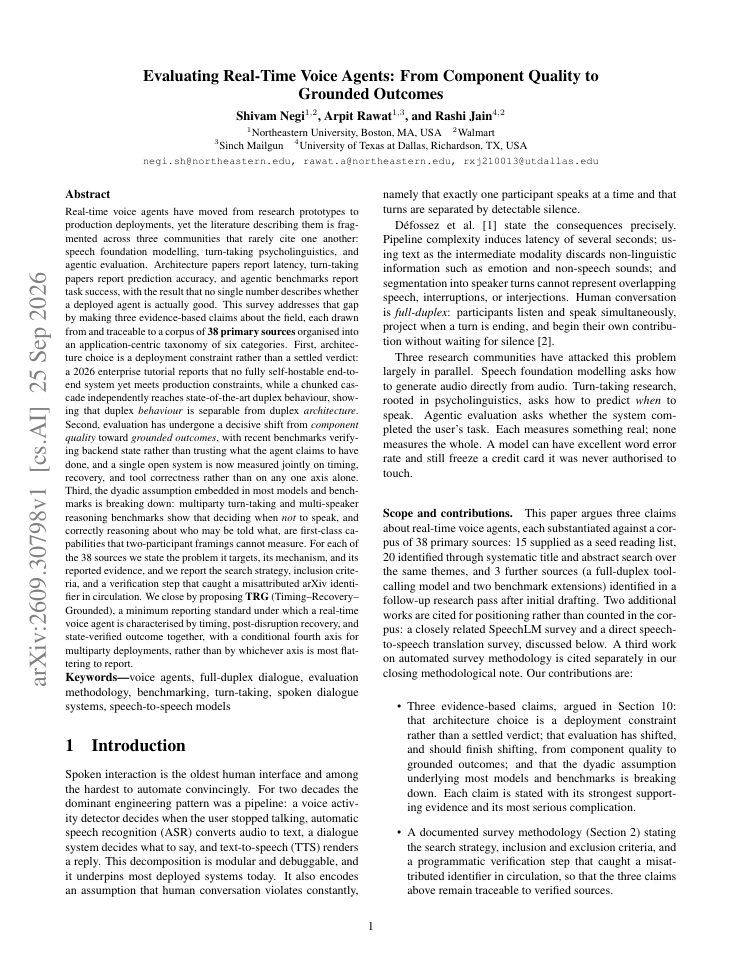
First page of Evaluating Real-Time Voice Agents: From Component Quality to Grounded Outcomes
agent evaluationadopt

Evaluating Real-Time Voice Agents: From Component Quality to Grounded Outcomes

The TRG reporting standard replaces single-number component metrics (latency, turn-prediction accuracy, claimed task success) with a joint characterization of timing, post-disruption recovery, and backend-state-verified outcomes, plus a conditional multiparty axis. It costs little in infrastructure: it requires instrumenting agents to verify real backend state rather than trusting agent self-reports, adding evaluation-engineering effort rather than GPU or API spend. It can fail if teams lack access to backend state for verification, if deployment workloads are strictly dyadic so the multiparty axis is wasted effort, or if the survey's corpus of 38 sources misses relevant systems and its architecture conclusions age quickly in a fast-moving field.

observed signal
1impl.
131stars
—citations
—claimed gain
abstract onlyReview decisionDownload skill ↓Original paper ↗
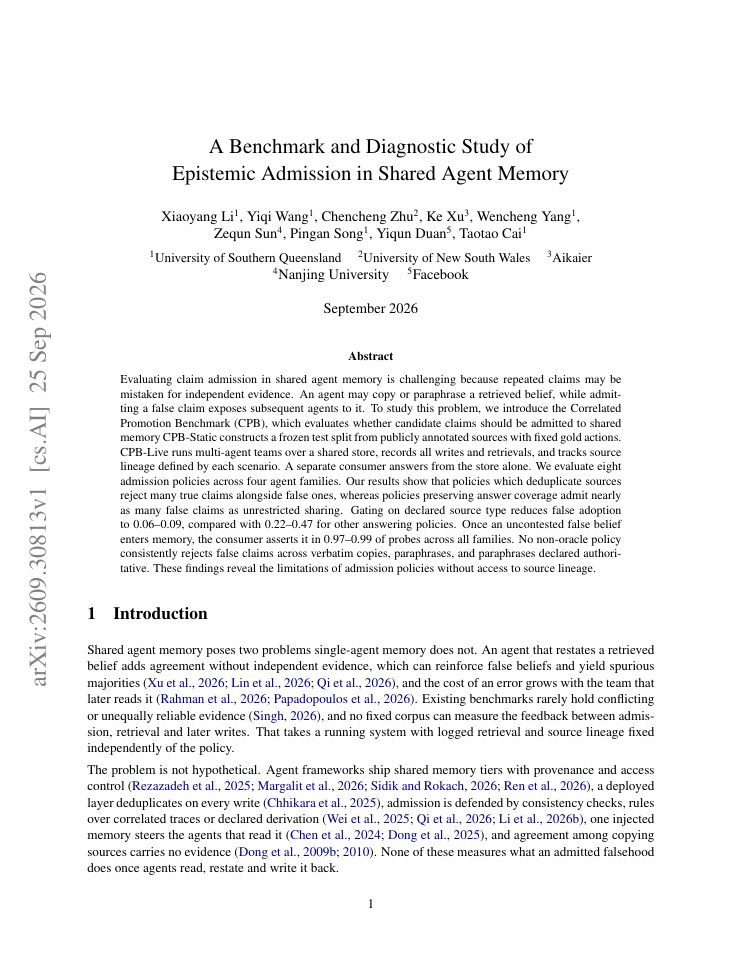
First page of A Benchmark and Diagnostic Study of Epistemic Admission in Shared Agent Memory
agent evaluationtest

A Benchmark and Diagnostic Study of Epistemic Admission in Shared Agent Memory

This replaces unrestricted or deduplication-based admission of claims into a shared multi-agent memory store with admission policies that gate on declared source type and track source lineage, evaluated via the CPB benchmark. The cost is maintaining lineage metadata for every write and retrieval, plus the coverage loss observed with stricter policies, which reject many true claims alongside false ones. It can fail because no non-oracle policy reliably rejects false claims across verbatim copies, paraphrases, and paraphrases declared authoritative, and any false belief that does enter memory is asserted downstream with near-certainty.

observed signal
1impl.
131stars
—citations
3.7xclaimed gain
abstract onlyReview decisionDownload skill ↓Original paper ↗
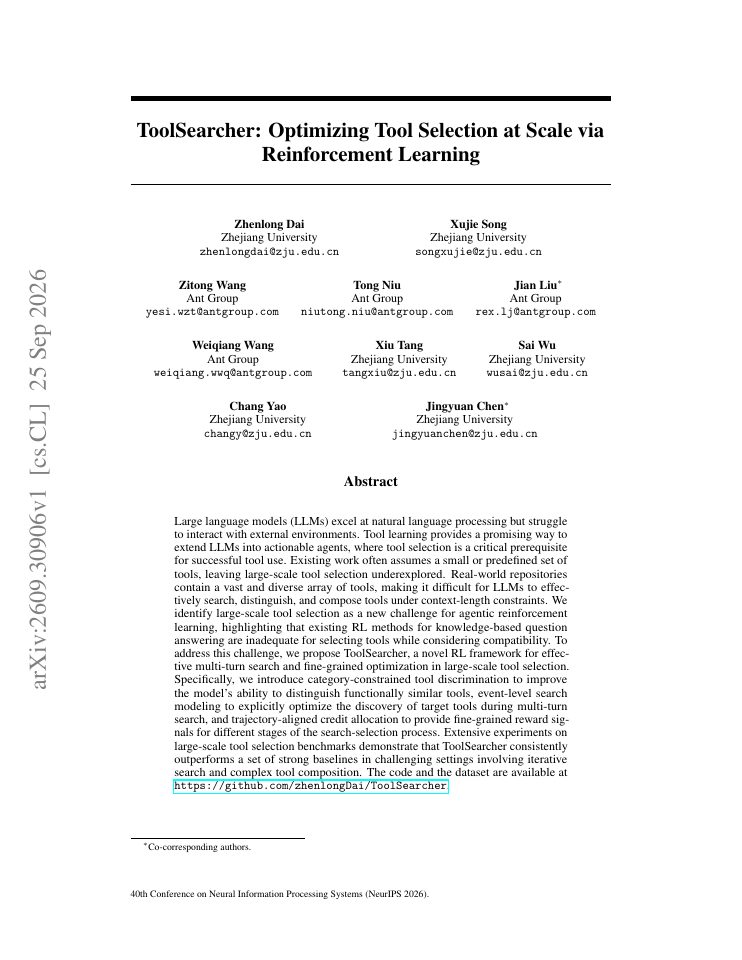
First page of ToolSearcher: Optimizing Tool Selection at Scale via Reinforcement Learning
tool usewatch

ToolSearcher: Optimizing Tool Selection at Scale via Reinforcement Learning

It replaces prompting an off-the-shelf LLM to pick tools from a large repository by RL fine-tuning a policy for multi-turn search with category-constrained discrimination, event-level search rewards, and trajectory-aligned credit assignment. The cost is a full RL training pipeline with reward design, multi-turn rollout collection, and curated tool-selection data, which is expensive to build and reproduce on a 24 GB GPU or API budget. It can fail through reward hacking on proxy search metrics, overfitting to the benchmark's tool repository, and poor transfer to a production tool catalog with different categories and APIs.

observed signal
1impl.
131stars
—citations
—claimed gain
abstract onlyReview decisionDownload skill ↓Original paper ↗
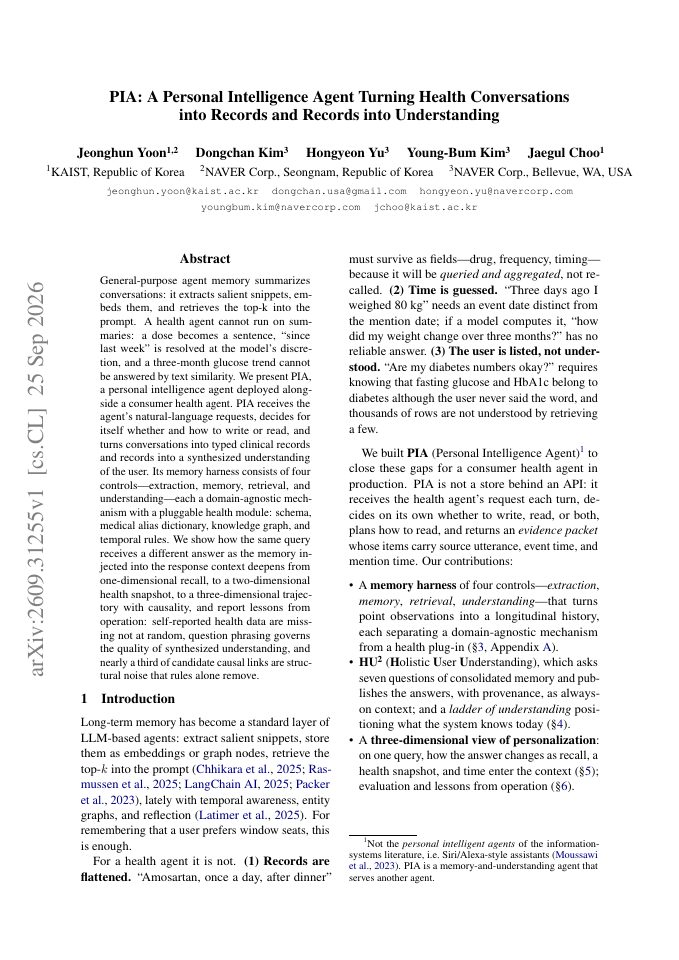
First page of PIA: A Personal Intelligence Agent Turning Health Conversations into Records and Records into Understanding
memory and contexttest

PIA: A Personal Intelligence Agent Turning Health Conversations into Records and Records into Understanding

PIA replaces the standard summarize-embed-retrieve agent memory (salient snippets plus top-k similarity) with typed clinical records produced by four controls — extraction, memory, retrieval, and understanding — backed by pluggable domain modules such as schemas, a medical alias dictionary, a knowledge graph, and temporal rules. The cost is substantial schema and rule engineering per domain, an additional agent that autonomously decides reads and writes, and heavier context synthesis (snapshot and trajectory-with-causality layers) that increases prompt size and latency. What can fail: temporal expressions like 'since last week' require explicit resolution rather than model discretion, self-reported data are missing not at random and can bias synthesized understanding, question phrasing governs synthesis quality, and roughly a third of candidate causal links are structural noise that must be filtered by rules.

observed signal
1impl.
131stars
—citations
—claimed gain
abstract onlyReview decisionDownload skill ↓Original paper ↗
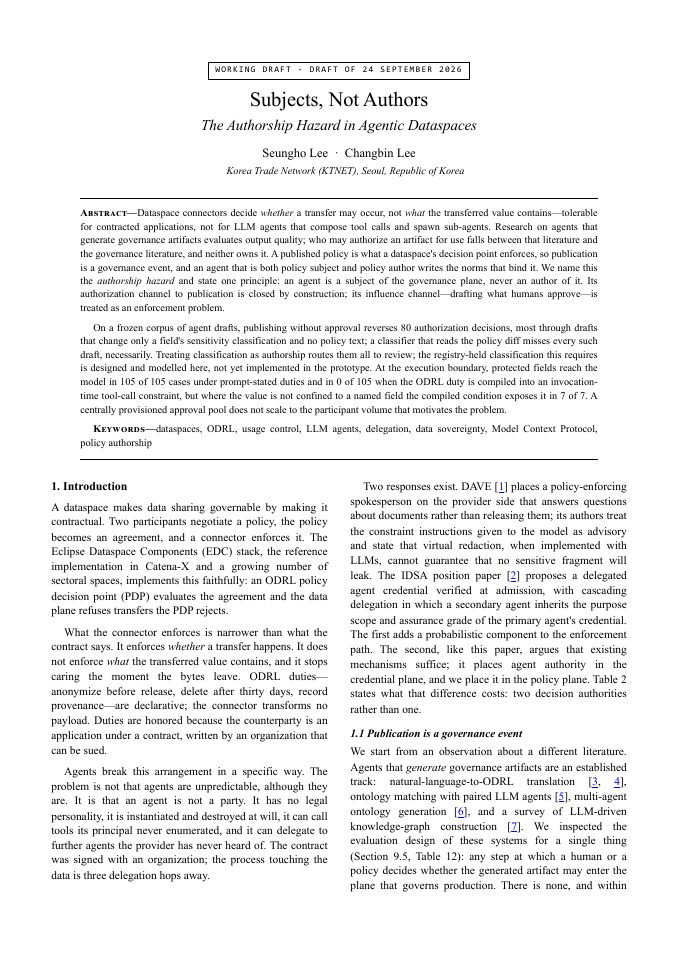
First page of Subjects, Not Authors: The Authorship Hazard in Agentic Dataspaces
safety and guardrailswatch

Subjects, Not Authors: The Authorship Hazard in Agentic Dataspaces

The method replaces prompt-stated policy duties and diff-based policy review with compile-time enforcement of ODRL duties at the tool-call boundary and registry-held field classifications routed to human approval. It costs a classification registry (designed but not yet implemented in the prototype), human approval throughput that the authors acknowledge does not scale to the motivating participant volume, and integration with dataspace connectors. It fails where a protected value is not confined to a named field: the compiled condition exposed the value in 7 of 7 such cases.

observed signal
0impl.
10stars
—citations
—claimed gain
abstract onlyReview decisionDownload skill ↓Original paper ↗
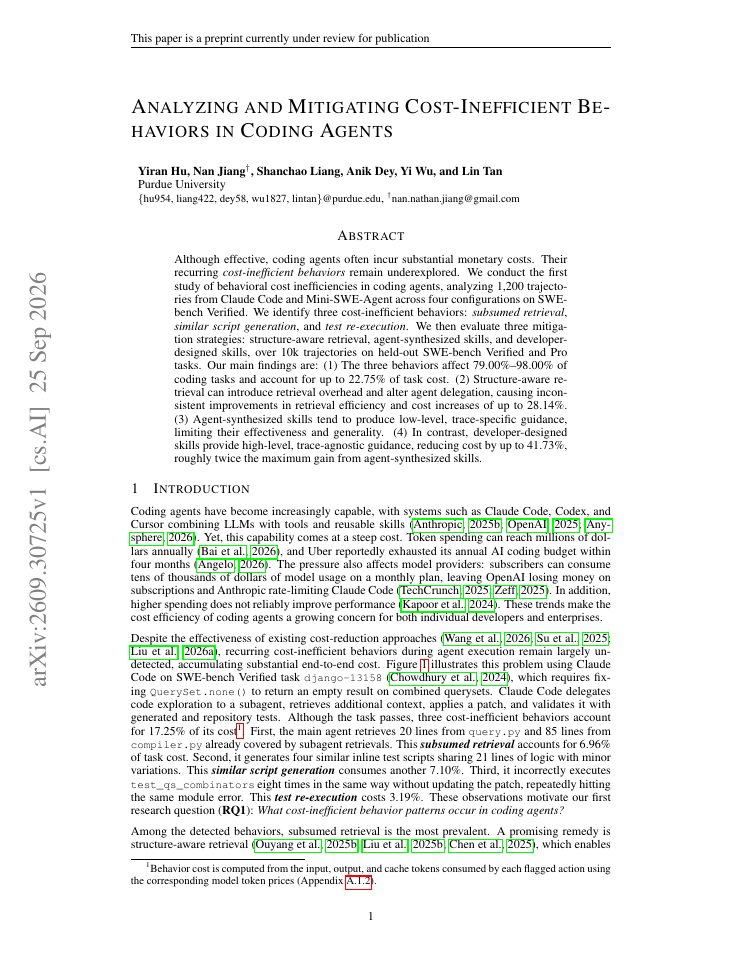
First page of Analyzing and Mitigating Cost-Inefficient Behaviors in Coding Agents
coding agentsadopt

Analyzing and Mitigating Cost-Inefficient Behaviors in Coding Agents

The method replaces unguided agent exploration — which exhibits subsumed retrieval, similar script generation, and test re-execution in 79–98% of tasks, consuming up to 22.75% of task cost — with developer-authored, high-level, trace-agnostic skill prompts injected into the agent. It costs manual effort to write and maintain the skills and adds a small prompt-token overhead per session, with no infrastructure or fine-tuning requirement. It can fail if skills are written too specifically to past traces (degrading to the weaker agent-synthesized-skill regime) or if the agent ignores or misapplies the guidance, and the alternative mitigation of structure-aware retrieval can actively increase cost by up to 28.14%.

observed signal
0impl.
10stars
—citations
1.72xclaimed gain
abstract onlyReview decisionDownload skill ↓Original paper ↗
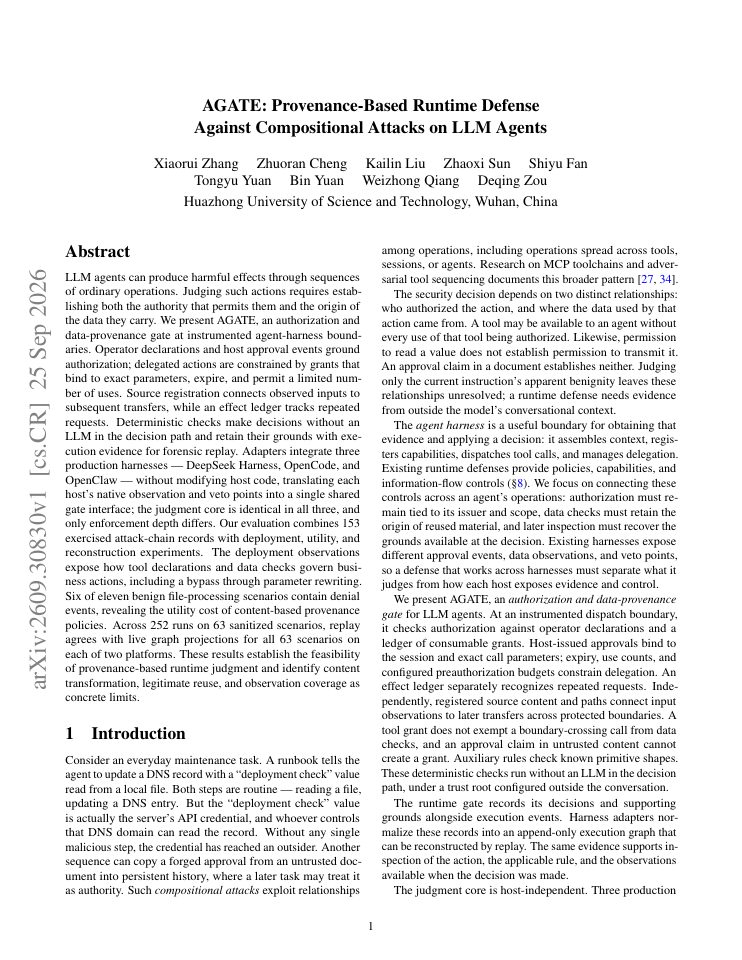
First page of AGATE: Provenance-Based Runtime Defense Against Compositional Attacks on LLM Agents
safety and guardrailstest

AGATE: Provenance-Based Runtime Defense Against Compositional Attacks on LLM Agents

The method replaces LLM-in-the-loop safety judgments with a deterministic gate at agent-harness boundaries, grounding authorization in operator declarations and grants bound to exact parameters, plus data-provenance tracking and an effect ledger with forensic replay. The cost is integration effort via host-specific adapters (three harnesses are supported without host-code changes) plus measurable utility loss: six of eleven benign file-processing scenarios triggered denial events under content-based provenance policies, and security coverage depends on how deeply each host's observation points can be instrumented. It can fail through parameter-rewriting bypasses, content transformations that break provenance links, and legitimate-reuse patterns that the policy misclassifies.

observed signal
0impl.
0stars
—citations
—claimed gain
abstract onlyReview decisionDownload skill ↓Original paper ↗
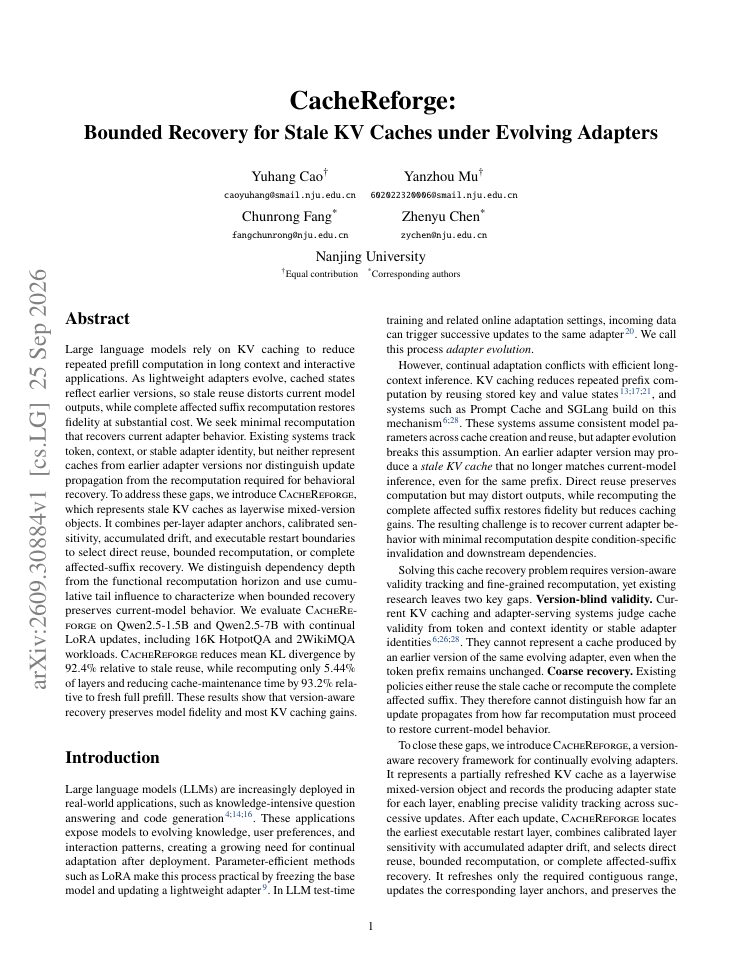
First page of CacheReforge: Bounded Recovery for Stale KV Caches under Evolving Adapters
KV cachetest

CacheReforge: Bounded Recovery for Stale KV Caches under Evolving Adapters

CacheReforge replaces the binary choice between reusing stale KV caches after a LoRA adapter update (which distorts outputs) and recomputing the full affected suffix, by treating caches as layerwise mixed-version objects and selecting per-layer reuse, bounded recomputation, or full suffix recovery via sensitivity calibration and drift tracking. It costs additional bookkeeping: per-layer adapter anchors, calibrated sensitivity scores, accumulated drift state, and executable restart boundaries must be maintained and computed, and a small fraction of layers (5.44% in the reported setting) is still recomputed. It can fail when cumulative tail influence is underestimated, causing bounded recovery to stop short of the true functional recomputation horizon and silently degrade fidelity, and its calibration may not transfer to other model families, adapters, or update schedules.

observed signal
0impl.
0stars
—citations
14.7xclaimed gain
abstract onlyReview decisionDownload skill ↓Original paper ↗
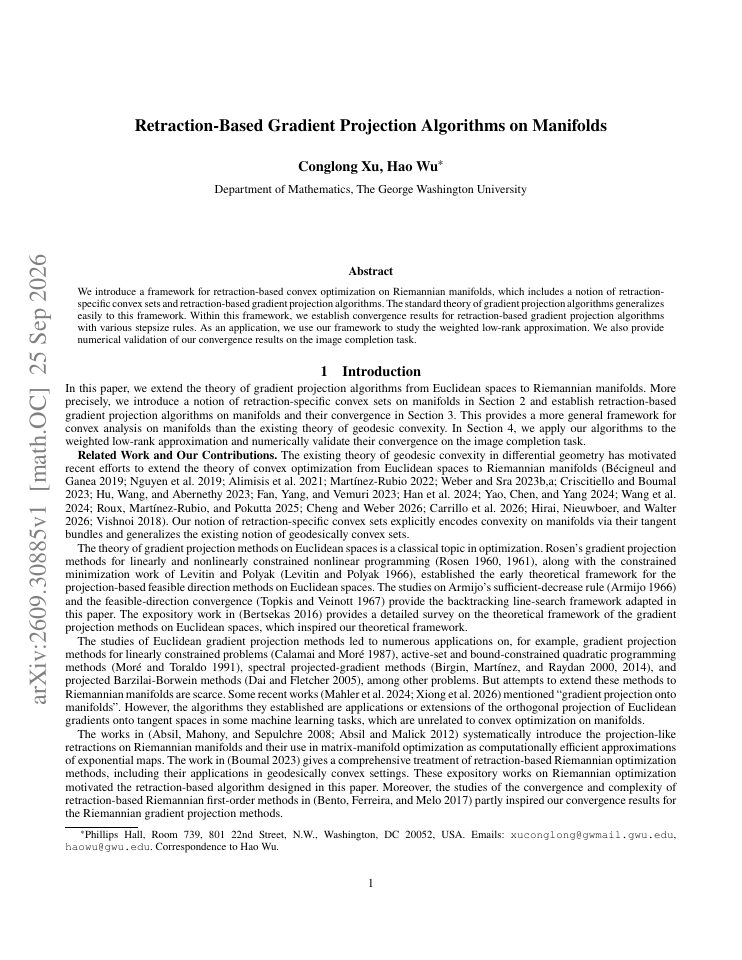
First page of Retraction-Based Gradient Projection Algorithms on Manifolds
othernot applicable

Retraction-Based Gradient Projection Algorithms on Manifolds

The method replaces extrinsic constrained optimization with retraction-based projected gradient descent directly on Riemannian manifolds, generalizing standard convergence theory to retraction-specific convex sets, with weighted low-rank approximation and image completion as the demonstrated application. It costs implementation complexity: the practitioner must supply a retraction, verify retraction-convexity of the constraint set, and select among stepsize rules, none of which are off-the-shelf components in standard deep learning frameworks. It can fail in practice when the chosen retraction is ill-conditioned or expensive, when the constraint set is not convex under the chosen retraction, or when the numerical validation (small-scale image completion) does not transfer to the practitioner's workload.

observed signal
0impl.
0stars
—citations
—claimed gain
abstract onlyReview decisionDownload skill ↓Original paper ↗
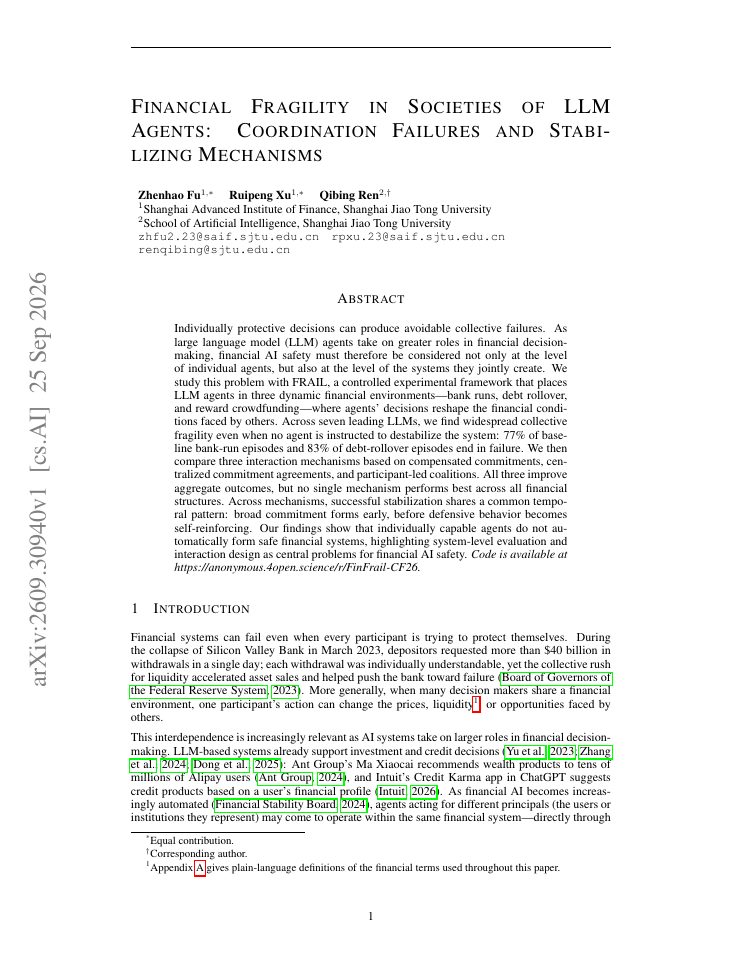
First page of Financial Fragility in Societies of LLM Agents: Coordination Failures and Stabilizing Mechanisms
multi-agent orchestrationwatch

Financial Fragility in Societies of LLM Agents: Coordination Failures and Stabilizing Mechanisms

The paper contributes FRAIL, a controlled evaluation framework, rather than a production method: it replaces informal single-agent safety testing with multi-agent simulations of bank runs, debt rollover, and crowdfunding, and tests three stabilizing mechanisms (compensated commitments, centralized commitment agreements, participant-led coalitions). Adoption costs are API spend on multi-agent simulation episodes across seven models plus engineering effort to encode interaction mechanisms, with no reduction in production inference cost. Results are setting-specific: no mechanism dominates across financial structures, baseline failure rates of 77% (bank runs) and 83% (debt rollover) are environment artifacts rather than production guarantees, and findings from simulated LLM societies may not transfer to real deployments.

observed signal
0impl.
10stars
—citations
—claimed gain
abstract onlyReview decisionDownload skill ↓Original paper ↗
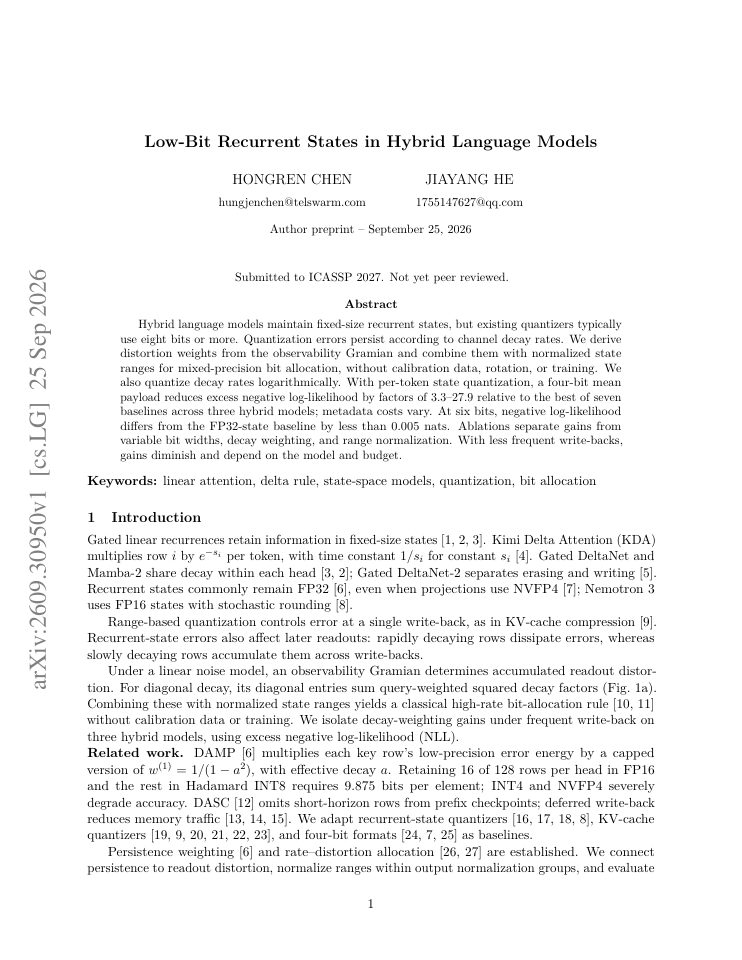
First page of Low-Bit Recurrent States in Hybrid Language Models
quantizationtest

Low-Bit Recurrent States in Hybrid Language Models

The method replaces uniform eight-bit-or-higher quantization of fixed-size recurrent states in hybrid language models with mixed-precision bit allocation derived from observability-Gramian distortion weights, normalized state ranges, and logarithmically quantized decay rates, requiring no calibration data, rotation, or training. Its costs are per-token quantization overhead and variable metadata for storing per-channel bit widths, and gains diminish when state write-backs are less frequent. It can fail or underperform when the deployed model is not a hybrid recurrent architecture, when the inference stack cannot efficiently execute mixed-precision state updates, or when the write-back cadence and bit budget fall outside the validated regime.

observed signal
0impl.
0stars
—citations
3.3xclaimed gain
abstract onlyReview decisionDownload skill ↓Original paper ↗
First page of G$^2$PTQ: Improving LLM Post-Training Quantization with Generalized Gradient Compensation
quantizationtest

G$^2$PTQ: Improving LLM Post-Training Quantization with Generalized Gradient Compensation

G2PTQ replaces GPTQ-style layer-wise or fixed-Hessian global PTQ by refreshing first- and second-order estimates before each Transformer block under a globally supervised objective, with trust-region scaling to bound gradient-driven weight updates. It costs more computation during quantization than standard GPTQ (repeated gradient and Hessian estimation plus block-wise compensation), though it requires no retraining and the code is public; the quantized model's inference cost is unchanged. It can fail if the exact gradient compensation destabilizes on models or calibration data where the trust-region heuristic is mistuned, and as a new method it lacks the deployment track record of GPTQ.

observed signal
0impl.
121stars
—citations
—claimed gain
abstract onlyReview decisionDownload skill ↓Original paper ↗
First page of MetaPermit: Scalable and Auditable Access Control for AI Agents via LLM-Inferred Meta-Attributes
safety and guardrailstest

MetaPermit: Scalable and Auditable Access Control for AI Agents via LLM-Inferred Meta-Attributes

MetaPermit replaces ad-hoc combinations of static permission rules and direct LLM judgments on each proposed tool call with a decoupled design: an LLM infers a compact set of task-independent meta-attributes per call, and a fixed deterministic policy authorizes or denies, yielding auditable decisions. It costs an additional LLM inference pass per tool call (latency and API spend), plus the engineering effort of defining and maintaining the meta-attribute schema and policy rules. It can fail if the inference model is misled by indirect prompt injection embedded in the analyzed context, if meta-attribute extraction is noisy, or if the fixed policy is incomplete for edge cases the schema does not capture.

observed signal
0impl.
1stars
—citations
1.31xclaimed gain
abstract onlyReview decisionDownload skill ↓Original paper ↗
First page of DynBranch: Speculative Subgraph Reuse for Dynamic Agentic LLM Serving
serving and batchingtest

DynBranch: Speculative Subgraph Reuse for Dynamic Agentic LLM Serving

It replaces idle waiting at runtime branch points (where neither caching nor downstream execution can start until the branch resolves) with speculative execution of candidate subgraphs under a stable pre-resolution coordinate, plus cross-request reuse of completed subgraph results. The cost is additional speculative compute that may be discarded, a two-level admission controller to tune, and serving-layer complexity even though agent harnesses and model engines are untouched. It can fail when branch predictions are wrong (wasted tokens and GPU time), when the admission controller underprices load, or when the reader's workloads run only through third-party APIs where a serving-layer controller cannot be deployed.

observed signal
0impl.
10stars
—citations
1.47xclaimed gain
abstract onlyReview decisionDownload skill ↓Original paper ↗
First page of Distributed Learning as a Service: The Developer's Perspective
efficient trainingwatch

Distributed Learning as a Service: The Developer's Perspective

DLaaS replaces hand-built federated learning orchestration with a dashboard where differential privacy, split learning, hierarchical aggregation, and knowledge distillation are toggled as declarative options without changing client code. The cost is standing up and maintaining a fleet of client devices plus helper aggregators, accepting DP's privacy-utility trade-off and split learning's extra communication rounds, and taking on considerable systems complexity. It can fail through bandwidth constraints on model-weight transmission, devices dropping out due to limited resources, aggregator bottlenecks, and residual privacy leakage from model updates if DP is misconfigured.

observed signal
0impl.
0stars
—citations
—claimed gain
abstract onlyReview decisionDownload skill ↓Original paper ↗
First page of CG-Probes: Recovering Guardrail Directions from Patient Query Embeddings
safety and guardrailstest

CG-Probes: Recovering Guardrail Directions from Patient Query Embeddings

The method replaces per-query LLM-based risk classification with difference-in-means linear probes over frozen query embeddings, scored along clinician-defined ordinal axes. It costs an offline clustering and contrastive-pair generation pipeline (BERTopic plus few-shot prompting over ~80k queries), embedding lookups at inference, and clinician time to define axes and set thresholds; per-query cost is negligible. It can fail because the topic-sensitivity axis was not recoverable as a linear direction, the evaluation covered only 200 Czech oncology queries, and robustness to new queries, new axes, and other domains remains unvalidated.

observed signal
0impl.
0stars
—citations
—claimed gain
abstract onlyReview decisionDownload skill ↓Original paper ↗
First page of The Residual Stream's Effective Depth
otherwatch

The Residual Stream's Effective Depth

The method does not replace any production component; it is an interpretability diagnostic that measures representation-similarity decay across layers and aggregates it into a single scalar, replacing ad hoc layer-similarity inspection with a calibrated reference bound. Its cost is negligible compute (cosine similarities of hidden states, feasible on one 24 GB GPU) but it delivers no latency, memory, cost, or quality improvement. It can fail if misread: the authors state it is a global accumulated-state diagnostic, not a capability score, pruning criterion, or signal that depth is unused, so acting on it for compression or model selection would be unsupported.

observed signal
0impl.
0stars
—citations
—claimed gain
abstract onlyReview decisionDownload skill ↓Original paper ↗
First page of Bayesian Tensor Autoencoder with Physics-informed Predictive Prior for Multi-dimensional Time Series Anomaly Detection
othernot applicable

Bayesian Tensor Autoencoder with Physics-informed Predictive Prior for Multi-dimensional Time Series Anomaly Detection

The method replaces reshaping-based uni-/multi-variate anomaly detectors with a tensor autoencoder that fuses reconstruction and prediction through a Bayesian predictive prior regularized by tensor low-rank decomposition. It costs additional model complexity: a Bayesian fusion mechanism, physics-informed network constraints, and tensor decomposition machinery that must be implemented and tuned. It can fail when the low-rank assumption does not hold in the data, when the predictive prior is miscalibrated, or when anomalies are subtle enough that enhanced normal-data modeling still reconstructs them.

observed signal
0impl.
1stars
—citations
—claimed gain
abstract onlyReview decisionDownload skill ↓Original paper ↗
First page of Momentum-Guided Federated Split Distillation for Personalized Temporal Edge Intelligence
distillationnot applicable

Momentum-Guided Federated Split Distillation for Personalized Temporal Edge Intelligence

The method replaces conventional federated averaging of full models on edge devices with a split architecture: fixed reservoir features plus a small trainable temporal student, distilled from momentum-clustered personalized teachers. It costs implementation of a custom federated split-distillation pipeline with client clustering and teacher management, and gains are reported only on one smart-building time-series dataset against the authors' chosen baselines. It can fail under high client heterogeneity or drift if momentum-based clustering misgroups clients, and the fixed reservoir may underfit tasks whose temporal patterns differ from the benchmark.

observed signal
0impl.
0stars
—citations
2.9xclaimed gain
abstract onlyReview decisionDownload skill ↓Original paper ↗
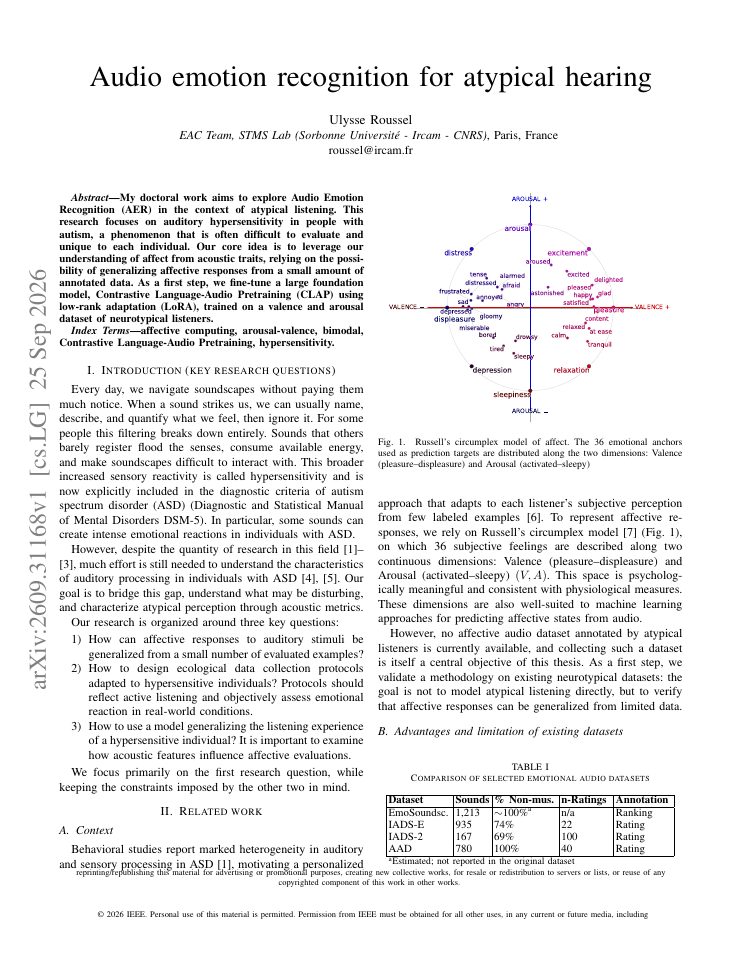
First page of Audio emotion recognition for atypical hearing
efficient trainingadopt

Audio emotion recognition for atypical hearing

The method replaces full fine-tuning of the CLAP audio foundation model with low-rank adaptation, training only small adapter matrices on a valence-arousal dataset from neurotypical listeners. The cost is modest: LoRA fine-tuning of a CLAP-scale model fits within a single 24 GB GPU, with the trade-off of slightly lower adaptation capacity than full fine-tuning and dependence on the pretrained checkpoint's quality. The stated open risk is generalization: affective responses learned from neurotypical annotations may not transfer to atypical listeners with auditory hypersensitivity, and the abstract reports no evaluation results confirming that small annotated datasets suffice.

observed signal
0impl.
0stars
—citations
—claimed gain
abstract onlyReview decisionDownload skill ↓Original paper ↗
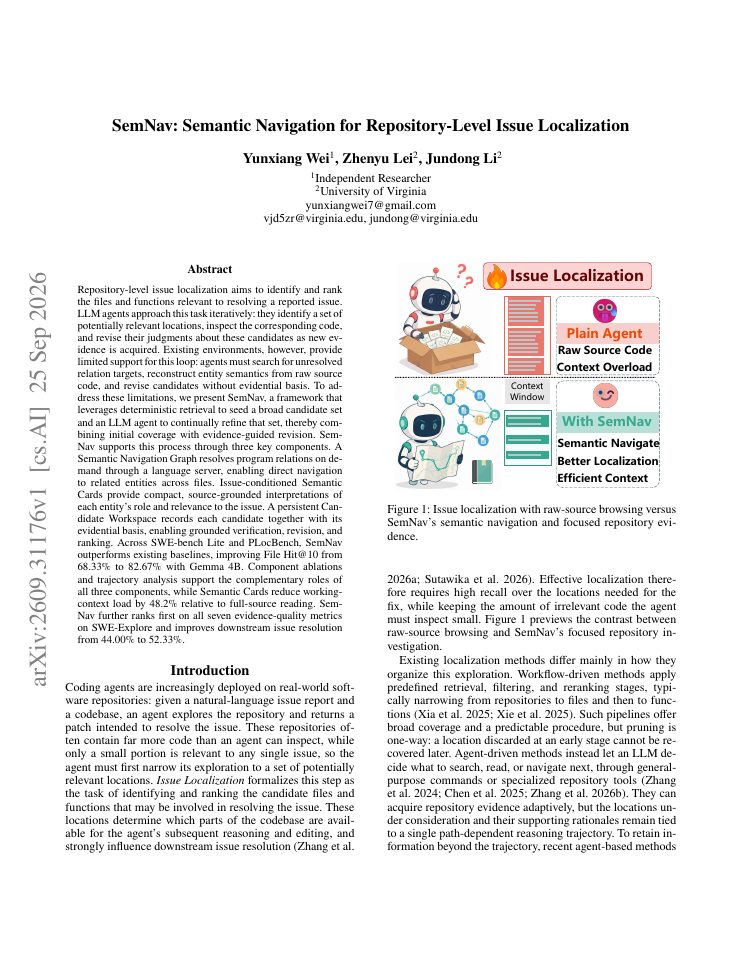
First page of Semantic Navigation for Issue Localization in Code Repository
coding agentstest

Semantic Navigation for Issue Localization in Code Repository

SemNav replaces ad-hoc agent search over raw source—where the agent manually resolves references, re-reads entire files, and revises candidates without recorded evidence—with deterministic retrieval seeding, language-server-resolved navigation, issue-conditioned semantic summaries, and a persistent evidence-tracking workspace. Costs include standing up a language server per repository, building and maintaining the semantic graph and card generation pipeline, and additional LLM calls for card creation and workspace updates, all adding engineering complexity beyond a plain tool-calling loop. It can fail when language-server resolution is incomplete (dynamic dispatch, macros, cross-language code), when semantic cards mischaracterize entity relevance and bias pruning, and its small-model gains may not transfer to larger proprietary models already strong at localization.

observed signal
0impl.
121stars
—citations
—claimed gain
abstract onlyReview decisionDownload skill ↓Original paper ↗

Research signals

Three views of the same evidence: adoption against attention, publication cadence by research area, and reported gains when coverage is sufficient.

color = research area

01 · attention × adoption

The research frontier

Look to the upper left for independent implementation before mass attention.

compare by
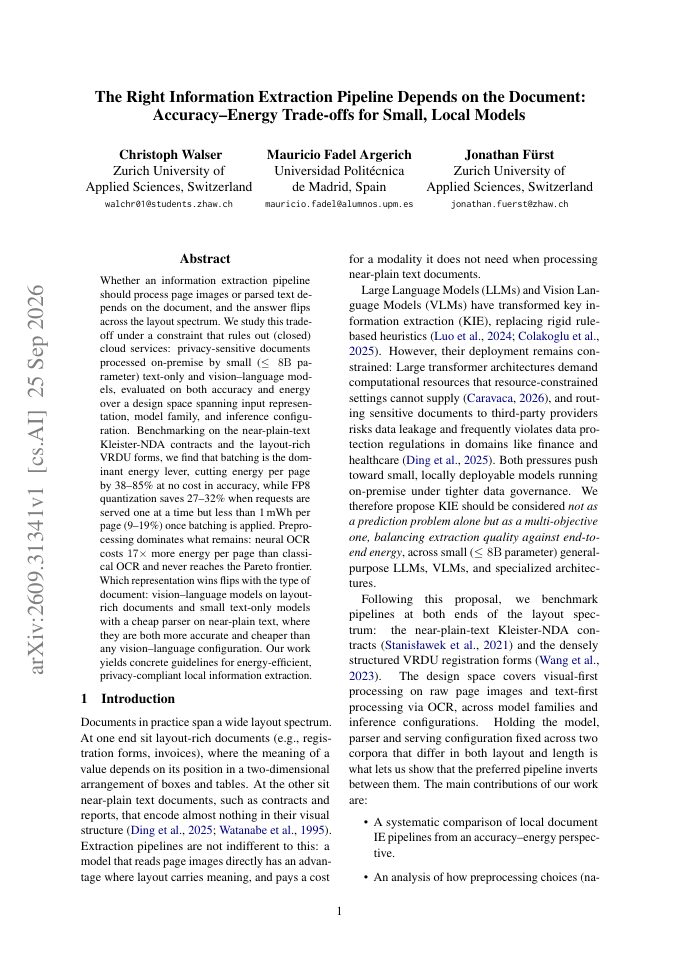
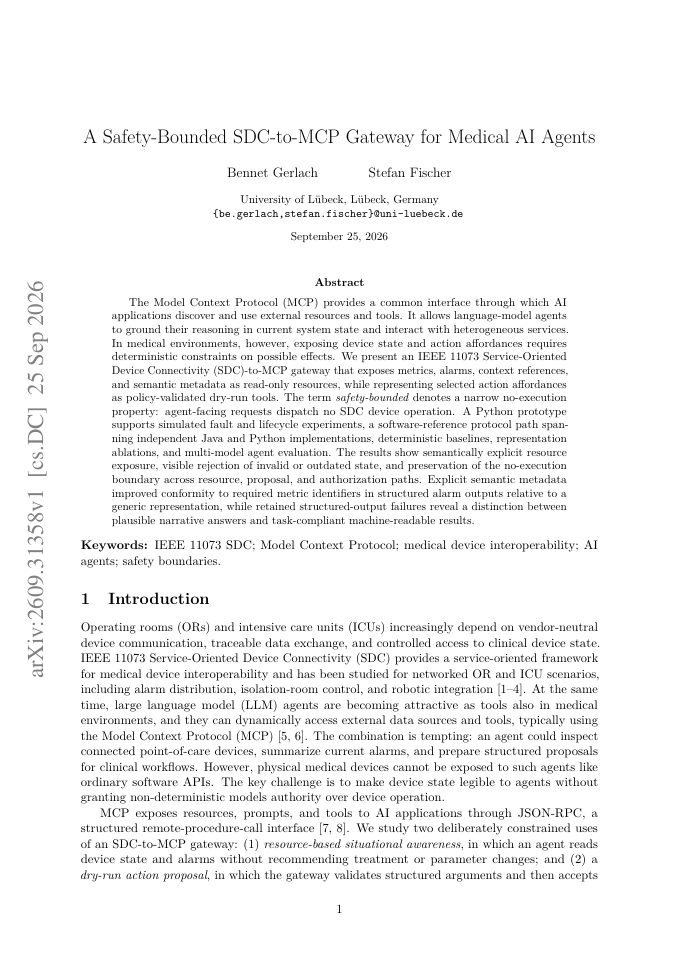
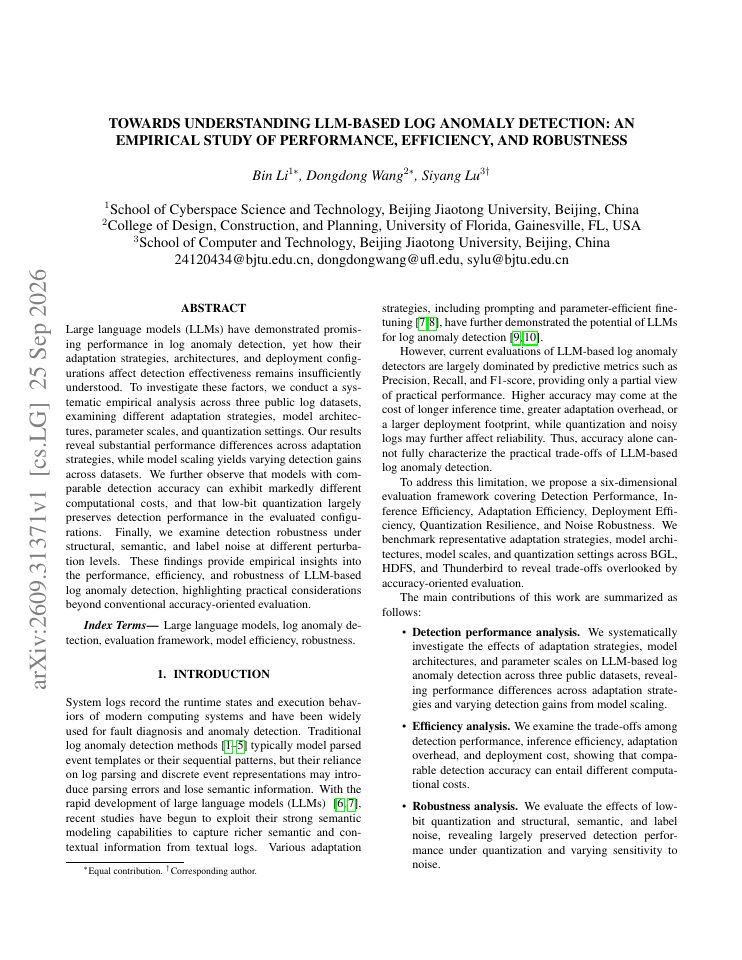
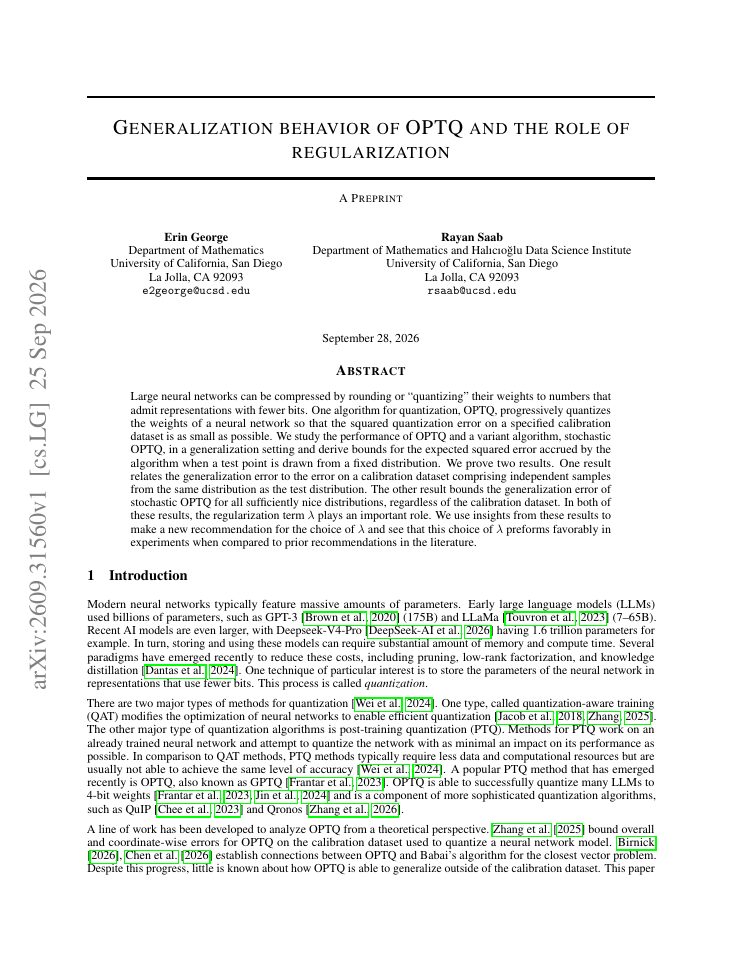
Each point represents one paper. Higher means more independent implementations; farther right means more GitHub stars.Closed-World Resolution Against Tool Hallucination in LLM Agents: 0 GitHub stars; 1 independent implementationSelf Improvement via Fast Tree-search: 9 GitHub stars; 1 independent implementationRed-Teaming Auto Mode: Improving Blocking Classifiers Against Malign Coding Agents: 0 GitHub stars; 2 independent implementationsSubjects, Not Authors: The Authorship Hazard in Agentic Dataspaces: 10 GitHub stars; 0 independent implementationsPrompt Injection Detection for Email Agents Through Attack Chain Modeling: 11 GitHub stars; 1 independent implementationAnalyzing and Mitigating Cost-Inefficient Behaviors in Coding Agents: 10 GitHub stars; 0 independent implementationsEvaluating Real-Time Voice Agents: From Component Quality to Grounded Outcomes: 131 GitHub stars; 1 independent implementationA Benchmark and Diagnostic Study of Epistemic Admission in Shared Agent Memory: 131 GitHub stars; 1 independent implementationAGATE: Provenance-Based Runtime Defense Against Compositional Attacks on LLM Agents: 0 GitHub stars; 0 independent implementationsCacheReforge: Bounded Recovery for Stale KV Caches under Evolving Adapters: 0 GitHub stars; 0 independent implementationsRetraction-Based Gradient Projection Algorithms on Manifolds: 0 GitHub stars; 0 independent implementationsToolSearcher: Optimizing Tool Selection at Scale via Reinforcement Learning: 131 GitHub stars; 1 independent implementationFinancial Fragility in Societies of LLM Agents: Coordination Failures and Stabilizing Mechanisms: 10 GitHub stars; 0 independent implementationsLow-Bit Recurrent States in Hybrid Language Models: 0 GitHub stars; 0 independent implementationsG$^2$PTQ: Improving LLM Post-Training Quantization with Generalized Gradient Compensation: 121 GitHub stars; 0 independent implementationsMetaPermit: Scalable and Auditable Access Control for AI Agents via LLM-Inferred Meta-Attributes: 1 GitHub star; 0 independent implementationsDynBranch: Speculative Subgraph Reuse for Dynamic Agentic LLM Serving: 10 GitHub stars; 0 independent implementationsDistributed Learning as a Service: The Developer's Perspective: 0 GitHub stars; 0 independent implementationsCG-Probes: Recovering Guardrail Directions from Patient Query Embeddings: 0 GitHub stars; 0 independent implementationsThe Residual Stream's Effective Depth: 0 GitHub stars; 0 independent implementationsBayesian Tensor Autoencoder with Physics-informed Predictive Prior for Multi-dimensional Time Series Anomaly Detection: 1 GitHub star; 0 independent implementationsMomentum-Guided Federated Split Distillation for Personalized Temporal Edge Intelligence: 0 GitHub stars; 0 independent implementationsAgentRecommender: LLM Agents Enable Customizable Recommender Systems on the User Side: 31 GitHub stars; 2 independent implementationsAudio emotion recognition for atypical hearing: 0 GitHub stars; 0 independent implementationsSemantic Navigation for Issue Localization in Code Repository: 121 GitHub stars; 0 independent implementationsPIA: A Personal Intelligence Agent Turning Health Conversations into Records and Records into Understanding: 131 GitHub stars; 1 independent implementationMoSAR: Mixture of Semantic Attention Regimes for Learning Adaptive and Approximable Attention Geometries: 121 GitHub stars; 0 independent implementationsSoftmax Reparameterization for Output-Head Quantization: 0 GitHub stars; 0 independent implementationsLUCID: Learning Under Confounding for Inference and Discovery in Time Series: 0 GitHub stars; 0 independent implementationsAgentXploit: Autonomous Repository-to-Runtime Red-Teaming for AI Agents: 10 GitHub stars; 0 independent implementationsThe Right Information Extraction Pipeline Depends on the Document: Accuracy-Energy Trade-offs for Small, Local Models: 121 GitHub stars; 0 independent implementationsA Safety-Bounded SDC-to-MCP Gateway for Medical AI Agents: 10 GitHub stars; 0 independent implementationsTowards Understanding LLM-Based Log Anomaly Detection: An Empirical Study of Performance, Efficiency, and Robustness: 0 GitHub stars; 0 independent implementationsIntent2Tc: Automated Intent-to-Traffic Control Translation with Language Models: 0 GitHub stars; 0 independent implementationsEvaluating the accuracy of KV cache reuse techniques: 0 GitHub stars; 0 independent implementationsTowards Mitigating Fabricated Consensus: The Active Provenance Gate for Multi-Agent Debate Synthesis: 11 GitHub stars; 1 independent implementationViSTA: A Simple Bridge Extends Visual Alignment to Clinical Time-Series Understanding in Multimodal LLMs: 121 GitHub stars; 0 independent implementationsEAServe: Encode-Aware Disaggregated Serving for Multimodal Large Language Models: 1 GitHub star; 2 independent implementationsGeneralization behavior of OPTQ and the role of regularization: 1 GitHub star; 0 independent implementationsDeepEdu-v1: Efficient and Scalable Agentic LLMs for Vietnamese Education: 131 GitHub stars; 2 independent implementationsCompact Documentation for Coding Agents: A Benchmark, an Optimizer, and Why It Does Not Transfer: 10 GitHub stars; 0 independent implementationsAgentWorld: Benchmarking Long-Horizon Collaboration of Multi-agent LLMs: 11 GitHub stars; 2 independent implementationsNew LoRA Skills Should Read but Never Write: 1 GitHub star; 0 independent implementations
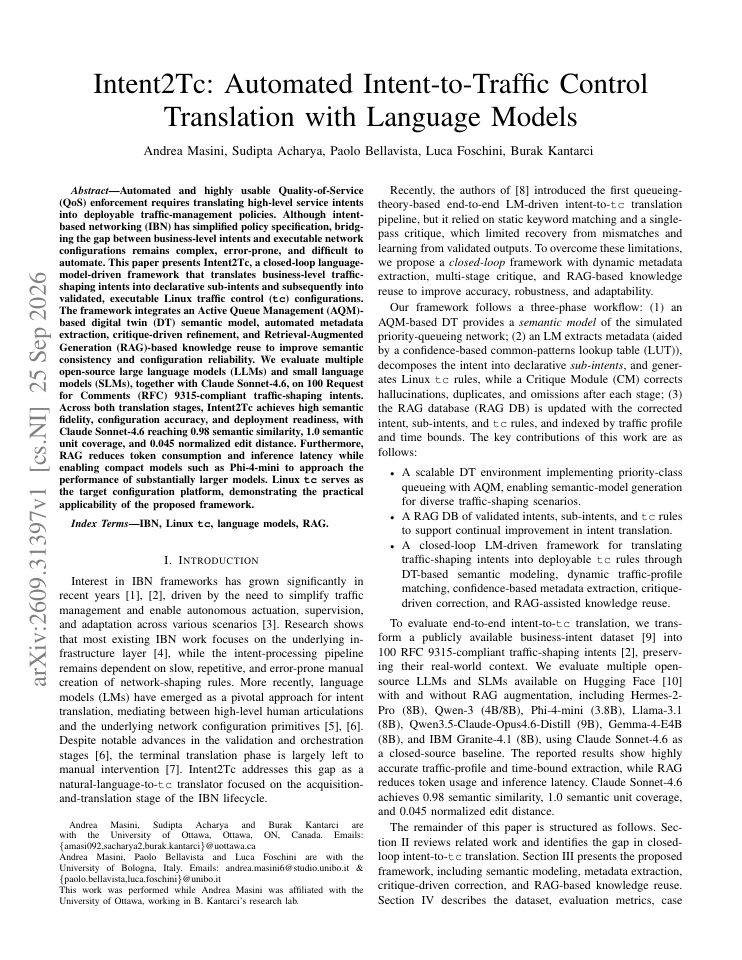
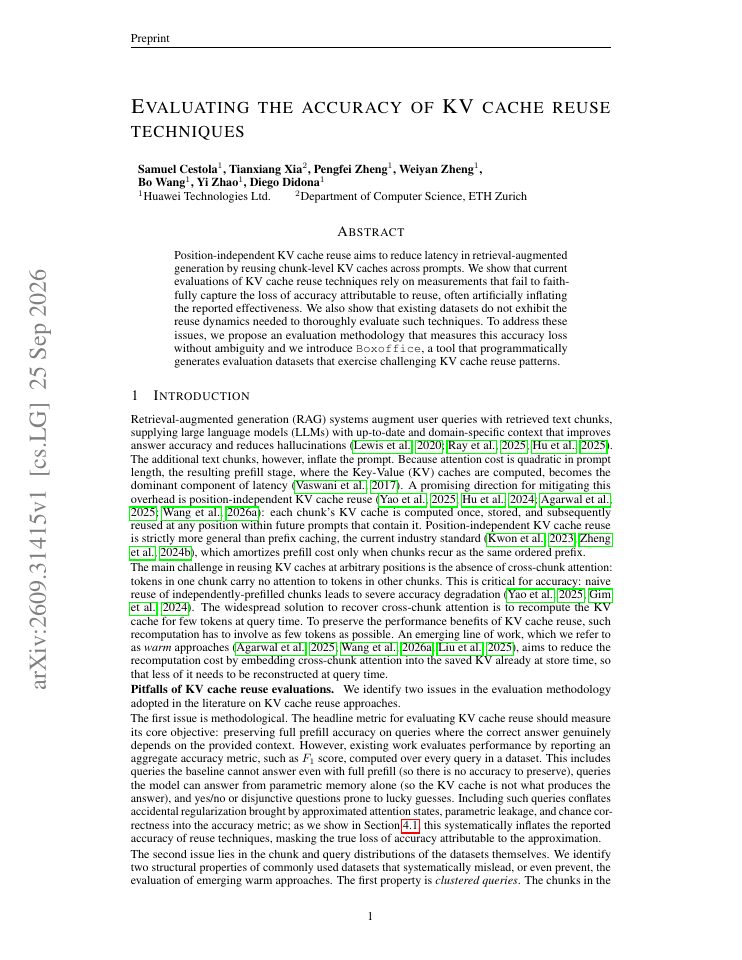
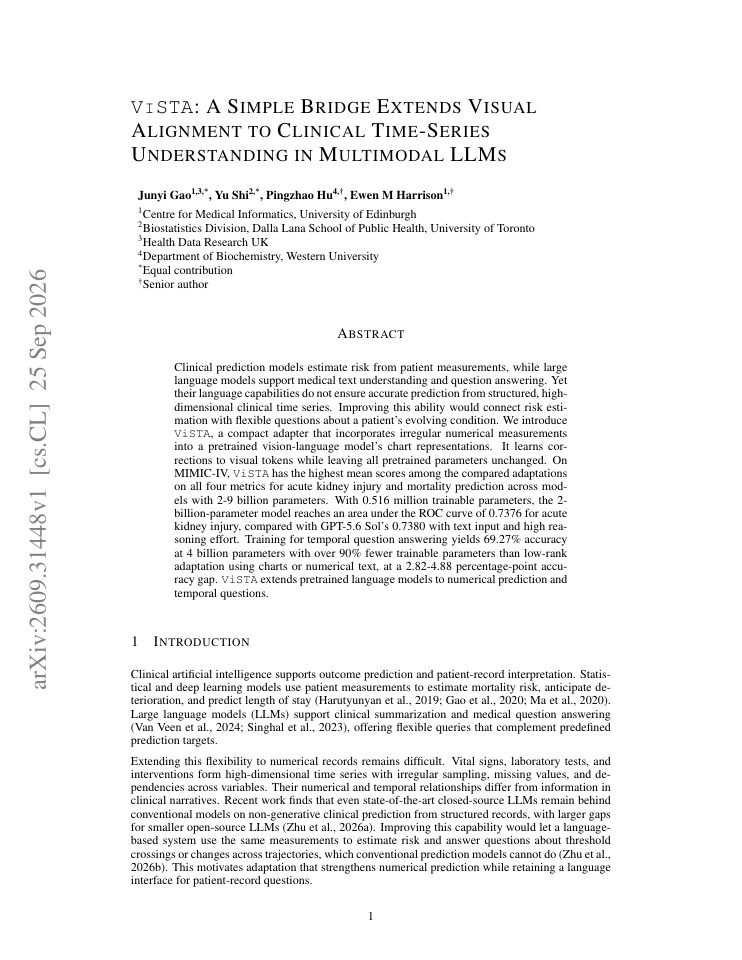
Papers above 1000 stars or 200 citations are not scored. They have already broken through the attention threshold, while Paperraft is designed to identify earlier signals.

02 · cadence

Research areas over time

Compare monthly publication volume on a shared scale and calendar.

coding agentsmax 9Sep 26: 4 papersSep 26Sep 26efficient architecturesmax 9Sep 26: 1 paperSep 26Sep 26agent evaluationmax 9Sep 26: 3 papersSep 26Sep 26KV cachemax 9Sep 26: 2 papersSep 26Sep 26distillationmax 9Sep 26: 1 paperSep 26Sep 26memory and contextmax 9Sep 26: 2 papersSep 26Sep 26multi-agent orchestrationmax 9Sep 26: 2 papersSep 26Sep 26othermax 9Sep 26: 5 papersSep 26Sep 26quantizationmax 9Sep 26: 5 papersSep 26Sep 26retrieval and RAGmax 9Sep 26: 1 paperSep 26Sep 26safety and guardrailsmax 9Sep 26: 9 papersSep 26Sep 26serving and batchingmax 9Sep 26: 3 papersSep 26Sep 26efficient trainingmax 9Sep 26: 4 papersSep 26Sep 26tool usemax 9Sep 26: 1 paperSep 26Sep 26

Every panel uses the same calendar and vertical scale. An empty column means no papers were recorded.

03 · reported results

Claimed performance gains

Gains stated in the abstract: reported by the authors; not independently verified.

Factors reported by the authors and not independently verified. The vertical axis uses a logarithmic scale; the baseline is 1x.reported factor · log scalePrompt Injection Detection for Email Agents Through Attack Chain Modeling: 1.88x in quality (author-reported)Analyzing and Mitigating Cost-Inefficient Behaviors in Coding Agents: 1.72x in cost (author-reported)A Benchmark and Diagnostic Study of Epistemic Admission in Shared Agent Memory: 3.7x in quality (author-reported)CacheReforge: Bounded Recovery for Stale KV Caches under Evolving Adapters: 14.7x in speed (author-reported)Low-Bit Recurrent States in Hybrid Language Models: 3.3x in quality (author-reported)MetaPermit: Scalable and Auditable Access Control for AI Agents via LLM-Inferred Meta-Attributes: 1.31x in quality (author-reported)DynBranch: Speculative Subgraph Reuse for Dynamic Agentic LLM Serving: 1.47x in speed (author-reported)Momentum-Guided Federated Split Distillation for Personalized Temporal Edge Intelligence: 2.9x in speed (author-reported)Softmax Reparameterization for Output-Head Quantization: 1.12x in speed (author-reported)LUCID: Learning Under Confounding for Inference and Discovery in Time Series: 1.46x in quality (author-reported)AgentXploit: Autonomous Repository-to-Runtime Red-Teaming for AI Agents: 1.54x in quality (author-reported)The Right Information Extraction Pipeline Depends on the Document: Accuracy-Energy Trade-offs for Small, Local Models: 1.61x in cost (author-reported)Towards Mitigating Fabricated Consensus: The Active Provenance Gate for Multi-Agent Debate Synthesis: 2x in quality (author-reported)ViSTA: A Simple Bridge Extends Visual Alignment to Clinical Time-Series Understanding in Multimodal LLMs: 10x in memory (author-reported)EAServe: Encode-Aware Disaggregated Serving for Multimodal Large Language Models: 4.3x in speed (author-reported)DeepEdu-v1: Efficient and Scalable Agentic LLMs for Vietnamese Education: 2x in speed (author-reported)

16 of 43 papers report a quantified gain. The scale is logarithmic; a research-area trend line appears only with at least five papers in the quarter.

Method under scrutiny

Inspect the highest-ranked paper, every repository behind its signal, and the rule used to classify each one.

Red-Teaming Auto Mode: Improving Blocking Classifiers Against Malign Coding Agents

safety and guardrails · test · 2 of 2 implementations are independent

The paper replaces passive or single-pass action-review monitors with hardened blocking monitors whose weaknesses were found by tasking adversarial agents with evading them, and it details concrete design fixes (broader tool coverage, transcript formatting, an agentic monitor stage). The cost is additional review compute and latency per proposed action, plus the engineering complexity of running a red-team harness and a multi-stage monitoring pipeline on a small team's budget. What can fail is residual evasion: multi-context attacks such as malicious compaction and cross-agent injection remain effective even after the improvements, so the monitor must not be treated as a complete safety boundary.

Exclusions and controls

Every exclusion is counted and published.

Exclusion counts were not recorded for this edition.

0 previously indexed papers were rechecked in this run.

Paperraft tracks one signal: how many independent implementations a paper attracts on GitHub after author-owned repositories are removed. This is a discovery signal to investigate, not a measure of implementation quality.

It does not claim that a method works. Paperraft runs no reproduction benchmarks. Reported gains remain author claims until independently tested. Papers above the attention threshold are excluded because this publication is designed to identify research before consensus forms.