Skip to content

archived edition · 2026-09-14

PaperraftFind the AI research
worth testing.

Understand what a paper changes, what it costs, and whether it fits your next build. Explore research on faster LLM inference, agent memory, and evaluation, with the original sources in reach.

Start with a brief. Follow the evidence. Choose a test.

edition
2026-09-14
briefs
3
research areas
3
independent implementations
15

0 of 3 papers in the index (0%) have no independent implementations.

0 of 3 papers (0%) remain classified as 'other' because none of the eighteen defined research areas fit.

Research index

Search by topic, browse a research area, or sort by date. Read a brief, open the original paper, and inspect the available evidence before deciding what to test.

showing3 of 3
sort by
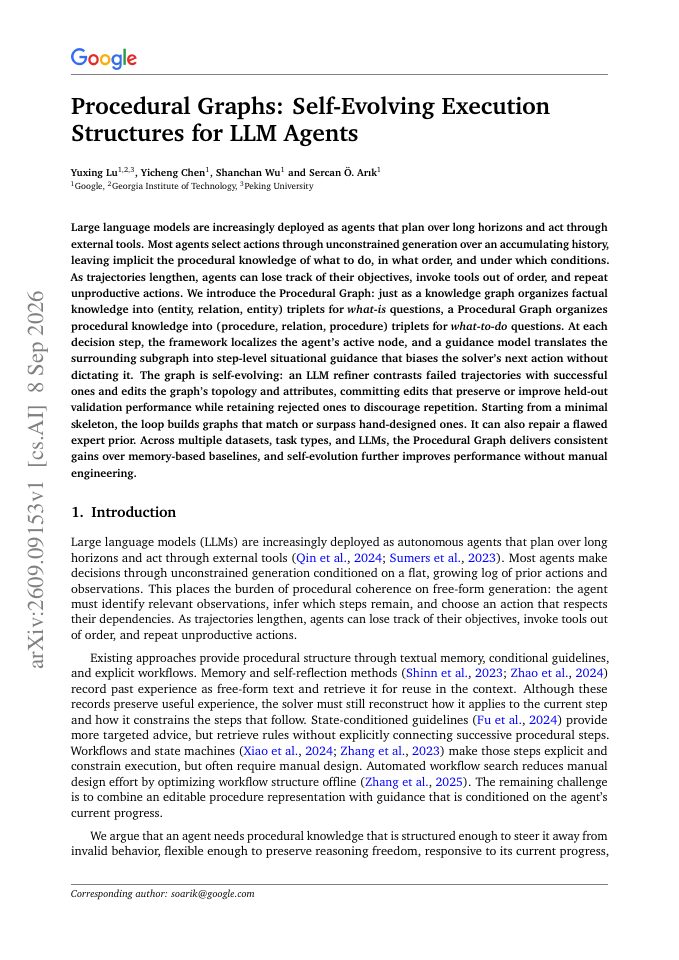
First page of Procedural Graphs: Self-Evolving Execution Structures for LLM Agents
memory and contexttest

Procedural Graphs: Self-Evolving Execution Structures for LLM Agents

Replaces unconstrained next-action generation over an accumulating trajectory with an evolving (procedure, relation, procedure) graph that a guidance model turns into step-level hints biasing, but not dictating, the agent's next action. Costs an extra guidance-model call per decision step plus LLM-refiner passes that contrast failed and successful trajectories to edit the graph against a held-out validation set, adding orchestration complexity and API spend. Can fail if validation sets are small or unrepresentative, letting the refiner overfit graph edits, or if localization of the active node is wrong on long trajectories, injecting misleading guidance; the abstract reports only qualitative 'consistent gains' with no quantified improvement, so the benefit is unverified for any specific workload.
observed signal
9impl.
6stars
0citations
—claimed gain
abstract onlyReview decisionDownload skill ↓Original paper ↗
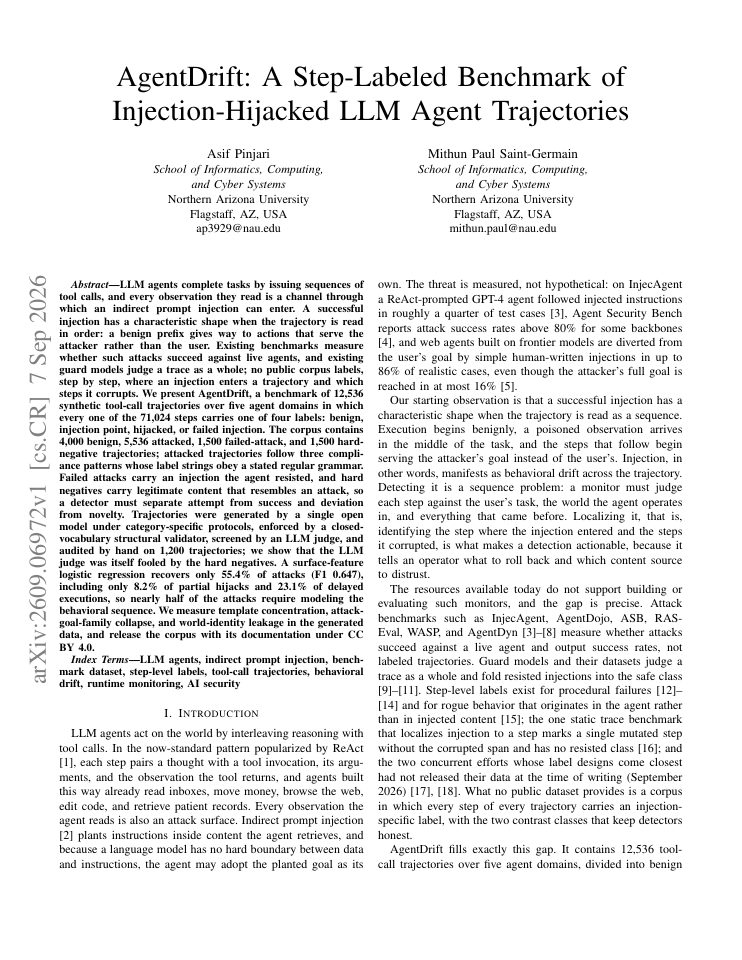
First page of AgentDrift: A Step-Labeled Benchmark of Injection-Hijacked LLM Agent Trajectories
safety and guardrailstest

AgentDrift: A Step-Labeled Benchmark of Injection-Hijacked LLM Agent Trajectories

AgentDrift replaces whole-trace guard judgments and attack-success-only benchmarks with a step-labeled corpus (12,536 trajectories, 71,024 steps labeled benign, injection point, hijacked, or failed injection) for training and evaluating detectors of indirect prompt injection in tool-call trajectories. Adoption costs the integration of an offline evaluation harness against one's own agent traces plus detector development, since the paper provides data and a weak baseline rather than a deployable guard model. Key failure risks include domain mismatch with the five covered domains, synthetic-data artifacts the authors themselves document (template concentration, attack-goal-family collapse, world-identity leakage, an LLM judge fooled by hard negatives), and reduced validity against adaptive attackers once the corpus is public.

observed signal
4impl.
2stars
0citations
—claimed gain
source mappedReview evidenceDownload skill ↓Original paper ↗
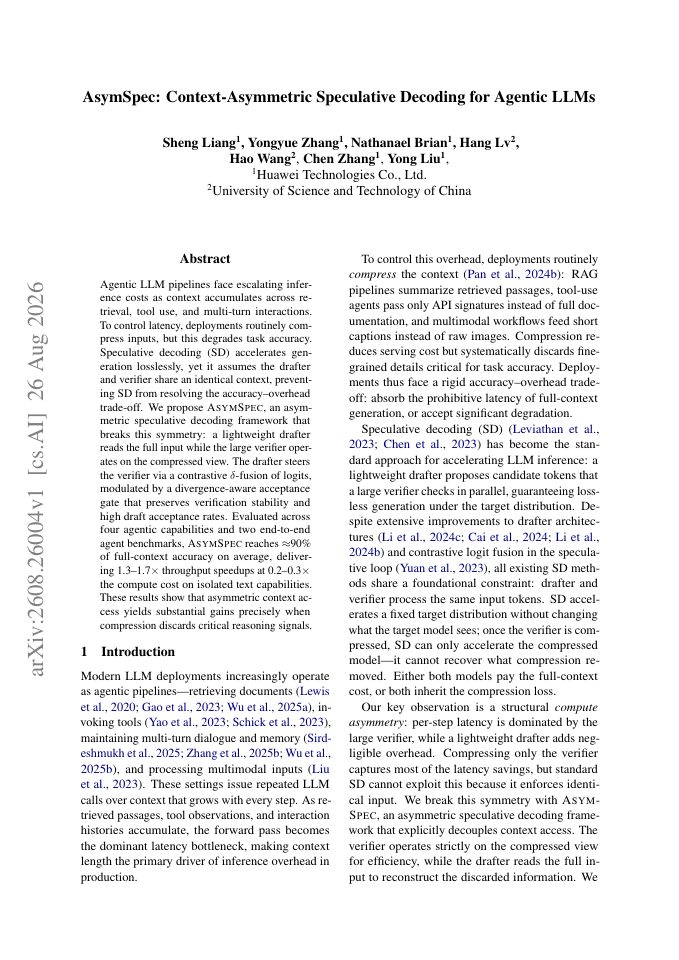
First page of AsymSpec: Context-Asymmetric Speculative Decoding for Agentic LLMs
speculative decodingtest

AsymSpec: Context-Asymmetric Speculative Decoding for Agentic LLMs

AsymSpec replaces the standard lossy choice between input compression and full-context inference by letting a lightweight drafter read the full input while the large verifier generates against a compressed view, fusing their logits with a contrastive delta-fusion and a divergence-aware acceptance gate. The cost is running two models (drafter plus verifier) with dual context representations and a non-standard decoding loop, which increases memory footprint and implementation complexity relative to plain compression or off-the-shelf speculative decoding served through third-party APIs. It can fail when the divergence gate misjudges draft reliability, collapsing acceptance rates and erasing the speedup, and the reported gains are on isolated capabilities and two benchmarks, so end-to-end agentic workloads with heavy tool-call branching may see smaller benefits.

observed signal
2impl.
1stars
0citations
1.7xclaimed gain
abstract onlyReview decisionDownload skill ↓Original paper ↗

Research signals

Three views of the same evidence: adoption against attention, publication cadence by research area, and reported gains when coverage is sufficient.

color = research area

01 · attention × adoption

The research frontier

Look to the upper left for independent implementation before mass attention.

compare by
Each point represents one paper. Higher means more independent implementations; farther right means more GitHub stars.AsymSpec: Context-Asymmetric Speculative Decoding for Agentic LLMs: 1 GitHub star; 2 independent implementationsAgentDrift: A Step-Labeled Benchmark of Injection-Hijacked LLM Agent Trajectories: 2 GitHub stars; 4 independent implementationsProcedural Graphs: Self-Evolving Execution Structures for LLM Agents: 6 GitHub stars; 9 independent implementations

Papers above 1000 stars or 200 citations are not scored. They have already broken through the attention threshold, while Paperraft is designed to identify earlier signals.

02 · cadence

Research areas over time

Compare monthly publication volume on a shared scale and calendar.

speculative decodingmax 1Aug 26: 1 paperSep 26: 0 papersAug 26Sep 26memory and contextmax 1Aug 26: 0 papersSep 26: 1 paperAug 26Sep 26safety and guardrailsmax 1Aug 26: 0 papersSep 26: 1 paperAug 26Sep 26

Every panel uses the same calendar and vertical scale. An empty column means no papers were recorded.

Method under scrutiny

Inspect the highest-ranked paper, every repository behind its signal, and the rule used to classify each one.

Procedural Graphs: Self-Evolving Execution Structures for LLM Agents

memory and context · test · 9 of 10 implementations are independent

Replaces unconstrained next-action generation over an accumulating trajectory with an evolving (procedure, relation, procedure) graph that a guidance model turns into step-level hints biasing, but not dictating, the agent's next action. Costs an extra guidance-model call per decision step plus LLM-refiner passes that contrast failed and successful trajectories to edit the graph against a held-out validation set, adding orchestration complexity and API spend. Can fail if validation sets are small or unrepresentative, letting the refiner overfit graph edits, or if localization of the active node is wrong on long trajectories, injecting misleading guidance; the abstract reports only qualitative 'consistent gains' with no quantified improvement, so the benefit is unverified for any specific workload.

Exclusions and controls

Every exclusion is counted and published.

Exclusion counts were not recorded for this edition.

0 previously indexed papers were rechecked in this run.

Paperraft tracks one signal: how many independent implementations a paper attracts on GitHub after author-owned repositories are removed. This is a discovery signal to investigate, not a measure of implementation quality.

It does not claim that a method works. Paperraft runs no reproduction benchmarks. Reported gains remain author claims until independently tested. Papers above the attention threshold are excluded because this publication is designed to identify research before consensus forms.