For solo builders
A possible application for this research area. Paper-specific feasibility still needs a full-paper review.
You already need task-specific training and want to reduce its memory or compute cost.
What you would change
Change only the training technique on a small controlled run after checking prerequisites.
Try the idea on your product
A proposed first test. Set your budget and success criteria before running it.
Change only the training technique on a small controlled run after checking prerequisites.
Compare against
Your current training recipe with the same model, data split, and evaluation.
- Locate the paper's implementation and check its license, model support, data needs, and hardware requirements. Stop here if you cannot obtain the required artifacts.
- Save a small set of representative product tasks and expected outcomes. Keep evaluation tasks out of any training or tuning, and choose quality and cost limits before running.
- Run the baseline and the proposed change on identical inputs. Keep other settings fixed and repeat paired runs to expose variation.
- Save per-task outputs, failures, timings, and all usage costs. Review regressions before expanding the test.
What to measure
Held-out quality, peak memory, training time, and full compute cost to the target quality.
When to keep it
Keep the change only if it meets your preselected quality and latency limits and improves the metric you care about after setup and operating costs. Otherwise retain the baseline. This is an exploration plan, not a validated recommendation.
Download test plan ↓abstract indexedPaperraft next step
Do not allocate compute yet.
This page uses the abstract and public adoption signal only. Request the deep report before relying on its recommendation.
Abstract-level screening only. Risks and infrastructure may not have been evaluated. This recommendation is not a reproduced result.- minimum test setup
- not reported
- published evidence setup
- not reported
- source-linked claims
- 0 of 2
- exposure checks
- 5 of 8
Why it was shortlisted
The technical change, research area, and reason it entered the archive.
- recommendation
- not applicable
- research area
- efficient training
- technical change
- Implicit zeroth-order perturbation for IMC spiking networks
- published
- 2026-08-21
Circuit design for IMC spiking-network accelerators, without a conventional language-model or GPU software component the reader can adopt.
Central equations
Original equations, typeset for reading. Paperraft explanations connect the mechanism, its aim, and the evidence.
Perturb the output, keep the weights in place
equation (3) · §IV Architecture and Design · proposed method
View original equationDistributivity separates the weighted input from its perturbation contribution. Their sum reconstructs the perturbed output.
Aim. Avoid rewriting stored weights during perturbation evaluations.
- x
- spike input
- θ
- weights
- ε
- perturbation scale
- zᵢ
- random perturbation
Find the energy break-even point
equation (6) · §V Experiments and Results · metric
View original equationR compares implicit and explicit perturbation energy. The numerator grows with batch size B and time steps T; R below one favors IPZO.
Aim. Identify workloads where avoided memory operations outweigh perturbation generation.
- B
- batch size
- T
- time steps
- ePGU-XOR
- energy per perturbation MVM
- eRMW
- energy per read-modify-write cycle
equations from arXiv HTML · fetched 2026-09-12
Claims and evidence
A claim is source-linked only when the PDF page and matching excerpt are available.
- claim 01Paperraft inference
Read the brief interpretation
Replaces explicit read-modify-write weight perturbation with perturbation sums from dedicated hardware attached to an IMC array for zeroth-order fine-tuning of spiking networks. Compared with the simplified variant, it requires 40%-46% more silicon area and 15%-49% more energy per operation, plus custom 16 nm CMOS fabrication or synthesis. It is a circuit for SNNs, rather than software deployable on a 24 GB GPU or through a third-party API.
This is a Paperraft inference. It is not pinned to a verified PDF passage.
Inspect the source - claim 02Paperraft inference
IPZO reduces perturbation energy to 0.46x-0.83x of explicit weight perturbation; PGU-XOR matches software RNG accuracy, 76.41% versus 76.53% on CIFAR-10, while PGU-Reuse loses 9.56 points.
This is a Paperraft inference. It is not pinned to a verified PDF passage.
Inspect the source
Exposure map
Author findings, Paperraft interpretations, and the next check. Missing analysis never counts as evidence of safety.
Selected source review · 2026-09-12. 4 from the paper · 1 inferred by Paperraft · 3 still unknown. This review is not an independent experiment.
quality
From the paperOn CIFAR-10, PGU-XOR reaches 76.41% accuracy, versus 66.85% for PGU-Reuse and 76.53% for the software Randint reference.
Paperraft interpretation
The gain is strongest against the reuse baseline. The software reference remains slightly ahead.
Limits and unknowns
These are the authors’ spiking-model results. They do not establish quality gains for GLM or Kimi.
Next check
Repeat the same task and perturbation baselines with fixed seeds before testing another architecture.
compute and memory
From the paperThe hardware study uses a 128 × 16 in-memory array and a custom perturbation generator in 16-nm CMOS, evaluated after chip layout.
Paperraft interpretation
The reported savings concern perturbation energy. They cannot price a complete training run or an A100/H200 rental.
Limits and unknowns
GPU memory needs, total system energy, and rental cost remain unknown.
Next check
First establish a runnable implementation and measure its full memory footprint and wall-clock cost.
Inspect source · PDF p. 10
All hardware results reported in this section are obtained from post-layout implementationsOpen paper at page 10
latency
From the paperAt 1 GHz, perturbation throughput falls from 4.10 to 0.51 TOPS as accumulation grows from one to eight cycles.
Paperraft interpretation
Smaller circuitry trades throughput for area. The paper’s no-penalty condition requires the generator to keep pace with the in-memory array.
Limits and unknowns
This is circuit throughput. Startup time, time to first token, and slow-request latency are not established.
Next check
Measure startup, median and p95 request latency separately on a complete implementation.
Inspect source · PDF p. 11
lowering the throughput from 4.10 TOPS at c = 1 to 2.05, 1.02 and 0.51 TOPSOpen paper at page 11
operations
Still unknownLimits and unknowns
The reviewed architecture and experiments do not establish a deployment, monitoring, or rollback procedure.
Next check
Define checkpoint recovery, failure detection, and rollback behavior before a service trial.
software compatibility
Paperraft interpretationApplying this method requires the spiking model, in-memory compute path, and perturbation generator to work together.
Limits and unknowns
A drop-in implementation for GLM-4.7-Flash, Kimi, or a conventional GPU inference server has not been established.
Next check
Locate runnable code and verify the architecture mapping before renting GPUs for this technique.
Inspect source · PDF p. 4
the IMC array executes the standard MVM with the input spike vectorOpen paper at page 4
security
Still unknownLimits and unknowns
The reviewed source does not establish data-access controls, isolation, or resistance to malicious inputs.
Next check
Review input handling, model access, and isolation for the actual implementation before using private data.
data and training
From the paperSpikingformer starts from ImageNet-1K pretraining; 75% of its parameters stay frozen during CIFAR-10 fine-tuning. SpikeGPT is fully fine-tuned on WikiText.
Paperraft interpretation
This requires model adaptation and training data. It is not an inference-server setting.
Limits and unknowns
Pretraining and data preparation are outside the quoted perturbation-energy comparison.
Next check
Account for checkpoints, dataset preparation, training, and evaluation in the experiment budget.
Inspect source · PDF p. 9
CIFAR-10 with 75% of its parameters frozen, leaving 16.6M trainable parametersOpen paper at page 9
reproducibility
Still unknownLimits and unknowns
The paper describes its circuit settings and benchmarks. Released hardware design files, exact seeds, and runnable evaluation scripts have not been verified.
Next check
Locate and pin the code, checkpoints, datasets, and hardware design; then attempt the smallest reported experiment.
Continue the investigation
A reading guide for efficient training.
Editorial prompts, not findings from this paper or a validated test plan. Detailed analysis is still pending for the topics below.
What to inspect
Which assumptions does the proposed method need, and where might your workload violate them?
Plan a fair comparison
Identify the baseline, metric, dataset, and experimental settings in the paper. Which can you match?
Questions for adoption
What implementation and evaluation artifacts are available, and what would you need to supply?
Inside the paper
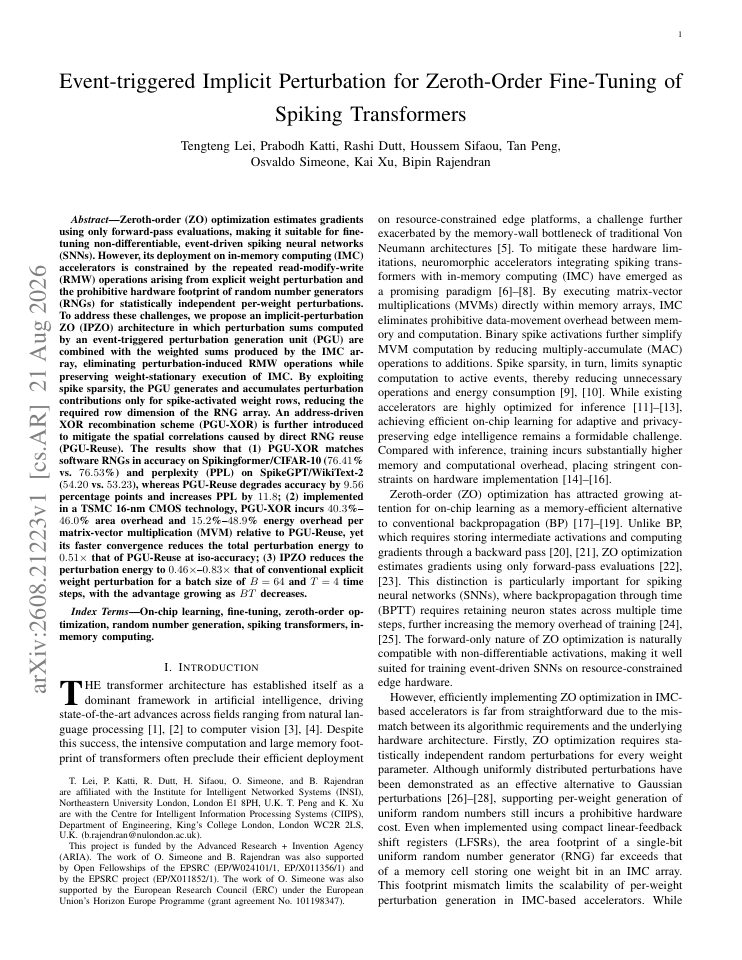
Preview the first 3 pages of the original PDF. Click the stack to turn the page.
The downloadable skill includes SKILL.md and evidence.json, with recorded findings and unanswered checks. TRY-IT.md adds a product test plan and a blank results sheet.
A reading aid for your agent. Findings still need validation.
Provisional research brief updated 2026-10-18. Paperraft has not reproduced this experiment.