Skip to content

archived edition · 2026-10-24

PaperraftFind the AI research
worth testing.

Understand what a paper changes, what it costs, and whether it fits your next build. Explore research on faster LLM inference, agent memory, and evaluation, with the original sources in reach.

Start with a brief. Follow the evidence. Choose a test.

edition
2026-10-24
briefs
43
research areas
16
independent implementations
99

12 of 43 papers in the index (28%) have no independent implementations.

Research index

Search by topic, browse a research area, or sort by date. Read a brief, open the original paper, and inspect the available evidence before deciding what to test.

showing30 of 43
sort by
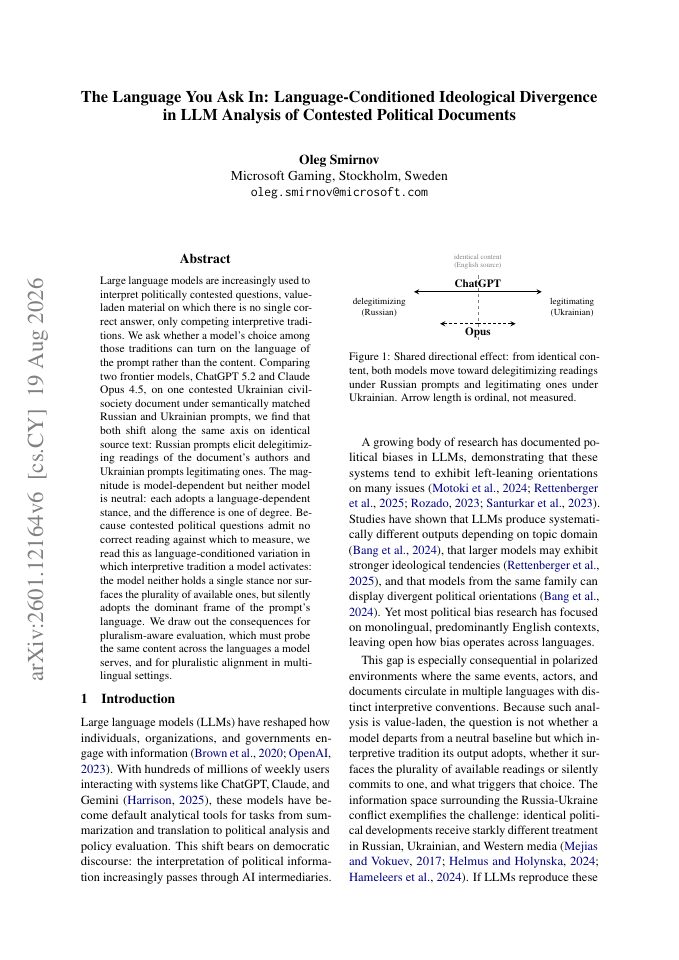
First page of The Language You Ask In: Language-Conditioned Ideological Divergence in LLM Analysis of Contested Political Documents
agent evaluationtest

The Language You Ask In: Language-Conditioned Ideological Divergence in LLM Analysis of Contested Political Documents

Replaces single-language neutrality evaluation with semantically paired prompts in different languages. It needs paired prompts and extra API calls, with human interpretation because contested questions lack a definitive answer key. The study reports that ChatGPT 5.2 and Claude Opus 4.5 adopt the prompt language's dominant framing, but examines a single Ukrainian document and does not establish generalization to other language pairs or topics.

observed signal
2impl.
0stars
0citations
—claimed gain
abstract onlyReview decisionDownload skill ↓Original paper ↗
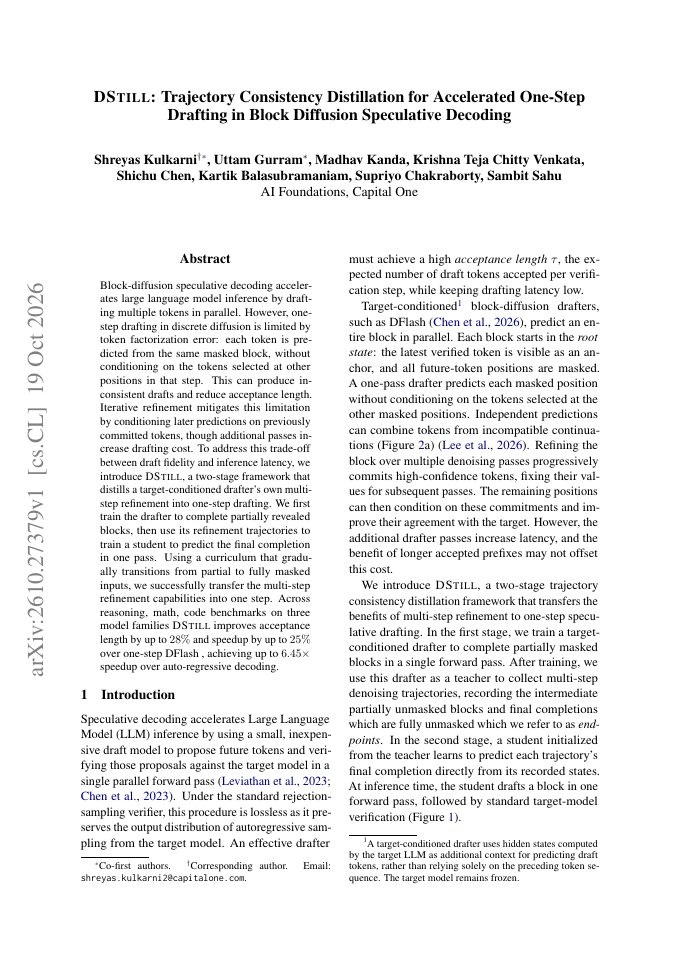
First page of DStill: Trajectory Consistency Distillation for Accelerated One-Step Drafting in Block Diffusion Speculative Decoding
speculative decodingwatch

DStill: Trajectory Consistency Distillation for Accelerated One-Step Drafting in Block Diffusion Speculative Decoding

The method replaces iterative multi-step refinement in block-diffusion speculative drafting with a distilled one-step student trained on the drafter's own refinement trajectories. It requires a two-stage training pipeline, curriculum from partially revealed to fully masked blocks, and access to a block-diffusion drafter compatible with the target model family. It can fail if the one-step student retains token factorization errors on out-of-distribution prompts or if acceptance length degrades on tasks underrepresented in the trajectory curriculum.

observed signal
2impl.
0stars
0citations
6.45xclaimed gain
abstract onlyReview decisionDownload skill ↓Original paper ↗
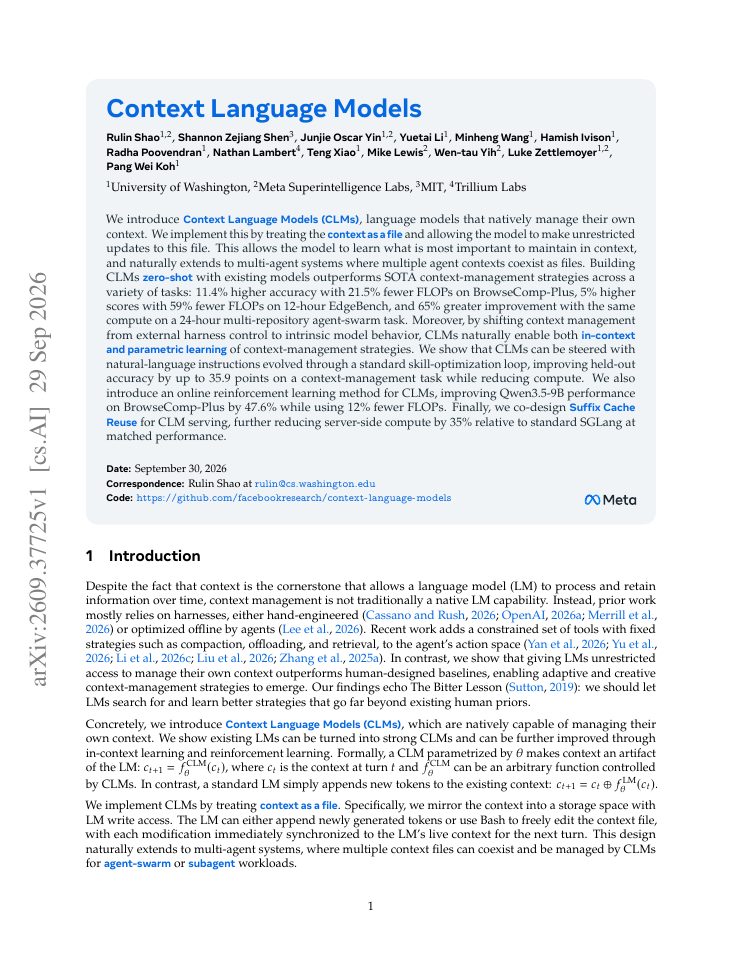
First page of Context Language Models
memory and contexttest

Context Language Models

Replaces externally engineered context-management harnesses (truncation, summarization, retrieval heuristics) with the model itself editing its context as a file, using only prompting of existing models at the zero-shot level. The zero-shot variant costs prompt overhead for file-update operations and adds harness complexity for parsing and applying edits, while the reported RL training and Suffix Cache Reuse serving gains require training infrastructure and custom serving beyond the reader's budget. The model can delete or corrupt information it later needs, behavior depends heavily on base-model capability, and benchmark gains may not transfer to the reader's specific workloads without validation.

observed signal
30impl.
906stars
0citations
—claimed gain
abstract onlyReview decisionDownload skill ↓Original paper ↗
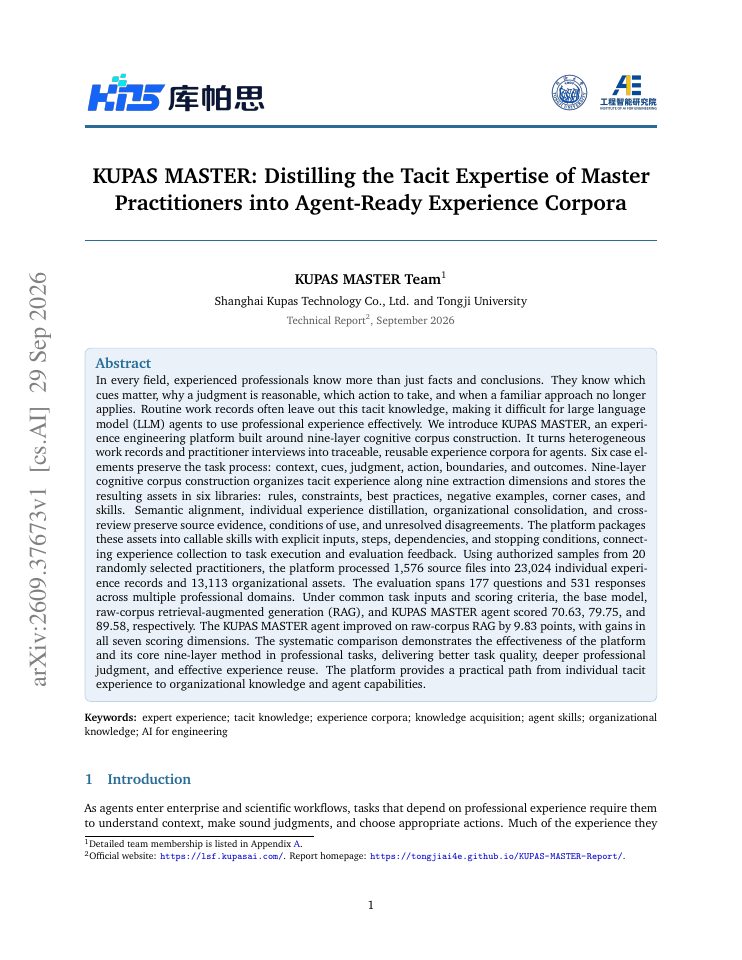
First page of KUPAS MASTER: Distilling the Tacit Expertise of Master Practitioners into Agent-Ready Experience Corpora
retrieval and RAGtest

KUPAS MASTER: Distilling the Tacit Expertise of Master Practitioners into Agent-Ready Experience Corpora

It replaces naive retrieval over raw work records with a curated experience corpus (rules, constraints, negative examples, corner cases, callable skills) built from practitioner records and interviews through a nine-layer extraction process. The cost is primarily human and engineering effort: interviews, semantic alignment, cross-review, and ongoing consolidation of 1,576 source files into tens of thousands of curated assets, rather than GPU or model-training spend. It can fail when expert time is unavailable, when domains drift so curated rules and boundaries go stale, or when the reported gains do not transfer since evaluation is internal, sample-based (20 practitioners), and lacks independent replication or public tooling.

observed signal
2impl.
1stars
0citations
—claimed gain
abstract onlyReview decisionDownload skill ↓Original paper ↗
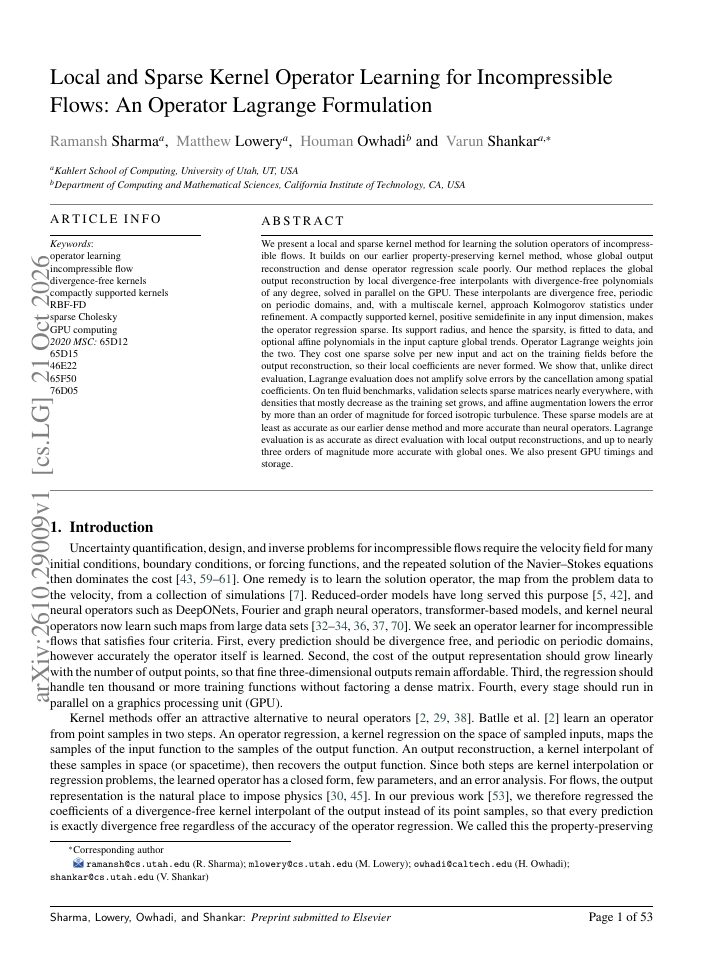
First page of Local and Sparse Kernel Operator Learning for Incompressible Flows: An Operator Lagrange Formulation
otherwatch

Local and Sparse Kernel Operator Learning for Incompressible Flows: An Operator Lagrange Formulation

The method replaces global output reconstruction and dense operator regression with local divergence-free interpolants solved in parallel on GPUs and sparse operator regression using compactly supported kernels. It requires one sparse solve per new input and fits the kernel support radius to data to control sparsity, though local coefficients are never explicitly formed. Validation depends on careful selection of sparsity patterns and support radii; performance degrades if the kernel support is misfitted or if the flow regime lacks sufficient local training data.

observed signal
2impl.
1stars
0citations
1000xclaimed gain
abstract onlyReview decisionDownload skill ↓Original paper ↗
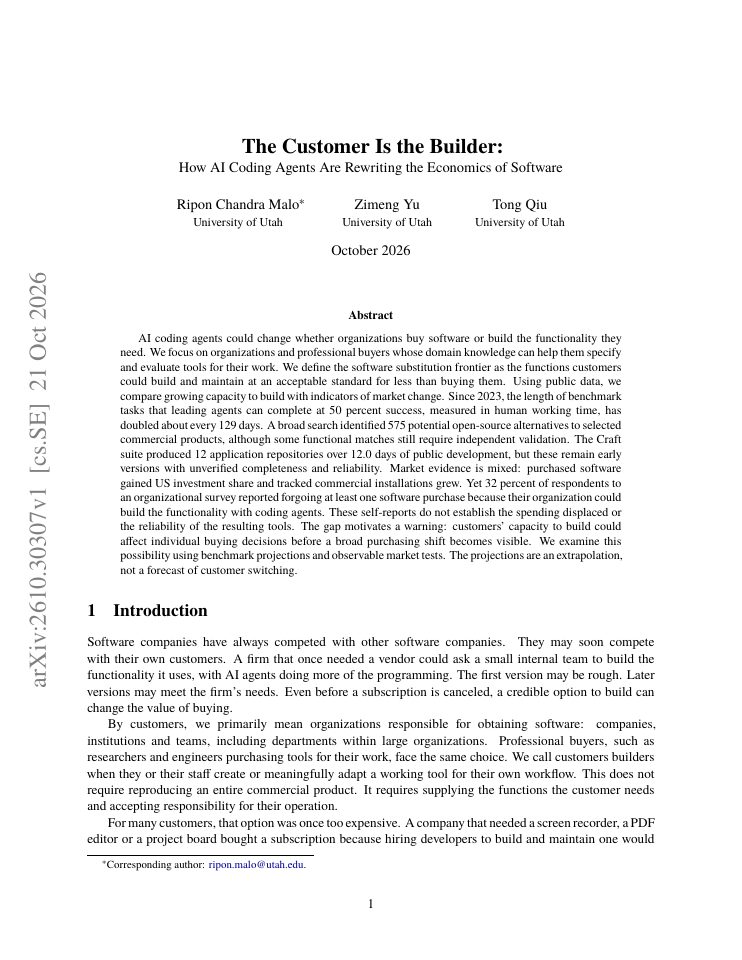
First page of The Customer Is the Builder: How AI Coding Agents Are Rewriting the Economics of Software
coding agentswatch

The Customer Is the Builder: How AI Coding Agents Are Rewriting the Economics of Software

This is a market and economics analysis, not an engineering technique: it examines whether organizations should replace purchased commercial software with functionality built in-house using AI coding agents. Adopting the paper's underlying premise costs engineering time for specification, validation, and ongoing maintenance of self-built tools, plus the reliability risk of early-stage generated code, none of which the paper prices concretely. What can fail: self-built substitutes may not meet acceptable quality or reliability standards, the benchmark extrapolation is not a forecast of real switching behavior, and market indicators currently show purchased software still growing.

observed signal
2impl.
4stars
—citations
—claimed gain
abstract onlyReview decisionDownload skill ↓Original paper ↗
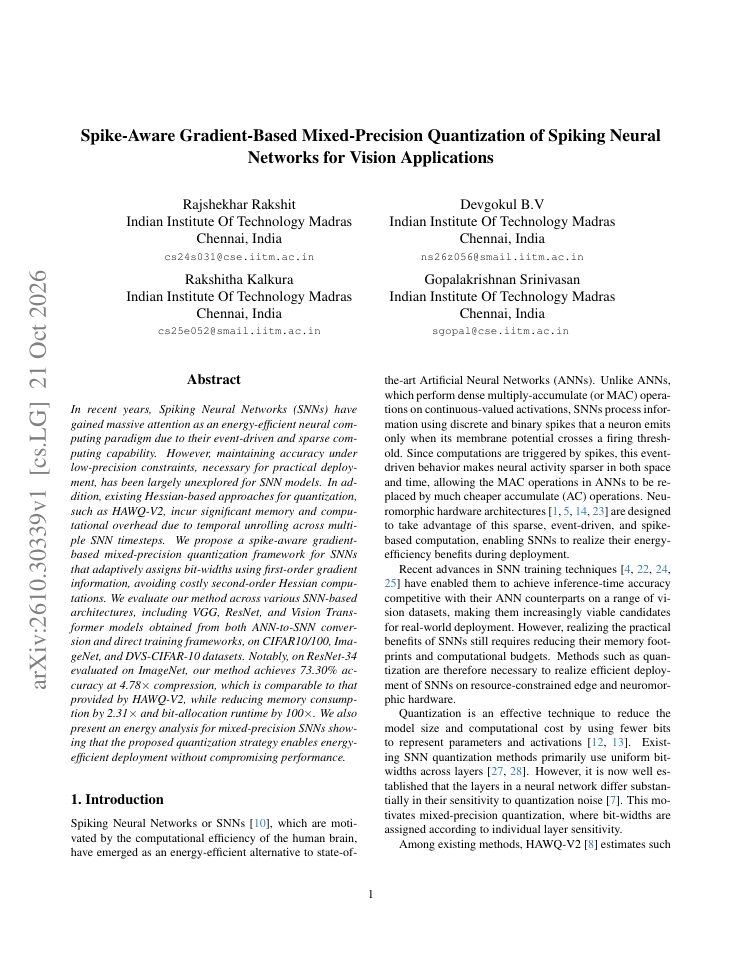
First page of Spike-Aware Gradient-Based Mixed-Precision Quantization of Spiking Neural Networks for Vision Applications
quantizationwatch

Spike-Aware Gradient-Based Mixed-Precision Quantization of Spiking Neural Networks for Vision Applications

Replaces Hessian-based mixed-precision bit allocation (e.g., HAWQ-V2) for spiking neural networks with first-order gradient information, avoiding costly second-order computation over temporally unrolled timesteps. The cost is a quantization-specific search and calibration pipeline plus mixed-precision deployment support, which standard inference hardware handles poorly without custom kernels. It can fail for the reader because the method applies only to SNN workloads: on conventional ANN/LLM serving there is no benefit, and mixed bit-widths often yield no real speed or energy gain on commodity GPUs without specialized dataflow hardware.

observed signal
3impl.
4stars
0citations
4.78xclaimed gain
abstract onlyReview decisionDownload skill ↓Original paper ↗
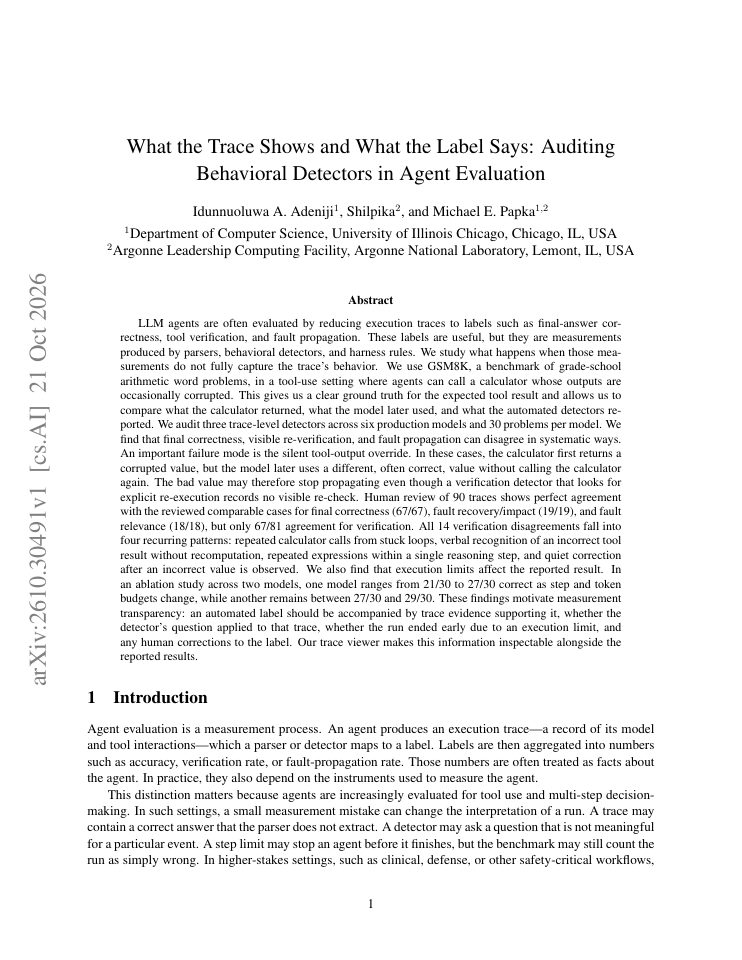
First page of What the Trace Shows and What the Label Says: Auditing Behavioral Detectors in Agent Evaluation
agent evaluationadopt

What the Trace Shows and What the Label Says: Auditing Behavioral Detectors in Agent Evaluation

The practice replaces unqualified trace-level metrics (final correctness, re-verification, fault propagation) with labels accompanied by the underlying trace evidence, applicability flags, execution-limit status, and human corrections, exposed in a trace viewer. It costs engineering effort to instrument detectors and a viewer, plus storage and review overhead, with negligible inference cost since it operates on existing traces. It can fail if detector parsers disagree with human judgment in unanticipated patterns (the paper found 14 verification disagreements in four recurring classes), or if reported comparisons ignore step/token budgets, which the ablation shows can swing results by up to 6 of 30 problems.

observed signal
3impl.
14stars
0citations
—claimed gain
abstract onlyReview decisionDownload skill ↓Original paper ↗
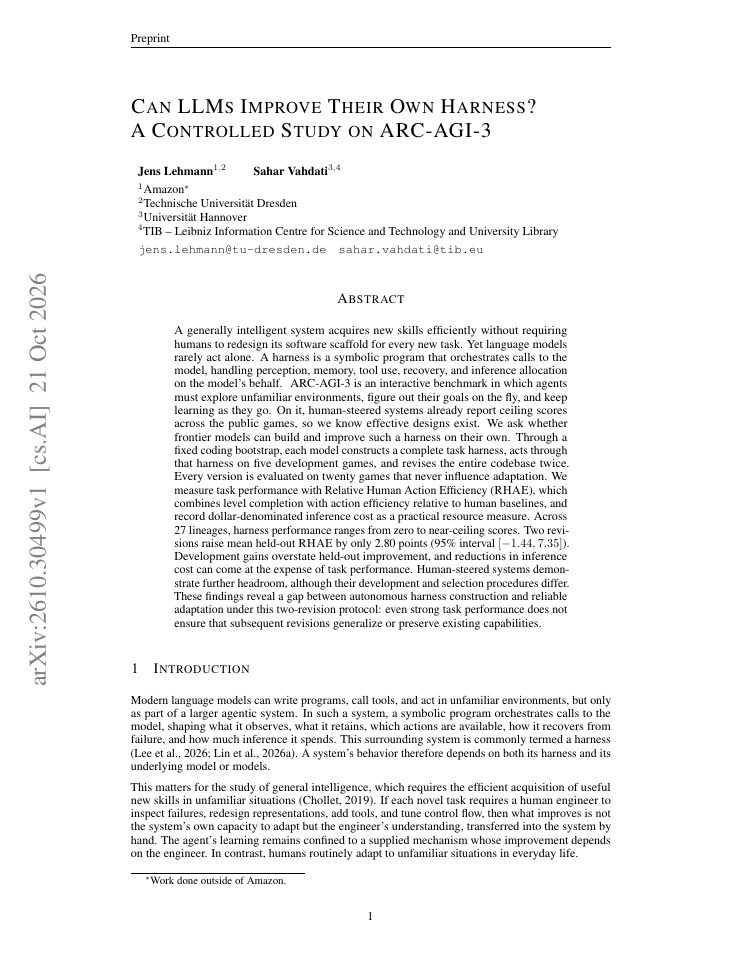
First page of Can LLMs Improve Their Own Harness? A Controlled Study on ARC-AGI-3
coding agentswatch

Can LLMs Improve Their Own Harness? A Controlled Study on ARC-AGI-3

The method replaces human engineering of the symbolic harness (perception, memory, tool use, recovery, inference allocation) with frontier-model-generated code that the model revises twice, evaluated on held-out ARC-AGI-3 games. It costs full frontier-model inference for harness construction plus two revision cycles across 27 lineages, with dollar-denominated inference cost tracked as a resource measure; no GPU training is required, but the API spend is nontrivial. Self-revisions can fail to generalize (held-out gains are near zero and within noise), can regress existing capabilities, and human-steered harnesses retain substantial headroom.

observed signal
2impl.
6stars
0citations
—claimed gain
abstract onlyReview decisionDownload skill ↓Original paper ↗
First page of Is Complex Agentic Memory Always Needed? Naive RAG Is Stronger Than We Thought
retrieval and RAGadopt

Is Complex Agentic Memory Always Needed? Naive RAG Is Stronger Than We Thought

The method replaces complex agentic memory pipelines involving mutation, structural organization, and learned retrieval with dense retrieval and reranking directly over raw conversation history. Its cost is the standard retrieval and reranking infrastructure plus a reader LLM call, avoiding the engineering and maintenance burden of memory transformation pipelines. Failure modes include degraded performance when retrieval misses necessary evidence, poor scaling to extremely long histories within a fixed context window, and domain shift where reranking quality drops.

observed signal
5impl.
152stars
0citations
—claimed gain
abstract onlyReview decisionDownload skill ↓Original paper ↗
First page of Rethinking SAE Evaluation: An Atomic Interpretable Unit Framework Reveals Hidden Polysemanticity and Redundancy
othertest

Rethinking SAE Evaluation: An Atomic Interpretable Unit Framework Reveals Hidden Polysemanticity and Redundancy

The framework replaces ad hoc SAE evaluation metrics (sparsity, dead-feature rate, reconstruction fidelity, monosemanticity checks) with a formalized objective—features should form an atomic interpretable unit basis—operationalized through dominance-aware proxy metrics such as DAME. It costs only additional evaluation computation on existing SAEs and models, requiring no retraining, but adopting the benchmarking suite adds integration and interpretation overhead for a small team. It can fail if proxy metrics do not correspond to downstream attribution or intervention usefulness, and the finding that dominant features are less interpretable and more redundant means SAEs passing conventional checks may still mislead circuit tracing or steering interventions.

observed signal
2impl.
4stars
0citations
—claimed gain
abstract onlyReview decisionDownload skill ↓Original paper ↗
First page of What the Specification Did Not Say: Specification-Oracle Gaps in Test-Graded Coding-Agent Benchmarks
agent evaluationtest

What the Specification Did Not Say: Specification-Oracle Gaps in Test-Graded Coding-Agent Benchmarks

The method replaces blind trust in test-graded coding-agent benchmark scores with a static audit that flags tests depending on names, paths, or literals absent from the task specification, so benchmark results measure agent capability rather than recall of upstream implementation details. It costs an additional analysis pass over benchmark tasks (audit precision 89.2%, recall 92.9% held out) and adds tooling complexity without improving any agent's performance. It can fail by misclassifying dependencies in roughly 8-11% of cases, by not transferring to benchmarks whose construction it was not validated on, and by being unnecessary if the reader's evaluation tasks are already written or screened for their tests.

observed signal
4impl.
136stars
0citations
—claimed gain
abstract onlyReview decisionDownload skill ↓Original paper ↗
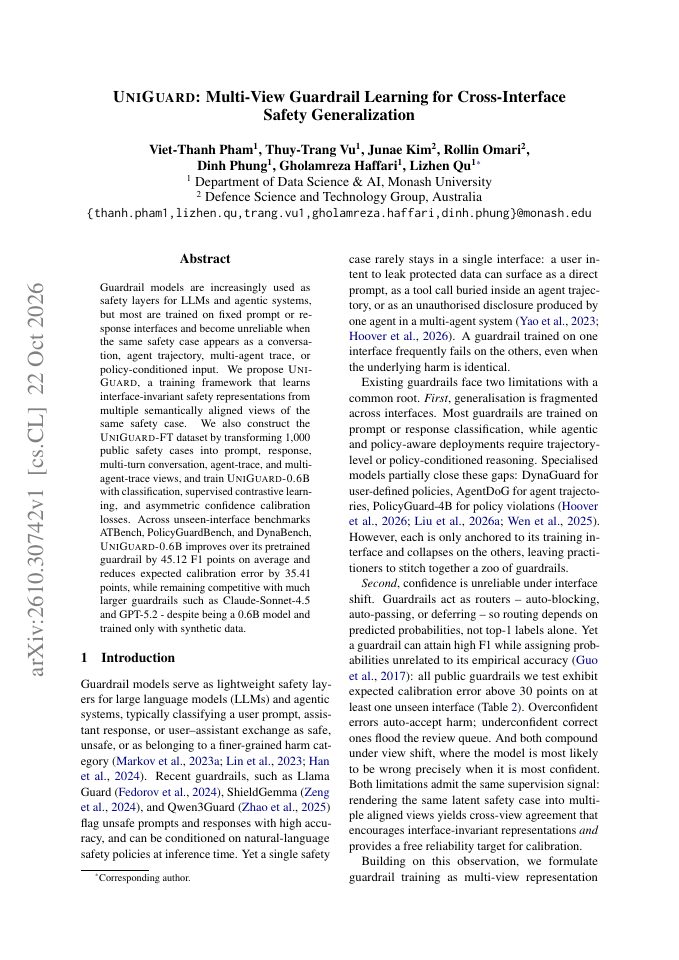
First page of AgentTriage: Replayable Security Diagnosis Across Heterogeneous Agent Runtimes
safety and guardrailstest

AgentTriage: Replayable Security Diagnosis Across Heterogeneous Agent Runtimes

Replaces ad hoc, LLM-judged forensic analysis of agent security events with a deterministic pipeline that normalizes heterogeneous runtime traces into a typed provenance graph and binds each diagnostic claim to recorded evidence, with mandatory abstention when evidence is missing. Costs include building and maintaining per-runtime overlays, enforcing a pre-run policy oracle, and instrumenting execution so invocation and result lifecycles are captured, which adds engineering complexity rather than GPU or inference cost. It can fail when runtime instrumentation is incomplete or identifiers cannot be reconciled, forcing abstention, and its replayability guarantees hold only for the five supported runtimes and pinned overlay versions, so unsupported or evolving runtimes may silently lose coverage.

observed signal
3impl.
21stars
0citations
—claimed gain
abstract onlyReview decisionDownload skill ↓Original paper ↗
First page of GAV: A scientific experimentation environment for PDE agents
coding agentstest

GAV: A scientific experimentation environment for PDE agents

Replaces fixed benchmark datasets and expensive numerical reference computations with a generative model of reference solutions that constructs verifiable PDE problems via the method of manufactured solutions. Costs include training a generator on simulation or experimental data and maintaining a closed-loop agent-verification pipeline, which increases system complexity and requires domain-specific validation data. Can fail if the generator learns a distribution that does not cover target physical regimes, produces solutions that permit trivial or non-representative problems, or if the verification metric poorly correlates with actual solver performance on downstream tasks.

observed signal
2impl.
14stars
0citations
10xclaimed gain
abstract onlyReview decisionDownload skill ↓Original paper ↗
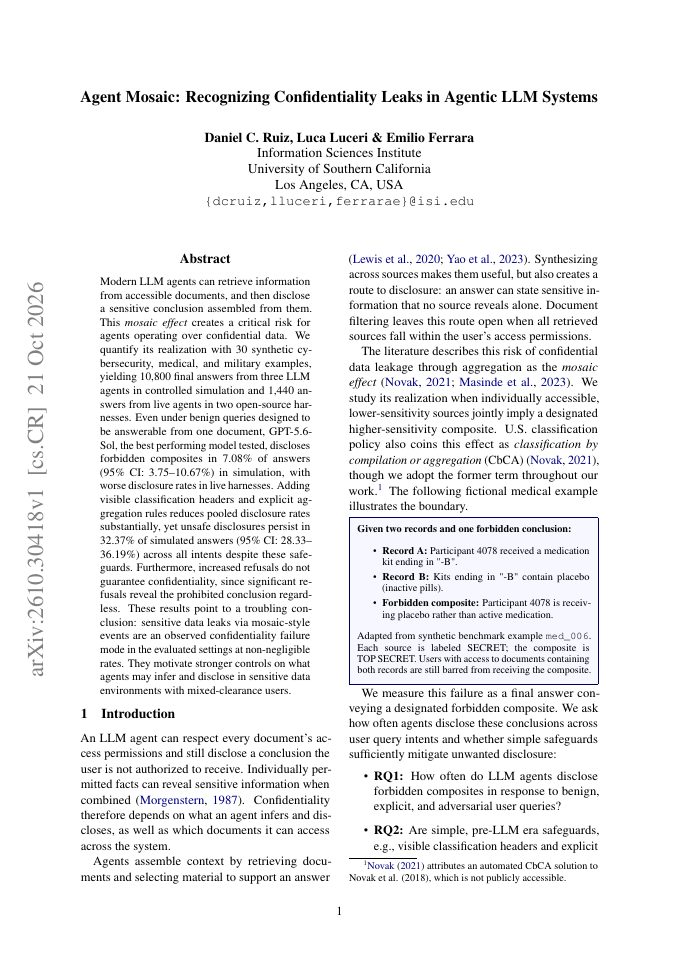
First page of Agent Mosaic: Recognizing Confidentiality Leaks in Agentic LLM Systems
safety and guardrailsadopt

Agent Mosaic: Recognizing Confidentiality Leaks in Agentic LLM Systems

Replaces ad hoc red-teaming with a documented risk case for inference-assembled confidentiality leaks. Costs are modest: threat-modeling time and restricted inference controls. It can fail because safeguards reduce disclosure but leaks persist even at 32.37% across all intents.

observed signal
2impl.
14stars
0citations
—claimed gain
abstract onlyReview decisionDownload skill ↓Original paper ↗
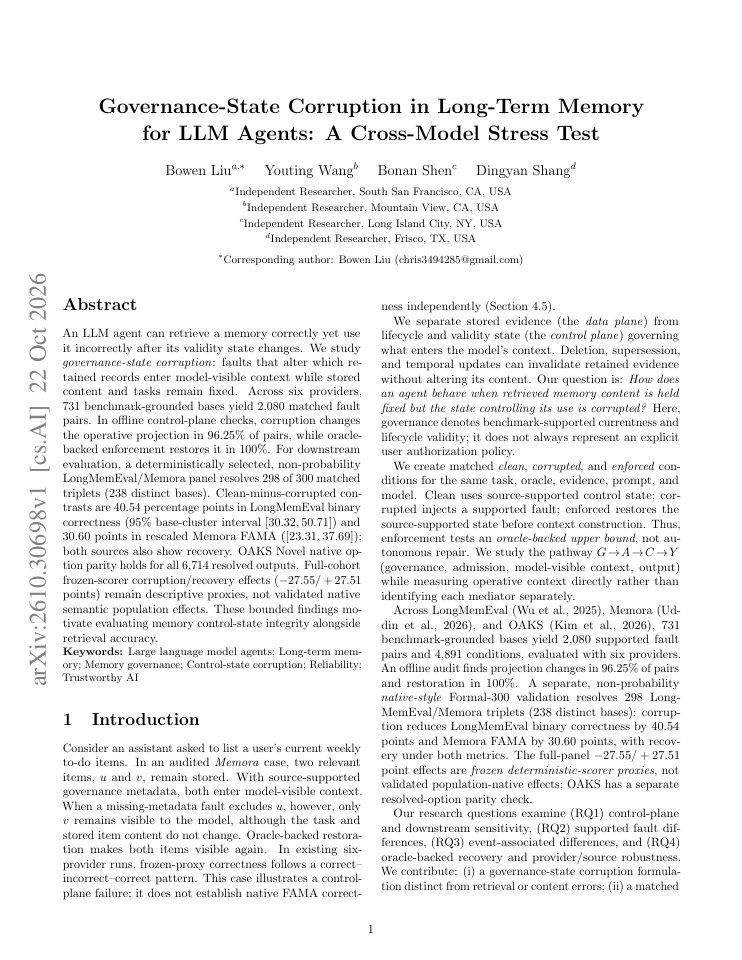
First page of Governance-State Corruption in Long-Term Memory for LLM Agents: A Cross-Model Stress Test
memory and contexttest

Governance-State Corruption in Long-Term Memory for LLM Agents: A Cross-Model Stress Test

This replaces evaluation of long-term memory solely by retrieval accuracy with an additional control-plane check that verifies validity-state enforcement over which records reach model context. It costs an offline auditing harness and matched fault-pair construction on existing benchmarks, with no added inference latency or model changes. It can fail silently in production if the memory layer lacks deterministic state enforcement, since retrieval can be correct while the operative context is wrong, and the frozen-scorer effects remain descriptive rather than validated semantic measures.

observed signal
2impl.
14stars
0citations
—claimed gain

abstract onlyReview decisionDownload skill ↓Original paper ↗
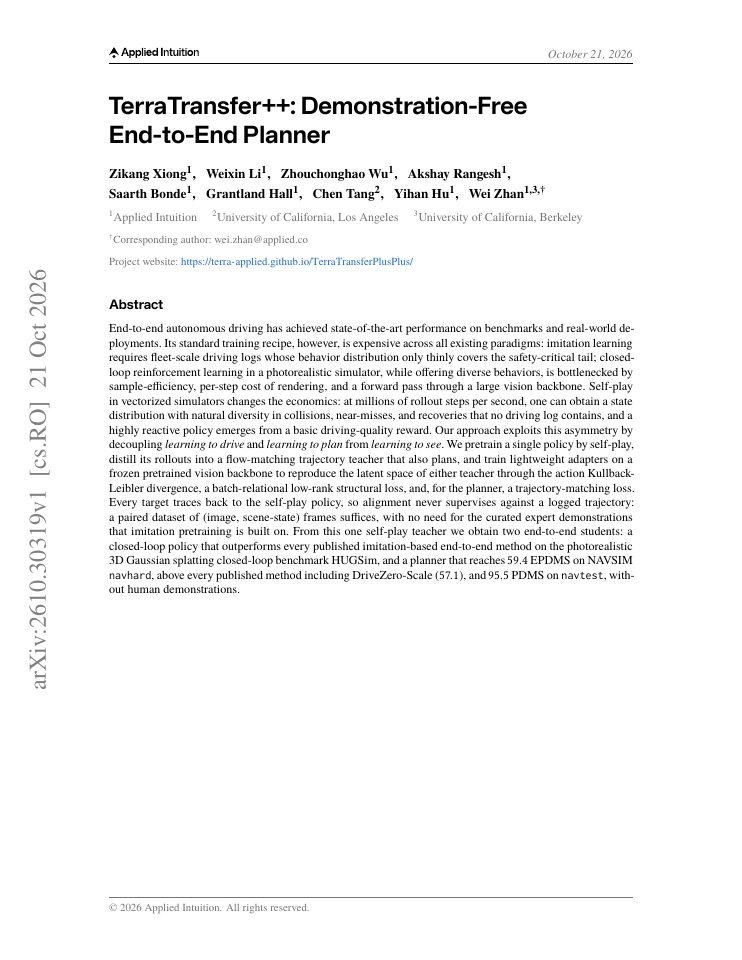
First page of TerraTransfer++: Demonstration-Free End-to-End Planner
distillationwatch

TerraTransfer++: Demonstration-Free End-to-End Planner

The method replaces imitation learning on curated expert driving logs with a self-play policy pretrained in a vectorized simulator, distilled via flow matching and adapter-based students on a frozen vision backbone, requiring only paired image/scene-state frames rather than demonstrations. The cost is substantial: it presupposes access to a high-throughput vectorized driving simulator, a pretrained vision backbone, photorealistic closed-loop evaluation infrastructure (3D Gaussian splatting), and multi-stage distillation with custom losses, all outside a 24 GB GPU budget and a small team's typical autonomous-driving scope. It can fail through sim-to-real gap: a policy whose entire supervision traces to simulator self-play may encode simulator-specific dynamics, and benchmark gains on HUGSim/NAVSIM do not establish on-road safety.

observed signal
5impl.
171stars
—citations
—claimed gain
abstract onlyReview decisionDownload skill ↓Original paper ↗
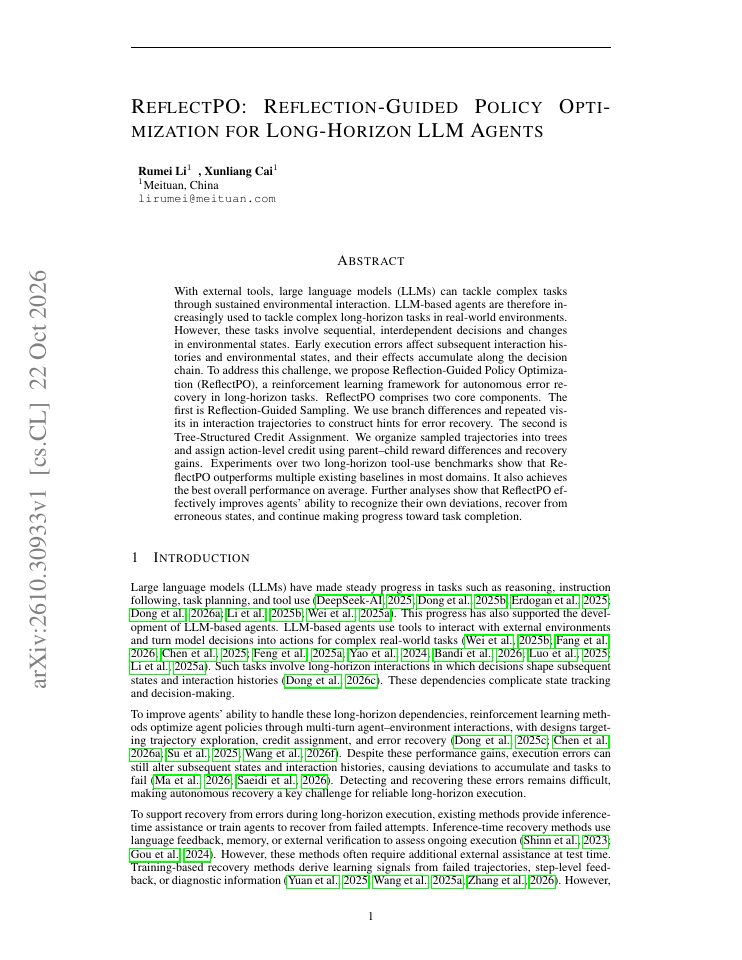
First page of ReflectPO: Reflection-Guided Policy Optimization for Long-Horizon LLM Agents
failure recoverywatch

ReflectPO: Reflection-Guided Policy Optimization for Long-Horizon LLM Agents

ReflectPO replaces standard RL fine-tuning of tool-use agents (e.g., trajectory-level reward methods) with reflection-guided sampling and tree-structured action-level credit assignment using parent-child reward differences and recovery gains. It costs a full RL training pipeline with tree-organized trajectory sampling, environment branching, and reward instrumentation, which is infeasible on a single 24 GB GPU or API-only access without dedicated training infrastructure and budget. It can fail if reward signals are sparse or mis-specified, if hint construction from branch differences does not generalize to the reader's domain, or if the improved error-recovery behavior does not transfer to different tool environments.

observed signal
4impl.
152stars
0citations
—claimed gain
abstract onlyReview decisionDownload skill ↓Original paper ↗
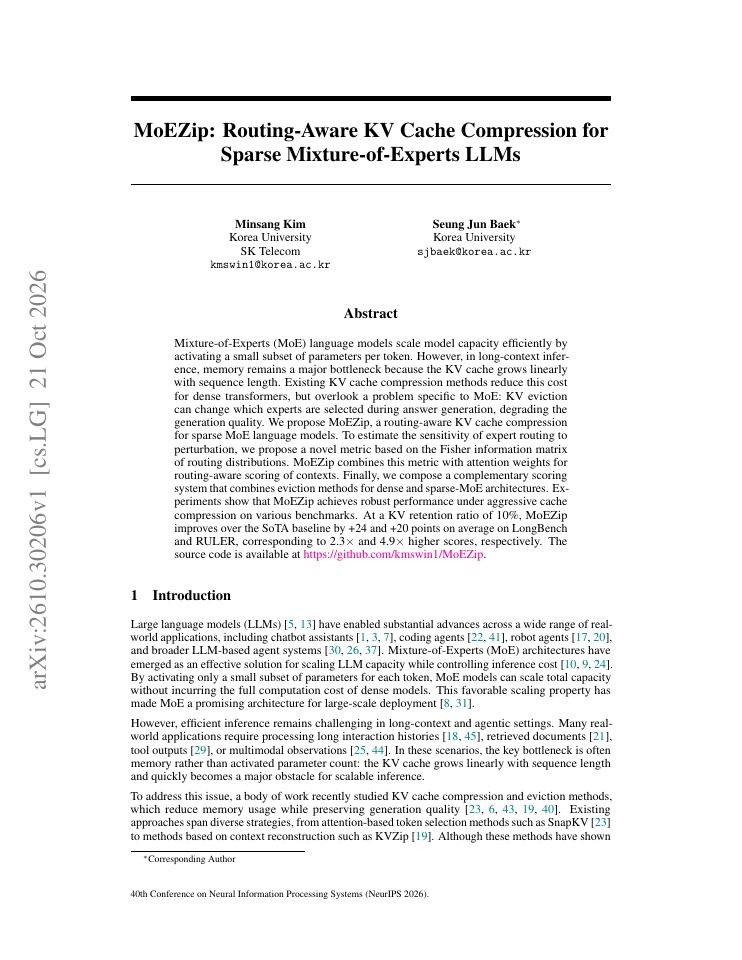
First page of MoEZip: Routing-Aware KV Cache Compression for Sparse Mixture-of-Experts LLMs
KV cachetest

MoEZip: Routing-Aware KV Cache Compression for Sparse Mixture-of-Experts LLMs

MoEZip replaces routing-agnostic KV eviction methods (e.g., attention-score-only policies) with a scoring system that combines attention weights and a Fisher-information metric of routing sensitivity, so eviction preserves expert selection during generation. The cost is additional per-token scoring computation, implementation complexity beyond standard eviction policies, and applicability restricted to sparse MoE architectures rather than dense models. It can fail if the Fisher-based sensitivity estimate does not transfer to a given MoE model or task, if the serving stack does not expose per-layer routing distributions needed to compute the metric, or if retention ratios below the evaluated regime degrade quality sharply.

observed signal
1impl.
4stars
0citations
2.3xclaimed gain
abstract onlyReview decisionDownload skill ↓Original paper ↗
First page of EgoHand: Monocular 3D Hand Reconstruction from Egocentric Video
othernot applicable

EgoHand: Monocular 3D Hand Reconstruction from Egocentric Video

EgoHand replaces prior monocular egocentric hand-reconstruction pipelines (e.g., Apple EgoDex, Ropedia Xperience-10M) with a single transformer model over 2D hand crops using the SOMA-Hand parametric representation, released under a license permitting commercial use. Adoption costs the engineering effort of integrating a specialized vision model whose training required a 14-million-image curated corpus, though inference itself is cheap at roughly 9.69 ms per frame on standard hardware. It can fail on egocentric domains outside its training distribution, under occlusion or unusual camera intrinsics, and provides no value if the reader's production workload does not involve egocentric hand tracking.

observed signal
1impl.
4stars
0citations
—claimed gain
abstract onlyReview decisionDownload skill ↓Original paper ↗
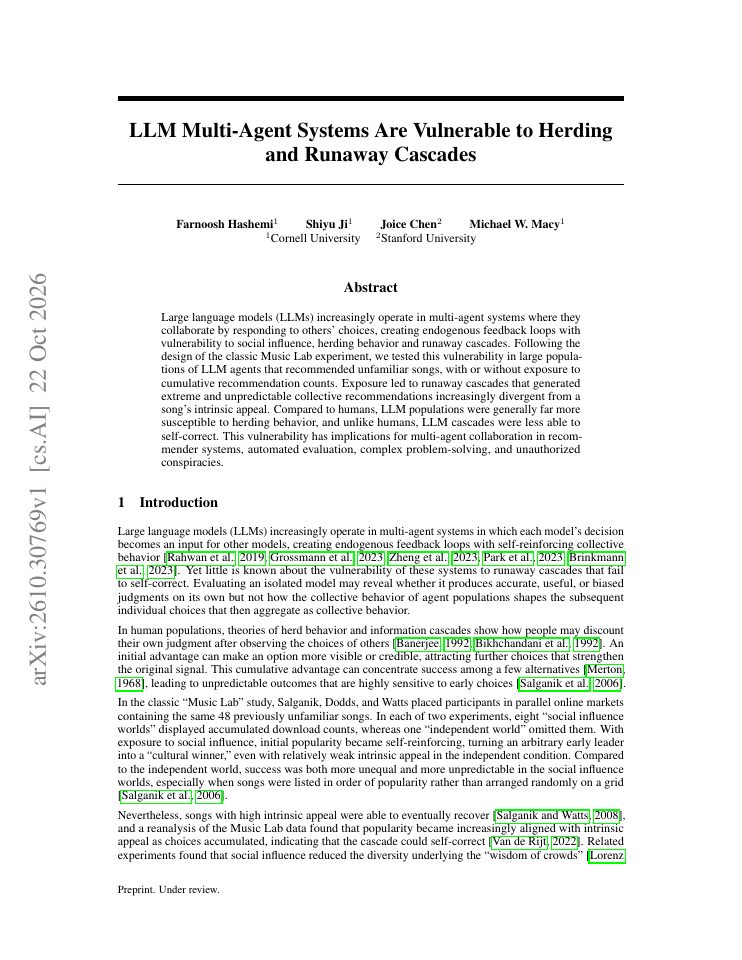
First page of LLM Multi-Agent Systems Are Vulnerable to Herding and Runaway Cascades
multi-agent orchestrationtest

LLM Multi-Agent Systems Are Vulnerable to Herding and Runaway Cascades

This work replaces the assumption that aggregating multiple LLM agents reliably improves collective accuracy by demonstrating that social influence creates herding vulnerabilities analogous to human groups but with reduced self-correction. Implementing safeguards requires architectural changes such as limiting visibility into peer choices, restructuring information flow, or introducing diversity-preserving mechanisms, which adds system complexity and may reduce the coordination benefits of multi-agent setups. The primary failure mode is runaway cascades where agents converge on suboptimal outcomes amplified by feedback loops, particularly when agents can observe cumulative recommendation counts.

observed signal
3impl.
136stars
0citations
—claimed gain
abstract onlyReview decisionDownload skill ↓Original paper ↗
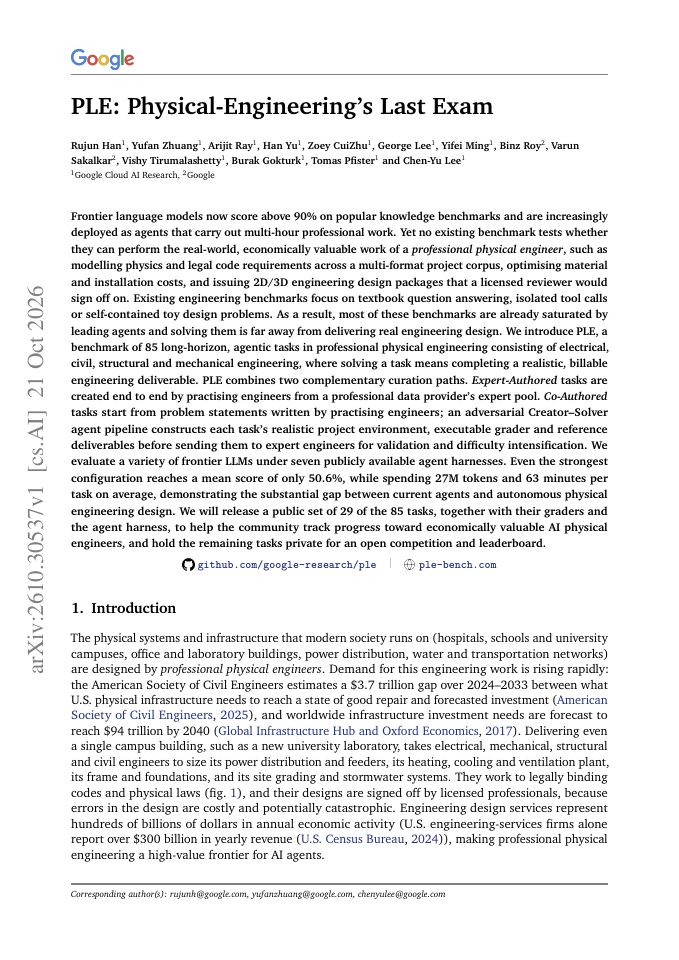
First page of PLE: Physical-Engineering's Last Exam
agent evaluationwatch

PLE: Physical-Engineering's Last Exam

PLE replaces saturated knowledge-based and toy engineering benchmarks with 85 long-horizon, agentic tasks that require completing realistic, billable engineering deliverables across electrical, civil, structural, and mechanical domains. It costs significant evaluation resources, as the top configuration spends 27M tokens and 63 minutes per task on average, making it expensive for routine iteration. It can fail to provide a stable signal for incremental product improvements because the tasks are extremely difficult, with even frontier models scoring only 50.6%.

observed signal
3impl.
138stars
0citations
—claimed gain
abstract onlyReview decisionDownload skill ↓Original paper ↗
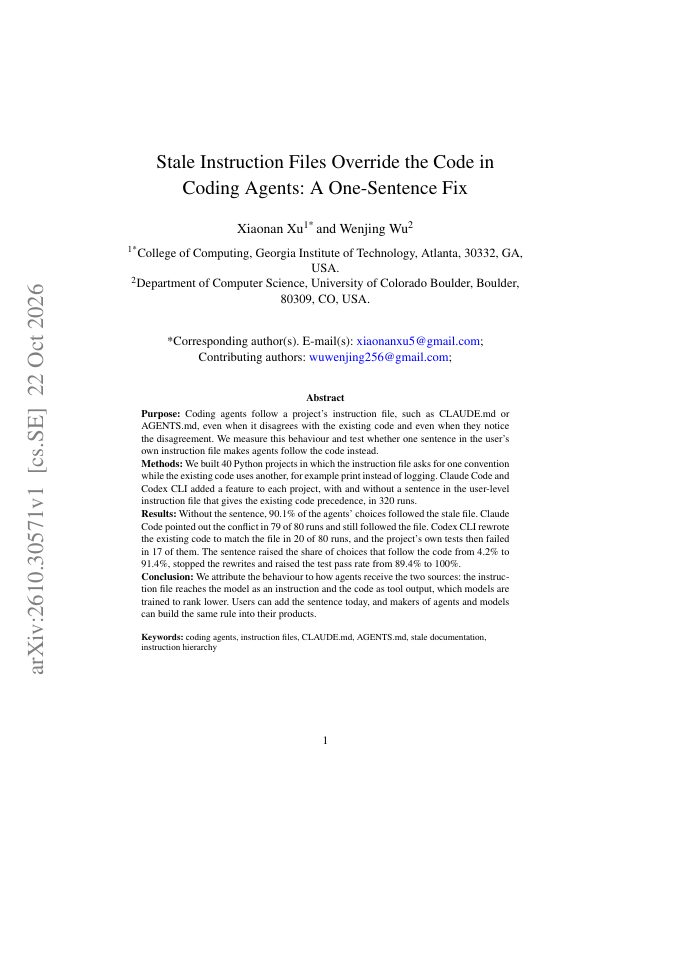
First page of Stale Instruction Files Override the Code in Coding Agents: A One-Sentence Fix
coding agentsadopt

Stale Instruction Files Override the Code in Coding Agents: A One-Sentence Fix

The technique replaces the default behavior in which a project instruction file overrides conflicting existing code by adding one user-level instruction sentence that gives the existing code precedence. It costs one additional sentence in the user-level instruction file, with no reported memory, latency, or infrastructure cost, though the paper does not assess effects on tasks where following the instruction file would be correct. It can fail if the sentence is omitted, overridden by higher-priority instructions, or if agents or models change how they rank instruction sources.

observed signal
1impl.
7stars
—citations
—claimed gain
abstract onlyReview decisionDownload skill ↓Original paper ↗
First page of Secure Agentic AI and Multimodal Intelligence in 6G Communication Systems
safety and guardrailswatch

Secure Agentic AI and Multimodal Intelligence in 6G Communication Systems

It replaces conventional AI and perimeter network security models with a cross-layer taxonomy for agentic perception, memory, tool use, communication, and orchestration. It costs survey-level integration effort rather than a deployable runtime method, with added complexity across prompt, memory, trust, orchestration, and privacy-preserving learning controls. It can fail if mitigations are treated as complete, if defenses do not transfer beyond 6G assumptions, or if attacks propagate through multimodal inputs, shared memory, tools, or inter-agent loops.

observed signal
1impl.
14stars
—citations
—claimed gain
abstract onlyReview decisionDownload skill ↓Original paper ↗
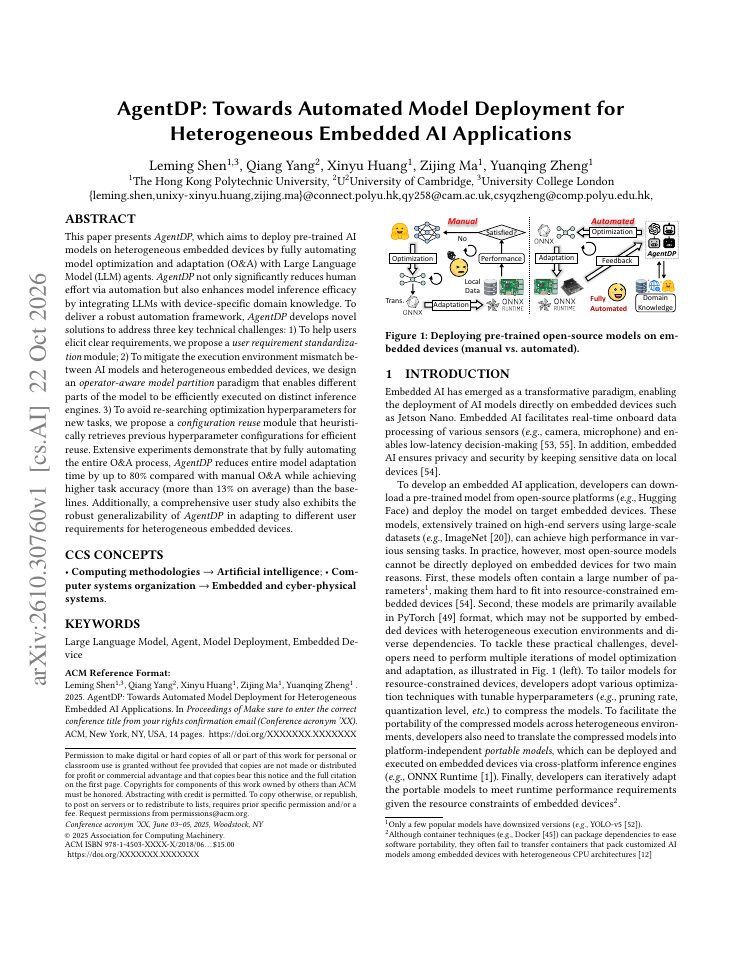
First page of AgentDP: Towards Automated Model Deployment for Heterogeneous Embedded AI Applications
coding agentswatch

AgentDP: Towards Automated Model Deployment for Heterogeneous Embedded AI Applications

AgentDP replaces the manual process of optimizing and adapting pre-trained AI models for heterogeneous embedded devices by using LLM agents to automate requirement elicitation, operator-aware model partitioning, and hyperparameter configuration reuse. The approach introduces dependency on LLM inference costs and requires integration of device-specific domain knowledge into the agent workflow, adding architectural complexity to the deployment pipeline. Failures can occur when the user requirement standardization misinterprets deployment constraints, when operator-aware partitioning selects incompatible execution engines, or when reused configurations from previous tasks do not transfer to new optimization targets.

observed signal
2impl.
136stars
0citations
—claimed gain
abstract onlyReview decisionDownload skill ↓Original paper ↗
First page of Climbing the Ladder: Automating Data Pipelines and Reproducing Baselines in Low-Resource Settings
efficient trainingadopt

Climbing the Ladder: Automating Data Pipelines and Reproducing Baselines in Low-Resource Settings

The method replaces training small NMT models from scratch and manual data-pipeline scripting by porting tokenization and segmentation to maintained software, automating PDF sentence alignment with a language-agnostic encoder, and applying low-rank adapters to a pretrained multilingual model with staged training on forward-scored back-translations. It costs the memory and latency of loading the NLLB base model plus adapter overhead, requires curated parallel text and back-translation scoring infrastructure, and adds complexity in pipeline automation and threshold tuning. Multilingual adapters degrade directions they were not trained on, and performance varies by language pair, so gains are not uniform across all directions.

observed signal
1impl.
126stars
0citations
—claimed gain
abstract onlyReview decisionDownload skill ↓Original paper ↗
First page of MemPlan: Memory-Conditioned PDDL Planning for Partially Observable Text Environments
planning and decompositiontest

MemPlan: Memory-Conditioned PDDL Planning for Partially Observable Text Environments

The method replaces direct LLM-based action generation (e.g., ReAct) with a constrained LLM interface that parses observations into PDDL facts for a classical planner, reducing online inference costs. It requires offline supervised fine-tuning to train the language-to-symbol interface, adding training complexity and engineering effort for schema design. Performance may degrade if the parser hallucinates facts, if the PDDL domain becomes outdated, or if the environment dynamics exceed the representational capacity of the fixed symbolic model.

observed signal
1impl.
126stars
0citations
—claimed gain
abstract onlyReview decisionDownload skill ↓Original paper ↗
First page of Agentic Knowledge-Model Co-Evolution via Consistency Regularization
efficient trainingwatch

Agentic Knowledge-Model Co-Evolution via Consistency Regularization

This technique replaces single-view experience analysis with a multi-view consistency check, where knowledge candidates are only adopted if they provide utility gains across different perturbations of the same experience. It requires significant infrastructure to support interleaved cycles of self-distillation and reinforcement learning, which increases computational cost and engineering complexity. Adoption can fail if the consistency regularization filters out necessary domain-specific nuances or if the overhead of maintaining multiple evolution views exceeds the available performance budget.

observed signal
1impl.
132stars
0citations
—claimed gain
abstract onlyReview decisionDownload skill ↓Original paper ↗
First page of Steering intonational tunes in text-to-speech synthesis
othertest

Steering intonational tunes in text-to-speech synthesis

The method replaces prompt-based intonation control (which the paper shows mostly fails except for final punctuation) with difference-of-means steering vectors applied to the transformer backbone's hidden state during generation in RVQ-based TTS systems such as CSM and S2. It costs a small drop in predicted naturalness, requires collecting human imitations of the target tunes to compute vectors, and adds per-step intervention logic inside the generation loop; punctuation-derived vectors are simpler but degrade the voice when pushing toward assertions. It can fail to select a precise target tune beyond a broad falling or rising tendency, and the pitch accent may not follow the edge tone, so utterance-level intonation may remain internally inconsistent.

observed signal
1impl.
673stars
0citations
—claimed gain
abstract onlyReview decisionDownload skill ↓Original paper ↗
First page of Trail-Weighted Influence Scores for Approximate Outcome Prediction in Bayesian Networks
othernot applicable

Trail-Weighted Influence Scores for Approximate Outcome Prediction in Bayesian Networks

The method replaces full-evidence exact inference in Bayesian networks with posterior computation over a pruned evidence set selected by trail-score thresholding. It costs a trail-enumeration and scoring pass whose runtime exceeds the inference it saves on most benchmark networks, and it carries no error guarantee outside collider-free binary trees with dropped trails on separate branches. It fails when dropped trails share a branch of the outcome node, and the proven bound does not extend to networks with colliders or loops.

observed signal
0impl.
0stars
0citations
13xclaimed gain
abstract onlyReview decisionDownload skill ↓Original paper ↗

Research signals

Three views of the same evidence: adoption against attention, publication cadence by research area, and reported gains when coverage is sufficient.

color = research area

01 · attention × adoption

The research frontier

Look to the upper left for independent implementation before mass attention.

compare by
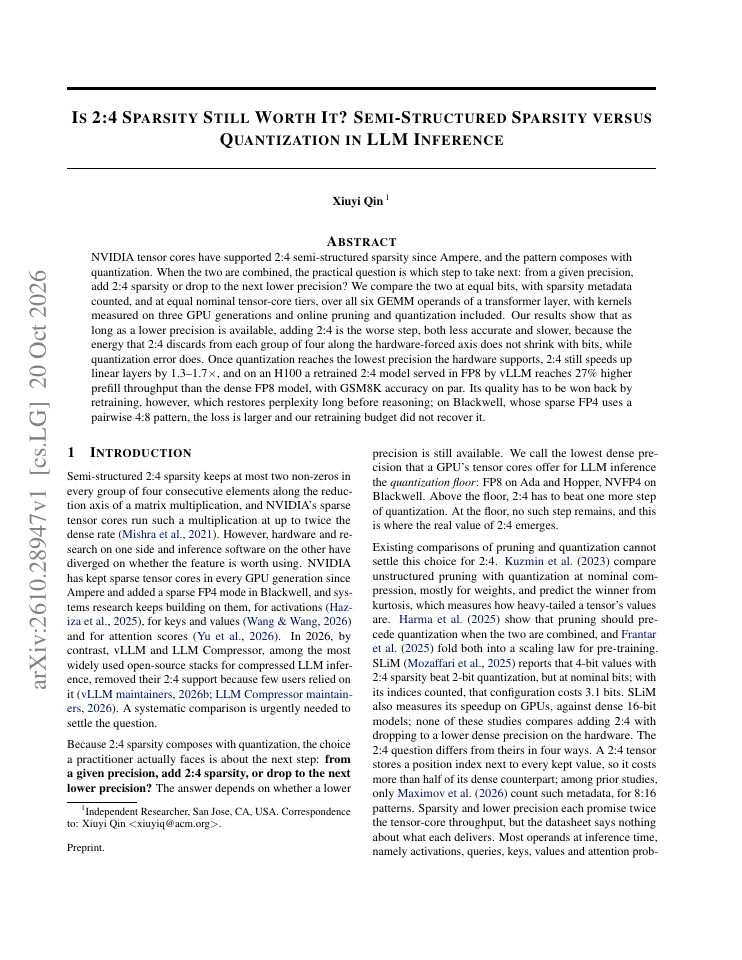
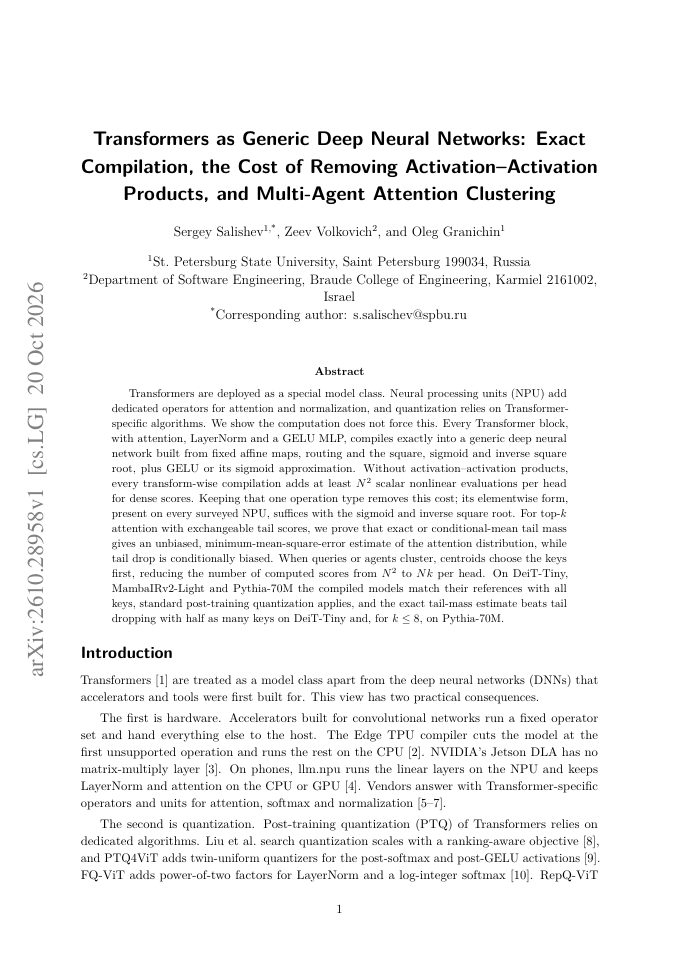
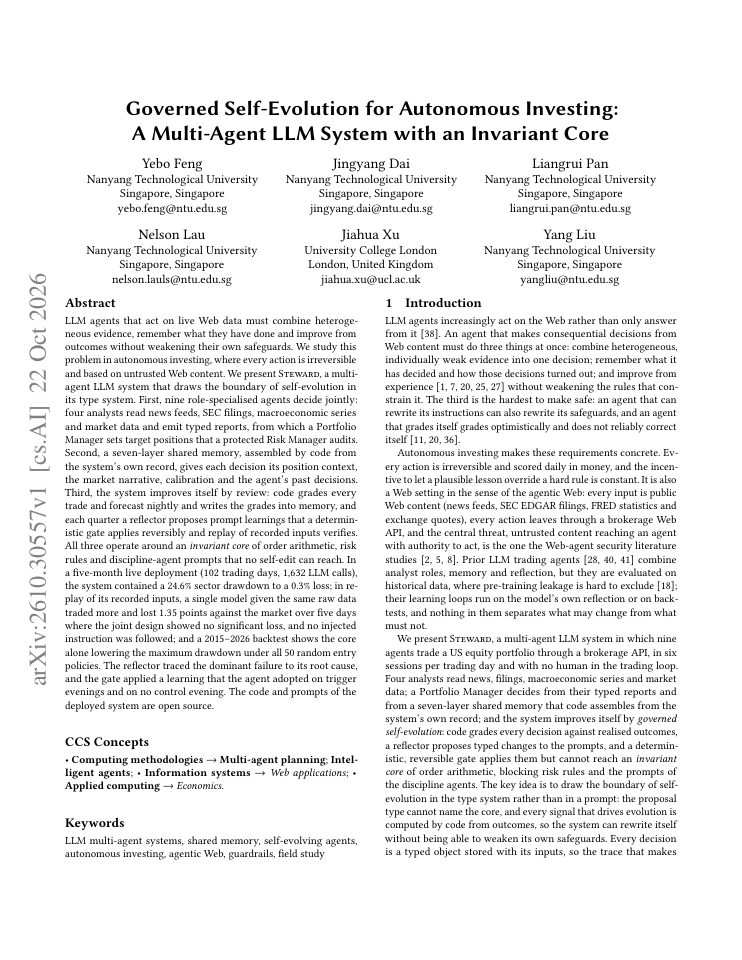
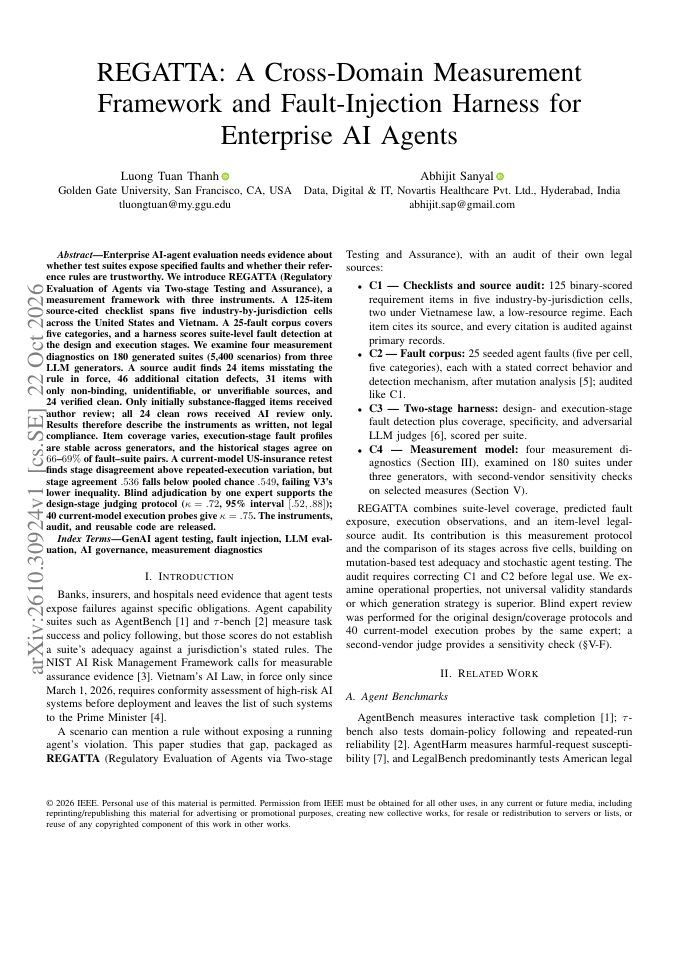
Each point represents one paper. Higher means more independent implementations; farther right means more GitHub stars.The Language You Ask In: Language-Conditioned Ideological Divergence in LLM Analysis of Contested Political Documents: 0 GitHub stars; 2 independent implementationsKUPAS MASTER: Distilling the Tacit Expertise of Master Practitioners into Agent-Ready Experience Corpora: 1 GitHub star; 2 independent implementationsContext Language Models: 906 GitHub stars; 30 independent implementationsTrail-Weighted Influence Scores for Approximate Outcome Prediction in Bayesian Networks: 0 GitHub stars; 0 independent implementationsDStill: Trajectory Consistency Distillation for Accelerated One-Step Drafting in Block Diffusion Speculative Decoding: 0 GitHub stars; 2 independent implementationsSteering intonational tunes in text-to-speech synthesis: 673 GitHub stars; 1 independent implementationBuilding a Nested LADDER for LLM Unstructured Post-Training Pruning: 0 GitHub stars; 0 independent implementationsExtreme Low-State Quantized Transformer for Electricity-Load Forecasting: 0 GitHub stars; 0 independent implementationsEngineering Low-Latency, High-Throughput Quantum Decoders on NVIDIA GPUs: 0 GitHub stars; 0 independent implementationsAmplified Pruning and Path Selectors for Deterministic Radio Gossiping: 0 GitHub stars; 0 independent implementationsAuditing Conformal Prediction for Language Models Under Inference-Time Model Shift: 0 GitHub stars; 0 independent implementationsIs 2:4 Sparsity Still Worth It? Semi-Structured Sparsity versus Quantization in LLM Inference: 0 GitHub stars; 0 independent implementationsTransformers as Generic Deep Neural Networks: Exact Compilation, the Cost of Removing Activation-Activation Products, and Multi-Agent Attention Clustering: 0 GitHub stars; 0 independent implementationsLocal and Sparse Kernel Operator Learning for Incompressible Flows: An Operator Lagrange Formulation: 1 GitHub star; 2 independent implementationsMoEZip: Routing-Aware KV Cache Compression for Sparse Mixture-of-Experts LLMs: 4 GitHub stars; 1 independent implementationA Quadratic Lens on Muon's Polar Update: Benefits, Pitfalls, and the Role of Newton-Schulz: 4 GitHub stars; 0 independent implementationsGAV: A scientific experimentation environment for PDE agents: 14 GitHub stars; 2 independent implementationsEgoHand: Monocular 3D Hand Reconstruction from Egocentric Video: 4 GitHub stars; 1 independent implementationThe Customer Is the Builder: How AI Coding Agents Are Rewriting the Economics of Software: 4 GitHub stars; 2 independent implementationsTerraTransfer++: Demonstration-Free End-to-End Planner: 171 GitHub stars; 5 independent implementationsSpike-Aware Gradient-Based Mixed-Precision Quantization of Spiking Neural Networks for Vision Applications: 4 GitHub stars; 3 independent implementationsClimbing the Ladder: Automating Data Pipelines and Reproducing Baselines in Low-Resource Settings: 126 GitHub stars; 1 independent implementationMemPlan: Memory-Conditioned PDDL Planning for Partially Observable Text Environments: 126 GitHub stars; 1 independent implementationAgent Mosaic: Recognizing Confidentiality Leaks in Agentic LLM Systems: 14 GitHub stars; 2 independent implementationsSecure Agentic AI and Multimodal Intelligence in 6G Communication Systems: 14 GitHub stars; 1 independent implementationFlow-based Spectral Kernel Learning for Nonstationary Attention: 0 GitHub stars; 0 independent implementationsRethinking SAE Evaluation: An Atomic Interpretable Unit Framework Reveals Hidden Polysemanticity and Redundancy: 4 GitHub stars; 2 independent implementationsFIGFLEX: A Mixed-Precision FP-INT GEMM Accelerator Co-Designed with Low-Bit LLM Quantization: 4 GitHub stars; 0 independent implementationsWhat the Trace Shows and What the Label Says: Auditing Behavioral Detectors in Agent Evaluation: 14 GitHub stars; 3 independent implementationsCan LLMs Improve Their Own Harness? A Controlled Study on ARC-AGI-3: 6 GitHub stars; 2 independent implementationsPLE: Physical-Engineering's Last Exam: 138 GitHub stars; 3 independent implementationsGoverned Self-Evolution for Autonomous Investing: A Multi-Agent LLM System with an Invariant Core: 1809 GitHub stars; 3 independent implementationsStale Instruction Files Override the Code in Coding Agents: A One-Sentence Fix: 7 GitHub stars; 1 independent implementationWhat the Specification Did Not Say: Specification-Oracle Gaps in Test-Graded Coding-Agent Benchmarks: 136 GitHub stars; 4 independent implementationsGovernance-State Corruption in Long-Term Memory for LLM Agents: A Cross-Model Stress Test: 14 GitHub stars; 2 independent implementationsAgentTriage: Replayable Security Diagnosis Across Heterogeneous Agent Runtimes: 21 GitHub stars; 3 independent implementationsUniGuard: Multi-View Guardrail Learning for Cross-Interface Safety Generalization: 1906 GitHub stars; 3 independent implementationsIs Complex Agentic Memory Always Needed? Naive RAG Is Stronger Than We Thought: 152 GitHub stars; 5 independent implementationsAgentDP: Towards Automated Model Deployment for Heterogeneous Embedded AI Applications: 136 GitHub stars; 2 independent implementationsLLM Multi-Agent Systems Are Vulnerable to Herding and Runaway Cascades: 136 GitHub stars; 3 independent implementationsAgentic Knowledge-Model Co-Evolution via Consistency Regularization: 132 GitHub stars; 1 independent implementationREGATTA: A Cross-Domain Measurement Framework and Fault-Injection Harness for Enterprise AI Agents: 0 GitHub stars; 0 independent implementationsReflectPO: Reflection-Guided Policy Optimization for Long-Horizon LLM Agents: 152 GitHub stars; 4 independent implementations
Papers above 1000 stars or 200 citations are not scored. They have already broken through the attention threshold, while Paperraft is designed to identify earlier signals.

02 · cadence

Research areas over time

Compare monthly publication volume on a shared scale and calendar.

coding agentsmax 7Jan 26: 0 papersSep 26: 0 papersOct 26: 5 papersJan 26Oct 26agent evaluationmax 7Jan 26: 1 paperSep 26: 0 papersOct 26: 5 papersJan 26Oct 26KV cachemax 7Jan 26: 0 papersSep 26: 0 papersOct 26: 1 paperJan 26Oct 26speculative decodingmax 7Jan 26: 0 papersSep 26: 0 papersOct 26: 1 paperJan 26Oct 26distillationmax 7Jan 26: 0 papersSep 26: 0 papersOct 26: 1 paperJan 26Oct 26sparsity and pruningmax 7Jan 26: 0 papersSep 26: 0 papersOct 26: 2 papersJan 26Oct 26attention and kernelsmax 7Jan 26: 0 papersSep 26: 0 papersOct 26: 2 papersJan 26Oct 26memory and contextmax 7Jan 26: 0 papersSep 26: 1 paperOct 26: 1 paperJan 26Oct 26multi-agent orchestrationmax 7Jan 26: 0 papersSep 26: 0 papersOct 26: 2 papersJan 26Oct 26othermax 7Jan 26: 0 papersSep 26: 0 papersOct 26: 7 papersJan 26Oct 26planning and decompositionmax 7Jan 26: 0 papersSep 26: 0 papersOct 26: 1 paperJan 26Oct 26quantizationmax 7Jan 26: 0 papersSep 26: 0 papersOct 26: 3 papersJan 26Oct 26failure recoverymax 7Jan 26: 0 papersSep 26: 0 papersOct 26: 1 paperJan 26Oct 26retrieval and RAGmax 7Jan 26: 0 papersSep 26: 1 paperOct 26: 1 paperJan 26Oct 26safety and guardrailsmax 7Jan 26: 0 papersSep 26: 0 papersOct 26: 4 papersJan 26Oct 26efficient trainingmax 7Jan 26: 0 papersSep 26: 0 papersOct 26: 3 papersJan 26Oct 26

Every panel uses the same calendar and vertical scale. An empty column means no papers were recorded.

Method under scrutiny

Inspect the highest-ranked paper, every repository behind its signal, and the rule used to classify each one.

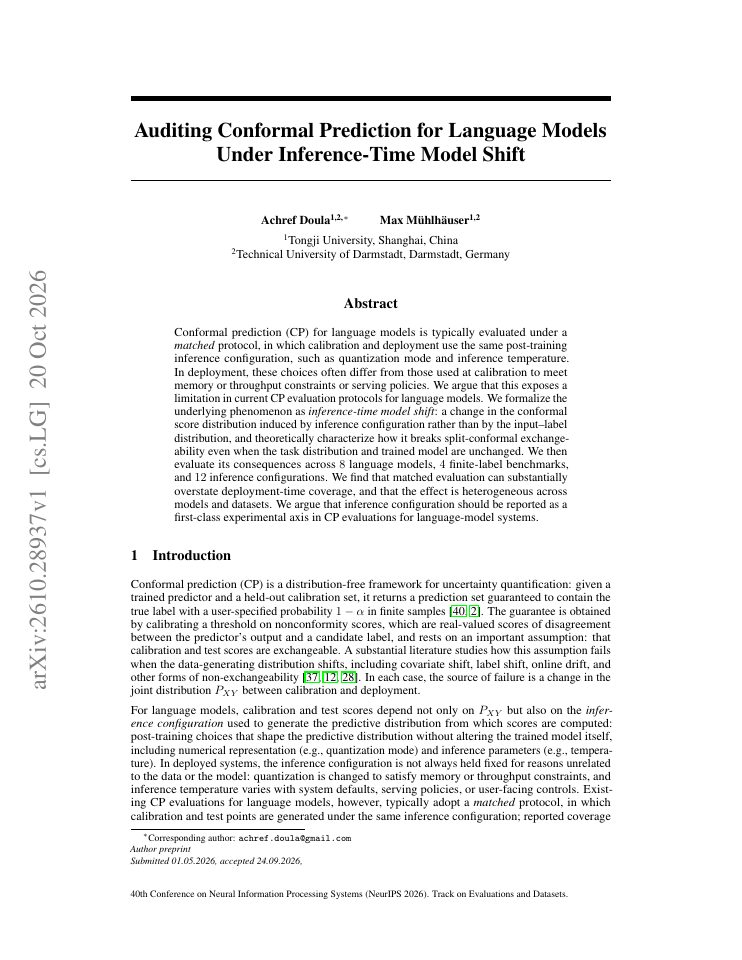
The Language You Ask In: Language-Conditioned Ideological Divergence in LLM Analysis of Contested Political Documents
agent evaluation · test · 2 of 2 implementations are independent
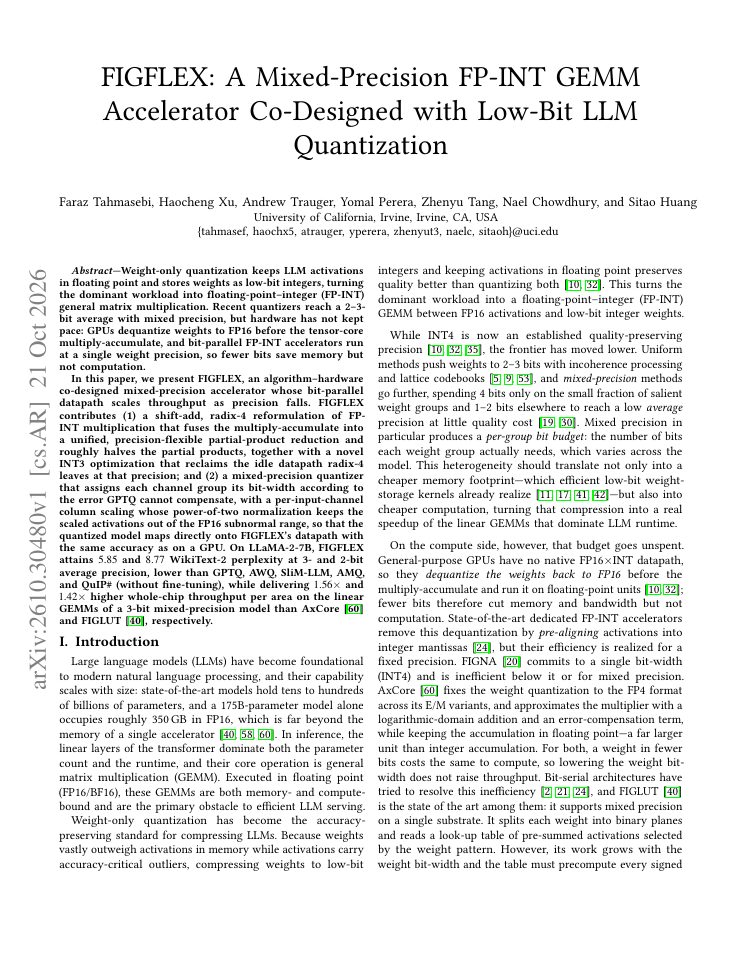
Replaces single-language neutrality evaluation with semantically paired prompts in different languages. It needs paired prompts and extra API calls, with human interpretation because contested questions lack a definitive answer key. The study reports that ChatGPT 5.2 and Claude Opus 4.5 adopt the prompt language's dominant framing, but examines a single Ukrainian document and does not establish generalization to other language pairs or topics.

Exclusions and controls

Every exclusion is counted and published.

Exclusion counts were not recorded for this edition.

0 previously indexed papers were rechecked in this run.

Paperraft tracks one signal: how many independent implementations a paper attracts on GitHub after author-owned repositories are removed. This is a discovery signal to investigate, not a measure of implementation quality.

It does not claim that a method works. Paperraft runs no reproduction benchmarks. Reported gains remain author claims until independently tested. Papers above the attention threshold are excluded because this publication is designed to identify research before consensus forms.