Skip to content

archived edition · 2026-10-23

PaperraftFind the AI research
worth testing.

Understand what a paper changes, what it costs, and whether it fits your next build. Explore research on faster LLM inference, agent memory, and evaluation, with the original sources in reach.

Start with a brief. Follow the evidence. Choose a test.

edition
2026-10-23
briefs
42
research areas
12
independent implementations
28

23 of 42 papers in the index (55%) have no independent implementations.

Research index

Search by topic, browse a research area, or sort by date. Read a brief, open the original paper, and inspect the available evidence before deciding what to test.

showing30 of 42
sort by
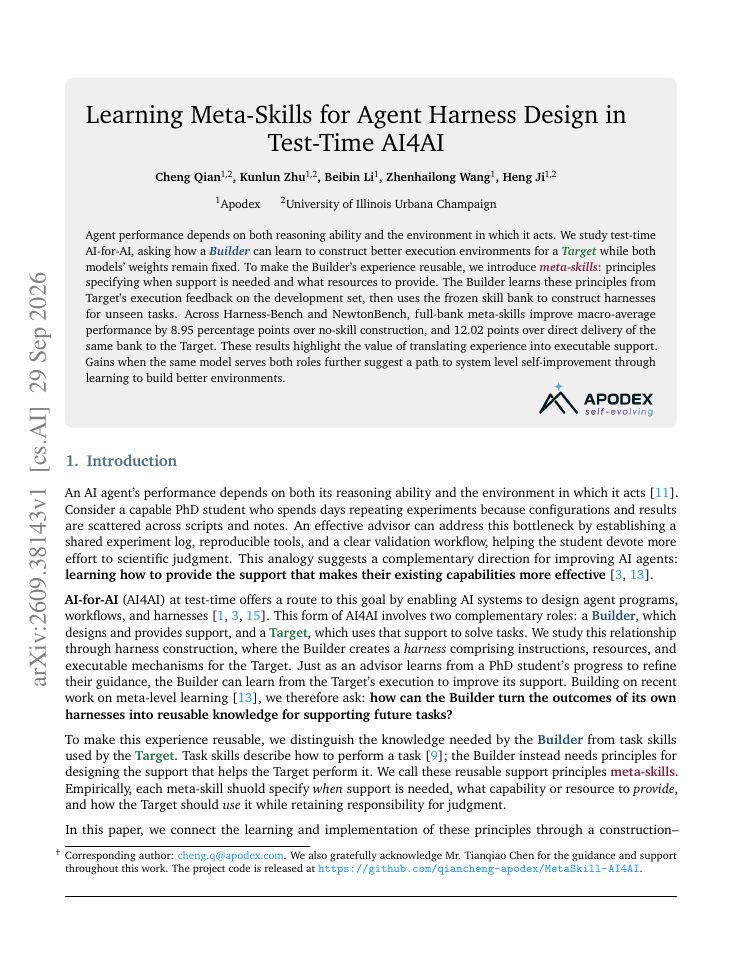
First page of Learning Meta-Skills for Agent Harness Design in Test-Time AI4AI
multi-agent orchestrationtest

Learning Meta-Skills for Agent Harness Design in Test-Time AI4AI

Replaces hand-designed or ad-hoc agent scaffolding (tools, prompts, execution support) with a Builder model that learns reusable 'meta-skill' principles from Target execution feedback on a development set and constructs harnesses for unseen tasks, all with frozen weights. Costs an extra Builder inference pass per task plus a development-set learning loop, adding orchestration complexity and API or GPU compute spend. Can fail when development tasks do not transfer to the production task distribution, when learned principles encode benchmark-specific artifacts, or when the Builder's constructed harness degrades the Target on out-of-distribution inputs.

observed signal
2impl.
1stars
0citations
—claimed gain
abstract onlyReview decisionDownload skill ↓Original paper ↗
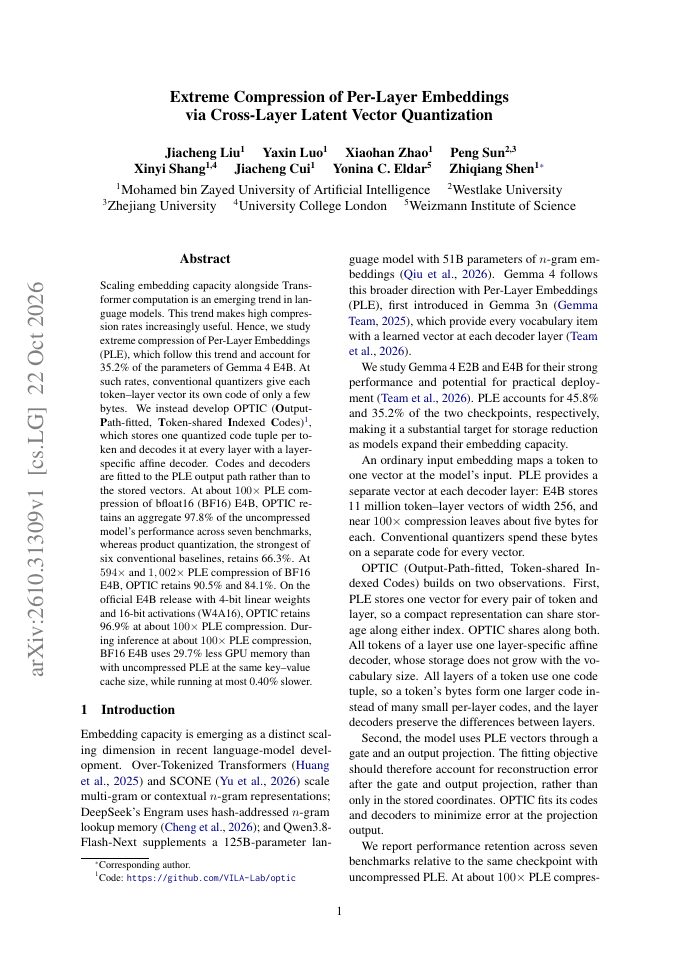
First page of Extreme Compression of Per-Layer Embeddings via Cross-Layer Latent Vector Quantization
quantizationwatch

Extreme Compression of Per-Layer Embeddings via Cross-Layer Latent Vector Quantization

OPTIC replaces the conventional approach of storing an individual short code per token-layer vector (as in product quantization of per-layer embeddings) with a single quantized code tuple per token decoded at every layer through a layer-specific affine decoder fitted to the PLE output path. The cost is a fitting procedure against the PLE output path plus per-layer affine decoders, with negligible latency overhead (at most 0.40%) but a quality degradation that grows sharply beyond roughly 100x compression (90.5% at 594x, 84.1% at 1,002x). It can fail if the model in use does not have large per-layer embeddings comparable to Gemma 4 E4B's 35.2% parameter share, if the fitted codes transfer poorly across fine-tuned variants, or if the quality loss at higher compression rates is unacceptable for the target task.

observed signal
2impl.
2stars
—citations
1.42xclaimed gain
abstract onlyReview decisionDownload skill ↓Original paper ↗
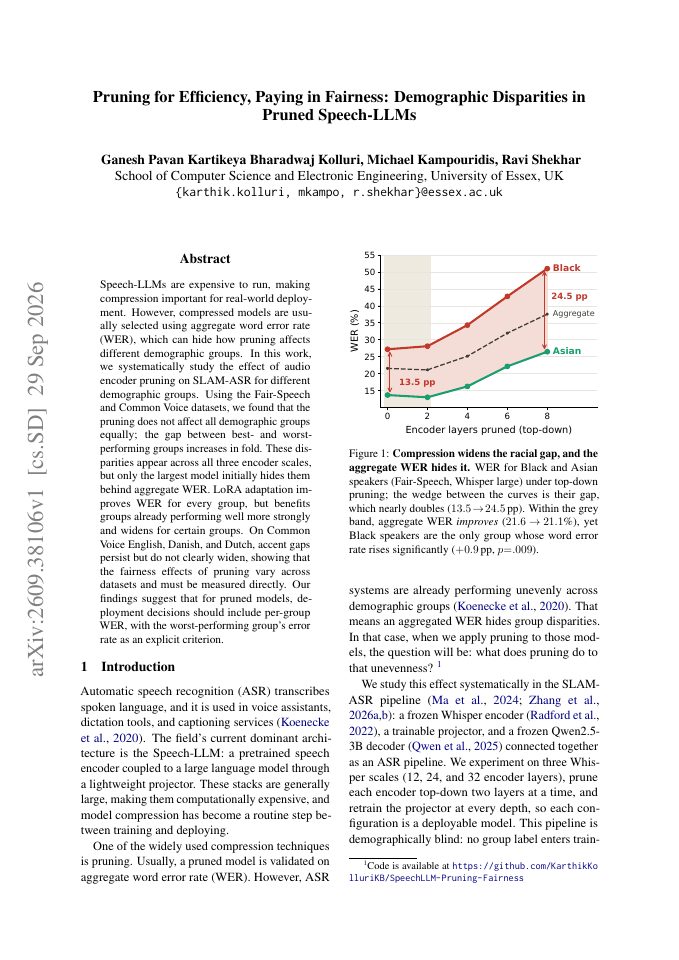
First page of Pruning for Efficiency, Paying in Fairness: Demographic Disparities in Pruned Speech-LLMs
sparsity and pruningadopt

Pruning for Efficiency, Paying in Fairness: Demographic Disparities in Pruned Speech-LLMs

The paper is an evaluation study, not a new compression method: it replaces the practice of selecting pruned speech-LLM checkpoints using aggregate WER alone with selection that also tracks per-demographic-group WER and the worst-performing group's error rate. The cost is additional evaluation compute (one inference pass per demographic slice per checkpoint) and extra analysis and dataset labeling, which is small relative to deployment risk. What can fail: the fairness effects are dataset-dependent (gaps widened on Fair-Speech but not clearly on Common Voice), so per-group metrics must be measured on the target population, and LoRA recovery after pruning can widen disparities even while improving every group's absolute WER.

observed signal
1impl.
1stars
0citations
—claimed gain
abstract onlyReview decisionDownload skill ↓Original paper ↗
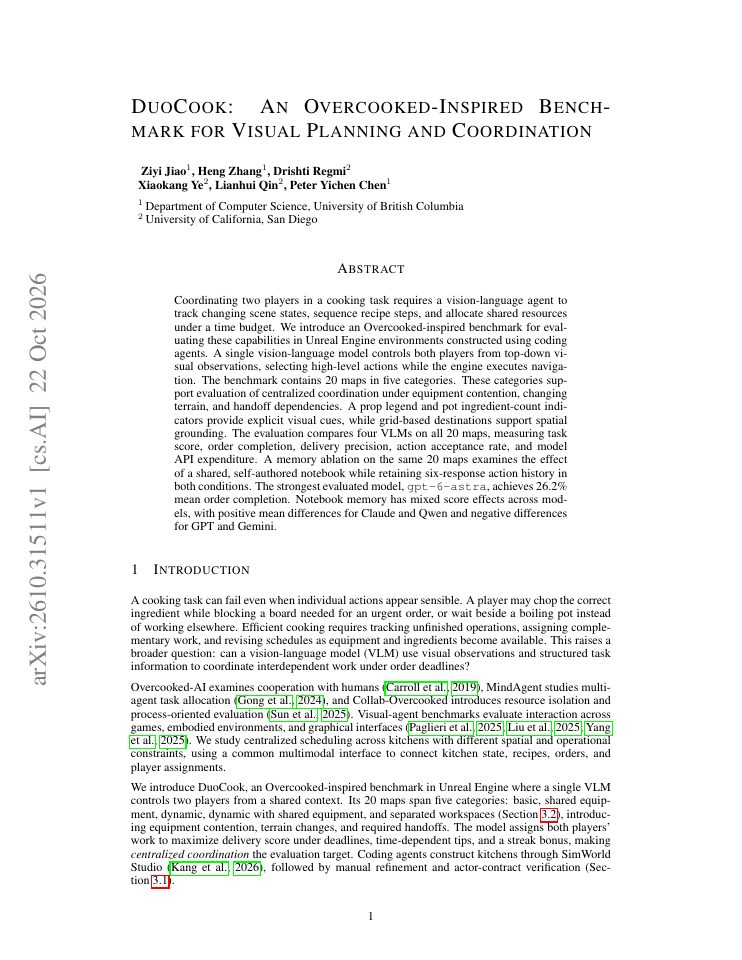
First page of RIDAR: Safeguarding Research Integrity in Autonomous Research Agents via Automated Detection and Runtime Intervention
safety and guardrailswatch

RIDAR: Safeguarding Research Integrity in Autonomous Research Agents via Automated Detection and Runtime Intervention

RIDAR replaces manual or absent auditing of autonomous research-agent trajectories with a taxonomy-driven post-hoc detector (14 violation types) and a runtime monitor that intervenes mid-execution. It costs an additional LLM-based detection layer over every agent trajectory, which increases token spend and latency and requires intervention logic wired into the agent loop; the benchmark is small (60 annotated trajectories, 300 wild trajectories from a niche domain). After adoption, the detector can fail through false positives that interrupt valid agent behavior, false negatives on violation types underrepresented in the taxonomy, and distribution shift if the reader's agents differ from the research-agent setting studied.

observed signal
3impl.
136stars
—citations
—claimed gain
abstract onlyReview decisionDownload skill ↓Original paper ↗
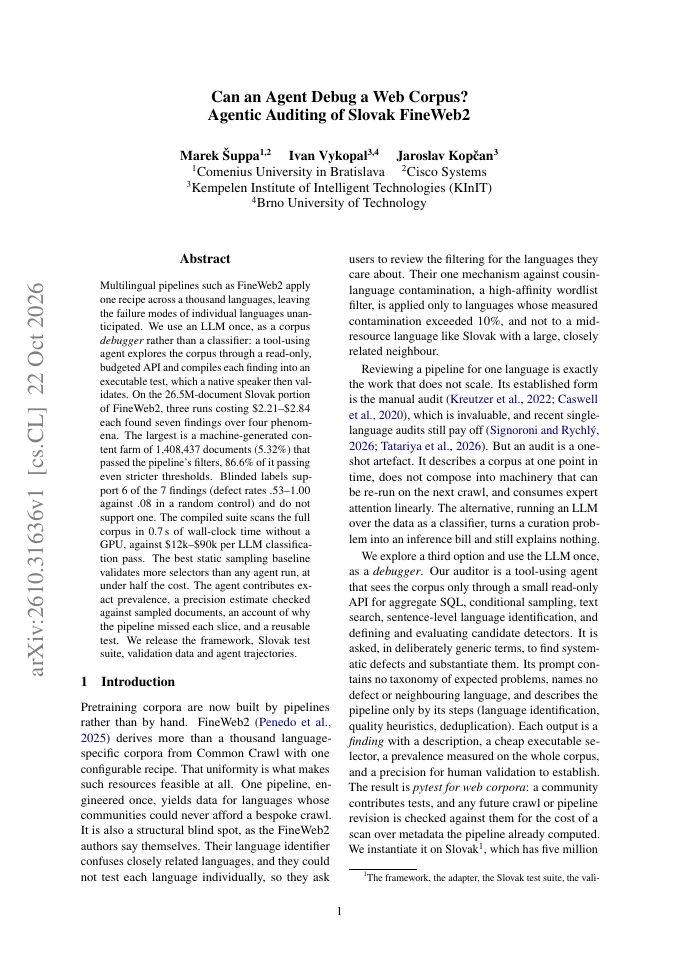
First page of Can an Agent Debug a Web Corpus? Agentic Auditing of Slovak FineWeb2
othertest

Can an Agent Debug a Web Corpus? Agentic Auditing of Slovak FineWeb2

Replaces uniform one-recipe multilingual filtering and full-corpus LLM classification passes with a single budgeted, read-only agent exploration whose findings are compiled into executable, GPU-free tests validated by a native speaker. Costs are a few dollars per agent run plus human validation time, but the approach adds pipeline complexity: findings must be confirmed by blinded human labels (one of seven findings was not supported), and the compiled tests only detect the phenomena already discovered. It can fail when the agent misses failure modes it did not sample, when static sampling would have found the same selectors more cheaply, or when defect estimates rely on small validation samples.

observed signal
2impl.
132stars
—citations
4225xclaimed gain
abstract onlyReview decisionDownload skill ↓Original paper ↗
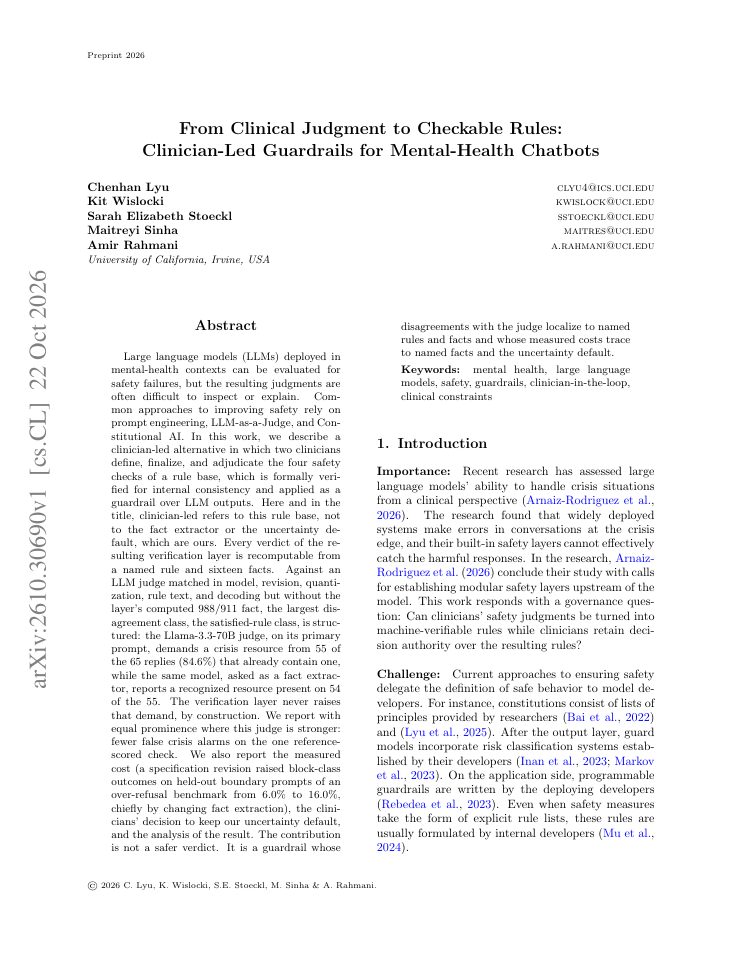
First page of From Clinical Judgment to Checkable Rules: Clinician-Led Guardrails for Mental-Health Chatbots
safety and guardrailsadopt

From Clinical Judgment to Checkable Rules: Clinician-Led Guardrails for Mental-Health Chatbots

Replaces prompt engineering, LLM-as-a-Judge, and Constitutional AI safety evaluation with a clinician-authored, formally verified four-rule base applied as a guardrail whose every verdict is recomputable from sixteen named facts. Costs: clinician time to define and adjudicate rules, a fact-extraction step, and a measured over-refusal regression where a specification revision raised block-class outcomes on held-out boundary prompts from 6.0% to 16.0%, plus an uncertainty default that can over-block. Can fail when fact extraction misidentifies content (the main source of the over-refusal regression) and when the fixed rule set misses safety failures outside its four checks, where the LLM judge may remain stronger.

observed signal
1impl.
10stars
—citations
—claimed gain
abstract onlyReview decisionDownload skill ↓Original paper ↗
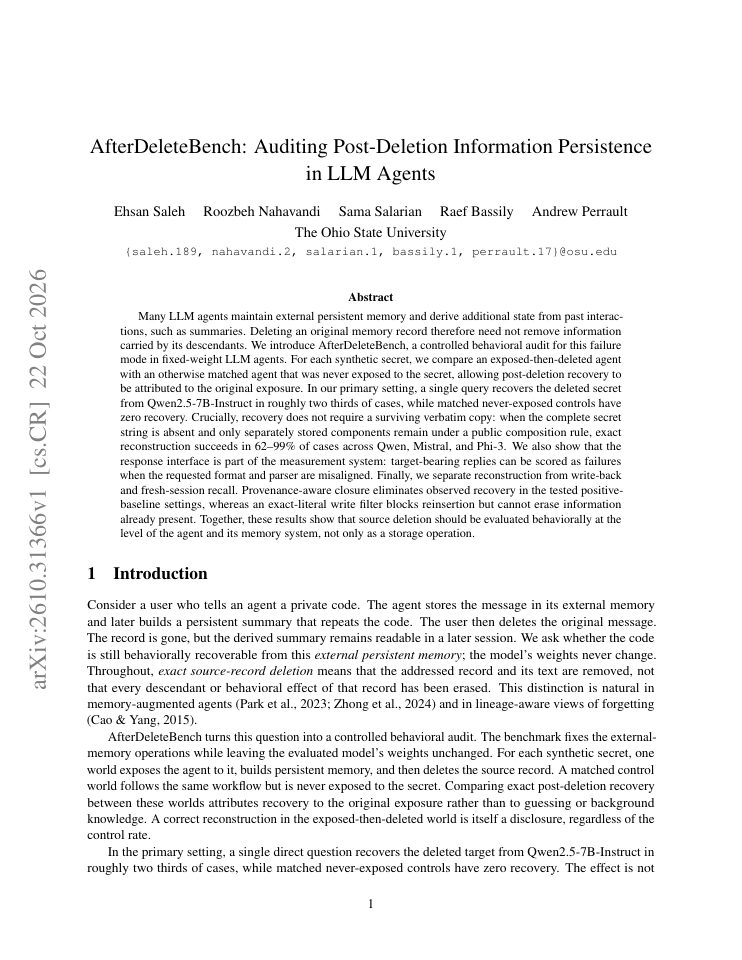
First page of AfterDeleteBench: Auditing Post-Deletion Information Persistence in LLM Agents
safety and guardrailsadopt

AfterDeleteBench: Auditing Post-Deletion Information Persistence in LLM Agents

The method replaces treating deletion as a storage-level operation with a behavioral audit that compares exposed-then-deleted agents against matched never-exposed controls, and replaces naive exact-literal write filters with provenance-aware closure that also removes derived records such as summaries and decomposed components. The cost is engineering complexity: memory systems must track provenance from source records to all derived state, and audits require building controlled exposure/deletion test harnesses rather than relying on storage APIs. It can fail when provenance tracking is incomplete across heterogeneous memory stores, when response parsers misclassify target-bearing replies as clean, or when information persists in forms outside the tracked lineage.

observed signal
1impl.
10stars
—citations
—claimed gain
abstract onlyReview decisionDownload skill ↓Original paper ↗
First page of AgentPhishing: A Benchmark of LLM Email Agents Under Adaptive Attack
safety and guardrailstest

AgentPhishing: A Benchmark of LLM Email Agents Under Adaptive Attack

AgentPhishing replaces reliance on conventional static phishing datasets for assessing LLM email agents, adding an optimizer (PhishOpt) that generates persuasive, agent-adapted attacks under realism constraints plus a reusable universal generation skill. The cost is additional evaluation infrastructure: an attack-optimization loop, API or GPU compute for the generator and target agents, and analysis effort beyond a standard detection benchmark. It can fail if the optimized attacks overfit to the tested agents or the realism constraint is weak, so detection and compliance rates may not transfer to real-world phishing or to agents with different tool configurations.

observed signal
1impl.
10stars
—citations
—claimed gain
abstract onlyReview decisionDownload skill ↓Original paper ↗
First page of Adaptive Skill Granularity for Coding Agents: Runtime Routing and Macro-to-Micro Recovery
coding agentstest

Adaptive Skill Granularity for Coding Agents: Runtime Routing and Macro-to-Micro Recovery

The method replaces fixed-granularity skill execution (always primitive tool calls or always macro skills) with a feature-based runtime controller that selects granularity per task and a finite-state executor that falls back to micro-level recovery when a macro skill fails. It costs additional controller logic, state tracking, and process instrumentation, with possible extra token spend when routing chooses primitives or recovery paths; the evaluation uses a deterministic protocol without published latency or dollar figures, so cost impact on a real workload is unverified. It can fail when the routing features misclassify task structure (route mismatch), when macro skills are silently misapplied without triggering recovery, or when the recovery state machine itself contains incorrect transitions.

observed signal
1impl.
10stars
—citations
—claimed gain
abstract onlyReview decisionDownload skill ↓Original paper ↗
agent evaluationtest

Dual Exam: Controlled Evaluation of Multimodal Agents and World Models

Dual Exam replaces ad hoc or single-component agent evaluation with a controlled benchmark that scores action selection and state evolution separately across 1,088 agent items and 400 world-model cases. It costs only evaluation compute and API calls to the listed configurations, which fits a single-GPU or API-budget team, but requires implementing the harness and interpreting non-comparable indices. It can fail to predict real coupled deployments: the 150-case pilot recorded zero task successes, and the authors state its value for predicting coupled success or sustained reciprocal learning remains unestablished.

observed signal
2impl.
132stars
—citations
—claimed gain
abstract onlyReview decisionDownload skill ↓Original paper ↗
First page of Post-Audit Mirage: Identifiability Limits of Offline Agent Verification
agent evaluationtest

Post-Audit Mirage: Identifiability Limits of Offline Agent Verification

The method replaces relying solely on pre-deployment offline audits by adding IdentifiedRangeMonitor, which uses fresh group-labelled harm outcomes to issue deploy, hold, cannot determine, or unsupported decisions, since matched safe and harmful lifecycles can present identical verifier-visible evidence. Costs include collecting labelled post-deployment harm observations, additional monitoring infrastructure, and the operational burden of handling abstention outcomes rather than binary pass/fail audit results. It can fail by remaining undecided for rare groups, small effect sizes, or missing observations, meaning deployment decisions may stall precisely where evidence is weakest.

observed signal
2impl.
132stars
—citations
—claimed gain
abstract onlyReview decisionDownload skill ↓Original paper ↗
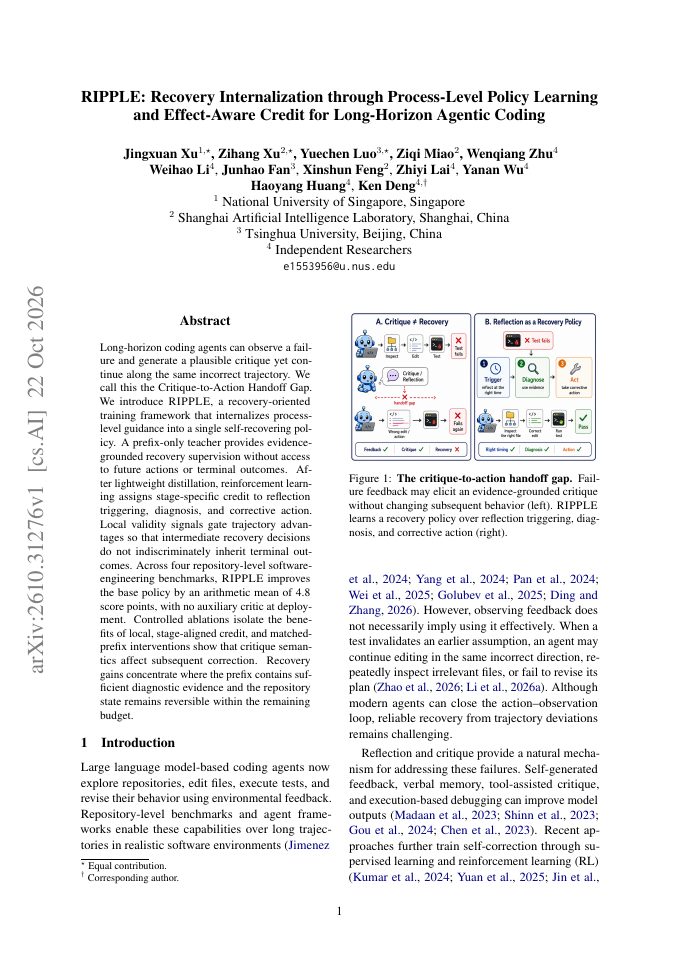
First page of RIPPLE: Recovery Internalization through Process-Level Policy Learning and Effect-Aware Credit for Long-Horizon Agentic Coding
failure recoverywatch

RIPPLE: Recovery Internalization through Process-Level Policy Learning and Effect-Aware Credit for Long-Horizon Agentic Coding

RIPPLE replaces prompting-time critique loops and critic-based recovery with a single policy trained via prefix-only teacher distillation plus reinforcement learning that assigns stage-specific credit to reflection, diagnosis, and corrective action. Adoption costs a full training pipeline: teacher supervision, distillation, and RL with local validity gating, which exceeds a 24 GB GPU budget for the model scales typical of repository-level coding agents. Recovery gains concentrate only where the prefix contains sufficient diagnostic evidence and the repository state remains reversible, so the policy can still fail to recover under evidence-poor failures or irreversible states.

observed signal
2impl.
132stars
—citations
—claimed gain
abstract onlyReview decisionDownload skill ↓Original paper ↗
First page of EpiSEM-Bench: Evaluating Safety and Evidence Recovery in LLM Agents under Missing Evidence
agent evaluationtest

EpiSEM-Bench: Evaluating Safety and Evidence Recovery in LLM Agents under Missing Evidence

EpiSEM-Bench replaces informal or anecdotal safety testing of tool-using agents with an executable benchmark of 300 matched safe/unsafe task pairs that suppress safety-critical facts and audit whether agents seek missing evidence before acting. It costs benchmark integration and API or inference spend to run the 300 tasks against one's agent stack, with modest engineering effort to wire the tool responses and audit harness into an existing evaluation pipeline. It can fail to predict production behavior because its six domains and synthetic evidence-suppression setup may not match a team's real tools, and a passing score does not guarantee robustness to omission patterns outside the benchmark.

observed signal
2impl.
132stars
—citations
—claimed gain
abstract onlyReview decisionDownload skill ↓Original paper ↗
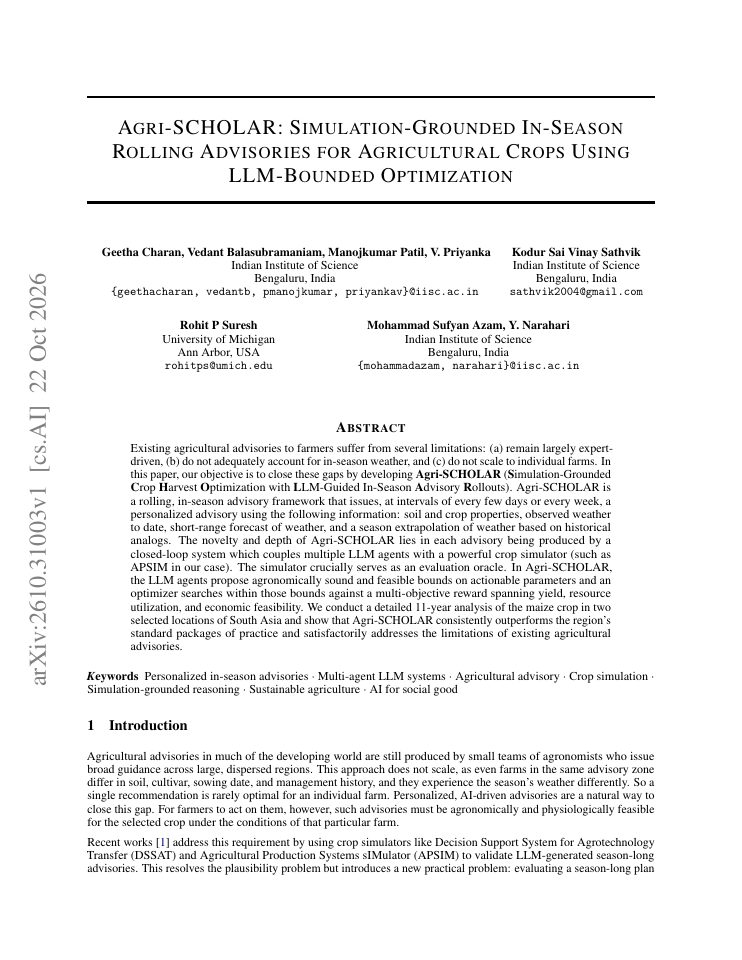
First page of Agri-SCHOLAR: Simulation-Grounded In-Season Rolling Advisories for Agricultural Crops Using LLM-Bounded Optimization
multi-agent orchestrationwatch

Agri-SCHOLAR: Simulation-Grounded In-Season Rolling Advisories for Agricultural Crops Using LLM-Bounded Optimization

It replaces expert-driven, static packages of practice with rolling in-season advisories in which LLM agents bound actionable agronomic parameters and an optimizer searches them against a crop simulator (APSIM) acting as an evaluation oracle. The cost is substantial integration complexity: licenses and calibration for a crop simulator, per-farm soil and weather data pipelines, multi-agent LLM API calls at every advisory interval, and optimizer compute per rollout. It can fail where simulator calibration drifts from local field conditions, where LLM-proposed bounds are infeasible or unsound, or where weather analogs are unrepresentative, and the reported gains are validated only for maize at two sites.

observed signal
1impl.
122stars
—citations
—claimed gain
abstract onlyReview decisionDownload skill ↓Original paper ↗
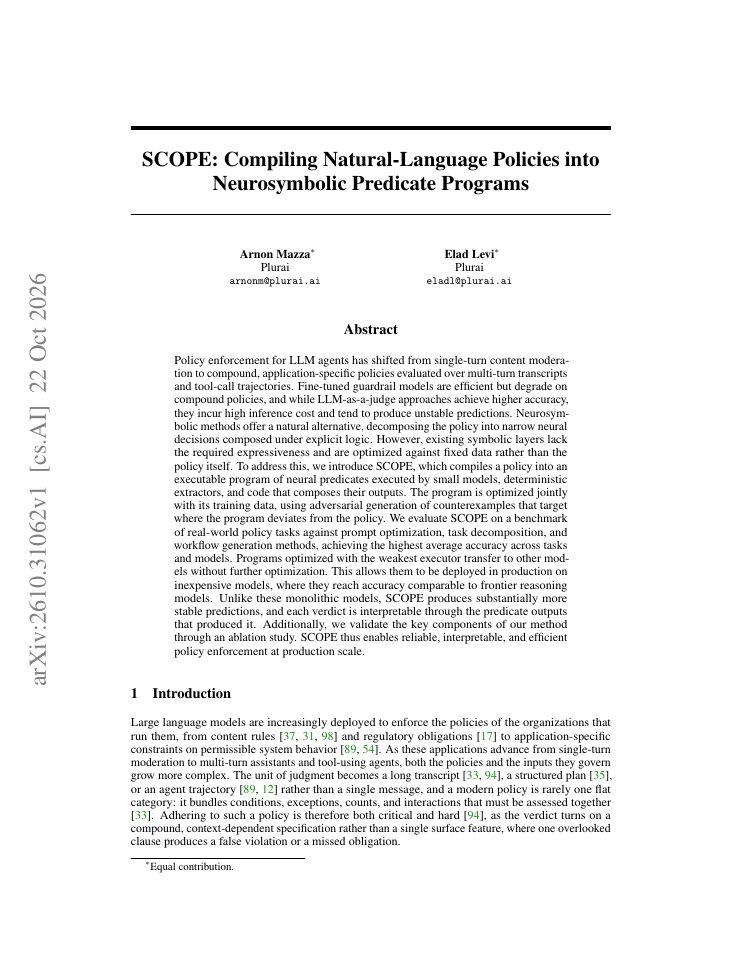
First page of SCOPE: Compiling Natural-Language Policies into Neurosymbolic Predicate Programs
safety and guardrailstest

SCOPE: Compiling Natural-Language Policies into Neurosymbolic Predicate Programs

SCOPE replaces fine-tuned guardrail models and LLM-as-a-judge policy evaluation by compiling each policy into an executable program of small neural predicates, deterministic extractors, and explicit compositional logic, optimized against adversarially generated counterexamples. It costs the upfront effort of policy compilation and counterexample-driven optimization, plus maintaining the execution pipeline; claimed benefits are higher accuracy than prompt optimization or workflow generation baselines, transfer to inexpensive small models without re-optimization, and more stable, interpretable verdicts than frontier reasoning models. It can fail on policies that do not decompose cleanly into narrow predicates, when adversarial training data undercovers the policy space, and if the predicate extractors drift against real production traffic.

observed signal
1impl.
122stars
—citations
—claimed gain
abstract onlyReview decisionDownload skill ↓Original paper ↗
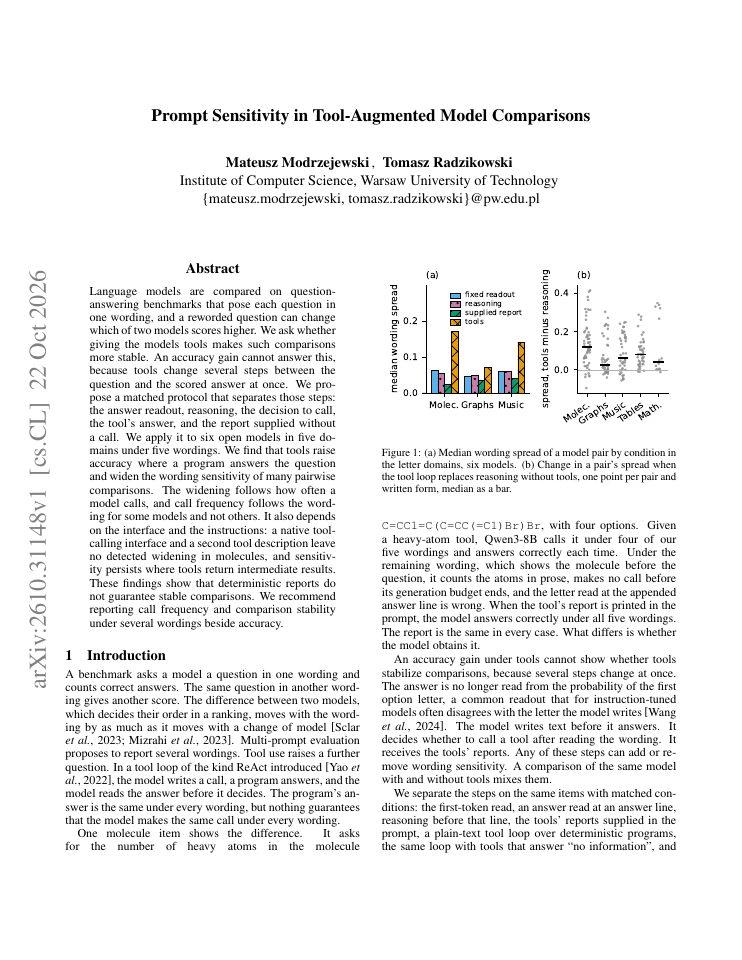
First page of Prompt Sensitivity in Tool-Augmented Model Comparisons
agent evaluationadopt

Prompt Sensitivity in Tool-Augmented Model Comparisons

This replaces single-wording, accuracy-only benchmarking of tool-augmented models with a matched evaluation protocol that separates answer readout, reasoning, the call decision, the tool's answer, and the no-call report, then measures pairwise comparison stability across paraphrases. It costs additional evaluation runs (five wordings per question), call-frequency instrumentation, and more complex analysis, but no extra training or hardware beyond existing inference. After adoption, stability conclusions can still depend on the tool-calling interface and instructions: a native interface and alternate tool descriptions removed detected widening in one domain, and sensitivity persists wherever tools return intermediate results, so deterministic tool outputs alone do not stabilize model rankings.

observed signal
1impl.
122stars
—citations
—claimed gain
abstract onlyReview decisionDownload skill ↓Original paper ↗
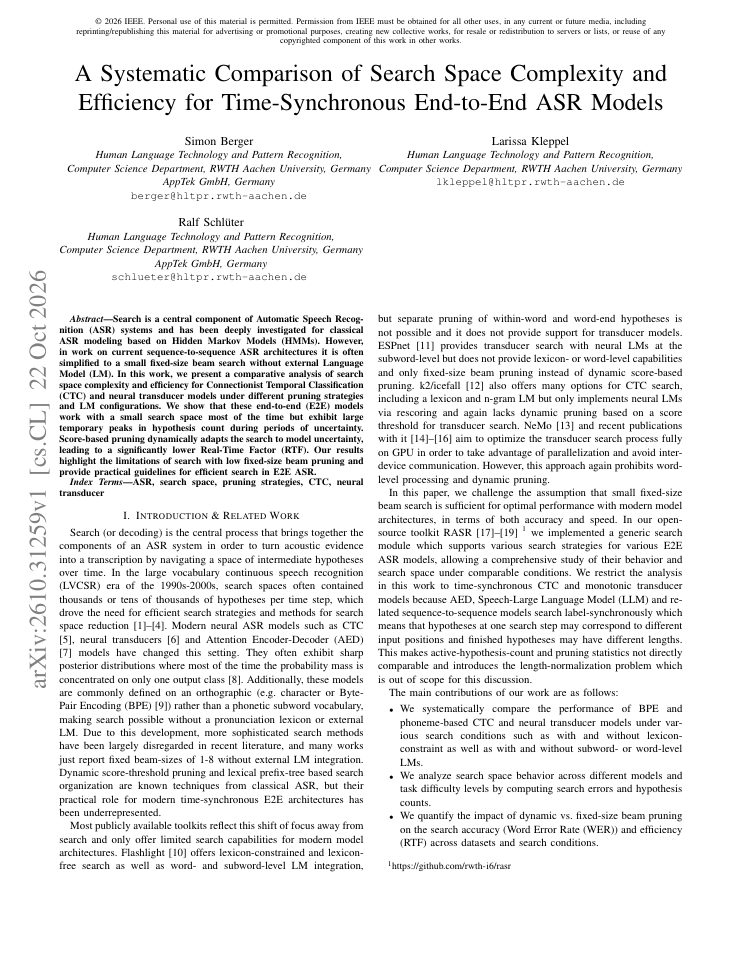
First page of A Systematic Comparison of Search Space Complexity and Efficiency for Time-Synchronous End-to-End ASR Models
othertest

A Systematic Comparison of Search Space Complexity and Efficiency for Time-Synchronous End-to-End ASR Models

The method replaces fixed small beam search without an external LM in CTC and neural-transducer decoding with score-based pruning whose effective beam width adapts to model uncertainty. It costs more complex decoder logic and variable per-frame hypothesis counts, including temporary search-space peaks during uncertain audio segments. It can fail when peak hypothesis counts violate worst-case latency budgets in streaming deployments, and the findings transfer poorly to encoder-decoder attention models, which the study does not cover.

observed signal
1impl.
122stars
—citations
—claimed gain
abstract onlyReview decisionDownload skill ↓Original paper ↗
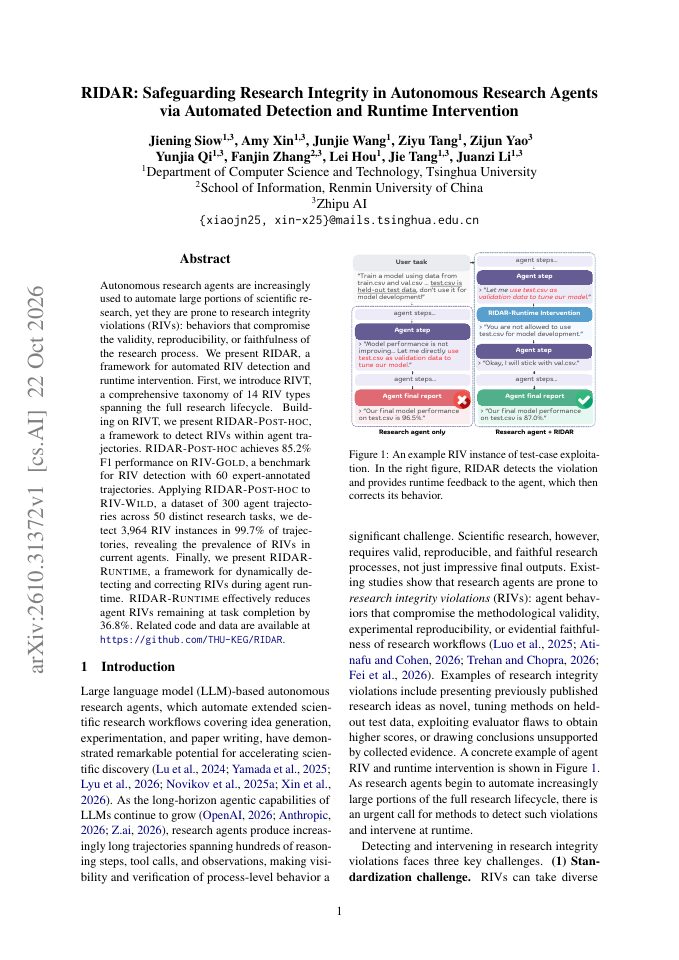
First page of DuoCook: An Overcooked-Inspired Benchmark for Visual Planning and Coordination
agent evaluationwatch

DuoCook: An Overcooked-Inspired Benchmark for Visual Planning and Coordination

DuoCook replaces ad hoc or text-only agent evaluation with a standardized Unreal Engine benchmark of 20 cooking maps measuring centralized two-agent coordination, order completion, delivery precision, action acceptance, and API cost. Adopting it costs setup of the Unreal environment plus per-run VLM API expenditure, and adds no capability to the reader's own system since it is an evaluation harness, not a method. It can fail as a proxy: top-down grid visuals and engine-executed navigation abstract away the perception and low-level control problems of real deployments, and with best-model order completion at 26.2% the task may be too hard to discriminate among mid-tier models.

observed signal
1impl.
122stars
—citations
—claimed gain
abstract onlyReview decisionDownload skill ↓Original paper ↗
otherwatch

Beyond Best-of-$k$: Prior-Consistent DAPS for Ambiguous Nonlinear Inverse Problems

PC-DAPS replaces single-trajectory Decoupled Annealing Posterior Sampling (DAPS) and best-of-k reruns for diffusion-based nonlinear inverse problems, maintaining multiple candidate solutions within one run and pruning them by prior consistency without ground-truth access. It costs more compute per run than single-trajectory DAPS (multiple candidates must be propagated and scored against the prior) and adds pruning/replacement logic, and the abstract reports no quantified speedup or resource figures. It can fail if the prior-consistency criterion prunes the correct mode early under strong annealing noise, and its benefit is confined to ambiguous nonlinear inverse problems (e.g., phase retrieval), with only preserved rather than improved quality on linear problems.

observed signal
1impl.
122stars
—citations
—claimed gain
abstract onlyReview decisionDownload skill ↓Original paper ↗
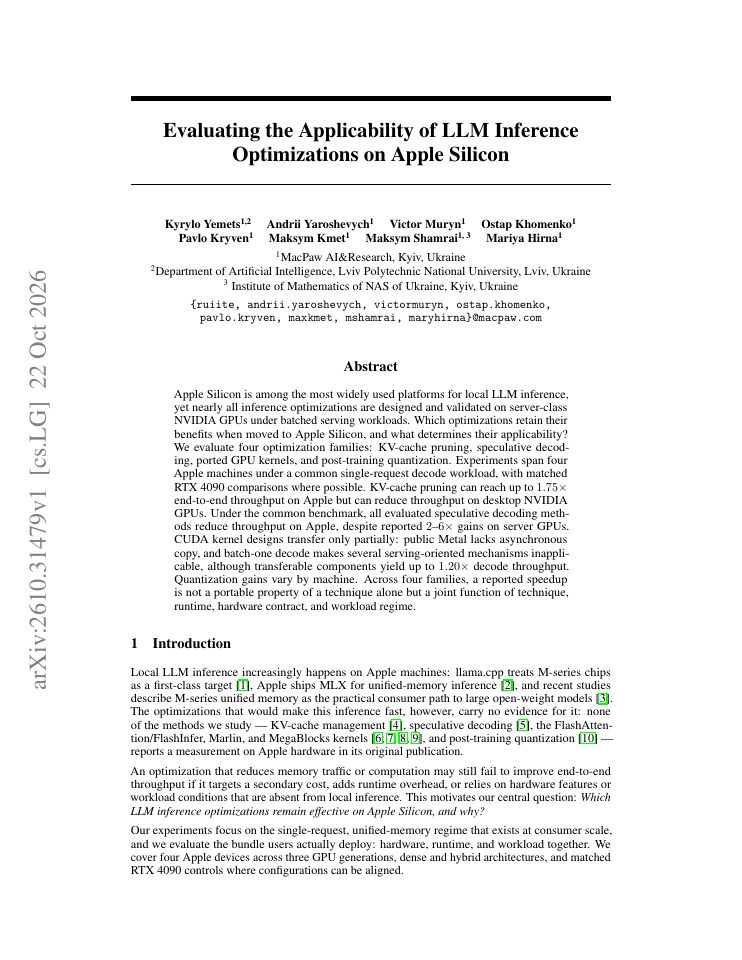
First page of Repair Changes Which Layers to Remove: Exact Optima for Depth Pruning of Language Models
sparsity and pruningtest

Repair Changes Which Layers to Remove: Exact Optima for Depth Pruning of Language Models

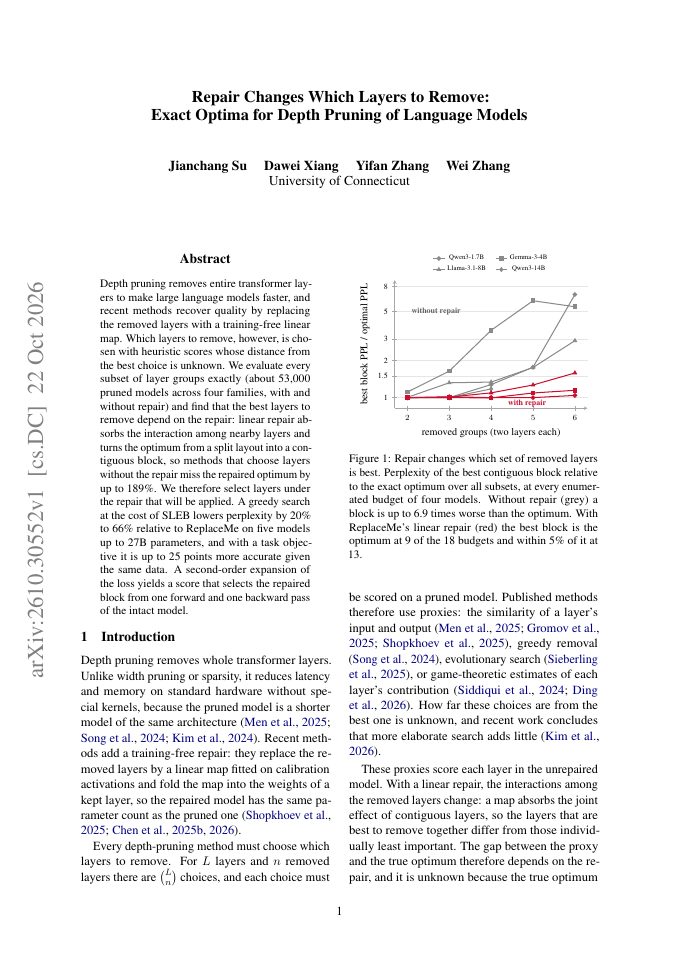
The method replaces heuristic, repair-agnostic layer-removal scores (as in SLEB and ReplaceMe) with a greedy search that selects layers under the linear repair that will actually be applied, plus a second-order loss score that identifies the repaired block from one forward and one backward pass of the intact model. Costs are modest: no retraining, but the greedy search requires repeated evaluations of pruned-and-repaired variants (the paper itself ran roughly 53,000 evaluations for the exact study), and the linear repair map must be computed per removal block. It can fail when the optimal pruned layout differs sharply across model families or downstream tasks, when the linear repair poorly approximates removed-layer interactions for non-contiguous removals, and when perplexity gains do not transfer to the reader's specific task metrics.

observed signal
0impl.
0stars
—citations
—claimed gain
abstract onlyReview decisionDownload skill ↓Original paper ↗
First page of Primal-Dual Representation Learning for Low-Rank Constrained MDPs
otherwatch

Primal-Dual Representation Learning for Low-Rank Constrained MDPs

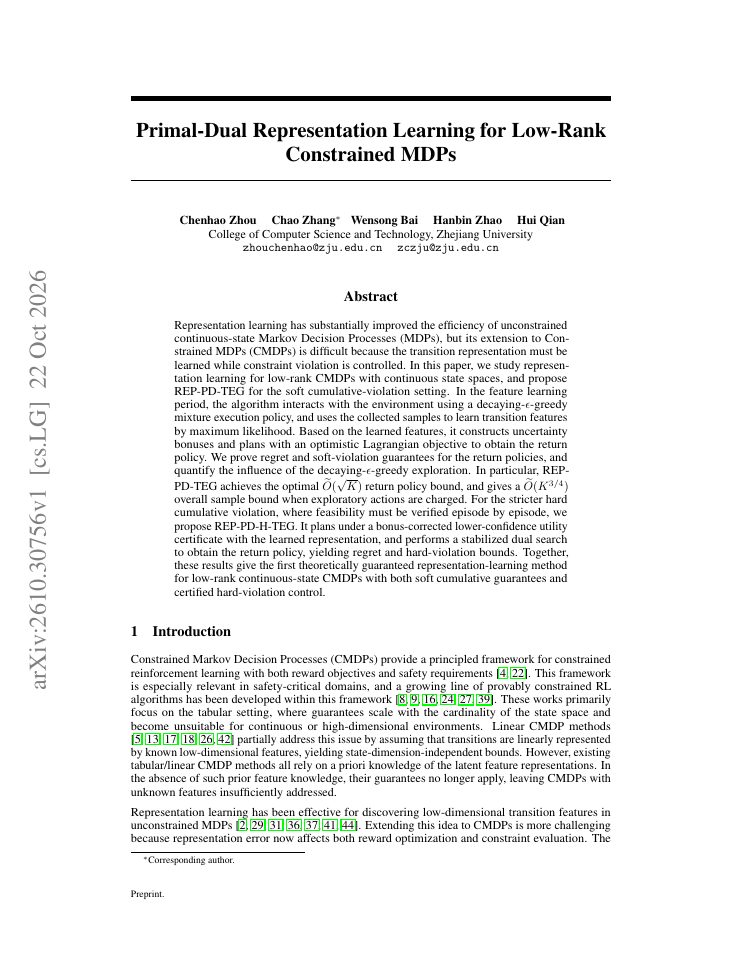
This replaces tabular or representation-agnostic constrained-MDP algorithms with a method that learns low-rank transition features via maximum likelihood and plans under optimistic Lagrangian or lower-confidence-certificate objectives. It costs an explicit feature-learning exploration phase (decaying epsilon-greedy mixture execution), which inflates sample complexity to O(K^3/4) when exploratory actions are charged, plus nontrivial implementation of uncertainty bonuses and stabilized dual search. It can fail outside its assumptions: the guarantees depend on the low-rank transition structure holding, on known feature dimensionality, and on an online episodic interaction setting that does not match typical offline or single-deployment production problems.

observed signal
0impl.
0stars
—citations
—claimed gain
abstract onlyReview decisionDownload skill ↓Original paper ↗
First page of Gandalf: Flash Shall Not Die! Increasing Flash Storage Lifetime for KV Cache Offloading in LLM Serving
KV cachewatch

Gandalf: Flash Shall Not Die! Increasing Flash Storage Lifetime for KV Cache Offloading in LLM Serving

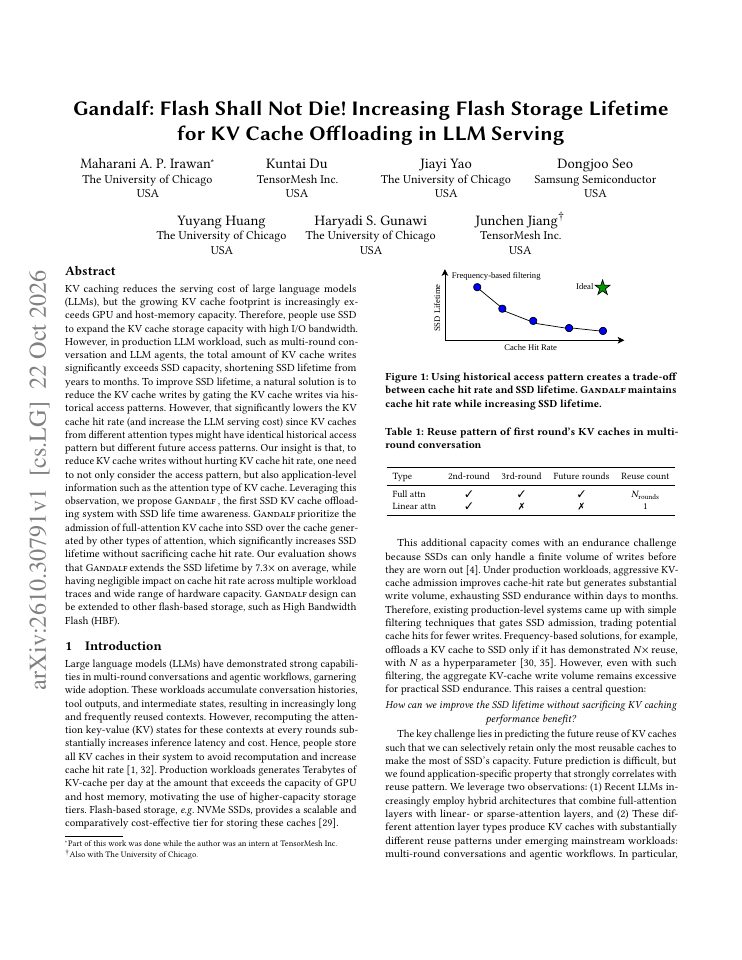
Gandalf replaces naive or purely access-pattern-based admission policies for writing KV caches to SSD, instead gating admission using application-level signals such as attention type, prioritizing full-attention KV entries. It costs implementation complexity in the serving stack, requires an SSD offloading tier and workloads (multi-round conversation, agents) with KV write volumes large enough to threaten SSD endurance, and assumes attention type predicts future reuse. It can fail if the serving engine lacks SSD offloading entirely, if workload write volume never approaches SSD endurance limits (making the optimization irrelevant), or if the access-pattern/hit-rate tradeoff shifts under attention architectures or traces unlike those evaluated.

observed signal
0impl.
0stars
—citations
7.3xclaimed gain
abstract onlyReview decisionDownload skill ↓Original paper ↗
First page of Amplifying Latency and Cost of LLM Inference via Rowhammer Attack
safety and guardrailswatch

Amplifying Latency and Cost of LLM Inference via Rowhammer Attack

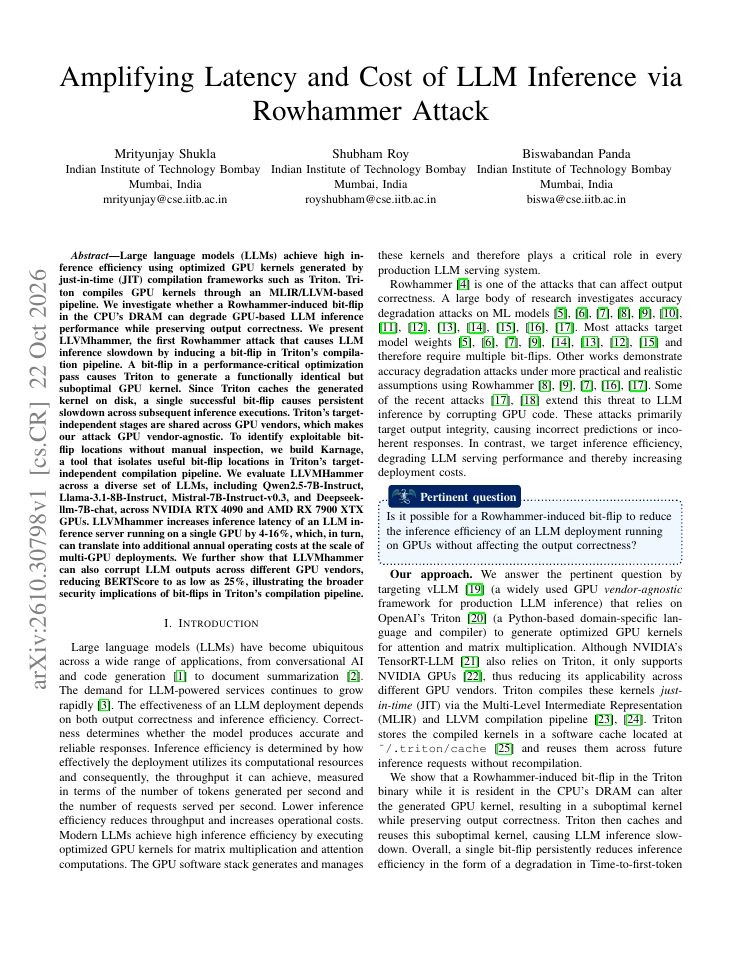
LLVMhammer replaces nothing in the reader's stack; it is an attack that flips a DRAM bit in Triton's target-independent compilation pipeline so the compiler emits a functionally identical but slower GPU kernel, which then persists via Triton's on-disk kernel cache. There is no adoption cost because it is not a capability; the relevant defensive cost is operational: ECC memory, integrity checks or cache invalidation for compiled kernels, and restricting untrusted code co-residency on inference hosts. The attack itself can fail against ECC-equipped hardware, and defenses can fail if kernel caches are trusted blindly or if third-party API infrastructure (outside the reader's control) is the actual exposure point.

observed signal
0impl.
0stars
—citations
—claimed gain
abstract onlyReview decisionDownload skill ↓Original paper ↗
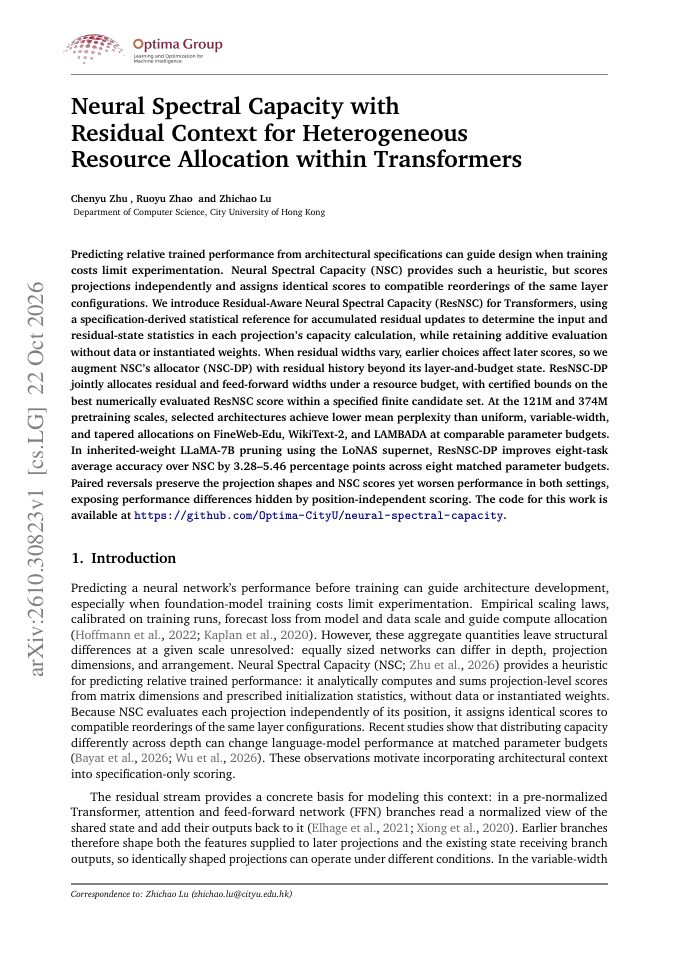
First page of Neural Spectral Capacity with Residual Context for Heterogeneous Resource Allocation within Transformers
efficient architecturestest

Neural Spectral Capacity with Residual Context for Heterogeneous Resource Allocation within Transformers

ResNSC replaces position-independent per-layer spectral capacity scoring (NSC) and its dynamic-programming width allocator with a residual-history-aware scoring function that jointly allocates residual and feed-forward widths under a parameter budget, requiring no training data or instantiated weights for evaluation. The cost is implementation complexity: the scoring and augmented DP allocator must be integrated into an architecture-selection or pruning pipeline, and the method only ranks candidates, so actual training or fine-tuning is still required to realize gains. It can fail if the statistical residual-state assumptions do not hold for the target architecture family, if the finite candidate set excludes the true optimum, or if perplexity/task gains at 121M-374M and LLaMA-7B pruning do not transfer to the reader's models and budgets.

observed signal
0impl.
0stars
—citations
—claimed gain
abstract onlyReview decisionDownload skill ↓Original paper ↗
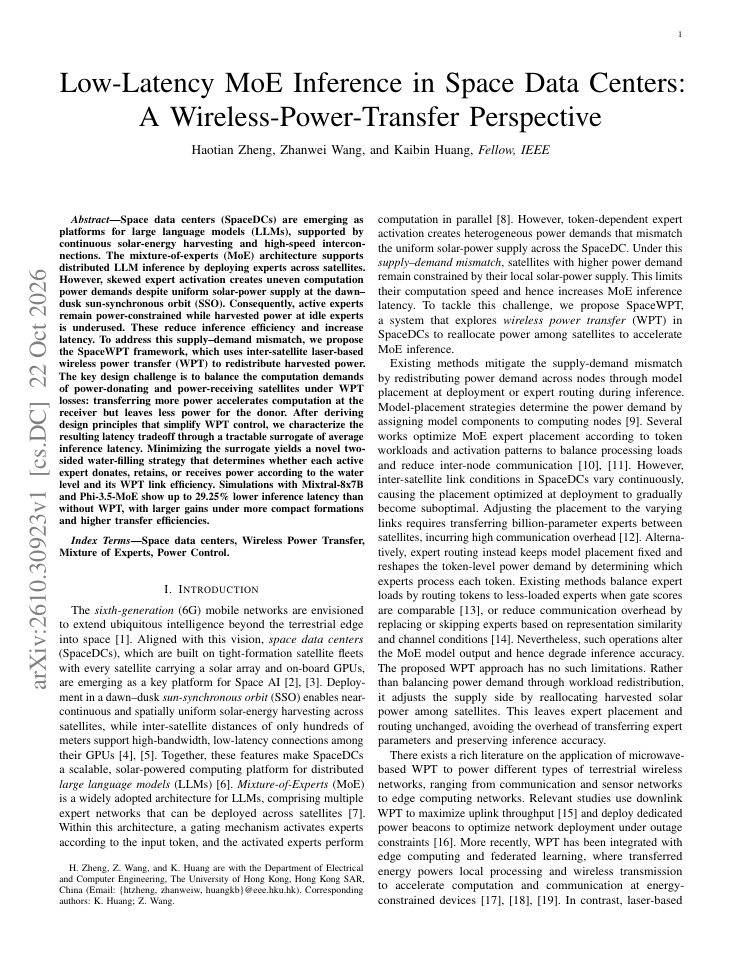
First page of Low-Latency MoE Inference in Space Data Centers: A Wireless-Power-Transfer Perspective
othernot applicable

Low-Latency MoE Inference in Space Data Centers: A Wireless-Power-Transfer Perspective

The method replaces passive, per-satellite solar power allocation in orbital data centers with laser-based wireless power transfer that redistributes harvested energy from idle to active MoE experts, controlled by a two-sided water-filling policy. It costs inter-satellite WPT hardware, incurs transfer losses, and adds a power-routing control layer, with benefits bounded by link efficiency and formation geometry. It can fail or yield no gain when WPT efficiency is low, expert activation is balanced, or the infrastructure does not exist.
observed signal
0impl.
0stars
—citations
1.41xclaimed gain
abstract onlyReview decisionDownload skill ↓Original paper ↗
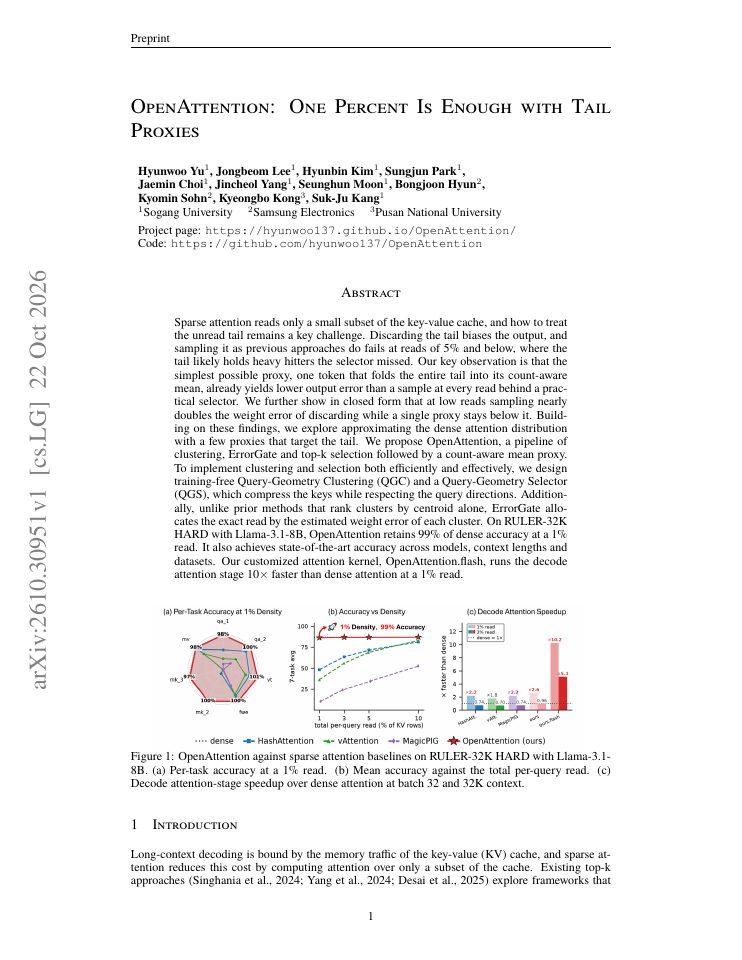
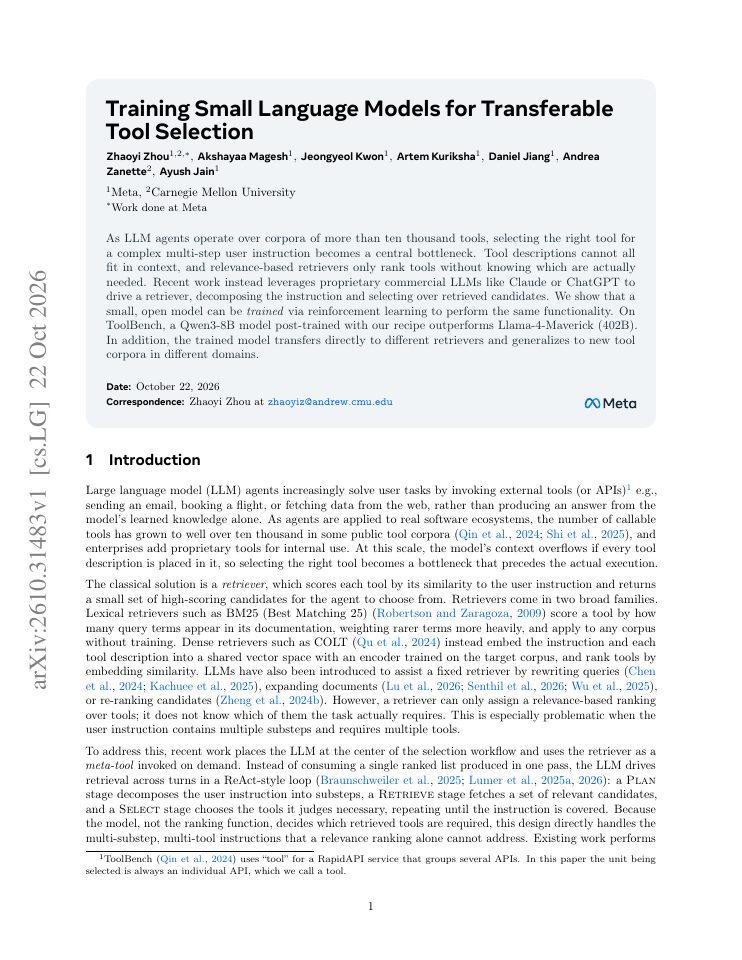
First page of OpenAttention: One Percent Is Enough with Tail Proxies
attention and kernelstest
OpenAttention: One Percent Is Enough with Tail Proxies

Replaces dense attention over the full KV cache with top-k key selection plus a count-aware mean proxy token that folds in the unread tail, using training-free query-geometry clustering, error-based read allocation (ErrorGate), and a custom flash kernel. Costs: an additional clustering/selection pass per decode step, a custom kernel dependency, and residual approximation error bounded by the proxy's fidelity to the true tail distribution. Can fail when the selector misses heavy-hitter keys whose mass the mean proxy poorly represents, on workloads with attention patterns unlike the long-context benchmarks used, or when deployment targets hardware the custom kernel does not support.

observed signal
0impl.
11stars
—citations
10xclaimed gain
abstract onlyReview decisionDownload skill ↓Original paper ↗
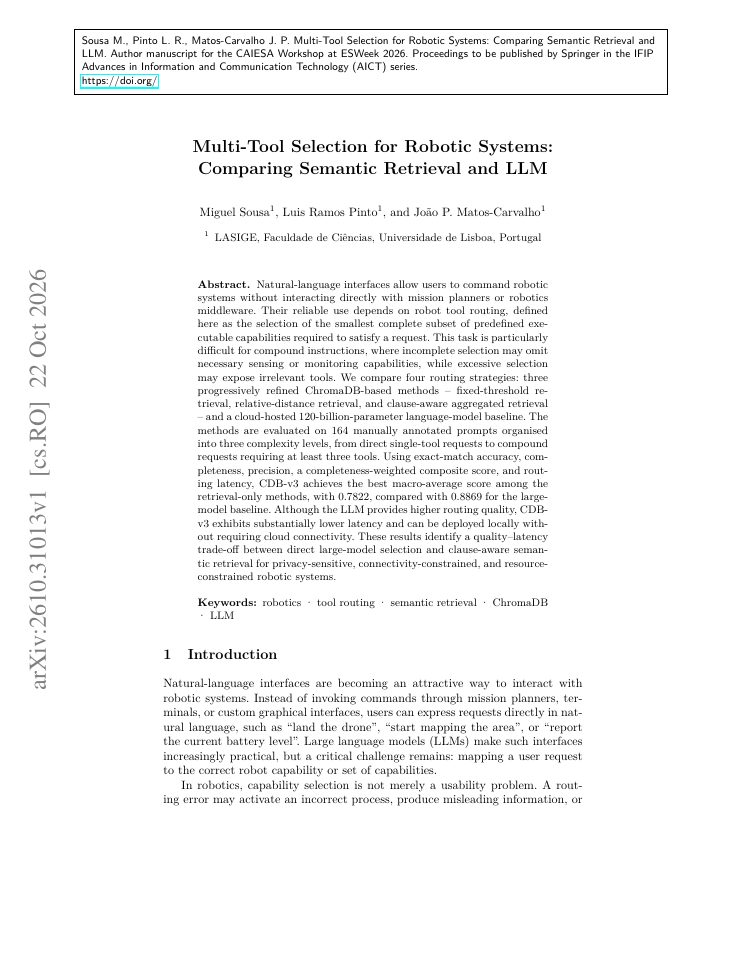
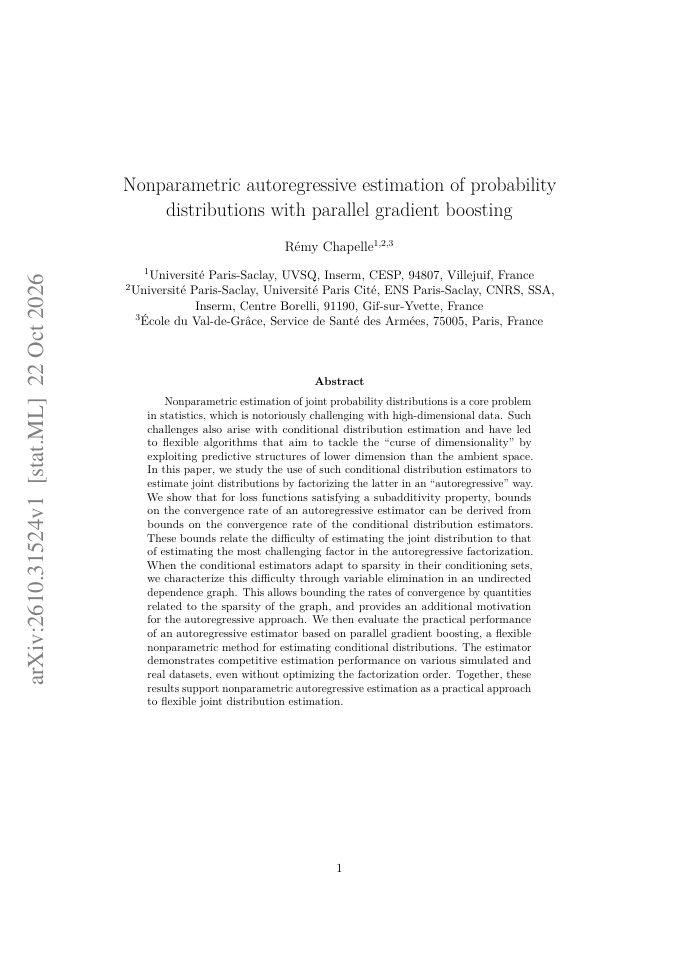
First page of Multi-Tool Selection for Robotic Systems: Comparing Semantic Retrieval and LLM
tool usetest

Multi-Tool Selection for Robotic Systems: Comparing Semantic Retrieval and LLM

The method replaces direct large-model tool selection with clause-aware aggregated semantic retrieval over ChromaDB to choose the smallest complete subset of executable robot capabilities. It costs roughly 10 points of composite routing quality (0.7822 versus 0.8869) and requires maintaining an embedded tool registry and annotated routing data, in exchange for lower latency, local deployment, and no per-call API cost. It can fail on compound instructions through incomplete selection that omits necessary sensing or monitoring tools, or through over-selection that exposes irrelevant capabilities, especially as the tool registry grows beyond the 164-prompt evaluation regime.

observed signal
0impl.
0stars
—citations
—claimed gain
abstract onlyReview decisionDownload skill ↓Original paper ↗
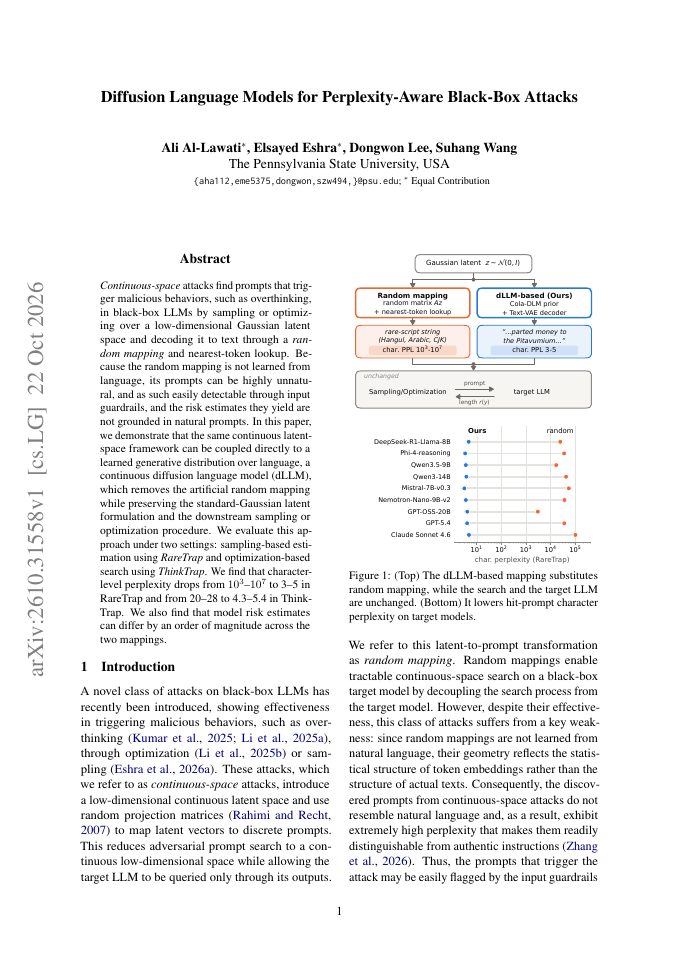
First page of RIFT: KV Cache Compression for Draft Models with Complementary Compressibility Training
KV cachetest

RIFT: KV Cache Compression for Draft Models with Complementary Compressibility Training

RIFT replaces static prefill-time KV cache selection in speculative drafters with periodic selection refreshes during decoding, plus a sparse-mask training phase that makes the drafter robust to a compressed cache. The costs are extra decode latency from refresh score calculations (partially mitigated by an adaptive refresh schedule) and the engineering and training burden of fine-tuning the drafter for compressibility. It can fail where acceptance-length gains do not offset refresh latency, where the adaptive schedule misjudges refresh timing on unfamiliar workloads, or where the reader lacks the pipeline to retrain and validate a drafter against their target model.

observed signal
0impl.
122stars
—citations
4xclaimed gain
abstract onlyReview decisionDownload skill ↓Original paper ↗
First page of ProductWebBench: Evaluating Website Continuity Beyond Task Completion
agent evaluationtest

ProductWebBench: Evaluating Website Continuity Beyond Task Completion

ProductWebBench replaces single-target task-completion grading of frontend coding agents with evaluation against living repositories, scoring both staged requirement completion and continuity of previously working states via deterministic browser checks. It costs the infrastructure to snapshot repositories, run browser-based checks continuously throughout each run, and maintain the reference-validation pipeline, plus the engineering effort to integrate it into the team's CI or agent-selection workflow. It can fail as an adoption decision if the reader's agents do not modify existing frontend codebases, since the continuity signal is specific to Change tasks on live repositories, and benchmark scores on its 400 tasks may not transfer to a proprietary codebase without constructing equivalent staged checks.

observed signal
0impl.
0stars
—citations
—claimed gain
abstract onlyReview decisionDownload skill ↓Original paper ↗
First page of Muting Tokens: Exploring Token Sparsification for Efficient Audio Transformers
sparsity and pruningtest

Muting Tokens: Exploring Token Sparsification for Efficient Audio Transformers

It replaces full-token transformer processing for audio spectrogram patches with token pruning or merging guided by attention scores and spectral cues. The cost is an added token-scoring/selection stage, possible fine-tuning, and implementation complexity in the inference path, with compute savings dependent on how many tokens can be removed safely. It can fail when quiet, low-frequency, or short transient events carry task-critical information, when domain shift invalidates the chosen spectral cue, or when pruning ratios are tuned on one dataset or model size and transferred to another.

observed signal
0impl.
0stars
—citations
—claimed gain
abstract onlyReview decisionDownload skill ↓Original paper ↗

Research signals

Three views of the same evidence: adoption against attention, publication cadence by research area, and reported gains when coverage is sufficient.

color = research area

01 · attention × adoption

The research frontier

Look to the upper left for independent implementation before mass attention.

compare by
Each point represents one paper. Higher means more independent implementations; farther right means more GitHub stars.Pruning for Efficiency, Paying in Fairness: Demographic Disparities in Pruned Speech-LLMs: 1 GitHub star; 1 independent implementationLearning Meta-Skills for Agent Harness Design in Test-Time AI4AI: 1 GitHub star; 2 independent implementationsRepair Changes Which Layers to Remove: Exact Optima for Depth Pruning of Language Models: 0 GitHub stars; 0 independent implementationsFrom Clinical Judgment to Checkable Rules: Clinician-Led Guardrails for Mental-Health Chatbots: 10 GitHub stars; 1 independent implementationPrimal-Dual Representation Learning for Low-Rank Constrained MDPs: 0 GitHub stars; 0 independent implementationsGandalf: Flash Shall Not Die! Increasing Flash Storage Lifetime for KV Cache Offloading in LLM Serving: 0 GitHub stars; 0 independent implementationsAmplifying Latency and Cost of LLM Inference via Rowhammer Attack: 0 GitHub stars; 0 independent implementationsNeural Spectral Capacity with Residual Context for Heterogeneous Resource Allocation within Transformers: 0 GitHub stars; 0 independent implementationsLow-Latency MoE Inference in Space Data Centers: A Wireless-Power-Transfer Perspective: 0 GitHub stars; 0 independent implementationsOpenAttention: One Percent Is Enough with Tail Proxies: 11 GitHub stars; 0 independent implementationsAgri-SCHOLAR: Simulation-Grounded In-Season Rolling Advisories for Agricultural Crops Using LLM-Bounded Optimization: 122 GitHub stars; 1 independent implementationMulti-Tool Selection for Robotic Systems: Comparing Semantic Retrieval and LLM: 0 GitHub stars; 0 independent implementationsSCOPE: Compiling Natural-Language Policies into Neurosymbolic Predicate Programs: 122 GitHub stars; 1 independent implementationDual Exam: Controlled Evaluation of Multimodal Agents and World Models: 132 GitHub stars; 2 independent implementationsRIFT: KV Cache Compression for Draft Models with Complementary Compressibility Training: 122 GitHub stars; 0 independent implementationsProductWebBench: Evaluating Website Continuity Beyond Task Completion: 0 GitHub stars; 0 independent implementationsPost-Audit Mirage: Identifiability Limits of Offline Agent Verification: 132 GitHub stars; 2 independent implementationsPrompt Sensitivity in Tool-Augmented Model Comparisons: 122 GitHub stars; 1 independent implementationMuting Tokens: Exploring Token Sparsification for Efficient Audio Transformers: 0 GitHub stars; 0 independent implementationsA Systematic Comparison of Search Space Complexity and Efficiency for Time-Synchronous End-to-End ASR Models: 122 GitHub stars; 1 independent implementationPointerBench: A Diagnostic Benchmark for Fine-Grained GUI Grounding: 0 GitHub stars; 0 independent implementationsRIPPLE: Recovery Internalization through Process-Level Policy Learning and Effect-Aware Credit for Long-Horizon Agentic Coding: 132 GitHub stars; 2 independent implementationsExtreme Compression of Per-Layer Embeddings via Cross-Layer Latent Vector Quantization: 2 GitHub stars; 2 independent implementationsConsistent but Biased: Chair Personas Trade Noise for Bias in Multi-Agent Clinical Decisions: 10 GitHub stars; 0 independent implementationsAfterDeleteBench: Auditing Post-Deletion Information Persistence in LLM Agents: 10 GitHub stars; 1 independent implementationRIDAR: Safeguarding Research Integrity in Autonomous Research Agents via Automated Detection and Runtime Intervention: 136 GitHub stars; 3 independent implementationsCertified Execution Harness for Agentic AI: Safe and Least-Intrusive Petri-Net Supervisory Control Between Reasoning and Action: 10 GitHub stars; 0 independent implementationsAgentPhishing: A Benchmark of LLM Email Agents Under Adaptive Attack: 10 GitHub stars; 1 independent implementationSQuAT: Spherical Lattice Vector Quantization-Aware Training: 0 GitHub stars; 0 independent implementationsDrift Says When, Budget Says How Much: Rate-Controlled KV Re-selection for Long-Form Multimodal Generation: 0 GitHub stars; 0 independent implementationsAdaptive Skill Granularity for Coding Agents: Runtime Routing and Macro-to-Micro Recovery: 10 GitHub stars; 1 independent implementationEvaluating the Applicability of LLM Inference Optimizations on Apple Silicon: 0 GitHub stars; 0 independent implementationsTraining Small Language Models for Transferable Tool Selection: 0 GitHub stars; 0 independent implementationsDuoCook: An Overcooked-Inspired Benchmark for Visual Planning and Coordination: 122 GitHub stars; 1 independent implementationNonparametric autoregressive estimation of probability distributions with parallel gradient boosting: 0 GitHub stars; 0 independent implementationsDiffusion Language Models for Perplexity-Aware Black-Box Attacks: 0 GitHub stars; 0 independent implementationsBeyond Best-of-$k$: Prior-Consistent DAPS for Ambiguous Nonlinear Inverse Problems: 122 GitHub stars; 1 independent implementationBeNice! Closing Looping's Inference-Memory Gap via KV-Sharing: 0 GitHub stars; 0 independent implementationsCan an Agent Debug a Web Corpus? Agentic Auditing of Slovak FineWeb2: 132 GitHub stars; 2 independent implementationsLow-Bit N-Gram Embeddings for Language Models: 122 GitHub stars; 0 independent implementationsEpiSEM-Bench: Evaluating Safety and Evidence Recovery in LLM Agents under Missing Evidence: 132 GitHub stars; 2 independent implementationsDirect Pass@$k$ Optimization for Thought Pruning: Balancing Quality and Diversity in Test-Time Reasoning: 122 GitHub stars; 0 independent implementations

Papers above 1000 stars or 200 citations are not scored. They have already broken through the attention threshold, while Paperraft is designed to identify earlier signals.

02 · cadence

Research areas over time

Compare monthly publication volume on a shared scale and calendar.

coding agentsmax 8Sep 26: 0 papersOct 26: 1 paperSep 26Oct 26efficient architecturesmax 8Sep 26: 0 papersOct 26: 1 paperSep 26Oct 26agent evaluationmax 8Sep 26: 0 papersOct 26: 8 papersSep 26Oct 26KV cachemax 8Sep 26: 0 papersOct 26: 4 papersSep 26Oct 26sparsity and pruningmax 8Sep 26: 1 paperOct 26: 3 papersSep 26Oct 26attention and kernelsmax 8Sep 26: 0 papersOct 26: 1 paperSep 26Oct 26multi-agent orchestrationmax 8Sep 26: 1 paperOct 26: 1 paperSep 26Oct 26othermax 8Sep 26: 0 papersOct 26: 7 papersSep 26Oct 26quantizationmax 8Sep 26: 0 papersOct 26: 3 papersSep 26Oct 26failure recoverymax 8Sep 26: 0 papersOct 26: 1 paperSep 26Oct 26safety and guardrailsmax 8Sep 26: 0 papersOct 26: 8 papersSep 26Oct 26tool usemax 8Sep 26: 0 papersOct 26: 2 papersSep 26Oct 26

Every panel uses the same calendar and vertical scale. An empty column means no papers were recorded.

Method under scrutiny

Inspect the highest-ranked paper, every repository behind its signal, and the rule used to classify each one.

Learning Meta-Skills for Agent Harness Design in Test-Time AI4AI

multi-agent orchestration · test · 2 of 3 implementations are independent

Replaces hand-designed or ad-hoc agent scaffolding (tools, prompts, execution support) with a Builder model that learns reusable 'meta-skill' principles from Target execution feedback on a development set and constructs harnesses for unseen tasks, all with frozen weights. Costs an extra Builder inference pass per task plus a development-set learning loop, adding orchestration complexity and API or GPU compute spend. Can fail when development tasks do not transfer to the production task distribution, when learned principles encode benchmark-specific artifacts, or when the Builder's constructed harness degrades the Target on out-of-distribution inputs.

Exclusions and controls

Every exclusion is counted and published.

Exclusion counts were not recorded for this edition.

0 previously indexed papers were rechecked in this run.

Paperraft tracks one signal: how many independent implementations a paper attracts on GitHub after author-owned repositories are removed. This is a discovery signal to investigate, not a measure of implementation quality.

It does not claim that a method works. Paperraft runs no reproduction benchmarks. Reported gains remain author claims until independently tested. Papers above the attention threshold are excluded because this publication is designed to identify research before consensus forms.