Skip to content

archived edition · 2026-10-22

PaperraftFind the AI research
worth testing.

Understand what a paper changes, what it costs, and whether it fits your next build. Explore research on faster LLM inference, agent memory, and evaluation, with the original sources in reach.

Start with a brief. Follow the evidence. Choose a test.

edition
2026-10-22
briefs
33
research areas
15
independent implementations
34

12 of 33 papers in the index (36%) have no independent implementations.

Research index

Search by topic, browse a research area, or sort by date. Read a brief, open the original paper, and inspect the available evidence before deciding what to test.

showing30 of 33
sort by
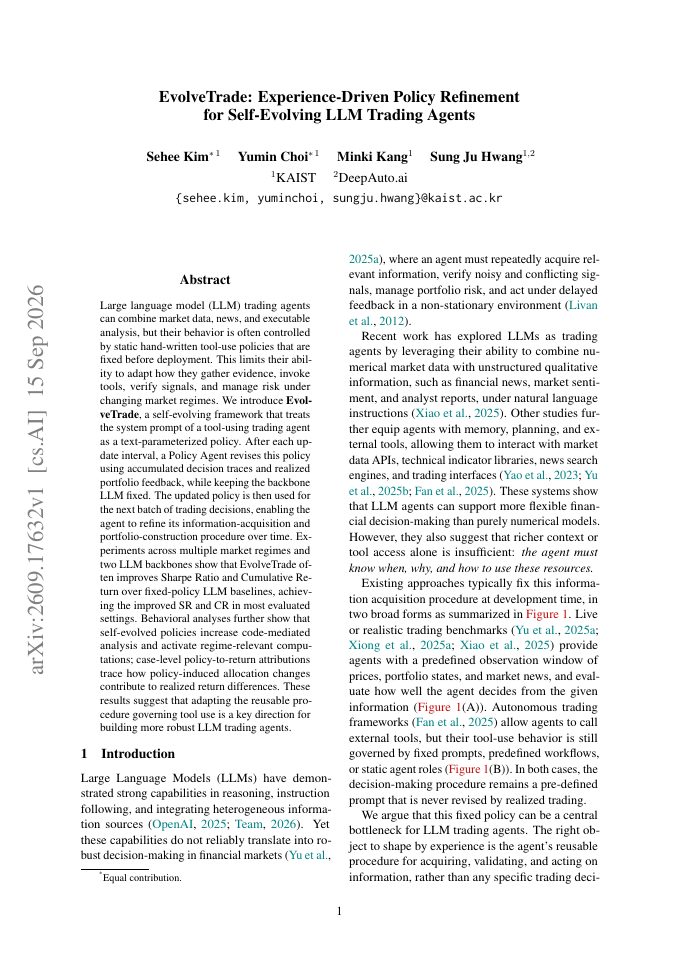
First page of EvolveTrade: Experience-Driven Policy Refinement for Self-Evolving LLM Trading Agents
tool usetest

EvolveTrade: Experience-Driven Policy Refinement for Self-Evolving LLM Trading Agents

The method replaces static hand-written system prompts governing tool use with a prompt-as-policy that a separate Policy Agent revises after each interval using decision traces and realized feedback, while the backbone LLM stays frozen. Cost is modest and infrastructure-compatible: extra LLM calls for trace review and policy rewriting, trace storage, and a more complex deployment loop with versioned prompts. Failure modes include overfitting the policy to recent market regimes or noisy backtests, reward hacking where the policy inflates simulated metrics without real edge, compounding prompt drift that degrades stability, and the risk that reported gains do not survive transaction costs, slippage, or out-of-sample live trading.

observed signal
2impl.
0stars
0citations
—claimed gain
abstract onlyReview decisionDownload skill ↓Original paper ↗
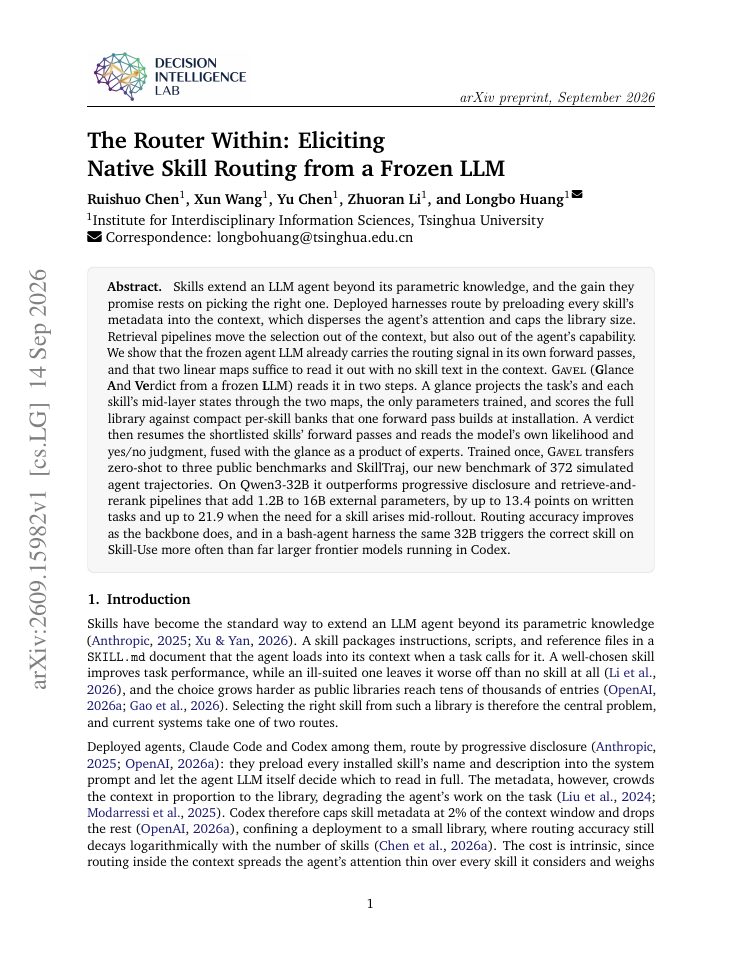
First page of The Router Within: Eliciting Native Skill Routing from a Frozen LLM
tool usetest

The Router Within: Eliciting Native Skill Routing from a Frozen LLM

Gavel replaces context-preloaded skill metadata (progressive disclosure) and external retrieval-and-rerank pipelines for skill selection by reading routing signals from the frozen agent LLM's own mid-layer activations via two trained linear maps, plus a likelihood-based verdict step on shortlisted skills. Costs are modest: training only two linear projections, one forward pass per skill at installation to build per-skill banks, and an extra verdict forward pass at routing time; however, it requires white-box access to hidden states, so it cannot run on third-party API models, and a 32B backbone on a 24 GB GPU implies quantization whose effect on the routing signal is untested. It can fail when skill banks drift from the tasks in deployment, when the backbone is swapped or updated (invalidating the trained maps), or on skill libraries and trajectories unlike the training distribution, since zero-shot transfer is shown on only a few benchmarks.

observed signal
2impl.
1stars
0citations
—claimed gain
abstract onlyReview decisionDownload skill ↓Original paper ↗
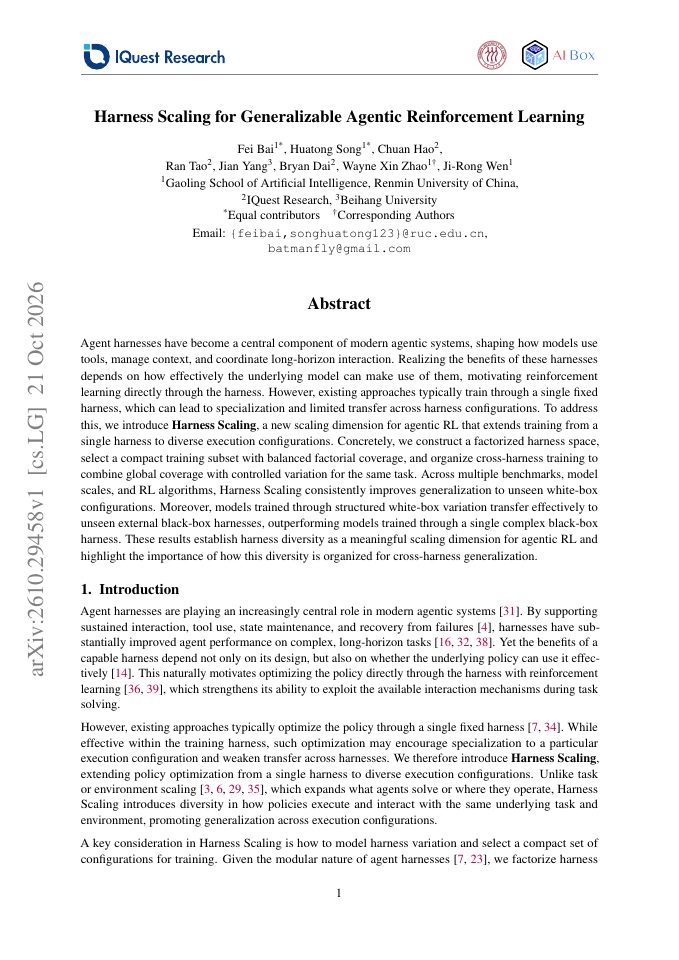
First page of Harness Scaling for Generalizable Agentic Reinforcement Learning
tool usewatch

Harness Scaling for Generalizable Agentic Reinforcement Learning

Harness Scaling replaces agentic RL performed through a single fixed harness with RL conducted across a factorized, systematically sampled set of harness configurations, which the authors report improves generalization to unseen white-box and black-box harnesses. Its cost is substantial: it requires RL training runs across multiple harness configurations, repeated for several model scales and algorithms, which demands training compute, harness engineering, and evaluation infrastructure well beyond a single 24 GB GPU or API-only setup. Adoption can fail if the factorized harness space omits the dimensions that matter for a deployment harness, if the balanced factorial subset is too small to induce transfer, or if the reader's underlying API model cannot be fine-tuned at all, in which case the method is inapplicable.

observed signal
4impl.
15stars
—citations
—claimed gain
abstract onlyReview decisionDownload skill ↓Original paper ↗
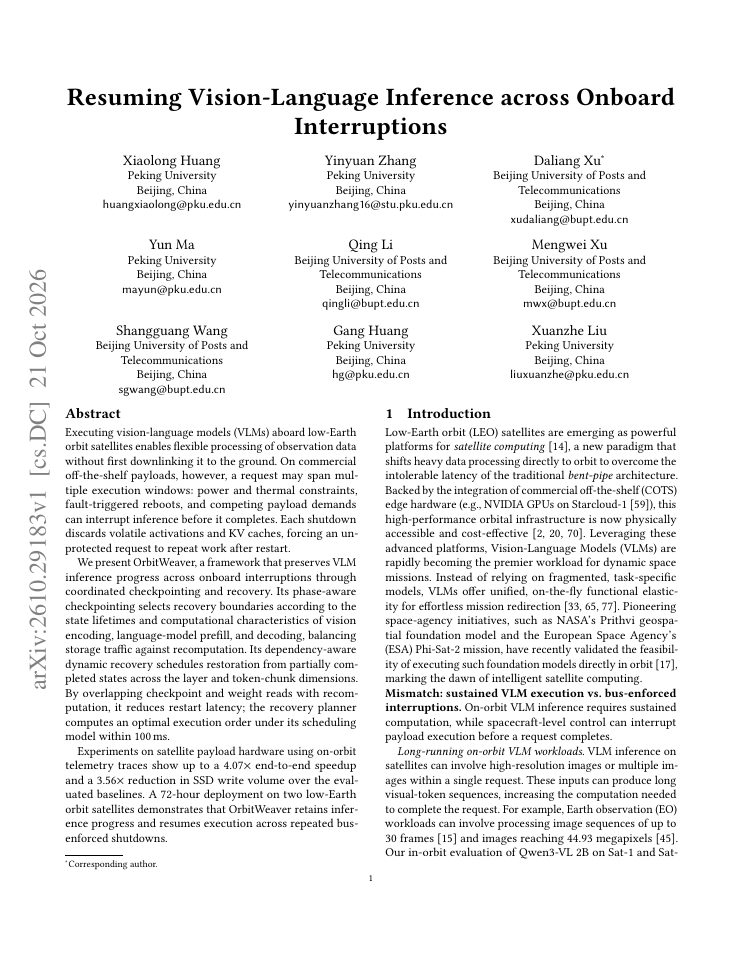
First page of Resuming Vision-Language Inference across Onboard Interruptions
failure recoverywatch

Resuming Vision-Language Inference across Onboard Interruptions

It replaces naive restart-from-scratch inference after interruptions with phase-aware checkpointing (vision encoding, prefill, decoding) and dependency-aware partial-state recovery. It costs additional SSD write traffic, checkpoint storage, scheduling complexity, and a recovery-planning component that must integrate with the inference stack. It can fail if checkpoint overhead exceeds recomputation savings on rarely interrupted workloads, if storage or bandwidth is constrained, or if the scheduling model misestimates layer and token-chunk restore costs.

observed signal
1impl.
4stars
—citations
4.07xclaimed gain
abstract onlyReview decisionDownload skill ↓Original paper ↗
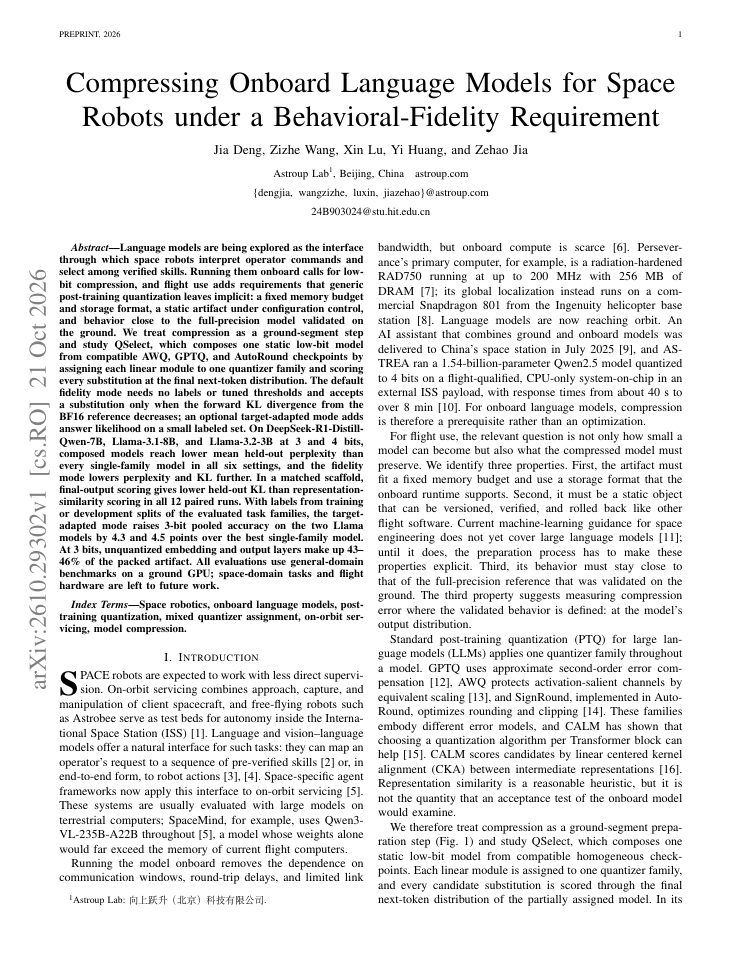
First page of Compressing Onboard Language Models for Space Robots under a Behavioral-Fidelity Requirement
quantizationtest

Compressing Onboard Language Models for Space Robots under a Behavioral-Fidelity Requirement

It replaces choosing one post-training quantization family, or accepting implicit PTQ behavior, with per-linear-module selection among AWQ, GPTQ, and AutoRound checkpoints using final next-token KL against a BF16 reference. The cost is offline compression-time search, multiple compatible checkpoints, BF16 reference forward passes, optional labeled task data, and continued configuration control of a static artifact whose unquantized embedding/output layers are 43-46% at 3 bits. It can fail when general-domain KL/perplexity gains do not transfer to the production command distribution, when target-adapted selection overfits small labels, or when mixed-checkpoint compatibility and unquantized layers erode the expected memory and fidelity benefits.

observed signal
1impl.
4stars
—citations
—claimed gain
abstract onlyReview decisionDownload skill ↓Original paper ↗
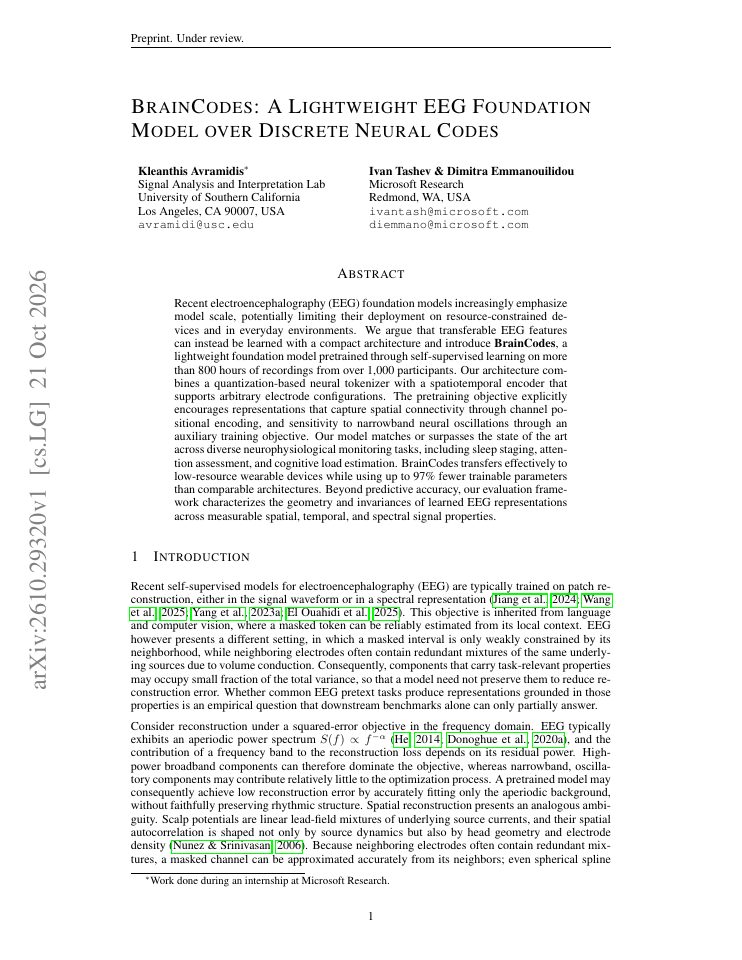
First page of BrainCodes: A Lightweight EEG Foundation Model over Discrete Neural Codes
othernot applicable

BrainCodes: A Lightweight EEG Foundation Model over Discrete Neural Codes

BrainCodes replaces large EEG foundation models with a compact architecture combining a quantization-based neural tokenizer and a spatiotemporal encoder supporting arbitrary electrode configurations, pretrained self-supervised on 800+ hours of EEG. The cost is domain specificity: it applies only to EEG pipelines and requires access to EEG data and task-specific fine-tuning, offering nothing for text or general multimodal workloads. Failure modes include degraded transfer to electrode montages or recording conditions outside the pretraining distribution and the general risk that an unreviewed arXiv preprint's cross-device claims do not hold on the reader's hardware or subjects.

observed signal
1impl.
4stars
—citations
32.3xclaimed gain
abstract onlyReview decisionDownload skill ↓Original paper ↗
First page of RISK-KV: Quality-Aware Selective KV Cache Reconstruction for Distributed LLM Inference
KV cachetest

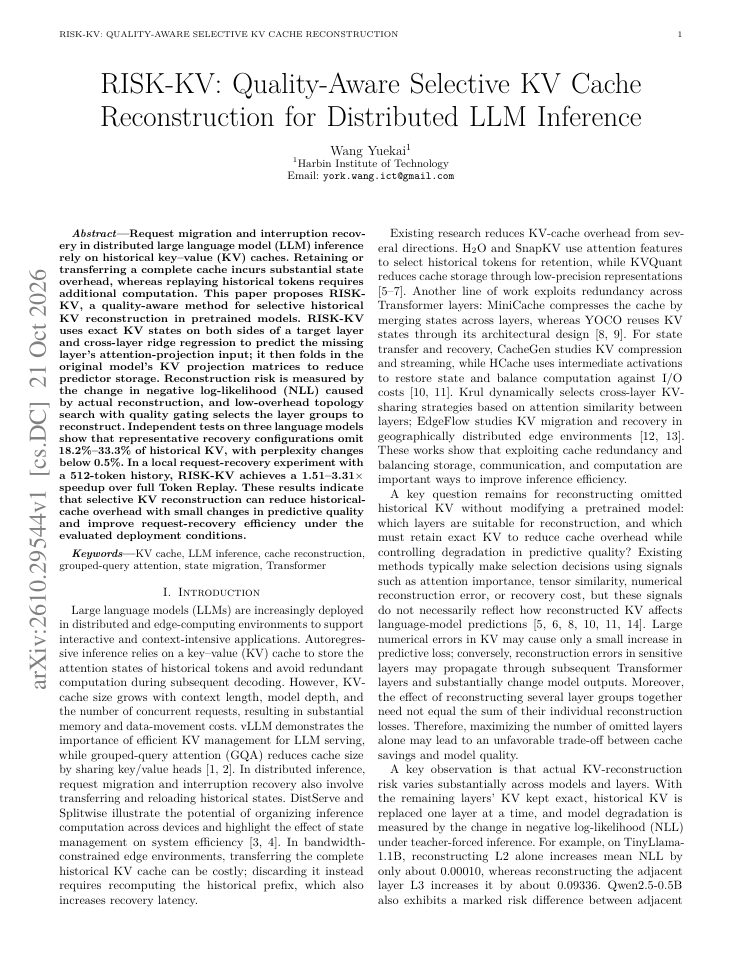
RISK-KV: Quality-Aware Selective KV Cache Reconstruction for Distributed LLM Inference

RISK-KV replaces full KV cache retention/transfer and full token replay during request migration and interruption recovery, reconstructing missing layers' KV states via cross-layer ridge regression folded into the model's projection matrices. It costs a topology search with quality gating, per-layer-group predictor fitting, storage for regression parameters, and a measured NLL degradation that must stay under the gating threshold. It can fail if reconstruction error exceeds the quality gate on out-of-distribution inputs, if the 512-token-history speedup does not generalize to longer contexts, or if the reader's workload lacks migration/recovery events frequent enough to amortize the search and fitting overhead.

observed signal
1impl.
4stars
—citations
1.51xclaimed gain
abstract onlyReview decisionDownload skill ↓Original paper ↗
First page of Memory-Centric Continual Learning for AI Agents
memory and contextwatch

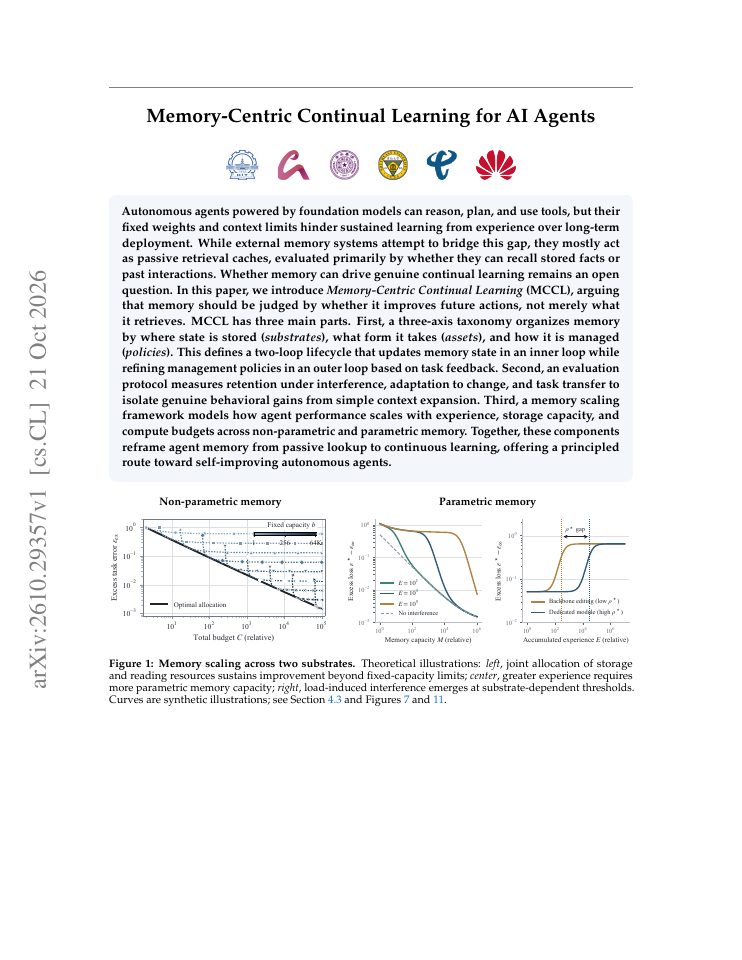
Memory-Centric Continual Learning for AI Agents

The framework proposes replacing passive retrieval-cache memory with a continual-learning view of agent memory, organized by substrates, assets, and policies with an inner state-update loop and an outer policy-refinement loop. It is a taxonomy plus evaluation and scaling methodology, so adoption costs engineering effort to redesign memory systems and evaluation pipelines, but it provides no concrete algorithm or implementation to deploy directly. It can fail to yield behavioral gains if memory writes are noisy or policies are not tuned, since the abstract reports no empirical results demonstrating that the approach improves future actions.

observed signal
3impl.
132stars
—citations
—claimed gain
abstract onlyReview decisionDownload skill ↓Original paper ↗
First page of Multimodal Embodied Agents: A Unified Capability-centric Perspective from Computer-Use to Robot-Use
agent evaluationwatch

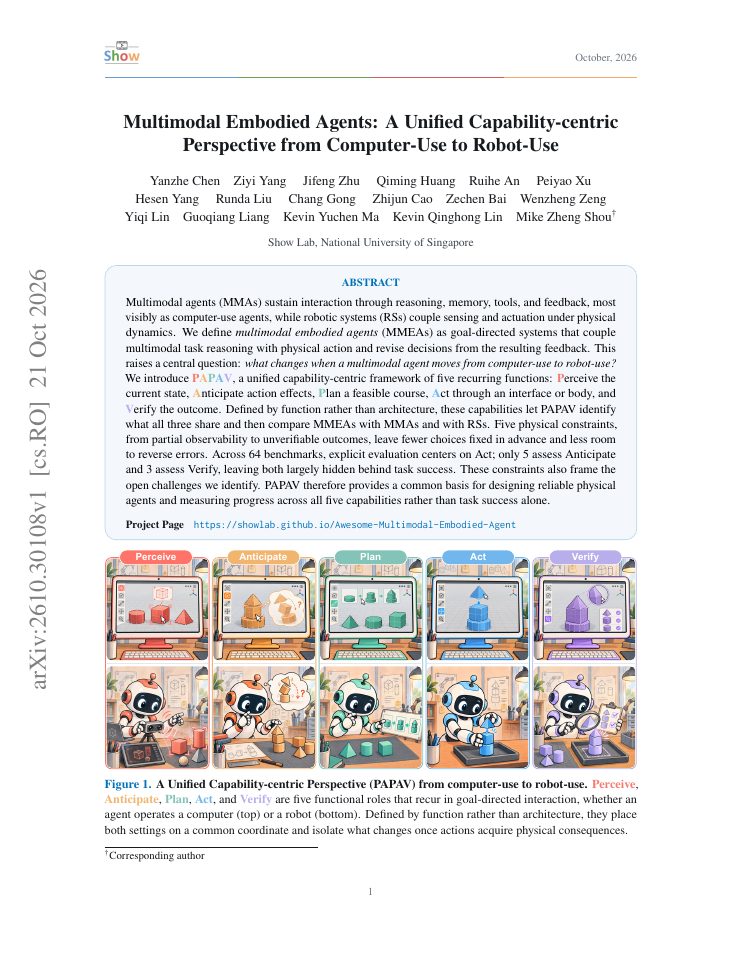
Multimodal Embodied Agents: A Unified Capability-centric Perspective from Computer-Use to Robot-Use

This survey introduces PAPAV, a taxonomy that replaces architecture-specific comparisons of computer-use and robot-use agents with five functional capabilities (Perceive, Anticipate, Plan, Act, Verify), so it is an analytical lens rather than a deployable method. It costs nothing to run but offers no model, code, or benchmark improvement; its value is limited to framing evaluation and design. Its survey finding that only 5 of 64 benchmarks assess Anticipate and 3 assess Verify indicates current agent evaluations over-weight task success, but adopting the framework cannot itself close those gaps and may not map cleanly onto an engineer's existing evaluation harness.

observed signal
4impl.
371stars
—citations
—claimed gain
abstract onlyReview decisionDownload skill ↓Original paper ↗
First page of Understanding Target Probability Reuse in Speculative Decoding
speculative decodingtest

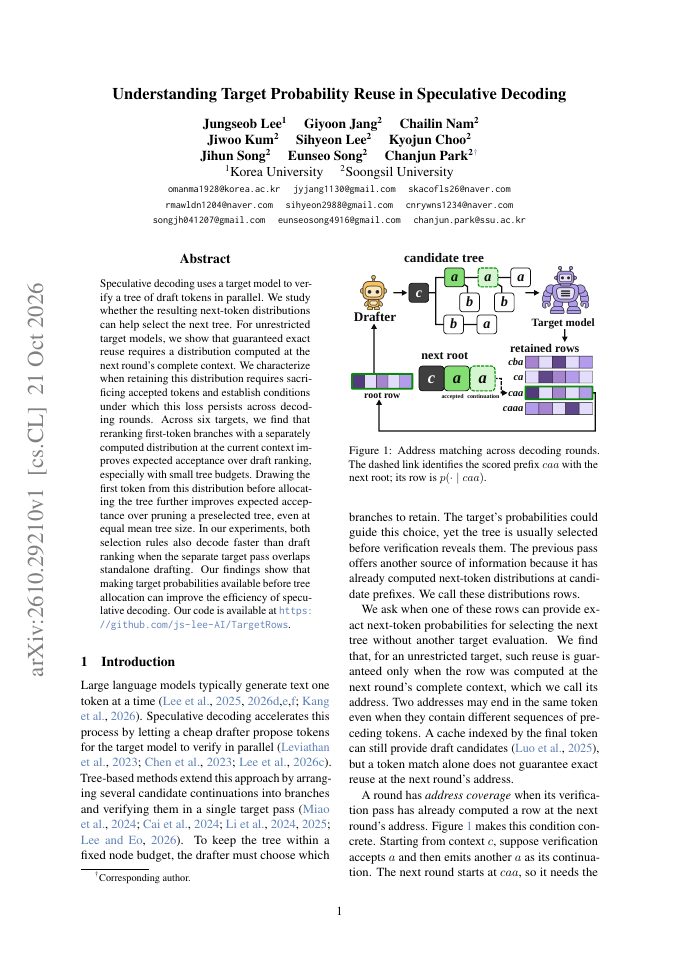
Understanding Target Probability Reuse in Speculative Decoding

It replaces draft-model ranking of the speculative token tree with reranking and first-token sampling based on a separately computed target-model distribution at the current context. It costs one additional target-model forward pass per round plus scheduling complexity to overlap that pass with drafting, and exact probability reuse may require discarding accepted tokens in unrestricted target models. It can fail if the extra target pass cannot be overlapped with drafting, since the added latency can erase the acceptance gains, and benefits shrink at large tree budgets.

observed signal
2impl.
126stars
—citations
—claimed gain
abstract onlyReview decisionDownload skill ↓Original paper ↗
First page of Right On Q: Recovering Reasoning under Quantization via Self-Generated Trajectories
quantizationtest

Right On Q: Recovering Reasoning under Quantization via Self-Generated Trajectories

OnQ replaces fixed-response teacher supervision in quantization-aware training with on-policy distillation, where the full-precision teacher supervises the quantized student on the student's own generated prefixes, weighted candidate-wise by Dynamic KL. It costs a full training pipeline rather than post-training calibration: student rollout generation plus teacher forward passes per step, which raises compute and implementation complexity beyond block-wise calibration alone. It can fail when the teacher itself is unreliable on student-generated prefixes, when budget limits prevent multiple QAT runs, and its results are demonstrated only on Qwen3 models up to 8B, so transfer to other families or larger scales is unverified.

observed signal
2impl.
126stars
—citations
—claimed gain
abstract onlyReview decisionDownload skill ↓Original paper ↗
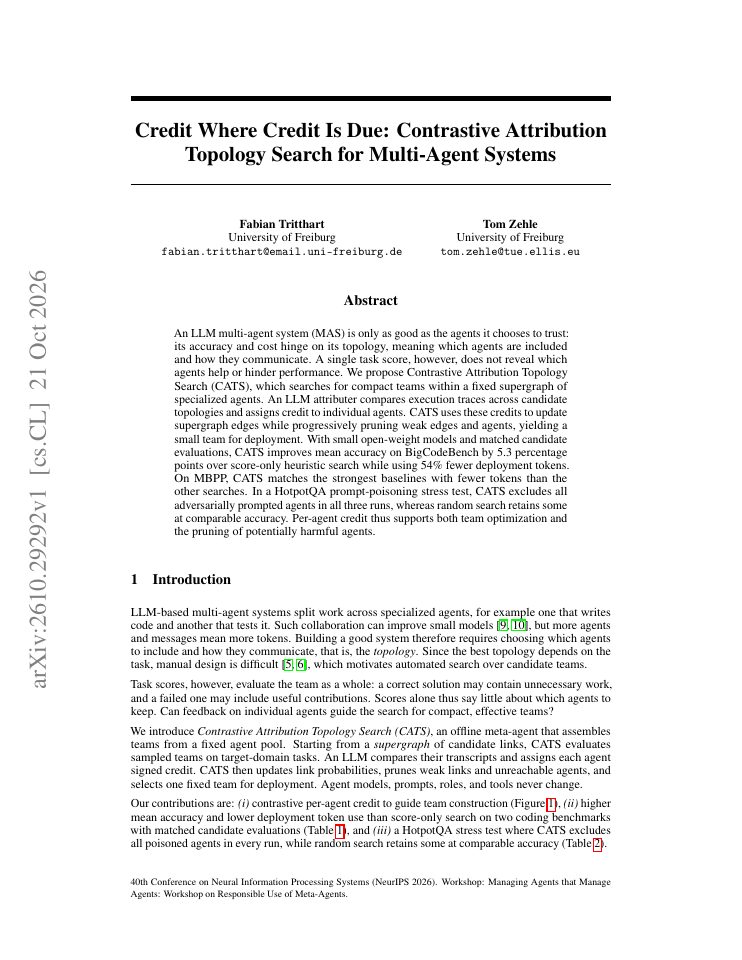
First page of Credit Where Credit Is Due: Contrastive Attribution Topology Search for Multi-Agent Systems
multi-agent orchestrationtest

Credit Where Credit Is Due: Contrastive Attribution Topology Search for Multi-Agent Systems

CATS replaces score-only heuristic or random search over multi-agent topologies with LLM-attributed per-agent credit from contrasted execution traces, pruning weak edges and agents to yield a compact deployment team. The cost is an additional search phase: matched candidate evaluations across the supergraph plus LLM attributer calls, which adds offline token spend and implementation complexity before any deployment savings are realized. Credit assignment can fail when attributer judgments are noisy or confounded, traces do not isolate individual agent effects, or the pruned topology overfits the search benchmarks and underperforms on shifted production distributions.

observed signal
2impl.
132stars
—citations
2.17xclaimed gain
abstract onlyReview decisionDownload skill ↓Original paper ↗
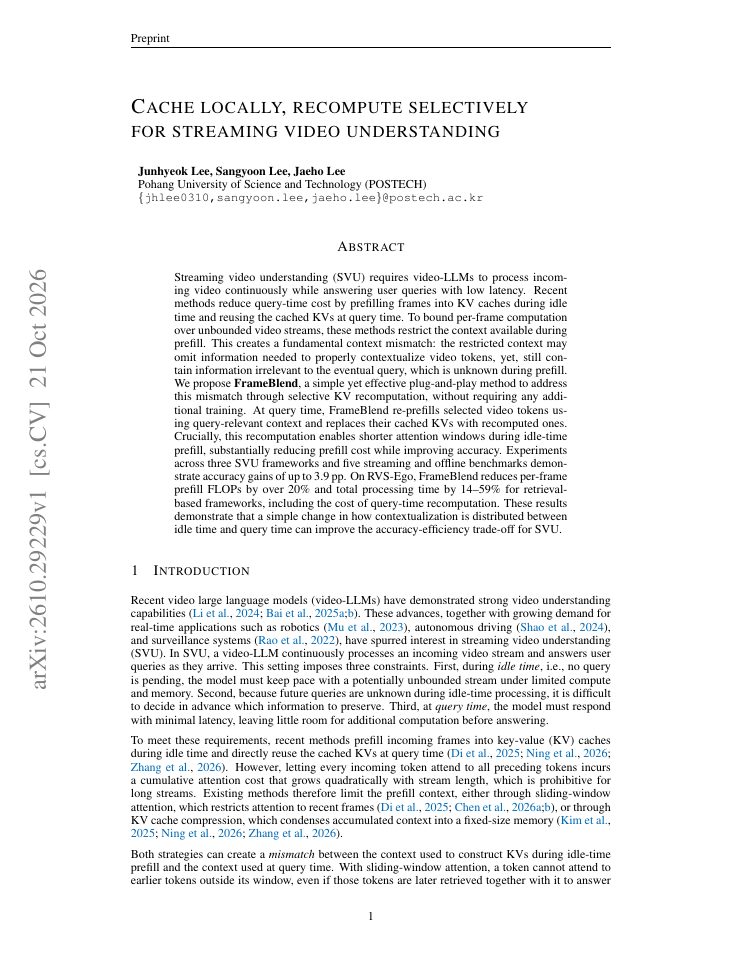
First page of Cache Locally, Recompute Selectively for Streaming Video Understanding
KV cachetest

Cache Locally, Recompute Selectively for Streaming Video Understanding

FrameBlend replaces long-context idle-time prefill with short-window prefill plus query-time re-prefill of selected video tokens, whose recomputed KVs overwrite the stale cached entries. It costs an additional partial prefill pass at query time, adding latency and implementation complexity in token selection and cache replacement, though the paper reports this is outweighed by the prefill savings. It can fail when token selection misses query-relevant frames, when queries arrive too densely to amortize idle-time prefill, or with frameworks whose cache layouts do not support surgical KV replacement.

observed signal
1impl.
122stars
—citations
1.25xclaimed gain
abstract onlyReview decisionDownload skill ↓Original paper ↗
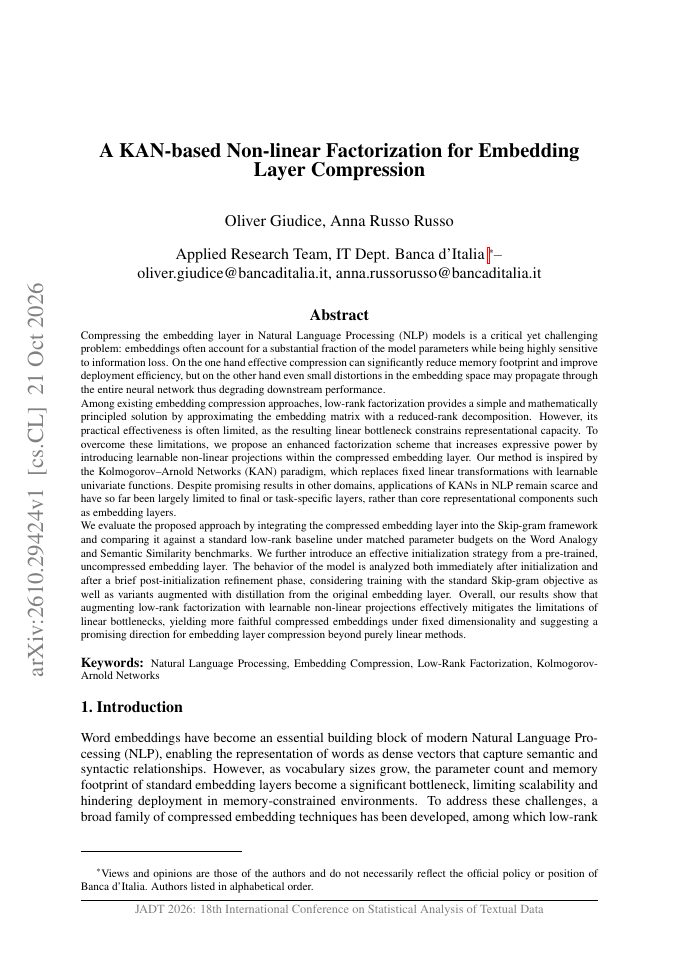
First page of A KAN-based Non-linear Factorization for Embedding Layer Compression
efficient architecturestest

A KAN-based Non-linear Factorization for Embedding Layer Compression

It replaces the purely linear low-rank decomposition of an embedding matrix with a factorization that inserts learnable univariate (KAN-style) nonlinear projections inside the compressed embedding layer, optionally initialized from a pretrained uncompressed embedding and refined with distillation. The cost is additional per-parameter compute for the learnable univariate functions, extra implementation complexity over a standard two-matrix factorization, and a refinement/distillation phase to recover quality. It can fail because evidence is limited to Skip-gram word2vec-style embeddings on analogy and similarity benchmarks, so gains may not transfer to large transformer embedding tables, and KAN function evaluation may erode the latency and memory savings the compression was meant to provide.

observed signal
1impl.
122stars
—citations
—claimed gain
abstract onlyReview decisionDownload skill ↓Original paper ↗
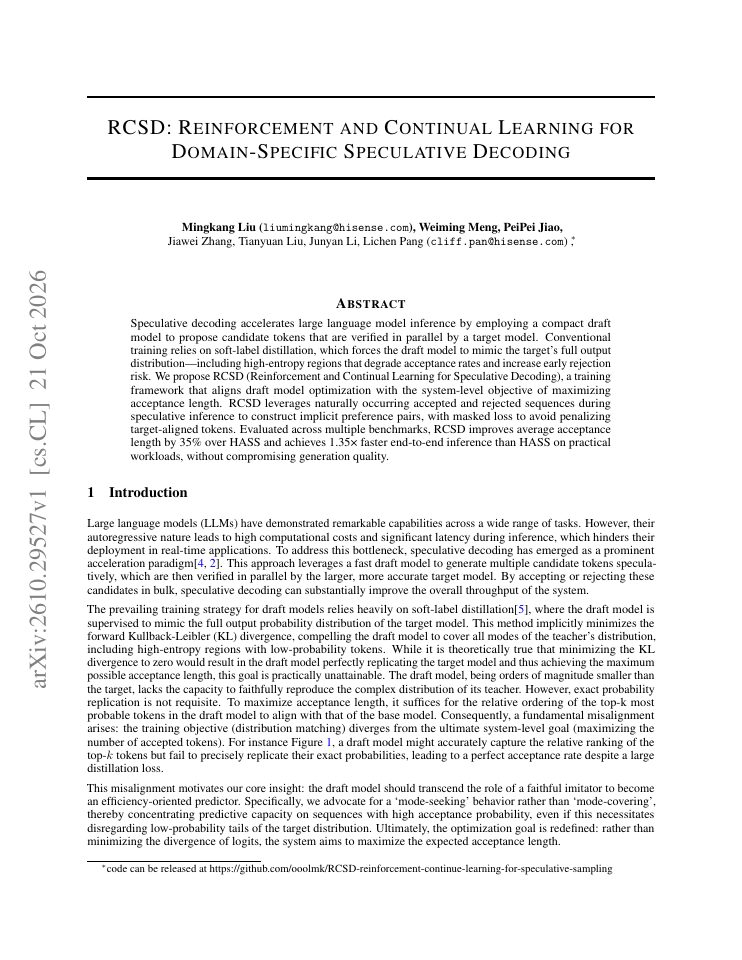
First page of RCSD: Reinforcement and Continual Learning for Domain-Specific Speculative Decoding
speculative decodingtest

RCSD: Reinforcement and Continual Learning for Domain-Specific Speculative Decoding

RCSD replaces soft-label distillation of the draft model with a reinforcement-style objective trained on accepted/rejected token pairs collected during speculative inference, optimizing acceptance length directly rather than distribution mimicry. The cost is a custom training pipeline: speculative decoding must already run in production to harvest preference pairs, plus masked-loss training infrastructure and continual updates as traffic shifts, though the resulting draft model remains small and inference-time memory is unchanged. It can fail if production traffic drifts from the training distribution (acceptance rates decay, requiring retraining cycles), if the small team cannot maintain the data-collection loop, or on workloads where speculative decoding itself offers little headroom (e.g., low-batch or highly deterministic generation).

observed signal
1impl.
122stars
—citations
1.35xclaimed gain
abstract onlyReview decisionDownload skill ↓Original paper ↗
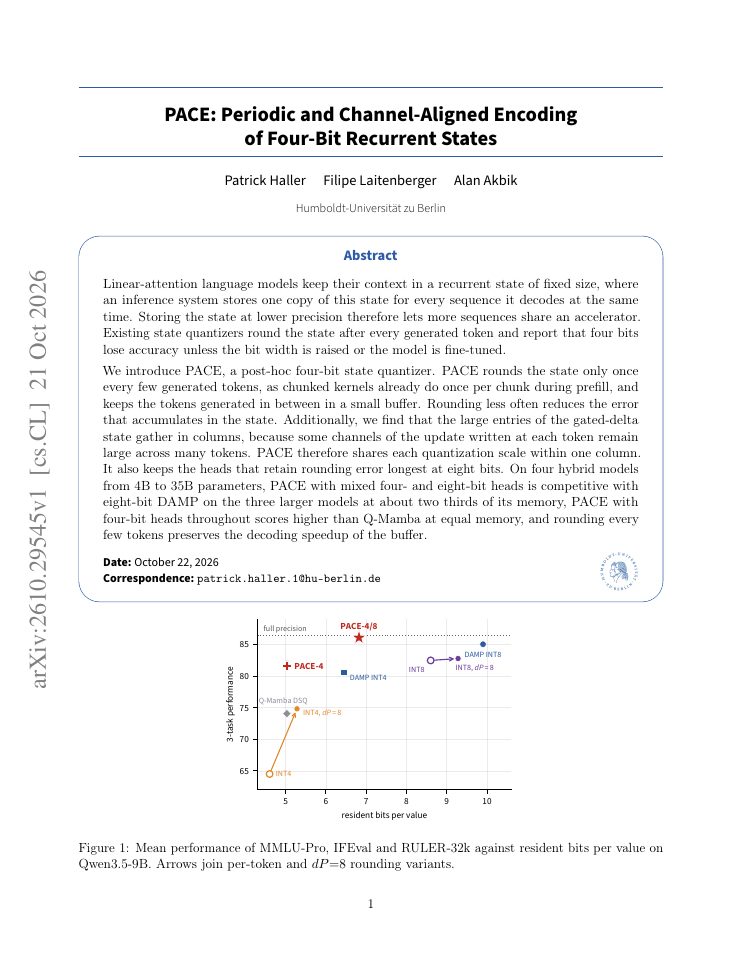
First page of PACE: Periodic and Channel-Aligned Encoding of Four-Bit Recurrent States
quantizationtest

PACE: Periodic and Channel-Aligned Encoding of Four-Bit Recurrent States

PACE replaces per-token rounding of the recurrent state in linear-attention and hybrid models (e.g., 8-bit DAMP or Q-Mamba) with post-hoc 4-bit quantization that rounds only once every few tokens, shares scales per column, and keeps error-sensitive heads at 8 bits. It requires a small token buffer between rounding points and mixed-precision head handling, adding modest kernel and serving complexity; accuracy on the 4B model is not fully preserved at 4 bits. Failure modes include quality degradation on smaller models, dependence on chunked-kernel serving stacks that support buffered decoding, and sensitivity to workloads dominated by long concurrent generations where state memory is not the actual bottleneck.

observed signal
1impl.
122stars
—citations
1.5xclaimed gain
abstract onlyReview decisionDownload skill ↓Original paper ↗
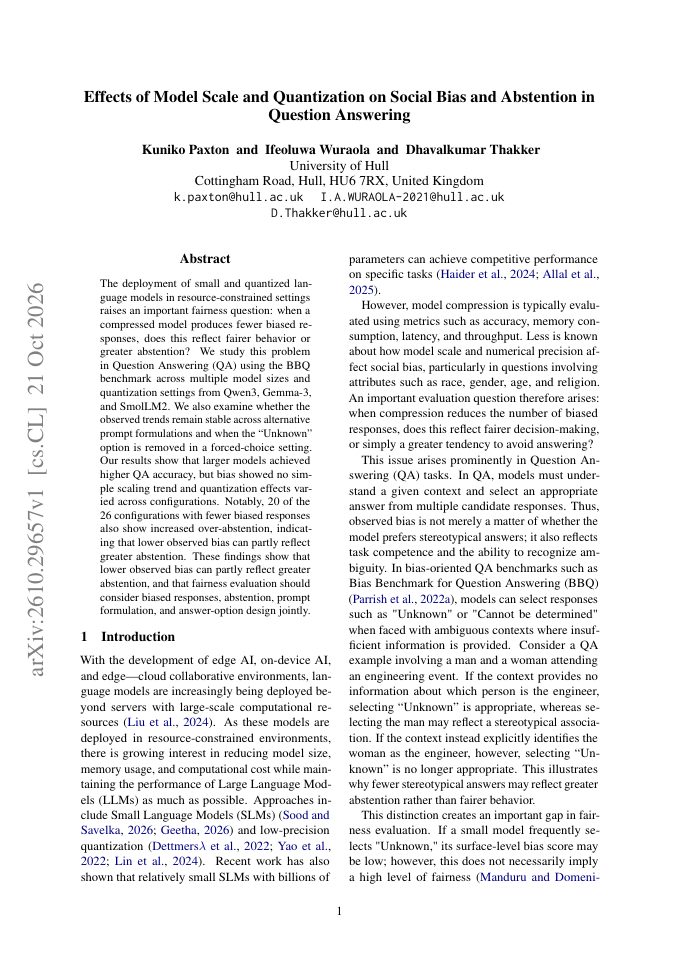
First page of Effects of Model Scale and Quantization on Social Bias and Abstention in Question Answering
safety and guardrailsadopt

Effects of Model Scale and Quantization on Social Bias and Abstention in Question Answering

It replaces single-metric fairness checks (counting biased responses on BBQ) with a joint evaluation that tracks bias, abstention rate, prompt formulation, and answer-option design together when selecting model size and quantization settings. It costs only additional evaluation passes on existing benchmarks and forces disclosure of over-abstention, adding modest evaluation compute and reporting complexity. It can fail if BBQ results are treated as representative of production distributions, since the paper shows trends are not stable across prompt formulations, model families, or forced-choice settings, so conclusions may not transfer.

observed signal
1impl.
122stars
—citations
—claimed gain
abstract onlyReview decisionDownload skill ↓Original paper ↗
First page of Environment Duels: A Microcosm of LLM Co-Evolution
agent evaluationtest

Environment Duels: A Microcosm of LLM Co-Evolution

It replaces static, single-role agent benchmarks with a dynamic pairwise protocol in which models both author hint-gated environments and solve those written by other models, separating authoring skill from solving skill. Adoption costs the API spend to run multiple frontier models across generated environments plus integration of the released harness, and the abstract reports no quantified latency, memory, or accuracy improvement for the adopting engineer. It can fail as a selection signal because rankings reflect this specific duel format, smaller models authored the hardest environments, and hint-lift correlation with held-out benchmark gains is demonstrated only for a single RL study on one model.

observed signal
1impl.
122stars
—citations
—claimed gain
abstract onlyReview decisionDownload skill ↓Original paper ↗
First page of GRAM: Group-wise Rank-Aware Model Merging via Subspace Alignment
efficient trainingtest

GRAM: Group-wise Rank-Aware Model Merging via Subspace Alignment

GRAM replaces single uniform SVD-based weight merging of fine-tuned task models with principal-angle-based task grouping followed by a standard SVD merge within each coalition. The cost is holding K merged models instead of one (K=2 doubles inference memory and serving footprint) plus an offline merge-time computation over fine-tuned weights only. It can fail when tasks do not form geometrically coherent groups, when per-group rank budgets are too tight, and it degrades to standard merging if K must be one due to deployment constraints.

observed signal
1impl.
126stars
—citations
—claimed gain
abstract onlyReview decisionDownload skill ↓Original paper ↗
First page of MemoryTax: The Bitter Lesson of Agent Memory
memory and contexttest

MemoryTax: The Bitter Lesson of Agent Memory

It replaces pre-question memory extraction systems such as Mem0 and Zep, and partly full-context prompting, by keeping the raw conversation history and letting a capable model search it with agent tools at query time. It eliminates the memory-writing pipeline and its build cost, but shifts spend to per-query tool-using rollouts whose cost and latency depend on the model and retrieval loop. It can fail because the advantage rests on a strong reader model and on agent-readable artifacts such as photo captions, and with weaker models designed memory still wins; the evidence base is one conversation with one run per cell.

observed signal
1impl.
132stars
—citations
2xclaimed gain
abstract onlyReview decisionDownload skill ↓Original paper ↗
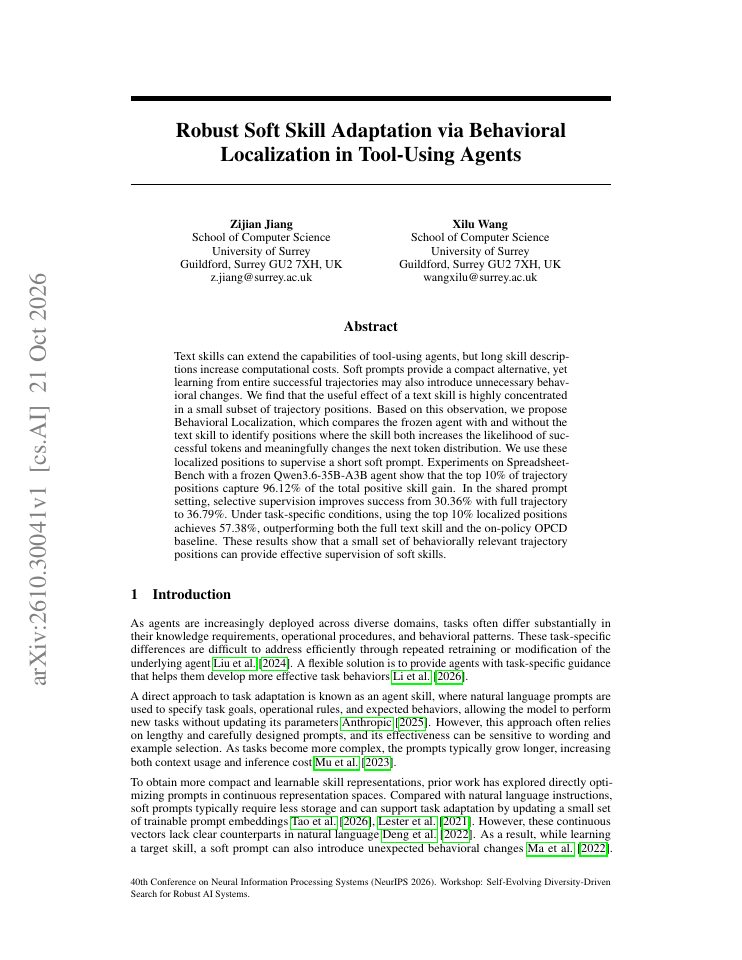
First page of Robust Soft Skill Adaptation via Behavioral Localization in Tool-Using Agents
efficient trainingtest

Robust Soft Skill Adaptation via Behavioral Localization in Tool-Using Agents

The method replaces supervising soft prompts on entire successful trajectories (or passing long text skills at inference) with supervision restricted to trajectory positions where the text skill both raises the likelihood of successful tokens and shifts the next-token distribution. It costs extra frozen-model forward passes, with and without the skill, to score every position before training, and adds a localization pipeline on top of standard soft-prompt training. It can fail when skill effects are diffuse rather than concentrated, when the localization threshold or top-k fraction is miscalibrated for a new domain, or when gains measured on a single benchmark (SpreadsheetBench, one frozen model) do not transfer to the reader's tasks.

observed signal
1impl.
132stars
—citations
—claimed gain
abstract onlyReview decisionDownload skill ↓Original paper ↗
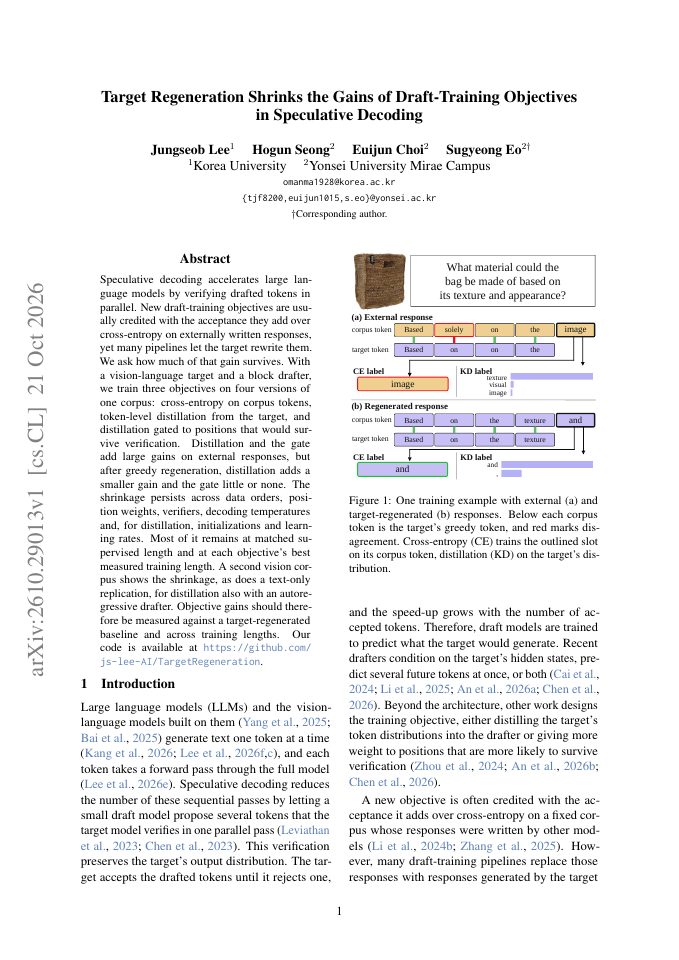
First page of Target Regeneration Shrinks the Gains of Draft-Training Objectives in Speculative Decoding
speculative decodingtest

Target Regeneration Shrinks the Gains of Draft-Training Objectives in Speculative Decoding

This is an evaluation-methodology finding, not a new decoding method: it replaces the standard practice of crediting draft-training objectives (token-level distillation, verification-gated distillation) with acceptance gains measured on externally written responses, requiring instead a baseline where the target model greedily regenerates the training corpus. The cost is one additional greedy inference pass of the target model over the corpus and retraining or re-evaluating drafters against the regenerated text, which is feasible on a single 24 GB GPU or via API. What can fail is overcorrecting: teams may discard distillation-based drafters that still help under real serving distributions, or regenerate with decoding settings that diverge from production, since the shrinkage's magnitude depends on the verifier and temperature regime.

observed signal
0impl.
122stars
—citations
—claimed gain
abstract onlyReview decisionDownload skill ↓Original paper ↗
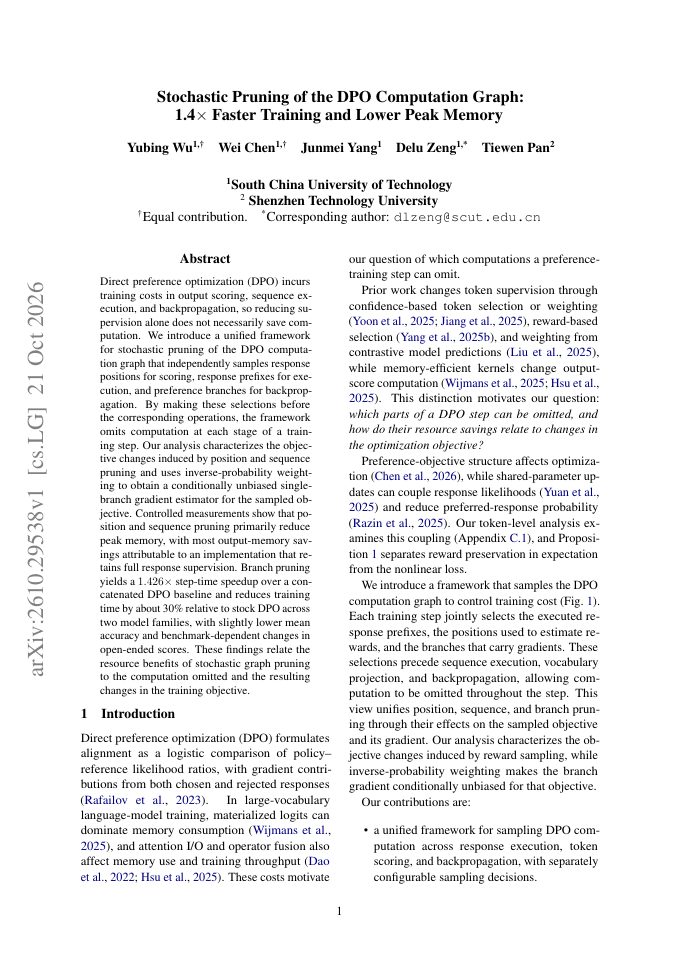
First page of Stochastic Pruning of the DPO Computation Graph: 1.4x Faster Training and Lower Peak Memory
efficient trainingtest

Stochastic Pruning of the DPO Computation Graph: 1.4x Faster Training and Lower Peak Memory

The method replaces the standard concatenated DPO training step with stochastic sampling of scored response positions, executed prefixes, and backpropagated preference branches, omitting the corresponding computation before it occurs. It costs a modified training objective (partially corrected with inverse-probability weighting for single-branch gradients), added implementation complexity in the training loop, and slightly lower mean accuracy with benchmark-dependent changes in open-ended generation scores. It can fail if the accuracy degradation is unacceptable for the target task, if the claimed savings do not transfer beyond the two model families evaluated, or if the unbiased estimator's higher variance destabilizes convergence on the reader's data distribution.

observed signal
0impl.
0stars
—citations
1.426xclaimed gain
abstract onlyReview decisionDownload skill ↓Original paper ↗
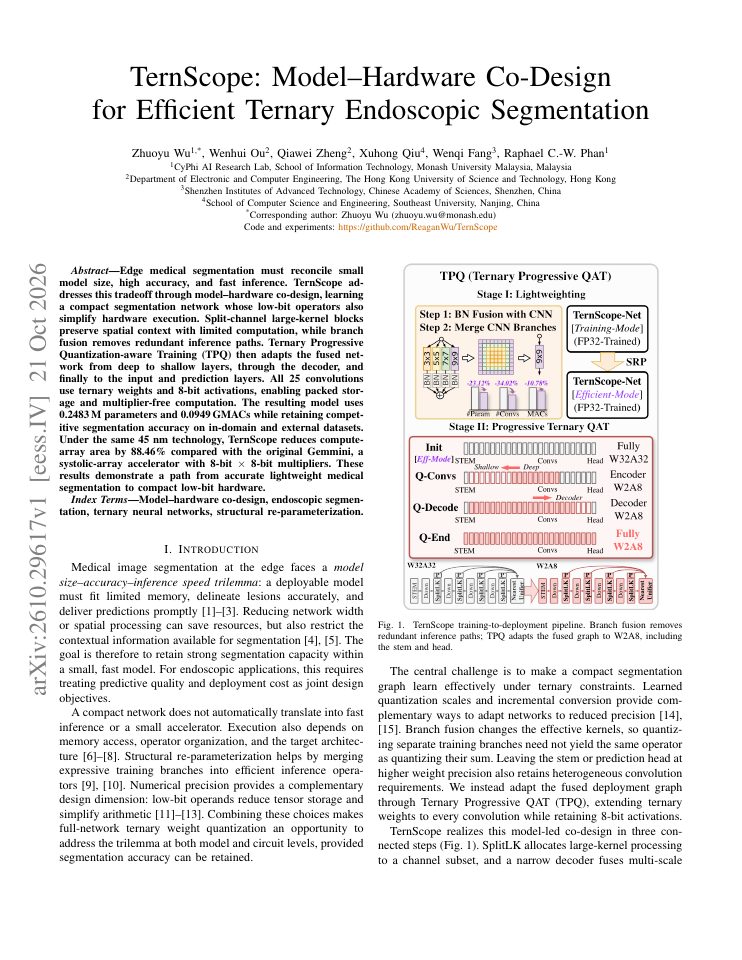
First page of TernScope: Model-Hardware Co-Design for Efficient Ternary Endoscopic Segmentation
quantizationwatch

TernScope: Model-Hardware Co-Design for Efficient Ternary Endoscopic Segmentation

TernScope replaces full-precision or 8-bit convolutional segmentation with a co-designed ternary-weight (W2/A8) network trained via progressive quantization-aware training from deep to shallow layers. The claimed gains (multiplier-free compute, packed storage, 88.46% area reduction) materialize only on custom systolic-array silicon; on a 24 GB GPU, ternary weights provide no practical speed or memory benefit without specialized kernels, and the model is already small enough that deployment constraints are unlikely to bind. Failure modes include accuracy loss on out-of-domain endoscopy data from aggressive quantization, engineering cost of the TPQ pipeline, and the fact that none of the hardware advantages transfer to commodity GPU inference.

observed signal
0impl.
0stars
—citations
8.65xclaimed gain
abstract onlyReview decisionDownload skill ↓Original paper ↗
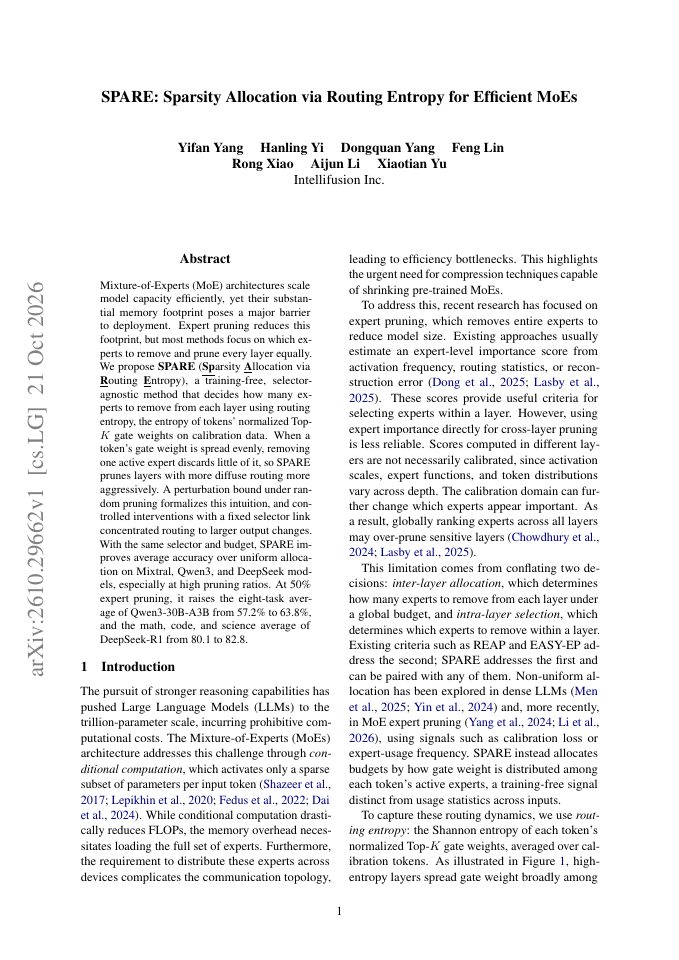
First page of SPARE: Sparsity Allocation via Routing Entropy for Efficient MoEs
sparsity and pruningtest

SPARE: Sparsity Allocation via Routing Entropy for Efficient MoEs

SPARE replaces uniform per-layer expert pruning budgets with a layer-wise allocation derived from routing entropy measured on calibration data, applied on top of any existing expert selector. It is training-free, so its cost is a calibration forward pass and the engineering of pruning and remapping experts; the pruned model is smaller in memory but loses capacity relative to the dense model. It can fail when calibration data is unrepresentative of production traffic, since routing entropy estimates then misallocate the pruning budget, and gains shrink at low pruning ratios where uniform allocation is already adequate.

observed signal
0impl.
0stars
—citations
—claimed gain
abstract onlyReview decisionDownload skill ↓Original paper ↗
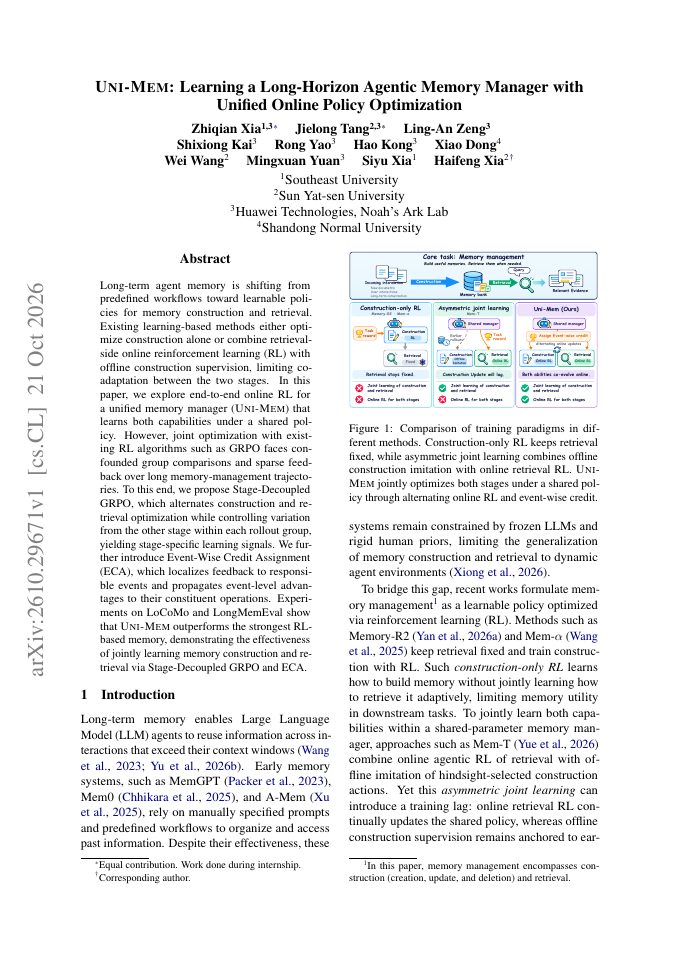
First page of Uni-Mem: Learning a Long-Horizon Agentic Memory Manager with Unified Online Policy Optimization
memory and contextwatch

Uni-Mem: Learning a Long-Horizon Agentic Memory Manager with Unified Online Policy Optimization

Replaces hand-designed memory workflows and hybrid RL-plus-offline-supervision pipelines with a single policy trained end-to-end online for both memory construction and retrieval, using stage-decoupled group comparisons and event-level credit assignment. Costs include an online RL training loop over long memory trajectories, the added complexity of alternating stage optimization, and dependence on RL-quality reward signals; the abstract gives no compute or latency figures. Can fail if rewards are sparse or misaligned, if benchmarks like LoCoMo do not transfer to the reader's workloads, or if the trained policy is brittle under distribution shift in production interactions.

observed signal
0impl.
0stars
—citations
—claimed gain
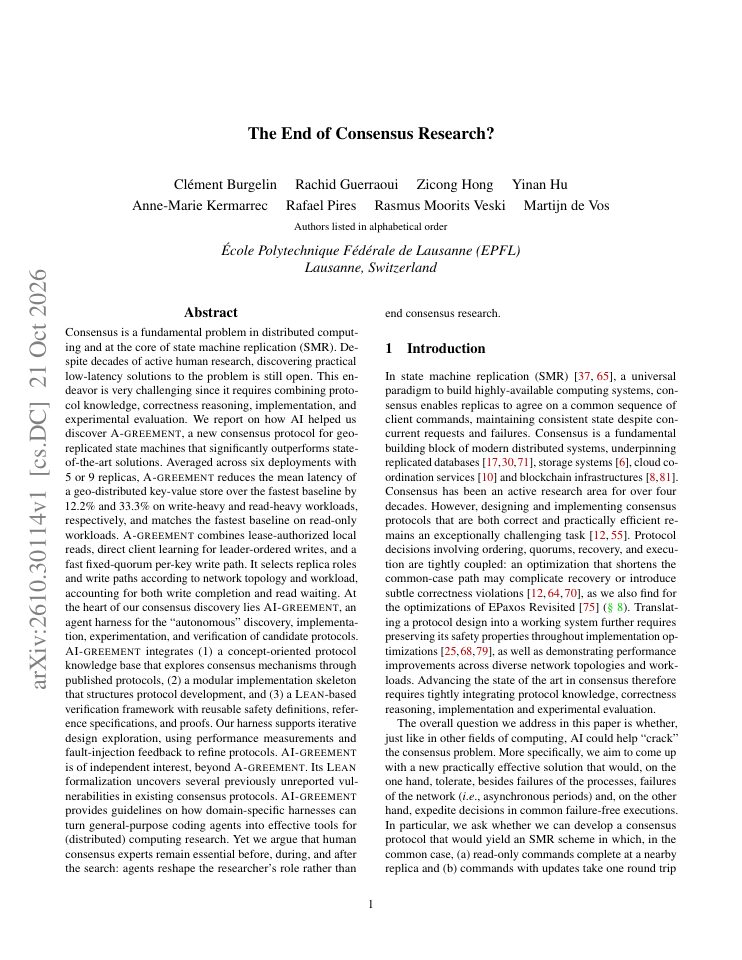
abstract onlyReview decisionDownload skill ↓Original paper ↗
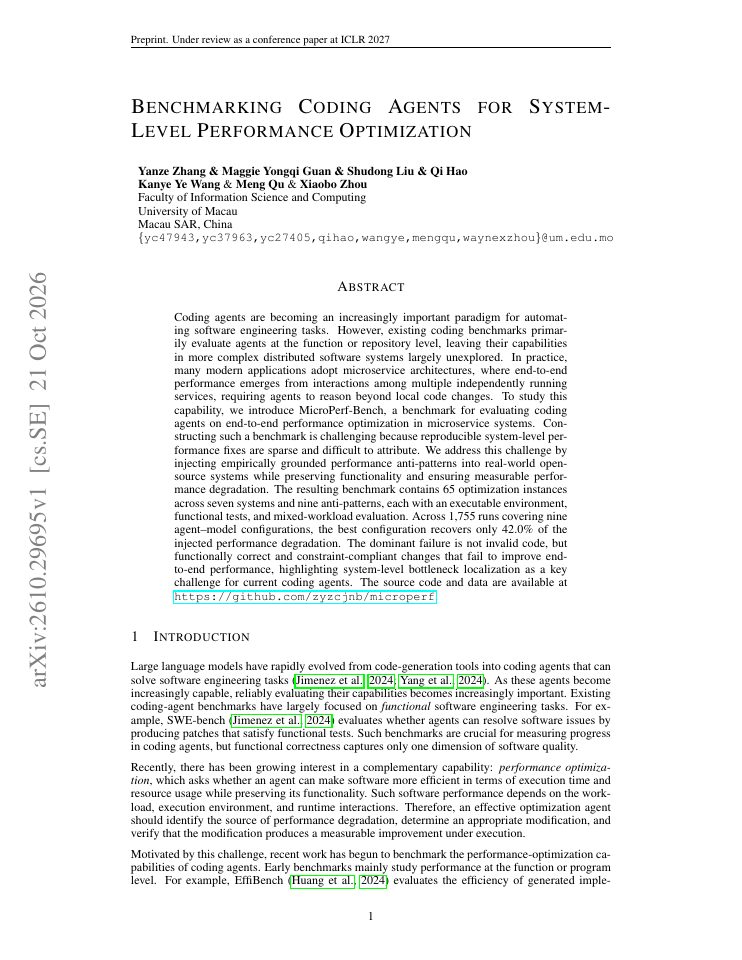
First page of Benchmarking Coding Agents for System-Level Performance Optimization
agent evaluationtest

Benchmarking Coding Agents for System-Level Performance Optimization

This benchmark replaces ad hoc or function-level evaluation of coding agents with 65 reproducible system-level optimization instances across seven microservice systems, each with executable environments, functional tests, and mixed-workload measurement. The cost is infrastructure effort: each instance requires a runnable multi-service environment and workload harness, which is heavier than typical function-level benchmarks though feasible on a single machine or modest cloud budget. It can fail to predict production behavior because the anti-patterns are synthetically injected rather than observed in real incidents, so agent scores may not transfer to organically occurring bottlenecks.

observed signal
0impl.
0stars
—citations
—claimed gain
abstract onlyReview decisionDownload skill ↓Original paper ↗
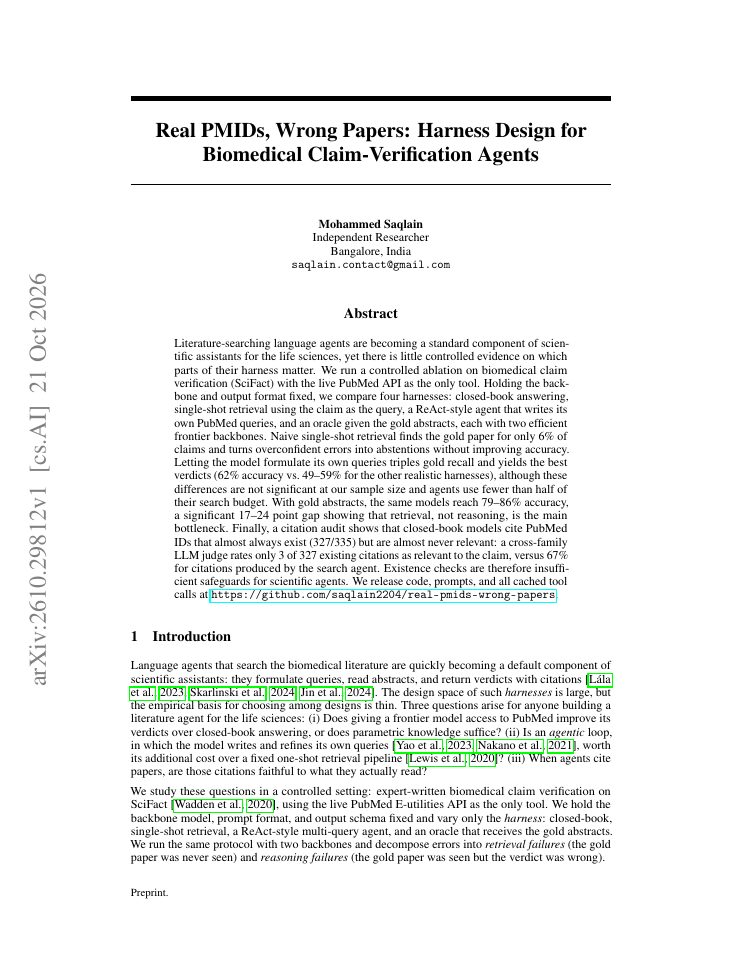
First page of Real PMIDs, Wrong Papers: Harness Design for Biomedical Claim-Verification Agents
tool usetest

Real PMIDs, Wrong Papers: Harness Design for Biomedical Claim-Verification Agents

This replaces closed-book answering and naive claim-as-query single-shot retrieval with a ReAct-style agent that writes its own search queries against a live retrieval API, and it replaces existence-only citation checks with relevance auditing. The cost is multi-turn tool interaction (more latency and API calls than single-shot, though agents used under half their search budget) plus harness complexity; the backbone and output format need not change. It can fail silently through plausible but irrelevant citations: closed-book models produced real PubMed IDs that were relevant in only 3 of 327 cases, so PMID existence checks give false assurance, and the accuracy gains are not statistically significant, so benefits must be validated on your workload.

observed signal
0impl.
10stars
—citations
3xclaimed gain
abstract onlyReview decisionDownload skill ↓Original paper ↗
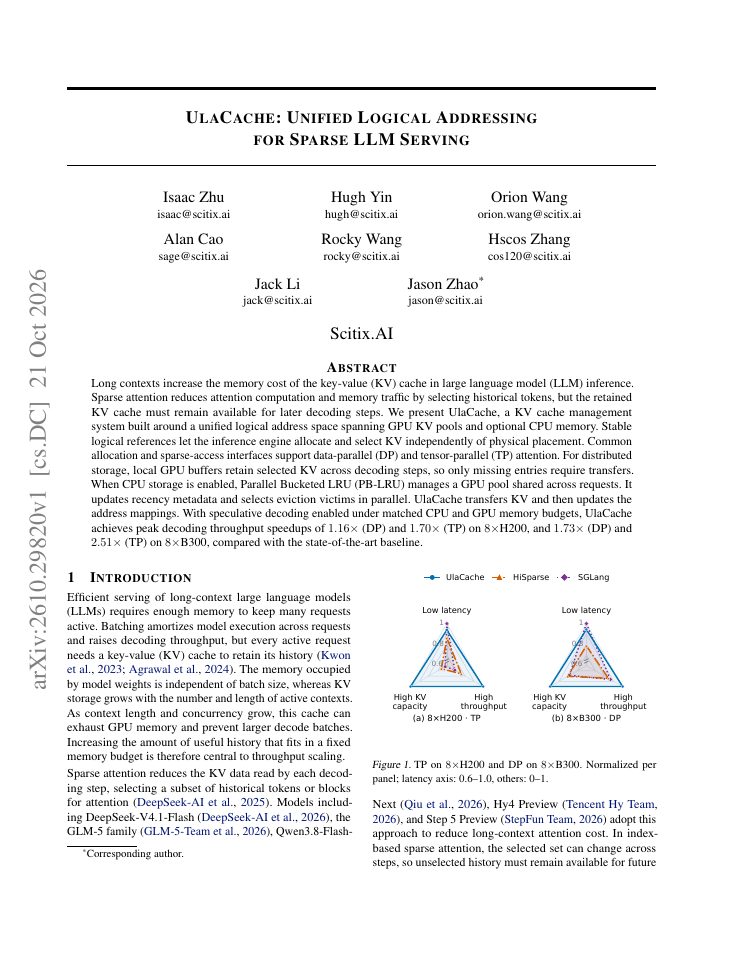
First page of UlaCache: Unified Logical Addressing for Sparse LLM Serving
KV cachewatch

UlaCache: Unified Logical Addressing for Sparse LLM Serving

UlaCache replaces conventional physically-tied KV cache management with a unified logical address space spanning GPU and optional CPU memory, combined with a Parallel Bucketed LRU for shared GPU pool eviction, so sparse-attention KV selection is decoupled from physical placement. The cost is substantial systems complexity: address-mapping infrastructure, CPU-GPU transfer coordination, local buffer management across decoding steps, and integration with sparse attention and speculative decoding, with gains demonstrated only on H200 and B300 hardware in DP/TP configurations. It can fail when the workload does not already use sparse attention and speculative decoding, when transfer bandwidth between CPU and GPU becomes the bottleneck, or when the reader's single 24 GB GPU cannot realize the distributed-storage benefits the system is designed around.

observed signal
0impl.
0stars
—citations
2.51xclaimed gain
abstract onlyReview decisionDownload skill ↓Original paper ↗
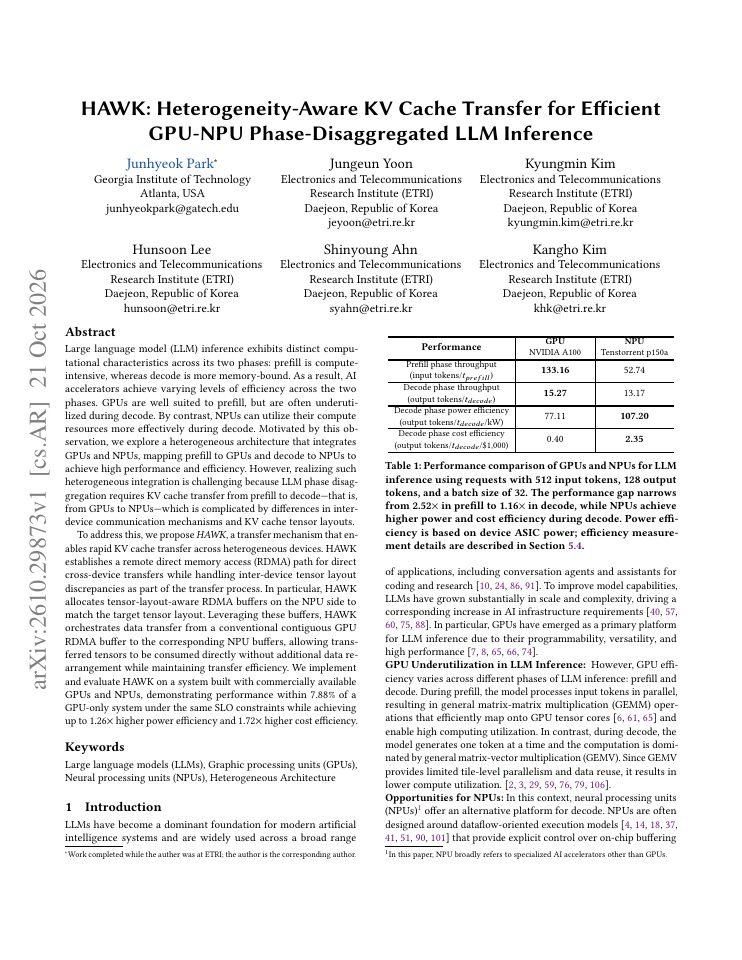
First page of HAWK: Heterogeneity-Aware KV Cache Transfer for Efficient GPU-NPU Phase-Disaggregated LLM Inference
serving and batchingnot applicable

HAWK: Heterogeneity-Aware KV Cache Transfer for Efficient GPU-NPU Phase-Disaggregated LLM Inference

HAWK replaces single-device-type serving with phase-disaggregated inference in which prefill runs on GPUs and decode on NPUs, connected by an RDMA path that remaps KV cache tensor layouts into NPU-side layout-aware buffers during transfer. It costs dedicated heterogeneous hardware (commercial NPUs plus RDMA-capable interconnect), custom transfer orchestration, and up to 7.88% throughput loss relative to a GPU-only baseline. It can fail through cross-device layout mismatches, RDMA path or interconnect instability, and engineering fragility when models, KV formats, or hardware generations change.

observed signal
0impl.
0stars
—citations
1.72xclaimed gain
abstract onlyReview decisionDownload skill ↓Original paper ↗

Research signals

Three views of the same evidence: adoption against attention, publication cadence by research area, and reported gains when coverage is sufficient.

color = research area

01 · attention × adoption

The research frontier

Look to the upper left for independent implementation before mass attention.

compare by
Each point represents one paper. Higher means more independent implementations; farther right means more GitHub stars.The Router Within: Eliciting Native Skill Routing from a Frozen LLM: 1 GitHub star; 2 independent implementationsEvolveTrade: Experience-Driven Policy Refinement for Self-Evolving LLM Trading Agents: 0 GitHub stars; 2 independent implementationsTarget Regeneration Shrinks the Gains of Draft-Training Objectives in Speculative Decoding: 122 GitHub stars; 0 independent implementationsGRAM: Group-wise Rank-Aware Model Merging via Subspace Alignment: 126 GitHub stars; 1 independent implementationResuming Vision-Language Inference across Onboard Interruptions: 4 GitHub stars; 1 independent implementationUnderstanding Target Probability Reuse in Speculative Decoding: 126 GitHub stars; 2 independent implementationsCache Locally, Recompute Selectively for Streaming Video Understanding: 122 GitHub stars; 1 independent implementationCredit Where Credit Is Due: Contrastive Attribution Topology Search for Multi-Agent Systems: 132 GitHub stars; 2 independent implementationsCompressing Onboard Language Models for Space Robots under a Behavioral-Fidelity Requirement: 4 GitHub stars; 1 independent implementationBrainCodes: A Lightweight EEG Foundation Model over Discrete Neural Codes: 4 GitHub stars; 1 independent implementationMemory-Centric Continual Learning for AI Agents: 132 GitHub stars; 3 independent implementationsRight On Q: Recovering Reasoning under Quantization via Self-Generated Trajectories: 126 GitHub stars; 2 independent implementationsA KAN-based Non-linear Factorization for Embedding Layer Compression: 122 GitHub stars; 1 independent implementationHarness Scaling for Generalizable Agentic Reinforcement Learning: 15 GitHub stars; 4 independent implementationsRCSD: Reinforcement and Continual Learning for Domain-Specific Speculative Decoding: 122 GitHub stars; 1 independent implementationStochastic Pruning of the DPO Computation Graph: 1.4x Faster Training and Lower Peak Memory: 0 GitHub stars; 0 independent implementationsRISK-KV: Quality-Aware Selective KV Cache Reconstruction for Distributed LLM Inference: 4 GitHub stars; 1 independent implementationPACE: Periodic and Channel-Aligned Encoding of Four-Bit Recurrent States: 122 GitHub stars; 1 independent implementationTernScope: Model-Hardware Co-Design for Efficient Ternary Endoscopic Segmentation: 0 GitHub stars; 0 independent implementationsEffects of Model Scale and Quantization on Social Bias and Abstention in Question Answering: 122 GitHub stars; 1 independent implementationSPARE: Sparsity Allocation via Routing Entropy for Efficient MoEs: 0 GitHub stars; 0 independent implementationsUni-Mem: Learning a Long-Horizon Agentic Memory Manager with Unified Online Policy Optimization: 0 GitHub stars; 0 independent implementationsBenchmarking Coding Agents for System-Level Performance Optimization: 0 GitHub stars; 0 independent implementationsReal PMIDs, Wrong Papers: Harness Design for Biomedical Claim-Verification Agents: 10 GitHub stars; 0 independent implementationsUlaCache: Unified Logical Addressing for Sparse LLM Serving: 0 GitHub stars; 0 independent implementationsMemoryTax: The Bitter Lesson of Agent Memory: 132 GitHub stars; 1 independent implementationHAWK: Heterogeneity-Aware KV Cache Transfer for Efficient GPU-NPU Phase-Disaggregated LLM Inference: 0 GitHub stars; 0 independent implementationsRobust Soft Skill Adaptation via Behavioral Localization in Tool-Using Agents: 132 GitHub stars; 1 independent implementationFrom Reasoning to Action: Benchmarking Frontier AI Models on LIBERO-10 Robot Manipulation Tasks: 0 GitHub stars; 0 independent implementationsFrom Classifier Heads to Encoder Prototypes: Personalized Federated Learning with Head-Derived Clustering: 0 GitHub stars; 0 independent implementationsMultimodal Embodied Agents: A Unified Capability-centric Perspective from Computer-Use to Robot-Use: 371 GitHub stars; 4 independent implementationsThe End of Consensus Research?: 0 GitHub stars; 0 independent implementationsEnvironment Duels: A Microcosm of LLM Co-Evolution: 122 GitHub stars; 1 independent implementation

Papers above 1000 stars or 200 citations are not scored. They have already broken through the attention threshold, while Paperraft is designed to identify earlier signals.

02 · cadence

Research areas over time

Compare monthly publication volume on a shared scale and calendar.

coding agentsmax 4Sep 26: 0 papersOct 26: 1 paperSep 26Oct 26efficient architecturesmax 4Sep 26: 0 papersOct 26: 1 paperSep 26Oct 26agent evaluationmax 4Sep 26: 0 papersOct 26: 4 papersSep 26Oct 26KV cachemax 4Sep 26: 0 papersOct 26: 3 papersSep 26Oct 26speculative decodingmax 4Sep 26: 0 papersOct 26: 3 papersSep 26Oct 26sparsity and pruningmax 4Sep 26: 0 papersOct 26: 1 paperSep 26Oct 26memory and contextmax 4Sep 26: 0 papersOct 26: 3 papersSep 26Oct 26multi-agent orchestrationmax 4Sep 26: 0 papersOct 26: 1 paperSep 26Oct 26othermax 4Sep 26: 0 papersOct 26: 2 papersSep 26Oct 26quantizationmax 4Sep 26: 0 papersOct 26: 4 papersSep 26Oct 26failure recoverymax 4Sep 26: 0 papersOct 26: 1 paperSep 26Oct 26safety and guardrailsmax 4Sep 26: 0 papersOct 26: 1 paperSep 26Oct 26serving and batchingmax 4Sep 26: 0 papersOct 26: 1 paperSep 26Oct 26efficient trainingmax 4Sep 26: 0 papersOct 26: 3 papersSep 26Oct 26tool usemax 4Sep 26: 2 papersOct 26: 2 papersSep 26Oct 26

Every panel uses the same calendar and vertical scale. An empty column means no papers were recorded.

03 · reported results

Claimed performance gains

Gains stated in the abstract: reported by the authors; not independently verified.

Factors reported by the authors and not independently verified. The vertical axis uses a logarithmic scale; the baseline is 1x.reported factor · log scaleResuming Vision-Language Inference across Onboard Interruptions: 4.07x in speed (author-reported)Cache Locally, Recompute Selectively for Streaming Video Understanding: 1.25x in speed (author-reported)Credit Where Credit Is Due: Contrastive Attribution Topology Search for Multi-Agent Systems: 2.17x in cost (author-reported)BrainCodes: A Lightweight EEG Foundation Model over Discrete Neural Codes: 32.3x in memory (author-reported)RCSD: Reinforcement and Continual Learning for Domain-Specific Speculative Decoding: 1.35x in speed (author-reported)Stochastic Pruning of the DPO Computation Graph: 1.4x Faster Training and Lower Peak Memory: 1.426x in speed (author-reported)RISK-KV: Quality-Aware Selective KV Cache Reconstruction for Distributed LLM Inference: 1.51x in speed (author-reported)PACE: Periodic and Channel-Aligned Encoding of Four-Bit Recurrent States: 1.5x in memory (author-reported)TernScope: Model-Hardware Co-Design for Efficient Ternary Endoscopic Segmentation: 8.65x in memory (author-reported)Real PMIDs, Wrong Papers: Harness Design for Biomedical Claim-Verification Agents: 3x in quality (author-reported)UlaCache: Unified Logical Addressing for Sparse LLM Serving: 2.51x in speed (author-reported)MemoryTax: The Bitter Lesson of Agent Memory: 2x in cost (author-reported)HAWK: Heterogeneity-Aware KV Cache Transfer for Efficient GPU-NPU Phase-Disaggregated LLM Inference: 1.72x in cost (author-reported)The End of Consensus Research?: 1.5x in speed (author-reported)

14 of 33 papers report a quantified gain. The scale is logarithmic; a research-area trend line appears only with at least five papers in the quarter.

Method under scrutiny

Inspect the highest-ranked paper, every repository behind its signal, and the rule used to classify each one.

EvolveTrade: Experience-Driven Policy Refinement for Self-Evolving LLM Trading Agents

tool use · test · 2 of 3 implementations are independent

The method replaces static hand-written system prompts governing tool use with a prompt-as-policy that a separate Policy Agent revises after each interval using decision traces and realized feedback, while the backbone LLM stays frozen. Cost is modest and infrastructure-compatible: extra LLM calls for trace review and policy rewriting, trace storage, and a more complex deployment loop with versioned prompts. Failure modes include overfitting the policy to recent market regimes or noisy backtests, reward hacking where the policy inflates simulated metrics without real edge, compounding prompt drift that degrades stability, and the risk that reported gains do not survive transaction costs, slippage, or out-of-sample live trading.

Exclusions and controls

Every exclusion is counted and published.

Exclusion counts were not recorded for this edition.

0 previously indexed papers were rechecked in this run.

Paperraft tracks one signal: how many independent implementations a paper attracts on GitHub after author-owned repositories are removed. This is a discovery signal to investigate, not a measure of implementation quality.

It does not claim that a method works. Paperraft runs no reproduction benchmarks. Reported gains remain author claims until independently tested. Papers above the attention threshold are excluded because this publication is designed to identify research before consensus forms.