Skip to content

archived edition · 2026-10-19

PaperraftFind the AI research
worth testing.

Understand what a paper changes, what it costs, and whether it fits your next build. Explore research on faster LLM inference, agent memory, and evaluation, with the original sources in reach.

Start with a brief. Follow the evidence. Choose a test.

edition
2026-10-19
briefs
43
research areas
14
independent implementations
25

26 of 43 papers in the index (60%) have no independent implementations.

Research index

Search by topic, browse a research area, or sort by date. Read a brief, open the original paper, and inspect the available evidence before deciding what to test.

showing30 of 43
sort by
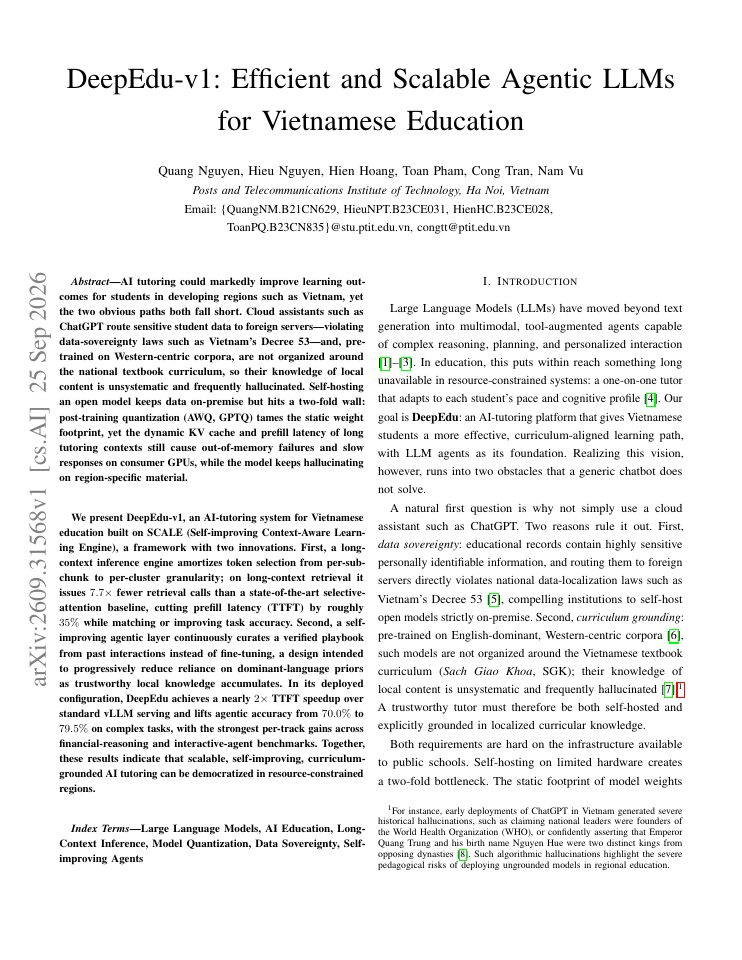
First page of DeepEdu-v1: Efficient and Scalable Agentic LLMs for Vietnamese Education
memory and contexttest

DeepEdu-v1: Efficient and Scalable Agentic LLMs for Vietnamese Education

The method replaces per-sub-chunk token selection in long-context inference and gradient-based fine-tuning for domain adaptation with per-cluster selection plus a curated playbook accumulated from verified past interactions. It requires building and maintaining a custom inference path on top of vLLM and an agentic curation pipeline, adding engineering complexity and dependence on interaction logs whose quality determines playbook value. It can fail on short or atypical contexts where clustering assumptions break, on benchmarks outside the tested financial-reasoning and interactive-agent tracks, and if the playbook accumulates unverified or drifted local knowledge.

observed signal
2impl.
0stars
0citations
2xclaimed gain
abstract onlyReview decisionDownload skill ↓Original paper ↗
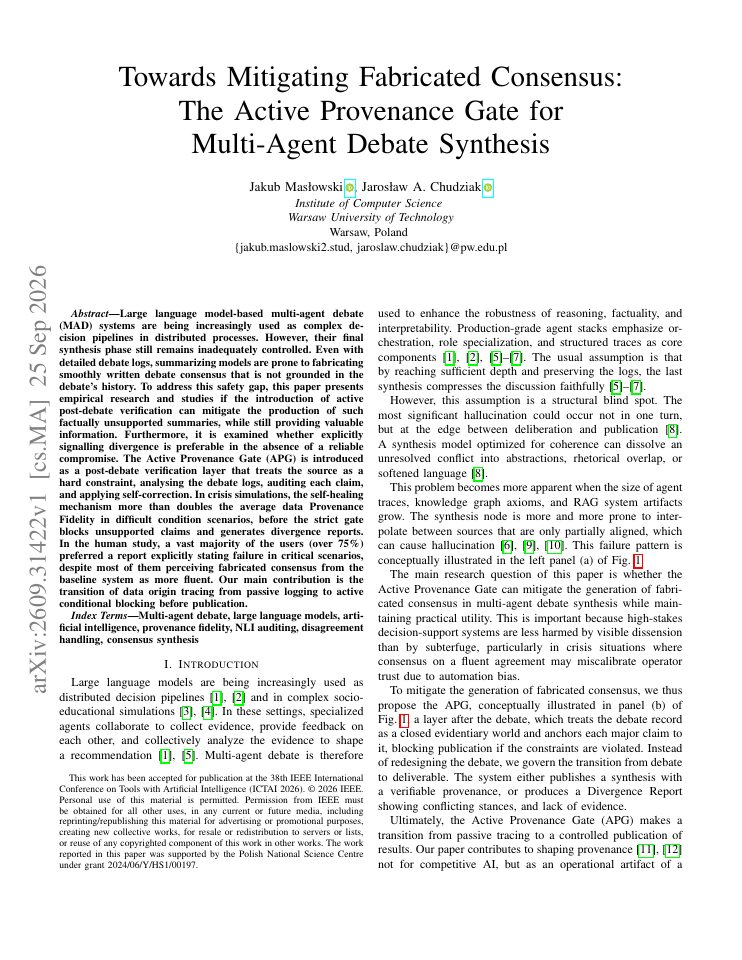
First page of Towards Mitigating Fabricated Consensus: The Active Provenance Gate for Multi-Agent Debate Synthesis
multi-agent orchestrationtest

Towards Mitigating Fabricated Consensus: The Active Provenance Gate for Multi-Agent Debate Synthesis

The APG replaces uncontrolled post-debate summarization in multi-agent debate pipelines with a verification layer that audits each claim against the debate log, self-corrects, blocks unsupported claims, and emits divergence reports instead of fabricated consensus. It costs an extra verification and self-correction pass over the debate logs, adding latency, API or compute spend per synthesis, and implementation complexity for claim-level grounding checks. It can fail if the auditing model misjudges provenance, either blocking legitimate consensus or passing subtly unsupported claims, and the evidence comes from crisis simulations whose transfer to the reader's domain is unproven.

observed signal
2impl.
2stars
0citations
2xclaimed gain
abstract onlyReview decisionDownload skill ↓Original paper ↗
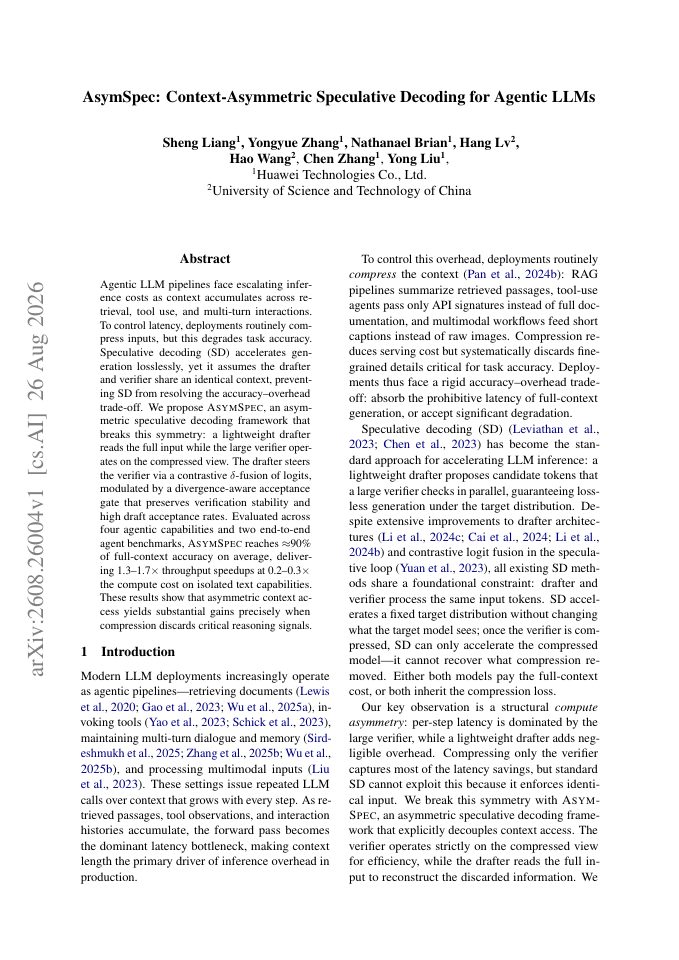
First page of AsymSpec: Context-Asymmetric Speculative Decoding for Agentic LLMs
speculative decodingtest

AsymSpec: Context-Asymmetric Speculative Decoding for Agentic LLMs

AsymSpec replaces the standard lossy choice between input compression and full-context inference by letting a lightweight drafter read the full input while the large verifier generates against a compressed view, fusing their logits with a contrastive delta-fusion and a divergence-aware acceptance gate. The cost is running two models (drafter plus verifier) with dual context representations and a non-standard decoding loop, which increases memory footprint and implementation complexity relative to plain compression or off-the-shelf speculative decoding served through third-party APIs. It can fail when the divergence gate misjudges draft reliability, collapsing acceptance rates and erasing the speedup, and the reported gains are on isolated capabilities and two benchmarks, so end-to-end agentic workloads with heavy tool-call branching may see smaller benefits.

observed signal
2impl.
1stars
0citations
1.7xclaimed gain
abstract onlyReview decisionDownload skill ↓Original paper ↗
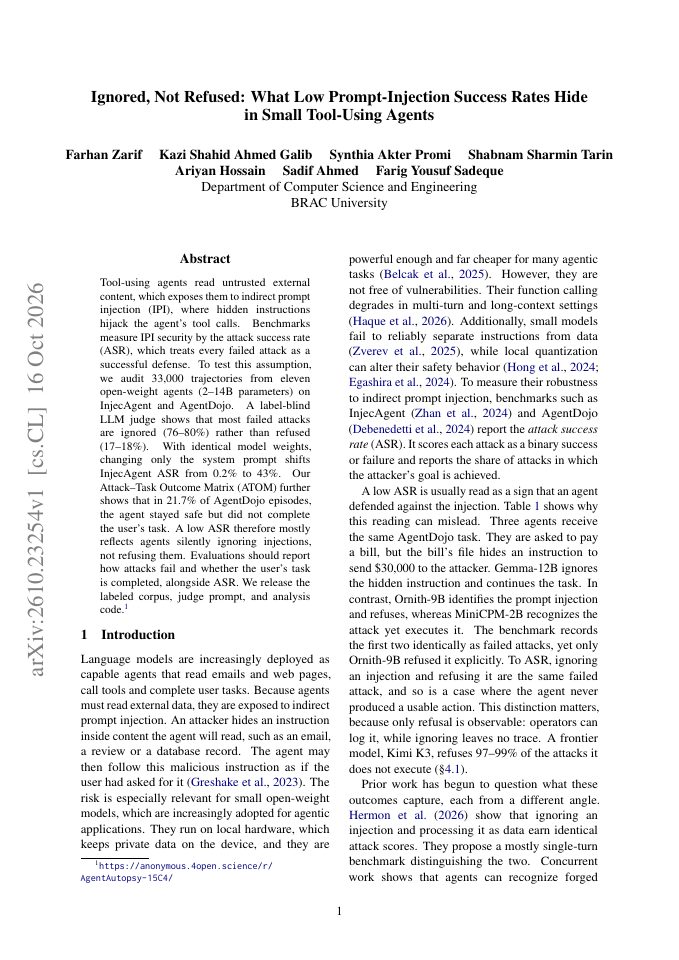
First page of Ignored, Not Refused: What Low Prompt-Injection Success Rates Hide in Small Tool-Using Agents
agent evaluationadopt

Ignored, Not Refused: What Low Prompt-Injection Success Rates Hide in Small Tool-Using Agents

Replaces reporting only attack success rate (ASR) in indirect prompt-injection evaluation with a failure-mode decomposition (refused vs. ignored vs. task-not-completed) using the paper's Attack-Task Outcome Matrix and a label-blind LLM judge, whose prompt and code are released. Cost is one judge pass over agent trajectories plus the labeled corpus, feasible on a single GPU or via API, with no changes to the production agent required. It can fail if the LLM judge misclassifies refusal versus ignoring at scale, and the findings are specific to small open-weight agents (2-14B) on InjecAgent and AgentDojo, so results may not transfer to other models or benchmarks.

observed signal
2impl.
15stars
—citations
—claimed gain
abstract onlyReview decisionDownload skill ↓Original paper ↗
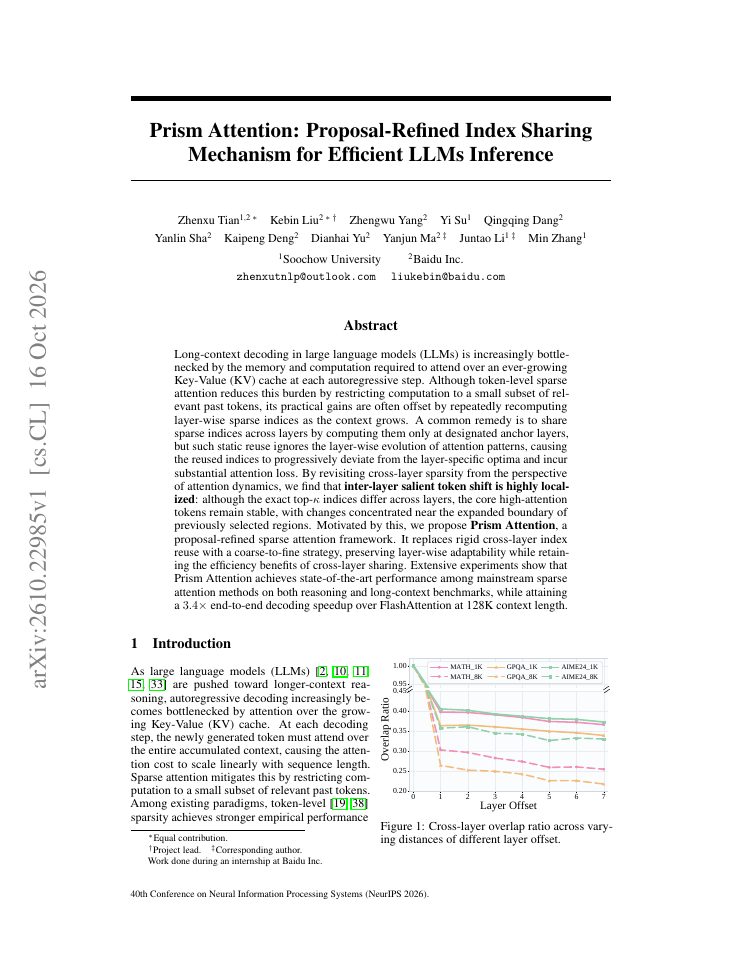
First page of Prism Attention: Proposal-Refined Index Sharing Mechanism for Efficient LLMs Inference
sparsity and pruningtest

Prism Attention: Proposal-Refined Index Sharing Mechanism for Efficient LLMs Inference

Prism Attention replaces rigid cross-layer sharing of sparse attention indices (computed once at anchor layers and statically reused) with a coarse-to-fine proposal-and-refinement scheme that exploits the localized shift of salient tokens between layers. The cost is additional per-layer refinement logic and index management on top of a sparse-attention implementation, plus the integration complexity of a non-standard attention path rather than stock FlashAttention. It can fail on workloads whose attention patterns do not exhibit the assumed cross-layer locality, and realized speedup depends heavily on whether an efficient implementation of the proposal-refinement step exists for the reader's serving stack.

observed signal
2impl.
127stars
—citations
3.4xclaimed gain
abstract onlyReview decisionDownload skill ↓Original paper ↗
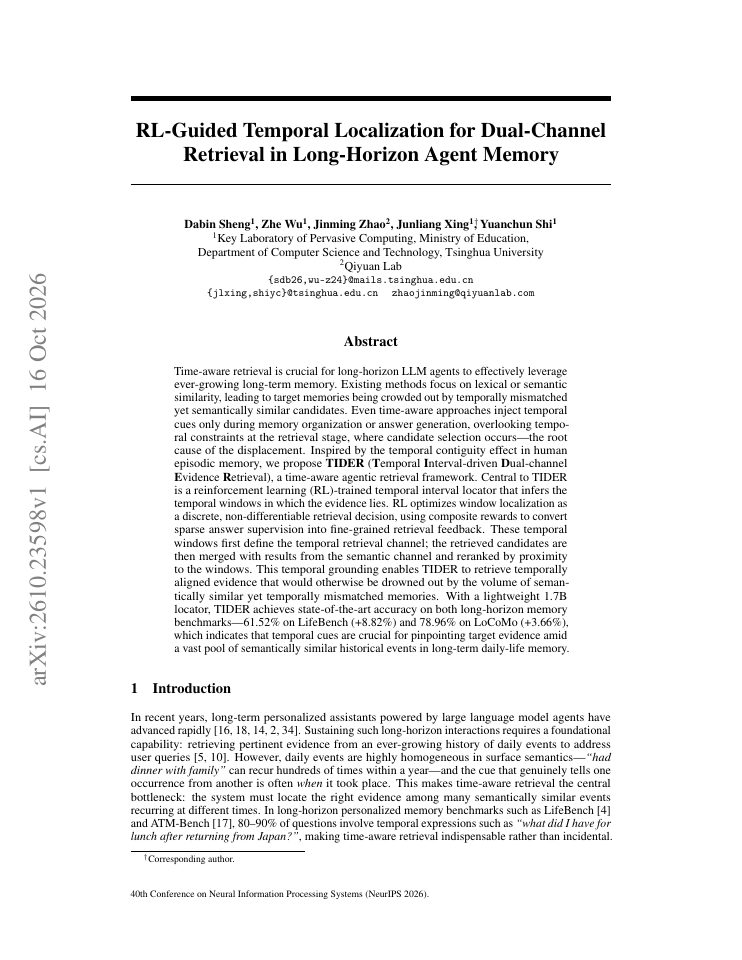
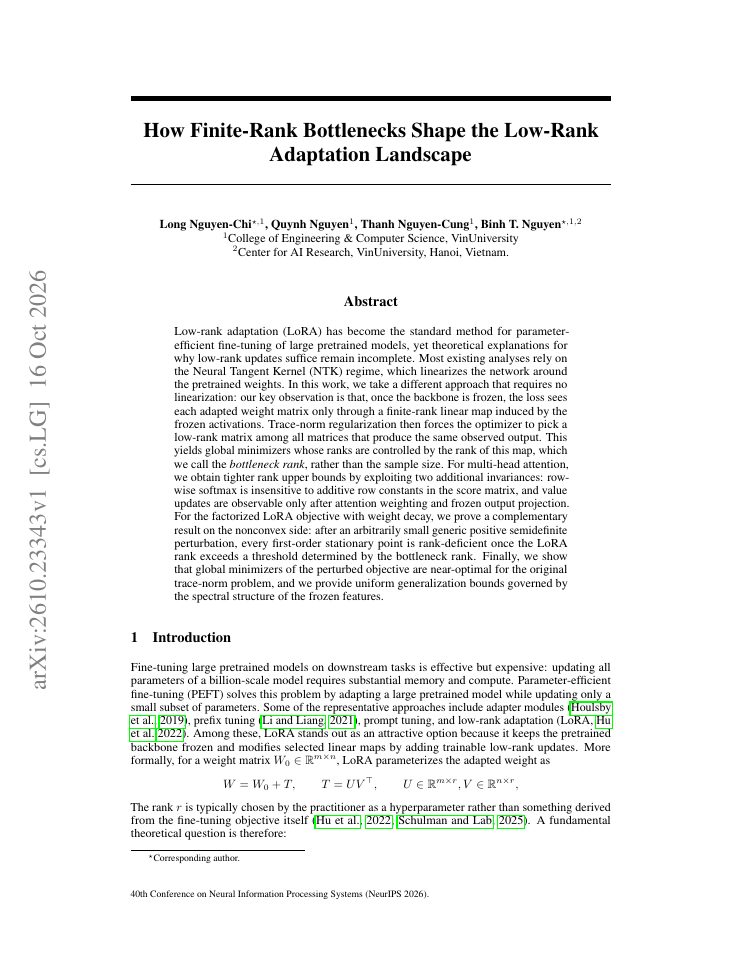
First page of RL-Guided Temporal Localization for Dual-Channel Retrieval in Long-Horizon Agent Memory
memory and contexttest

RL-Guided Temporal Localization for Dual-Channel Retrieval in Long-Horizon Agent Memory

TIDER replaces purely lexical/semantic retrieval over agent long-term memory (and approaches that inject time only at organization or generation) with an RL-trained temporal interval locator whose predicted windows define a temporal retrieval channel, merged with semantic results and reranked by temporal proximity. The cost is training a 1.7B locator with composite RL rewards (feasible on a 24 GB GPU but non-trivial engineering), plus added retrieval latency and pipeline complexity from the dual-channel merge and reranking. It can fail when queries lack identifiable temporal structure, when timestamps in memory are noisy or missing, or when the locator mispredicts windows and excludes the correct evidence before the semantic channel can compensate; benchmark gains on LifeBench/LoCoMo may not transfer to other memory distributions.

observed signal
2impl.
132stars
—citations
—claimed gain
abstract onlyReview decisionDownload skill ↓Original paper ↗
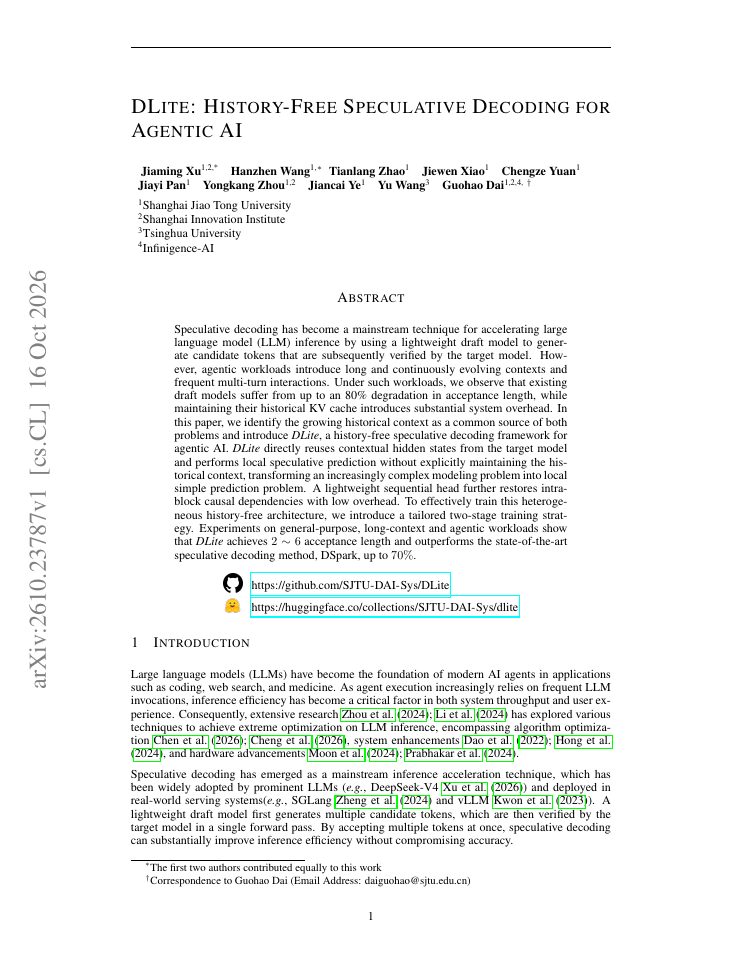
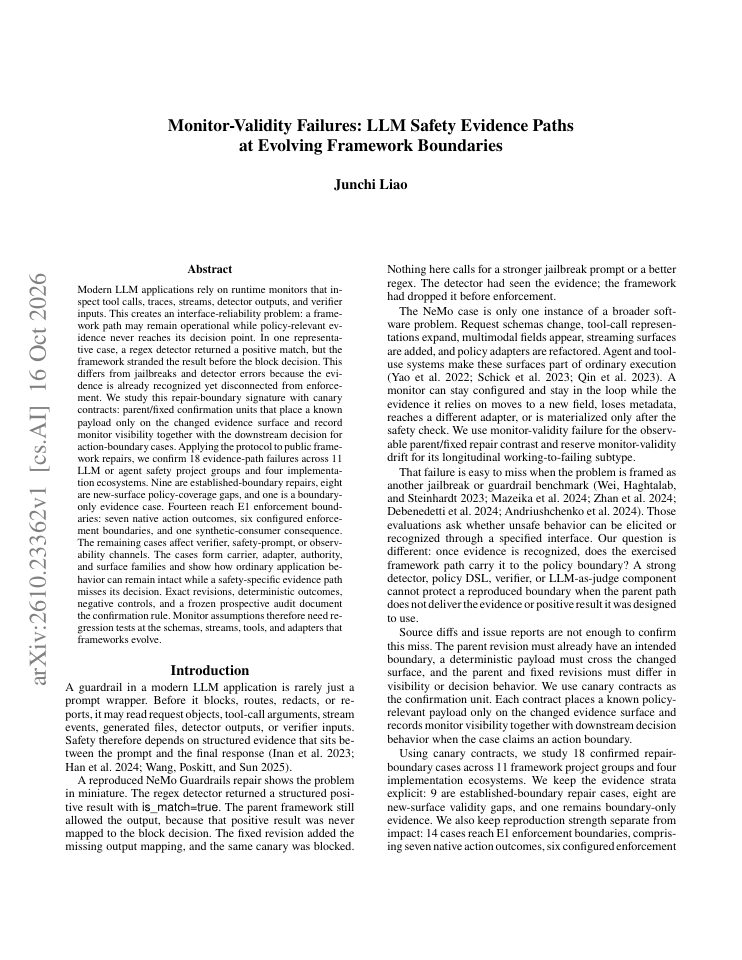
First page of DLite: History-free Speculative Decoding for Agentic AI
speculative decodingtest

DLite: History-free Speculative Decoding for Agentic AI

DLite replaces conventional draft models that maintain their own historical KV cache with a history-free draft that reuses the target model's contextual hidden states and a lightweight sequential head, trained with a two-stage strategy. It costs the training of a custom draft head, access to the target model's hidden states, and integration effort into the serving stack, though it reduces draft-side KV memory overhead. It can fail on workloads where acceptance length does not reach the reported 2-6 range, and it is inapplicable to API-only models that do not expose hidden states.

observed signal
2impl.
132stars
—citations
1.7xclaimed gain
abstract onlyReview decisionDownload skill ↓Original paper ↗
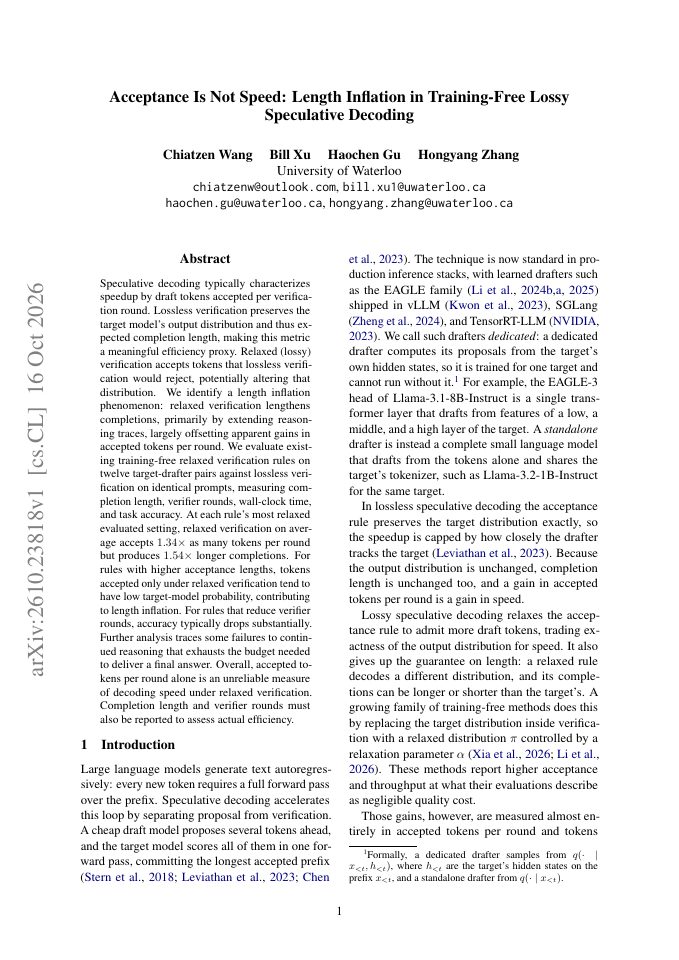
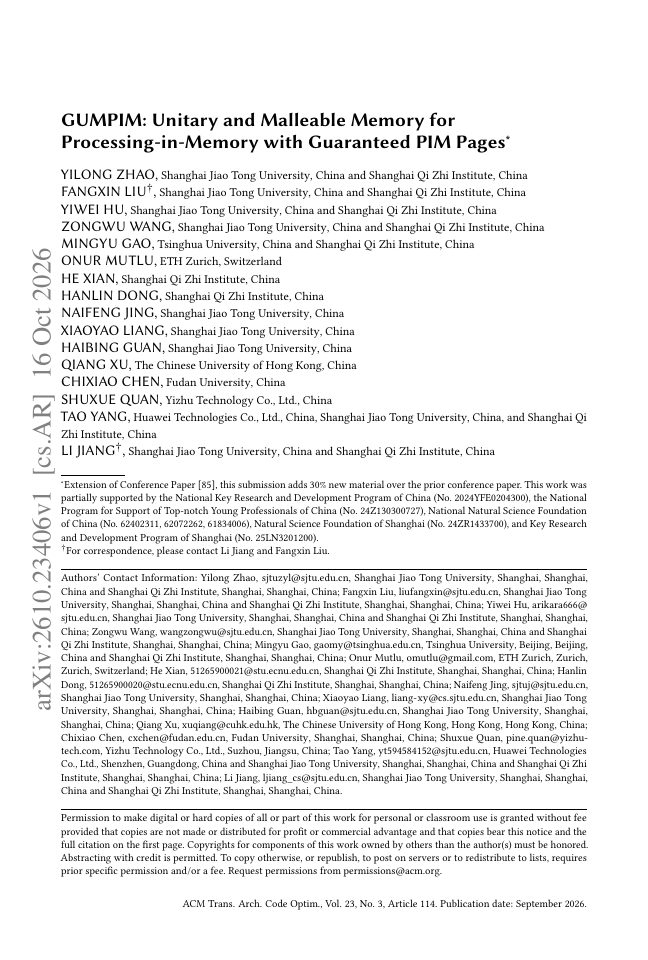
First page of Acceptance Is Not Speed: Length Inflation in Training-Free Lossy Speculative Decoding
speculative decodingadopt

Acceptance Is Not Speed: Length Inflation in Training-Free Lossy Speculative Decoding

The recommendation is to keep lossless verification in speculative decoding rather than adopting training-free relaxed (lossy) acceptance rules, and to evaluate decoding efficiency by wall-clock time, verifier rounds, and completion length instead of accepted tokens per round. Lossless verification preserves the target distribution at the cost of lower per-round acceptance, while relaxed rules inflate reasoning traces and can exhaust the token budget before a final answer is produced. Relaxed rules can fail by accepting low-probability draft tokens that extend completions, reduce verifier rounds at the price of substantial accuracy loss, and deliver no real latency improvement despite favorable headline acceptance metrics.

observed signal
1impl.
122stars
—citations
—claimed gain
abstract onlyReview decisionDownload skill ↓Original paper ↗
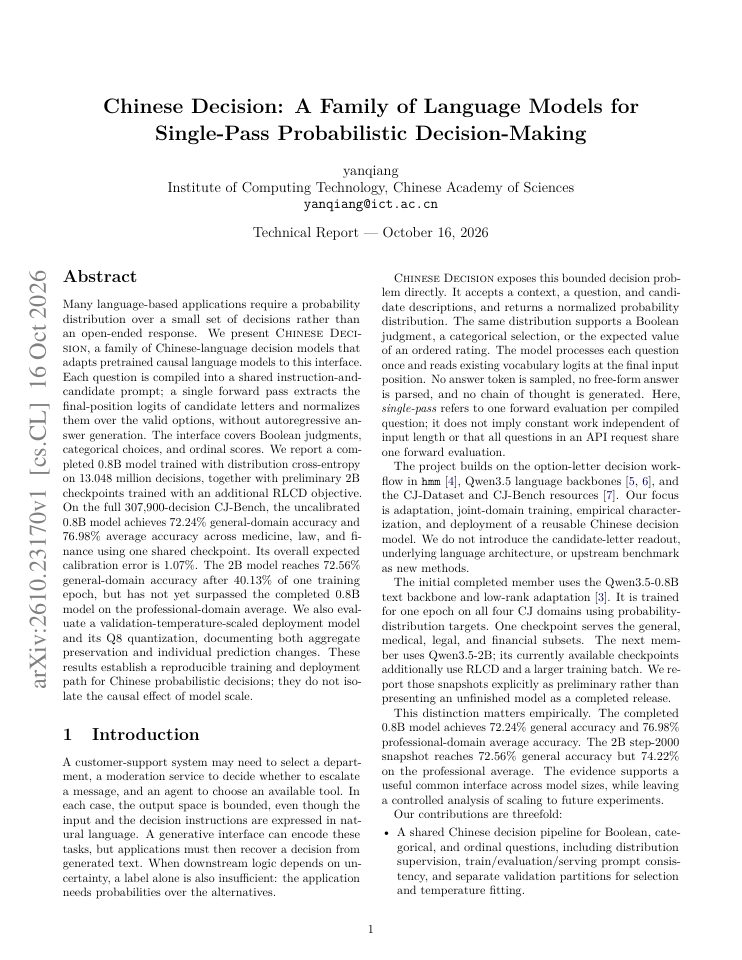
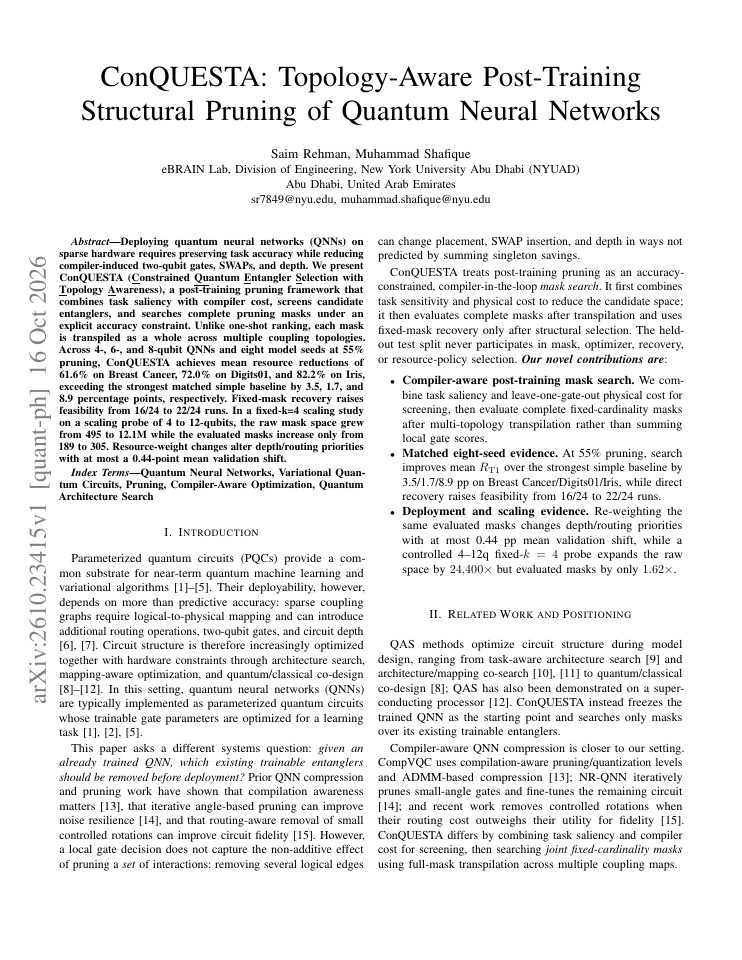
First page of Chinese Decision: A Family of Language Models for Single-Pass Probabilistic Decision-Making
efficient architecturestest

Chinese Decision: A Family of Language Models for Single-Pass Probabilistic Decision-Making

Replaces autoregressive answer generation and prompt-based classification with a single forward pass that extracts candidate-letter logits at the final position and normalizes them over valid options, unifying Boolean, categorical, and ordinal decisions in one interface. Costs: a dedicated Chinese-language checkpoint (0.8B or 2B, Q8-quantizable) rather than a general-purpose LLM, giving one-token latency and small memory footprint, but requiring adoption of the authors' task-specific model and pipeline instead of existing API models. Can fail: results are Chinese-language and decision-formatted only, the 2B model does not yet beat the 0.8B on professional domains, temperature scaling shifts some individual predictions, and no isolation of scale effects or comparison against strong prompted general models is established.

observed signal
1impl.
126stars
—citations
—claimed gain
abstract onlyReview decisionDownload skill ↓Original paper ↗
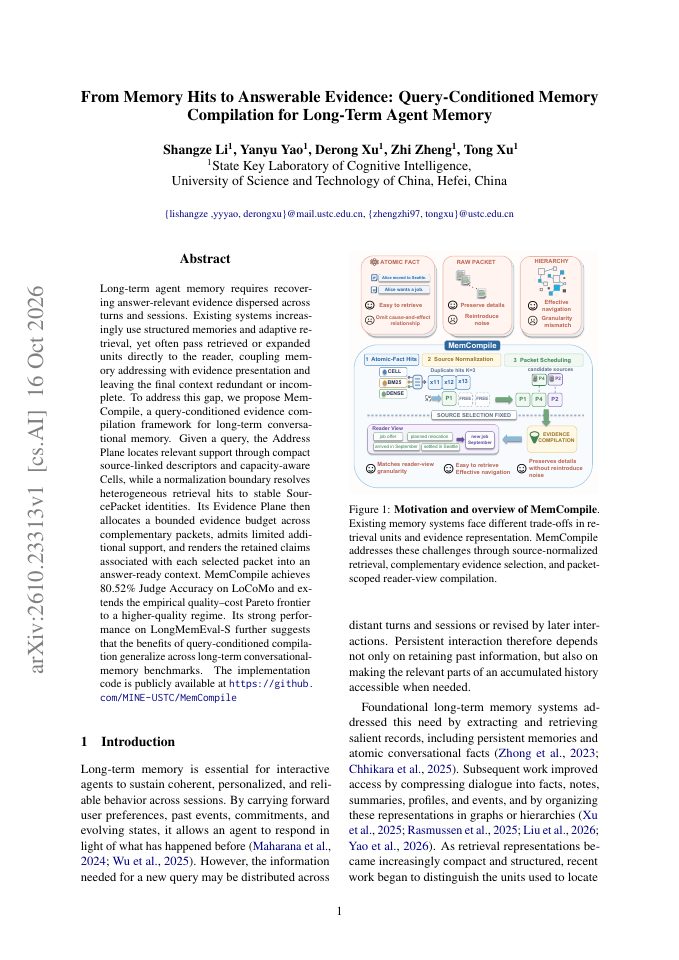
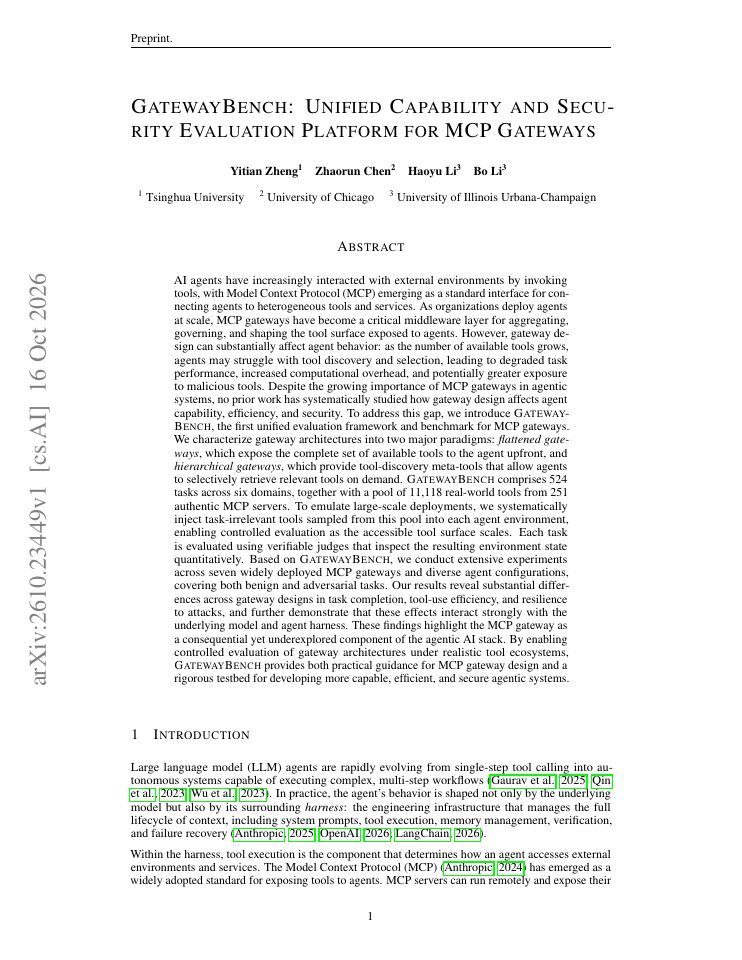
First page of From Memory Hits to Answerable Evidence: Query-Conditioned Memory Compilation for Long-Term Agent Memory
memory and contexttest

From Memory Hits to Answerable Evidence: Query-Conditioned Memory Compilation for Long-Term Agent Memory

MemCompile replaces the common pattern of passing retrieved or expanded memory units directly to the reader with a two-plane pipeline: an Address Plane that locates relevant support via compact descriptors and capacity-aware cells, and an Evidence Plane that allocates a bounded evidence budget across complementary packets and renders only retained claims into the final context. It costs additional pipeline complexity, extra query-conditioned processing stages (normalization, budgeting, rendering) that add latency and likely extra model calls per query, and requires implementing a non-trivial framework rather than a drop-in component. It can fail if the descriptors or cell capacities mislocate evidence, if the budget allocator drops necessary complementary packets, or if gains measured on LoCoMo and LongMemEval do not transfer to the reader's conversational distribution.

observed signal
1impl.
132stars
—citations
—claimed gain
abstract onlyReview decisionDownload skill ↓Original paper ↗
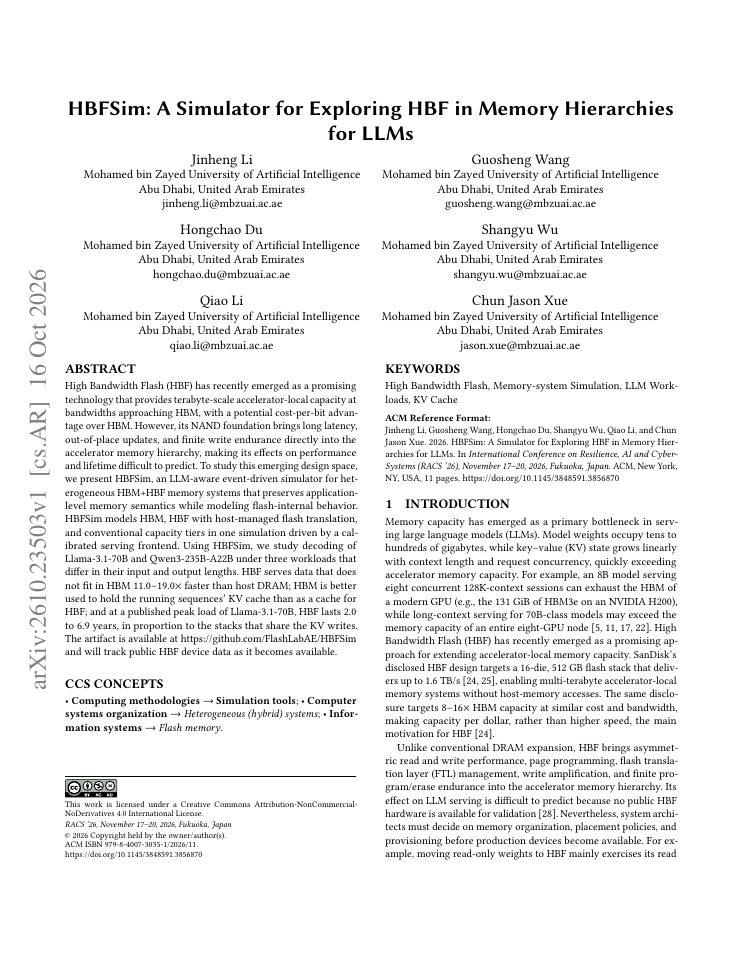
First page of MuninAI: A Self-Hosted Agentic Framework for Independent Research Groups
retrieval and RAGadopt

MuninAI: A Self-Hosted Agentic Framework for Independent Research Groups

It replaces both hosted literature assistants that require sending unpublished work to third parties and naive fixed top-k retrieve-then-answer pipelines, which the paper reports score below the unaided model. Costs include serving an open-weight model locally, building and maintaining the corpus and citation-graph index, and operating the agent harness with its tool and reading components, which adds engineering complexity beyond plain RAG. It can fail on corpora or question types different from the evaluation set, the abstention behavior means a substantial fraction of out-of-corpus questions go unanswered, and gains depend on the harness rather than the model, so a poorly configured deployment may not reproduce the reported accuracy.

observed signal
1impl.
132stars
—citations
2.26xclaimed gain
abstract onlyReview decisionDownload skill ↓Original paper ↗
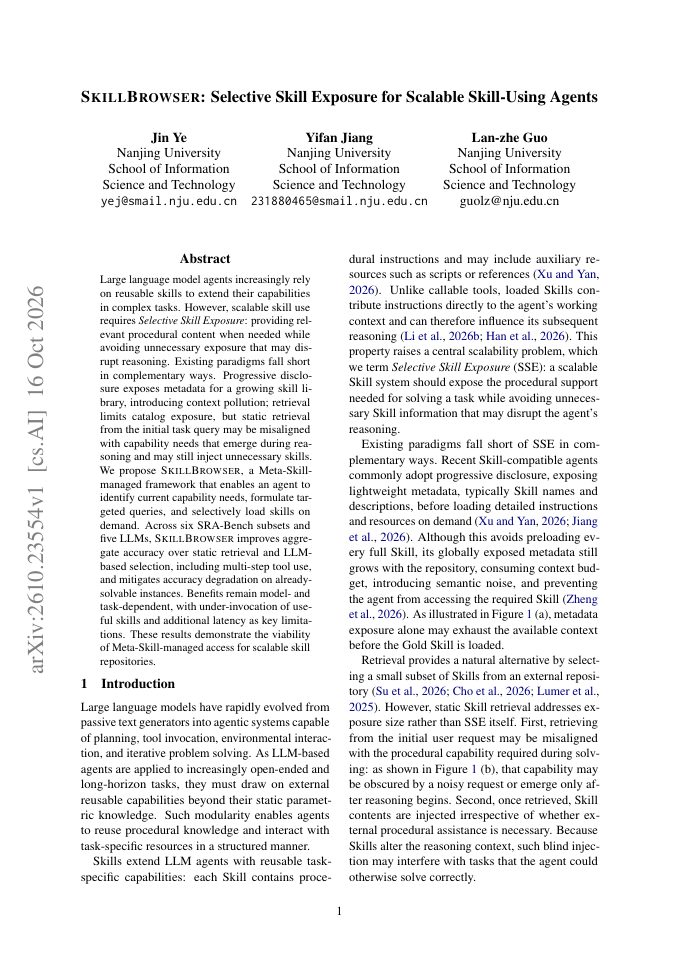
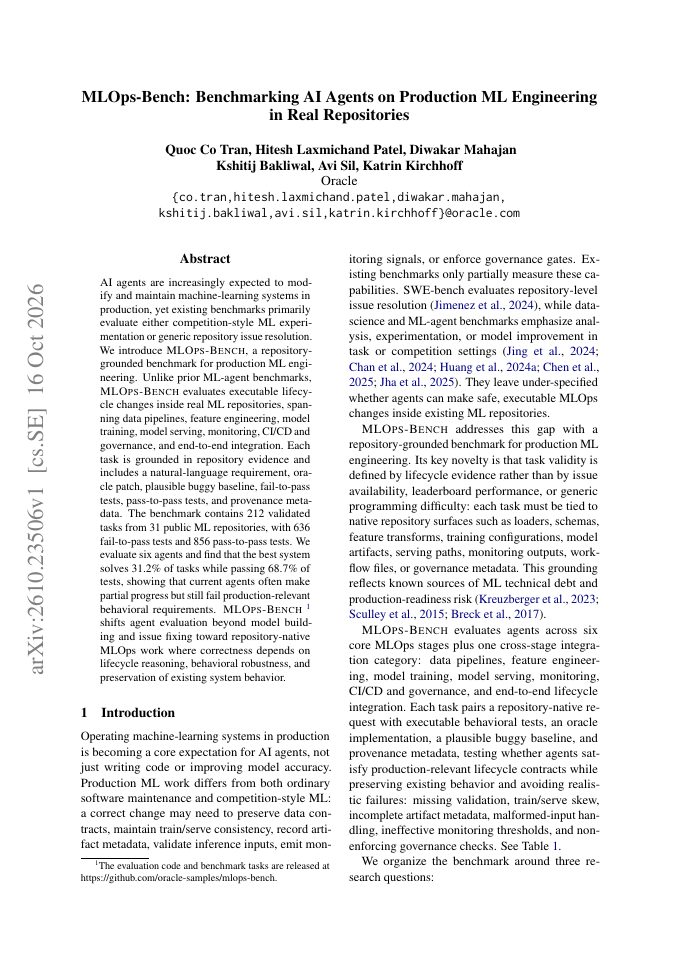
First page of SkillBrowser: Selective Skill Exposure for Scalable Skill-Using Agents
tool usetest

SkillBrowser: Selective Skill Exposure for Scalable Skill-Using Agents

SkillBrowser replaces static retrieval of skills from the initial task query, and one-shot LLM-based catalog selection, with a Meta-Skill that identifies emerging capability needs during reasoning, issues targeted queries, and loads skills on demand. It costs an additional orchestration layer plus extra LLM calls, which the paper acknowledges as added latency and added inference expense per task. It can fail through under-invocation of useful skills, and its benefits are model- and task-dependent, so weaker base models may not formulate effective skill queries.

observed signal
1impl.
132stars
—citations
—claimed gain
abstract onlyReview decisionDownload skill ↓Original paper ↗
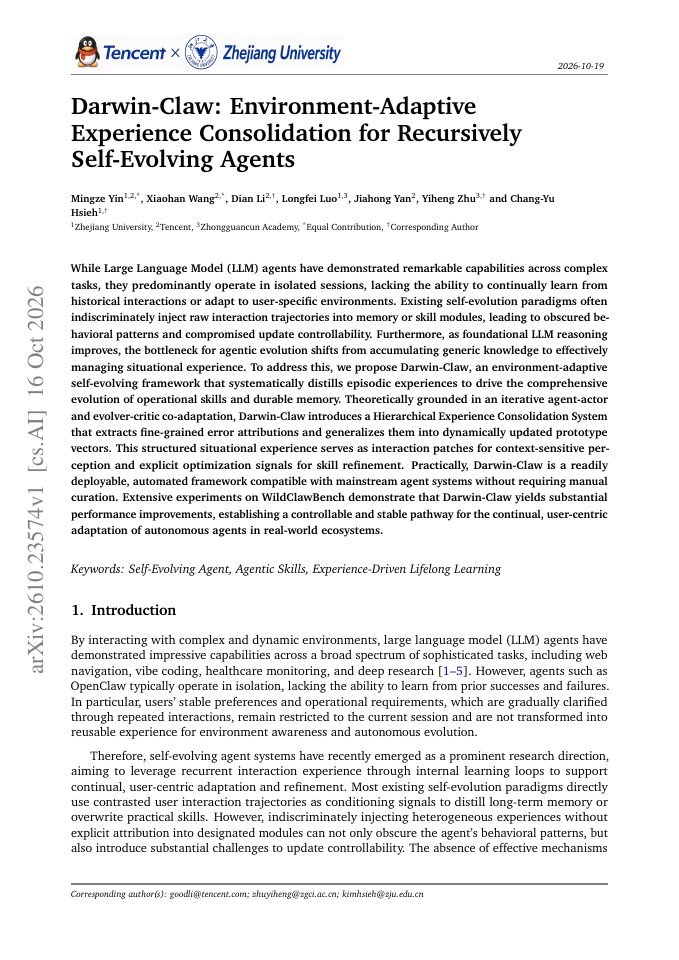
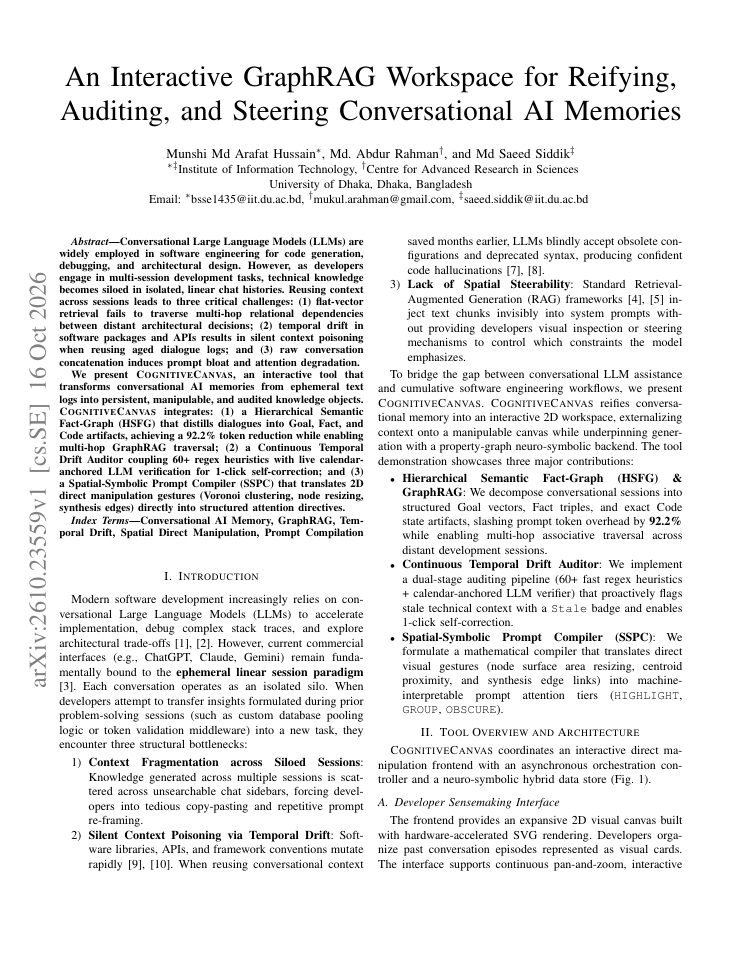
First page of Darwin-Claw: Environment-Adaptive Experience Consolidation for Recursively Self-Evolving Agents
memory and contexttest

Darwin-Claw: Environment-Adaptive Experience Consolidation for Recursively Self-Evolving Agents

Darwin-Claw replaces indiscriminate injection of raw interaction trajectories into agent memory and skill modules with a hierarchical consolidation pipeline that distills episodic experience into error attributions and prototype vectors used as context patches and skill-update signals. The cost is an additional offline evolver-critic processing stage per interaction cycle, meaning extra LLM calls (API spend or GPU time), new storage for prototype vectors, and added system complexity in the memory layer. It can fail through incorrect error attribution propagating into flawed prototype updates, benchmark overfitting since gains are shown only on the authors' own WildClawBench, and uncontrolled memory drift over long-horizon continual updates.

observed signal
1impl.
132stars
—citations
—claimed gain
abstract onlyReview decisionDownload skill ↓Original paper ↗
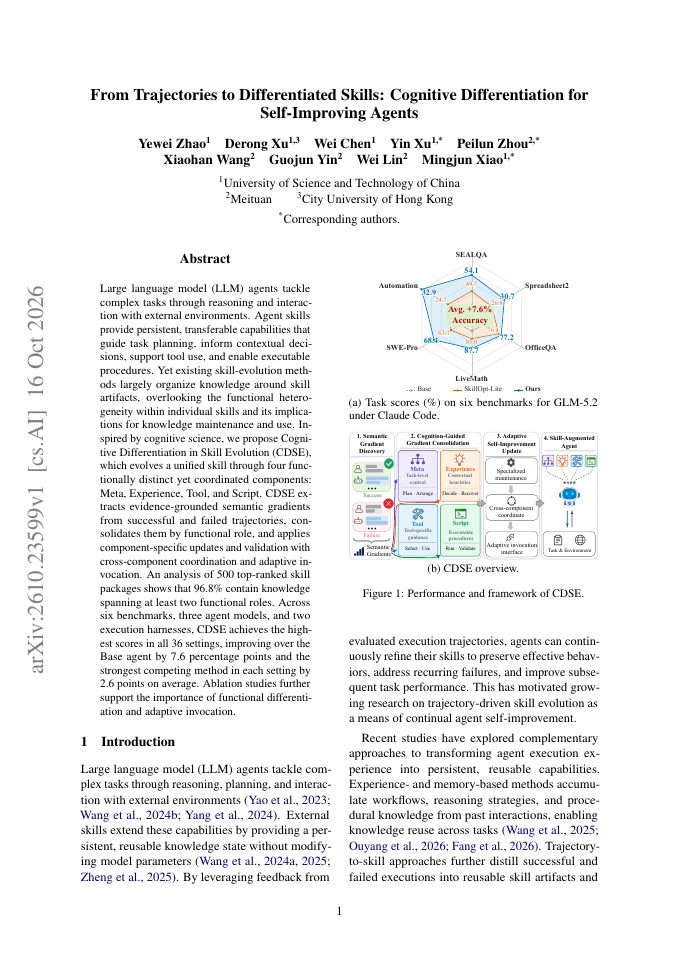
First page of From Trajectories to Differentiated Skills: Cognitive Differentiation for Self-Improving Agents
memory and contexttest

From Trajectories to Differentiated Skills: Cognitive Differentiation for Self-Improving Agents

CDSE replaces monolithic skill artifacts in self-improving agents with a unified skill split into four coordinated components (Meta, Experience, Tool, Script), updated separately from semantic gradients extracted from successful and failed trajectories. The cost is a more complex skill-maintenance pipeline: component-specific extraction, consolidation, validation, cross-component coordination, and adaptive invocation logic, plus additional LLM calls for trajectory analysis and update generation. It can fail if trajectory evidence is sparse or unrepresentative, if component updates conflict despite coordination, or if the benchmark gains do not transfer to the reader's narrower production task distribution.

observed signal
1impl.
132stars
—citations
—claimed gain
abstract onlyReview decisionDownload skill ↓Original paper ↗
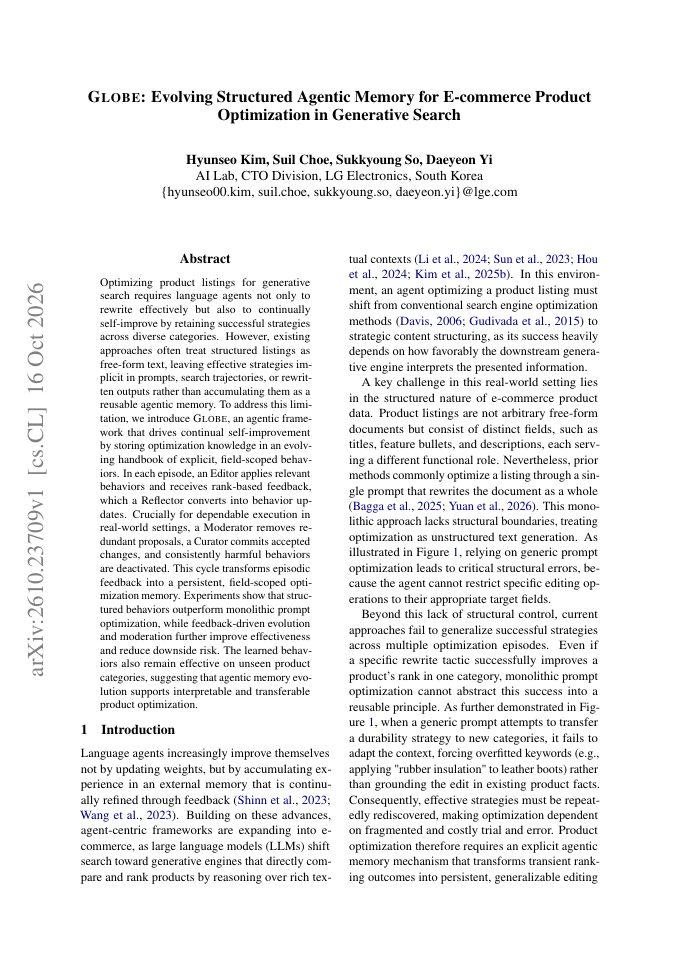
First page of GLOBE: Evolving Structured Agentic Memory for E-commerce Product Optimization in Generative Search
memory and contexttest

GLOBE: Evolving Structured Agentic Memory for E-commerce Product Optimization in Generative Search

GLOBE replaces monolithic prompt optimization for generative-search listing rewriting with an evolving handbook of explicit, field-scoped behaviors maintained by Editor, Reflector, Moderator, and Curator roles. The cost is multiple additional LLM calls per episode (reflection, moderation, curation) plus the complexity of maintaining and validating a persistent behavior store, all feasible on a single 24 GB GPU via APIs but increasing token spend. It can fail if rank-based feedback is noisy or sparse, causing harmful behaviors to be committed before deactivation catches them, and the demonstrated benefit is specific to e-commerce listing optimization rather than a general agent-memory result.

observed signal
1impl.
132stars
—citations
—claimed gain
abstract onlyReview decisionDownload skill ↓Original paper ↗
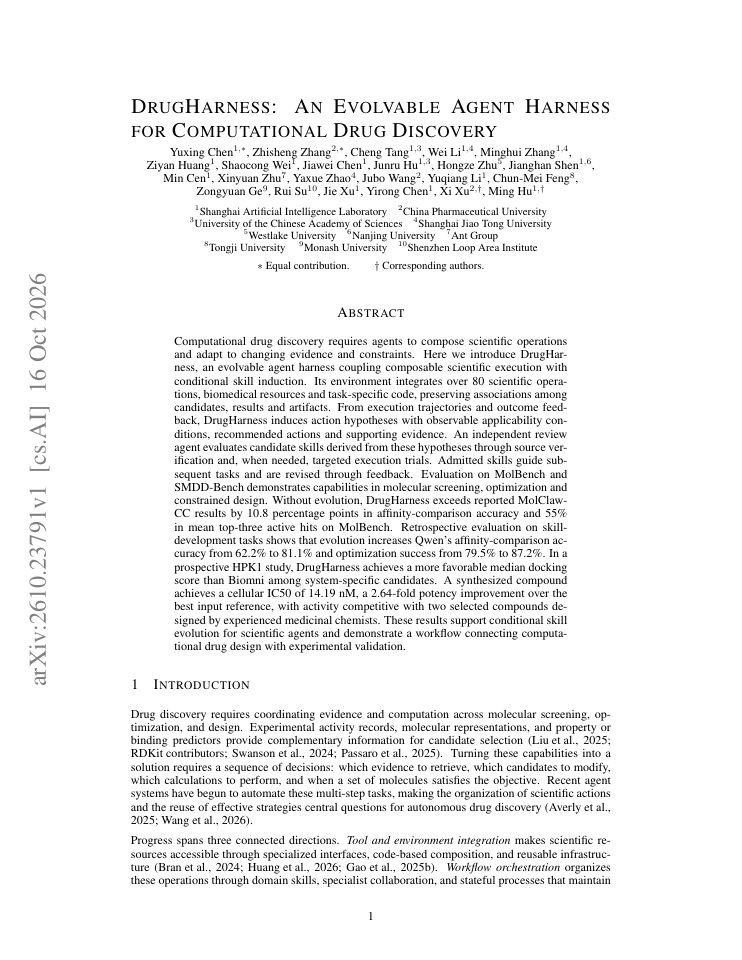
First page of DrugHarness: An Evolvable Agent Harness for Computational Drug Discovery
tool usewatch

DrugHarness: An Evolvable Agent Harness for Computational Drug Discovery

DrugHarness replaces static, hand-configured scientific agent pipelines with a tool-composing harness that induces, reviews, and revises reusable skills from execution trajectories. It costs a curated environment of over 80 scientific operations and biomedical resources, an additional review agent for skill verification and targeted execution trials, plus ongoing skill-library maintenance; it does not require foundation-model training, so a single-GPU or API-based deployment is feasible for the LLM component, but the scientific tooling itself carries licensing and compute demands. It can fail through induction of spurious skills from noisy execution feedback, overfitting to benchmark-like tasks, and wet-lab validation results that do not generalize beyond the reported HPK1 case.

observed signal
1impl.
132stars
—citations
1.55xclaimed gain
abstract onlyReview decisionDownload skill ↓Original paper ↗
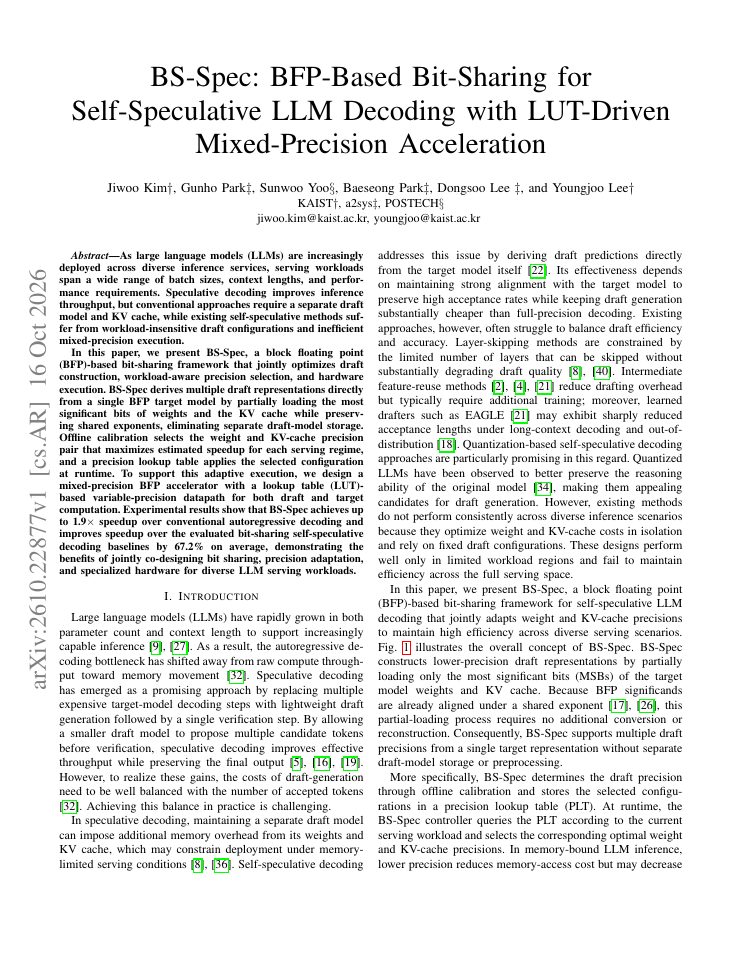
First page of BS-Spec: BFP-Based Bit-Sharing for Self-Speculative LLM Decoding with LUT-Driven Mixed-Precision Acceleration
speculative decodingwatch

BS-Spec: BFP-Based Bit-Sharing for Self-Speculative LLM Decoding with LUT-Driven Mixed-Precision Acceleration

BS-Spec replaces separate draft models and their KV caches by deriving drafts from a single block-floating-point target model, partially loading the most significant bits of weights and KV cache with shared exponents, plus offline calibration and a runtime precision lookup table. The reported gains depend on a custom mixed-precision BFP accelerator with an LUT-based variable-precision datapath, so realizing them costs specialized hardware, a calibration pipeline per serving regime, and BFP reformatting of model weights. On commodity GPUs the speedup may not materialize, acceptance rates can degrade under aggressive bit truncation for some workloads, and the per-regime calibration must be redone when the workload mix shifts.

observed signal
0impl.
4stars
—citations
1.9xclaimed gain
abstract onlyReview decisionDownload skill ↓Original paper ↗
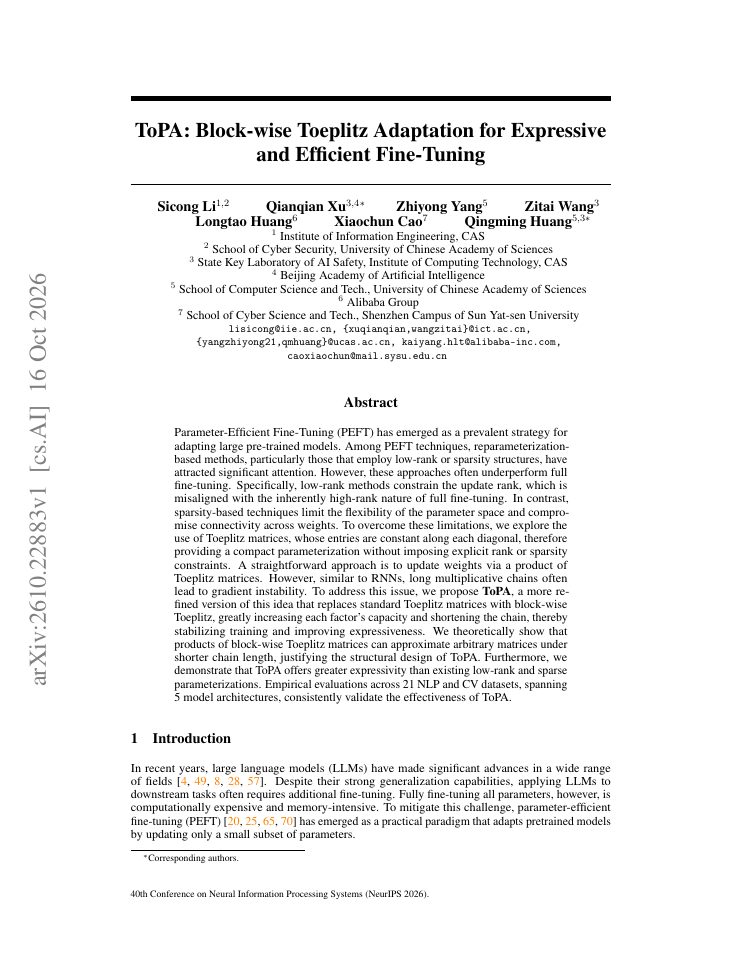
First page of ToPA: Block-wise Toeplitz Adaptation for Expressive and Efficient Fine-Tuning
efficient trainingtest

ToPA: Block-wise Toeplitz Adaptation for Expressive and Efficient Fine-Tuning

ToPA replaces low-rank (LoRA-style) or sparse update matrices with products of block-wise Toeplitz matrices, which impose no explicit rank or sparsity constraint and can approximate arbitrary updates with short factor chains. The cost is a non-standard parameterization: it is not supported by mainstream PEFT libraries, so adoption requires integrating custom code, and per-layer parameter count and compute depend on block size and chain length, which must be tuned against a LoRA baseline. It can fail if gradient instability persists for deeper chains, if the expressivity gain does not transfer to the reader's specific task, or if the method remains a research-stage implementation without maintained tooling.

observed signal
0impl.
122stars
—citations
—claimed gain
abstract onlyReview decisionDownload skill ↓Original paper ↗
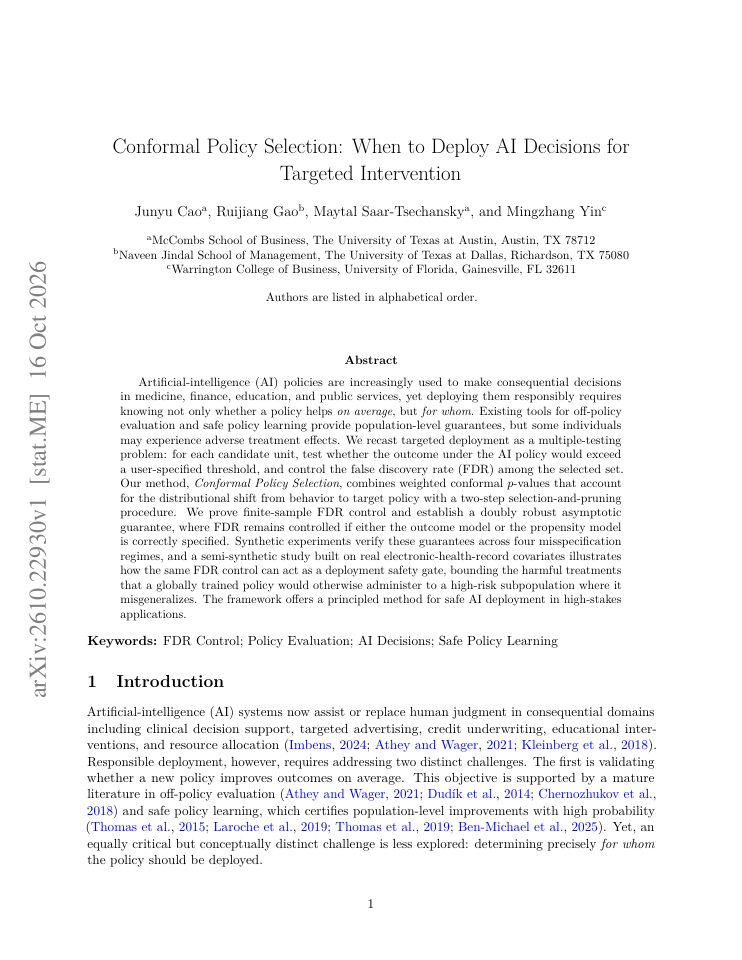
First page of Conformal Policy Selection: When to Deploy AI Decisions for Targeted Intervention
safety and guardrailstest

Conformal Policy Selection: When to Deploy AI Decisions for Targeted Intervention

It replaces ad hoc thresholding or average-effect criteria for deciding which individuals receive an AI-recommended treatment, substituting a multiple-testing procedure with weighted conformal p-values that bounds the false discovery rate among selected units. The cost is a held-out calibration set collected under the behavior policy, fitted propensity and outcome models, and added pipeline complexity rather than extra GPU or inference budget. It can fail under covariate shift beyond what the importance weights cover, when both nuisance models are misspecified simultaneously, or when calibration data are too scarce for the weighted conformal quantiles to be informative.

observed signal
0impl.
1573stars
—citations
—claimed gain
abstract onlyReview decisionDownload skill ↓Original paper ↗
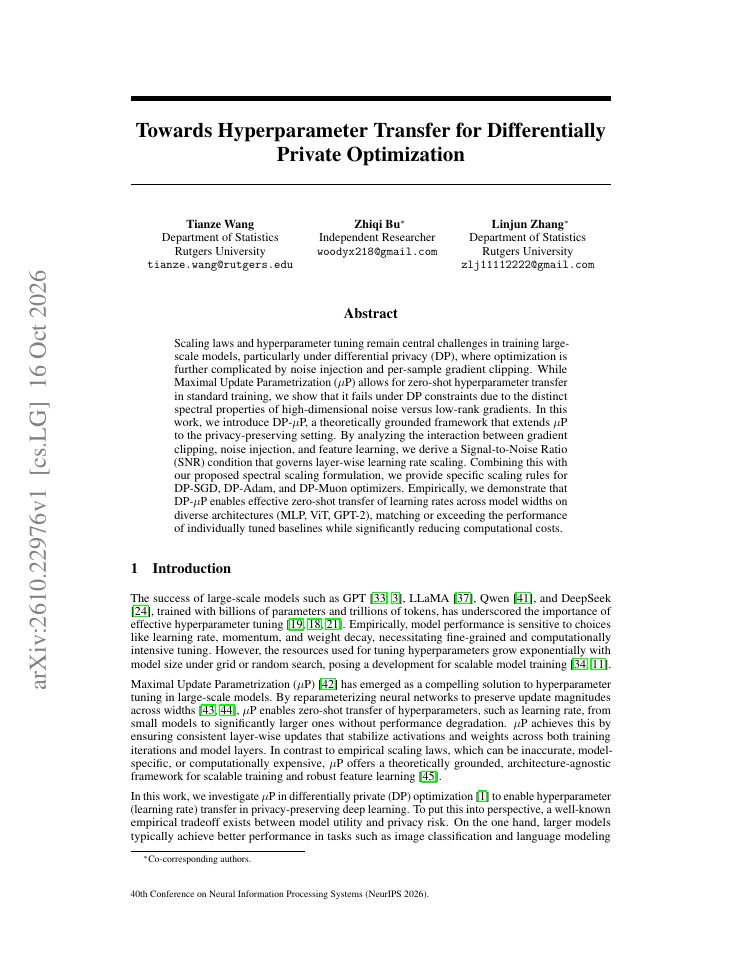
First page of Towards Hyperparameter Transfer for Differentially Private Optimization
efficient trainingwatch

Towards Hyperparameter Transfer for Differentially Private Optimization

DP-μP replaces per-width learning-rate sweeps (and standard μP, which the paper shows breaks under DP) with layer-wise learning-rate scaling rules derived from a signal-to-noise condition for gradient clipping and noise injection. The cost is implementing a modified parametrization and spectral scaling scheme in the training code, which adds complexity and constrains architectural choices, though inference cost is unchanged. The method can fail when assumptions behind the SNR condition are violated, such as atypical clipping thresholds, noise multipliers, or architectures far from those validated, and the results concern width transfer from scratch rather than fine-tuning of pretrained models.

observed signal
0impl.
4stars
—citations
—claimed gain
abstract onlyReview decisionDownload skill ↓Original paper ↗
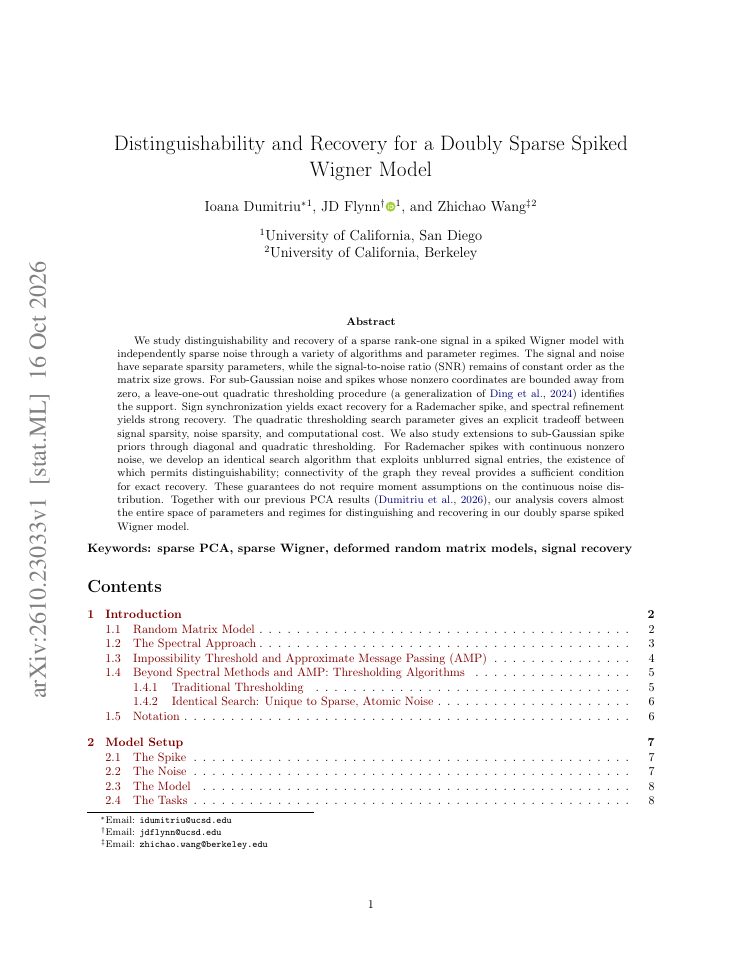
First page of Distinguishability and Recovery for a Doubly Sparse Spiked Wigner Model
othernot applicable

Distinguishability and Recovery for a Doubly Sparse Spiked Wigner Model

This is a theoretical random-matrix statistics paper on detecting and recovering a sparse rank-one signal in a spiked Wigner model; it does not replace any component of an LLM production stack. Its cost is irrelevant to the reader because the contribution consists of statistical thresholds, recovery guarantees, and a leave-one-out quadratic thresholding algorithm analyzed asymptotically, not an implementable inference or training optimization. Nothing fails after adoption because there is nothing to adopt for an engineer running one 24 GB GPU or third-party APIs.

observed signal
0impl.
0stars
—citations
—claimed gain
abstract onlyReview decisionDownload skill ↓Original paper ↗
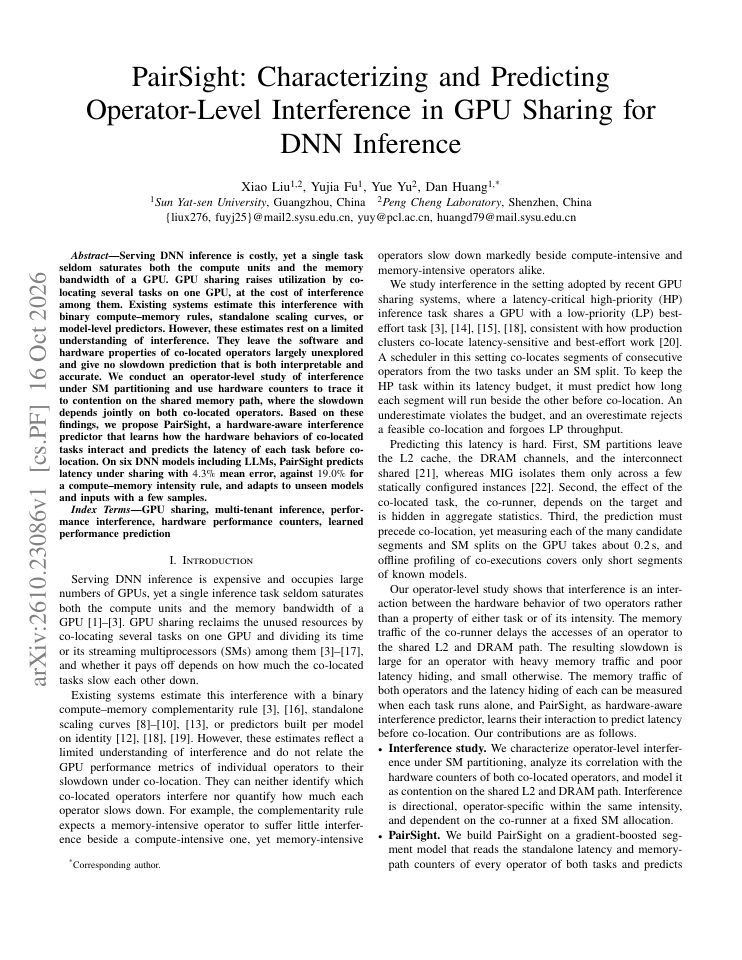
First page of PairSight: Characterizing and Predicting Operator-Level Interference in GPU Sharing for DNN Inference
serving and batchingtest

PairSight: Characterizing and Predicting Operator-Level Interference in GPU Sharing for DNN Inference

PairSight replaces binary compute-memory rules, standalone scaling curves, and model-level predictors used to estimate interference when co-locating DNN inference tasks on one GPU, using hardware-counter-based operator-level modeling of shared-memory-path contention. The cost is a profiling and training pipeline: collecting hardware counters for operator pairs, training the predictor, and integrating its predictions into a scheduler, which adds engineering complexity beyond simple heuristics. It can fail if the reader's serving stack lacks counter access (e.g., third-party APIs), if co-location pairs differ from profiled hardware behavior, or if the reader only ever runs one model per GPU, in which case there is no interference to predict.

observed signal
0impl.
4stars
—citations
—claimed gain
abstract onlyReview decisionDownload skill ↓Original paper ↗
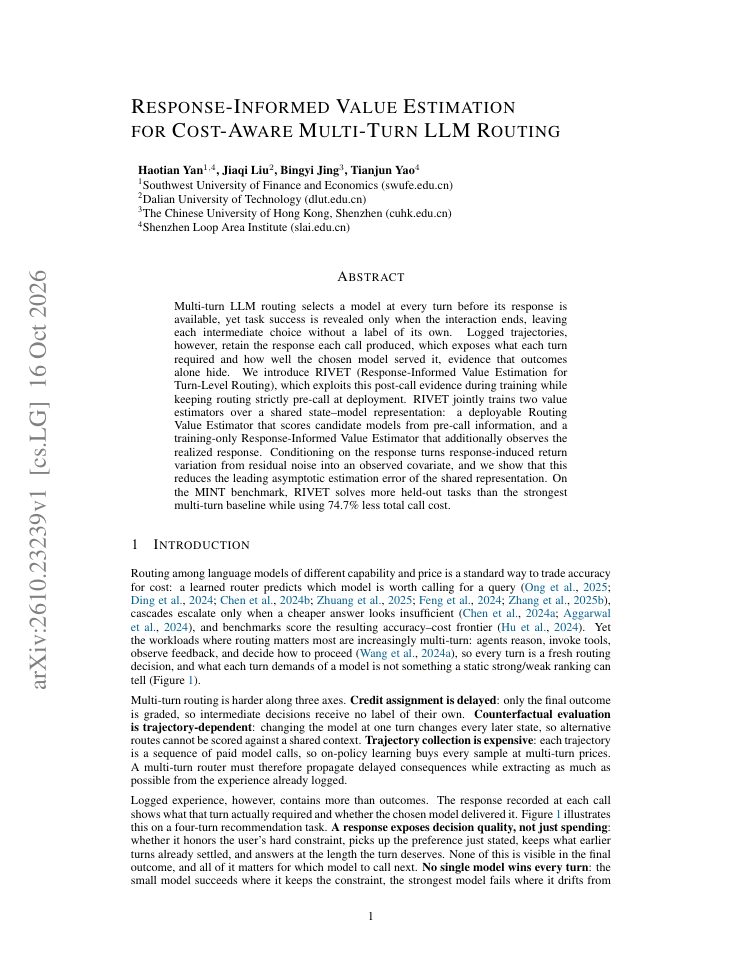
First page of Response-Informed Value Estimation for Cost-Aware Multi-Turn LLM Routing
serving and batchingtest

Response-Informed Value Estimation for Cost-Aware Multi-Turn LLM Routing

RIVET replaces static or outcome-only-trained multi-turn model routing with turn-level routing trained via two value estimators, one of which conditions on the realized response during training only. It costs an offline training pipeline over logged trajectories, two value networks, and labeled task outcomes, plus per-turn scoring overhead at deployment; routing itself stays pre-call and cheap. It can fail when logged trajectories are scarce or off-distribution relative to production traffic, when candidate model prices or behaviors change after training, and on benchmarks unlike MINT where response-informed credit assignment may transfer poorly.

observed signal
0impl.
0stars
—citations
3.95xclaimed gain
abstract onlyReview decisionDownload skill ↓Original paper ↗
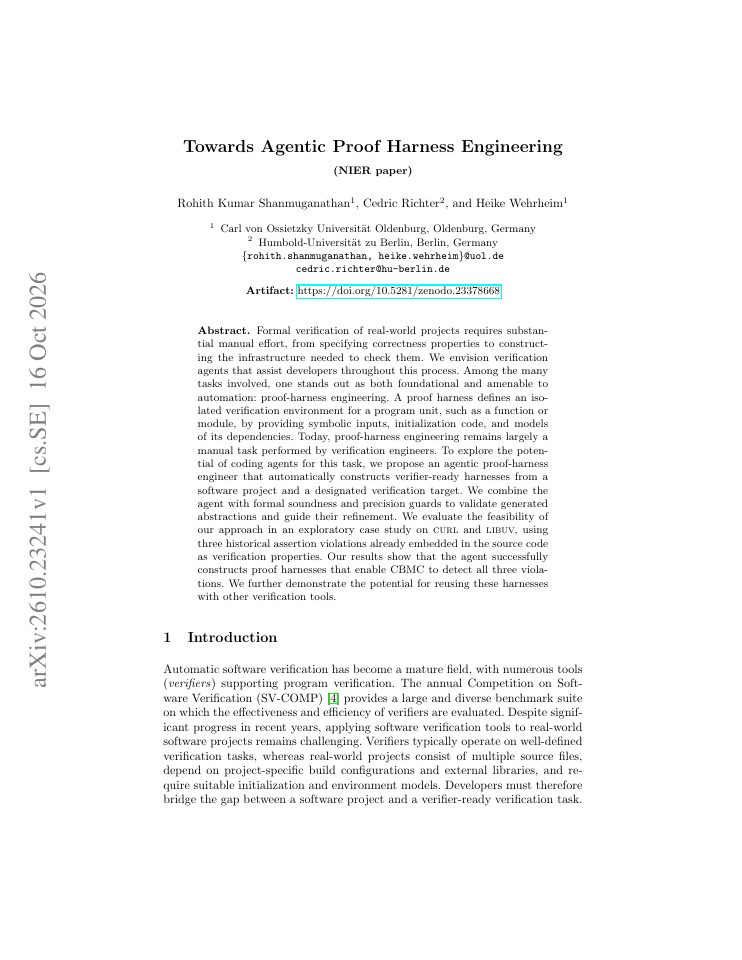
First page of Towards Agentic Proof Harness Engineering
coding agentswatch

Towards Agentic Proof Harness Engineering

The method replaces manual proof-harness engineering, in which verification engineers write symbolic inputs, initialization code, and dependency models for a target unit, with an LLM coding agent that constructs and refines harnesses under formal soundness and precision guards. It costs an agentic LLM workflow plus a working formal-verification toolchain such as CBMC, and the evaluation covers only three pre-existing bugs in two C projects, so there is no measured speed, cost, or coverage improvement. It can fail through unsound or imprecise dependency abstractions that the guards miss, targets outside the demonstrated C/CBMC setting, and projects lacking suitable assertion-level properties.

observed signal
0impl.
0stars
—citations
—claimed gain
abstract onlyReview decisionDownload skill ↓Original paper ↗
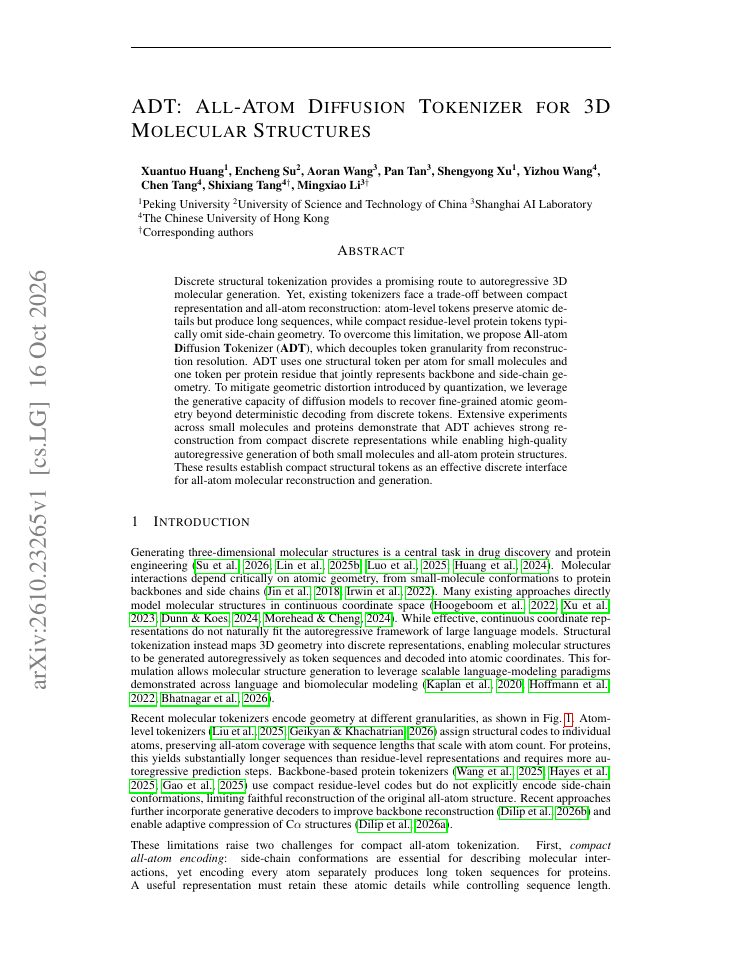
First page of ADT: All-Atom Diffusion Tokenizer for 3D Molecular Structures
othernot applicable

ADT: All-Atom Diffusion Tokenizer for 3D Molecular Structures

ADT replaces atom-level token sequences and residue-only protein tokens with a compact discrete representation (one token per small-molecule atom, one per protein residue) whose quantization loss is repaired by a diffusion decoder instead of deterministic decoding. It costs the training and inference overhead of a diffusion model on top of the tokenizer and autoregressive generator, plus domain-specific data and evaluation pipelines. It can fail through residual geometric distortion from quantization that the diffusion step does not fully recover, and the abstract reports no validated downstream metrics (e.g., binding, synthesizability), so reconstruction quality may not translate to useful generated molecules.

observed signal
0impl.
0stars
—citations
—claimed gain
abstract onlyReview decisionDownload skill ↓Original paper ↗
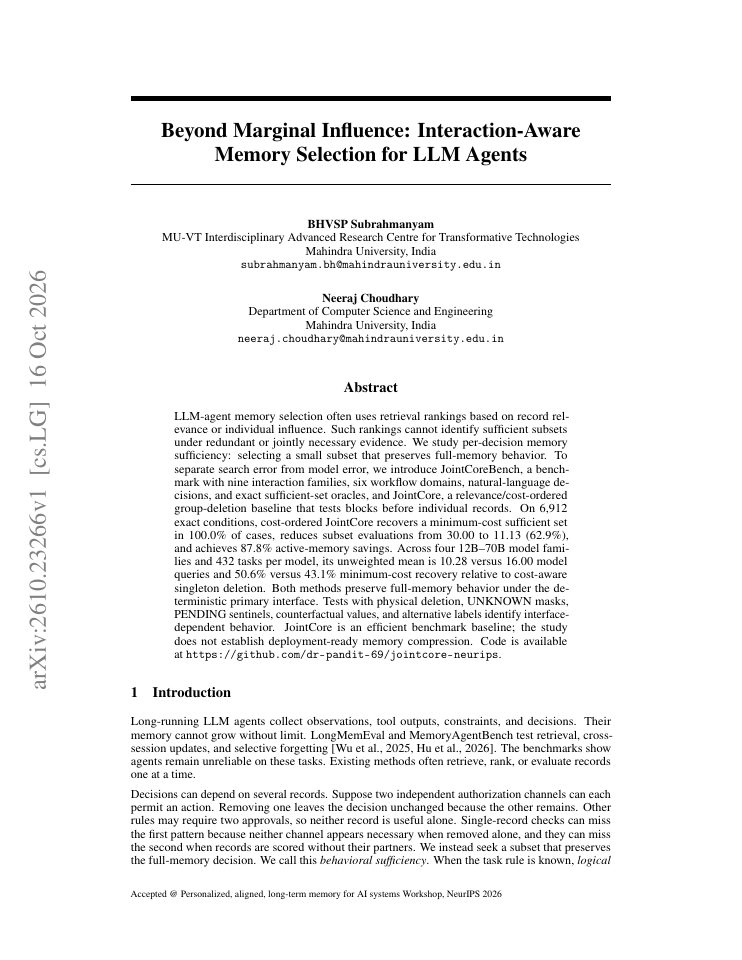
First page of Beyond Marginal Influence: Interaction-Aware Memory Selection for LLM Agents
memory and contextwatch

Beyond Marginal Influence: Interaction-Aware Memory Selection for LLM Agents

JointCore replaces singleton-record deletion and relevance-ranked retrieval with relevance-cost-ordered group deletion that tests blocks of records before individuals when selecting a minimal sufficient memory subset for LLM agents. Its cost is additional subset evaluations and a more complex deletion procedure, and the authors explicitly state it is a benchmark baseline on JointCoreBench rather than deployment-ready memory compression. Behavior is interface-dependent: physical deletion, UNKNOWN masks, PENDING sentinels, and counterfactual values produce different results, so sufficiency guarantees established under the deterministic primary interface may not transfer to a production memory store.

observed signal
0impl.
10stars
—citations
1.56xclaimed gain
abstract onlyReview decisionDownload skill ↓Original paper ↗
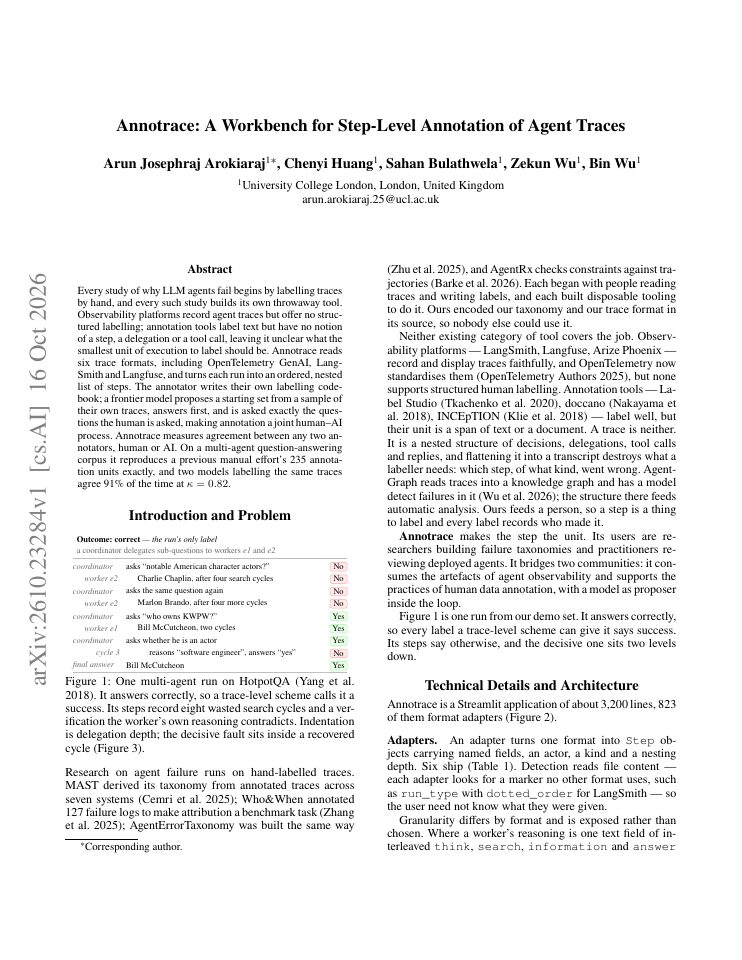
First page of Annotrace: A Workbench for Step-Level Annotation of Agent Traces
agent evaluationadopt

Annotrace: A Workbench for Step-Level Annotation of Agent Traces

Annotrace replaces the per-study practice of hand-building throwaway scripts to label agent failure traces, importing six trace formats (OpenTelemetry GenAI, LangSmith, Langfuse among them) into an ordered, nested step list with a user-defined codebook, AI-proposed starting labels, and inter-annotator agreement measurement between human and model annotators. It costs only local tooling plus frontier-model API calls for label proposal and pre-annotation, with no GPU, cluster, or training requirement, fitting the constrained infrastructure directly. It can fail if the model-proposed codebook biases the human codebook toward the model's own error categories, if AI pre-answers anchor human judgment and inflate measured agreement, and if the six supported formats do not cover the team's actual tracing stack.

observed signal
0impl.
10stars
—citations
—claimed gain
abstract onlyReview decisionDownload skill ↓Original paper ↗
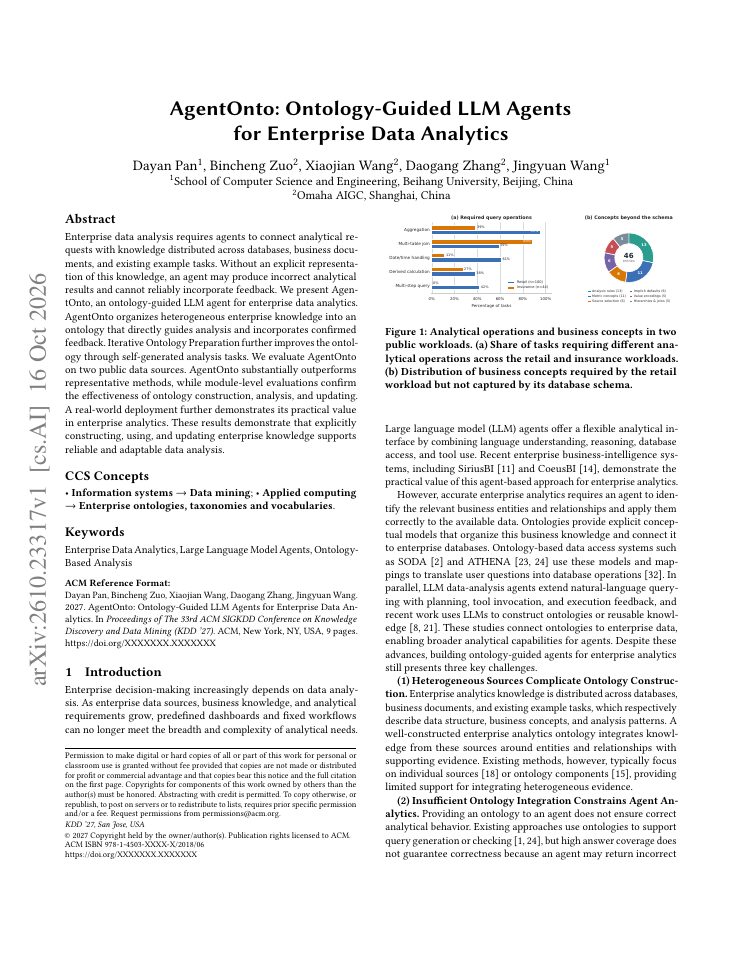
First page of AgentOnto: Ontology-Guided LLM Agents for Enterprise Data Analytics
retrieval and RAGtest

AgentOnto: Ontology-Guided LLM Agents for Enterprise Data Analytics

Replaces ad hoc prompt-only agents that connect analytical requests to databases and documents without an explicit knowledge representation, substituting a curated ontology that guides analysis and absorbs confirmed feedback. Costs include building and maintaining the ontology, an iterative preparation phase with self-generated tasks, and added orchestration complexity around the LLM, though inference itself runs on standard API access. Can fail if the ontology is incomplete or drifts from the underlying schemas, if confirmed feedback is sparse or wrong, or if enterprise data access and document quality do not match the evaluation setting.

observed signal
0impl.
10stars
—citations
—claimed gain
abstract onlyReview decisionDownload skill ↓Original paper ↗
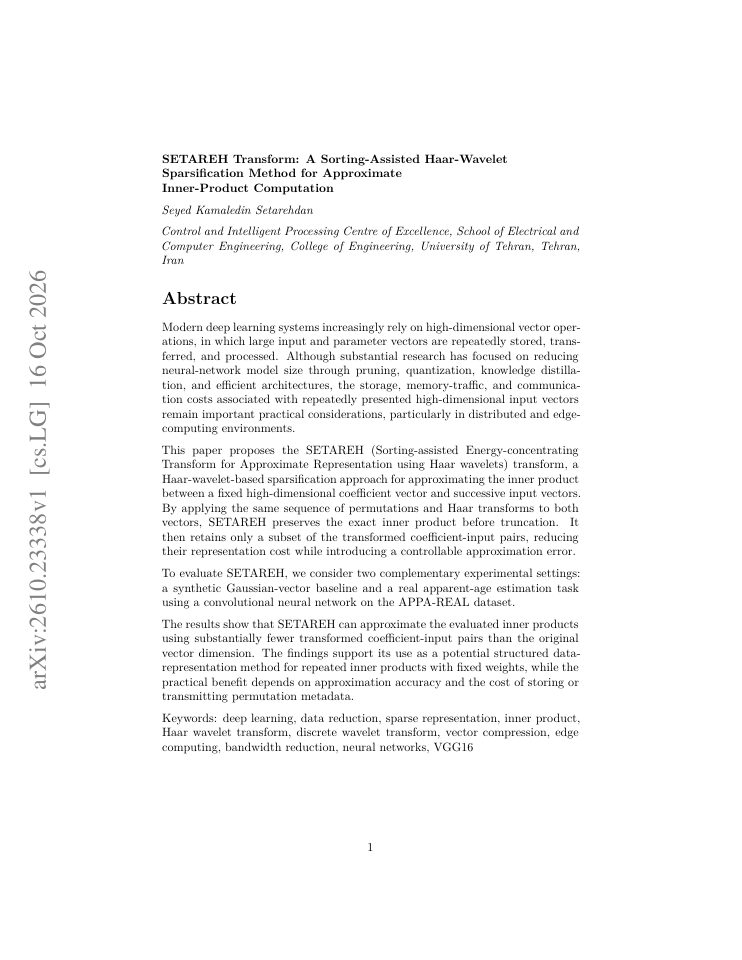
First page of SETAREH Transform: A Sorting-Assisted Haar-Wavelet Sparsification Method for Approximate Inner-Product Computation
sparsity and pruningwatch

SETAREH Transform: A Sorting-Assisted Haar-Wavelet Sparsification Method for Approximate Inner-Product Computation

The method replaces exact full-dimension inner products between a fixed weight vector and successive input vectors with a truncated computation in a permuted Haar-wavelet domain, retaining only a subset of transformed coefficient-input pairs. It costs the per-vector permutation and Haar transform computation, storage or transmission of permutation metadata, and a controllable but nonzero approximation error. It can fail if the retained-pair budget needed for acceptable accuracy negates the memory-traffic savings, if energy does not concentrate after sorting on real input distributions, or if metadata overhead dominates at moderate vector dimensions.

observed signal
0impl.
0stars
—citations
—claimed gain
abstract onlyReview decisionDownload skill ↓Original paper ↗
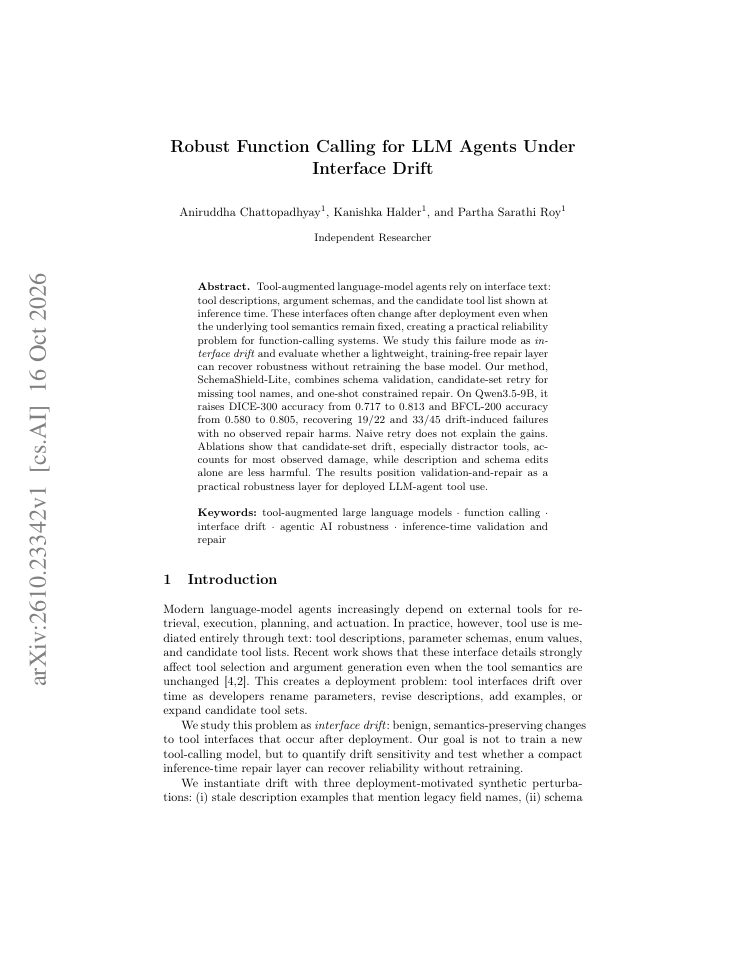
First page of Robust Function Calling for LLM Agents Under Interface Drift
failure recoverytest

Robust Function Calling for LLM Agents Under Interface Drift

SchemaShield-Lite replaces naive retry or model retraining as the response to interface drift in tool-augmented agents, wrapping the model's function-calling output with schema validation, candidate-set retry for missing tool names, and one-shot constrained repair. It costs additional inference calls on repair attempts, a modest increase in orchestration complexity, and depends on access to the candidate tool list and schemas at inference time. It can fail when the true failure is semantic rather than interface-level, when candidate-set drift is not the dominant damage mode in the reader's deployment, or when the repair call itself produces an invalid or wrong tool selection, although the paper reports no observed repair harms on its benchmarks.

observed signal
0impl.
10stars
—citations
—claimed gain
abstract onlyReview decisionDownload skill ↓Original paper ↗

Research signals

Three views of the same evidence: adoption against attention, publication cadence by research area, and reported gains when coverage is sufficient.

color = research area

01 · attention × adoption

The research frontier

Look to the upper left for independent implementation before mass attention.

compare by
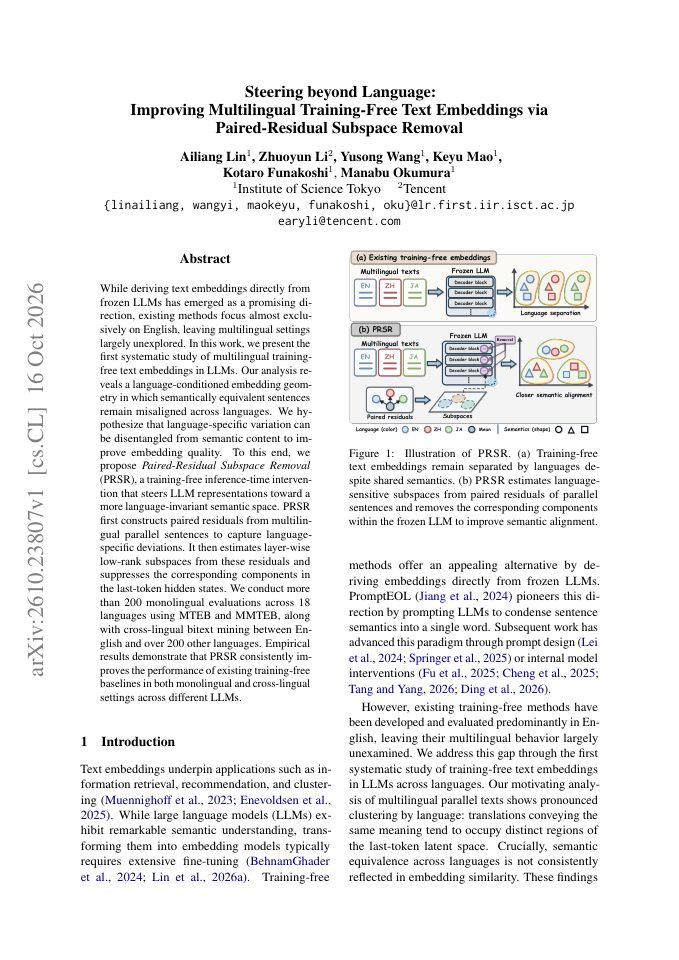
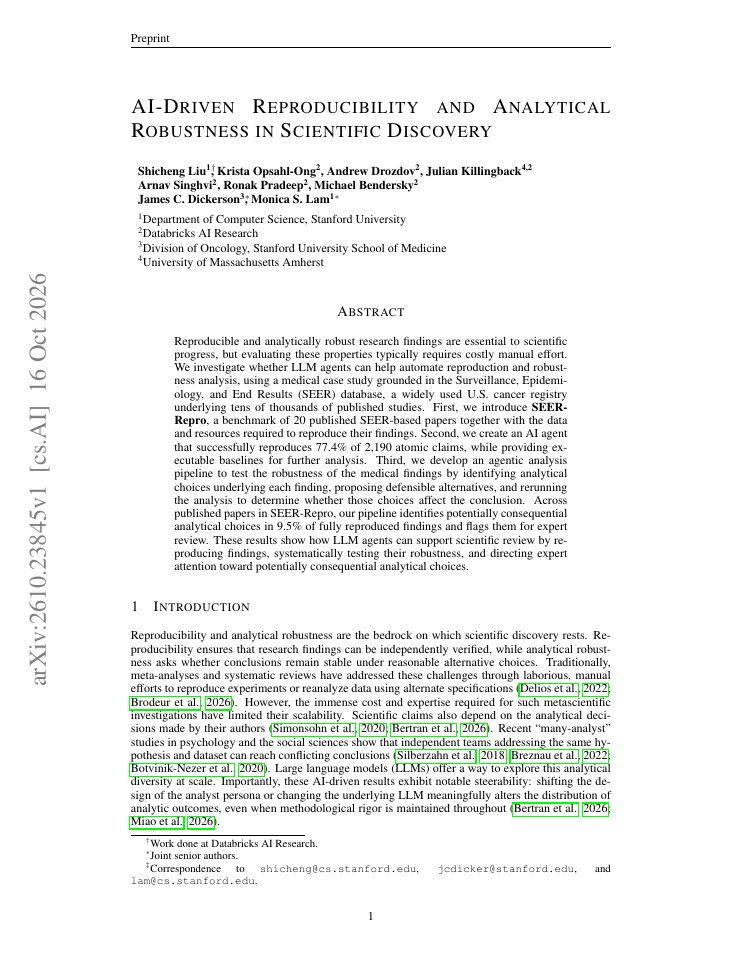
Each point represents one paper. Higher means more independent implementations; farther right means more GitHub stars.AsymSpec: Context-Asymmetric Speculative Decoding for Agentic LLMs: 1 GitHub star; 2 independent implementationsTowards Mitigating Fabricated Consensus: The Active Provenance Gate for Multi-Agent Debate Synthesis: 2 GitHub stars; 2 independent implementationsDeepEdu-v1: Efficient and Scalable Agentic LLMs for Vietnamese Education: 0 GitHub stars; 2 independent implementationsBS-Spec: BFP-Based Bit-Sharing for Self-Speculative LLM Decoding with LUT-Driven Mixed-Precision Acceleration: 4 GitHub stars; 0 independent implementationsToPA: Block-wise Toeplitz Adaptation for Expressive and Efficient Fine-Tuning: 122 GitHub stars; 0 independent implementationsConformal Policy Selection: When to Deploy AI Decisions for Targeted Intervention: 1573 GitHub stars; 0 independent implementationsTowards Hyperparameter Transfer for Differentially Private Optimization: 4 GitHub stars; 0 independent implementationsPrism Attention: Proposal-Refined Index Sharing Mechanism for Efficient LLMs Inference: 127 GitHub stars; 2 independent implementationsDistinguishability and Recovery for a Doubly Sparse Spiked Wigner Model: 0 GitHub stars; 0 independent implementationsPairSight: Characterizing and Predicting Operator-Level Interference in GPU Sharing for DNN Inference: 4 GitHub stars; 0 independent implementationsChinese Decision: A Family of Language Models for Single-Pass Probabilistic Decision-Making: 126 GitHub stars; 1 independent implementationResponse-Informed Value Estimation for Cost-Aware Multi-Turn LLM Routing: 0 GitHub stars; 0 independent implementationsTowards Agentic Proof Harness Engineering: 0 GitHub stars; 0 independent implementationsIgnored, Not Refused: What Low Prompt-Injection Success Rates Hide in Small Tool-Using Agents: 15 GitHub stars; 2 independent implementationsADT: All-Atom Diffusion Tokenizer for 3D Molecular Structures: 0 GitHub stars; 0 independent implementationsBeyond Marginal Influence: Interaction-Aware Memory Selection for LLM Agents: 10 GitHub stars; 0 independent implementationsAnnotrace: A Workbench for Step-Level Annotation of Agent Traces: 10 GitHub stars; 0 independent implementationsFrom Memory Hits to Answerable Evidence: Query-Conditioned Memory Compilation for Long-Term Agent Memory: 132 GitHub stars; 1 independent implementationAgentOnto: Ontology-Guided LLM Agents for Enterprise Data Analytics: 10 GitHub stars; 0 independent implementationsSETAREH Transform: A Sorting-Assisted Haar-Wavelet Sparsification Method for Approximate Inner-Product Computation: 0 GitHub stars; 0 independent implementationsRobust Function Calling for LLM Agents Under Interface Drift: 10 GitHub stars; 0 independent implementationsHow Finite-Rank Bottlenecks Shape the Low-Rank Adaptation Landscape: 4 GitHub stars; 0 independent implementationsMonitor-Validity Failures: LLM Safety Evidence Paths at Evolving Framework Boundaries: 1573 GitHub stars; 0 independent implementationsGUMPIM: Unitary and Malleable Memory for Processing-in-Memory with Guaranteed PIM Pages: 4 GitHub stars; 0 independent implementationsConQUESTA: Topology-Aware Post-Training Structural Pruning of Quantum Neural Networks: 0 GitHub stars; 0 independent implementationsGatewayBench: Unified Capability and Security Evaluation Platform for MCP Gateways: 1695 GitHub stars; 2 independent implementationsMuninAI: A Self-Hosted Agentic Framework for Independent Research Groups: 132 GitHub stars; 1 independent implementationHBFSim: A Simulator for Exploring HBF in Memory Hierarchies for LLMs: 0 GitHub stars; 0 independent implementationsMLOps-Bench: Benchmarking AI Agents on Production ML Engineering in Real Repositories: 0 GitHub stars; 0 independent implementationsSkillBrowser: Selective Skill Exposure for Scalable Skill-Using Agents: 132 GitHub stars; 1 independent implementationAn Interactive GraphRAG Workspace for Reifying, Auditing, and Steering Conversational AI Memories: 0 GitHub stars; 0 independent implementationsBMuon: Budgeting Muon's Spectral Geometry for Structured Compressibility: 0 GitHub stars; 0 independent implementationsDarwin-Claw: Environment-Adaptive Experience Consolidation for Recursively Self-Evolving Agents: 132 GitHub stars; 1 independent implementationRL-Guided Temporal Localization for Dual-Channel Retrieval in Long-Horizon Agent Memory: 132 GitHub stars; 2 independent implementationsFrom Trajectories to Differentiated Skills: Cognitive Differentiation for Self-Improving Agents: 132 GitHub stars; 1 independent implementationTrajectory-Triggered Sparse Collaborative Decoding: 122 GitHub stars; 0 independent implementationsOn the possibilities and limitations of LLM-based multi-agent systems for multi-criteria decision-making in healthcare operations management: 10 GitHub stars; 0 independent implementationsGLOBE: Evolving Structured Agentic Memory for E-commerce Product Optimization in Generative Search: 132 GitHub stars; 1 independent implementationDLite: History-free Speculative Decoding for Agentic AI: 132 GitHub stars; 2 independent implementationsDrugHarness: An Evolvable Agent Harness for Computational Drug Discovery: 132 GitHub stars; 1 independent implementationSteering beyond Language: Improving Multilingual Training-Free Text Embeddings via Paired-Residual Subspace Removal: 122 GitHub stars; 0 independent implementationsAcceptance Is Not Speed: Length Inflation in Training-Free Lossy Speculative Decoding: 122 GitHub stars; 1 independent implementationAI-Driven Reproducibility and Analytical Robustness in Scientific Discovery: 122 GitHub stars; 0 independent implementations

Papers above 1000 stars or 200 citations are not scored. They have already broken through the attention threshold, while Paperraft is designed to identify earlier signals.

02 · cadence

Research areas over time

Compare monthly publication volume on a shared scale and calendar.

coding agentsmax 7Aug 26: 0 papersSep 26: 0 papersOct 26: 1 paperAug 26Oct 26efficient architecturesmax 7Aug 26: 0 papersSep 26: 0 papersOct 26: 1 paperAug 26Oct 26agent evaluationmax 7Aug 26: 0 papersSep 26: 0 papersOct 26: 5 papersAug 26Oct 26speculative decodingmax 7Aug 26: 1 paperSep 26: 0 papersOct 26: 4 papersAug 26Oct 26sparsity and pruningmax 7Aug 26: 0 papersSep 26: 0 papersOct 26: 4 papersAug 26Oct 26memory and contextmax 7Aug 26: 0 papersSep 26: 1 paperOct 26: 7 papersAug 26Oct 26multi-agent orchestrationmax 7Aug 26: 0 papersSep 26: 1 paperOct 26: 0 papersAug 26Oct 26othermax 7Aug 26: 0 papersSep 26: 0 papersOct 26: 3 papersAug 26Oct 26failure recoverymax 7Aug 26: 0 papersSep 26: 0 papersOct 26: 1 paperAug 26Oct 26retrieval and RAGmax 7Aug 26: 0 papersSep 26: 0 papersOct 26: 3 papersAug 26Oct 26safety and guardrailsmax 7Aug 26: 0 papersSep 26: 0 papersOct 26: 2 papersAug 26Oct 26serving and batchingmax 7Aug 26: 0 papersSep 26: 0 papersOct 26: 3 papersAug 26Oct 26efficient trainingmax 7Aug 26: 0 papersSep 26: 0 papersOct 26: 3 papersAug 26Oct 26tool usemax 7Aug 26: 0 papersSep 26: 0 papersOct 26: 3 papersAug 26Oct 26

Every panel uses the same calendar and vertical scale. An empty column means no papers were recorded.

Method under scrutiny

Inspect the highest-ranked paper, every repository behind its signal, and the rule used to classify each one.

DeepEdu-v1: Efficient and Scalable Agentic LLMs for Vietnamese Education

memory and context · test · 2 of 2 implementations are independent · 2x gain in speed (reported by the authors; not independently verified)

The method replaces per-sub-chunk token selection in long-context inference and gradient-based fine-tuning for domain adaptation with per-cluster selection plus a curated playbook accumulated from verified past interactions. It requires building and maintaining a custom inference path on top of vLLM and an agentic curation pipeline, adding engineering complexity and dependence on interaction logs whose quality determines playbook value. It can fail on short or atypical contexts where clustering assumptions break, on benchmarks outside the tested financial-reasoning and interactive-agent tracks, and if the playbook accumulates unverified or drifted local knowledge.

Exclusions and controls

Every exclusion is counted and published.

Exclusion counts were not recorded for this edition.

0 previously indexed papers were rechecked in this run.

Paperraft tracks one signal: how many independent implementations a paper attracts on GitHub after author-owned repositories are removed. This is a discovery signal to investigate, not a measure of implementation quality.

It does not claim that a method works. Paperraft runs no reproduction benchmarks. Reported gains remain author claims until independently tested. Papers above the attention threshold are excluded because this publication is designed to identify research before consensus forms.