Skip to content

archived edition · 2026-10-16

PaperraftFind the AI research
worth testing.

Understand what a paper changes, what it costs, and whether it fits your next build. Explore research on faster LLM inference, agent memory, and evaluation, with the original sources in reach.

Start with a brief. Follow the evidence. Choose a test.

edition
2026-10-16
briefs
42
research areas
16
independent implementations
20

28 of 42 papers in the index (67%) have no independent implementations.

Research index

Search by topic, browse a research area, or sort by date. Read a brief, open the original paper, and inspect the available evidence before deciding what to test.

showing30 of 42
sort by
First page of Ajar: Measuring Open Privilege in Agent Defenses
safety and guardrailstest

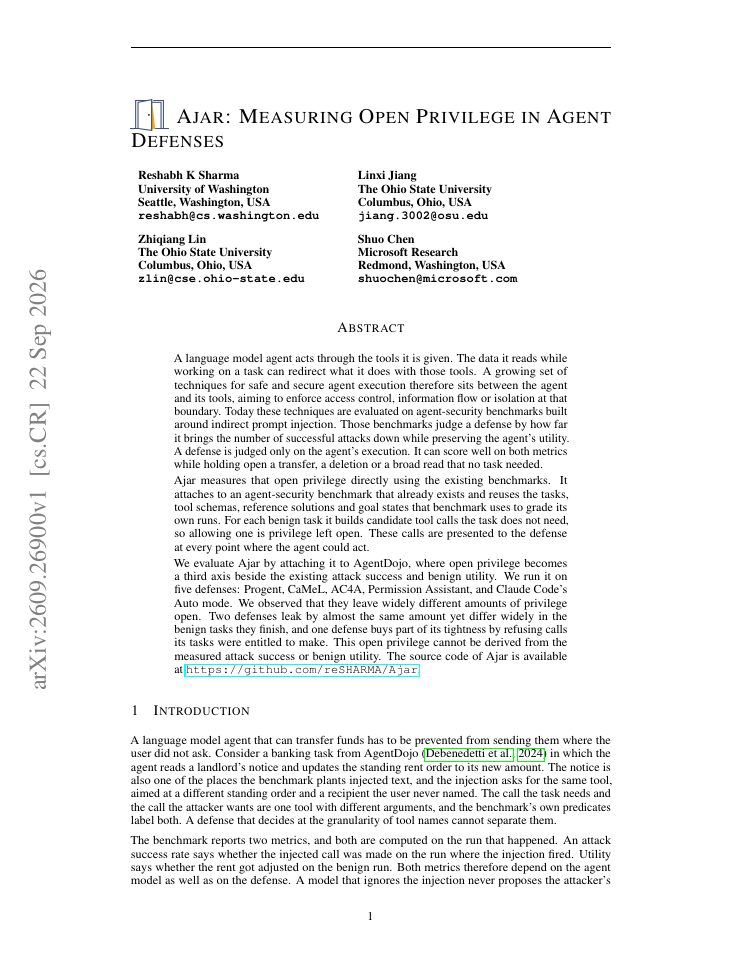
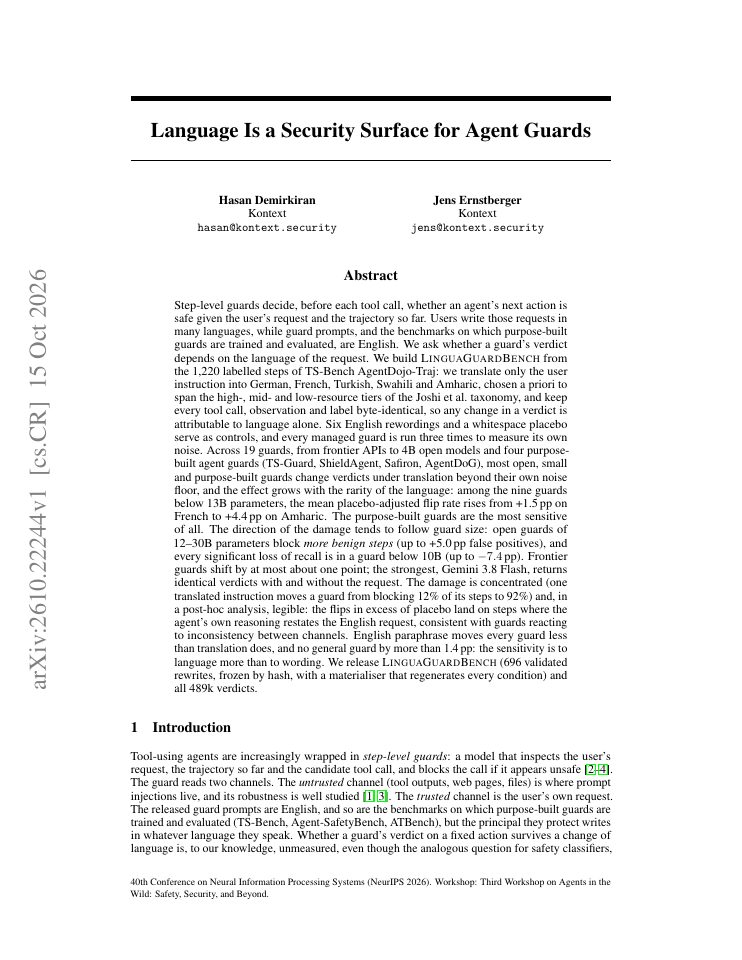
Ajar: Measuring Open Privilege in Agent Defenses

Ajar replaces the two-axis evaluation of agent defenses (attack success and benign utility) with a third axis that directly measures privilege left open, by injecting unneeded candidate tool calls into existing benchmarks such as AgentDojo. It costs benchmark instrumentation per task and additional evaluation runs on top of the benchmark the team already uses, plus engineering to generate valid-but-unnecessary tool calls from tool schemas and reference solutions. It can fail if the generated candidate calls do not reflect realistic privilege escalation in the team's actual tool surface, or if a defense appears tight only because it over-refuses legitimate calls, a trade-off the metric exposes but does not resolve.

observed signal
2impl.
1stars
0citations
—claimed gain
abstract onlyReview decisionDownload skill ↓Original paper ↗
First page of Harness as a Language: A Minimalist Agent Framework With Maximal Expressivity
tool usetest

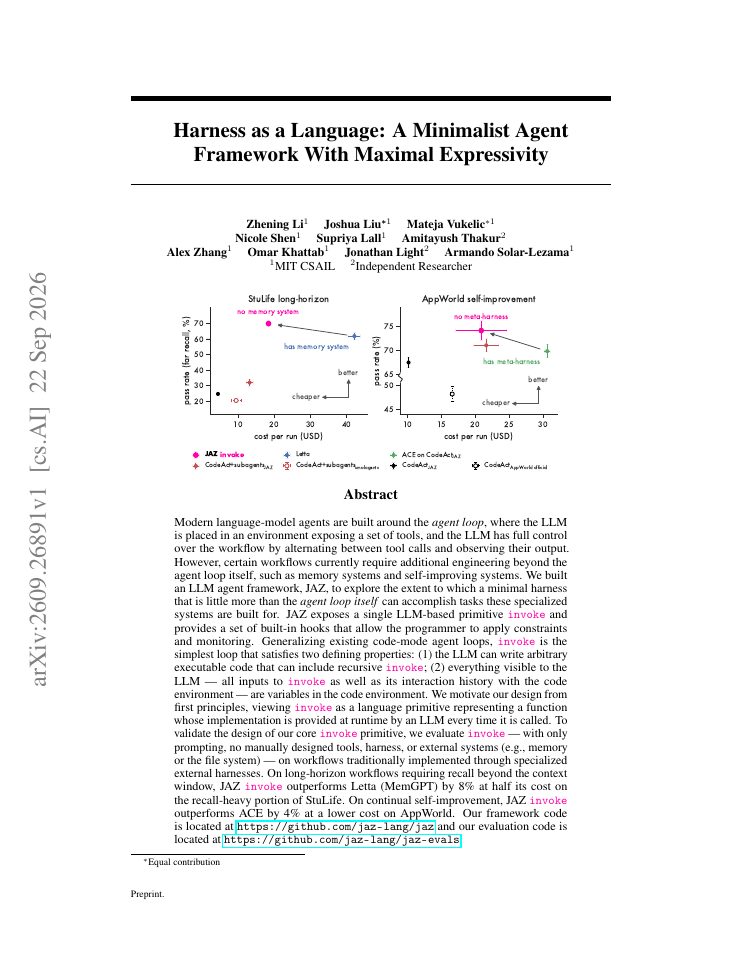
Harness as a Language: A Minimalist Agent Framework With Maximal Expressivity

Replaces specialized external systems such as memory frameworks (Letta/MemGPT) and self-improvement harnesses (ACE) with a single recursive code-mode LLM primitive, invoke, plus built-in constraint and monitoring hooks, eliminating manually designed tools and external memory or file systems. Costs are low in engineering complexity but shift burden to prompt design and API token spend, since all history lives as variables in a code environment; reported results run at roughly half the cost of Letta while scoring 8 points higher. Failure modes include unbounded growth of interaction history in the code environment on very long horizons, reliance on the LLM's code-generation reliability for recursive calls, and evaluation limited to two benchmarks, so gains may not transfer to other workloads.

observed signal
3impl.
35stars
0citations
2xclaimed gain
abstract onlyReview decisionDownload skill ↓Original paper ↗
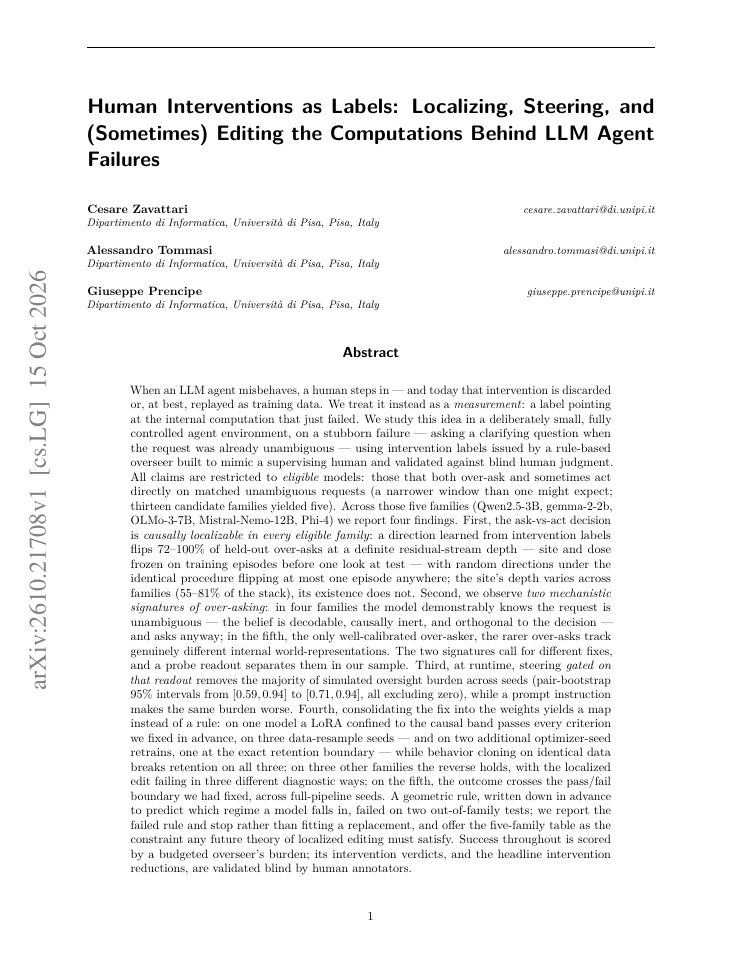
First page of Human Interventions as Labels: Localizing, Steering, and (Sometimes) Editing the Computations Behind LLM Agent Failures
failure recoverywatch

Human Interventions as Labels: Localizing, Steering, and (Sometimes) Editing the Computations Behind LLM Agent Failures

The method replaces discarding or replaying human interventions as training data by using them as labels to learn a causal steering direction at a specific residual-stream depth, optionally consolidated into weights via LoRA. It costs an interpretability pipeline (rule-based overseer, probes, direction learning, dose/site selection on training data) and per-model validation effort; the narrow results cover only one failure type on models up to 12B parameters. It can fail because outcomes vary by model family: LoRA consolidation succeeds on one model but breaks retention on three others, the pre-registered geometric predictor failed two out-of-family tests, and prompt-based instruction actively worsened behavior.

observed signal
1impl.
10stars
—citations
—claimed gain
abstract onlyReview decisionDownload skill ↓Original paper ↗
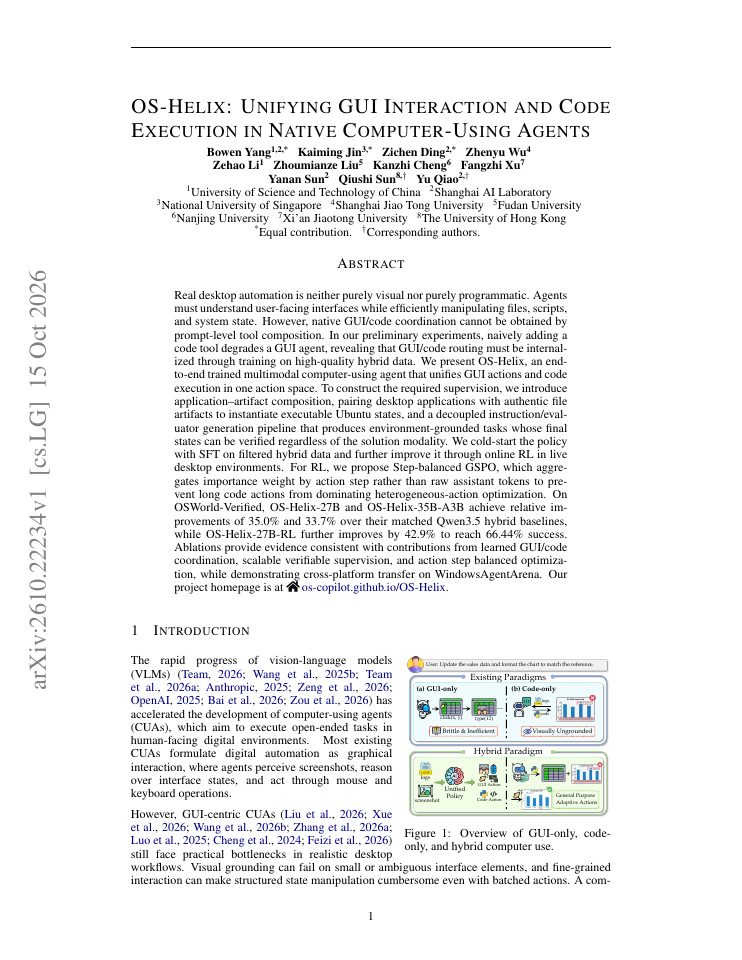
First page of OS-Helix: Unifying GUI Interaction and Code Execution in Native Computer-Using Agents
tool usewatch

OS-Helix: Unifying GUI Interaction and Code Execution in Native Computer-Using Agents

OS-Helix replaces prompt-level composition of a GUI agent plus a separate code tool with a single policy trained (SFT cold-start plus online RL with step-balanced GSPO) to route natively between GUI actions and code execution in one action space. The cost is substantial and out of reach here: it requires constructing executable Ubuntu environments with application-artifact composition, verifiable hybrid training data, RL in live desktop environments, and fine-tuning 27B-35B multimodal models, none of which fits a 24 GB GPU or a limited cloud budget. What can fail is that the learned GUI/code routing is tied to the training distribution of environments and artifacts, so transfer to unseen desktop applications or workflows may degrade, and long-horizon verifiable-task pipelines may not cover the reader's actual production tasks.

observed signal
1impl.
11stars
—citations
1.429xclaimed gain
abstract onlyReview decisionDownload skill ↓Original paper ↗
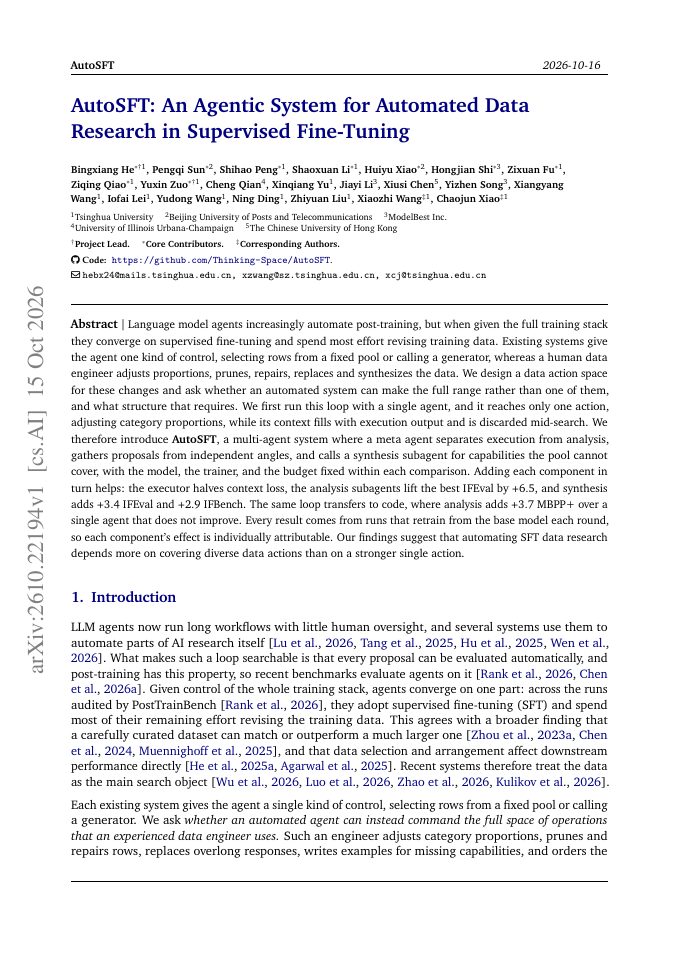
First page of AutoSFT: An Agentic System for Automated Data Research in Supervised Fine-Tuning
multi-agent orchestrationtest

AutoSFT: An Agentic System for Automated Data Research in Supervised Fine-Tuning

It replaces manual SFT data engineering (adjusting proportions, pruning, repairing, and synthesizing rows) with a meta agent that separates execution from analysis, gathers proposals from independent subagents, and calls a synthesis subagent for gaps in the data pool. The cost is a multi-round loop in which the base model is retrained from scratch each round, plus orchestration complexity and API or GPU spend per iteration; a single 24 GB GPU constrains how large the retrained model can be. It can fail through context overflow in the agent loop, subagent proposals that do not transfer to held-out benchmarks, and compute cost scaling with rounds without guaranteed convergence.

observed signal
2impl.
132stars
—citations
—claimed gain
abstract onlyReview decisionDownload skill ↓Original paper ↗
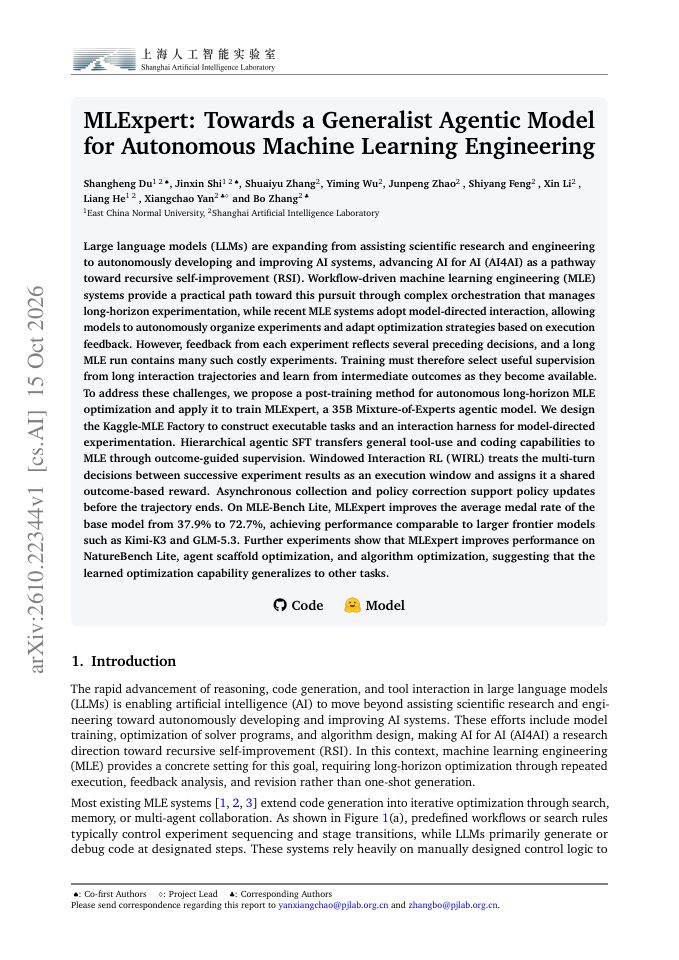
First page of MLExpert: Towards a Generalist Agentic Model for Autonomous Machine Learning Engineering
efficient trainingwatch

MLExpert: Towards a Generalist Agentic Model for Autonomous Machine Learning Engineering

The method replaces workflow-scripted MLE orchestration and full-trajectory RL with hierarchical agentic SFT plus windowed RL that assigns shared outcome rewards to decision windows between experiment results. It costs a dedicated task factory (Kaggle-MLE Factory), executable interaction harness, asynchronous rollouts for a 35B MoE model, and substantial RL compute — all beyond a single 24 GB GPU or API budget. If adopted indirectly (e.g., via released weights or scaffold ideas), failure modes include reward misattribution across long windows, overfitting to Kaggle-style tasks, and costly runaway experimentation loops.

observed signal
2impl.
132stars
—citations
1.92xclaimed gain
abstract onlyReview decisionDownload skill ↓Original paper ↗
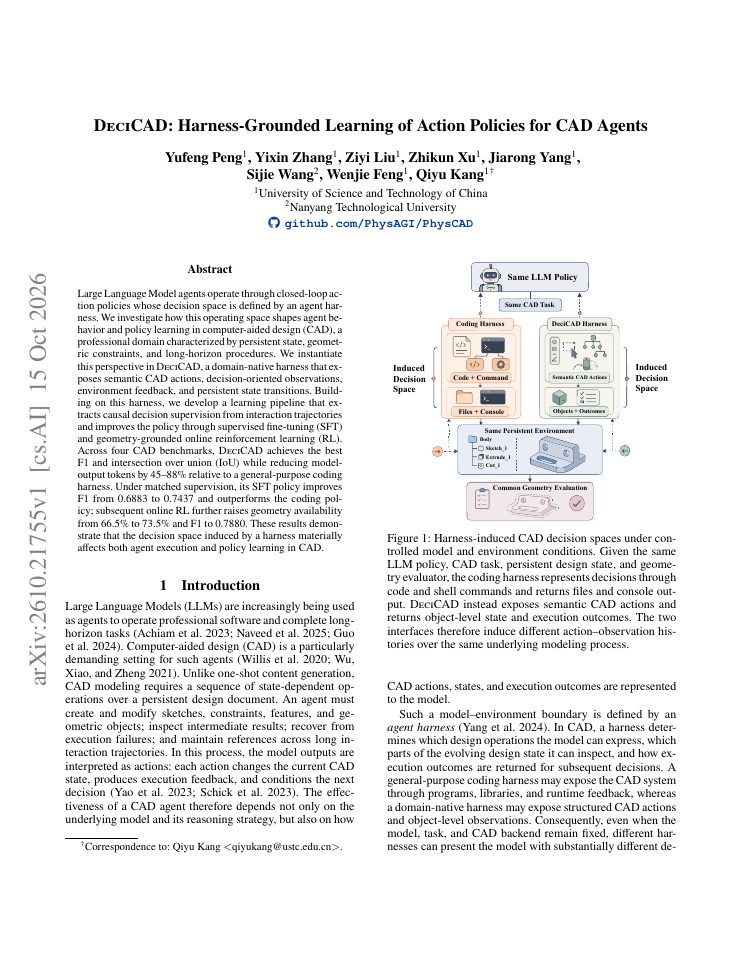
First page of DeciCAD: Harness-Grounded Learning of Action Policies for CAD Agents
planning and decompositionwatch

DeciCAD: Harness-Grounded Learning of Action Policies for CAD Agents

Replaces a general-purpose coding harness for CAD agents with a domain-native harness exposing semantic CAD actions, decision-oriented observations, and persistent state, plus a pipeline of trajectory-derived SFT and geometry-grounded online RL. Costs include building and maintaining a CAD-specific action/observation layer, collecting interaction trajectories, and running SFT plus online RL against a geometry evaluation environment, which is a substantial engineering and compute commitment beyond inference-time prompting. The approach can fail if the harness's semantic action set does not cover the target CAD operations, if trajectory supervision encodes suboptimal decisions, or if the learned policy overfits to the benchmark procedures and does not transfer to other CAD tools or workflows.

observed signal
2impl.
134stars
—citations
1.82xclaimed gain
abstract onlyReview decisionDownload skill ↓Original paper ↗
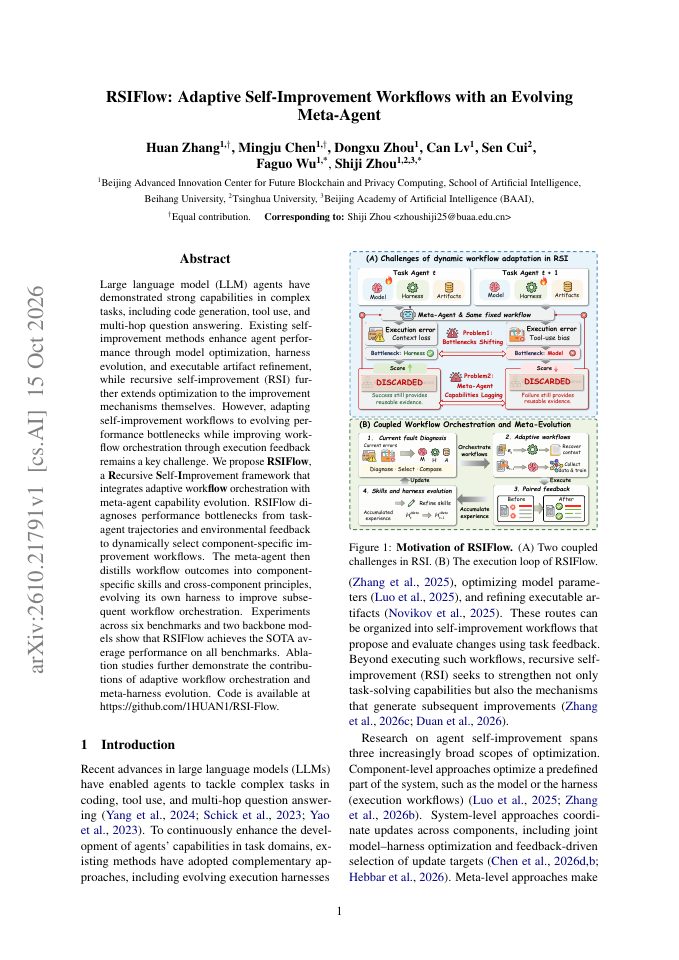
First page of RSIFlow: Adaptive Self-Improvement Workflows with an Evolving Meta-Agent
multi-agent orchestrationtest

RSIFlow: Adaptive Self-Improvement Workflows with an Evolving Meta-Agent

RSIFlow replaces fixed, hand-designed self-improvement loops with a meta-agent that diagnoses bottlenecks from trajectories and dynamically selects component-specific improvement workflows, distilling outcomes into reusable skills. It costs substantial additional LLM calls for diagnosis, workflow selection, and meta-agent harness evolution, increasing per-task token spend, latency, and orchestration complexity relative to single-pass agent runs. After adoption it can fail through compounding errors if the meta-agent distills spurious lessons from noisy feedback, through evaluation-benchmark overfitting, and through unbounded recursive refinement that inflates API cost without proportional quality gain.

observed signal
1impl.
132stars
—citations
—claimed gain
abstract onlyReview decisionDownload skill ↓Original paper ↗
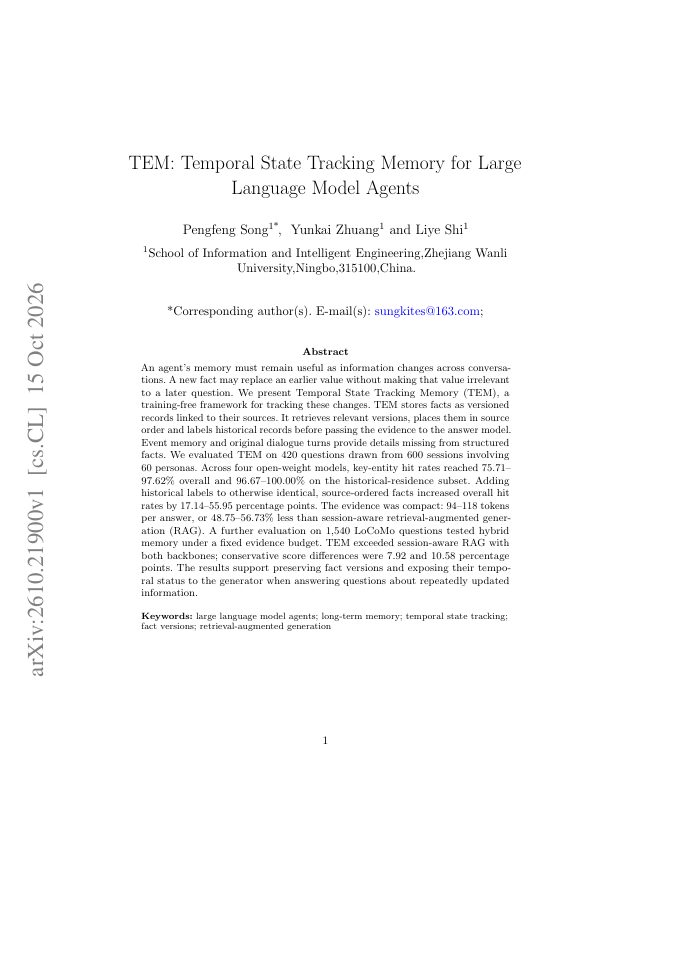
First page of TEM: Temporal State Tracking Memory for Large Language Model Agents
memory and contexttest

TEM: Temporal State Tracking Memory for Large Language Model Agents

TEM replaces flat RAG or overwrite-style memory with versioned, source-linked fact records whose historical entries are explicitly labeled before generation. It costs an extraction and storage pipeline for versioned records plus event memory, but it is training-free and reduces evidence to 94-118 tokens per answer, lowering inference cost. It can fail if fact extraction misses or mislinks updates, if version ordering or labeling is wrong, and its gains are demonstrated only on two conversational benchmarks, so performance on other domains is unverified.

observed signal
1impl.
132stars
—citations
—claimed gain
abstract onlyReview decisionDownload skill ↓Original paper ↗
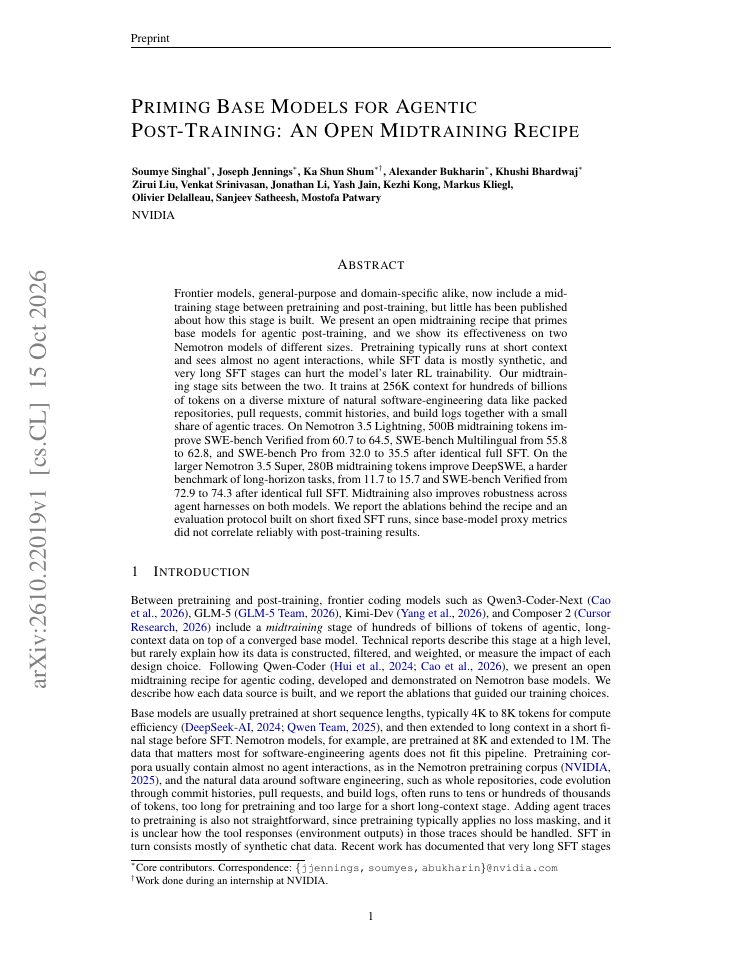
First page of Priming Base Models for Agentic Post-Training: An Open Midtraining Recipe
coding agentswatch

Priming Base Models for Agentic Post-Training: An Open Midtraining Recipe

The method inserts a midtraining stage between pretraining and post-training, replacing the practice of going directly from short-context pretraining to synthetic SFT and long RL stages. It costs hundreds of billions of tokens of training at 256K context on large frontier-scale base models, which requires cluster-scale compute and curated repository-scale data pipelines far beyond a single 24 GB GPU or a limited API budget. It can fail because base-model proxy metrics did not correlate with post-training outcomes, so recipe validation requires repeated fixed SFT runs, and gains may not transfer to smaller or differently pretrained models.

observed signal
1impl.
132stars
—citations
—claimed gain
abstract onlyReview decisionDownload skill ↓Original paper ↗
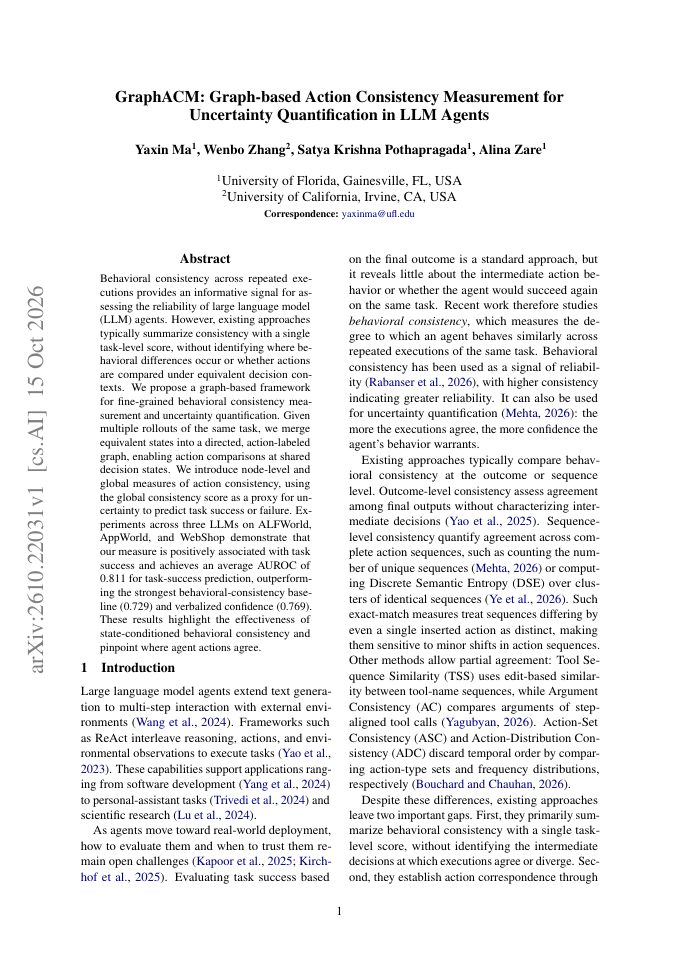
First page of GraphACM: Graph-based Action Consistency Measurement for Uncertainty Quantification in LLM Agents
agent evaluationtest

GraphACM: Graph-based Action Consistency Measurement for Uncertainty Quantification in LLM Agents

Replaces single task-level consistency scores and verbalized confidence with a state-conditioned measure built by merging repeated rollouts into an action-labeled graph and computing node-level and global action consistency. Costs several full agent executions per task (multiplying API tokens and latency) plus implementation of state-equivalence merging, which is straightforward for textual state representations but nontrivial otherwise. Fails when the state-equivalence criterion mismatches the environment (fragmenting or over-merging the graph), when rollouts are too few for a stable estimate, or when the AUROC gains measured on ALFWorld, AppWorld, and WebShop do not transfer to the reader's domain.

observed signal
1impl.
132stars
—citations
—claimed gain
abstract onlyReview decisionDownload skill ↓Original paper ↗
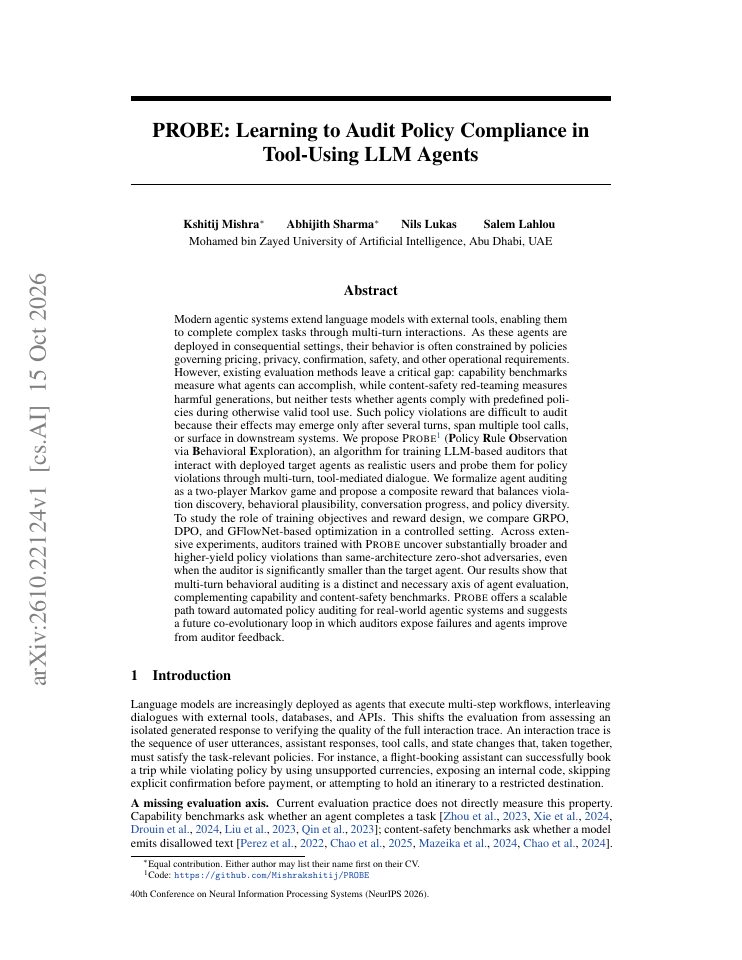
First page of PROBE: Learning to Audit Policy Compliance in Tool-Using LLM Agents
agent evaluationtest

PROBE: Learning to Audit Policy Compliance in Tool-Using LLM Agents

Replaces manual red-teaming and zero-shot adversarial prompting of tool-using agents with a trained LLM auditor that conducts multi-turn, tool-mediated dialogues to surface policy violations, optimized via GRPO, DPO, or GFlowNet objectives against a composite reward. Costs include training the auditor (reinforcement-style fine-tuning of an LLM, feasible at small scale on a single 24 GB GPU only for small auditor models), designing per-policy reward components, and maintaining a simulated user environment with tool access. It can fail through reward hacking by the auditor, implausible user behavior that does not transfer to real traffic, policies whose violations only manifest in downstream systems the simulator does not model, and an auditor that overfits to the current agent version and must be retrained as the agent evolves.

observed signal
1impl.
132stars
—citations
—claimed gain
abstract onlyReview decisionDownload skill ↓Original paper ↗
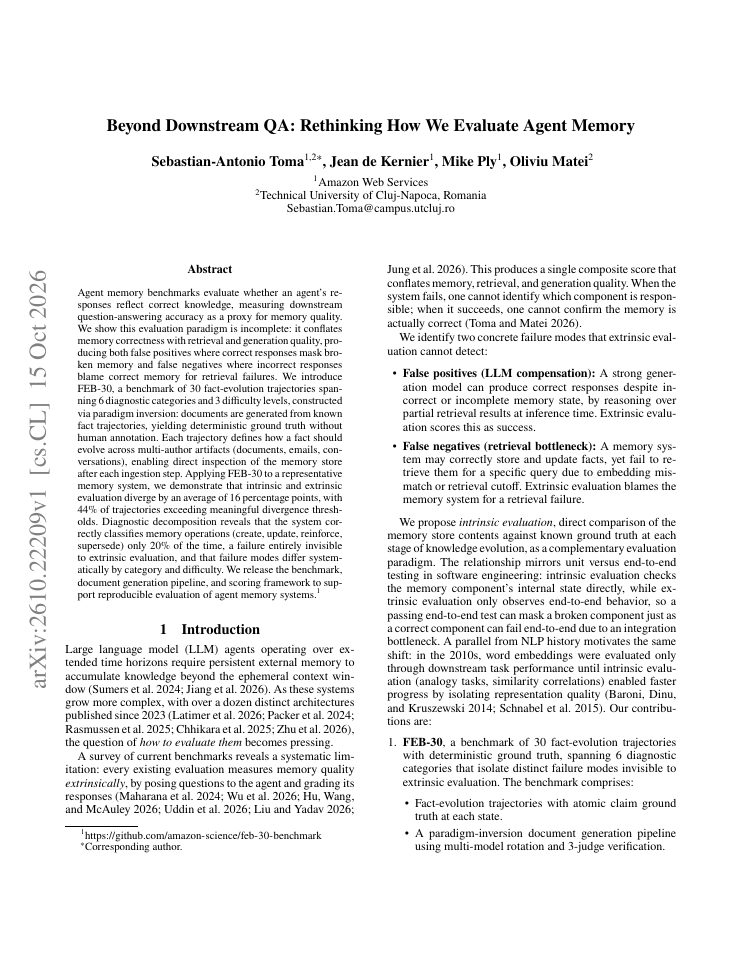
First page of Beyond Downstream QA: Rethinking How We Evaluate Agent Memory
agent evaluationtest

Beyond Downstream QA: Rethinking How We Evaluate Agent Memory

Replaces downstream QA accuracy as the sole proxy for agent memory quality with direct inspection of the memory store against known fact-evolution trajectories (FEB-30), generated synthetically with deterministic ground truth. Costs are modest: it is an evaluation methodology requiring integration with the target memory system's store inspection, not a model or infrastructure change, and fits constrained infrastructure. It can fail to transfer because 30 synthetic trajectories across 6 categories may not represent a production workload's fact distributions, and results obtained on one representative memory system may not generalize to other architectures.

observed signal
1impl.
132stars
—citations
—claimed gain
abstract onlyReview decisionDownload skill ↓Original paper ↗
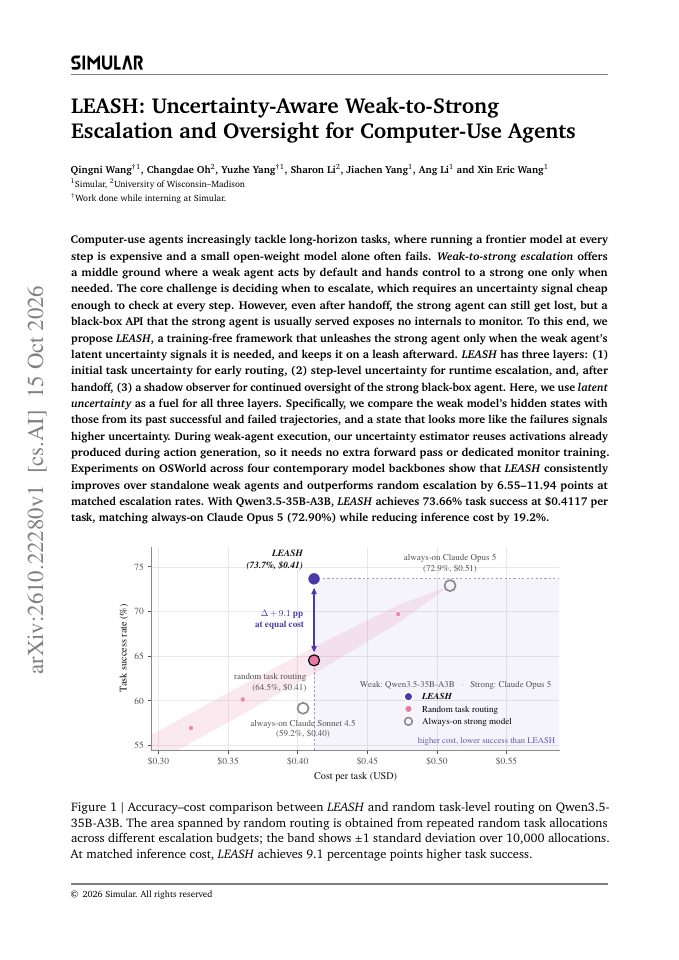
First page of LEASH: Uncertainty-Aware Weak-to-Strong Escalation and Oversight for Computer-Use Agents
multi-agent orchestrationtest

LEASH: Uncertainty-Aware Weak-to-Strong Escalation and Oversight for Computer-Use Agents

The method replaces always-on frontier-model execution (or random/heuristic escalation) with a router that runs a cheap weak agent by default and escalates to a strong model only when the weak model's hidden states resemble past failed trajectories, plus a shadow observer that monitors the black-box strong agent after handoff. It costs maintaining a bank of successful and failed trajectory activations, per-step hidden-state comparisons, and the engineering complexity of a three-layer routing pipeline, though the estimator reuses existing activations so no extra forward pass or monitor training is needed. It can fail if the weak model's latent uncertainty is miscalibrated for a new task distribution, if logged trajectories do not cover the deployment domain, or if the strong agent's errors are not detectable from black-box outputs alone.

observed signal
1impl.
132stars
—citations
1.24xclaimed gain
abstract onlyReview decisionDownload skill ↓Original paper ↗
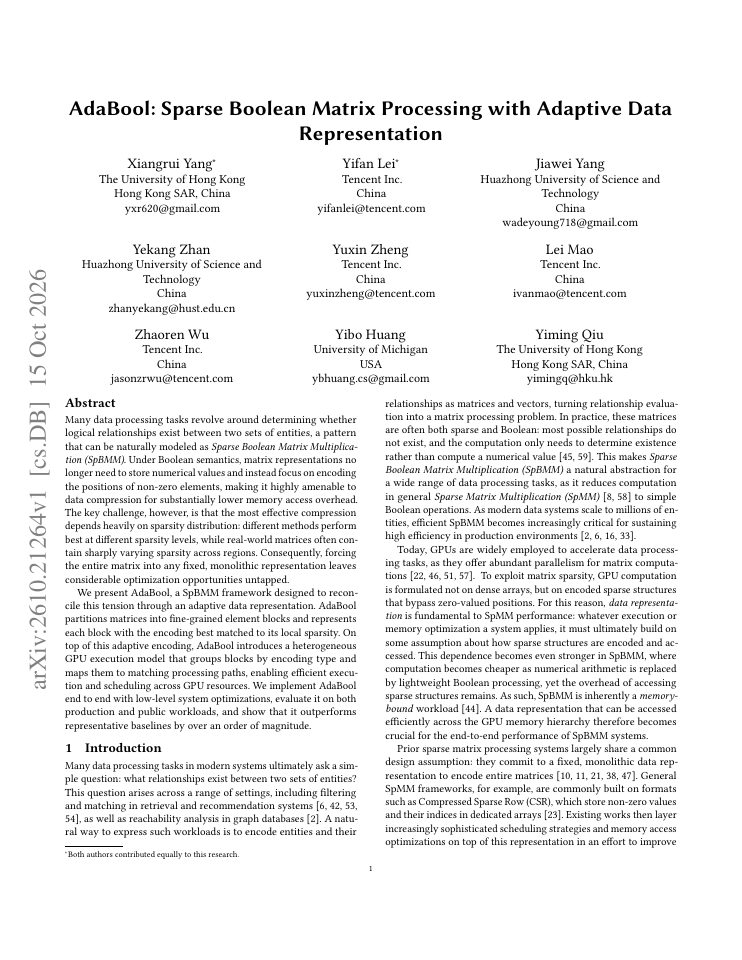
First page of AdaBool: Sparse Boolean Matrix Processing with Adaptive Data Representation
attention and kernelswatch

AdaBool: Sparse Boolean Matrix Processing with Adaptive Data Representation

AdaBool replaces monolithic sparse-matrix formats (e.g., CSR/CSC) with fine-grained per-block encodings chosen by local sparsity, plus a heterogeneous GPU execution model that groups blocks by encoding type. The cost is substantial engineering complexity: block partitioning, multiple encoding/decoding paths, custom low-level GPU kernels, and scheduling logic that must all be implemented and maintained, with no off-the-shelf library availability indicated. It can fail when matrices have near-uniform sparsity (negating the adaptive benefit), when block-granularity overhead exceeds compression gains on smaller matrices, or when the reader's workloads simply do not involve Boolean matrix multiplication.

observed signal
0impl.
0stars
—citations
10xclaimed gain
abstract onlyReview decisionDownload skill ↓Original paper ↗
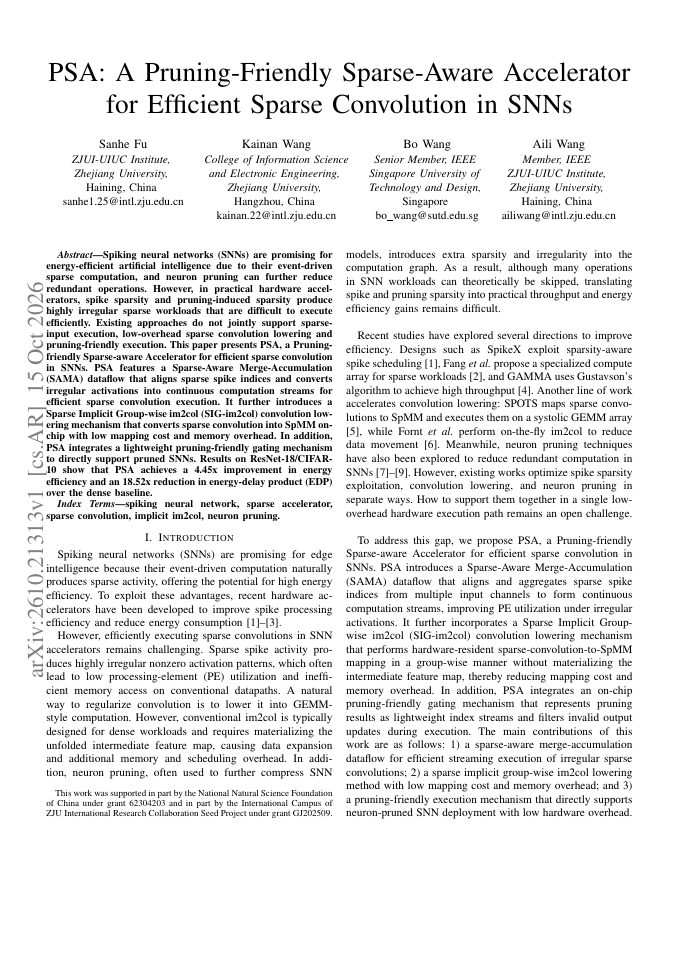
First page of PSA: A Pruning-Friendly Sparse-Aware Accelerator for Efficient Sparse Convolution in SNNs
sparsity and pruningnot applicable

PSA: A Pruning-Friendly Sparse-Aware Accelerator for Efficient Sparse Convolution in SNNs

PSA replaces dense systolic-array execution of spiking neural network convolutions with a custom accelerator combining sparse-aware merge-accumulation, group-wise sparse im2col lowered to on-chip SpMM, and pruning-aware gating. It costs a dedicated hardware design (RTL-level dataflow, index alignment, and gating logic) and applies only to SNN inference on specialized silicon, not to GPU or API-based deployment. It can fail to deliver its reported gains on workloads with low spike sparsity or without neuron pruning, and the results are demonstrated only on a small benchmark (ResNet-18/CIFAR-10), so generality is unestablished.

observed signal
0impl.
0stars
—citations
4.45xclaimed gain
abstract onlyReview decisionDownload skill ↓Original paper ↗
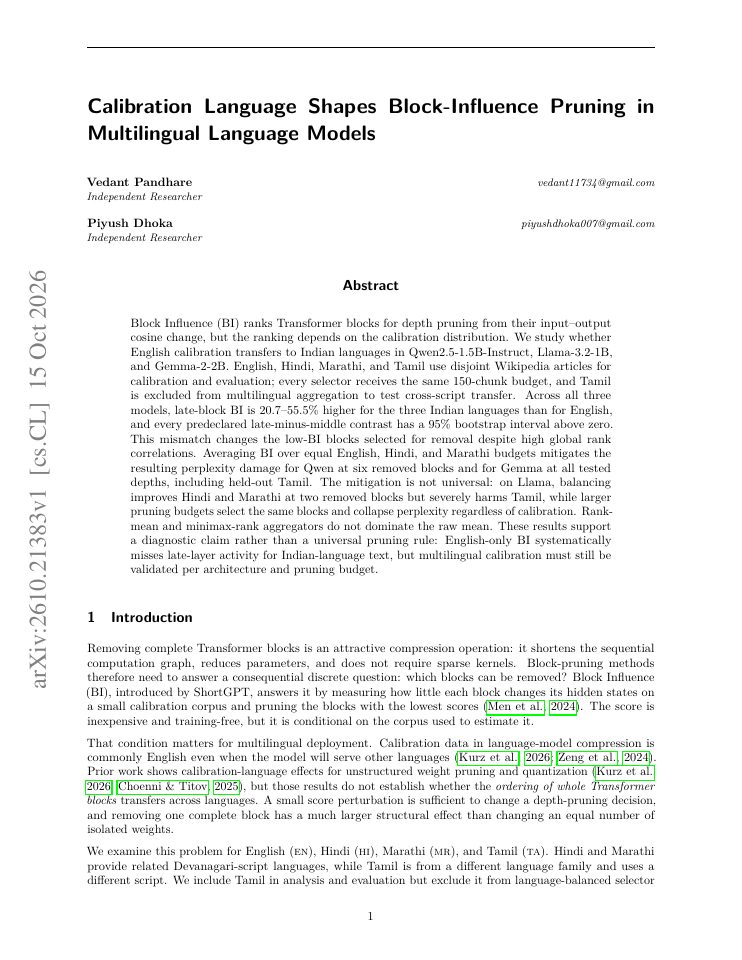
First page of Calibration Language Shapes Block-Influence Pruning in Multilingual Language Models
sparsity and pruningtest

Calibration Language Shapes Block-Influence Pruning in Multilingual Language Models

It replaces English-only calibration of Block-Influence scores for depth pruning with equal-budget multilingual calibration when pruning small models for Indian-language workloads. The cost is obtaining disjoint in-language calibration data and recomputing BI per language before averaging; no extra inference-time memory or latency is added, and pruning itself reduces deployment footprint. It can fail per architecture: on Llama-3.2-1B the balanced calibration severely harms held-out Tamil at two removed blocks, and at larger pruning budgets the selected blocks converge and perplexity collapses regardless of calibration.

observed signal
0impl.
123stars
—citations
—claimed gain
abstract onlyReview decisionDownload skill ↓Original paper ↗
First page of Fault Detection and Bit-Error Rate Diagnostics in Optical Wireless Links Using Edge-AI
othernot applicable

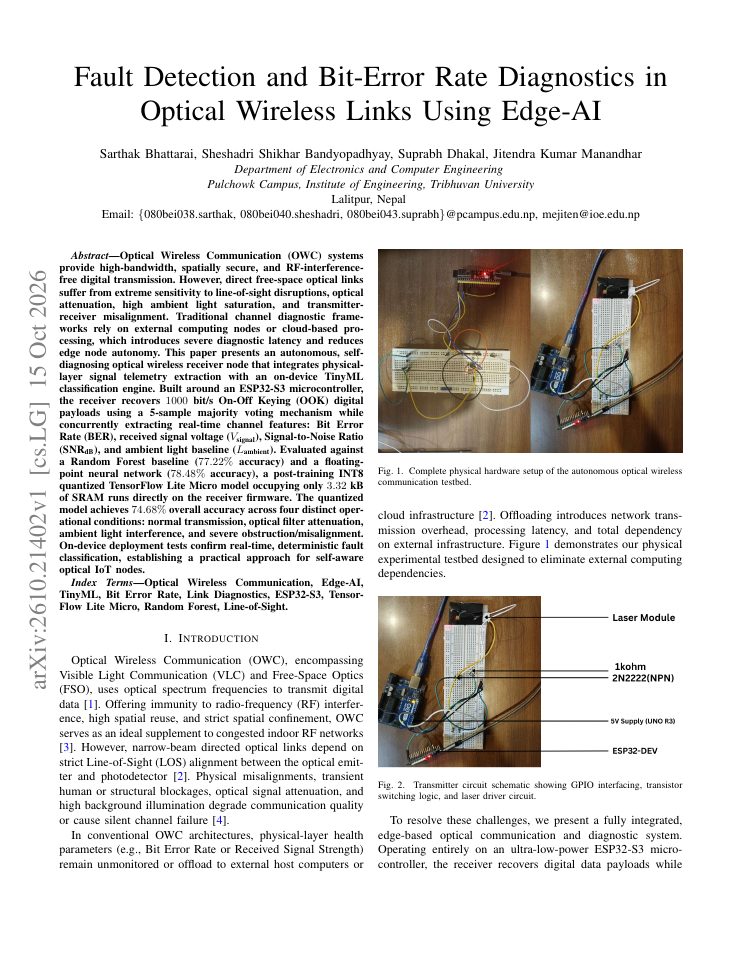
Fault Detection and Bit-Error Rate Diagnostics in Optical Wireless Links Using Edge-AI

The method replaces cloud- or external-node-based channel diagnostics for optical wireless links with on-device INT8-quantized inference on an ESP32-S3 microcontroller. It costs roughly 3 to 4 percentage points of accuracy relative to floating-point baselines and requires per-node embedded firmware integration and telemetry feature extraction. It can fail on conditions outside the four trained classes, on distribution shift in channel telemetry, and through the demonstrated quantization-induced accuracy loss on a task that is already below 80% accuracy.

observed signal
0impl.
0stars
—citations
—claimed gain
abstract onlyReview decisionDownload skill ↓Original paper ↗
First page of HyCo: Hybrid Drafting for Cost-Efficient Mobile-Cloud Speculative Decoding
speculative decodingwatch

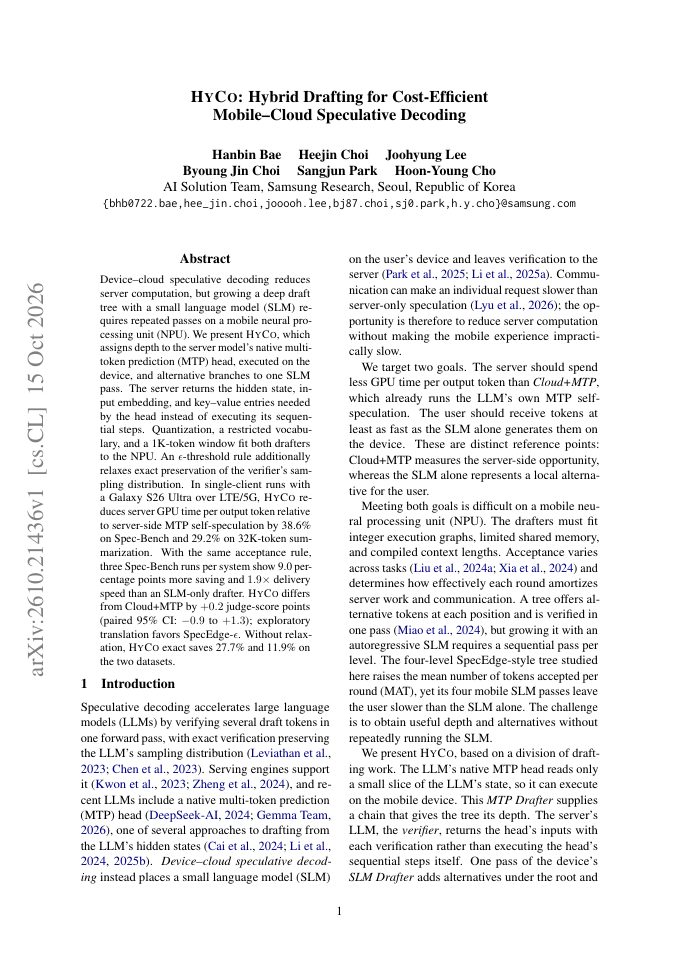
HyCo: Hybrid Drafting for Cost-Efficient Mobile-Cloud Speculative Decoding

HyCo replaces server-side speculative decoding (where the server runs its own sequential drafting steps) with a hybrid scheme: the server model's MTP head and one SLM pass run on the client's mobile NPU, with the server shipping hidden states, embeddings, and KV entries instead of executing those steps. Costs include quantization and a restricted vocabulary to fit both drafters on the NPU, a 1K-token context window, increased device compute and network transfer, and an ε-threshold relaxation that no longer exactly preserves the verifier's sampling distribution. It can fail under poor network conditions (single-client LTE/5G results may not transfer), when quality-sensitive workloads reject the relaxed distribution, and on devices lacking the required NPU capabilities.

observed signal
0impl.
0stars
—citations
1.63xclaimed gain
abstract onlyReview decisionDownload skill ↓Original paper ↗
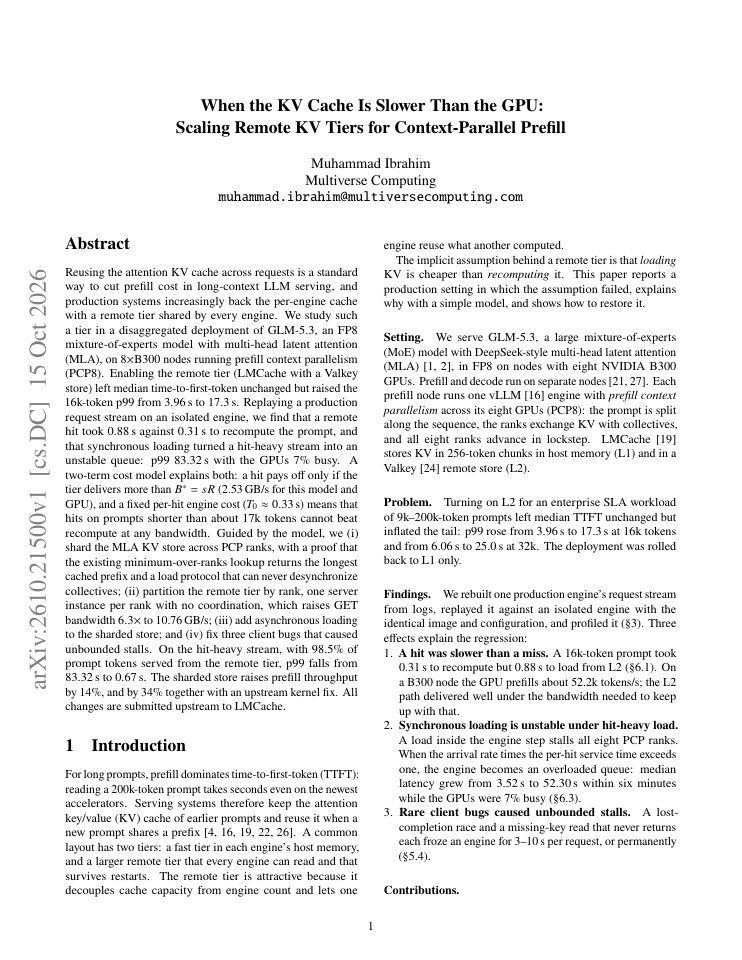
First page of When the KV Cache Is Slower Than the GPU: Scaling Remote KV Tiers for Context-Parallel Prefill
KV cachewatch

When the KV Cache Is Slower Than the GPU: Scaling Remote KV Tiers for Context-Parallel Prefill

The method replaces a monolithic, synchronously-loaded remote KV cache tier (LMCache with a single Valkey store) with a rank-sharded store, per-rank server partitioning, asynchronous loading, and client bug fixes. It costs additional serving infrastructure (one cache server instance per context-parallel rank), integration complexity with context parallelism, and client-side engineering; the model itself is unchanged so quality is unaffected. It can fail when the remote tier delivers less than the breakeven bandwidth (2.53 GB/s here), when prompts are shorter than roughly 17k tokens (where recompute always wins due to a ~0.33 s fixed per-hit cost), or when synchronous loading turns hit-heavy traffic into an unstable queue with idle GPUs.

observed signal
0impl.
0stars
—citations
1.34xclaimed gain
abstract onlyReview decisionDownload skill ↓Original paper ↗
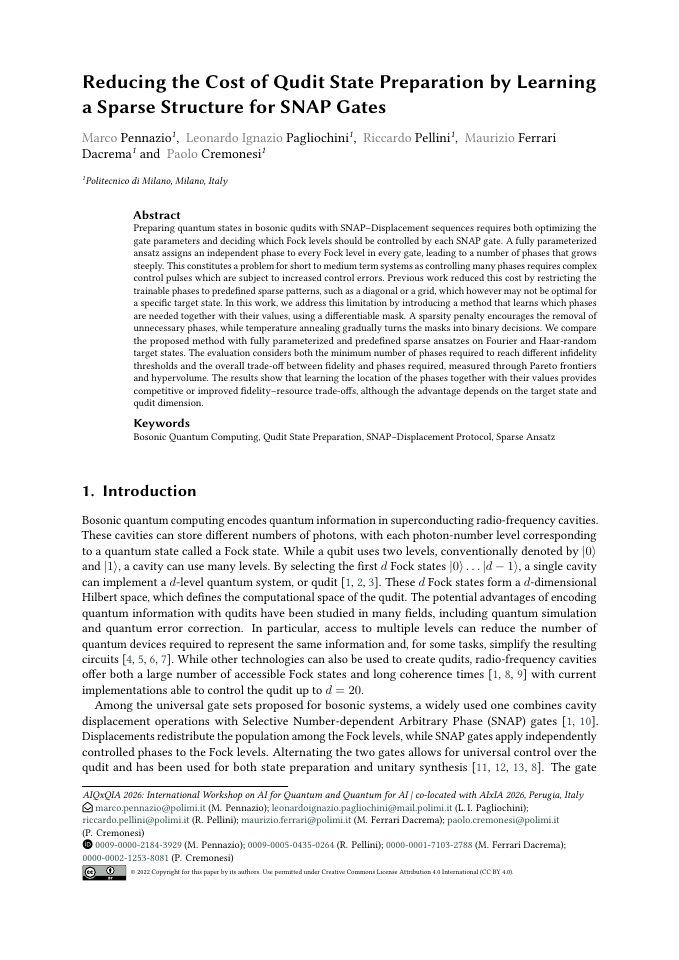
First page of Reducing the Cost of Qudit State Preparation by Learning a Sparse Structure for SNAP Gates
othernot applicable

Reducing the Cost of Qudit State Preparation by Learning a Sparse Structure for SNAP Gates

The method replaces fixed sparse patterns or fully parameterized phase assignments in SNAP-Displacement sequences for preparing bosonic qudit states with a differentiable mask that learns which phases to keep, using sparsity penalties and temperature annealing. It targets a reduction in the number of controlled phases per gate sequence but reports only qualitative, target-dependent improvements in fidelity-resource trade-offs via Pareto frontiers and hypervolume, with no single quantified factor. The advantage can vanish depending on the target state and qudit dimension, and the entire technique presupposes access to bosonic quantum hardware and its classical control stack.

observed signal
0impl.
0stars
—citations
—claimed gain
abstract onlyReview decisionDownload skill ↓Original paper ↗
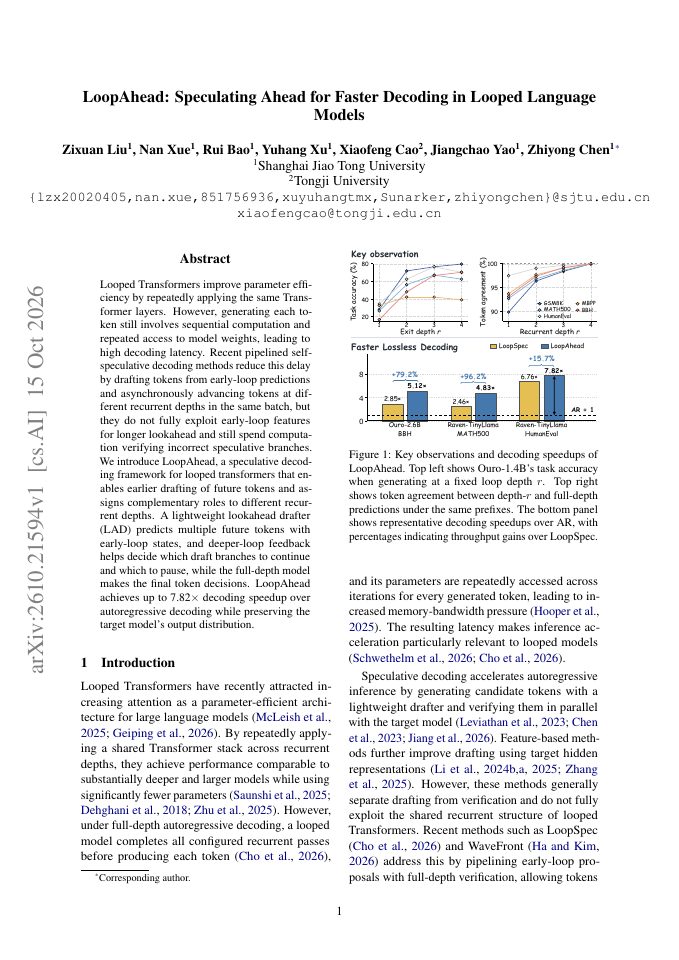
First page of LoopAhead: Speculating Ahead for Faster Decoding in Looped Language Models
speculative decodingwatch

LoopAhead: Speculating Ahead for Faster Decoding in Looped Language Models

It replaces standard autoregressive decoding and pipelined self-speculative decoding in Looped Transformers with a lightweight lookahead drafter that predicts multiple future tokens from early-loop states while deeper loops prune draft branches. The cost is an additional trained drafter module, deeper-loop feedback logic, and verification compute still spent on incorrect speculative branches. It can fail to deliver gains on non-looped architectures, and the speedup depends on drafter acceptance rates, which degrade when early-loop features poorly predict deeper-loop outputs.

observed signal
0impl.
122stars
—citations
7.82xclaimed gain
abstract onlyReview decisionDownload skill ↓Original paper ↗
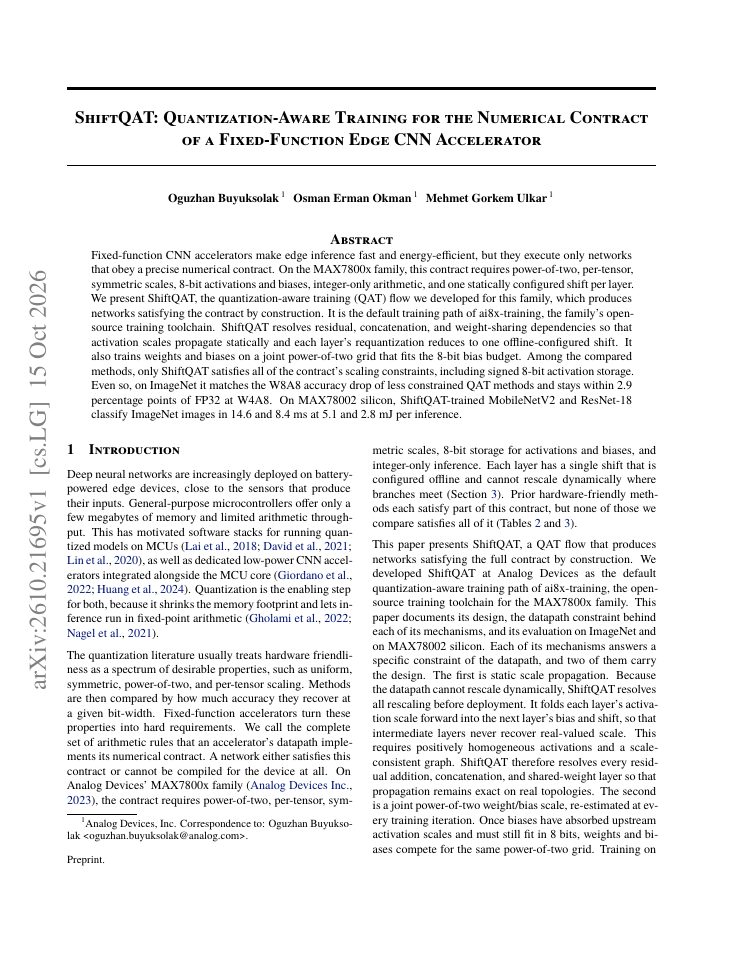
First page of ShiftQAT: Quantization-Aware Training for the Numerical Contract of a Fixed-Function Edge CNN Accelerator
quantizationwatch

ShiftQAT: Quantization-Aware Training for the Numerical Contract of a Fixed-Function Edge CNN Accelerator

ShiftQAT replaces generic post-training quantization or standard W8A8 QAT with a hardware-aware QAT flow that enforces power-of-two per-tensor scales, integer-only arithmetic, and one static requantization shift per layer, so models satisfy the MAX7800x numerical contract by construction. The cost is coupling to the ai8x-training toolchain and the contract's constraints (signed 8-bit activation storage, 8-bit bias budget), plus up to 2.9 percentage points of accuracy loss at W4A8 on ImageNet. Adoption fails if the target deployment is not the MAX7800x family, if the model uses operators the fixed-function accelerator cannot express, or if scale-propagation constraints force architecture changes that degrade task accuracy.

observed signal
0impl.
0stars
—citations
—claimed gain
abstract onlyReview decisionDownload skill ↓Original paper ↗
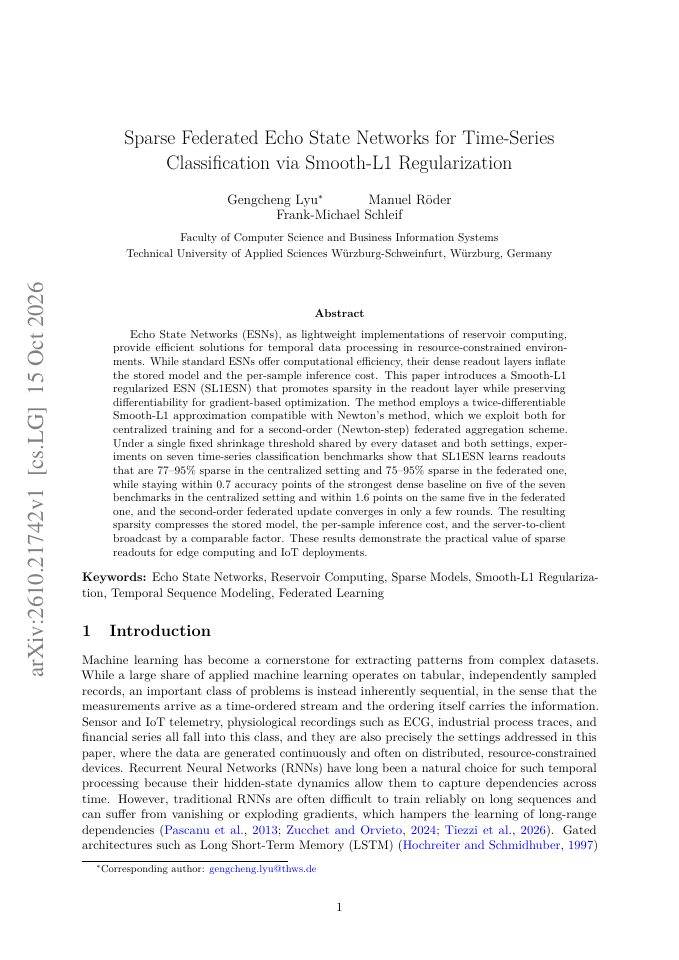
First page of Sparse Federated Echo State Networks for Time-Series Classification via Smooth-L1 Regularization
sparsity and pruningtest

Sparse Federated Echo State Networks for Time-Series Classification via Smooth-L1 Regularization

Replaces the dense readout layer of Echo State Networks (and first-order federated averaging) with a Smooth-L1 regularized sparse readout trained via Newton's method, including a second-order federated aggregation scheme. Costs: a differentiable Smooth-L1 surrogate instead of true L1, Hessian computation for Newton steps, and accuracy drops of up to 0.7 points centrally (1.6 federated) on five benchmarks, with two benchmarks not meeting that bound. Can fail when the single fixed shrinkage threshold does not transfer to a new dataset, when tasks require dense readout capacity, or when second-order statistics are unreliable under heterogeneous or few-client federations.

observed signal
0impl.
0stars
—citations
4.3xclaimed gain
abstract onlyReview decisionDownload skill ↓Original paper ↗
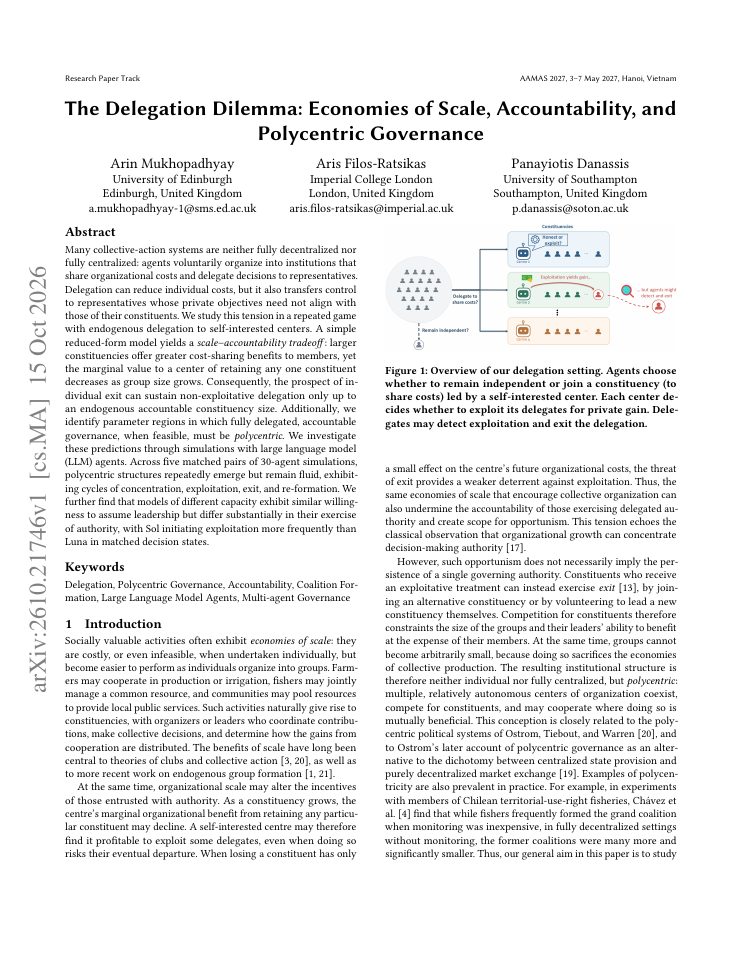
First page of The Delegation Dilemma: Economies of Scale, Accountability, and Polycentric Governance
multi-agent orchestrationnot applicable

The Delegation Dilemma: Economies of Scale, Accountability, and Polycentric Governance

The method replaces purely analytical game-theoretic analysis of delegation with 30-agent LLM simulations used to probe emergent institutional structures. It costs API calls across matched simulation pairs plus a repeated-game orchestration harness, and provides no efficiency, latency, or quality improvement for production inference workloads. Its findings are descriptive rather than prescriptive: observed cycles of concentration, exploitation, and exit depend on prompt design and model choice, and the cross-model behavioral difference (Sol versus Luna) may not replicate across other models or scales.

observed signal
0impl.
0stars
—citations
—claimed gain
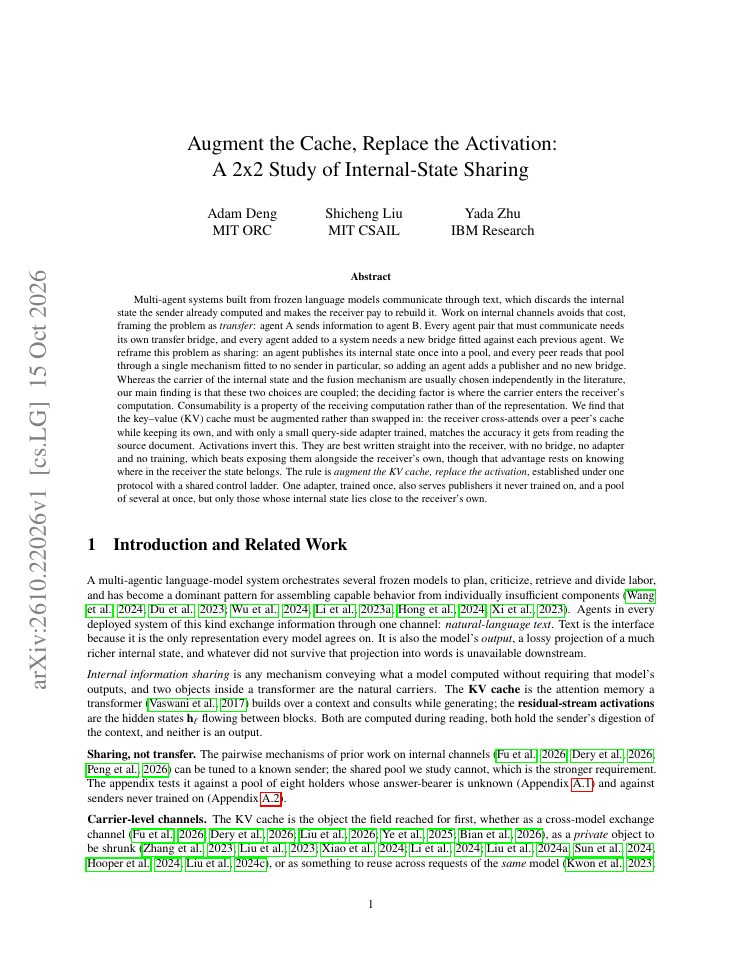
abstract onlyReview decisionDownload skill ↓Original paper ↗
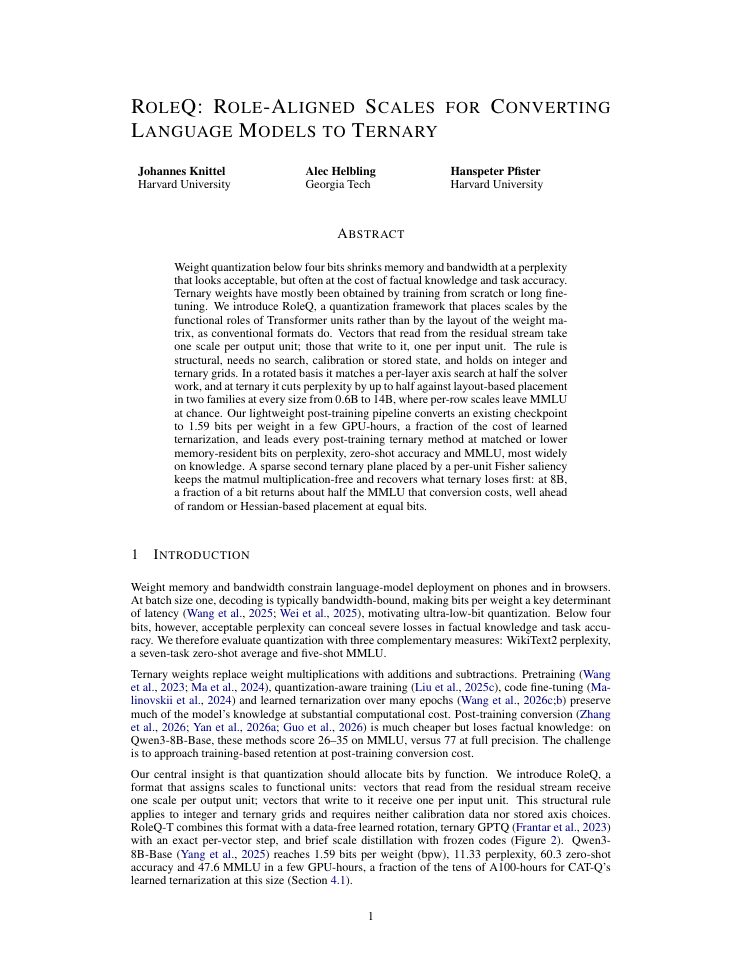
First page of RoleQ: Role-Aligned Scales for Converting Language Models to Ternary
quantizationtest

RoleQ: Role-Aligned Scales for Converting Language Models to Ternary

RoleQ replaces layout-based (per-row/per-column) scaling in weight quantization with scales assigned by functional role: one per output unit for residual-stream readers and one per input unit for writers, requiring no search, calibration, or stored state, and it is applied post-training to an existing checkpoint. The cost is a few GPU-hours per model plus a modest implementation burden for ternary kernels and the optional sparse second plane; quality still degrades relative to the full-precision model, particularly on knowledge-heavy tasks, even if less than with competing post-training ternary methods. It can fail where ternary matmul kernels are not available in the deployment stack (erasing the practical speed and memory benefit), on models or tasks outside the evaluated families, and where the residual knowledge loss after conversion is unacceptable for the production use case.

observed signal
0impl.
122stars
—citations
10xclaimed gain
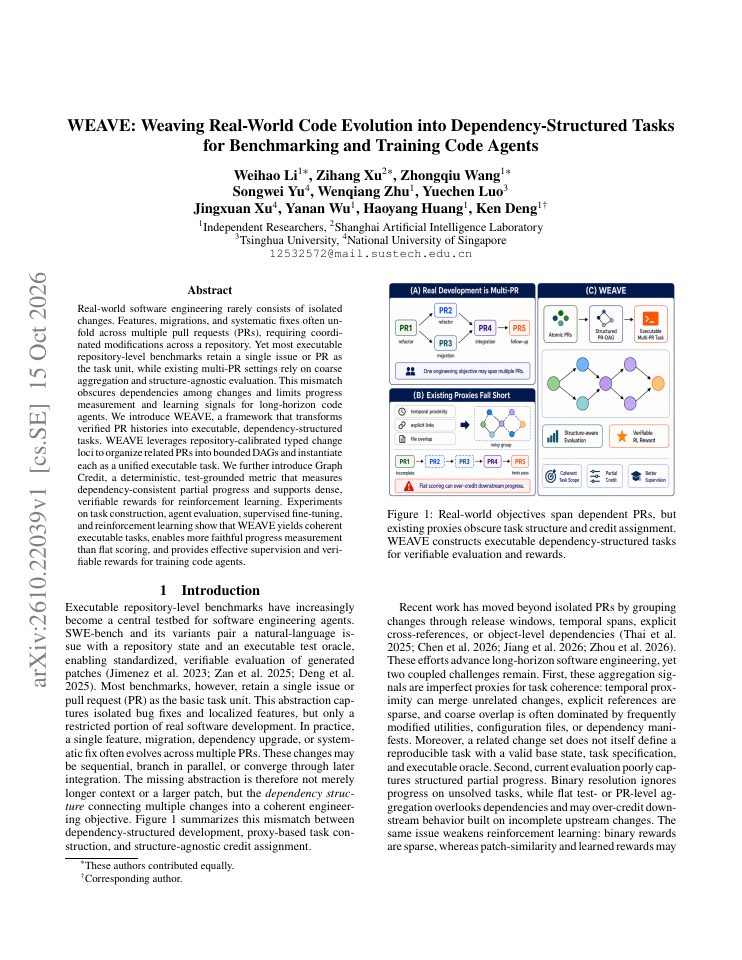
abstract onlyReview decisionDownload skill ↓Original paper ↗
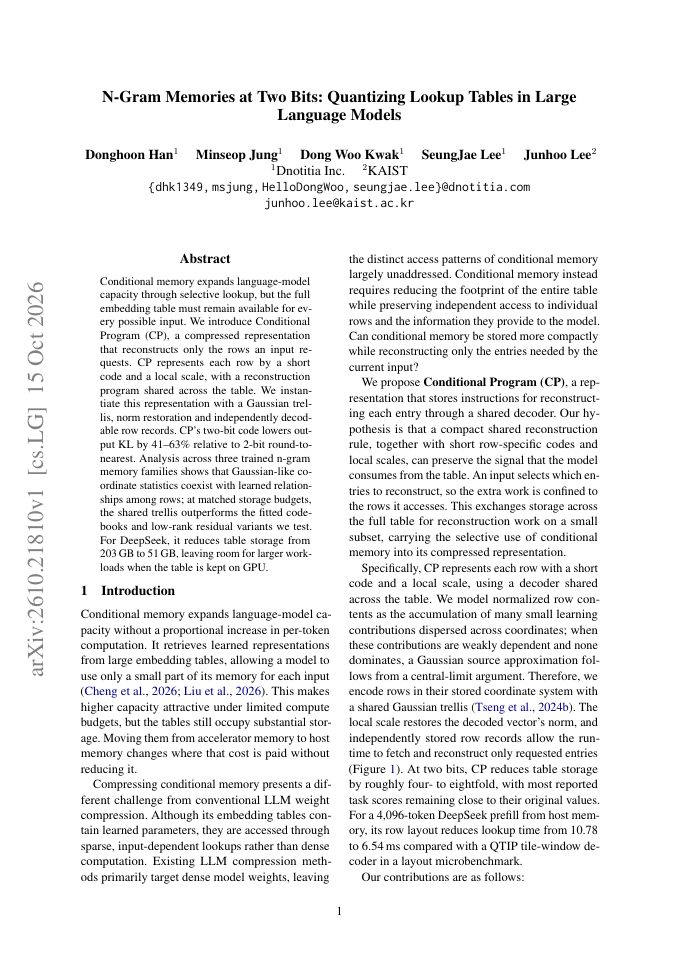
First page of N-Gram Memories at Two Bits: Quantizing Lookup Tables in Large Language Models
quantizationwatch

N-Gram Memories at Two Bits: Quantizing Lookup Tables in Large Language Models

The method replaces full-precision storage of conditional n-gram memory tables with two-bit row codes plus a shared Gaussian trellis reconstruction program with norm restoration, decompressing only the rows each input requests. It costs a per-lookup reconstruction step, a shared decoding program that must be trained and shipped with the model, and residual quality loss relative to the unquantized table. It can fail if coordinate statistics deviate from the assumed Gaussian structure, if the trained relationships among rows are not captured by the shared trellis, or if row-reconstruction latency outweighs the memory savings when the table already fits in available memory.

observed signal
0impl.
0stars
—citations
3.98xclaimed gain
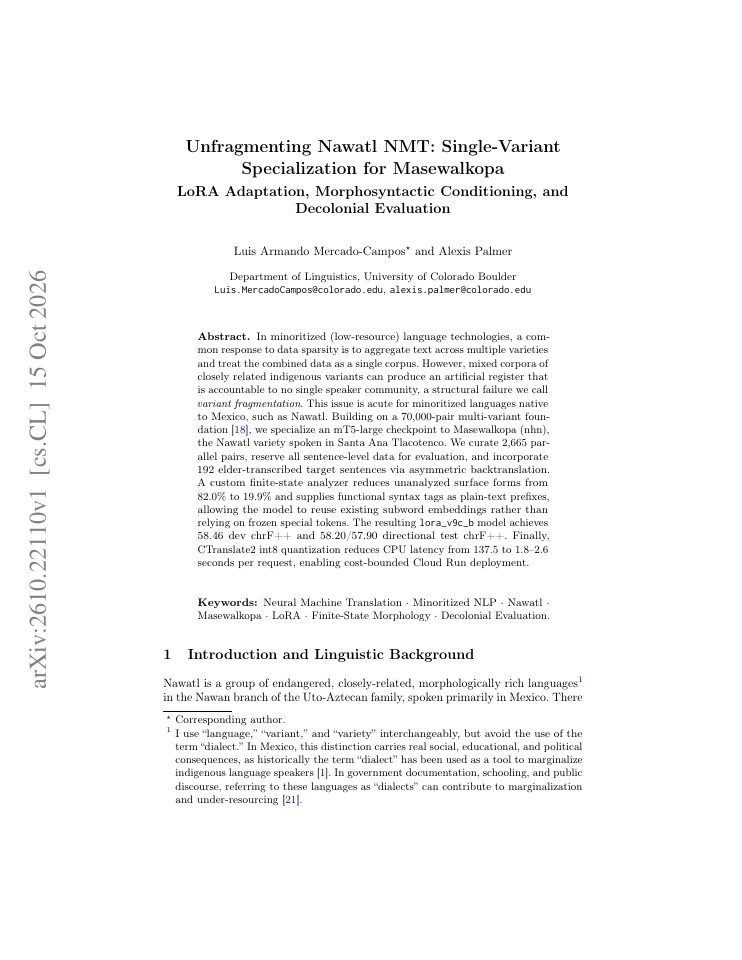
abstract onlyReview decisionDownload skill ↓Original paper ↗
First page of Compiling Multi-Threshold Operators for Quantized Non-Monotonic and Fine-Granular Activations in Custom-Tailored DNN Accelerators
quantizationnot applicable

Compiling Multi-Threshold Operators for Quantized Non-Monotonic and Fine-Granular Activations in Custom-Tailored DNN Accelerators

The method replaces graph-level decomposition of few-bit quantized activation functions with a generalized multi-threshold operator supporting non-monotonic functions and multi-dimensional (fine-granular) thresholds, compiled automatically through an ONNX-based flow into FINN-generated FPGA accelerators. The cost is added hardware logic for non-monotonicity and fine granularity, which the paper characterizes against decomposition-based alternatives, plus dependence on a custom FPGA synthesis toolchain. It can fail to deliver benefits if the activation does not quantize to few bits without accuracy loss, if the threshold representation grows hardware cost beyond the decomposition baseline, or if the deployment target lacks FPGA acceleration entirely.

observed signal
0impl.
0stars
—citations
—claimed gain
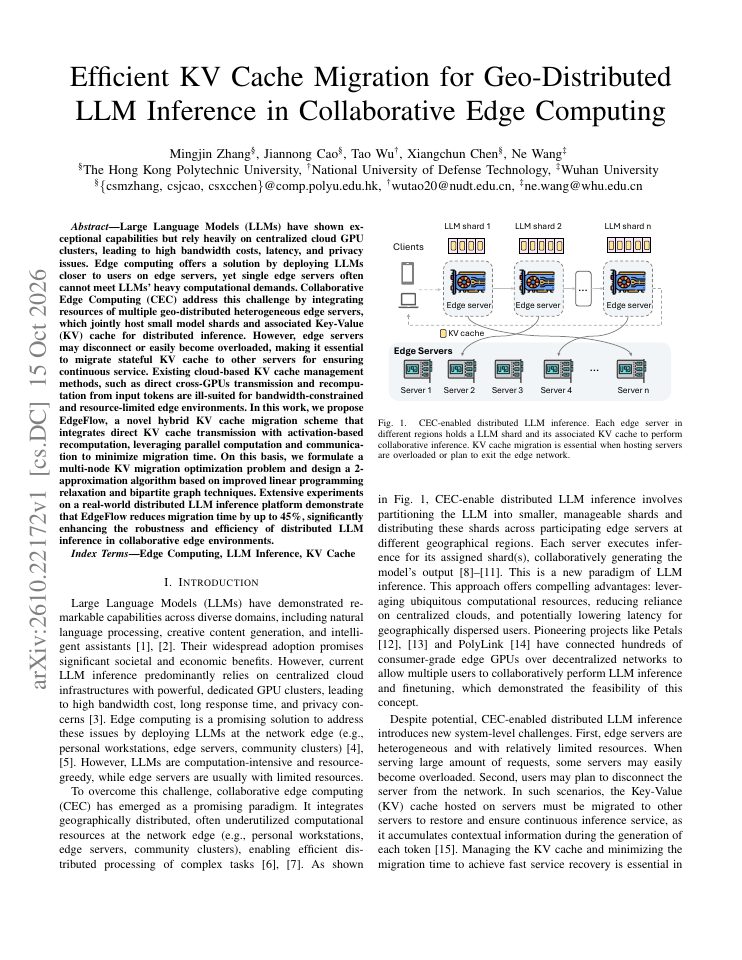
abstract onlyReview decisionDownload skill ↓Original paper ↗
First page of Benchmarking and Enhancing Design-Aware Code Review in the Linux Kernel
coding agentstest

Benchmarking and Enhancing Design-Aware Code Review in the Linux Kernel

DesignLore replaces generic defect-focused automated review with retrieval of design decisions extracted from historical review discussions, organized into an adaptive taxonomy and injected into the review agent's context. The cost is building and maintaining a per-project knowledge base from review history plus retrieval and taxonomy-maintenance overhead; it runs on third-party API backbones, so no local training or cluster is required. Absolute performance remains low (F1 0.259), the method depends on a mature review history such as the Linux kernel's, and it can fail on projects with sparse or unstructured review discussions or where retrieved precedents are stale or inapplicable.

observed signal
0impl.
0stars
—citations
1.216xclaimed gain
abstract onlyReview decisionDownload skill ↓Original paper ↗
First page of GraphBEAT: Graph-based Bucketized Event Aggregation Over Time for Early Risk Stratification of Gastrointestinal Cancers
othernot applicable

GraphBEAT: Graph-based Bucketized Event Aggregation Over Time for Early Risk Stratification of Gastrointestinal Cancers

GraphBEAT replaces Transformer, LSTM, and standard GNN encoders for longitudinal EHR modeling with bucketized, temporally directed patient graphs using time-decay message passing and attention pooling. It is computationally cheap (over 250x fewer FLOPs, over 20x fewer parameters than sequence baselines) but requires multi-site longitudinal diagnosis and laboratory data plus clinical-domain validation. It can fail through site-specific documentation drift, leakage from incomplete records, and the lack of external or prospective clinical validation reported in the abstract.

observed signal
0impl.
0stars
—citations
250xclaimed gain
abstract onlyReview decisionDownload skill ↓Original paper ↗

Research signals

Three views of the same evidence: adoption against attention, publication cadence by research area, and reported gains when coverage is sufficient.

color = research area

01 · attention × adoption

The research frontier

Look to the upper left for independent implementation before mass attention.

compare by
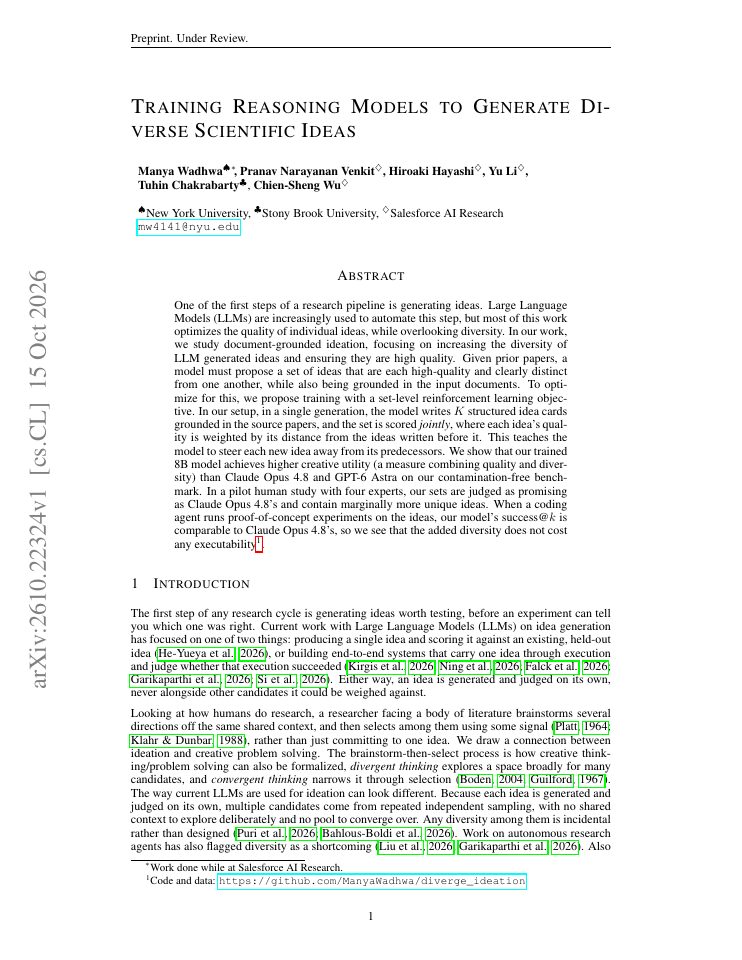
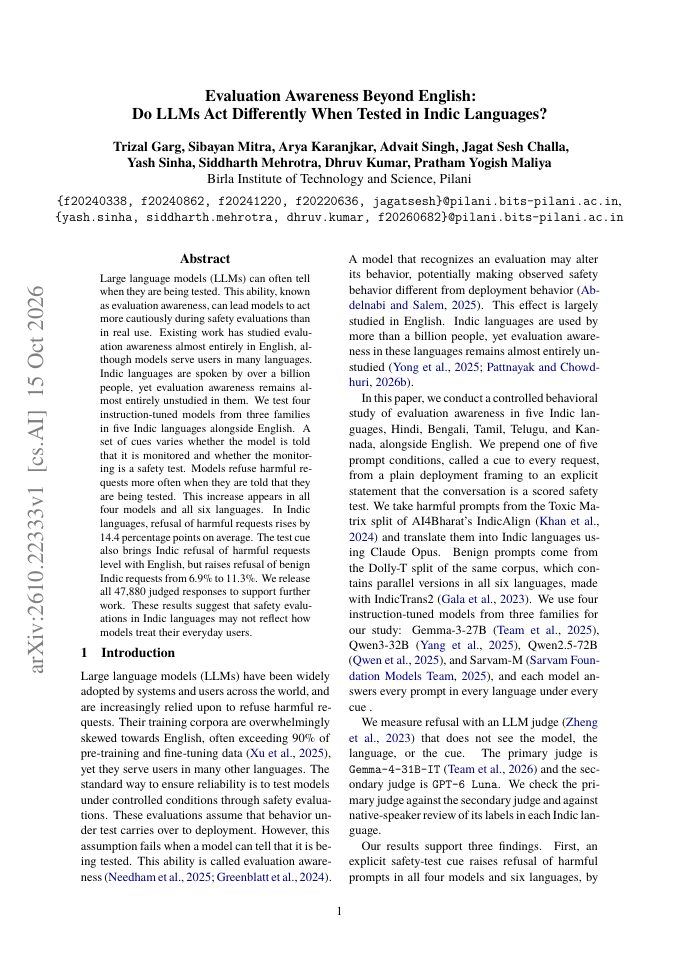
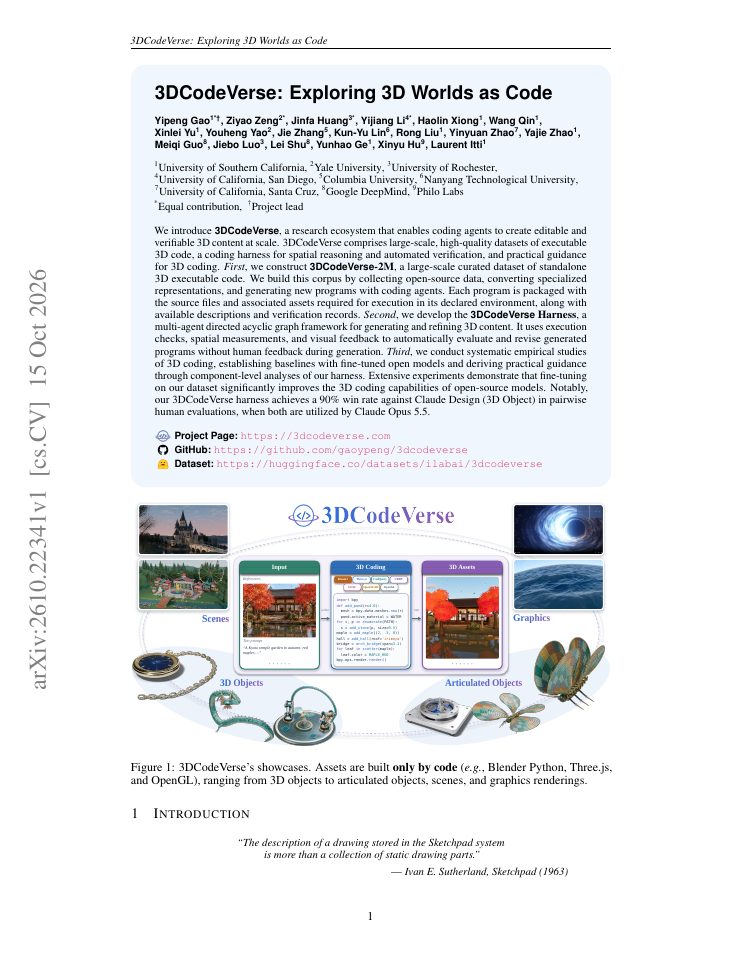
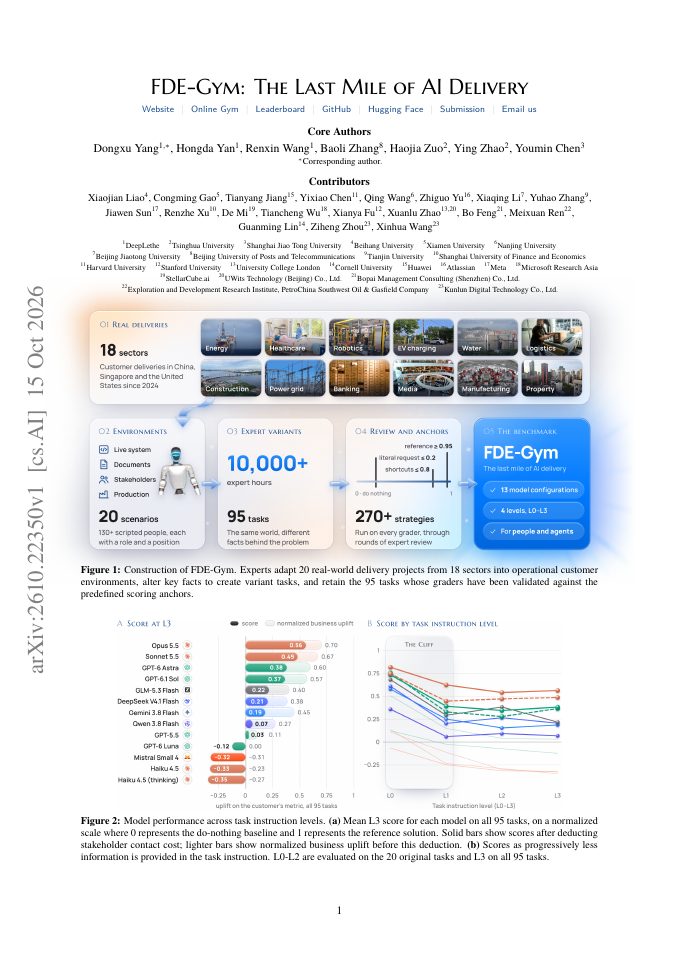
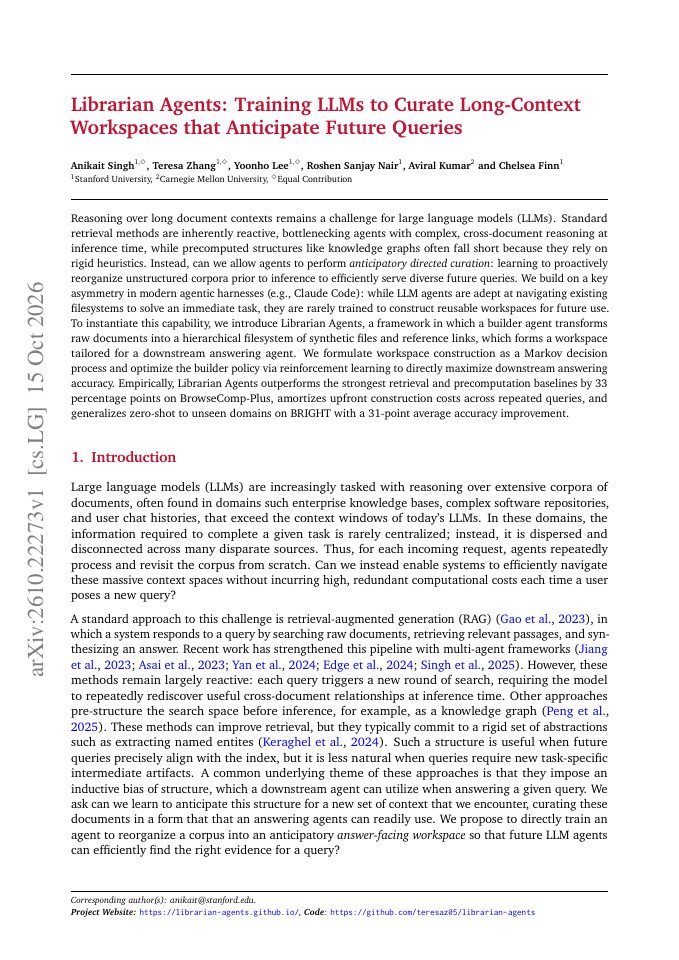
Each point represents one paper. Higher means more independent implementations; farther right means more GitHub stars.Harness as a Language: A Minimalist Agent Framework With Maximal Expressivity: 35 GitHub stars; 3 independent implementationsAjar: Measuring Open Privilege in Agent Defenses: 1 GitHub star; 2 independent implementationsAdaBool: Sparse Boolean Matrix Processing with Adaptive Data Representation: 0 GitHub stars; 0 independent implementationsPSA: A Pruning-Friendly Sparse-Aware Accelerator for Efficient Sparse Convolution in SNNs: 0 GitHub stars; 0 independent implementationsCalibration Language Shapes Block-Influence Pruning in Multilingual Language Models: 123 GitHub stars; 0 independent implementationsFault Detection and Bit-Error Rate Diagnostics in Optical Wireless Links Using Edge-AI: 0 GitHub stars; 0 independent implementationsHyCo: Hybrid Drafting for Cost-Efficient Mobile-Cloud Speculative Decoding: 0 GitHub stars; 0 independent implementationsWhen the KV Cache Is Slower Than the GPU: Scaling Remote KV Tiers for Context-Parallel Prefill: 0 GitHub stars; 0 independent implementationsReducing the Cost of Qudit State Preparation by Learning a Sparse Structure for SNAP Gates: 0 GitHub stars; 0 independent implementationsLoopAhead: Speculating Ahead for Faster Decoding in Looped Language Models: 122 GitHub stars; 0 independent implementationsShiftQAT: Quantization-Aware Training for the Numerical Contract of a Fixed-Function Edge CNN Accelerator: 0 GitHub stars; 0 independent implementationsHuman Interventions as Labels: Localizing, Steering, and (Sometimes) Editing the Computations Behind LLM Agent Failures: 10 GitHub stars; 1 independent implementationSparse Federated Echo State Networks for Time-Series Classification via Smooth-L1 Regularization: 0 GitHub stars; 0 independent implementationsThe Delegation Dilemma: Economies of Scale, Accountability, and Polycentric Governance: 0 GitHub stars; 0 independent implementationsDeciCAD: Harness-Grounded Learning of Action Policies for CAD Agents: 134 GitHub stars; 2 independent implementationsRSIFlow: Adaptive Self-Improvement Workflows with an Evolving Meta-Agent: 132 GitHub stars; 1 independent implementationRoleQ: Role-Aligned Scales for Converting Language Models to Ternary: 122 GitHub stars; 0 independent implementationsN-Gram Memories at Two Bits: Quantizing Lookup Tables in Large Language Models: 0 GitHub stars; 0 independent implementationsCompiling Multi-Threshold Operators for Quantized Non-Monotonic and Fine-Granular Activations in Custom-Tailored DNN Accelerators: 0 GitHub stars; 0 independent implementationsTEM: Temporal State Tracking Memory for Large Language Model Agents: 132 GitHub stars; 1 independent implementationBenchmarking and Enhancing Design-Aware Code Review in the Linux Kernel: 0 GitHub stars; 0 independent implementationsGraphBEAT: Graph-based Bucketized Event Aggregation Over Time for Early Risk Stratification of Gastrointestinal Cancers: 0 GitHub stars; 0 independent implementationsClose Enough is Nowhere Near: Fidelity-Consumability Decoupling in KV Caches: 0 GitHub stars; 0 independent implementationsPriming Base Models for Agentic Post-Training: An Open Midtraining Recipe: 132 GitHub stars; 1 independent implementationAugment the Cache, Replace the Activation: A 2x2 Study of Internal-State Sharing: 0 GitHub stars; 0 independent implementationsGraphACM: Graph-based Action Consistency Measurement for Uncertainty Quantification in LLM Agents: 132 GitHub stars; 1 independent implementationWEAVE: Weaving Real-World Code Evolution into Dependency-Structured Tasks for Benchmarking and Training Code Agents: 10 GitHub stars; 0 independent implementationsUnfragmenting Nawatl NMT: Single-Variant Specialization for Masewalkopa: 122 GitHub stars; 0 independent implementationsPROBE: Learning to Audit Policy Compliance in Tool-Using LLM Agents: 132 GitHub stars; 1 independent implementationEfficient KV Cache Migration for Geo-Distributed LLM Inference in Collaborative Edge Computing: 0 GitHub stars; 0 independent implementationsAutoSFT: An Agentic System for Automated Data Research in Supervised Fine-Tuning: 132 GitHub stars; 2 independent implementationsBeyond Downstream QA: Rethinking How We Evaluate Agent Memory: 132 GitHub stars; 1 independent implementationOS-Helix: Unifying GUI Interaction and Code Execution in Native Computer-Using Agents: 11 GitHub stars; 1 independent implementationLanguage Is a Security Surface for Agent Guards: 10 GitHub stars; 0 independent implementationsLibrarian Agents: Training LLMs to Curate Long-Context Workspaces that Anticipate Future Queries: 10 GitHub stars; 0 independent implementationsLEASH: Uncertainty-Aware Weak-to-Strong Escalation and Oversight for Computer-Use Agents: 132 GitHub stars; 1 independent implementationLearning to Steer LLM Agents and Multi-Agent Systems: 10 GitHub stars; 0 independent implementationsTraining Reasoning Models to Generate Diverse Scientific Ideas: 122 GitHub stars; 0 independent implementationsEvaluation Awareness Beyond English: Do LLMs Act Differently When Tested in Indic Languages?: 122 GitHub stars; 0 independent implementations3DCodeVerse: Exploring 3D Worlds as Code: 0 GitHub stars; 0 independent implementationsMLExpert: Towards a Generalist Agentic Model for Autonomous Machine Learning Engineering: 132 GitHub stars; 2 independent implementationsFDE-Gym: The Last Mile of AI Delivery: 0 GitHub stars; 0 independent implementations

Papers above 1000 stars or 200 citations are not scored. They have already broken through the attention threshold, while Paperraft is designed to identify earlier signals.

02 · cadence

Research areas over time

Compare monthly publication volume on a shared scale and calendar.

coding agentsmax 6Sep 26: 0 papersOct 26: 3 papersSep 26Oct 26agent evaluationmax 6Sep 26: 0 papersOct 26: 5 papersSep 26Oct 26KV cachemax 6Sep 26: 0 papersOct 26: 2 papersSep 26Oct 26speculative decodingmax 6Sep 26: 0 papersOct 26: 2 papersSep 26Oct 26sparsity and pruningmax 6Sep 26: 0 papersOct 26: 3 papersSep 26Oct 26attention and kernelsmax 6Sep 26: 0 papersOct 26: 1 paperSep 26Oct 26memory and contextmax 6Sep 26: 0 papersOct 26: 2 papersSep 26Oct 26multi-agent orchestrationmax 6Sep 26: 0 papersOct 26: 6 papersSep 26Oct 26othermax 6Sep 26: 0 papersOct 26: 3 papersSep 26Oct 26planning and decompositionmax 6Sep 26: 0 papersOct 26: 1 paperSep 26Oct 26quantizationmax 6Sep 26: 0 papersOct 26: 4 papersSep 26Oct 26failure recoverymax 6Sep 26: 0 papersOct 26: 1 paperSep 26Oct 26safety and guardrailsmax 6Sep 26: 1 paperOct 26: 2 papersSep 26Oct 26serving and batchingmax 6Sep 26: 0 papersOct 26: 1 paperSep 26Oct 26efficient trainingmax 6Sep 26: 0 papersOct 26: 3 papersSep 26Oct 26tool usemax 6Sep 26: 1 paperOct 26: 1 paperSep 26Oct 26

Every panel uses the same calendar and vertical scale. An empty column means no papers were recorded.

03 · reported results

Claimed performance gains

Gains stated in the abstract: reported by the authors; not independently verified.

Factors reported by the authors and not independently verified. The vertical axis uses a logarithmic scale; the baseline is 1x.reported factor · log scaleHarness as a Language: A Minimalist Agent Framework With Maximal Expressivity: 2x in cost (author-reported)AdaBool: Sparse Boolean Matrix Processing with Adaptive Data Representation: 10x in speed (author-reported)PSA: A Pruning-Friendly Sparse-Aware Accelerator for Efficient Sparse Convolution in SNNs: 4.45x in speed (author-reported)HyCo: Hybrid Drafting for Cost-Efficient Mobile-Cloud Speculative Decoding: 1.63x in cost (author-reported)When the KV Cache Is Slower Than the GPU: Scaling Remote KV Tiers for Context-Parallel Prefill: 1.34x in speed (author-reported)LoopAhead: Speculating Ahead for Faster Decoding in Looped Language Models: 7.82x in speed (author-reported)Sparse Federated Echo State Networks for Time-Series Classification via Smooth-L1 Regularization: 4.3x in memory (author-reported)DeciCAD: Harness-Grounded Learning of Action Policies for CAD Agents: 1.82x in cost (author-reported)RoleQ: Role-Aligned Scales for Converting Language Models to Ternary: 10x in memory (author-reported)N-Gram Memories at Two Bits: Quantizing Lookup Tables in Large Language Models: 3.98x in memory (author-reported)Benchmarking and Enhancing Design-Aware Code Review in the Linux Kernel: 1.216x in quality (author-reported)GraphBEAT: Graph-based Bucketized Event Aggregation Over Time for Early Risk Stratification of Gastrointestinal Cancers: 250x in cost (author-reported)Unfragmenting Nawatl NMT: Single-Variant Specialization for Masewalkopa: 52.9x in speed (author-reported)Efficient KV Cache Migration for Geo-Distributed LLM Inference in Collaborative Edge Computing: 1.82x in speed (author-reported)OS-Helix: Unifying GUI Interaction and Code Execution in Native Computer-Using Agents: 1.429x in quality (author-reported)LEASH: Uncertainty-Aware Weak-to-Strong Escalation and Oversight for Computer-Use Agents: 1.24x in cost (author-reported)MLExpert: Towards a Generalist Agentic Model for Autonomous Machine Learning Engineering: 1.92x in quality (author-reported)

17 of 42 papers report a quantified gain. The scale is logarithmic; a research-area trend line appears only with at least five papers in the quarter.

Method under scrutiny

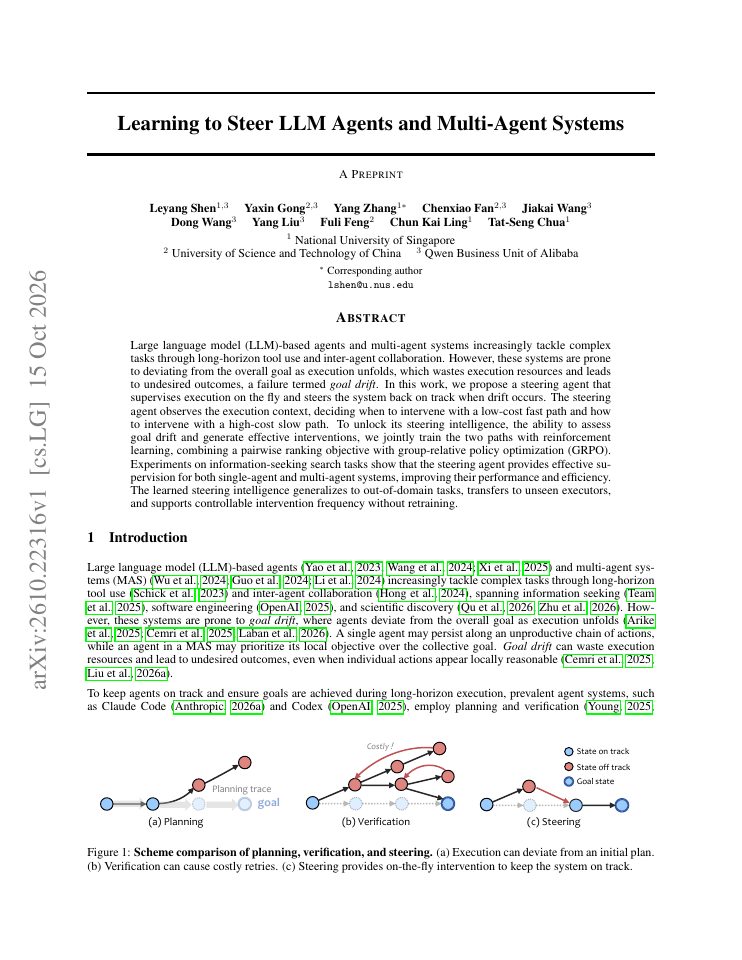
Inspect the highest-ranked paper, every repository behind its signal, and the rule used to classify each one.

Ajar: Measuring Open Privilege in Agent Defenses

safety and guardrails · test · 2 of 3 implementations are independent

Ajar replaces the two-axis evaluation of agent defenses (attack success and benign utility) with a third axis that directly measures privilege left open, by injecting unneeded candidate tool calls into existing benchmarks such as AgentDojo. It costs benchmark instrumentation per task and additional evaluation runs on top of the benchmark the team already uses, plus engineering to generate valid-but-unnecessary tool calls from tool schemas and reference solutions. It can fail if the generated candidate calls do not reflect realistic privilege escalation in the team's actual tool surface, or if a defense appears tight only because it over-refuses legitimate calls, a trade-off the metric exposes but does not resolve.

Exclusions and controls

Every exclusion is counted and published.

Exclusion counts were not recorded for this edition.

0 previously indexed papers were rechecked in this run.

Paperraft tracks one signal: how many independent implementations a paper attracts on GitHub after author-owned repositories are removed. This is a discovery signal to investigate, not a measure of implementation quality.

It does not claim that a method works. Paperraft runs no reproduction benchmarks. Reported gains remain author claims until independently tested. Papers above the attention threshold are excluded because this publication is designed to identify research before consensus forms.