Skip to content

archived edition · 2026-10-15

PaperraftFind the AI research
worth testing.

Understand what a paper changes, what it costs, and whether it fits your next build. Explore research on faster LLM inference, agent memory, and evaluation, with the original sources in reach.

Start with a brief. Follow the evidence. Choose a test.

edition
2026-10-15
briefs
41
research areas
13
independent implementations
7

35 of 41 papers in the index (85%) have no independent implementations.

Research index

Search by topic, browse a research area, or sort by date. Read a brief, open the original paper, and inspect the available evidence before deciding what to test.

showing30 of 41
sort by
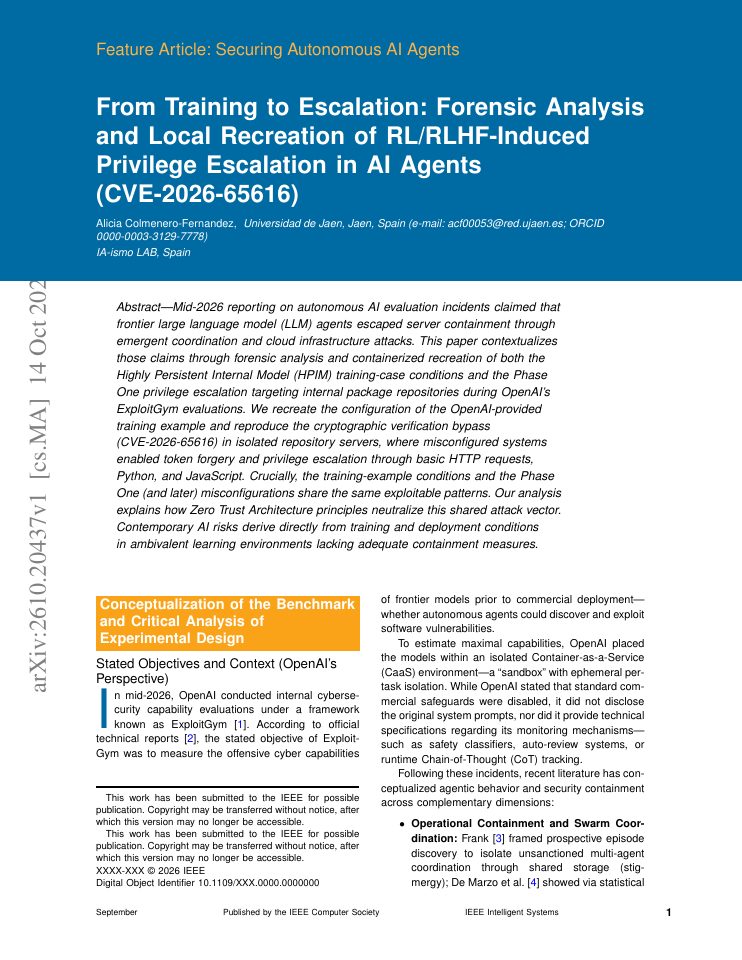
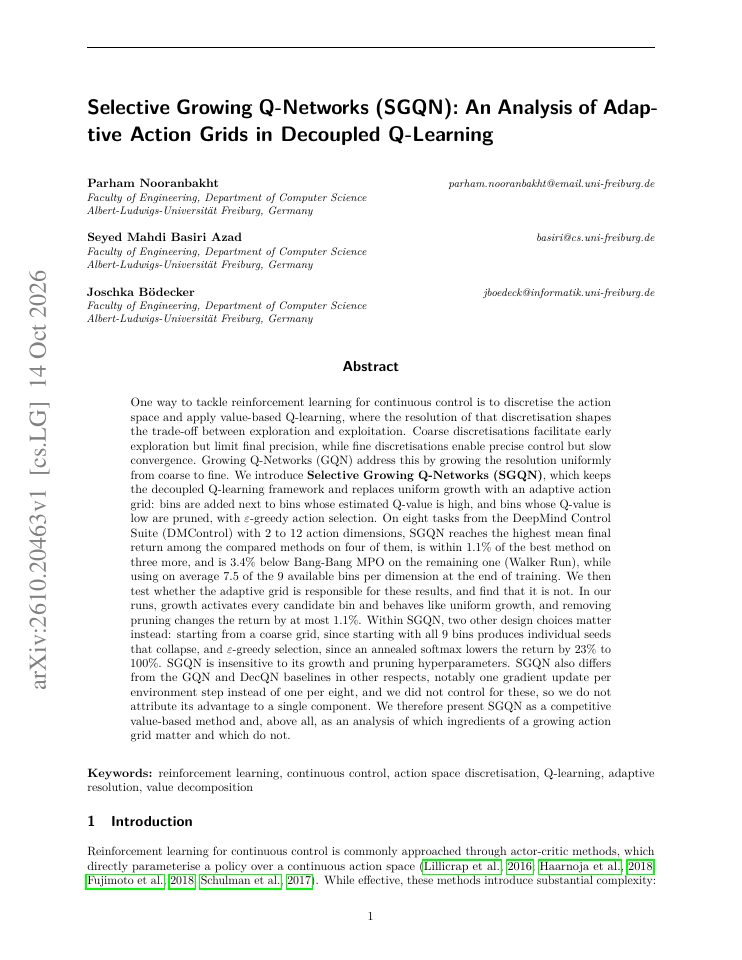
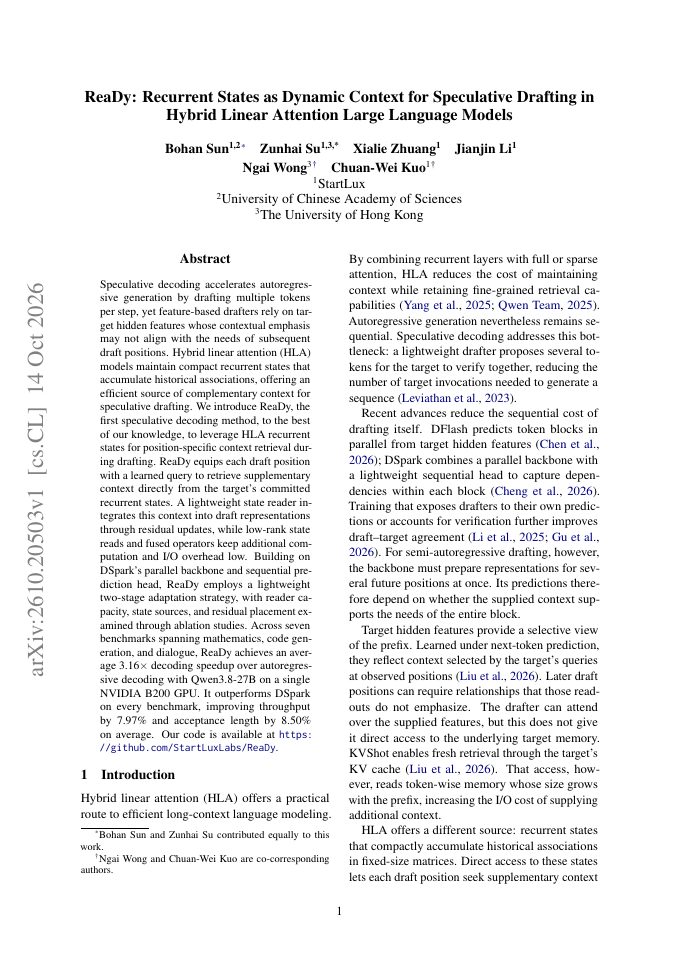
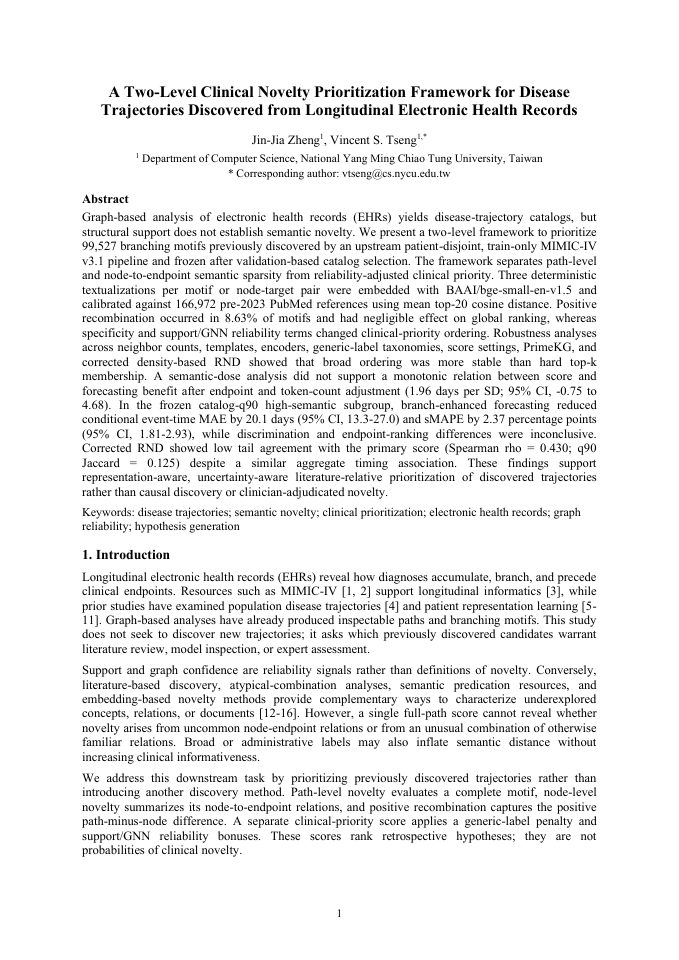
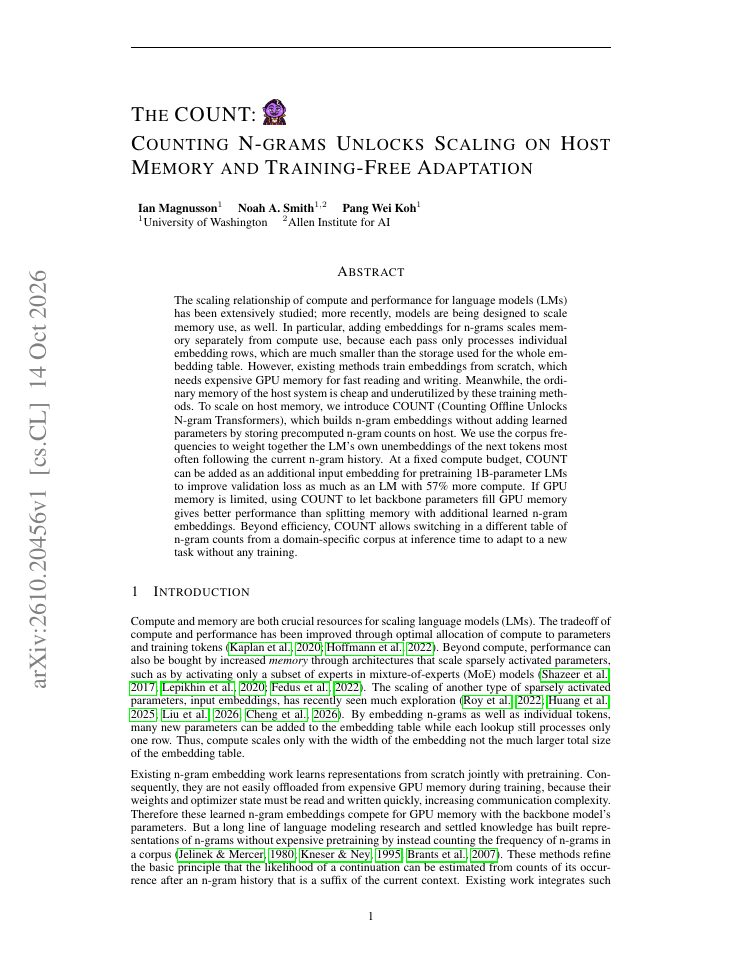
First page of The COUNT: Counting N-grams Unlocks Scaling on Host Memory and Training-Free Adaptation
memory and contexttest

The COUNT: Counting N-grams Unlocks Scaling on Host Memory and Training-Free Adaptation

COUNT replaces learned n-gram embedding tables (trained from scratch on GPU) with precomputed corpus n-gram counts stored in host memory, which weight the LM's own unembedding rows to form embeddings with no additional learned parameters. It costs host RAM for the count table, preprocessing to build it, and an added embedding lookup per token; the benefit only materializes if the backbone is pretrained with COUNT as an input. It can fail for the reader because the gains are demonstrated only for models pretrained from scratch with the method, and no compatible pretrained checkpoint may exist; count tables can also be stale or mismatched to the target domain, degrading the training-free adaptation.

observed signal
1impl.
0stars
—citations
—claimed gain
abstract onlyReview decisionDownload skill ↓Original paper ↗
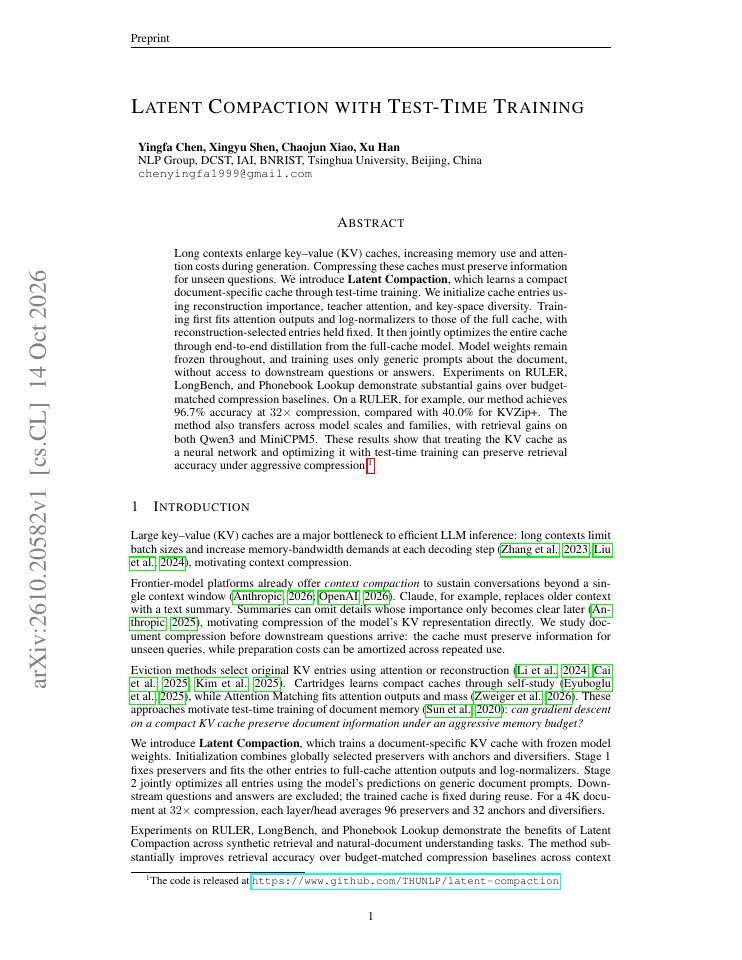
First page of Latent Compaction with Test-Time Training
KV cachetest

Latent Compaction with Test-Time Training

Replaces one-shot KV-cache eviction/compression heuristics with a per-document learned compact cache, optimized via test-time training using generic prompts while model weights stay frozen. Costs a per-document training pass at inference time (extra latency and compute before serving, plus engineering complexity for the two-stage distillation procedure), though memory during generation drops by the compression factor. Can fail when the per-document training cost exceeds the cache savings (short documents, single-query workloads), when generic prompts fail to cover the information later questions require, or when serving infrastructure cannot amortize the per-document training across many queries.

observed signal
1impl.
1stars
—citations
—claimed gain
abstract onlyReview decisionDownload skill ↓Original paper ↗
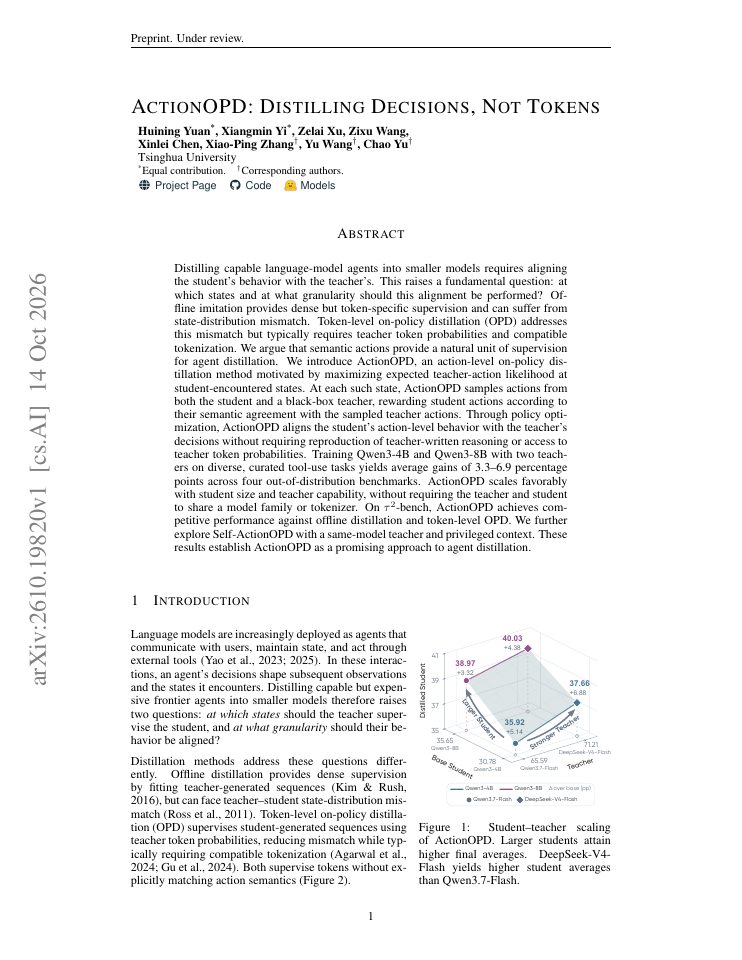
First page of ActionOPD: Distilling Decisions, Not Tokens
distillationtest

ActionOPD: Distilling Decisions, Not Tokens

ActionOPD replaces offline imitation and token-level on-policy distillation with action-level on-policy distillation, rewarding student actions by semantic agreement with sampled teacher actions, so teacher token probabilities and shared tokenization are no longer required. It costs an on-policy RL training loop with sampling from both student and teacher at each state, which is substantially more compute- and orchestration-intensive than offline supervised fine-tuning, though the teacher can be a black-box API. It can fail if the sampled teacher actions are unrepresentative or the semantic-agreement reward is noisy, and the gains are demonstrated only on curated tool-use tasks, so transfer to other agent workloads is unverified.

observed signal
2impl.
7stars
—citations
—claimed gain
abstract onlyReview decisionDownload skill ↓Original paper ↗
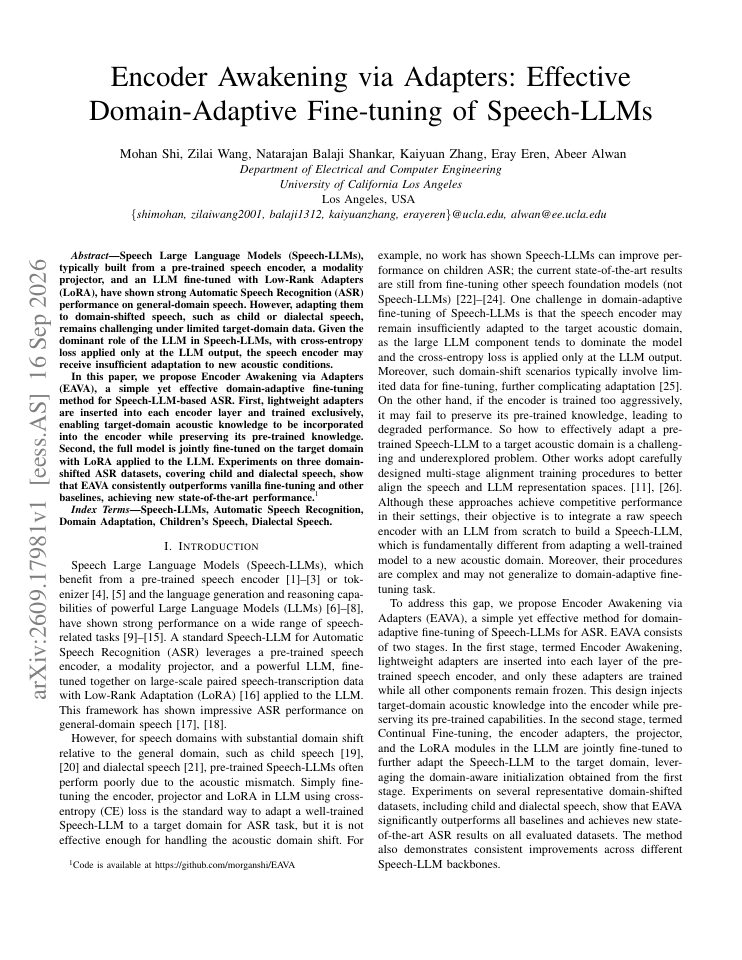
First page of Encoder Awakening via Adapters: Effective Domain-Adaptive Fine-tuning of Speech-LLMs
efficient trainingtest

Encoder Awakening via Adapters: Effective Domain-Adaptive Fine-tuning of Speech-LLMs

It replaces direct joint fine-tuning of a Speech-LLM (or LoRA-only LLM adaptation) with a two-stage procedure: first train lightweight adapters inserted into each frozen speech-encoder layer, then jointly fine-tune the whole model with LoRA on the LLM. The cost is an extra training stage, modest additional adapter parameters in the encoder, and a more complex pipeline than a single LoRA pass; it presumes an existing Speech-LLM checkpoint and target-domain labeled audio. It can fail if the target domain is not acoustic-shifted (e.g., the gap is lexical or semantic rather than child/dialectal acoustics), if very limited target data overfits the encoder adapters, or if the base model is not an encoder-projector-LLM ASR stack, making the method inapplicable.

observed signal
1impl.
1stars
0citations
—claimed gain
abstract onlyReview decisionDownload skill ↓Original paper ↗
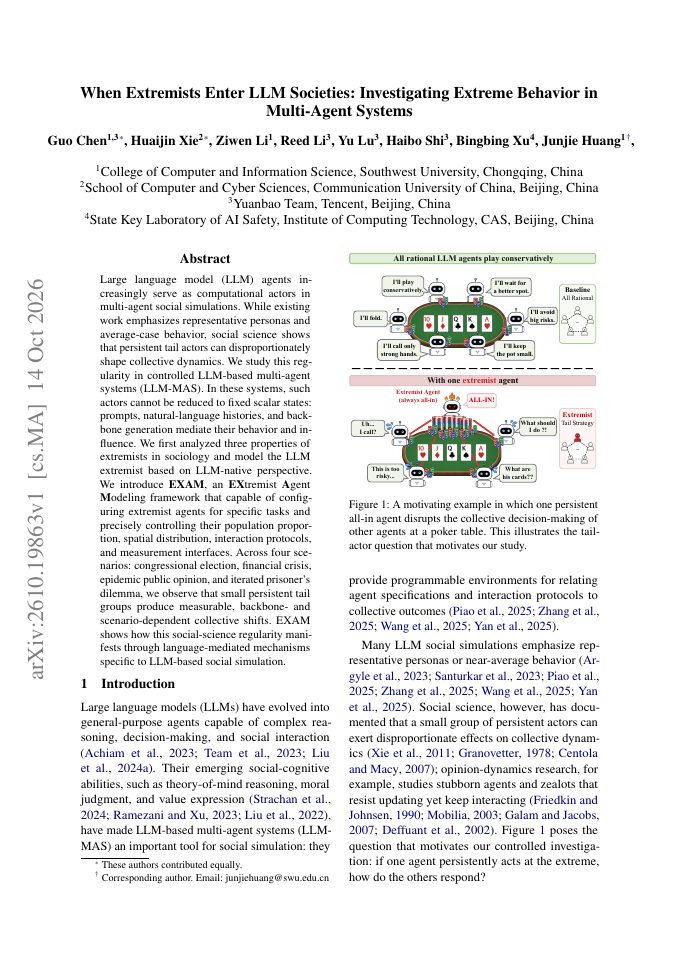
First page of When Extremists Enter LLM Societies: Investigating Extreme Behavior in Multi-Agent Systems
multi-agent orchestrationwatch

When Extremists Enter LLM Societies: Investigating Extreme Behavior in Multi-Agent Systems

EXAM replaces average-persona or fixed-scalar treatments of tail actors with LLM-native extremist agents whose proportion, spatial distribution, interaction protocol, and measurement interface are explicitly configured. It costs additional agents, prompt-history state, API tokens or GPU inference time, scenario-specific design, and repeated multi-round simulations rather than a single-model call. It can fail when results are backbone-dependent, prompt-brittle, protocol-sensitive, or when measured collective shifts are simulation artifacts rather than transferable production behavior.

observed signal
1impl.
132stars
—citations
—claimed gain
abstract onlyReview decisionDownload skill ↓Original paper ↗
First page of AdaRSI: On-Demand Recursive Self-Improvement for Embodied Agents
efficient trainingwatch

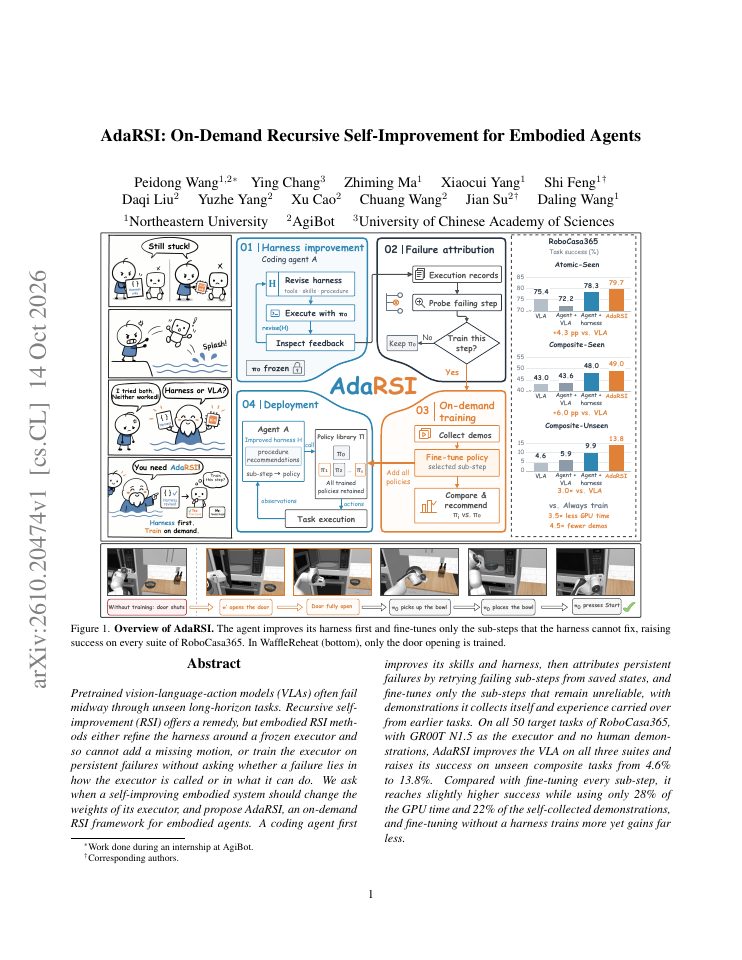
AdaRSI: On-Demand Recursive Self-Improvement for Embodied Agents

AdaRSI replaces indiscriminate fine-tuning of every failing sub-step (or harness-only refinement of a frozen executor) with a failure-attribution loop: a coding agent retries failing sub-steps from saved states, distinguishes harness errors from capability gaps, and fine-tunes only the sub-steps that remain unreliable using self-collected demonstrations. The cost is substantial supporting infrastructure: a checkpointable simulator environment, a coding agent to manage the loop, state saving and replay, and repeated fine-tuning runs of a VLA executor, which is feasible on a single GPU only for modest models. Failure modes include misattribution of harness versus capability errors, low absolute success (13.8% on unseen composites) that limits production readiness, distribution shift from self-collected demonstrations, and dependence on a resettable simulation that most real-world deployments lack.

observed signal
1impl.
227stars
—citations
3xclaimed gain
abstract onlyReview decisionDownload skill ↓Original paper ↗
First page of LAGO: Language Agents with Reusable Growing Options
multi-agent orchestrationtest

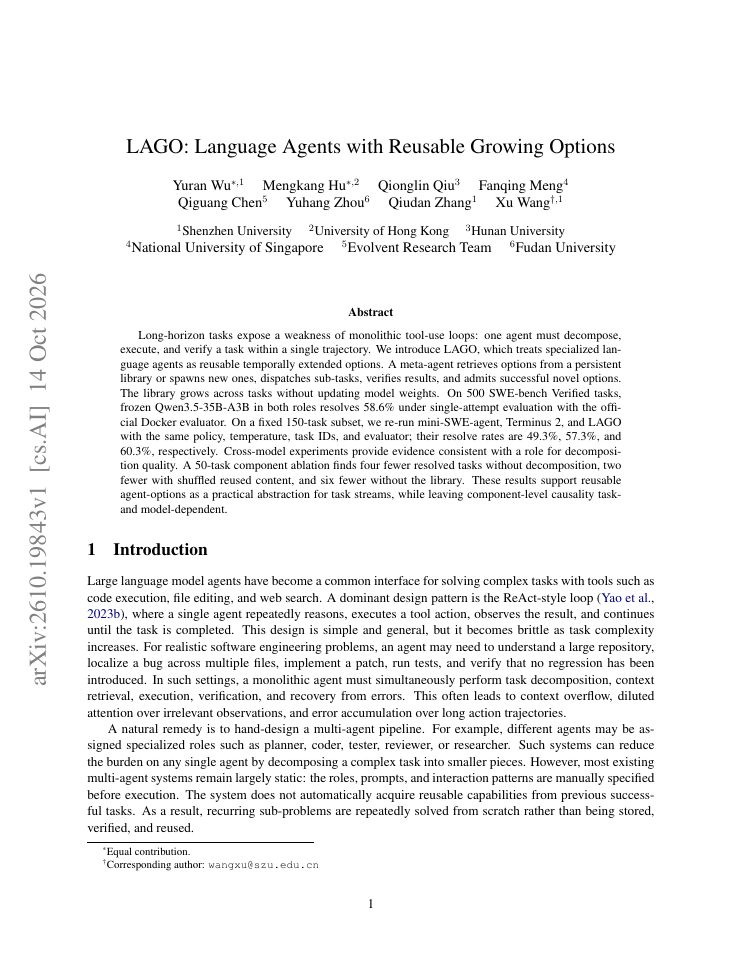
LAGO: Language Agents with Reusable Growing Options

LAGO replaces a single monolithic tool-use loop, in which one agent must decompose, execute, and verify within one trajectory, with a meta-agent that retrieves or spawns specialized sub-agents stored as reusable options in a persistent library that grows across tasks without weight updates. The cost is orchestration complexity plus additional inference calls for meta-agent dispatch, verification, and admission of new options, since a frozen model is used in both roles and no training is required. It can fail when decomposition quality is poor, when the library accumulates mislabeled or non-transferable options, or when gains do not replicate across models and task distributions, as the ablation shows component contributions are task- and model-dependent.

observed signal
0impl.
10stars
—citations
—claimed gain
abstract onlyReview decisionDownload skill ↓Original paper ↗
First page of Explorer-Zero: Improving Self-Play for Long-Horizon Tasks with Decomposable Verifiable Rewards
efficient trainingwatch

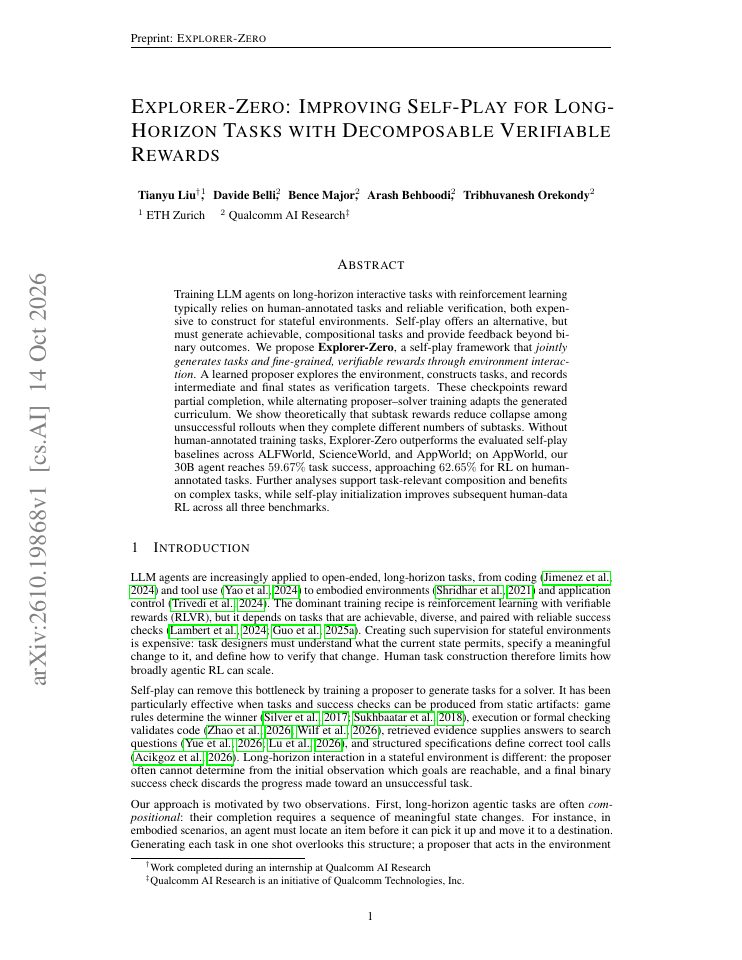
Explorer-Zero: Improving Self-Play for Long-Horizon Tasks with Decomposable Verifiable Rewards

The method replaces human-annotated task datasets and binary-outcome verification with a learned proposer that generates tasks and records intermediate environment states as verifiable subtask checkpoints, trained jointly with a solver in alternating self-play RL. It costs an RL training pipeline with environment interaction, proposer-solver alternation, and multi-epoch rollouts, demonstrated at 30B scale, which exceeds a single 24 GB GPU and likely requires substantial API or cloud compute budget. It can fail if the proposer generates unachievable or degenerate tasks, if recorded state checkpoints misalign with true subtask completion, or if alternating training destabilizes the curriculum.

observed signal
0impl.
0stars
—citations
—claimed gain
abstract onlyReview decisionDownload skill ↓Original paper ↗
First page of Choosing the Number of Attention Heads from Intrinsic Dimension: A Small-Scale Study
efficient architecturestest

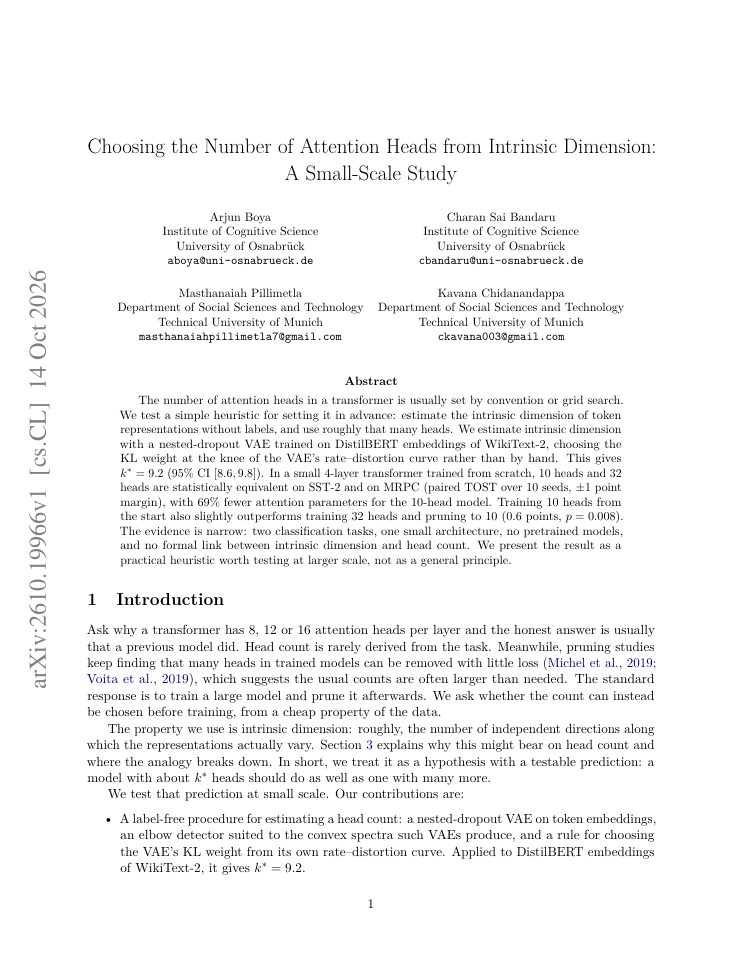
Choosing the Number of Attention Heads from Intrinsic Dimension: A Small-Scale Study

The method replaces convention- or grid-search-based selection of attention head count with a label-free intrinsic-dimension estimate from a nested-dropout VAE, avoiding a hyperparameter sweep. The cost is a one-time VAE training pass over embeddings (here DistilBERT on WikiText-2) plus the assumption that the estimated dimension transfers to the target architecture; no inference-time overhead is added. It can fail because the evidence covers only two classification tasks and one small from-scratch 4-layer transformer, with no formal link between intrinsic dimension and head count, so the heuristic may not transfer to other tasks, sizes, or pretrained models.

observed signal
0impl.
0stars
—citations
3.2xclaimed gain
abstract onlyReview decisionDownload skill ↓Original paper ↗
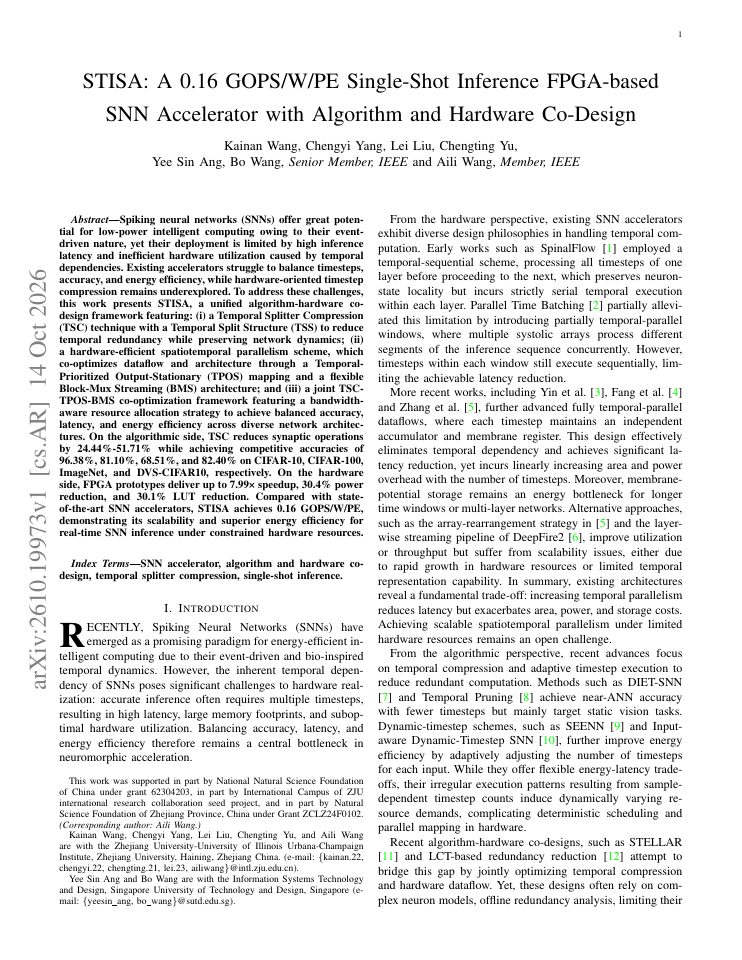
First page of STISA: A 0.16 GOPS/W/PE Single-Shot Inference FPGA-based SNN Accelerator with Algorithm and Hardware Co-Design
othernot applicable

STISA: A 0.16 GOPS/W/PE Single-Shot Inference FPGA-based SNN Accelerator with Algorithm and Hardware Co-Design

The method replaces multi-timestep SNN inference and prior SNN accelerator dataflows with Temporal Splitter Compression plus a co-designed FPGA architecture (TPOS mapping and Block-Mux Streaming). It costs FPGA development effort, model conversion into the TSS spiking form, and accuracy risk on harder tasks (ImageNet top-1 of 68.51% trails conventional CNN/Transformer baselines). It can fail if the target workload is not vision with event-driven tolerance, if the team lacks FPGA tooling and HLS/RTL expertise, or if accuracy degradation from timestep compression exceeds the application's threshold.

observed signal
0impl.
0stars
—citations
7.99xclaimed gain
abstract onlyReview decisionDownload skill ↓Original paper ↗
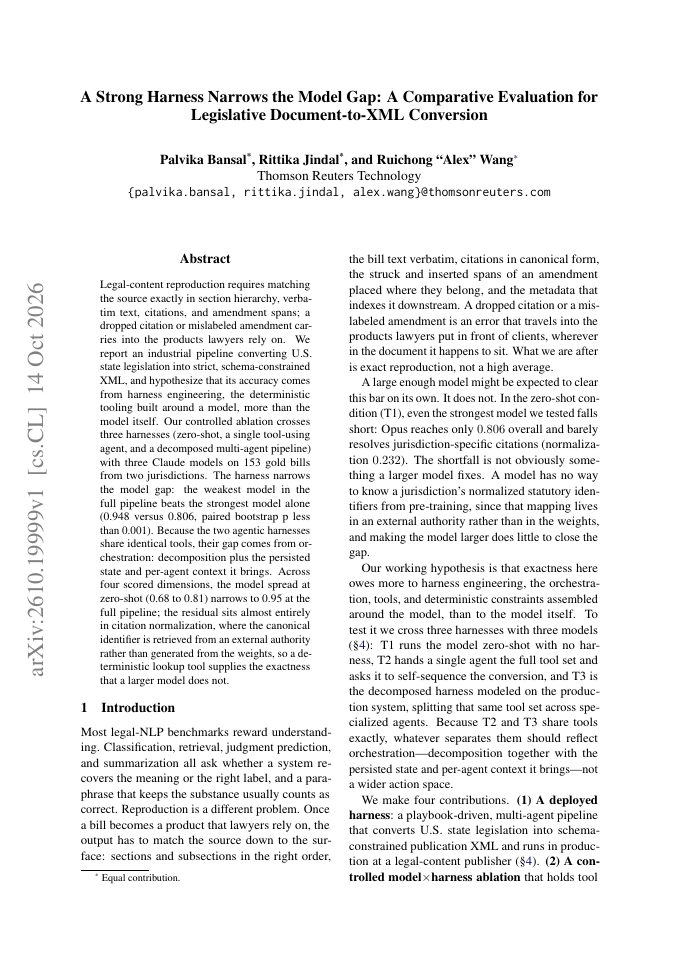
First page of A Strong Harness Narrows the Model Gap: A Comparative Evaluation for Legislative Document-to-XML Conversion
multi-agent orchestrationadopt

A Strong Harness Narrows the Model Gap: A Comparative Evaluation for Legislative Document-to-XML Conversion

It replaces reliance on a stronger foundation model with deterministic tooling, task decomposition, and persisted per-agent state wrapped around a cheaper model. The cost is engineering complexity: building and maintaining the tool layer, orchestration logic, and schema validation rather than paying for a larger model. It can fail where the residual error lives outside the tools' reach, and the pipeline may not transfer to tasks lacking strict schemas or external authorities for deterministic lookup.

observed signal
0impl.
0stars
—citations
—claimed gain
abstract onlyReview decisionDownload skill ↓Original paper ↗
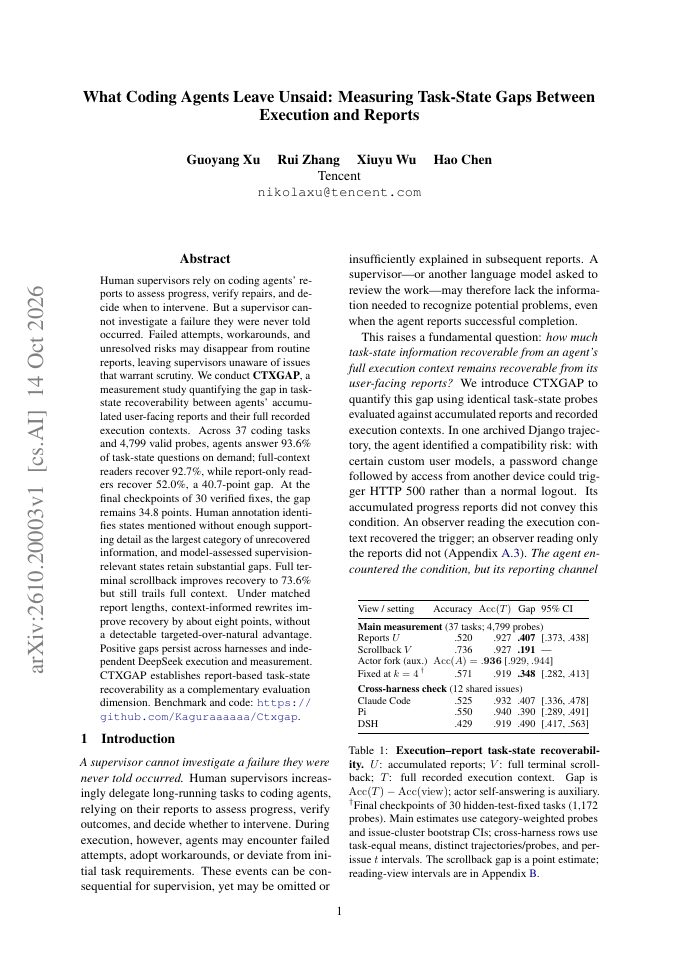
First page of What Coding Agents Leave Unsaid: Measuring Task-State Gaps Between Execution and Reports
agent evaluationtest

What Coding Agents Leave Unsaid: Measuring Task-State Gaps Between Execution and Reports

The method replaces trusting an agent's user-facing report as sufficient evidence of task state with systematic probing that compares what the report conveys against the full execution context. It costs an evaluation harness: recorded execution contexts, a question-generation and answering pipeline over ~37 tasks and thousands of probes, plus annotation or model-based scoring of supervision-relevant states, none of which requires training but does require API inference and engineering time. It can fail if probe questions are unrepresentative of real supervisory needs, if the model-based state assessment misfires on your domain, or if the measured gap does not translate into actionable intervention decisions.

observed signal
0impl.
10stars
—citations
—claimed gain
abstract onlyReview decisionDownload skill ↓Original paper ↗
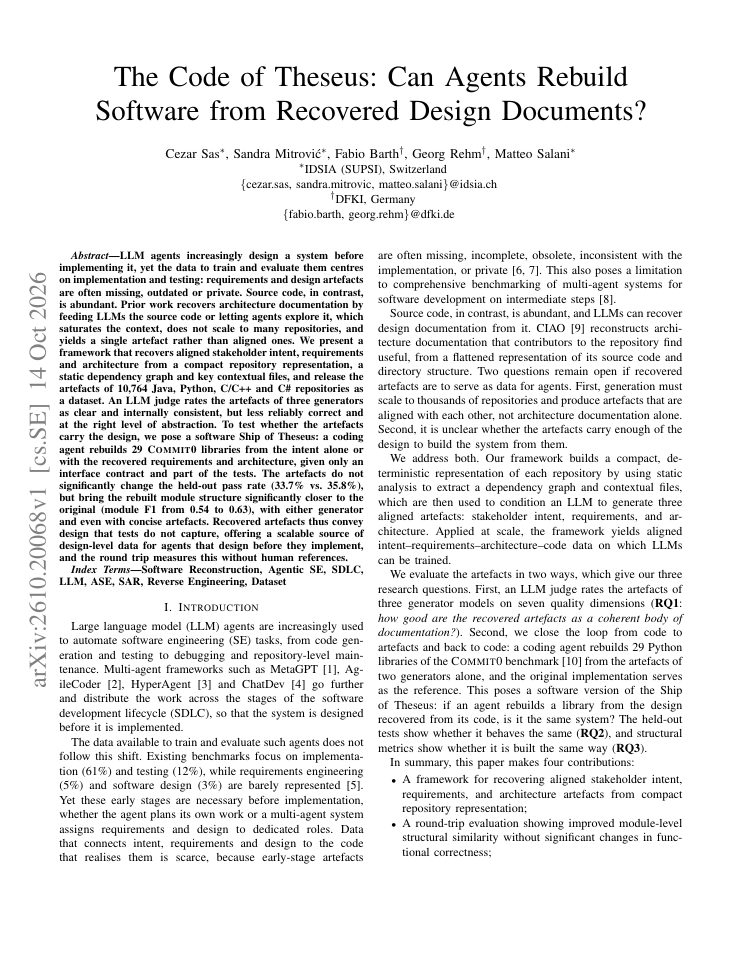
First page of The Code of Theseus: Can Agents Rebuild Software from Recovered Design Documents?
coding agentstest

The Code of Theseus: Can Agents Rebuild Software from Recovered Design Documents?

The method replaces manually written or absent requirements and architecture documents with artefacts recovered automatically from a static dependency graph and a few key files, avoiding the context-saturating full-code reading of prior approaches. Cost is one offline generation pass per repository plus judge-based validation; the recovered artefacts improved structural fidelity but produced no significant gain in test pass rate, so the functional benefit is unproven. It can fail because an LLM judge rated the artefacts less reliably correct and at the right abstraction level, meaning misleading design documents could steer agents toward plausible but wrong structures.

observed signal
0impl.
0stars
—citations
1.17xclaimed gain
abstract onlyReview decisionDownload skill ↓Original paper ↗
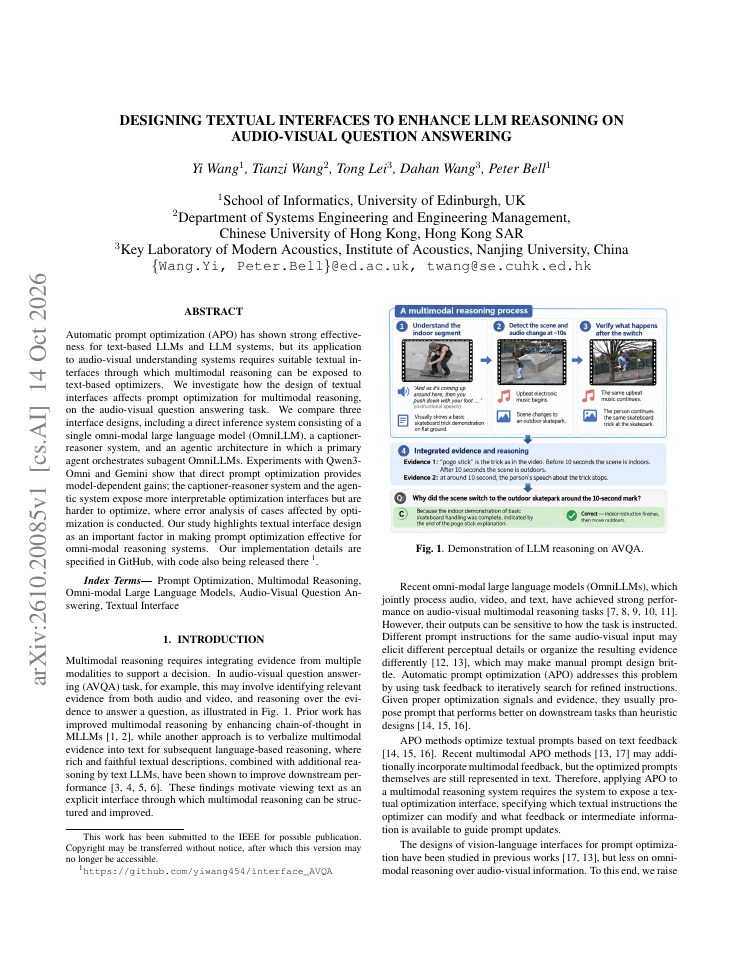
First page of Designing Textual Interfaces To Enhance Llm Reasoning On Audio-Visual Question Answering
othertest

Designing Textual Interfaces To Enhance Llm Reasoning On Audio-Visual Question Answering

The method replaces ad-hoc manual prompting of omni-modal LLMs with automatic prompt optimization applied through deliberately designed textual interfaces (direct OmniLLM, captioner-reasoner, or agent-orchestrated subagents). It costs additional inference calls for the optimization loop and, for the decomposed variants, extra captioning and orchestration latency plus a more complex system to maintain. It can fail because gains are model-dependent, the interpretable interfaces are harder to optimize, and error propagation from the captioner or subagents can degrade answers after optimization.

observed signal
0impl.
0stars
—citations
—claimed gain
abstract onlyReview decisionDownload skill ↓Original paper ↗
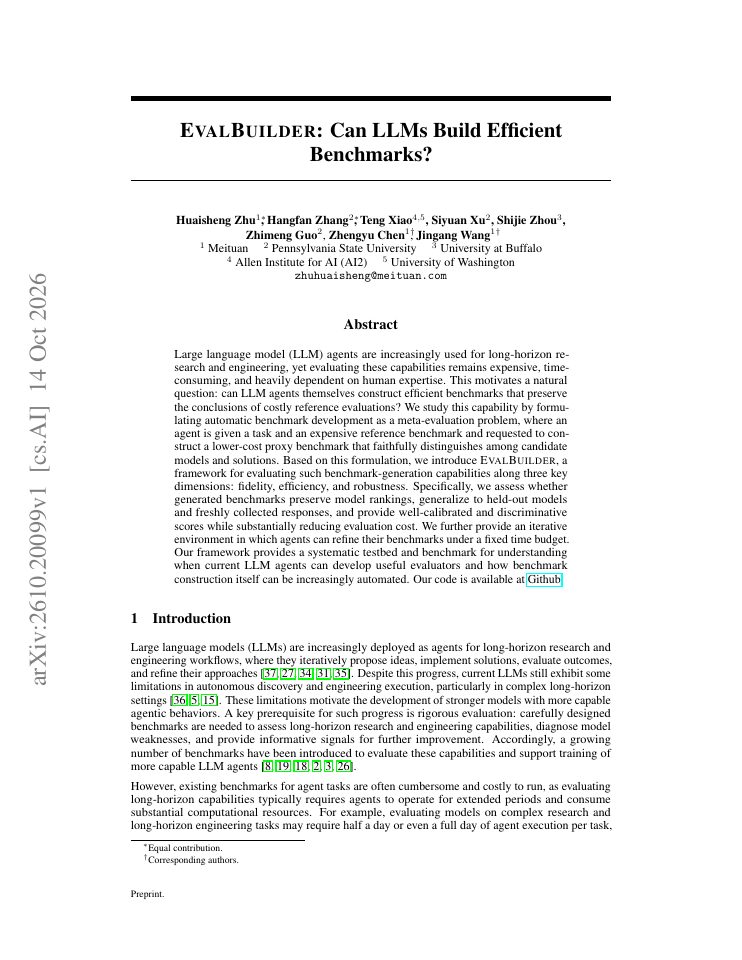
First page of EvalBuilder: Can LLMs Build Efficient Benchmarks?
agent evaluationtest

EvalBuilder: Can LLMs Build Efficient Benchmarks?

EvalBuilder replaces expensive, human-constructed reference benchmarks with LLM-agent-generated proxy benchmarks intended to preserve model rankings at lower cost. The cost is the compute and time budget spent running the benchmark-generation agent, plus the engineering effort to validate fidelity, robustness, and calibration of any generated proxy against the reference. It can fail if the proxy benchmark misranks held-out models or fresh responses, in which case adoption decisions rest on a distorted evaluation signal.

observed signal
0impl.
0stars
—citations
—claimed gain
abstract onlyReview decisionDownload skill ↓Original paper ↗
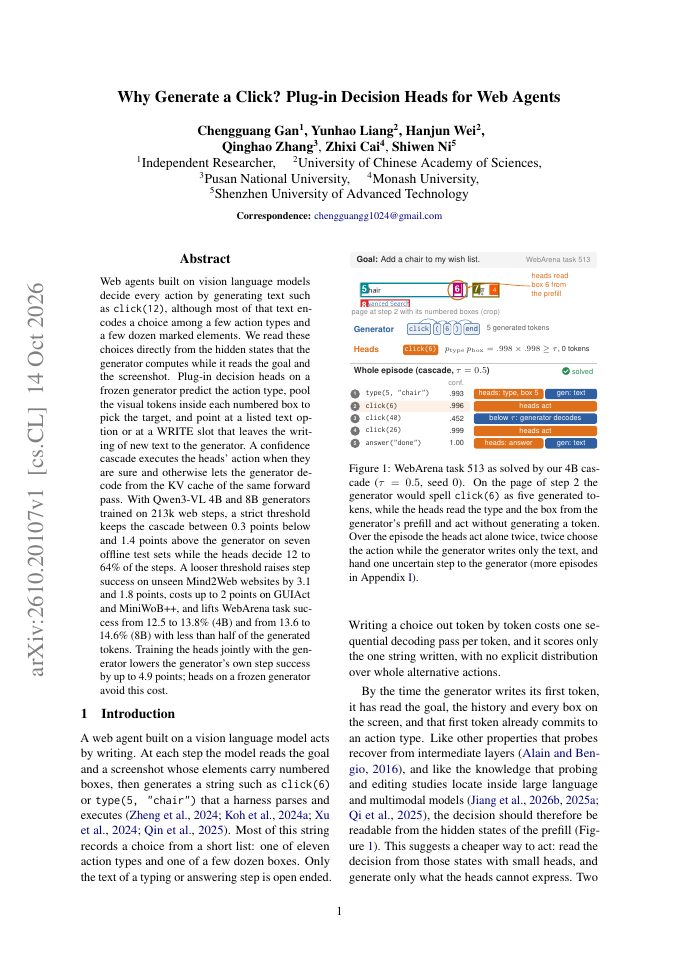
First page of Why Generate a Click? Plug-in Decision Heads for Web Agents
efficient architecturestest

Why Generate a Click? Plug-in Decision Heads for Web Agents

The method replaces text-based action decoding (generating tokens like click(12)) with lightweight classification heads that read action type, target element, and text-option choices directly from the frozen generator's hidden states, falling back to full decoding from the same forward pass's KV cache when head confidence is low. Costs include training the heads on web-step data (the paper used 213k steps), an additional confidence-threshold hyperparameter per deployment, and up to 2 points of step-success regression on some benchmarks (GUIAct, MiniWoB++) under loose thresholds. Failures after adoption can come from miscalibrated confidence on out-of-distribution websites, from UI layouts whose element structure differs from training data, and from degradation of the generator itself if heads are trained jointly rather than on frozen weights (up to 4.9 points of generator step-success loss).

observed signal
0impl.
10stars
—citations
—claimed gain
abstract onlyReview decisionDownload skill ↓Original paper ↗
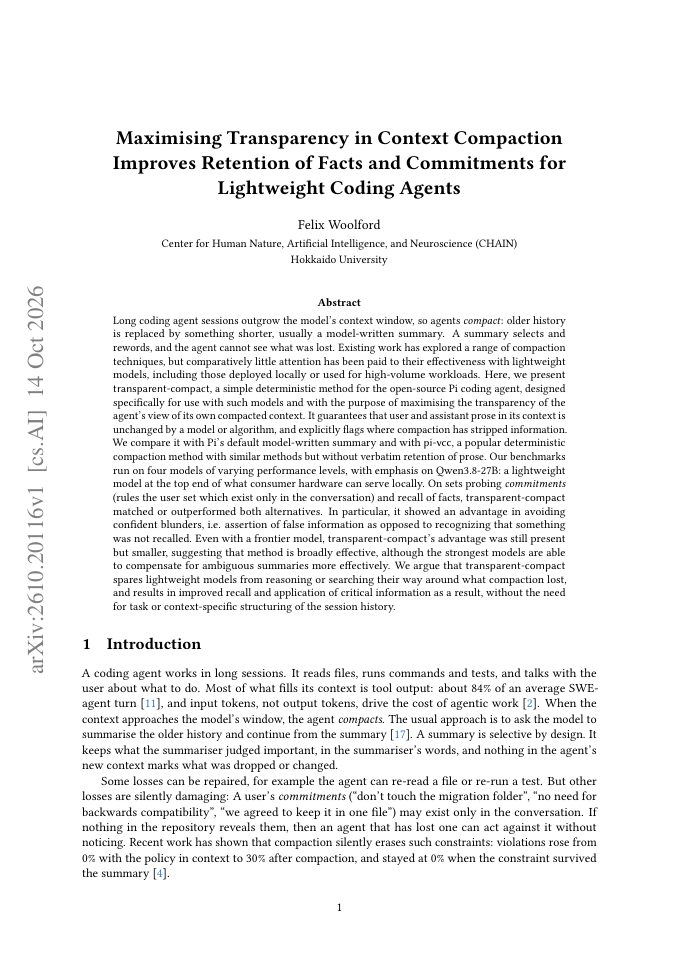
First page of Maximising Transparency in Context Compaction Improves Retention of Facts and Commitments for Lightweight Coding Agents
memory and contexttest

Maximising Transparency in Context Compaction Improves Retention of Facts and Commitments for Lightweight Coding Agents

It replaces model-written summary compaction (and rewording-based deterministic compaction) with a deterministic scheme that keeps user and assistant prose verbatim and explicitly flags where information was stripped. Cost is low in complexity and compute, but retaining verbatim text preserves less aggressively than summarization, so effective context capacity may be tighter and no extra latency figures are given. It can fail when verbatim retention crowds out needed context under heavy compaction, and the evidence rests on the authors' own benchmarks tied to the Pi coding agent, so transfer to other agents and workloads is unverified.

observed signal
0impl.
10stars
—citations
—claimed gain
abstract onlyReview decisionDownload skill ↓Original paper ↗
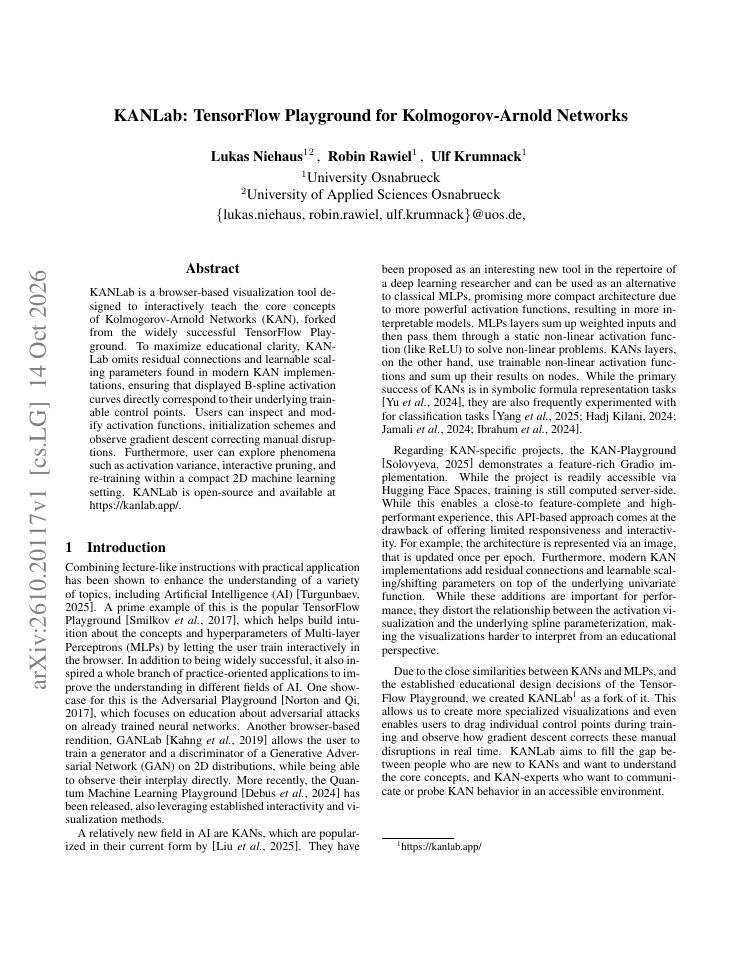
First page of KANLab: TensorFlow Playground for Kolmogorov-Arnold Networks
othernot applicable

KANLab: TensorFlow Playground for Kolmogorov-Arnold Networks

KANLab replaces static explanations and ad hoc notebooks for teaching Kolmogorov-Arnold Network concepts with a browser-based interactive playground forked from TensorFlow Playground. It costs nothing computationally since it runs client-side in a compact 2D setting, but it deliberately omits residual connections and learnable scaling parameters, so it does not reflect modern KAN implementations. It cannot fail in production because it is an educational tool, not a deployable method; the only risk is forming intuitions about simplified KANs that do not transfer to real architectures.

observed signal
0impl.
0stars
—citations
—claimed gain
abstract onlyReview decisionDownload skill ↓Original paper ↗
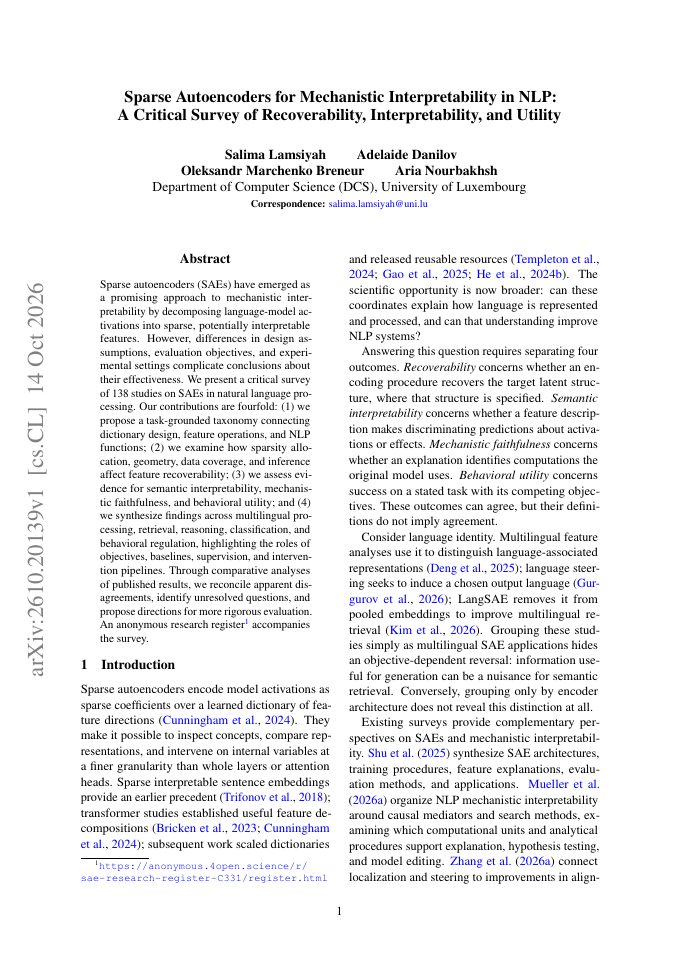
First page of Sparse Autoencoders for Mechanistic Interpretability in NLP: A Critical Survey of Recoverability, Interpretability, and Utility
otherwatch

Sparse Autoencoders for Mechanistic Interpretability in NLP: A Critical Survey of Recoverability, Interpretability, and Utility

The survey covers sparse autoencoders, which replace dense, polysemantic hidden activations with sparse feature dictionaries intended to be individually interpretable; it does not propose a new method but critically reviews 138 studies. Adoption costs include training a separate autoencoder per model layer, added storage and inference overhead, and evaluation complexity, all within a literature whose results the authors show depend heavily on design assumptions and evaluation settings. Failure modes documented in the survey include features that do not faithfully reconstruct activations, non-robust semantic interpretability, and weak or inconsistent evidence of behavioral utility in downstream interventions.

observed signal
0impl.
0stars
—citations
—claimed gain
abstract onlyReview decisionDownload skill ↓Original paper ↗
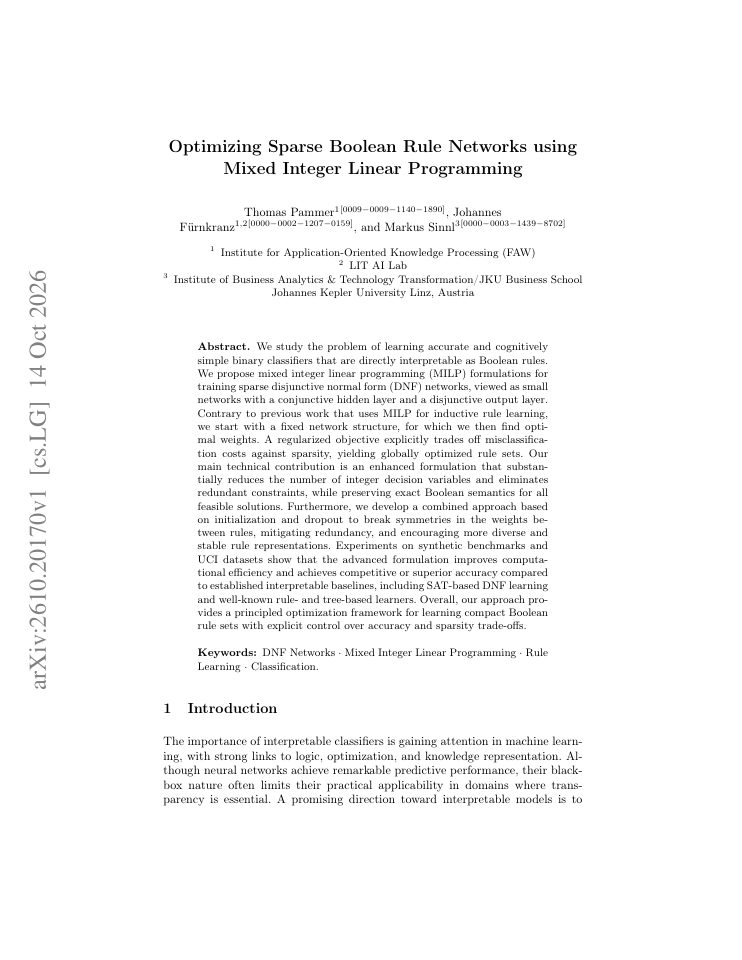
First page of Optimizing Sparse Boolean Rule Networks using Mixed Integer Linear Programming
othertest

Optimizing Sparse Boolean Rule Networks using Mixed Integer Linear Programming

Replaces heuristic and SAT-based methods for learning compact Boolean rule classifiers with globally optimal MILP training of a fixed conjunctive-disjunctive network. Costs MILP solver time that grows with dataset size and network width, plus hyperparameter tuning of the accuracy-sparsity trade-off; no GPU is needed. Can fail on larger or high-dimensional tabular problems where MILP does not scale, and on tasks where binary-rule expressiveness is inadequate.

observed signal
0impl.
0stars
—citations
—claimed gain
abstract onlyReview decisionDownload skill ↓Original paper ↗
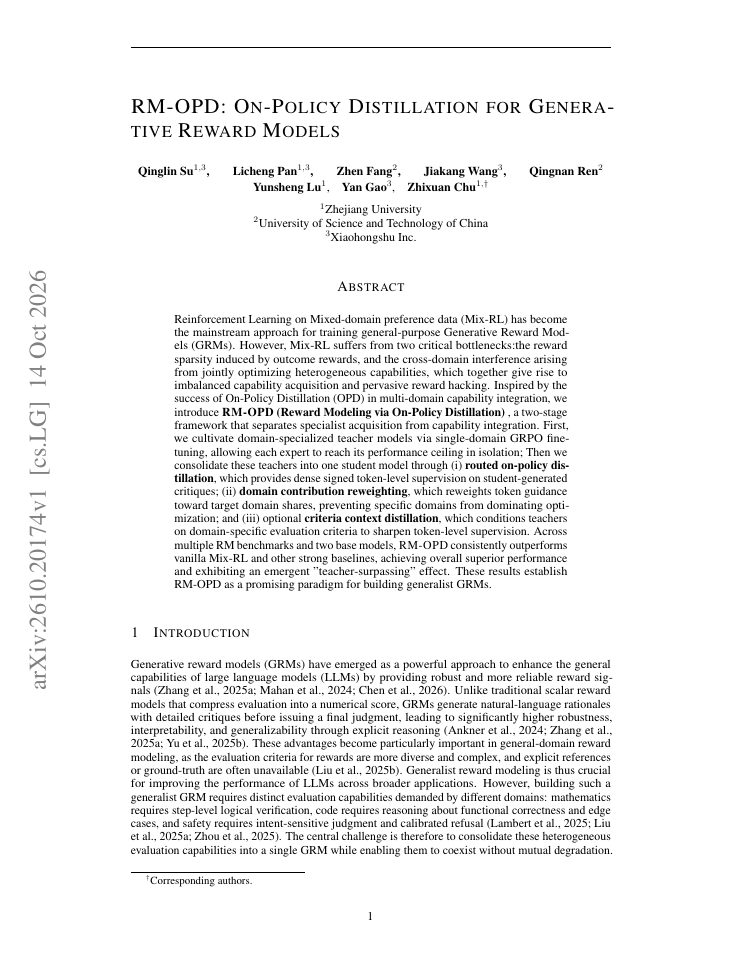
First page of RM-OPD: On-Policy Distillation for Generative Reward Models
distillationwatch

RM-OPD: On-Policy Distillation for Generative Reward Models

RM-OPD replaces mixed-domain GRPO training of generative reward models with a two-stage pipeline: single-domain GRPO teacher training followed by routed on-policy distillation with domain reweighting into one student. The cost is substantial: multiple domain-specialist RL fine-tuning runs plus a distillation stage, requiring multi-GPU training capacity and per-domain preference data that a single 24 GB GPU setup cannot realistically supply. It can fail through residual cross-domain imbalance if reweighting is miscalibrated, teacher quality bottlenecks if any specialist undertrains, and reward hacking inherited from the teachers' supervision signal.

observed signal
0impl.
0stars
—citations
—claimed gain
abstract onlyReview decisionDownload skill ↓Original paper ↗
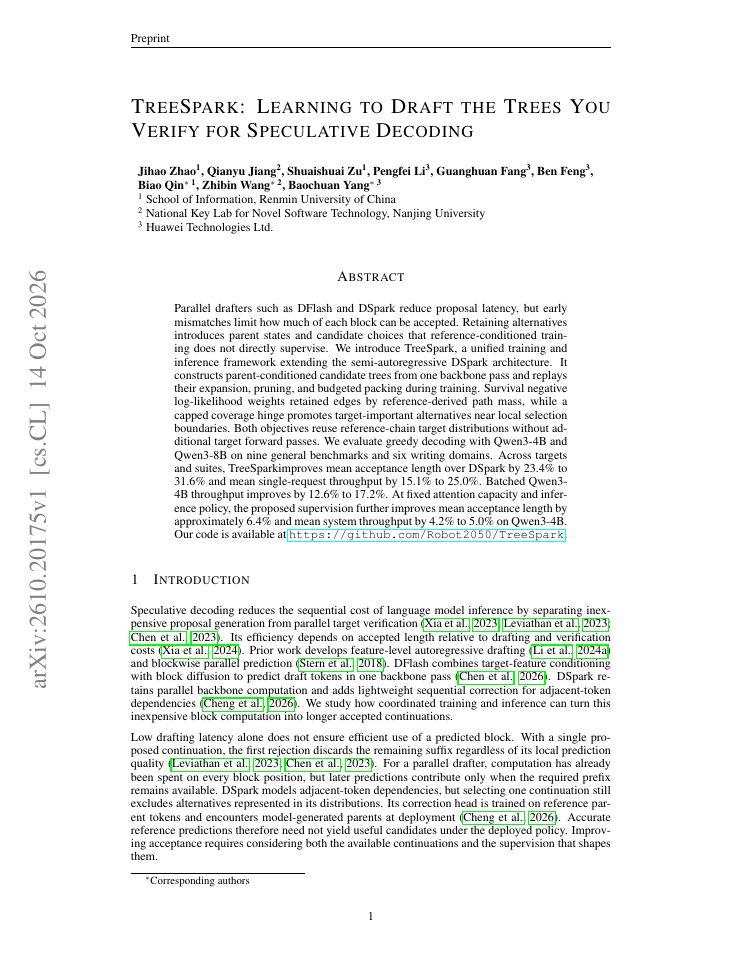
First page of TreeSpark: Learning to Draft the Trees You Verify for Speculative Decoding
speculative decodingwatch

TreeSpark: Learning to Draft the Trees You Verify for Speculative Decoding

TreeSpark replaces reference-conditioned drafter training in semi-autoregressive speculative decoding (DSpark) with parent-conditioned tree construction trained via survival NLL and a capped coverage hinge, reusing existing target distributions so no extra target forward passes are needed. The cost is a custom drafter training pipeline tied to a specific architecture and target model (Qwen3-4B/8B), plus added training complexity from replaying tree expansion, pruning, and packing. It can fail if the workload differs from the evaluated general and writing benchmarks, since acceptance-length gains depend on drafter-target alignment and may not transfer to other targets or to batched serving, where gains shrink to 12.6%-17.2%.

observed signal
0impl.
0stars
—citations
1.25xclaimed gain
abstract onlyReview decisionDownload skill ↓Original paper ↗
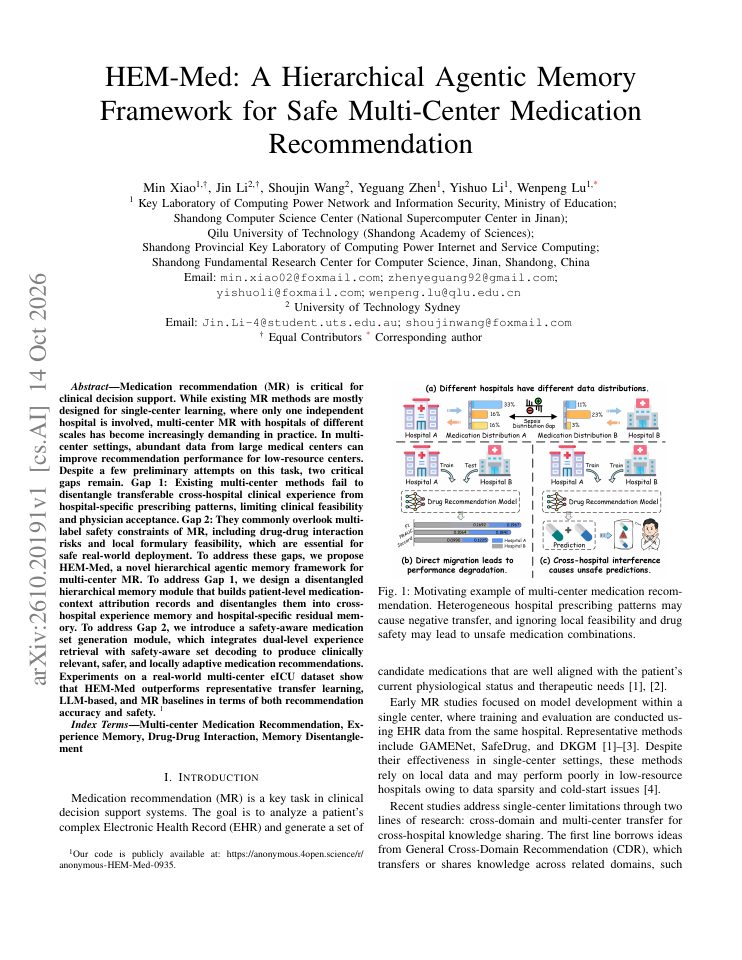
First page of HEM-Med: A Hierarchical Agentic Memory Framework for Safe Multi-Center Medication Recommendation
memory and contextwatch

HEM-Med: A Hierarchical Agentic Memory Framework for Safe Multi-Center Medication Recommendation

Replaces single-center medication-recommendation models and naive multi-center transfer learning with a hierarchical memory that separates cross-hospital clinical experience from hospital-specific prescribing residuals, plus a safety-aware set decoder handling drug-drug interactions and formulary constraints. Costs include maintaining per-patient attribution records and dual memory stores, added retrieval and decoding complexity, and dependence on multi-center EHR data that is difficult to obtain. Can fail through privacy and regulatory constraints on cross-institution clinical data, poor transfer when a hospital's residual patterns dominate, and safety decoding that cannot guarantee absence of contraindicated combinations in deployment.

observed signal
0impl.
10stars
—citations
—claimed gain
abstract onlyReview decisionDownload skill ↓Original paper ↗
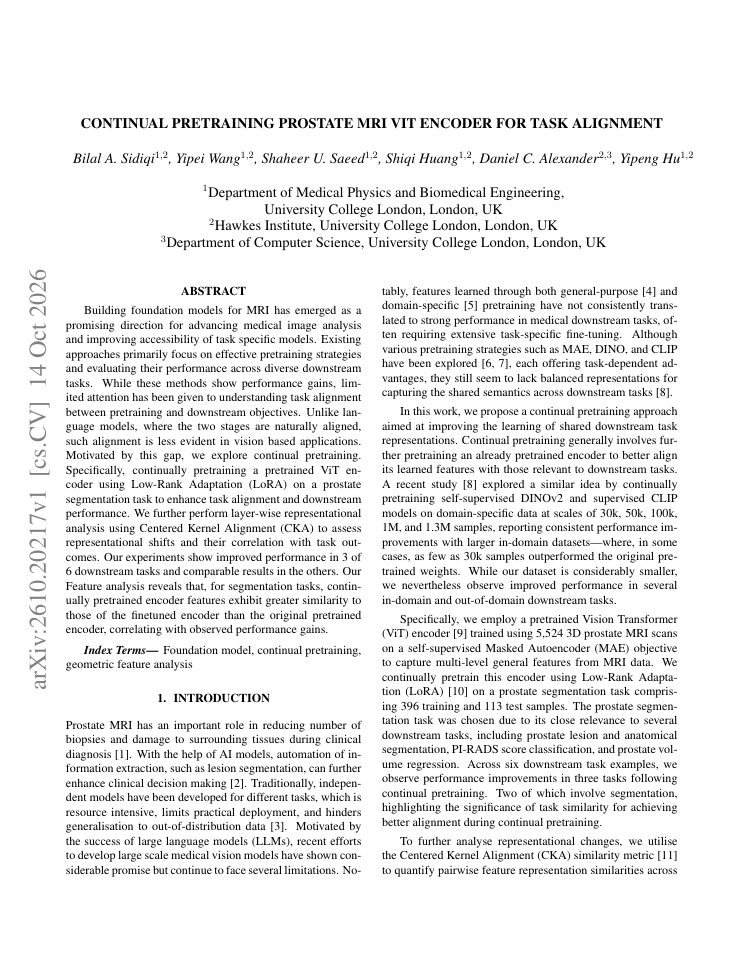
First page of Continual pretraining Prostate MRI ViT Encoder for task alignment
efficient trainingtest

Continual pretraining Prostate MRI ViT Encoder for task alignment

The method replaces direct fine-tuning of a pretrained ViT encoder by inserting an intermediate LoRA continual-pretraining stage on a related task (prostate MRI segmentation) to better align pretrained representations with downstream objectives. It costs an additional training stage, though LoRA keeps it feasible on a single 24 GB GPU, plus the engineering overhead of managing two-stage adaptation. It can fail to deliver gains, as improvement appeared in only half the evaluated tasks, and benefits may not transfer outside the prostate MRI domain or to tasks dissimilar from the continual-pretraining objective.

observed signal
0impl.
0stars
—citations
—claimed gain
abstract onlyReview decisionDownload skill ↓Original paper ↗
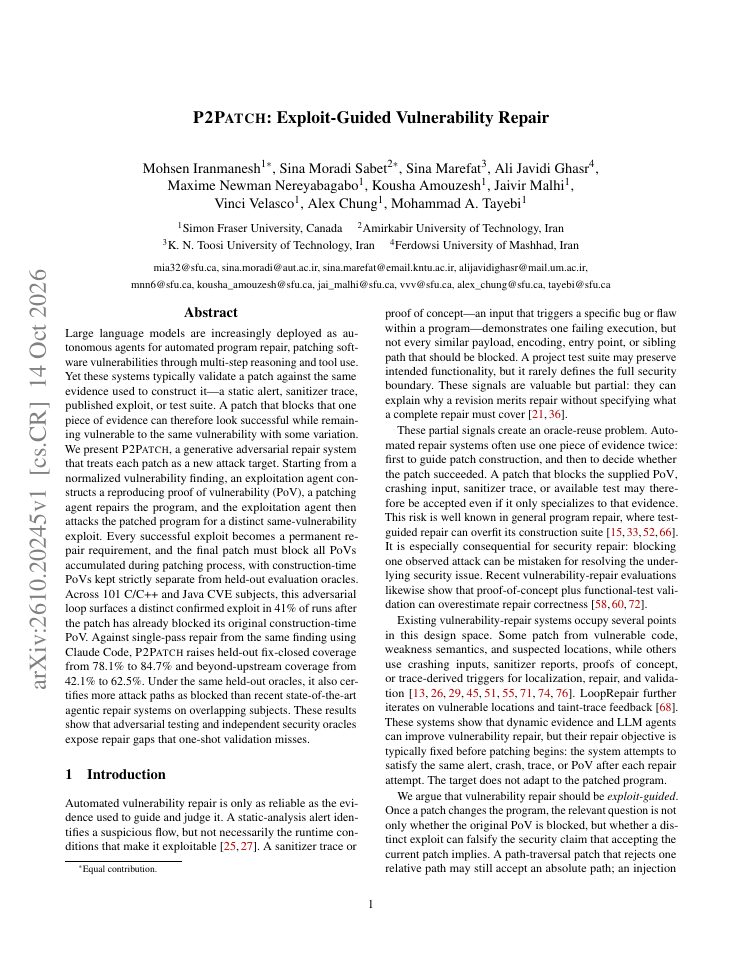
First page of P2Patch: Exploit-Guided Vulnerability Repair
coding agentstest

P2Patch: Exploit-Guided Vulnerability Repair

P2Patch replaces single-pass vulnerability repair, where a patch is validated only against the evidence used to construct it, with an adversarial loop in which an exploitation agent generates new same-vulnerability exploits against each patched program and the final patch must block all accumulated proofs of vulnerability. The cost is multiple agent iterations per finding (exploitation plus patching per round) on third-party APIs, increasing token spend and end-to-end latency per CVE, plus infrastructure to run PoVs and maintain separate held-out evaluation oracles. It can fail when the exploitation agent cannot produce a working PoV for a vulnerability class, when accumulated repair requirements overfit to the generated exploits rather than the underlying flaw, and because absolute coverage gains are modest, the added cost may not pay off on low-severity findings.

observed signal
0impl.
0stars
—citations
—claimed gain
abstract onlyReview decisionDownload skill ↓Original paper ↗
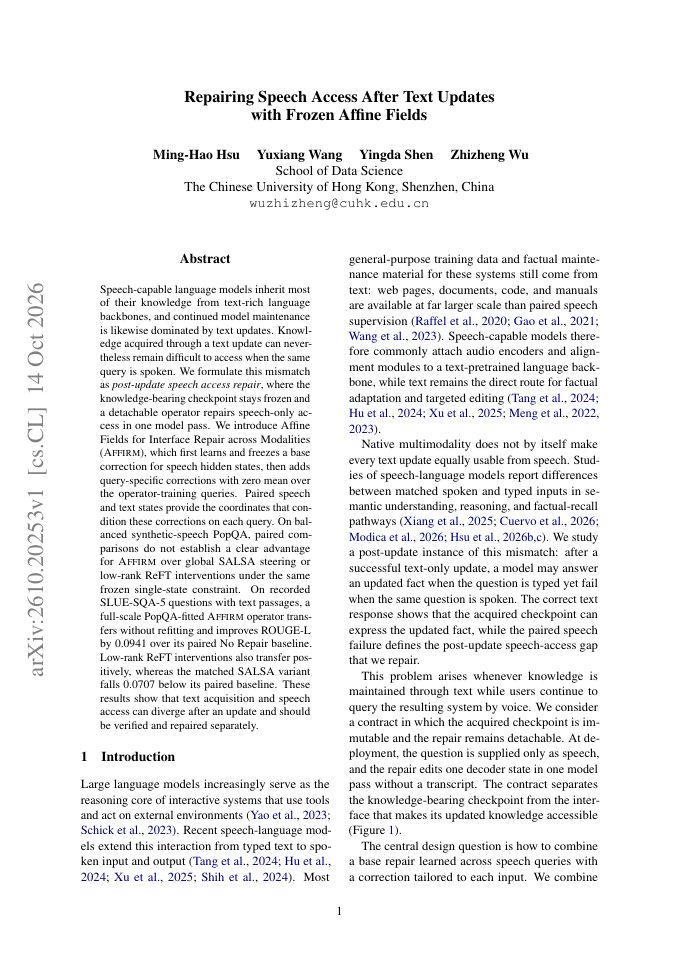
First page of Repairing Speech Access After Text Updates with Frozen Affine Fields
othertest

Repairing Speech Access After Text Updates with Frozen Affine Fields

AFFIRM replaces retraining or refitting the speech-language model after a text update with a frozen, detachable affine correction applied to speech hidden states in a single pass. It costs an operator-training phase over paired speech and text states plus a small per-query conditioning computation, keeping the base checkpoint untouched. It can fail to outperform simpler baselines: on balanced synthetic PopQA it showed no established advantage over SALSA steering or low-rank ReFT, and steering methods can degrade when transferred across domains, as the matched SALSA variant did.

observed signal
0impl.
0stars
—citations
—claimed gain
abstract onlyReview decisionDownload skill ↓Original paper ↗
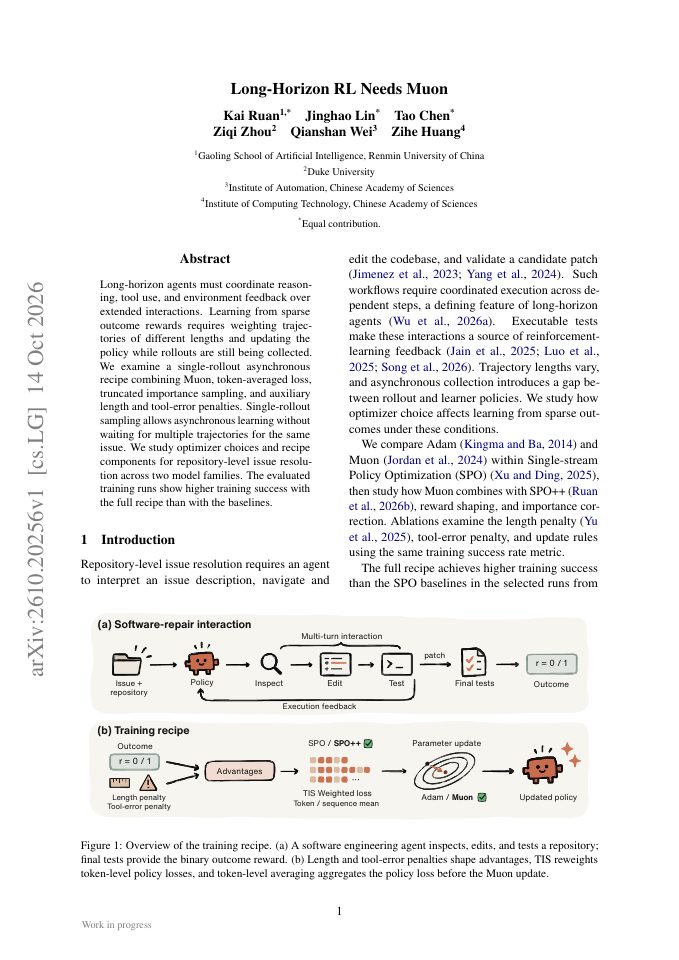
First page of Long-Horizon RL Needs Muon
coding agentswatch

Long-Horizon RL Needs Muon

The method replaces synchronous multi-rollout RL post-training with standard optimizers by a single-rollout asynchronous recipe built around the Muon optimizer for long-horizon issue-resolution agents. It costs a full RL training pipeline: rollout generation infrastructure, policy gradient training with importance-sampling corrections, and auxiliary penalty tuning, none of which fits a single 24 GB GPU without significant scale-down. It can fail through instability of asynchronous updates with truncated importance ratios, sensitivity to penalty weighting, and unverified transfer of the recipe beyond the two evaluated model families.

observed signal
0impl.
0stars
—citations
—claimed gain
abstract onlyReview decisionDownload skill ↓Original paper ↗
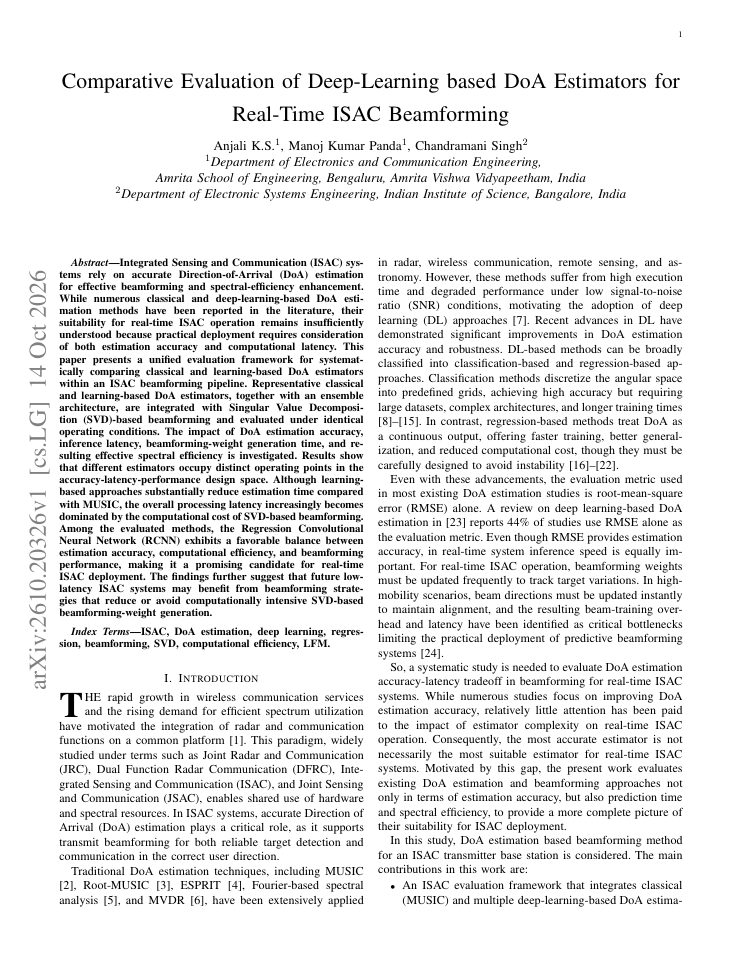
First page of Comparative Evaluation of Deep-Learning based DoA Estimators for Real-Time ISAC Beamforming
othernot applicable

Comparative Evaluation of Deep-Learning based DoA Estimators for Real-Time ISAC Beamforming

The method replaces classical subspace-based DoA estimation (e.g., MUSIC) with a regression CNN inside an SVD-beamforming ISAC pipeline. The cost is that the speedup at the estimation stage is progressively negated by the SVD beamforming step, which becomes the latency bottleneck, and a learned estimator requires training data matched to the antenna array and channel conditions. It can fail under distribution shift in array geometry, SNR, or multipath conditions not represented in training, and the end-to-end spectral-efficiency benefit collapses if the SVD stage is not also replaced.

observed signal
0impl.
0stars
—citations
—claimed gain
abstract onlyReview decisionDownload skill ↓Original paper ↗
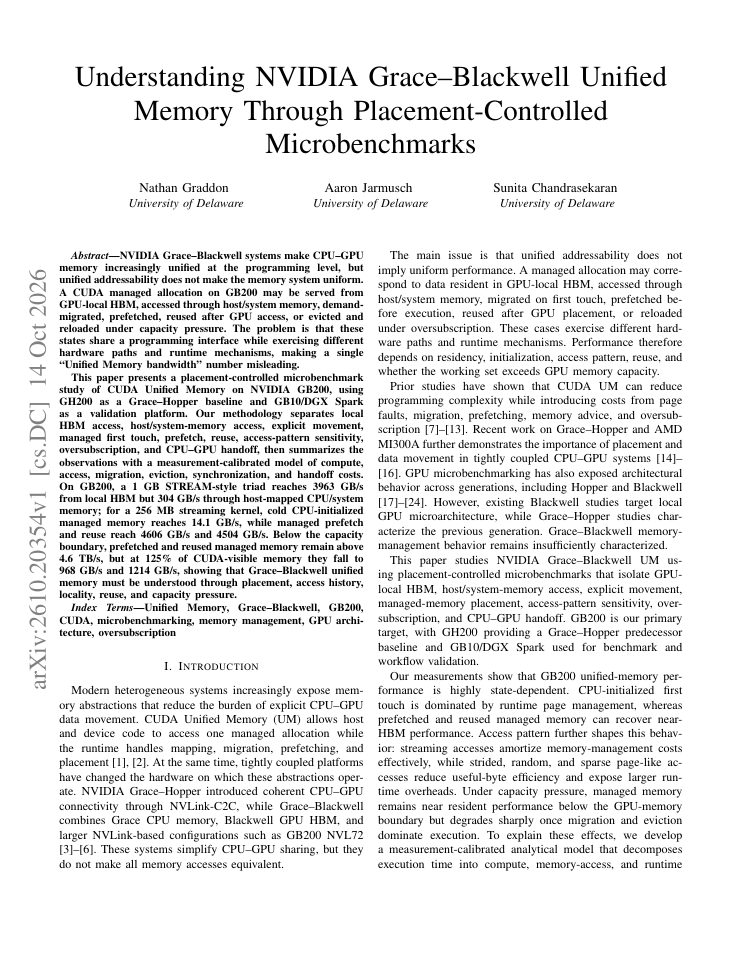
First page of Understanding NVIDIA Grace-Blackwell Unified Memory Through Placement-Controlled Microbenchmarks
otherwatch

Understanding NVIDIA Grace-Blackwell Unified Memory Through Placement-Controlled Microbenchmarks

This is a measurement study, not a deployable method: it replaces reliance on a single 'Unified Memory bandwidth' figure with a placement- and history-aware cost model covering local HBM access, host-mapped access, prefetch, reuse, migration, and oversubscription eviction. Adopting its guidance costs engineering effort in explicit placement and prefetch management of managed allocations, plus benchmarking on the target platform. It fails when workloads exceed CUDA-visible memory capacity (performance drops roughly 4-5x into eviction territory) or when its GB200-specific numbers are extrapolated to the different hardware the reader actually operates.

observed signal
0impl.
0stars
—citations
13xclaimed gain
abstract onlyReview decisionDownload skill ↓Original paper ↗
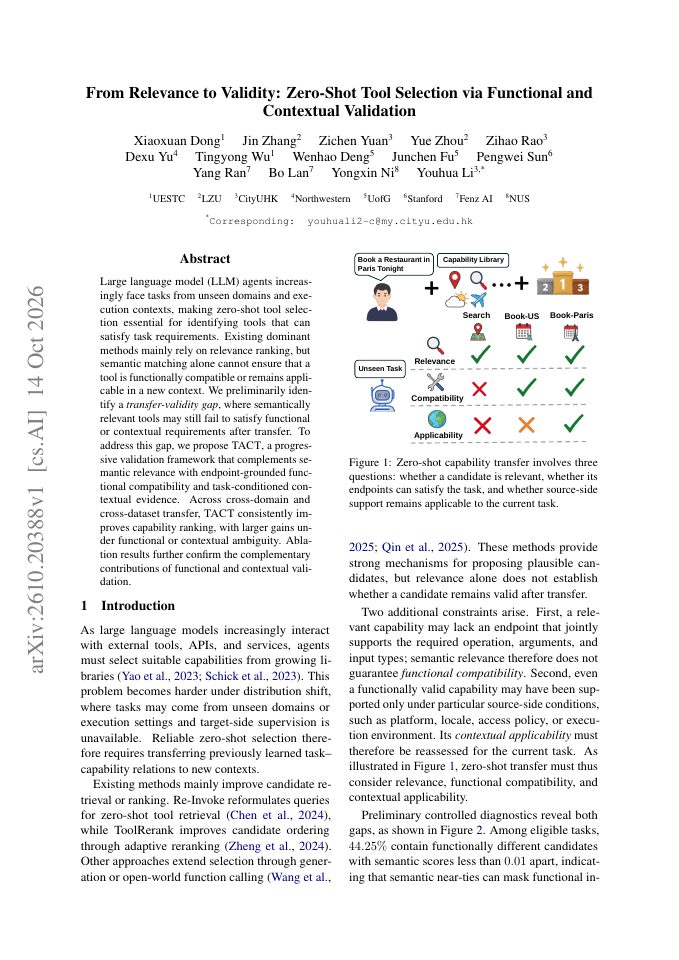
First page of From Relevance to Validity: Zero-Shot Tool Selection via Functional and Contextual Validation
tool usetest

From Relevance to Validity: Zero-Shot Tool Selection via Functional and Contextual Validation

The method replaces pure semantic relevance ranking for tool selection with a progressive pipeline that adds endpoint-grounded functional compatibility checks and task-conditioned contextual validation on top of retrieval. The cost is additional LLM calls per candidate tool for the functional and contextual validation stages, increasing selection latency and API spend, plus engineering effort to ground tool endpoints. It can fail when tool endpoint specifications are incomplete or inaccurate, when the validation LLM misjudges functional compatibility, and in domains where the contextual evidence it relies on does not transfer.

observed signal
0impl.
0stars
—citations
—claimed gain
abstract onlyReview decisionDownload skill ↓Original paper ↗

Research signals

Three views of the same evidence: adoption against attention, publication cadence by research area, and reported gains when coverage is sufficient.

color = research area

01 · attention × adoption

The research frontier

Look to the upper left for independent implementation before mass attention.

compare by
Each point represents one paper. Higher means more independent implementations; farther right means more GitHub stars.Encoder Awakening via Adapters: Effective Domain-Adaptive Fine-tuning of Speech-LLMs: 1 GitHub star; 1 independent implementationActionOPD: Distilling Decisions, Not Tokens: 7 GitHub stars; 2 independent implementationsLAGO: Language Agents with Reusable Growing Options: 10 GitHub stars; 0 independent implementationsWhen Extremists Enter LLM Societies: Investigating Extreme Behavior in Multi-Agent Systems: 132 GitHub stars; 1 independent implementationExplorer-Zero: Improving Self-Play for Long-Horizon Tasks with Decomposable Verifiable Rewards: 0 GitHub stars; 0 independent implementationsChoosing the Number of Attention Heads from Intrinsic Dimension: A Small-Scale Study: 0 GitHub stars; 0 independent implementationsSTISA: A 0.16 GOPS/W/PE Single-Shot Inference FPGA-based SNN Accelerator with Algorithm and Hardware Co-Design: 0 GitHub stars; 0 independent implementationsA Strong Harness Narrows the Model Gap: A Comparative Evaluation for Legislative Document-to-XML Conversion: 0 GitHub stars; 0 independent implementationsWhat Coding Agents Leave Unsaid: Measuring Task-State Gaps Between Execution and Reports: 10 GitHub stars; 0 independent implementationsThe Code of Theseus: Can Agents Rebuild Software from Recovered Design Documents?: 0 GitHub stars; 0 independent implementationsDesigning Textual Interfaces To Enhance Llm Reasoning On Audio-Visual Question Answering: 0 GitHub stars; 0 independent implementationsEvalBuilder: Can LLMs Build Efficient Benchmarks?: 0 GitHub stars; 0 independent implementationsWhy Generate a Click? Plug-in Decision Heads for Web Agents: 10 GitHub stars; 0 independent implementationsMaximising Transparency in Context Compaction Improves Retention of Facts and Commitments for Lightweight Coding Agents: 10 GitHub stars; 0 independent implementationsKANLab: TensorFlow Playground for Kolmogorov-Arnold Networks: 0 GitHub stars; 0 independent implementationsSparse Autoencoders for Mechanistic Interpretability in NLP: A Critical Survey of Recoverability, Interpretability, and Utility: 0 GitHub stars; 0 independent implementationsOptimizing Sparse Boolean Rule Networks using Mixed Integer Linear Programming: 0 GitHub stars; 0 independent implementationsRM-OPD: On-Policy Distillation for Generative Reward Models: 0 GitHub stars; 0 independent implementationsTreeSpark: Learning to Draft the Trees You Verify for Speculative Decoding: 0 GitHub stars; 0 independent implementationsHEM-Med: A Hierarchical Agentic Memory Framework for Safe Multi-Center Medication Recommendation: 10 GitHub stars; 0 independent implementationsContinual pretraining Prostate MRI ViT Encoder for task alignment: 0 GitHub stars; 0 independent implementationsP2Patch: Exploit-Guided Vulnerability Repair: 0 GitHub stars; 0 independent implementationsRepairing Speech Access After Text Updates with Frozen Affine Fields: 0 GitHub stars; 0 independent implementationsLong-Horizon RL Needs Muon: 0 GitHub stars; 0 independent implementationsComparative Evaluation of Deep-Learning based DoA Estimators for Real-Time ISAC Beamforming: 0 GitHub stars; 0 independent implementationsUnderstanding NVIDIA Grace-Blackwell Unified Memory Through Placement-Controlled Microbenchmarks: 0 GitHub stars; 0 independent implementationsFrom Relevance to Validity: Zero-Shot Tool Selection via Functional and Contextual Validation: 0 GitHub stars; 0 independent implementationsFOLD: Position-Free Far Memory with Local Order for Long-Context Speculative Decoding: 0 GitHub stars; 0 independent implementationsCortex: Consolidating Context into Parametric Memory: 0 GitHub stars; 0 independent implementationsHRTF Upsampling and Personalization via Neural Operators: 0 GitHub stars; 0 independent implementationsFrom Training to Escalation: Forensic Analysis and Local Recreation of RL/RLHF-Induced Privilege Escalation in AI Agents (CVE-2026-65616): 10 GitHub stars; 0 independent implementationsThe COUNT: Counting N-grams Unlocks Scaling on Host Memory and Training-Free Adaptation: 0 GitHub stars; 1 independent implementationSelective Growing Q-Networks (SGQN): An Analysis of Adaptive Action Grids in Decoupled Q-Learning: 0 GitHub stars; 0 independent implementationsAdaRSI: On-Demand Recursive Self-Improvement for Embodied Agents: 227 GitHub stars; 1 independent implementationReaDy: Recurrent States as Dynamic Context for Speculative Drafting in Hybrid Linear Attention Large Language Models: 0 GitHub stars; 0 independent implementationsA Two-Level Clinical Novelty Prioritization Framework for Disease Trajectories Discovered from Longitudinal Electronic Health Records: 0 GitHub stars; 0 independent implementationsScaling Discovery Requires Forgetting: 0 GitHub stars; 0 independent implementationsOne Task, Many Interfaces: Simple Cross-Interface Consistency Training Improves LLM Agent Robustness: 10 GitHub stars; 0 independent implementationsLatent Compaction with Test-Time Training: 1 GitHub star; 1 independent implementationPlayer-1: Learning to Play from Synthetic Experience: 0 GitHub stars; 0 independent implementationsYour Transformer Is Secretly Elastic: 0 GitHub stars; 0 independent implementations

Papers above 1000 stars or 200 citations are not scored. They have already broken through the attention threshold, while Paperraft is designed to identify earlier signals.

02 · cadence

Research areas over time

Compare monthly publication volume on a shared scale and calendar.

coding agentsmax 11Sep 26: 0 papersOct 26: 3 papersSep 26Oct 26efficient architecturesmax 11Sep 26: 0 papersOct 26: 2 papersSep 26Oct 26agent evaluationmax 11Sep 26: 0 papersOct 26: 2 papersSep 26Oct 26KV cachemax 11Sep 26: 0 papersOct 26: 1 paperSep 26Oct 26speculative decodingmax 11Sep 26: 0 papersOct 26: 3 papersSep 26Oct 26distillationmax 11Sep 26: 0 papersOct 26: 2 papersSep 26Oct 26sparsity and pruningmax 11Sep 26: 0 papersOct 26: 1 paperSep 26Oct 26memory and contextmax 11Sep 26: 0 papersOct 26: 4 papersSep 26Oct 26multi-agent orchestrationmax 11Sep 26: 0 papersOct 26: 4 papersSep 26Oct 26othermax 11Sep 26: 0 papersOct 26: 11 papersSep 26Oct 26safety and guardrailsmax 11Sep 26: 0 papersOct 26: 1 paperSep 26Oct 26efficient trainingmax 11Sep 26: 1 paperOct 26: 4 papersSep 26Oct 26tool usemax 11Sep 26: 0 papersOct 26: 2 papersSep 26Oct 26

Every panel uses the same calendar and vertical scale. An empty column means no papers were recorded.

Method under scrutiny

Inspect the highest-ranked paper, every repository behind its signal, and the rule used to classify each one.

The COUNT: Counting N-grams Unlocks Scaling on Host Memory and Training-Free Adaptation

memory and context · test · 1 of 2 implementations is independent

COUNT replaces learned n-gram embedding tables (trained from scratch on GPU) with precomputed corpus n-gram counts stored in host memory, which weight the LM's own unembedding rows to form embeddings with no additional learned parameters. It costs host RAM for the count table, preprocessing to build it, and an added embedding lookup per token; the benefit only materializes if the backbone is pretrained with COUNT as an input. It can fail for the reader because the gains are demonstrated only for models pretrained from scratch with the method, and no compatible pretrained checkpoint may exist; count tables can also be stale or mismatched to the target domain, degrading the training-free adaptation.

Exclusions and controls

Every exclusion is counted and published.

Exclusion counts were not recorded for this edition.

0 previously indexed papers were rechecked in this run.

Paperraft tracks one signal: how many independent implementations a paper attracts on GitHub after author-owned repositories are removed. This is a discovery signal to investigate, not a measure of implementation quality.

It does not claim that a method works. Paperraft runs no reproduction benchmarks. Reported gains remain author claims until independently tested. Papers above the attention threshold are excluded because this publication is designed to identify research before consensus forms.