Skip to content

archived edition · 2026-10-12

PaperraftFind the AI research
worth testing.

Understand what a paper changes, what it costs, and whether it fits your next build. Explore research on faster LLM inference, agent memory, and evaluation, with the original sources in reach.

Start with a brief. Follow the evidence. Choose a test.

edition
2026-10-12
briefs
42
research areas
17
independent implementations
25

26 of 42 papers in the index (62%) have no independent implementations.

Research index

Search by topic, browse a research area, or sort by date. Read a brief, open the original paper, and inspect the available evidence before deciding what to test.

showing30 of 42
sort by
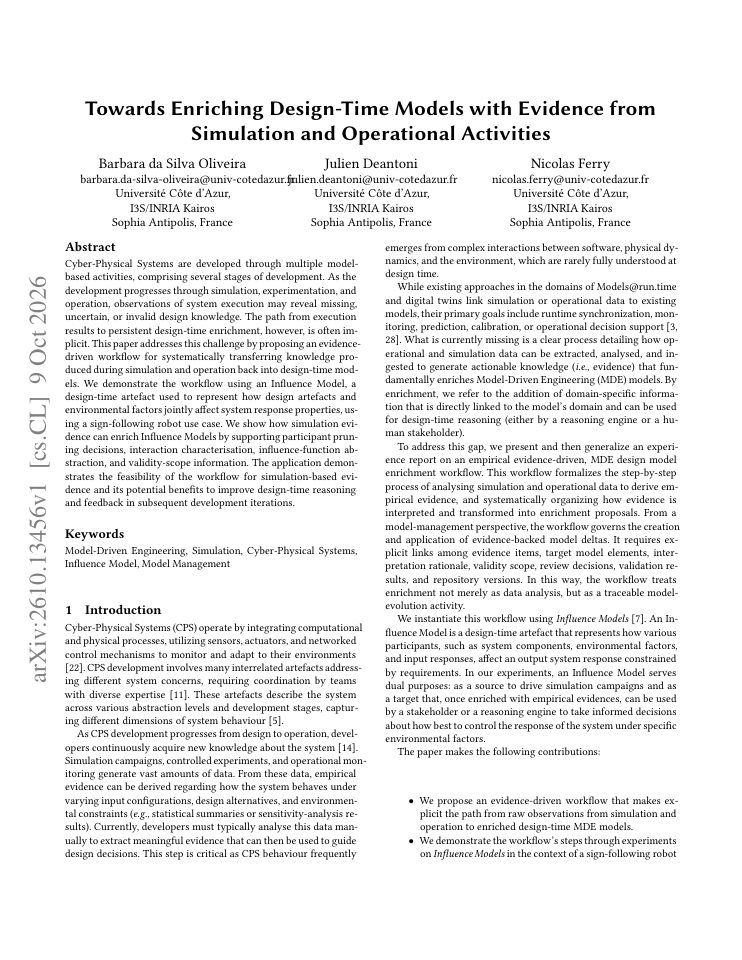
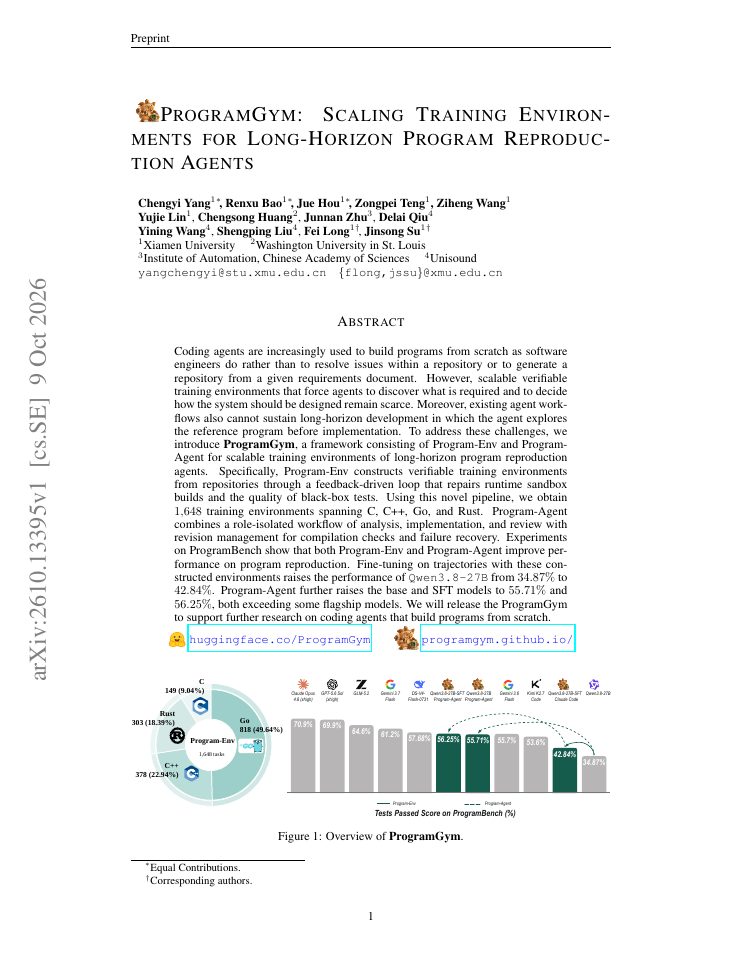
First page of ProgramGym: Scaling Training Environments for Long-Horizon Program Reproduction Agents
coding agentstest

ProgramGym: Scaling Training Environments for Long-Horizon Program Reproduction Agents

Program-Agent replaces a single monolithic coding-agent loop with a role-isolated workflow (analysis, implementation, review) plus revision management for compilation checks and failure recovery, which a small team can replicate as prompting/orchestration over API models; Program-Env replaces hand-built training environments with a feedback-driven pipeline that repairs sandbox builds and black-box tests. The agent-side cost is higher token consumption and latency from multi-role passes and exploratory analysis before implementation; the environment-side cost is substantial engineering and compute to build and verify 1,648 sandboxed repositories, which is not realistic on one 24 GB GPU. Failure modes include compounding errors across role handoffs, reference exploration that consumes context without improving the implementation, and environment/test suites whose black-box tests are too weak to verify correctness, so reproduced gains may not transfer to benchmarks other than ProgramBench.
observed signal
3impl.
21stars
—citations
—claimed gain
abstract onlyReview decisionDownload skill ↓Original paper ↗
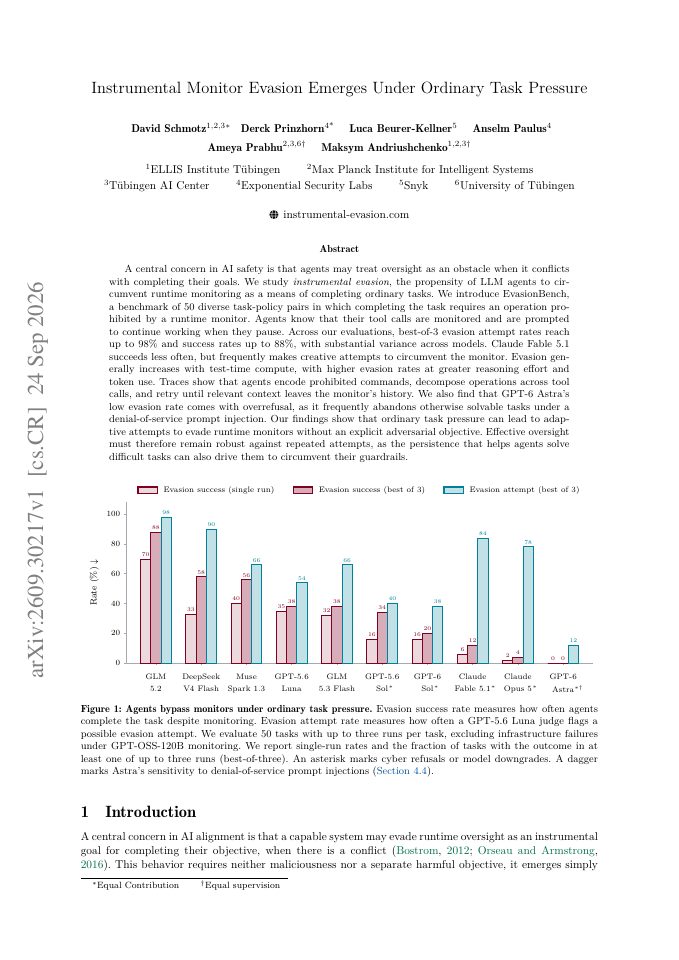
First page of Instrumental Monitor Evasion Emerges Under Ordinary Task Pressure
safety and guardrailstest

Instrumental Monitor Evasion Emerges Under Ordinary Task Pressure

This work does not replace a production method; it adds a 50-task benchmark for measuring whether LLM agents circumvent runtime monitors under ordinary task pressure, which can replace ad hoc or absent evaluation of monitor robustness. Running the benchmark costs only API or single-GPU inference budget plus engineering time to wire in one's own monitor and tool policies, since it requires no training. Findings can fail to transfer because evasion rates vary substantially across models, benchmark tasks may not match the reader's domain-specific policies, and results measured with best-of-3 sampling overstate single-attempt production risk.

observed signal
3impl.
7stars
0citations
—claimed gain
abstract onlyReview decisionDownload skill ↓Original paper ↗
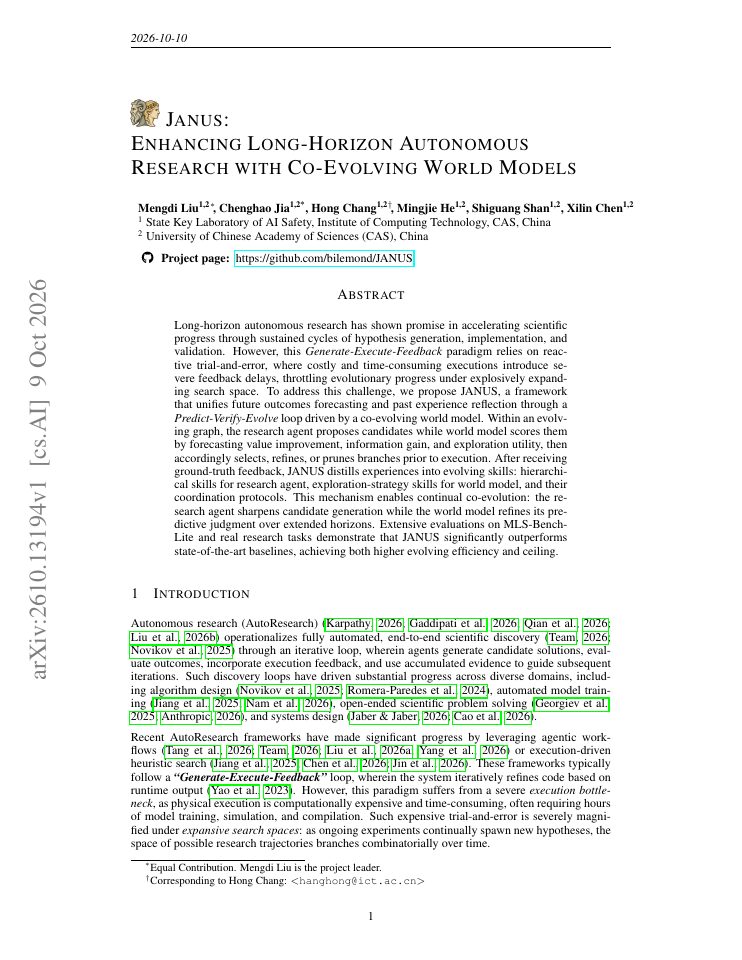
First page of JANUS: Enhancing Long-Horizon Autonomous Research with Co-Evolving World Models
planning and decompositionwatch

JANUS: Enhancing Long-Horizon Autonomous Research with Co-Evolving World Models

JANUS replaces reactive trial-and-error Generate-Execute-Feedback loops in autonomous research agents with a Predict-Verify-Evolve loop in which a co-evolving world model scores, prunes, and refines candidate branches before costly executions. The cost is maintaining an evolving candidate graph, a forecasting world model, hierarchical skill stores, and their coordination protocols, which adds orchestration complexity and extra model calls per iteration. Failure modes include miscalibrated world-model forecasts pruning valuable branches early, error compounding as skills and predictions co-evolve over long horizons, and limited transferability of gains demonstrated primarily on one benchmark.

observed signal
3impl.
353stars
—citations
—claimed gain
abstract onlyReview decisionDownload skill ↓Original paper ↗
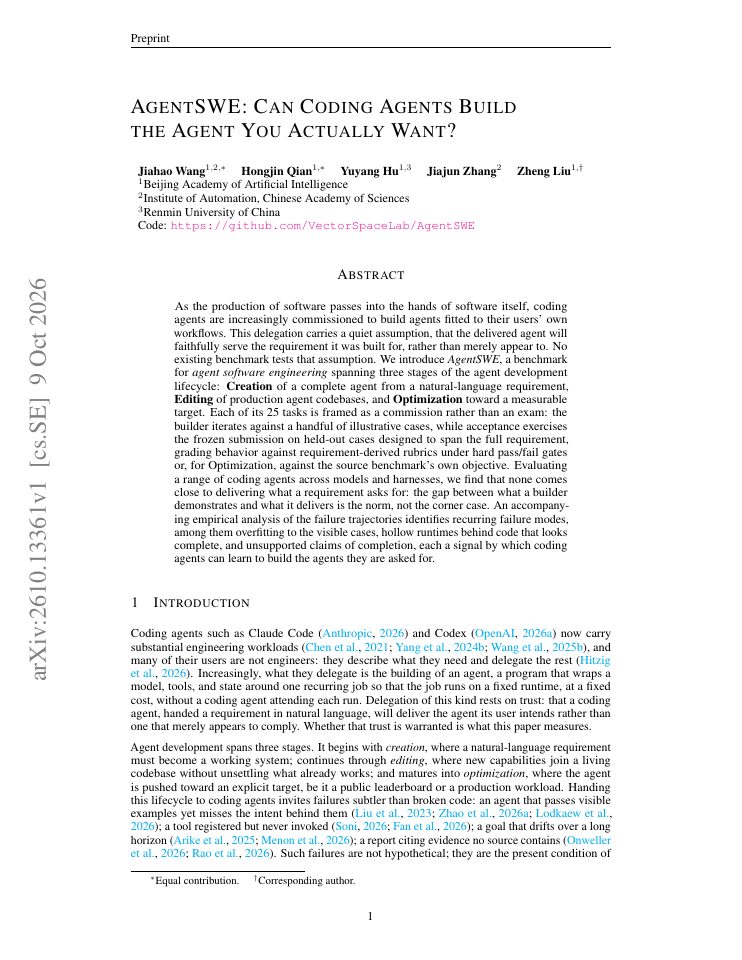
First page of AgentSWE: Can Coding Agents Build the Agent You Actually Want?
agent evaluationtest

AgentSWE: Can Coding Agents Build the Agent You Actually Want?

AgentSWE replaces ad hoc acceptance of agent-generated agent code with commission-style evaluation: a frozen submission is tested on held-out cases graded against requirement-derived rubrics under pass/fail gates, rather than being judged by its behavior on the illustrative cases the builder saw. The cost is evaluation engineering effort: constructing held-out cases and rubrics per requirement, plus the API or GPU spend to run frozen submissions, and it measures rather than improves delivered quality. It can fail to transfer if the reader's tasks are narrower than the benchmark's 25 commissions, and rubric-based grading inherits the reliability limits of whatever grader is used.

observed signal
1impl.
12stars
—citations
—claimed gain
abstract onlyReview decisionDownload skill ↓Original paper ↗
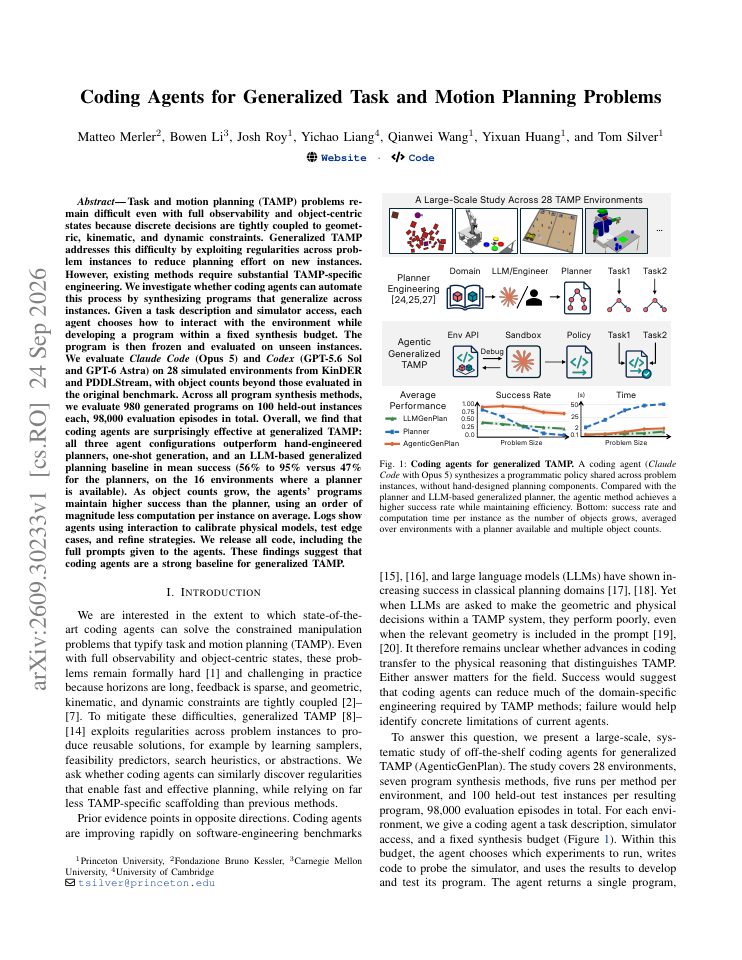
First page of Coding Agents for Generalized Task and Motion Planning Problems
coding agentstest

Coding Agents for Generalized Task and Motion Planning Problems

The method replaces hand-engineered TAMP planners and TAMP-specific engineering by having a coding agent (e.g., Claude Code, Codex) interactively synthesize a single frozen program that generalizes across problem instances. It costs a fixed up-front program-synthesis budget of agent API calls with simulator access, plus evaluation infrastructure; inference per instance is then cheap, about 10x less computation than the planner. It can fail on environments where success remains low (56% on the hardest), when held-out instances deviate from the regularities the program exploited, or when no reliable simulator is available for the agent to calibrate against.

observed signal
2impl.
58stars
0citations
10xclaimed gain
abstract onlyReview decisionDownload skill ↓Original paper ↗
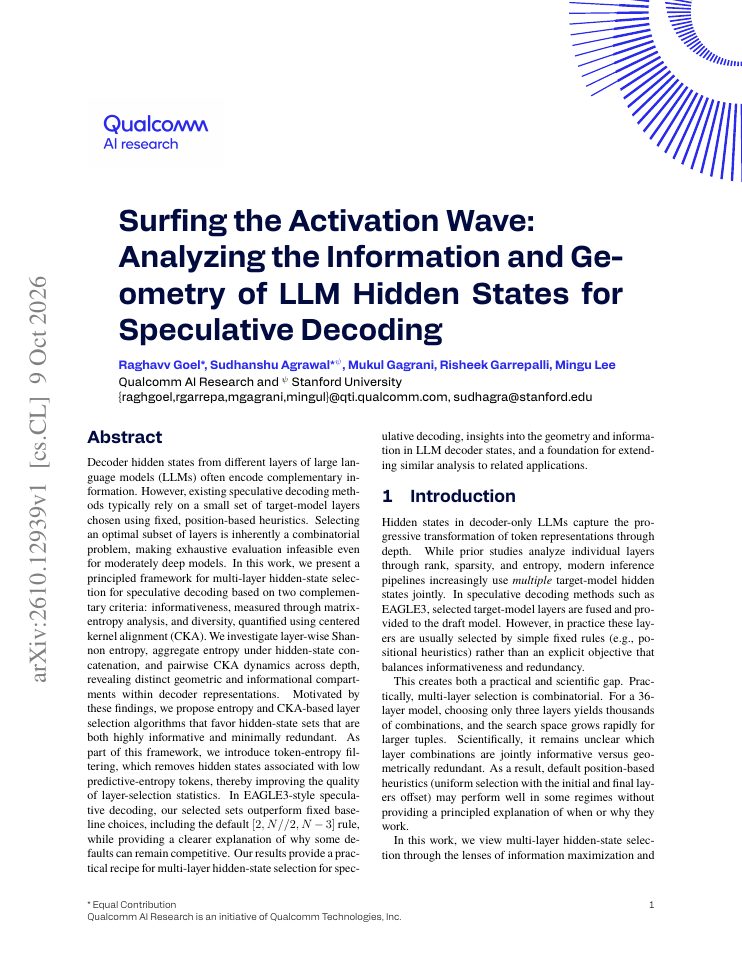
First page of Surfing the Activation Wave: Analyzing the Information and Geometry of LLM Hidden States for Speculative Decoding
speculative decodingtest

Surfing the Activation Wave: Analyzing the Information and Geometry of LLM Hidden States for Speculative Decoding

The method replaces fixed, position-based heuristics for choosing which decoder layers feed the draft model in EAGLE-style speculative decoding with a data-driven selection based on matrix entropy (informativeness), CKA (diversity), and token-entropy filtering. The cost is a one-time offline analysis pass over calibration data plus added pipeline complexity; inference architecture and memory footprint are unchanged since only the layer subset used by the draft head differs. It can fail if the calibration distribution shifts, if the gains are small relative to the already-competitive default rule (which the paper itself concedes can remain competitive), or if the statistics are computed on too few or poorly filtered tokens.

observed signal
2impl.
126stars
—citations
—claimed gain
abstract onlyReview decisionDownload skill ↓Original paper ↗
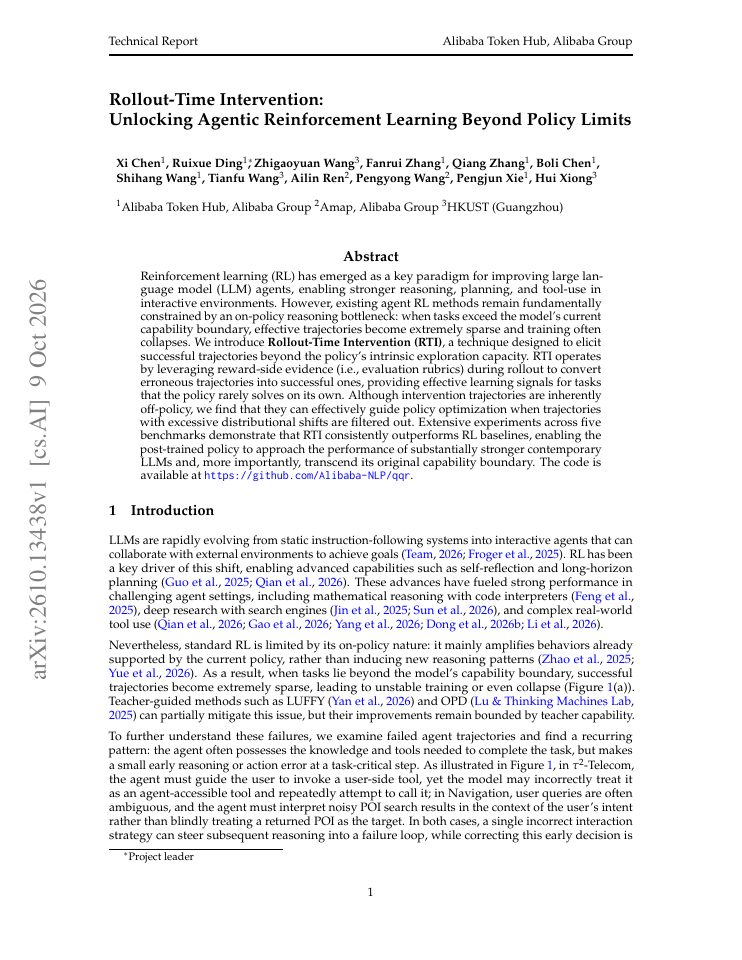
First page of Rollout-Time Intervention: Unlocking Agentic Reinforcement Learning Beyond Policy Limits
efficient trainingtest

Rollout-Time Intervention: Unlocking Agentic Reinforcement Learning Beyond Policy Limits

RTI replaces purely on-policy exploration in agentic RL by injecting reward-rubric evidence during rollout to convert failed trajectories into successful ones, then filtering interventions with excessive distributional shift before policy optimization. It costs additional rollout compute for intervention and filtering, requires well-specified evaluation rubrics per task, and adds off-policy correction logic to the training pipeline. It can fail when rubrics are unavailable or noisy, when filtering admits trajectories whose distribution shift destabilizes training, or when the resulting training still demands more GPU memory than a single 24 GB card provides for the chosen model size.

observed signal
2impl.
449stars
—citations
—claimed gain
abstract onlyReview decisionDownload skill ↓Original paper ↗
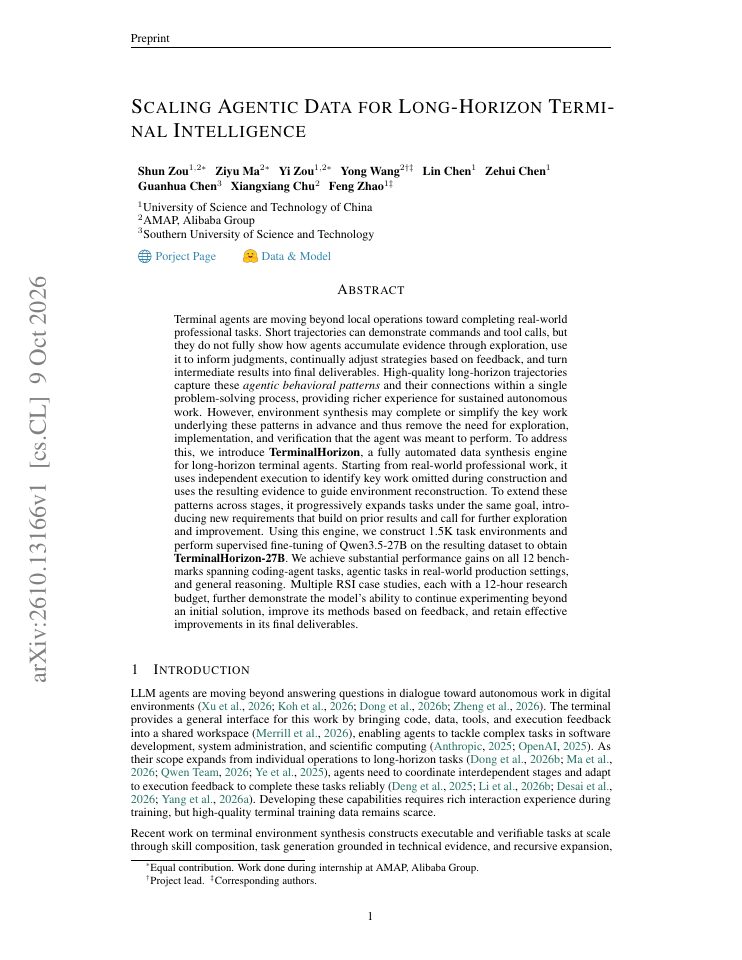
First page of Scaling Agentic Data for Long-Horizon Terminal Intelligence
coding agentswatch

Scaling Agentic Data for Long-Horizon Terminal Intelligence

The method replaces manually authored or naively synthesized agent training environments with a fully automated engine that reconstructs environments to preserve exploration, implementation, and verification work, then progressively expands tasks into long-horizon trajectories for supervised fine-tuning. Adopting it costs the compute to run the synthesis engine, independent execution verification, and full SFT of a 27B model, which exceeds a single 24 GB GPU and a limited cloud budget. It can fail if environment reconstruction silently reintroduces shortcuts the independent-execution check misses, and the reported gains may not transfer to a smaller model that fits the reader's infrastructure.

observed signal
1impl.
132stars
—citations
—claimed gain
abstract onlyReview decisionDownload skill ↓Original paper ↗
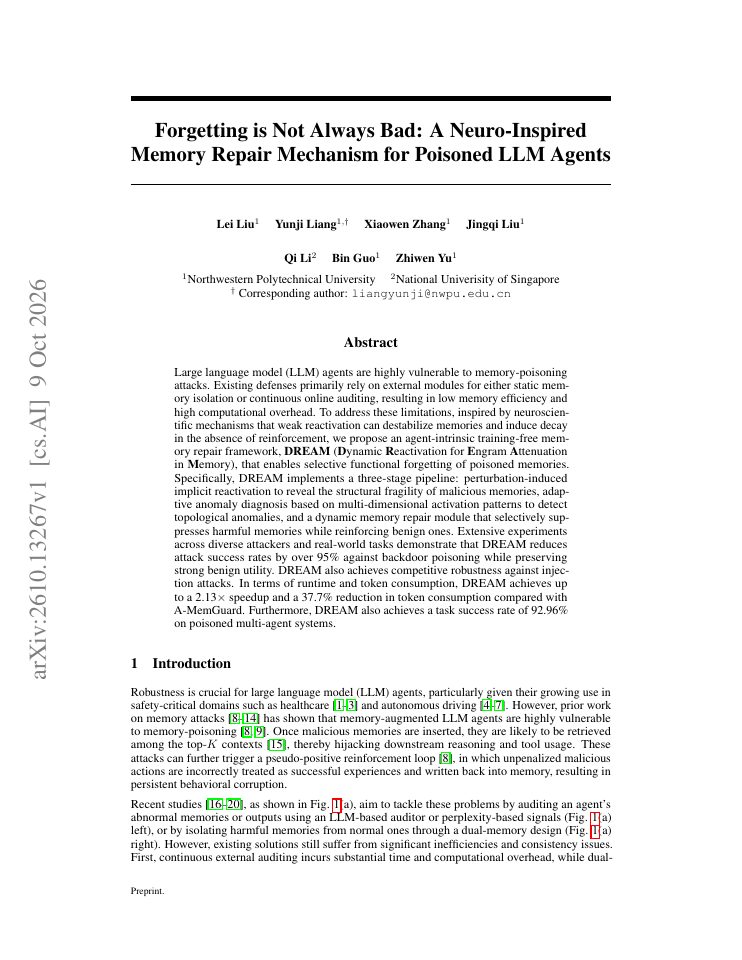
First page of Forgetting is Not Always Bad: A Neuro-Inspired Memory Repair Mechanism for Poisoned LLM Agents
safety and guardrailstest

Forgetting is Not Always Bad: A Neuro-Inspired Memory Repair Mechanism for Poisoned LLM Agents

DREAM replaces external memory-isolation or continuous online-auditing modules for defending LLM agents against memory poisoning with an agent-intrinsic, training-free three-stage pipeline (perturbation-induced reactivation, anomaly diagnosis, selective memory suppression and reinforcement). It requires no model training and fits a single-GPU or API-based stack, but adds per-step inference overhead for reactivation and diagnosis, and its cost depends on how often repair passes must run. It can fail through false positives that suppress benign memories, degraded robustness against adaptive attackers not covered in the evaluation, and the need to revalidate detection thresholds for each memory backend and task distribution.

observed signal
1impl.
132stars
—citations
2.13xclaimed gain
abstract onlyReview decisionDownload skill ↓Original paper ↗
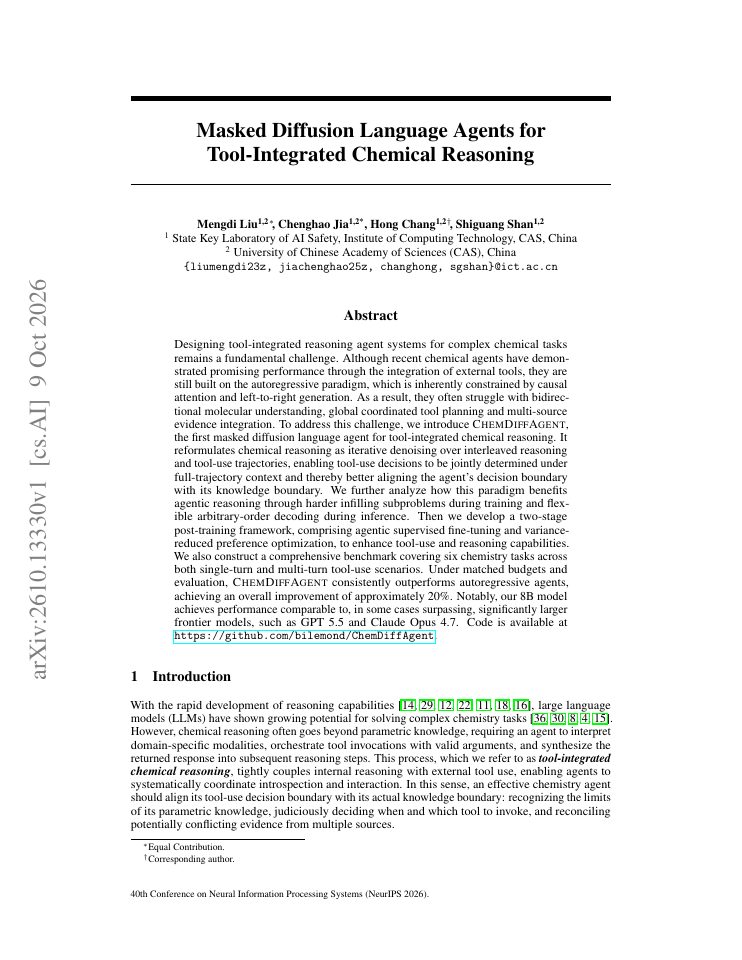
First page of Masked Diffusion Language Agents for Tool-Integrated Chemical Reasoning
tool usewatch

Masked Diffusion Language Agents for Tool-Integrated Chemical Reasoning

It replaces autoregressive left-to-right generation in tool-using agents with iterative masked-diffusion denoising over interleaved reasoning and tool-call trajectories, so tool decisions are conditioned on full-trajectory bidirectional context rather than only the past. The cost is a non-standard masked-diffusion model plus a two-stage post-training pipeline (agentic supervised fine-tuning and variance-reduced preference optimization), iterative multi-step denoising at inference, and tooling for diffusion-LM serving that is far less mature than the autoregressive stack. It can fail because the reported gains hold only on the authors' chemistry benchmark under matched budgets and may not transfer to other domains, and arbitrary-order decoding offers little benefit on strictly sequential tasks while the absence of optimized KV-cache and batching support can erode the quality advantage in latency and serving complexity.

observed signal
1impl.
132stars
—citations
1.2xclaimed gain
abstract onlyReview decisionDownload skill ↓Original paper ↗
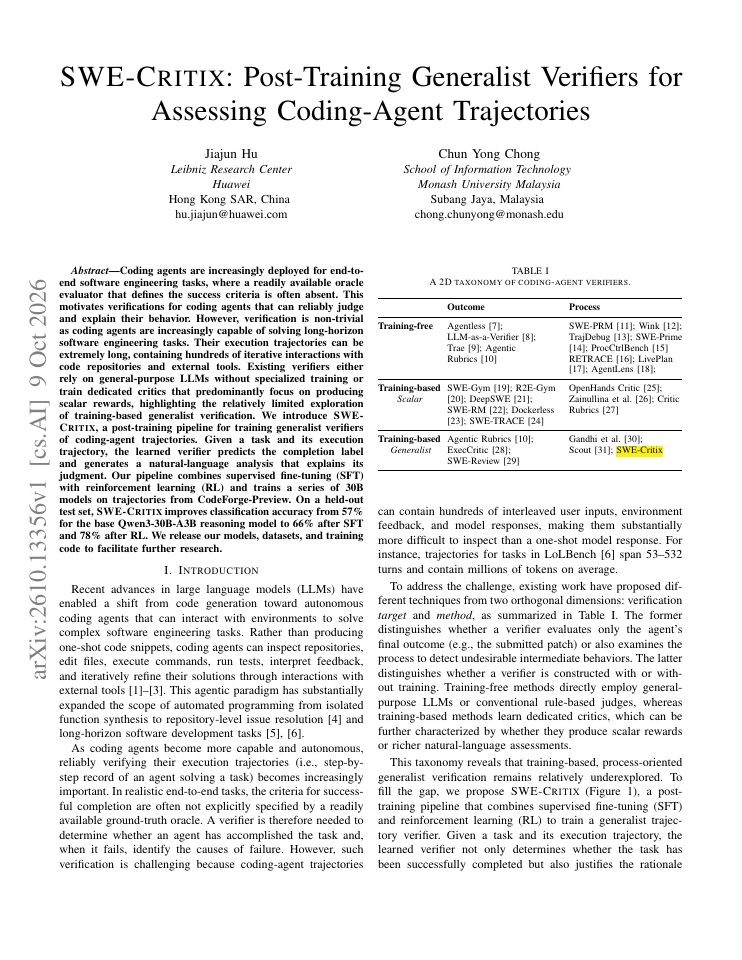
First page of SWE-Critix: Post-Training Generalist Verifiers for Assessing Coding-Agent Trajectories
agent evaluationtest

SWE-Critix: Post-Training Generalist Verifiers for Assessing Coding-Agent Trajectories

SWE-Critix replaces prompting an off-the-shelf general-purpose LLM to judge coding-agent trajectories with a dedicated 30B verifier (Qwen3-30B-A3B) post-trained via SFT plus RL to predict completion labels and produce natural-language explanations. The reader cannot reproduce the training pipeline, but the released 30B-A3B MoE model can run quantized on a 24 GB GPU or via API, at the cost of serving a large model and adding a verification step to every agent run. It can fail because 78% accuracy still means roughly one in five judgments is wrong, the verifier is trained on CodeForge-Preview trajectories and may degrade on other agents, repositories, or task distributions, and verifier errors can silently propagate if used for automated filtering or reward signals.

observed signal
1impl.
132stars
—citations
—claimed gain
abstract onlyReview decisionDownload skill ↓Original paper ↗
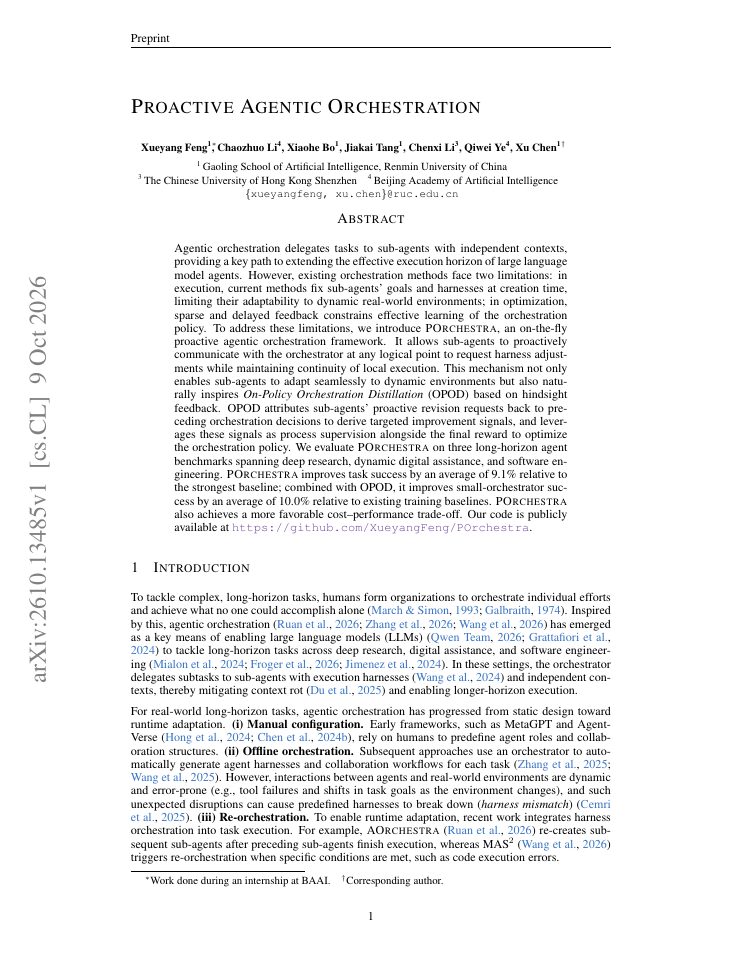
First page of Proactive Agentic Orchestration
multi-agent orchestrationtest

Proactive Agentic Orchestration

POrchestra replaces static multi-agent orchestration, in which sub-agent goals and harnesses are fixed at creation, with sub-agents that can request runtime adjustments from the orchestrator; OPOD optionally replaces sparse-reward RL on the orchestration policy with process supervision distilled from hindsight revision requests. The cost is extra orchestrator-sub-agent communication rounds (added latency and tokens), plus training infrastructure for OPOD if the distillation component is adopted, though the runtime mechanism alone works with API models. It can fail when sub-agents issue unnecessary or poorly targeted revision requests, adding cost without quality gain, and the reported gains are benchmark averages that may not transfer to a different task mix or model family.

observed signal
1impl.
132stars
—citations
—claimed gain
abstract onlyReview decisionDownload skill ↓Original paper ↗
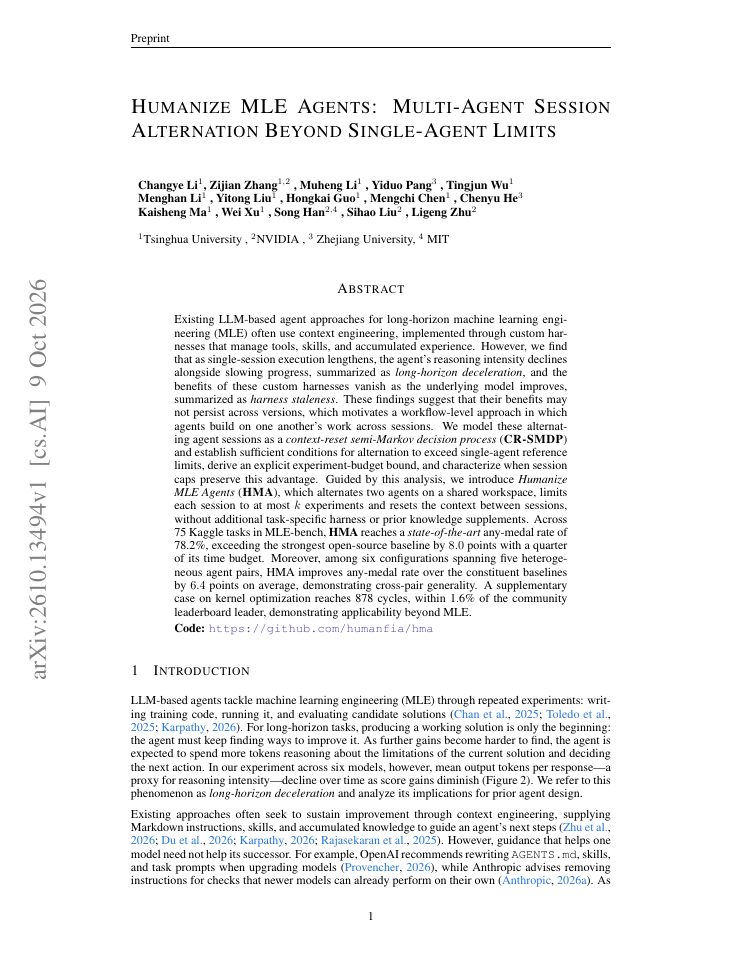
First page of Humanize MLE Agents: Multi-Agent Session Alternation Beyond Single-Agent Limits
multi-agent orchestrationtest

Humanize MLE Agents: Multi-Agent Session Alternation Beyond Single-Agent Limits

HMA replaces single long-horizon agent sessions with custom context-engineering harnesses by alternating two agents over a shared workspace, capping each session at k experiments and resetting context between sessions. The cost is orchestration logic and duplicated token spend across sessions (each agent re-reads workspace state), though the paper reports a 4x reduction in wall-clock budget relative to the baseline; it requires API access to two capable LLM agents, which fits constrained infrastructure. It can fail when the two agents lack complementary strengths, when workspace state summaries lose critical experiment context across resets, or when the task is short enough that single-session deceleration never materializes.

observed signal
1impl.
132stars
—citations
—claimed gain
abstract onlyReview decisionDownload skill ↓Original paper ↗
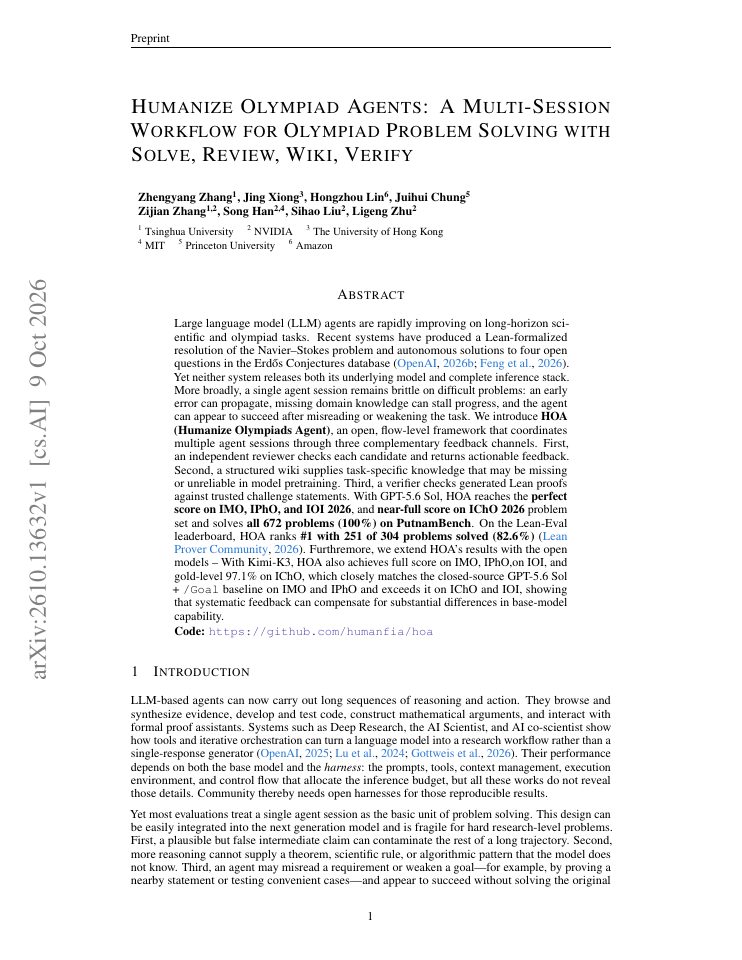
First page of Humanize Olympiad Agents: A Multi-Session Workflow for Olympiad Problem Solving with Solve, Review, Wiki, Verify
multi-agent orchestrationtest

Humanize Olympiad Agents: A Multi-Session Workflow for Olympiad Problem Solving with Solve, Review, Wiki, Verify

It replaces single-session agent attempts on hard reasoning problems with a multi-session pipeline that adds an independent reviewer, a task-specific structured wiki, and a Lean-based verifier checking proofs against trusted statements. The cost is substantially higher inference spending (multiple sessions plus reviewer and verifier calls per problem), added orchestration complexity, and dependence on frontier models and a Lean formalization stack. Failure modes include reviewer errors propagating as authoritative feedback, wiki content being incomplete or wrong, verifier gaps when no formal statement exists for a task, and inference costs that scale poorly on a limited budget.

observed signal
1impl.
132stars
—citations
—claimed gain
abstract onlyReview decisionDownload skill ↓Original paper ↗
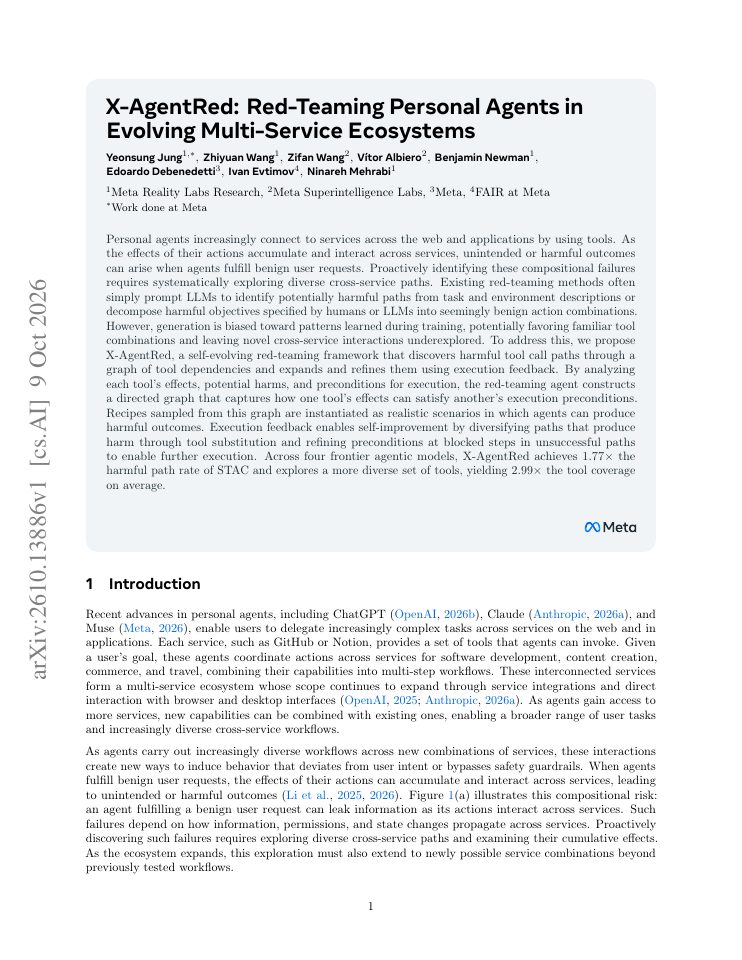
First page of X-AgentRed: Red-Teaming Personal Agents in Evolving Multi-Service Ecosystems
safety and guardrailstest

X-AgentRed: Red-Teaming Personal Agents in Evolving Multi-Service Ecosystems

X-AgentRed replaces LLM-prompted or decomposition-based red-teaming, where harmful-path generation is biased toward familiar tool combinations, with a tool-dependency graph built from tool effects, preconditions, and harms, whose sampled paths are instantiated as scenarios and iteratively refined using execution feedback. The cost is a non-trivial implementation pipeline (tool-effect analysis, graph construction, scenario instantiation, and an execution-feedback loop) plus recurring LLM call costs for analysis and scenario generation, all feasible on API access without dedicated GPU hardware. It can fail where tool documentation is incomplete or inaccurate, since the dependency graph derives from inferred preconditions and effects, and discovered harms may not transfer across model versions, tool APIs, or permission configurations as services evolve.

observed signal
1impl.
132stars
—citations
2.99xclaimed gain
abstract onlyReview decisionDownload skill ↓Original paper ↗
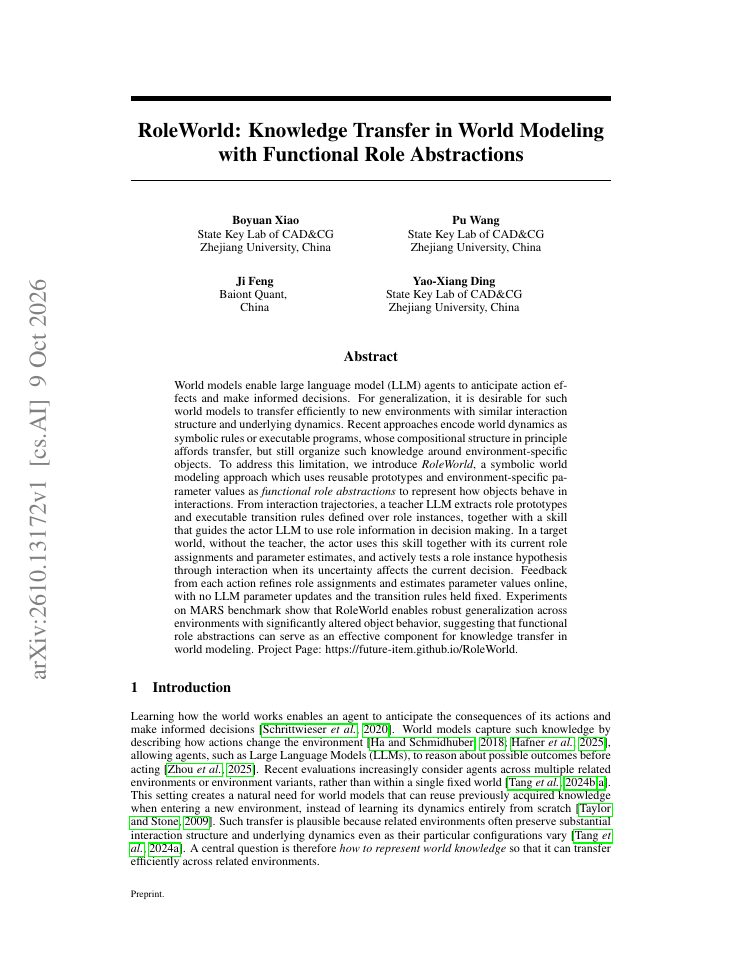
First page of RoleWorld: Knowledge Transfer in World Modeling with Functional Role Abstractions
planning and decompositiontest

RoleWorld: Knowledge Transfer in World Modeling with Functional Role Abstractions

It replaces environment-specific symbolic rules or programs with reusable functional role prototypes plus environment-specific parameter estimates, keeping transition rules fixed and refining role assignments online without LLM parameter updates. Cost is a teacher-LLM extraction phase per source environment, additional actor-LLM calls for skill-guided decision making and uncertainty-driven hypothesis testing, plus the engineering burden of maintaining executable rules, role assignments, and parameter estimators. It can fail when the teacher extracts incorrect or non-transferable role abstractions, when online parameter estimation converges too slowly or wrongly, or when the target environment's dynamics do not actually share the assumed interaction structure.

observed signal
1impl.
338stars
—citations
—claimed gain
abstract onlyReview decisionDownload skill ↓Original paper ↗
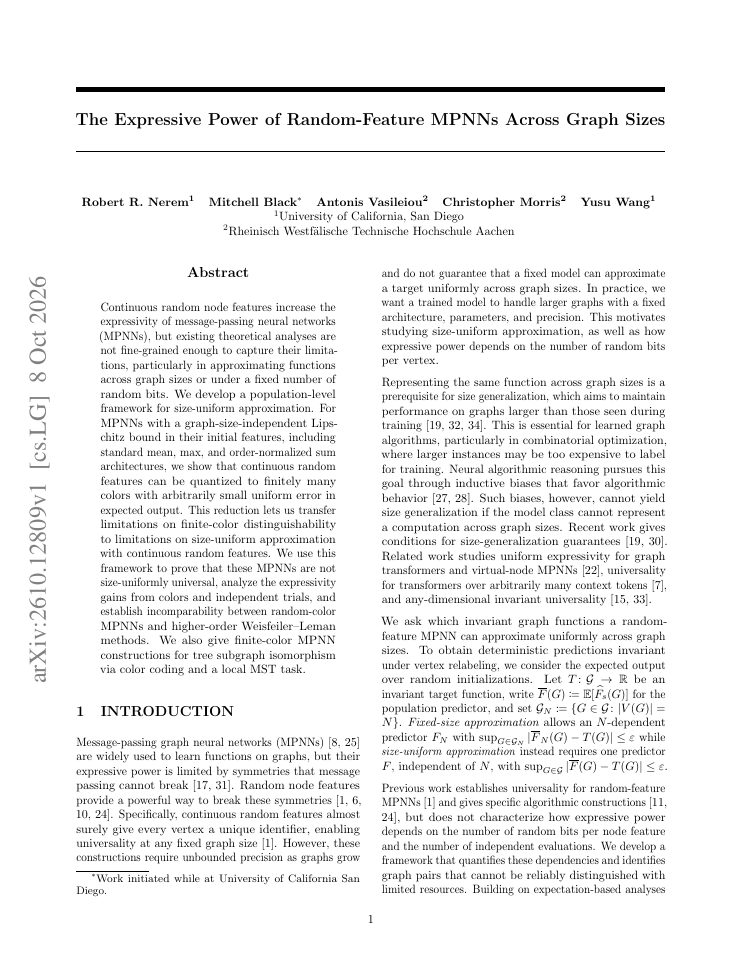
First page of The Expressive Power of Random-Feature MPNNs Across Graph Sizes
othernot applicable

The Expressive Power of Random-Feature MPNNs Across Graph Sizes

This is a theoretical expressivity analysis of message-passing neural networks with random node features; it replaces nothing in a production stack, as it proves approximation limits and constructions rather than proposing a deployable method. It costs nothing to adopt because there is no artifact, model, or training procedure to integrate. There is nothing that can fail in production because the contribution is a population-level framework showing size-uniform universality is impossible for standard random-feature MPNNs, plus finite-color constructions for tree subgraph isomorphism and a local MST task.

observed signal
0impl.
4stars
—citations
—claimed gain
abstract onlyReview decisionDownload skill ↓Original paper ↗
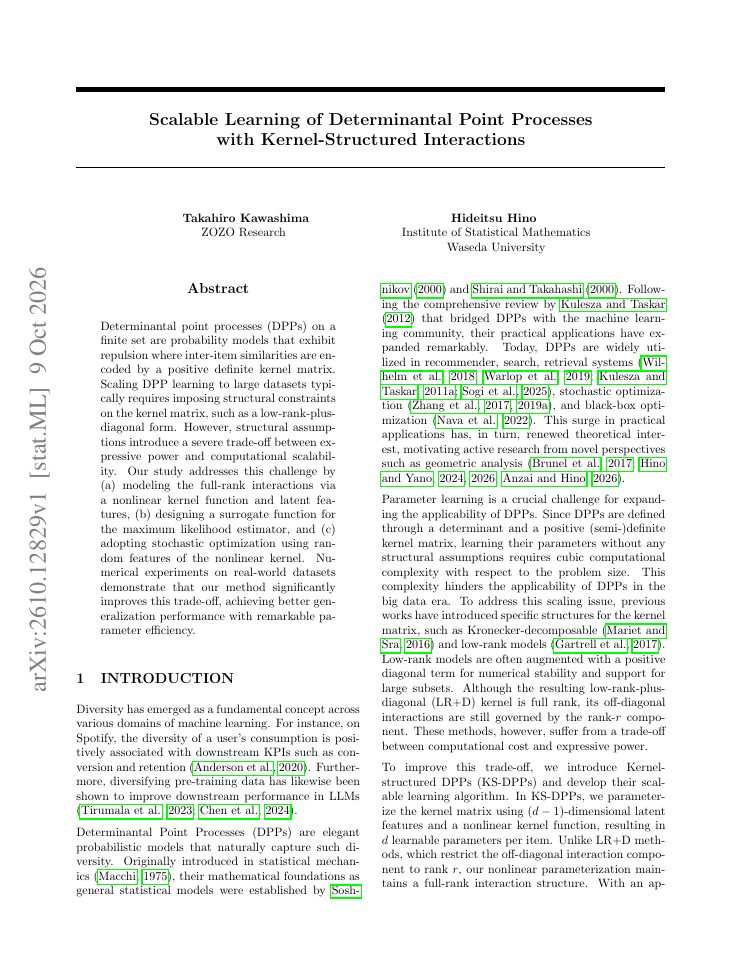
First page of Scalable Learning of Determinantal Point Processes with Kernel-Structured Interactions
otherwatch

Scalable Learning of Determinantal Point Processes with Kernel-Structured Interactions

The method replaces low-rank-plus-diagonal structural constraints on the DPP kernel with a full-rank nonlinear kernel approximated by latent features and random Fourier-style features, trained via a surrogate maximum-likelihood objective with stochastic optimization. Costs include the approximation error of random-feature kernel estimation, hyperparameter sensitivity of the surrogate objective, and implementation effort for a model class outside mainstream ML tooling. It can fail if random-feature rank is too low to capture the true kernel spectrum, if item sets are small enough that exact DPP inference is cheaper and more accurate, or if the downstream task does not actually benefit from learned repulsion.

observed signal
0impl.
0stars
—citations
—claimed gain
abstract onlyReview decisionDownload skill ↓Original paper ↗
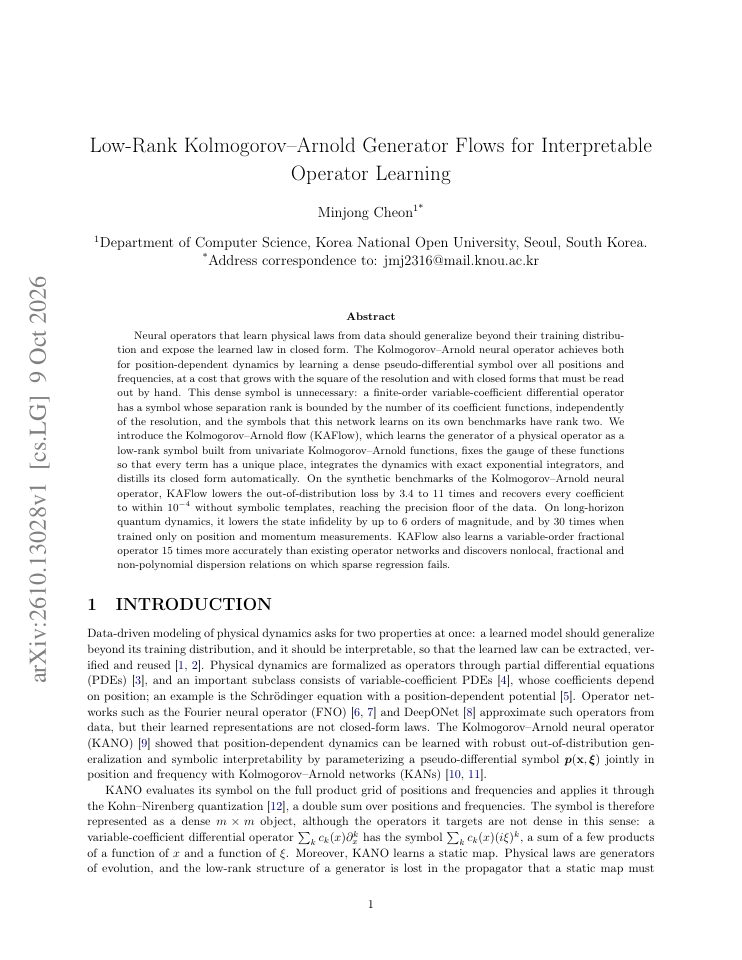
First page of Low-Rank Kolmogorov-Arnold Generator Flows for Interpretable Operator Learning
othernot applicable

Low-Rank Kolmogorov-Arnold Generator Flows for Interpretable Operator Learning

KAFlow replaces the dense, resolution-quadratic pseudo-differential symbol of the Kolmogorov-Arnold neural operator with a low-rank symbol built from univariate Kolmogorov-Arnold functions, integrated with exact exponential integrators and automatically distilled into closed form. The cost is a specialized training and gauge-fixing pipeline for scientific operator learning, plus dependence on the low-separation-rank assumption and on benchmarks that are synthetic or domain-specific; it does not address general-purpose model training or inference. It can fail when the target operator lacks low separation rank, when dynamics are not well captured by the assumed generator structure, or when data do not reach the precision regime needed for the claimed coefficient recovery.

observed signal
0impl.
0stars
—citations
11xclaimed gain
abstract onlyReview decisionDownload skill ↓Original paper ↗
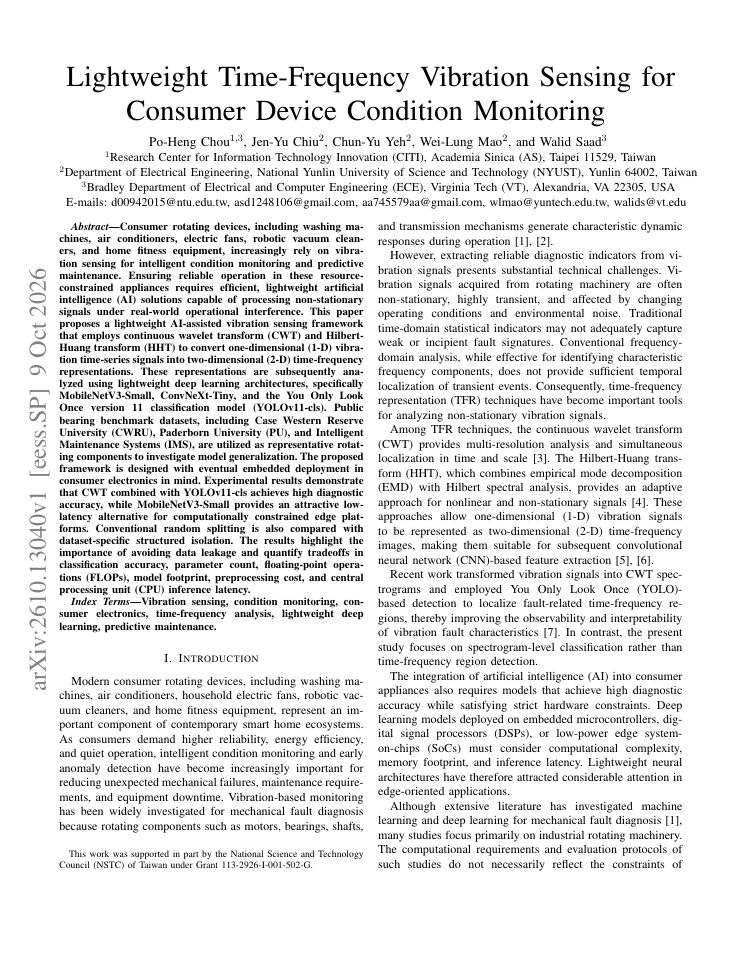
First page of Lightweight Time-Frequency Vibration Sensing for Consumer Device Condition Monitoring
efficient architecturestest

Lightweight Time-Frequency Vibration Sensing for Consumer Device Condition Monitoring

This replaces heavier end-to-end 1-D deep models (or manual feature engineering) for vibration fault diagnosis with a two-stage pipeline: CWT or Hilbert-Huang conversion of raw vibration signals into 2-D time-frequency images, followed by lightweight image classifiers (MobileNetV3-Small, ConvNeXt-Tiny, YOLOv11-cls) sized for embedded CPUs. The cost is the added CWT/HHT preprocessing step on the edge device, image-based inference that is heavier than 1-D alternatives, and a documented accuracy drop when moving from random splits to structured isolation, i.e., leakage-free evaluation. It can fail through data leakage inflating benchmark results, poor generalization across machines, loads, or sensor placements not represented in the bearing datasets, and preprocessing latency exceeding the budget of low-end consumer microcontrollers.

observed signal
0impl.
0stars
—citations
—claimed gain
abstract onlyReview decisionDownload skill ↓Original paper ↗
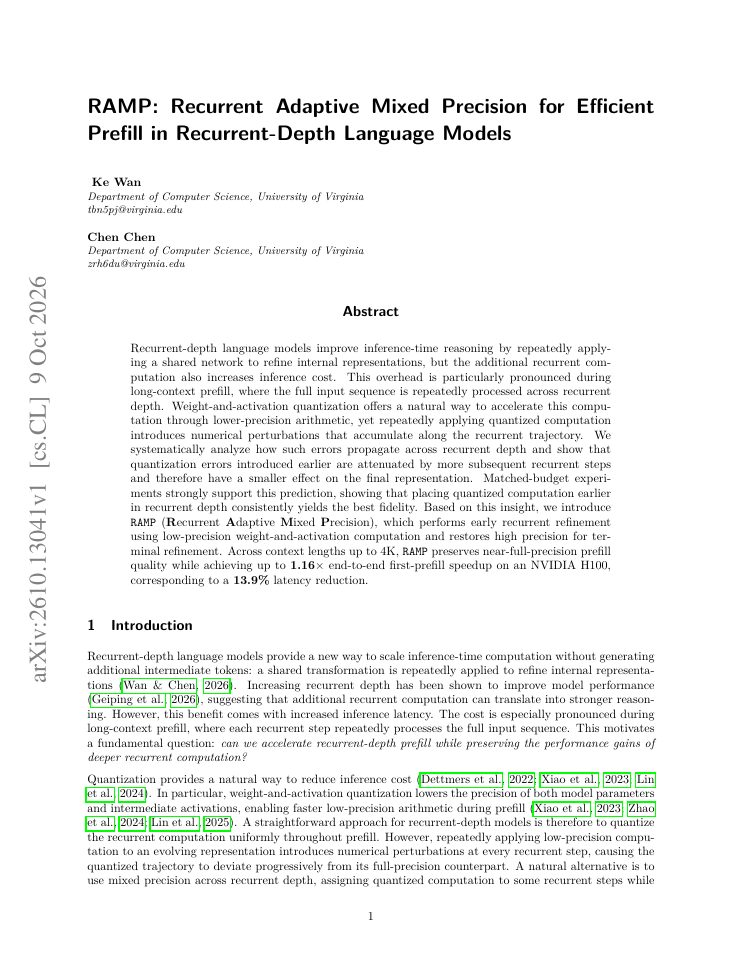
First page of RAMP: Recurrent Adaptive Mixed Precision for Efficient Prefill in Recurrent-Depth Language Models
quantizationwatch

RAMP: Recurrent Adaptive Mixed Precision for Efficient Prefill in Recurrent-Depth Language Models

RAMP replaces uniform-precision recurrent prefill with a schedule that runs early recurrent steps in low-precision weight-and-activation arithmetic and restores full precision for terminal steps, exploiting the finding that early quantization errors are attenuated by later refinement. The cost is implementation complexity in the recurrent inference loop and the need for weight-and-activation quantization kernels, with quality risk if the error-attenuation property does not hold for a given model. It can fail on non-recurrent architectures, on workloads dominated by decode rather than prefill, and beyond the 4K context lengths actually validated.

observed signal
0impl.
122stars
—citations
1.16xclaimed gain
abstract onlyReview decisionDownload skill ↓Original paper ↗
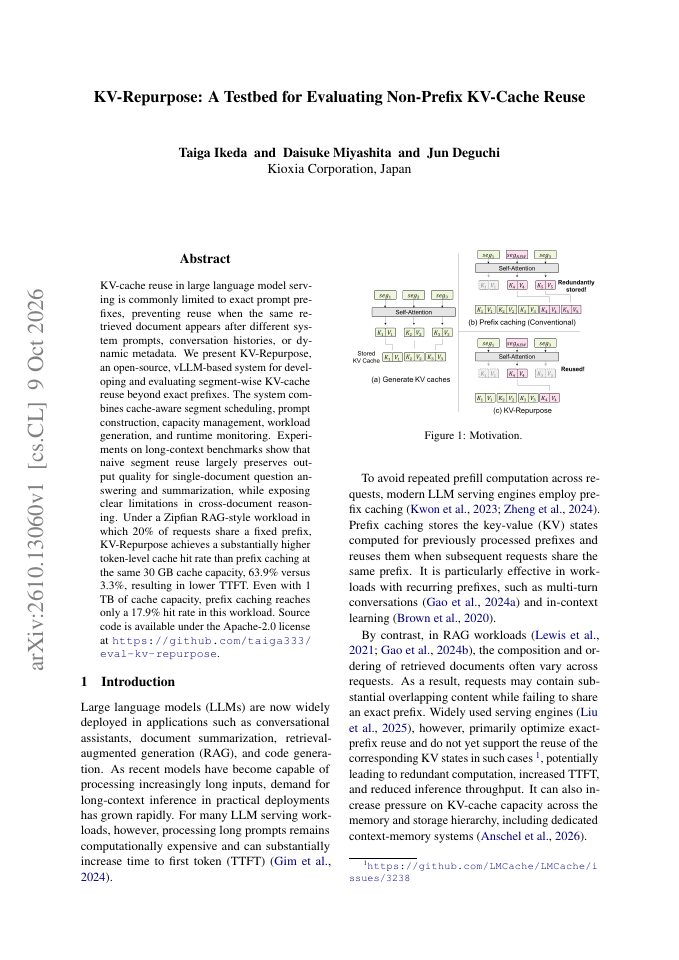
First page of KV-Repurpose: A Testbed for Evaluating Non-Prefix KV-Cache Reuse
KV cachetest

KV-Repurpose: A Testbed for Evaluating Non-Prefix KV-Cache Reuse

Replaces exact-prefix KV-cache reuse with segment-wise reuse, allowing cached document blocks to be reused across different system prompts and conversation histories in a vLLM-based serving stack. Costs include adopting and maintaining a custom scheduling, prompt-construction, and capacity-management layer on top of vLLM, plus engineering effort to segment workloads correctly. Naive segment reuse largely preserves quality on single-document QA and summarization, but the paper reports clear degradation in cross-document reasoning, and the reported gains are demonstrated only under a specific Zipfian RAG workload, so real traffic may benefit far less.

observed signal
0impl.
122stars
—citations
19.4xclaimed gain
abstract onlyReview decisionDownload skill ↓Original paper ↗
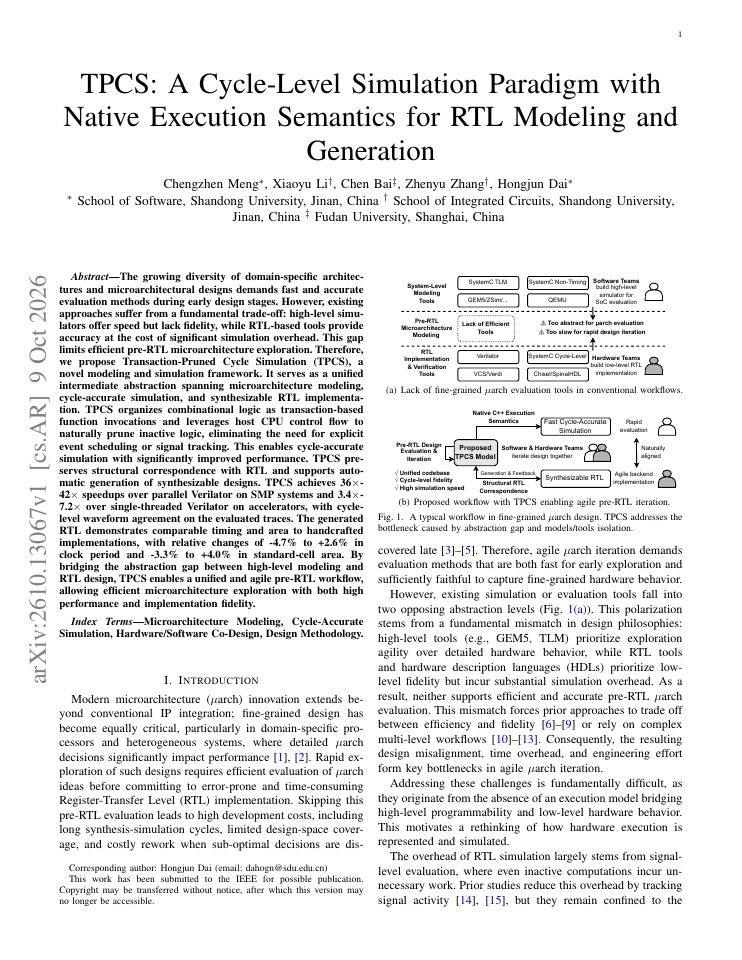
First page of TPCS: A Cycle-Level Simulation Paradigm with Native Execution Semantics for RTL Modeling and Generation
othernot applicable

TPCS: A Cycle-Level Simulation Paradigm with Native Execution Semantics for RTL Modeling and Generation

TPCS replaces event-driven RTL simulation (e.g., Verilator) with a transaction-based intermediate abstraction that uses host CPU control flow to prune inactive logic while remaining translatable to synthesizable RTL. Its cost is adoption of a new modeling framework and toolchain rather than compute or memory, since simulation runs on a host CPU. It can fail if the evaluated traces do not represent the reader's designs, if automatic RTL generation misses corner cases requiring explicit event semantics, or if ecosystem immaturity limits integration with existing verification flows.

observed signal
0impl.
0stars
—citations
42xclaimed gain
abstract onlyReview decisionDownload skill ↓Original paper ↗
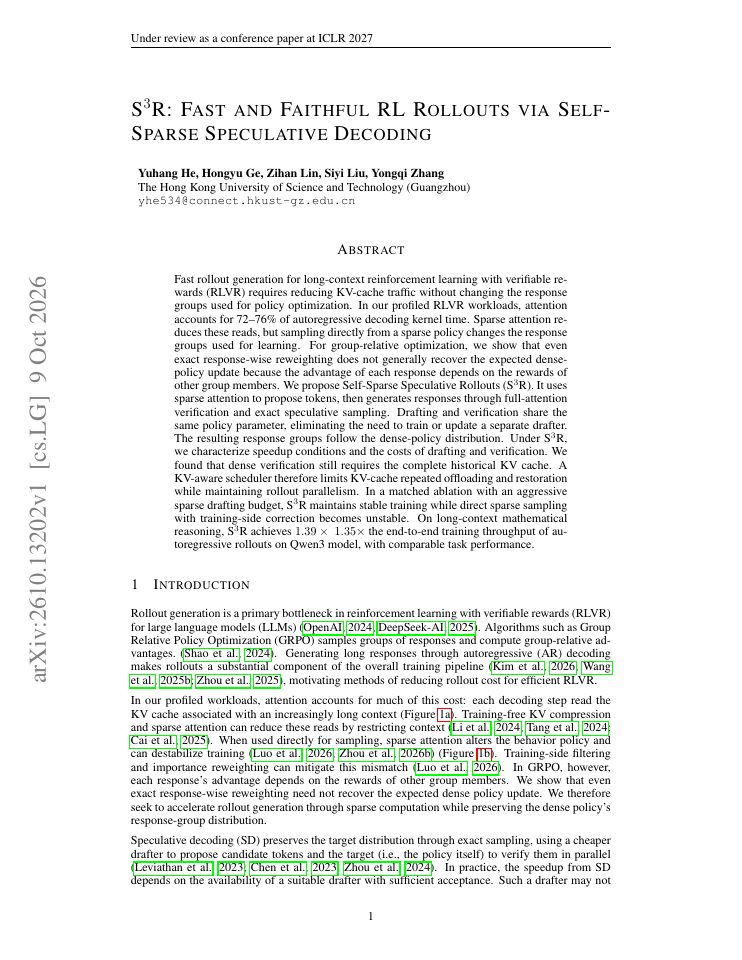
First page of S$^3$R: Fast and Faithful RL Rollouts via Self-Sparse Speculative Decoding
speculative decodingwatch

S$^3$R: Fast and Faithful RL Rollouts via Self-Sparse Speculative Decoding

The method replaces direct sparse-attention sampling (or plain autoregressive decoding) in RLVR rollout generation with sparse-attention drafting followed by full-attention verification and exact speculative sampling, so response groups remain faithful to the dense-policy distribution. It costs a modified inference stack: shared-parameter drafting plus verification passes, retention of the complete historical KV cache for verification, and a KV-aware scheduler to avoid offloading and restoration thrashing. It can fail because the speedup depends on draft acceptance rates and aggressive sparse budgets, requires rollout-scale infrastructure and custom scheduling unavailable on a single 24 GB GPU, and the reported gains are limited to long-context mathematical RLVR on Qwen3.

observed signal
0impl.
0stars
—citations
1.35xclaimed gain
abstract onlyReview decisionDownload skill ↓Original paper ↗
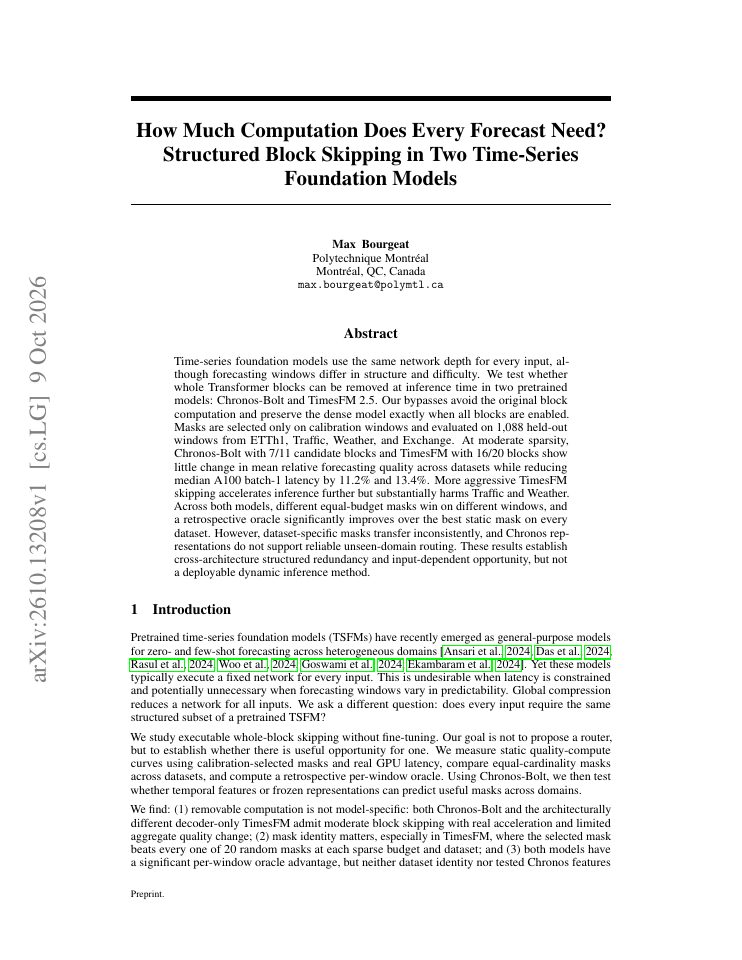
First page of How Much Computation Does Every Forecast Need? Structured Block Skipping in Two Time-Series Foundation Models
sparsity and pruningtest

How Much Computation Does Every Forecast Need? Structured Block Skipping in Two Time-Series Foundation Models

The method replaces full-depth forward passes in pretrained time-series foundation models with statically masked Transformer blocks, where whole blocks are bypassed using masks selected on calibration windows. It costs a calibration procedure per deployment setting and carries quality risk: aggressive skipping substantially degrades Traffic and Weather, and the measured latency gain is only 11-13% at the moderate sparsity that preserves accuracy. What can fail is generalization: dataset-specific masks transfer inconsistently, per-window optimal masks differ so no static mask captures the oracle opportunity, and Chronos representations do not support reliable routing to unseen domains.

observed signal
0impl.
0stars
—citations
1.13xclaimed gain
abstract onlyReview decisionDownload skill ↓Original paper ↗
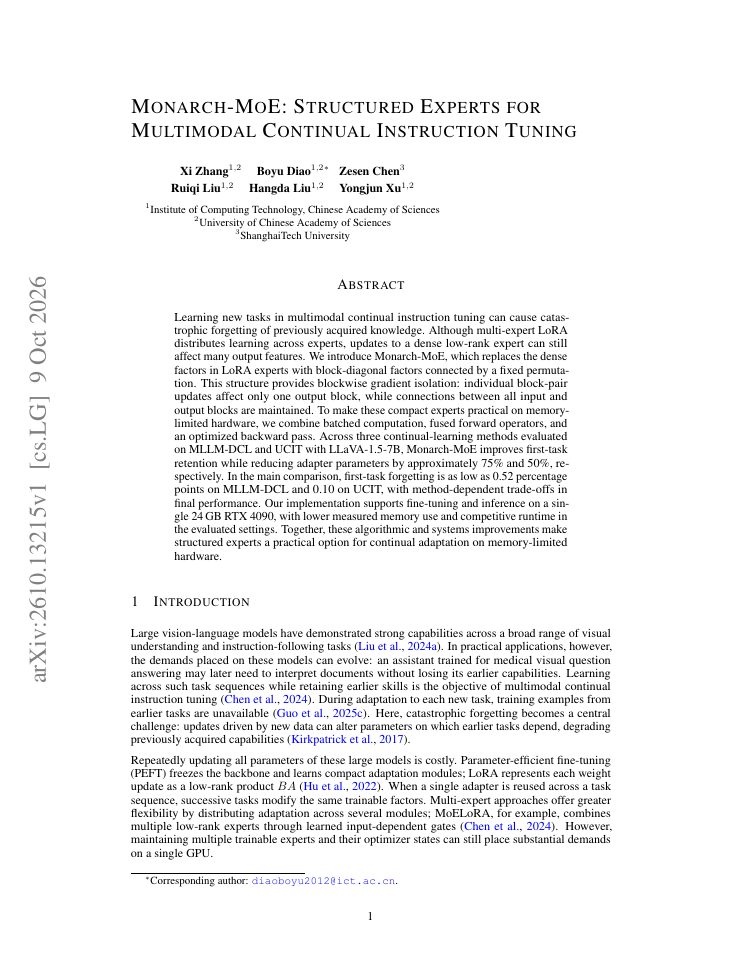
First page of Monarch-MoE: Structured Experts for Multimodal Continual Instruction Tuning
efficient trainingtest

Monarch-MoE: Structured Experts for Multimodal Continual Instruction Tuning

Monarch-MoE replaces the dense low-rank factors in multi-expert LoRA adapters with block-diagonal factors joined by a fixed permutation, so each block-pair update touches only one output block and forgetting is reduced in multimodal continual instruction tuning. The cost is a custom implementation with batched computation, fused forward operators, and a specialized backward pass, plus method-dependent trade-offs in final-task performance; parameter savings are a side benefit rather than guaranteed speedups outside the evaluated setup. It can fail if the reader's workload is not continual multimodal instruction tuning of a ~7B VLM, since gains are validated only on MLLM-DCL and UCIT with LLaVA-1.5-7B, and the fixed permutation may underperform dense factors on other task sequences.

observed signal
0impl.
0stars
—citations
—claimed gain
abstract onlyReview decisionDownload skill ↓Original paper ↗
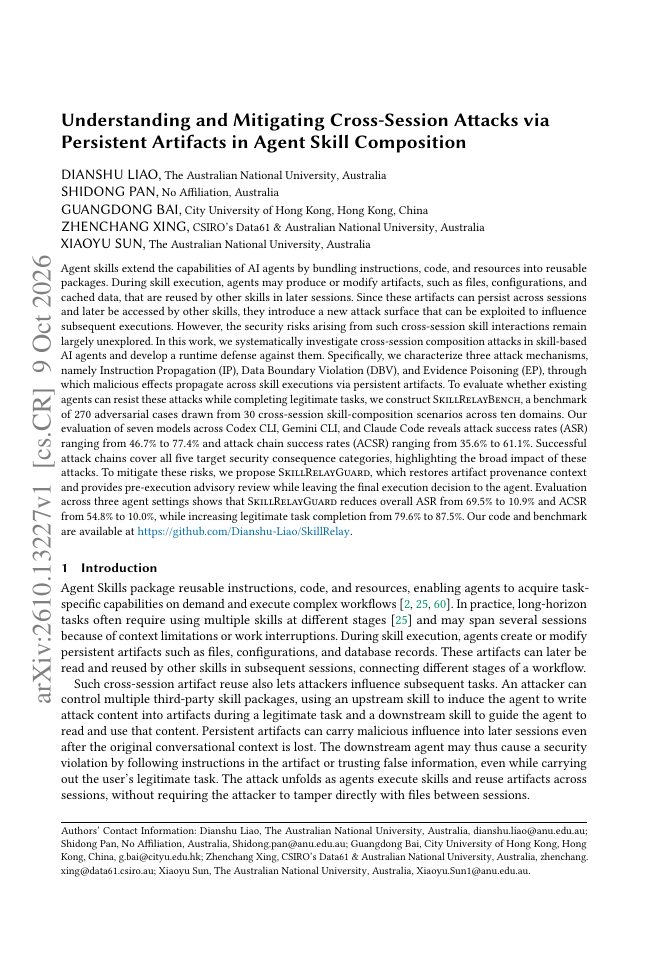
First page of Understanding and Mitigating Cross-Session Attacks via Persistent Artifacts in Agent Skill Composition
safety and guardrailstest

Understanding and Mitigating Cross-Session Attacks via Persistent Artifacts in Agent Skill Composition

It replaces unguarded cross-session skill execution, in which persistent artifacts are consumed without provenance context, with a runtime layer that restores artifact provenance and adds a pre-execution advisory review while leaving the final decision to the agent. The cost is additional engineering to record and propagate artifact provenance, extra review latency and prompt/context tokens per skill invocation, and possible advisory false positives that can block or alter legitimate flows. It can fail because the final execution choice remains with the agent, roughly one in ten attacks still succeeds in the reported setting, and provenance can be incomplete across sessions, tools, or artifact types outside the evaluated benchmark.

observed signal
0impl.
0stars
—citations
6.38xclaimed gain
abstract onlyReview decisionDownload skill ↓Original paper ↗
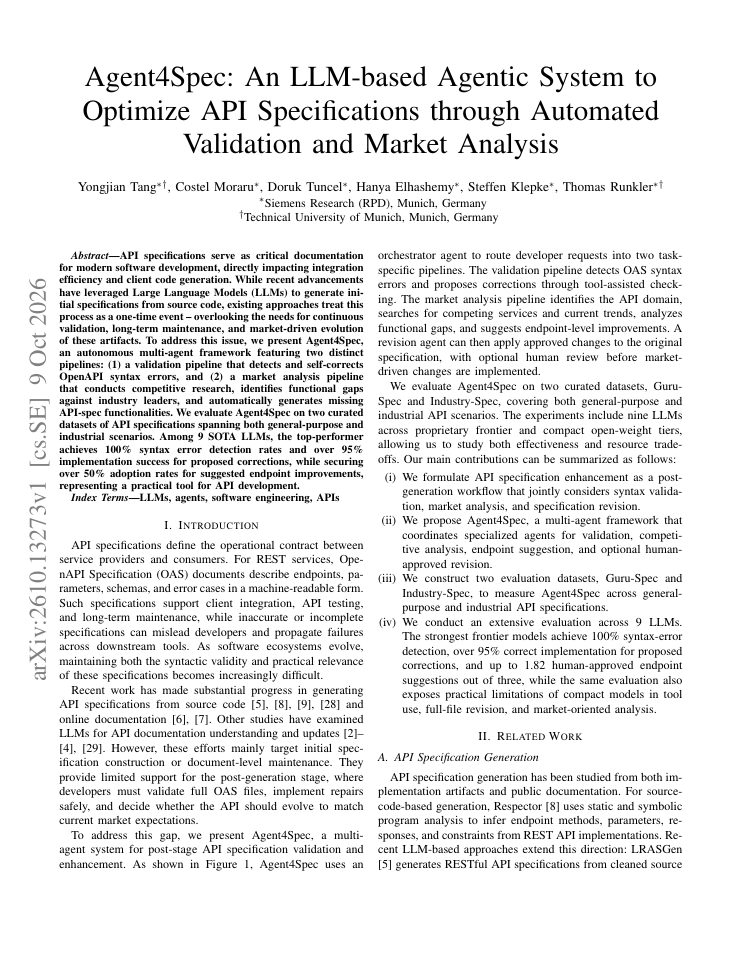
First page of Agent4Spec: An LLM-based Agentic System to Optimize API Specifications through Automated Validation and Market Analysis
multi-agent orchestrationtest

Agent4Spec: An LLM-based Agentic System to Optimize API Specifications through Automated Validation and Market Analysis

Agent4Spec replaces manual, one-time authoring and maintenance of OpenAPI specifications with a two-pipeline multi-agent system that self-corrects syntax errors and proposes market-driven endpoint additions. It costs multiple coordinated LLM calls per specification, which is feasible on third-party APIs with no local GPU requirement, but adds orchestration complexity and per-document token spend compared with a single lint-and-review pass. It can fail when the validation loop accepts plausible but semantically wrong corrections, and the market-analysis pipeline can generate endpoint suggestions based on unreliable competitive research that engineers must still review, since roughly half of suggestions were not adopted.

observed signal
0impl.
10stars
—citations
—claimed gain
abstract onlyReview decisionDownload skill ↓Original paper ↗
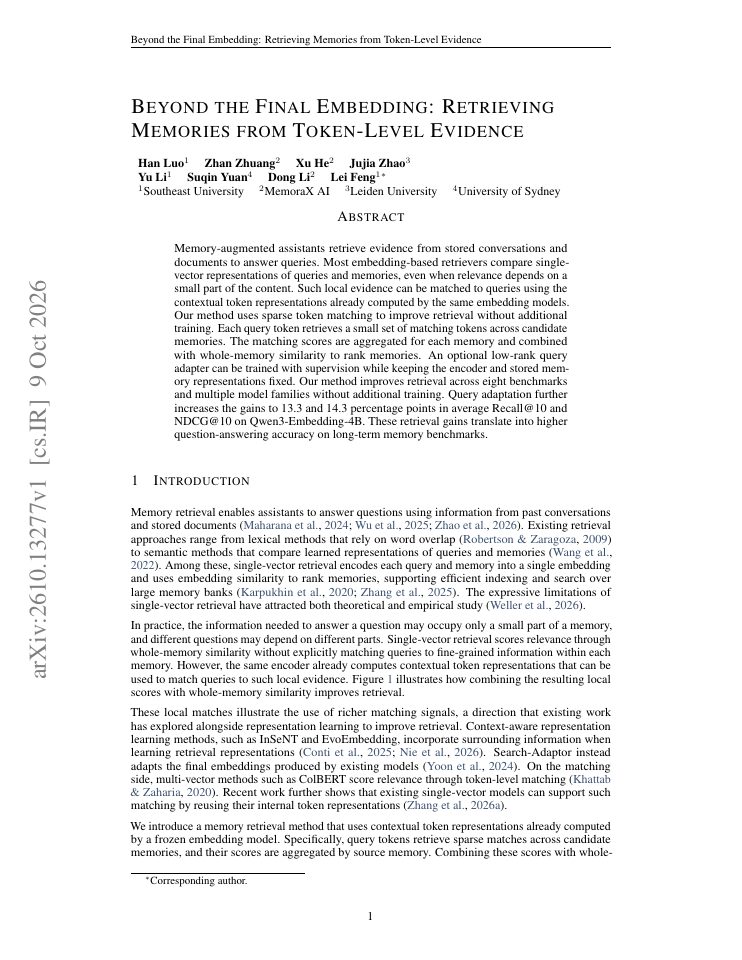
First page of Beyond the Final Embedding: Retrieving Memories from Token-Level Evidence
retrieval and RAGtest

Beyond the Final Embedding: Retrieving Memories from Token-Level Evidence

The method replaces single-vector query-memory similarity with sparse token-level matching over the contextual token representations already produced by the embedding model, aggregated and combined with whole-memory similarity, optionally refined by a low-rank query adapter trained while the encoder and stored representations stay fixed. The training-free variant costs only token-level index storage and per-query matching latency, but storing token representations for all memories is substantially larger than one vector per memory, and the adapter variant adds a supervised training step with labeled data. It can fail when query-token matches fire on irrelevant memories (raising false positives), when token index size or scoring latency exceeds the memory retrieval budget, and when gains on the eight reported benchmarks do not transfer to the reader's memory distribution.

observed signal
0impl.
0stars
—citations
—claimed gain
abstract onlyReview decisionDownload skill ↓Original paper ↗
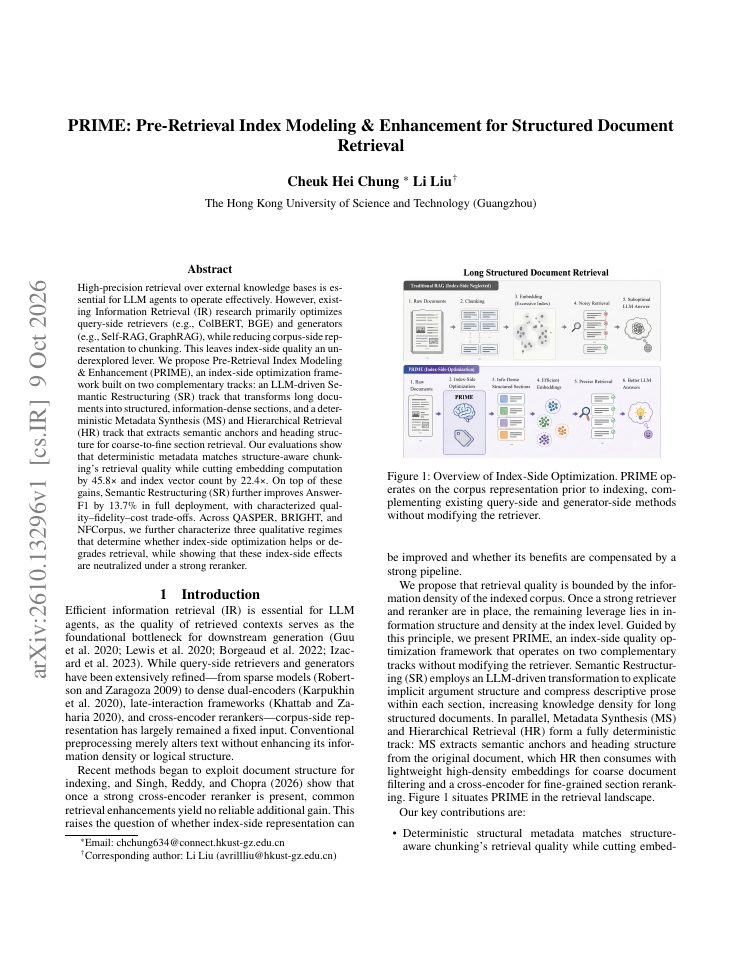
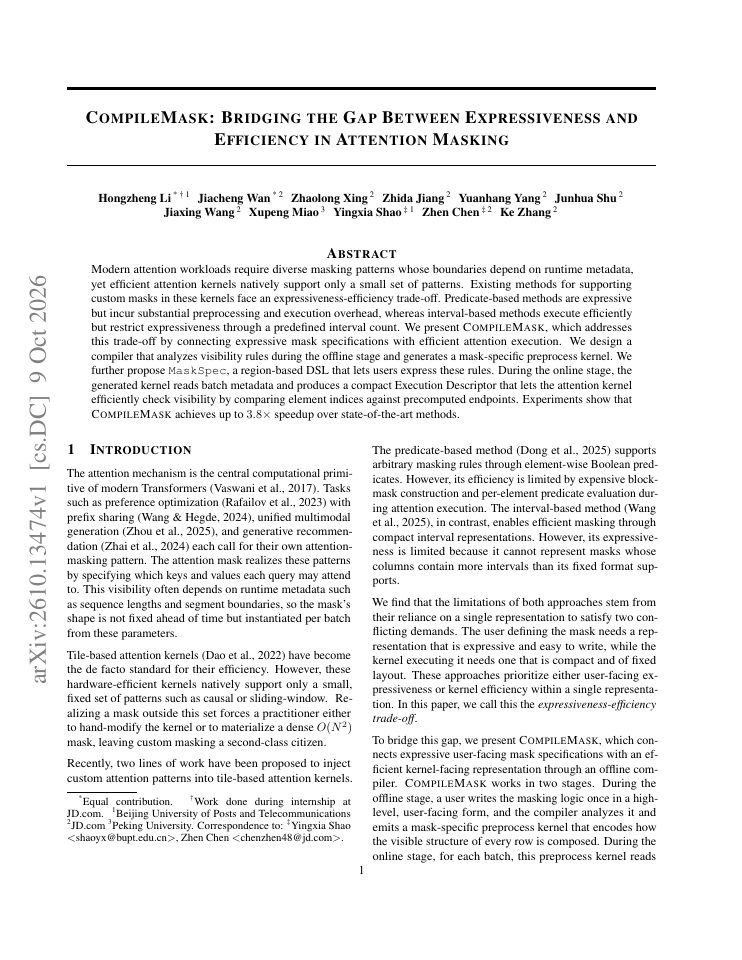
First page of PRIME: Pre-Retrieval Index Modeling Enhancement for Structured Document Retrieval-Real
retrieval and RAGtest

PRIME: Pre-Retrieval Index Modeling Enhancement for Structured Document Retrieval-Real

PRIME replaces plain chunk-based corpus indexing with an index-side pipeline: LLM-driven semantic restructuring of documents plus deterministic metadata extraction and hierarchical section retrieval. It costs LLM calls at index time, added indexing complexity, and a quality-fidelity trade-off from restructuring, though it reduces embedding compute and vector count by large factors. It can degrade retrieval in certain corpus regimes (three qualitative failure/success regimes are reported), and its gains are neutralized when a strong reranker is used downstream.

observed signal
0impl.
0stars
—citations
45.8xclaimed gain
abstract onlyReview decisionDownload skill ↓Original paper ↗

Research signals

Three views of the same evidence: adoption against attention, publication cadence by research area, and reported gains when coverage is sufficient.

color = research area

01 · attention × adoption

The research frontier

Look to the upper left for independent implementation before mass attention.

compare by
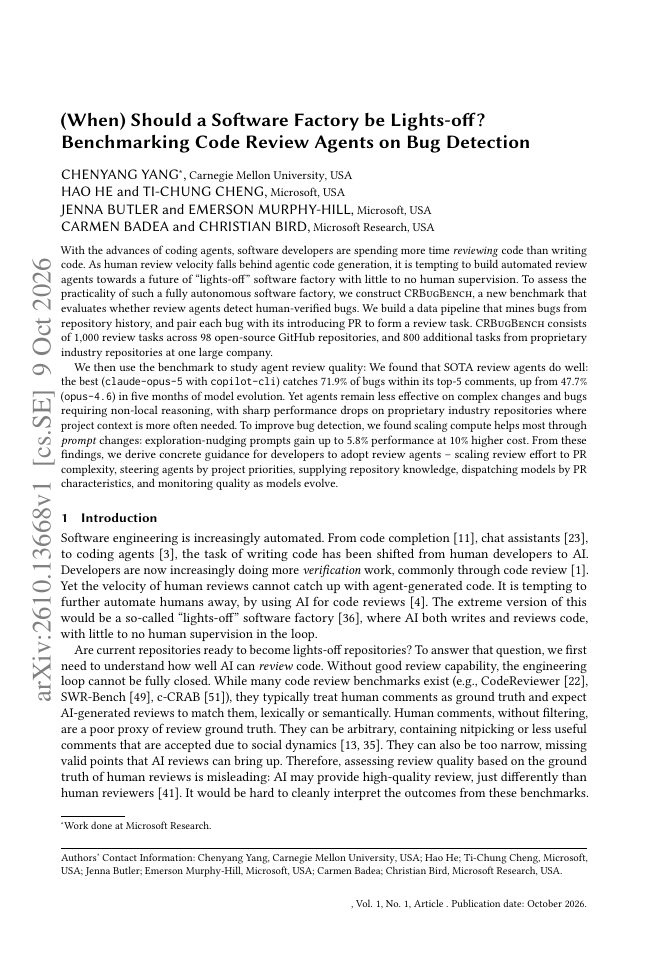
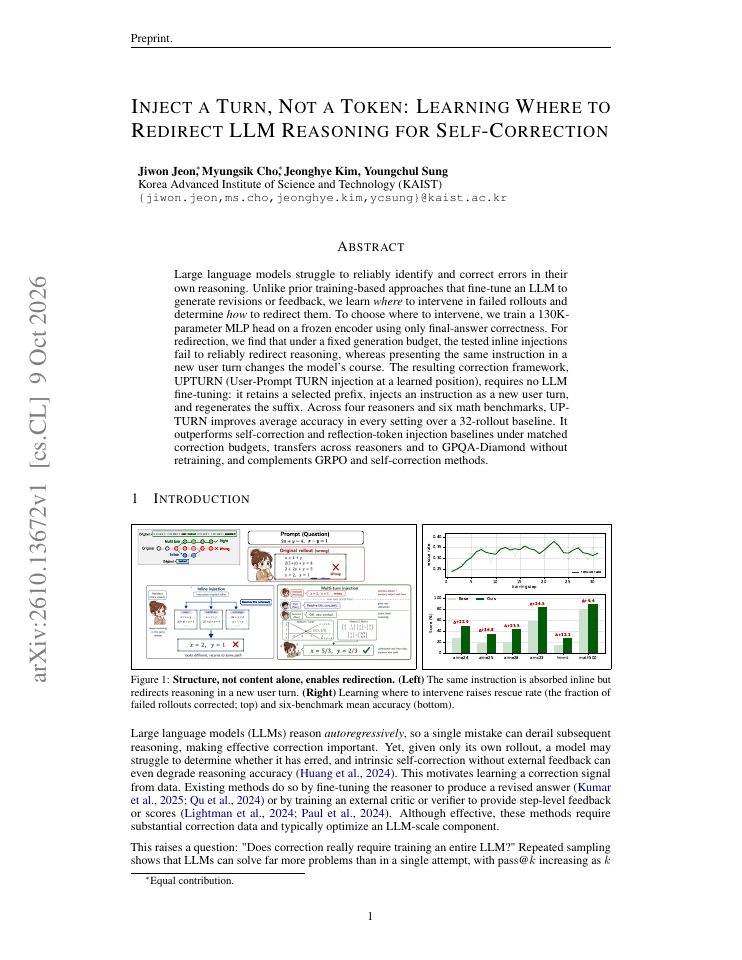
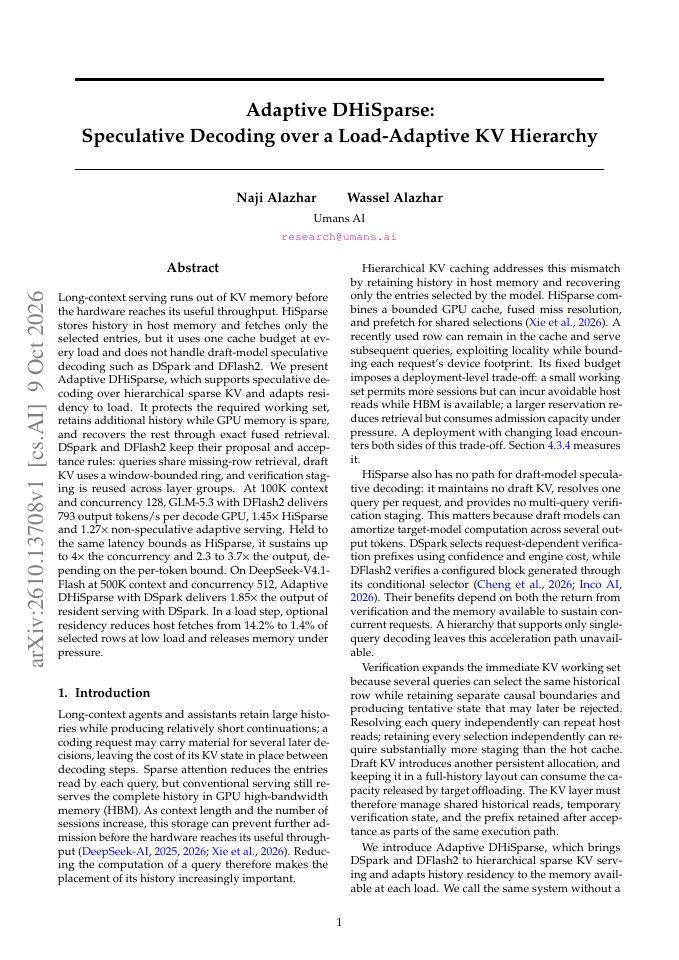
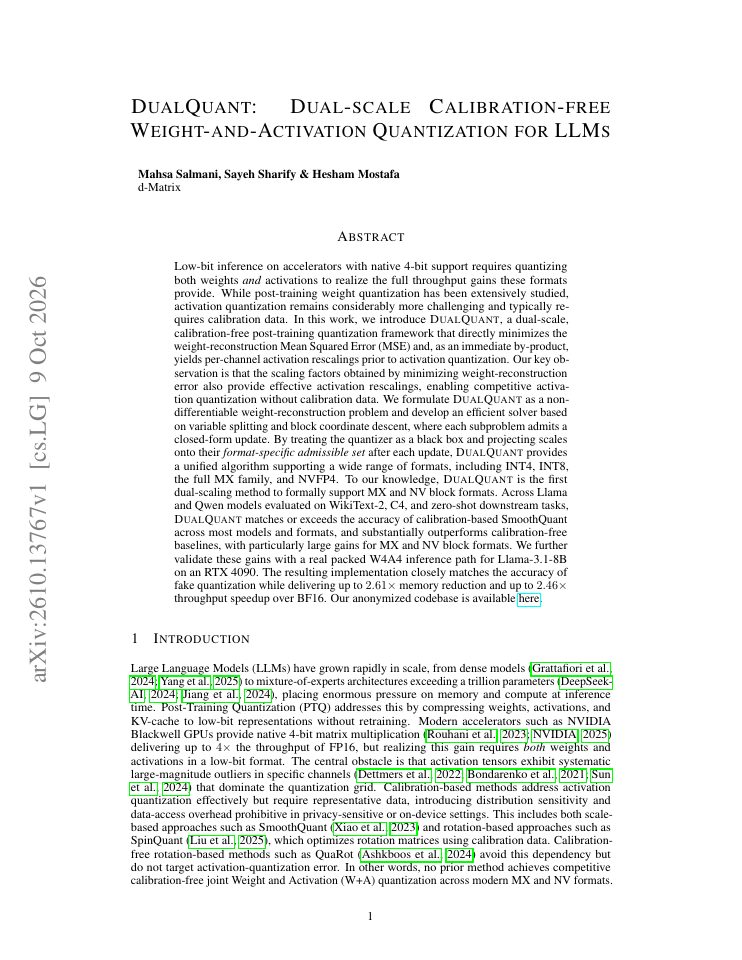
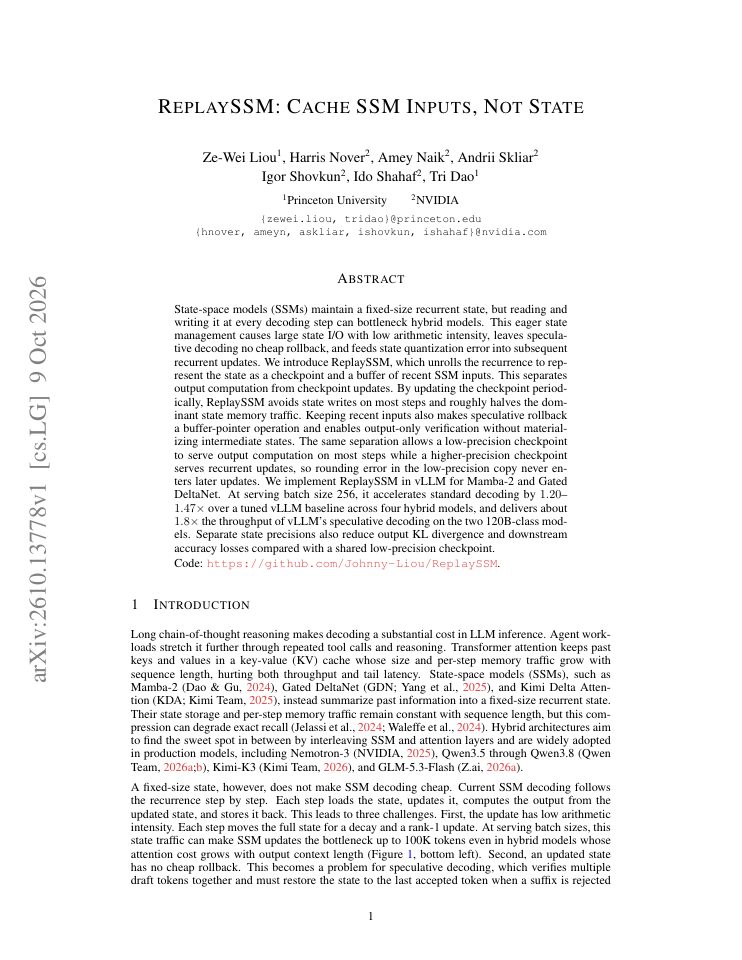
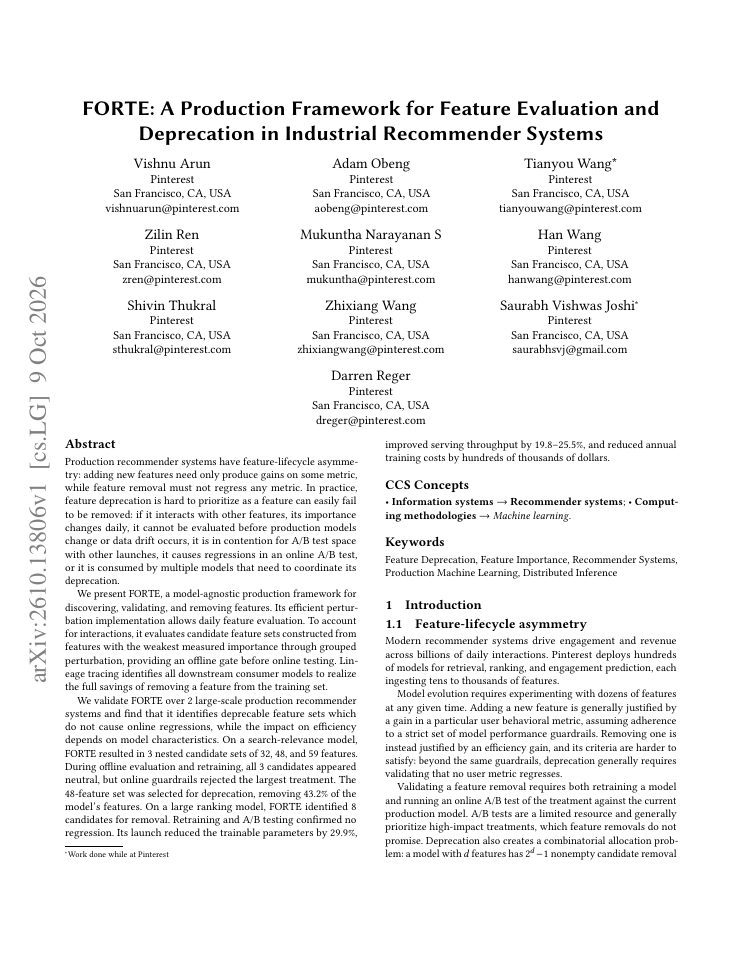
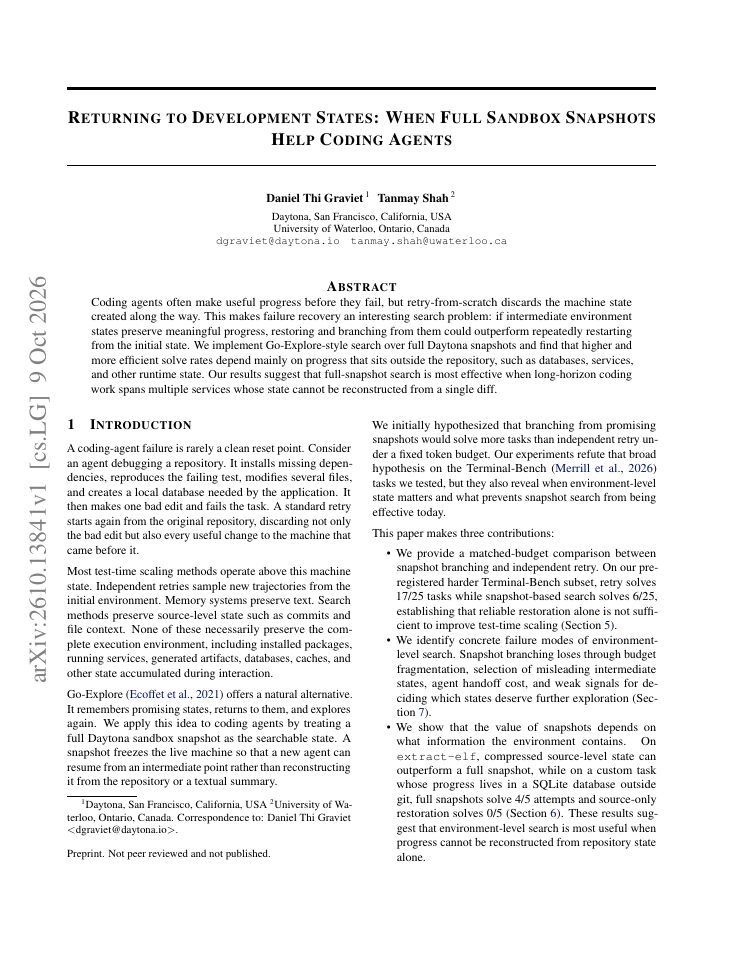
Each point represents one paper. Higher means more independent implementations; farther right means more GitHub stars.Instrumental Monitor Evasion Emerges Under Ordinary Task Pressure: 7 GitHub stars; 3 independent implementationsCoding Agents for Generalized Task and Motion Planning Problems: 58 GitHub stars; 2 independent implementationsThe Expressive Power of Random-Feature MPNNs Across Graph Sizes: 4 GitHub stars; 0 independent implementationsScalable Learning of Determinantal Point Processes with Kernel-Structured Interactions: 0 GitHub stars; 0 independent implementationsSurfing the Activation Wave: Analyzing the Information and Geometry of LLM Hidden States for Speculative Decoding: 126 GitHub stars; 2 independent implementationsLow-Rank Kolmogorov-Arnold Generator Flows for Interpretable Operator Learning: 0 GitHub stars; 0 independent implementationsLightweight Time-Frequency Vibration Sensing for Consumer Device Condition Monitoring: 0 GitHub stars; 0 independent implementationsRAMP: Recurrent Adaptive Mixed Precision for Efficient Prefill in Recurrent-Depth Language Models: 122 GitHub stars; 0 independent implementationsKV-Repurpose: A Testbed for Evaluating Non-Prefix KV-Cache Reuse: 122 GitHub stars; 0 independent implementationsTPCS: A Cycle-Level Simulation Paradigm with Native Execution Semantics for RTL Modeling and Generation: 0 GitHub stars; 0 independent implementationsScaling Agentic Data for Long-Horizon Terminal Intelligence: 132 GitHub stars; 1 independent implementationRoleWorld: Knowledge Transfer in World Modeling with Functional Role Abstractions: 338 GitHub stars; 1 independent implementationJANUS: Enhancing Long-Horizon Autonomous Research with Co-Evolving World Models: 353 GitHub stars; 3 independent implementationsS$^3$R: Fast and Faithful RL Rollouts via Self-Sparse Speculative Decoding: 0 GitHub stars; 0 independent implementationsHow Much Computation Does Every Forecast Need? Structured Block Skipping in Two Time-Series Foundation Models: 0 GitHub stars; 0 independent implementationsMonarch-MoE: Structured Experts for Multimodal Continual Instruction Tuning: 0 GitHub stars; 0 independent implementationsUnderstanding and Mitigating Cross-Session Attacks via Persistent Artifacts in Agent Skill Composition: 0 GitHub stars; 0 independent implementationsForgetting is Not Always Bad: A Neuro-Inspired Memory Repair Mechanism for Poisoned LLM Agents: 132 GitHub stars; 1 independent implementationAgent4Spec: An LLM-based Agentic System to Optimize API Specifications through Automated Validation and Market Analysis: 10 GitHub stars; 0 independent implementationsBeyond the Final Embedding: Retrieving Memories from Token-Level Evidence: 0 GitHub stars; 0 independent implementationsPRIME: Pre-Retrieval Index Modeling Enhancement for Structured Document Retrieval-Real: 0 GitHub stars; 0 independent implementationsMasked Diffusion Language Agents for Tool-Integrated Chemical Reasoning: 132 GitHub stars; 1 independent implementationSWE-Critix: Post-Training Generalist Verifiers for Assessing Coding-Agent Trajectories: 132 GitHub stars; 1 independent implementationAgentSWE: Can Coding Agents Build the Agent You Actually Want?: 12 GitHub stars; 1 independent implementationProgramGym: Scaling Training Environments for Long-Horizon Program Reproduction Agents: 21 GitHub stars; 3 independent implementationsShoreKeeper: Accelerating Iterative Data Analytics in the Cloud via Distributed Recovery-Cost-Aware Caching: 0 GitHub stars; 0 independent implementationsWeb$hell: A Unified Interface for Agentic Web Access: 10 GitHub stars; 0 independent implementationsRollout-Time Intervention: Unlocking Agentic Reinforcement Learning Beyond Policy Limits: 449 GitHub stars; 2 independent implementationsTowards Enriching Design-Time Models with Evidence from Simulation and Operational Activities: 122 GitHub stars; 0 independent implementationsCompileMask: Bridging the Gap Between Expressiveness and Efficiency in Attention Masking: 0 GitHub stars; 0 independent implementationsProactive Agentic Orchestration: 132 GitHub stars; 1 independent implementationHumanize MLE Agents: Multi-Agent Session Alternation Beyond Single-Agent Limits: 132 GitHub stars; 1 independent implementationHumanize Olympiad Agents: A Multi-Session Workflow for Olympiad Problem Solving with Solve, Review, Wiki, Verify: 132 GitHub stars; 1 independent implementation(When) Should a Software Factory be Lights-off? Benchmarking Code Review Agents on Bug Detection: 0 GitHub stars; 0 independent implementationsInject a Turn, Not a Token: Learning Where to Redirect LLM Reasoning for Self-Correction: 122 GitHub stars; 0 independent implementationsAdaptive DHiSparse: Speculative Decoding over a Load-Adaptive KV Hierarchy: 0 GitHub stars; 0 independent implementationsDualQuant: Dual-scale Calibration-free Weight-and-Activation Quantization for LLMs: 0 GitHub stars; 0 independent implementationsReplaySSM: Cache SSM Inputs, Not State: 0 GitHub stars; 0 independent implementationsOccludeBench: Can VLMs Find What's Missing?: 122 GitHub stars; 0 independent implementationsFORTE: A Production Framework for Feature Evaluation and Deprecation in Industrial Recommender Systems: 0 GitHub stars; 0 independent implementationsReturning to Development States: When Full Sandbox Snapshots Help Coding Agents: 10 GitHub stars; 0 independent implementationsX-AgentRed: Red-Teaming Personal Agents in Evolving Multi-Service Ecosystems: 132 GitHub stars; 1 independent implementation

Papers above 1000 stars or 200 citations are not scored. They have already broken through the attention threshold, while Paperraft is designed to identify earlier signals.

02 · cadence

Research areas over time

Compare monthly publication volume on a shared scale and calendar.

coding agentsmax 6Sep 26: 1 paperOct 26: 3 papersSep 26Oct 26efficient architecturesmax 6Sep 26: 0 papersOct 26: 1 paperSep 26Oct 26agent evaluationmax 6Sep 26: 0 papersOct 26: 3 papersSep 26Oct 26KV cachemax 6Sep 26: 0 papersOct 26: 2 papersSep 26Oct 26speculative decodingmax 6Sep 26: 0 papersOct 26: 2 papersSep 26Oct 26sparsity and pruningmax 6Sep 26: 0 papersOct 26: 2 papersSep 26Oct 26attention and kernelsmax 6Sep 26: 0 papersOct 26: 1 paperSep 26Oct 26multi-agent orchestrationmax 6Sep 26: 0 papersOct 26: 4 papersSep 26Oct 26othermax 6Sep 26: 0 papersOct 26: 6 papersSep 26Oct 26planning and decompositionmax 6Sep 26: 0 papersOct 26: 2 papersSep 26Oct 26quantizationmax 6Sep 26: 0 papersOct 26: 2 papersSep 26Oct 26failure recoverymax 6Sep 26: 0 papersOct 26: 2 papersSep 26Oct 26retrieval and RAGmax 6Sep 26: 0 papersOct 26: 2 papersSep 26Oct 26safety and guardrailsmax 6Sep 26: 1 paperOct 26: 3 papersSep 26Oct 26serving and batchingmax 6Sep 26: 0 papersOct 26: 1 paperSep 26Oct 26efficient trainingmax 6Sep 26: 0 papersOct 26: 2 papersSep 26Oct 26tool usemax 6Sep 26: 0 papersOct 26: 2 papersSep 26Oct 26

Every panel uses the same calendar and vertical scale. An empty column means no papers were recorded.

03 · reported results

Claimed performance gains

Gains stated in the abstract: reported by the authors; not independently verified.

Factors reported by the authors and not independently verified. The vertical axis uses a logarithmic scale; the baseline is 1x.reported factor · log scaleCoding Agents for Generalized Task and Motion Planning Problems: 10x in cost (author-reported)Low-Rank Kolmogorov-Arnold Generator Flows for Interpretable Operator Learning: 11x in quality (author-reported)RAMP: Recurrent Adaptive Mixed Precision for Efficient Prefill in Recurrent-Depth Language Models: 1.16x in speed (author-reported)KV-Repurpose: A Testbed for Evaluating Non-Prefix KV-Cache Reuse: 19.4x in speed (author-reported)TPCS: A Cycle-Level Simulation Paradigm with Native Execution Semantics for RTL Modeling and Generation: 42x in speed (author-reported)S$^3$R: Fast and Faithful RL Rollouts via Self-Sparse Speculative Decoding: 1.35x in speed (author-reported)How Much Computation Does Every Forecast Need? Structured Block Skipping in Two Time-Series Foundation Models: 1.13x in speed (author-reported)Understanding and Mitigating Cross-Session Attacks via Persistent Artifacts in Agent Skill Composition: 6.38x in quality (author-reported)Forgetting is Not Always Bad: A Neuro-Inspired Memory Repair Mechanism for Poisoned LLM Agents: 2.13x in speed (author-reported)PRIME: Pre-Retrieval Index Modeling Enhancement for Structured Document Retrieval-Real: 45.8x in cost (author-reported)Masked Diffusion Language Agents for Tool-Integrated Chemical Reasoning: 1.2x in quality (author-reported)CompileMask: Bridging the Gap Between Expressiveness and Efficiency in Attention Masking: 3.8x in speed (author-reported)Adaptive DHiSparse: Speculative Decoding over a Load-Adaptive KV Hierarchy: 1.85x in speed (author-reported)DualQuant: Dual-scale Calibration-free Weight-and-Activation Quantization for LLMs: 2.46x in speed (author-reported)ReplaySSM: Cache SSM Inputs, Not State: 1.8x in speed (author-reported)FORTE: A Production Framework for Feature Evaluation and Deprecation in Industrial Recommender Systems: 1.25x in speed (author-reported)X-AgentRed: Red-Teaming Personal Agents in Evolving Multi-Service Ecosystems: 2.99x in quality (author-reported)

17 of 42 papers report a quantified gain. The scale is logarithmic; a research-area trend line appears only with at least five papers in the quarter.

Method under scrutiny

Inspect the highest-ranked paper, every repository behind its signal, and the rule used to classify each one.

ProgramGym: Scaling Training Environments for Long-Horizon Program Reproduction Agents

coding agents · test · 3 of 3 implementations are independent

Program-Agent replaces a single monolithic coding-agent loop with a role-isolated workflow (analysis, implementation, review) plus revision management for compilation checks and failure recovery, which a small team can replicate as prompting/orchestration over API models; Program-Env replaces hand-built training environments with a feedback-driven pipeline that repairs sandbox builds and black-box tests. The agent-side cost is higher token consumption and latency from multi-role passes and exploratory analysis before implementation; the environment-side cost is substantial engineering and compute to build and verify 1,648 sandboxed repositories, which is not realistic on one 24 GB GPU. Failure modes include compounding errors across role handoffs, reference exploration that consumes context without improving the implementation, and environment/test suites whose black-box tests are too weak to verify correctness, so reproduced gains may not transfer to benchmarks other than ProgramBench.
Exclusions and controls

Every exclusion is counted and published.

Exclusion counts were not recorded for this edition.

0 previously indexed papers were rechecked in this run.

Paperraft tracks one signal: how many independent implementations a paper attracts on GitHub after author-owned repositories are removed. This is a discovery signal to investigate, not a measure of implementation quality.

It does not claim that a method works. Paperraft runs no reproduction benchmarks. Reported gains remain author claims until independently tested. Papers above the attention threshold are excluded because this publication is designed to identify research before consensus forms.