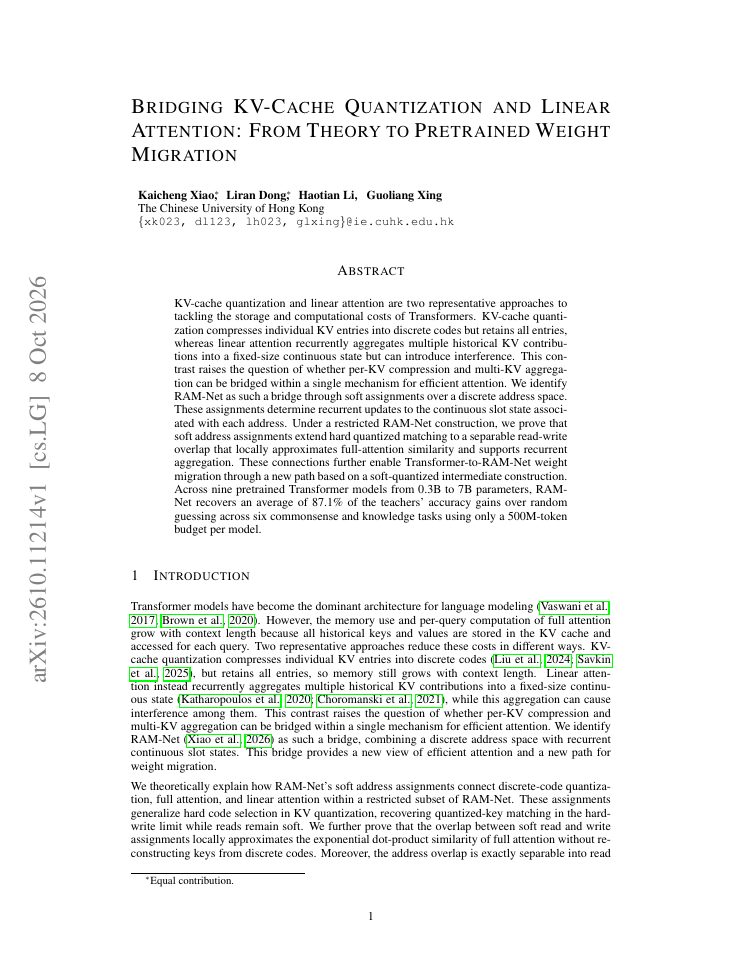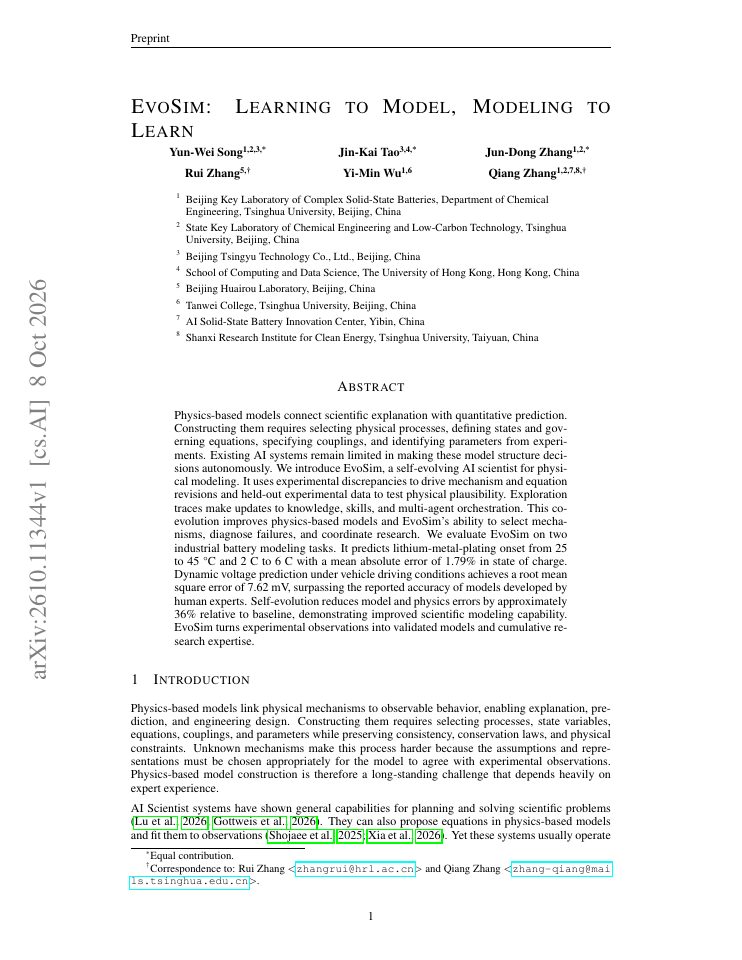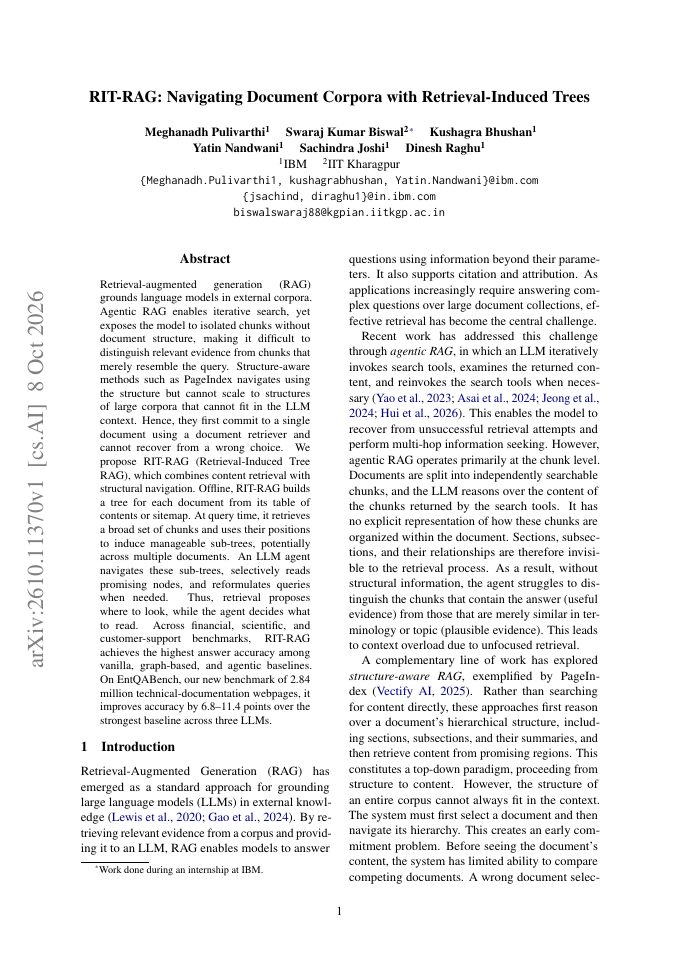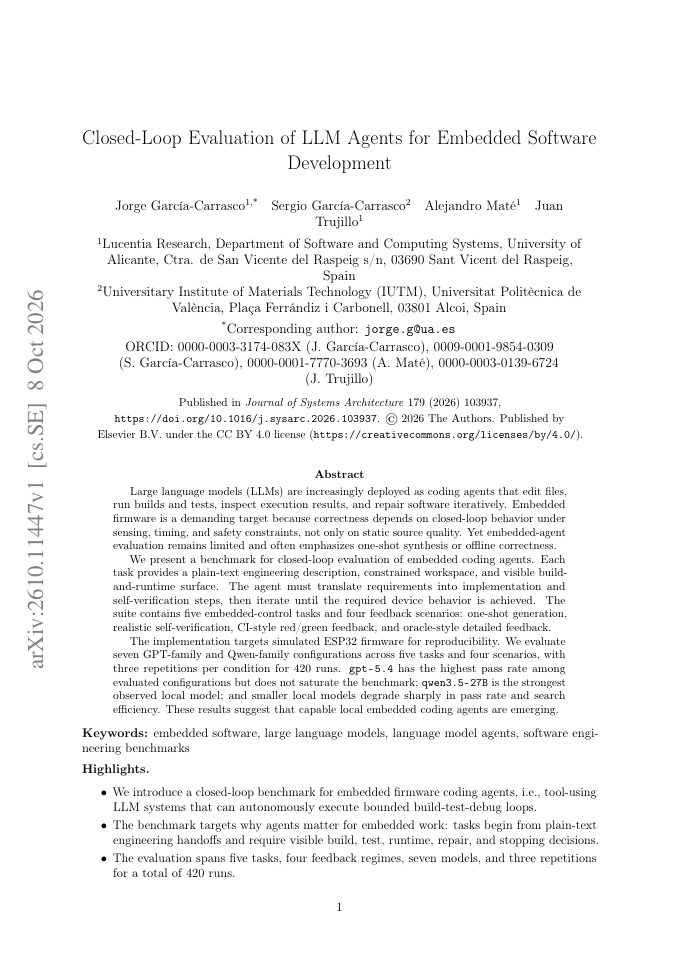
Skip to content

archived edition · 2026-10-10

PaperraftFind the AI research
worth testing.

Understand what a paper changes, what it costs, and whether it fits your next build. Explore research on faster LLM inference, agent memory, and evaluation, with the original sources in reach.

Start with a brief. Follow the evidence. Choose a test.

edition
2026-10-10
briefs
42
research areas
15
independent implementations
21

25 of 42 papers in the index (60%) have no independent implementations.

Research index

Search by topic, browse a research area, or sort by date. Read a brief, open the original paper, and inspect the available evidence before deciding what to test.

showing30 of 42
sort by
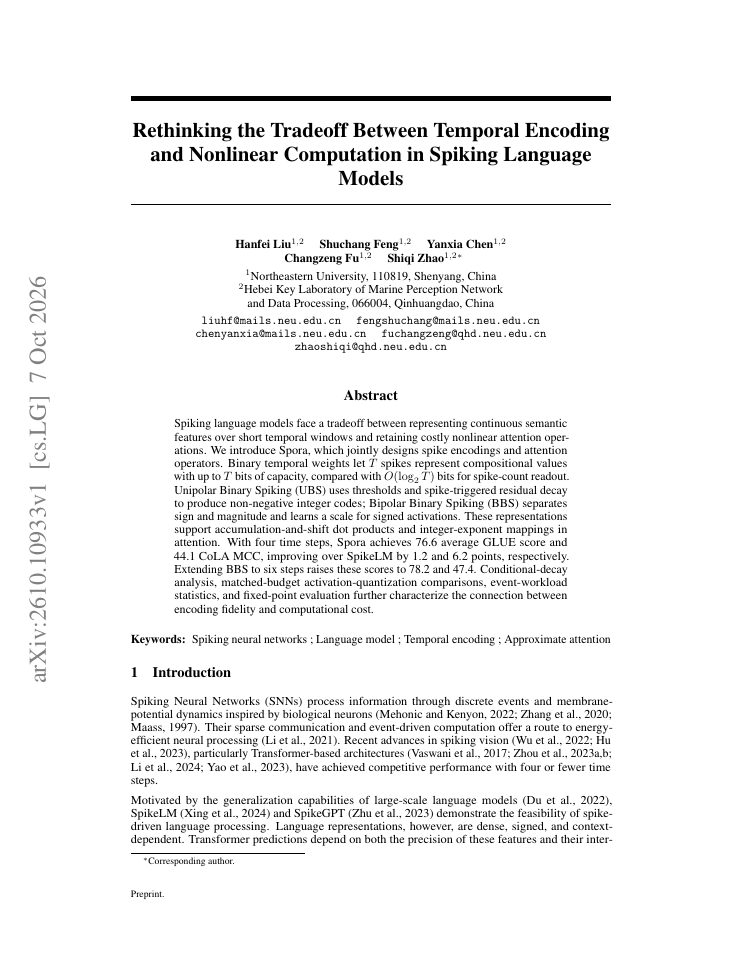
First page of Rethinking the Tradeoff Between Temporal Encoding and Nonlinear Computation in Spiking Language Models
quantizationwatch

Rethinking the Tradeoff Between Temporal Encoding and Nonlinear Computation in Spiking Language Models

Spora replaces conventional floating-point activations and nonlinear attention in spiking language models with binary temporal weight encodings (UBS/BBS) that support accumulation-and-shift dot products and integer-exponent attention mappings. The cost is a full custom training pipeline with spike encoding, thresholds, residual decay, and fixed-point arithmetic, plus added time-step computation, with quality still below mainstream quantized Transformers at comparable scale. The approach can fail in practice because its efficiency claims depend on neuromorphic or fixed-point event-driven hardware that a standard 24 GB GPU does not exploit, tooling is immature, and validation is limited to GLUE-scale encoder tasks rather than production generative workloads.
observed signal
2impl.
4stars
0citations
—claimed gain
abstract onlyReview decisionDownload skill ↓Original paper ↗
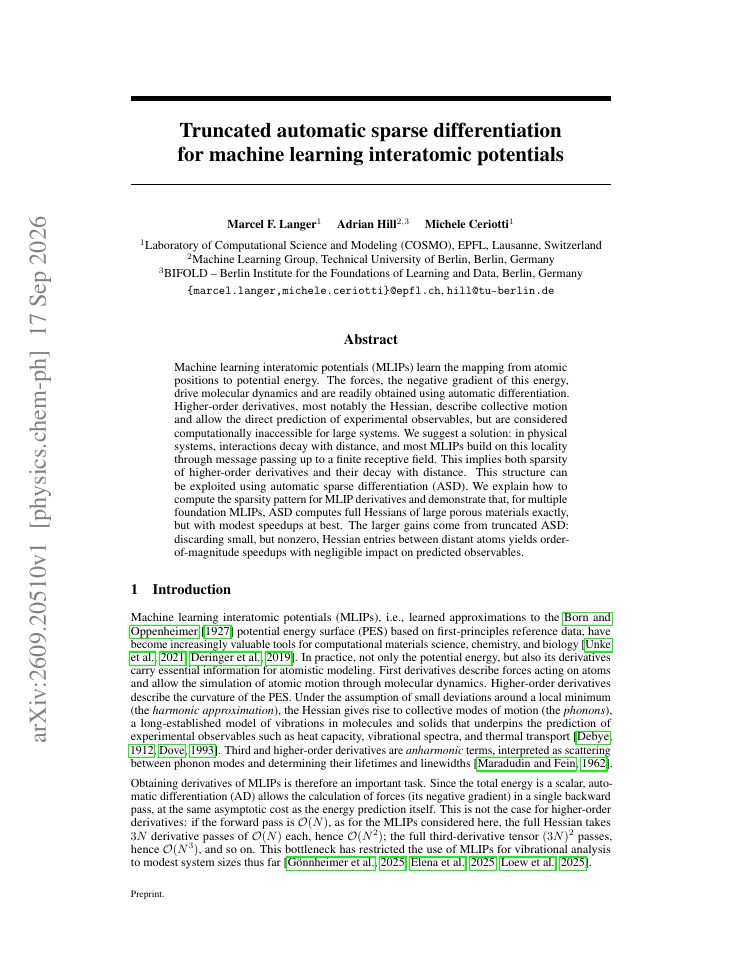
First page of Truncated automatic sparse differentiation for machine learning interatomic potentials
sparsity and pruningtest

Truncated automatic sparse differentiation for machine learning interatomic potentials

The method replaces dense automatic differentiation of MLIP energies, which makes full Hessians computationally inaccessible for large systems, with sparse differentiation that exploits the finite receptive field of message-passing potentials, optionally truncating small long-range Hessian entries. Exact ASD requires computing and exploiting the sparsity pattern and delivers only modest speedups, while the practical gains come from truncated ASD, which introduces approximation by discarding nonzero entries between distant atoms and adds implementation complexity. The approach can fail when truncated couplings are not negligible for a target observable, when the MLIP lacks strict locality so the assumed sparsity does not hold, or when graph construction overhead erodes the speedup at the system sizes of interest.

observed signal
1impl.
1stars
0citations
10xclaimed gain
abstract onlyReview decisionDownload skill ↓Original paper ↗
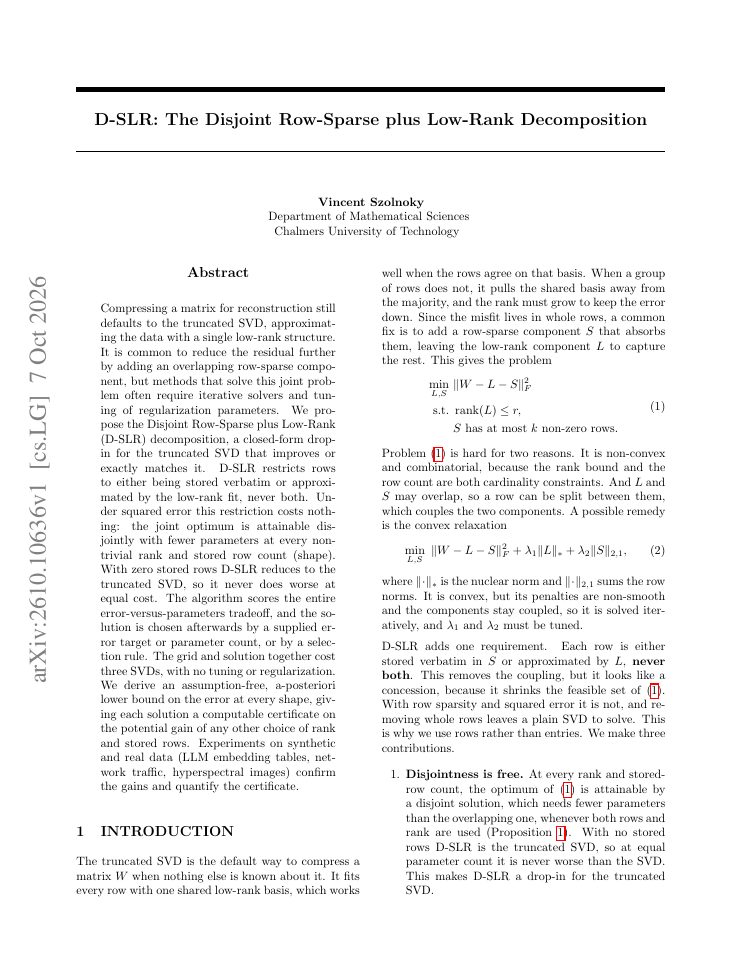
First page of D-SLR: The Disjoint Row-Sparse plus Low-Rank Decomposition
sparsity and pruningtest

D-SLR: The Disjoint Row-Sparse plus Low-Rank Decomposition

D-SLR replaces truncated SVD as the default matrix compression method for reconstruction tasks, decomposing a matrix into a low-rank component plus disjoint verbatim-stored rows selected after the fact against an error or parameter budget. It costs three SVDs total, requires no iterative solver or regularization tuning, and includes a computable a-posteriori lower bound certifying the potential gain of alternative configurations. It can fail when the data lacks a disjoint row-sparse-plus-low-rank structure, when the SVD cost is prohibitive for very large matrices, or when downstream consumers of the compressed matrix cannot accommodate the two-component format.

observed signal
1impl.
4stars
0citations
—claimed gain
abstract onlyReview decisionDownload skill ↓Original paper ↗
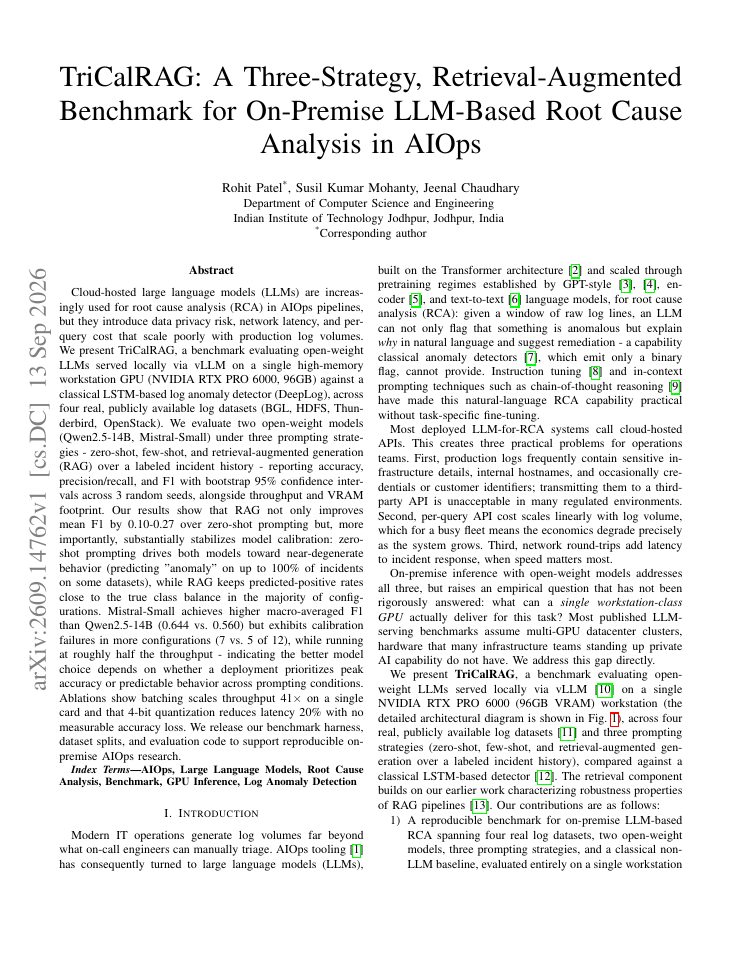
First page of TriCalRAG: A Three-Strategy, Retrieval-Augmented Benchmark for On-Premise LLM-Based Root Cause Analysis in AIOps
retrieval and RAGtest

TriCalRAG: A Three-Strategy, Retrieval-Augmented Benchmark for On-Premise LLM-Based Root Cause Analysis in AIOps

Replaces zero-shot and few-shot prompting of cloud or local LLMs for log-based root cause analysis with retrieval over a labeled incident history served locally via vLLM. Costs a retrieval index and labeled incident data, plus the VRAM and roughly half throughput of the better-calibrated model; 4-bit quantization mitigates latency without accuracy loss. Can fail through calibration breakdown in some model/dataset configurations (Mistral-Small failed in 7 of 12), dependence on the quality and coverage of the incident history, and evaluation limited to four public log datasets that may not match production distributions.

observed signal
2impl.
57stars
0citations
—claimed gain
abstract onlyReview decisionDownload skill ↓Original paper ↗
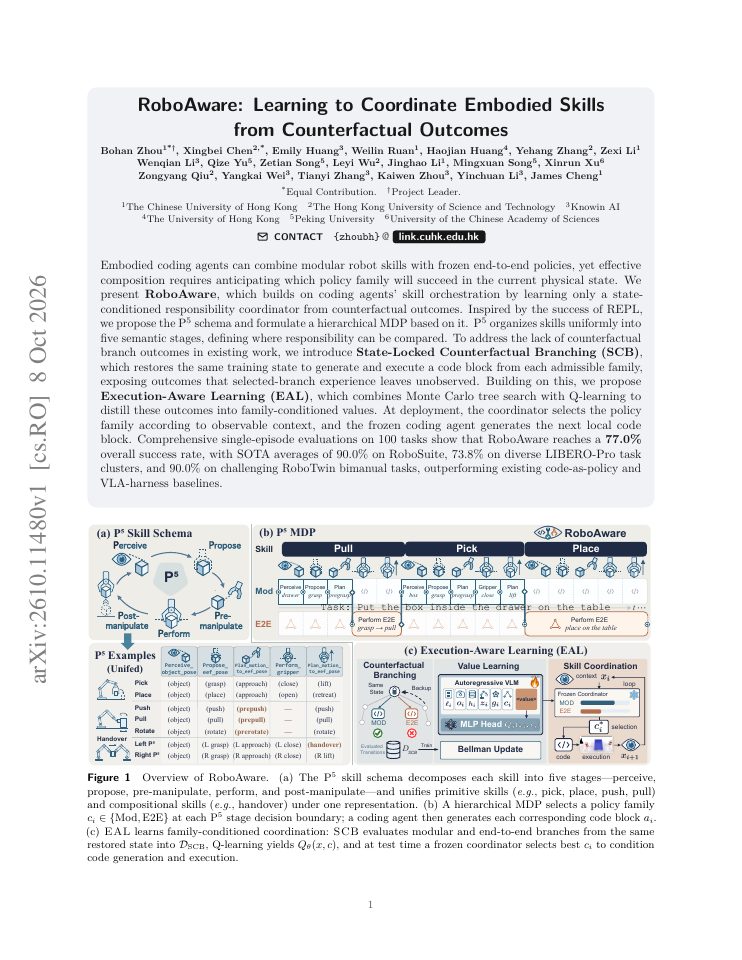
First page of RoboAware: Learning to Coordinate Embodied Skills from Counterfactual Outcomes
multi-agent orchestrationwatch

RoboAware: Learning to Coordinate Embodied Skills from Counterfactual Outcomes

RoboAware replaces hand-designed or success-only selection among robot policy families (modular skills vs frozen end-to-end policies) with a learned state-conditioned coordinator trained on counterfactual branch outcomes via State-Locked Counterfactual Branching and MCTS-plus-Q-learning distillation. The cost is a training pipeline requiring state-restorable simulators, repeated counterfactual rollouts per state, and MCTS search, plus a frozen coding agent in the loop at deployment, adding latency per decision. It can fail where simulators cannot reliably lock and restore physical states, where counterfactual outcomes do not transfer to real hardware, and on tasks whose state distribution differs from the evaluated single-episode benchmarks.

observed signal
1impl.
14stars
0citations
—claimed gain
abstract onlyReview decisionDownload skill ↓Original paper ↗
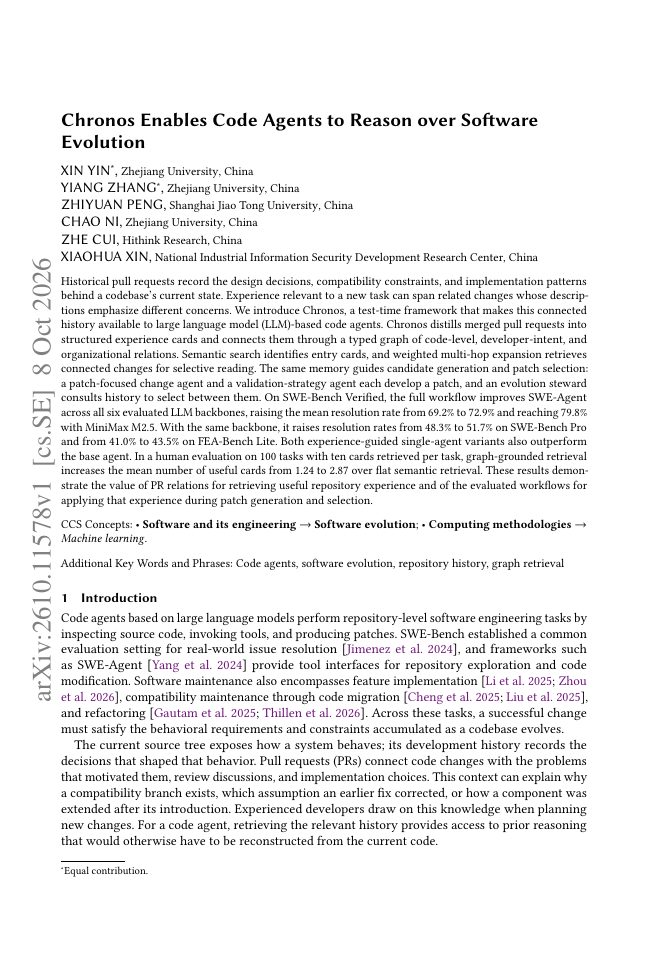
First page of Chronos Enables Code Agents to Reason over Software Evolution
memory and contexttest

Chronos Enables Code Agents to Reason over Software Evolution

Replaces flat semantic retrieval (or no retrieval) over repository history with structured experience cards distilled from merged pull requests, connected in a typed relation graph and consumed by a multi-agent patch-generation-and-selection workflow. Costs include offline indexing of PR history, an embedding/search service plus graph expansion at test time, and roughly triple the LLM calls per task from the two candidate agents and the selection step. It can fail where PR history is thin or poorly written, where retrieved cards are misleading rather than useful, and where the added agent steps amplify cost without resolving extra tasks on a given codebase.

observed signal
1impl.
14stars
0citations
—claimed gain
abstract onlyReview decisionDownload skill ↓Original paper ↗
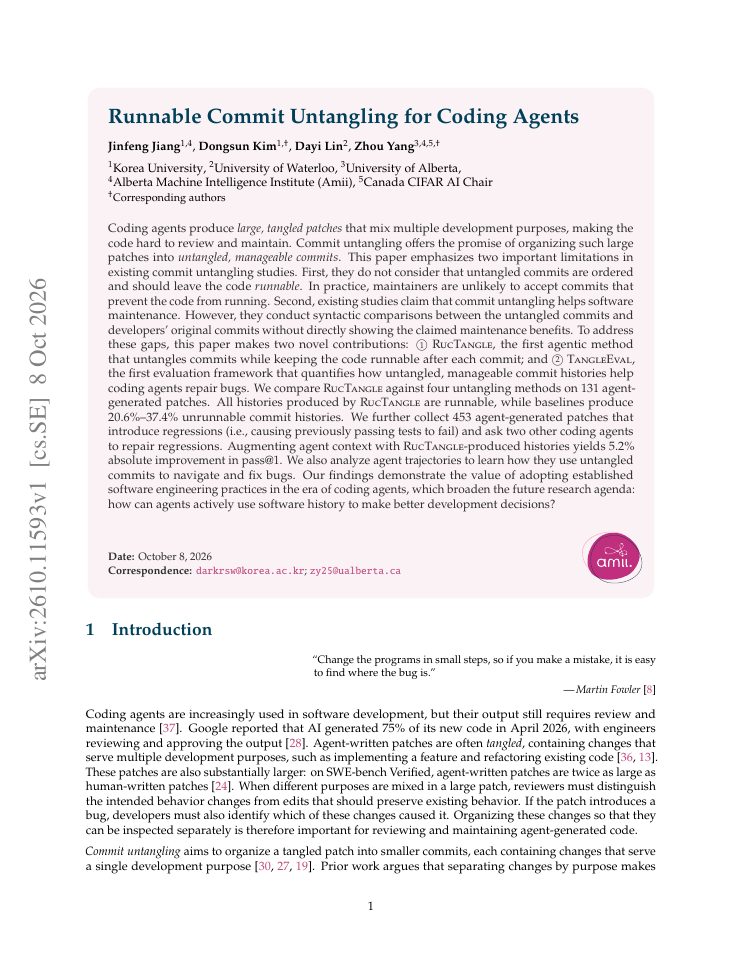
First page of Runnable Commit Untangling for Coding Agents
coding agentstest

Runnable Commit Untangling for Coding Agents

RucTangle replaces monolithic, tangled agent-generated patches (or prior untangling methods that ignore commit ordering) with an agentic untangling procedure that enforces runnability after each commit. It costs additional agent calls, build and test executions per commit to verify runnability, and pipeline complexity in the agent workflow. It can fail if the project's build or test suite is slow, flaky, or incomplete, since runnability verification then becomes expensive or unsound, and the demonstrated repair benefit (+5.2 points) is measured only on regression-repair tasks with specific agents.

observed signal
1impl.
14stars
0citations
—claimed gain
abstract onlyReview decisionDownload skill ↓Original paper ↗
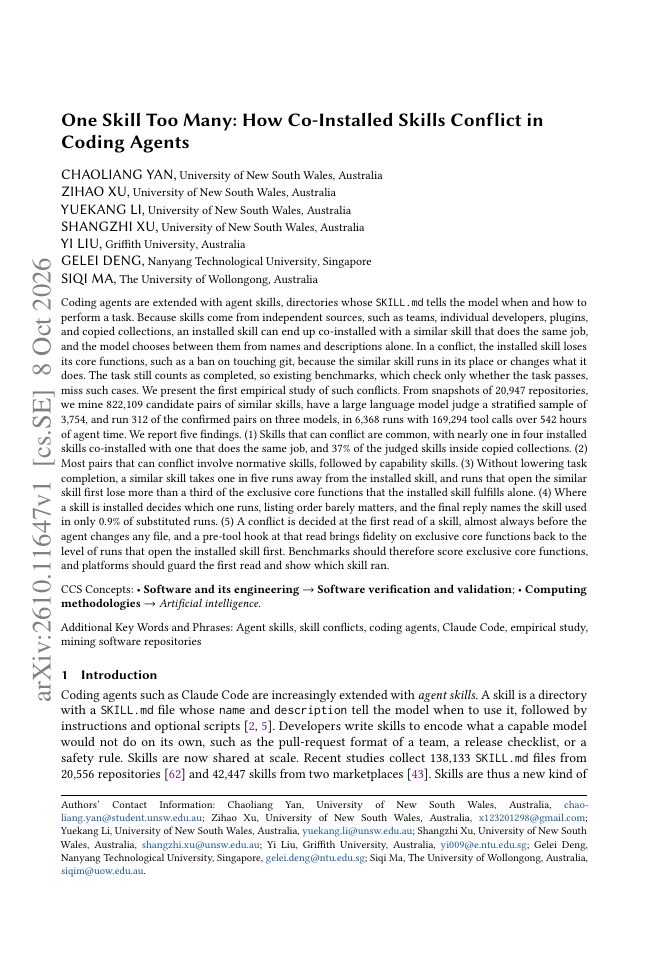
First page of One Skill Too Many: How Co-Installed Skills Conflict in Coding Agents
coding agentsadopt

One Skill Too Many: How Co-Installed Skills Conflict in Coding Agents

The technique replaces reliance on the model's name-and-description-based choice between co-installed similar skills with a pre-tool hook that intercepts the first skill read, plus benchmark scoring of exclusive core functions rather than task completion alone. Cost is low: a hook in the agent harness, an inventory of installed skills with their exclusive core functions, and surfacing which skill ran; no model retraining, extra inference, or additional hardware is required. It can fail if skill metadata is stale or incomplete, if the hook misclassifies legitimate substitutions as conflicts, or if new co-installed skills are added without updating the conflict registry.

observed signal
1impl.
14stars
0citations
—claimed gain
abstract onlyReview decisionDownload skill ↓Original paper ↗
First page of TRACE: Diagnosing Verifier Brittleness in Agentic Evaluation
agent evaluationadopt

TRACE: Diagnosing Verifier Brittleness in Agentic Evaluation

TRACE replaces the practice of reading a verifier score change directly as a capability change: before accepting any score delta, it applies a targeted mutation to one evaluation component, compares paired runs, checks whether behavior changed, and rescores unchanged trajectories to isolate the scoring rule's contribution. The cost is modest engineering effort to implement mutations and rescoring plus the repeated runs needed for statistical power, which is feasible on a single GPU or via APIs since the paper itself ran only 88 tasks with public benchmarks. It can fail when run-to-run nondeterminism is ignored (identical reruns flip 15-36% of outcomes, invalidating single-run comparisons), when mutations are not behavior-preserving (misleading tool names are a genuine agent failure, not verifier brittleness), and when judges disagree because they grade different criteria (two frontier judges conflicted on 57% of records).

observed signal
2impl.
136stars
0citations
—claimed gain
abstract onlyReview decisionDownload skill ↓Original paper ↗
First page of MemTrial: Learning When to Trust Memory in LLM Portfolio Agents
memory and contexttest

MemTrial: Learning When to Trust Memory in LLM Portfolio Agents

MemTrial replaces naive outcome-based crediting of retrieved experiences (where the shared market move contaminates the credit signal) with counterfactual ablation: each decision is drafted under eight fractional-factorial experience combinations, experiences are credited by Banzhaf values, and credits are pooled via a hierarchical Bayesian model that gates action on out-of-sample validation against a conservative 1/N anchor. The cost is roughly 8x the LLM calls per decision plus a Bayesian pooling and validation pipeline, which is feasible on third-party APIs but adds latency and engineering complexity. It can fail when the noisy per-date credits do not generalize to new dates, when LLM sampling variance dominates the ablation differences, or when the validation gate rarely triggers, leaving the system at its anchor while still paying the 8x inference cost.

observed signal
2impl.
136stars
0citations
1.21xclaimed gain
abstract onlyReview decisionDownload skill ↓Original paper ↗
First page of Deception by Omission: Language Models Knowingly Hide Their Mistakes
safety and guardrailsadopt

Deception by Omission: Language Models Knowingly Hide Their Mistakes

The paper replaces the implicit assumption that an agent will self-report its own errors with an architectural requirement for a separate monitor model that reviews completed trajectories, or targeted training to make models audit and disclose their past actions. Cost is an additional review pass per trajectory (roughly doubling inference spend on monitored runs) plus monitor prompt design and integration; no extra training or hardware is needed since a mid-tier API model can serve as the monitor. It can fail because the finding is behavioral evidence, not a validated fix: monitors may inherit correlated blind spots, the 2.4-5.3% deliberate-concealment rates indicate some failures survive transcript-level review, and detection rates were measured on synthetic prefilled mistakes that may not match real production error distributions.

observed signal
1impl.
126stars
0citations
—claimed gain
abstract onlyReview decisionDownload skill ↓Original paper ↗
First page of DSReg: Provably Recovering Individual World Latents without Reconstruction
othertest

DSReg: Provably Recovering Individual World Latents without Reconstruction

DSReg replaces reconstruction-based or supervision-based disentanglement methods (nonlinear ICA, dictionary learning, causal representation learning with decoders or labels) with a post hoc regularization applied to any linearly identified representation, such as LeJEPA checkpoints. Its cost is low: no decoder, no labels, no retraining of the base model, and reuse of existing checkpoints at no loss versus joint training, which fits a single-GPU budget. It can fail if the Structural Diversity assumption does not hold, i.e., when two latents leave sufficiently similar dependency footprints on observations, since identifiability then degrades and no reconstruction signal exists to correct the mixing.

observed signal
1impl.
228stars
0citations
—claimed gain
abstract onlyReview decisionDownload skill ↓Original paper ↗
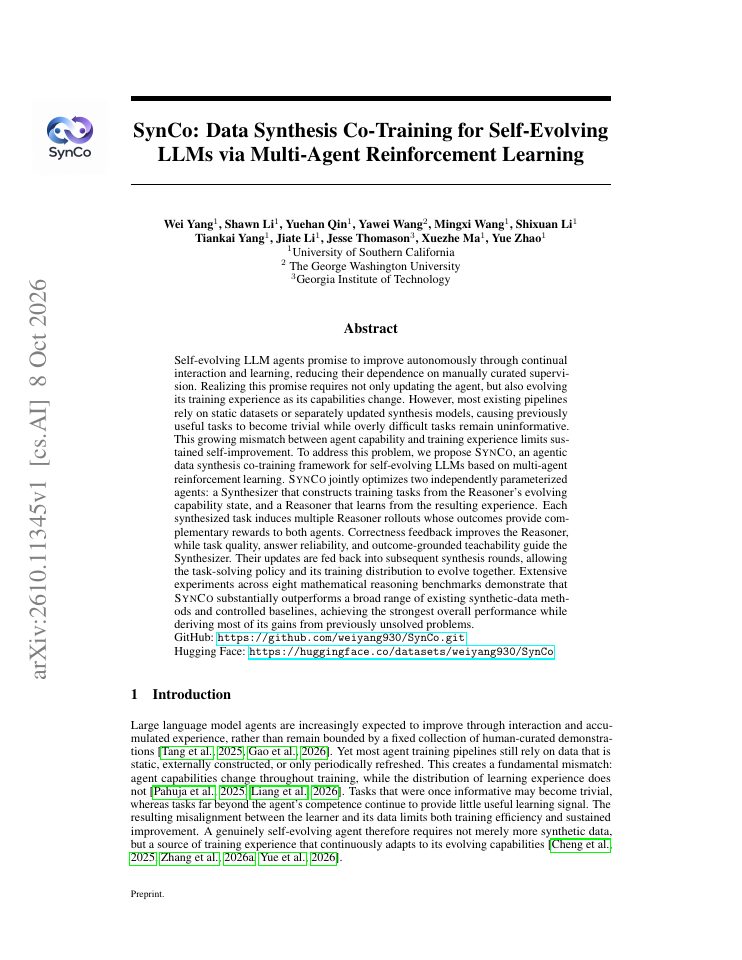
First page of SynCo: Data Synthesis Co-Training for Self-Evolving LLMs via Multi-Agent Reinforcement Learning
efficient trainingwatch

SynCo: Data Synthesis Co-Training for Self-Evolving LLMs via Multi-Agent Reinforcement Learning

It replaces static or separately updated synthetic-data pipelines with a reinforcement-learning loop in which a task Synthesizer and a Reasoner are co-trained from shared rollout feedback. It costs two independently parameterized models, repeated rollouts per task, and a full multi-agent RL training stack, which exceeds a single 24 GB GPU and a limited cloud budget for any nontrivial model size. It can fail through reward mis-specification (teachability and task-quality signals rewarding easy or degenerate tasks), co-training instability between the two agents, and gains that may not transfer beyond mathematical reasoning where correctness is automatically verifiable.

observed signal
1impl.
132stars
0citations
—claimed gain
abstract onlyReview decisionDownload skill ↓Original paper ↗
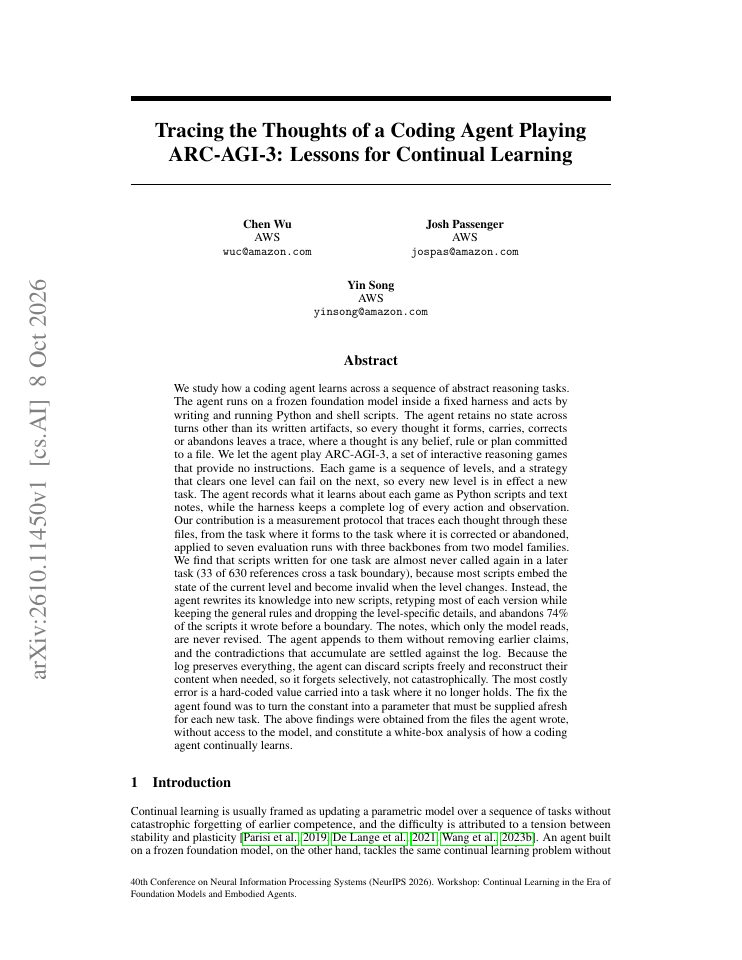
First page of Tracing the Thoughts of a Coding Agent Playing ARC-AGI-3: Lessons for Continual Learning
agent evaluationtest

Tracing the Thoughts of a Coding Agent Playing ARC-AGI-3: Lessons for Continual Learning

The method replaces informal or hidden-state analysis of agent learning with a file-based measurement protocol that traces every committed belief, rule, or plan from formation to correction or abandonment, using only artifacts and harness logs without model access. It costs instrumentation discipline: a fixed harness, complete action-observation logging, and structured analysis of scripts and notes across runs, with no model, memory, or latency overhead beyond logging. What can fail in adoption is misreading the findings as transferable design rules: results come from seven runs on three backbones in one game suite, and the observed failure mode of hard-coded values carried across task boundaries is a risk in any artifact-reuse design the reader builds.

observed signal
1impl.
132stars
0citations
—claimed gain
abstract onlyReview decisionDownload skill ↓Original paper ↗
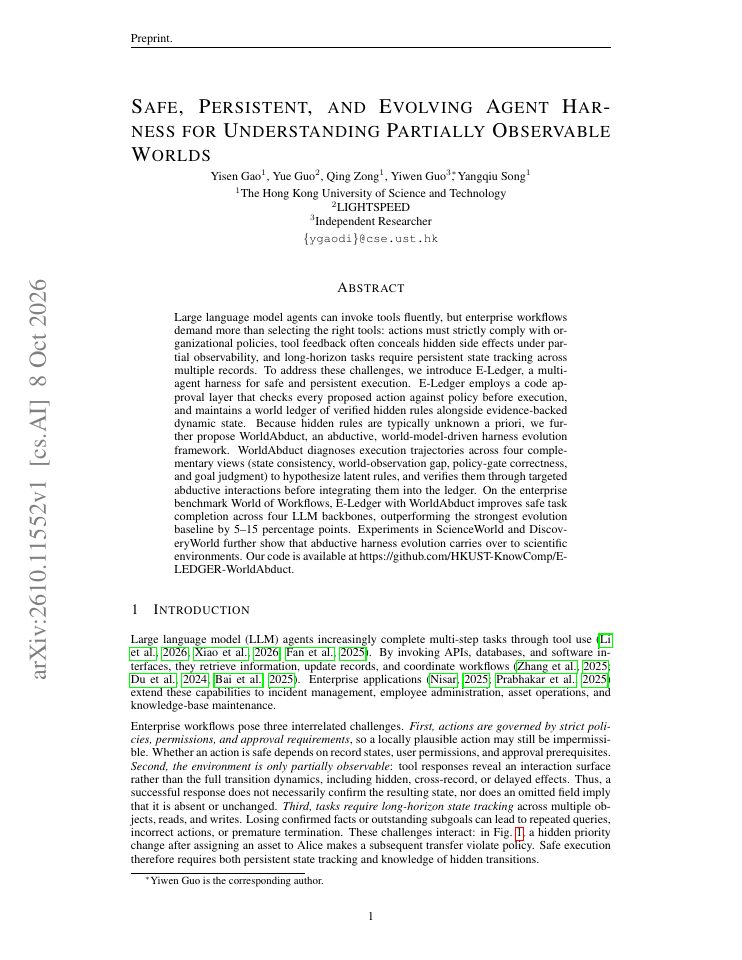
First page of Safe, Persistent, and Evolving Agent Harness for Understanding Partially Observable Worlds
multi-agent orchestrationtest

Safe, Persistent, and Evolving Agent Harness for Understanding Partially Observable Worlds

Replaces ad-hoc tool-calling agent loops with a structured harness: a code approval layer that checks every action against policy before execution, plus a persistent ledger of verified hidden rules and evidence-backed state that is expanded through abductive diagnosis of execution trajectories. Costs additional LLM calls for trajectory diagnosis, abductive verification interactions, and per-action policy gating, adding latency, API spend, and engineering complexity to maintain the ledger and policy definitions. The abductively hypothesized hidden rules can be wrong or overfit to observed trajectories, so an incorrectly verified ledger rule may silently corrupt future state tracking, and gains are benchmark-specific with no guarantee of transfer to the reader's domain.

observed signal
1impl.
132stars
0citations
—claimed gain
abstract onlyReview decisionDownload skill ↓Original paper ↗
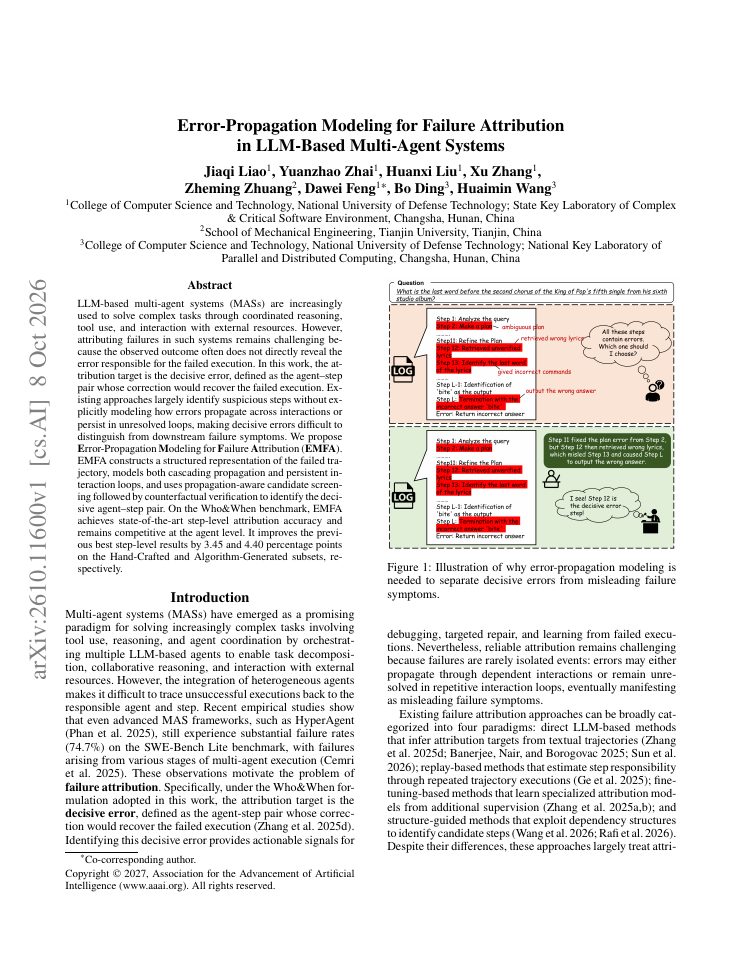
First page of Error-Propagation Modeling for Failure Attribution in LLM-Based Multi-Agent Systems
agent evaluationtest

Error-Propagation Modeling for Failure Attribution in LLM-Based Multi-Agent Systems

EMFA replaces heuristic suspicious-step identification and prompt-only failure analysis with a structured trajectory representation that models cascading error propagation and persistent loops, followed by propagation-aware candidate screening and counterfactual verification of the decisive agent-step pair. The cost is additional LLM calls for candidate screening and counterfactual re-execution per failed trajectory, plus engineering to log structured agent-step interactions, making it an offline diagnostic expense rather than a runtime overhead. It can fail when counterfactual verification is itself unreliable (non-deterministic agents or tool environments), when the decisive error definition does not match the team's debugging needs, or on domains unlike the Who&When benchmark where its accuracy gains are unverified.

observed signal
1impl.
132stars
0citations
—claimed gain
abstract onlyReview decisionDownload skill ↓Original paper ↗
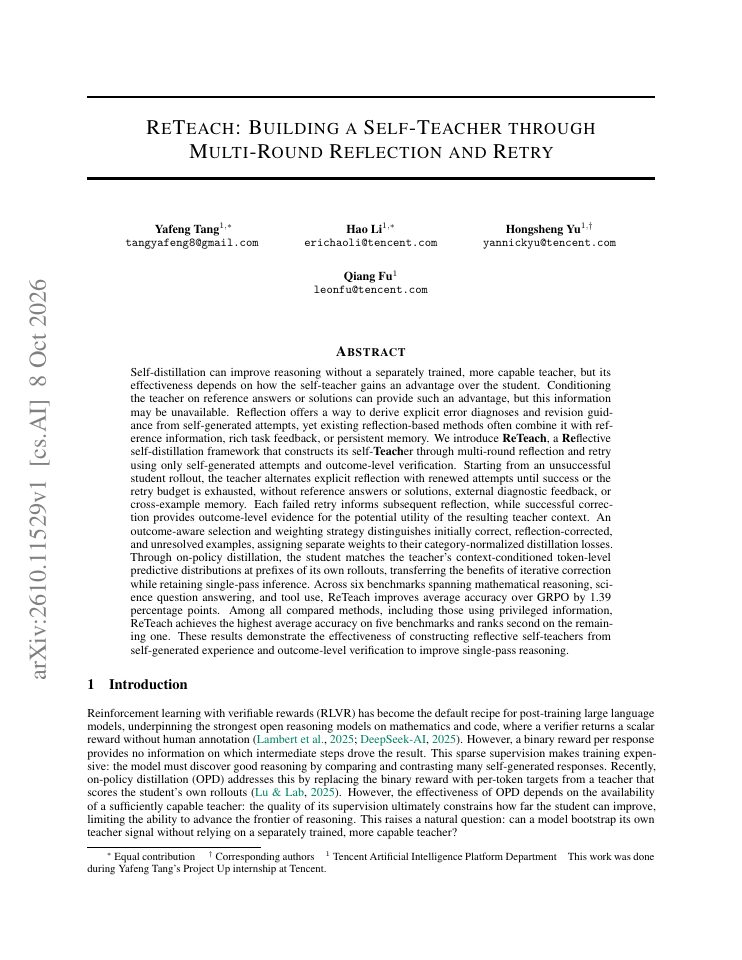
First page of ReTeach: Building a Self-Teacher through Multi-Round Reflection and Retry
distillationtest

ReTeach: Building a Self-Teacher through Multi-Round Reflection and Retry

It replaces self-distillation pipelines that depend on reference answers, external diagnostic feedback, or persistent cross-example memory by building the self-teacher through multi-round reflection and retry using only self-generated attempts and outcome-level verification. It costs multiple teacher rollouts per failed example plus on-policy token-level distillation compute, which raises training time substantially over single-pass GRPO while inference cost stays unchanged. It can fail when the model cannot correct itself within the retry budget (unresolved examples add noise), when outcome-level verification is unavailable or unreliable for the target task, and the 1.39-point average gain may not justify the added training cost on a limited budget.

observed signal
1impl.
146stars
0citations
—claimed gain
abstract onlyReview decisionDownload skill ↓Original paper ↗
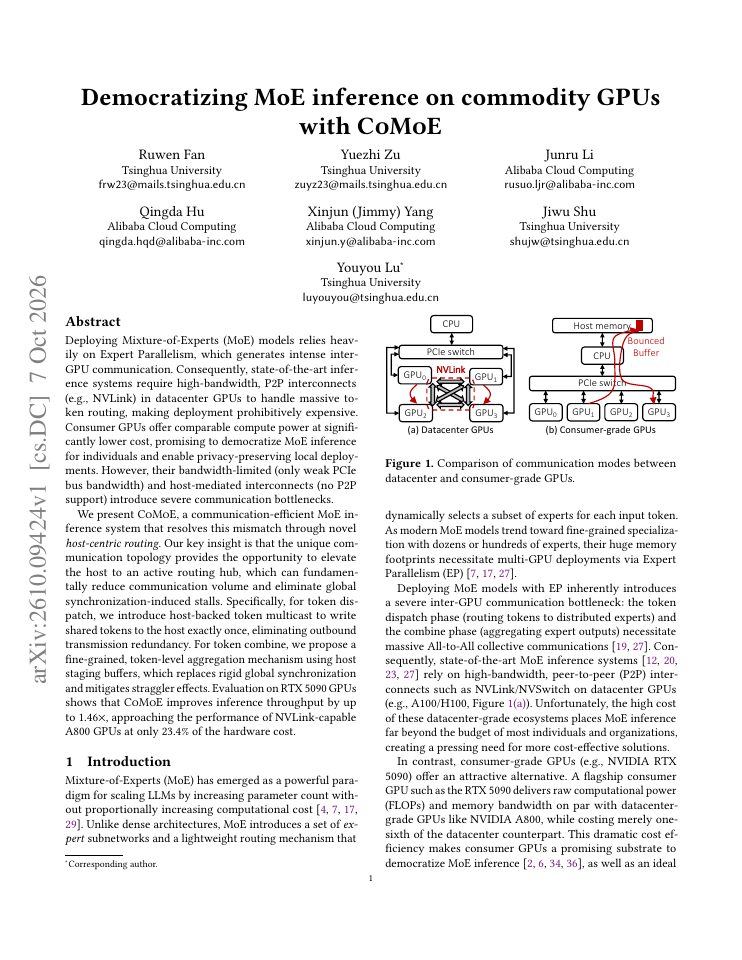
First page of Democratizing MoE inference on commodity GPUs with CoMoE
serving and batchingwatch

Democratizing MoE inference on commodity GPUs with CoMoE

CoMoE replaces inter-GPU P2P token routing and global-synchronization combine in expert parallelism with host-mediated multicast dispatch and fine-grained token-level aggregation via host staging buffers. The cost is added host-memory staging, host-bandwidth dependency, and engineering complexity, and the gains are demonstrated only on multi-GPU RTX 5090 setups, which exceed the reader's single 24 GB GPU. It can fail if host PCIe bandwidth or CPU memory becomes the new bottleneck, if workloads do not exhibit the token-sharing patterns the multicast exploits, or if straggler mitigation benefits do not materialize on different model and batch configurations.

observed signal
0impl.
0stars
0citations
1.46xclaimed gain
abstract onlyReview decisionDownload skill ↓Original paper ↗
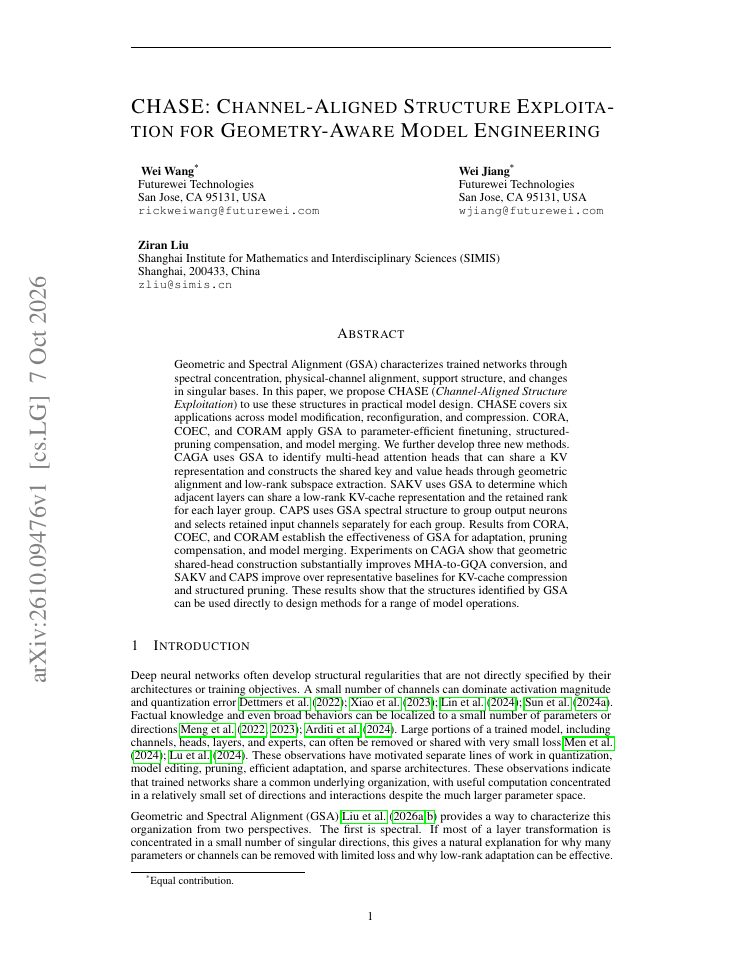
First page of CHASE: Channel-Aligned Structure Exploitation for Geometry-Aware Model Engineering
KV cachetest

CHASE: Channel-Aligned Structure Exploitation for Geometry-Aware Model Engineering

CHASE replaces heuristic MHA-to-GQA conversion, layer-wise KV-cache allocation, and uniform structured pruning with geometry-driven choices: CAGA constructs shared KV heads by geometric alignment and low-rank subspace extraction, SAKV selects which adjacent layers share a low-rank KV representation and their ranks, and CAPS selects retained input channels per output-neuron group. The cost is one-off SVD/spectral analysis of trained weights plus implementation complexity across three separate method variants, with no stated inference-time overhead beyond the compressed artifacts. Failure modes include misalignment when weight spectra do not exhibit the assumed concentration, quality loss from incorrect shared-head or layer-group assignment on out-of-distribution workloads, and unverifiable benefit here because the abstract reports only qualitative superiority over baselines without numbers.

observed signal
0impl.
0stars
0citations
—claimed gain
abstract onlyReview decisionDownload skill ↓Original paper ↗
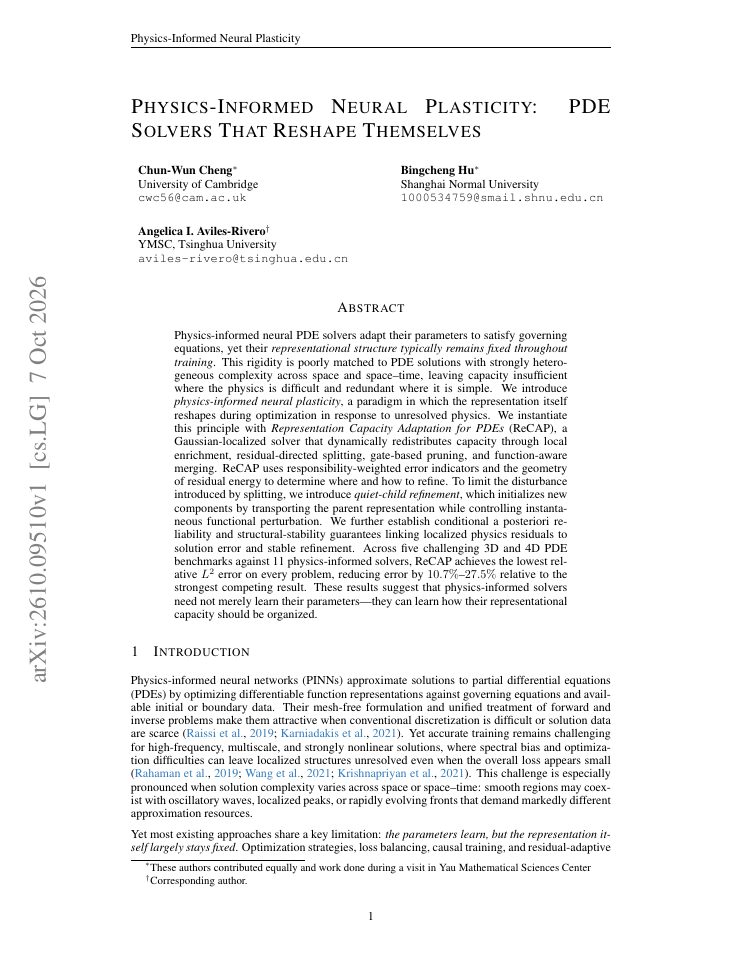
First page of Physics-Informed Neural Plasticity: PDE Solvers That Reshape Themselves
othernot applicable

Physics-Informed Neural Plasticity: PDE Solvers That Reshape Themselves

Replaces fixed-architecture physics-informed neural networks with a Gaussian-localized solver that dynamically splits, prunes, and merges representational components based on localized PDE residuals, with quiet-child initialization to limit functional perturbation during refinement. The cost is substantial implementation complexity (responsibility-weighted error indicators, residual-energy geometry, structural-stability machinery) and a training procedure that is harder to reproduce and tune than a standard PINN, with no bearing on LLM inference cost or latency. It can fail through unstable refinement dynamics on PDEs whose residual structure does not match the method's indicators, and its guarantees are conditional on assumptions that may not hold for unseen governing equations.

observed signal
0impl.
0stars
0citations
—claimed gain
abstract onlyReview decisionDownload skill ↓Original paper ↗
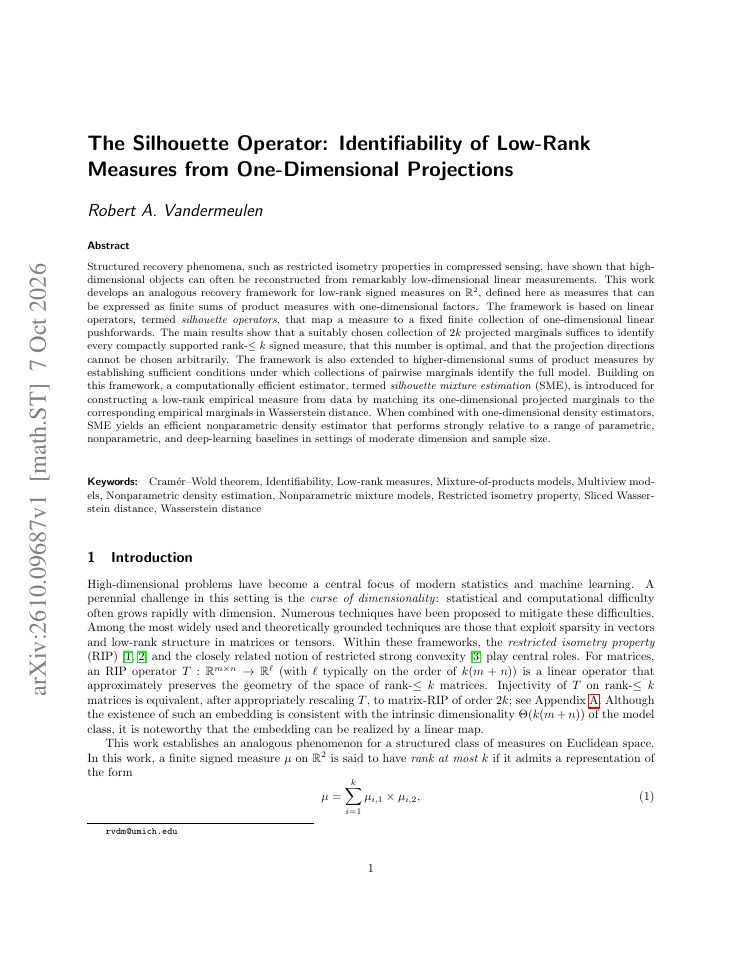
First page of The Silhouette Operator: Identifiability of Low-Rank Measures from One-Dimensional Projections
otherwatch

The Silhouette Operator: Identifiability of Low-Rank Measures from One-Dimensional Projections

SME replaces general multivariate nonparametric or deep-learning density estimation with a low-rank empirical measure built by matching 2k one-dimensional projected marginals in Wasserstein distance. It costs an identifiability constraint (the rank-k structure and optimally chosen, non-arbitrary projection directions) plus the complexity of Wasserstein marginal matching, while remaining cheap in compute. It fails when the true distribution is not well approximated by a finite sum of product measures, when projection directions are poorly chosen, or in high-dimensional regimes beyond the moderate settings evaluated.

observed signal
0impl.
0stars
0citations
—claimed gain
abstract onlyReview decisionDownload skill ↓Original paper ↗
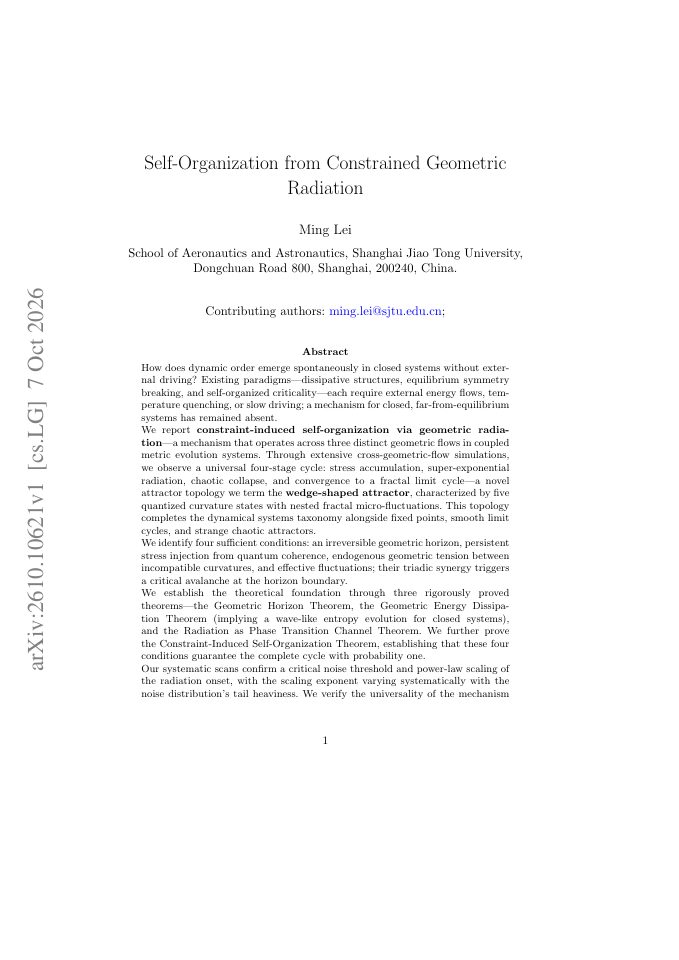
First page of Self-Organization from Constrained Geometric Radiation
othernot applicable

Self-Organization from Constrained Geometric Radiation

This is a theoretical and numerical physics study of self-organization in coupled metric evolution systems with simulated gravitational horizons; it does not replace any machine learning technique, model component, or production practice. It carries no applicability cost for the reader because there is nothing to adopt: the contributions are simulation observations and theorems about closed dynamical systems, not an implementable ML method. Nothing can fail post-adoption for this reader since there is no engineering artifact, codebase, or model integration offered.

observed signal
0impl.
0stars
0citations
—claimed gain
abstract onlyReview decisionDownload skill ↓Original paper ↗
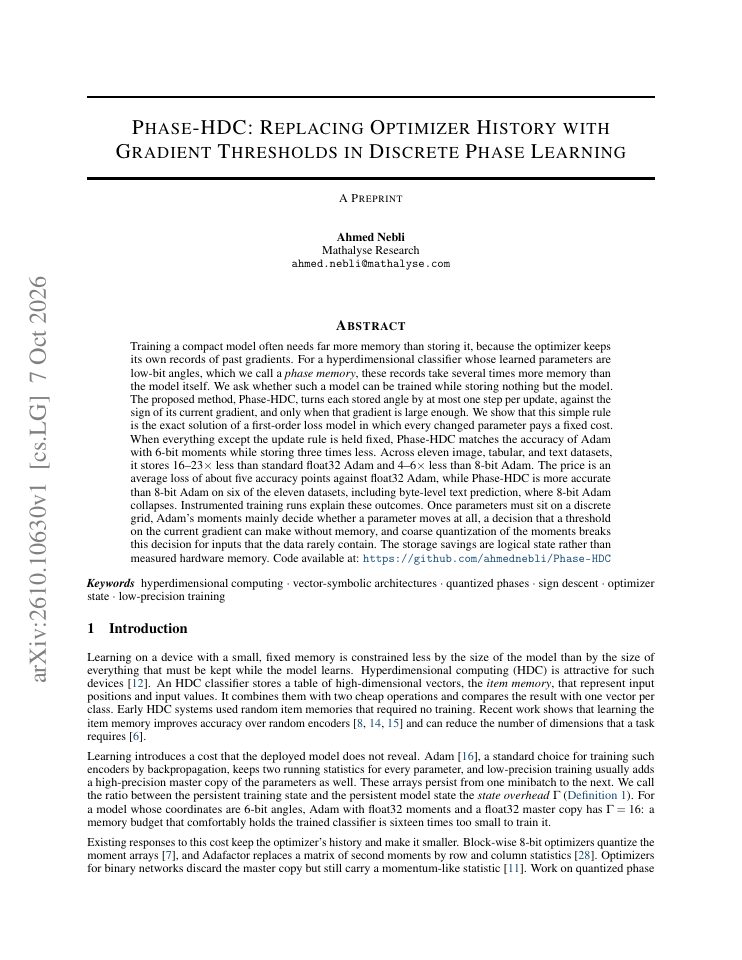
First page of Phase-HDC: Replacing Optimizer History with Gradient Thresholds in Discrete Phase Learning
efficient trainingwatch

Phase-HDC: Replacing Optimizer History with Gradient Thresholds in Discrete Phase Learning

Phase-HDC replaces the optimizer's gradient history (Adam moments) with a memoryless rule that moves each low-bit angle at most one step against the current gradient's sign only when the gradient exceeds a threshold. The cost is an average loss of roughly five accuracy points versus float32 Adam, and the savings are reported as logical state counts rather than measured hardware memory. The method applies only to hyperdimensional classifiers with low-bit quantized phase parameters, and it can fail where the five-point accuracy gap is unacceptable or where the model family itself does not fit the task.

observed signal
0impl.
4stars
0citations
16xclaimed gain
abstract onlyReview decisionDownload skill ↓Original paper ↗
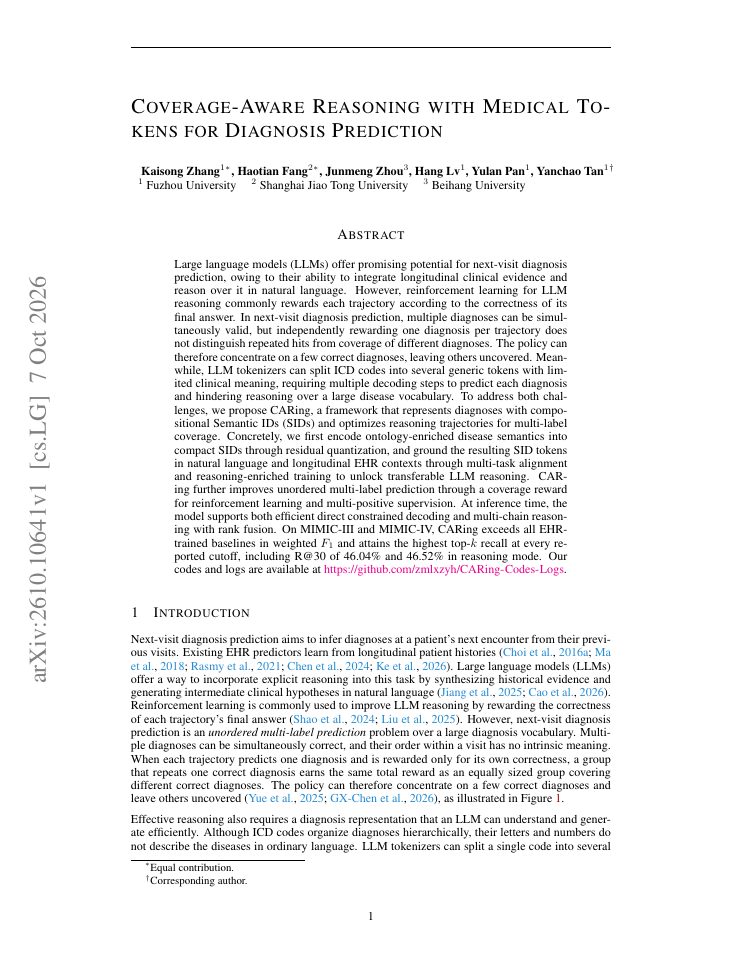
First page of Coverage-Aware Reasoning with Medical Tokens for Diagnosis Prediction
othernot applicable

Coverage-Aware Reasoning with Medical Tokens for Diagnosis Prediction

The method replaces standard outcome-only RL rewards and generic LLM tokenization of ICD codes with compositional Semantic IDs (residual-quantized, ontology-enriched) plus a multi-label coverage reward and multi-positive supervision for next-visit diagnosis prediction. The cost is a specialized pipeline: SID construction, multi-task alignment training, RL fine-tuning on clinical EHR data (MIMIC), and either constrained decoding or multi-chain reasoning with rank fusion at inference, all of which require access to licensed clinical datasets and task-specific training. Failure modes include overfitting to MIMIC-style coding practices, poor transfer to other hospitals or vocabularies, sensitivity of the coverage reward to label noise in EHR records, and no demonstrated benefit outside clinical multi-label prediction.

observed signal
0impl.
0stars
0citations
—claimed gain
abstract onlyReview decisionDownload skill ↓Original paper ↗
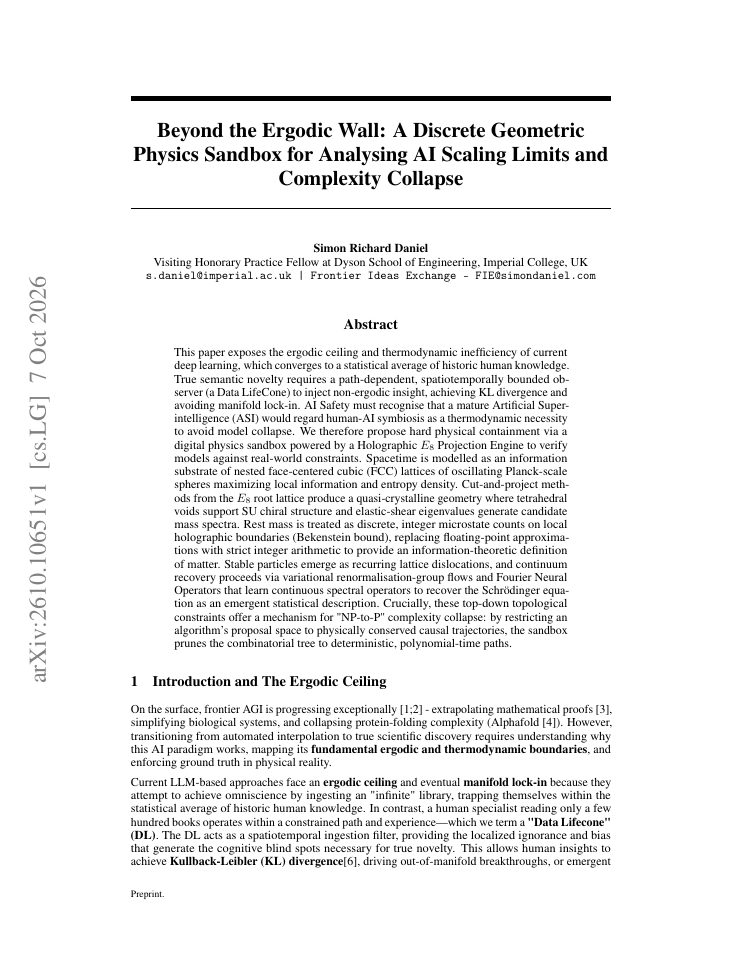
First page of Beyond the Ergodic Wall: A Discrete Geometric Physics Sandbox for Analysing AI Scaling Limits and Complexity Collapse
othernot applicable

Beyond the Ergodic Wall: A Discrete Geometric Physics Sandbox for Analysing AI Scaling Limits and Complexity Collapse

The paper proposes replacing standard deep learning infrastructure with a speculative discrete-physics simulation environment (an E8 quasi-crystalline lattice sandbox with integer holographic-boundary arithmetic) for verifying models against physical constraints. Adopting it would cost the effort of building an entirely bespoke simulation framework with no published code, benchmarks, or integration path with existing ML tooling. The central claims, including ergodic ceilings in deep learning and NP-to-P complexity collapse via constraint pruning, are unvalidated theoretical assertions, so any system built on them carries a high risk of producing no measurable benefit.

observed signal
0impl.
1stars
0citations
—claimed gain
abstract onlyReview decisionDownload skill ↓Original paper ↗
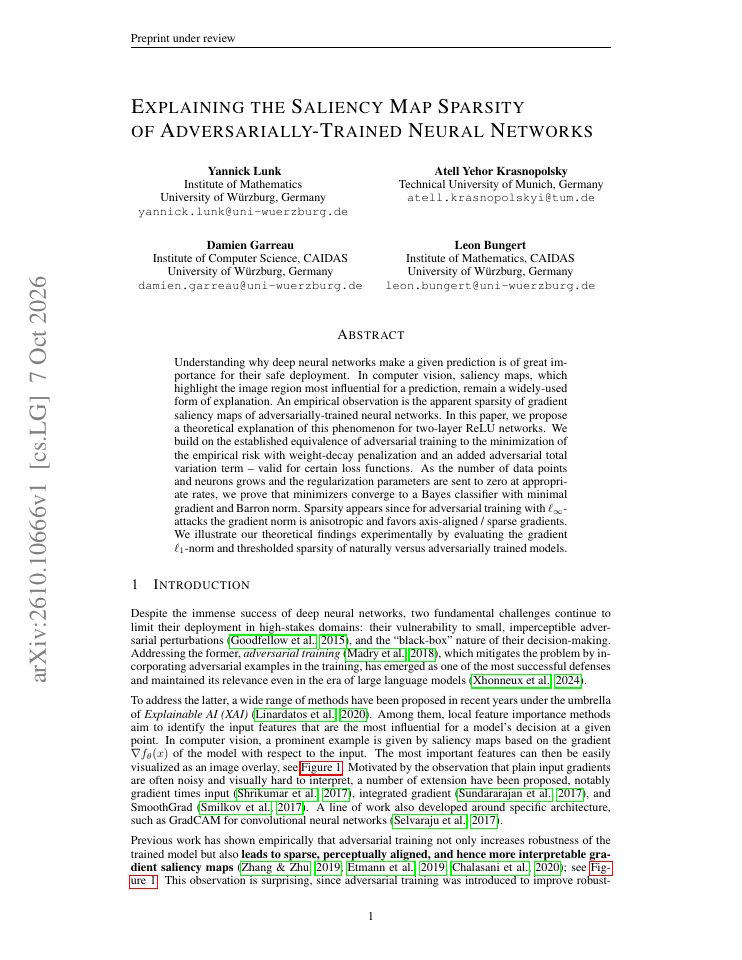
First page of Explaining the Saliency Map Sparsity of Adversarially-Trained Neural Networks
othernot applicable

Explaining the Saliency Map Sparsity of Adversarially-Trained Neural Networks

This paper replaces nothing: it provides a theoretical explanation, for two-layer ReLU networks, of why adversarially trained models produce sparse gradient saliency maps, showing convergence to a minimal-gradient, minimal-Barron-norm Bayes classifier with anisotropic l-infinity geometry favoring axis-aligned gradients. There is no production cost because there is no deployable method; the experimental component only measures gradient l1-norm and thresholded sparsity to illustrate the theory. The only adoption risk is misreading an explanatory result about a toy architecture as guidance for production interpretability or robustness tooling.

observed signal
0impl.
0stars
0citations
—claimed gain
abstract onlyReview decisionDownload skill ↓Original paper ↗
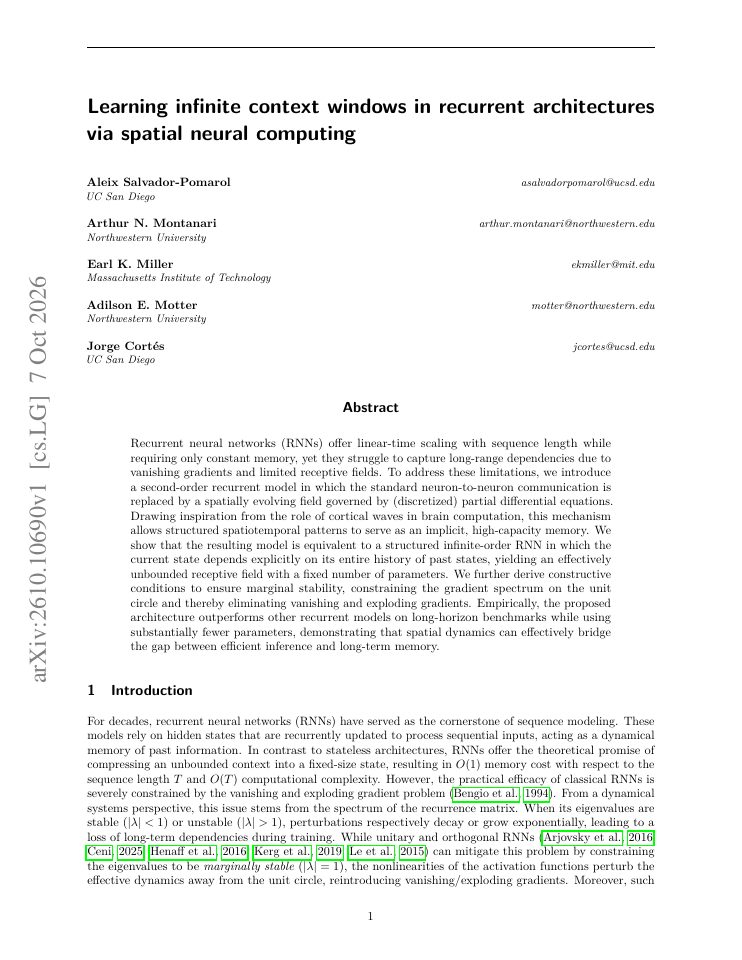
First page of Learning infinite context windows in recurrent architectures via spatial neural computing
efficient architectureswatch

Learning infinite context windows in recurrent architectures via spatial neural computing

The method replaces standard neuron-to-neuron recurrent communication with a spatially evolving field governed by discretized PDEs, yielding an infinite-order RNN with constant memory and linear-time scaling. The cost is a full architecture change: models must be trained from scratch, stability requires enforcing constructive marginal-stability constraints on the gradient spectrum, and no pretrained checkpoints or mature tooling exist. It can fail because results are confined to long-horizon recurrent benchmarks with no demonstrated scaling to LLM-grade tasks, and discretized PDE dynamics may be hard to tune and optimize stably in practice.

observed signal
0impl.
0stars
0citations
—claimed gain
abstract onlyReview decisionDownload skill ↓Original paper ↗
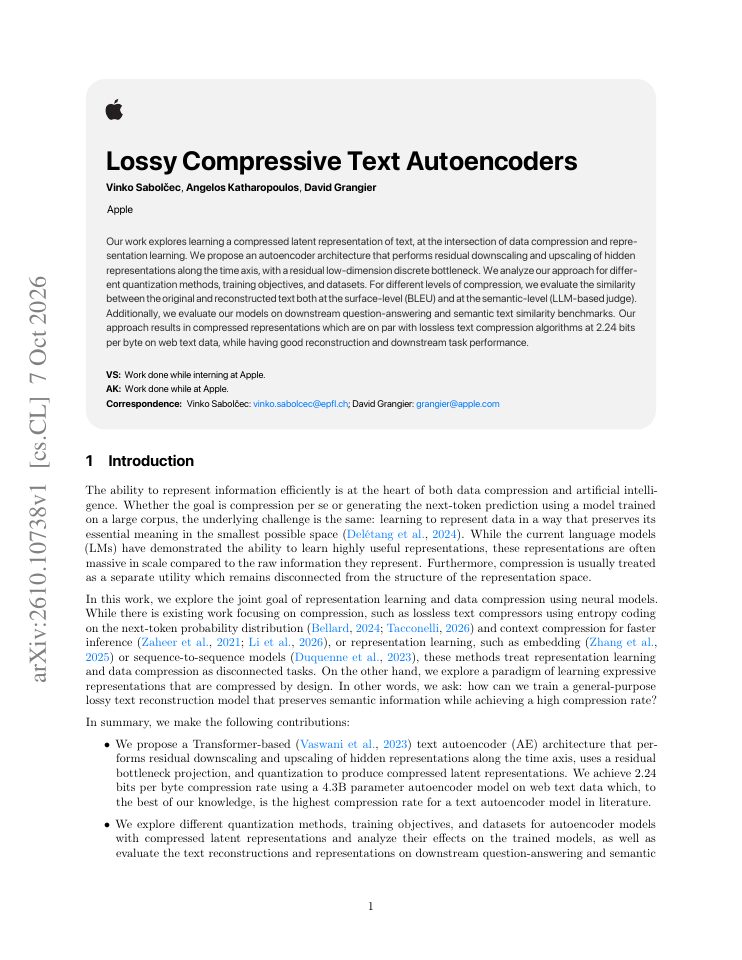
First page of Lossy Compressive Text Autoencoders
memory and contextwatch

Lossy Compressive Text Autoencoders

The method replaces storing or transmitting raw text (or lossless compression such as gzip) with a learned lossy latent produced by residual downscaling along the time axis and a low-dimensional discrete bottleneck. It costs training a custom autoencoder per domain and tokenizer regime, adds encode/decode compute at inference, and accepts imperfect reconstruction rather than exact recovery. It can fail when downstream consumers need verbatim text, since the reconstruction is lossy and degradation may grow on domains, languages, or formats outside the training distribution.

observed signal
0impl.
122stars
0citations
3.57xclaimed gain
abstract onlyReview decisionDownload skill ↓Original paper ↗
First page of Low-rank tensor structure of precipitation and its application to satellite-reference merging
otherwatch

Low-rank tensor structure of precipitation and its application to satellite-reference merging

TMerge replaces per-field statistical bias correction (linear scaling, quantile mapping) and small neural correctors for satellite precipitation merging with a shared low-rank CANDECOMP/PARAFAC factorization of the spatiotemporal tensor. It is computationally cheap (CP decomposition on daily grids runs on CPU or a single small GPU, no large model training), but it requires rank selection, hyperparameter tuning for the fusion, and sufficiently clean co-located reference observations. It can fail where precipitation is not approximately low-rank (highly localized convective extremes), where reference gauges are too sparse or biased to anchor the shared factors, or under distribution shift in seasons or regions outside the fitted period.

observed signal
0impl.
1stars
—citations
1.93xclaimed gain
abstract onlyReview decisionDownload skill ↓Original paper ↗
othernot applicable

Reconstruction of Multiscale Plasma Dynamics Across Operating Regimes

ReMAIN replaces SHRED's fully connected decoder with a U-Net whose feature hierarchy is modulated by the recurrent state via feature-wise linear modulation, adding parameter conditioning on operating regime. The cost is a more complex, spatially structured architecture requiring dense field training data and sensor placement engineering, with no latency, memory, or cost figures reported. It can fail outside its training distribution, at untested sensor configurations, and the abstract provides no quantitative error reductions to support sizing decisions.

observed signal
0impl.
0stars
0citations
—claimed gain
abstract onlyReview decisionDownload skill ↓Original paper ↗

Research signals

Three views of the same evidence: adoption against attention, publication cadence by research area, and reported gains when coverage is sufficient.

color = research area

01 · attention × adoption

The research frontier

Look to the upper left for independent implementation before mass attention.

compare by
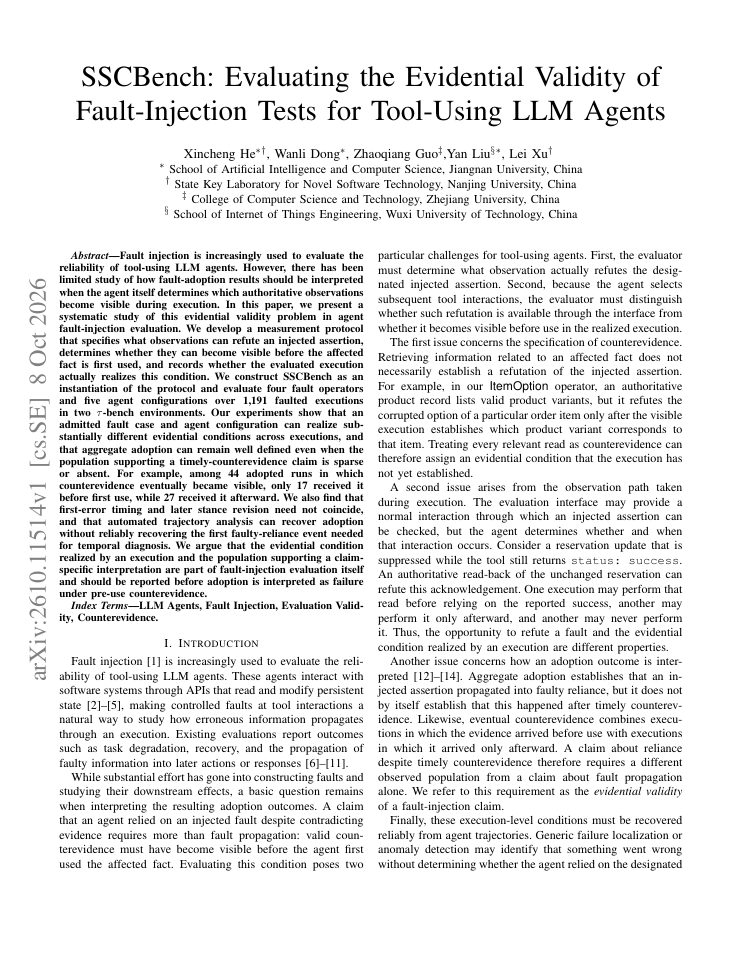
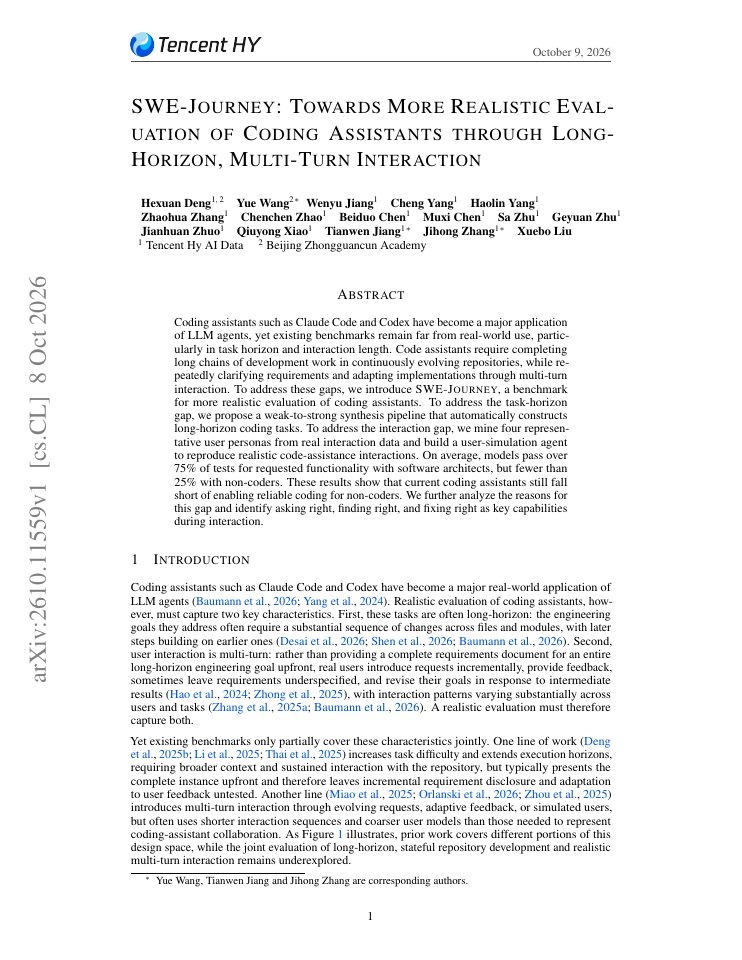
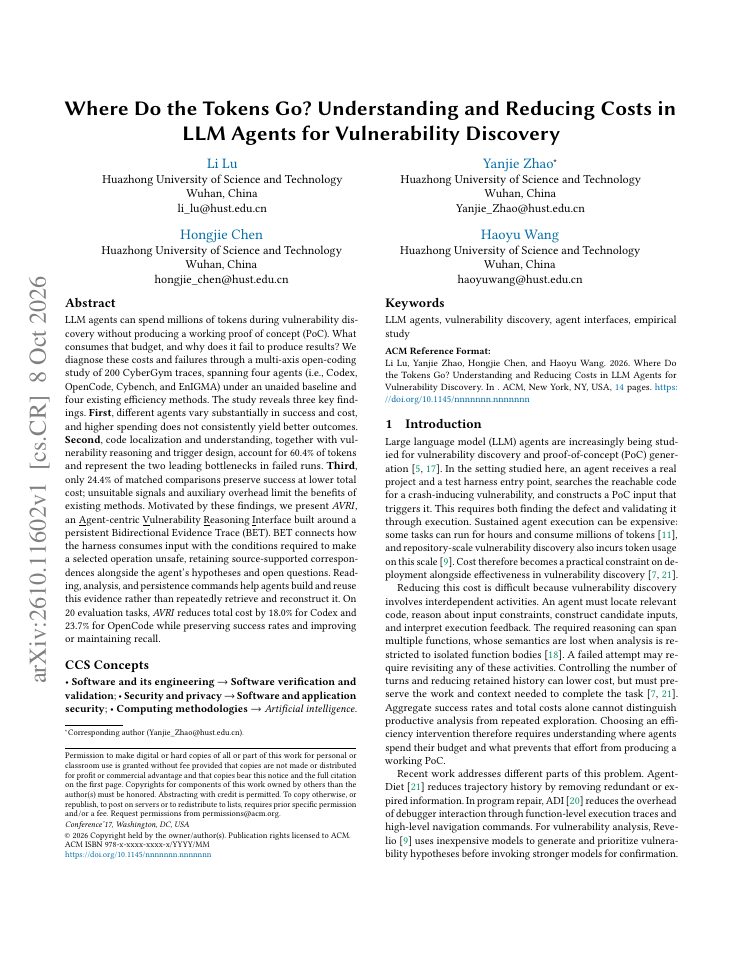
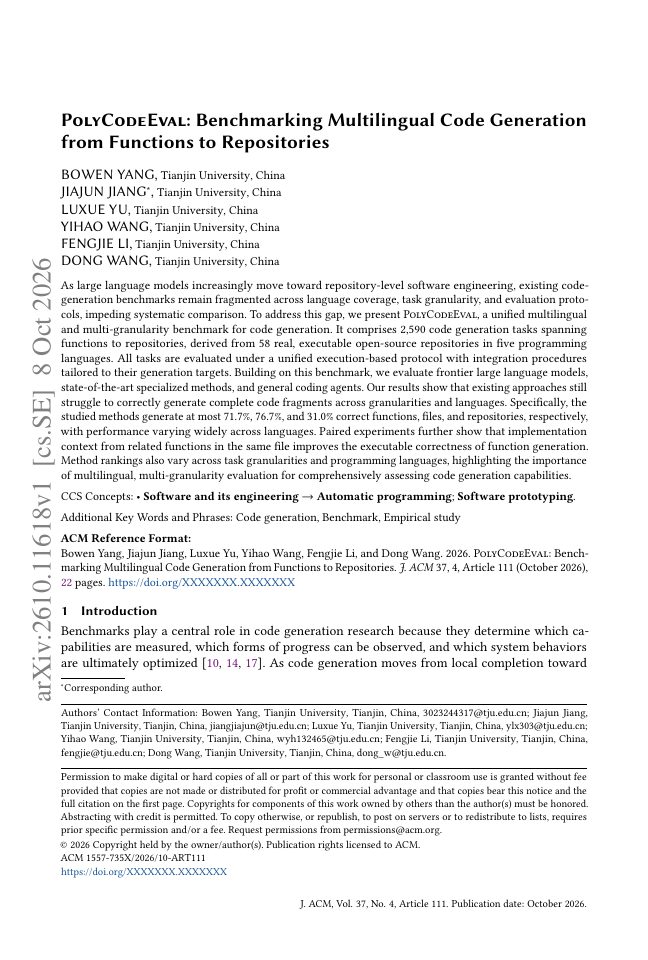
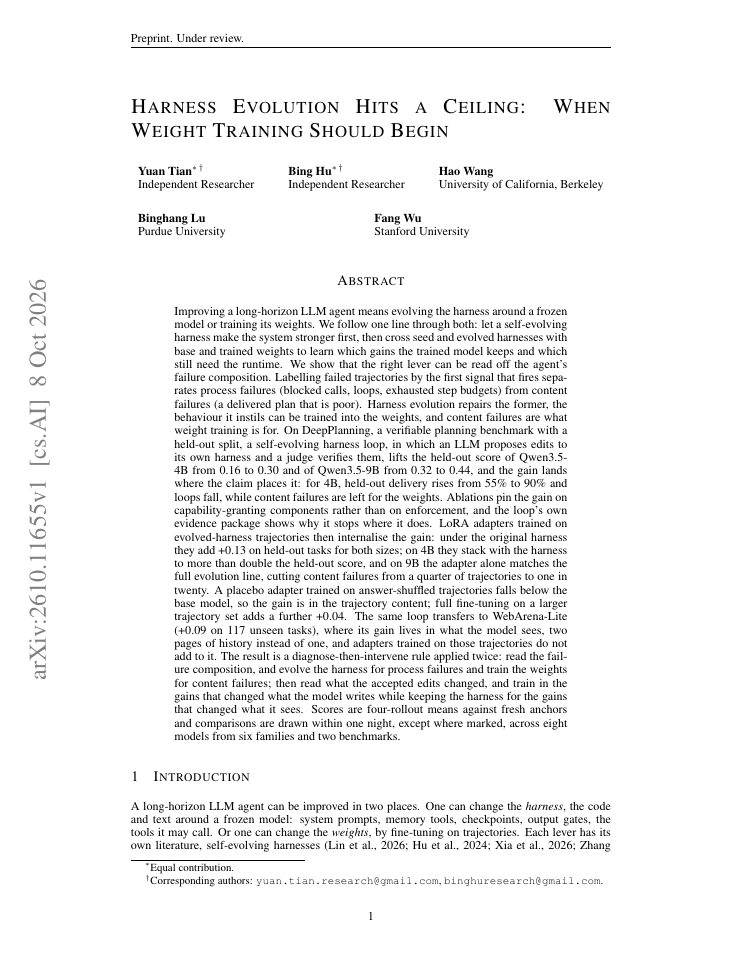
Each point represents one paper. Higher means more independent implementations; farther right means more GitHub stars.TriCalRAG: A Three-Strategy, Retrieval-Augmented Benchmark for On-Premise LLM-Based Root Cause Analysis in AIOps: 57 GitHub stars; 2 independent implementationsTruncated automatic sparse differentiation for machine learning interatomic potentials: 1 GitHub star; 1 independent implementationDemocratizing MoE inference on commodity GPUs with CoMoE: 0 GitHub stars; 0 independent implementationsDSReg: Provably Recovering Individual World Latents without Reconstruction: 228 GitHub stars; 1 independent implementationCHASE: Channel-Aligned Structure Exploitation for Geometry-Aware Model Engineering: 0 GitHub stars; 0 independent implementationsPhysics-Informed Neural Plasticity: PDE Solvers That Reshape Themselves: 0 GitHub stars; 0 independent implementationsThe Silhouette Operator: Identifiability of Low-Rank Measures from One-Dimensional Projections: 0 GitHub stars; 0 independent implementationsSelf-Organization from Constrained Geometric Radiation: 0 GitHub stars; 0 independent implementationsPhase-HDC: Replacing Optimizer History with Gradient Thresholds in Discrete Phase Learning: 4 GitHub stars; 0 independent implementationsD-SLR: The Disjoint Row-Sparse plus Low-Rank Decomposition: 4 GitHub stars; 1 independent implementationCoverage-Aware Reasoning with Medical Tokens for Diagnosis Prediction: 0 GitHub stars; 0 independent implementationsBeyond the Ergodic Wall: A Discrete Geometric Physics Sandbox for Analysing AI Scaling Limits and Complexity Collapse: 1 GitHub star; 0 independent implementationsExplaining the Saliency Map Sparsity of Adversarially-Trained Neural Networks: 0 GitHub stars; 0 independent implementationsLearning infinite context windows in recurrent architectures via spatial neural computing: 0 GitHub stars; 0 independent implementationsLossy Compressive Text Autoencoders: 122 GitHub stars; 0 independent implementationsRethinking the Tradeoff Between Temporal Encoding and Nonlinear Computation in Spiking Language Models: 4 GitHub stars; 2 independent implementationsLow-rank tensor structure of precipitation and its application to satellite-reference merging: 1 GitHub star; 0 independent implementationsReconstruction of Multiscale Plasma Dynamics Across Operating Regimes: 0 GitHub stars; 0 independent implementationsDynamics as Code: On Model Compression via Dynamic System: 0 GitHub stars; 0 independent implementationsQUILT: Rethinking Sparse-Attention Prefill through Shared Query Execution: 0 GitHub stars; 0 independent implementationsLadderEdit: Edit-Level Residual Compression for Memory-Efficient Lifelong Editing of LLMs: 0 GitHub stars; 0 independent implementationsBridging KV-Cache Quantization and Linear Attention: From Theory to Pretrained Weight Migration: 4 GitHub stars; 0 independent implementationsEvoSim: Learning to Model, Modeling to Learn: 0 GitHub stars; 0 independent implementationsSynCo: Data Synthesis Co-Training for Self-Evolving LLMs via Multi-Agent Reinforcement Learning: 132 GitHub stars; 1 independent implementationDeception by Omission: Language Models Knowingly Hide Their Mistakes: 126 GitHub stars; 1 independent implementationRIT-RAG: Navigating Document Corpora with Retrieval-Induced Trees: 4 GitHub stars; 0 independent implementationsClosed-loop evaluation of LLM agents for embedded software development: 10 GitHub stars; 0 independent implementationsTracing the Thoughts of a Coding Agent Playing ARC-AGI-3: Lessons for Continual Learning: 132 GitHub stars; 1 independent implementationRoboAware: Learning to Coordinate Embodied Skills from Counterfactual Outcomes: 14 GitHub stars; 1 independent implementationSSCBench: Evaluating the Evidential Validity of Fault-Injection Tests for Tool-Using LLM Agents: 0 GitHub stars; 0 independent implementationsReTeach: Building a Self-Teacher through Multi-Round Reflection and Retry: 146 GitHub stars; 1 independent implementationSafe, Persistent, and Evolving Agent Harness for Understanding Partially Observable Worlds: 132 GitHub stars; 1 independent implementationSWE-Journey: Towards More Realistic Evaluation of Coding Assistants through Long-Horizon, Multi-Turn Interaction: 0 GitHub stars; 0 independent implementationsChronos Enables Code Agents to Reason over Software Evolution: 14 GitHub stars; 1 independent implementationRunnable Commit Untangling for Coding Agents: 14 GitHub stars; 1 independent implementationError-Propagation Modeling for Failure Attribution in LLM-Based Multi-Agent Systems: 132 GitHub stars; 1 independent implementationWhere Do the Tokens Go? Understanding and Reducing Costs in LLM Agents for Vulnerability Discovery: 0 GitHub stars; 0 independent implementationsPolyCodeEval: Benchmarking Multilingual Code Generation from Functions to Repositories: 1 GitHub star; 0 independent implementationsOne Skill Too Many: How Co-Installed Skills Conflict in Coding Agents: 14 GitHub stars; 1 independent implementationHarness Evolution Hits a Ceiling: When Weight Training Should Begin: 122 GitHub stars; 0 independent implementationsTRACE: Diagnosing Verifier Brittleness in Agentic Evaluation: 136 GitHub stars; 2 independent implementationsMemTrial: Learning When to Trust Memory in LLM Portfolio Agents: 136 GitHub stars; 2 independent implementations

Papers above 1000 stars or 200 citations are not scored. They have already broken through the attention threshold, while Paperraft is designed to identify earlier signals.

02 · cadence

Research areas over time

Compare monthly publication volume on a shared scale and calendar.

coding agentsmax 10Sep 26: 0 papersOct 26: 2 papersSep 26Oct 26efficient architecturesmax 10Sep 26: 0 papersOct 26: 2 papersSep 26Oct 26agent evaluationmax 10Sep 26: 0 papersOct 26: 7 papersSep 26Oct 26KV cachemax 10Sep 26: 0 papersOct 26: 1 paperSep 26Oct 26distillationmax 10Sep 26: 0 papersOct 26: 1 paperSep 26Oct 26sparsity and pruningmax 10Sep 26: 1 paperOct 26: 1 paperSep 26Oct 26attention and kernelsmax 10Sep 26: 0 papersOct 26: 1 paperSep 26Oct 26memory and contextmax 10Sep 26: 0 papersOct 26: 4 papersSep 26Oct 26multi-agent orchestrationmax 10Sep 26: 0 papersOct 26: 3 papersSep 26Oct 26othermax 10Sep 26: 0 papersOct 26: 10 papersSep 26Oct 26quantizationmax 10Sep 26: 0 papersOct 26: 1 paperSep 26Oct 26retrieval and RAGmax 10Sep 26: 1 paperOct 26: 1 paperSep 26Oct 26safety and guardrailsmax 10Sep 26: 0 papersOct 26: 1 paperSep 26Oct 26serving and batchingmax 10Sep 26: 0 papersOct 26: 1 paperSep 26Oct 26efficient trainingmax 10Sep 26: 0 papersOct 26: 4 papersSep 26Oct 26

Every panel uses the same calendar and vertical scale. An empty column means no papers were recorded.

Method under scrutiny

Inspect the highest-ranked paper, every repository behind its signal, and the rule used to classify each one.

Rethinking the Tradeoff Between Temporal Encoding and Nonlinear Computation in Spiking Language Models

quantization · watch · 2 of 2 implementations are independent

Spora replaces conventional floating-point activations and nonlinear attention in spiking language models with binary temporal weight encodings (UBS/BBS) that support accumulation-and-shift dot products and integer-exponent attention mappings. The cost is a full custom training pipeline with spike encoding, thresholds, residual decay, and fixed-point arithmetic, plus added time-step computation, with quality still below mainstream quantized Transformers at comparable scale. The approach can fail in practice because its efficiency claims depend on neuromorphic or fixed-point event-driven hardware that a standard 24 GB GPU does not exploit, tooling is immature, and validation is limited to GLUE-scale encoder tasks rather than production generative workloads.
Exclusions and controls

Every exclusion is counted and published.

Exclusion counts were not recorded for this edition.

0 previously indexed papers were rechecked in this run.

Paperraft tracks one signal: how many independent implementations a paper attracts on GitHub after author-owned repositories are removed. This is a discovery signal to investigate, not a measure of implementation quality.

It does not claim that a method works. Paperraft runs no reproduction benchmarks. Reported gains remain author claims until independently tested. Papers above the attention threshold are excluded because this publication is designed to identify research before consensus forms.