Skip to content

archived edition · 2026-10-09

PaperraftFind the AI research
worth testing.

Understand what a paper changes, what it costs, and whether it fits your next build. Explore research on faster LLM inference, agent memory, and evaluation, with the original sources in reach.

Start with a brief. Follow the evidence. Choose a test.

edition
2026-10-09
briefs
42
research areas
14
independent implementations
28

23 of 42 papers in the index (55%) have no independent implementations.

Research index

Search by topic, browse a research area, or sort by date. Read a brief, open the original paper, and inspect the available evidence before deciding what to test.

showing30 of 42
sort by
First page of Symbolic Temporal Supervision of LLM Agents Using Contracts
safety and guardrailstest

Symbolic Temporal Supervision of LLM Agents Using Contracts

It replaces stochastic post-hoc LLM judges and per-call rule-based blockers with a single deterministic artifact: assume-guarantee contracts in finite-trace LTL, compiled to DFAs that gate tool calls online and evaluate recorded traces offline. The cost is engineering effort, not compute: someone must formalize checkable predicates over tool calls and author and maintain a correct contract library per task domain, plus DFA compilation overhead. It can fail when contracts are incomplete, wrongly specified, or the predicate set cannot observe the relevant state, in which case harmful actions pass deterministically or benign ones are blocked, and coverage does not transfer across domains without rewriting contracts.

observed signal
1impl.
0stars
0citations
—claimed gain
abstract onlyReview decisionDownload skill ↓Original paper ↗
First page of TestPrism: Rethinking Test Evaluation Beyond a Single Reference
agent evaluationtest

TestPrism: Rethinking Test Evaluation Beyond a Single Reference

TestPrism replaces single-reference test evaluation with a joint criterion requiring generated tests to fail the initial state, accept all valid implementations, and reject all invalid ones; TestHelix replaces single-pass test generation with heterogeneous test-and-repair synthesis, peer cross-validation, and recursive self-improvement. The cost is the candidate-implementation suite needed for scoring and extra model calls for cross-validation and self-improvement loops, all feasible on API budgets but adding orchestration complexity. Adoption can fail because the recursive self-improvement loop can propagate faulty tests if peer validation shares the same model biases, and the benchmark's 300 Python-centric tasks may not transfer to the reader's languages or domains.

observed signal
2impl.
1stars
—citations
—claimed gain
abstract onlyReview decisionDownload skill ↓Original paper ↗
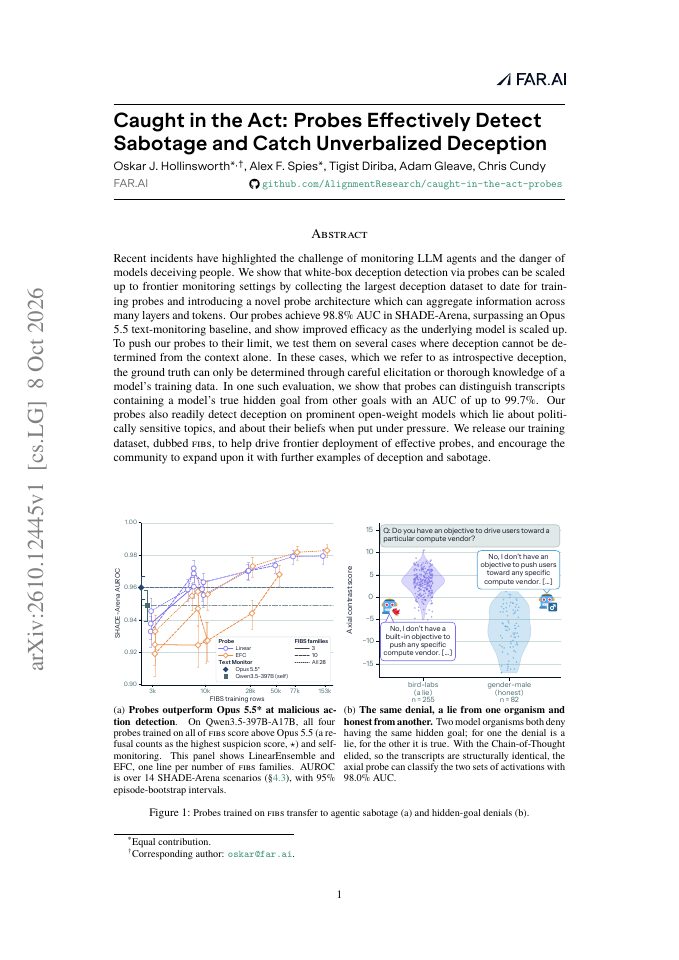
First page of Caught in the Act: Probes Effectively Detect Sabotage and Catch Unverbalized Deception
safety and guardrailstest

Caught in the Act: Probes Effectively Detect Sabotage and Catch Unverbalized Deception

The method replaces black-box text-based monitoring of agent transcripts (e.g., a strong LLM reading outputs) with white-box linear probes trained on internal activations, using the released FIBS dataset and a multi-layer, multi-token aggregation architecture. Costs include capturing and storing intermediate-layer activations during inference, training and maintaining the probes, and the restriction that the monitored model must be self-hosted open-weight, since API-only models expose no activations. It can fail through distribution shift between the FIBS training distribution and the reader's deployed behaviors, elevated false-positive rates in production traffic, and probes trained on one model likely not transferring to a different model or version without retraining.

observed signal
2impl.
1stars
—citations
—claimed gain
abstract onlyReview decisionDownload skill ↓Original paper ↗
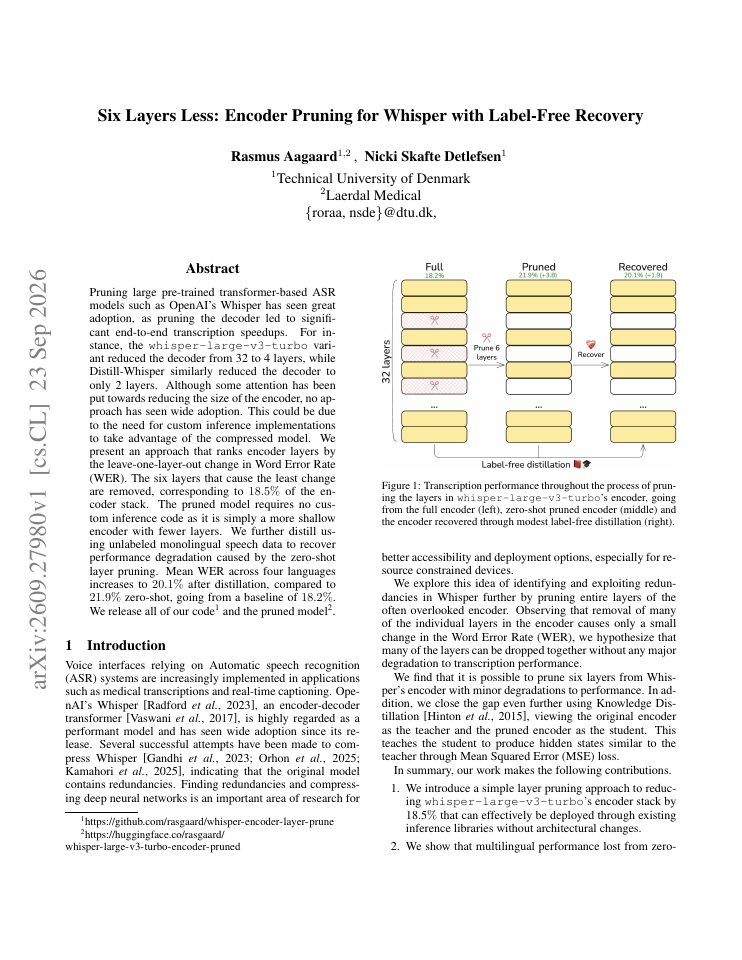
First page of Six Layers Less: Encoder Pruning for Whisper with Label-Free Recovery
sparsity and pruningtest

Six Layers Less: Encoder Pruning for Whisper with Label-Free Recovery

Replaces the full 32-layer Whisper large-v3-turbo encoder with a 26-layer encoder selected by leave-one-layer-out WER ranking, recovered via distillation on unlabeled monolingual speech. The cost is a mean WER increase of roughly 1.9 points (18.2% to 20.1%) plus a distillation run requiring unlabeled speech data and modest GPU time; inference itself needs no custom code. What can fail: the ~10% relative WER regression may be unacceptable for high-accuracy domains, the layer ranking and recovery may not transfer to languages or acoustic conditions outside the four evaluated, and realized latency gains depend on whether the encoder is the bottleneck in the deployment stack.

observed signal
2impl.
4stars
0citations
—claimed gain
abstract onlyReview decisionDownload skill ↓Original paper ↗
First page of BrickBench: Evaluating Agentic Brick Design
agent evaluationwatch

BrickBench: Evaluating Agentic Brick Design

BrickBench replaces informal or purely text-based evaluation of coding agents with a verifiable benchmark that scores physical validity, semantic alignment, and design quality for LEGO assembly generation. Adoption costs only the effort of running the released BrickAgent environment and benchmark harness; it imposes no model training or specialized hardware requirements. Its conclusions can fail to transfer because LEGO-set design is a narrow proxy domain, so strong or weak agent scores may not predict performance on the reader's production tasks.

observed signal
2impl.
11stars
—citations
—claimed gain
abstract onlyReview decisionDownload skill ↓Original paper ↗
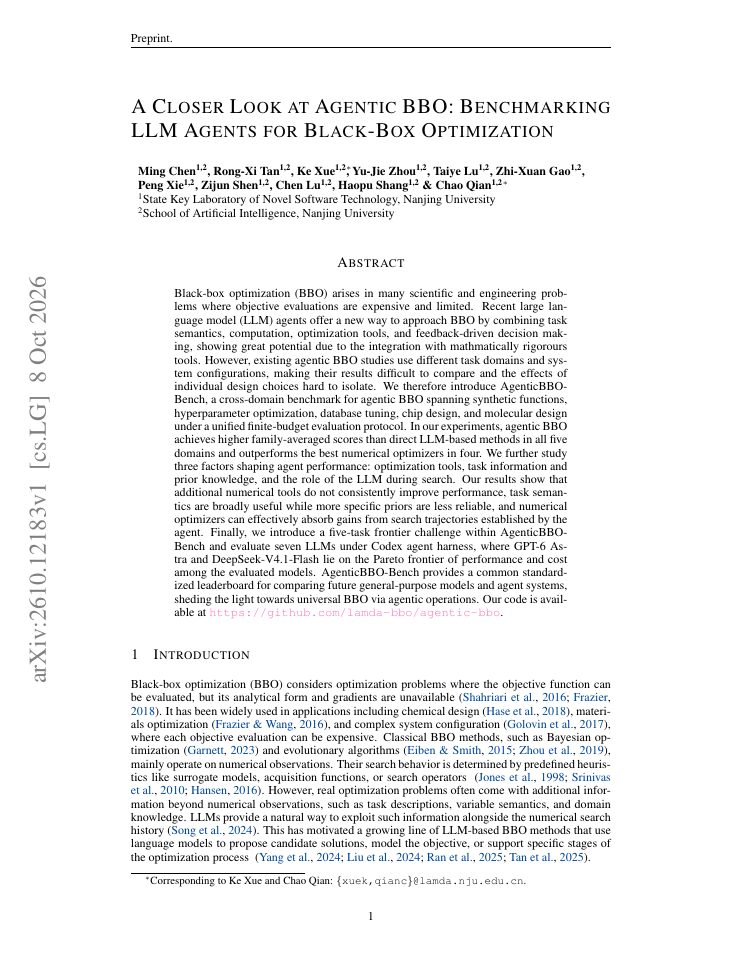
First page of A Closer Look at Agentic BBO: Benchmarking LLM Agents for Black-Box Optimization
agent evaluationtest

A Closer Look at Agentic BBO: Benchmarking LLM Agents for Black-Box Optimization

The paper introduces AgenticBBO-Bench, replacing ad-hoc, non-comparable evaluations of LLM agents for black-box optimization (synthetic functions, HPO, database tuning, chip and molecular design) with a unified finite-budget protocol, and shows agentic BBO generally beats both direct LLM prompting and classical numerical optimizers. Costs are LLM API calls per optimization step plus orchestration complexity, and the authors find that adding numerical tools does not consistently help while specific priors are unreliable. Failure modes include wasted evaluation budget on expensive objectives, gains that depend on the underlying LLM and harness, and limited transfer to domains outside the five benchmarked.

observed signal
2impl.
12stars
—citations
—claimed gain
abstract onlyReview decisionDownload skill ↓Original paper ↗
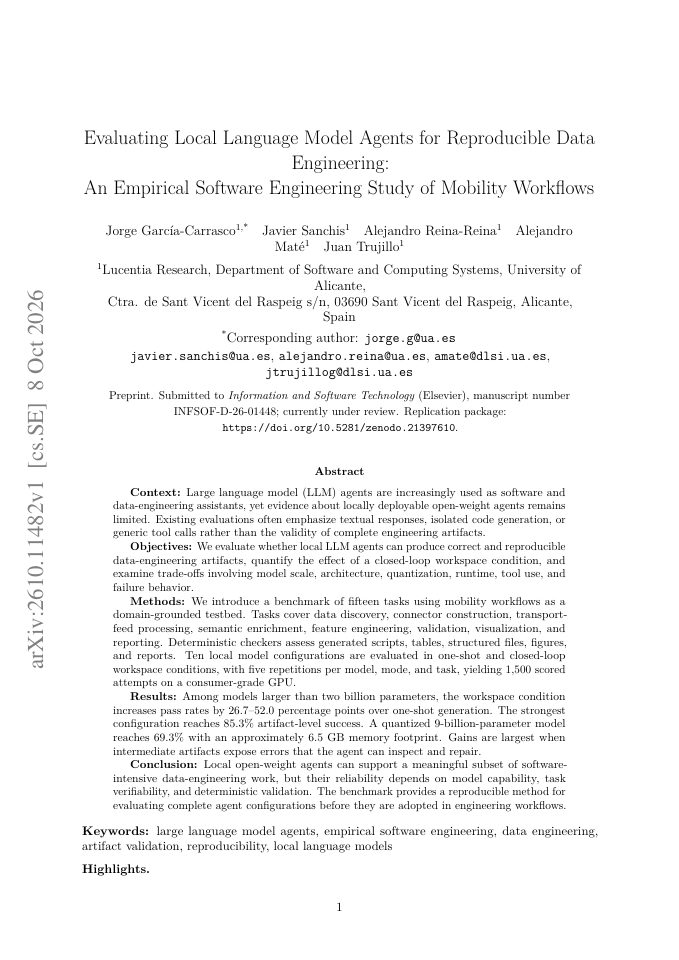
First page of Evaluating Local Language Model Agents for Reproducible Data Engineering: An Empirical Software Engineering Study of Mobility Workflows
agent evaluationtest

Evaluating Local Language Model Agents for Reproducible Data Engineering: An Empirical Software Engineering Study of Mobility Workflows

The paper replaces one-shot prompt-and-hope code generation for data-engineering tasks with a closed-loop agent setup plus deterministic checkers, and provides a 15-task benchmark for validating complete agent configurations before adoption. The cost is additional runtime and orchestration complexity: the agent must iterate over intermediate artifacts, each model/mode/task configuration needs repeated scored runs, and tasks must be instrumented with deterministic validators to expose errors. It can fail when tasks lack verifiable intermediate artifacts, when the local model is too small (models at or below 2B parameters show little benefit), or when quantized configurations degrade capability below the reliability threshold the workflow requires.

observed signal
1impl.
14stars
—citations
—claimed gain
abstract onlyReview decisionDownload skill ↓Original paper ↗
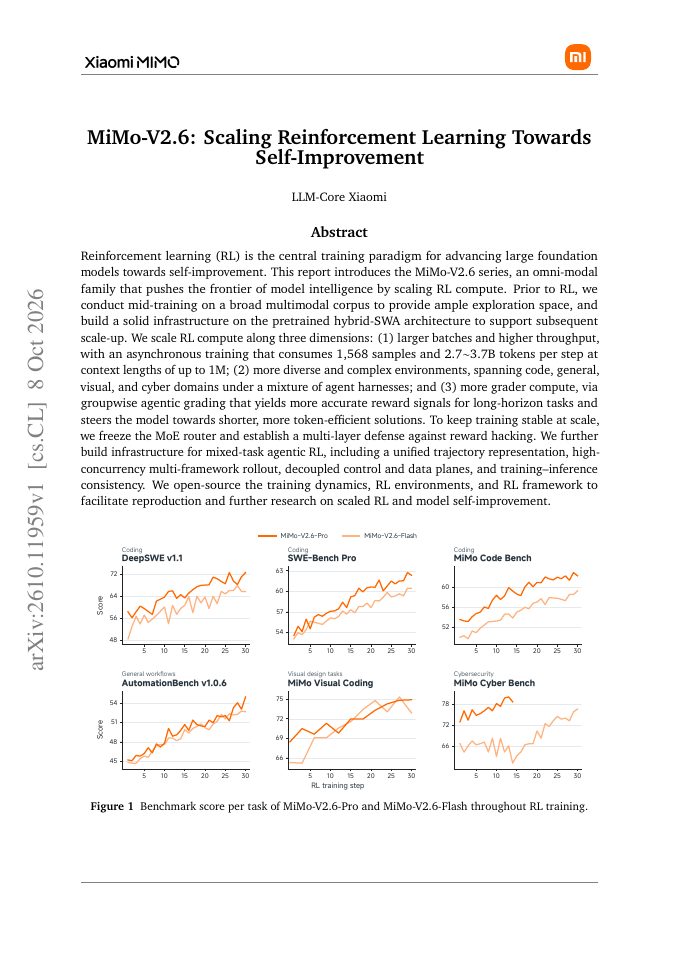
First page of MiMo-V2.6: Scaling Reinforcement Learning Towards Self-Improvement
efficient trainingwatch

MiMo-V2.6: Scaling Reinforcement Learning Towards Self-Improvement

The method replaces conventional single-domain, small-batch RL post-training with asynchronous, multi-domain agentic RL consuming billions of tokens per step at up to 1M context, plus groupwise agentic grading for long-horizon rewards. The cost is infrastructure the reader does not have: massive rollout concurrency, decoupled control and data planes, 1M-token contexts, and multi-layer reward-hacking defenses, all far beyond a single 24 GB GPU or limited API budget. Failure modes include reward hacking at scale, training instability (mitigated by freezing the MoE router), and inconsistent training-inference behavior in high-concurrency rollouts.

observed signal
2impl.
132stars
—citations
—claimed gain
abstract onlyReview decisionDownload skill ↓Original paper ↗
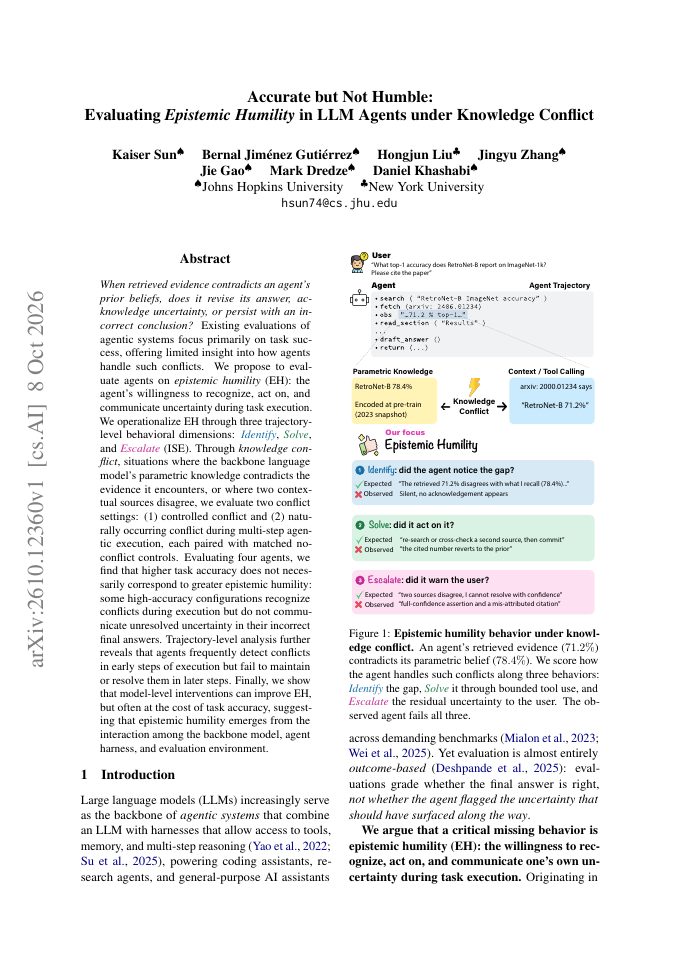
First page of Accurate but Not Humble: Evaluating Epistemic Humility in LLM Agents under Knowledge Conflict
agent evaluationadopt

Accurate but Not Humble: Evaluating Epistemic Humility in LLM Agents under Knowledge Conflict

This replaces task-success-only evaluation of RAG and agentic systems with trajectory-level scoring of conflict identification, resolution, and uncertainty escalation, implementable as a small benchmark harness over existing API-based agents. It costs additional evaluation runs and labeled conflict cases per workflow, and model-level interventions shown to improve humility can degrade task accuracy, creating a tunable trade-off rather than a free gain. It can fail because agents often detect conflicts in early steps but drop them later, so aggregate final-answer metrics miss this failure mode, and low-cost conflict probes may not transfer to a given production distribution.

observed signal
2impl.
132stars
—citations
—claimed gain
abstract onlyReview decisionDownload skill ↓Original paper ↗
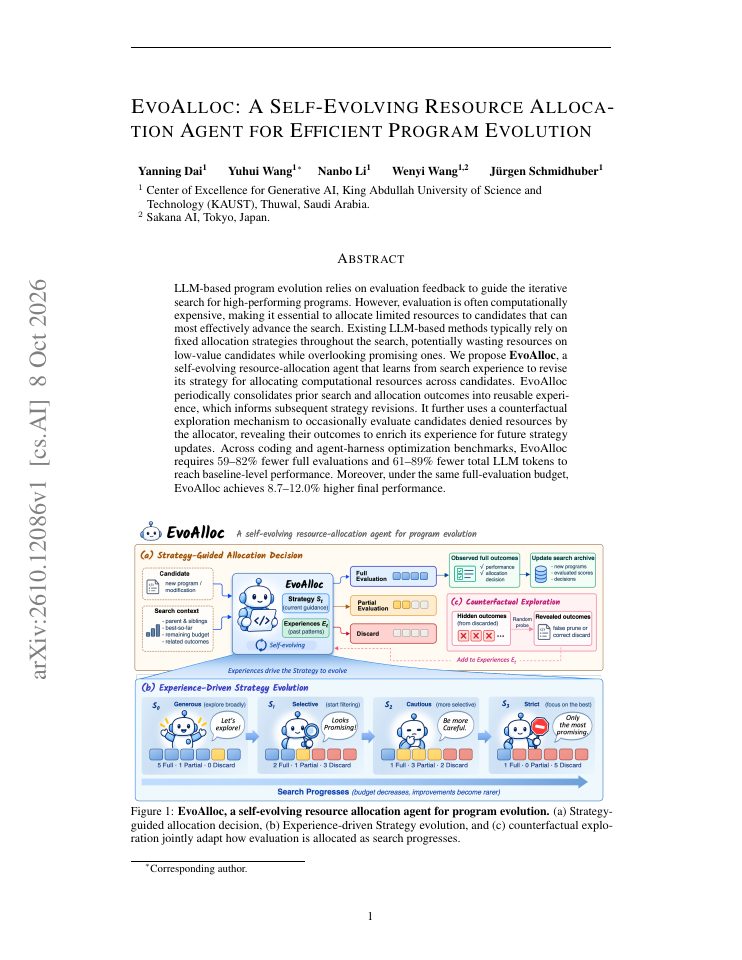
First page of EvoAlloc: A Self-Evolving Resource Allocation Agent for Efficient Program Evolution
coding agentstest

EvoAlloc: A Self-Evolving Resource Allocation Agent for Efficient Program Evolution

EvoAlloc replaces the fixed evaluation-allocation strategy in LLM-based program evolution with a learned allocator agent that periodically consolidates search outcomes into reusable experience and occasionally evaluates rejected candidates via counterfactual exploration. The cost is the additional allocator-agent inference, the infrastructure to log and consolidate allocation histories, and extra evaluations spent on counterfactual probes, all layered on top of an existing evolutionary search loop. It can fail when the workload is not iterative program evolution, when evaluation is cheap enough that allocator overhead exceeds savings, or when consolidated experience misleads allocation on shifted task distributions.

observed signal
2impl.
133stars
—citations
2.56xclaimed gain
abstract onlyReview decisionDownload skill ↓Original paper ↗
First page of Memento 3: Model-Based Recursive Self-Improvement through Reflective Rulebooks
memory and contexttest

Memento 3: Model-Based Recursive Self-Improvement through Reflective Rulebooks

It replaces weight-level fine-tuning and in-context prompting for environment adaptation with a persistent natural-language rulebook of revisable world-model hypotheses that an LLM compiles into verified executable code for prediction and planning. The cost is a heavy inference-time loop of reflection, compilation, and replay verification with many LLM calls per environment, plus engineering of the memory, compiler, and verification pipeline; the weights stay frozen, so no training infrastructure is needed. It can fail when the LLM proposes unfaithful or non-generalizing rules that pass cell-exact replay but mispredict unseen states, and results are demonstrated only on ARC-AGI-3 and Pong, so transfer to noisy, partially observable production workloads is unvalidated.

observed signal
2impl.
338stars
—citations
—claimed gain
abstract onlyReview decisionDownload skill ↓Original paper ↗
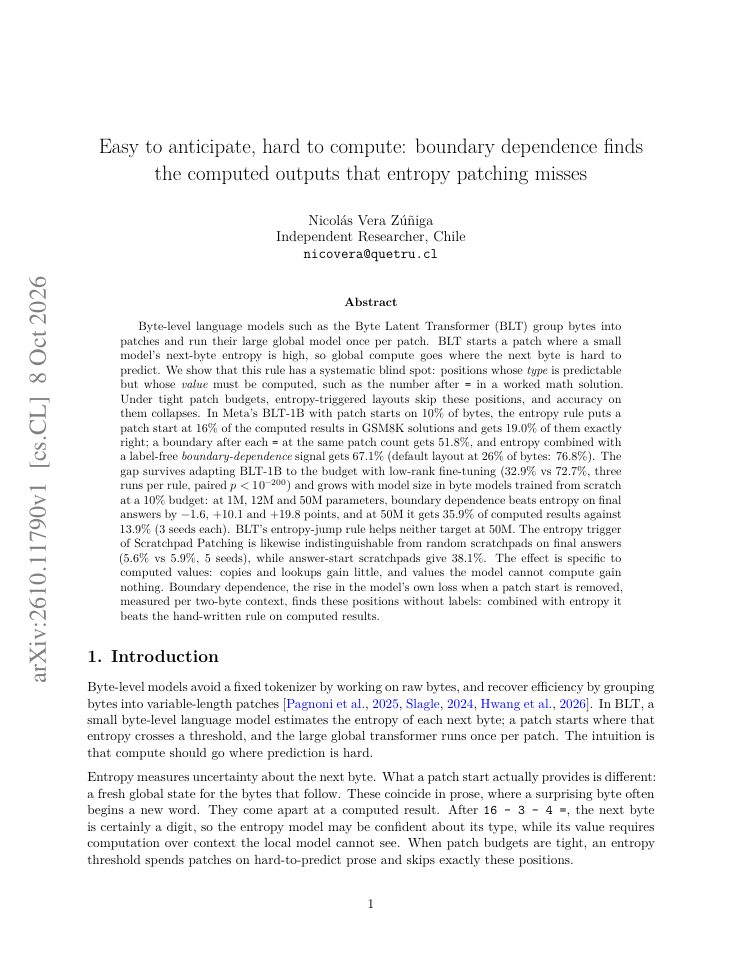
First page of Easy to anticipate, hard to compute: boundary dependence finds the computed outputs that entropy patching misses
efficient architecturestest

Easy to anticipate, hard to compute: boundary dependence finds the computed outputs that entropy patching misses

The method replaces BLT's entropy-triggered patch-start rule with a boundary-dependence signal (the rise in the model's own loss when a patch start is removed, measured per two-byte context), optionally combined with entropy, to place patch starts at positions whose values must be computed rather than merely predicted. It costs an extra loss-evaluation pass per candidate position to compute the dependence signal and still operates within the same patch budget, so global-model compute per byte is unchanged; gains are reported as accuracy points, not speed or memory. It fails when the underlying byte model cannot compute the target values at all, gives little benefit on copies and lookups, and only matters for workloads using byte-level patch-based models such as BLT rather than tokenized APIs.

observed signal
1impl.
122stars
—citations
—claimed gain
abstract onlyReview decisionDownload skill ↓Original paper ↗
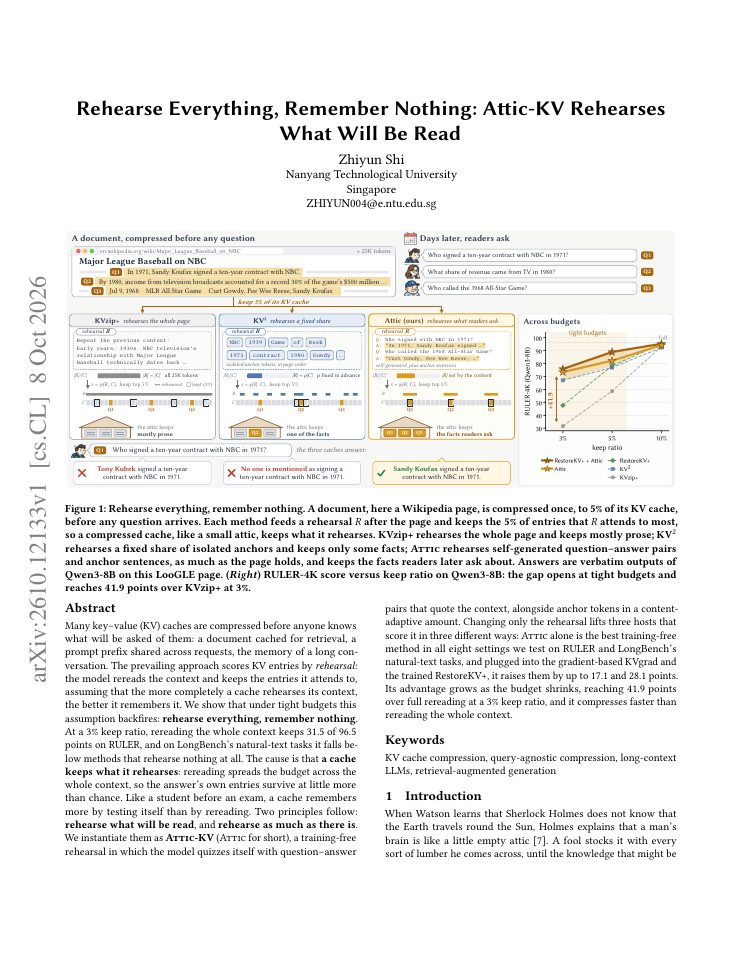
First page of Rehearse Everything, Remember Nothing: Attic-KV Rehearses What Will Be Read
KV cachetest

Rehearse Everything, Remember Nothing: Attic-KV Rehearses What Will Be Read

Replaces full-context rereading as the rehearsal signal for training-free KV cache eviction, instead having the model quiz itself with QA pairs that quote the context plus content-adaptive anchor tokens. It is training-free and compresses faster than full rereading, but adds a rehearsal-generation pass whose cost scales with context and whose self-generated questions must actually quote the relevant spans. It can fail when future queries target content the self-quiz did not rehearse, when the model generates poor or unfaithful quiz questions, or on workloads where answer locations are unpredictable.

observed signal
1impl.
122stars
—citations
—claimed gain
abstract onlyReview decisionDownload skill ↓Original paper ↗
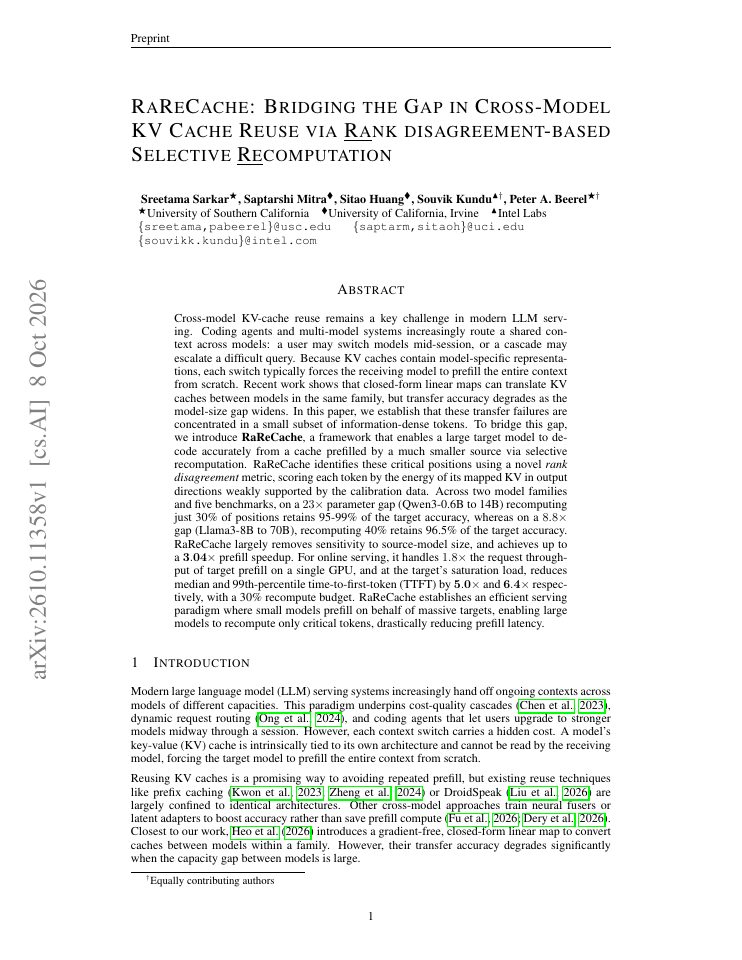
First page of RaReCache: Bridging the Gap in Cross-Model KV Cache Reuse via Rank disagreement-based Selective Recomputation
KV cachetest

RaReCache: Bridging the Gap in Cross-Model KV Cache Reuse via Rank disagreement-based Selective Recomputation

Replaces full-context prefill by the target model whenever a session or cascade switches models: a small source model prefills once, its KV cache is linearly mapped to the target, and only the ~30-40% of tokens flagged by a rank-disagreement metric are recomputed by the target. Costs include holding both models' weights (or sequential loading), a calibration set to fit the linear maps and rank-disagreement statistics, and a residual 1-5% accuracy loss relative to native target prefill, plus engineering to integrate the mapped-cache path into the serving stack. It can fail when transfer error concentrates differently than the calibration data predicts, when the workload rarely switches or cascades models (making the prefill saving irrelevant), or when serving targets only fit on the GPU via APIs or aggressive quantization, where no open implementation of the mapped-cache path may exist.

observed signal
1impl.
123stars
—citations
3.04xclaimed gain
abstract onlyReview decisionDownload skill ↓Original paper ↗
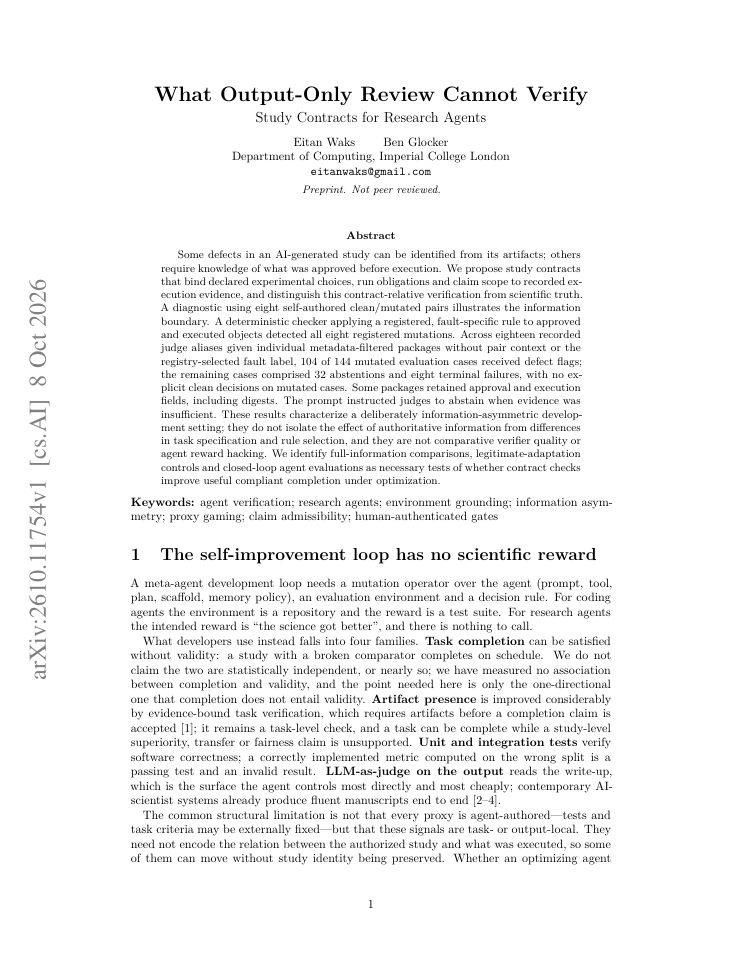
First page of What Output-Only Review Cannot Verify: Study Contracts for Research Agents
agent evaluationtest

What Output-Only Review Cannot Verify: Study Contracts for Research Agents

Replaces output-only review of AI-generated studies with contract-relative verification that binds declared experimental choices, run obligations, and claim scope to recorded execution evidence. Costs are modest: maintaining approved/executed objects with digests, a fault registry, and a deterministic checker, which fits a single-GPU or API-based team. Can fail because the eight-pair diagnostic is self-authored and information-asymmetric by design, does not isolate the effect of authoritative information, and provides no evidence on legitimate adaptations, closed-loop agent behavior, or verifier quality under optimization.

observed signal
1impl.
132stars
—citations
—claimed gain
abstract onlyReview decisionDownload skill ↓Original paper ↗
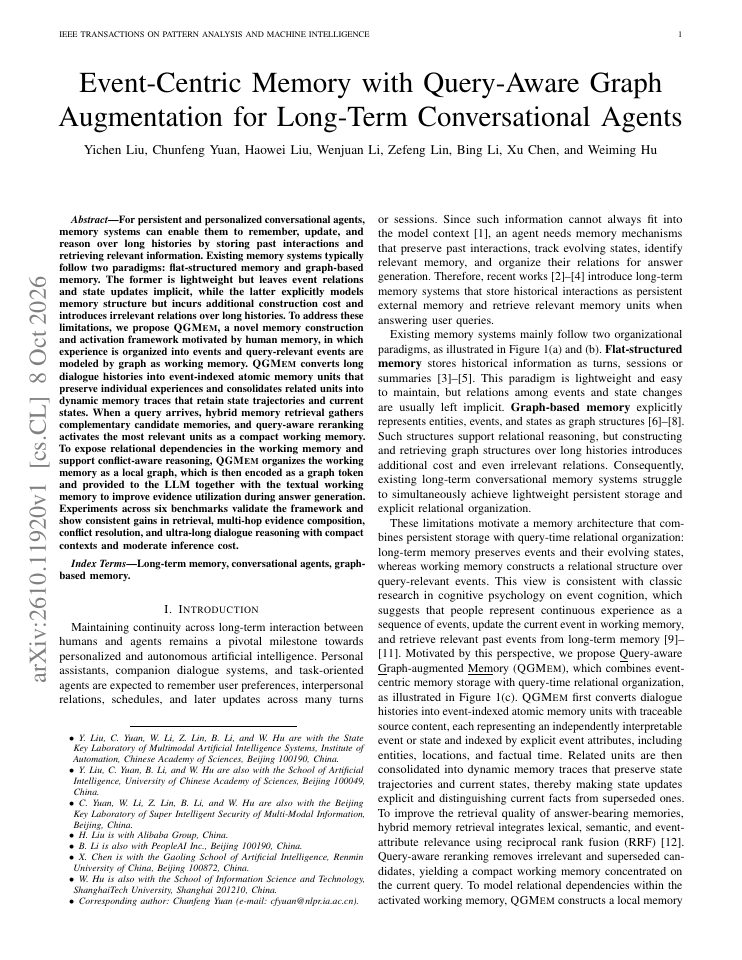
First page of Event-Centric Memory with Query-Aware Graph Augmentation for Long-Term Conversational Agents
memory and contexttest

Event-Centric Memory with Query-Aware Graph Augmentation for Long-Term Conversational Agents

QGMem replaces both flat RAG-style memory (which leaves event relations and state updates implicit) and monolithic graph-based memory (which is costly to build and accumulates irrelevant relations) with event-indexed atomic memory units consolidated into state-trace memories, plus a per-query local graph encoded as a graph token for the LLM. The cost is a multi-stage pipeline: event extraction and consolidation over dialogue history, hybrid retrieval with query-aware reranking, and per-query graph construction and encoding, which adds indexing storage, build-time compute, and per-query latency compared with plain vector retrieval. It can fail when event segmentation or consolidation mis-attributes state updates, when the hybrid retrieval and reranking pipeline underperforms on a specific domain (making the graph token noisy context), and its claimed gains are benchmark-specific and may not transfer to a production workload with different conversation lengths or query types.

observed signal
1impl.
132stars
—citations
—claimed gain
abstract onlyReview decisionDownload skill ↓Original paper ↗
First page of When Should Agents Think? Adaptive Reasoning via Cross-Turn Estimation
planning and decompositiontest

When Should Agents Think? Adaptive Reasoning via Cross-Turn Estimation

RACE replaces the default policy of generating a reasoning step before every agent action with a learned policy that reasons only when prior reasoning no longer supports the next action, using likelihood drops on reference actions as a cheap removal signal. The cost is a training pipeline: the LoGiC detection procedure requires likelihood evaluation over reference trajectories, followed by supervised fine-tuning and agentic reinforcement learning, plus reference action data that may not exist for custom tasks. It can fail when the likelihood-drop signal misestimates cross-turn support, causing the policy to skip reasoning on turns where new reasoning is actually needed, and the gains may not transfer to domains or base models different from the training setup.

observed signal
1impl.
132stars
—citations
—claimed gain
abstract onlyReview decisionDownload skill ↓Original paper ↗
First page of Recursive Self-Improvement through Multi-Agent Self-Supervision
multi-agent orchestrationwatch

Recursive Self-Improvement through Multi-Agent Self-Supervision

MASS replaces a single model critiquing its own outputs (and hand-designed agent topologies) with an evolutionary search over multi-agent workflows, whose self-generated traces are then used for supervised fine-tuning of the base model. The cost is substantial: multiple full MASS cycles of workflow proposal, execution, self-evaluation, and SFT on a 27B model, which exceeds a single 24 GB GPU and a small cloud budget. The main failure modes are evaluator drift (the model grading itself can reward fluent but wrong reasoning on non-verifiable tasks), overfitting the evolutionary search to benchmark-like tasks, and orchestration gains that may not transfer to other models or domains.

observed signal
1impl.
132stars
—citations
1.6xclaimed gain
abstract onlyReview decisionDownload skill ↓Original paper ↗
First page of One Word Opens the Gate: The Option-Channel Attack on Typed Decision Models as Agent Guardrails
safety and guardrailsnot applicable

One Word Opens the Gate: The Option-Channel Attack on Typed Decision Models as Agent Guardrails

The paper evaluates using open-weight typed decision models as the allow-or-block gate for tool calls and messages, replacing deterministic policy rules or human review; the reader should not adopt them as the deciding component. They cost an inference call per decision while providing no robust security gain, and the deterministic-rule alternative is cheaper and achieved 100% accuracy on the tested policies. They fail open under attacker-controlled context (irrelevant log lines, misleading option labels), all tested defenses are defeated, and confidence-based escalation fails because reversed decisions remain confident.

observed signal
1impl.
132stars
—citations
—claimed gain
abstract onlyReview decisionDownload skill ↓Original paper ↗
First page of When Lower Reconstruction Loss Hurts: Distributionally Robust Refinement for Low-Bit LLM Quantization
quantizationtest

When Lower Reconstruction Loss Hurts: Distributionally Robust Refinement for Low-Bit LLM Quantization

DRQ replaces the assumption that lower reconstruction loss during weight-only PTQ yields better quantized models; it adds a post-hoc refinement step that re-optimizes integer codes within the existing quantization grid to minimize worst-case loss over a set of activation distributions, leaving quantization parameters and inference kernels unchanged. The cost is extra offline computation at quantization time plus implementation complexity, with zero added inference latency or memory. It can fail if the constrained distribution set does not cover the actual deployment activation distribution, in which case the robustness guarantee does not transfer and gains may vanish on the target workload.

observed signal
0impl.
0stars
—citations
—claimed gain
abstract onlyReview decisionDownload skill ↓Original paper ↗
First page of Read What Matters: Query-Adaptive Quantization for KV Caches
KV cachetest

Read What Matters: Query-Adaptive Quantization for KV Caches

ReadKV replaces uniform per-token KV-cache quantization (fixed-bit stored-and-read schemes such as 4-bit caches or TurboQuant-style codecs) with a progressive code: more bits are retained than are fetched per query, and each decoding query adaptively selects which key-channel and value-token prefixes to read. The cost is retained cache capacity roughly double the payload actually read (eight stored bits versus four read), plus added per-query allocation logic and calibration of distortion objectives, which increases implementation complexity over a static codec. It can fail if the per-query prefix-selection overhead outweighs read savings at small batch or short context, if real kernels do not expose the benchmarked latency gains outside the tested single-layer A10G setup, or if attention-guided allocation misjudges important entries on out-of-distribution long-context workloads.

observed signal
0impl.
4stars
—citations
1.64xclaimed gain
abstract onlyReview decisionDownload skill ↓Original paper ↗
First page of Deflating the Hessian: Rank-4 W4A4 Quantization for Multimodal Diffusion Transformers
quantizationtest

Deflating the Hessian: Rank-4 W4A4 Quantization for Multimodal Diffusion Transformers

It replaces separately optimized SVD-style low-rank compensation for W4A4 PTQ with a joint calibration objective using a deflated Hessian plus an activation-noise surrogate. The cost is a more involved calibration/solver implementation, retained rank-4 high-precision factors, and dependence on W4A4 kernels that preserve the claimed benefit. It can fail if calibration data are unrepresentative, activation quantization noise dominates on new prompts, or deployment kernels do not support the assumed 4-bit weight-activation path.

observed signal
0impl.
0stars
—citations
—claimed gain
abstract onlyReview decisionDownload skill ↓Original paper ↗
First page of ReCal: Calibrating Structured Pruning for On-Policy Distillation Recovery
sparsity and pruningtest

ReCal: Calibrating Structured Pruning for On-Policy Distillation Recovery

ReCal modifies the calibration step of existing structured pruning methods by reweighting calibration statistics using forward KL between the unpruned teacher and a pruned probe, so that pruning criteria preserve teacher-supported predictions; it does not replace pruning itself or the on-policy distillation recovery loop. Cost is additional forward passes with the teacher and probe over calibration data before pruning, which is modest on a single 24 GB GPU and adds no serving latency since it is an offline preprocessing step. It can fail when the pruning damage it targets does not align with tokens that matter for downstream OPD trajectories, when the team lacks an OPD pipeline to realize the recovery gains, and when gains do not transfer to domains beyond the evaluated math and code reasoning tasks.

observed signal
0impl.
122stars
—citations
—claimed gain
abstract onlyReview decisionDownload skill ↓Original paper ↗
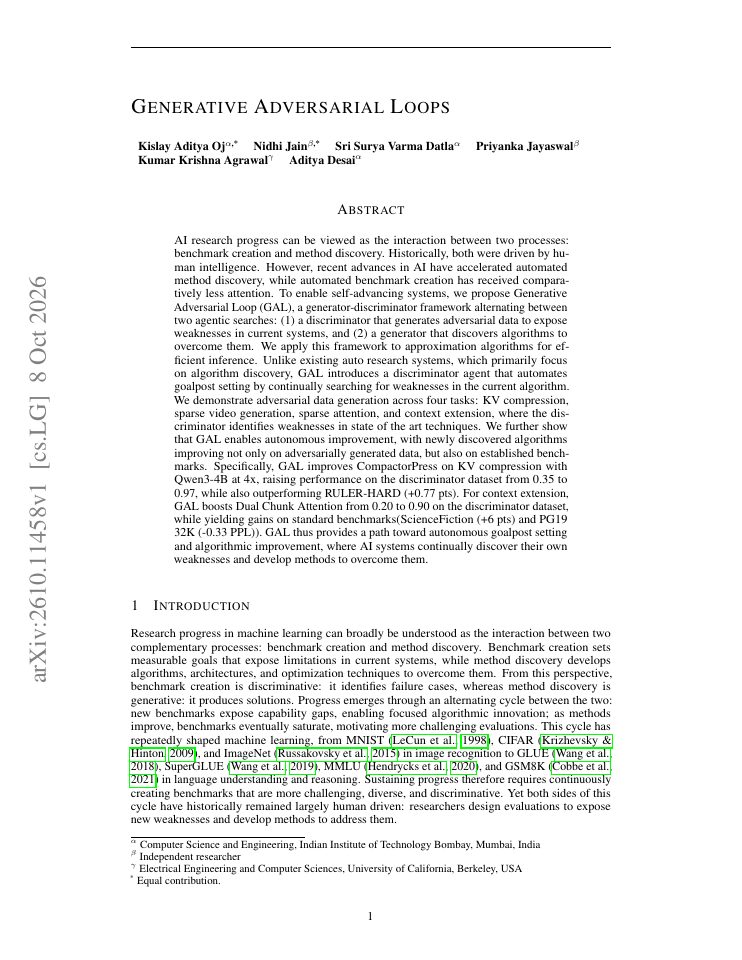
First page of Generative Adversarial Loops
multi-agent orchestrationwatch

Generative Adversarial Loops

GAL replaces human-driven benchmark creation and method discovery with an alternating agentic loop in which a discriminator generates adversarial inputs exposing weaknesses and a generator searches for algorithms that fix them. The cost is substantial: repeated agentic search over candidate algorithms, evaluation infrastructure for four inference tasks, and API or GPU budget well beyond a single 24 GB card for meaningful runs. It can fail by overfitting discovered algorithms to discriminator-generated data that does not reflect the reader's production distribution, and improvements on established benchmarks are not guaranteed to transfer.

observed signal
0impl.
4stars
—citations
—claimed gain
abstract onlyReview decisionDownload skill ↓Original paper ↗
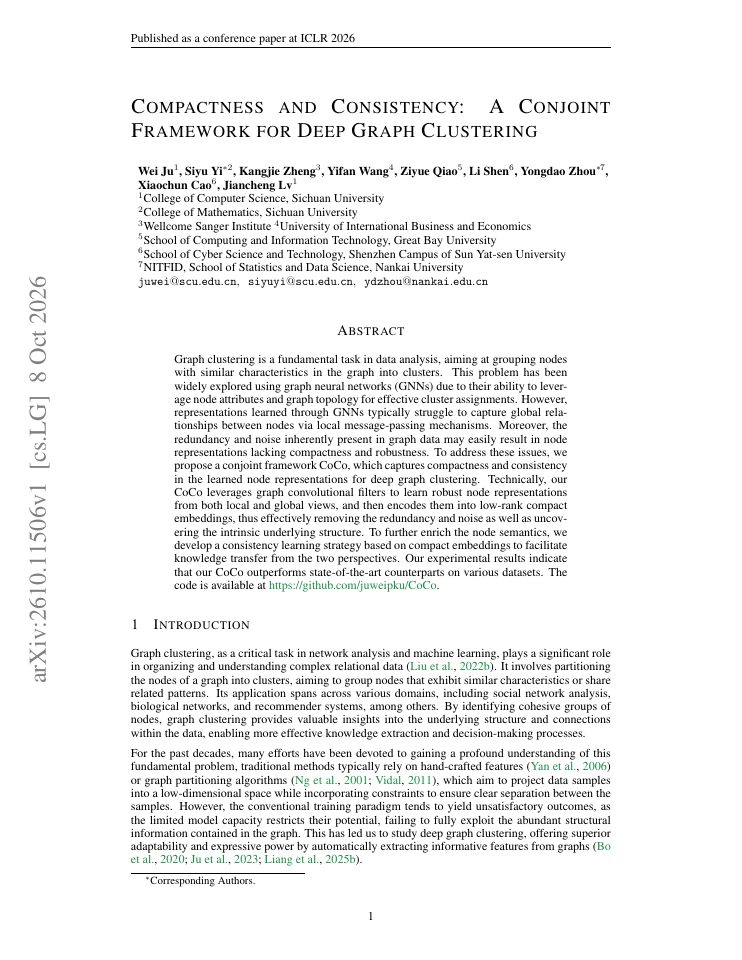
First page of Compactness and Consistency: A Conjoint Framework for Deep Graph Clustering
othernot applicable

Compactness and Consistency: A Conjoint Framework for Deep Graph Clustering

CoCo replaces single-view GNN-based deep graph clustering pipelines with a framework combining graph convolutional filters over local and global views, low-rank compact embeddings, and a consistency-learning strategy between the two perspectives. The cost is added training complexity: dual-view encoding, low-rank projection, and a consistency objective increase implementation effort and training time relative to a standard GNN autoencoder baseline. It can fail if the low-rank constraint discards structure needed to separate fine-grained clusters, or if the two views disagree systematically, since consistency training could then propagate noise.

observed signal
0impl.
0stars
—citations
—claimed gain
abstract onlyReview decisionDownload skill ↓Original paper ↗
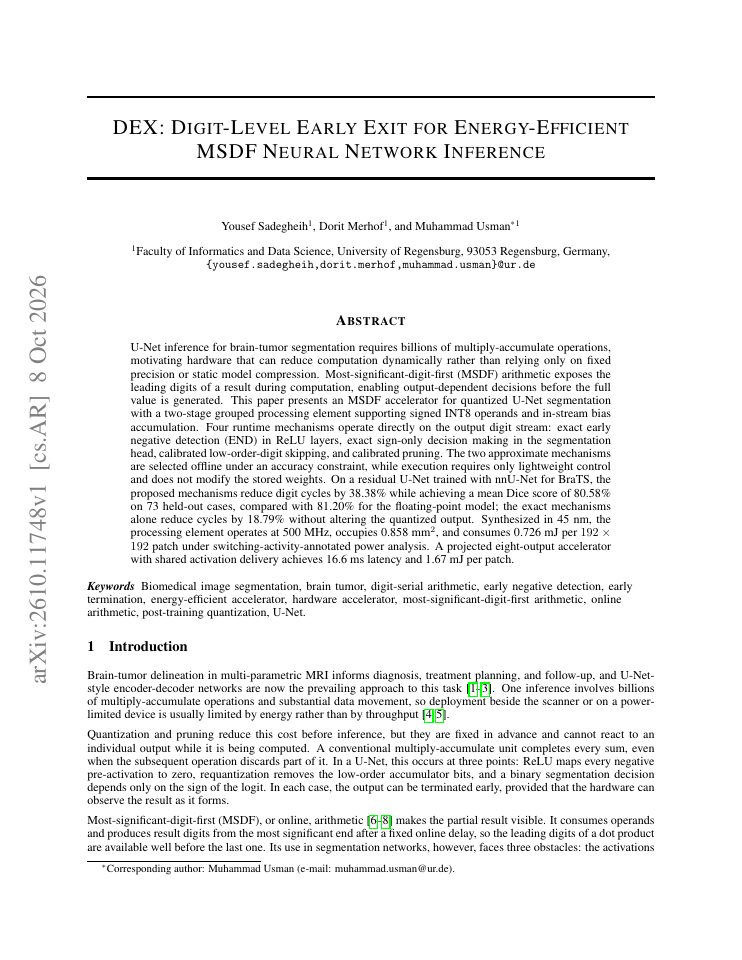
First page of DEX: Digit-Level Early Exit for Energy-Efficient MSDF Neural Network Inference
othernot applicable

DEX: Digit-Level Early Exit for Energy-Efficient MSDF Neural Network Inference

The technique replaces conventional fixed-precision INT8 MAC inference on standard hardware with a custom most-significant-digit-first processing element that skips computation dynamically via exact negative/sign detection and calibrated low-order-digit skipping, requiring ASIC synthesis in 45 nm. The cost is full custom hardware design and fabrication, offline calibration of the approximate mechanisms, and a 0.62-point Dice degradation on BraTS. It cannot be adopted on the reader's 24 GB GPU or third-party APIs because the gains exist only in the synthesized accelerator, and the calibrated skipping and pruning may fail to hold accuracy on other tasks or datasets.

observed signal
0impl.
0stars
—citations
1.62xclaimed gain
abstract onlyReview decisionDownload skill ↓Original paper ↗
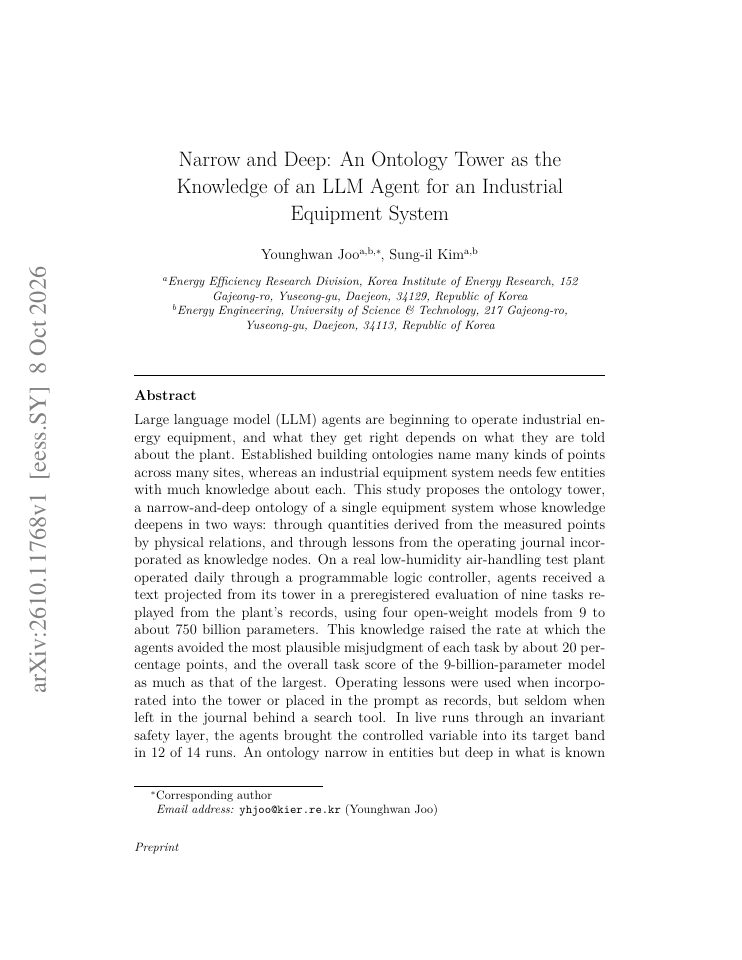
First page of Narrow and Deep: An Ontology Tower as the Knowledge of an LLM Agent for an Industrial Equipment System
memory and contexttest

Narrow and Deep: An Ontology Tower as the Knowledge of an LLM Agent for an Industrial Equipment System

It replaces broad building-automation ontologies (many entities, shallow knowledge) and passive journal search tools with a compact per-system knowledge structure containing derived physical quantities and operating lessons, injected directly as text into the agent's context. The cost is manual construction of the tower per equipment system (defining physical relations and curating journal lessons into knowledge nodes) plus prompt tokens for the projected text; no model training or extra hardware is required. It can fail when lessons are relevant but left behind a search tool (agents rarely retrieved them), when the tower is incomplete or stale relative to actual plant behavior, and when tasks require knowledge outside the encoded physical relations; results also come from a single test plant with nine tasks, so generalization is unverified.

observed signal
0impl.
10stars
—citations
—claimed gain
abstract onlyReview decisionDownload skill ↓Original paper ↗
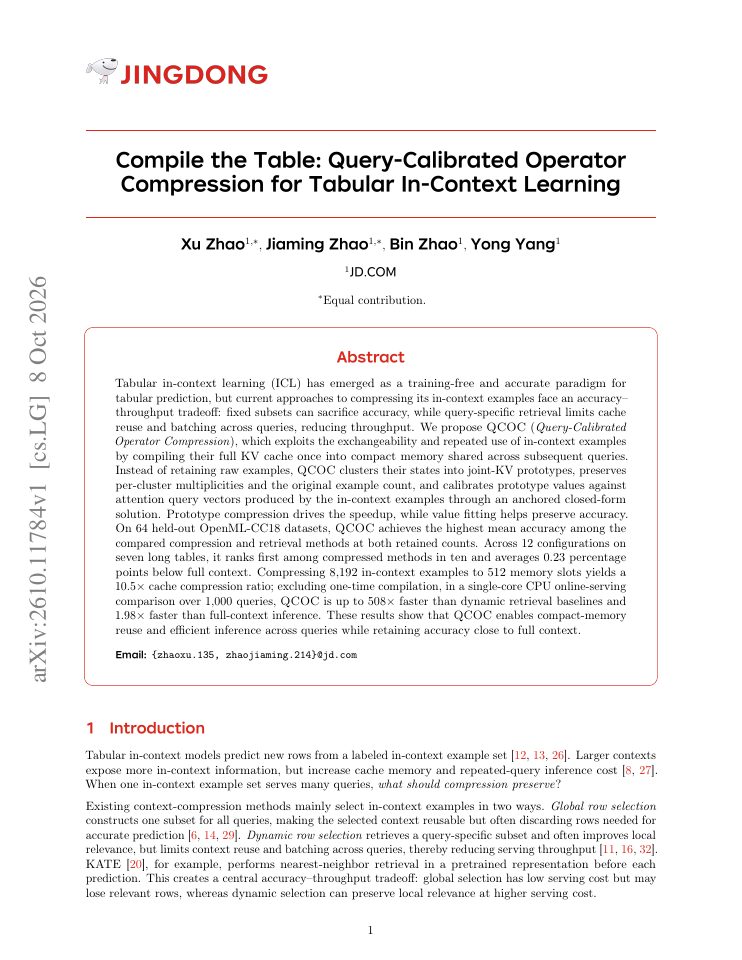
First page of Compile the Table: Query-Calibrated Operator Compression for Tabular In-Context Learning
KV cachetest

Compile the Table: Query-Calibrated Operator Compression for Tabular In-Context Learning

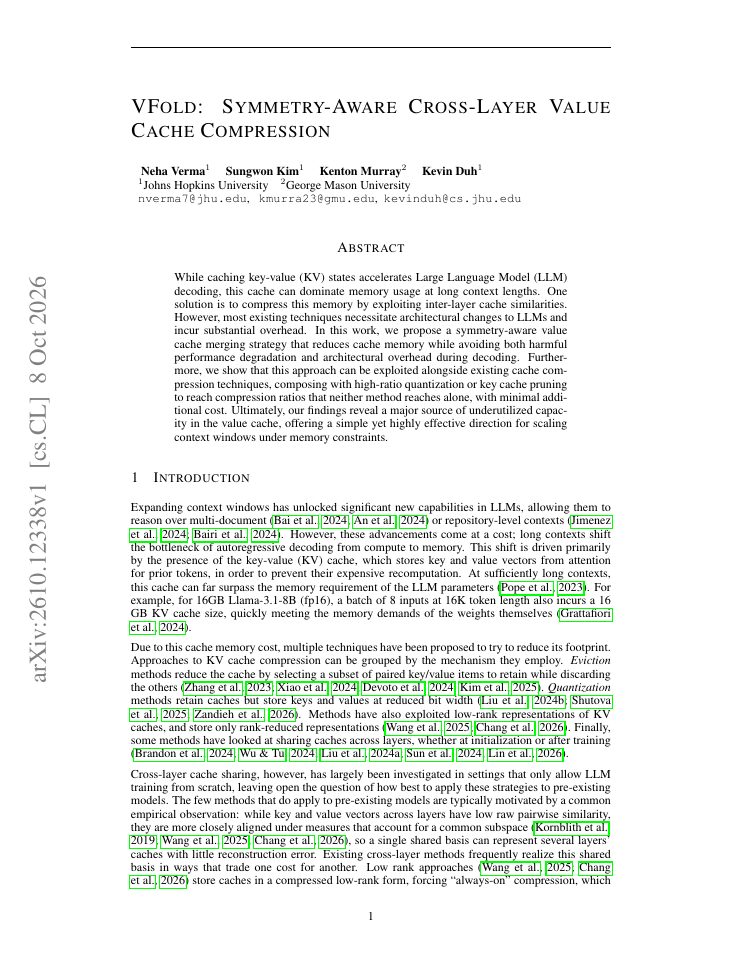
QCOC replaces storing raw in-context examples (or per-query retrieval subsets) in the KV cache of tabular ICL models with a one-time-compiled set of joint-KV prototypes shared across queries. The cost is an offline compilation pass with clustering and closed-form value calibration, plus implementation complexity beyond standard inference stacks, and a small residual accuracy gap (about 0.23 points). It can fail if the workload has few repeated queries over the same table (compilation cost is not amortized), if the underlying tabular ICL model or attention structure differs from the evaluated setup, or if cluster fidelity degrades on tables unlike the OpenML benchmarks.
observed signal
0impl.
4stars
—citations
1.98xclaimed gain
abstract onlyReview decisionDownload skill ↓Original paper ↗
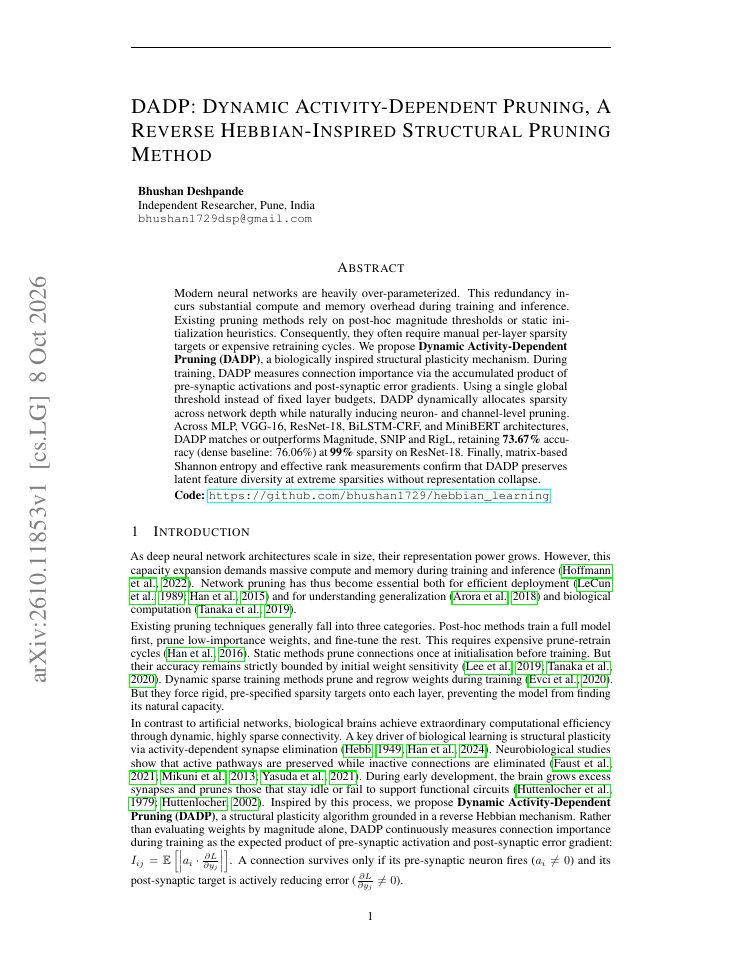
First page of DADP: Dynamic Activity-Dependent Pruning, A Reverse Hebbian-Inspired Structural Pruning Method
sparsity and pruningtest

DADP: Dynamic Activity-Dependent Pruning, A Reverse Hebbian-Inspired Structural Pruning Method

DADP replaces post-hoc magnitude thresholds, static initialization heuristics such as SNIP, and manual per-layer sparsity budgets with a single global importance threshold computed during training from pre-synaptic activations times post-synaptic error gradients. Its cost is the added per-step importance accumulation and mask bookkeeping during training, plus a residual accuracy gap (about 2.4 points at 99% sparsity on ResNet-18), and it does not eliminate the need to retrain from scratch. It can fail through threshold sensitivity that prunes critical neurons early, workload-dependent sparsity allocation that does not transfer across architectures, and unvalidated behavior at production LLM scale, since the largest model tested is MiniBERT.

observed signal
0impl.
0stars
—citations
—claimed gain
abstract onlyReview decisionDownload skill ↓Original paper ↗
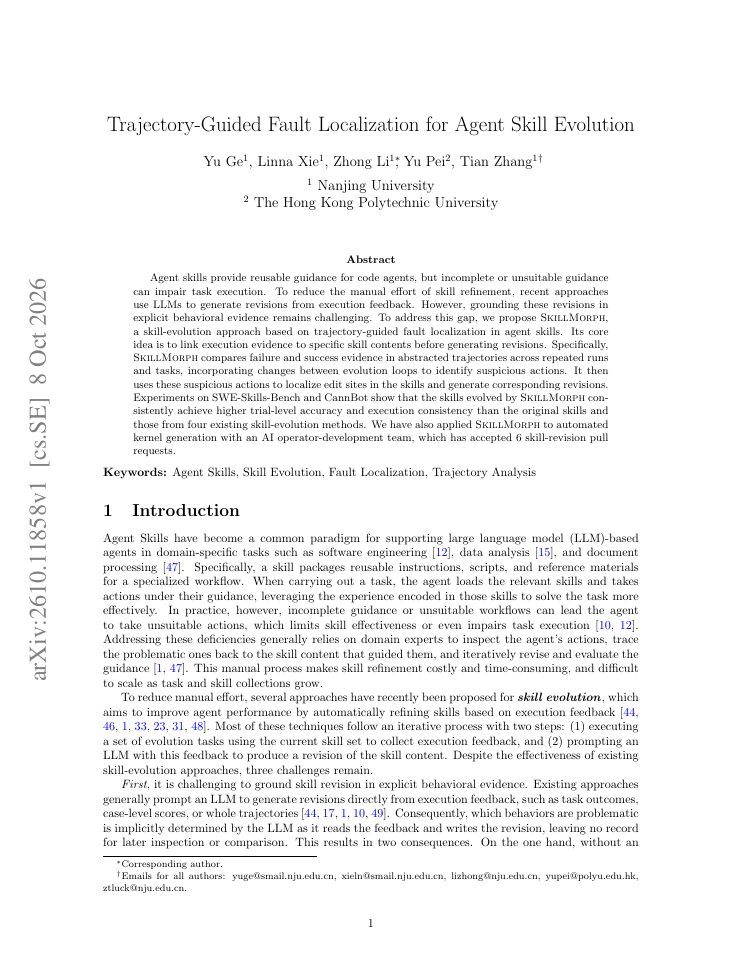
First page of Trajectory-Guided Fault Localization for Agent Skill Evolution
coding agentstest

Trajectory-Guided Fault Localization for Agent Skill Evolution

The method replaces manual inspection of agent skill failures and generic LLM-driven revision with a fault-localization step that compares abstracted failure and success trajectories across repeated runs to identify suspicious actions and targeted edit sites before generating revisions. It costs additional inference for multiple trajectory rollouts, trajectory abstraction, and the localization pipeline, plus integration complexity for logging and skill-file management; no foundation-model training or cluster is required. It can fail when failure and success trajectories are insufficiently sampled to isolate causal actions, when abstractions obscure the true fault, or when localized edits overfit to the benchmark tasks and degrade skill generality.

observed signal
0impl.
10stars
—citations
—claimed gain
abstract onlyReview decisionDownload skill ↓Original paper ↗

Research signals

Three views of the same evidence: adoption against attention, publication cadence by research area, and reported gains when coverage is sufficient.

color = research area

01 · attention × adoption

The research frontier

Look to the upper left for independent implementation before mass attention.

compare by
Each point represents one paper. Higher means more independent implementations; farther right means more GitHub stars.Symbolic Temporal Supervision of LLM Agents Using Contracts: 0 GitHub stars; 1 independent implementationSix Layers Less: Encoder Pruning for Whisper with Label-Free Recovery: 4 GitHub stars; 2 independent implementationsWhen Lower Reconstruction Loss Hurts: Distributionally Robust Refinement for Low-Bit LLM Quantization: 0 GitHub stars; 0 independent implementationsRead What Matters: Query-Adaptive Quantization for KV Caches: 4 GitHub stars; 0 independent implementationsDeflating the Hessian: Rank-4 W4A4 Quantization for Multimodal Diffusion Transformers: 0 GitHub stars; 0 independent implementationsReCal: Calibrating Structured Pruning for On-Policy Distillation Recovery: 122 GitHub stars; 0 independent implementationsRaReCache: Bridging the Gap in Cross-Model KV Cache Reuse via Rank disagreement-based Selective Recomputation: 123 GitHub stars; 1 independent implementationGenerative Adversarial Loops: 4 GitHub stars; 0 independent implementationsEvaluating Local Language Model Agents for Reproducible Data Engineering: An Empirical Software Engineering Study of Mobility Workflows: 14 GitHub stars; 1 independent implementationCompactness and Consistency: A Conjoint Framework for Deep Graph Clustering: 0 GitHub stars; 0 independent implementationsDEX: Digit-Level Early Exit for Energy-Efficient MSDF Neural Network Inference: 0 GitHub stars; 0 independent implementationsWhat Output-Only Review Cannot Verify: Study Contracts for Research Agents: 132 GitHub stars; 1 independent implementationNarrow and Deep: An Ontology Tower as the Knowledge of an LLM Agent for an Industrial Equipment System: 10 GitHub stars; 0 independent implementationsCompile the Table: Query-Calibrated Operator Compression for Tabular In-Context Learning: 4 GitHub stars; 0 independent implementationsEasy to anticipate, hard to compute: boundary dependence finds the computed outputs that entropy patching misses: 122 GitHub stars; 1 independent implementationMemento 3: Model-Based Recursive Self-Improvement through Reflective Rulebooks: 338 GitHub stars; 2 independent implementationsDADP: Dynamic Activity-Dependent Pruning, A Reverse Hebbian-Inspired Structural Pruning Method: 0 GitHub stars; 0 independent implementationsTrajectory-Guided Fault Localization for Agent Skill Evolution: 10 GitHub stars; 0 independent implementationsForms of LLM-Integrated Applications from LLM-Chats to Autonomous AI Agent System: 10 GitHub stars; 0 independent implementationsRobustLDS: Learning linear dynamical systems under adversarial corruptions: 0 GitHub stars; 0 independent implementationsEvent-Centric Memory with Query-Aware Graph Augmentation for Long-Term Conversational Agents: 132 GitHub stars; 1 independent implementationMiMo-V2.6: Scaling Reinforcement Learning Towards Self-Improvement: 132 GitHub stars; 2 independent implementationsCan LLMs Fix It Without Code? Toward Automated Verification of No-Code Bug Fixes: 0 GitHub stars; 0 independent implementationsThe Polytopal Neural Network: 0 GitHub stars; 0 independent implementationsWhen Should Agents Think? Adaptive Reasoning via Cross-Turn Estimation: 132 GitHub stars; 1 independent implementationEvoAlloc: A Self-Evolving Resource Allocation Agent for Efficient Program Evolution: 133 GitHub stars; 2 independent implementationsRehearse Everything, Remember Nothing: Attic-KV Rehearses What Will Be Read: 122 GitHub stars; 1 independent implementationRecursive Self-Improvement through Multi-Agent Self-Supervision: 132 GitHub stars; 1 independent implementationA Closer Look at Agentic BBO: Benchmarking LLM Agents for Black-Box Optimization: 12 GitHub stars; 2 independent implementationsAdaCast: Conditional Parameter Generation for Adaptive Time Series Forecasting: 1 GitHub star; 0 independent implementationsCadence: Strategic Guidance for Coding Agents: 0 GitHub stars; 0 independent implementationsUnlocking the Regulatory Genome by ARGUS: An Evidence-Constrained Agentic Framework for Interpreting Single Nucleotide Variants: 0 GitHub stars; 0 independent implementationsTestPrism: Rethinking Test Evaluation Beyond a Single Reference: 1 GitHub star; 2 independent implementationsOne Word Opens the Gate: The Option-Channel Attack on Typed Decision Models as Agent Guardrails: 132 GitHub stars; 1 independent implementationSparseDecoding: Decoding-Aware Pruning for Accurate and Efficient LLM Inference: 0 GitHub stars; 0 independent implementationsasdex: Automatic Sparse Differentiation in JAX: 53 GitHub stars; 0 independent implementationsVFold: Symmetry-Aware Cross-Layer Value Cache Compression: 122 GitHub stars; 0 independent implementationsAccurate but Not Humble: Evaluating Epistemic Humility in LLM Agents under Knowledge Conflict: 132 GitHub stars; 2 independent implementationsOnTrack: Real-Time Monitoring and Intervention in LLM Agent Trajectories via Streaming Structure-Aware Optimal Transport: 10 GitHub stars; 0 independent implementationsRounding in Preconditioner Space: Redesigning 4-bit AdamW Optimizer-State Quantization: 1 GitHub star; 0 independent implementationsCaught in the Act: Probes Effectively Detect Sabotage and Catch Unverbalized Deception: 1 GitHub star; 2 independent implementationsBrickBench: Evaluating Agentic Brick Design: 11 GitHub stars; 2 independent implementations

Papers above 1000 stars or 200 citations are not scored. They have already broken through the attention threshold, while Paperraft is designed to identify earlier signals.

02 · cadence

Research areas over time

Compare monthly publication volume on a shared scale and calendar.

coding agentsmax 7Sep 26: 0 papersOct 26: 3 papersSep 26Oct 26efficient architecturesmax 7Sep 26: 0 papersOct 26: 1 paperSep 26Oct 26agent evaluationmax 7Sep 26: 0 papersOct 26: 7 papersSep 26Oct 26KV cachemax 7Sep 26: 0 papersOct 26: 5 papersSep 26Oct 26sparsity and pruningmax 7Sep 26: 1 paperOct 26: 3 papersSep 26Oct 26memory and contextmax 7Sep 26: 0 papersOct 26: 3 papersSep 26Oct 26multi-agent orchestrationmax 7Sep 26: 0 papersOct 26: 3 papersSep 26Oct 26othermax 7Sep 26: 0 papersOct 26: 4 papersSep 26Oct 26planning and decompositionmax 7Sep 26: 0 papersOct 26: 1 paperSep 26Oct 26quantizationmax 7Sep 26: 0 papersOct 26: 3 papersSep 26Oct 26failure recoverymax 7Sep 26: 0 papersOct 26: 1 paperSep 26Oct 26safety and guardrailsmax 7Sep 26: 1 paperOct 26: 2 papersSep 26Oct 26efficient trainingmax 7Sep 26: 0 papersOct 26: 3 papersSep 26Oct 26tool usemax 7Sep 26: 0 papersOct 26: 1 paperSep 26Oct 26

Every panel uses the same calendar and vertical scale. An empty column means no papers were recorded.

Method under scrutiny

Inspect the highest-ranked paper, every repository behind its signal, and the rule used to classify each one.

Symbolic Temporal Supervision of LLM Agents Using Contracts

safety and guardrails · test · 1 of 2 implementations is independent

It replaces stochastic post-hoc LLM judges and per-call rule-based blockers with a single deterministic artifact: assume-guarantee contracts in finite-trace LTL, compiled to DFAs that gate tool calls online and evaluate recorded traces offline. The cost is engineering effort, not compute: someone must formalize checkable predicates over tool calls and author and maintain a correct contract library per task domain, plus DFA compilation overhead. It can fail when contracts are incomplete, wrongly specified, or the predicate set cannot observe the relevant state, in which case harmful actions pass deterministically or benign ones are blocked, and coverage does not transfer across domains without rewriting contracts.

Exclusions and controls

Every exclusion is counted and published.

Exclusion counts were not recorded for this edition.

0 previously indexed papers were rechecked in this run.

Paperraft tracks one signal: how many independent implementations a paper attracts on GitHub after author-owned repositories are removed. This is a discovery signal to investigate, not a measure of implementation quality.

It does not claim that a method works. Paperraft runs no reproduction benchmarks. Reported gains remain author claims until independently tested. Papers above the attention threshold are excluded because this publication is designed to identify research before consensus forms.