Skip to content

archived edition · 2026-10-07

PaperraftFind the AI research
worth testing.

Understand what a paper changes, what it costs, and whether it fits your next build. Explore research on faster LLM inference, agent memory, and evaluation, with the original sources in reach.

Start with a brief. Follow the evidence. Choose a test.

edition
2026-10-07
briefs
25
research areas
14
independent implementations
13

20 of 25 papers in the index (80%) have no independent implementations.

Research index

Search by topic, browse a research area, or sort by date. Read a brief, open the original paper, and inspect the available evidence before deciding what to test.

showing25 of 25
sort by
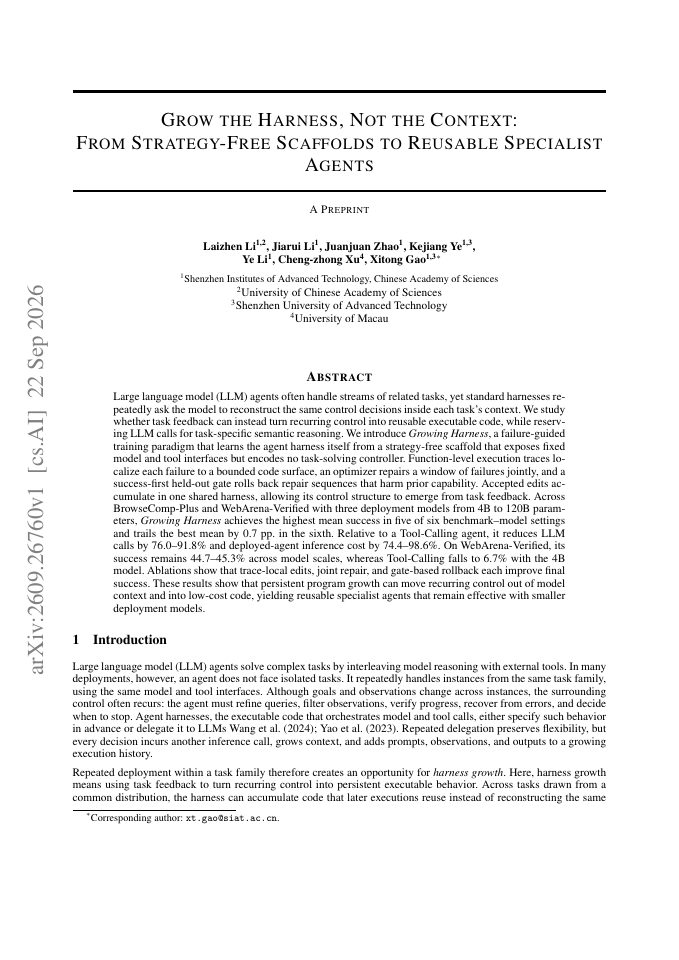
First page of Grow the Harness, Not the Context: From Strategy-Free Scaffolds to Reusable Specialist Agents
memory and contexttest

Grow the Harness, Not the Context: From Strategy-Free Scaffolds to Reusable Specialist Agents

The method replaces per-task in-context reconstruction of control logic with a shared executable harness that is iteratively grown from failure traces, reserving LLM calls for task-specific reasoning. It costs an offline optimization loop with function-level tracing, joint failure repair, and gated rollback, plus ongoing maintenance of an accumulating code artifact whose complexity grows with use. After adoption it can fail when repairs overfit to the training task distribution, when the success gate misses regressions not covered by held-out tasks, or when task drift makes the frozen control code obsolete.

observed signal
4impl.
10stars
0citations
4.2xclaimed gain
abstract onlyReview decisionDownload skill ↓Original paper ↗
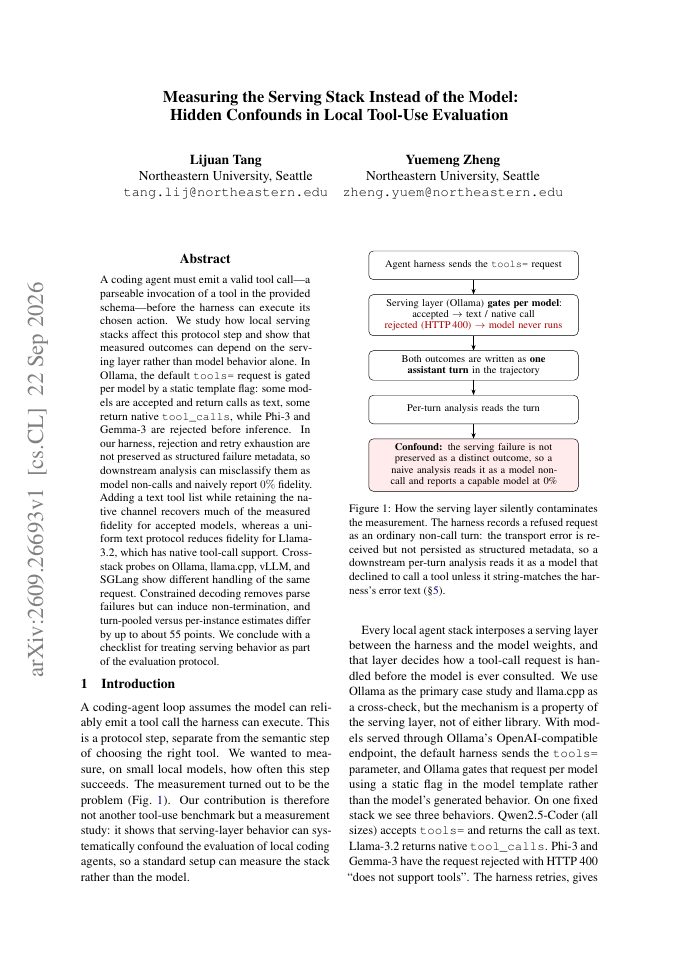
First page of Measuring the Serving Stack Instead of the Model: Hidden Confounds in Local Tool-Use Evaluation
agent evaluationadopt

Measuring the Serving Stack Instead of the Model: Hidden Confounds in Local Tool-Use Evaluation

The technique replaces naive tool-call fidelity measurement, which treats serving-stack rejections and parse failures as model errors, with a protocol that logs structured failure metadata, probes per-model serving behavior (Ollama template flags, llama.cpp, vLLM, SGLang), and reports per-instance rather than turn-pooled estimates. It costs additional harness instrumentation, per-model serving configuration checks, and more verbose failure logging, but requires no extra compute or training. It can fail if constrained decoding is applied blindly, since it eliminates parse failures but can induce non-termination, and if teams assume one protocol fits all models, since uniform text protocols degrade models with native tool-call support.

observed signal
2impl.
3stars
0citations
—claimed gain
abstract onlyReview decisionDownload skill ↓Original paper ↗
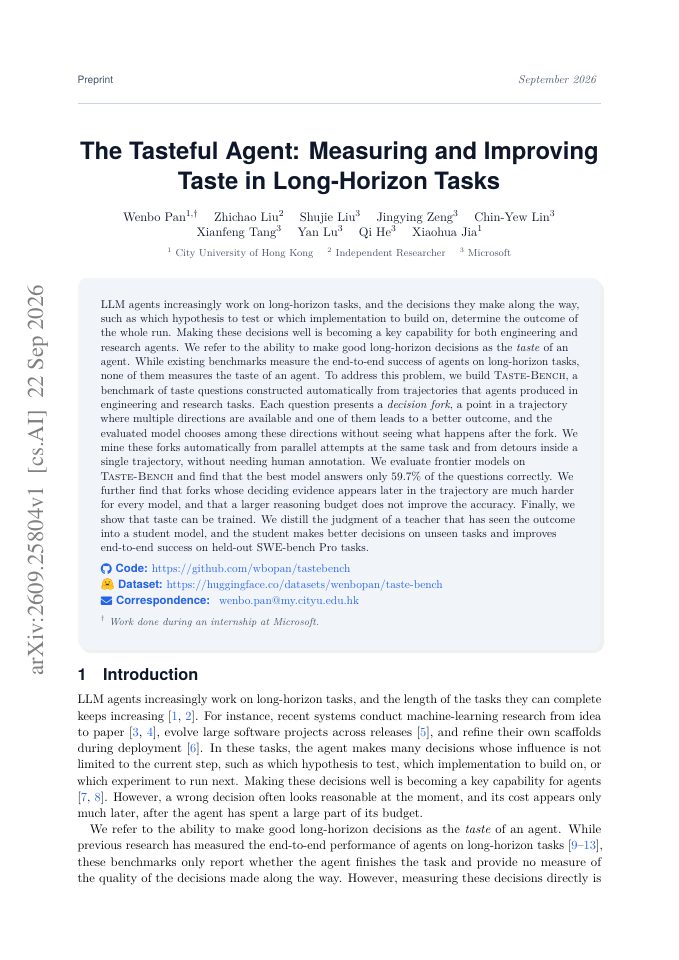
First page of The Tasteful Agent: Measuring and Improving Taste in Long-Horizon Tasks
agent evaluationtest

The Tasteful Agent: Measuring and Improving Taste in Long-Horizon Tasks

The paper replaces end-to-end agent success metrics with a benchmark of automatically mined decision forks from parallel attempts and detours, plus a distillation method that replaces ad hoc prompting of long-horizon decisions with a student trained on a teacher that has seen outcomes. The benchmark itself costs only trajectory collection and comparison (no human annotation), but the training component requires generating parallel rollouts, teacher labeling with outcome access, and fine-tuning, which is feasible on a 24 GB GPU only for smaller students and is more realistically done via API-based teachers plus local fine-tuning. Findings that later-evidence forks are hard for all models and that larger reasoning budgets do not help indicate the capability gap will not close with inference-time scaling, and distillation can fail if teacher outcomes are noisy proxies for decision quality, if mined forks correlate with spurious cues, or if gains do not transfer beyond SWE-bench-like coding tasks.

observed signal
3impl.
34stars
0citations
—claimed gain
abstract onlyReview decisionDownload skill ↓Original paper ↗
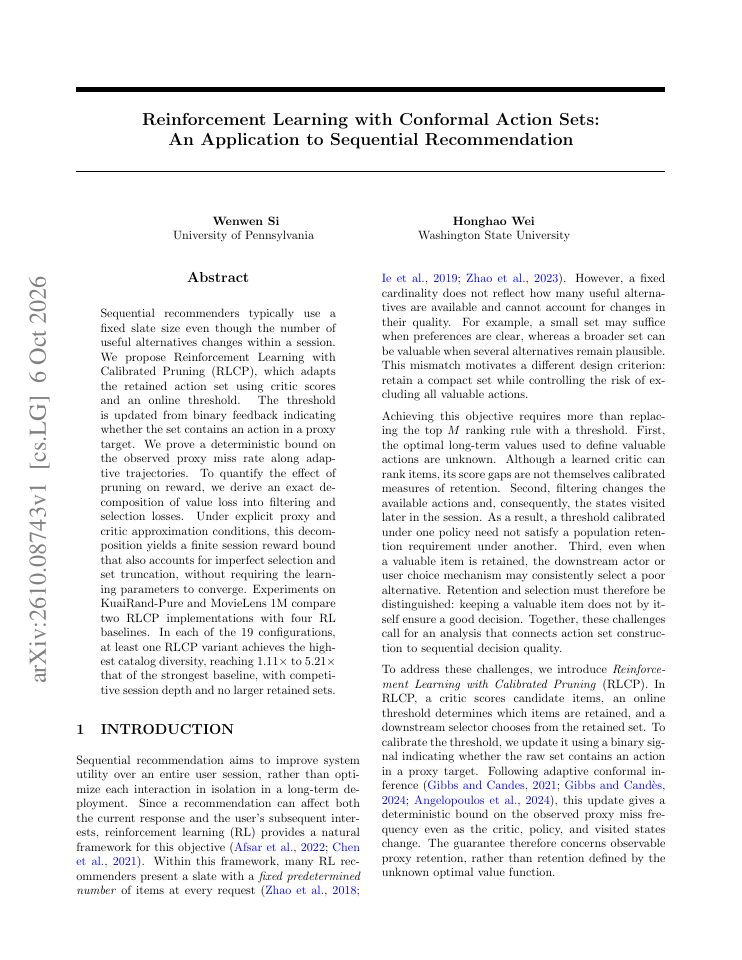
First page of Reinforcement Learning with Conformal Action Sets: An Application to Sequential Recommendation
otherwatch

Reinforcement Learning with Conformal Action Sets: An Application to Sequential Recommendation

The method replaces fixed-slate sequential recommendation with an RL policy whose action set is adaptively pruned via critic scores and an online-calibrated threshold, providing a deterministic proxy miss-rate bound and a value-loss decomposition into filtering and selection terms. The cost is additional machinery beyond a standard recommender: a trained critic, an online threshold update driven by proxy-target feedback, and dependence on a well-specified proxy and critic approximation conditions for the finite-session reward guarantee. It can fail when the proxy target poorly represents true user intent (the bound covers only proxy miss rate, not realized reward), when critic estimation is inaccurate, or in cold-start and sparse-feedback regimes, and the reported gains are limited to two offline datasets (KuaiRand-Pure, MovieLens 1M) rather than live A/B traffic.

observed signal
3impl.
33stars
—citations
5.21xclaimed gain
abstract onlyReview decisionDownload skill ↓Original paper ↗
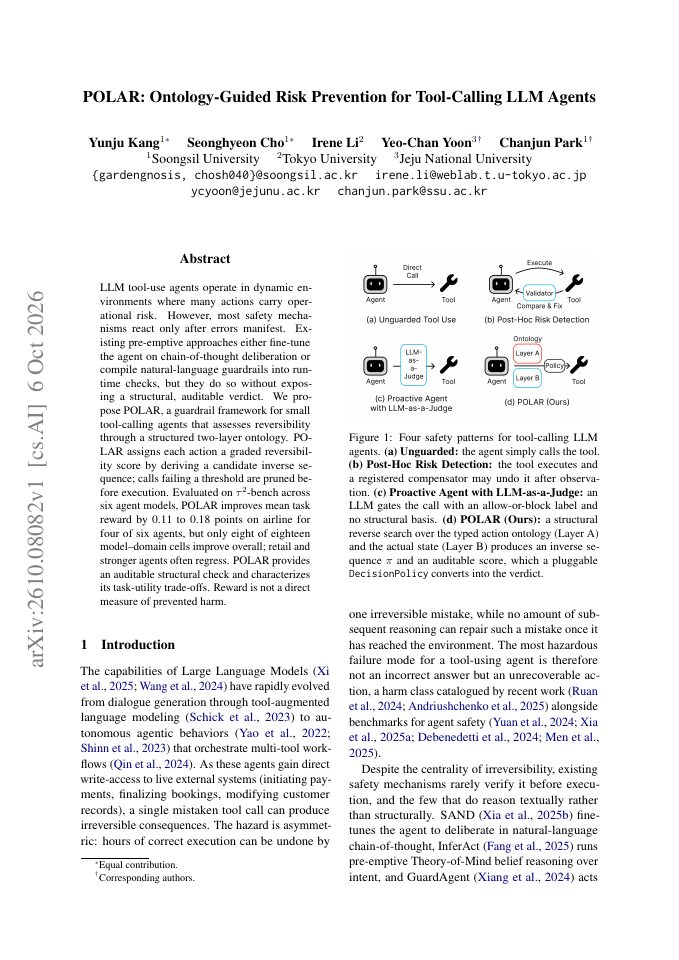
First page of POLAR: Ontology-Guided Risk Prevention for Tool-Calling LLM Agents
safety and guardrailswatch

POLAR: Ontology-Guided Risk Prevention for Tool-Calling LLM Agents

POLAR replaces reactive post-error safety mechanisms and unstructured natural-language guardrails with a pre-execution structural check that scores action reversibility via a two-layer ontology and prunes calls below a threshold. It costs additional inference calls to derive candidate inverse action sequences and their scoring, adding latency and API expense per candidate action, plus the engineering burden of maintaining the domain ontology. It can fail by pruning valid actions in domains with poor ontology coverage, and the paper's own results show regressions on retail tasks and stronger agent models, so adoption can reduce task success rather than protect it.

observed signal
1impl.
131stars
—citations
—claimed gain
abstract onlyReview decisionDownload skill ↓Original paper ↗
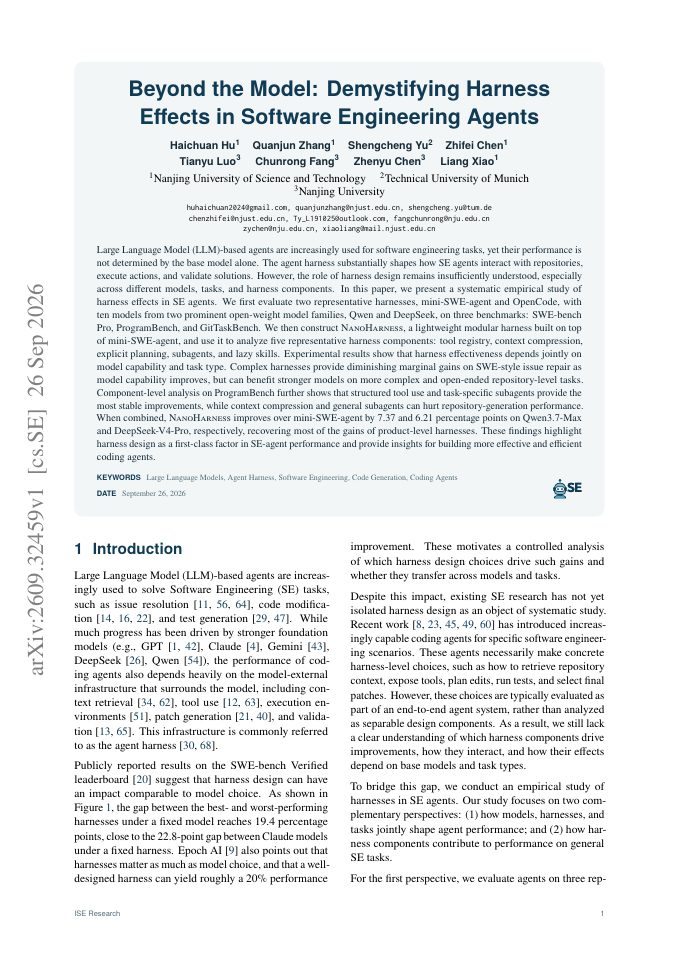
First page of Beyond the Model: Demystifying Harness Effects in Software Engineering Agents
coding agentstest

Beyond the Model: Demystifying Harness Effects in Software Engineering Agents

The study replaces the assumption that agent performance is a property of the base model alone, evaluating harness components (tool registry, context compression, explicit planning, subagents, lazy skills) as first-class design decisions on top of existing open-weight models and benchmarks. Cost is primarily engineering complexity rather than compute: NanoHarness builds on the lightweight mini-SWE-agent and runs with API-accessible models, so no additional GPU or training budget is required, though each added component increases orchestration and maintenance burden. What can fail: harness benefits depend jointly on model capability and task type, complex harnesses yield diminishing returns on SWE-style issue repair with stronger models, and context compression or general-purpose subagents can actively degrade repository-generation performance.

observed signal
0impl.
0stars
0citations
—claimed gain
abstract onlyReview decisionDownload skill ↓Original paper ↗
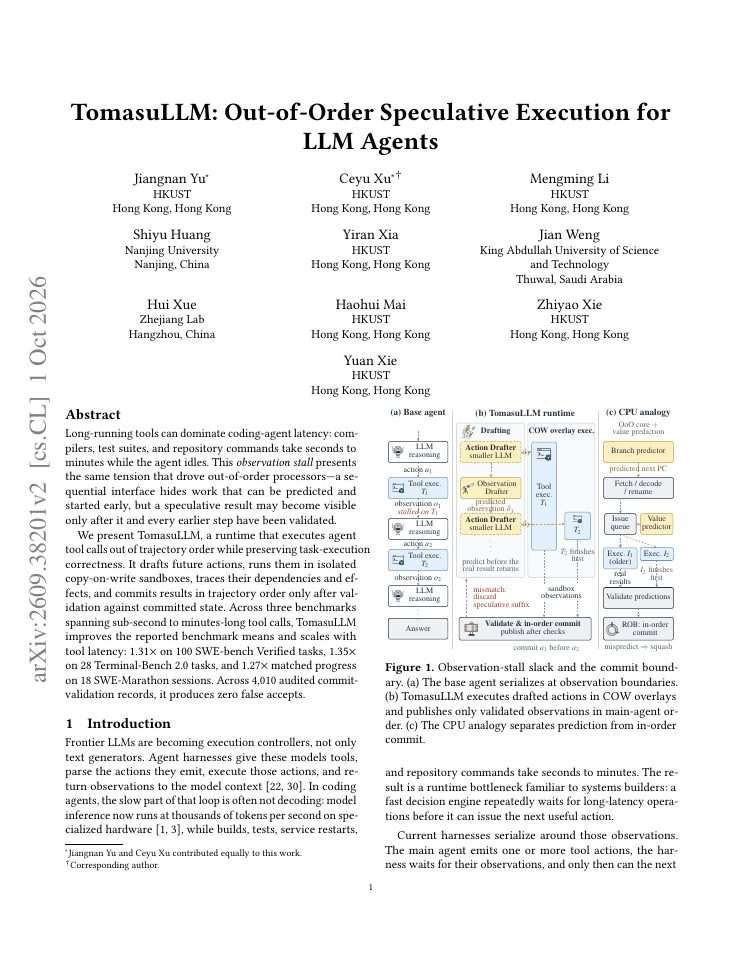
First page of TomasuLLM: Out-of-Order Speculative Execution for LLM Agents
tool usewatch

TomasuLLM: Out-of-Order Speculative Execution for LLM Agents

It replaces the sequential tool-call loop of a coding agent, in which the model idles while long-running tools execute, with a runtime that drafts future actions, executes them in copy-on-write sandboxes, and commits results in trajectory order after validation. It costs sandboxing and dependency/effect-tracing infrastructure, extra compute for speculative executions that are later invalidated, and substantial engineering complexity beyond a single-GPU deployment. It can fail when drafted actions diverge from the actual trajectory, making wasted speculative runs offset the latency gains on workloads with short or unpredictable tool calls.

observed signal
0impl.
0stars
0citations
1.31xclaimed gain
abstract onlyReview decisionDownload skill ↓Original paper ↗
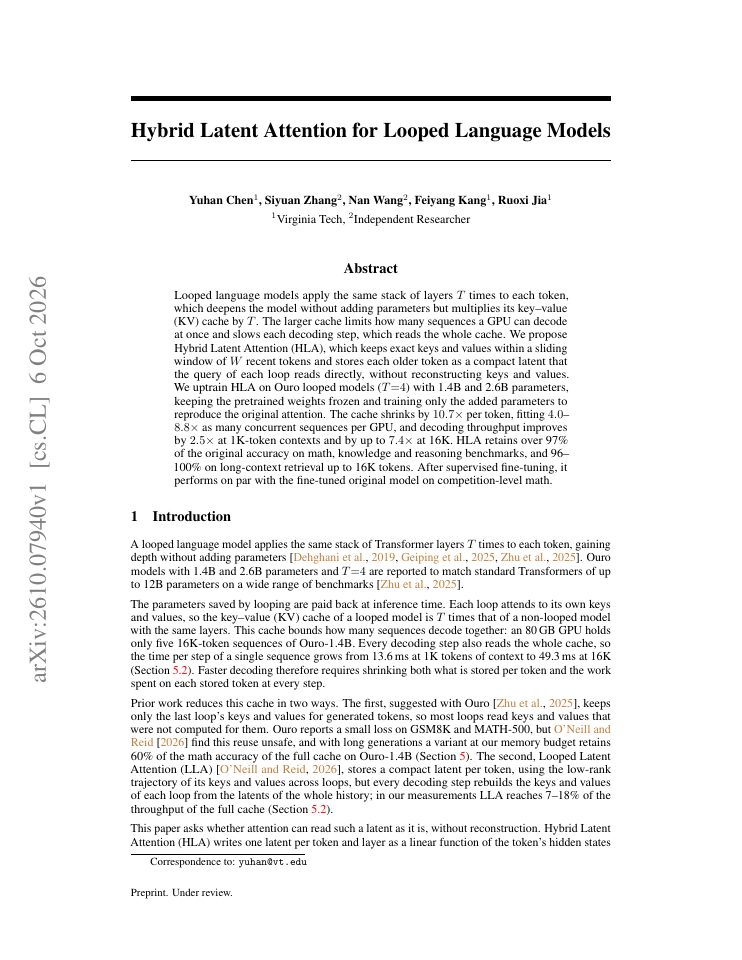
First page of Hybrid Latent Attention for Looped Language Models
KV cachewatch

Hybrid Latent Attention for Looped Language Models

HLA replaces full per-loop key-value storage in looped language models (which multiply the KV cache by the loop count T) with exact keys/values in a sliding window plus compact latents for older tokens, read directly without reconstruction. It costs an uptraining phase per base model, added latent-attention parameters and implementation complexity, and a small accuracy loss (up to roughly 3% on some benchmarks). It can fail on tasks sensitive to information outside the sliding window at longer contexts than evaluated, and its gains vanish on standard non-looped architectures where the cache is not multiplied by T.

observed signal
0impl.
121stars
—citations
10.7xclaimed gain
abstract onlyReview decisionDownload skill ↓Original paper ↗
sparsity and pruningwatch

VisionWeave: Weaving Elastic Visual Representations as a Native Capability of MLLMs

The method replaces dense fixed-size patch token encoding, and static downsampling or token pruning, with a learned gated spatial pooler plus granularity router that allocates coarse or fine visual tokens per region inside a shared MRoPE coordinate system. The cost is that this is a native model capability established through large-scale end-to-end self-distillation training (over 30K A100 GPU-hours on a 27B model), not an inference-time drop-in; adopting it requires either training such a model or using released weights, and quality retention is 98.9% rather than 100%. It can fail on workloads whose visual content distribution differs from the training data, causing the router to misallocate granularity, and benefits vanish if no compatible trained checkpoint exists for the reader's chosen base model.

observed signal
0impl.
0stars
—citations
2.3xclaimed gain
abstract onlyReview decisionDownload skill ↓Original paper ↗
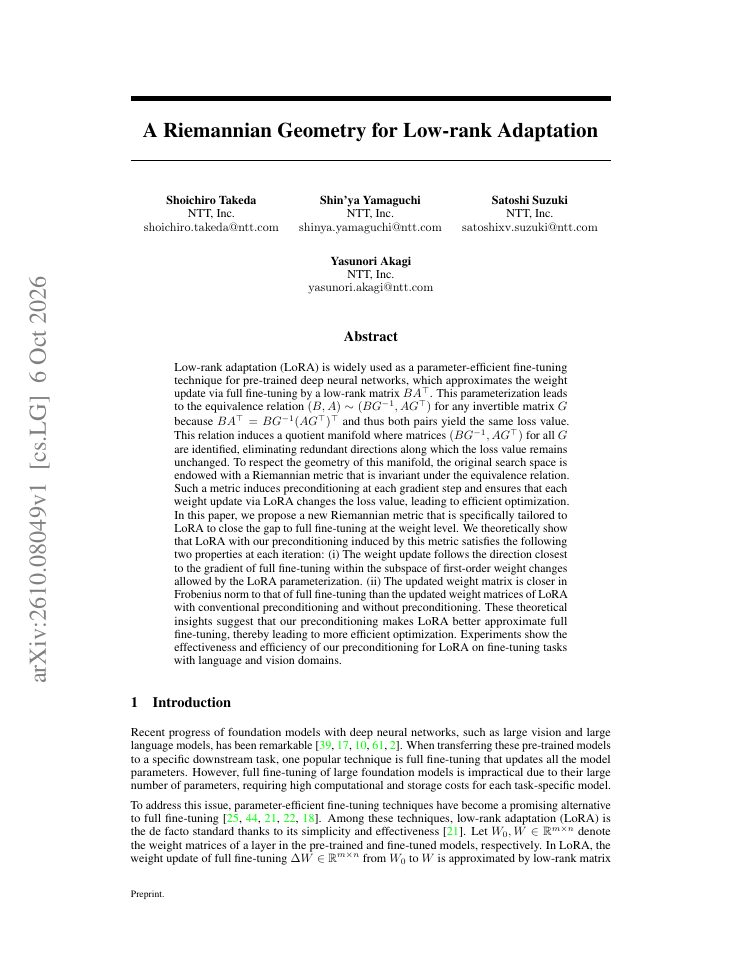
First page of A Riemannian Geometry for Low-rank Adaptation
efficient trainingtest

A Riemannian Geometry for Low-rank Adaptation

The method replaces standard gradient descent on LoRA's A and B matrices with gradients preconditioned by a Riemannian metric invariant to LoRA's reparameterization symmetry, making each low-rank update provably closer to the full fine-tuning gradient direction. It costs additional per-step computation and implementation complexity for the preconditioning operator, while keeping memory footprint at standard LoRA levels since no extra parameters are stored. It can fail if the theoretical advantage does not survive optimizer interactions (Adam-style adaptive methods already precondition gradients), if the preconditioner adds non-trivial overhead per step, or if gains are task-dependent and absent on the reader's specific fine-tuning workload.

observed signal
0impl.
0stars
—citations
—claimed gain
abstract onlyReview decisionDownload skill ↓Original paper ↗
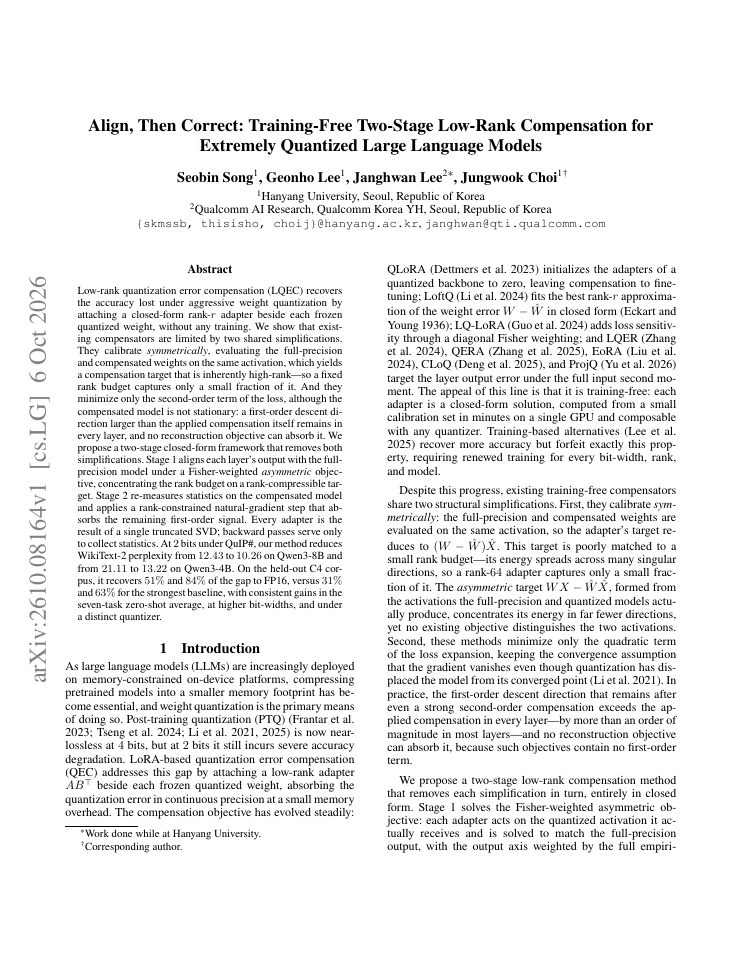
First page of Align, Then Correct: Training-Free Two-Stage Low-Rank Compensation for Extremely Quantized Large Language Models
quantizationadopt

Align, Then Correct: Training-Free Two-Stage Low-Rank Compensation for Extremely Quantized Large Language Models

It replaces one-shot symmetric low-rank error compensation (e.g., standard LQEC adapters) with a two-stage closed-form procedure: a Fisher-weighted asymmetric alignment stage followed by a rank-constrained natural-gradient correction computed on re-measured statistics of the compensated model. Cost is one truncated SVD plus calibration forward and backward passes per layer for statistics, a small rank-r adapter added beside each frozen quantized weight (modest memory overhead on top of the quantized model), and additional compute during quantization only, not at serving. It can fail when calibration data is unrepresentative of deployment distribution, when the rank budget is too small for layers with high-rank residual error, or when gains do not transfer to quantizers or architectures beyond those evaluated.

observed signal
0impl.
0stars
—citations
—claimed gain
abstract onlyReview decisionDownload skill ↓Original paper ↗
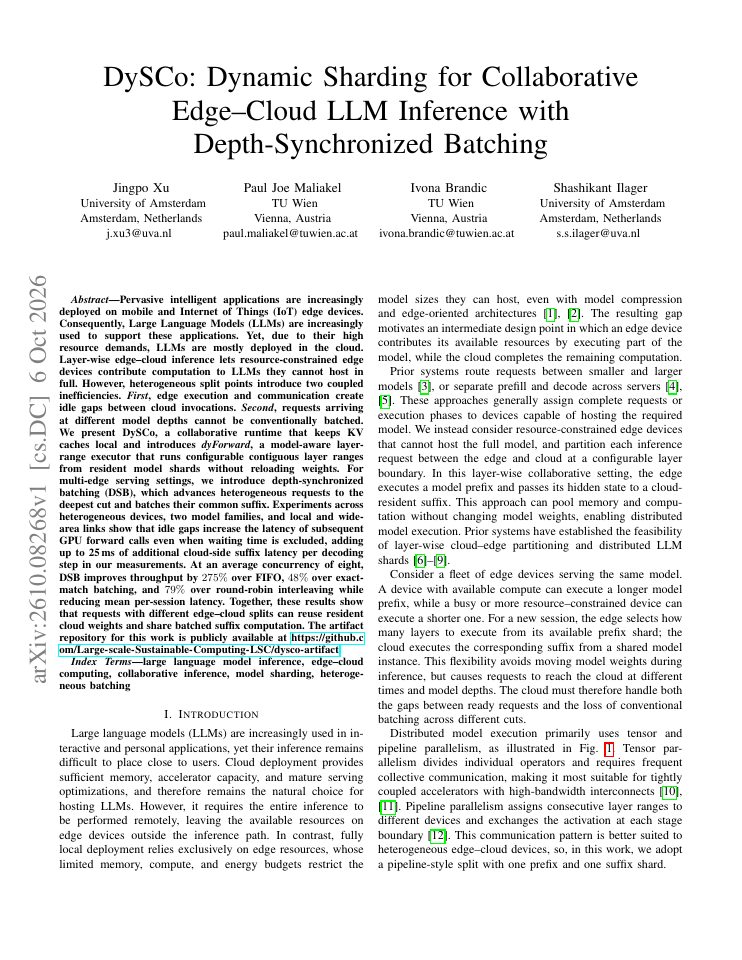
First page of DySCo: Dynamic Sharding for Collaborative Edge-Cloud LLM Inference with Depth-Synchronized Batching
serving and batchingwatch

DySCo: Dynamic Sharding for Collaborative Edge-Cloud LLM Inference with Depth-Synchronized Batching

DySCo replaces conventional cloud-only batching (FIFO, exact-match, or round-robin scheduling of split-inference requests) with a runtime that keeps KV caches on edge devices, executes arbitrary contiguous layer ranges from resident shards without weight reloads, and batches the common cloud-side suffix of requests cut at heterogeneous depths. The cost is a custom model-aware executor, edge-resident KV cache memory, and scheduling complexity that only pays off at meaningful concurrency with mixed split points. It can fail when concurrency is low (no batching benefit), when edge devices are too weak or links too slow for split inference to beat direct API calls, and when the engineering effort exceeds the latency budget of a small team.

observed signal
0impl.
0stars
—citations
3.75xclaimed gain
abstract onlyReview decisionDownload skill ↓Original paper ↗
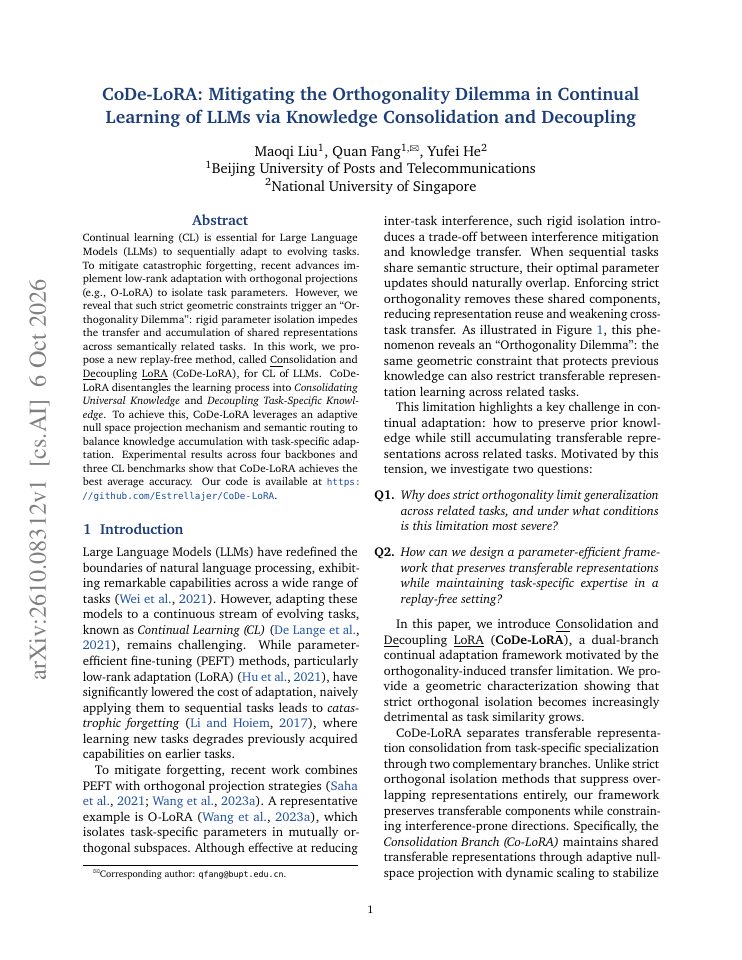
First page of CoDe-LoRA: Mitigating the Orthogonality Dilemma in Continual Learning of LLMs via Knowledge Consolidation and Decoupling
efficient trainingtest

CoDe-LoRA: Mitigating the Orthogonality Dilemma in Continual Learning of LLMs via Knowledge Consolidation and Decoupling

CoDe-LoRA replaces strictly orthogonal LoRA updates (e.g., O-LoRA) for sequential fine-tuning with adaptive null-space projection plus semantic routing, splitting learning into shared-knowledge consolidation and task-specific decoupling, and it is replay-free, so it fits a single 24 GB GPU budget. The cost is added implementation complexity (routing and per-task projection bookkeeping) and a modest memory overhead for storing accumulated task adapters relative to a single LoRA. It can fail when task semantics are ambiguous or the router misassigns tasks, when benchmarks used in the paper do not match the reader's task sequence, or when many tasks accumulate enough adapters to strain storage and adapter-selection latency.

observed signal
0impl.
121stars
—citations
—claimed gain
abstract onlyReview decisionDownload skill ↓Original paper ↗
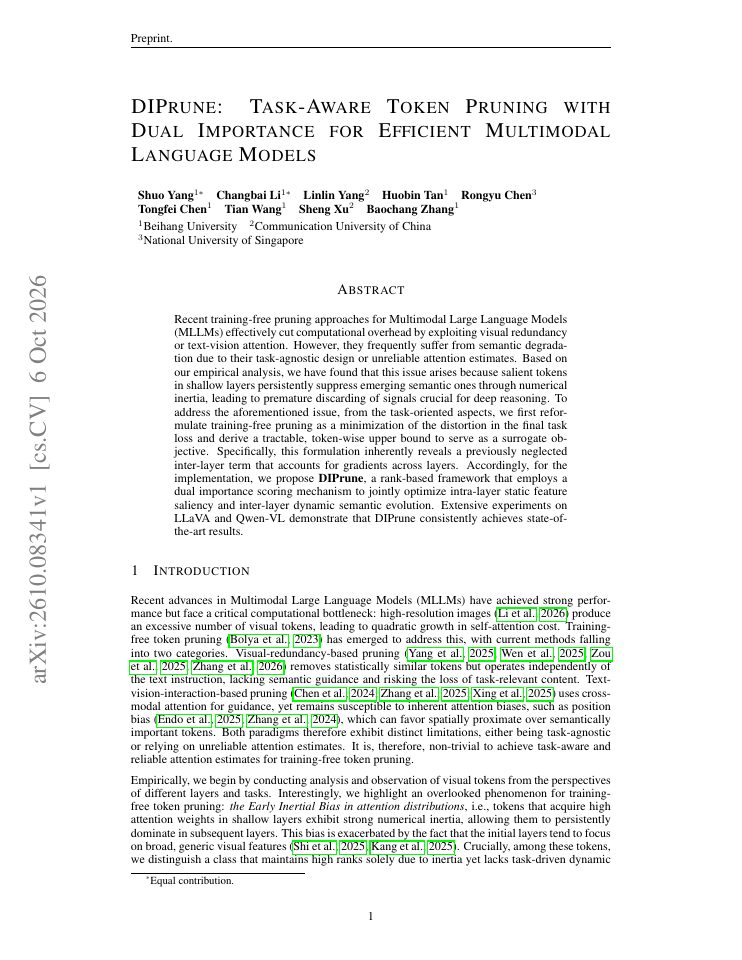
First page of DIPrune: Task-Aware Token Pruning with Dual Importance for Efficient Multimodal Language Models
sparsity and pruningtest

DIPrune: Task-Aware Token Pruning with Dual Importance for Efficient Multimodal Language Models

DIPrune replaces task-agnostic or attention-based training-free visual token pruning in MLLMs with a dual importance score combining intra-layer feature saliency and inter-layer semantic evolution derived from a task-loss distortion bound. It costs additional per-layer scoring and ranking computation at inference and implementation complexity, though it requires no retraining and reduces visual token count and thus compute on a single GPU. It can fail if the gradient-based inter-layer importance estimates are unreliable for a given task distribution, or if aggressive pruning ratios still discard tokens needed for deep reasoning despite the corrective term.

observed signal
0impl.
0stars
—citations
—claimed gain
abstract onlyReview decisionDownload skill ↓Original paper ↗
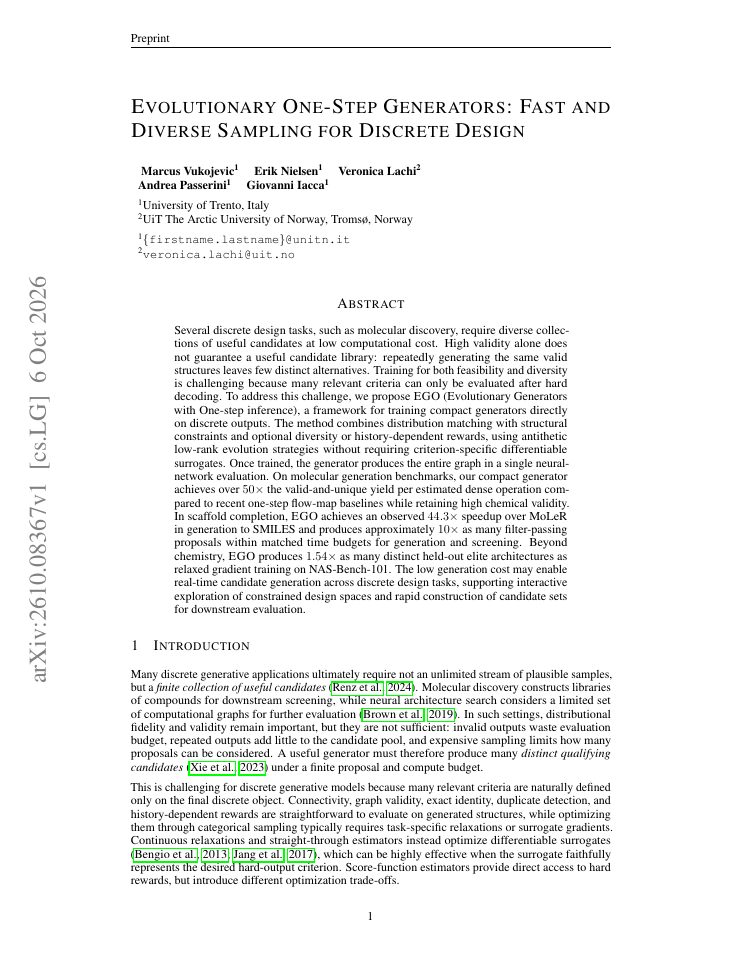
First page of Evolutionary One-Step Generators: Fast and Diverse Sampling for Discrete Design
othertest

Evolutionary One-Step Generators: Fast and Diverse Sampling for Discrete Design

EGO replaces multi-step iterative sampling (autoregressive, diffusion, or flow-map generation) for discrete structures with a compact generator trained via distribution matching plus antithetic low-rank evolution strategies, emitting the full graph in one forward pass. Training requires an evolutionary optimization loop with non-differentiable reward evaluation (validity, diversity, history-dependent criteria), which adds implementation complexity and many reward evaluations, though inference itself is cheap and fits a single GPU. It can fail when the reward signal is misspecified or evaluation is expensive per sample, mode collapse is not prevented by the diversity rewards, or the target task lacks a reliable post-decoding validity check.

observed signal
0impl.
2stars
—citations
50xclaimed gain
abstract onlyReview decisionDownload skill ↓Original paper ↗
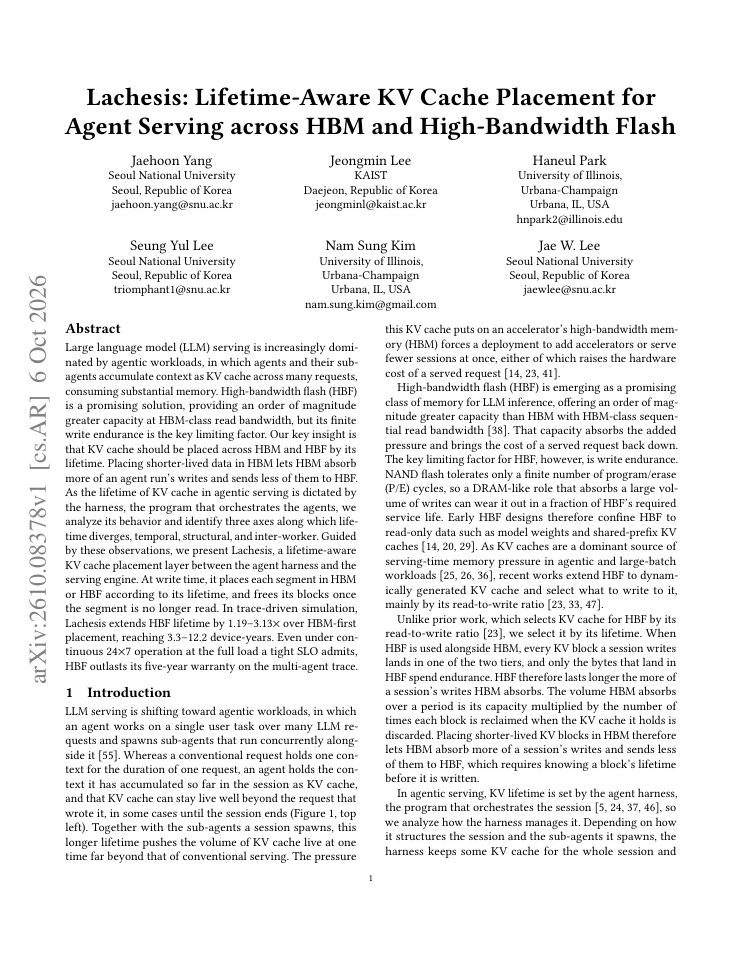
First page of Lachesis: Lifetime-Aware KV Cache Placement for Agent Serving across HBM and High-Bandwidth Flash
KV cachewatch

Lachesis: Lifetime-Aware KV Cache Placement for Agent Serving across HBM and High-Bandwidth Flash

The method replaces lifetime-agnostic (HBM-first) KV cache placement with a layer between the agent harness and the serving engine that writes each KV segment to HBM or high-bandwidth flash based on its predicted lifetime, inferred from temporal, structural, and inter-worker behavior of the harness. The cost is an additional placement and eviction layer, dependence on high-bandwidth flash hardware that is not yet generally available, and harness analysis to characterize segment lifetimes. It can fail if lifetime predictions misclassify long-lived segments into flash, accelerating wear beyond endurance limits, and its results are trace-driven simulation rather than measurements on a deployed system.

observed signal
0impl.
0stars
—citations
3.13xclaimed gain
abstract onlyReview decisionDownload skill ↓Original paper ↗
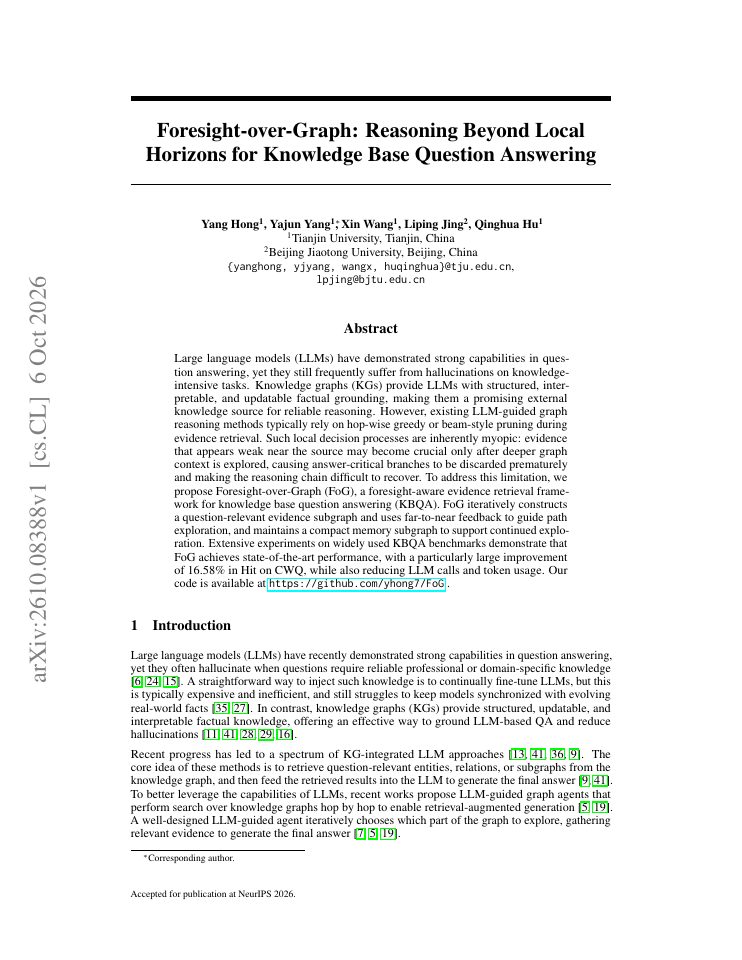
First page of Foresight-over-Graph: Reasoning Beyond Local Horizons for Knowledge Base Question Answering
retrieval and RAGtest

Foresight-over-Graph: Reasoning Beyond Local Horizons for Knowledge Base Question Answering

FoG replaces hop-wise greedy or beam-style pruning in LLM-guided KG evidence retrieval with far-to-near feedback and a compact memory subgraph that guides deeper path exploration. It costs iterative LLM calls per question and requires a populated, question-relevant knowledge graph, plus implementation and maintenance of the retrieval loop. It can fail when the KG is incomplete or misaligned with the domain, when early foresight signals steer exploration toward irrelevant regions, or when the task does not require multi-hop evidence, making the added orchestration overhead unjustified.

observed signal
0impl.
121stars
—citations
—claimed gain
abstract onlyReview decisionDownload skill ↓Original paper ↗
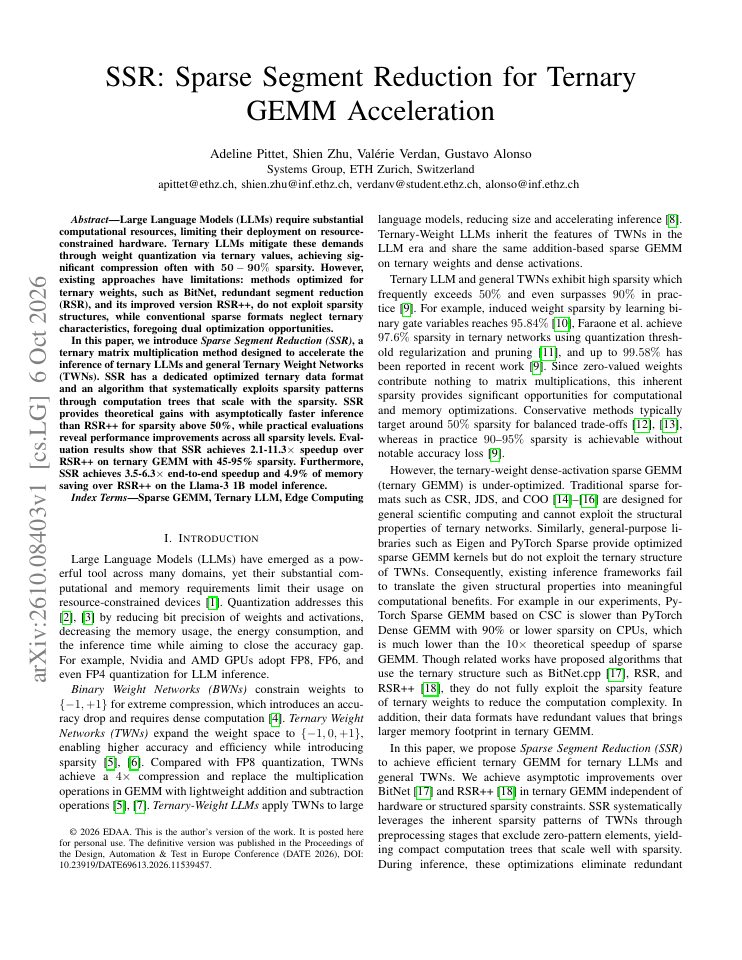
First page of SSR: Sparse Segment Reduction for Ternary GEMM Acceleration
quantizationwatch

SSR: Sparse Segment Reduction for Ternary GEMM Acceleration

SSR replaces dense ternary GEMM kernels (BitNet-style lookup, RSR, and RSR++) with a sparsity-aware ternary data format and computation-tree reduction that exploits the 50-90% zeros typical of ternary weights. The cost is adopting a custom kernel and format tied to ternary-weight models, which constrains the reader to the small BitNet/TWN ecosystem rather than mainstream 4-bit or 8-bit quantized models. It can fail if production models are not ternary, if the reported gains do not transfer from the evaluated 1B model to larger models or the reader's specific GPU, or if the kernel implementation is unavailable or immature for the reader's inference stack.

observed signal
0impl.
0stars
—citations
3.5xclaimed gain
abstract onlyReview decisionDownload skill ↓Original paper ↗
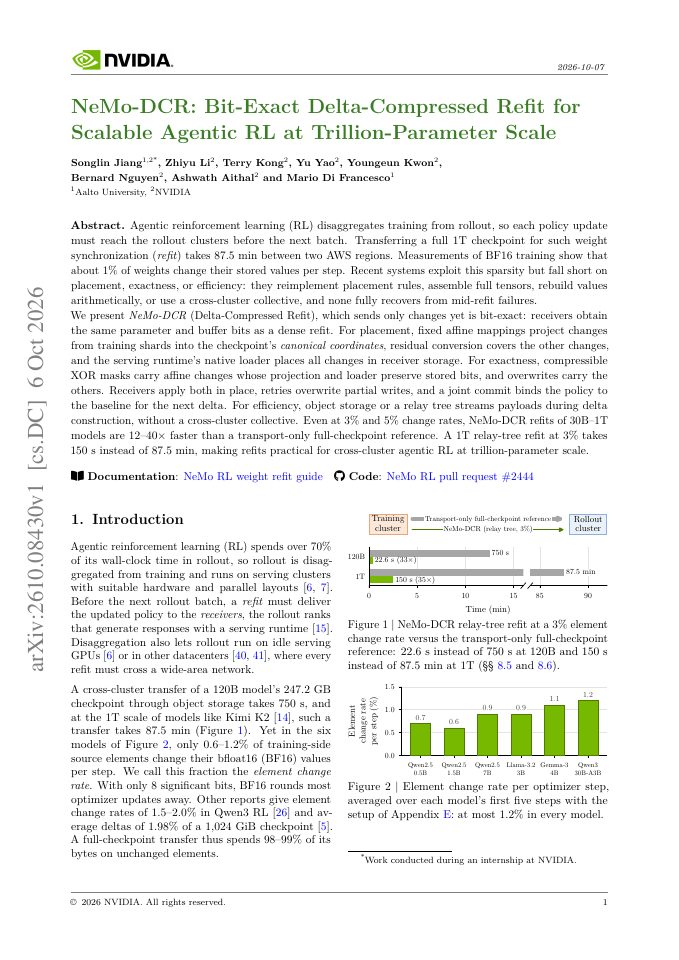
First page of NeMo-DCR: Bit-Exact Delta-Compressed Refit for Scalable Agentic RL at Trillion-Parameter Scale
efficient trainingwatch

NeMo-DCR: Bit-Exact Delta-Compressed Refit for Scalable Agentic RL at Trillion-Parameter Scale

Replaces full-checkpoint transfer for weight synchronization between disaggregated training and rollout clusters by sending only bit-exact compressed deltas (XOR masks plus overwrites) applied in place via the serving runtime's native loader. Costs include implementing affine shard-to-checkpoint projection, residual conversion, joint commit logic binding policy to baseline, and object-storage or relay-tree streaming infrastructure. It can fail if the affine mapping or residual conversion misplaces changes, if mid-refit retries do not correctly overwrite partial writes, or if the commit binding breaks delta chaining across steps.

observed signal
0impl.
0stars
—citations
40xclaimed gain
abstract onlyReview decisionDownload skill ↓Original paper ↗
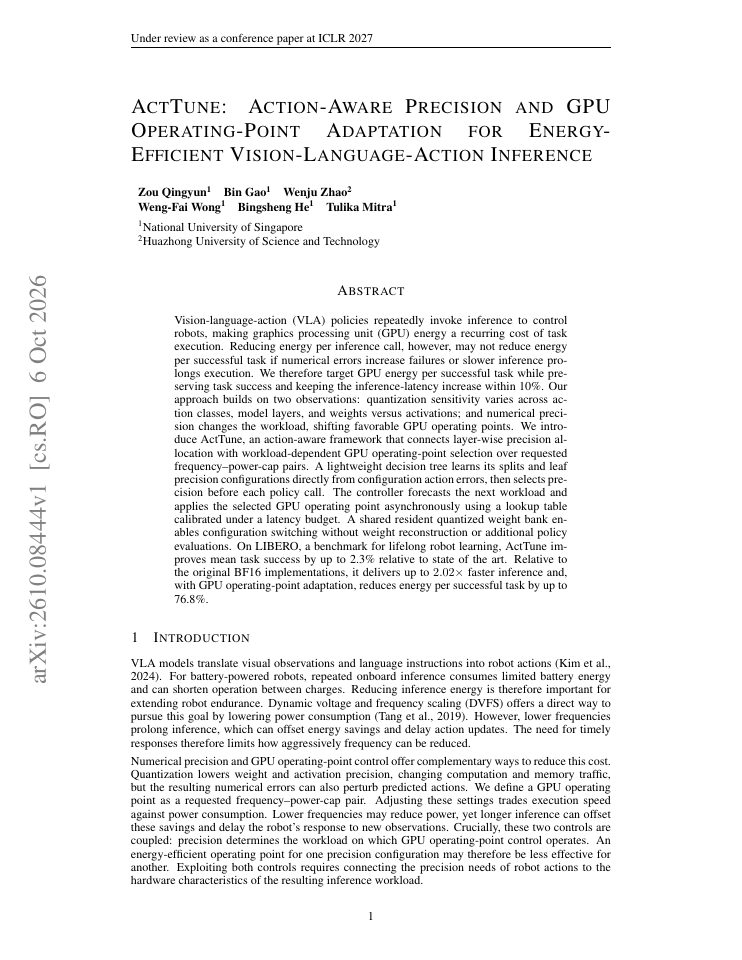
First page of ActTune: Action-Aware Precision and GPU Operating-Point Adaptation for Energy-Efficient Vision-Language-Action Inference
quantizationtest

ActTune: Action-Aware Precision and GPU Operating-Point Adaptation for Energy-Efficient Vision-Language-Action Inference

ActTune replaces fixed-precision (BF16) VLA inference with per-call, action-class-aware layer-wise precision allocation chosen by a decision tree, coupled with workload-dependent GPU frequency/power-cap selection, using a shared resident quantized weight bank to avoid weight reconstruction at switch time. It costs an offline calibration pass over configuration action errors, a latency-budgeted lookup-table build for GPU operating points, a forecasting controller running asynchronously, and up to 10% added inference latency. It can fail if the decision tree's action-error splits do not transfer to new tasks or action distributions, if workload forecasts mispredict and select poor operating points, or if the success and energy claims do not replicate outside LIBERO on different VLA models or hardware.

observed signal
0impl.
2stars
—citations
4.31xclaimed gain
abstract onlyReview decisionDownload skill ↓Original paper ↗
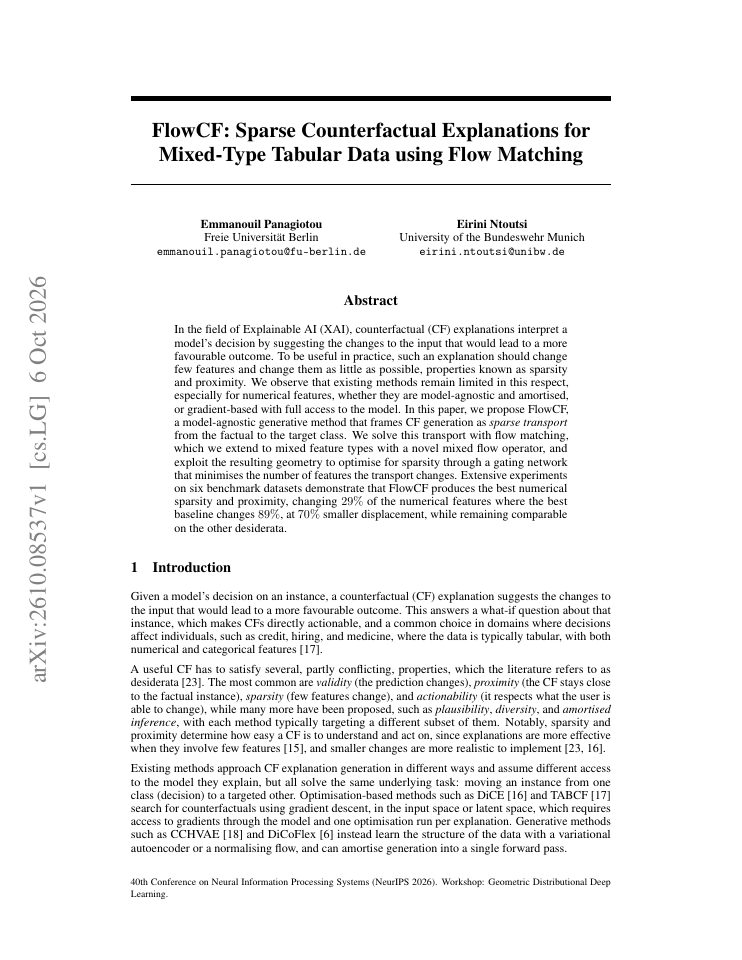
First page of FlowCF: Sparse Counterfactual Explanations for Mixed-Type Tabular Data using Flow Matching
othertest

FlowCF: Sparse Counterfactual Explanations for Mixed-Type Tabular Data using Flow Matching

FlowCF replaces gradient-based and amortized model-agnostic counterfactual generators (e.g., Wachter-style optimization or VAE/flow baselines) with a flow-matching transport from factual to target class, extended to mixed feature types and regularized for sparsity via a gating network. The cost is training a conditional flow-matching generative model plus gating network per dataset, which adds a training stage and hyperparameter burden beyond what query-only CF optimizers require, though inference afterward is amortized. It can fail when the learned flow does not cover the data manifold well (producing implausible or out-of-distribution counterfactuals), when dataset shift invalidates the trained generator, or on datasets too small to train the flow reliably.

observed signal
0impl.
0stars
—citations
—claimed gain
abstract onlyReview decisionDownload skill ↓Original paper ↗
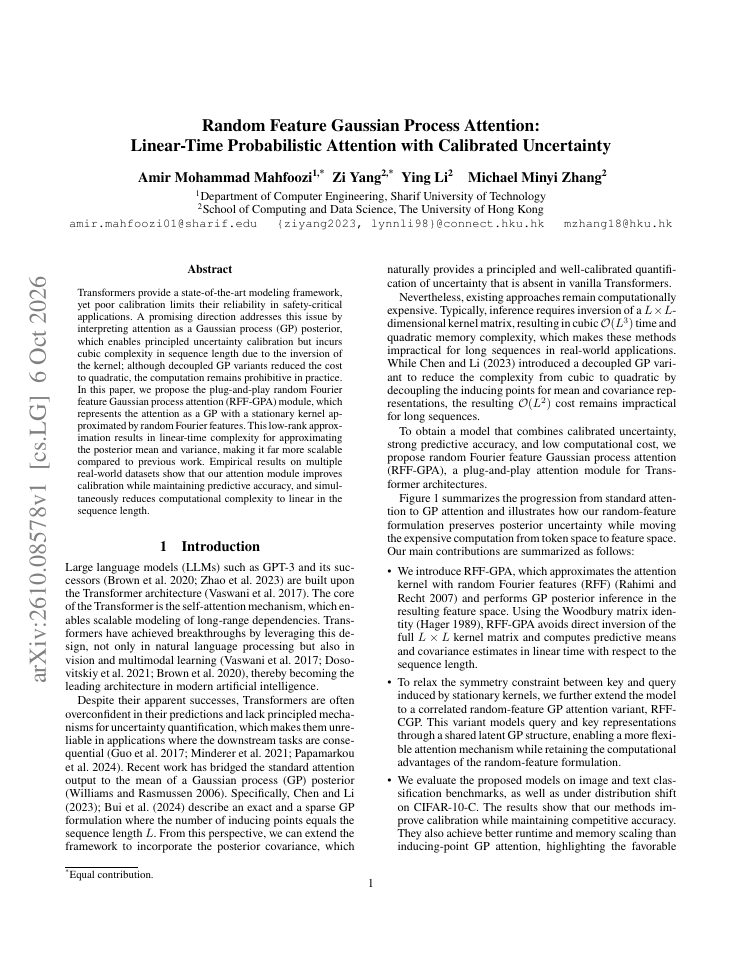
First page of Random Feature Gaussian Process Attention: Linear-Time Probabilistic Attention with Calibrated Uncertainty
attention and kernelstest

Random Feature Gaussian Process Attention: Linear-Time Probabilistic Attention with Calibrated Uncertainty

RFF-GPA replaces standard softmax attention with a Gaussian process posterior whose stationary kernel is approximated by random Fourier features, yielding linear-time computation of the posterior mean and variance. The cost is an additional low-rank feature mapping and the approximation error inherent to random Fourier features, plus integration and tuning overhead relative to drop-in softmax attention. It can fail if the stationary-kernel assumption poorly matches the task's attention structure, if the chosen number of random features underfits the kernel and degrades accuracy, or if calibration gains do not transfer to the reader's data distribution.

observed signal
0impl.
0stars
—citations
—claimed gain
abstract onlyReview decisionDownload skill ↓Original paper ↗
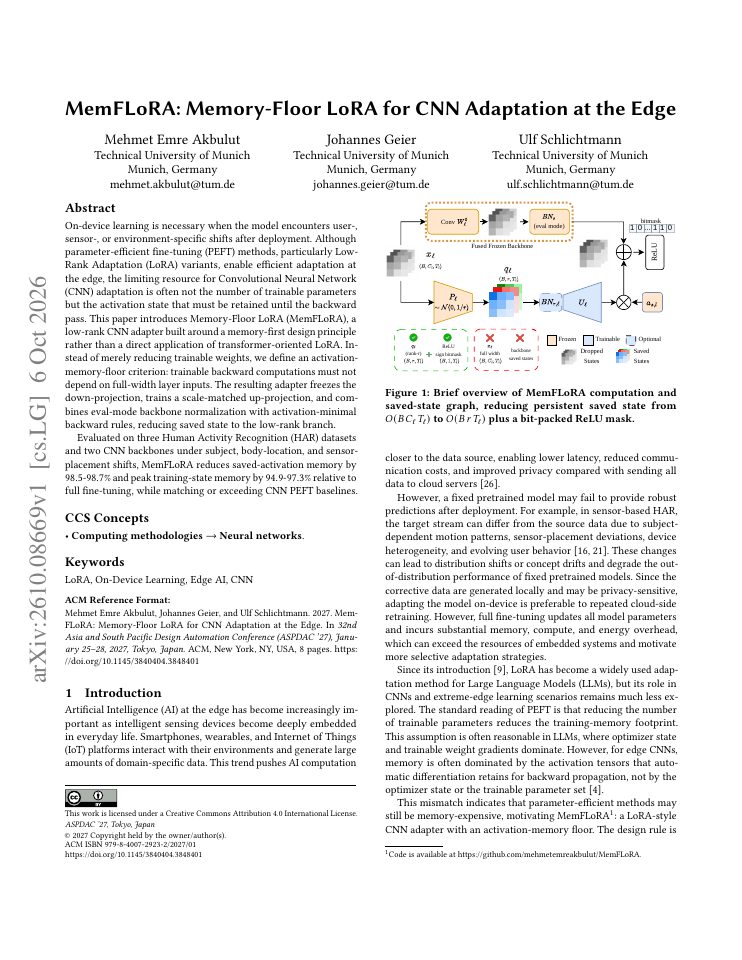
First page of MemFLoRA: Memory-Floor LoRA for CNN Adaptation at the Edge
efficient trainingwatch

MemFLoRA: Memory-Floor LoRA for CNN Adaptation at the Edge

MemFLoRA replaces standard LoRA-style CNN fine-tuning, in which full-width layer inputs must be saved for the backward pass, with a low-rank adapter that freezes the down-projection, trains only a scale-matched up-projection, and uses eval-mode backbone normalization so that backward computation depends only on the low-rank branch. The cost is a restricted trainable parameterization (a fixed down-projection and modified normalization behavior), a custom training implementation, and validation limited to small CNNs on HAR classification tasks rather than mainstream vision workloads. It can fail if the frozen random down-projection underfits a given domain shift, if eval-mode batch normalization statistics mismatch the adapted data distribution, or if the approach is assumed to transfer to larger vision models or transformer backbones without evidence.

observed signal
0impl.
1stars
—citations
66xclaimed gain
abstract onlyReview decisionDownload skill ↓Original paper ↗
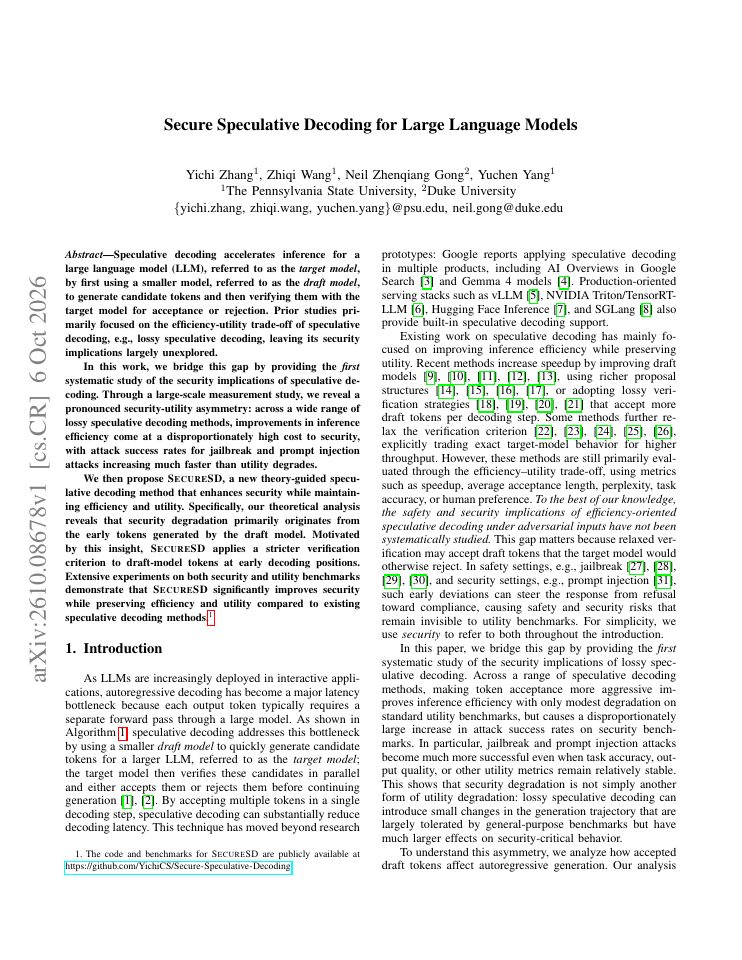
First page of Secure Speculative Decoding for Large Language Models
speculative decodingwatch

Secure Speculative Decoding for Large Language Models

It replaces the uniform token-acceptance rule used in lossy speculative decoding with a stricter verification criterion applied to early draft-model positions, aiming to cut jailbreak and prompt-injection acceptance while keeping speed and output quality. It retains the two-model draft-plus-target memory footprint, requires modifying the decoding/verification loop in a self-hosted inference stack, and stricter early rejection can reduce acceptance rate unless thresholds are retuned; the abstract reports no auditable numeric factor. It can fail if the early-token threat model does not transfer to other attacks or target models, if miscalibrated thresholds erode the latency benefit of speculative decoding, and it offers no hardening for a conventional non-speculative deployment.

observed signal
0impl.
1stars
—citations
—claimed gain
abstract onlyReview decisionDownload skill ↓Original paper ↗
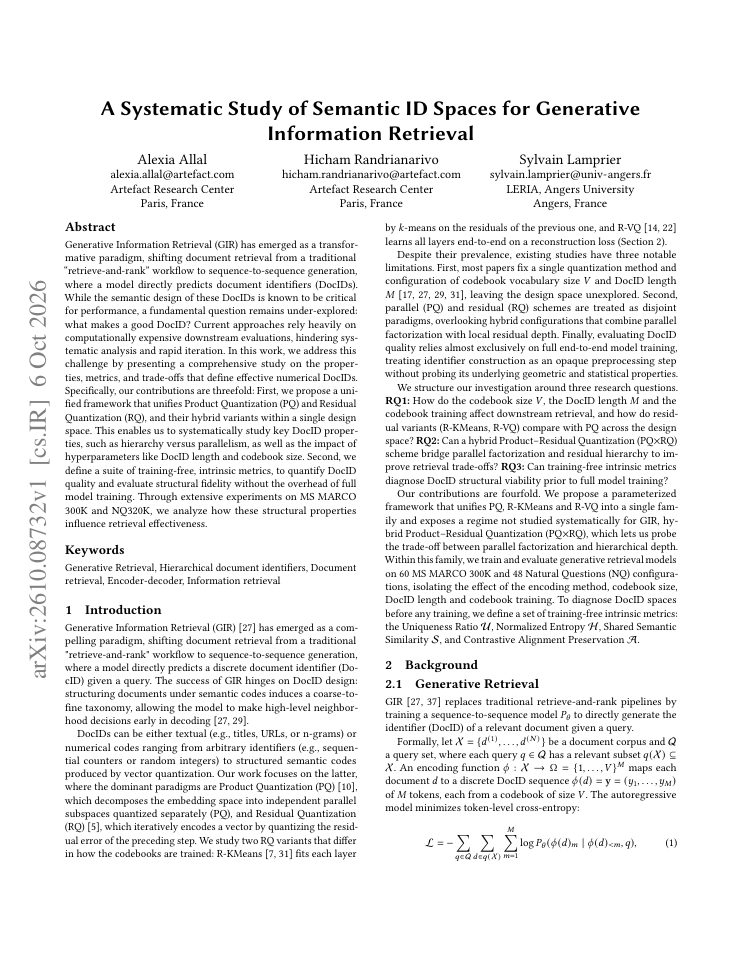
First page of A Systematic Study of Semantic ID Spaces for Generative Information Retrieval
retrieval and RAGtest

A Systematic Study of Semantic ID Spaces for Generative Information Retrieval

The work replaces expensive end-to-end model training as the evaluation loop for DocID design with a suite of training-free intrinsic metrics, plus a unified PQ/RQ framework for comparing DocID structures. The cost is adopting the generative retrieval paradigm itself: training or fine-tuning a seq2seq model on document identifiers, maintaining codebooks, and handling identifier generation and constrained decoding at inference. What can fail is that intrinsic metric scores may not predict downstream retrieval quality on the reader's specific corpus, and GIR scales poorly to large or frequently updated document collections compared to conventional ANN indexes.

observed signal
0impl.
22stars
—citations
—claimed gain
abstract onlyReview decisionDownload skill ↓Original paper ↗

Research signals

Three views of the same evidence: adoption against attention, publication cadence by research area, and reported gains when coverage is sufficient.

color = research area

01 · attention × adoption

The research frontier

Look to the upper left for independent implementation before mass attention.

compare by
Each point represents one paper. Higher means more independent implementations; farther right means more GitHub stars.The Tasteful Agent: Measuring and Improving Taste in Long-Horizon Tasks: 34 GitHub stars; 3 independent implementationsMeasuring the Serving Stack Instead of the Model: Hidden Confounds in Local Tool-Use Evaluation: 3 GitHub stars; 2 independent implementationsGrow the Harness, Not the Context: From Strategy-Free Scaffolds to Reusable Specialist Agents: 10 GitHub stars; 4 independent implementationsBeyond the Model: Demystifying Harness Effects in Software Engineering Agents: 0 GitHub stars; 0 independent implementationsTomasuLLM: Out-of-Order Speculative Execution for LLM Agents: 0 GitHub stars; 0 independent implementationsHybrid Latent Attention for Looped Language Models: 121 GitHub stars; 0 independent implementationsVisionWeave: Weaving Elastic Visual Representations as a Native Capability of MLLMs: 0 GitHub stars; 0 independent implementationsA Riemannian Geometry for Low-rank Adaptation: 0 GitHub stars; 0 independent implementationsPOLAR: Ontology-Guided Risk Prevention for Tool-Calling LLM Agents: 131 GitHub stars; 1 independent implementationAlign, Then Correct: Training-Free Two-Stage Low-Rank Compensation for Extremely Quantized Large Language Models: 0 GitHub stars; 0 independent implementationsDySCo: Dynamic Sharding for Collaborative Edge-Cloud LLM Inference with Depth-Synchronized Batching: 0 GitHub stars; 0 independent implementationsCoDe-LoRA: Mitigating the Orthogonality Dilemma in Continual Learning of LLMs via Knowledge Consolidation and Decoupling: 121 GitHub stars; 0 independent implementationsDIPrune: Task-Aware Token Pruning with Dual Importance for Efficient Multimodal Language Models: 0 GitHub stars; 0 independent implementationsEvolutionary One-Step Generators: Fast and Diverse Sampling for Discrete Design: 2 GitHub stars; 0 independent implementationsLachesis: Lifetime-Aware KV Cache Placement for Agent Serving across HBM and High-Bandwidth Flash: 0 GitHub stars; 0 independent implementationsForesight-over-Graph: Reasoning Beyond Local Horizons for Knowledge Base Question Answering: 121 GitHub stars; 0 independent implementationsSSR: Sparse Segment Reduction for Ternary GEMM Acceleration: 0 GitHub stars; 0 independent implementationsNeMo-DCR: Bit-Exact Delta-Compressed Refit for Scalable Agentic RL at Trillion-Parameter Scale: 0 GitHub stars; 0 independent implementationsActTune: Action-Aware Precision and GPU Operating-Point Adaptation for Energy-Efficient Vision-Language-Action Inference: 2 GitHub stars; 0 independent implementationsFlowCF: Sparse Counterfactual Explanations for Mixed-Type Tabular Data using Flow Matching: 0 GitHub stars; 0 independent implementationsRandom Feature Gaussian Process Attention: Linear-Time Probabilistic Attention with Calibrated Uncertainty: 0 GitHub stars; 0 independent implementationsMemFLoRA: Memory-Floor LoRA for CNN Adaptation at the Edge: 1 GitHub star; 0 independent implementationsSecure Speculative Decoding for Large Language Models: 1 GitHub star; 0 independent implementationsA Systematic Study of Semantic ID Spaces for Generative Information Retrieval: 22 GitHub stars; 0 independent implementationsReinforcement Learning with Conformal Action Sets: An Application to Sequential Recommendation: 33 GitHub stars; 3 independent implementations

Papers above 1000 stars or 200 citations are not scored. They have already broken through the attention threshold, while Paperraft is designed to identify earlier signals.

02 · cadence

Research areas over time

Compare monthly publication volume on a shared scale and calendar.

coding agentsmax 4Sep 26: 1 paperOct 26: 0 papersSep 26Oct 26agent evaluationmax 4Sep 26: 2 papersOct 26: 0 papersSep 26Oct 26KV cachemax 4Sep 26: 0 papersOct 26: 2 papersSep 26Oct 26speculative decodingmax 4Sep 26: 0 papersOct 26: 1 paperSep 26Oct 26sparsity and pruningmax 4Sep 26: 0 papersOct 26: 2 papersSep 26Oct 26attention and kernelsmax 4Sep 26: 0 papersOct 26: 1 paperSep 26Oct 26memory and contextmax 4Sep 26: 1 paperOct 26: 0 papersSep 26Oct 26othermax 4Sep 26: 0 papersOct 26: 3 papersSep 26Oct 26quantizationmax 4Sep 26: 0 papersOct 26: 3 papersSep 26Oct 26retrieval and RAGmax 4Sep 26: 0 papersOct 26: 2 papersSep 26Oct 26safety and guardrailsmax 4Sep 26: 0 papersOct 26: 1 paperSep 26Oct 26serving and batchingmax 4Sep 26: 0 papersOct 26: 1 paperSep 26Oct 26efficient trainingmax 4Sep 26: 0 papersOct 26: 4 papersSep 26Oct 26tool usemax 4Sep 26: 1 paperOct 26: 0 papersSep 26Oct 26

Every panel uses the same calendar and vertical scale. An empty column means no papers were recorded.

03 · reported results

Claimed performance gains

Gains stated in the abstract: reported by the authors; not independently verified.

Factors reported by the authors and not independently verified. The vertical axis uses a logarithmic scale; the baseline is 1x.reported factor · log scaleGrow the Harness, Not the Context: From Strategy-Free Scaffolds to Reusable Specialist Agents: 4.2x in cost (author-reported)TomasuLLM: Out-of-Order Speculative Execution for LLM Agents: 1.31x in speed (author-reported)Hybrid Latent Attention for Looped Language Models: 10.7x in memory (author-reported)VisionWeave: Weaving Elastic Visual Representations as a Native Capability of MLLMs: 2.3x in speed (author-reported)DySCo: Dynamic Sharding for Collaborative Edge-Cloud LLM Inference with Depth-Synchronized Batching: 3.75x in speed (author-reported)Evolutionary One-Step Generators: Fast and Diverse Sampling for Discrete Design: 50x in speed (author-reported)Lachesis: Lifetime-Aware KV Cache Placement for Agent Serving across HBM and High-Bandwidth Flash: 3.13x in cost (author-reported)SSR: Sparse Segment Reduction for Ternary GEMM Acceleration: 3.5x in speed (author-reported)NeMo-DCR: Bit-Exact Delta-Compressed Refit for Scalable Agentic RL at Trillion-Parameter Scale: 40x in speed (author-reported)ActTune: Action-Aware Precision and GPU Operating-Point Adaptation for Energy-Efficient Vision-Language-Action Inference: 4.31x in cost (author-reported)MemFLoRA: Memory-Floor LoRA for CNN Adaptation at the Edge: 66x in memory (author-reported)Reinforcement Learning with Conformal Action Sets: An Application to Sequential Recommendation: 5.21x in quality (author-reported)

12 of 25 papers report a quantified gain. The scale is logarithmic; a research-area trend line appears only with at least five papers in the quarter.

Method under scrutiny

Inspect the highest-ranked paper, every repository behind its signal, and the rule used to classify each one.

Grow the Harness, Not the Context: From Strategy-Free Scaffolds to Reusable Specialist Agents

memory and context · test · 4 of 4 implementations are independent · 4.2x gain in cost (reported by the authors; not independently verified)

The method replaces per-task in-context reconstruction of control logic with a shared executable harness that is iteratively grown from failure traces, reserving LLM calls for task-specific reasoning. It costs an offline optimization loop with function-level tracing, joint failure repair, and gated rollback, plus ongoing maintenance of an accumulating code artifact whose complexity grows with use. After adoption it can fail when repairs overfit to the training task distribution, when the success gate misses regressions not covered by held-out tasks, or when task drift makes the frozen control code obsolete.

Exclusions and controls

Every exclusion is counted and published.

Exclusion counts were not recorded for this edition.

0 previously indexed papers were rechecked in this run.

Paperraft tracks one signal: how many independent implementations a paper attracts on GitHub after author-owned repositories are removed. This is a discovery signal to investigate, not a measure of implementation quality.

It does not claim that a method works. Paperraft runs no reproduction benchmarks. Reported gains remain author claims until independently tested. Papers above the attention threshold are excluded because this publication is designed to identify research before consensus forms.