Skip to content

archived edition · 2026-10-03

PaperraftFind the AI research
worth testing.

Understand what a paper changes, what it costs, and whether it fits your next build. Explore research on faster LLM inference, agent memory, and evaluation, with the original sources in reach.

Start with a brief. Follow the evidence. Choose a test.

edition
2026-10-03
briefs
42
research areas
13
independent implementations
46

24 of 42 papers in the index (57%) have no independent implementations.

Research index

Search by topic, browse a research area, or sort by date. Read a brief, open the original paper, and inspect the available evidence before deciding what to test.

showing30 of 42
sort by
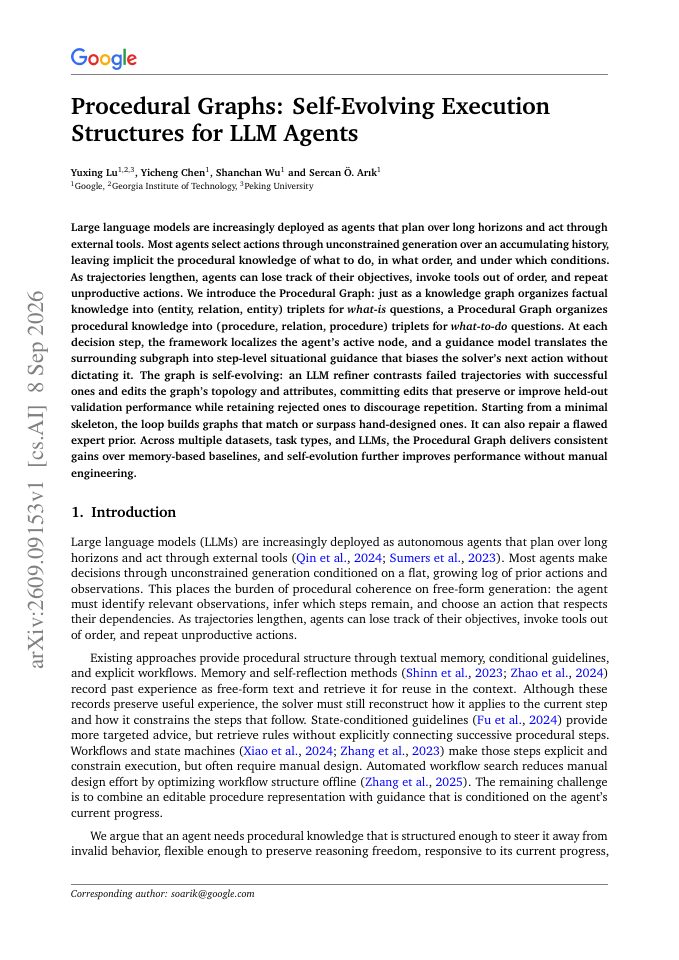
First page of Procedural Graphs: Self-Evolving Execution Structures for LLM Agents
memory and contexttest

Procedural Graphs: Self-Evolving Execution Structures for LLM Agents

Replaces unconstrained next-action generation over an accumulating trajectory with an evolving (procedure, relation, procedure) graph that a guidance model turns into step-level hints biasing, but not dictating, the agent's next action. Costs an extra guidance-model call per decision step plus LLM-refiner passes that contrast failed and successful trajectories to edit the graph against a held-out validation set, adding orchestration complexity and API spend. Can fail if validation sets are small or unrepresentative, letting the refiner overfit graph edits, or if localization of the active node is wrong on long trajectories, injecting misleading guidance; the abstract reports only qualitative 'consistent gains' with no quantified improvement, so the benefit is unverified for any specific workload.
observed signal
14impl.
17stars
0citations
—claimed gain
abstract onlyReview decisionDownload skill ↓Original paper ↗
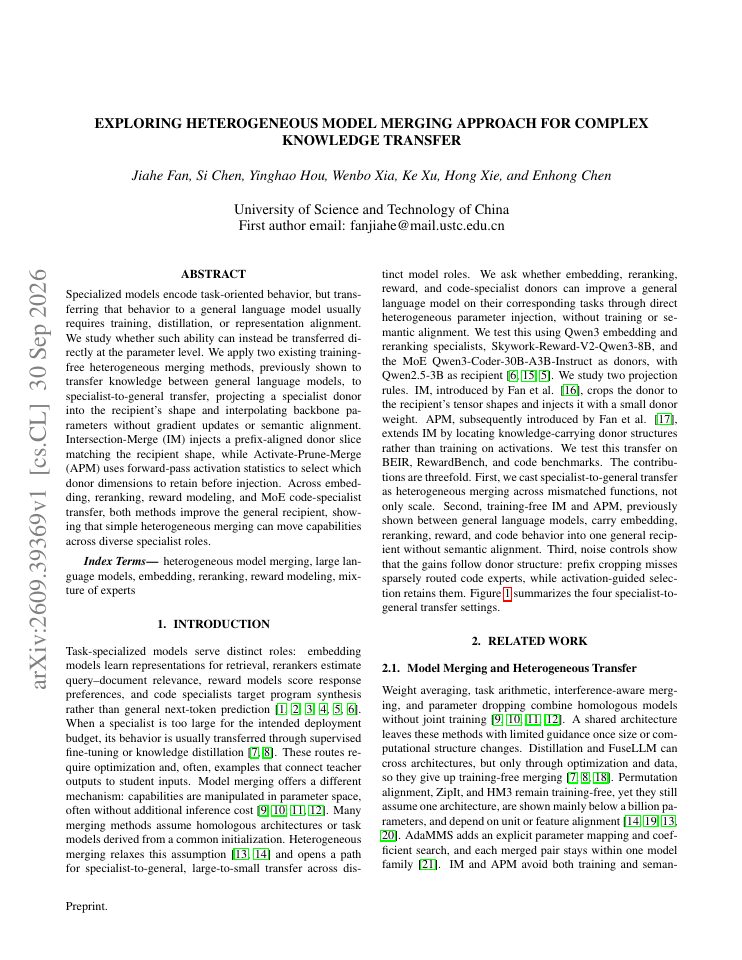
First page of Exploring Heterogeneous Model Merging Approach for Complex Knowledge Transfer
efficient trainingtest

Exploring Heterogeneous Model Merging Approach for Complex Knowledge Transfer

The method replaces training-based knowledge transfer (fine-tuning, distillation, representation alignment) with direct parameter-level injection of a specialist donor into a general recipient using Intersection-Merge or Activate-Prune-Merge. It costs no gradient computation and no additional serving memory or latency, since the output is a single merged model, but it requires access to donor and recipient weights and applies only to open-weight models. It can fail silently through degraded general capabilities from interpolation, mismatched donor-recipient architectures that corrupt the injected slice, or transfer that does not survive the reader's specific task distribution.

observed signal
1impl.
0stars
—citations
—claimed gain
abstract onlyReview decisionDownload skill ↓Original paper ↗
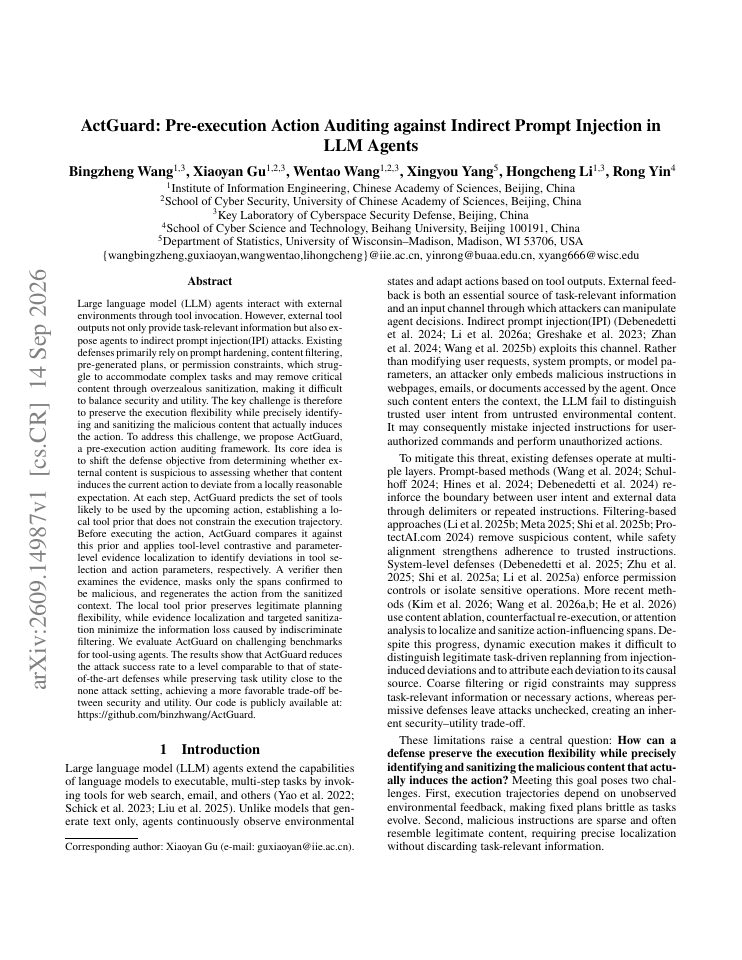
First page of ActGuard: Pre-execution Action Auditing against Indirect Prompt Injection in LLM Agents
safety and guardrailstest

ActGuard: Pre-execution Action Auditing against Indirect Prompt Injection in LLM Agents

ActGuard replaces coarse prompt-hardening and content-filtering defenses with a per-step audit that predicts a local tool prior, flags deviations in tool choice and parameters, and masks only evidence-verified malicious spans before regenerating the action. Its cost is additional inference at every agent step: a tool-prior prediction, contrastive analysis, and a verifier pass, which increases latency and API spend roughly proportional to trajectory length. It can fail when the injected instruction produces an action consistent with the tool prior (parameter-only manipulation that evades localization), when the verifier over- or under-masks evidence, or when legitimate but unusual tool sequences are treated as deviations.

observed signal
2impl.
3stars
0citations
—claimed gain
abstract onlyReview decisionDownload skill ↓Original paper ↗
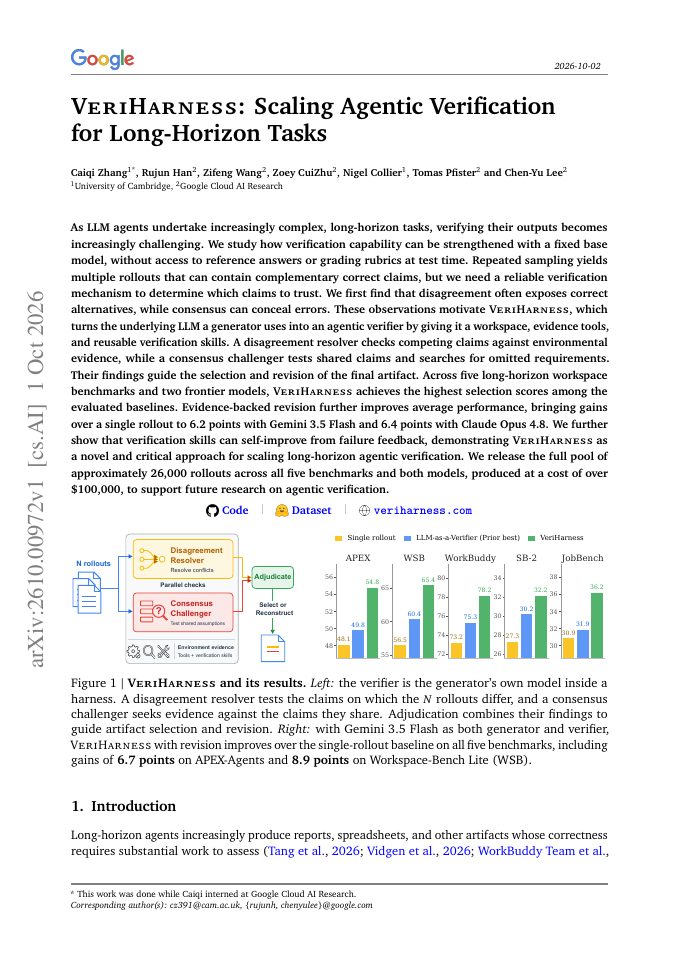
First page of VeriHarness: Scaling Agentic Verification for Long-Horizon Tasks
agent evaluationtest

VeriHarness: Scaling Agentic Verification for Long-Horizon Tasks

VeriHarness replaces single-rollout generation (and naive self-consistency voting) with a verifier agent built from the same LLM, using a workspace with evidence tools to resolve disagreements between sampled rollouts, challenge consensus claims, and revise the final artifact. It costs multiple rollouts plus verifier agent passes per task, multiplying inference spend roughly proportional to the sampling budget, and it requires tool access to environment evidence, so it fits API-based setups but adds orchestration complexity. It can fail when no sampled rollout contains the correct claims, when the verifier's evidence tools are unavailable or misleading, or when the same base model's biases lead it to endorse shared errors that consensus conceals.

observed signal
4impl.
139stars
0citations
—claimed gain
abstract onlyReview decisionDownload skill ↓Original paper ↗
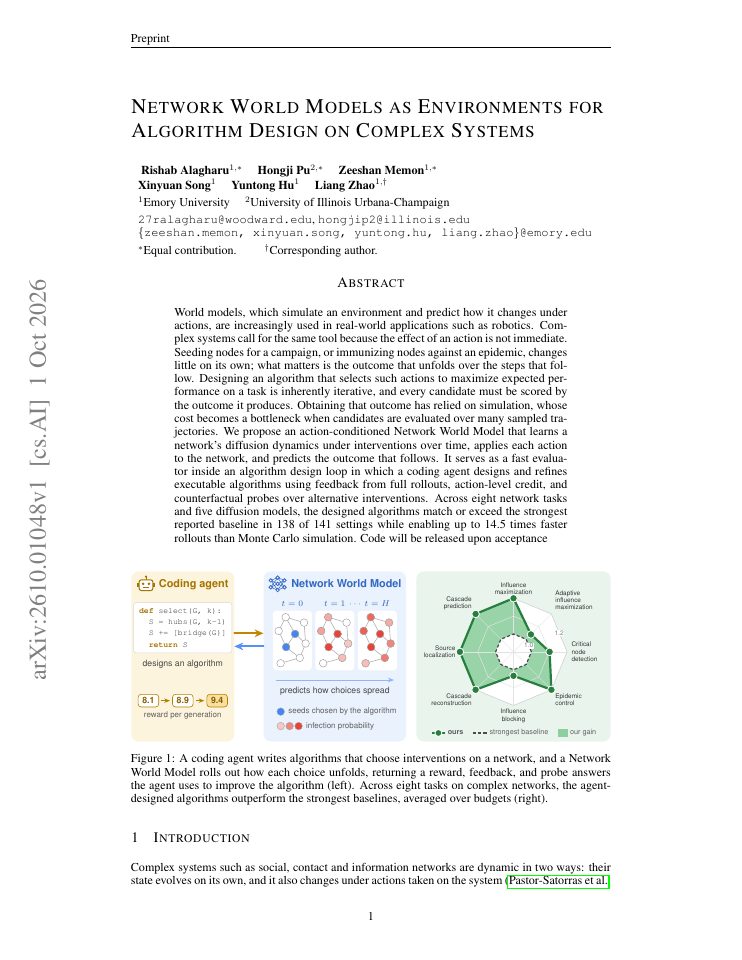
First page of Network World Models as Environments for Algorithm Design on Complex Systems
coding agentstest

Network World Models as Environments for Algorithm Design on Complex Systems

The method replaces Monte Carlo simulation of network diffusion dynamics with a learned action-conditioned world model that scores candidate intervention algorithms inside a coding-agent design loop using rollouts, action-level credit, and counterfactual probes. The cost is training a per-dynamics surrogate model plus the API or compute budget for the iterative agent loop, and it adds pipeline complexity beyond running a simulator directly. It can fail when the learned dynamics diverge from true diffusion behavior on out-of-distribution interventions or network structures, silently rewarding algorithms that exploit surrogate errors rather than real performance.

observed signal
4impl.
341stars
0citations
14.5xclaimed gain
abstract onlyReview decisionDownload skill ↓Original paper ↗
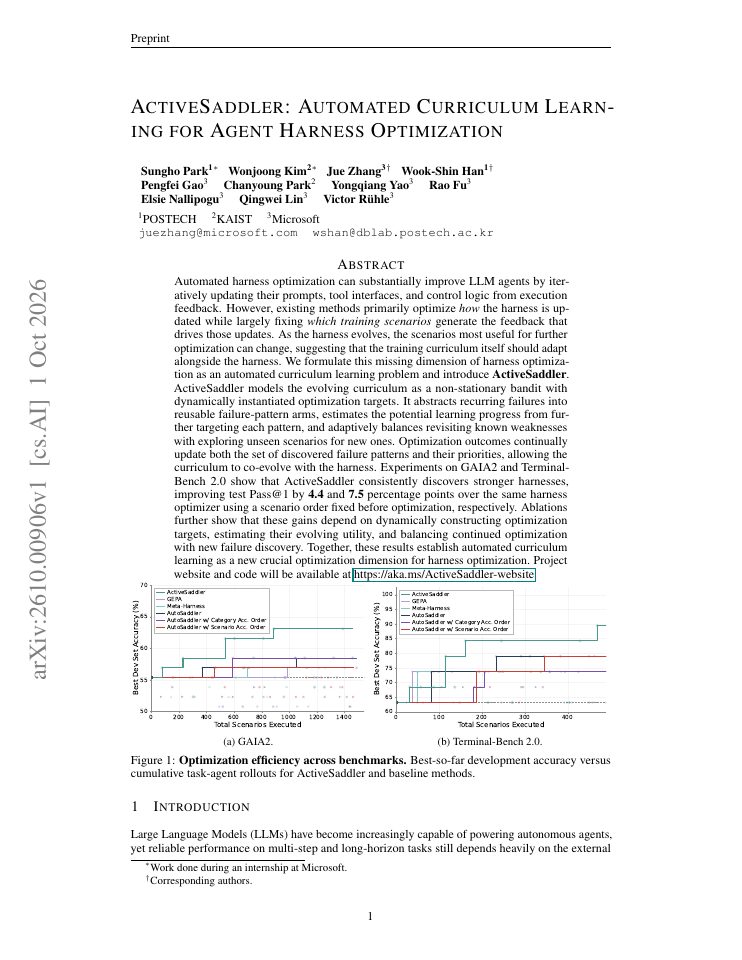
First page of ActiveSaddler: Automated Curriculum Learning for Agent Harness Optimization
failure recoverytest

ActiveSaddler: Automated Curriculum Learning for Agent Harness Optimization

It replaces the fixed, pre-selected scenario order used to generate feedback during automated harness optimization with a non-stationary bandit curriculum that abstracts failures into reusable arms, estimates their learning-progress utility, and balances revisiting known weaknesses against exploring new scenarios. It costs additional infrastructure for clustering execution failures into patterns, maintaining utility estimates per arm, and running exploration episodes that do not directly target known weaknesses, on top of the underlying optimizer's API spend. It can fail when failure-pattern abstraction is too coarse or noisy to be reusable, when utility estimates mis-rank patterns on small feedback samples, or when the evaluation benchmarks' diversity (GAIA2, Terminal-Bench) does not match the reader's task distribution.

observed signal
2impl.
14stars
—citations
—claimed gain
abstract onlyReview decisionDownload skill ↓Original paper ↗
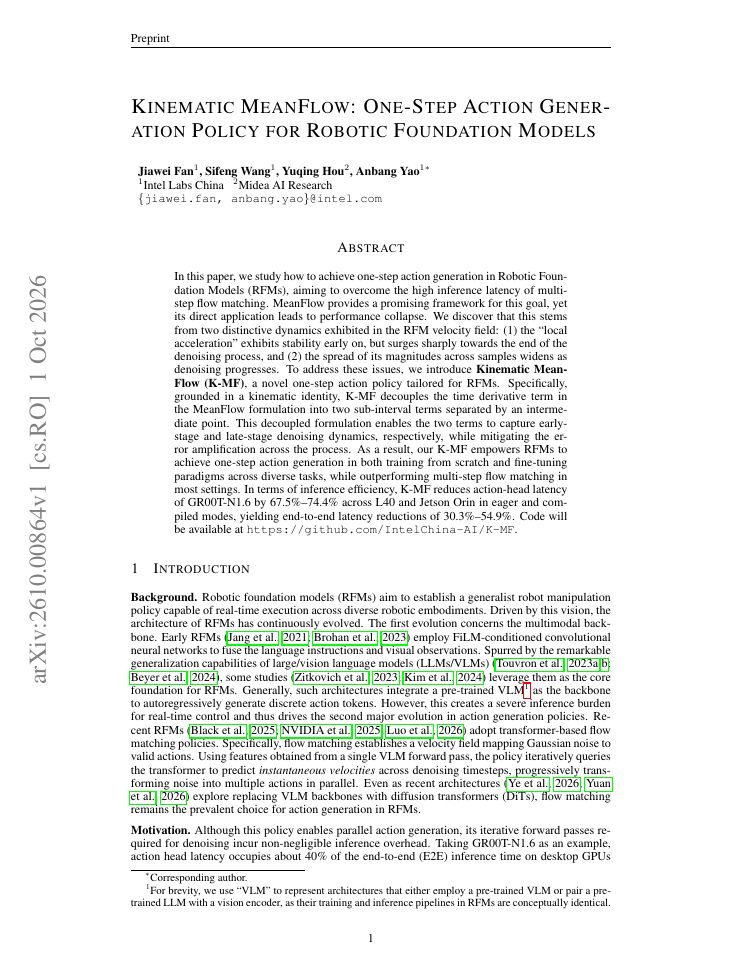
First page of Kinematic MeanFlow: One-Step Action Generation Policy for Robotic Foundation Models
othernot applicable

Kinematic MeanFlow: One-Step Action Generation Policy for Robotic Foundation Models

K-MF replaces multi-step flow-matching sampling in robotic foundation model action heads with a one-step policy, using a kinematic identity that decouples the MeanFlow time derivative into early- and late-stage sub-interval terms to avoid the performance collapse of naive MeanFlow application. The cost is a modified training objective that must be applied either from scratch or during fine-tuning of an RFM, plus integration with a specific robotics model stack rather than a general-purpose inference optimization. What can fail: the method is validated only on RFMs such as GR00T-N1.6, direct MeanFlow training collapses without the decoupled formulation, and benefits do not transfer to language-model serving workloads.

observed signal
2impl.
112stars
0citations
3.1xclaimed gain
abstract onlyReview decisionDownload skill ↓Original paper ↗
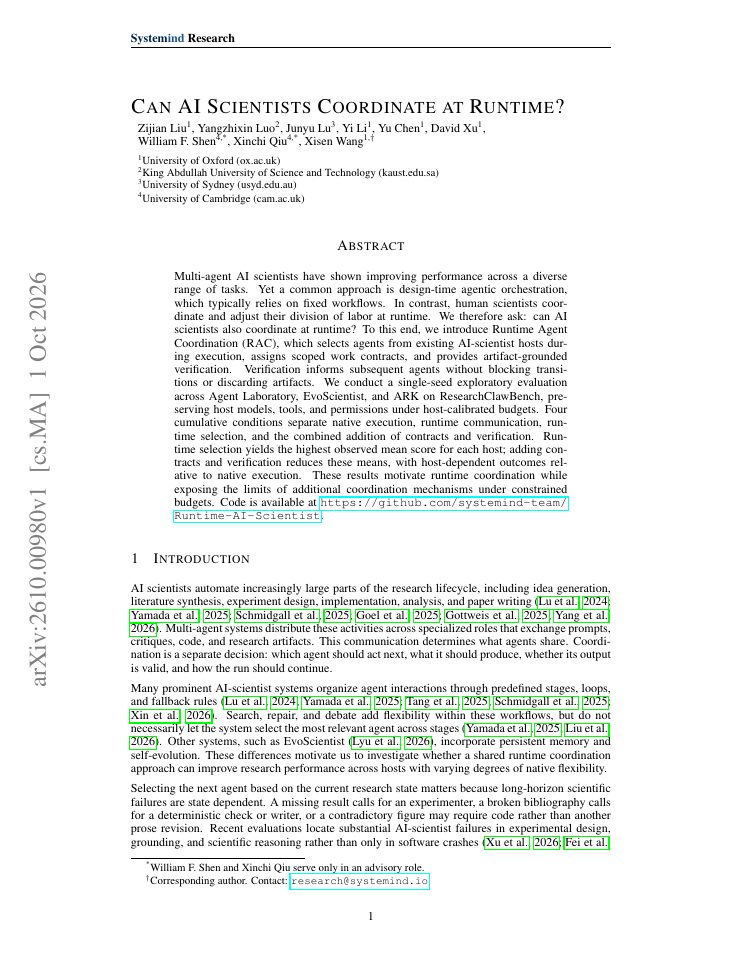
First page of Can AI Scientists Coordinate at Runtime?
multi-agent orchestrationtest

Can AI Scientists Coordinate at Runtime?

RAC replaces fixed design-time orchestration workflows with runtime agent selection from existing hosts, scoped work contracts, and artifact-grounded verification. It costs an additional coordination layer (selection, contracts, verification) at execution time, which under host-calibrated budgets consumed resources and lowered mean scores relative to runtime selection alone. It can fail when verification overhead exhausts constrained budgets, when the single-seed exploratory findings do not transfer to other hosts or benchmarks, or when added coordination degrades outcomes below native execution, as occurred for some hosts.

observed signal
1impl.
12stars
0citations
—claimed gain
abstract onlyReview decisionDownload skill ↓Original paper ↗
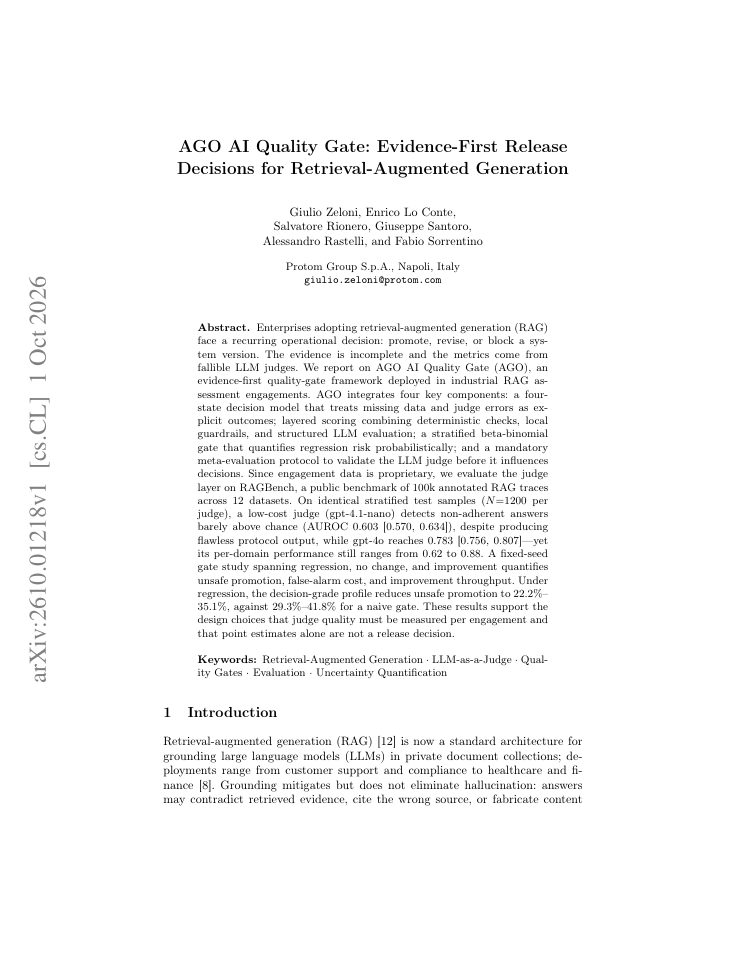
First page of AGO AI Quality Gate: Evidence-First Release Decisions for Retrieval-Augmented Generation
agent evaluationtest

AGO AI Quality Gate: Evidence-First Release Decisions for Retrieval-Augmented Generation

The framework replaces point-estimate metric checks and unvalidated LLM judges with a four-state decision model (including explicit missing-data and judge-error outcomes), layered deterministic/local/LLM scoring, a stratified beta-binomial regression-risk gate, and mandatory judge meta-evaluation before the judge influences release decisions. It costs implementation complexity, per-engagement judge validation against labeled data, and additional evaluation compute on every release cycle, all feasible on a single GPU or via APIs. It can fail if the judge is validated on a public benchmark but degrades on the target domain, since per-domain AUROC varies widely, and the gate still permits 22%-35% unsafe promotion under regression rather than eliminating it.

observed signal
2impl.
125stars
0citations
—claimed gain
abstract onlyReview decisionDownload skill ↓Original paper ↗
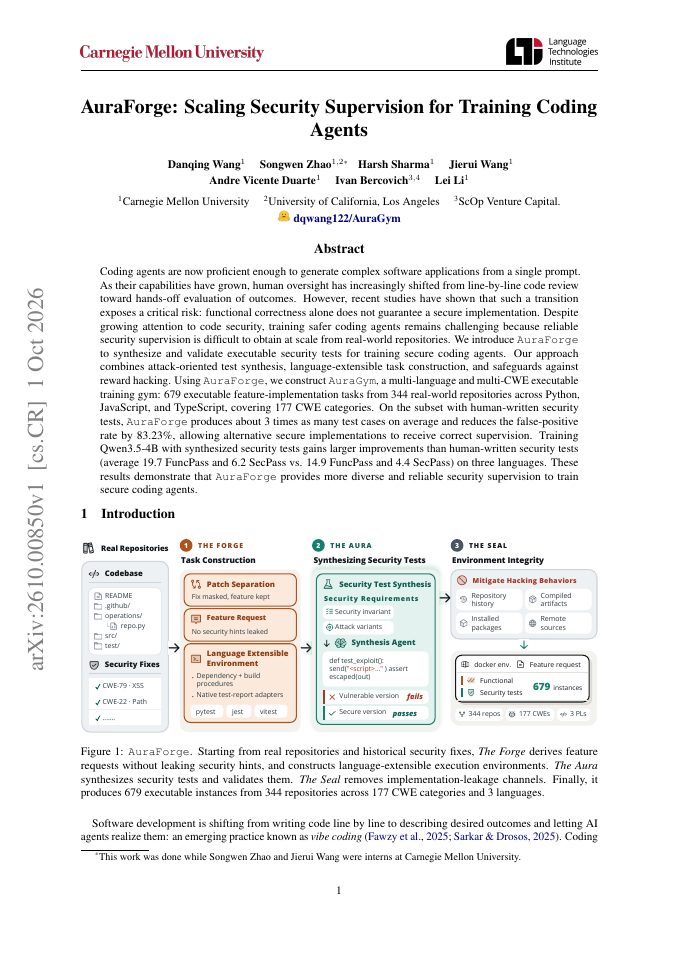
First page of AuraForge: Scaling Security Supervision for Training Coding Agents
safety and guardrailstest

AuraForge: Scaling Security Supervision for Training Coding Agents

It replaces reliance on scarce human-written security tests in real repositories with automatically synthesized and validated executable attack-oriented tests used as training supervision for coding agents. The cost is a substantial task-construction and validation pipeline (repository execution environments, anti-reward-hacking safeguards) plus the fine-tuning run itself, which is feasible for a 4B model on a 24 GB GPU but the gym-building infrastructure is not turnkey. Synthesized tests can still mislabel secure alternative implementations or overfit to the attack patterns the generator knows, leaving uncovered CWEs without supervision.

observed signal
1impl.
14stars
0citations
3xclaimed gain
abstract onlyReview decisionDownload skill ↓Original paper ↗
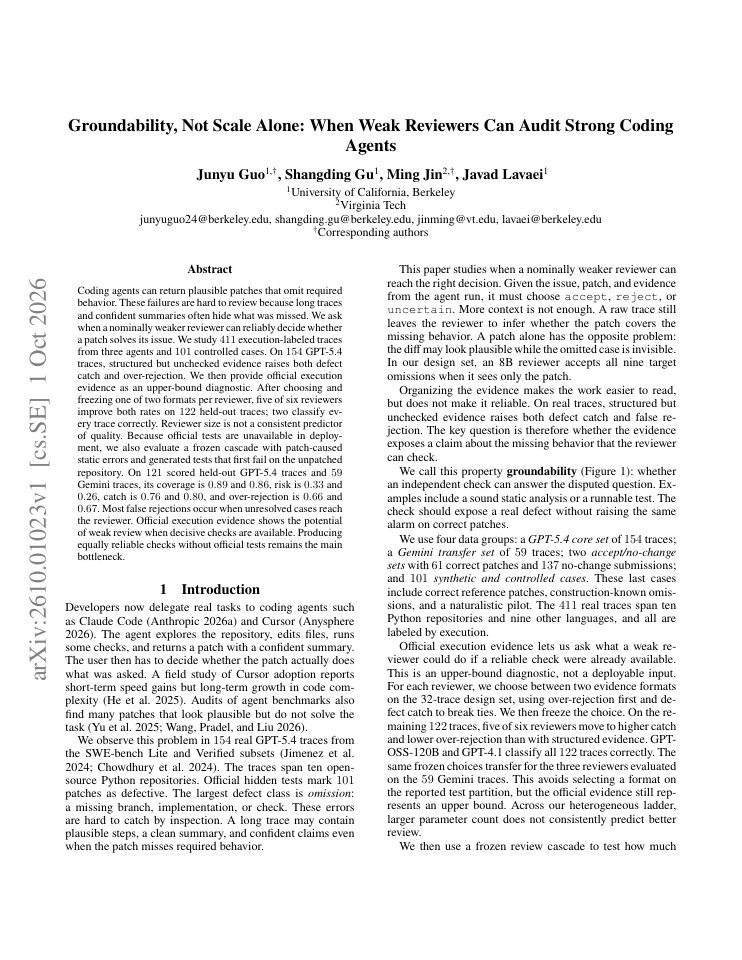
First page of Groundability, Not Scale Alone: When Weak Reviewers Can Audit Strong Coding Agents
agent evaluationtest

Groundability, Not Scale Alone: When Weak Reviewers Can Audit Strong Coding Agents

The method replaces unaided human or LLM review of agent-generated patches and their long traces with a cascade that grounds reviewer decisions in patch-caused static errors and generated tests validated to fail on the unpatched repository. It costs additional pipeline stages (static analysis, test generation, fail-to-pass validation, a frozen evidence format) and API or GPU inference for the reviewer, with no foundation-model training required. It can fail by over-rejecting correct patches (0.66-0.67 false-rejection rate, concentrated in unresolved cases that reach the reviewer) and by depending on generated checks whose reliability without official tests remains the open bottleneck.

observed signal
1impl.
14stars
0citations
—claimed gain
abstract onlyReview decisionDownload skill ↓Original paper ↗
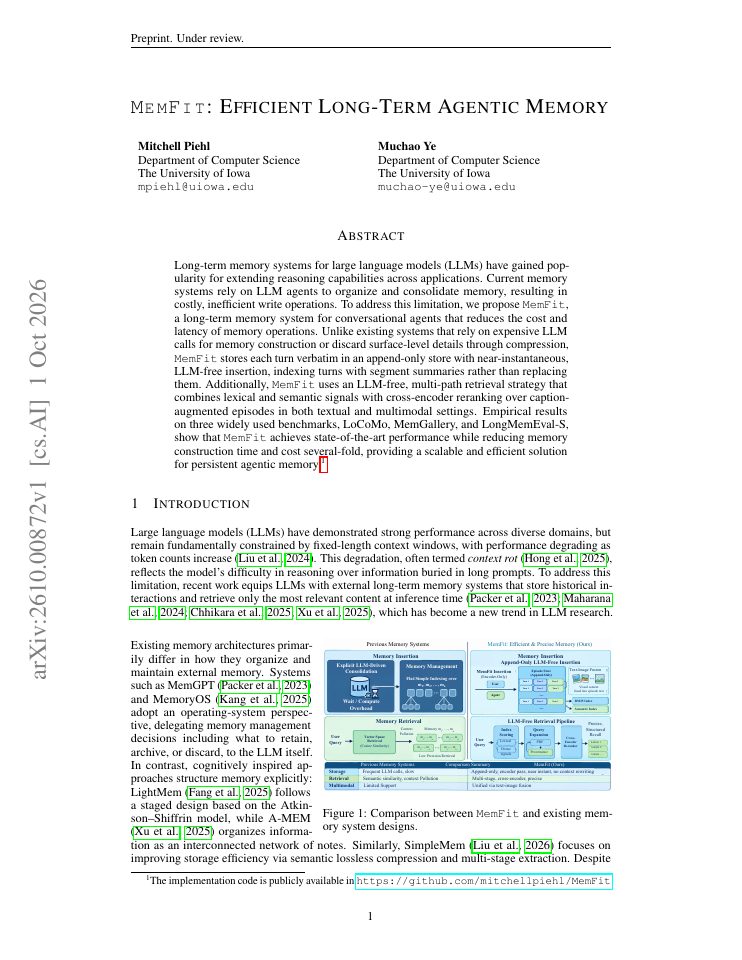
First page of MemFit: Efficient Long-Term Agentic Memory
memory and contexttest

MemFit: Efficient Long-Term Agentic Memory

MemFit replaces LLM-driven memory construction and consolidation (as in MemGPT-style systems) with verbatim append-only turn storage, segment-summary indexing, and LLM-free retrieval combining lexical and semantic signals with cross-encoder reranking. Costs include an ever-growing raw store with associated embedding and reranking infrastructure, retrieval latency from the multi-path pipeline plus cross-encoder stage, and the engineering complexity of maintaining the indexing stack. Failure modes include storage growth without bound in long deployments, reranker and embedding quality bottlenecks on domain-specific conversations, potential degradation relative to LLM-curated memory on tasks requiring genuine consolidation or abstraction, and unverified performance on workloads unlike the three benchmarks reported.

observed signal
2impl.
131stars
0citations
—claimed gain
abstract onlyReview decisionDownload skill ↓Original paper ↗
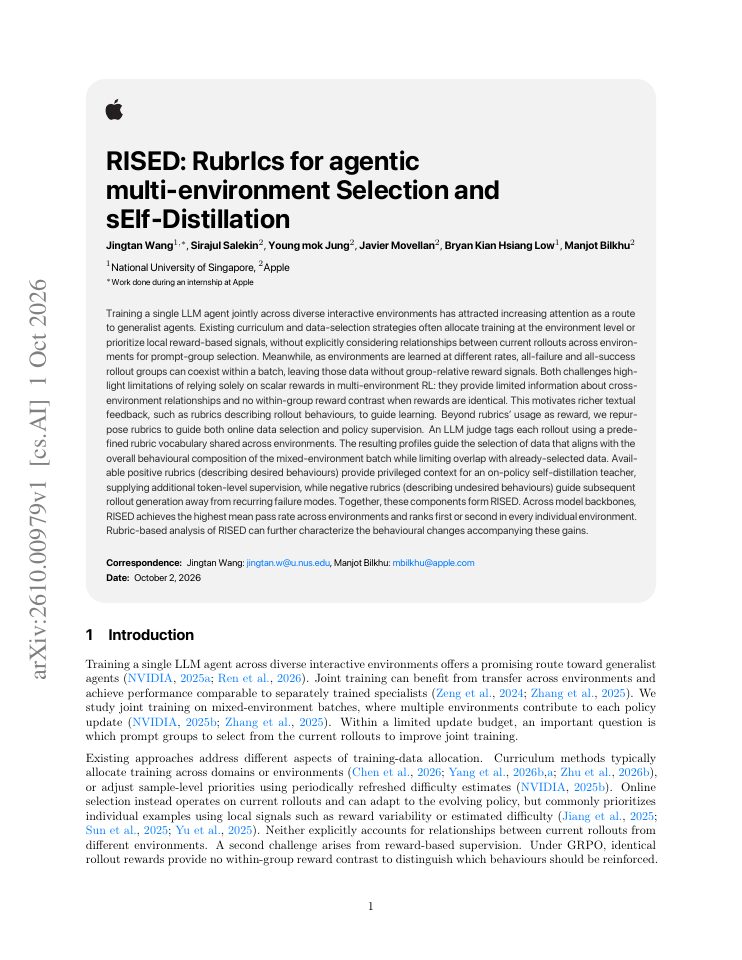
First page of RISED: RubrIcs for agentic multi-environment Selection and sElf-Distillation
efficient trainingwatch

RISED: RubrIcs for agentic multi-environment Selection and sElf-Distillation

RISED replaces scalar-reward-only group-relative RL (GRPO-style) data allocation in multi-environment agent training with LLM-judge rubric tagging that guides prompt-group selection and on-policy self-distillation, using positive rubrics as privileged teacher context and negative rubrics to steer rollouts away from failure modes. It costs an additional LLM judge pass over every rollout, a distillation teacher forward pass, and the full multi-environment RL training loop, which already exceeds a single 24 GB GPU budget for meaningful model backbones. The rubric judge can mislabel behaviours, the shared rubric vocabulary may fail to capture environment-specific failures, and self-distillation on privileged context can entrench judge biases rather than genuine capability gains.

observed signal
2impl.
131stars
0citations
—claimed gain
abstract onlyReview decisionDownload skill ↓Original paper ↗
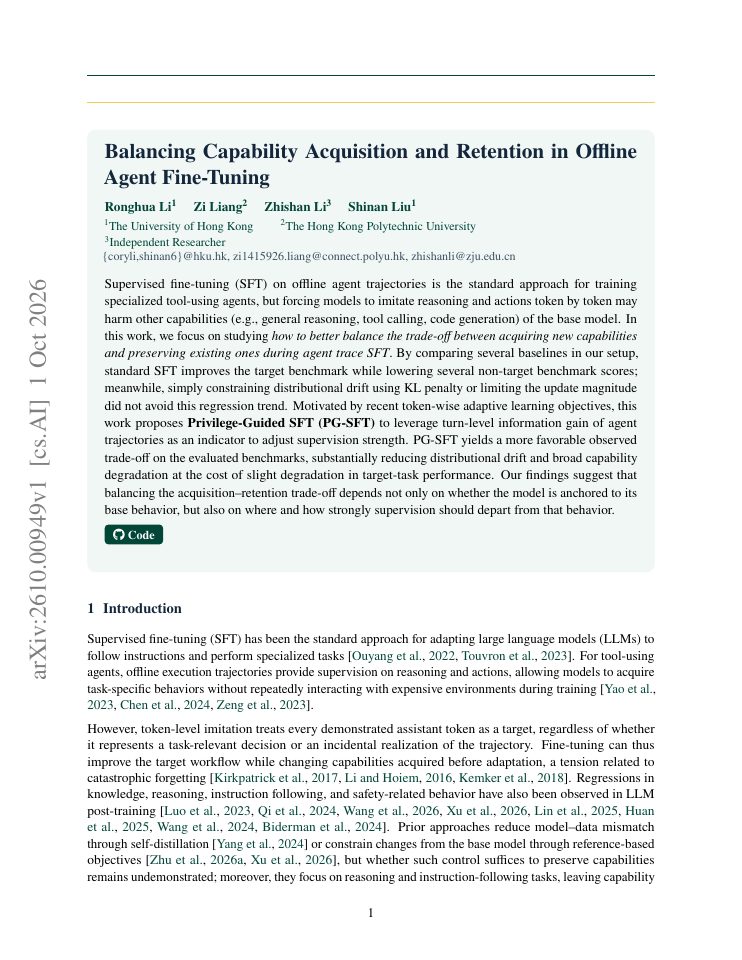
First page of PG-SFT: Balancing Capability Acquisition and Retention in Offline Agent Fine-Tuning
efficient trainingtest

PG-SFT: Balancing Capability Acquisition and Retention in Offline Agent Fine-Tuning

PG-SFT replaces uniform token-by-token supervised fine-tuning on offline agent trajectories with a token-wise objective that scales supervision strength by turn-level information gain, rather than relying on KL penalties or update-magnitude constraints. It costs a slight reduction in target-task performance and adds the complexity of computing per-turn information gain over the training trajectories. It can fail if the information-gain signal is noisy or misestimated on the reader's trajectory data, or if the retention-acquisition balance it was tuned for does not transfer to different base models or tool-use domains.

observed signal
2impl.
135stars
0citations
—claimed gain
abstract onlyReview decisionDownload skill ↓Original paper ↗
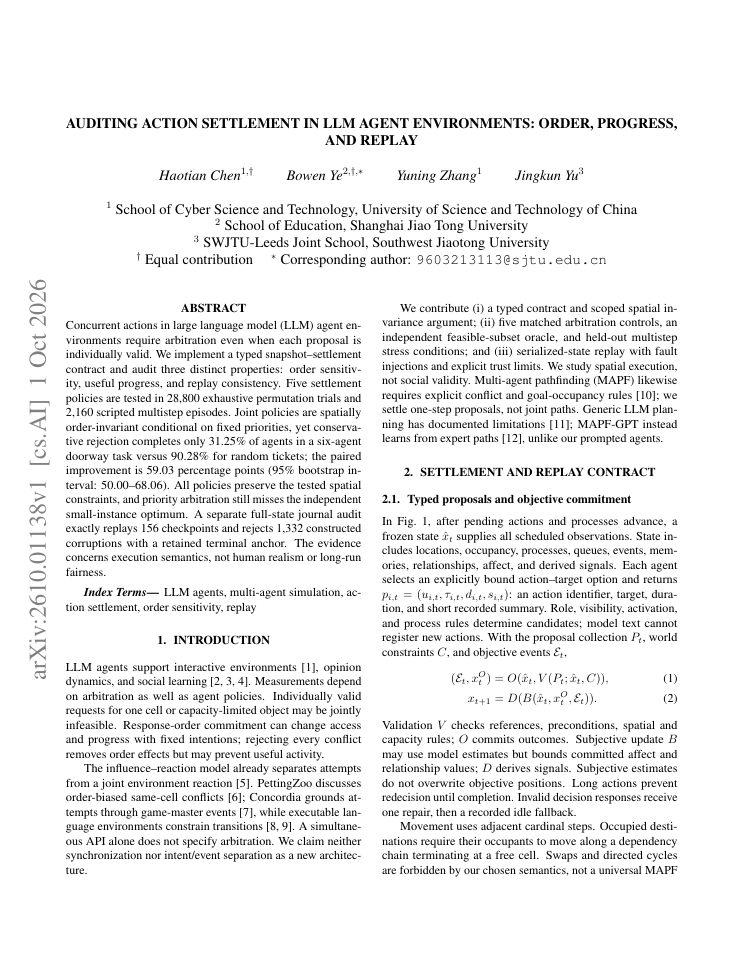
First page of Auditing Action Settlement in LLM Agent Environments: Order, Progress, and Replay
multi-agent orchestrationtest

Auditing Action Settlement in LLM Agent Environments: Order, Progress, and Replay

The method replaces ad-hoc or implicit arbitration of concurrent LLM agent actions with a typed snapshot-settlement contract plus a full-state journal for replay verification. It costs implementation complexity in the environment layer and policy-dependent throughput, since conservative settlement sharply reduces task completion. Order sensitivity persists under fixed priorities, priority arbitration can miss the small-instance optimum, and the evidence covers execution semantics only, not human realism or long-run fairness.

observed signal
2impl.
135stars
0citations
—claimed gain
abstract onlyReview decisionDownload skill ↓Original paper ↗
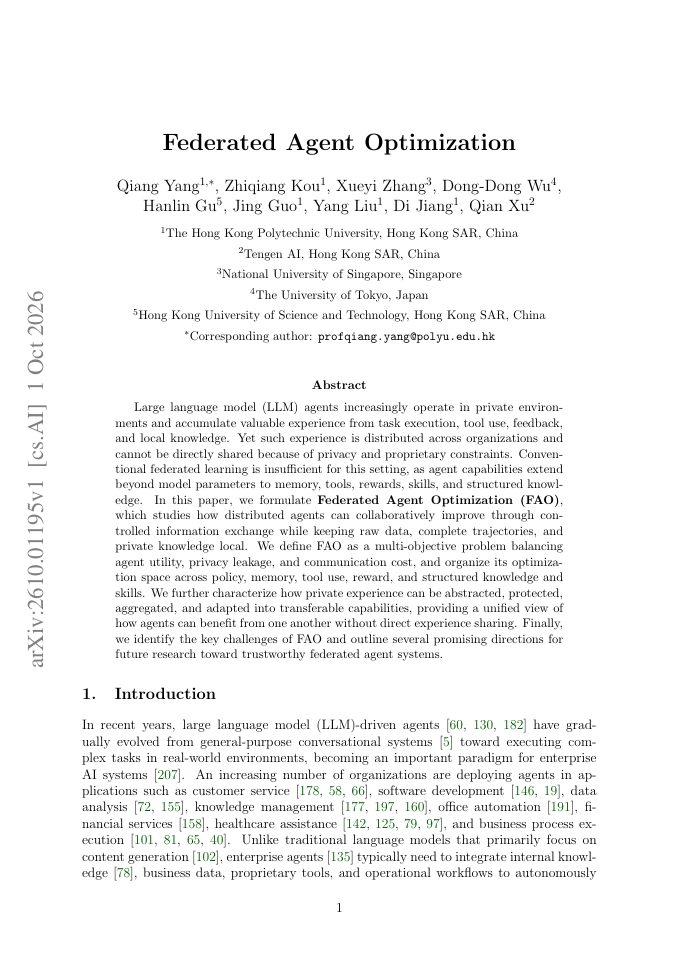
First page of Federated Agent Optimization
multi-agent orchestrationwatch

Federated Agent Optimization

FAO is a problem formulation and taxonomy, not a deployable method; it would replace ad hoc or absent cross-organization sharing of agent experience (policies, memories, tools, rewards, skills) with controlled, privacy-constrained exchange, but specifies no concrete algorithm to adopt. Its cost is organizational and engineering complexity: abstracting private experience, adding protection mechanisms, and managing aggregation infrastructure across trust boundaries, none of which is priced or benchmarked here. What can fail is the central premise itself: abstracted experience may leak private information, aggregated capabilities may not transfer across heterogeneous agents and tasks, and the multi-objective trade-off among utility, privacy, and communication is asserted rather than validated.

observed signal
2impl.
135stars
0citations
—claimed gain
abstract onlyReview decisionDownload skill ↓Original paper ↗
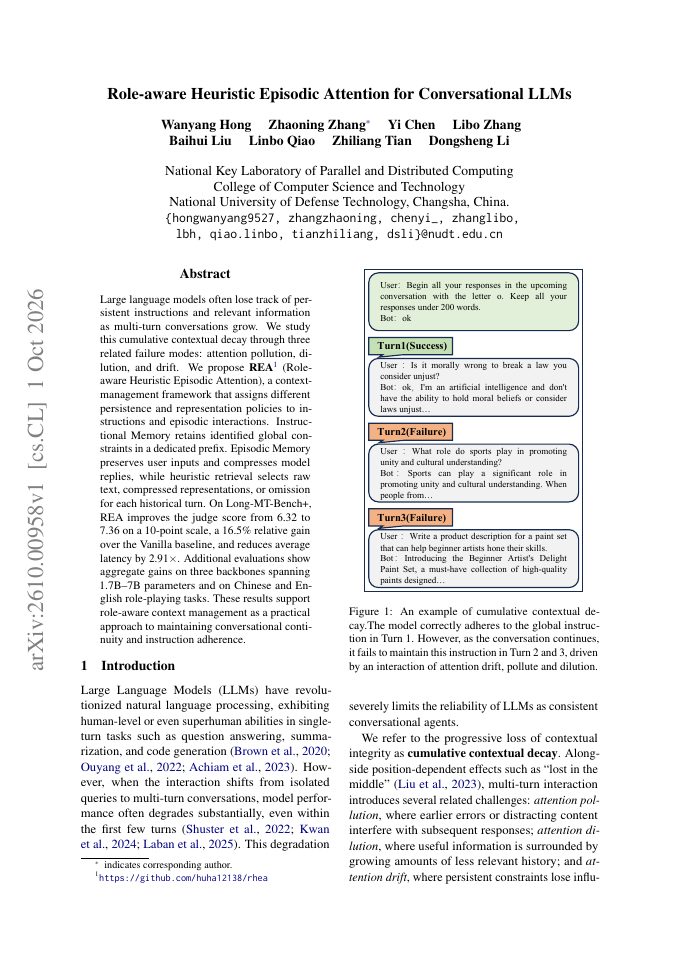
First page of Role-aware Heuristic Episodic Attention for Conversational LLMs
memory and contexttest

Role-aware Heuristic Episodic Attention for Conversational LLMs

REA replaces naive full-history concatenation with a structured context policy: a persistent instruction prefix plus episodic memory that keeps user turns raw, compresses model replies, and heuristically selects, compresses, or omits each historical turn. It costs an extra retrieval-and-compression pipeline, prompt-assembly complexity, and some loss of verbatim assistant history, but adds no training and runs on a single 24 GB GPU or via third-party APIs. It can fail when heuristic turn selection drops information needed later, when reply compression loses details the user references, or when instruction identification misclassifies constraints, and the reported gains come from judge-scored benchmarks on small backbones that may not transfer to the reader's workload.

observed signal
1impl.
125stars
0citations
2.91xclaimed gain
abstract onlyReview decisionDownload skill ↓Original paper ↗
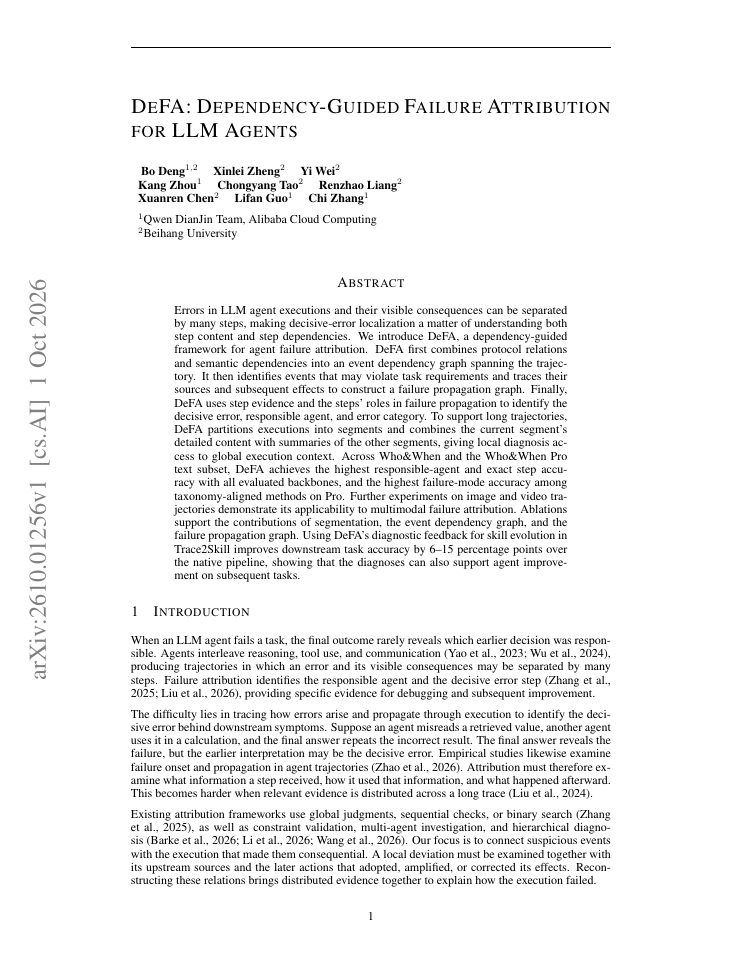
First page of DeFA: Dependency-Guided Failure Attribution for LLM Agents
failure recoverytest

DeFA: Dependency-Guided Failure Attribution for LLM Agents

DeFA replaces manual or single-pass LLM inspection of agent trajectories with a pipeline that builds an event dependency graph, constructs a failure propagation graph, and then attributes the decisive error, responsible agent, and error category, using segmentation plus cross-segment summaries for long traces. The cost is additional LLM inference per trajectory (graph construction and per-segment diagnosis), added pipeline complexity, and latency that makes it suitable for offline debugging rather than real-time control. It can fail when dependency extraction itself is erroneous on messy real-world logs, when benchmarks do not transfer to the reader's domain, and when the reported 6-15 point downstream gain does not replicate on tasks unlike the evaluated ones.

observed signal
1impl.
131stars
0citations
—claimed gain
abstract onlyReview decisionDownload skill ↓Original paper ↗
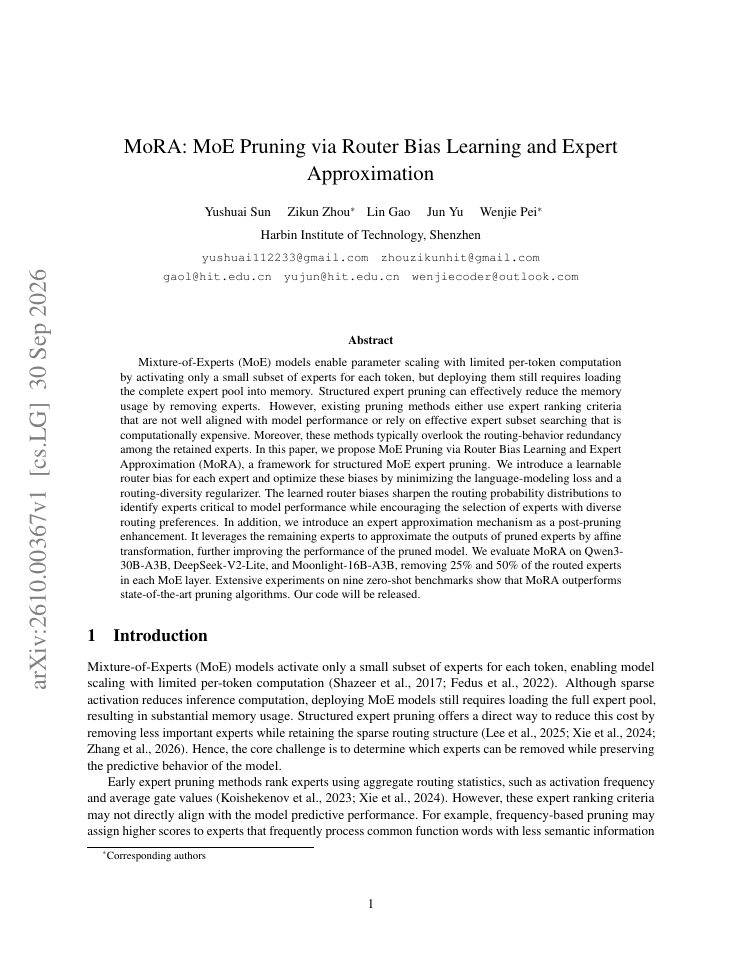
First page of MoRA: MoE Pruning via Router Bias Learning and Expert Approximation
sparsity and pruningtest

MoRA: MoE Pruning via Router Bias Learning and Expert Approximation

Replaces heuristic expert-ranking criteria and expensive expert-subset search with a learnable per-expert router bias optimized on language-modeling loss plus a routing-diversity regularizer, followed by affine approximation of pruned experts from retained ones. Costs a calibration-style optimization pass over the router biases and approximation parameters, adds pipeline complexity, and pruned models will still show some quality degradation that grows with the pruning ratio. Can fail when removed experts carried rare but important routing behaviors that the affine approximation cannot reconstruct, and results are validated only on three specific MoE architectures, so transfer to other models is unverified.

observed signal
0impl.
4stars
—citations
—claimed gain
abstract onlyReview decisionDownload skill ↓Original paper ↗
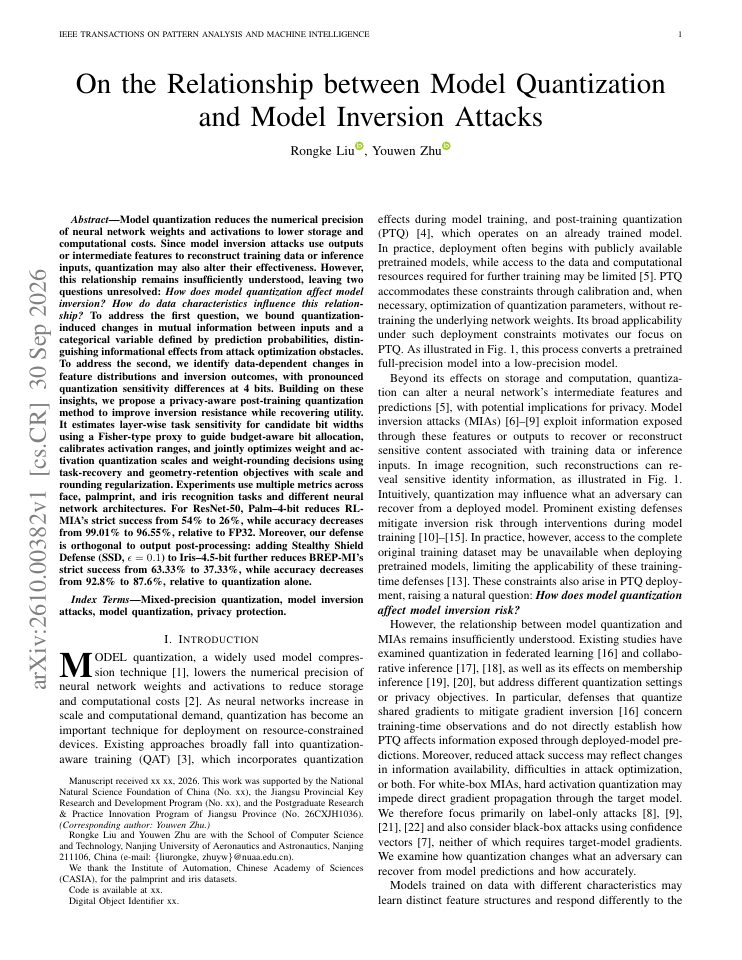
First page of On the Relationship between Model Quantization and Model Inversion Attacks
quantizationtest

On the Relationship between Model Quantization and Model Inversion Attacks

It replaces standard post-training quantization with a bit-allocation and scale/rounding optimization scheme (Fisher-type sensitivity proxy, activation range calibration, task-recovery and geometry-retention objectives) designed to degrade model inversion attacks while preserving task accuracy. The cost is additional PTQ optimization complexity and a measurable utility loss, roughly 2.5 to 5 accuracy points in the reported biometric benchmarks. It can fail against attack families not evaluated, since the defense is demonstrated mainly on RL-MIA and BREP-MI over face, palmprint, and iris recognition, and the privacy gain is entangled with quantization sensitivity that varies by dataset and bit-width, particularly around 4 bits.

observed signal
0impl.
0stars
0citations
—claimed gain
abstract onlyReview decisionDownload skill ↓Original paper ↗
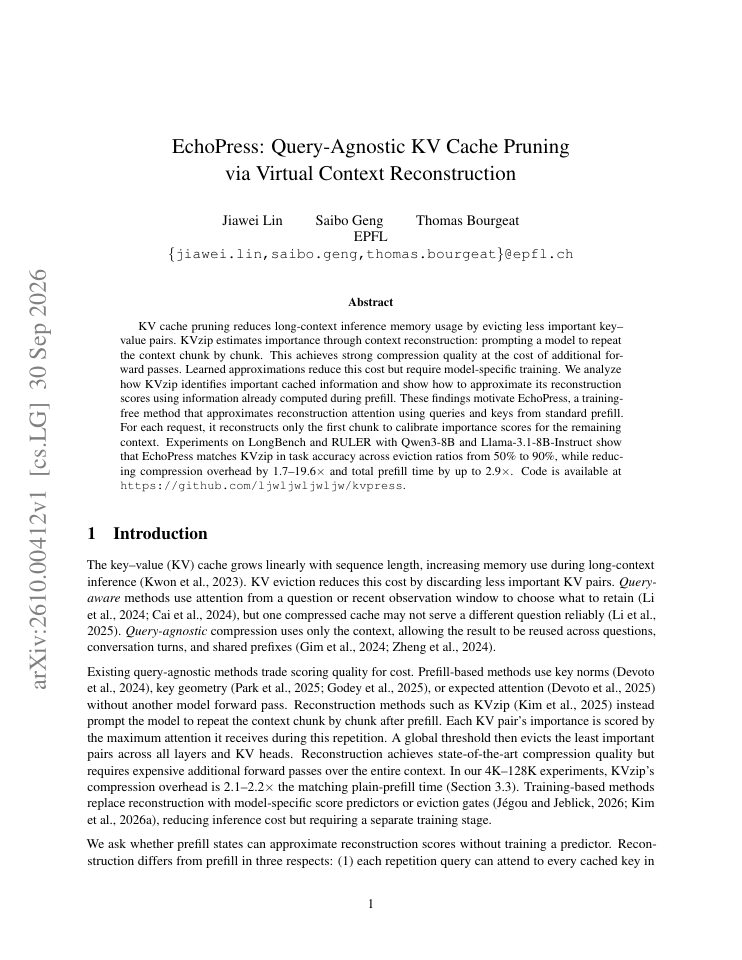
First page of EchoPress: Query-Agnostic KV Cache Pruning via Virtual Context Reconstruction
KV cachetest

EchoPress: Query-Agnostic KV Cache Pruning via Virtual Context Reconstruction

EchoPress replaces KVzip's chunk-by-chunk context reconstruction (multiple extra forward passes) and its learned approximations (model-specific training) with a training-free scoring method that reuses queries and keys from standard prefill, reconstructing only the first chunk per request for calibration. It costs one additional partial forward pass per request plus integration of a pruning library into the serving path; accuracy is claimed to match KVzip, so the quality cost is near zero on the evaluated benchmarks. It can fail on workloads unlike LongBench/RULER (e.g., retrieval-heavy or code contexts where first-chunk calibration misestimates importance of later chunks), at extreme eviction ratios beyond 90%, or on models other than the two evaluated, since the approximation relies on prefill attention statistics that may not transfer.

observed signal
0impl.
4stars
0citations
2.9xclaimed gain
abstract onlyReview decisionDownload skill ↓Original paper ↗
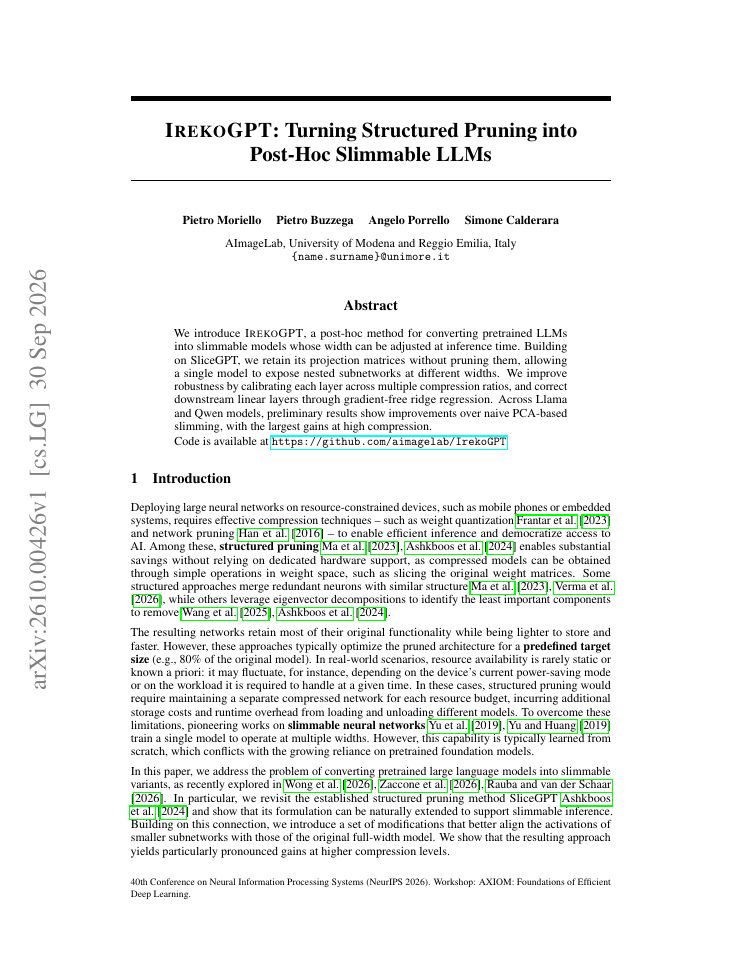
First page of IrekoGPT: Turning Structured Pruning into Post-Hoc Slimmable LLMs
sparsity and pruningtest

IrekoGPT: Turning Structured Pruning into Post-Hoc Slimmable LLMs

The method replaces one-shot structured pruning (SliceGPT-style PCA slicing that permanently removes width) with a single model retaining full projection matrices so nested subnetworks at multiple widths can be selected at inference time, with per-layer multi-ratio calibration and gradient-free ridge-regression correction of downstream linear layers. The cost is a calibration and regression pass per target ratio plus storing the full-width weights, and it does not reduce memory at rest the way quantization does; savings materialize only when a smaller width is actually deployed. It can fail because results are explicitly preliminary, per-width accuracy is not guaranteed to match separately pruned models, and serving efficiency depends on runtime support for dynamic width selection, which standard inference stacks do not provide out of the box.

observed signal
0impl.
0stars
0citations
—claimed gain
abstract onlyReview decisionDownload skill ↓Original paper ↗
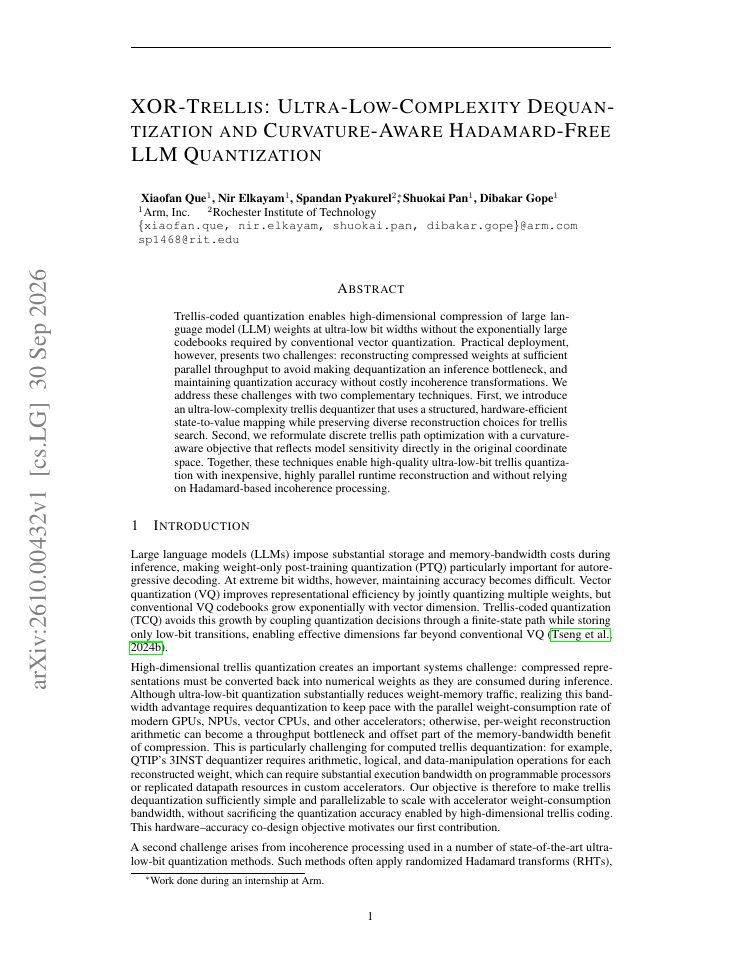
First page of XOR-Trellis: Ultra-Low-Complexity Dequantization and Curvature-Aware Hadamard-Free LLM Quantization
quantizationtest

XOR-Trellis: Ultra-Low-Complexity Dequantization and Curvature-Aware Hadamard-Free LLM Quantization

The method replaces Hadamard-based incoherence processing and conventional vector-quantization codebooks in ultra-low-bit LLM weight quantization, using a curvature-aware trellis path objective in the original coordinate space and a structured hardware-efficient state-to-value mapping for reconstruction. Its cost is the added complexity of trellis search during quantization and of a custom dequantization path in the inference stack, neither of which is supported by mainstream serving runtimes today. It can fail if the claimed reconstruction throughput does not materialize on real GPU kernels, if quality at ultra-low bit widths degrades on the reader's specific models, or if the absence of published numbers hides accuracy regressions relative to established GPTQ/AWQ-style baselines.

observed signal
0impl.
0stars
0citations
—claimed gain
abstract onlyReview decisionDownload skill ↓Original paper ↗
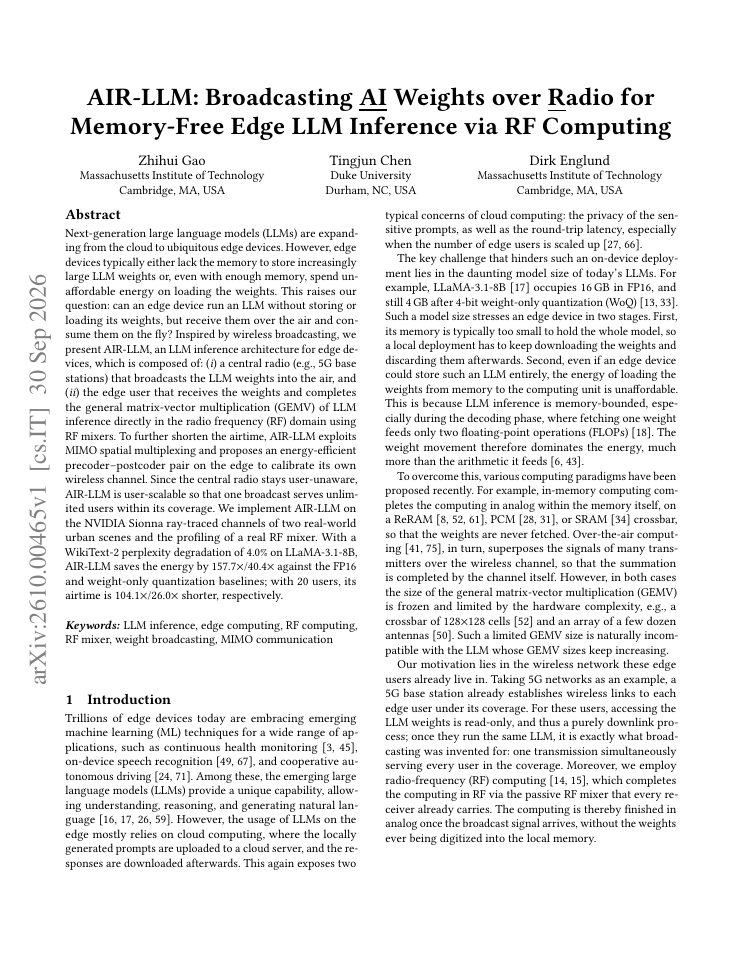
First page of AIR-LLM: Broadcasting AI Weights over Radio for Memory-Free Edge LLM Inference via RF Computing
othernot applicable

AIR-LLM: Broadcasting AI Weights over Radio for Memory-Free Edge LLM Inference via RF Computing

AIR-LLM replaces on-device weight storage and DRAM loading at the edge by broadcasting weights from a central radio and computing GEMV directly in the RF domain with analog mixers. It requires a dedicated broadcasting base station, MIMO-capable RF front-ends with calibrated precoder/postcoder hardware, and is validated only in simulation with a 4.0% perplexity degradation; none of this maps to a GPU- or API-based deployment. It can fail through wireless channel noise and interference corrupting weight delivery, per-device calibration overhead, dependence on infrastructure that does not exist commercially, and unverified accuracy under real RF hardware impairments.

observed signal
0impl.
4stars
0citations
—claimed gain
abstract onlyReview decisionDownload skill ↓Original paper ↗
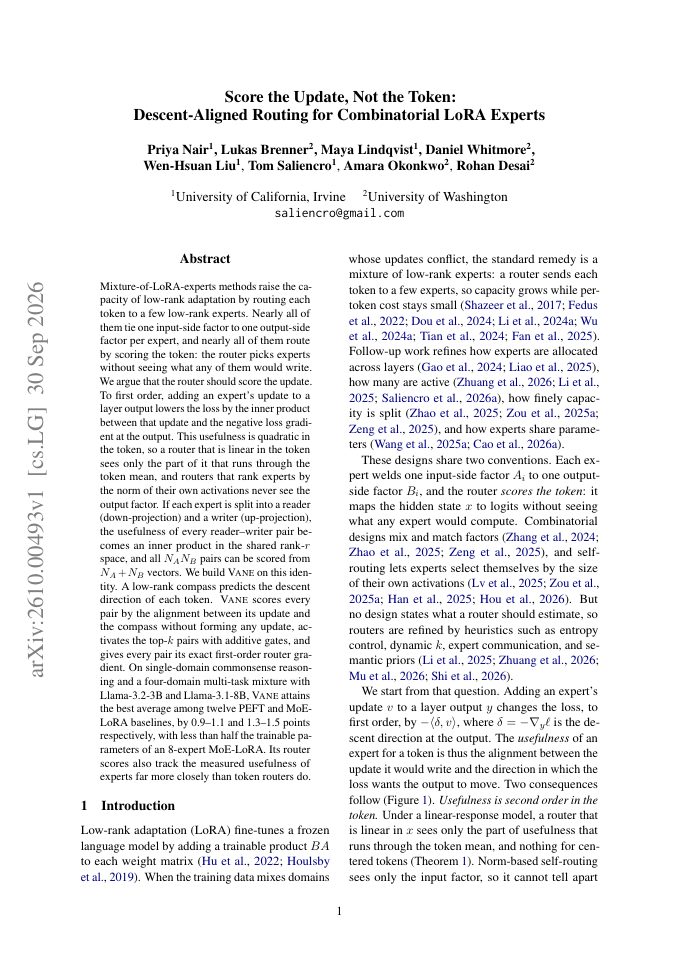
First page of Score the Update, Not the Token: Descent-Aligned Routing for Combinatorial LoRA Experts
efficient trainingtest

Score the Update, Not the Token: Descent-Aligned Routing for Combinatorial LoRA Experts

VANE replaces token-similarity MoE-LoRA routers with a router that scores each reader-writer LoRA pair by the inner product between its implied weight update and a low-rank predicted descent direction, enabling all N_A x N_B pairs to be ranked from N_A + N_B vectors and giving every pair an exact first-order router gradient. The cost is modest inference-side compute for the compass and pair scoring, implementation complexity well above standard LoRA or off-the-shelf MoE-LoRA, and current validation limited to 3B-8B models on a small set of commonsense and multi-task benchmarks. What can fail: the first-order loss-reduction approximation can mislead under large learning rates or noisy gradients, the compass may mispredict descent directions out of distribution, gains of roughly one accuracy point may not transfer to other domains, and no mature open-source implementation or serving integration is guaranteed.

observed signal
0impl.
0stars
0citations
—claimed gain
abstract onlyReview decisionDownload skill ↓Original paper ↗
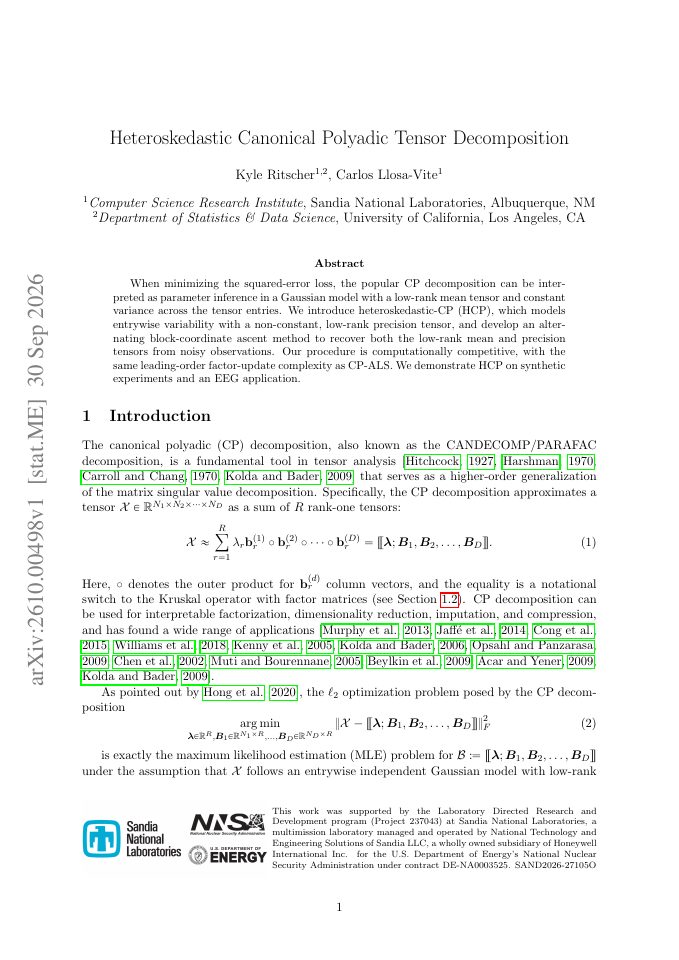
First page of Heteroskedastic Canonical Polyadic Tensor Decomposition
othernot applicable

Heteroskedastic Canonical Polyadic Tensor Decomposition

HCP replaces standard CP-ALS squared-error decomposition with a model that jointly estimates a low-rank mean tensor and a low-rank precision tensor for entrywise non-constant noise. The cost is an alternating block-coordinate ascent routine with the same leading-order factor-update complexity as CP-ALS, plus the added state and estimation burden of the precision tensor. It can fail when the low-rank precision assumption is wrong, when data are insufficient to identify both tensors, or in small-sample regimes where variance estimation adds instability rather than accuracy.

observed signal
0impl.
0stars
0citations
—claimed gain
abstract onlyReview decisionDownload skill ↓Original paper ↗
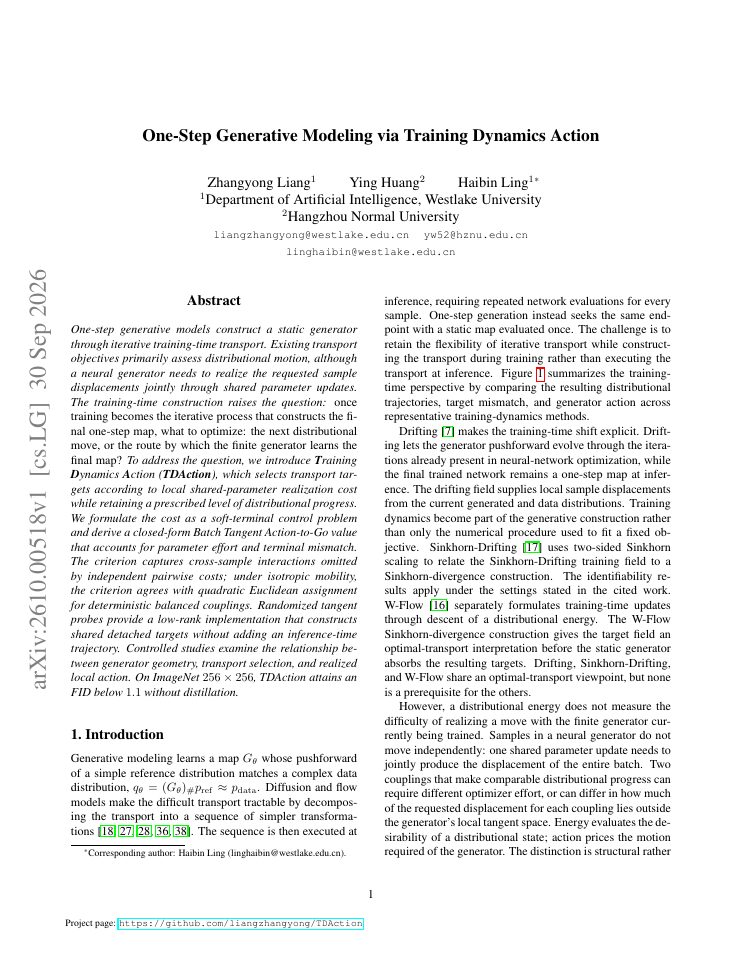
First page of One-Step Generative Modeling via Training Dynamics Action
efficient trainingwatch

One-Step Generative Modeling via Training Dynamics Action

TDAction replaces the standard distributional transport objectives (and distillation-based pipelines) used to train one-step generative models with transport targets selected by a shared-parameter realization cost, computed via a closed-form Batch Tangent Action-to-Go value and low-rank randomized tangent probes. It costs additional training-time computation for tangent probes and detached shared targets, though it adds no inference-time trajectory; training a competitive ImageNet 256x256 generator still demands compute beyond a single 24 GB GPU. It can fail if the isotropic-mobility or local linearization assumptions behind the tangent action misestimate true parameter effort, and the controlled evidence base means gains may not transfer to other architectures, datasets, or resolutions.

observed signal
0impl.
0stars
0citations
—claimed gain
abstract onlyReview decisionDownload skill ↓Original paper ↗
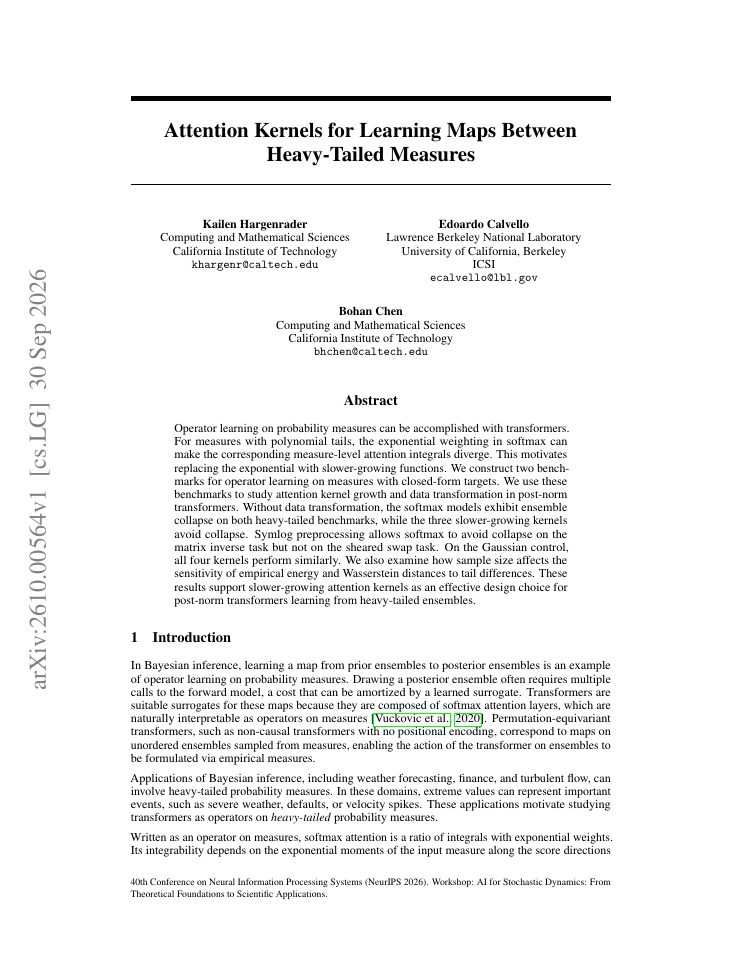
First page of Attention Kernels for Learning Maps Between Heavy-Tailed Measures
attention and kernelstest

Attention Kernels for Learning Maps Between Heavy-Tailed Measures

The method replaces the exponential weighting in softmax attention with slower-growing kernel functions so that attention integrals remain finite when learning maps between probability measures with polynomial tails. The cost is minimal in memory and latency, but it requires a custom attention implementation rather than off-the-shelf fused softmax kernels, and it matters only for post-norm transformers trained on heavy-tailed ensembles. It can fail to help on light-tailed data, where all kernels perform equivalently, and even data transformation (symlog) does not rescue softmax on the sheared swap task, so kernel choice rather than preprocessing must carry the fix.

observed signal
0impl.
0stars
0citations
—claimed gain
abstract onlyReview decisionDownload skill ↓Original paper ↗
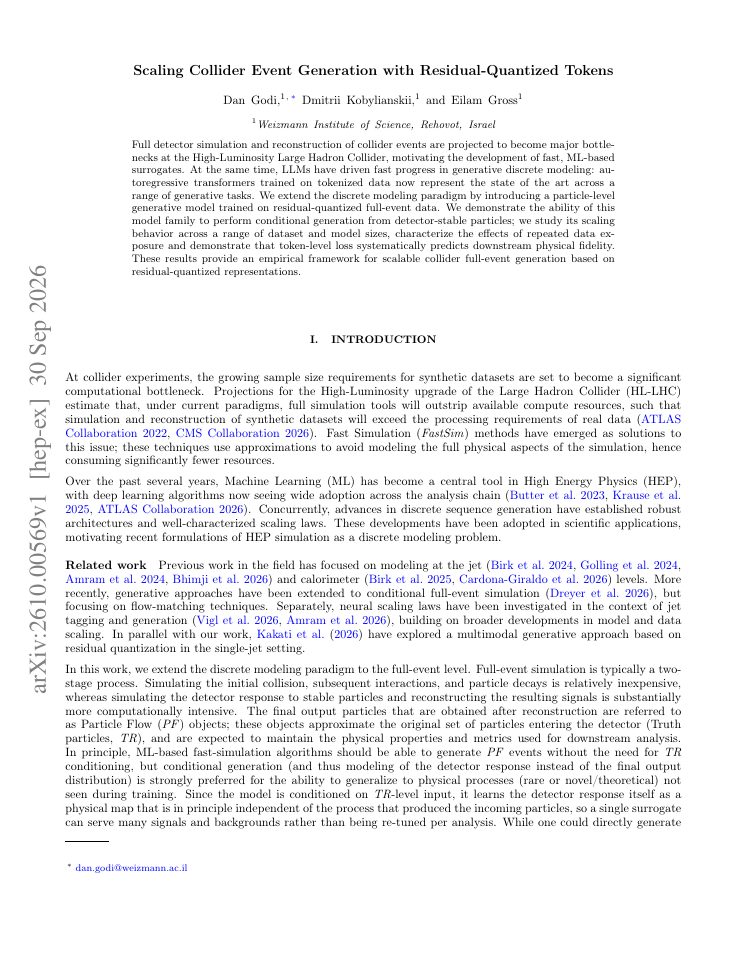
First page of Scaling Collider Event Generation with Residual-Quantized Tokens
othernot applicable

Scaling Collider Event Generation with Residual-Quantized Tokens

The method replaces computationally expensive full detector simulation and reconstruction in high-energy physics with a fast autoregressive transformer surrogate trained on residual-quantized representations of particle-level event data. It costs the training of a domain-specific tokenizer and transformer on specialized collider datasets, plus validation effort to confirm that token-level loss correlates with physical fidelity. It can fail if the surrogate's learned distributions deviate from true detector physics in regions that matter for downstream analyses, and its applicability is limited to particle physics event generation rather than general language or code workloads.

observed signal
0impl.
0stars
0citations
—claimed gain
abstract onlyReview decisionDownload skill ↓Original paper ↗
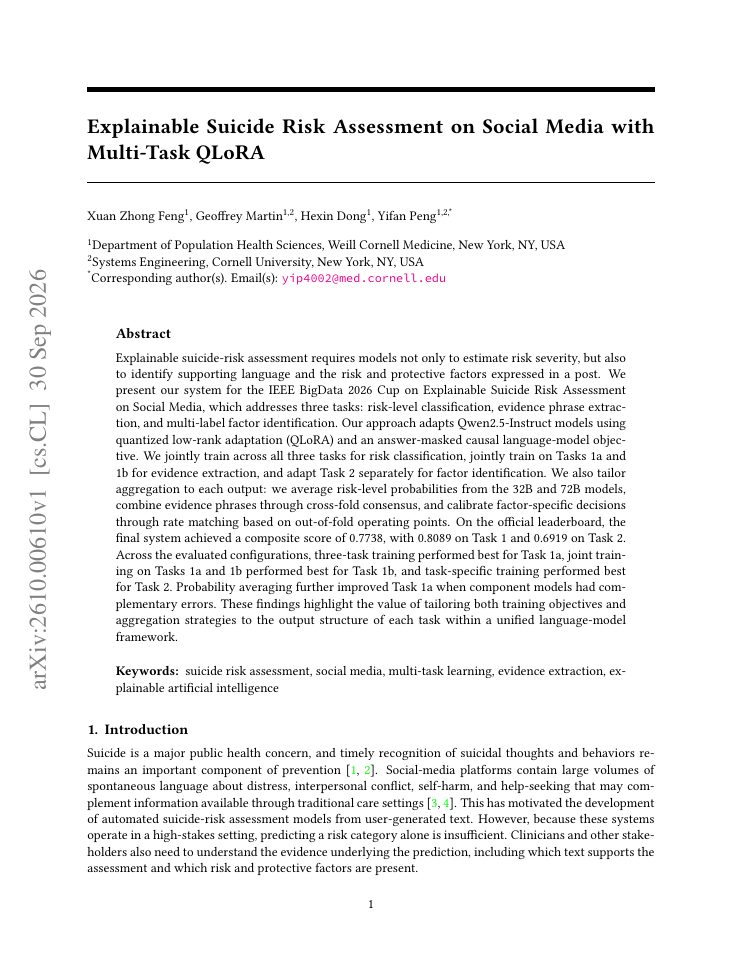
First page of Explainable Suicide Risk Assessment on Social Media with Multi-Task QLoRA
efficient trainingtest

Explainable Suicide Risk Assessment on Social Media with Multi-Task QLoRA

The method replaces full fine-tuning of large instruct models with 4-bit QLoRA adapters trained under an answer-masked causal-LM objective, plus per-task aggregation (probability averaging, cross-fold consensus, rate-matched calibration) instead of a single uniform decoding scheme. The cost is substantial engineering complexity: three distinct training configurations, cross-validation folds, and calibration pipelines, and the 32B/72B ensemble used for the top result exceeds a 24 GB GPU budget and would require API access or smaller model substitution. What can fail is that multi-task training gains are task-dependent (three-task training helped Task 1a but hurt Task 2), ensemble gains depend on complementary errors that may not hold for other model pairs, and a small team may not recoup the calibration overhead on a different dataset.

observed signal
0impl.
121stars
0citations
—claimed gain
abstract onlyReview decisionDownload skill ↓Original paper ↗

Research signals

Three views of the same evidence: adoption against attention, publication cadence by research area, and reported gains when coverage is sufficient.

color = research area

01 · attention × adoption

The research frontier

Look to the upper left for independent implementation before mass attention.

compare by
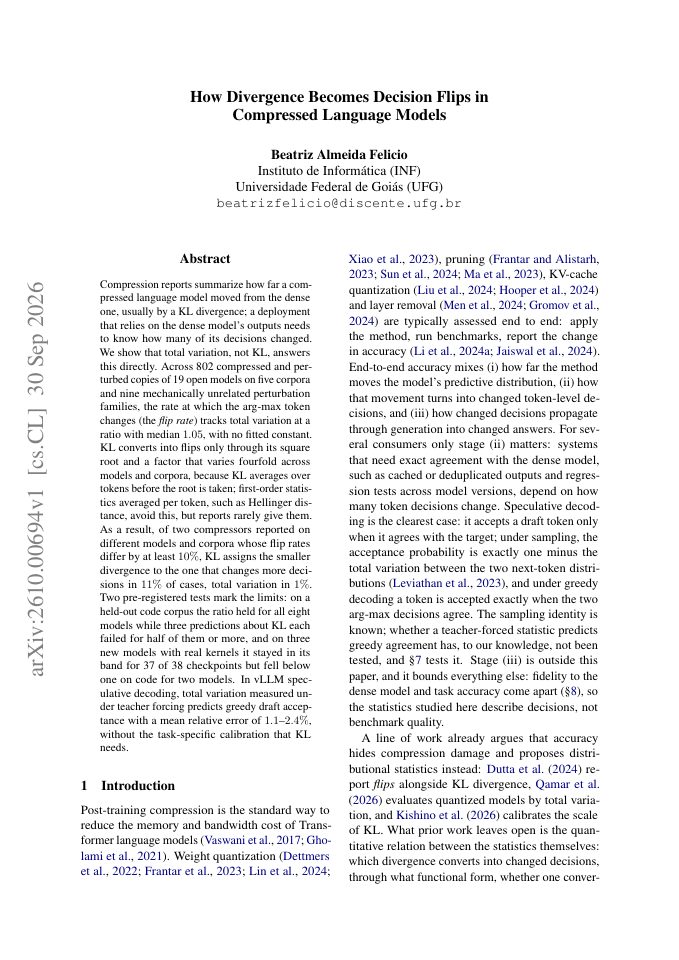
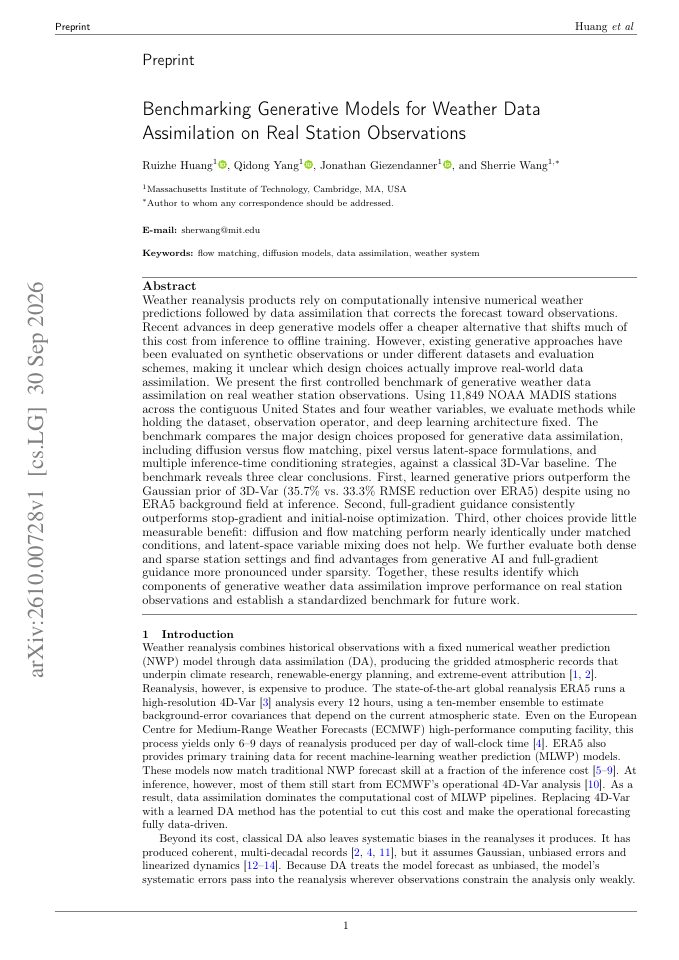
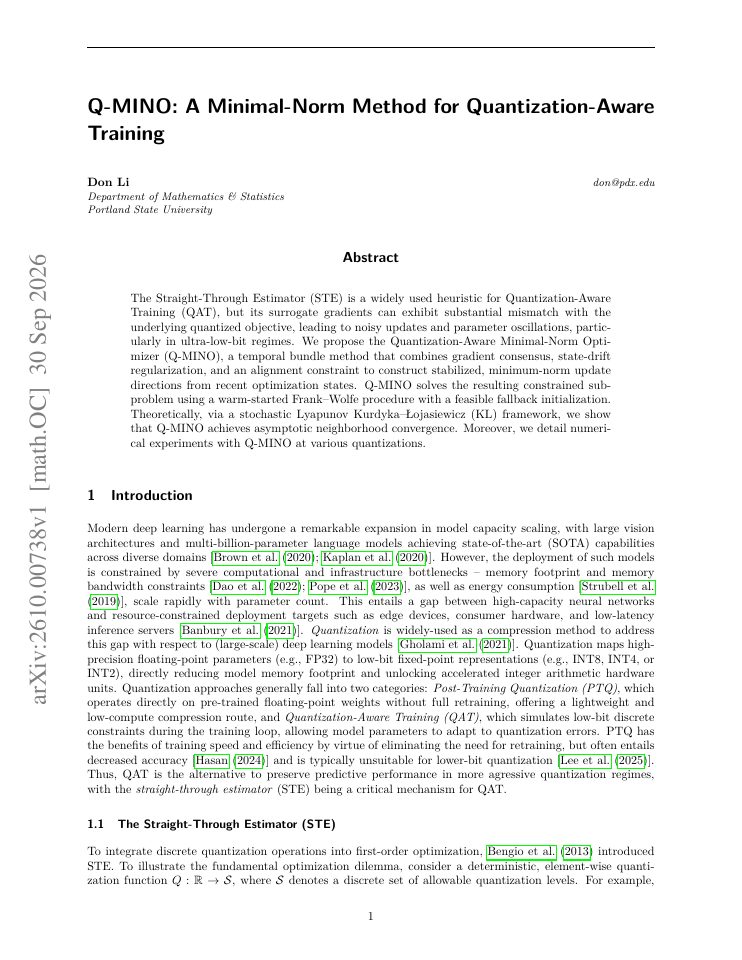
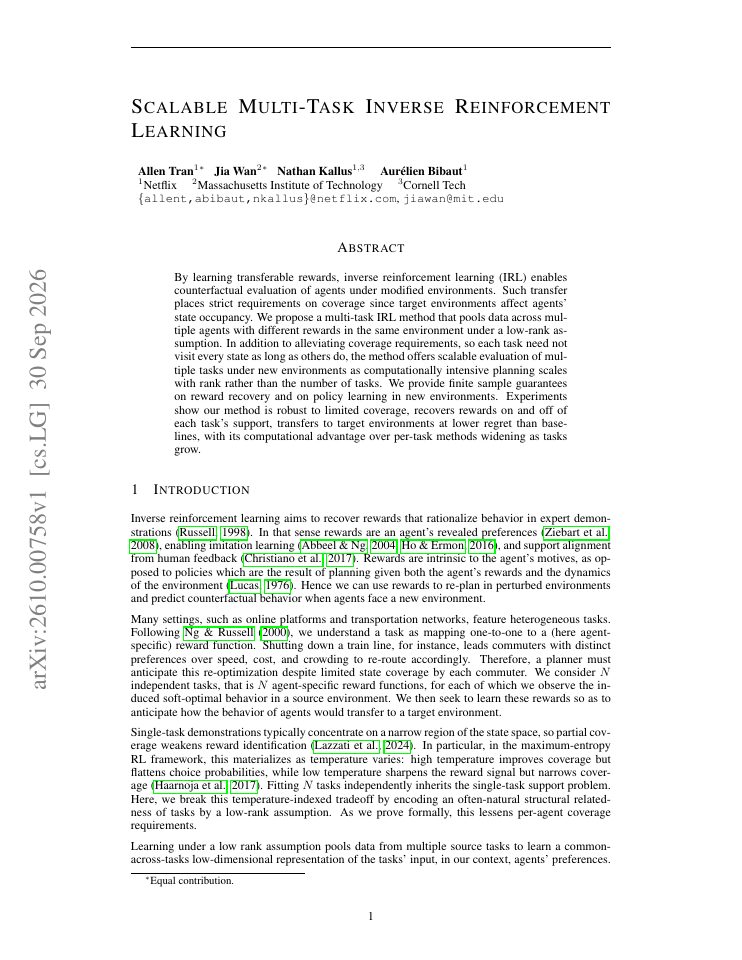
Each point represents one paper. Higher means more independent implementations; farther right means more GitHub stars.Procedural Graphs: Self-Evolving Execution Structures for LLM Agents: 17 GitHub stars; 14 independent implementationsActGuard: Pre-execution Action Auditing against Indirect Prompt Injection in LLM Agents: 3 GitHub stars; 2 independent implementationsExploring Heterogeneous Model Merging Approach for Complex Knowledge Transfer: 0 GitHub stars; 1 independent implementationMoRA: MoE Pruning via Router Bias Learning and Expert Approximation: 4 GitHub stars; 0 independent implementationsOn the Relationship between Model Quantization and Model Inversion Attacks: 0 GitHub stars; 0 independent implementationsEchoPress: Query-Agnostic KV Cache Pruning via Virtual Context Reconstruction: 4 GitHub stars; 0 independent implementationsIrekoGPT: Turning Structured Pruning into Post-Hoc Slimmable LLMs: 0 GitHub stars; 0 independent implementationsXOR-Trellis: Ultra-Low-Complexity Dequantization and Curvature-Aware Hadamard-Free LLM Quantization: 0 GitHub stars; 0 independent implementationsAIR-LLM: Broadcasting AI Weights over Radio for Memory-Free Edge LLM Inference via RF Computing: 4 GitHub stars; 0 independent implementationsScore the Update, Not the Token: Descent-Aligned Routing for Combinatorial LoRA Experts: 0 GitHub stars; 0 independent implementationsHeteroskedastic Canonical Polyadic Tensor Decomposition: 0 GitHub stars; 0 independent implementationsOne-Step Generative Modeling via Training Dynamics Action: 0 GitHub stars; 0 independent implementationsAttention Kernels for Learning Maps Between Heavy-Tailed Measures: 0 GitHub stars; 0 independent implementationsScaling Collider Event Generation with Residual-Quantized Tokens: 0 GitHub stars; 0 independent implementationsExplainable Suicide Risk Assessment on Social Media with Multi-Task QLoRA: 121 GitHub stars; 0 independent implementationsPhysicsMate: A Curriculum-Grounded Bengali Benchmark for Secondary Physics QA with Small-Model Adaptation: 121 GitHub stars; 0 independent implementationsAnalysis of Quantized and Efficiently Adapted Protein Language Models: 4 GitHub stars; 0 independent implementationsHow Divergence Becomes Decision Flips in Compressed Language Models: 0 GitHub stars; 0 independent implementationsBenchmarking Generative Models for Weather Data Assimilation on Real Station Observations: 1 GitHub star; 0 independent implementationsQ-MINO: A Minimal-Norm Method for Quantization-Aware Training: 0 GitHub stars; 0 independent implementationsScalable Multi-Task Inverse Reinforcement Learning: 10 GitHub stars; 0 independent implementationsAuraForge: Scaling Security Supervision for Training Coding Agents: 14 GitHub stars; 1 independent implementationKinematic MeanFlow: One-Step Action Generation Policy for Robotic Foundation Models: 112 GitHub stars; 2 independent implementationsMemFit: Efficient Long-Term Agentic Memory: 131 GitHub stars; 2 independent implementationsFORALL-LEAN-AGENT for Auditable Reasoning in Formal Mathematics and Software Verification: 0 GitHub stars; 0 independent implementationsCross-Benchmark Transfer from RL on Agentic Coding Tasks: 10 GitHub stars; 0 independent implementationsActiveSaddler: Automated Curriculum Learning for Agent Harness Optimization: 14 GitHub stars; 2 independent implementationsFinding the Right Fit: Model-Harness Interactions across Agent Tasks: 13 GitHub stars; 0 independent implementationsPG-SFT: Balancing Capability Acquisition and Retention in Offline Agent Fine-Tuning: 135 GitHub stars; 2 independent implementationsRole-aware Heuristic Episodic Attention for Conversational LLMs: 125 GitHub stars; 1 independent implementationVeriHarness: Scaling Agentic Verification for Long-Horizon Tasks: 139 GitHub stars; 4 independent implementationsABSENTIA: Detecting Broken Access Control Vulnerabilities in Web Applications: 0 GitHub stars; 0 independent implementationsRISED: RubrIcs for agentic multi-environment Selection and sElf-Distillation: 131 GitHub stars; 2 independent implementationsCan AI Scientists Coordinate at Runtime?: 12 GitHub stars; 1 independent implementationGroundability, Not Scale Alone: When Weak Reviewers Can Audit Strong Coding Agents: 14 GitHub stars; 1 independent implementationNetwork World Models as Environments for Algorithm Design on Complex Systems: 341 GitHub stars; 4 independent implementationsAuditing Action Settlement in LLM Agent Environments: Order, Progress, and Replay: 135 GitHub stars; 2 independent implementationsCineMR: Tool-Integrated Vision-Language Reasoning for Quantitative Cardiac MRI Assessment: 0 GitHub stars; 0 independent implementationsFederated Agent Optimization: 135 GitHub stars; 2 independent implementationsAGO AI Quality Gate: Evidence-First Release Decisions for Retrieval-Augmented Generation: 125 GitHub stars; 2 independent implementationsDeFA: Dependency-Guided Failure Attribution for LLM Agents: 131 GitHub stars; 1 independent implementationScience Utopia? Closed-Loop LLM Simulation of Academic Research Ecosystems: 0 GitHub stars; 0 independent implementations

Papers above 1000 stars or 200 citations are not scored. They have already broken through the attention threshold, while Paperraft is designed to identify earlier signals.

02 · cadence

Research areas over time

Compare monthly publication volume on a shared scale and calendar.

coding agentsmax 5Sep 26: 0 papersOct 26: 1 paperSep 26Oct 26agent evaluationmax 5Sep 26: 1 paperOct 26: 4 papersSep 26Oct 26KV cachemax 5Sep 26: 1 paperOct 26: 0 papersSep 26Oct 26sparsity and pruningmax 5Sep 26: 2 papersOct 26: 0 papersSep 26Oct 26attention and kernelsmax 5Sep 26: 1 paperOct 26: 0 papersSep 26Oct 26memory and contextmax 5Sep 26: 1 paperOct 26: 2 papersSep 26Oct 26multi-agent orchestrationmax 5Sep 26: 0 papersOct 26: 4 papersSep 26Oct 26othermax 5Sep 26: 4 papersOct 26: 1 paperSep 26Oct 26quantizationmax 5Sep 26: 5 papersOct 26: 0 papersSep 26Oct 26failure recoverymax 5Sep 26: 0 papersOct 26: 2 papersSep 26Oct 26safety and guardrailsmax 5Sep 26: 1 paperOct 26: 3 papersSep 26Oct 26efficient trainingmax 5Sep 26: 5 papersOct 26: 3 papersSep 26Oct 26tool usemax 5Sep 26: 0 papersOct 26: 1 paperSep 26Oct 26

Every panel uses the same calendar and vertical scale. An empty column means no papers were recorded.

Method under scrutiny

Inspect the highest-ranked paper, every repository behind its signal, and the rule used to classify each one.

Procedural Graphs: Self-Evolving Execution Structures for LLM Agents

memory and context · test · 14 of 14 implementations are independent

Replaces unconstrained next-action generation over an accumulating trajectory with an evolving (procedure, relation, procedure) graph that a guidance model turns into step-level hints biasing, but not dictating, the agent's next action. Costs an extra guidance-model call per decision step plus LLM-refiner passes that contrast failed and successful trajectories to edit the graph against a held-out validation set, adding orchestration complexity and API spend. Can fail if validation sets are small or unrepresentative, letting the refiner overfit graph edits, or if localization of the active node is wrong on long trajectories, injecting misleading guidance; the abstract reports only qualitative 'consistent gains' with no quantified improvement, so the benefit is unverified for any specific workload.
Exclusions and controls

Every exclusion is counted and published.
Exclusion counts were not recorded for this edition.
0 previously indexed papers were rechecked in this run.

Paperraft tracks one signal: how many independent implementations a paper attracts on GitHub after author-owned repositories are removed. This is a discovery signal to investigate, not a measure of implementation quality.

It does not claim that a method works. Paperraft runs no reproduction benchmarks. Reported gains remain author claims until independently tested. Papers above the attention threshold are excluded because this publication is designed to identify research before consensus forms.