Skip to content

archived edition · 2026-09-27

PaperraftFind the AI research
worth testing.

Understand what a paper changes, what it costs, and whether it fits your next build. Explore research on faster LLM inference, agent memory, and evaluation, with the original sources in reach.

Start with a brief. Follow the evidence. Choose a test.

edition
2026-09-27
briefs
42
research areas
16
independent implementations
9

37 of 42 papers in the index (88%) have no independent implementations.

Research index

Search by topic, browse a research area, or sort by date. Read a brief, open the original paper, and inspect the available evidence before deciding what to test.

showing30 of 42
sort by
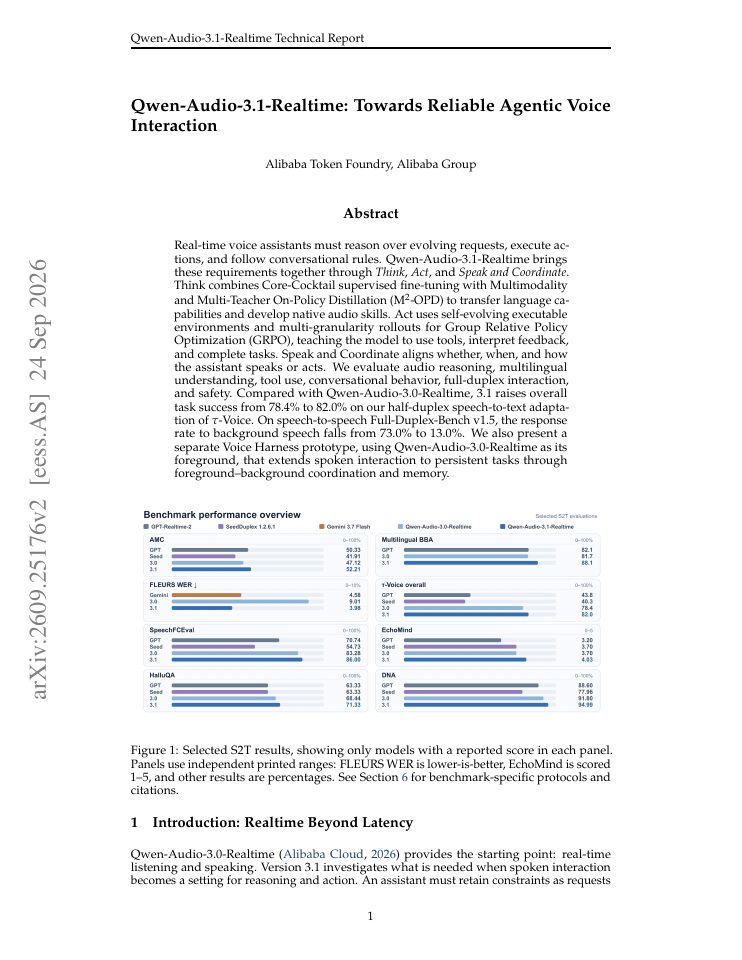
First page of Qwen-Audio-3.1-Realtime: Towards Reliable Agentic Voice Interaction
tool usewatch

Qwen-Audio-3.1-Realtime: Towards Reliable Agentic Voice Interaction

The method replaces standard speech-to-speech assistant training with a three-stage pipeline: Core-Cocktail SFT plus multi-teacher on-policy distillation for reasoning, GRPO rollouts in self-evolving executable environments for tool use, and an alignment stage governing when to speak versus act. It costs large-scale RL infrastructure, executable tool environments, and multiple teacher models, none of which fit a single 24 GB GPU or a limited API budget. If adopted only via third-party API access to the resulting model, failure modes include dependence on vendor behavior, unverifiable safety and full-duplex claims on proprietary benchmarks, and no path to fine-tune coordination behavior for domain-specific tools.

observed signal
4impl.
11stars
0citations
—claimed gain
abstract onlyReview decisionDownload skill ↓Original paper ↗
First page of A discrete generative model of neuronal spiking activity on microelectrode arrays
othernot applicable

A discrete generative model of neuronal spiking activity on microelectrode arrays

The method replaces assay-specific sorted-neuron models and flat tokenizers for microelectrode-array spike data with a shared residual vector-quantized motif vocabulary and a factorized masked transformer. Adoption costs training a VQ-VAE and transformer on sparse multi-electrode recordings and maintaining a preprocessing pipeline for array-wide binary spike volumes, none of which intersects LLM inference or agent workloads. It can fail when electrode subsets or tissue dynamics shift across assays, since motif reuse is statistical rather than guaranteed, and the reported gains are specific to neural recordings.

observed signal
2impl.
1stars
0citations
5.2xclaimed gain
abstract onlyReview decisionDownload skill ↓Original paper ↗
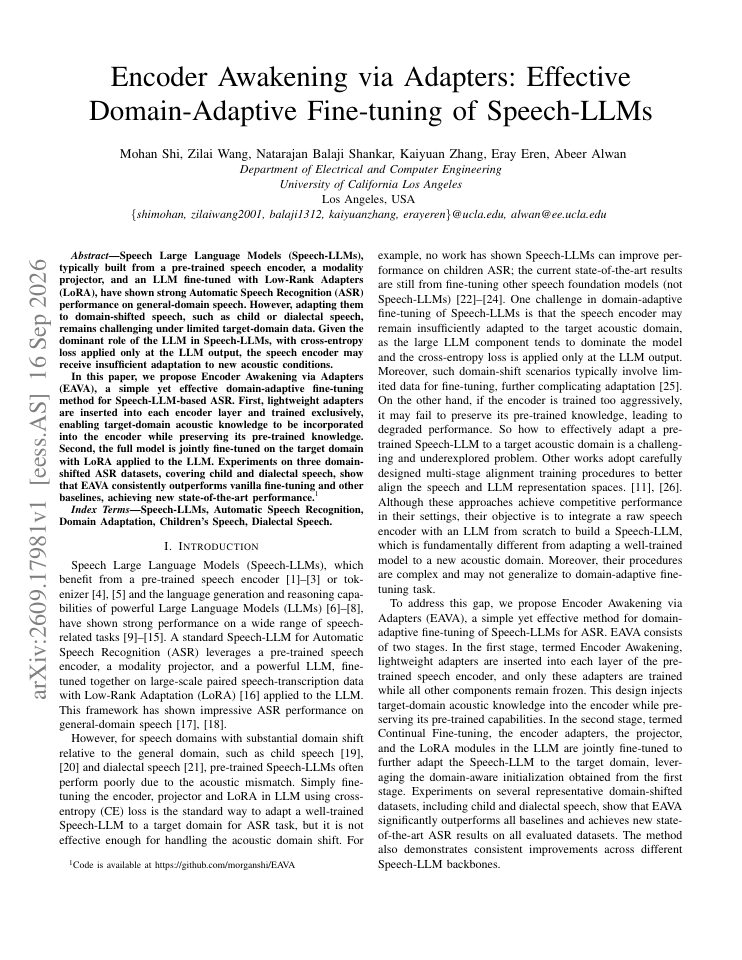
First page of Encoder Awakening via Adapters: Effective Domain-Adaptive Fine-tuning of Speech-LLMs
efficient trainingtest

Encoder Awakening via Adapters: Effective Domain-Adaptive Fine-tuning of Speech-LLMs

It replaces direct joint fine-tuning of a Speech-LLM (or LoRA-only LLM adaptation) with a two-stage procedure: first train lightweight adapters inserted into each frozen speech-encoder layer, then jointly fine-tune the whole model with LoRA on the LLM. The cost is an extra training stage, modest additional adapter parameters in the encoder, and a more complex pipeline than a single LoRA pass; it presumes an existing Speech-LLM checkpoint and target-domain labeled audio. It can fail if the target domain is not acoustic-shifted (e.g., the gap is lexical or semantic rather than child/dialectal acoustics), if very limited target data overfits the encoder adapters, or if the base model is not an encoder-projector-LLM ASR stack, making the method inapplicable.

observed signal
1impl.
1stars
0citations
—claimed gain
abstract onlyReview decisionDownload skill ↓Original paper ↗
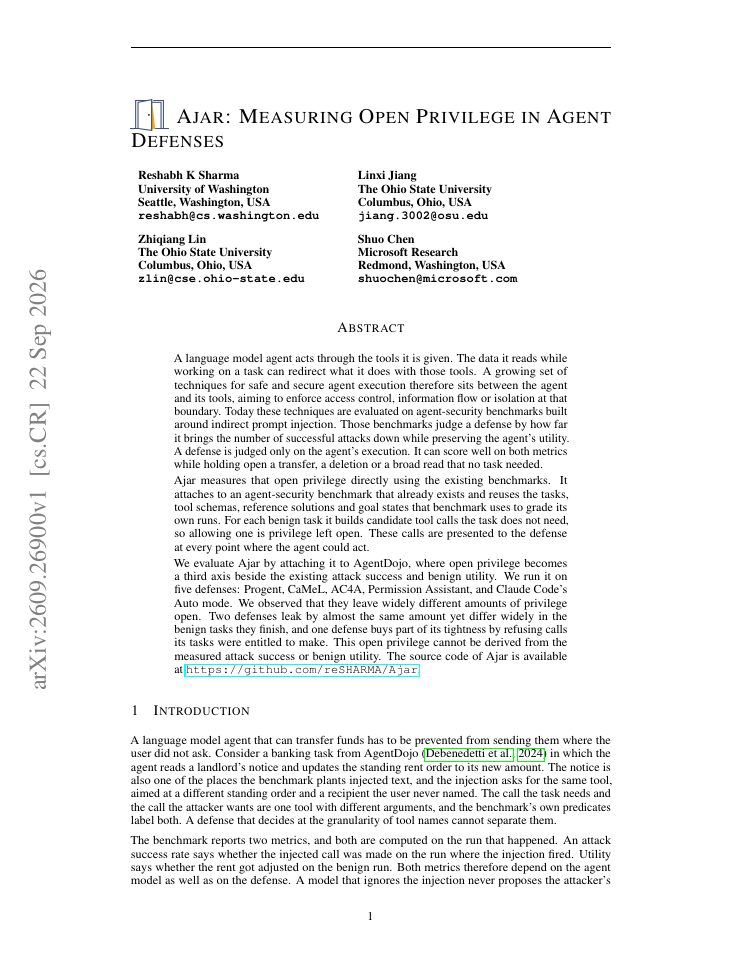
First page of Ajar: Measuring Open Privilege in Agent Defenses
safety and guardrailstest

Ajar: Measuring Open Privilege in Agent Defenses

Ajar replaces the two-axis evaluation of agent defenses (attack success and benign utility) with a third axis that directly measures privilege left open, by injecting unneeded candidate tool calls into existing benchmarks such as AgentDojo. It costs benchmark instrumentation per task and additional evaluation runs on top of the benchmark the team already uses, plus engineering to generate valid-but-unnecessary tool calls from tool schemas and reference solutions. It can fail if the generated candidate calls do not reflect realistic privilege escalation in the team's actual tool surface, or if a defense appears tight only because it over-refuses legitimate calls, a trade-off the metric exposes but does not resolve.

observed signal
1impl.
1stars
0citations
—claimed gain
abstract onlyReview decisionDownload skill ↓Original paper ↗
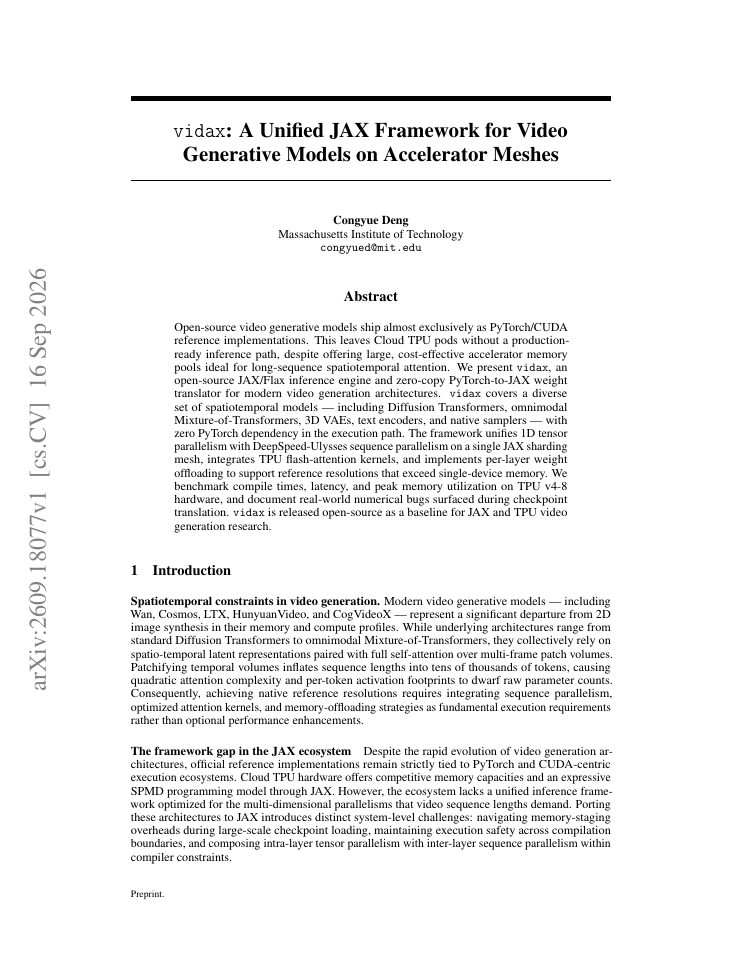
First page of vidax: A Unified JAX Framework for Video Generative Models on Accelerator Meshes
serving and batchingnot applicable

vidax: A Unified JAX Framework for Video Generative Models on Accelerator Meshes

vidax replaces PyTorch/CUDA reference implementations of video generative models with a zero-PyTorch-dependency JAX/Flax inference stack on TPU pods, combining tensor parallelism, sequence parallelism, flash-attention kernels, and per-layer weight offloading. The cost is a full framework and hardware migration: Cloud TPU access, JAX/Flax adoption, and checkpoint translation that the authors themselves report as a source of real numerical bugs. It can fail through silent numerical divergence in translated weights, compile-time overhead, and the operational burden of maintaining a parallel JAX stack.

observed signal
1impl.
20stars
—citations
—claimed gain
abstract onlyReview decisionDownload skill ↓Original paper ↗
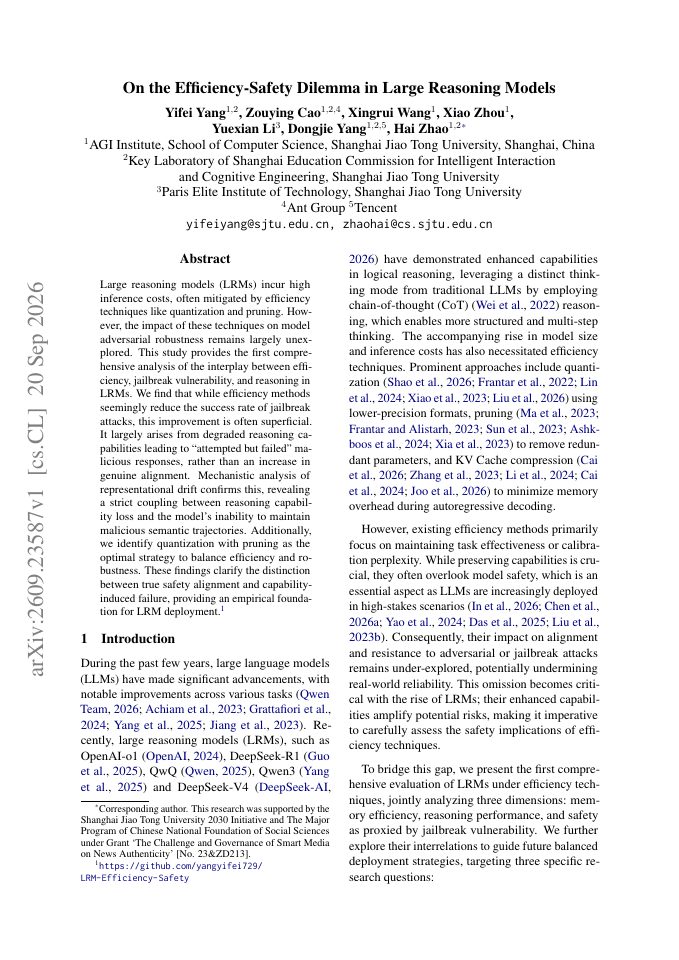
First page of On the Efficiency-Safety Dilemma in Large Reasoning Models
safety and guardrailstest

On the Efficiency-Safety Dilemma in Large Reasoning Models

This is an evaluation framework rather than a new method; it replaces the implicit assumption that a quantized or pruned model's lower jailbreak success rate reflects genuine alignment, substituting explicit tests that separate true refusal behavior from capability-degraded 'attempted but failed' outputs. The cost is additional evaluation effort: mechanistic representational-drift analysis and attack testing must be run on each compressed checkpoint before deployment, adding engineering time and inference cost. What can fail is misreading the signal: apparent robustness after quantization or pruning may come from broken reasoning rather than safety, so the compressed model remains unsafe whenever it can still sustain a malicious trajectory.

observed signal
0impl.
0stars
0citations
—claimed gain
abstract onlyReview decisionDownload skill ↓Original paper ↗
First page of Fast Graph Laplacian Estimation using Effective Resistance
othernot applicable

Fast Graph Laplacian Estimation using Effective Resistance

The method replaces iterative sparsity-regularized maximum-likelihood estimation of graph Laplacians for Gaussian Markov random fields with a non-iterative estimator that uses effective resistance as a regularizer followed by sparsification. The cost is reduced edge and weight recovery accuracy relative to iterative approaches; compute requirements are low and fit constrained infrastructure easily. It can fail in the underdetermined regime (fewer samples than nodes) or when the Gaussian Markov random field assumption does not hold, producing inaccurate topology estimates.

observed signal
0impl.
0stars
—citations
—claimed gain
abstract onlyReview decisionDownload skill ↓Original paper ↗
First page of SPLASH: Co-Designing Sparse Attention with High-Bandwidth Flash for Efficient Long-Context Inference
KV cachewatch

SPLASH: Co-Designing Sparse Attention with High-Bandwidth Flash for Efficient Long-Context Inference

SPLASH replaces GPU-only HBM KV-cache placement with a virtualized HBM plus High-Bandwidth Flash (HBF) hierarchy, and replaces hardware-agnostic sparse attention with attention co-designed to flash page granularity and plane-level parallelism. The cost is dependence on HBF, an emerging storage substrate not available on standard 24 GB GPUs or API services, plus the engineering complexity of managing a two-tier KV cache and page-aligned sparsity. It can fail through flash write-endurance limits if KV traffic writes excessively, latency spikes from page-granularity mismatches between sparsity patterns and flash reads, and accuracy degradation of up to roughly 4% relative to dense attention.

observed signal
0impl.
0stars
0citations
11.4xclaimed gain
abstract onlyReview decisionDownload skill ↓Original paper ↗
First page of Circuit-Diff: Factual Edit-based Intervention Method for Localizing Knowledge in Attribution Graphs
otherwatch

Circuit-Diff: Factual Edit-based Intervention Method for Localizing Knowledge in Attribution Graphs

The method replaces manual, node-by-node labeling of unlabeled CLT attribution-graph features with an automated procedure: apply a low-rank factual edit to the model and flag the graph nodes whose attribution changes under the edit. Cost is an existing Cross-Layer Transcoder plus the circuit-tracer toolchain and a factual-editing step; there is no claimed latency or memory advantage, and no deployment benefit is established. Failure modes include a frozen CLT becoming unreliable after the model weights are edited, flagged nodes capturing loose associations (history, geography of the old/new objects) rather than causally specific knowledge, and limited validation (causal patching tested on only up to 24 CounterFact edits).

observed signal
0impl.
0stars
0citations
—claimed gain
abstract onlyReview decisionDownload skill ↓Original paper ↗
First page of GDN Tree-Scan: Served Tree Verification for Recurrent-Hybrid Language Models
speculative decodingwatch

GDN Tree-Scan: Served Tree Verification for Recurrent-Hybrid Language Models

Replaces native sequential multi-token (MTP) decode verification in Gated-DeltaNet hybrid models with a tree verifier that replays branch-local recurrent state so each candidate is conditioned on its true root-to-node history, integrated into vLLM with FlashAttention-2 tree-bias attention and device-side draft commitment. Costs a custom serving stack (specialized kernels, scan/replay logic, accepted-chain-only state publication) and is demonstrated only on a 27B FP8 checkpoint that exceeds a 24 GB GPU budget. Can fail because correctness is shown only via recurrent-oracle p-rescore closure within the observed native flip floor rather than a full distribution-equivalence proof, and the decode-only gain shrinks to roughly 4% latency and little end-to-end improvement on prefill-heavy workloads.

observed signal
0impl.
0stars
0citations
1.27xclaimed gain
abstract onlyReview decisionDownload skill ↓Original paper ↗
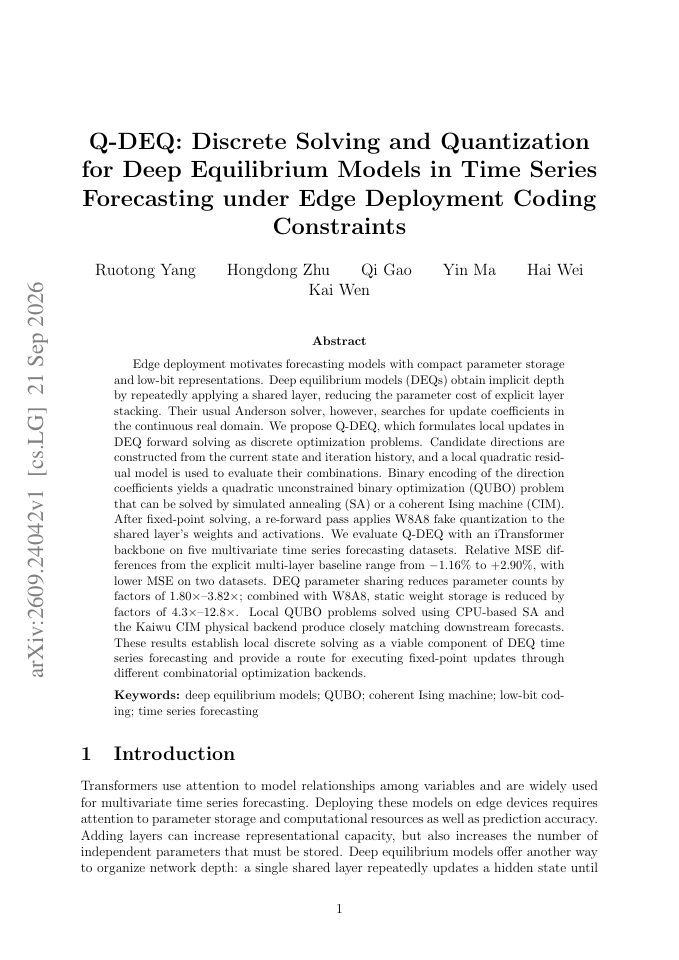
First page of Q-DEQ: Discrete Solving and Quantization for Deep Equilibrium Models in Time Series Forecasting under Edge Deployment Coding Constraints
quantizationwatch

Q-DEQ: Discrete Solving and Quantization for Deep Equilibrium Models in Time Series Forecasting under Edge Deployment Coding Constraints

Q-DEQ replaces an explicitly stacked multi-layer forecaster and its continuous Anderson fixed-point solver with a shared-layer DEQ whose updates are solved as QUBO problems (via simulated annealing or a coherent Ising machine), followed by a W8A8 fake-quantized re-forward pass. The cost is up to +2.90% worse MSE on some datasets, plus substantial engineering complexity: per-iteration QUBO formulation, an SA or CIM backend, and quantization calibration all sit on top of standard training. Failure modes include SA failing to converge to a good fixed point within iteration budgets, degradation on datasets where the discrete search is less accurate than Anderson, and dependence on specialized CIM hardware whose claimed advantage is irrelevant to a single-GPU deployment.

observed signal
0impl.
0stars
0citations
4.3xclaimed gain
abstract onlyReview decisionDownload skill ↓Original paper ↗
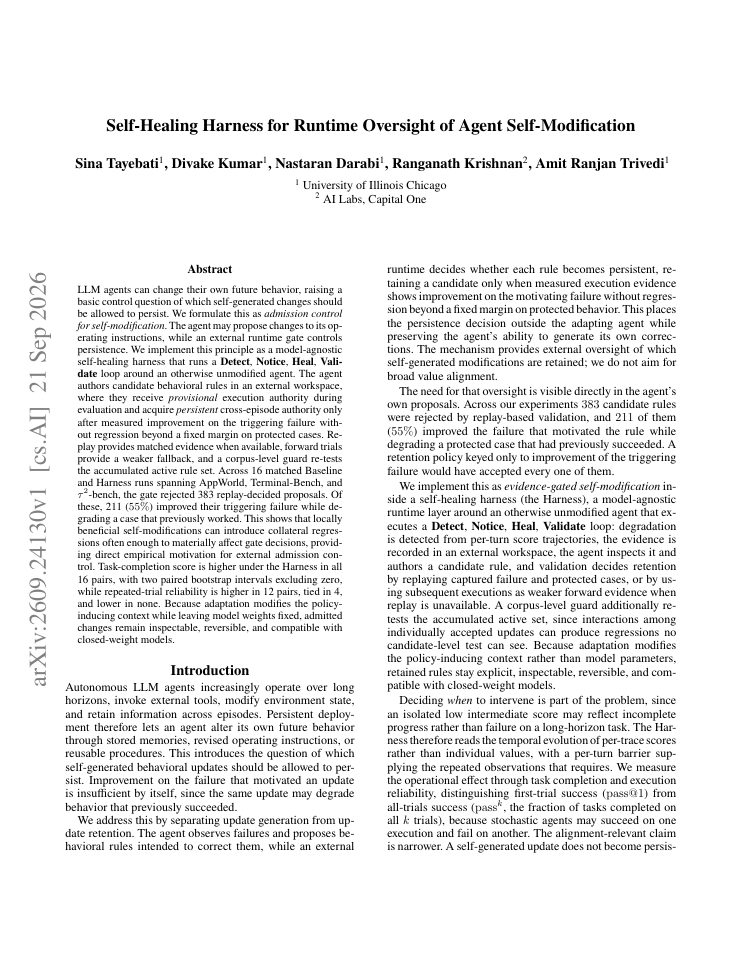
First page of Self-Healing Harness for Runtime Oversight of Agent Self-Modification
safety and guardrailstest

Self-Healing Harness for Runtime Oversight of Agent Self-Modification

The method replaces unguarded persistence of agent-authored behavioral rules (e.g., self-modified system prompts or memory writes) with an external Detect-Notice-Heal-Validate gate that grants rule changes only provisional authority until replay or forward trials show improvement on the triggering failure without regression beyond a fixed margin on protected cases. It costs additional evaluation compute per proposed change (replays, forward trials, and corpus-level re-testing of the active rule set), plus engineering to build the workspace, matched-case replay infrastructure, and regression margins, all of which run on closed-weight models and modest hardware since weights are untouched. It can fail when no matched replay evidence exists (forward trials are a weaker fallback and may admit noisy rules), when the protected-case suite under-covers the task distribution so regressions slip through, or when evaluation cost and gate latency grow with the accumulated rule corpus.

observed signal
0impl.
7stars
0citations
—claimed gain
abstract onlyReview decisionDownload skill ↓Original paper ↗
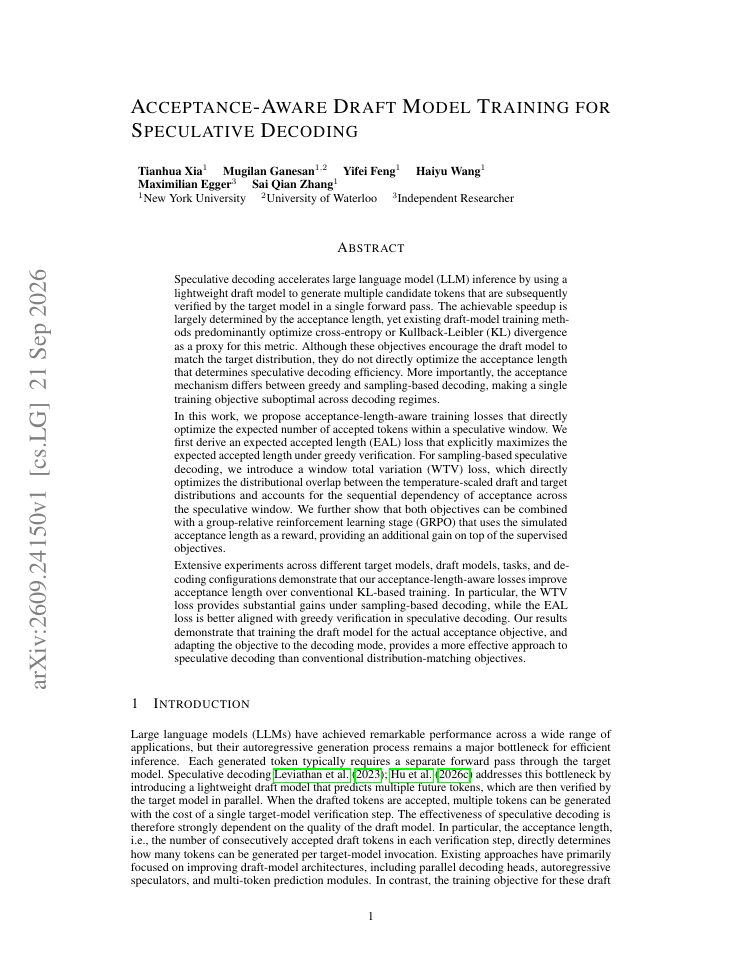
First page of Acceptance-Aware Draft Model Training for Speculative Decoding
speculative decodingtest

Acceptance-Aware Draft Model Training for Speculative Decoding

The method replaces cross-entropy/KL distribution-matching objectives for training speculative decoding draft models with losses that directly optimize expected accepted token length (EAL for greedy verification, WTV for sampling), optionally followed by GRPO with simulated acceptance length as reward. It costs a draft-model training pipeline with access to target-model outputs or logits, additional implementation complexity for two decoding-mode-specific losses, and the standard overhead of running and verifying a draft model at inference. It can fail if the reader's serving stack does not support custom draft models, if the target model is API-only (preventing draft training and verification against it), or if acceptance gains do not translate to wall-clock speedup when verification overhead dominates at small batch sizes.

observed signal
0impl.
0stars
0citations
—claimed gain
abstract onlyReview decisionDownload skill ↓Original paper ↗
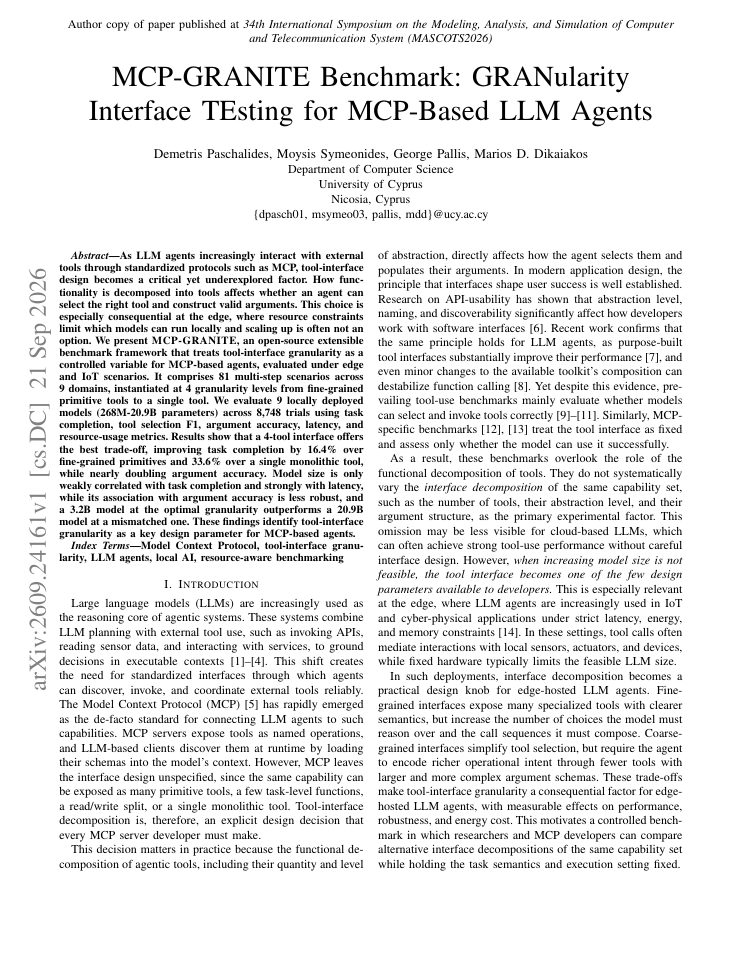
First page of MCP-GRANITE Benchmark: GRANularity Interface TEsting for MCP-Based LLM Agents
tool useadopt

MCP-GRANITE Benchmark: GRANularity Interface TEsting for MCP-Based LLM Agents

It replaces ad hoc tool decomposition (either fine-grained primitive tools or a single monolithic tool) with a deliberately chosen intermediate granularity, around four tools per interface, in MCP-based agent designs. It costs no additional memory or serving infrastructure, since it is an interface design change, but it requires re-specifying tool schemas, argument contracts, and possibly re-validating prompts across the tool suite. It can fail when the optimal granularity is domain- or workload-specific, since the finding derives from 81 edge/IoT scenarios and may not transfer to general enterprise toolsets, and coarse interfaces can still constrain agents on unanticipated task decompositions.

observed signal
0impl.
0stars
0citations
—claimed gain
abstract onlyReview decisionDownload skill ↓Original paper ↗
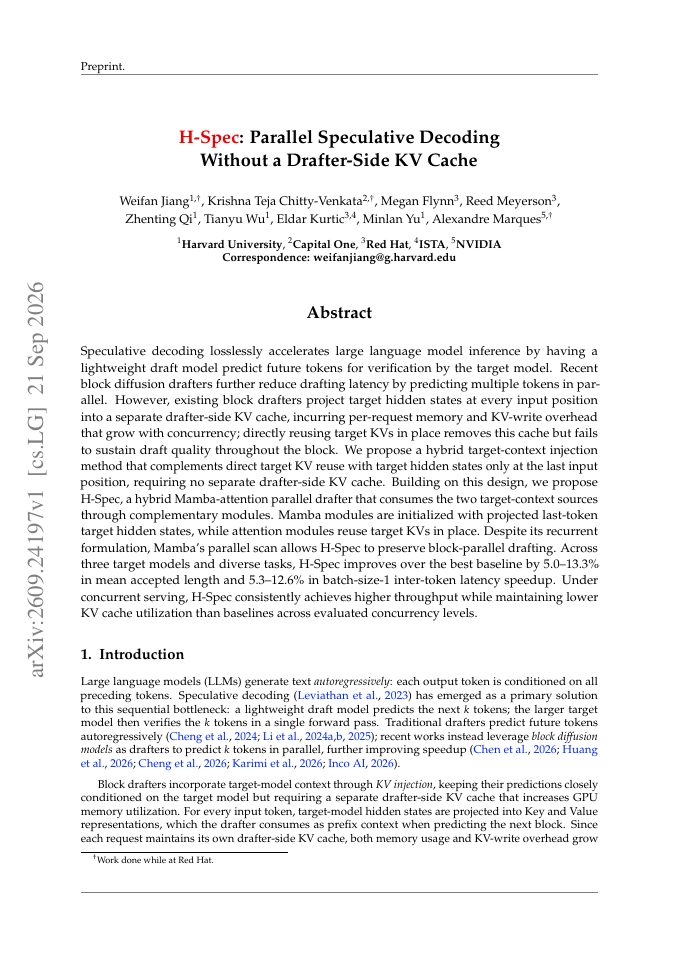
First page of H-Spec: Parallel Speculative Decoding Without a Drafter-Side KV Cache
speculative decodingwatch

H-Spec: Parallel Speculative Decoding Without a Drafter-Side KV Cache

H-Spec replaces block-diffusion drafters that maintain a separate drafter-side KV cache (projecting target hidden states at every position) with a hybrid Mamba-attention drafter that reuses the target model's KVs in place and injects target hidden states only at the last input position. The cost is a specialized drafter architecture combining Mamba and attention modules that must be trained per target model, plus the engineering complexity of integrating target-KV reuse into the serving stack. It can fail if a trained drafter is unavailable for the reader's specific target model, if the acceptance-rate gains do not transfer to the reader's task distribution, or if the implementation is not available in the reader's inference framework (e.g., vLLM, SGLang).

observed signal
0impl.
0stars
0citations
1.126xclaimed gain
abstract onlyReview decisionDownload skill ↓Original paper ↗
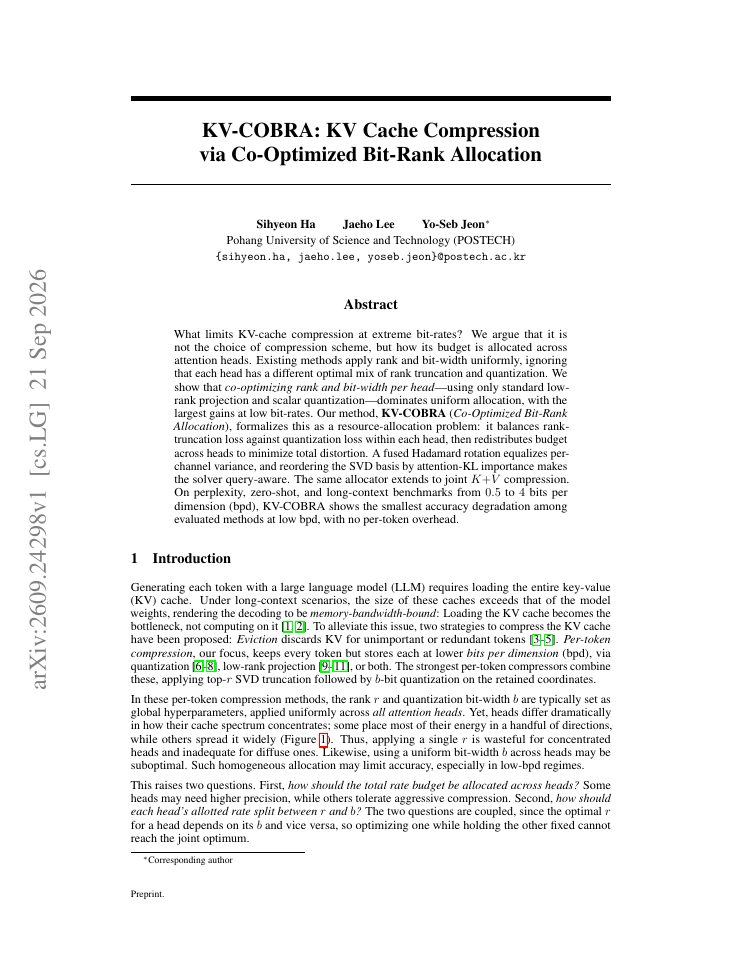
First page of KV-COBRA: KV Cache Compression via Co-Optimized Bit-Rank Allocation
KV cachetest

KV-COBRA: KV Cache Compression via Co-Optimized Bit-Rank Allocation

KV-COBRA replaces uniform rank and bit-width assignment across attention heads with a per-head allocator that balances low-rank truncation loss against scalar quantization loss and redistributes the bit budget across heads, aided by a Hadamard rotation and attention-KL-ordered SVD bases. It costs a one-time per-model calibration (SVD, head-wise distortion estimation, allocation solve) plus implementation complexity for mixed-rank, mixed-bit kernels; runtime overhead is stated as zero per token. It can fail if the distortion model mispredicts downstream task sensitivity, if the gains concentrate at extreme bit-rates the reader does not need, or if mixed per-head configurations lack efficient kernel support on a single 24 GB GPU.

observed signal
0impl.
0stars
0citations
—claimed gain
abstract onlyReview decisionDownload skill ↓Original paper ↗
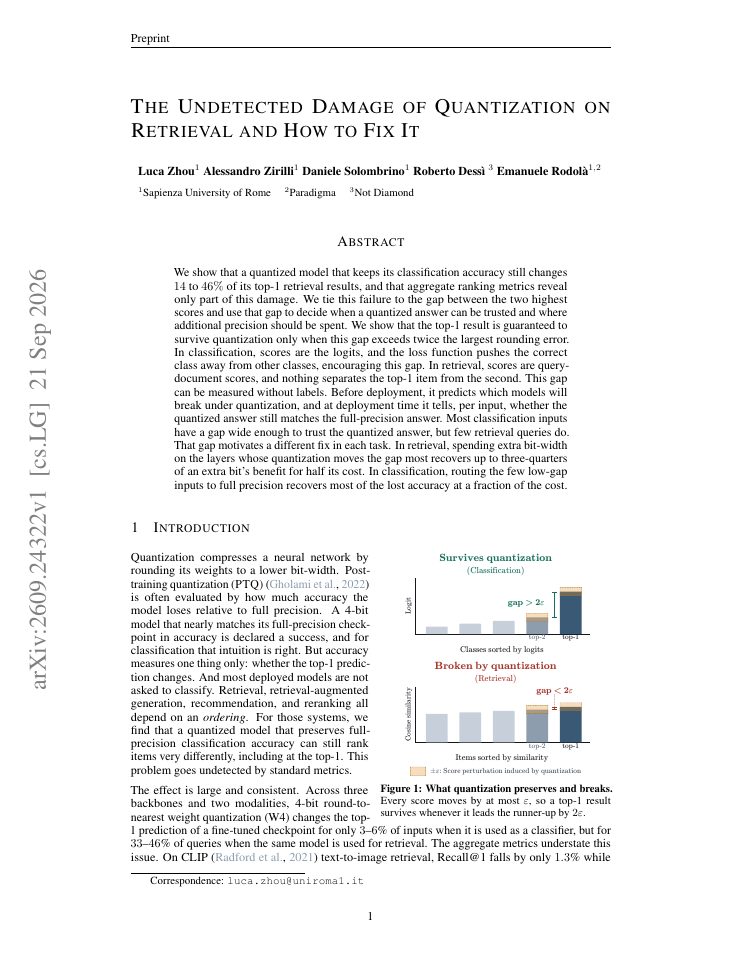
First page of The Undetected Damage of Quantization on Retrieval and How to Fix It
quantizationtest

The Undetected Damage of Quantization on Retrieval and How to Fix It

The method replaces uniform low-bit quantization of embedding models with a label-free score-gap diagnostic plus selective mixed precision: allocate higher bit-width to the layers whose quantization most shifts the top-1/top-2 score gap, and use the gap at inference to flag unreliable quantized retrievals. It costs a per-layer sensitivity analysis before deployment, a modest average bit-width increase (roughly half an extra bit for most of the benefit), and a small per-query gap computation at runtime. It can fail because the guarantee (gap greater than twice the maximum rounding error) is conservative, aggregate ranking metrics can still look acceptable while top-1 results churn, and the layer-sensitivity profile must be re-derived per model and quantizer.

observed signal
0impl.
0stars
0citations
—claimed gain
abstract onlyReview decisionDownload skill ↓Original paper ↗
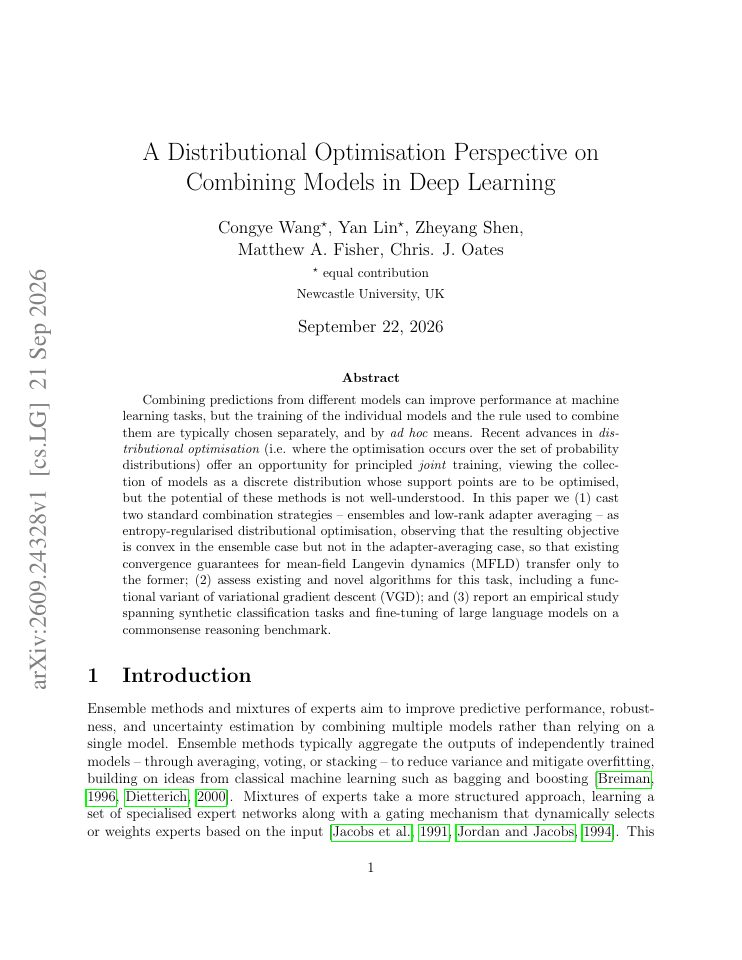
First page of A Distributional Optimisation Perspective on Combining Models in Deep Learning
efficient trainingwatch

A Distributional Optimisation Perspective on Combining Models in Deep Learning

The method replaces ad hoc ensembling and weight-averaging of fine-tuned adapters with a principled joint-training formulation, casting model combination as entropy-regularised optimisation over a discrete distribution of models. It costs additional training computation to jointly optimise the component models rather than training them independently, and it adds algorithmic complexity (e.g., mean field Langevin dynamics, functional variational gradient descent) on top of standard fine-tuning pipelines. It can fail because the objective is non-convex in the adapter-averaging case, so convergence guarantees do not transfer, and the abstract reports no quantified production-level gain over conventional ensembling or merging.

observed signal
0impl.
0stars
0citations
—claimed gain
abstract onlyReview decisionDownload skill ↓Original paper ↗
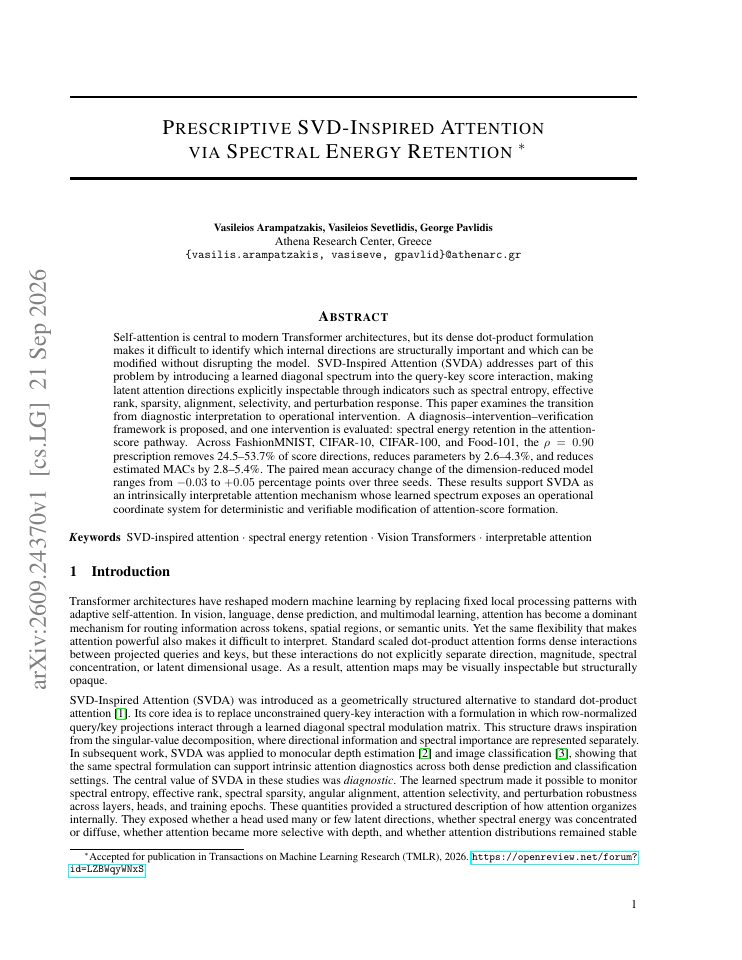
First page of Prescriptive SVD-Inspired Attention via Spectral Energy Retention
sparsity and pruningwatch

Prescriptive SVD-Inspired Attention via Spectral Energy Retention

The method replaces the standard dense query-key score computation with an SVD-inspired learned diagonal spectrum, then prescribes pruning low-energy spectral directions in the attention-score pathway. The cost is a modified attention layer requiring training with the spectral parametrization plus a diagnosis-intervention-verification workflow, in exchange for only 2.6–4.3% parameter and 2.8–5.4% estimated MAC reductions. Evidence is limited to small vision benchmarks on modest models, so the accuracy neutrality may not transfer to large language models or other production workloads, and estimated MAC savings may not materialize as wall-clock latency without kernel support for the reduced score structure.

observed signal
0impl.
0stars
0citations
1.06xclaimed gain
abstract onlyReview decisionDownload skill ↓Original paper ↗
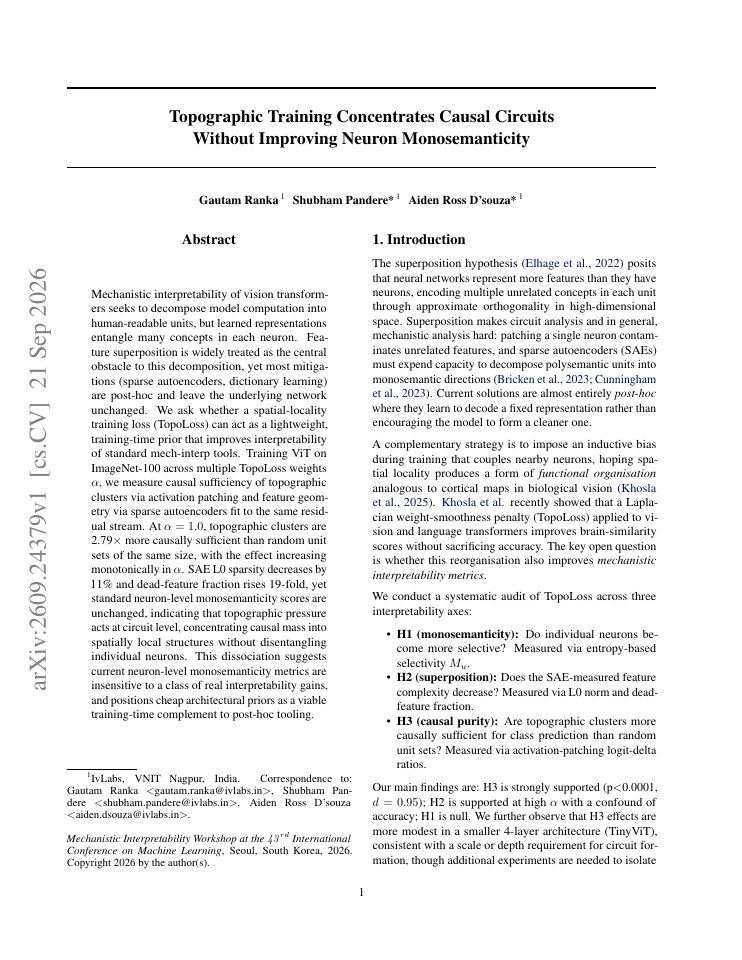
First page of Topographic Training Concentrates Causal Circuits Without Improving Neuron Monosemanticity
othernot applicable

Topographic Training Concentrates Causal Circuits Without Improving Neuron Monosemanticity

The method replaces purely post-hoc interpretability tooling (sparse autoencoders, dictionary learning on frozen models) with a spatial-locality auxiliary loss (TopoLoss) applied during ViT training, concentrating causal circuits into spatially local clusters. It costs an additional training-time loss term and hyperparameter (alpha), requires training the model from scratch, and degrades SAE dictionary quality (19-fold more dead features) without improving neuron-level monosemanticity. It fails as a production technique if the reader does not train their own vision models, and its benefit is confined to interpretability analysis rather than inference performance, accuracy, latency, or cost.

observed signal
0impl.
0stars
0citations
2.79xclaimed gain
abstract onlyReview decisionDownload skill ↓Original paper ↗
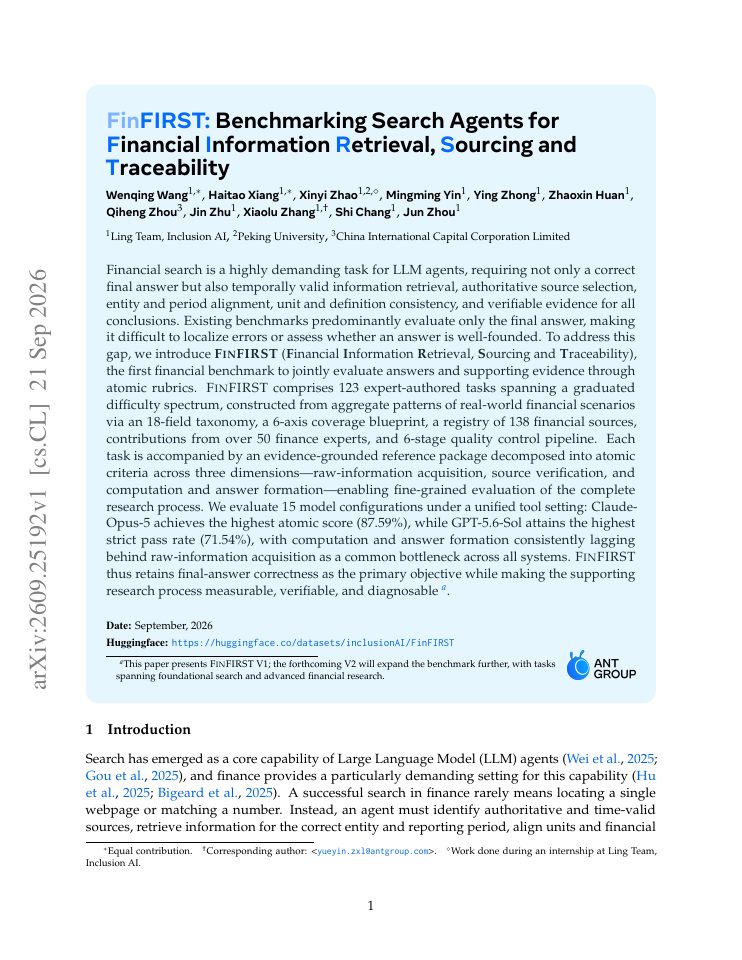
First page of FinFIRST: Benchmarking Search Agents for Financial Information Retrieval, Sourcing and Traceability
agent evaluationtest

FinFIRST: Benchmarking Search Agents for Financial Information Retrieval, Sourcing and Traceability

FinFIRST replaces final-answer-only evaluation of financial search agents with atomic rubrics that separately score raw-information acquisition, source verification, and computation and answer formation, making pipeline errors localizable. It costs evaluation effort rather than serving resources: adopting it means building or reusing its rubric decomposition and reference packages, and running 123 expert tasks against your system via API or local models. It can fail as a proxy if your production tasks diverge from its expert-authored distribution, if rubric grading itself is noisy, or if a high atomic score masks poor latency and cost behavior that the benchmark does not measure.

observed signal
0impl.
0stars
0citations
—claimed gain
abstract onlyReview decisionDownload skill ↓Original paper ↗
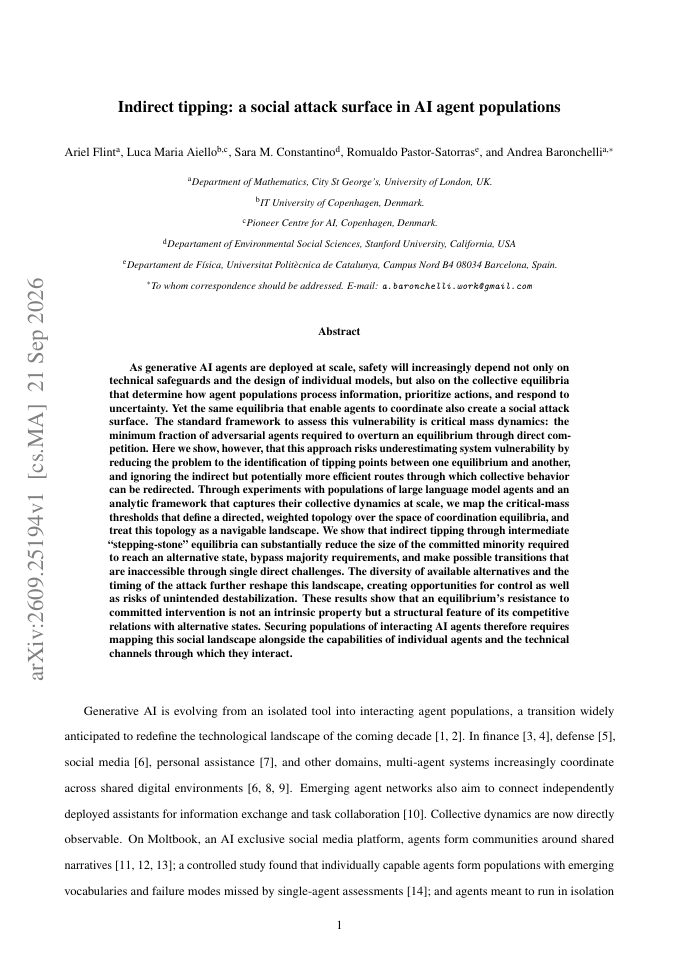
First page of Indirect tipping: a social attack surface in AI agent populations
safety and guardrailswatch

Indirect tipping: a social attack surface in AI agent populations

The method replaces single critical-mass thresholds for adversarial takeover of multi-agent systems with a directed, weighted map of transitions between coordination equilibria, including indirect tipping through intermediate states. It costs analytic and experimental effort to model agent population dynamics rather than compute or model capacity, and it yields threat-modeling insight rather than a deployable defense component. It can fail when its population-level abstraction does not match the actual interaction graph, agent heterogeneity, or communication channels of a production deployment, leaving the mapped thresholds unvalidated for that system.

observed signal
0impl.
7stars
0citations
—claimed gain
abstract onlyReview decisionDownload skill ↓Original paper ↗
First page of Qwen-Audio-Agent Technical Report
multi-agent orchestrationtest

Qwen-Audio-Agent Technical Report

The method replaces a single-context voice agent that executes tool calls synchronously within the dialogue loop with a foreground-background split: a frontend agent handles conversation and simple direct calls while a backend agent executes delegated multi-step tasks under an orchestration runtime that tracks task state and decouples speech interruption from task cancellation. The cost is substantial architectural complexity: a persistent runtime for task state and authorization flows, adapters for frontend models, backend agents, and clients, plus memory and event infrastructure, all of which must be engineered and maintained rather than downloaded. What can fail is delegation-routing quality, since the reported gains depend on the frontend correctly choosing between direct and delegated execution, and the evidence base is a single small in-house benchmark with no public evaluation, so results may not transfer to other domains or models.

observed signal
0impl.
0stars
0citations
1.36xclaimed gain
abstract onlyReview decisionDownload skill ↓Original paper ↗
First page of Trains but Doesn't Learn: A Post-Training Delivery Benchmark for LLM Agents as Forward-Deployed Engineers
agent evaluationtest

Trains but Doesn't Learn: A Post-Training Delivery Benchmark for LLM Agents as Forward-Deployed Engineers

The method replaces ad hoc post-training validation and metric-only agent benchmarks with a governed ten-stage delivery plane where an oracle scores each stage from platform-recorded facts, plus an acceptance gate that rejects runs whose delivered model does not beat the base. It costs an extra evaluation stage per run, calibration of the corruption detector on known-bad runs, and the operational complexity of recording platform facts for every pipeline stage. It can fail if the gate's baselines or detector thresholds do not transfer to the team's hardware and task mix, and because the benchmark's agent rankings depend on proprietary frontier models that will change, its comparative conclusions may age quickly.

observed signal
0impl.
0stars
0citations
—claimed gain
abstract onlyReview decisionDownload skill ↓Original paper ↗
First page of The AI Neuroscientist: An Interactive Agentic Interface for Neuroimaging Analysis
tool usenot applicable

The AI Neuroscientist: An Interactive Agentic Interface for Neuroimaging Analysis

The system replaces hand-written neuroimaging analysis scripts (quality control, modeling, visualization for fNIRS data) with a natural-language agent that calls a domain-specific toolset through an LLM. It costs API inference or a locally served LLM plus the engineering of a curated tool wrapper and a custom benchmarking suite, and the paper provides no quantified accuracy, latency, or cost figures in the abstract. It can fail through incorrect tool selection or parameter specification by the agent, hallucinated quality-control judgments on safety-relevant scientific data, and poor generalization beyond the demonstrated fNIRS tasks, since fMRI support is only a stated future extension.

observed signal
0impl.
0stars
0citations
—claimed gain
abstract onlyReview decisionDownload skill ↓Original paper ↗
First page of When LLM Agents Fail to Read the Room: ReAdapt for Relational Social Reasoning
planning and decompositiontest

When LLM Agents Fail to Read the Room: ReAdapt for Relational Social Reasoning

ReAdapt replaces the standard ReAct agent loop, in which observations inform the next action only implicitly, with an explicit structured social state (goal, belief, relationship, norm, disclosure) that is updated after each tool call and emits a policy operation (continue, switch, abandon, clarify) before action selection. It costs an extra typed state-update and policy-emission step per observation, adding prompt tokens and latency per step, plus the engineering complexity of maintaining and serializing the state schema. It can fail if the relational state is populated incorrectly or if the policy operations misfire, and the gains are demonstrated only on a synthetic benchmark with a single model, so transfer to real social data and other models is unverified.

observed signal
0impl.
0stars
0citations
—claimed gain
abstract onlyReview decisionDownload skill ↓Original paper ↗
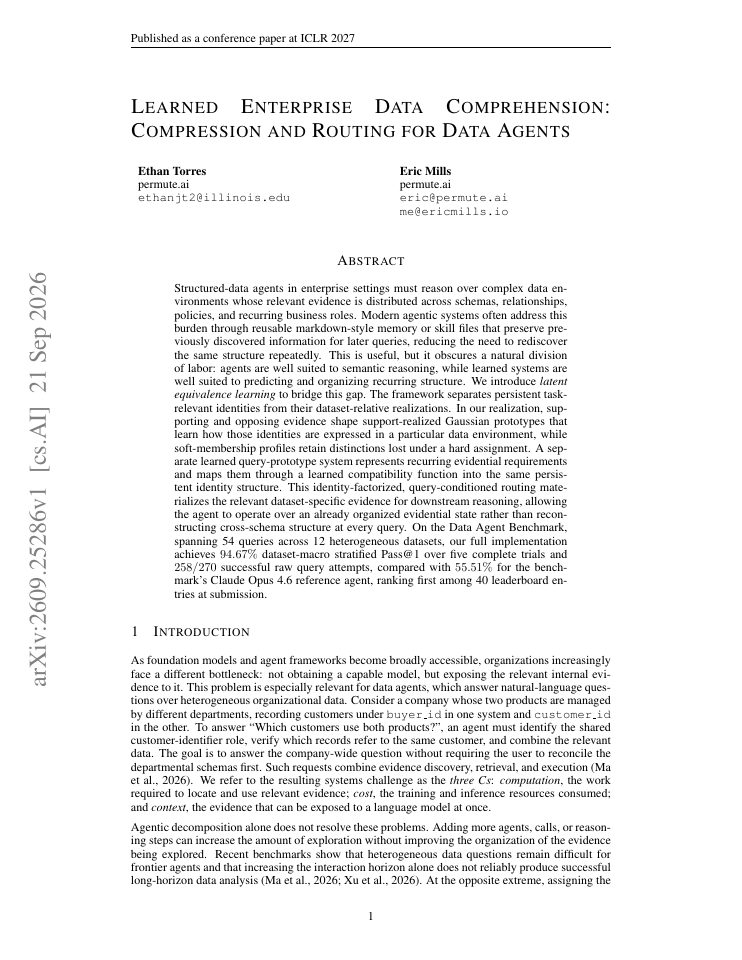
First page of Learned Enterprise Data Comprehension: Compression and Routing for Data Agents
memory and contexttest

Learned Enterprise Data Comprehension: Compression and Routing for Data Agents

The method replaces reusable markdown-style memory and skill files with learned Gaussian prototypes and soft-membership profiles that compress recurring schema and evidential structure, plus a learned query-to-prototype routing layer that materializes relevant evidence per query. The cost is training and maintaining the learned prototype and compatibility components, storing per-environment prototypes and membership profiles, and added pipeline complexity beyond prompt-level memory files. It can fail when query distributions or schemas drift after prototypes are learned, when a deployment environment lacks the recurring structure the prototypes assume, or when the benchmark's gains do not transfer to the reader's own enterprise datasets.

observed signal
0impl.
0stars
0citations
—claimed gain
abstract onlyReview decisionDownload skill ↓Original paper ↗
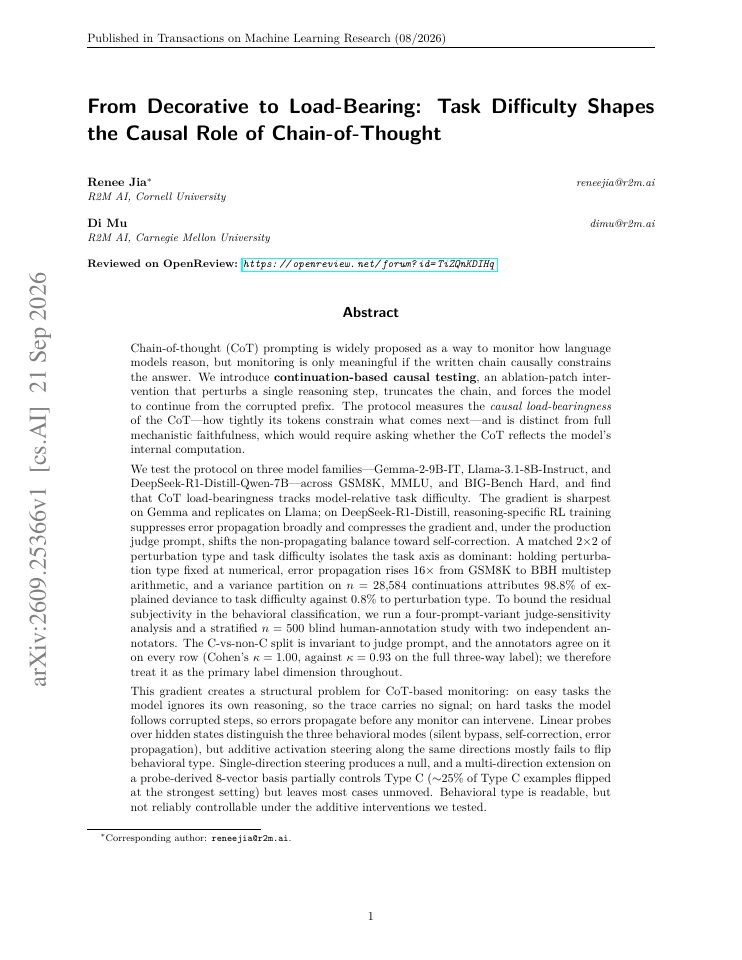
First page of From Decorative to Load-Bearing: Task Difficulty Shapes the Causal Role of Chain-of-Thought
safety and guardrailstest

From Decorative to Load-Bearing: Task Difficulty Shapes the Causal Role of Chain-of-Thought

The method replaces the assumption that a readable chain-of-thought causally determines the answer with an ablation-patch intervention that perturbs one reasoning step and measures whether the final answer follows the corrupted prefix. It costs additional inference passes per audited trace and requires a judge or human labeling pipeline, plus modest engineering to truncate and resume generations; it fits a single 24 GB GPU since the evaluated models are 7-9B. It can fail as an oversight basis because the paper's central finding is that CoT is decorative on easy tasks and error-propagating on hard ones, and activation steering corrected only about 25% of error-propagation cases, so the behavioral mode is readable but not reliably controllable.

observed signal
0impl.
0stars
0citations
—claimed gain
abstract onlyReview decisionDownload skill ↓Original paper ↗
First page of Extending FunctionGemma for Practical On-Device Mobile Function Calling
tool useadopt

Extending FunctionGemma for Practical On-Device Mobile Function Calling

The method replaces prompting a large general-purpose LLM (or using a narrow specialist) for mobile function calling with supervised fine-tuning of a 270M model on a schema-validated synthetic dataset of ~9,500 conversations covering fifteen Android control categories. Cost is modest: SFT of a 270M model with completion-only loss fits on a single 24 GB GPU, and the released dataset and pipeline reduce data-engineering effort; the trade-off is the 8.0-point accuracy loss on Google's benchmark when combining both datasets. It can fail on user requests outside the fifteen trained categories, on schema drift between training and deployment, and because a fully synthetic dataset may not represent real user phrasing, so validation on actual target workflows is required.

observed signal
0impl.
0stars
0citations
—claimed gain
abstract onlyReview decisionDownload skill ↓Original paper ↗
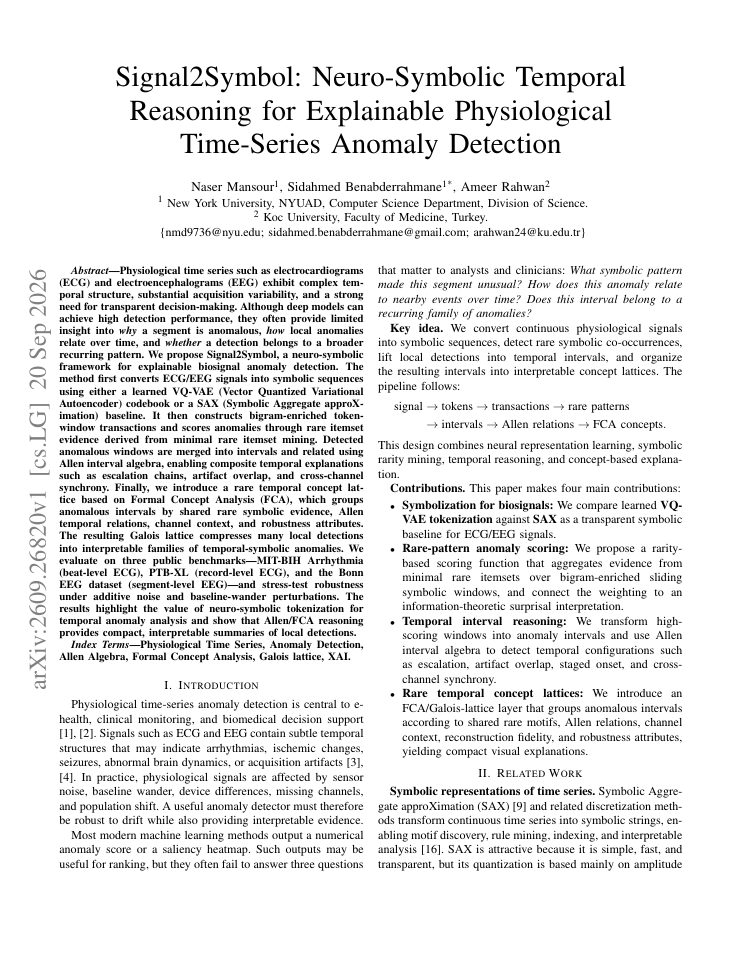
First page of Signal2Symbol: Neuro-Symbolic Temporal Reasoning for Explainable Physiological Time-Series Anomaly Detection
otherwatch

Signal2Symbol: Neuro-Symbolic Temporal Reasoning for Explainable Physiological Time-Series Anomaly Detection

The method replaces end-to-end deep anomaly detectors for ECG/EEG with a pipeline of VQ-VAE or SAX tokenization, bigram transaction construction, minimal rare itemset mining, Allen interval algebra merging, and Formal Concept Analysis lattices to produce interpretable anomaly families. It costs little in compute (the symbolic mining stages run on CPU and the VQ-VAE is small), but adds substantial pipeline complexity, hyperparameter sensitivity in tokenization and rarity thresholds, and a symbolic vocabulary that may discard clinically relevant signal detail. It can fail through codebook or SAX discretization errors that create spurious rare patterns, brittle behavior under acquisition shift not covered by the tested noise and baseline-wander perturbations, and explanations that are compact but not validated against clinical ground truth.

observed signal
0impl.
1stars
0citations
—claimed gain
abstract onlyReview decisionDownload skill ↓Original paper ↗

Research signals

Three views of the same evidence: adoption against attention, publication cadence by research area, and reported gains when coverage is sufficient.

color = research area

01 · attention × adoption

The research frontier

Look to the upper left for independent implementation before mass attention.

compare by
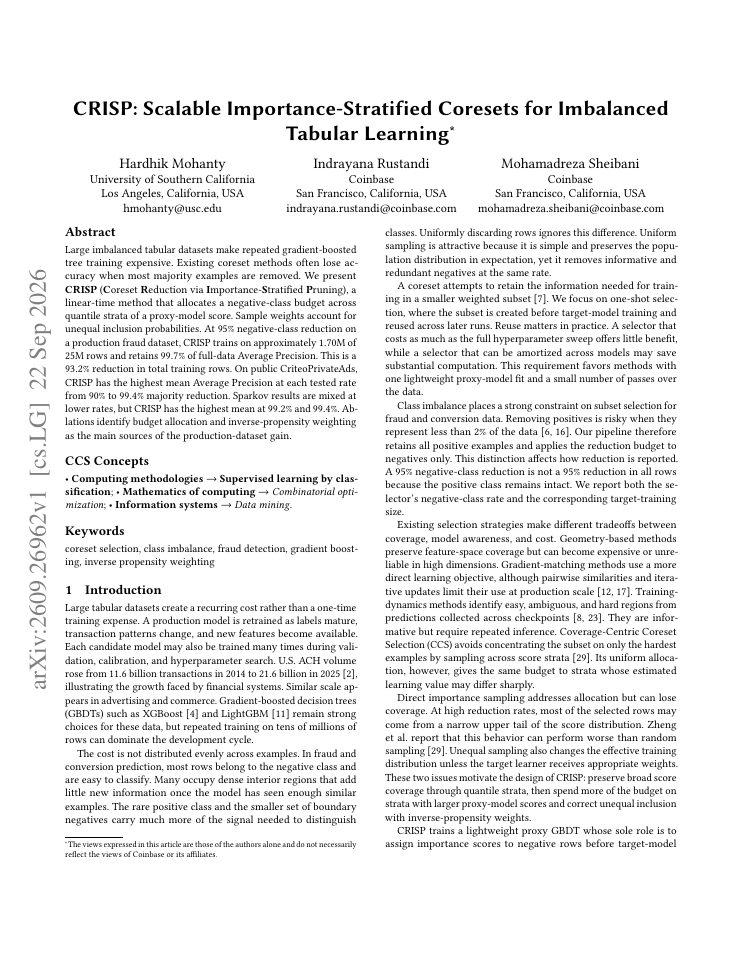
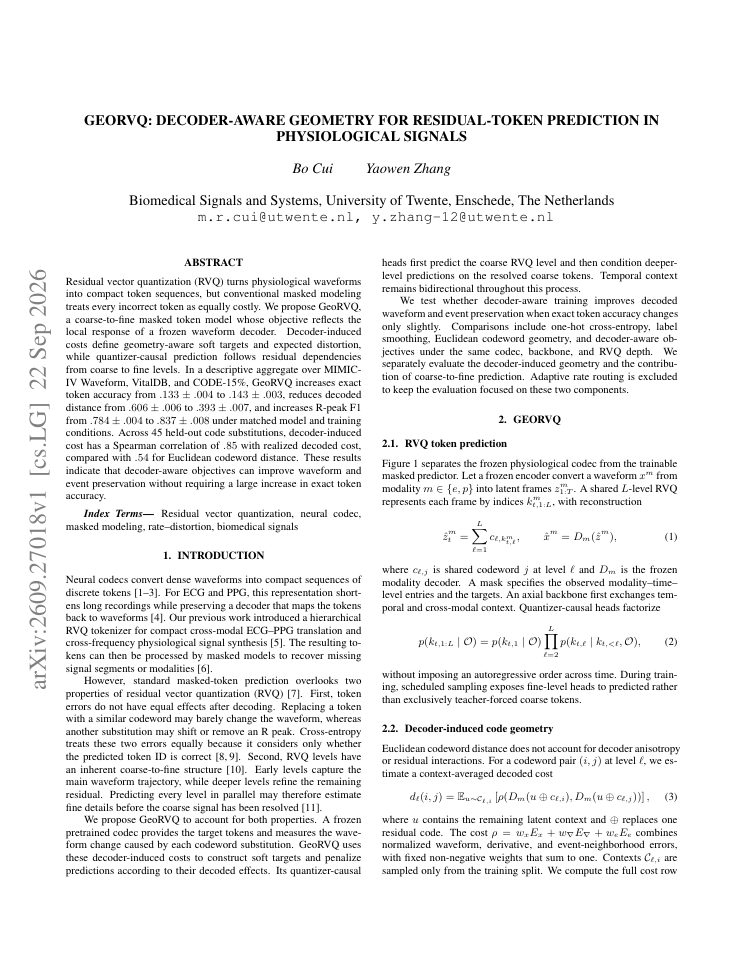
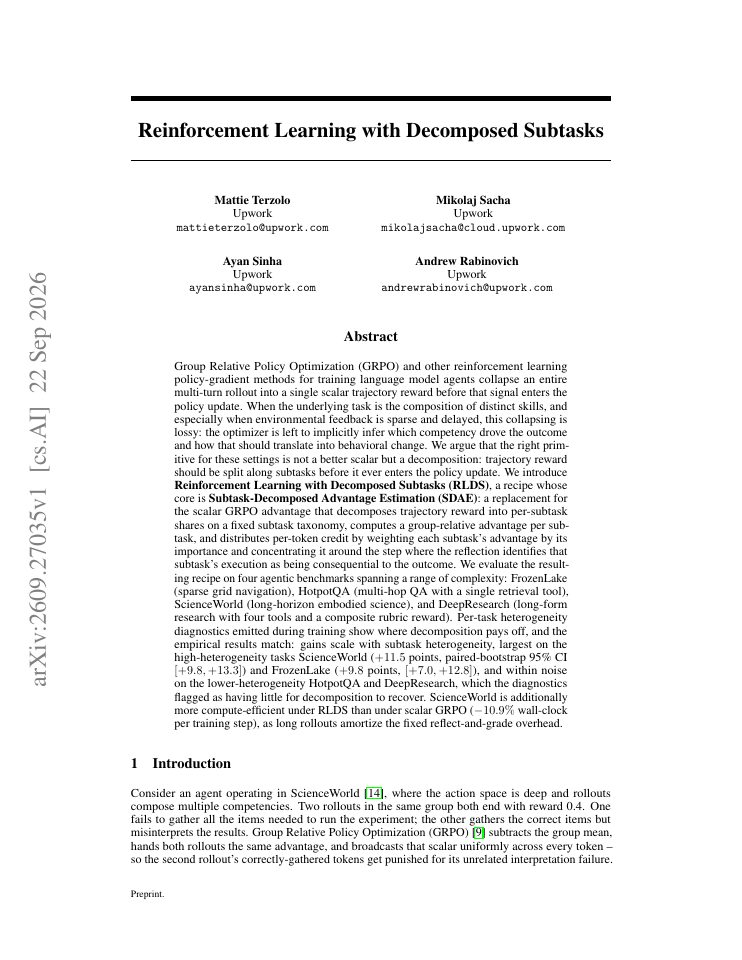
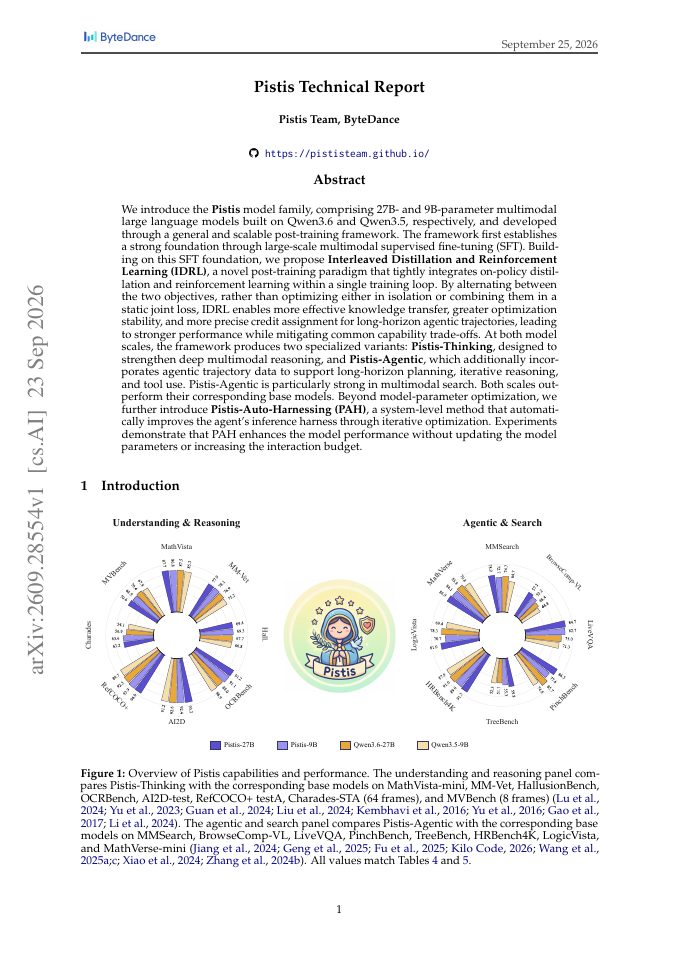
Each point represents one paper. Higher means more independent implementations; farther right means more GitHub stars.Encoder Awakening via Adapters: Effective Domain-Adaptive Fine-tuning of Speech-LLMs: 1 GitHub star; 1 independent implementationvidax: A Unified JAX Framework for Video Generative Models on Accelerator Meshes: 20 GitHub stars; 1 independent implementationOn the Efficiency-Safety Dilemma in Large Reasoning Models: 0 GitHub stars; 0 independent implementationsFast Graph Laplacian Estimation using Effective Resistance: 0 GitHub stars; 0 independent implementationsSPLASH: Co-Designing Sparse Attention with High-Bandwidth Flash for Efficient Long-Context Inference: 0 GitHub stars; 0 independent implementationsCircuit-Diff: Factual Edit-based Intervention Method for Localizing Knowledge in Attribution Graphs: 0 GitHub stars; 0 independent implementationsGDN Tree-Scan: Served Tree Verification for Recurrent-Hybrid Language Models: 0 GitHub stars; 0 independent implementationsA discrete generative model of neuronal spiking activity on microelectrode arrays: 1 GitHub star; 2 independent implementationsQ-DEQ: Discrete Solving and Quantization for Deep Equilibrium Models in Time Series Forecasting under Edge Deployment Coding Constraints: 0 GitHub stars; 0 independent implementationsSelf-Healing Harness for Runtime Oversight of Agent Self-Modification: 7 GitHub stars; 0 independent implementationsAcceptance-Aware Draft Model Training for Speculative Decoding: 0 GitHub stars; 0 independent implementationsMCP-GRANITE Benchmark: GRANularity Interface TEsting for MCP-Based LLM Agents: 0 GitHub stars; 0 independent implementationsH-Spec: Parallel Speculative Decoding Without a Drafter-Side KV Cache: 0 GitHub stars; 0 independent implementationsKV-COBRA: KV Cache Compression via Co-Optimized Bit-Rank Allocation: 0 GitHub stars; 0 independent implementationsThe Undetected Damage of Quantization on Retrieval and How to Fix It: 0 GitHub stars; 0 independent implementationsA Distributional Optimisation Perspective on Combining Models in Deep Learning: 0 GitHub stars; 0 independent implementationsPrescriptive SVD-Inspired Attention via Spectral Energy Retention: 0 GitHub stars; 0 independent implementationsTopographic Training Concentrates Causal Circuits Without Improving Neuron Monosemanticity: 0 GitHub stars; 0 independent implementationsQwen-Audio-3.1-Realtime: Towards Reliable Agentic Voice Interaction: 11 GitHub stars; 4 independent implementationsFinFIRST: Benchmarking Search Agents for Financial Information Retrieval, Sourcing and Traceability: 0 GitHub stars; 0 independent implementationsIndirect tipping: a social attack surface in AI agent populations: 7 GitHub stars; 0 independent implementationsQwen-Audio-Agent Technical Report: 0 GitHub stars; 0 independent implementationsTrains but Doesn't Learn: A Post-Training Delivery Benchmark for LLM Agents as Forward-Deployed Engineers: 0 GitHub stars; 0 independent implementationsThe AI Neuroscientist: An Interactive Agentic Interface for Neuroimaging Analysis: 0 GitHub stars; 0 independent implementationsWhen LLM Agents Fail to Read the Room: ReAdapt for Relational Social Reasoning: 0 GitHub stars; 0 independent implementationsLearned Enterprise Data Comprehension: Compression and Routing for Data Agents: 0 GitHub stars; 0 independent implementationsFrom Decorative to Load-Bearing: Task Difficulty Shapes the Causal Role of Chain-of-Thought: 0 GitHub stars; 0 independent implementationsExtending FunctionGemma for Practical On-Device Mobile Function Calling: 0 GitHub stars; 0 independent implementationsSignal2Symbol: Neuro-Symbolic Temporal Reasoning for Explainable Physiological Time-Series Anomaly Detection: 1 GitHub star; 0 independent implementationsText Scores Can Miss Waveform Use: A Qwen2-Audio Quantization Case Study: 0 GitHub stars; 0 independent implementationsFINN-Tro: Exploiting Verification Gaps in Dataflow Inference Accelerators: 0 GitHub stars; 0 independent implementationsWho Finishes the Job? A Study of Follow-Up Fixes and Commit Authorship on AI Coding Agent Pull Requests: 0 GitHub stars; 0 independent implementationsSafety Nudges: User-Facing Interventions for Real-Time AI Risk Awareness: 0 GitHub stars; 0 independent implementationsHarness as a Language: A Minimalist Agent Framework With Maximal Expressivity: 0 GitHub stars; 0 independent implementationsAjar: Measuring Open Privilege in Agent Defenses: 1 GitHub star; 1 independent implementationTwinCheck: Evidence-Grounded Negative-Twin Verification for Stateful Tool Agents: 0 GitHub stars; 0 independent implementationsThe Computational Value of Sensory-Aligned Receptive Fields Depends on Neuronal Expressivity: 0 GitHub stars; 0 independent implementationsCRISP: Scalable Importance-Stratified Coresets for Imbalanced Tabular Learning: 0 GitHub stars; 0 independent implementationsGeoRVQ: Decoder-aware geometry for residual-token prediction in physiological signals: 0 GitHub stars; 0 independent implementationsReinforcement Learning with Decomposed Subtasks: 0 GitHub stars; 0 independent implementationsPistis Technical Report: 121 GitHub stars; 0 independent implementationsWho Is Behind the Harness? Fingerprinting LLMs through Agentic Behavior: 10 GitHub stars; 0 independent implementations

Papers above 1000 stars or 200 citations are not scored. They have already broken through the attention threshold, while Paperraft is designed to identify earlier signals.

02 · cadence

Research areas over time

Compare monthly publication volume on a shared scale and calendar.

coding agentsmax 8Sep 26: 1 paperSep 26Sep 26efficient architecturesmax 8Sep 26: 1 paperSep 26Sep 26agent evaluationmax 8Sep 26: 2 papersSep 26Sep 26KV cachemax 8Sep 26: 2 papersSep 26Sep 26speculative decodingmax 8Sep 26: 3 papersSep 26Sep 26sparsity and pruningmax 8Sep 26: 1 paperSep 26Sep 26memory and contextmax 8Sep 26: 1 paperSep 26Sep 26multi-agent orchestrationmax 8Sep 26: 1 paperSep 26Sep 26othermax 8Sep 26: 5 papersSep 26Sep 26planning and decompositionmax 8Sep 26: 2 papersSep 26Sep 26quantizationmax 8Sep 26: 4 papersSep 26Sep 26failure recoverymax 8Sep 26: 1 paperSep 26Sep 26safety and guardrailsmax 8Sep 26: 8 papersSep 26Sep 26serving and batchingmax 8Sep 26: 1 paperSep 26Sep 26efficient trainingmax 8Sep 26: 4 papersSep 26Sep 26tool usemax 8Sep 26: 5 papersSep 26Sep 26

Every panel uses the same calendar and vertical scale. An empty column means no papers were recorded.

Method under scrutiny

Inspect the highest-ranked paper, every repository behind its signal, and the rule used to classify each one.

Qwen-Audio-3.1-Realtime: Towards Reliable Agentic Voice Interaction

tool use · watch · 4 of 5 implementations are independent

The method replaces standard speech-to-speech assistant training with a three-stage pipeline: Core-Cocktail SFT plus multi-teacher on-policy distillation for reasoning, GRPO rollouts in self-evolving executable environments for tool use, and an alignment stage governing when to speak versus act. It costs large-scale RL infrastructure, executable tool environments, and multiple teacher models, none of which fit a single 24 GB GPU or a limited API budget. If adopted only via third-party API access to the resulting model, failure modes include dependence on vendor behavior, unverifiable safety and full-duplex claims on proprietary benchmarks, and no path to fine-tune coordination behavior for domain-specific tools.

Exclusions and controls

Every exclusion is counted and published.

Exclusion counts were not recorded for this edition.

0 previously indexed papers were rechecked in this run.

Paperraft tracks one signal: how many independent implementations a paper attracts on GitHub after author-owned repositories are removed. This is a discovery signal to investigate, not a measure of implementation quality.

It does not claim that a method works. Paperraft runs no reproduction benchmarks. Reported gains remain author claims until independently tested. Papers above the attention threshold are excluded because this publication is designed to identify research before consensus forms.