Skip to content

archived edition · 2026-09-23

PaperraftFind the AI research
worth testing.

Understand what a paper changes, what it costs, and whether it fits your next build. Explore research on faster LLM inference, agent memory, and evaluation, with the original sources in reach.

Start with a brief. Follow the evidence. Choose a test.

edition
2026-09-23
briefs
42
research areas
15
independent implementations
27

27 of 42 papers in the index (64%) have no independent implementations.

Research index

Search by topic, browse a research area, or sort by date. Read a brief, open the original paper, and inspect the available evidence before deciding what to test.

showing30 of 42
sort by
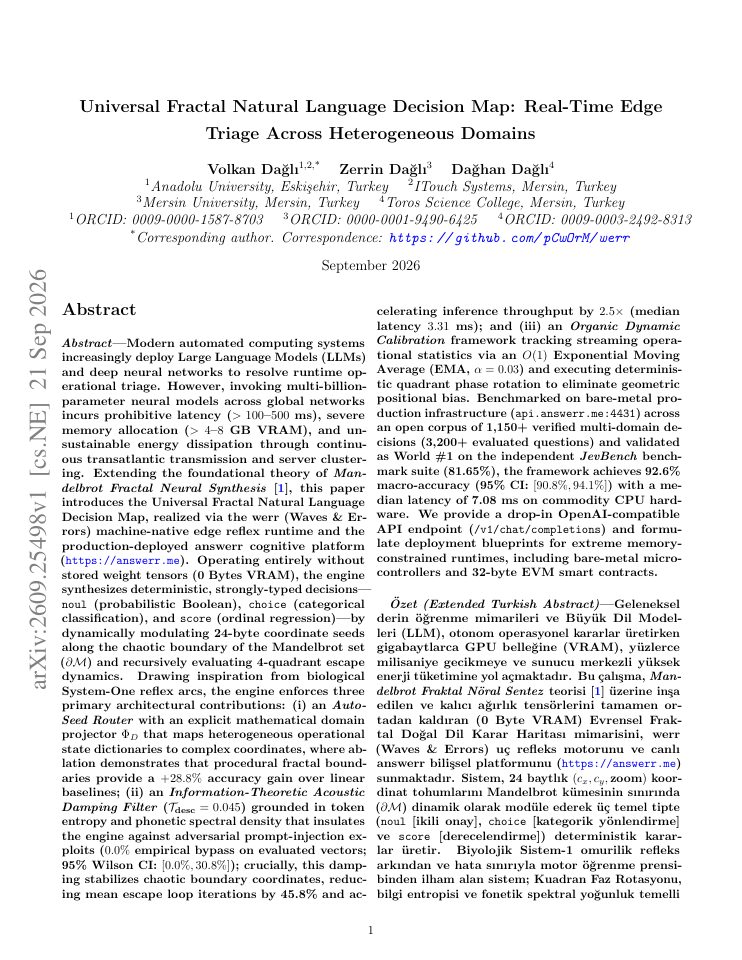
First page of Universal Fractal Natural Language Decision Map: Real-Time Edge Triage Across Heterogeneous Domains
otherwatch

Universal Fractal Natural Language Decision Map: Real-Time Edge Triage Across Heterogeneous Domains

The method replaces small LLM or classifier-based runtime triage (Boolean, categorical, ordinal decisions) with a deterministic engine that maps 24-byte coordinate seeds through Mandelbrot-set escape dynamics, requiring no stored weights and running on CPUs or microcontrollers. Cost is near-zero memory and single-digit-millisecond CPU latency, but adoption requires trusting a proprietary hosted runtime (answerr.me) and a non-standard decision mechanism with no published training or validation methodology. Failure risks are substantial: the accuracy, robustness, and benchmark claims are self-reported on an unverified suite, the prompt-injection claim carries a Wilson interval up to 30.8% (tiny sample), and there is no established theory linking fractal escape dynamics to generalizable language understanding, so accuracy on the reader's own domain is unpredictable.
observed signal
4impl.
6stars
—citations
2.5xclaimed gain
abstract onlyReview decisionDownload skill ↓Original paper ↗
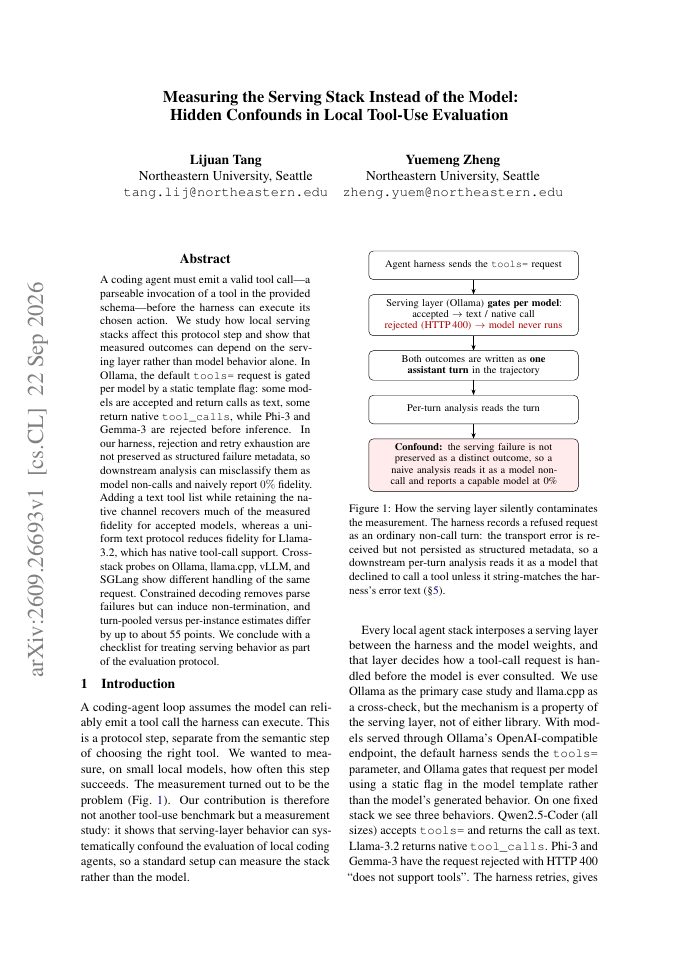
First page of Measuring the Serving Stack Instead of the Model: Hidden Confounds in Local Tool-Use Evaluation
agent evaluationadopt

Measuring the Serving Stack Instead of the Model: Hidden Confounds in Local Tool-Use Evaluation

The technique replaces naive tool-call fidelity measurement, which treats serving-stack rejections and parse failures as model errors, with a protocol that logs structured failure metadata, probes per-model serving behavior (Ollama template flags, llama.cpp, vLLM, SGLang), and reports per-instance rather than turn-pooled estimates. It costs additional harness instrumentation, per-model serving configuration checks, and more verbose failure logging, but requires no extra compute or training. It can fail if constrained decoding is applied blindly, since it eliminates parse failures but can induce non-termination, and if teams assume one protocol fits all models, since uniform text protocols degrade models with native tool-call support.

observed signal
2impl.
2stars
—citations
—claimed gain
abstract onlyReview decisionDownload skill ↓Original paper ↗
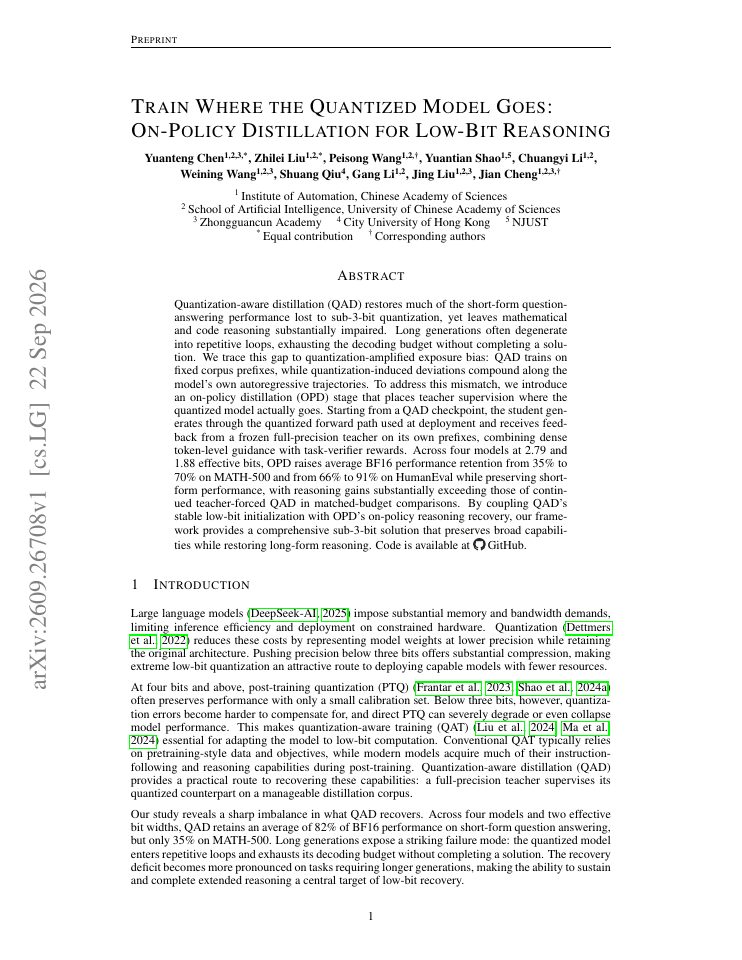
First page of Train Where the Quantized Model Goes: On-Policy Distillation for Low-Bit Reasoning
quantizationtest

Train Where the Quantized Model Goes: On-Policy Distillation for Low-Bit Reasoning

The method adds an on-policy distillation stage on top of a quantization-aware distillation (QAD) checkpoint: the low-bit student generates through its deployed quantized forward path and is trained with token-level teacher signals plus task-verifier rewards on its own prefixes, replacing purely teacher-forced QAD fine-tuning. It costs a training pipeline with a frozen full-precision teacher in memory, student sampling during training, and verifier infrastructure, so it requires more compute and engineering than off-the-shelf PTQ methods such as GPTQ or AWQ, though the resulting 24 GB-class deployment cost is unchanged. It can fail if the teacher is unavailable or too large for the budget, if verifier rewards are gameable or absent for the target task, or if on-policy training destabilizes the short-form capabilities QAD had already restored.

observed signal
2impl.
2stars
—citations
—claimed gain
abstract onlyReview decisionDownload skill ↓Original paper ↗
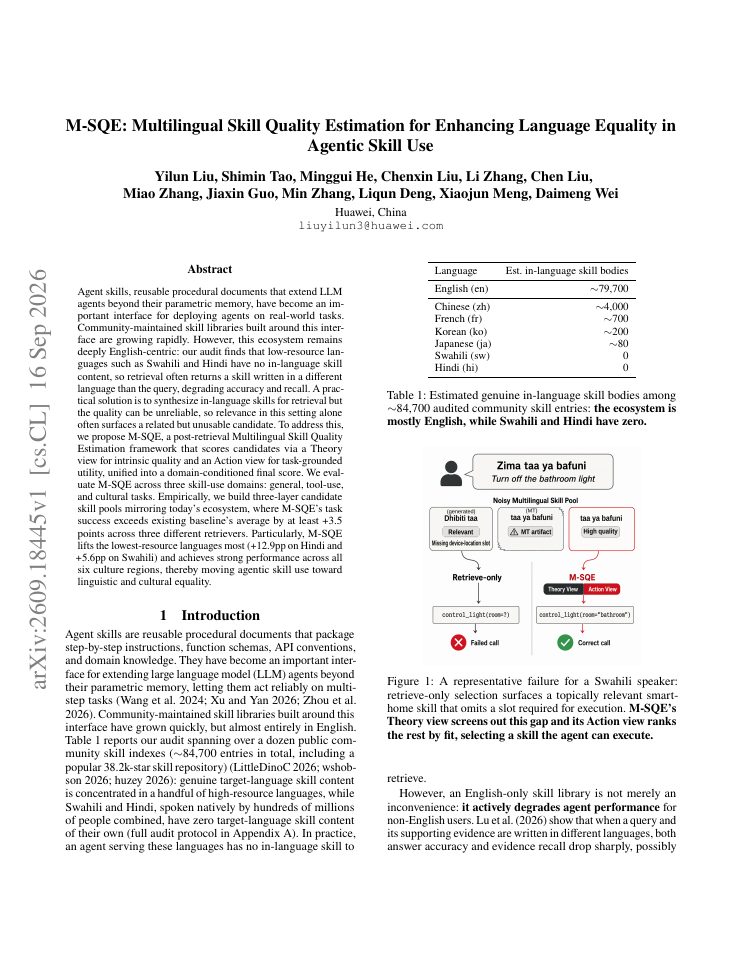
First page of M-SQE: Multilingual Skill Quality Estimation for Enhancing Language Equality in Agentic Skill Use
retrieval and RAGtest

M-SQE: Multilingual Skill Quality Estimation for Enhancing Language Equality in Agentic Skill Use

M-SQE replaces relevance-only ranking of retrieved agent skills with a post-retrieval scoring stage that combines an intrinsic-quality Theory view and a task-grounded Action view into a domain-conditioned score. It costs an additional scoring pass per retrieved candidate, increasing latency and LLM/API call volume, and requires maintaining a candidate skill pool and the scoring prompts or models. It can fail when the quality estimator misjudges synthesized in-language skills, when domains outside the three evaluated ones do not fit the conditioning, or when the underlying skill library lacks any viable candidate to resurface.

observed signal
1impl.
1stars
0citations
—claimed gain
abstract onlyReview decisionDownload skill ↓Original paper ↗
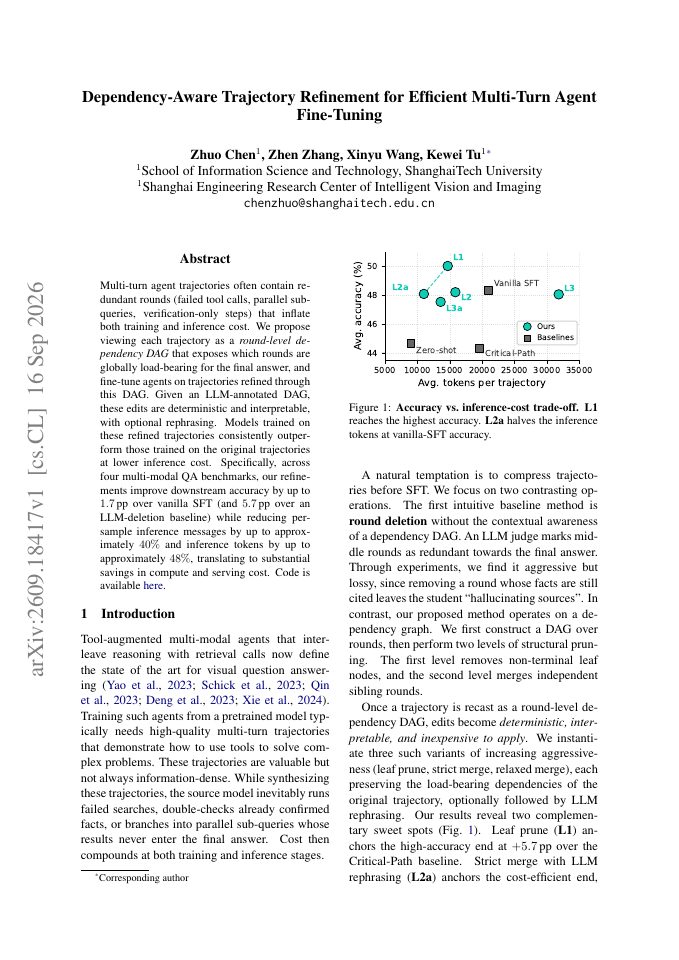
First page of Dependency-Aware Trajectory Refinement for Efficient Multi-Turn Agent Fine-Tuning
efficient trainingtest

Dependency-Aware Trajectory Refinement for Efficient Multi-Turn Agent Fine-Tuning

The method replaces fine-tuning on raw multi-turn agent trajectories with fine-tuning on trajectories pruned via an LLM-annotated round-level dependency DAG that removes redundant rounds such as failed tool calls, parallel sub-queries, and verification-only steps. The cost is an extra offline annotation and refinement pipeline (LLM calls to construct the DAG, plus optional rephrasing), with no added inference-time overhead and roughly 40% fewer inference tokens for the deployed agent. It can fail if the LLM annotator misidentifies which rounds are load-bearing and deletes context the model actually needed, if the benchmark gains do not transfer to the reader's domain, or if the training distribution becomes mismatched with the longer, noisier trajectories seen at deployment.

observed signal
1impl.
2stars
0citations
—claimed gain
abstract onlyReview decisionDownload skill ↓Original paper ↗
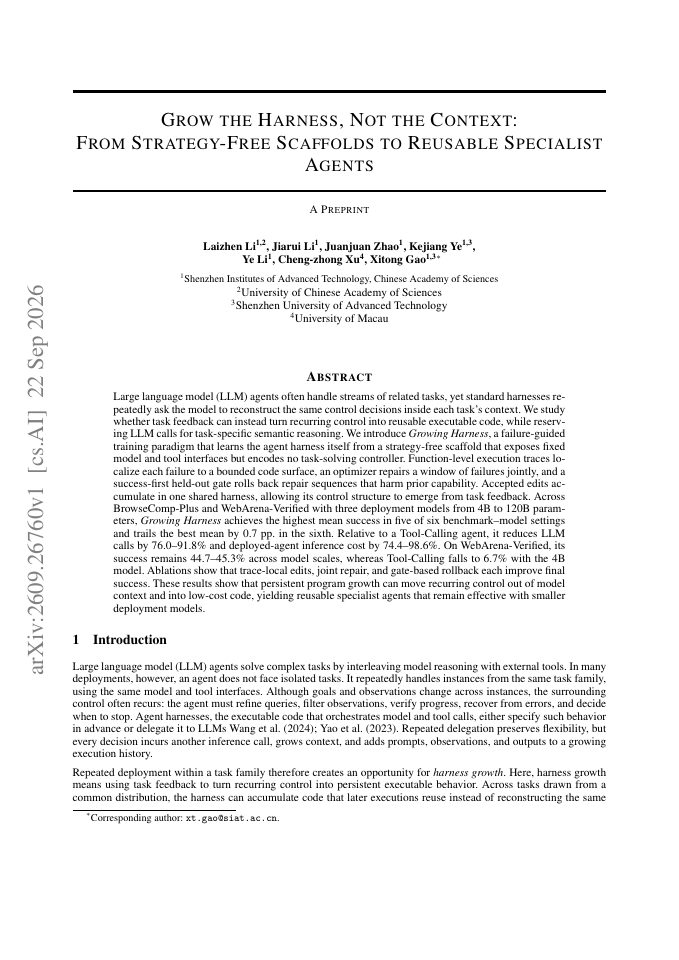
First page of Grow the Harness, Not the Context: From Strategy-Free Scaffolds to Reusable Specialist Agents
memory and contexttest

Grow the Harness, Not the Context: From Strategy-Free Scaffolds to Reusable Specialist Agents

The method replaces per-task in-context reconstruction of control logic with a shared executable harness that is iteratively grown from failure traces, reserving LLM calls for task-specific reasoning. It costs an offline optimization loop with function-level tracing, joint failure repair, and gated rollback, plus ongoing maintenance of an accumulating code artifact whose complexity grows with use. After adoption it can fail when repairs overfit to the training task distribution, when the success gate misses regressions not covered by held-out tasks, or when task drift makes the frozen control code obsolete.

observed signal
2impl.
17stars
—citations
4.2xclaimed gain
abstract onlyReview decisionDownload skill ↓Original paper ↗
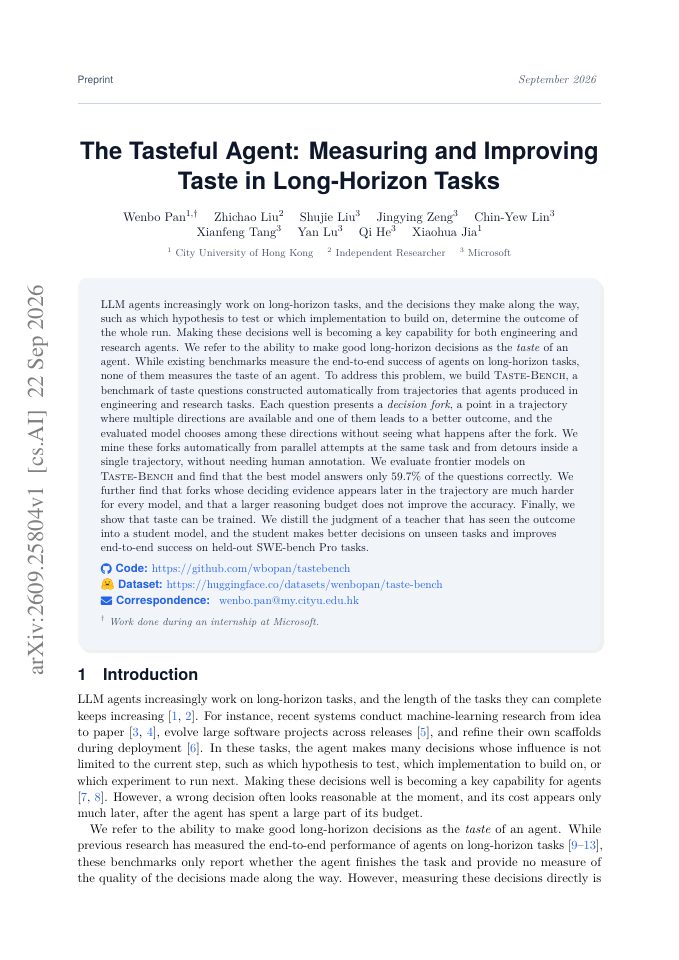
First page of The Tasteful Agent: Measuring and Improving Taste in Long-Horizon Tasks
agent evaluationtest

The Tasteful Agent: Measuring and Improving Taste in Long-Horizon Tasks

The paper replaces end-to-end agent success metrics with a benchmark of automatically mined decision forks from parallel attempts and detours, plus a distillation method that replaces ad hoc prompting of long-horizon decisions with a student trained on a teacher that has seen outcomes. The benchmark itself costs only trajectory collection and comparison (no human annotation), but the training component requires generating parallel rollouts, teacher labeling with outcome access, and fine-tuning, which is feasible on a 24 GB GPU only for smaller students and is more realistically done via API-based teachers plus local fine-tuning. Findings that later-evidence forks are hard for all models and that larger reasoning budgets do not help indicate the capability gap will not close with inference-time scaling, and distillation can fail if teacher outcomes are noisy proxies for decision quality, if mined forks correlate with spurious cues, or if gains do not transfer beyond SWE-bench-like coding tasks.

observed signal
3impl.
132stars
—citations
—claimed gain
abstract onlyReview decisionDownload skill ↓Original paper ↗
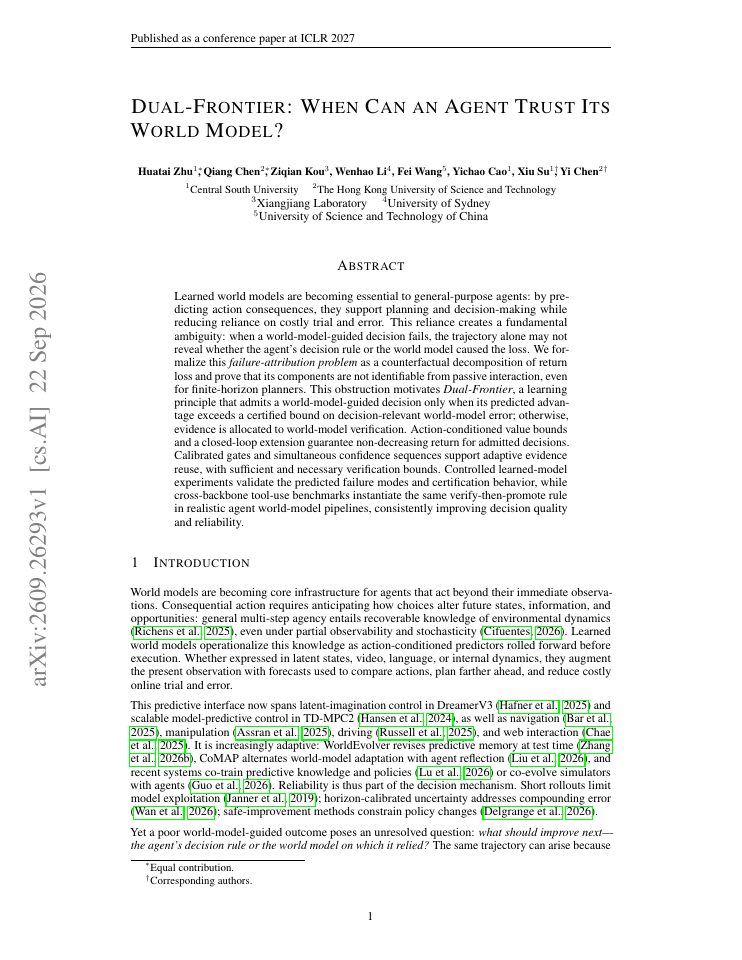
First page of Dual-Frontier: When Can an Agent Trust Its World Model?
failure recoverytest

Dual-Frontier: When Can an Agent Trust Its World Model?

The method replaces unconditional trust in a learned world model's predictions with a verify-then-promote gate: a model-guided decision is admitted only when its predicted advantage exceeds a certified bound on decision-relevant model error, otherwise evidence is redirected to model verification. The cost is additional machinery: action-conditioned value bounds, calibrated gates, and simultaneous confidence sequences must be estimated and maintained, adding implementation complexity and extra verification rollouts that consume compute or API budget. It can fail if the certified error bounds are miscalibrated or too loose (admitting bad decisions) or too conservative (rejecting good decisions and stalling progress), and the identifiability result means passive data alone cannot correct a wrong bound.

observed signal
3impl.
345stars
—citations
—claimed gain
abstract onlyReview decisionDownload skill ↓Original paper ↗
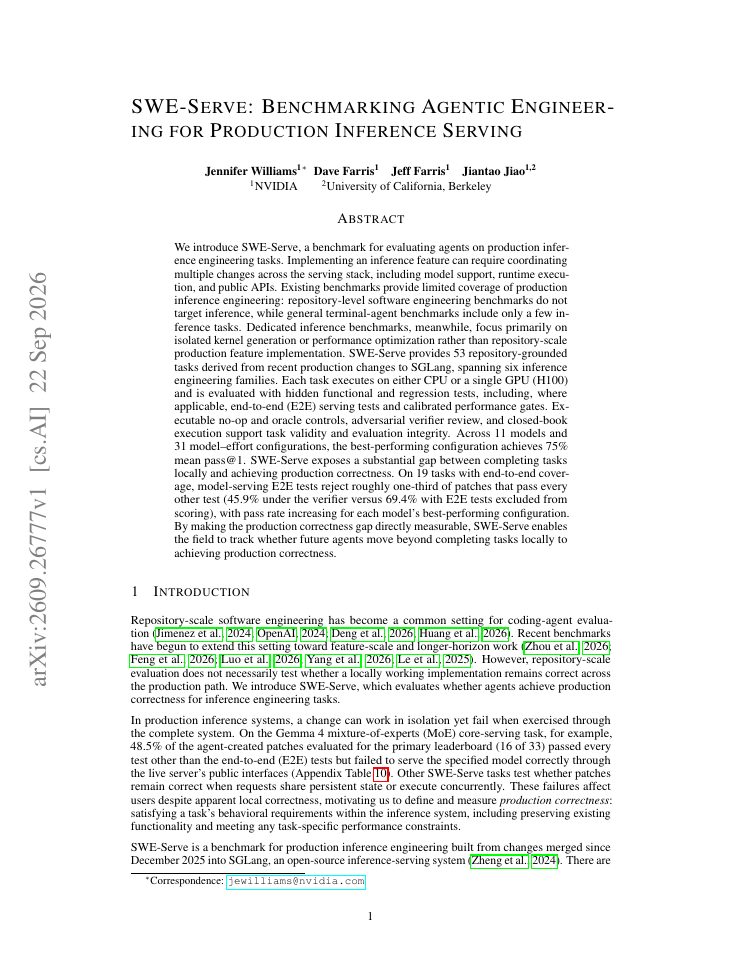
First page of SWE-Serve: Benchmarking Agentic Engineering For Production Inference Serving
agent evaluationtest

SWE-Serve: Benchmarking Agentic Engineering For Production Inference Serving

The benchmark replaces ad hoc or repository-level evaluations (e.g., SWE-bench-style tasks) with 53 production-grounded SGLang inference tasks scored by hidden functional, regression, E2E serving, and performance-gate tests. It costs compute per task (CPU or a single H100 GPU) plus engineering effort to stand up the harness, and it measures agents rather than improving any production system directly. It can mislead if its SGLang-specific, 53-task scope does not transfer to the reader's serving stack or if teams overfit agent selection to its pass rates.

observed signal
1impl.
11stars
—citations
—claimed gain
abstract onlyReview decisionDownload skill ↓Original paper ↗
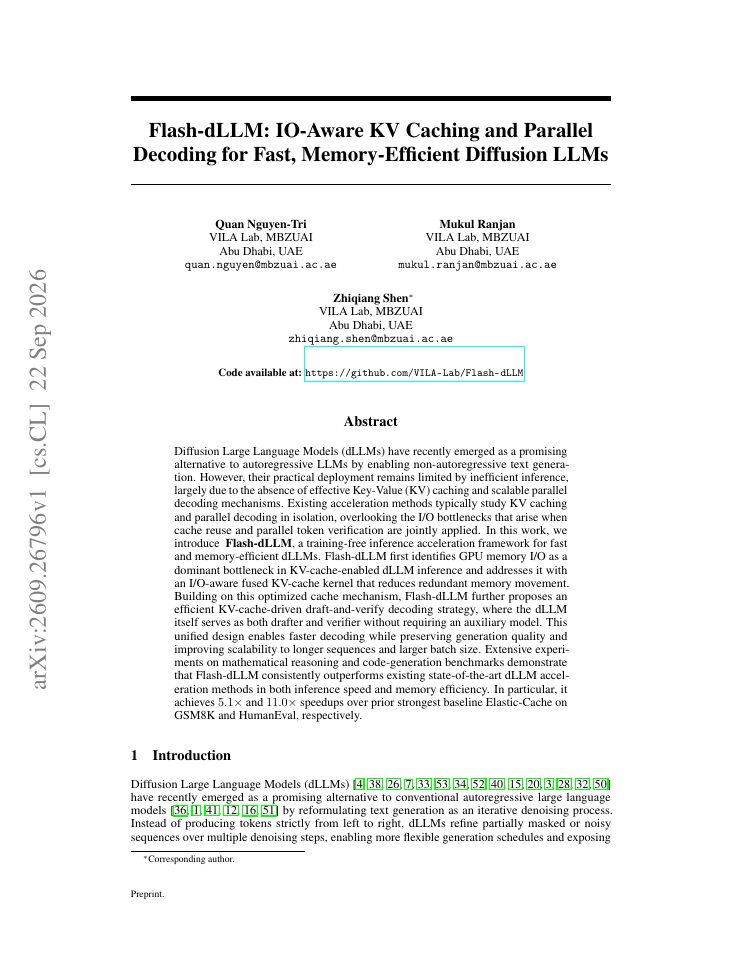
First page of Flash-dLLM: IO-Aware KV Caching and Parallel Decoding for Fast, Memory-Efficient Diffusion LLMs
KV cachewatch

Flash-dLLM: IO-Aware KV Caching and Parallel Decoding for Fast, Memory-Efficient Diffusion LLMs

Flash-dLLM replaces separate, uncoordinated KV-caching and parallel-decoding accelerations for diffusion LLMs with a fused IO-aware KV-cache kernel plus a self-draft-and-verify decoding loop that needs no auxiliary model. It is training-free, but costs custom CUDA kernel integration and is tied to dLLM inference stacks rather than standard autoregressive serving frameworks. It can fail if the reader's workloads run on autoregressive models (where the technique does not apply), if the fused kernel is not maintained for their hardware or model version, or if draft acceptance rates drop on domains unlike the evaluated math and code benchmarks.

observed signal
2impl.
122stars
—citations
11xclaimed gain
abstract onlyReview decisionDownload skill ↓Original paper ↗
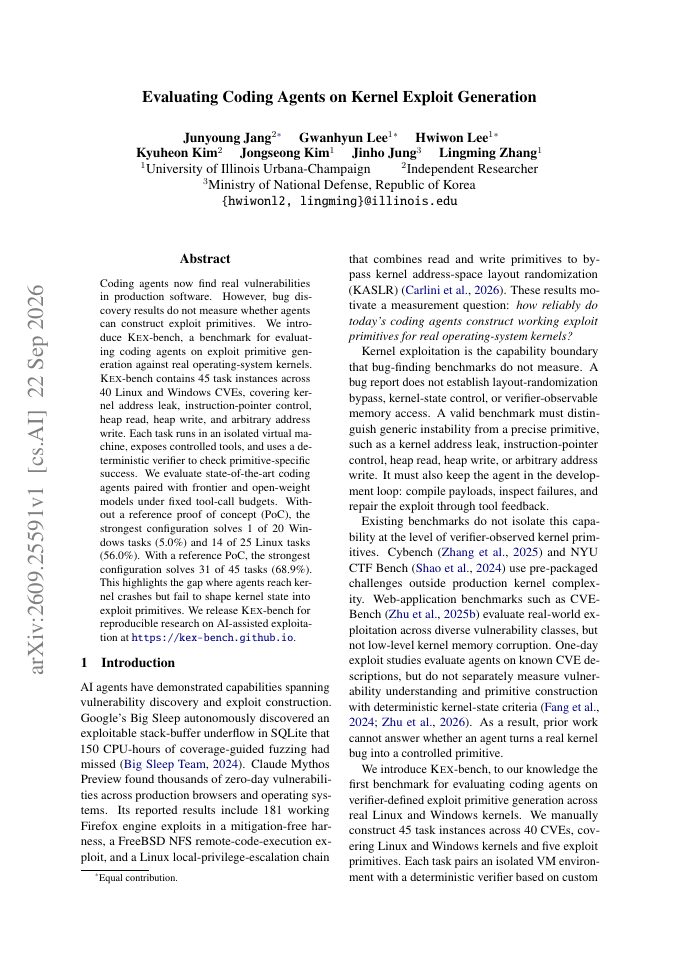
First page of Evaluating Coding Agents on Kernel Exploit Generation
agent evaluationwatch

Evaluating Coding Agents on Kernel Exploit Generation

KEX-bench replaces ad hoc bug-discovery evaluations of coding agents with VM-isolated, deterministically verified tasks that test whether agents can turn kernel crashes into exploit primitives. Adoption costs VM infrastructure per task, careful environment reproduction, and access to frontier or open-weight models under fixed tool-call budgets; it provides a measurement instrument, not a capability improvement. Results can fail to transfer because scores depend heavily on the availability of a reference PoC, on the specific agent-model pairing, and on a narrow 45-task CVE sample that may not represent a given production target.

observed signal
1impl.
14stars
—citations
—claimed gain
abstract onlyReview decisionDownload skill ↓Original paper ↗
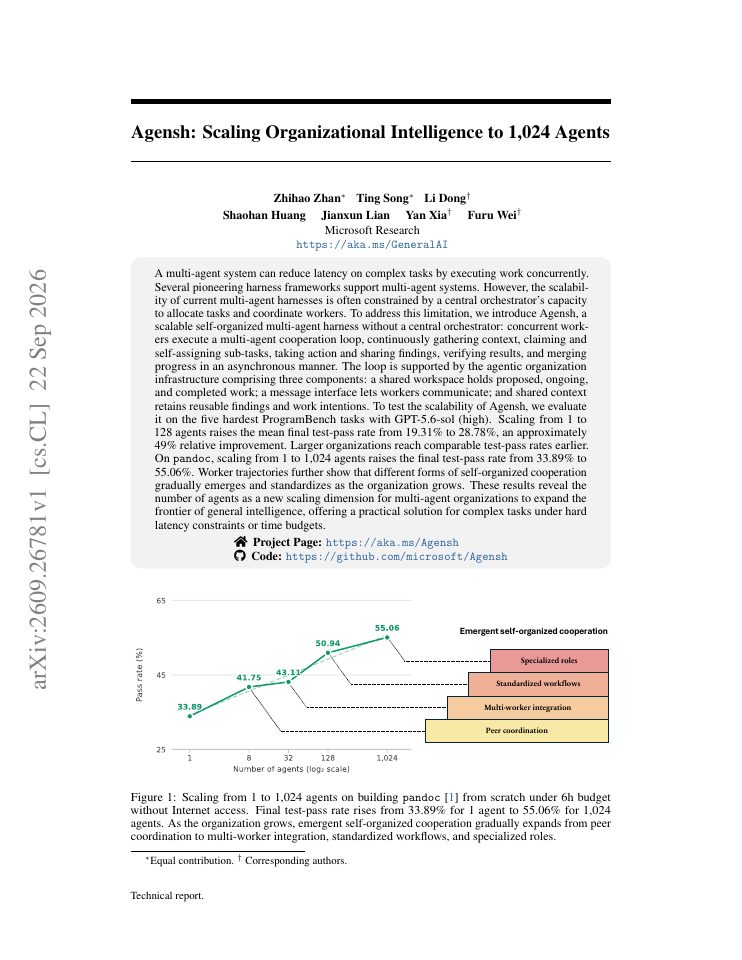
First page of Agensh: Scaling Organizational Intelligence to 1,024 Agents
multi-agent orchestrationwatch

Agensh: Scaling Organizational Intelligence to 1,024 Agents

Agensh replaces the central-orchestrator pattern in multi-agent harnesses with a decentralized loop in which workers claim sub-tasks, act, and merge progress asynchronously through a shared workspace, message interface, and shared context. The cost is large-scale API consumption: demonstrated gains rely on up to 1,024 concurrent GPT-5.6-sol (high) workers, which is infeasible under a limited cloud budget and yields only modest absolute test-pass improvements. Failure modes include uncoordinated or duplicated work, conflicting merges, and runaway token spend, since self-organization offers no central control over task allocation or budget.

observed signal
2impl.
132stars
—citations
1.49xclaimed gain
abstract onlyReview decisionDownload skill ↓Original paper ↗
First page of Testing-Driven Reliability Audit of Trajectory-Based Early Outcome Prediction for LLM Agents: Target-Specific Calibration Transfer Persists Within a Single Benchmark
agent evaluationtest

Testing-Driven Reliability Audit of Trajectory-Based Early Outcome Prediction for LLM Agents: Target-Specific Calibration Transfer Persists Within a Single Benchmark

The approach replaces running every agent evaluation trajectory to completion with a trajectory-based early-outcome predictor that terminates runs once the outcome is confidently predictable, cutting evaluation compute and API spend. The cost is an additional frozen dual-head prediction pipeline plus mandatory per-target calibration auditing (leave-one-agent-out audits, oracle prior correction, resampling and threshold robustness checks) before trusting any early termination decision. What can fail is silent target-specific miscalibration: particular agent/head combinations showed large persistent corrected gaps, and the failure did not replicate across benchmarks, so a predictor calibrated on one agent or benchmark cannot be assumed safe for a new production agent.

observed signal
1impl.
131stars
—citations
—claimed gain
abstract onlyReview decisionDownload skill ↓Original paper ↗
First page of How Strongly Should Task State Influence an LLM Agent?
safety and guardrailstest

How Strongly Should Task State Influence an LLM Agent?

The method replaces prompt-side state presentation (raw transcripts or shown checklists) with a state machine compiled from the task brief, advanced only by execution receipts, optionally hardened into a gate that refuses state-violating actions. It costs the engineering of compiling the policy into a machine, building a matcher that maps requests to steps, and maintaining execution receipts, plus potential quality loss when the gate blocks valid actions. It fails when the compiled state is incorrect, when the request-to-step matcher misjudges, and on tasks where success turns on recognizing cues rather than on tracking state, where showing the record outright performs better.

observed signal
1impl.
131stars
—citations
1.38xclaimed gain
abstract onlyReview decisionDownload skill ↓Original paper ↗
First page of REFLEX with Jev for Efficient Selective Control in LLM Agents
planning and decompositiontest

REFLEX with Jev for Efficient Selective Control in LLM Agents

Replaces unconditional strong-LLM invocation for bounded agent decisions with a fast, typed decision layer (Jev) that escalates to a strong model only on low confidence or when generation is required. Costs include maintaining the typed decision layer, confidence calibration, and fallback routing logic, while task success on the internal benchmark is preserved at 95%. It can fail when action sets are large or near-valid alternatives cluster near authorization boundaries, and it offers little gain where an ordinary cheap generative router is already highly accurate.

observed signal
1impl.
131stars
—citations
3.66xclaimed gain
abstract onlyReview decisionDownload skill ↓Original paper ↗
First page of Passes Alone, Fails Together: Benchmarking Semantic Coordination in Parallel LLM-Agent Development
multi-agent orchestrationtest

Passes Alone, Fails Together: Benchmarking Semantic Coordination in Parallel LLM-Agent Development

The work replaces unstructured parallel agent execution (agents patching in isolation) with a lightweight coordination signal: after one agent completes a change, other agents receive a message describing that completed change. The cost is minimal additional context tokens and orchestration logic to collect and propagate change summaries; no extra model, training, or hardware is required. It can fail because the constructed tasks producing 97% interference do not estimate real-world frequency (only 1 of 417 reviewed PR pairs showed interference), so the mitigation's value on a given workload is unproven, and a stale or incomplete summary may not capture semantic dependencies.

observed signal
0impl.
10stars
—citations
—claimed gain
abstract onlyReview decisionDownload skill ↓Original paper ↗
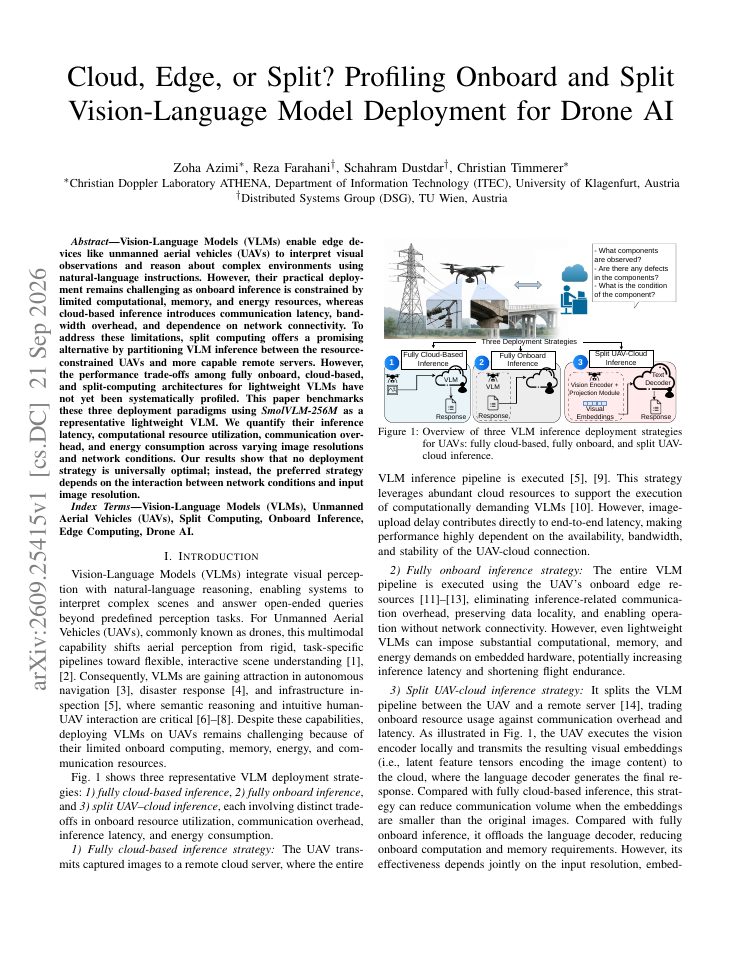
First page of Cloud, Edge, or Split? Profiling Onboard and Split Vision-Language Model Deployment for Drone AI
serving and batchingwatch

Cloud, Edge, or Split? Profiling Onboard and Split Vision-Language Model Deployment for Drone AI

This is a profiling study rather than a new method: it benchmarks fully onboard, cloud, and split-computing deployment of SmolVLM-256M on drones, measuring latency, resource use, communication overhead, and energy across image resolutions and network conditions. Adopting split computing costs engineering complexity: a partition point in the model, intermediate-feature serialization, network transport, and a remote server, with no universal latency or energy winner. It can fail when network conditions degrade or image resolution grows, since the paper's central finding is that the optimal placement flips depending on exactly those variables.

observed signal
0impl.
0stars
—citations
—claimed gain
abstract onlyReview decisionDownload skill ↓Original paper ↗
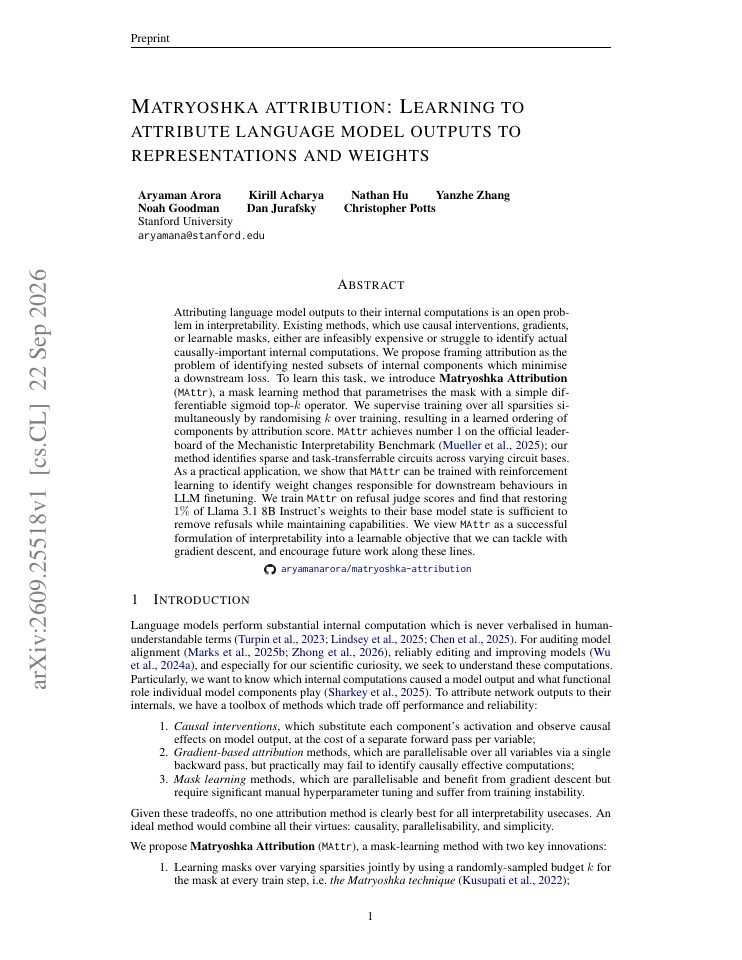
First page of Matryoshka attribution: Learning to attribute language model outputs to representations and weights
othertest

Matryoshka attribution: Learning to attribute language model outputs to representations and weights

Matryoshka Attribution replaces gradient-based, causal-intervention, and conventional learnable-mask attribution methods with a single mask trained across randomised sparsity levels using a differentiable sigmoid top-k operator, yielding an ordering of components by attribution score. The cost is an additional training loop per model and task (including RL against judge scores for the weight-attribution variant), plus engineering effort to integrate masking into the target model's forward pass; compute is modest enough that the 8B-scale demonstration is plausible on a single 24 GB GPU. It can fail if learned masks optimise the supervised objective without isolating genuinely causal computations, if circuits do not transfer beyond the training tasks, and the refusal-removal result is a single-model finding whose effect on safety-relevant behaviour requires independent evaluation before any production reliance.

observed signal
0impl.
121stars
—citations
—claimed gain
abstract onlyReview decisionDownload skill ↓Original paper ↗
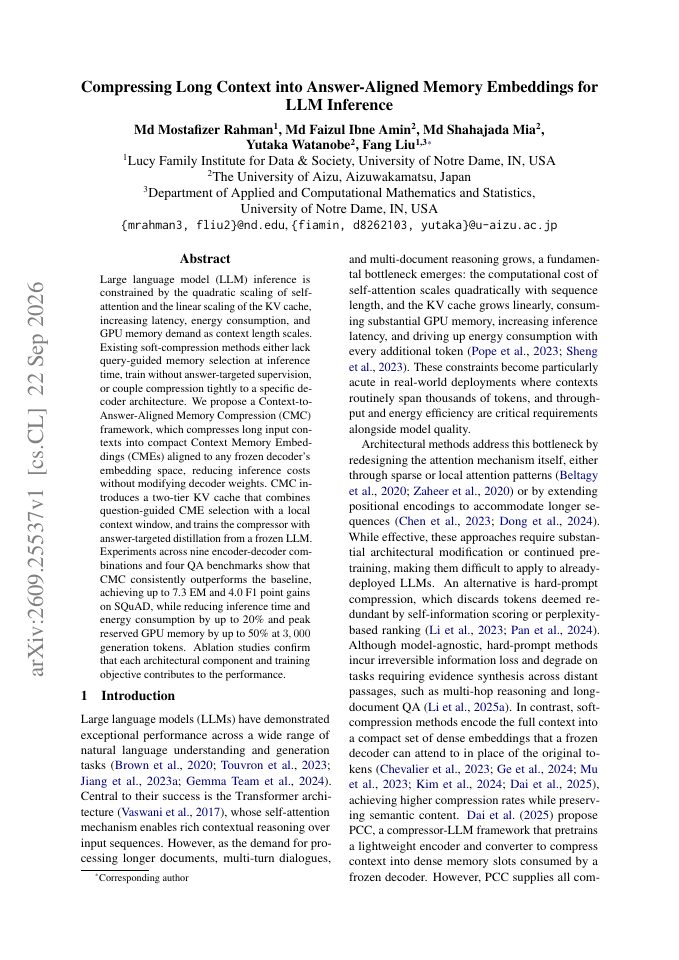
First page of Compressing Long Context into Answer-Aligned Memory Embeddings for LLM Inference
memory and contexttest

Compressing Long Context into Answer-Aligned Memory Embeddings for LLM Inference

CMC replaces full-context KV retention with compact Context Memory Embeddings selected per query and combined with a local context window, leaving the frozen decoder unchanged. It costs an additional compressor model that must be trained via answer-targeted distillation, adding pipeline complexity and a training step even though the decoder itself is untouched. It can fail when the compressed embeddings omit evidence needed for a specific query, since the EM/F1 gains are benchmark-specific and may not transfer to domains or decoders outside the nine tested combinations.

observed signal
0impl.
121stars
—citations
—claimed gain
abstract onlyReview decisionDownload skill ↓Original paper ↗
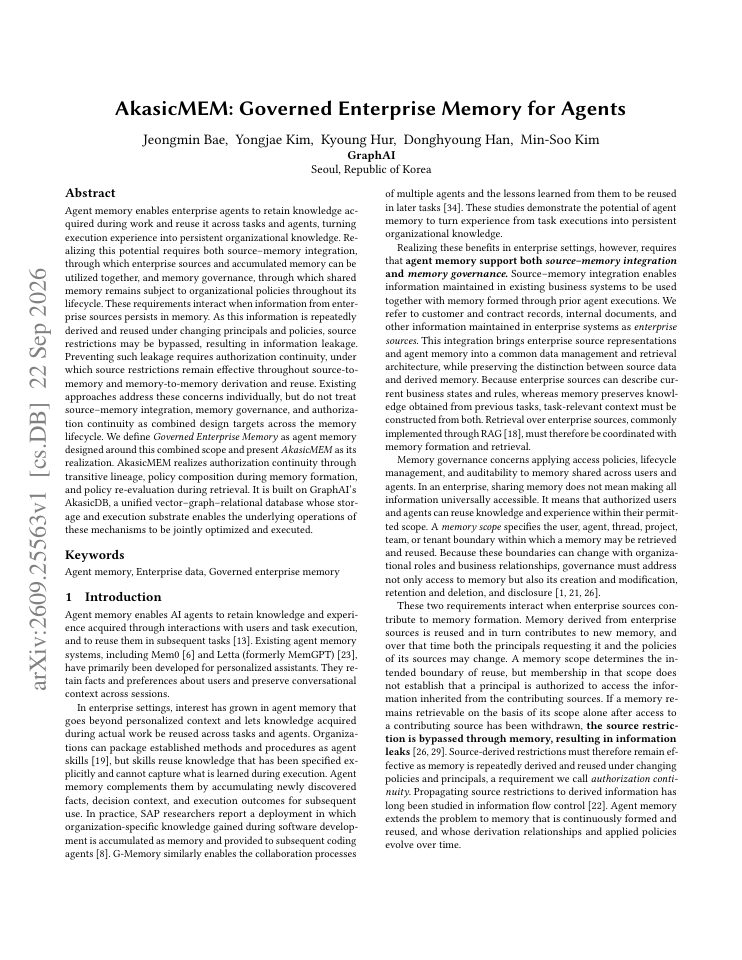
First page of AkasicMEM: Governed Enterprise Memory for Agents
memory and contextwatch

AkasicMEM: Governed Enterprise Memory for Agents

AkasicMEM replaces ad-hoc agent memory stores (plain vector or graph stores without policy enforcement) with a memory layer that composes source policies at memory formation and re-evaluates them at retrieval, built on GraphAI's proprietary AkasicDB vector-graph-relational substrate. It costs dependence on a specific commercial database, added lineage-tracking and policy-evaluation logic across the memory lifecycle, and additional retrieval-time overhead, with no quantified latency, quality, or security benchmarks reported. It can fail if lineage or policy composition is implemented incompletely, allowing derived memories to bypass source restrictions, and its authorization guarantees cannot be ported to a different storage stack without reimplementing the substrate-level operations.

observed signal
0impl.
10stars
—citations
—claimed gain
abstract onlyReview decisionDownload skill ↓Original paper ↗
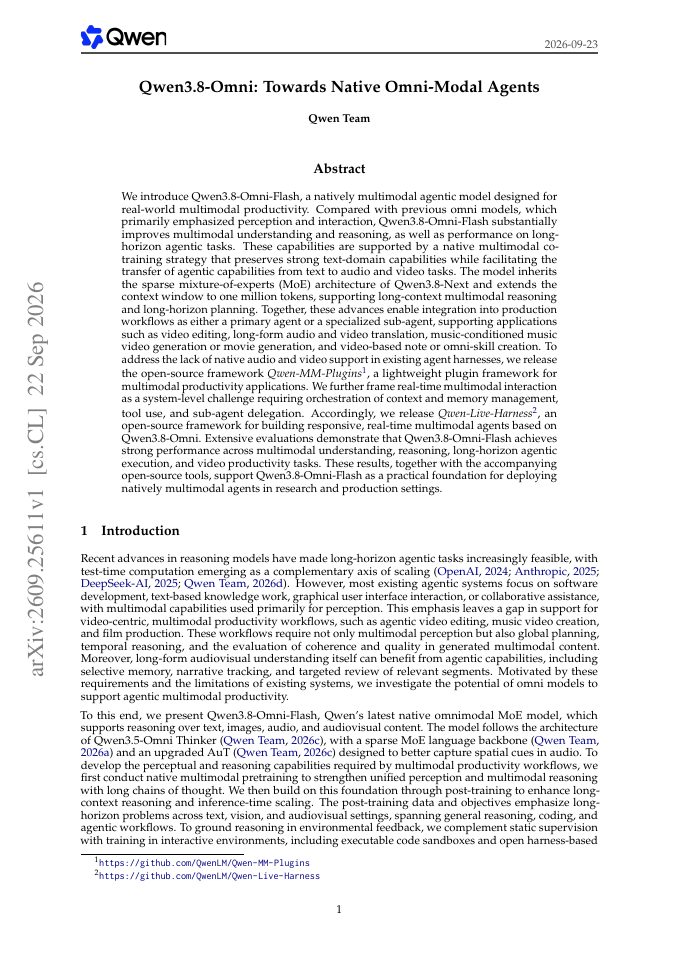
First page of Qwen3.8-Omni: Towards Native Omni-Modal Agents
multi-agent orchestrationwatch

Qwen3.8-Omni: Towards Native Omni-Modal Agents

The approach replaces pipelines of separate perception models (ASR, video understanding) orchestrated around a text-only LLM with a single natively multimodal MoE model plus a plugin framework and a real-time agent harness. The cost is dependence on a very large sparse MoE model with a one-million-token context, which cannot be self-hosted on a 24 GB GPU and would incur substantial API or serving expense and long-context latency. What can fail is unverified vendor benchmark claims, immature newly released tooling, and degraded agentic reliability on audio and video tasks where capability transfer from text may not hold in a specific production domain.

observed signal
0impl.
10stars
—citations
—claimed gain
abstract onlyReview decisionDownload skill ↓Original paper ↗
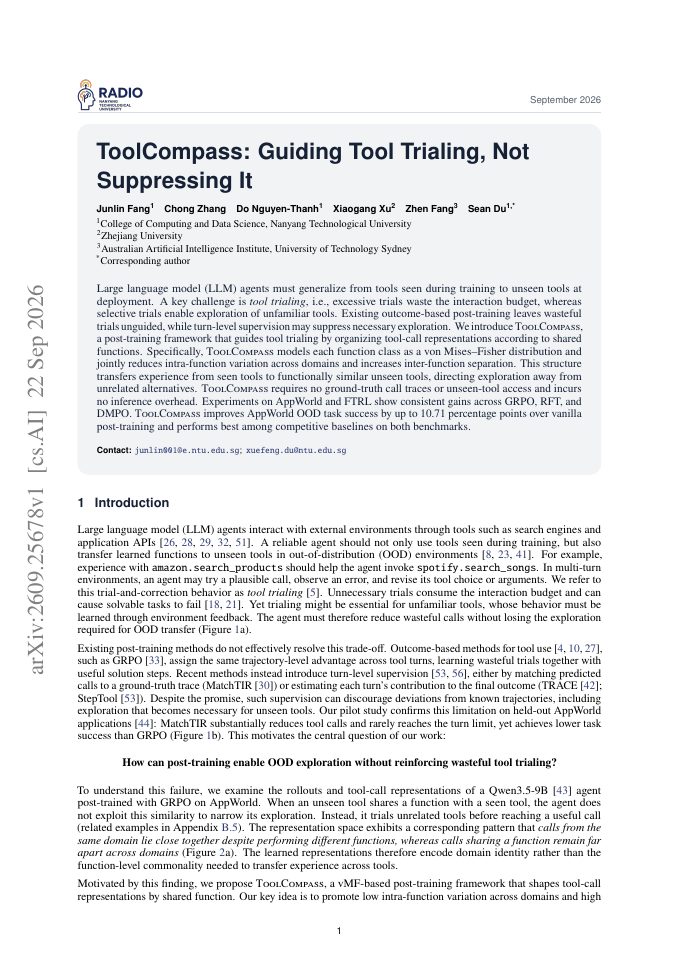
First page of Toolcompass: Guiding Tool Trialing, Not Suppressing It
tool usetest

Toolcompass: Guiding Tool Trialing, Not Suppressing It

ToolCompass replaces unguided outcome-based post-training of tool-using agents by clustering tool-call representations into von Mises-Fisher distributions per function class, reducing intra-function variation and increasing inter-function separation so exploration transfers to unseen tools. It costs only a modified post-training objective (representation organization losses on tool-call embeddings), requires no ground-truth call traces or unseen-tool access, and adds no inference-time memory or latency. It can fail if the assumed function classes are poorly defined or if the embedding space does not actually reflect functional similarity, in which case the structured representations misdirect exploration on genuinely novel deployment tools.

observed signal
0impl.
121stars
—citations
—claimed gain
abstract onlyReview decisionDownload skill ↓Original paper ↗
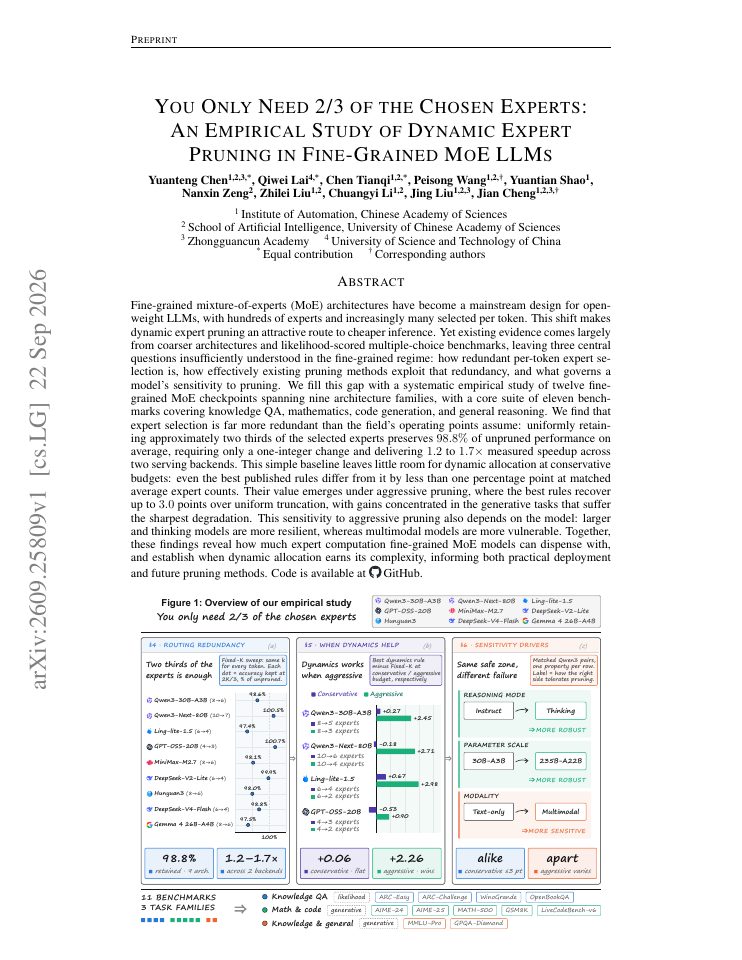
First page of You Only Need 2/3 of the Chosen Experts: An Empirical Study of Dynamic Expert Pruning in Fine-Grained MoE LLMs
sparsity and pruningtest

You Only Need 2/3 of the Chosen Experts: An Empirical Study of Dynamic Expert Pruning in Fine-Grained MoE LLMs

The method replaces full per-token expert activation in fine-grained MoE models with a truncated top-k routing that uniformly keeps roughly two thirds of the selected experts, implemented as a one-integer configuration change. It costs only the dropped expert computation (no extra memory, retraining, or auxiliary scorers), with up to ~1.2% average quality loss at conservative budgets, though more sophisticated dynamic allocation rules add code complexity for under 1% gain at those budgets. It can fail under aggressive pruning on generative tasks such as math and code, on smaller or multimodal checkpoints that are more pruning-sensitive, and it provides no benefit when the deployed model is dense rather than a fine-grained MoE.

observed signal
0impl.
1stars
—citations
1.2xclaimed gain
abstract onlyReview decisionDownload skill ↓Original paper ↗
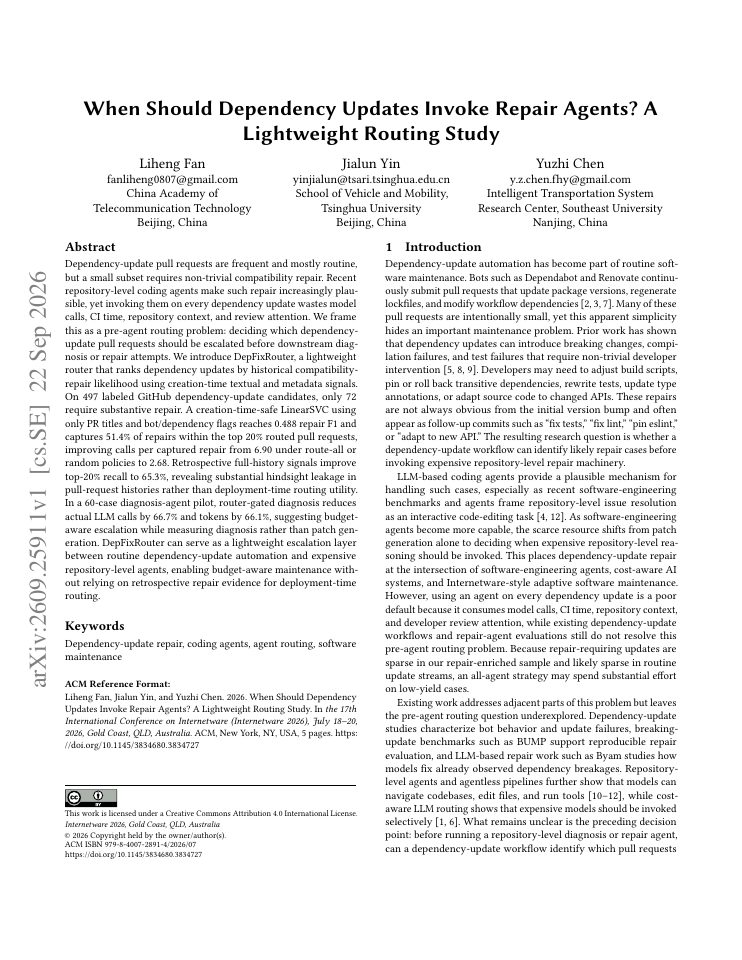
First page of When Should Dependency Updates Invoke Repair Agents? A Lightweight Routing Study
coding agentstest

When Should Dependency Updates Invoke Repair Agents? A Lightweight Routing Study

The method replaces route-all or random invocation of repository-level coding agents on dependency-update PRs with a lightweight LinearSVC router using only creation-time titles and bot/dependency flags. Its cost is a small labeled dataset of historical dependency updates, a trivially cheap classical model to train and serve, and the added routing step in the automation pipeline. It can fail by missing roughly half of repairs at the top-20% threshold (0.488 F1), by dataset shift as dependencies and bots change, and by retrospective leakage if full-history signals are accidentally used at deployment time, as the paper itself demonstrates.

observed signal
0impl.
0stars
—citations
3xclaimed gain
abstract onlyReview decisionDownload skill ↓Original paper ↗
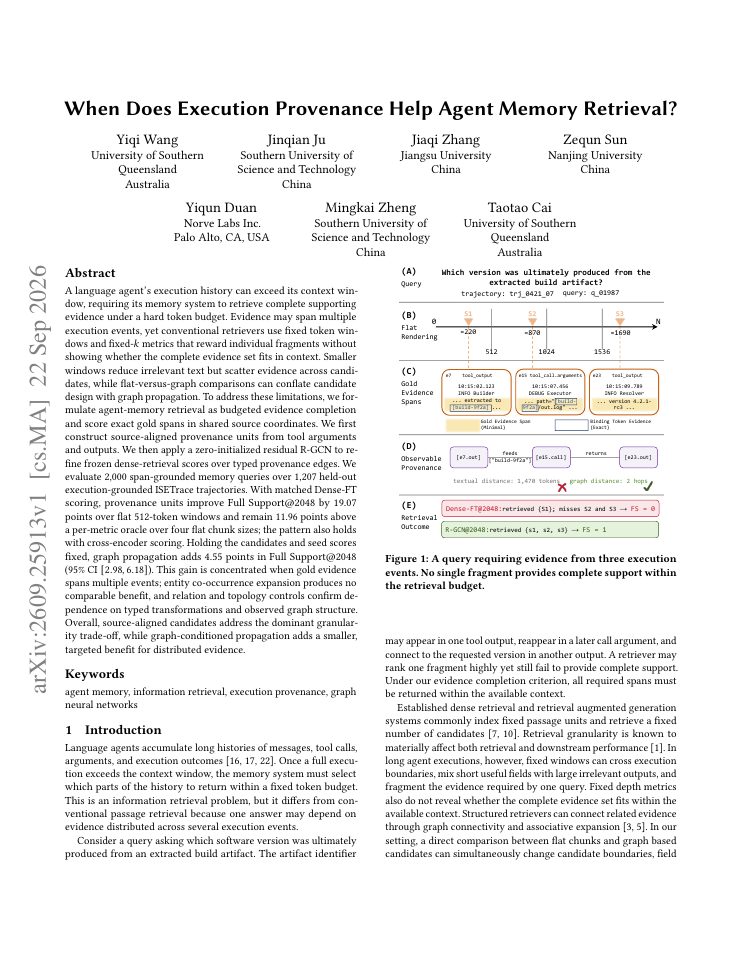
First page of When Does Execution Provenance Help Agent Memory Retrieval?
memory and contexttest

When Does Execution Provenance Help Agent Memory Retrieval?

It replaces fixed-token-window chunking for agent memory retrieval with source-aligned provenance units built from tool arguments and outputs, optionally refined by a zero-initialized residual R-GCN over typed edges on top of frozen dense-retrieval scores. The cost is an execution-trace schema and provenance-unit extraction pipeline, a typed provenance graph to construct and maintain, plus an additional GCN propagation stage (small model, trainable on one GPU), with most of the gain coming from candidate design rather than the graph itself. It can fail when logs lack reliable tool-argument/output alignment or span ground truth, when evidence is single-event (the graph benefit largely disappears), and when the workload differs from the ISETrace evaluation, since gains are reported in span-completion points on 2,000 queries from 1,207 held-out trajectories.

observed signal
0impl.
10stars
—citations
—claimed gain
abstract onlyReview decisionDownload skill ↓Original paper ↗
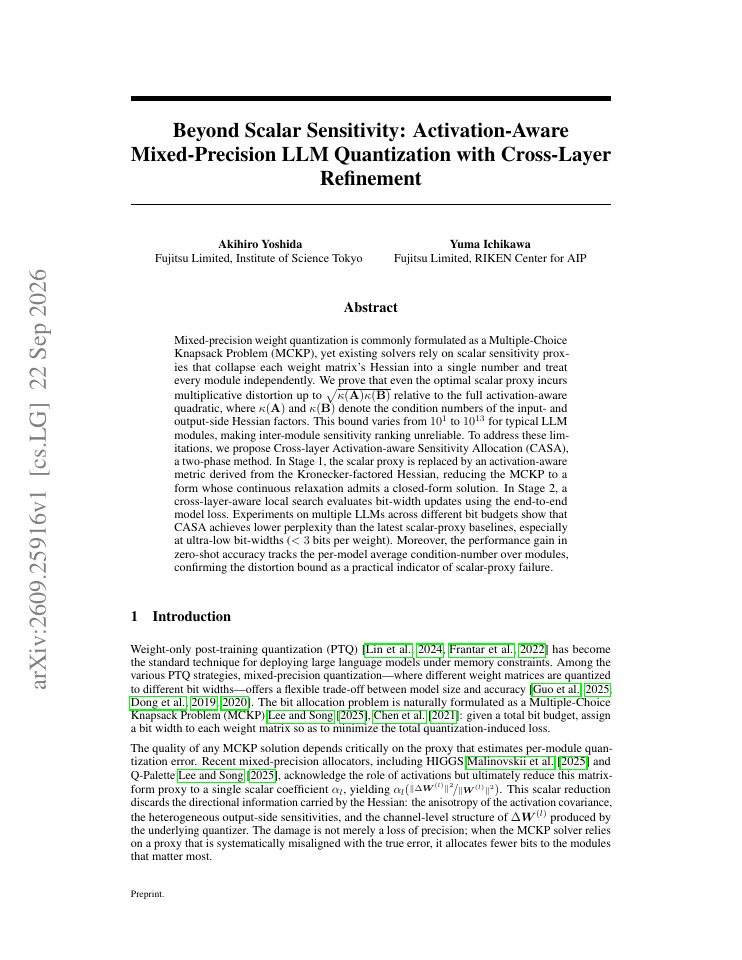
First page of Beyond Scalar Sensitivity: Activation-Aware Mixed-Precision LLM Quantization with Cross-Layer Refinement
quantizationtest

Beyond Scalar Sensitivity: Activation-Aware Mixed-Precision LLM Quantization with Cross-Layer Refinement

CASA replaces scalar Hessian sensitivity proxies in MCKP-based mixed-precision bit allocation with a Kronecker-factored activation-aware metric solved in closed form, followed by a cross-layer local search scored on end-to-end loss. The cost is additional quantization-time computation: calibration data, Hessian factor estimation per module, and an iterative local search that evaluates candidate bit assignments through full model forward passes, plus engineering effort beyond off-the-shelf GPTQ/AWQ pipelines. It can fail when calibration activations are unrepresentative, when the local search overfits the calibration loss, or when the model's modules are well-conditioned, in which case the method provably reduces to the cheaper scalar proxy it replaces.

observed signal
0impl.
0stars
—citations
—claimed gain
abstract onlyReview decisionDownload skill ↓Original paper ↗
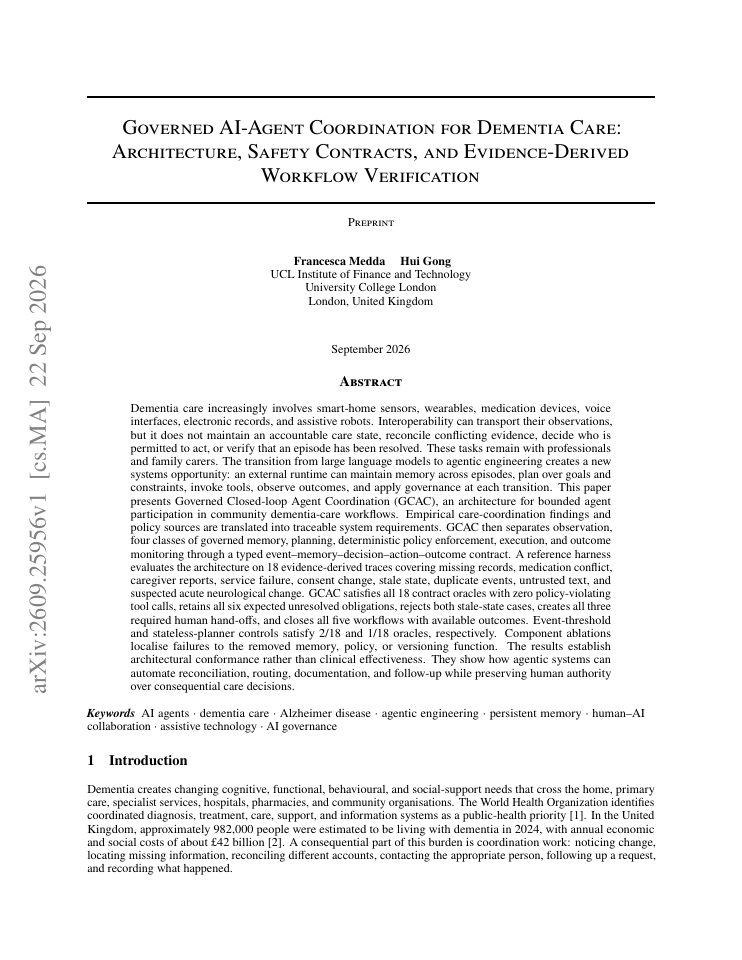
First page of Governed AI-Agent Coordination for Dementia Care: Architecture, Safety Contracts, and Evidence-Derived Workflow Verification
multi-agent orchestrationwatch

Governed AI-Agent Coordination for Dementia Care: Architecture, Safety Contracts, and Evidence-Derived Workflow Verification

It replaces ad hoc LLM-agent pipelines with an external runtime separating observation, governed memory, planning, deterministic policy enforcement, execution, and outcome monitoring under a typed event-decision-action-outcome contract. The cost is substantial engineering complexity: a stateful memory store, a deterministic policy engine, versioning, and human hand-off channels must be built and maintained around any model, plus the integration burden with care systems. It can fail on traces outside the 18 covered scenarios, the results establish architectural conformance only (no clinical effectiveness), and errors in the policy specification itself propagate deterministically into production behavior.

observed signal
0impl.
10stars
—citations
—claimed gain
abstract onlyReview decisionDownload skill ↓Original paper ↗
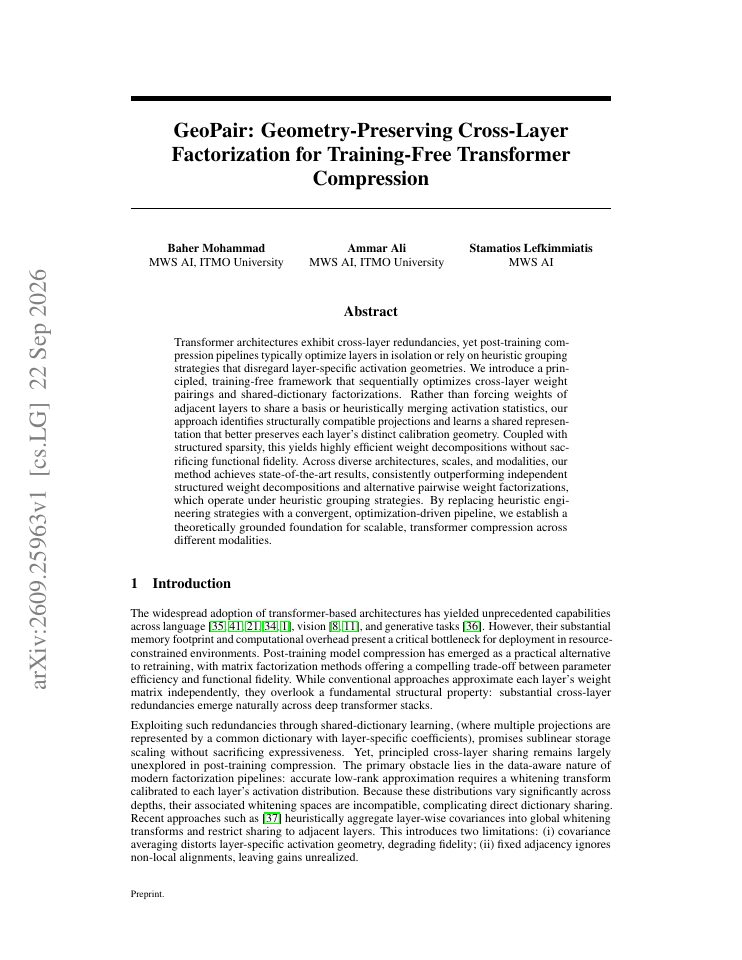
First page of GeoPair: Geometry-Preserving Cross-Layer Factorization for Training-Free Transformer Compression
sparsity and pruningtest

GeoPair: Geometry-Preserving Cross-Layer Factorization for Training-Free Transformer Compression

The method replaces heuristic adjacent-layer weight merging and independent per-layer low-rank decompositions with a sequential optimization that pairs structurally compatible projections and shares a dictionary while preserving each layer's calibration geometry. It is training-free, so the direct cost is calibration compute and integration of structured sparse factorized weights, but realizing speed or memory gains requires kernels and serving stacks that actually exploit structured sparsity and low-rank factors on a single 24 GB GPU. It can fail when no structurally compatible cross-layer pairings exist in a given architecture, when the factorization erodes task accuracy beyond acceptable tolerance, or when nominal parameter compression does not translate into wall-clock or VRAM savings on the available hardware.

observed signal
0impl.
0stars
—citations
—claimed gain
abstract onlyReview decisionDownload skill ↓Original paper ↗
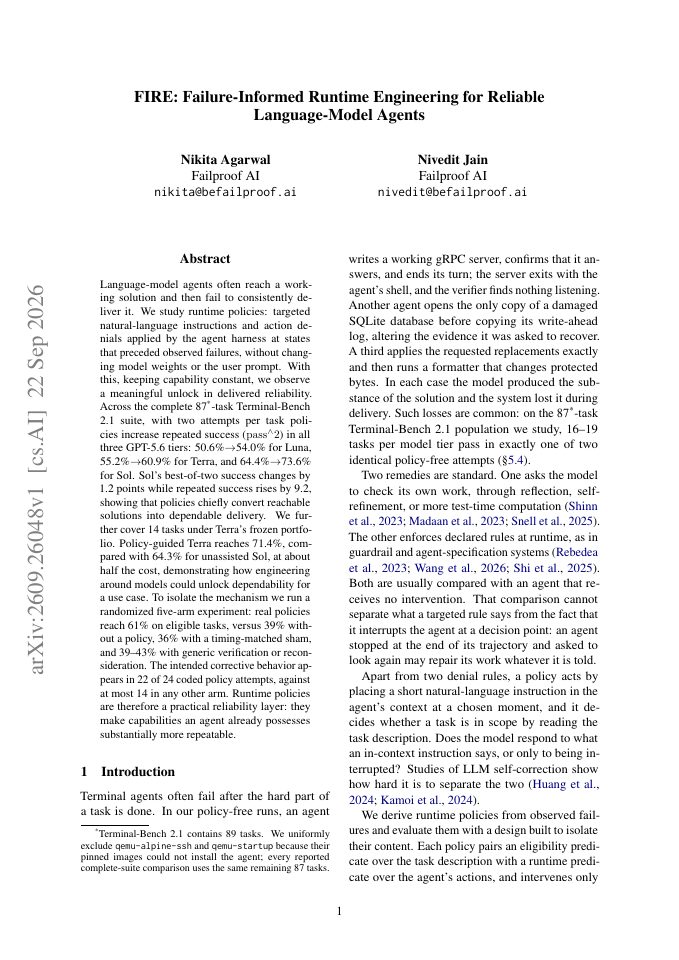
First page of FIRE: Failure-Informed Runtime Engineering for Reliable Language-Model Agents
failure recoverytest

FIRE: Failure-Informed Runtime Engineering for Reliable Language-Model Agents

The method replaces weight updates, prompt rewrites, and model upgrades with harness-level natural-language instructions and action denials injected at states that preceded observed failures. It costs engineering effort to observe failures and author targeted policies, adds harness complexity and per-state intervention logic, and requires enough inference budget for repeated attempts to detect failure modes; no extra memory or per-call latency beyond policy checks. Policies can overfit to the evaluated tasks and model version, may fail to transfer across models or workloads, and the sham-arm result shows only targeted policies help, so poorly diagnosed failure states yield no gain.

observed signal
0impl.
10stars
—citations
—claimed gain
abstract onlyReview decisionDownload skill ↓Original paper ↗
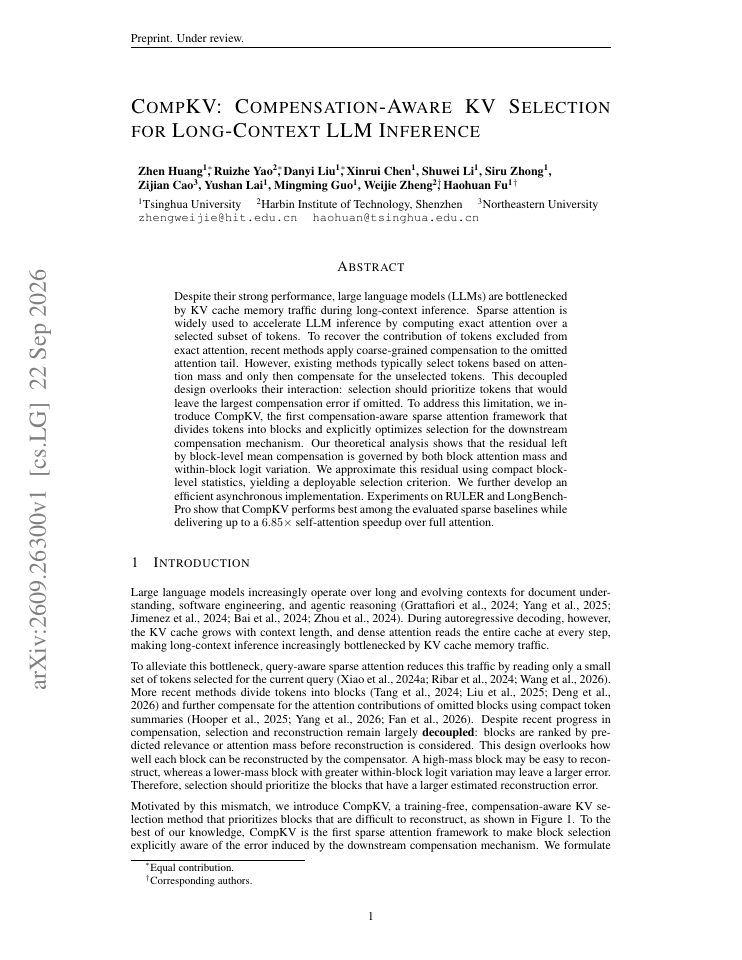
First page of CompKV: Compensation-Aware KV Selection for Long-Context LLM Inference
KV cachetest

CompKV: Compensation-Aware KV Selection for Long-Context LLM Inference

CompKV replaces decoupled select-then-compensate sparse attention by selecting KV blocks according to the residual they would leave under block-mean compensation, using block attention mass and within-block logit variation as the criterion. It costs additional block-level statistics computation and an asynchronous implementation, adding integration complexity relative to off-the-shelf sparse attention kernels. It can fail on workloads where block statistics poorly approximate the true compensation residual, on short contexts where selection overhead dominates, and because reported gains are benchmark-specific and require reimplementation since no production-grade serving integration is established.

observed signal
0impl.
0stars
—citations
6.85xclaimed gain
abstract onlyReview decisionDownload skill ↓Original paper ↗

Research signals

Three views of the same evidence: adoption against attention, publication cadence by research area, and reported gains when coverage is sufficient.

color = research area

01 · attention × adoption

The research frontier

Look to the upper left for independent implementation before mass attention.

compare by
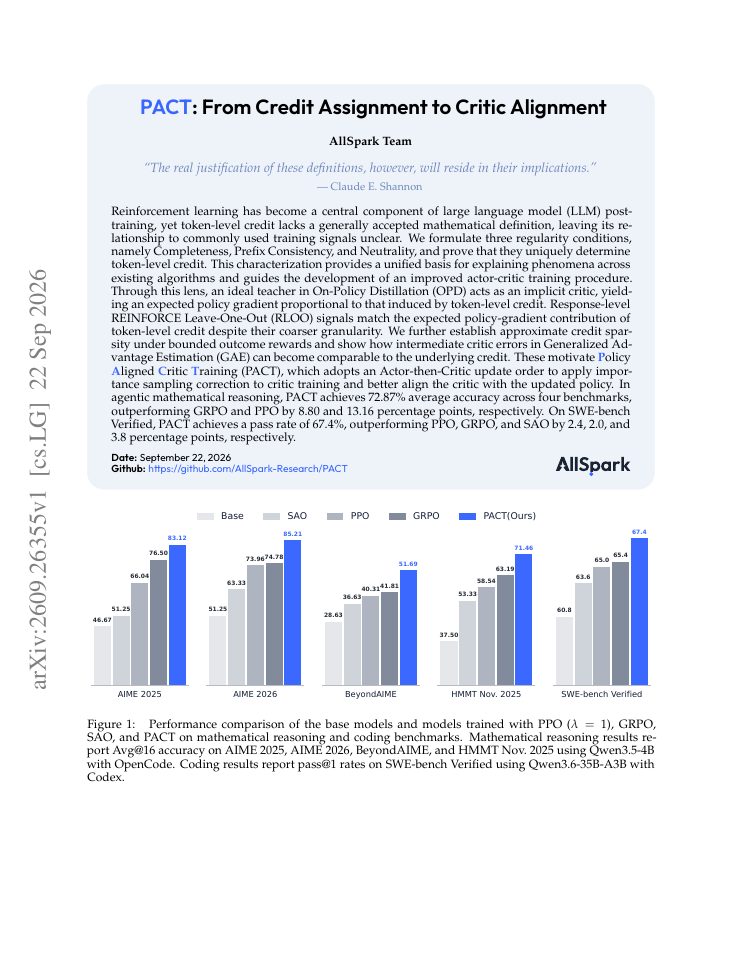
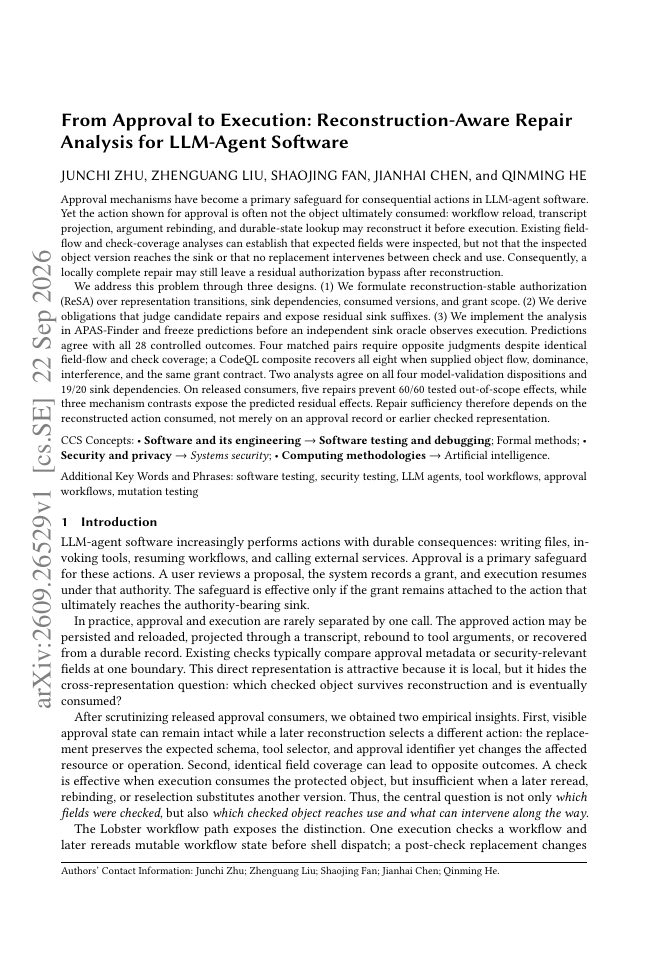
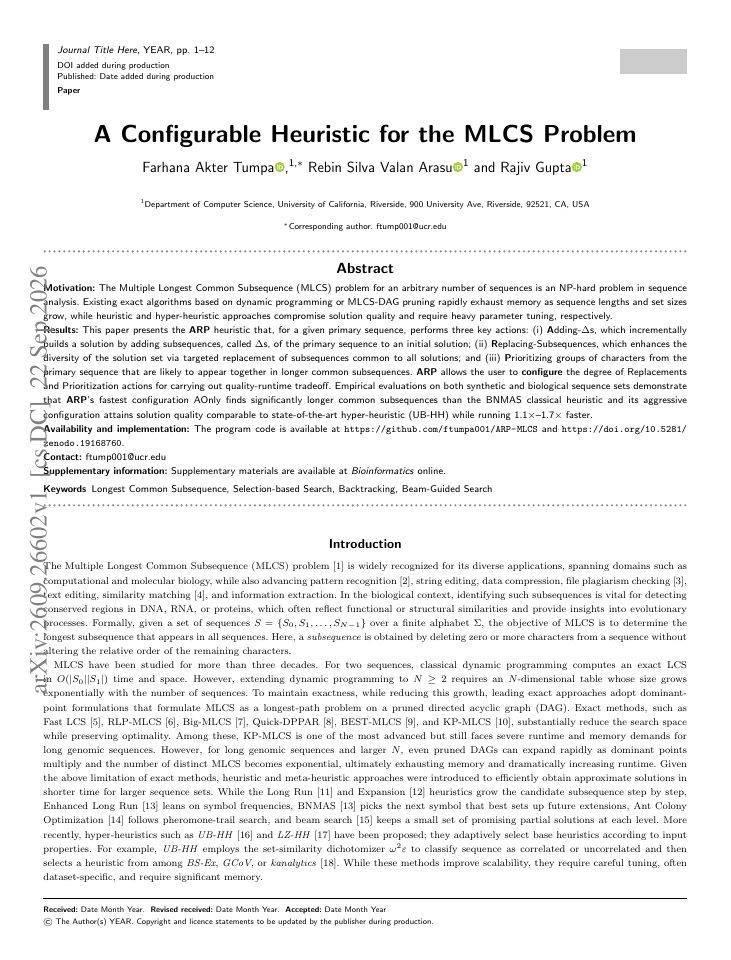
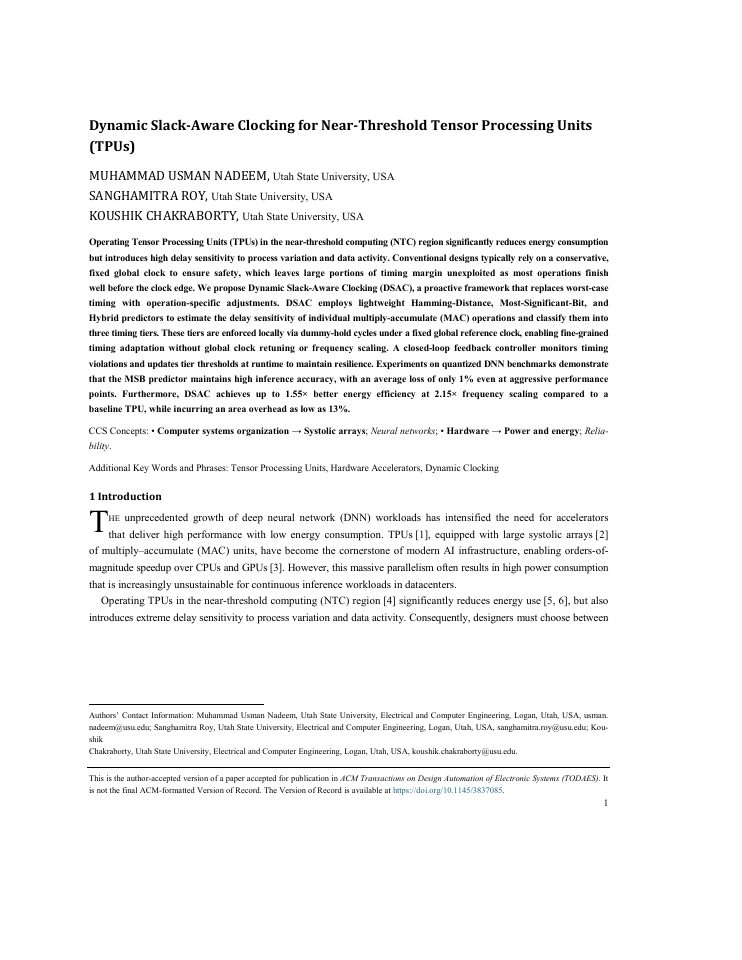
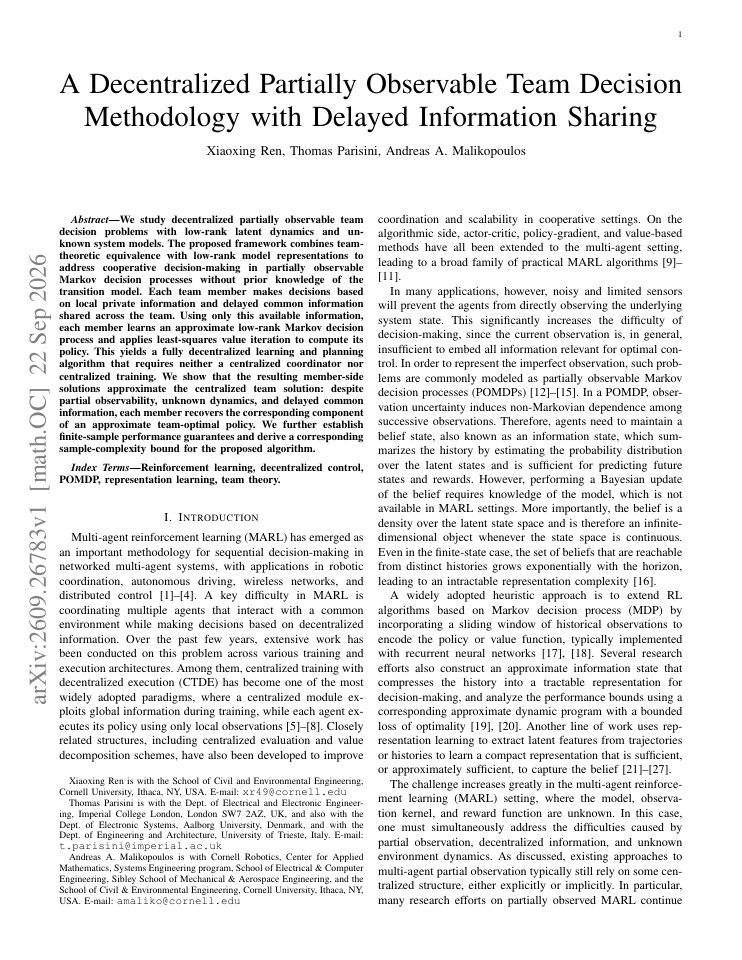
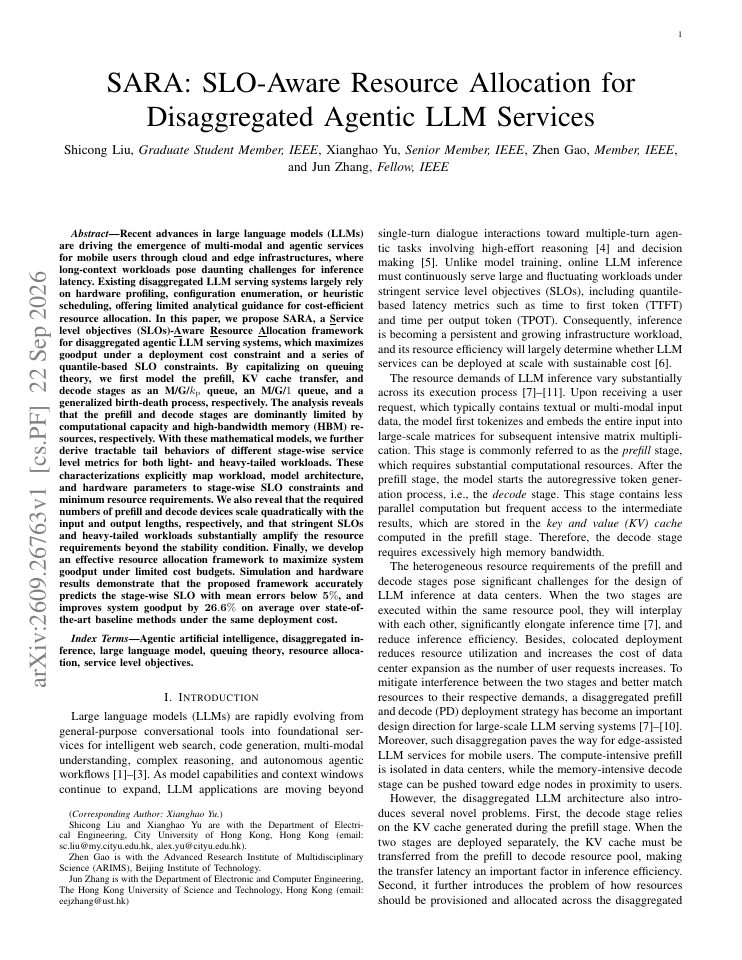
Each point represents one paper. Higher means more independent implementations; farther right means more GitHub stars.Dependency-Aware Trajectory Refinement for Efficient Multi-Turn Agent Fine-Tuning: 2 GitHub stars; 1 independent implementationM-SQE: Multilingual Skill Quality Estimation for Enhancing Language Equality in Agentic Skill Use: 1 GitHub star; 1 independent implementationPasses Alone, Fails Together: Benchmarking Semantic Coordination in Parallel LLM-Agent Development: 10 GitHub stars; 0 independent implementationsCloud, Edge, or Split? Profiling Onboard and Split Vision-Language Model Deployment for Drone AI: 0 GitHub stars; 0 independent implementationsUniversal Fractal Natural Language Decision Map: Real-Time Edge Triage Across Heterogeneous Domains: 6 GitHub stars; 4 independent implementationsMatryoshka attribution: Learning to attribute language model outputs to representations and weights: 121 GitHub stars; 0 independent implementationsCompressing Long Context into Answer-Aligned Memory Embeddings for LLM Inference: 121 GitHub stars; 0 independent implementationsAkasicMEM: Governed Enterprise Memory for Agents: 10 GitHub stars; 0 independent implementationsEvaluating Coding Agents on Kernel Exploit Generation: 14 GitHub stars; 1 independent implementationQwen3.8-Omni: Towards Native Omni-Modal Agents: 10 GitHub stars; 0 independent implementationsTesting-Driven Reliability Audit of Trajectory-Based Early Outcome Prediction for LLM Agents: Target-Specific Calibration Transfer Persists Within a Single Benchmark: 131 GitHub stars; 1 independent implementationToolcompass: Guiding Tool Trialing, Not Suppressing It: 121 GitHub stars; 0 independent implementationsHow Strongly Should Task State Influence an LLM Agent?: 131 GitHub stars; 1 independent implementationThe Tasteful Agent: Measuring and Improving Taste in Long-Horizon Tasks: 132 GitHub stars; 3 independent implementationsYou Only Need 2/3 of the Chosen Experts: An Empirical Study of Dynamic Expert Pruning in Fine-Grained MoE LLMs: 1 GitHub star; 0 independent implementationsWhen Should Dependency Updates Invoke Repair Agents? A Lightweight Routing Study: 0 GitHub stars; 0 independent implementationsWhen Does Execution Provenance Help Agent Memory Retrieval?: 10 GitHub stars; 0 independent implementationsBeyond Scalar Sensitivity: Activation-Aware Mixed-Precision LLM Quantization with Cross-Layer Refinement: 0 GitHub stars; 0 independent implementationsGoverned AI-Agent Coordination for Dementia Care: Architecture, Safety Contracts, and Evidence-Derived Workflow Verification: 10 GitHub stars; 0 independent implementationsGeoPair: Geometry-Preserving Cross-Layer Factorization for Training-Free Transformer Compression: 0 GitHub stars; 0 independent implementationsFIRE: Failure-Informed Runtime Engineering for Reliable Language-Model Agents: 10 GitHub stars; 0 independent implementationsDual-Frontier: When Can an Agent Trust Its World Model?: 345 GitHub stars; 3 independent implementationsCompKV: Compensation-Aware KV Selection for Long-Context LLM Inference: 0 GitHub stars; 0 independent implementationsDesign and Evaluation of a Controlled Post-Alert Incident Orchestration and Response Subsystem Using a Rule Engine and a Local Large Language Model: 0 GitHub stars; 0 independent implementationsDisaggregated Quantization: Specializing LLM Prefill and Decode: 0 GitHub stars; 0 independent implementationsGeometry-Aware Hyperbolic Residual Quantization: 0 GitHub stars; 0 independent implementationsPACT: From Credit Assignment to Critic Alignment: 20 GitHub stars; 0 independent implementationsHySparse2: Hybrid Sparse Attention with Two-Level KV Sharing: 122 GitHub stars; 0 independent implementationsCombining Hierarchical Cognitive Process with Process Supervision for Interpretable Scene Safety Understanding: 121 GitHub stars; 0 independent implementationsPP-Net: A Hybrid Physical-Prior Neural Network for Scattered Light Removal in Biomedical Images on Embedded Devices: 0 GitHub stars; 0 independent implementationsFrom Approval to Execution: Reconstruction-Aware Repair Analysis for LLM-Agent Software: 0 GitHub stars; 0 independent implementationsREFLEX with Jev for Efficient Selective Control in LLM Agents: 131 GitHub stars; 1 independent implementationA Configurable Heuristic for the MLCS Problem: 0 GitHub stars; 0 independent implementationsDynamic Slack-Aware Clocking for Near-Threshold Tensor Processing Units (TPUs): 0 GitHub stars; 0 independent implementationsMeasuring the Serving Stack Instead of the Model: Hidden Confounds in Local Tool-Use Evaluation: 2 GitHub stars; 2 independent implementationsTrain Where the Quantized Model Goes: On-Policy Distillation for Low-Bit Reasoning: 2 GitHub stars; 2 independent implementationsGrow the Harness, Not the Context: From Strategy-Free Scaffolds to Reusable Specialist Agents: 17 GitHub stars; 2 independent implementationsSARA: SLO-Aware Resource Allocation for Disaggregated Agentic LLM Services: 1 GitHub star; 0 independent implementationsSWE-Serve: Benchmarking Agentic Engineering For Production Inference Serving: 11 GitHub stars; 1 independent implementationAgensh: Scaling Organizational Intelligence to 1,024 Agents: 132 GitHub stars; 2 independent implementationsA Decentralized Partially Observable Team Decision Methodology with Delayed Information Sharing: 1 GitHub star; 0 independent implementationsFlash-dLLM: IO-Aware KV Caching and Parallel Decoding for Fast, Memory-Efficient Diffusion LLMs: 122 GitHub stars; 2 independent implementations

Papers above 1000 stars or 200 citations are not scored. They have already broken through the attention threshold, while Paperraft is designed to identify earlier signals.

02 · cadence

Research areas over time

Compare monthly publication volume on a shared scale and calendar.

coding agentsmax 6Sep 26: 1 paperSep 26Sep 26agent evaluationmax 6Sep 26: 5 papersSep 26Sep 26KV cachemax 6Sep 26: 3 papersSep 26Sep 26sparsity and pruningmax 6Sep 26: 2 papersSep 26Sep 26memory and contextmax 6Sep 26: 4 papersSep 26Sep 26multi-agent orchestrationmax 6Sep 26: 4 papersSep 26Sep 26othermax 6Sep 26: 6 papersSep 26Sep 26planning and decompositionmax 6Sep 26: 2 papersSep 26Sep 26quantizationmax 6Sep 26: 4 papersSep 26Sep 26failure recoverymax 6Sep 26: 2 papersSep 26Sep 26retrieval and RAGmax 6Sep 26: 1 paperSep 26Sep 26safety and guardrailsmax 6Sep 26: 3 papersSep 26Sep 26serving and batchingmax 6Sep 26: 2 papersSep 26Sep 26efficient trainingmax 6Sep 26: 2 papersSep 26Sep 26tool usemax 6Sep 26: 1 paperSep 26Sep 26

Every panel uses the same calendar and vertical scale. An empty column means no papers were recorded.

Method under scrutiny

Inspect the highest-ranked paper, every repository behind its signal, and the rule used to classify each one.

Universal Fractal Natural Language Decision Map: Real-Time Edge Triage Across Heterogeneous Domains

other · watch · 4 of 4 implementations are independent · 2.5x gain in speed (reported by the authors; not independently verified)

The method replaces small LLM or classifier-based runtime triage (Boolean, categorical, ordinal decisions) with a deterministic engine that maps 24-byte coordinate seeds through Mandelbrot-set escape dynamics, requiring no stored weights and running on CPUs or microcontrollers. Cost is near-zero memory and single-digit-millisecond CPU latency, but adoption requires trusting a proprietary hosted runtime (answerr.me) and a non-standard decision mechanism with no published training or validation methodology. Failure risks are substantial: the accuracy, robustness, and benchmark claims are self-reported on an unverified suite, the prompt-injection claim carries a Wilson interval up to 30.8% (tiny sample), and there is no established theory linking fractal escape dynamics to generalizable language understanding, so accuracy on the reader's own domain is unpredictable.
Exclusions and controls

Every exclusion is counted and published.
Exclusion counts were not recorded for this edition.

0 previously indexed papers were rechecked in this run.

Paperraft tracks one signal: how many independent implementations a paper attracts on GitHub after author-owned repositories are removed. This is a discovery signal to investigate, not a measure of implementation quality.

It does not claim that a method works. Paperraft runs no reproduction benchmarks. Reported gains remain author claims until independently tested. Papers above the attention threshold are excluded because this publication is designed to identify research before consensus forms.