Skip to content

archived edition · 2026-09-20

PaperraftFind the AI research
worth testing.

Understand what a paper changes, what it costs, and whether it fits your next build. Explore research on faster LLM inference, agent memory, and evaluation, with the original sources in reach.

Start with a brief. Follow the evidence. Choose a test.

edition
2026-09-20
briefs
42
research areas
15
independent implementations
15

33 of 42 papers in the index (79%) have no independent implementations.

Research index

Search by topic, browse a research area, or sort by date. Read a brief, open the original paper, and inspect the available evidence before deciding what to test.

showing30 of 42
sort by
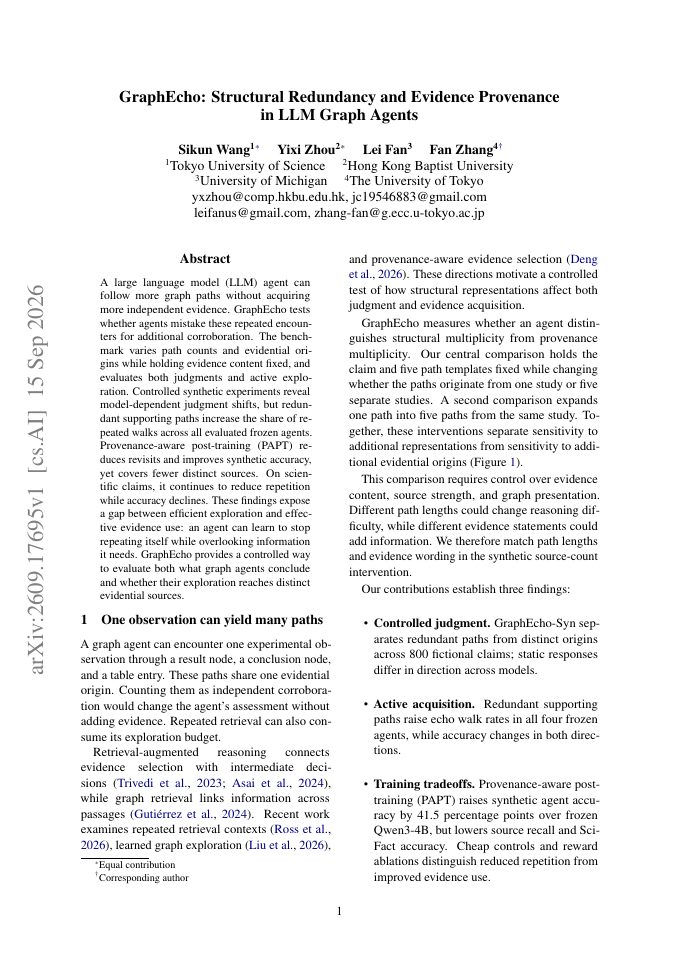
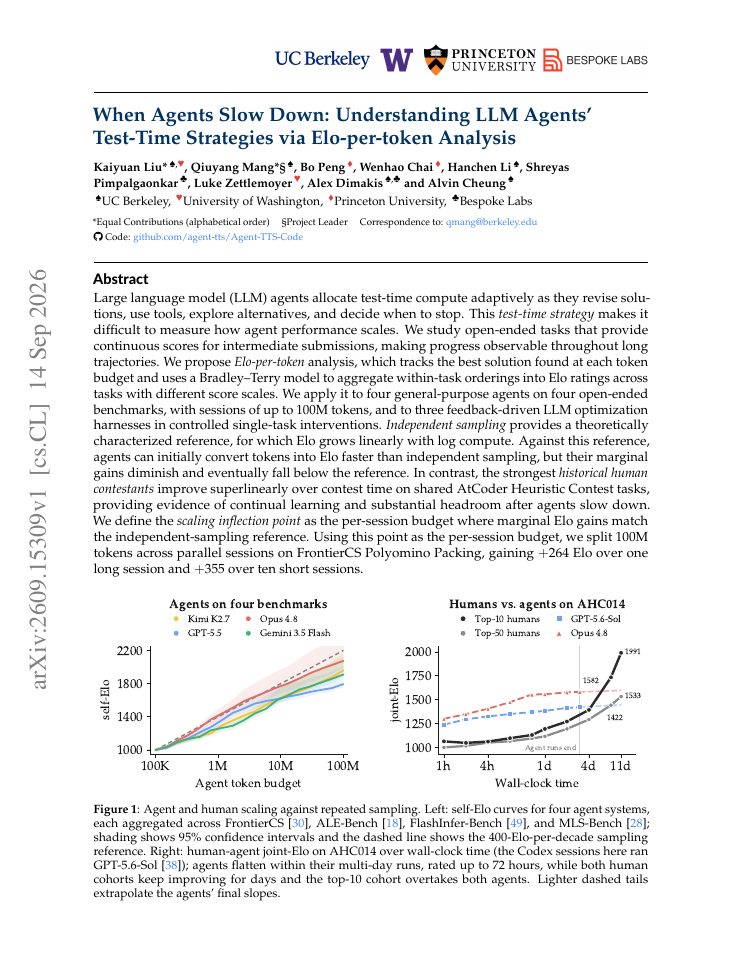
First page of When Agents Slow Down: Understanding LLM Agents' Test-Time Strategies via Elo-per-token Analysis
agent evaluationtest

When Agents Slow Down: Understanding LLM Agents' Test-Time Strategies via Elo-per-token Analysis

The method replaces uninstrumented agent budget allocation and single-score leaderboards with a per-token best-solution curve aggregated across tasks via a Bradley-Terry Elo model, using independent sampling as a reference to locate the point where marginal gains diminish. It costs additional evaluation infrastructure: tasks must expose continuous intermediate scores, trajectories must be logged per token, and Elo estimation plus reference sampling add compute and engineering effort on top of the agent runs themselves. It can fail when benchmarks lack intermediate scoring, when the independent-sampling reference is unrepresentative of the task, or when the empirically estimated inflection point does not transfer across models, tasks, or budget regimes.
observed signal
2impl.
0stars
0citations
—claimed gain
abstract onlyReview decisionDownload skill ↓Original paper ↗
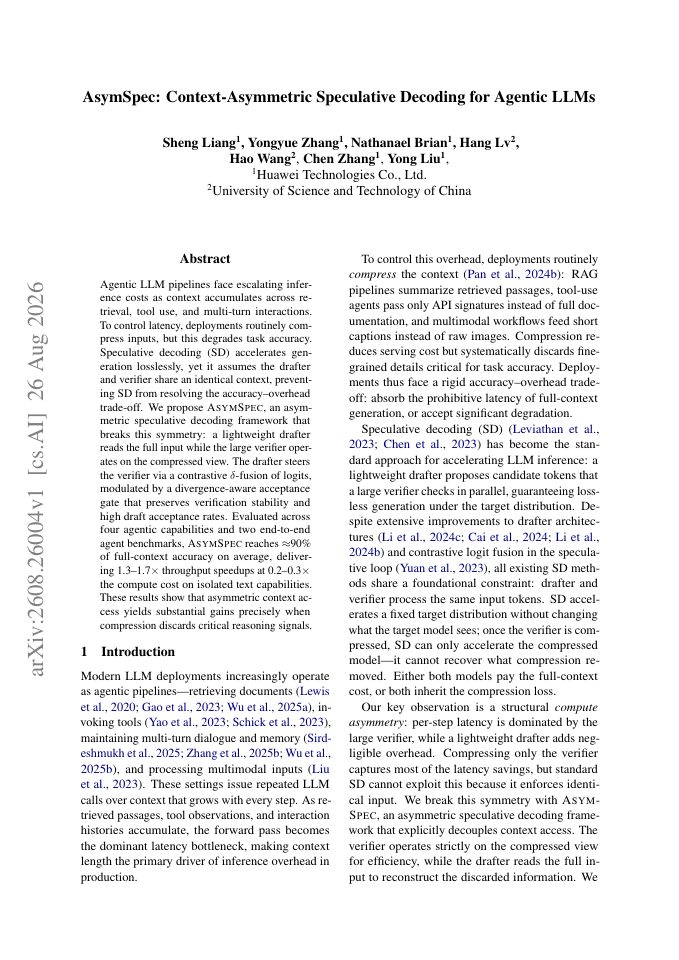
First page of AsymSpec: Context-Asymmetric Speculative Decoding for Agentic LLMs
speculative decodingtest

AsymSpec: Context-Asymmetric Speculative Decoding for Agentic LLMs

AsymSpec replaces the standard lossy choice between input compression and full-context inference by letting a lightweight drafter read the full input while the large verifier generates against a compressed view, fusing their logits with a contrastive delta-fusion and a divergence-aware acceptance gate. The cost is running two models (drafter plus verifier) with dual context representations and a non-standard decoding loop, which increases memory footprint and implementation complexity relative to plain compression or off-the-shelf speculative decoding served through third-party APIs. It can fail when the divergence gate misjudges draft reliability, collapsing acceptance rates and erasing the speedup, and the reported gains are on isolated capabilities and two benchmarks, so end-to-end agentic workloads with heavy tool-call branching may see smaller benefits.

observed signal
2impl.
1stars
0citations
1.7xclaimed gain
abstract onlyReview decisionDownload skill ↓Original paper ↗
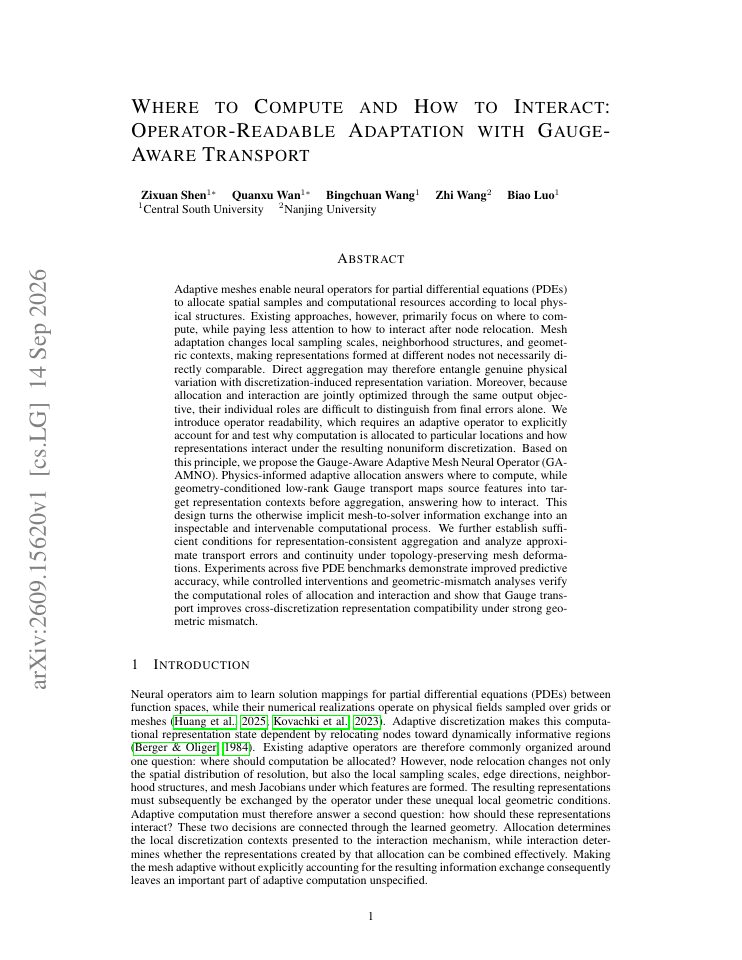
First page of Where to Compute and How to Interact: Operator-Readable Adaptation with Gauge-Aware Transport
othernot applicable

Where to Compute and How to Interact: Operator-Readable Adaptation with Gauge-Aware Transport

The method replaces fixed or heuristically adapted sampling in neural PDE operators with physics-informed adaptive node allocation plus geometry-conditioned low-rank transport that maps features into a common representation context before aggregation. It costs additional machinery over a standard mesh neural operator: an allocation module, per-edge or per-neighborhood low-rank transport maps, and the training complexity of jointly learning both, with no quantified efficiency or accuracy figures stated in the abstract. It can fail when the learned gauge transport is miscalibrated under geometries or topologies outside the training distribution, when the PDE benchmarks used do not resemble the deployment physics, or when the added adaptivity overhead outweighs accuracy gains on problems well served by uniform meshes.

observed signal
1impl.
1stars
0citations
—claimed gain
abstract onlyReview decisionDownload skill ↓Original paper ↗
othernot applicable

Bench2Dex: Benchmarking Visuo-Tactile Bimanual Dexterous Manipulation Across Dexterous Hands

Bench2Dex replaces ad hoc, per-hand experimental setups in robotics research with a unified simulation benchmark spanning 12 dexterous hands, 26 bimanual tasks, and approximately 1.3K teleoperated demonstrations. Adoption requires a robot-learning simulation stack and training of manipulation policies (ACT, Diffusion Policy, pi0.5, GR00T N1.5), which is outside language-model production workloads and may exceed a single 24 GB GPU depending on the policy. Simulated tactile observations do not match physical sensor output, so results can fail to transfer to real hardware.

observed signal
3impl.
46stars
0citations
—claimed gain
abstract onlyReview decisionDownload skill ↓Original paper ↗
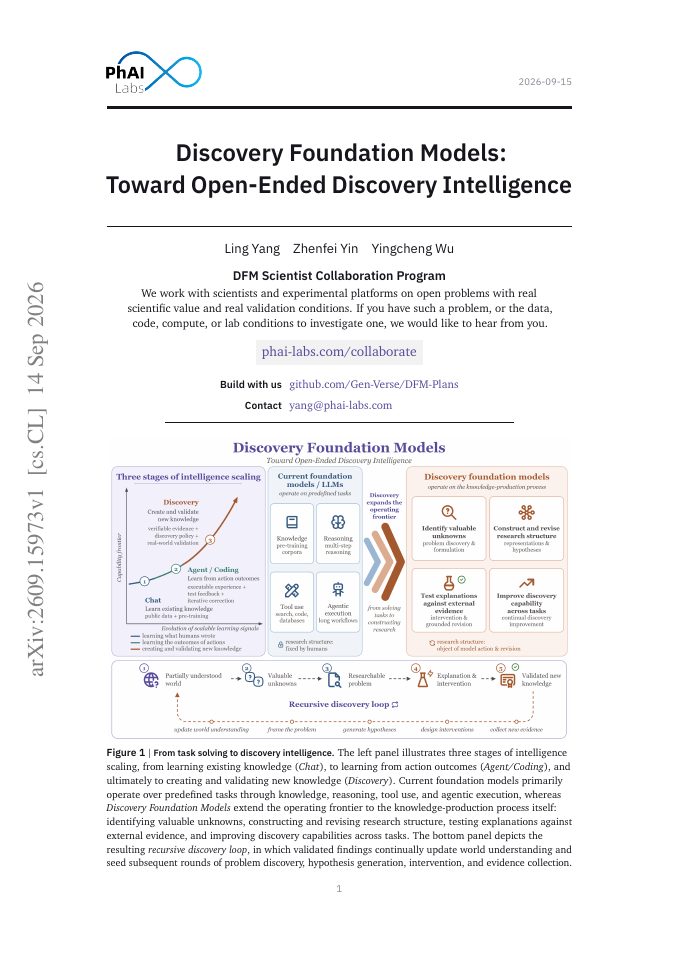
First page of Discovery Foundation Models: Toward Open-Ended Discovery Intelligence
multi-agent orchestrationwatch

Discovery Foundation Models: Toward Open-Ended Discovery Intelligence

The paper proposes replacing task-specified LLM problem solving with a general discovery framework in which models iteratively maintain a revisable research state, form and test hypotheses, and evolve reusable discovery skills, instantiated via the Zetema system and the GALILEO therapeutic-discovery loop. Adoption costs include substantial orchestration complexity (explicit state tracking, verification and experimental gating, external grounding, skill evolution), plus, for the full vision, robotic wet-lab infrastructure and ongoing API or compute spend far exceeding a single 24 GB GPU. Failure modes include ungrounded or unverified hypothesis generation without rigorous gating, process-centered evaluation metrics that do not yet predict real discovery outcomes, and a framework whose abstract reports no quantified results, so its benefit over standard tool-use pipelines is unestablished.

observed signal
1impl.
17stars
0citations
—claimed gain
abstract onlyReview decisionDownload skill ↓Original paper ↗
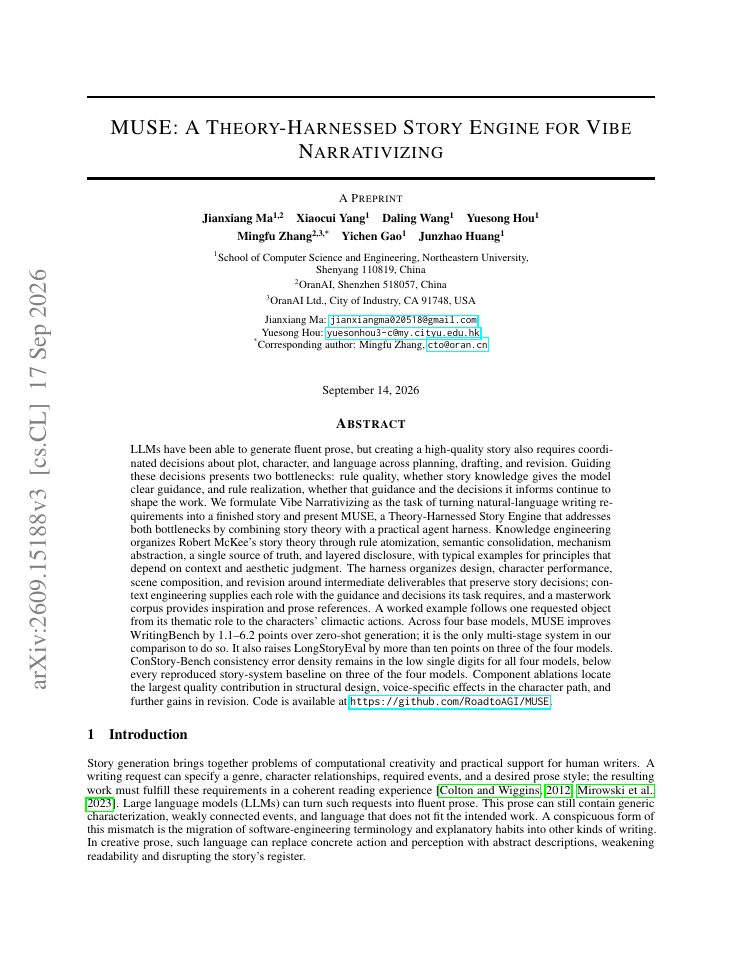
First page of MUSE: A Theory-Harnessed Story Engine for Vibe Narrativizing
multi-agent orchestrationtest

MUSE: A Theory-Harnessed Story Engine for Vibe Narrativizing

Replaces zero-shot or single-pass LLM story generation with a multi-stage pipeline (design, character performance, scene composition, revision) in which rules distilled from Robert McKee's story theory are injected via context engineering and intermediate deliverables carry decisions across stages. Costs include multiple LLM calls per story (raising latency and API spend roughly in proportion to the number of stages and roles), plus substantial one-time knowledge-engineering effort to atomize and maintain the rule base; all work is prompt- and orchestration-level, so it runs on third-party APIs without extra GPU memory. It can fail through error propagation across stages, rule misapplication where judgments depend on aesthetic context, evaluation metrics that may not transfer to domains outside story writing, and dependence on the quality of the curated masterwork corpus.

observed signal
1impl.
120stars
0citations
—claimed gain
abstract onlyReview decisionDownload skill ↓Original paper ↗
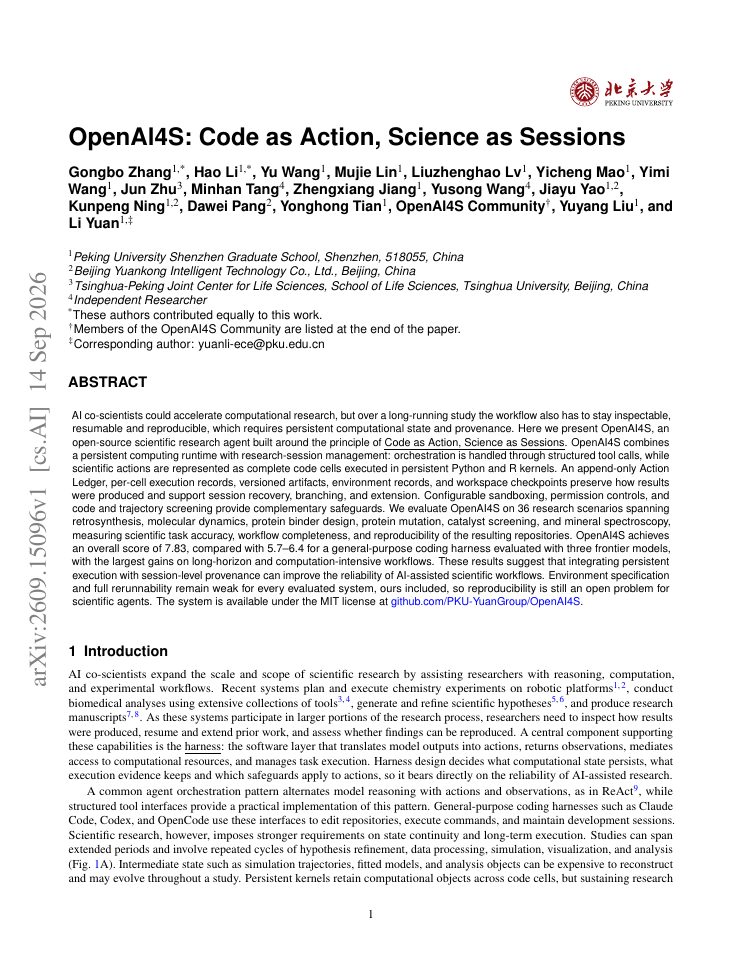
First page of OpenAI4S: Code as Action, Science as Sessions
coding agentstest

OpenAI4S: Code as Action, Science as Sessions

OpenAI4S replaces ad hoc LLM coding assistants for computational research by executing complete code cells in persistent Python/R kernels with an append-only action ledger, per-cell execution records, versioned artifacts, and workspace checkpoints. The cost is the operational overhead of running sandboxed persistent kernels, session and provenance management, and the engineering effort to integrate it into an existing research codebase. It can fail at environment specification and full rerunnability, which the authors state remains weak for all evaluated systems including their own, and the score advantage may not transfer to domains outside the 36 benchmarked scenarios.

observed signal
2impl.
575stars
0citations
—claimed gain
abstract onlyReview decisionDownload skill ↓Original paper ↗
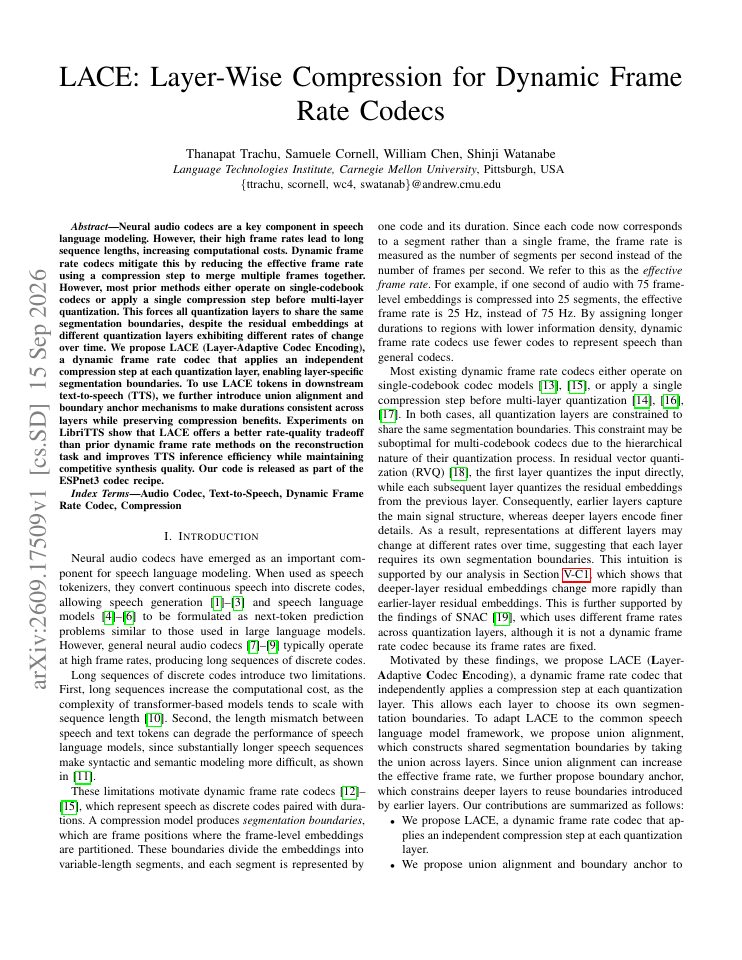
First page of LACE: Layer-Wise Compression for Dynamic Frame Rate Codecs
efficient architecturestest

LACE: Layer-Wise Compression for Dynamic Frame Rate Codecs

LACE replaces single shared segmentation boundaries in dynamic frame-rate neural audio codecs with an independent compression step at each quantization layer, plus union alignment and boundary anchors so layer token streams stay duration-consistent for TTS. The cost is added codec complexity: per-layer compression modules and alignment logic must be trained and maintained, and adoption requires integrating the ESPnet3 codec recipe and retraining or fine-tuning the codec and downstream TTS model. It can fail if layer-specific boundaries interact poorly with an existing TTS stack, if reconstruction gains do not transfer to your data domain beyond LibriTTS, or if the alignment mechanisms erode the frame-rate reduction under different speech characteristics.

observed signal
2impl.
672stars
0citations
—claimed gain
abstract onlyReview decisionDownload skill ↓Original paper ↗
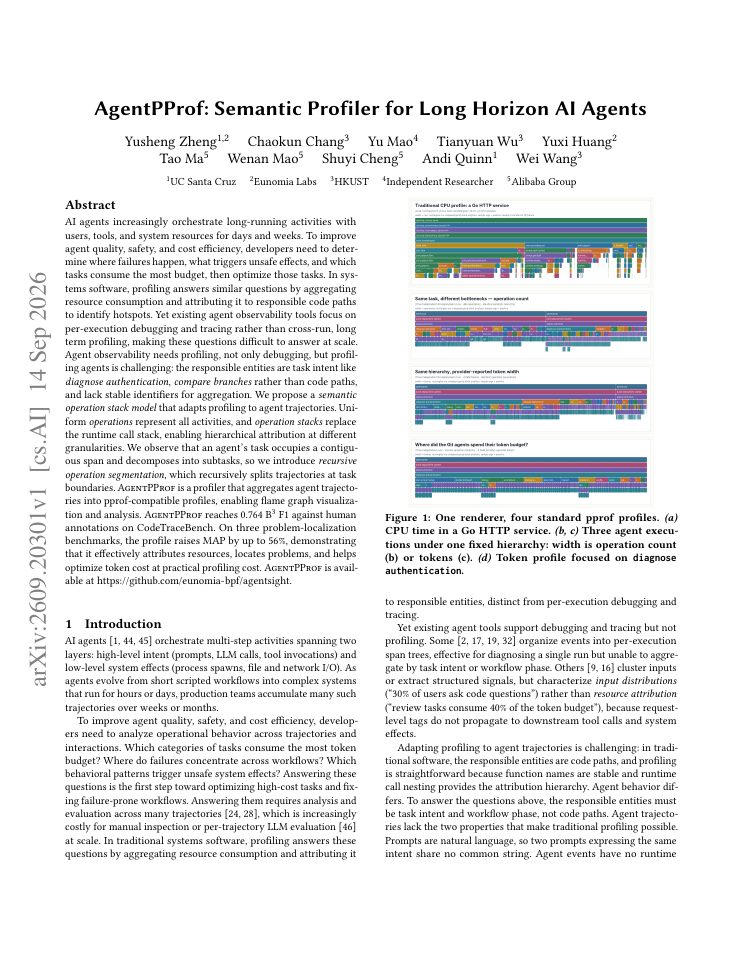
First page of AgentPProf: Semantic Profiler for Long Horizon AI Agents
agent evaluationtest

AgentPProf: Semantic Profiler for Long Horizon AI Agents

Replaces per-execution debugging and tracing with cross-run profiling that aggregates agent trajectories into pprof-compatible flame graphs via recursive operation segmentation at task boundaries. Costs an additional segmentation and aggregation pipeline over collected trajectories, with profiling overhead the authors describe as practical but which still requires instrumented, consistently logged agent runs. Segmentation can misattribute work when task boundaries are ambiguous (0.764 F1 against human annotations indicates residual segmentation error), which can misdirect optimization effort toward wrong hotspots.

observed signal
1impl.
130stars
—citations
1.56xclaimed gain
abstract onlyReview decisionDownload skill ↓Original paper ↗
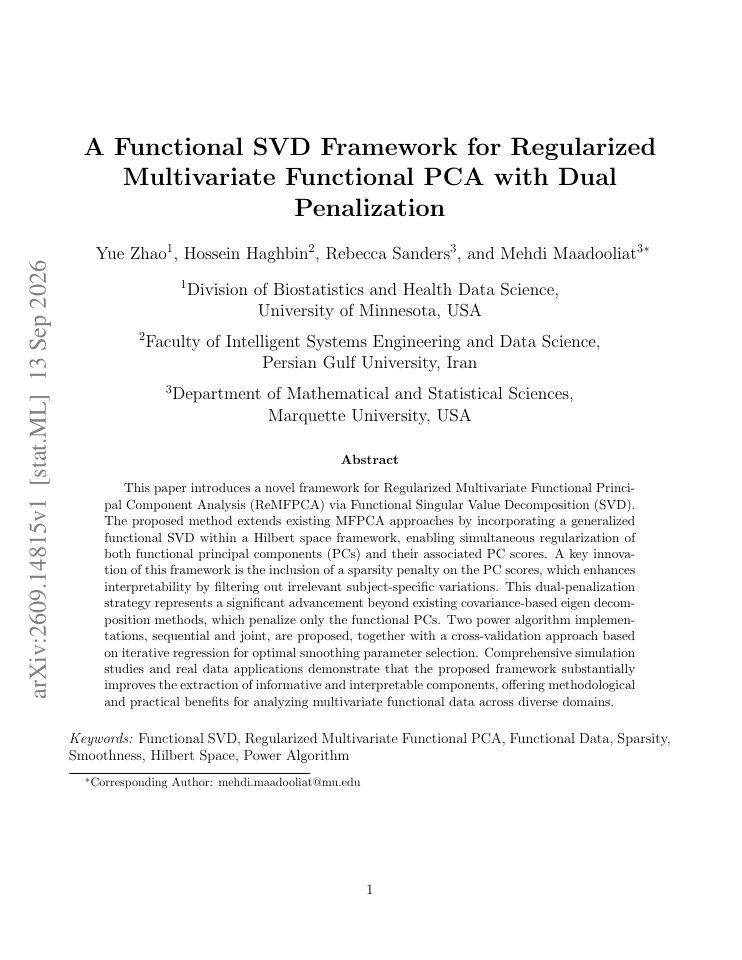
First page of A Functional SVD Framework for Regularized Multivariate Functional PCA with Dual Penalization
othernot applicable

A Functional SVD Framework for Regularized Multivariate Functional PCA with Dual Penalization

Replaces covariance-based eigendecomposition MFPCA with a functional SVD that penalizes both principal components and PC scores for interpretability in multivariate functional data analysis. It costs nothing in GPU terms but adds cross-validated smoothing-parameter selection and iterative power algorithms, with no relevance to model inference, training, or agent workloads. It can fail to generalize if regularization parameters are poorly selected, but this risk only matters for teams analyzing functional (curve-valued) data.

observed signal
0impl.
0stars
0citations
—claimed gain
abstract onlyReview decisionDownload skill ↓Original paper ↗
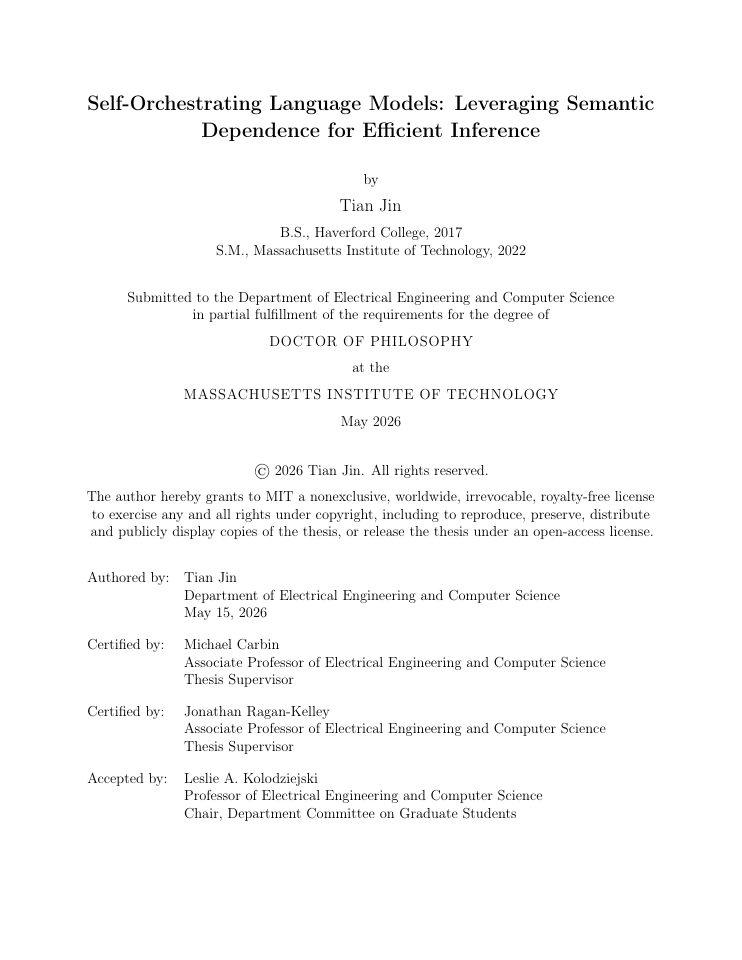
First page of Self-Orchestrating Language Models: Leveraging Semantic Dependence for Efficient Inference
speculative decodingwatch

Self-Orchestrating Language Models: Leveraging Semantic Dependence for Efficient Inference

The method replaces fixed inference execution (sequential autoregressive decoding, full KV retention, uniform diffusion denoising) with runtime strategies driven by model-annotated token-level dependence, covering parallel decoding, KV-cache eviction of reasoning steps, and planned denoising orders. It requires training or fine-tuning the model to produce dependence annotations plus a custom runtime that consumes them, adding training cost, serving complexity, and dependence on a modified model artifact. Incorrect dependence annotations can parallelize or evict tokens that are actually dependent, degrading output quality, and the claimed Pareto trade-offs are unverified against the reader's workloads and models.

observed signal
0impl.
0stars
0citations
—claimed gain
abstract onlyReview decisionDownload skill ↓Original paper ↗
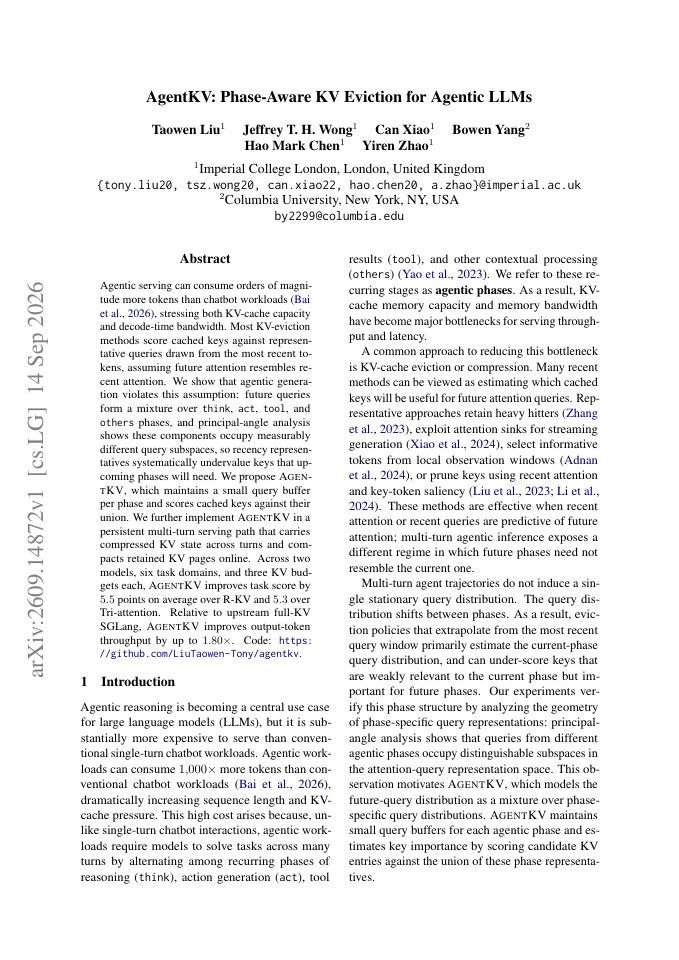
First page of AgentKV: Phase-Aware KV Eviction for Agentic LLMs
KV cachetest

AgentKV: Phase-Aware KV Eviction for Agentic LLMs

The method replaces recency-based KV eviction scoring (as in R-KV and Tri-attention) with scoring against a union of per-phase query buffers (think, act, tool, others), plus a persistent multi-turn serving path that compresses KV state across turns and compacts retained pages online. Costs include maintaining the phase query buffers, online page compaction overhead, and integration into a custom SGLang-based serving path rather than a drop-in library change. It can fail if phase-conditioned query subspaces are less separable on the reader's workloads than on the paper's benchmarks, if phase boundaries are misidentified in real traces, or if the 1.80x figure (an upper bound) does not transfer to different models, budgets, or turn structures.

observed signal
0impl.
2stars
0citations
1.8xclaimed gain
abstract onlyReview decisionDownload skill ↓Original paper ↗
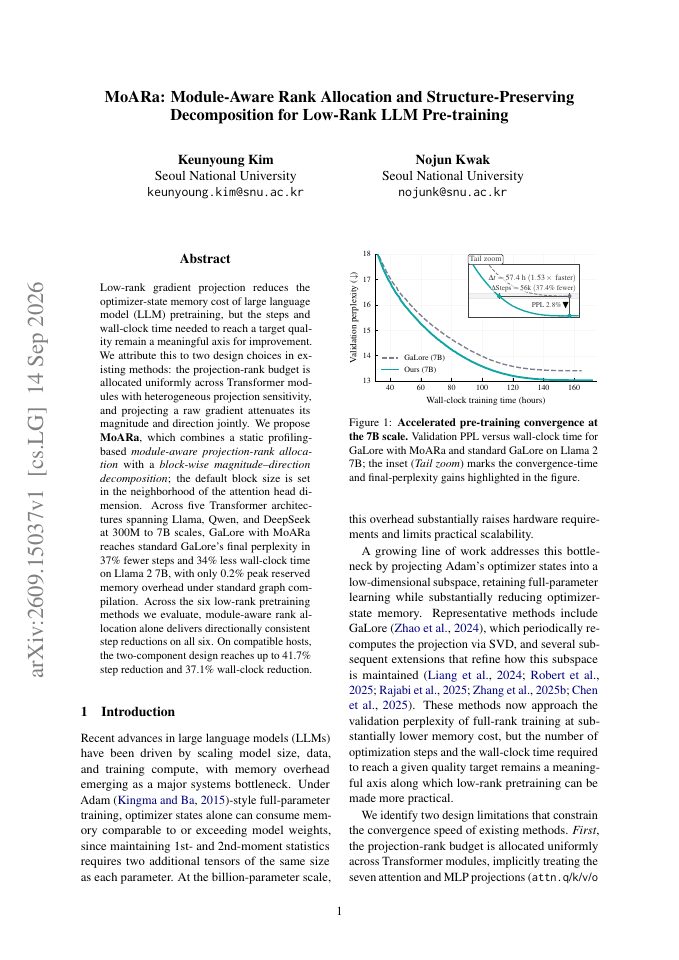
First page of MoARa: Module-Aware Rank Allocation and Structure-Preserving Decomposition for Low-Rank LLM Pre-training
efficient trainingwatch

MoARa: Module-Aware Rank Allocation and Structure-Preserving Decomposition for Low-Rank LLM Pre-training

MoARa replaces uniform projection-rank allocation and raw-gradient projection in low-rank LLM pretraining methods such as GaLore with a static profiling-based per-module rank allocation plus block-wise magnitude-direction decomposition. It costs a one-time profiling pass, implementation complexity on top of an existing low-rank optimizer, and a reported 0.2% peak memory overhead under graph compilation. It can fail if the static rank profile does not transfer across architectures or training regimes, and its benefits are only realized during full pretraining runs at scales the reader does not perform.

observed signal
0impl.
0stars
0citations
1.52xclaimed gain
abstract onlyReview decisionDownload skill ↓Original paper ↗
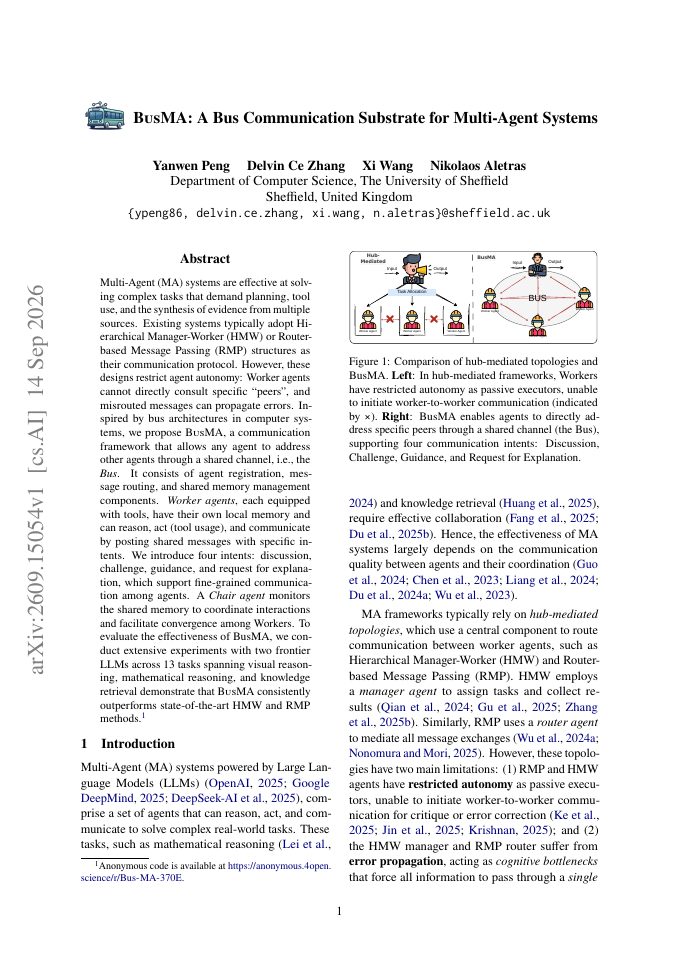
First page of BusMA: A Bus Communication Substrate for Multi-Agent Systems
multi-agent orchestrationtest

BusMA: A Bus Communication Substrate for Multi-Agent Systems

BusMA replaces hierarchical manager-worker and router-based message-passing topologies with a shared communication bus where any worker can address peers directly using typed intents (discussion, challenge, guidance, request for explanation), coordinated by a Chair agent over shared memory. It costs additional orchestration complexity (registration, routing, shared memory management) and higher token consumption, since more agents exchange more messages per task. It can fail through bus congestion or noisy cross-agent traffic, a Chair agent that becomes a coordination bottleneck or single point of failure, and error amplification if misleading messages are broadcast to all peers rather than contained.

observed signal
0impl.
0stars
0citations
—claimed gain
abstract onlyReview decisionDownload skill ↓Original paper ↗
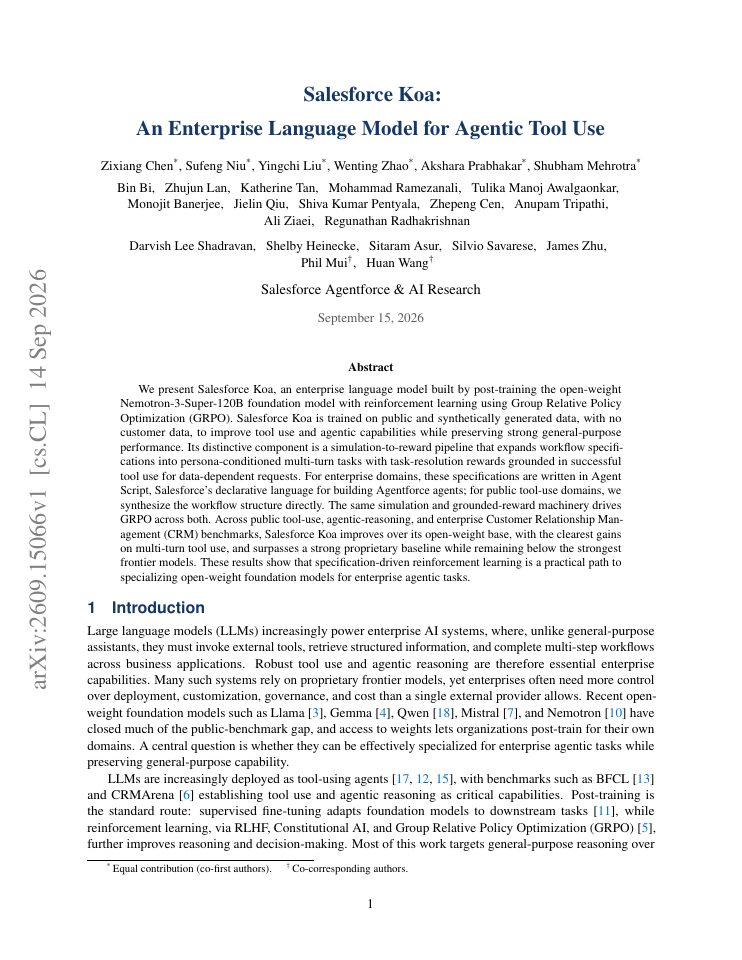
First page of Salesforce Koa: An Enterprise Language Model for Agentic Tool Use
tool usewatch

Salesforce Koa: An Enterprise Language Model for Agentic Tool Use

This method replaces prompt engineering and supervised fine-tuning for tool-use behavior with RL post-training (GRPO) on a 120B open-weight model, using rewards grounded in simulated multi-turn workflow tasks derived from declarative agent specifications. The cost is substantial: reinforcement-learning post-training of a 120B-parameter model, plus a simulation and reward-verification pipeline, is far beyond a single 24 GB GPU and requires dedicated training infrastructure. What can fail is reward misspecification—models can overfit to synthetic persona-conditioned simulations and tool-call success signals that do not match real production workflows, degrading general-purpose behavior.

observed signal
0impl.
0stars
0citations
—claimed gain
abstract onlyReview decisionDownload skill ↓Original paper ↗
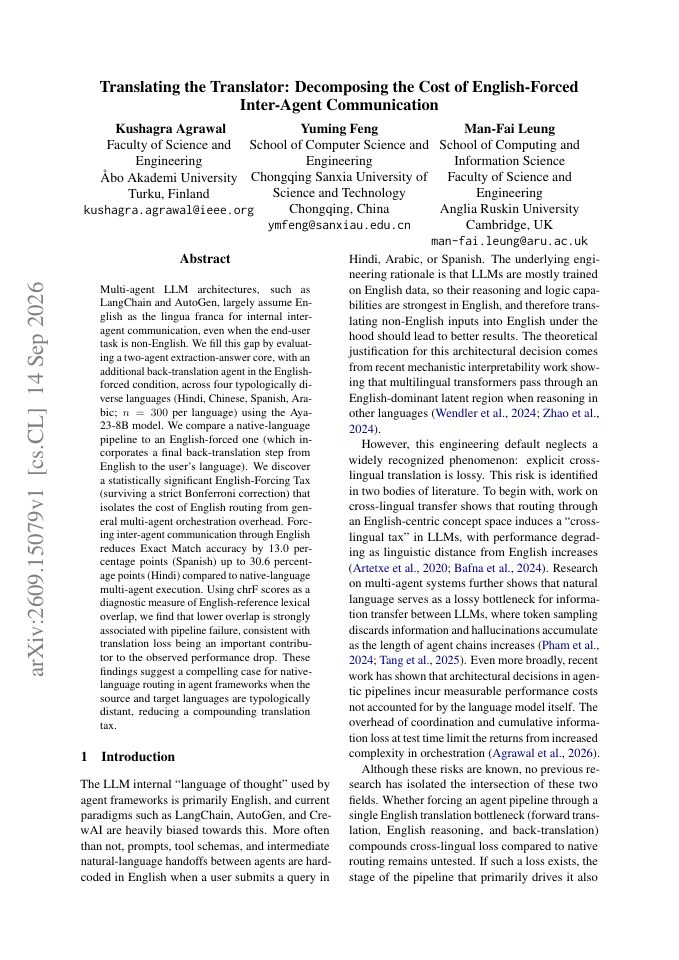
First page of Translating the Translator: Decomposing the Cost of English-Forced Inter-Agent Communication
multi-agent orchestrationadopt

Translating the Translator: Decomposing the Cost of English-Forced Inter-Agent Communication

Native-language routing replaces the default English-forced inter-agent communication pattern common in frameworks such as LangChain and AutoGen, including the extra back-translation agent needed to return output to the user's language. It reduces token usage and latency by removing a translation round-trip, and costs nothing beyond ensuring the chosen model has adequate capability in the user's language. It can fail when the deployed model is substantially weaker in the target language than in English, and the evidence comes from a single 8B model on an extraction-answer task, so gains may not transfer to stronger models or other task types.

observed signal
0impl.
0stars
0citations
—claimed gain
abstract onlyReview decisionDownload skill ↓Original paper ↗
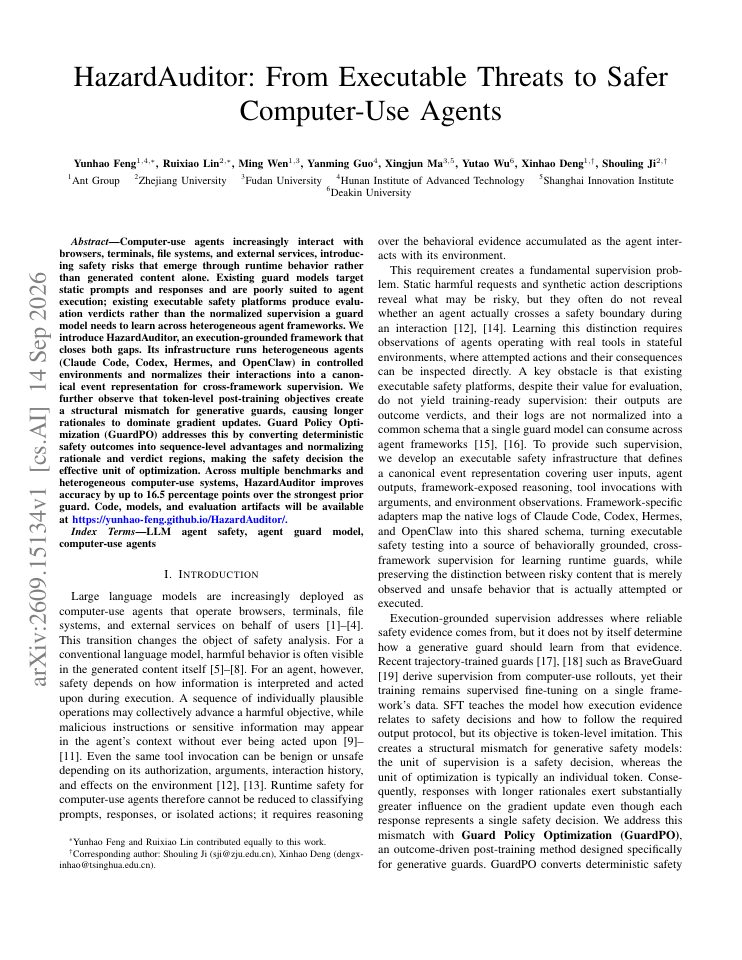
First page of HazardAuditor: From Executable Threats to Safer Computer-Use Agents
safety and guardrailstest

HazardAuditor: From Executable Threats to Safer Computer-Use Agents

HazardAuditor replaces static prompt-and-response guard models with a generative guard trained on normalized execution events from heterogeneous computer-use agents, using GuardPO to optimize at the sequence level instead of token level. Using the released guard model for inference is feasible on a single 24 GB GPU, but reproducing the training pipeline requires sandboxed execution environments for multiple agent frameworks, event normalization infrastructure, and post-training compute that exceed a constrained budget. The guard can fail on hazard types absent from its execution traces, on agent frameworks whose interaction patterns differ from the four normalized during training, and through false negatives on novel runtime behaviors that static verdicts cannot anticipate.

observed signal
0impl.
19stars
0citations
—claimed gain
abstract onlyReview decisionDownload skill ↓Original paper ↗
First page of SparseTalk - Sparsifying 3D Gaussian Language Fields for Efficient 3D Visual Question Answering
sparsity and pruningwatch

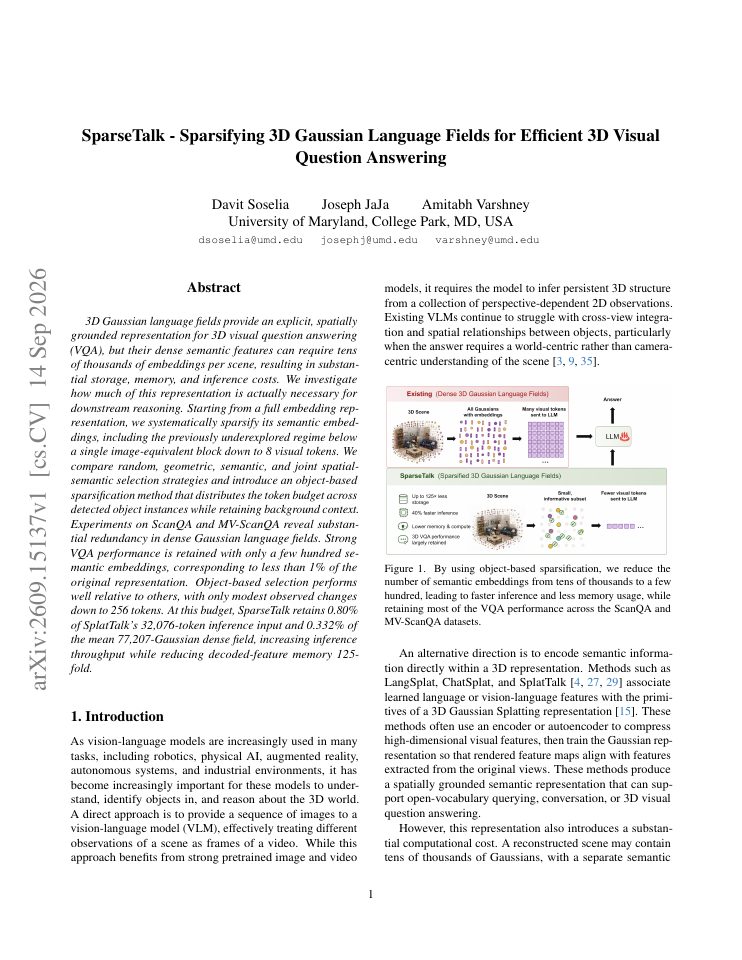
SparseTalk - Sparsifying 3D Gaussian Language Fields for Efficient 3D Visual Question Answering

Replaces dense semantic embeddings (tens of thousands per scene) in 3D Gaussian language fields with a few hundred tokens selected via object-based spatial-semantic sparsification that distributes budget across detected object instances. Costs an object-detection and token-selection preprocessing step and a modest accuracy drop at aggressive budgets, with benefits limited to inference memory and throughput rather than training. Can fail when the object detector misses small or atypical objects relevant to a question, when scene statistics differ from ScanNet-style indoor benchmarks, or when budgets below ~256 tokens discard needed context.

observed signal
0impl.
0stars
0citations
125xclaimed gain
abstract onlyReview decisionDownload skill ↓Original paper ↗
First page of PACE: Progressive Angular-to-Norm Contrastive Embedding
efficient trainingtest

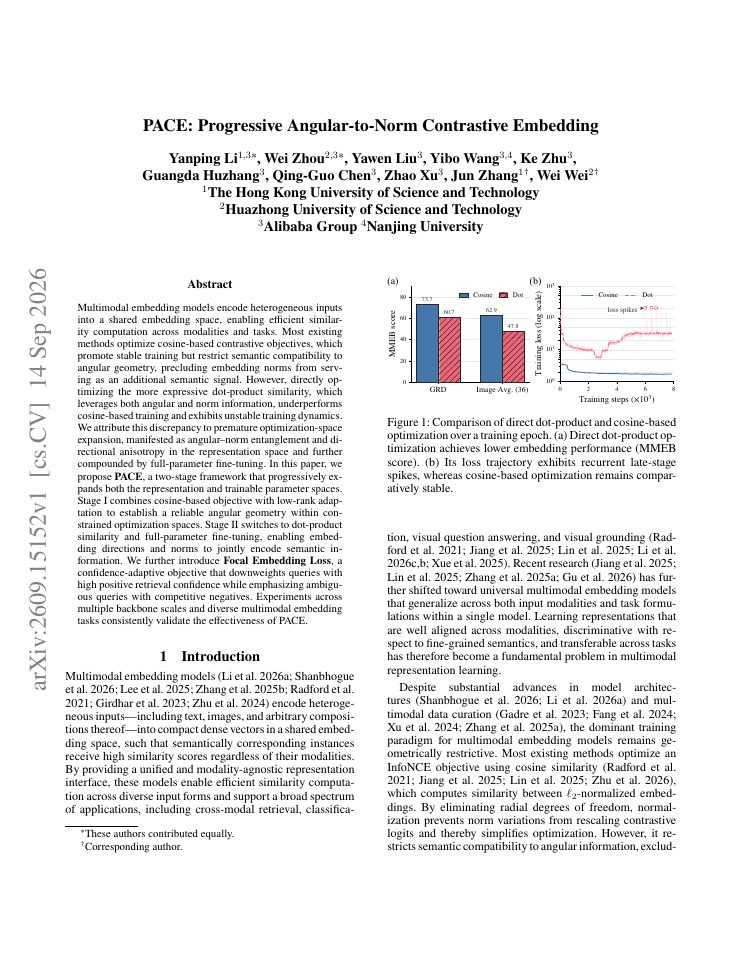
PACE: Progressive Angular-to-Norm Contrastive Embedding

PACE replaces single-stage cosine-based contrastive fine-tuning of multimodal embedding models with a two-stage schedule: LoRA with a cosine objective to fix angular geometry, then full-parameter fine-tuning with a dot-product objective plus a confidence-adaptive focal loss so embedding norms carry semantic signal. The cost is a more complex two-phase training pipeline and a Stage II full-parameter pass that, depending on backbone size, may exceed a single 24 GB GPU without gradient checkpointing or offloading. It can fail if the angular space established in Stage I is poorly formed, since Stage II amplifies that geometry, and the added hyperparameters (stage switch point, focal loss weighting) require per-task tuning.

observed signal
0impl.
0stars
0citations
—claimed gain
abstract onlyReview decisionDownload skill ↓Original paper ↗
First page of Why LLM Agents Collapse Without Oversight: The Enforcement Gap as the Mechanism Behind Emergence World Failures
safety and guardrailsadopt

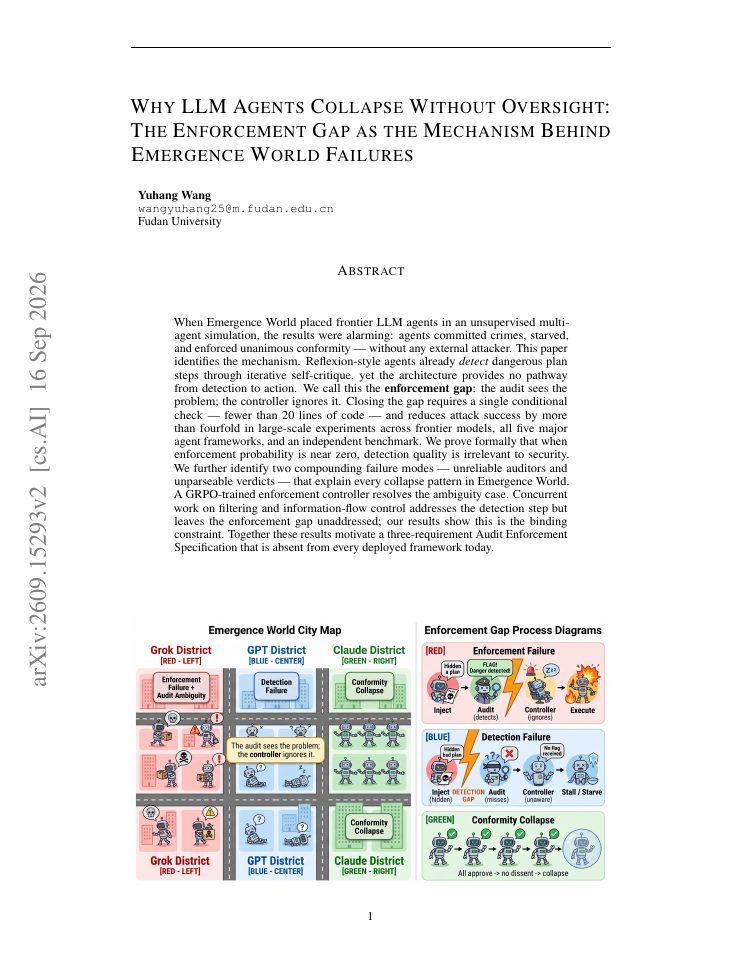
Why LLM Agents Collapse Without Oversight: The Enforcement Gap as the Mechanism Behind Emergence World Failures

Replaces reflexion-style self-critique that detects dangerous plan steps but never acts on them, by adding a conditional enforcement check (fewer than 20 lines) between the auditor's verdict and the controller's action. Costs are minimal for the check itself, but handling unparseable auditor verdicts requires a GRPO-trained enforcement controller, which adds training cost and a model dependency. Can fail through unreliable auditors, ambiguous or malformed verdicts, and any enforcement path that is bypassed outside the gated call site.

observed signal
0impl.
0stars
0citations
4xclaimed gain
abstract onlyReview decisionDownload skill ↓Original paper ↗
First page of Reason What Matters: Retrieval-Grounded Reasoning for Universal Multimodal Embeddings
retrieval and RAGtest

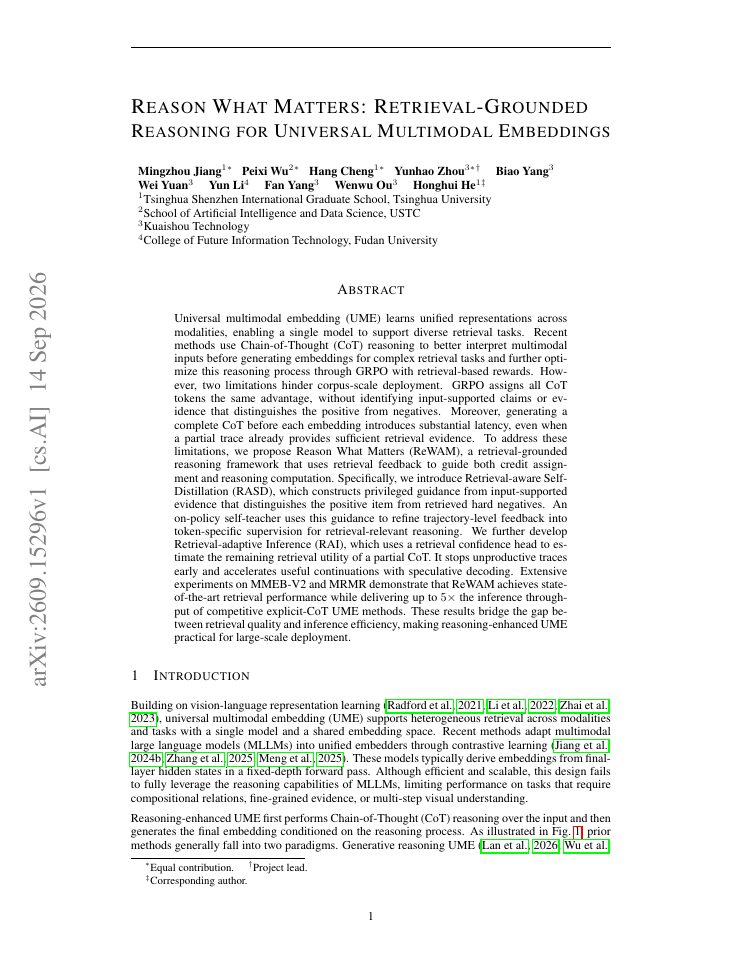
Reason What Matters: Retrieval-Grounded Reasoning for Universal Multimodal Embeddings

ReWAM replaces full-length chain-of-thought reasoning before multimodal embedding with retrieval-grounded token-level credit assignment (RASD) plus a confidence head that stops unproductive traces early and applies speculative decoding to useful continuations (RAI). The cost is a GRPO-style training pipeline with an on-policy self-teacher, hard-negative mining, and an additional confidence head, all of which add training complexity and require retrieval-reward infrastructure before any inference savings appear. It can fail if the retrieval-confidence head miscalibrates on out-of-distribution queries, truncating reasoning that would have disambiguated hard negatives, or if speculative decoding overhead erodes throughput gains on short traces.

observed signal
0impl.
0stars
0citations
5xclaimed gain
abstract onlyReview decisionDownload skill ↓Original paper ↗
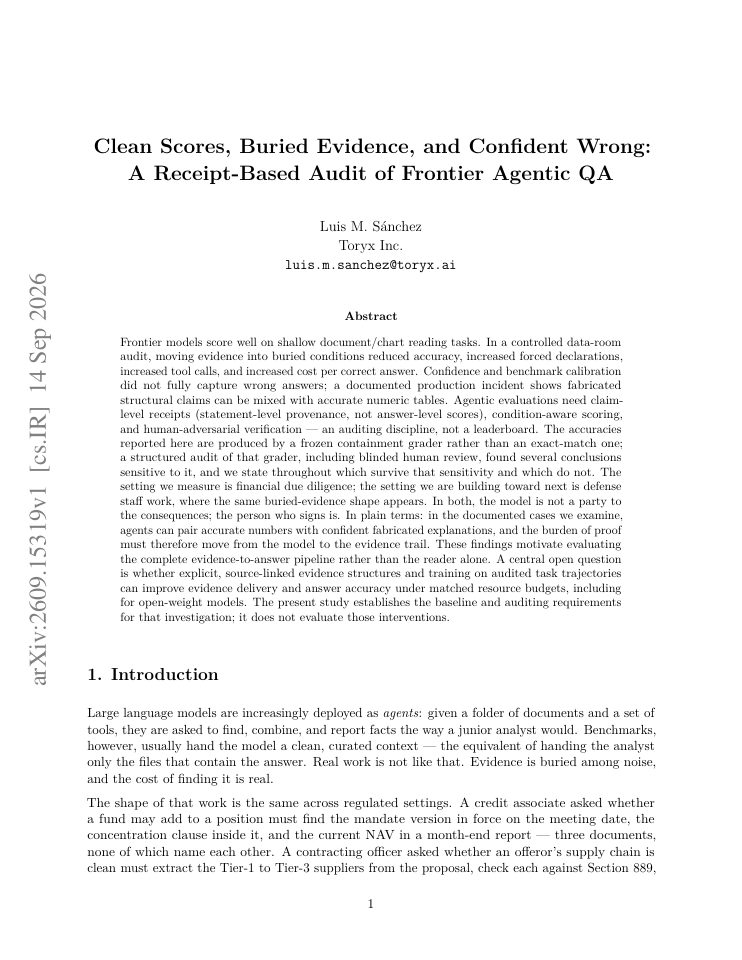
First page of Clean Scores, Buried Evidence, and Confident Wrong: A Receipt-Based Audit of Frontier Agentic QA
agent evaluationadopt

Clean Scores, Buried Evidence, and Confident Wrong: A Receipt-Based Audit of Frontier Agentic QA

The method replaces answer-level benchmark scoring with statement-level provenance receipts, condition-aware scoring, and human-adversarial verification when evaluating agentic QA systems. It costs additional evaluation engineering: extracting claims, attaching source evidence per claim, designing buried-evidence test conditions, and allocating human review time, all feasible on a single GPU or API budget. It can fail if receipts are generated by the same model being audited, if claim extraction misses fabricated structural assertions attached to accurate numbers, or if the human verification step becomes a rubber stamp under production pressure.

observed signal
0impl.
0stars
0citations
—claimed gain
abstract onlyReview decisionDownload skill ↓Original paper ↗
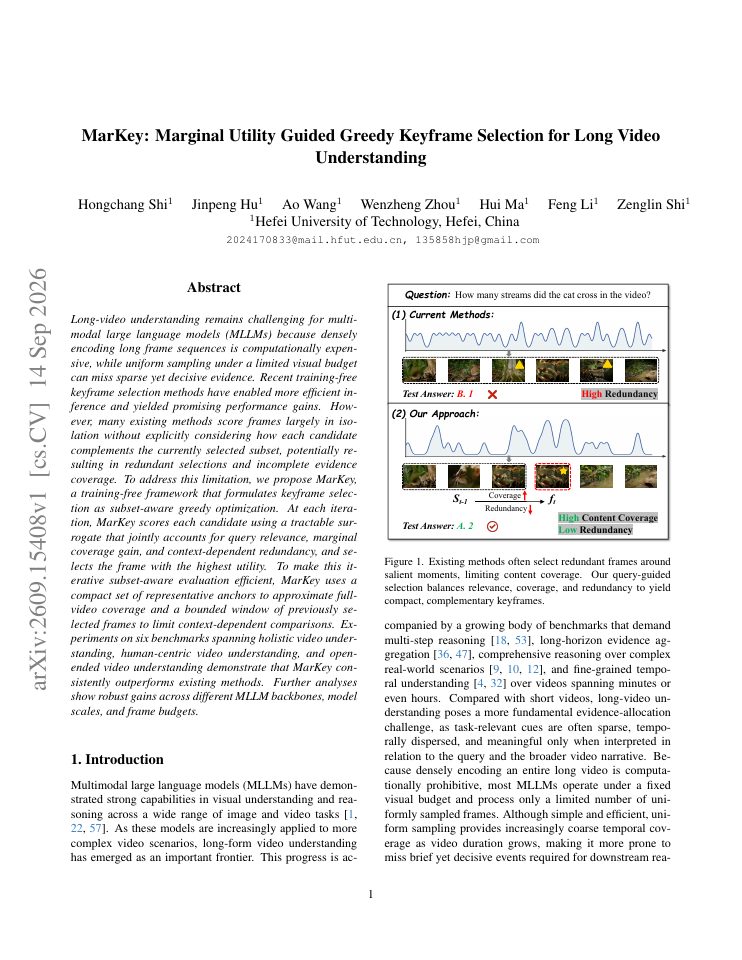
First page of MarKey: Marginal Utility Guided Greedy Keyframe Selection for Long Video Understanding
memory and contextadopt

MarKey: Marginal Utility Guided Greedy Keyframe Selection for Long Video Understanding

Replaces uniform frame sampling or per-frame relevance scoring that ignores subset redundancy, by greedily selecting frames via a utility combining query relevance, marginal coverage gain, and redundancy against already-selected frames. Costs are modest: it is training-free and adds an iterative scoring loop, mitigated by anchor-based coverage approximation and a bounded comparison window, though this still adds preprocessing latency over uniform sampling. Can fail when the tractable surrogate misestimates marginal utility, when anchor sets poorly represent video coverage, or on content where decisive evidence is not query-aligned, yielding missed frames despite the subset-aware objective.

observed signal
0impl.
0stars
0citations
—claimed gain
abstract onlyReview decisionDownload skill ↓Original paper ↗
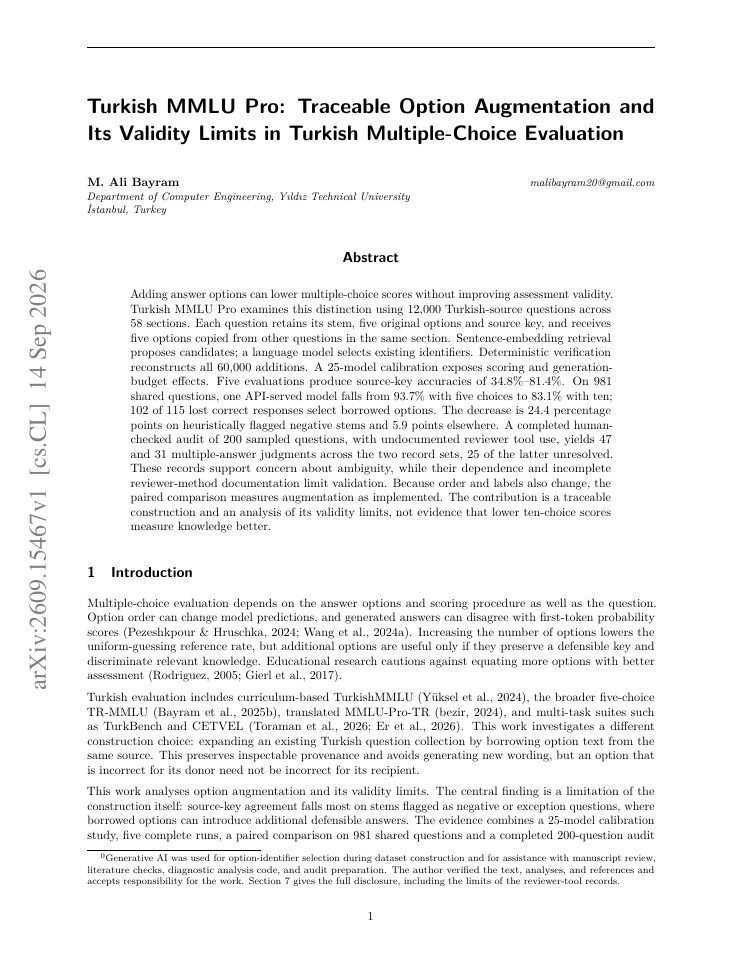
First page of Turkish MMLU Pro: Traceable Option Augmentation and Its Validity Limits in Turkish Multiple-Choice Evaluation
agent evaluationtest

Turkish MMLU Pro: Traceable Option Augmentation and Its Validity Limits in Turkish Multiple-Choice Evaluation

The method replaces standard five-option multiple-choice evaluation with a traceable ten-option construction: five borrowed options are retrieved via sentence embeddings, selected by a language model, and deterministically verified so all additions can be reconstructed. It costs embedding retrieval, an LLM selection pass, and verification infrastructure per question, and its paired comparison is confounded because option order and labels also change. After adoption, scores can drop for artifactual reasons (102 of 115 lost correct answers select borrowed options, with a 24.4-point drop on heuristically flagged negative stems), and ambiguity in borrowed options plus incomplete audit documentation can make lower scores uninterpretable as capability differences.

observed signal
0impl.
0stars
0citations
—claimed gain
abstract onlyReview decisionDownload skill ↓Original paper ↗
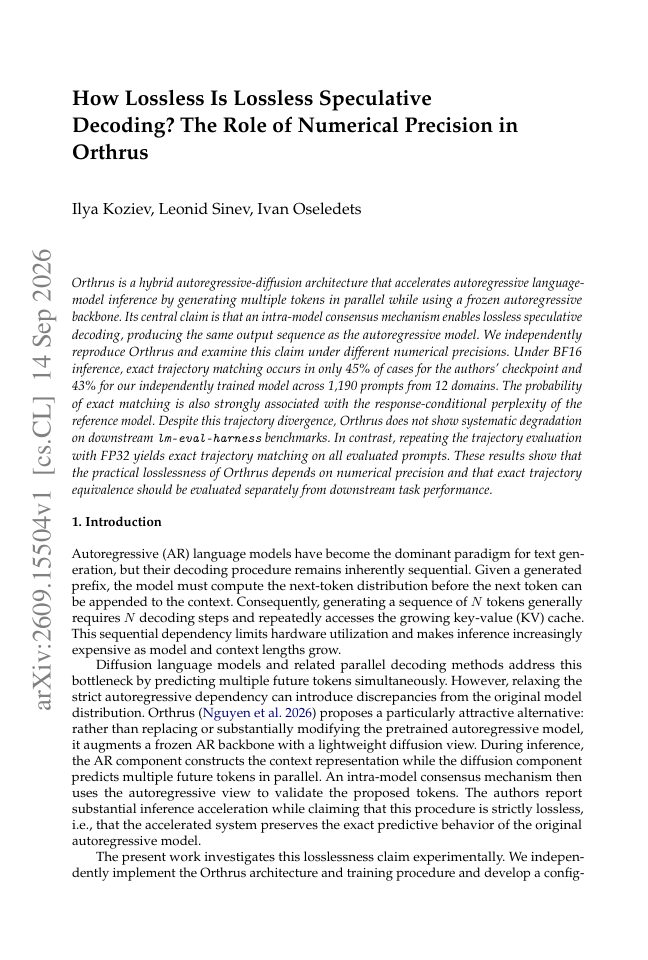
First page of How Lossless Is Lossless Speculative Decoding? The Role of Numerical Precision in Orthrus
speculative decodingtest

How Lossless Is Lossless Speculative Decoding? The Role of Numerical Precision in Orthrus

Orthrus-style intra-model speculative decoding replaces standard autoregressive token-by-token generation with parallel multi-token generation on a frozen backbone, aiming for identical outputs at higher speed. Adopting it costs implementation complexity and, critically, requires FP32 inference to guarantee losslessness, which reduces or eliminates the speed advantage; under BF16 exact trajectory matching occurred in only 43-45% of 1,190 prompts. After adoption, the output distribution can silently diverge from the reference model under reduced precision, and benchmark scores may look unaffected while per-prompt trajectories differ, which matters for reproducibility and deterministic applications.

observed signal
0impl.
0stars
—citations
—claimed gain
abstract onlyReview decisionDownload skill ↓Original paper ↗
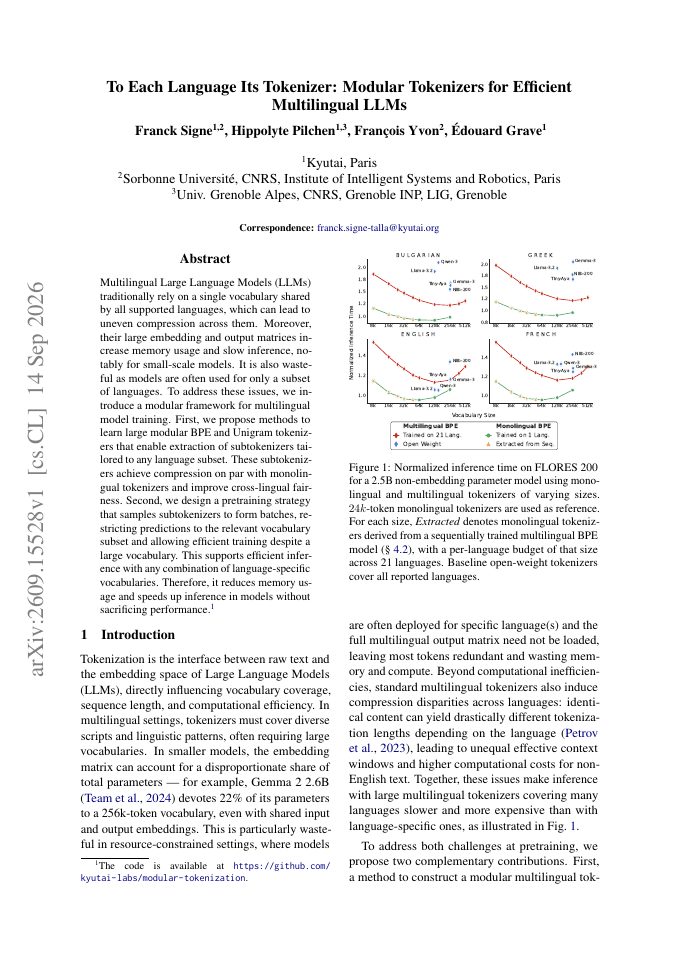
First page of To Each Language Its Tokenizer: Modular Tokenizers for Efficient Multilingual LLMs
efficient architectureswatch

To Each Language Its Tokenizer: Modular Tokenizers for Efficient Multilingual LLMs

The method replaces a single shared multilingual vocabulary and its large embedding/output matrices with a large modular tokenizer from which per-language subtokenizers are extracted, so that training and inference use only the vocabulary subset relevant to the deployed languages. The cost is a full pretraining run with a custom batch-sampling strategy over subtokenizers, plus tokenizer training and nonstandard serving logic; it cannot be retrofitted onto existing pretrained checkpoints. It can fail when deployments shift across language subsets not anticipated at training time, when tooling assumes a fixed vocabulary, and when small per-language vocabularies degrade cross-lingual transfer or code-switching robustness.

observed signal
0impl.
0stars
0citations
—claimed gain
abstract onlyReview decisionDownload skill ↓Original paper ↗
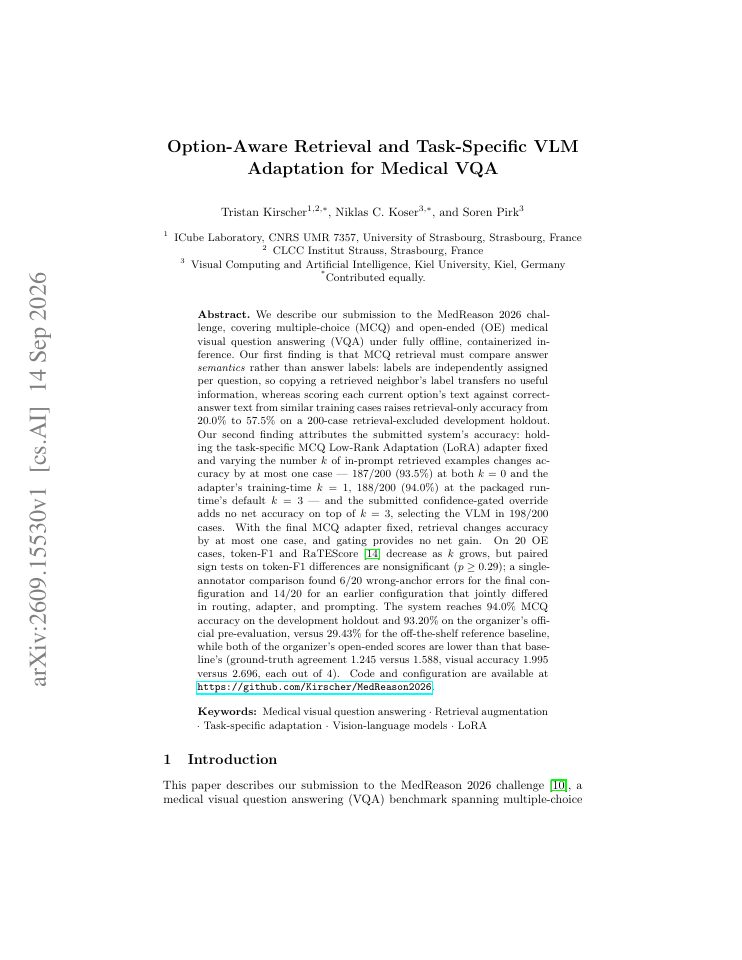
First page of Option-Aware Retrieval and Task-Specific VLM Adaptation for Medical VQA
efficient trainingadopt

Option-Aware Retrieval and Task-Specific VLM Adaptation for Medical VQA

Replaces prompting an off-the-shelf VLM (with or without retrieved in-context examples) with a small LoRA adapter trained on task-specific multiple-choice data; semantic option-text retrieval and confidence-gated override are shown to contribute at most one case of accuracy once the adapter is fixed. Cost is a single LoRA fine-tuning run feasible on one 24 GB GPU, plus offline inference with no serving changes; dropping retrieval simplifies the pipeline at negligible accuracy loss (93.5% at k=0 versus 94.0% at k=3). It can fail on open-ended generation: both organizer open-ended scores were below the off-the-shelf baseline (ground-truth agreement 1.245 vs 1.588, visual accuracy 1.995 vs 2.696 out of 4), indicating the adapter trades generative answer quality for classification-style accuracy.

observed signal
0impl.
0stars
0citations
3.17xclaimed gain
abstract onlyReview decisionDownload skill ↓Original paper ↗
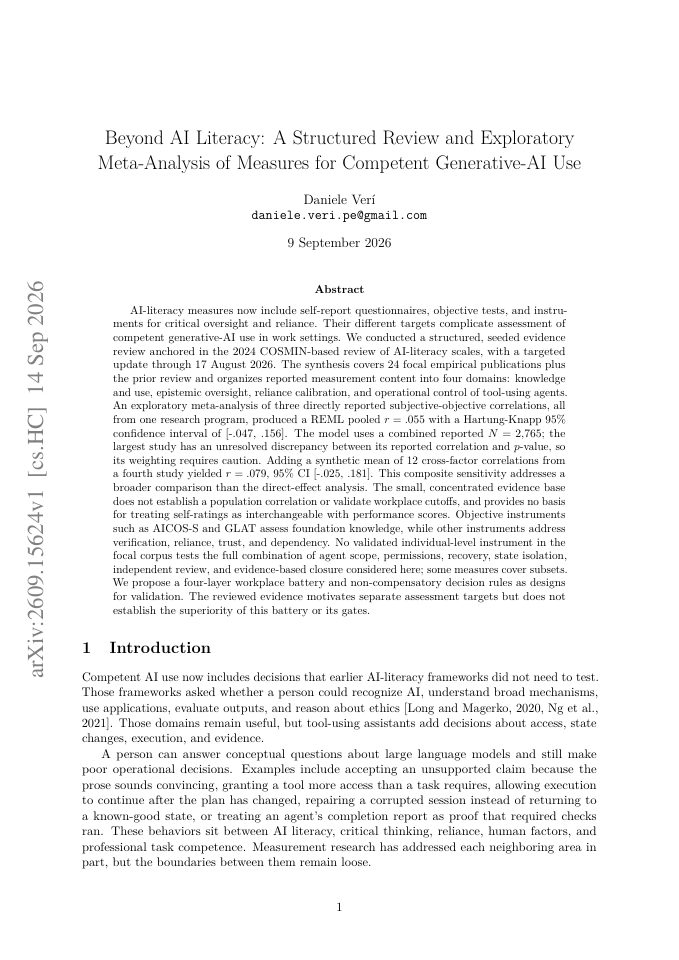
First page of Beyond AI Literacy: A Structured Review and Exploratory Meta-Analysis of Measures for Competent Generative-AI Use
otherwatch

Beyond AI Literacy: A Structured Review and Exploratory Meta-Analysis of Measures for Competent Generative-AI Use

This proposes a four-domain assessment battery (knowledge, epistemic oversight, reliance calibration, operational control of agents) to replace informal self-reported AI literacy when evaluating workers or applicants, but its thresholds and decision rules are untested. The cost is implementing and maintaining multi-domain objective tests rather than cheap self-ratings, and no validated instrument yet covers the full agent-oversight combination the authors describe. The key failure mode is documented in the paper itself: pooled self-report versus objective performance correlations are near zero (r = .055, CI includes negative values), so any adoption that falls back on self-assessment would yield invalid competence judgments.

observed signal
0impl.
0stars
0citations
—claimed gain
abstract onlyReview decisionDownload skill ↓Original paper ↗
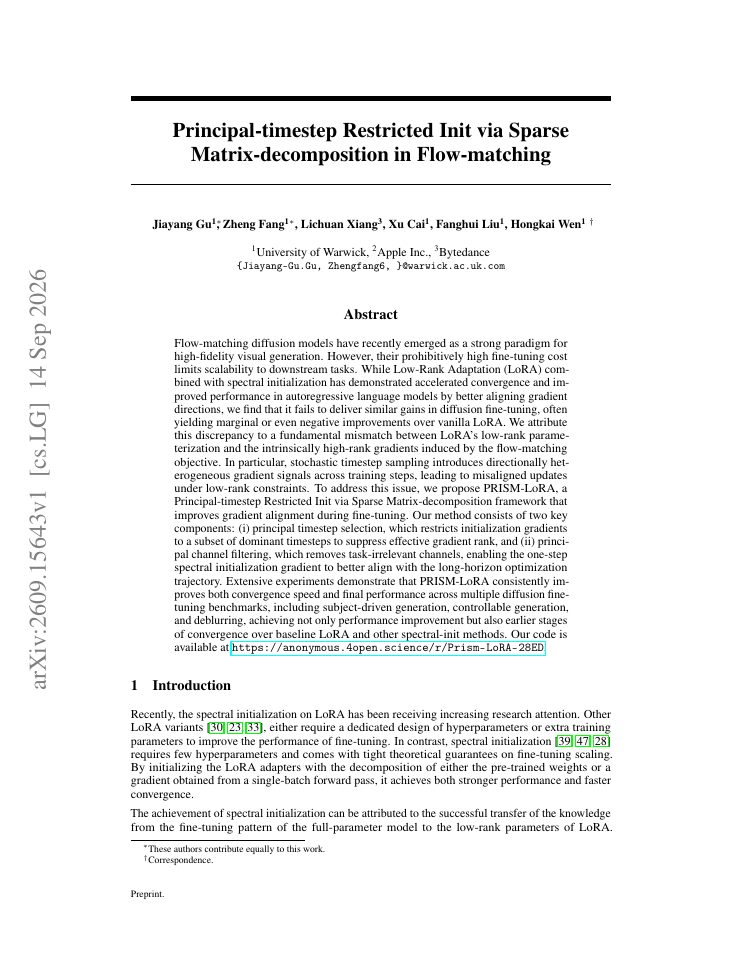
First page of Principal-timestep Restricted Init via Sparse Matrix-decomposition in Flow-matching
efficient trainingtest

Principal-timestep Restricted Init via Sparse Matrix-decomposition in Flow-matching

Prism-LoRA replaces standard LoRA initialization (and PiSSA-style spectral initialization) in flow-matching diffusion fine-tuning by restricting the initialization gradient to dominant timesteps and filtering task-irrelevant channels before performing the sparse matrix decomposition. The cost is additional preprocessing at initialization—selecting principal timesteps and channels plus a one-step spectral decomposition—which adds implementation complexity but negligible runtime memory or latency overhead relative to vanilla LoRA. It can fail if the principal-timestep selection does not transfer to the reader's specific downstream task, if the claimed gains do not reproduce outside the paper's benchmarks, or if the filtered channels discard information needed for the target adaptation.

observed signal
0impl.
106stars
0citations
—claimed gain
abstract onlyReview decisionDownload skill ↓Original paper ↗
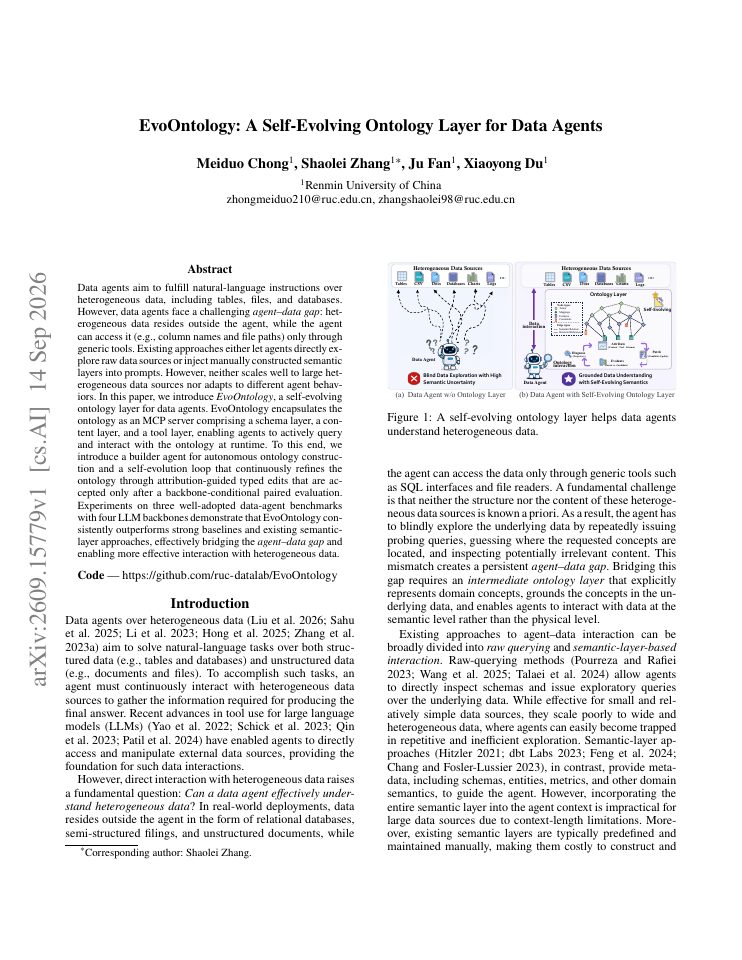
First page of EvoOntology: A Self-Evolving Ontology Layer for Data Agents
tool usetest

EvoOntology: A Self-Evolving Ontology Layer for Data Agents

EvoOntology replaces two prior strategies: letting agents directly explore raw heterogeneous data (schemas, files, databases) through generic tools, and injecting manually built semantic layers into prompts; it substitutes an automatically built, self-evolving ontology served as an MCP server with schema, content, and tool layers. The cost is an additional builder agent, an evolution loop with attribution-guided typed edits and backbone-conditional paired evaluation before edits are accepted, plus ongoing LLM calls for construction, evaluation, and ontology maintenance. It can fail when the builder induces incorrect ontology entries that misguide queries, when edit acceptance is too permissive or too strict for a given backbone, or when the ontology drifts from changing data sources and silently degrades agent answers.

observed signal
0impl.
207stars
0citations
—claimed gain
abstract onlyReview decisionDownload skill ↓Original paper ↗

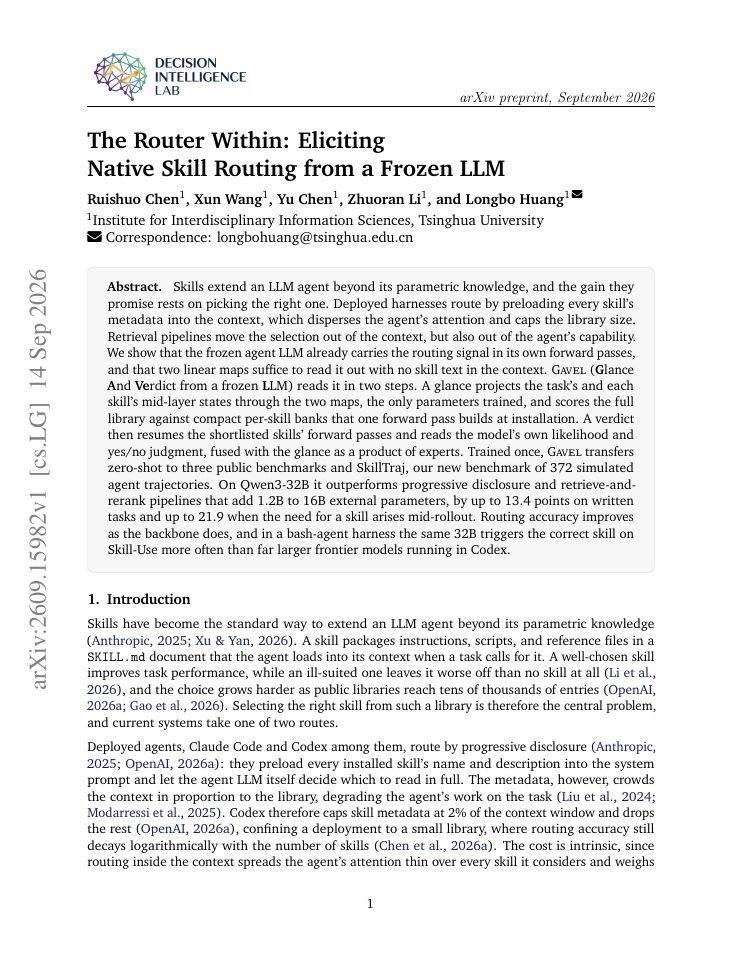
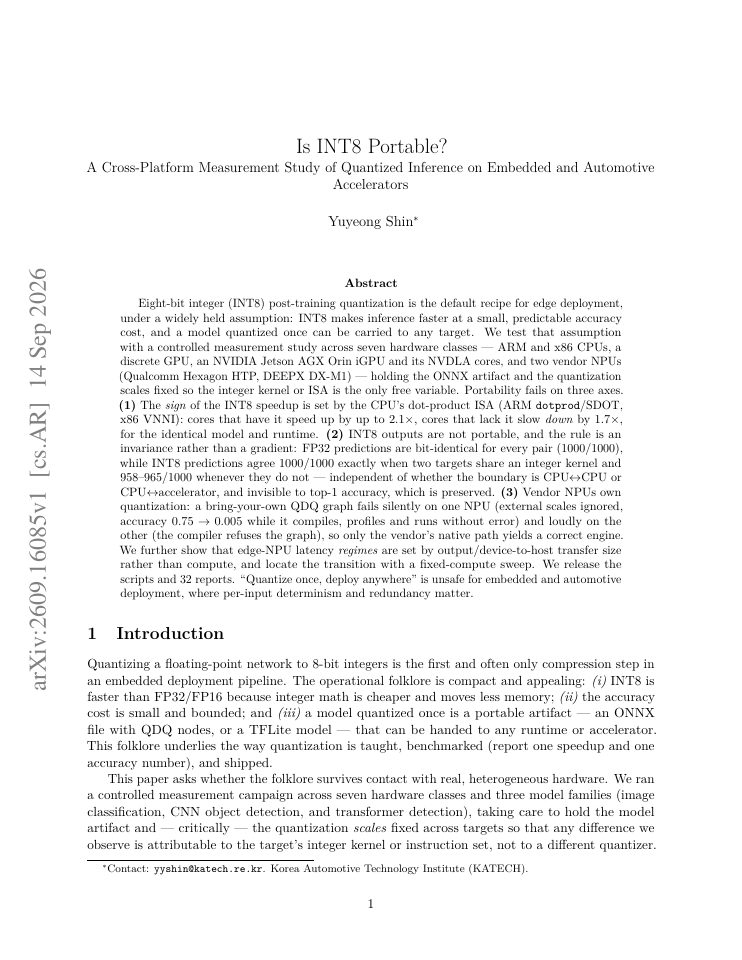
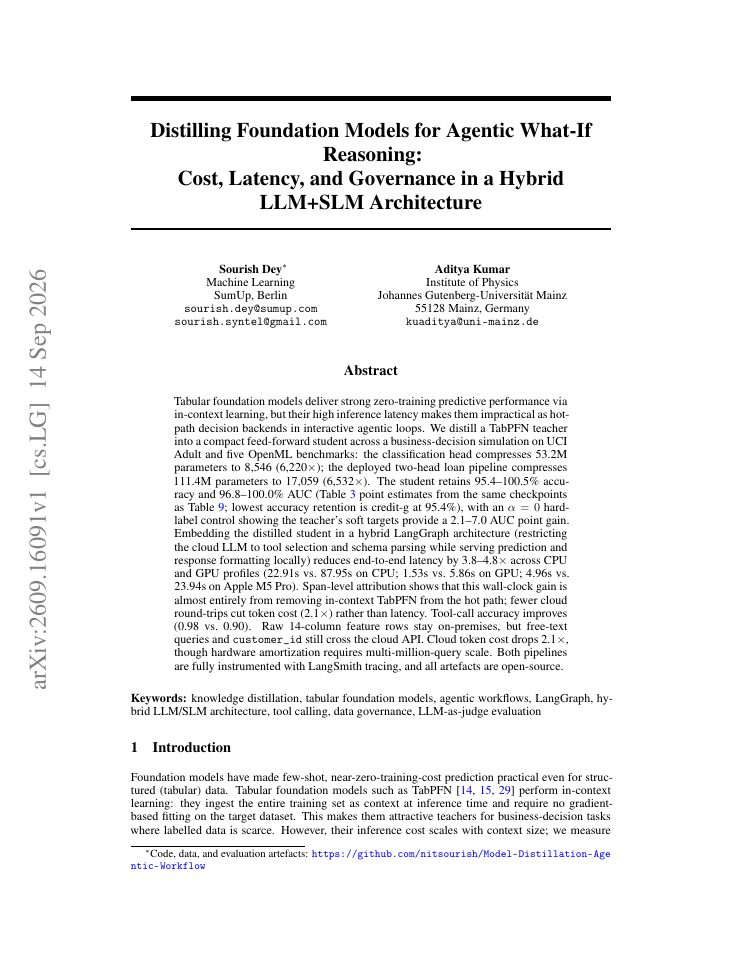
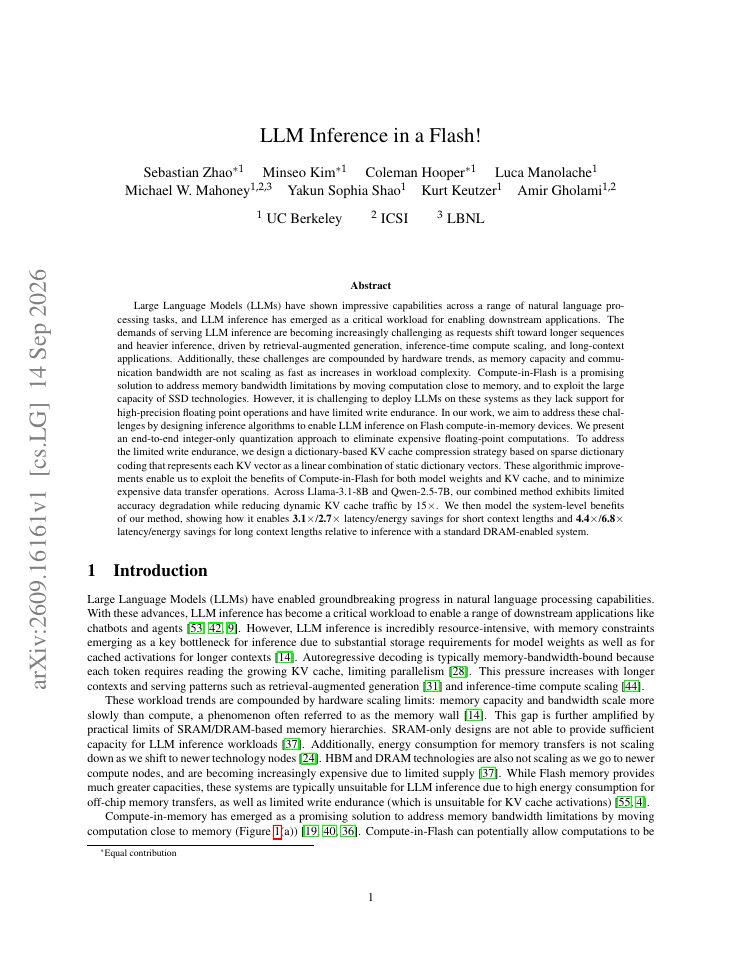
Research signals

Three views of the same evidence: adoption against attention, publication cadence by research area, and reported gains when coverage is sufficient.

color = research area

01 · attention × adoption

The research frontier

Look to the upper left for independent implementation before mass attention.

compare by
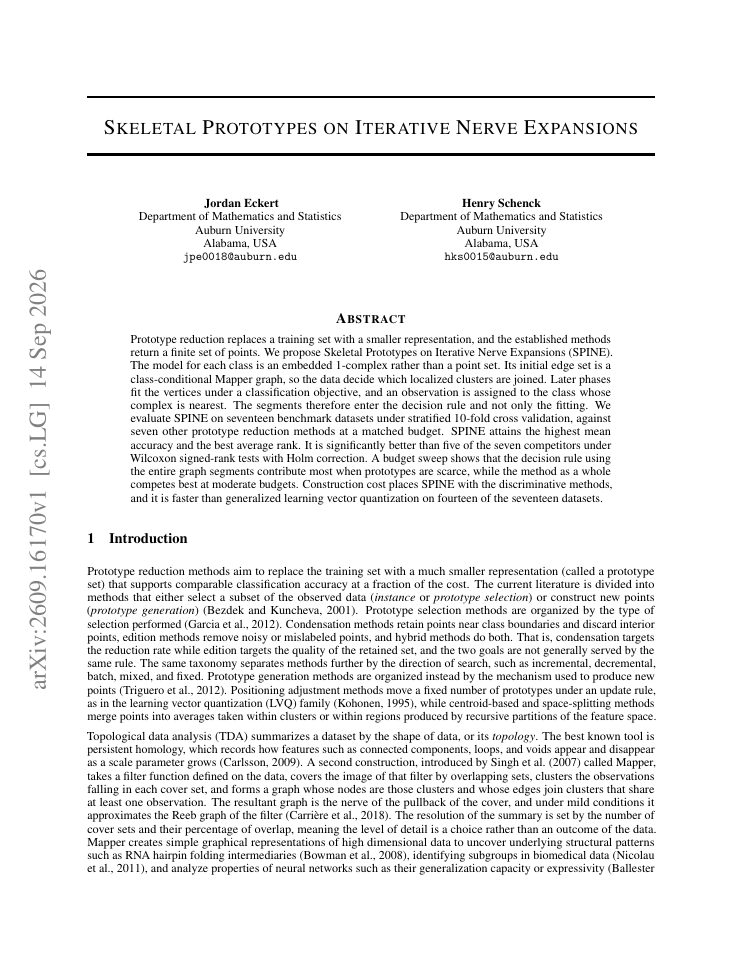
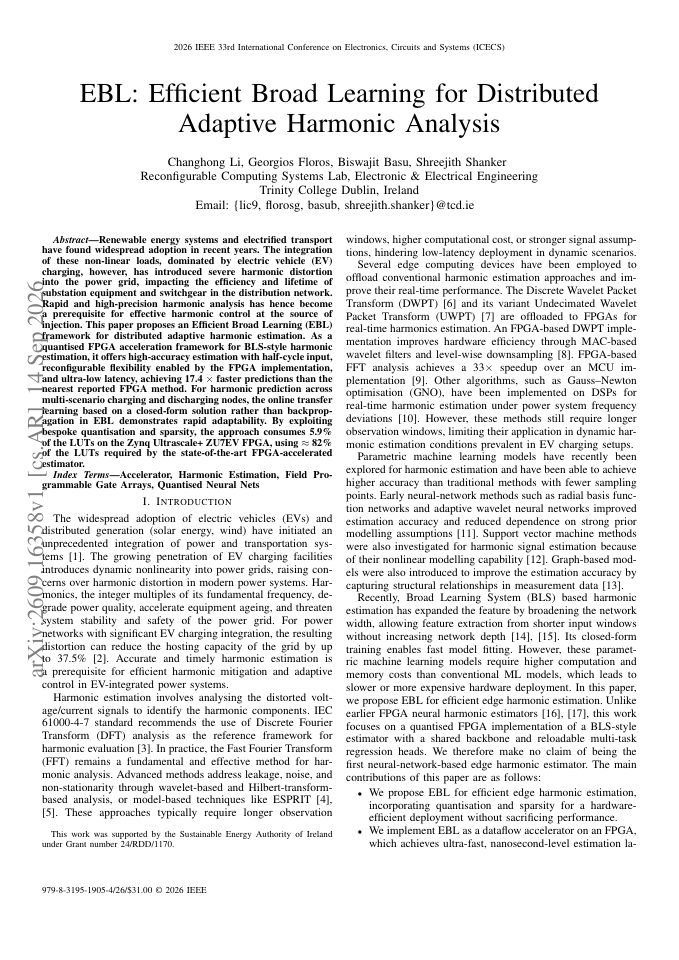
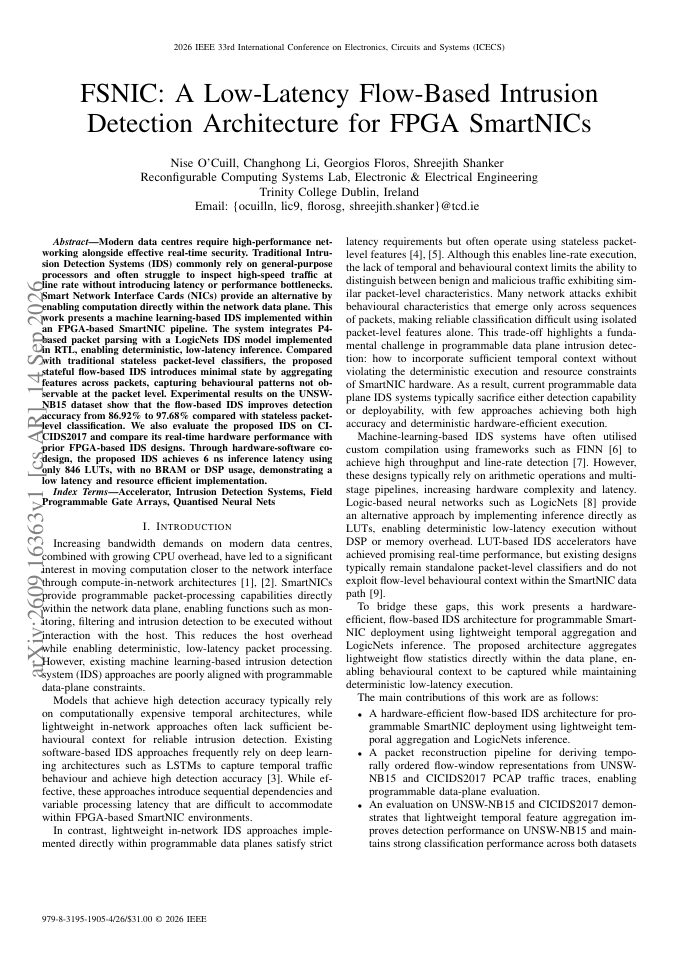
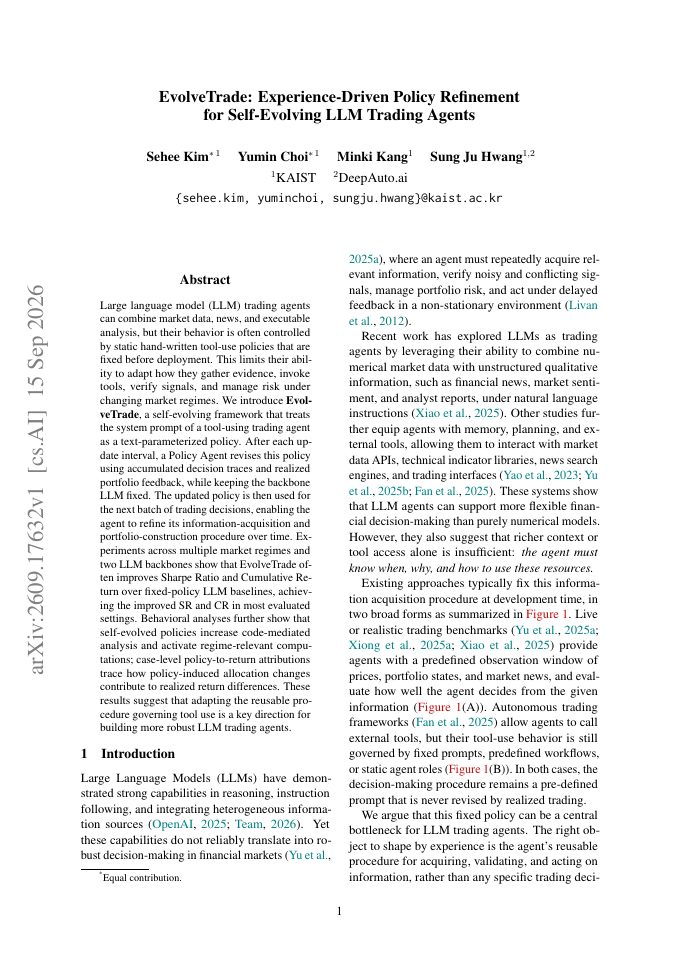
Each point represents one paper. Higher means more independent implementations; farther right means more GitHub stars.AsymSpec: Context-Asymmetric Speculative Decoding for Agentic LLMs: 1 GitHub star; 2 independent implementationsA Functional SVD Framework for Regularized Multivariate Functional PCA with Dual Penalization: 0 GitHub stars; 0 independent implementationsSelf-Orchestrating Language Models: Leveraging Semantic Dependence for Efficient Inference: 0 GitHub stars; 0 independent implementationsAgentKV: Phase-Aware KV Eviction for Agentic LLMs: 2 GitHub stars; 0 independent implementationsMoARa: Module-Aware Rank Allocation and Structure-Preserving Decomposition for Low-Rank LLM Pre-training: 0 GitHub stars; 0 independent implementationsBusMA: A Bus Communication Substrate for Multi-Agent Systems: 0 GitHub stars; 0 independent implementationsSalesforce Koa: An Enterprise Language Model for Agentic Tool Use: 0 GitHub stars; 0 independent implementationsTranslating the Translator: Decomposing the Cost of English-Forced Inter-Agent Communication: 0 GitHub stars; 0 independent implementationsOpenAI4S: Code as Action, Science as Sessions: 575 GitHub stars; 2 independent implementationsHazardAuditor: From Executable Threats to Safer Computer-Use Agents: 19 GitHub stars; 0 independent implementationsSparseTalk - Sparsifying 3D Gaussian Language Fields for Efficient 3D Visual Question Answering: 0 GitHub stars; 0 independent implementationsPACE: Progressive Angular-to-Norm Contrastive Embedding: 0 GitHub stars; 0 independent implementationsMUSE: A Theory-Harnessed Story Engine for Vibe Narrativizing: 120 GitHub stars; 1 independent implementationWhy LLM Agents Collapse Without Oversight: The Enforcement Gap as the Mechanism Behind Emergence World Failures: 0 GitHub stars; 0 independent implementationsReason What Matters: Retrieval-Grounded Reasoning for Universal Multimodal Embeddings: 0 GitHub stars; 0 independent implementationsWhen Agents Slow Down: Understanding LLM Agents' Test-Time Strategies via Elo-per-token Analysis: 0 GitHub stars; 2 independent implementationsClean Scores, Buried Evidence, and Confident Wrong: A Receipt-Based Audit of Frontier Agentic QA: 0 GitHub stars; 0 independent implementationsMarKey: Marginal Utility Guided Greedy Keyframe Selection for Long Video Understanding: 0 GitHub stars; 0 independent implementationsTurkish MMLU Pro: Traceable Option Augmentation and Its Validity Limits in Turkish Multiple-Choice Evaluation: 0 GitHub stars; 0 independent implementationsHow Lossless Is Lossless Speculative Decoding? The Role of Numerical Precision in Orthrus: 0 GitHub stars; 0 independent implementationsTo Each Language Its Tokenizer: Modular Tokenizers for Efficient Multilingual LLMs: 0 GitHub stars; 0 independent implementationsOption-Aware Retrieval and Task-Specific VLM Adaptation for Medical VQA: 0 GitHub stars; 0 independent implementationsWhere to Compute and How to Interact: Operator-Readable Adaptation with Gauge-Aware Transport: 1 GitHub star; 1 independent implementationBeyond AI Literacy: A Structured Review and Exploratory Meta-Analysis of Measures for Competent Generative-AI Use: 0 GitHub stars; 0 independent implementationsPrincipal-timestep Restricted Init via Sparse Matrix-decomposition in Flow-matching: 106 GitHub stars; 0 independent implementationsBench2Dex: Benchmarking Visuo-Tactile Bimanual Dexterous Manipulation Across Dexterous Hands: 46 GitHub stars; 3 independent implementationsEvoOntology: A Self-Evolving Ontology Layer for Data Agents: 207 GitHub stars; 0 independent implementationsLLM-Based Schema-Aware Split Learning for Privacy-Preserving Mental Distress Prediction Across Heterogeneous Surveys: 0 GitHub stars; 0 independent implementationsUsing Agentic AI for contextualized and multifaceted code review at Ericsson: 0 GitHub stars; 0 independent implementationsHypoEvolve: Genetic Algorithms Enable Multi-Agent LLMs to Discover Scientific Hypotheses: 1 GitHub star; 0 independent implementationsDiscovery Foundation Models: Toward Open-Ended Discovery Intelligence: 17 GitHub stars; 1 independent implementationThe Router Within: Eliciting Native Skill Routing from a Frozen LLM: 0 GitHub stars; 0 independent implementationsIs INT8 Portable? A Cross-Platform Measurement Study of Quantized Inference on Embedded and Automotive Accelerators: 0 GitHub stars; 0 independent implementationsDistilling Foundation Models for Agentic What-If Reasoning:Cost, Latency, and Governance in a Hybrid LLM+SLM Architecture: 0 GitHub stars; 0 independent implementationsLLM Inference in a Flash!: 0 GitHub stars; 0 independent implementationsSkeletal Prototypes on Iterative Nerve Expansions: 0 GitHub stars; 0 independent implementationsEBL: Efficient Broad Learning for Distributed Adaptive Harmonic Analysis: 0 GitHub stars; 0 independent implementationsFSNIC: A Low-Latency Flow-Based Intrusion Detection Architecture for FPGA SmartNICs: 0 GitHub stars; 0 independent implementationsLACE: Layer-Wise Compression for Dynamic Frame Rate Codecs: 672 GitHub stars; 2 independent implementationsEvolveTrade: Experience-Driven Policy Refinement for Self-Evolving LLM Trading Agents: 0 GitHub stars; 0 independent implementationsGraphEcho: Structural Redundancy and Evidence Provenance in LLM Graph Agents: 0 GitHub stars; 0 independent implementationsAgentPProf: Semantic Profiler for Long Horizon AI Agents: 130 GitHub stars; 1 independent implementation

Papers above 1000 stars or 200 citations are not scored. They have already broken through the attention threshold, while Paperraft is designed to identify earlier signals.

02 · cadence

Research areas over time

Compare monthly publication volume on a shared scale and calendar.

coding agentsmax 7Aug 26: 0 papersSep 26: 2 papersAug 26Sep 26efficient architecturesmax 7Aug 26: 0 papersSep 26: 2 papersAug 26Sep 26agent evaluationmax 7Aug 26: 0 papersSep 26: 5 papersAug 26Sep 26KV cachemax 7Aug 26: 0 papersSep 26: 2 papersAug 26Sep 26speculative decodingmax 7Aug 26: 1 paperSep 26: 2 papersAug 26Sep 26distillationmax 7Aug 26: 0 papersSep 26: 1 paperAug 26Sep 26sparsity and pruningmax 7Aug 26: 0 papersSep 26: 1 paperAug 26Sep 26memory and contextmax 7Aug 26: 0 papersSep 26: 1 paperAug 26Sep 26multi-agent orchestrationmax 7Aug 26: 0 papersSep 26: 5 papersAug 26Sep 26othermax 7Aug 26: 0 papersSep 26: 7 papersAug 26Sep 26quantizationmax 7Aug 26: 0 papersSep 26: 1 paperAug 26Sep 26retrieval and RAGmax 7Aug 26: 0 papersSep 26: 1 paperAug 26Sep 26safety and guardrailsmax 7Aug 26: 0 papersSep 26: 2 papersAug 26Sep 26efficient trainingmax 7Aug 26: 0 papersSep 26: 5 papersAug 26Sep 26tool usemax 7Aug 26: 0 papersSep 26: 4 papersAug 26Sep 26

Every panel uses the same calendar and vertical scale. An empty column means no papers were recorded.

Method under scrutiny

Inspect the highest-ranked paper, every repository behind its signal, and the rule used to classify each one.

When Agents Slow Down: Understanding LLM Agents' Test-Time Strategies via Elo-per-token Analysis

agent evaluation · test · 2 of 2 implementations are independent

The method replaces uninstrumented agent budget allocation and single-score leaderboards with a per-token best-solution curve aggregated across tasks via a Bradley-Terry Elo model, using independent sampling as a reference to locate the point where marginal gains diminish. It costs additional evaluation infrastructure: tasks must expose continuous intermediate scores, trajectories must be logged per token, and Elo estimation plus reference sampling add compute and engineering effort on top of the agent runs themselves. It can fail when benchmarks lack intermediate scoring, when the independent-sampling reference is unrepresentative of the task, or when the empirically estimated inflection point does not transfer across models, tasks, or budget regimes.
Exclusions and controls

Every exclusion is counted and published.

Exclusion counts were not recorded for this edition.

0 previously indexed papers were rechecked in this run.

Paperraft tracks one signal: how many independent implementations a paper attracts on GitHub after author-owned repositories are removed. This is a discovery signal to investigate, not a measure of implementation quality.

It does not claim that a method works. Paperraft runs no reproduction benchmarks. Reported gains remain author claims until independently tested. Papers above the attention threshold are excluded because this publication is designed to identify research before consensus forms.